Introductory material
Reading edition
OFFICERS AND COMMITTEES, 1912.
President,
John B. White, Kansas City, Mo.
Executive Secretary,
Thomas R. Shipp, Washington, D. C.
Treasurer,
D. Austin Latchaw, Kansas City, Mo.
Recording Secretary,
James C. Gipe, Indianapolis, Ind.
Executive Committee.
E. Lee Worsham, Atlanta, Ga., Chairman.
J. Lewis Thompson, Houston, Texas. Dr. H. E. Barnard, Indianapolis, Ind.
W. A. Fleming Jones, Las Cruces, N.M. Mrs. Philip N. Moore, St. Louis, Mo.
Walter H. Page, New York. Bernard N. Baker, Baltimore, Md.
George C. Pardee, Oakland, Cal. Henry C. Wallace, Des Moines, Iowa.
Gifford Pinchot, Washington, D. C.
Local Board of Managers, Indianapolis.
Richard Lieber, Chairman.
Joseph C. Schaf, Vice-Chairman. James W. Lilly, Treasurer.
L. H. Lewis, Secretary.
Frederic M. Ayres. O. D. Haskett.
George L. Denny. Albert E. Metzger.
Edgar H. Evans. William J. Mooney.
Carl G. Fisher. W. H. O’Brien.
C. G. Hanch.
Vice-Presidents.
Arkansas—E. N. Plank, Decatur. Nebraska—Prof. E. A. Burnett, Lincoln.
California—Francis Cuttle, Riverside.
Colorado—I. S. T. Gregg, Golden. New Jersey—E. A. Stevens, Hoboken.
Connecticut—Prof. J. W. Toumey, Hartford. New York—Dr. W. T. Hornaday, New York City.
District of Columbia—Dr. Harvey W. Wiley, Washington. Ohio—J. C. Rodgers, Mechanicsburg.
Florida—T. J. Campbell, Palm Beach. Oklahoma—T. C. Harrice, Wagoner.
Georgia—L. R. Akin. South Carolina—Prof. M. W. Twitchell, Columbia.
Illinois—Ballard Dunn, Chicago. South Dakota—Gov. R. S. Vessey, Pierre.
Iowa—Prof. P. G. Holden, Ames. Texas—W. Goodrich Jones, Temple.
Louisiana—Henry E. Hardtner, Urania. Washington—A. L. Flewelling, Spokane.
Massachusetts—Prof. F. W. Rane, Boston. Wisconsin—Herbert Quick, Madison.
Missouri—Herman Von Schrenk, St. Louis.
STANDING COMMITTEES, 1912.
STANDING COMMITTEES, 1912.
Forests—H. S. Graves, Washington, D. C., Chairman; E. T. Allen, Portland, Ore.; Major E. G. Griggs, Tacoma, Wash.; William Irvine, Chippewa Falls, Wis.; George K. Smith, St. Louis.
Minerals—Dr. Joseph A. Holmes, Washington, D. C., Chairman; Dr. Charles R. Van Hise, Madison, Wis.; Dr. I. C. White, Morgantown, W. Va.; C. W. Brunton, Denver, Col.; John Mitchell, New York City.
Lands and Agriculture—Prof. L. H. Bailey, Cornell University, Chairman; Prof. George E. Condra, Nebraska; Prof. J. L. Snyder, Lansing, Mich.; F. D. Coburn, Kansas; Charles S. Barrett, Union City, Ga.
Education—Dr. C. E. Bessey, Lincoln, Neb., Chairman; Dr. David Starr Jordan, Leland Stanford University, Oakland, Cal.; Dr. Edward E. Alderman, University of Virginia, Charlottesville; Dr. E. C. Craighead, Tulane University, New Orleans, La.; Prof. E. T. Fairchild, Topeka, Kas.
Vital Resources—Dr. William H. Welch, Johns Hopkins University, Baltimore, Md., Chairman; Prof. Irving Fisher, Yale University, New Haven, Conn.; Dr. J. N. Hurty, Indianapolis, Ind.; Hon. A. B. Farquhar, York, Pa.; Dr. Oscar Dowling, Shreveport, La.
Homes—Mrs. Matthew T. Scott, Washington, Chairman; Mrs. Harriet Wallace-Ashby, Des Moines, Iowa; Mrs. J. E. Rhodes, St. Paul, Minn.; Mrs. Sarah S. Platt-Decker,[1] Denver, Col.; Mrs. Amos F. Draper, Washington, D. C.
Child Life—Hon. Ben B. Lindsay, Denver, Col., Chairman; Dr. Samuel M. Lindsay, New York City; Judge Henry L. McCune, Kansas City, Mo.; Mrs. Carl Vrooman, Bloomington, Ill.; Dr. Anna Louise Strong, Seattle, Wash.
Food—Dr. Harvey W. Wiley, Washington, D. C., Chairman; F. G. Urner, New York; Prof. F. Spencer Baldwin, Boston, Mass.; J. F. Nickerson, Chicago, Ill.; Lucius P. Brown, Nashville, Tenn.; E. H. Jenkins, New Haven, Conn.; M. A. Scovelle, Lexington, Ky.; Prof. Geo. A. Loveland, Lincoln, Neb.
Civics—Ralph Easley, New York, Chairman; Albert Hall Whitfield, Jackson, Miss.; B. A. Fowler, Phœnix, Ariz.; H. M. Beardsley, Kansas City, Mo.; Francis J. Heney, San Francisco, Cal.
General (including Domesticated Animals and Wild Life)—Dr. W. T. Hornaday, New York, Chairman; Dr. L. O. Howard, Washington, D. C.; Mrs. Minnie Maddern Fiske, New York City; Dr. John Muir, Martinez, Cal.; D. Austin Latchaw, Kansas City, Mo.; Prof. Geo. A. Loveland, Lincoln, Neb.
Waters—Hon. J. N. Teal, Portland, Ore., Chairman; Hon. Joseph E. Ransdell, Lake Providence, La.; Walter S. Dickey, Kansas City, Mo.; Hon. Herbert Knox Smith, Washington, D. C.; W. K. Kavanaugh, St. Louis, Mo.; Dr. W. J. McGee, Washington, D. C.; Prof. Geo. F. Swain, Harvard University.
National Parks (including Mammoth Cave, Ky., and Adjacent Lands)—Dr. W. J. McGee,[1] Washington, D. C.; Dr. Henry F. Drinker, South Bethlehem, Pa.; Hon. William P. Borland, Kansas City, Mo.; Hon. Gifford Pinchot, Washington, D. C.; M. H. Crump, Bowling Green, Ky.
FOOTNOTES:
OFFICERS AND COMMITTEES, 1913.
President,
Charles Lathrop Pack, Lakewood, N. J.
Vice-President,
Mrs. Philip N. Moore, St. Louis, Mo.
Executive Secretary,
Thomas B. Shipp, Indianapolis, Ind.
Treasurer,
D. A. Latchaw, Kansas City, Mo.
Recording Secretary,
James C. Gipe, Indianapolis, Ind.
Executive Committee,
E. Lee Worsham, Atlanta, Ga., Chairman.
Walter H. Page, New York City. Joseph N. Teal, Portland, Oregon.
J. B. White, Kansas City, Missouri. Dr. Henry Wallace, Des Moines, Iowa.
B. N. Baker, Baltimore, Maryland. Dr. George C. Pardee, Oakland, Cal.
Dr. Henry S. Drinker, S. Bethlehem, Pa. Thomas Nelson Page, Washington, D. C.
George E. Condra, Lincoln, Neb. Gifford Pinchot, Washington, D. C.
Mrs. Emmons Crocker, Fitchburg, Mass.
[2]Standing Committees.
Forestry—Henry S. Graves, Chairman, Forest Service, Washington, D. C.; E. T. Allen, Yeon Portland, Ore.; J. B. White, Long Building, Kansas City, Mo.; W. R. Brown, Berlin, New Hampshire; E. A. Sterling, Secretary, Real Estate Building, Philadelphia, Pa.
FOOTNOTES:
CONSTITUTION
OF THE
NATIONAL CONSERVATION CONGRESS
As Amended by the Fourth Congress.
Article 1—Name.
This organization shall be known as the National Conservation Congress.
Article 2—Object.
The object of the National Conservation Congress shall be: (1) to provide a forum for discussion of the resources of the United States as the foundation for the prosperity of the people, (2) to furnish definite information concerning the resources and their utilization, and (3) to afford an agency through which the people of the country may frame policies and principles affecting the wise and practical development, conservation and utilization of the resources to be put into effect by their representatives in State and Federal Governments.
Article 3—Meetings.
Section 1. Regular annual meetings shall be held at such time and place as may be determined by the Executive Committee.
Section 2. Special meetings of the Congress, or its officers, committees or boards, may be held subject to the call of the President of the Congress or the Chairman of the Executive Committee.
Section 3. After a call of the Executive Committee by the Chairman, and after all members of the Committee have been notified of the meeting in sufficient time to be present, three members shall constitute a quorum for the transaction of business.
Article 4—Officers.
Section 1. The officers of the Congress shall consist of a President, to be elected by the Congress; a Vice-President to be elected by the Congress; a Vice-President from each State, to be chosen by the respective State delegations; one from the National Conservation Association and one from the National Association of Conservation Commissioners; an Executive Secretary, a Recording Secretary, and a Treasurer, all to be elected by the Congress.
Section 2. The duties of these officers may at any time be prescribed by formal action of the Congress or Executive Committee. In the absence of such action their duties shall be those implied by their designations and established by custom. In addition, it shall be the duty of the Vice-Presidents to receive from the State Conservation Commissions, and other organizations concerned in Conservation, suggestions and recommendations and report them to the Executive Committee of the Congress.
Section 3. The officers shall serve for one year, or until their successors are elected and qualify.
Article 5—Committees and Boards.
Section 1. An Executive Committee of seven, in addition to which the President of the National Conservation Association, the President of the National Association of State Conservation Commissioners, and all ex-Presidents of the Congress shall be members, ex officio, shall be appointed by the President to act for the ensuing year; its membership shall be drawn from different States, and not more than one of the appointed members shall be from any one State. The Executive Committee shall act for the Congress and shall be empowered to initiate action and meet emergencies. It shall report to each regular annual session.
Section 2. A Board of Managers shall be created in each city in which the next ensuing session of the Congress is to be held, preferably by leading organizations of citizens. The Board of Managers shall have power to raise and expend funds, to incur obligations of its own responsibility, to appoint subordinate boards and committees, all with the approval of the Executive Committee of the Congress. It shall report to the Executive Committee at least two days before the opening of the ensuing session, and at such other times as the Congress or the Executive Committee may direct.
Section 3. An Advisory Board, consisting of one person from each national organization having a conservation committee, shall be created to serve during that Congress and during the interval before the next succeeding Congress. The board shall report to and co-operate with the Executive Committee.
Section 4. The President shall appoint a Finance Committee of five, three from the members of the Executive Committee and two from the Advisory Board, whose duty it shall be to plan ways and means of increasing the revenue of the Congress, and to prepare a budget of expenditures. The Chairman shall be a member of the Executive Committee.
Section 5. The Executive Committee shall appoint, in consultation with the Vice-President from the State, a State Secretary whose duty shall be to work with the State organizations for the special interests of the Congress. Such Secretary shall report progress to the Executive Committee.
Section 6. A Committee on Credentials shall be appointed, consisting of five (5) members, by the President of the Congress not later than on the second day of each session of the Congress. It shall determine all questions raised by delegates as to representation, and shall report to the Congress from time to time as required by the President of the Congress.
Section 7. A Committee on Resolutions shall be created for each annual meeting of the Congress. A Chairman shall be appointed by the President. One member of the committee shall be selected by each State represented in the Congress. The committee shall report to the Congress not later than the morning of the last day of each annual meeting.
Section 8. Permanent committees, consisting of five members each, on each of the following five divisions of Conservation: Forests, waters, lands, minerals and vital resources, shall be appointed by the President of the Congress. The Committee on Vital Resources is to consist of six subordinate committees as follows: Food, homes, child life, education, civics, and general (including wild life, domesticated animals, and cultivated plants). These committees shall, during the intervals between the annual meetings of the Congress, inquire into these respective subjects and prepare reports to be submitted on the request of the Executive Committee, and render such other assistance to the Congress as the Executive Committee may direct.
Section 9. By direction of the Congress, standing and special committees may be appointed by the President.
Section 10. The President shall be a member, ex officio, of every committee of the Congress.
Article 6—Arrangements for Sessions.
Section 1. The program for the session of each annual meeting of the Congress, including a list of speakers, shall be arranged by the Executive Committee. The entire program, including allotments of time to speakers and hours for daily sessions and all other arrangements concerning the program, shall be made by the Executive Committee.
Section 2. Unless otherwise ordered, the rules adopted for the guidance of the preceding Congress shall continue in force.
Article 7—Membership.
Section 1. The personnel of the National Conservation Congress shall be as follows:
Officers and Delegates.
Officers of the National Conservation Congress.
Fifteen delegates appointed by the Governor of each State and Territory.
Five delegates appointed by the mayor of each city with a population of 25,000 or more.
Two delegates appointed by the mayor of each city with a population of less than 25,000.
Two delegates appointed by each board of county commissioners.
Five delegates appointed by each national organization concerned in the work of Conservation.
Five delegates appointed by each State or interstate organization concerned in the work of Conservation.
Three delegates appointed by each chamber of commerce, board of trade, commercial club, or other local organization concerned in the work of Conservation.
Two delegates appointed by each State, or other university, or college, and by each agricultural college, or experiment station.
Honorary Members.
The President of the United States.
The Vice-President of the United States.
The Speaker of the House of Representatives.
The Cabinet.
The United States Senate and House of Representatives.
The Supreme Court of the United States.
The representatives of foreign countries.
The Governors of the States and Territories.
The Lieutenant-Governors of the States and Territories.
The Speakers of State Houses of Representatives.
The State officers.
The mayors of cities.
The county commissioners.
The presidents of State and other universities and colleges.
The officers and members of the National Conservation Association.
The officers and members of the National Conservation Commission.
The officers and members of the State Conservation Commissions and associations.
Section 2. Membership in the National Conservation Congress shall be as follows:
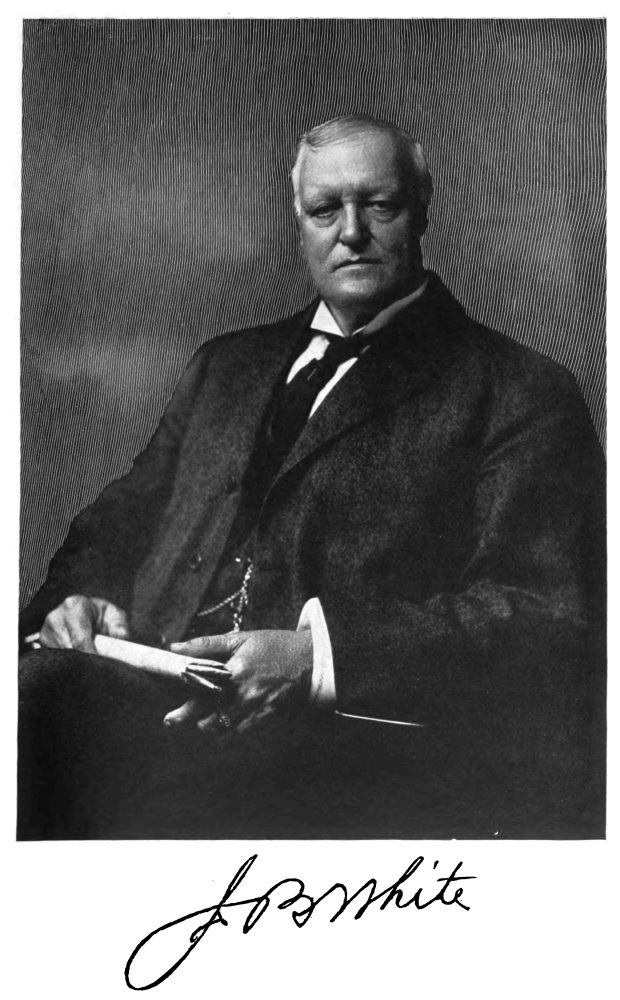
J. B. White (signature)
OF KANSAS CITY, MO.,
PRESIDENT, FOURTH NATIONAL CONSERVATION CONGRESS
Individual membership: One dollar a year, entitling the member to a copy of the Proceedings and an invitation to the next year’s Congress, without further appointment from any organization.
Individual permanent, or life membership: Twenty-five dollars, entitling the member to a certificate of membership and a copy of the Proceedings and invitations to all succeeding annual Congresses.
Individual supporting membership: One hundred dollars, or more, entitling the member to a certificate of membership, a copy of the Proceedings, and an invitation to all succeeding Congresses.
Organization membership: Twenty-five dollars, entitling its delegates to the Proceedings, and an invitation to the organization to appoint delegates to the next Congress.
Organization supporting membership: One hundred dollars, or more, entitling the organization to appoint one delegate from each State, each of whom shall receive a copy of the Proceedings.
Article 8—Delegations and State Officers.
Section 1. The several delegates from each State in attendance at any Congress shall assemble at the earliest practicable time and organize by choosing a Chairman and a Secretary. These delegates, when approved by the Committee on Credentials, shall constitute the delegation from that State.
Article 9—Voting.
Section 1. Each member of the Congress shall be entitled to one vote on all actions taken viva voce.
Section 2. A division or call of States may be demanded on any action, by a State delegation. On division, each delegate shall be entitled to one vote; provided (1) that no State shall have more than twenty votes; and provided (2) that when a State is represented by less than ten delegates, said delegates may cast ten votes for each State.
Section 3. The term “State” as used herein is to be construed to mean either State, Territory, or insular possession.
Article 10—Amendments.
This Constitution may be amended by a two-thirds vote of the Congress during any regular session, provided notice of the proposed amendment has been given from the Chair not less than one day or more than two days preceding; or by unanimous vote without such notice.
RESOLUTIONS.
FOURTH NATIONAL CONSERVATION CONGRESS.
The Fourth National Conservation Congress, made up of delegates from all sections and from thirty-five States of the Union, met in the City of Indianapolis, do hereby make the following declarations:
Recognizing the natural resources of the country as the prime basis of property and opportunity, we reaffirm the declaration of the preceding Congress, that the rights of the people in these resources are natural, inherent, and inalienable; and we insist that these resources shall be developed, used and conserved in ways consistent both with the current and future welfare of our people.
We put chief emphasis on vital resources and the health of the people; and since health and brains are the first and most important factors of efficient life, we urge the adoption of all rational and scientific methods which will lead to their building-up.
To be well born is the primal requirement, and the first step to make sure that children shall be well born is to stop the multiplication of those bearing hereditary defects of body and mind. We believe that science is capable of solving the problem satisfactorily and that improvement is possible under existing conditions. We earnestly urge its consideration by the public.
We believe that every State should have wisely ordered health laws, with officers empowered to enforce them, and also that a National Department of Health should be created, comporting with the dignity and importance of the cause. This department should work effectively for the promotion of the physical and hence the moral and intellectual health of the people.
The accurate registration of births and deaths, which has been called the ‘Bookkeeping of Humanity,’ is a fundamental necessity for a study and knowledge of disease, and for all public health work. Therefore, we affirm our belief in the importance of vital statistics registration, and recommend that all States now without proper vital statistics adopt as early as possible the model bill for the registration of vital statistics indorsed by the United States Bureau of the Census, and by many prominent professional and scientific bodies.
We urge the strengthening of laws safeguarding the health and the lives of workers in industrial establishments; and we commend to the employers of labor all practicable safety devices and proved preventive measures against illness and injury and physical inefficiency; and we urge upon the other States the investigation of accidents by elevators and the enactment of laws similar to those on the statute books of Pennsylvania and Rhode Island.
We commend the activity of all individuals and organizations and governmental agencies to put an end to such work by children and women as impairs the health of the race. Childhood is our greatest resource, and its right to protection in growing to a normal maturity is inalienable. We deplore the ignorant use of medicines; and we call upon all humane and educational agencies to teach the waste and danger of any drug-habit.
We earnestly advocate the employment by communities and manufacturing concerns of such methods of sewage disposal as will render their waste products harmless to health and utilize them in the restoration of soil fertility; and we urge the enactment by States of laws prohibiting stream pollution and by the Federal Government of such legislation as will prevent the pollution of interstate and coastal waters.
Uniform State legislation regulating the refrigeration of perishable food stuffs is advisable, therefore this Congress recommends that its Food Committee be requested to study the questions involved in the production, collection, sanitary preparation, transportation, preservation and marketing of perishable foods and to report its findings to the succeeding Congress as a basis for uniform legislation.
In view of the enormous losses annually sustained by the agricultural interests of the United States on account of the ravages of injurious insects, which might be kept more under control by an increase of insect-eating birds, we urge the passage of Federal laws for the protection of all migratory birds; and the passage of State laws for the prohibition of spring shooting and of the sale of game.
We reaffirm the great importance of our fishery resources, which are threatened with serious diminution. We urge upon Congress and the States to provide more liberally for the propagation and preservation of food fishes.
LANDS.
We keenly recognize the need of the people of the country for more complete and accurate knowledge of their land and its conditions than is now available, in order to promote their economic, social and intellectual well-being and to conserve scattered individual energy;
We recognize that such data should be collected by a general series of State and National surveys arranged in the order in which they will be most accurate and effective and that many of these are already in progress;
This Congress earnestly points out the following kinds of data of which the people have need and the approximate order in which it should be collected, namely:
1. A thorough geographical survey of public boundaries and cultural features.
2. Of the form or topography of the earth’s surface.
3. Of the geology, including the structure and economic deposits of the earth’s crust.
4. Of the kinds and distribution of soils in their relation to agricultural operations.
5. Of the climate in its local variations and relation to crops and industry.
6. Of the surface and underground water supply of the country in its local and regional relation, including flood and storage problems.
7. Of various biological, crop and forestry conditions and relations.
8. And of many other surveys of a more specialized character and local application which may be adequately carried forward on the basis outlined above.
We urge the several States and the Federal Government to examine their existing agencies to determine whether they are completely and effectively fulfilling these functions.
Further, we reaffirm the action of the last Conservation Congress in approving the withdrawal of the public lands pending classification, and the separation of surface rights from mineral, forest and water rights, including water-power sites, and we recommend legislation for the classification and leasing for grazing purposes all unreserved lands suitable chiefly for this purpose, subject to the rights of homesteaders and settlers, on the acquisition thereof under the land laws of the United States; and we hold that arid and non-irrigable public grazing lands should be administered by the Government in the interest of small stockmen and home-seekers until they have passed into the possession of actual settlers.
FORESTS.
Believing that the necessity of preserving our forests and forest industries is so generally realized that it calls only for constructive support along specific lines—
We commend the work of the Federal Forest Service, and urge our constituent bodies and all citizens to insist upon more adequate appropriations for this work and to combat any attempt to break down the integrity of the national forest system by reductions in area, or transfer to State authority.
Since Federal co-operation under the Weeks law is stimulating better forest protection by the States, and since the appropriation for such co-operative work is nearly exhausted, we urge appropriation by Congress for its continuance.
We recommend that the Federal troops be made systematically available for controlling forest fires.
Deploring the lack of uniform State activity in forest work, we emphatically urge the crystallization of effort in the lagging States toward securing the creation of forest departments with definite and ample appropriations, in no case of less than ten thousand dollars per annum, to enable the organization of forest fire work, publicity propaganda, surveys of forest resources and general investigations upon which to base the earliest possible development of perfected and liberally financed forest policies.
We recommend in all States more liberal appropriation for forest fire prevention, especially for patrol to obviate expenditure for fighting neglected fires, and the expenditure of such effort in the closest possible co-operation with Federal and private protective agencies; and also urge such special legislation and appropriation as may be necessary to stamp out insect and fungus attacks which threaten to spread to other States. We cite for emulation the expenditure by Pennsylvania of $275,000 to combat the chestnut blight, and the large appropriation by Massachusetts to control insect depredation, and urge greater Congressional appropriation for similar work by the Bureau of Entomology.
Holding that conservative forest management and reforestation by private owners are very generally discouraged or prevented by our methods of forest taxation, we recommend State legislation to secure the most moderate taxation of forest land consistent with justice and the taxation of the forest crop upon such land only when the crop is harvested and returns revenue wherewith to pay the tax.
We appreciate the increasing support by lumbermen of forestry reforms and suggest particularly to forest owners the study and emulation of the many co-operative patrol associations which are doing extensive and efficient forest fire work and also securing closer relations between private, State and Federal forest agencies. Believing that lumbermen and the public have a common object in perpetuating the use of forests, we indorse every means of bringing them together in mutual aid and confidence to this end.
MINERALS.
We reaffirm the opinion of the last Conservation Congress that mineral deposits underlying public lands should be transferred to private ownership only by long-time leases with revaluation at stated periods, such leases to be in such amounts and subject to such regulations as to prevent monopoly and needless waste; and that in case of doubt as to availability of such mineral deposits, or while they are waiting exploration, surface rights to the land should be transferred by lease only under such conditions as to promote development and protect the public interest. Natural and manufactured fertilizing materials should be limited and regulated by law.
Since present conditions in the mining industry result in heavy and unnecessary loss of life and great waste of natural gas, coal and other mineral resources, we call to public attention the need of specific and uniform laws for the betterment of these conditions—laws as rigid and comprehensive as we enact for the protection of life and for the right use of property in any other fundamental industry.
WATER POWER.
We reaffirm the previously expressed belief of the Conservation Congress than all parts of every drainage basin are related and inter-dependent, and that each stream should be regarded and treated as a unit from its source to its mouth.
Recognizing the vast economic benefits to the people of water power derived largely from interstate and navigable rivers, we favor public control of their water power development; and we demand that the use of their water rights be permitted only for limited periods, with just compensation in the interests of the people.
COUNTRY LIFE.
We applaud the betterment of conditions affecting country life, such as good roads, and organizations for co-operative buying and selling; and we urge the study of rural credit systems whereby the farmer may more easily borrow capital at a reasonable rate of interest.
We applaud the work of making rural schools fit rural needs.
DR. W. J. McGEE.
We here place on record our sense of the deep loss by the country through the untimely death of Dr. W. J. McGee, a member of a Committee of this Congress, a scientific man of broad attainment, and of the widest human sympathy, whose helpfulness in these Congresses and many similar meetings will be sadly missed.
THE EXHIBIT.
We mention with appreciation the work of the Committee on Exhibits, Mrs. Philip N. Moore, Chairman, which made the instructive health exhibit under the management of Dr. Winthrop Talbot.
We record our grateful appreciation of the hospitality and helpfulness of the State Government of Indiana, and of the City Government of Indianapolis; and of the Local Board of Managers, Mr. Richard Lieber, Chairman; of the Reception Committee, Mr. Albert E. Metzger, Chairman; of the Commercial and Industrial organizations which, through the Commercial Club, made the Congress here possible; of the State Board of Agriculture, and of the Claypool Hotel, for their helpful courtesies and generous co-operation; and we thank the newspapers of Indianapolis for their unusually generous and accurate reports.
We wish to assure the retiring President, Captain White, of the heartiest appreciation of the Congress and of the country for his generous and efficient administration of the complicated business of the Congress; and Mr. Thomas R. Shipp, the Executive Secretary, for his zealous labor and good judgment and skilful management; and Mr. James C. Gipe, the Recording Secretary, for his energy and efficiency; and Colonel John I. Martin, the Sergeant-at-arms, must add one more vote of thanks to his ever-lengthening collection.
FOURTH NATIONAL CONSERVATION CONGRESS.