Book 3 — CHAPTER L.
Reading edition
FORMATION OF CORAL REEFS.
Growth of coral chiefly confined to tropical regions—Principal genera of coral-building zoophytes—Their rate of growth—Seldom flourish at greater depths than twenty fathoms—Atolls or annular reefs with lagoons—Maldive Isles—Origin of the circular form—Coral reefs not based on submerged volcanic craters—Mr. Darwin's theory of subsidence in explanation of atolls, encircling and barrier reefs—Why the windward side of atolls highest—Subsidence explains why all atolls are nearly on one level—Alternate areas of elevation and subsidence—Origin of openings into the lagoons—Size of atolls and barrier reefs—Objection to the theory of subsidence considered—Composition, structure, and stratified arrangement of rocks now forming in coral reefs—Lime, whence derived—Supposed increase of calcareous matter in modern epochs controverted—Concluding remarks.
The powers of the organic creation in modifying the form and structure of the earth's crust, are most conspicuously displayed in the labors of the coral animals. We may compare the operation of these zoophytes in the ocean, to the effects produced on a smaller scale upon the land by the plants which generate peat. In the case of the Sphagnum, the upper part vegetates while the lower part is entering into a mineral mass, in which the traces of organization remain when life has entirely ceased. In corals, in like manner, the more durable materials of the generation that has passed away serve as the foundation on which the living animals continue to rear a similar structure.
The stony part of the lamelliform zoophyte may be likened to an internal skeleton; for it is always more or less surrounded by a soft animal substance capable of expanding itself; yet, when alarmed, it has the power of contracting and drawing itself almost entirely into the cells and hollows of the hard coral. Although oftentimes beautifully colored in their own element, the soft parts become when taken from the sea nothing more in appearance than a brown slime spread over the stony nucleus.1111
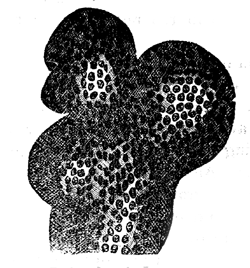
The growth of those corals which form reefs of solid stone is entirely confined to the warmer regions of the globe, rarely extending beyond the tropics above two or three degrees, except under peculiar circumstances, as in the Bermuda Islands, in lat. 32° N., where the Atlantic is warmed by the Gulf stream. The Pacific Ocean, throughout a space comprehended between the thirtieth parallels of latitude on each side of the equator, is extremely productive of coral; as also are the Arabian and Persian Gulfs. Coral is also abundant in the sea between the coast of Malabar and the island of Madagascar. Flinders describes a reef of coral on the east coast of New Holland as having a length of nearly 1000 miles, and as being in one part unbroken for a distance of 350 miles. Some groups of coral islands in the Pacific are from 1100 to 1200 miles Fig. 108. Meandrina labyrinthica, Lam. in length, by 300 or 400 in breadth, as the Dangerous Archipelago, for example, and that called Radack by Kotzebue; but the islands within these spaces are always small points, and often very thinly sown.
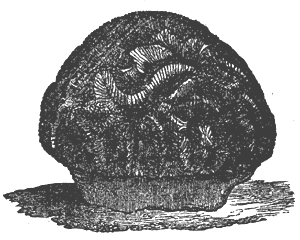
Of the numerous species of zoophytes which are engaged in the production of coral banks, some of the most common belong to the Lamarckian genera Astrea, Porites, Madrepora, Millepora, Caryophyllia, and Meandrina.
Rate of the growth of Coral.—Very different opinions have been entertained in regard to the rate at which coral reefs increase. In Captain Beechey's late expedition to the Pacific, no positive information could be obtained of any channel having been filled up within a given period; and it seems established, that several reefs had remained for more than half a century, at about the same depth from the surface.
Ehrenberg also questions the fact of channels and harbors having been closed up in the Red Sea by the rapid increase of coral limestone. He supposes the notion to have arisen from the circumstance of havens having been occasionally filled up in some places with coral sand, in others with large quantities of ballast of coral rock thrown down from vessels.
Genera of Zoophytes most common in coral reefs. Fig. 109.
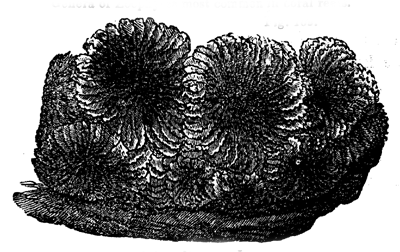
Astrea dipsacea, Lam.
Fig. 110. Fig. 111.
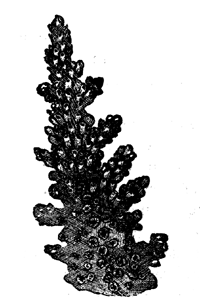
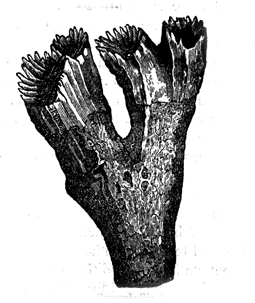
Extremity of branch of Madrepora muricata, Lin. Caryophyllia fastigiata, Lam.
Fig. 112. Fig. 113.
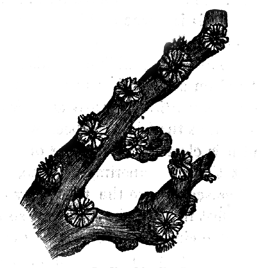
Porites clavaria, Lam. Oculina hirtella, Lam.
The natives of the Bermuda Islands point out certain corals now growing in the sea, which, according to tradition, have been living in the same spots for centuries. It is supposed that some of them may vie in age with the most ancient trees of Europe. Ehrenberg also observed single corals of the genera Meandrina and Favia, having a globular form, from six to nine feet in diameter, "which must (he says) be of immense antiquity, probably several thousand years old, so that Pharaoh may have looked upon these same individuals in the Red Sea."1112 They certainly imply, as he remarks, that the reef on which they grow has increased at a very slow rate. After collecting more than 100 species, he found none of them covered with parasitic zoophytes, nor any instance of a living coral growing on another living coral. To this repulsive power which they exert whilst living, against all others of their own class, we owe the beautiful symmetry of some large Meandrinæ, and other species which adorn our museums. Yet Balani and Serpulæ can attach themselves to living corals, and holes are excavated in them by saxicavous mollusca.
At the island called Taaopoto, in the South Pacific, the anchor of a ship, wrecked about 50 years before, was observed in seven fathoms water, still preserving its original form, but entirely incrusted by coral.1113 This fact would seem to imply a slow rate of augmentation; but to form a correct estimate of the average rate must be very difficult, since it must vary not only according to the species of coral, but according to the circumstances under which each species may be placed; such, for example, as the depth from the surface, the quantity of light, the temperature of the water, its freedom from sand or mud, or the absence or presence of breakers, which is favorable to the growth of some kinds and is fatal to that of others. It should also be observed that the apparent stationary condition of some coral reefs, which according to Beechey have remained for centuries at the same depth under water, may be due to subsidence, the upward growth of the coral having been just sufficient to keep pace with the sinking of the solid foundation on which the zoophytes have built. We shall afterwards see how far this hypothesis is borne out by other evidence in the regions of annular reefs or atolls.
In one of the Maldive islands a coral reef, which, within a few years, existed on an islet bearing cocoa-nut trees, was found by Lieutenant Prentice, "entirely covered with live coral and madrepore." The natives stated that the islet had been washed away by a change in the currents, and it is clear that a coating of growing coral had been formed in a short time.1114 Experiments, also, of Dr. Allan, on the east coast of Madagascar, prove the possibility of coral growing to a thickness of three feet in about half a year,1115 so that the rate of increase may, under favorable circumstances, be very far from slow.
It must not be supposed that the calcareous masses termed coral reefs are exclusively the work of zoophytes: a great variety of shells, and, among them, some of the largest and heaviest of known species, contribute to augment the mass. In the South Pacific, great beds of oysters, mussels, Pinnæ marinæ, Chamœ (or Tridacnæ), and other shells, cover in profusion almost every reef; and on the beach of coral islands are seen the shells of echini and broken fragments of crustaceous animals. Large shoals of fish are also discernible through the clear blue water, and their teeth and hard palates cannot fail to be often preserved although their soft cartilaginous bones may decay.
It was the opinion of the German naturalist Forster, in 1780, after his voyage round the world with Captain Cook, that coral animals had the power of building up steep and almost perpendicular walls from great depths in the sea, a notion afterwards adopted by Captain Flinders and others; but it is now very generally believed that these zoophytes cannot live in water of great depths.
Mr. Darwin has come to the conclusion, that those species which are most effective in the construction of reefs, rarely flourish at a greater depth than 20 fathoms, or 120 feet. In some lagoons, however, where the water is but little agitated, there are, according to Kotzebue, beds of living coral in 25 fathoms of water, or 150 feet; but these may perhaps have begun to live in shallower water, and may have been carried downwards by the subsidence of the reef. There are also various species of zoophytes, and among them some which are provided with calcareous as well as horny stems, which live in much deeper water, even in some cases to a depth of 180 fathoms; but these do not appear to give origin to stony reefs.
There is every variety of form in coral reefs, but the most remarkable and numerous in the Pacific consist of circular or oval strips of dry land, enclosing a shallow lake or lagoon of still water, in which zoophytes and mollusca abound. These annular reefs just raise themselves above the level of the sea, and are surrounded by a deep and often unfathomable ocean.
In the annexed cut (fig. 114), one of these circular islands is represented, just rising above the waves, covered with the cocoa-nut and other trees, and inclosing within a lagoon of tranquil water.
Fig. 114.
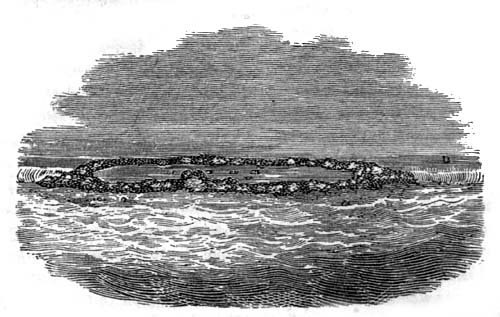
View of Whitsunday Island. (Capt. Beechey.)1116
The accompanying section will enable the reader to comprehend the usual form of such islands. (Fig. 115.)
Fig. 115.

Section of a Coral Island.
a, a, Habitable part of the island, consisting of a strip of coral, inclosing the lagoon.
b, b, The lagoon.
The subjoined cut (fig. 116.) exhibits a small part of the section of a coral island on a larger scale.
Fig. 116.

Section of part of a Coral Island.
a, b, Habitable part of the island.
b, c, Slope of the side of the island, plunging at an angle of forty-five to the depth of fifteen hundred feet.
c, c, Part of the lagoon.
d, d, Knolls of coral in the lagoon, with overhanging masses of coral resembling the capitals of columns.
Of thirty-two of these coral islands visited by Beechey in his voyage to the Pacific, twenty-nine had lagoons in their centres. The largest was 30 miles in diameter, and the smallest less than a mile. All were increasing their dimensions by the active operations of the lithophytes, which appeared to be gradually extending and bringing the immersed parts of their structure to the surface. The scene presented by these annular reefs is equally striking for its singularity and beauty. A strip of land a few hundred yards wide is covered by lofty cocoa-nut trees, above which is the blue vault of heaven. This band of verdure is bounded by a beach of glittering white sand, the outer margin of which is encircled with a ring of snow-white breakers, beyond which are the dark heaving waters of the ocean. The inner beach incloses the still clear water of the lagoon, resting in its greater part on white sand, and when illuminated by a vertical sun, of a most vivid green.1117 Certain species of zoophytes abound most in the lagoon, others on the exterior margin, where there is a great surf. "The ocean," says Mr. Darwin, "throwing its breakers on these outer shores, appears an invincible enemy, yet we see it resisted and even conquered by means which at first seem most weak and inefficient. No periods of repose are granted, and the long swell caused by the steady action of the trade wind never ceases. The breakers exceed in violence those of our temperate regions, and it is impossible to behold them without feeling a conviction that rocks of granite or quartz would ultimately yield and be demolished by such irresistible forces. Yet these low insignificant coral islets stand and are victorious, for here another power, as antagonist to the former, takes part in the contest. The organic forces separate the atoms of carbonate of lime one by one from the foaming breakers, and unite them into a symmetrical structure; myriads of architects are at work night and day, month after month, and we see their soft and gelatinous bodies through the agency of the vital laws conquering the great mechanical power of the waves of an ocean, which neither the art of man, nor the inanimate works of nature could successfully resist."1118
As the coral animals require to be continually immersed in salt water, they cannot raise themselves by their own efforts, above the level of the lowest tides. The manner in which the reefs are converted into islands above the level of the sea is thus described by Chamisso, a naturalist, who accompanied Kotzebue in his voyages:—"When the reef," says he, "is of such a height that it remains almost dry at low water the corals leave off building. Above this line a continuous mass of solid stone is seen composed of the shells of mollusks and echini, with their broken-off prickles and fragments of coral, united by calcareous sand, produced by the pulverization of shells. The heat of the sun often penetrates the mass of stone when it is dry, so that it splits in many places, and the force of the waves is thereby enabled to separate and lift blocks of coral, frequently six feet long and three or four in thickness, and throw them upon the reef, by which means the ridge becomes at length so high that it is covered only during some seasons of the year by the spring tides. After this the calcareous sand lies undisturbed, and offers to the seeds of trees and plants cast upon it by the waves a soil upon which they rapidly grow, to overshadow its dazzling white surface. Entire trunks of trees, which are carried by the rivers from other countries and islands, find here, at length, a resting-place after their long wanderings: with these come some small animals such as insects and lizards, as the first inhabitants. Even before the trees form a wood, the sea-birds nestle here; stray land-birds take refuge in the bushes; and, at a much later period, when the work has been long since completed, man appears and builds his hut on the fruitful soil."1119
In the above description the solid stone is stated to consist of shell and coral, united by sand; but masses of very compact limestone are also found even in the uppermost and newest parts of the reef, such as could only have been produced by chemical precipitation. Professor Agassiz also informs me that his observations on the Florida reefs (which confirm Darwin's theory of atolls to be mentioned in the sequel) have convinced him, that large blocks are loosened, not by shrinkage in the sun's heat, as Chamisso imagined, but by innumerable perforations of lithodomi and other boring testacea.
The carbonate of lime may have been principally derived from the decomposition of corals and testacea; for when the animal matter undergoes putrefaction, the calcareous residuum must be set free under circumstances very favorable to precipitation, especially when there are other calcareous substances, such as shells and corals, on which it may be deposited. Thus organic bodies may be inclosed in a solid cement, and become portions of rocky masses.1120
The width of the circular strip of dead coral forming the islands explored by Captain Beechey, exceeded in no instance half a mile from the usual wash of the sea to the edge of the lagoon, and, in general, was only about three or four hundred yards.1121 The depth of the lagoons is various; in some, entered by Captain Beechey, it was from twenty to thirty-eight fathoms.
The two other peculiarities which are most characteristic of the annular Fig. 117. Section of part of a Coral Island. reef or atoll are first, that the strip of dead coral is invariably highest on the windward side, and secondly, that there is very generally an opening at some point in the reef affording a narrow passage, often of considerable depth, from the sea into the lagoon.
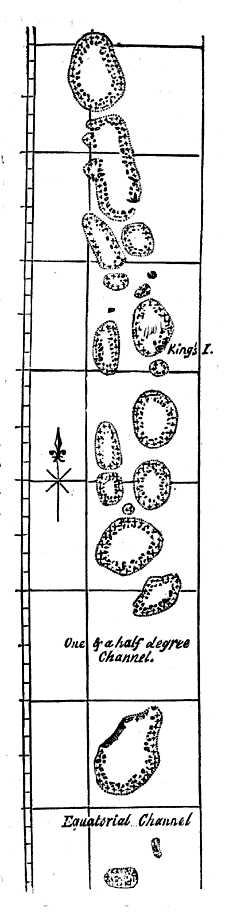
Maldive and Laccadive Isles.—The chain of reefs and islets called the Maldives (see fig. 117.), situated in the Indian Ocean, to the south-west of Malabar, forms a chain 470 geographical miles in length, running due north and south, with an average breadth of about 50 miles. It is composed throughout of a series of circular assemblages of islets, all formed of coral, the larger groups being from forty to ninety miles in their longest diameter. Captain Horsburgh, whose chart of these islands is subjoined, states, that outside of each circle or atoll, as it is termed, there are coral reefs sometimes extending to the distance of two or three miles, beyond which there are no soundings at immense depths. But in the centre of each atoll there is a lagoon from fifteen to forty-nine fathoms deep. In the channels between the atolls no soundings can usually be obtained at the depth of 150 or even 250 fathoms, but during Captain Moresby's survey, soundings were struck at 150 and 200 fathoms, the only instances as yet known of the bottom having been reached, either in the Indian or Pacific oceans, in a space intervening between two separate and well characterized atolls.
The singularity in the form of the atolls of this archipelago consists in their being made up, not of one continuous circular reef but of a ring of small coral islets sometimes more than a hundred in number, each of which is a miniature atoll in itself; in other words, a ring-shaped strip of coral surrounding a lagoon of salt water. To account for the origin of these, Mr. Darwin supposes the larger annular reef to have been broken up into a number of fragments, each of which acquired its peculiar configurations under the influence of causes similar to those to which the structure of the parent atoll has been due. Many of the minor rings are no less than three, and even five miles in diameter, and some are situated in the midst of the principal lagoon; but this happens only in cases where the sea can enter freely through breaches in the outer or marginal reef.
The rocks of the Maldives are composed of sandstone formed of broken shells and corals, such as may be obtained in a loose state from the beach, and which is seen when exposed for a few days to the air to become hardened. The sandstone is sometimes observed to be an aggregate of broken shells, corals, pieces of wood, and shells of the cocoa-nut.1122
The Laccadive islands run in the same line with the Maldives, on the north, as do the isles of the Chagos Archipelago, on the south; so that these may be continuations of the same chain of submerged mountains, crested in a similar manner by coral limestones.
Origin of the circular form—not volcanic.—The circular and oval shape of so many reefs, each having a lagoon in the centre, and being surrounded on all sides by a deep ocean, naturally suggested the idea that they were nothing more than the crests of submarine volcanic craters overgrown by coral; and this theory I myself advocated in the earlier editions of this work. Although I am now about to show that it must be abandoned, it may still be instructive to point out the grounds on which it was formerly embraced. In the first place, it had been remarked that there were many active volcanoes in the coral region of the Pacific, and that in some places, as in Gambier's group, rocks composed of porous lava rise up in a lagoon bordered by a circular reef, just as the two cones of eruption called the Kamenis have made their appearance in the times of history within the circular gulf of Santorin.1123 It was also observed that, as in S. Shetland, Barren Island, and others of volcanic origin, there is one narrow breach in the walls of the outer cone by which ships may enter a circular gulf, so in like manner there is often a single deep passage leading into the lagoon of a coral island, the lagoon itself seeming to represent the hollow or gulf just as the ring of dry coral recalls to our minds the rim of a volcanic crater. More lately, indeed, Mr. Darwin has shown that the numerous volcanic craters of the Galapagos Archipelago in the Pacific have all of them their southern sides the lowest, or in many cases quite broken down, so that if they were submerged and incrusted with coral, they would resemble true atolls in shape.1124
Another argument which I adduced when formerly defending this doctrine was derived from Ehrenberg's statement, that some banks of coral in the Red Sea were square, while many others were ribbon-like strips, with flat tops, and without lagoons. Since, therefore, all the genera and many of the species of zoophytes in the Red Sea agreed with those which elsewhere construct lagoon islands, it followed that the stone-making zoophytes are not guided by their own instinct in the formation of annular reefs, but that this peculiar shape and the position of such reefs in the midst of a deep ocean must depend on the outline of the submarine bottom, which resembles nothing else in nature but the crater of a lofty submerged volcanic cone. The enormous size, it is true, of some atolls, made it necessary for me to ascribe to the craters of many submarine volcanoes a magnitude which was startling, and which had often been appealed to as a serious objection to the volcanic theory. That so many of them were of the same height, or just level with the water, did not present a difficulty so long as we remained ignorant of the fact that the reef-building species do not grow at greater depths than twenty-five fathoms.
May be explained by subsidence.—Mr. Darwin, after examining a variety of coral formations in different parts of the globe, was induced to reject the opinion that their shape represented the form of the original bottom. Instead of admitting that the ring of dead coral rested on a circular or oval ridge of rock, or that the lagoon corresponded to a preexisting cavity, he advanced a new opinion, which must, at first sight, seem paradoxical in the extreme; namely, that the lagoon is precisely in the place once occupied by the highest part of a mountainous island, or, in other cases, by the top of a shoal.
The following is a brief sketch of the facts and arguments in favor of this new view:—Besides those rings of dry coral which enclose lagoons, there are others having a similar form and structure which encircle lofty islands. Of the latter kind is Vanikoro, (see map, fig. 39, p. 351,) celebrated on account of the shipwreck of La Peyrouse, where the coral reef runs at the distance of two or three miles from the shore, the channel between it and the land having a general depth of between 200 and 300 feet. This channel, therefore, is analogous to a lagoon, but with an island standing in the middle like a picture in its frame. In like manner in Tahiti we see a mountainous land, with everywhere round its margin a lake or zone of smooth salt water, separated from the ocean by an encircling reef of coral, on which a line of breakers is always foaming. So also New Caledonia, a long narrow island east of New Holland, in which the rocks are granitic, is surrounded by a reef which runs for a length of 400 miles. This reef encompasses not only the island itself, but a ridge of rocks which are prolonged in the same direction beneath the sea. No one, therefore, will contend for a moment that in this case the corals are based upon the rim of a volcanic crater, in the middle of which stands a mountain or island of granite.
The great barrier reef, already mentioned as running parallel to the north-east coast of Australia for nearly 1000 miles, is another most remarkable example of a long strip of coral running parallel to a coast. Its distance from the mainland varies from twenty to seventy miles, and the depth of the great arm of the sea thus enclosed is usually between ten and twenty fathoms, but towards one end from forty to sixty. This great reef would extend much farther, according to Mr. Jukes, if the growth of coral were not prevented off the shores of New Guinea by a muddy bottom, caused by rivers charged with sediment which flow from the southern coast of that great island.1125
Two classes of reefs, therefore, have now been considered; first, the atoll, and, secondly, the encircling and barrier reef, all agreeing perfectly in structure, and the sole difference lying in the absence in the case of the atoll of all land, and in the others the presence of land bounded either by an encircling or a barrier reef. But there is still a third class of reefs, called by Mr. Darwin "fringing reefs," which approach much nearer the land than those of the encircling and barrier class, and which indeed so nearly touched the coast as to leave nothing in the intervening space resembling a lagoon. "That these reefs are not attached quite close to the shore appears to be the result of two causes; first, that the water immediately adjoining the beach is rendered turbid by the surf, and therefore injurious to all zoophytes; and, secondly, that the larger and efficient kinds only flourish on the outer edge amidst the breakers of the open sea."1126
Fig. 118.
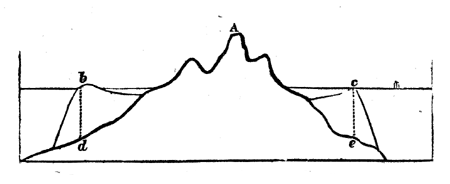
Supposed section of an island with an encircling reef of coral.
A, The island.
b, c, Highest points of the encircling reef between which and the coast is seen a space occupied by still water.
It will at once be conceded that there is so much analogy between the form and position of the strip of coral in the atoll, and in the encircling and barrier reef, that no explanation can be satisfactory which does not include the whole. If we turn in the first place to the encircling and barrier reefs, and endeavor to explain how the zoophytes could have found a bottom on which to begin to build, we are met at once with a great difficulty. It is a general fact, long since remarked by Dampier, that high land and deep seas go together. In other words, steep mountains coming down abruptly to the sea-shore are generally continued with the same slope beneath the water. But where the reef, as at b and c (fig. 118), is distant several miles from a steep coast, a line drawn perpendicularly downwards from its outer edges b c to the fundamental rock d e, must descend to a depth exceeding by several thousand feet the limits at which the efficient stone-building corals can exist, for we have seen that they cease to grow in water which is more than 120 feet deep. That the original root immediately beneath the points b c is actually as far from the surface as d e, is not merely inferred from Dampier's rule, but confirmed by the fact, that, immediately outside the reef, soundings are either not met with at all, or only at enormous depths. In short, the ocean is as deep there as might have been anticipated in the neighborhood of a bold coast; and it is obviously the presence of the coral alone which has given rise to the anomalous existence of shallow water on the reef and between it and the land.
After studying in minute detail all the phenomena above described, Mr. Darwin has offered in explanation a theory now very generally adopted. The coral-forming polypi, he states, begin to build in water of a moderate depth, and while they are yet at work, the bottom of the sea subsides gradually, so that the foundation of their edifice is carried downwards at the same time that they are raising the superstructure. If, therefore, the rate of subsidence be not too rapid, the growing coral will continue to build up to the surface; the mass always gaining in height above its original base, but remaining in other respects in the same position. Not so with the land; each inch lost is irreclaimably gone; as it sinks, the water gains foot by foot on the shore, till in many cases the highest peak of the original island disappears. What was before land is then occupied by the lagoon, the position of the encircling coral remaining unaltered, with the exception of a slight contraction of its dimensions.
In this manner are encircling reefs and atolls produced; and in confirmation of his views Mr. Darwin has pointed out examples which illustrate every intermediate state, from that of lofty islands, such as Otaheite, encircled by coral, to that of Gambier's group, where a few peaks only of land rise out of a lagoon, and lastly, to the perfect atoll, having a lagoon several hundred feet deep, surrounded by a reef rising steeply from an unfathomed ocean.
Fig. 119.
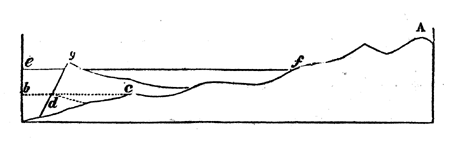
If we embrace these views, it is clear, that in regions of growing coral a similar subsidence must give rise to barrier reefs along the shores of a continent. Thus suppose A (fig. 119), to represent the north-east portion of Australia, and b c the ancient level of the sea, when the coral reef d was formed. If the land sink so that it is submerged more and more, the sea must at length stand at the level e f, the reef in the mean time having been enlarged and raised to the point g. The distance between the shore f, and the barrier reef g, is now much greater than originally between the shore c and the reef d, and the longer the subsidence continues the farther will the coast of the mainland recede.
When the first edition of this work appeared in 1831, several years before Mr. Darwin had investigated the facts on which his theory is founded, I had come to the opinion that the land was subsiding at the bottom of those parts of the Pacific where atolls are numerous, although I failed to perceive that such a subsidence, if conceded, would equally solve the enigma as to the form both of annular and barrier reefs.
I shall cite the passage referred to, as published by me in 1831:—"It is a remarkable circumstance that there should be so vast an area in Eastern Oceanica, studded with minute islands, without one single spot where there is a wider extent of land than belongs to such islands as Otaheite, Owhyhee, and a few others, which either have been or are still the seats of active volcanoes. If an equilibrium only were maintained between the upheaving and depressing force of earthquakes, large islands would very soon be formed in the Pacific; for, in that case, the growth of limestone, the flowing of lava, and the ejection of volcanic ashes, would combine with the upheaving force to form new land.
"Suppose a shoal, 600 miles in length, to sink fifteen feet, and then to remain unmoved for a thousand years; during that interval the growing coral may again approach the surface. Then let the mass be re-elevated fifteen feet, so that the original reef is restored to its former position: in this case, the new coral formed since the first subsidence will constitute an island 600 miles long. An analogous result would have occurred if a lava-current fifteen feet thick had overflowed the submerged reef. The absence, therefore, of more extensive tracts of land in the Pacific, seems to show that the amount of subsidence by earthquakes exceeds, in that quarter of the globe, at present, the elevation due to the same cause."1127
Another proof also of subsidence derived from the structure of atolls, was pointed out by me in the following passage in all former editions. "The low coral islands of the Pacific," says Captain Beechey, "follow one general rule in having their windward side higher and more perfect than the other. At Gambia and Matilda islands this inequality is very conspicuous, the weather side of both being wooded, and of the former inhabited, while the other sides are from twenty to thirty feet under water; where, however, they may be perceived to be equally narrow and well defined. It is on the leeward side also that the entrances into the lagoons occur; and although they may sometimes be situated on a side that runs in the direction of the wind, as at Bow Island, yet there are none to windward." These observations of Captain Beechey accord with those which Captain Horsburgh and other hydrographers have made in regard to the coral islands of other seas. From this fortunate circumstance ships can enter and sail out with ease; whereas if the narrow inlets were to windward, vessels which once entered might not succeed for months in making their way out again. The well-known security of many of these harbors depends entirely on this fortunate peculiarity in their structure.
"In what manner is this singular conformation to be accounted for? The action of the waves is seen to be the cause of the superior elevation of some reefs on their windward sides, where sand and large masses of coral rock are thrown up by the breakers; but there is a variety of cases where this cause alone is inadequate to solve the problem; for reefs submerged at considerable depths, where the movements of the sea cannot exert much power, have, nevertheless, the same conformation, the leeward being much lower than the windward side.1128
"I am informed by Captain King, that, on examining the reefs called Rowley Shoals, which lie off the north-west coast of Australia, where the east and west monsoons prevail alternately, he found the open side of one crescent-shaped reef, the Impérieuse, turned to the east, and of another, the Mermaid, turned to the west; while a third oval reef, of the same group, was entirely submerged. This want of conformity is exactly what we should expect, where the winds vary periodically.
"It seems impossible to refer the phenomenon now under consideration to any original uniformity in the configuration of submarine volcanoes, on the summits of which we may suppose the coral reefs to grow; for although it is very common for craters to be broken down on one side only, we cannot imagine any cause that should breach them all in the same direction. But the difficulty will, perhaps, be removed, if we call in another part of the volcanic agency—subsidence by earthquakes. Suppose the windward barrier to have been raised by the mechanical action of the waves to the height of two or three yards above the wall on the leeward side, and then the whole island to sink down a few fathoms, the appearances described would then be presented by the submerged reef. A repetition of such operations, by the alternate elevation and depression of the same mass (an hypothesis strictly conformable to analogy), might produce still greater inequality in the two sides, especially as the violent efflux of the tide has probably a strong tendency to check the accumulation of the more tender corals on the leeward reef; while the action of the breakers contributes to raise the windward barrier."1129
Previously to my adverting to the signs above enumerated of a downward movement in the bed of the ocean, Dr. MacCulloch, Captain Beechey, and many other writers, had shown that masses of recent coral had been laid dry at various heights above the sea-level, both in the Red Sea, the islands of the Pacific, and in the East and West Indies. After describing thirty-two coral islands in the Pacific, Captain Beechey mentioned that they were all formed of living coral except one, which, although of coral formation, was raised about seventy or eighty feet above the level of the sea, and was encompassed by a reef of living coral. It is called Elizabeth or Henderson's Island, and is five miles in length by one in breadth. It has a flat surface, and, on all sides, except the north, is bounded by perpendicular cliffs about fifty feet high, composed entirely of dead coral, more or less porous, honey-combed at the surface, and hardening into a compact calcareous mass, which possesses the fracture of secondary limestone, and has a species of millepore interspersed through it. These cliffs are considerably undermined by the action of the waves, and some of them appear on the eve of precipitating their superincumbent weight into the sea. Those which are less injured in this way present no alternate ridges or indication of the different levels which the sea might have occupied at different periods; but a smooth surface, as if the island, which has probably been raised by volcanic agency, had been forced up by one great subterraneous convulsion.1130 At the distance of a few hundred yards from this island, no bottom could be gained with 200 fathoms of line.
Fig. 120.

Elizabeth, or Henderson's Island.
It will be seen, from the annexed sketch, communicated to me by Lieutenant Smith, of the Blossom, that the trees came down to the beach towards the centre of the island; a break at first sight resembling the openings which usually lead into lagoons; but the trees stand on a steep slope, and no hollow of an ancient lagoon was perceived.
Beechey also remarks, that the surface of Henderson's Island is flat, and that in Queen Charlotte's Island, one of the same group, but under water, there was no lagoon, the coral having grown up everywhere to one level. The probable cause of this obliteration of the central basin or lagoon will be considered in the sequel.
That the bed of the Pacific and Indian oceans, where atolls are frequent, must have been sinking for ages, might be inferred, says Mr. Darwin, from simply reflecting on two facts; first, that the efficient coral-building zoophytes do not flourish in the ocean at a greater depth than 120 feet; and, secondly, that there are spaces occupying areas of many hundred thousand square miles, where all the islands consist of coral, and yet none of which rise to a greater height than may be accounted for by the action of the winds and waves on broken and triturated coral. Were we to take for granted that the floor of the ocean had remained stationary from the time when the coral began to grow, we should be compelled to assume that an incredible number of submarine mountains of vast height (for the ocean is always deep, and often unfathomable between the different atolls) had all come to within 120 feet of the surface, and yet no one mountain had risen above water. But no sooner do we admit the theory of subsidence, than this great, difficulty vanishes. However varied may have been the altitude of different islands, or the separate peaks of particular mountain-chains, all may have been reduced to one uniform level by the gradual submergence of the loftiest points, and the additions made to the calcareous cappings of the less elevated summits as they subsided to great depths.
Openings into the lagoons.—In the general description of atolls and encircling reefs, it was mentioned that there is almost always a deep narrow passage opening into the lagoon, or into the still water between the reef and the shore, which is kept open by the efflux of the sea as the tide goes down.
The origin of this channel must, according to the theory of subsidence before explained, be traced back to causes which were in action during the existence of the encircling reef, and when an island or mountain-top rose within it, for such a reef precedes the atoll in the order of formation. Now in those islands in the Pacific, which are large enough to feed small rivers, there is generally an opening or channel in the surrounding coral reef at the point where the stream of fresh water enters the sea. The depth of these channels rarely exceeds twenty-five feet; and they may be attributed, says Captain Beechey, to the aversion of the lithophytes to fresh water, and to the probable absence of the mineral matter of which they construct their habitations.1131
Mr. Darwin, however, has shown, that mud at the bottom of river-courses is far more influential than the freshness of the water in preventing the growth of the polypi, for the walls which inclose the openings are perpendicular, and do not slant off gradually, as would be the case, if the nature of the element presented the only obstacle to the increase of the coral-building animals.
When a breach has thus been made in the reef, it will be prevented from closing up by the efflux of the sea at low tides; for it is sufficient that a reef should rise a few feet above low-water mark to cause the waters to collect in the lagoon at high tide, and when the sea falls, to rush out at one or more points where the reef happens to be lowest or weakest. This event is strictly analogous to that witnessed in our estuaries, where a body of salt water accumulated during the flow issues with great velocity at the ebb of the tide, and scours out or keeps open a deep passage through the bar, which is almost always formed at the mouth of a river. At first there are probably many openings, but the growth of the coral tends to obstruct all those which do not serve as the principal channels of discharge; so that their number is gradually reduced to a few, and often finally to one. The fact observed universally, that the principal opening fronts a considerable valley in the encircled island, between the shores of which and the outer reef there is often deep water, scarcely leaves any doubt as to the real origin of the channel in all those countless atolls where the nucleus of land has vanished.
Size of atolls and barrier reefs.—In regard to the dimensions of atolls, it was stated that some of the smallest observed by Beechey in the Pacific were only a mile in diameter. If their external slope under water equals upon an average an angle of 45°, then would such an atoll at the depth of half a mile, or 2640 feet, have a diameter of two miles. Hence it would appear that there must be a tendency in every atoll to grow smaller, except in those cases where oscillations of level enlarge the base on which the coral grows by throwing down a talus of detrital matter all round the original cone of limestone.
Bow Island is described by Captain Beechey as seventy miles in circumference, and thirty in its greatest diameter, but we have seen that some of the Maldives are much larger.
As the shore of an island or continent which is subsiding will recede from a coral reef at a slow or rapid rate according as the surface of the land has a steep or gentle slope, we cannot measure the thickness of the coral by its distance from the coast; yet, as a general rule, those reefs which are farthest from the land imply the greatest amount of subsidence. We learn from Flinders, that the barrier reef of north-eastern Australia is in some places seventy miles from the mainland, and it should seem that a calcareous formation is there in progress 1000 miles long from north to south, with a breadth varying from twenty to seventy miles. It may not, indeed, be continuous over this vast area, for doubtless innumerable islands have been submerged one after another between the reef and mainland, like some which still remain, as, for example, Murray's Islands, lat. 9° 54' S. We are also told that some parts of the gulf inclosed within a barrier are 400 feet deep, so that the efficient rock-building corals cannot be growing there, and in other parts of it islands appear encircled by reefs.
It will follow as one of the consequences of the theory already explained that, provided the bottom of the sea does not sink too fast to allow the zoophytes to build upwards at the same pace, the thickness of coral will be great in proportion to the rapidity of subsidence, so that if one area sinks two feet while another sinks one, the mass of coral in the first area will be double that in the second. But the downward movement must in general have been very slow and uniform, or where intermittent, must have consisted of a great number of depressions, each of slight amount, otherwise the bottom of the sea would have been carried down faster than the corals could build upwards, and the island or continent would be permanently submerged, having reached a depth of 120 or 150 feet, at which the effective reef-constructing zoophytes cease to live. If, then, the subsidence required to account for all the existing atolls must have amounted to three or four thousand feet, or even sometimes more, we are brought to the conclusion that there has been a slow and gradual sinking to this enormous extent. Such an inference is perfectly in harmony with views which the grand scale of denudation, everywhere observable in the older rocks, has led geologists to adopt in reference to upward movements. They must also have been gradual and continuous throughout indefinite ages to allow the waves and currents of the ocean to operate with adequate power.
The map constructed by Mr. Darwin to display at one view the geographical position of all the coral reefs throughout the globe is of the highest geological interest (see above, p. 351.), leading to splendid generalizations, when we have once embraced the theory that all atolls and barrier reefs indicate recent subsidence, while the presence of fringing reefs proves the land to be stationary or rising. These two classes of coral formations are depicted by different colors; and one of the striking facts brought to light by the same classification of coral formations is the absence of active volcanoes in the areas of subsidence, and their frequent presence in the areas of elevation. The only supposed exception to this remarkable coincidence at the time when Mr. Darwin wrote, in 1842, was the volcano of Torres Strait, at the northern point of Australia, placed on the borders of an area of subsidence; but it has been since proved that this volcano has no existence.
We see, therefore, an evident connection, first, between the bursting forth every now and then of volcanic matter through rents and fissures, and the expansion or forcing outwards of the earth's crust, and, secondly, between a dormant and less energetic development of subterranean heat, and an amount of subsidence sufficiently great to cause mountains to disappear over the broad face of the ocean, leaving only small and scattered lagoon islands, or groups of atolls, to indicate the spots where those mountains once stood.
On a review of the differently-colored reefs on the map alluded to, it will be seen that there are large spaces in which upheaval, and others in which depression prevails, and these are placed alternately, while there are a few smaller areas where movements of oscillation occur. Thus if we commence with the western shores of South America, between the summit of the Andes and the Pacific (a region of earthquakes and active volcanoes), we find signs of recent elevation, not attested indeed by coral formations, which are wanting there, but by upraised banks of marine shells. Then proceeding westward, we traverse a deep ocean without islands, until we come to a band of atolls and encircled islands, including the Dangerous and Society archipelagoes, and constituting an area of subsidence more than 4000 miles long and 600 broad. Still farther, in the same direction, we reach the chain of islands to which the New Hebrides, Salomon, and New Ireland belong, where fringing reefs and masses of elevated coral indicate another area of upheaval. Again, to the westward of the New Hebrides we meet with the encircling reef of New Caledonia and the great Australian barrier, implying a second area of subsidence.
The only objection deserving attention which has hitherto been advanced against the theory of atolls, as before explained (p. 759.), is that proposed by Mr. Maclaren.1132 "On the outside," he observes, "of coral reefs very highly inclined, no bottom is sometimes found with a line of 2000 or 3000 feet, and this is by no means a rare case. It follows that the reef ought to have this thickness; and Mr. Darwin's diagrams show that he understood it so. Now, if such masses of coral exist under the sea, they ought somewhere to be found on terra firma; for there is evidence that all the lands yet visited by geologists, have been at one time submerged. But neither in the great volcanic chain, extending from Sumatra to Japan, nor in the West Indies, nor in any other region yet explored, has a bed or formation of coral even 500 feet thick been discovered, so far as we know."
When considering this objection, it is evident that the first question we have to deal with is, whether geologists have not already discovered calcareous masses of the required thickness and structure, or precisely such as the upheaval of atolls might be expected to expose to view? We are called upon, in short, to make up our minds both as to the internal composition of the rocks that must result from the growth of corals, whether in lagoon islands or barrier reefs, and the external shape which the reefs would retain when upraised gradually to a vast height,—a task by no means so easy as some may imagine. If the reader has pictured to himself large masses of entire corals, piled one upon another, for a thickness of several thousand feet, he unquestionably mistakes altogether the nature of the accumulations now in progress. In the first place, the strata at present forming very extensively over the bottom of the ocean, within such barrier reefs as those of Australia and New Caledonia, are known to consist chiefly of horizontal layers of calcareous sediment, while here and there an intermixture must occur of the detritus of granitic and other rocks brought down by rivers from the adjoining lands, or washed from sea-cliffs by the waves and currents. Secondly, in regard to atolls, the stone-making polypifers grow most luxuriantly on the outer edge of the island, to a thickness of a few feet only. Beyond this margin broken pieces of coral and calcareous sand are strewed by the breakers over a steep seaward slope, and as the subsidence continues the next coating of live coral does not grow vertically over the first layer, but on a narrow annular space within it, the reef, as was before stated (p. 761), constantly contracting its dimensions as it sinks. Thirdly, within the lagoon the accumulation of calcareous matter is chiefly sedimentary, a kind of chalky mud derived from the decay of the softer corallines, with a mixture of calcareous sand swept by the winds and waves from the surrounding circular reef. Here and there, but only in partial clumps, are found living corals, which grow in the middle of the lagoon, and mixed with fine mud and sand, a great variety of shells, and fragments of testacea and echinoderms.
We owe to Lieutenant Nelson the discovery that in the Bermudas the calcareous mud resulting from the decomposition of the softer corallines is absolutely undistinguishable when dried from the ordinary white chalk of Europe,1133 and this mud is carried to great distances by currents, and spread far and wide over the floor of the ocean. We also have opportunities of seeing in upraised atolls, such as Elizabeth Island, Tonga, and Hapai, which rise above the level of the sea to heights varying from ten to eighty feet, that the rocks of which they consist do not differ in structure or in the state of preservation of their included zoophytes and shells from some of the oldest limestones known to the geologist. Captain Beechey remarks that the dead coral in Elizabeth Island is more or less porous and honeycombed at the surface, and hardening into a compact rock which has the fracture of secondary limestone.1134
The island of Pulo Nias, off Sumatra (see Map, fig. 39. p. 351), which is about 3000 feet high, is described by Dr. Jack as being overspread by coral and large shells of the Chama (Tridacna) gigas, which rest on quartzose and arenaceous rocks, at various levels from the sea-coast to the summit of the highest hills.
The cliffs of the island of Timor in the Indian Ocean are composed, says Mr. Jukes, of a raised coral reef abounding in Astræa, Meandrina, and Porites, with shells of Strombus, Conus, Nerita, Arca, Pecten, Venus, and Lucina. On a ledge about 150 feet above the sea, a Tridacna (or large clam shell), two feet across, was found bedded in the rock with closed valves, just as they are often seen in barrier reefs. This formation in the islands of Sandlewood, Sumbawa, Madura, and Java, where it is exposed in sea cliffs, was found to be from 200 to 300 feet thick, and is believed to ascend to much greater heights in the interior. It has usually the form of a "chalk-like" rock, white when broken, but in the weathered surface turning nearly black.1135
It appears, therefore, premature to assert that there are no recent coral formations uplifted to great heights, for we are only beginning to be acquainted with the geological structure of the rocks of equatorial regions. Some of the upraised islands, such as Elizabeth and Queen Charlotte, in the Pacific, although placed in regions of atolls, are described by Captain Beechey and others as flat-topped, and exhibiting no traces of lagoons. In explanation of the fact, we may presume that after they had been sinking for ages, the descending movement was relaxed; and while it was in the course of being converted into an ascending one, the ground remained for a long season almost stationary, in which case the corals within the lagoon would build up to the surface, and reach the level already attained by those on the margin of the reef. In this manner the lagoon would be effaced, and the island acquire a flat summit.
It may, however, be thought strange that many examples have not been noticed of fringing reefs uplifted above the level of the sea. Mr. Darwin, indeed, cites one instance where the reef preserved, on dry land in the Mauritius, its peculiar moat-like structure; but they ought, he says, to be of rare occurrence, for in the case of atolls or of barrier or fringing reefs, the characteristic outline must usually be destroyed by denudation as soon as a reef begins to rise; since it is immediately exposed to the action of the breakers, and the large and conspicuous corals on the outer rim of the atoll or barrier are the first to be destroyed and to fall to the bottom of vertical and undermined cliffs. After slow and continued upheaval a wreck alone can remain of the original reef. If, therefore, says Mr. Darwin, "at some period as far in futurity as the secondary rocks are in the past, the bed of the Pacific with its atolls and barrier reefs should be converted into a continent, we may conceive that scarcely any or none of the existing reefs would be preserved, but only widely spread strata of calcareous matter derived from their wear and tear."1136
When it is urged in support of the objection before stated (p. 767), that the theory of atolls by subsidence implies the accumulation of calcareous formations 2000 or 3000 feet thick, it must be conceded that this estimate of the minimum density of the deposits is by no means exaggerated. On the contrary, when we consider that the space over which atolls are scattered in Polynesia and the Indian oceans may be compared to the whole continent of Asia, we cannot but infer from analogy that the differences in level in so vast an area have amounted, antecedently to subsidence, to 5000 or even a greater number of feet. Whatever was the difference in height between the loftiest and lowest of the original mountains or mountainous islands on which the different atolls are based, that difference must represent the thickness of coral which has now reduced all of them to one level. Flinders, therefore, by no means exaggerated the volume of the limestone, which he conceived to have been the work of coral animals; he was merely mistaken as to the manner in which they were enabled to build reefs in an unfathomed ocean.
But is it reasonable to expect, after the waste caused by denudation, that calcareous masses, gradually upheaved in an open sea, should retain such vast thicknesses? Or may not the limestones of the cretaceous and oolitic epochs, which attain in the Alps and Pyrenees a density of 3000 or 4000 feet, and are in great part made up of coralline and shelly matter, present us with a true geological counterpart of the recent coral reefs of equatorial seas?
Before we attach serious importance to arguments founded on negative evidence, and opposed to a theory which so admirably explains a great variety of complicated phenomena, we ought to remember that the upheaval to the height of 4000 feet of atolls in which the coralline limestone would be 4000 feet thick, implies, first, a slow subsidence of 4000 feet, and, secondly, an elevation of the same amount. Even if the reverse or ascending movement began the instant the downward one ceased, we must allow a great lapse of ages for the accomplishment of the whole operation. We must also assume that at the commencement of the period in question, the equatorial regions were as fitted as now for the support of reef-building zoophytes. This postulate would demand the continuance of a complicated variety of conditions throughout a much longer period than they are usually persistent in one place.
To show the difficulty of speculating on the permanence of the geographical and climatal circumstances requisite for the growth of reef-building corals, we have only to state the fact that there are no reefs in the Atlantic, off the west coast of Africa, nor among the islands of the Gulf of Guinea, nor in St. Helena, Ascension, the Cape Verdes, or St. Paul's. With the exception of Bermuda, there is not a single coral reef in the central expanse of the Atlantic, although in some parts the waves, as at Ascension, are charged to excess with calcareous matter. This capricious distribution of coral reefs is probably owing to the absence of fit stations for the reef-building polypifers, other organic beings in those regions obtaining in the great struggle for existence a mastery over them. Their absence, in whatever manner it be accounted for, should put us on our guard against expecting upraised reefs at all former geological epochs, similar to those now in progress.
Lime, whence derived.—Dr. Maculloch, in his system of Geology, vol. i. p. 219, expressed himself in favor of the theory of some of the earlier geologists, that all limestones have originated in organized substances. If we examine, he says, the quantity of limestone in the primary strata, it will be found to bear a much smaller proportion to the siliceous and argillaceous rocks than in the secondary; and this may have some connexion with the rarity of testaceous animals in the ancient ocean. He farther infers, that in consequence of the operations of animals, "the quantity of calcareous earth deposited in the form of mud or stone is always increasing; and that as the secondary series far exceeds the primary in this respect, so a third series may hereafter arise from the depths of the sea, which may exceed the last in the proportion of its calcareous strata."
If these propositions went no farther than to suggest that every particle of lime that now enters into the crust of the globe, may possibly in its turn have been subservient to the purposes of life, by entering into the composition of organized bodies, I should not deem the speculation improbable; but, when it is hinted that lime may be an animal product combined by the powers of vitality from some simple elements, I can discover no sufficient grounds for such an hypothesis, and many facts militate against it.
If a large pond be made in almost any soil, and filled with rain water, it may usually become tenanted by testacea; for carbonate of lime is almost universally diffused in small quantities. But if no calcareous matter be supplied by waters flowing from the surrounding high grounds, or by springs, no tufa or shell-marl are formed. The thin shells of one generation of mollusks decompose, so that their elements afford nutriment to the succeeding races; and it is only where a stream enters a lake, which may introduce a fresh supply of calcareous matter, or where the lake is fed by springs, that shells accumulate and form marl.
All the lakes in Forfarshire which have produced deposits of shell-marl have been the sites of springs, which still evolve much carbonic acid, and a small quantity of carbonate of lime. But there is no marl in Loch Fithie, near Forfar, where there are no springs, although that lake is surrounded by these calcareous deposits, and although, in every other respect, the site is favorable to the accumulation of aquatic testacea.
We find those Charæ which secrete the largest quantity of calcareous matter in their stems to abound near springs impregnated with carbonate of lime. We know that, if the common hen be deprived altogether of calcareous nutriment, the shells of her eggs will become of too slight a consistency to protect the contents; and some birds eat chalk greedily during the breeding season.
If, on the other hand, we turn to the phenomena of inorganic nature, we observe that, in volcanic countries, there is an enormous evolution of carbonic acid, either free, in a gaseous form, or mixed with water; and the springs of such districts are usually impregnated with carbonate of lime in great abundance. No one who has travelled in Tuscany, through the region of extinct volcanos and its confines, or who has seen the map constructed by Targioni (1827), to show the principal sites of mineral springs, can doubt, for a moment, that if this territory was submerged beneath the sea, it might supply materials for the most extensive coral reefs. The importance of these springs is not to be estimated by the magnitude of the rocks which they have thrown down on the slanting sides of hills, although of these alone large cities might be built, nor by a coating of travertin that covers the soil in some districts for miles in length. The greater part of the calcareous matter passes down in a state of solution to the sea, and in all countries the rivers which flow from chalk and other marly and calcareous rocks carry down vast quantities of lime into the ocean. Lime is also one of the component parts of augite and other volcanic and hypogene minerals, and when these decompose is set free, and may then find its way in a state of solution to the sea.
The lime, therefore, contained generally in sea water, and secreted so plentifully by the testacea and corals of the Pacific, may have been derived either from springs rising up in the bed of the ocean, or from rivers fed by calcareous springs, or impregnated with lime derived from disintegrated rocks, both volcanic and hypogene. If this be admitted, the greater proportion of limestone in the more modern formations as compared to the most ancient, will be explained, for springs in general hold no argillaceous, and but a small quantity of siliceous matter in solution, but they are continually subtracting calcareous matter from the inferior rocks. The constant transfer, therefore, of carbonate of lime from the lower or older portions of the earth's crust to the surface, must cause at all periods and throughout an indefinite succession of geological epochs, a preponderance of calcareous matter in the newer as contrasted with the older formations.
THE END.
CONCLUDING REMARKS.
In the concluding chapters of the first book, I examined in detail a great variety of arguments which have been adduced to prove the distinctness of the state of the earth's crust at remote and recent epochs. Among other supposed proofs of this distinctness, the dearth of calcareous matter, in the ancient rocks above adverted to, might have been considered. But it would have been endless to enumerate all the objections urged against those geologists who represent the course of nature at the earliest periods as resembling in all essential circumstances the state of things now established. We have seen that, in opposition to this doctrine, a strong desire has been manifested to discover in the ancient rocks the signs of an epoch when the planet was uninhabited, and when its surface was in a chaotic condition and uninhabitable. The opposite opinion, indeed, that the oldest of the rocks now visible may be the last monuments of an antecedent era in which living beings may already have peopled the land and water, has been declared to be equivalent to the assumption that there never was a beginning to the present order of things.
With equal justice might an astronomer be accused of asserting that the works of creation extended throughout infinite space, because he refuses to take for granted that the remotest stars now seen in the heavens are on the utmost verge of the material universe. Every improvement of the telescope has brought thousands of new worlds into view; and it would, therefore, be rash and unphilosophical to imagine that we already survey the whole extent of the vast scheme, or that it will ever be brought within the sphere of human observation.
But no argument can be drawn from such premises in favor of the infinity of the space that has been filled with worlds; and if the material universe has any limits, it then follows, that it must occupy a minute and infinitesimal point in infinite space.
So if, in tracing back the earth's history, we arrive at the monuments of events which may have happened millions of ages before our times, and if we still find no decided evidence of a commencement, yet the arguments from analogy in support of the probability of a beginning remain unshaken; and if the past duration of the earth be finite, then the aggregate of geological epochs, however numerous, must constitute a mere moment of the past, a mere infinitesimal portion of eternity.
It has been argued, that, as the different states of the earth's surface, and the different species by which it has been inhabited have all had their origin, and many of them their termination, so the entire series may have commenced at a certain period. It has also been urged, that, as we admit the creation of man to have occurred at a comparatively modern epoch—as we concede the astonishing fact of the first introduction of a moral and intellectual being—so also we may conceive the first creation of the planet itself.
I am far from denying the weight of this reasoning from analogy; but, although it may strengthen our conviction, that the present system of change has not gone on from eternity, it cannot warrant us in presuming that we shall be permitted to behold the signs of the earth's origin, or the evidences of the first introduction into it of organic beings. We aspire in vain to assign limits to the works of creation in space, whether we examine the starry heavens, or that world of minute animalcules which is revealed to us by the microscope. We are prepared, therefore, to find that in time also the confines of the universe lie beyond the reach of mortal ken. But in whatever direction we pursue our researches, whether in time or space, we discover everywhere the clear proofs of a Creative Intelligence, and of His foresight, wisdom, and power.
As geologists, we learn that it is not only the present condition of the globe which has been suited to the accommodation of myriads of living creatures, but that many former states also have been adapted to the organization and habits of prior races of beings. The disposition of the seas, continents, and islands, and the climates, have varied; the species likewise have been changed; and yet they have all been so modelled, on types analogous to those of existing plants and animals, as to indicate, throughout, a perfect harmony of design and unity of purpose. To assume that the evidence of the beginning or end of so vast a scheme lies within the reach of our philosophical inquiries, or even of our speculations, appears to be inconsistent with a just estimate of the relations which subsist between the finite powers of man and the attributes of an Infinite and Eternal Being.
GLOSSARY
OF GEOLOGICAL AND OTHER SCIENTIFIC TERMS USED IN THIS WORK.
Acephalous. The Acephala are that division of molluscous animals which, like the oyster and scallop, are without heads. The class Acephala of Cuvier comprehends many genera of animals with bivalve shells, and a few which are devoid of shells. Etym., α, a, without, and κεφαλη, cephale, the head.
Acidulous. Slightly acid.
Acrogens. One of five classes into which all plants may be divided; it includes such flowerless ones as grow from the top only, and whose stems consequently do not increase materially in bulk, as Mosses, Ferns, Lycopodiums, Equisetums, &c. The trunk of a tree fern is a good example. They are also called Acrobrya. Etym., ακρον, acron, the top, and γενεσις, genesis, increase.
Adipocire. A substance apparently intermediate between fat and wax, into which dead animal matter is converted when buried in the earth, and in a certain stage of decomposition. Etym., adeps, fat, and cera, wax.
Albite. See "Felspar."
Alembio. An apparatus for distilling.
Algæ. An order or division of the cryptogamic class of plants. The whole of the sea-weeds are comprehended under this division, and the application of the term in this work is to marine plants. Etym., alga, sea-weed.
Alluvial. The adjective of alluvium, which see.
Alluvion. Synonymous with alluvium, which see.
Alluvium. Earth, sand, gravel, stones, and other transported matter which has been washed away and thrown down by rivers, floods, or other causes upon land not permanently submerged beneath the waters of lakes or seas. Etym., alluo, to wash upon, or alluvio, an inundation.
Alum-stone, Alumen, Aluminous. Alum is the base of pure clay, and strata of clay are often met with containing much iron pyrites. When the latter substance decomposes, sulphuric acid is produced, which unites with the aluminous earth of the clay to form sulphate of alumine, or common alum. Where manufactories are established for obtaining the alum, the indurated beds of clay employed are called Alum-stone.
Ammonite. An extinct and very numerous genus of the order of molluscous animals called Cephalopoda, allied to the modern genus Nautilus, which inhabited a chambered shell, curved like a coiled snake. Species of it are found in all geological periods of the secondary strata; but they have not been seen in the tertiary beds. They are named from their resemblance to the horns on the statues of Jupiter Ammon.
Amorphous. Bodies devoid of regular form. Etym., α, a, without, and μορφη, morphe, form.
Amygdaloid. One of the forms of the Trap-rocks, in which agates and simple minerals appear to be scattered like almonds in a cake. Etym., αμυγδαλα, amygdala, an almond.
Analcime. A simple mineral of the Zeolite family, also called Cubizite, of frequent occurrence in the Trap-rocks.
Analogue. A body that resembles or corresponds with another body. A recent shell of the same species as a fossil shell is the analogue of the latter.
Angoiosperms. A term applied to all flowering plants in which the ovules are inclosed in an ovary, and the seeds in a pericarp or covering, as in all flowering plants except those mentioned under gymnosperms and gymnogens, which see. Etym., αγγος, angos, a vessel, and σπερμα, a seed.
Anoplotherium. A fossil extinct quadruped belonging to the order Pachydermata, resembling a pig. It has received its name because the animal must have been singularly wanting in means of defence, from the form of its teeth and the absence of claws, hoofs, and horns. Etym., ανοπλος, anoplos, unarmed, and θηριον, therion, a wild beast.
Antagonist Power. Two powers in nature, the action of the one counteracting that of the other, by which a kind of equilibrium or balance is maintained, and the destructive effect prevented that would be produced by one operating without a check.
Antennæ. The articulated horns with which the heads of insects are invariably furnished.
Anthracite. A shining substance like black-lead; a species of mineral charcoal. Etym., ανθραξ, anthrax, coal.
Anthracotherium. A name given to an extinct quadruped, supposed to belong to the Pachydermata, the bones of which were first found in lignite and coal of the tertiary strata. Etym., ανθραξ, anthrax, coal, and θηριον, therion, wild beast.
Anthropomorphous. Having a form resembling the human. Etym., ανθρωπος, anthropos, a man, and μορφη, morphe, form.
Antiseptic. Substances which prevent corruption in animal and vegetable matter, as common salt does, are said to be antiseptic. Etym., αντι, anti, against, and σηπω, sepo, to putrefy.
Arenaceous. Sandy. Etym., arena, sand.
Argillaceous. Clayey, composed of clay. Etym., argilla, clay.
Arragonite. A simple mineral, a variety of carbonate of lime, so called from having been first found in Aragon in Spain.
Atolls. Coral islands of an annular form, or consisting of a circular strip or ring of coral surrounding a central lagoon.
Augite. A simple mineral of a dark green, or black color, which forms a constituent part of many varieties of volcanic rocks. Name applied by Pliny to a particular mineral, from the Greek αυγη, auge, lustre.
Avalanches. Masses of snow which, being detached from great heights in the Alps, acquire enormous bulk by fresh accumulations as they descend; and when they fall into the valleys below often cause great destruction. They are also called lavanges and lavanches in the dialects of Switzerland.
Basalt. One of the most common varieties of the Trap-rocks. It is a dark green or black stone, composed of augite and felspar, very compact in texture, and of considerable hardness, often found in regular pillars of three or more sides called basaltic columns. Remarkable examples of this kind are seen at the Giant's Causeway, in Ireland, and at Fingal's Cave, in Staffa, one of the Hebrides. The term is used by Pliny, and is said to come from basal, an Æthiopian word signifying iron. The rock often contains much iron.
Basin" of Paris, "Basin" of London. Deposits lying in a hollow or trough, formed of older rocks; sometimes used in geology almost synonymously with "formations," to express the deposits lying in a certain cavity or depression in older rocks.
Belemnite. An extinct genus of the order of molluscous animals called Cephalopoda, having a long, straight, and chambered conical shell. Etym., βελεμνον, belemnon, a dart.
Bitumen. Mineral pitch, of which the tar-like substance which is often seen to ooze out of the Newcastle coal when on the fire, and which makes it cake, is a good example. Etym., bitumen, pitch.
Bituminous Shale. An argillaceous shale, much impregnated with bitumen, which is very common in the Coal Measures.
Blende. A metallic ore, a compound of the metal zinc with sulphur. It is often found in brown shining crystals; hence its name among the German miners, from the word blenden, to dazzle.
Bluffs. High banks presenting a precipitous front to the sea or a river. A term used in the United States of North America.
Botryoidal. Resembling a bunch of Grapes. Etym., βοτρυς, botrys, a bunch of grapes, and ειδος, eidos, form.
Boulders. A provincial term for large rounded blocks of stone lying on the surface of the ground, or sometimes imbedded in loose soil, different in composition from the rocks in their vicinity, and which have been therefore transported from a distance.
Breccia. A rock composed of angular fragments connected together by lime or other mineral substance. An Italian term.
Calc Sinter. A German name for the deposits from springs holding carbonate of lime in solution—petrifying springs. Etym., kalk, lime, and sintern, to drop.
Calcaire Grossier. An extensive stratum, or rather series of strata, found in the Paris Basin, belonging to the Eocene tertiary period. Etym., calcaire, limestone, and grossier, coarse.
Calcareous Rock. Limestone. Etym., calx, lime.
Calcareous Spar. Crystallized carbonate of lime.
Carbon. An undecomposed inflammable substance, one of the simple elementary bodies. Charcoal is almost entirely composed of it. Etym., carbo, coal.
Carbonate of Lime. Lime combines with great avidity with carbonic acid, a gaseous acid only obtained fluid when united with water,—and all combinations of it with other substances are called Carbonates. All limestones are carbonates of lime, and quicklime is obtained by driving off the carbonic acid by heat.
Carbonated Springs. Springs of water, containing carbonic acid gas. They are very common, especially in volcanic countries; and sometimes contain so much gas, that if a little sugar be thrown into the water it effervesces like soda-water.
Carbonic Acid Gas. A natural gas which often issues from the ground, especially in volcanic countries. Etym., carbo, coal; because the gas is obtained by the slow burning of charcoal.
Carboniferous. A term usually applied, in a technical sense, to an ancient group of secondary strata; but any bed containing coal may be said to be carboniferous. Etym., carbo, coal, and fero, to bear.
Cataclysm. A deluge. Etym., κατακλυζω, catacluzo, to deluge.
Cephalopoda. A class of molluscous animals, having their organs of motion arranged round their head. Etym., κεφαλη, cephale, head, and ποδα, poda, feet.
Cetacea. An order of vertebrated mammiferous animals inhabiting the sea. The whale, dolphin, and narwal are examples. Etym., cete, whale.
Chalcedony. A siliceous simple mineral, uncrystallized. Agates are partly composed of chalcedony.
Chalk. A white earthy limestone, the uppermost of the secondary series of strata.
Chert. A siliceous mineral, nearly allied to chalcedony and flint, but less homogeneous and simple in texture. A gradual passage from chert to limestone is not uncommon.
Chloritic Sand. Sand colored green by an admixture of the simple mineral chlorite. Etym., χλωρυς, chlorus, green.
Cleavage. Certain rocks, usually called Slate-rocks, may be cleaved into an indefinite number of thin laminæ which are parallel to each other, but which are generally not parallel to the planes of the true strata or layers of deposition. The planes of cleavage, therefore, are distinguishable from those of stratification.
Clinkstone, called also phonolite, a felspathic rock of the trap family, usually fissile. It is sonorous when struck with a hammer, whence its name.
Coal Formation. This term is generally understood to mean the same as the Coal Measures, or Carboniferous group.
Coleoptera. An order of insects (Beetles) which have four wings, the upper pair being crustaceous and forming a shield. Etym., κολεος, coleos, a sheath, and πτερον, pteron, a wing.
Conformable. When the planes of one set of strata are generally parallel to those of another set which are in contact, they are said to be conformable. Thus the set a, b, Fig. 98, rest conformably on the inferior set c, d; but c, d rest unconformably on E.
Fig. 98.

Congeners. Species which belong to the same genus.
Conglomerate, or Puddingstone. Rounded water-worn fragments of rock or pebbles, cemented together by another mineral substance, which may be of a siliceous, calcareous, or argillaceous nature. Etym., con, together, glomero, to heap.
Coniferæ. An order of plants, all of which have disks in their wood fibres, by which they are recognized in a fossil state. Their ovules are naked (see Gymnogens). Most of the northern kinds bear the seeds in cones; but the yew does not, nor do a host of tropical and south temperate species. Etym., conus, a cone, and fero, to bear.
Cosmogony, Cosmology. Words synonymous in meaning, applied to speculations respecting the first origin or mode of creation of the earth. Etym., κοσμος, kosmos, the world, and γονη, gonee, generation, or λογος, logos, discourse.
Crag. A provincial name in Norfolk and Suffolk for certain tertiary deposits usually composed of sand with shells, belonging to the Older Pliocene period.
Crater. The circular cavity at the summit of a volcano, from which the volcanic matter is ejected. Etym., crater, a great cup or bowl.
Cretaceous. Belonging to chalk. Etym., creta, chalk.
Crop Out. A miner's or mineral surveyor's term, to express the rising up or exposure at the surface of a stratum or series of strata.
Crust of the Earth. See "Earth's crust."
Crustaceous. Animals having a shelly coating or crust which they cast periodically. Crabs, shrimps, and lobsters are examples.
Cryptogamic. Asexual, flowerless, or Acotyledonous plants; a term applied to half the vegetable kingdom in contradistinction to Phænogamic, sexual, or flowering plants. It includes Fungi, Sea-weeds, Lichens, Mosses, Ferns, &c., which have no obvious flowers, and no cotyledons (seed-lobes) to their spores or seeds. Etym., κρυπτος, cruptos, concealed, and γαμος, gamos, marriage.
Crystals. Simple minerals are frequently found in regular forms, with facets like the drops of cut glass of chandeliers. Quartz being often met with in rocks in such forms, and beautifully transparent like ice, was called rock-crystal, κρυσταλλος, crystallos, being Greek for ice. Hence the regular forms of other minerals are called crystals, whether they be clear or opake.
Crystallized. A mineral which is found in regular forms or crystals is said to be crystallized.
Crystalline. The internal texture which regular crystals exhibit when broken, or a confused assemblage of ill-defined crystals. Loaf-sugar and statuary-marble have a crystalline texture. Sugar-candy and calcareous spar are crystallized.
Cupriferous. Copper-bearing. Etym., cuprum, copper, and fero, to bear.
Cycadeæ. A small and very anomalous order of flowering plants, chiefly found in Mexico, the East Indian Islands, South Africa, and Australia. They are Gymnogens as to ovules, and neither Exogens nor Endogens in the wood of their short, simple, or branched trunks, and they have dicotyledonous seeds. The leaves are pinnated (like those of cocoa-nut palms), and when young are rolled inwards as in Ferns. The wood fibres are curiously perforated, and marked, by which they are recognized in a fossil state as well as by the trunk and foliage, and the cones, which contain the male flowers. The term is derived from κυκας, cycas, a name applied by the ancient Greek naturalist Threophrastus to a palm.
Cyperaceæ. A tribe of plants answering to the English sedges; they are distinguished from grasses by their stems being solid, and generally triangular, instead of being hollow and round. Together with Gramineæ, they constitute what writers on botanical geography often call glumaceæ.
Debacle. A great rush of waters, which, breaking down all opposing barriers, carries forward the broken fragments of rocks, and spreads them in its course. Etym., débacler, French, to unbar, to break up as a river does at the cessation of a long-continued frost.
Delta. When a great river, before it enters the sea, divides into separate streams, they often diverge and form two sides of a triangle, the sea being the base. The land included by the three lines, and which is invariably alluvial, was first called, in the case of the Nile a delta, from its resemblance to the letter of the Greek alphabet which goes by that name Δ. Geologists apply the term to alluvial land formed by a river at its mouth, without reference to its precise shape.
Denudation. The carrying away by the action of running water of a portion of the solid materials of the land, by which inferior rocks are laid bare. Etym., denudo, to lay bare.
Deoxidized, Deoxidated. Deprived of oxygen. Disunited from oxygen.
Desiccation. The art of drying up. Etym., desicco, to dry up.
Detritus. Matter worn or rubbed off from rocks. Etym., de, from, and tero, to rub.
Dicotyledonous. A grand division of the vegetable kingdom, founded on the plant having two cotyledons, or seed-lobes. Etym., δις, dis, double, and κοτυληδον, cotyledon.
Dikes. When a mass of the unstratified or igneous rocks, such as granite, trap, and lava, appears as if injected into a rent in the stratified rocks, cutting across the strata, it forms a dike. They are sometimes seen running along the ground, and projecting, like a wall, from the softer strata on both sides of them having wasted away; whence they were first called in the north of England and in Scotland dikes, a provincial name for wall. It is not easy to draw the line between dikes and veins. The former are generally of larger dimensions, and have their sides parallel for considerable distances; while veins have generally many ramifications, and these often thin away into slender threads.
Diluvium. Those accumulations of gravel and loose materials, which, by some geologists, are said to have been produced by the action of a diluvian wave or deluge sweeping over the surface of the earth. Etym., diluvium, deluge.
Dip. When a stratum does not lie horizontally, but is inclined, it is said to dip towards some point of the compass, and the angle it makes with the horizon is called the angle of dip or inclination.
Diptera. An order of insects, comprising those which have only two wings. Etym., δις, dis, double, and πτερον, pteron, wing.
Dolerite. One of the varieties of the Trap-rocks, composed of augite and felspar.
Dolomite. A crystalline limestone, containing magnesia as a constituent part. Named after the French geologist Dolomieu.
Dunes. Low hills of blown sand that skirt the shores of Holland, England, Spain, and other countries.
Earth's Crust. Such superficial parts of our planet as are accessible to human observation.
Eopyrosis. A Greek term for a destruction by fire.
Elytra. The wing-sheaths, or upper crustaceous membranes, which form the superior wings in the tribe of beetles. They cover the body, and protect the true membranous wing. Etym., ελυτρον, elytron, a sheath.
Endogens. A class of flowering plants, whose stems present no distinction of wood, pith, and bark. The wood is disposed in bundles, placed nearer the axis than those of the previous year, as in palm trunks. This class answers to the Monocotyledones of Jussieu. Etym., ενδον, endon, within, and γενεσις, genesis, increase.
Entomostraca. Cuvier's second section of Crustacea; so called from their relationship to insects. Etym., εντομα, entoma, insects.
Eocene. A name given to the lowest division of the tertiary strata, containing an extremely small percentage of living species amongst its fossil shells, which indicate the first commencement or dawn of the existing state of the animate creation. Etym., ηως, eos, aurora or the dawn, and καινος, kainos, recent.
Escarpment. The abrupt face of a ridge of high land. Etym., escarper, French, to cut steep.
Estuaries. Inlets of the land, which are entered both by rivers and the tides of the sea. Thus we have the estuaries of the Thames, Severn, Tay, &c. Etym., æstus, the tide.
Exogens. A class of flowering plants whose stems have bark, wood, and pith. The bark is increased by layers deposited within the previously formed layers and the wood of layers or rings placed outside of those of the previous year. This class answers to the Dicotyledones of Jussieu, and includes all common English trees except pines, &c. (See Gymnogens.) Etym., εξο, exo, outside, γενεσις, genesis, increase.
Experimentum Crucis. A decisive experiment, so called, because, like a cross or direction-post, it directs men to true knowledge; or, as some explain it, because it is a kind of torture whereby the nature of the thing is extorted, as it were, by violence.
Exuviæ. Properly speaking, the transient parts of certain animals which they put off or lay down to assume new ones, as serpents and caterpillars shift their skins; but in geology it refers not only to the cast-off coverings of animals, but to fossil shells and other remains which animals have left in the strata of the earth. Etym., exuere, to put off or divest.
Faluns. A French provincial name for some tertiary strata abounding in shells in Touraine, which resemble in lithological characters the "Crag" of Norfolk and Suffolk.
Fault, in the language of miners, is the sudden interruption of the continuity of strata in the same plane, accompanied Fig. 99. by a crack or fissure, varying in width from a mere line to several feet, which is generally filled with broken stone, clay, &c. The strata, a, b, c, &c., must at one time have been continuous; but a fracture having taken place at the fault F, either by the upheaving of the portion A, or the sinking of the portion B, the strata were so displaced that the bed a in B is many feet lower than the same bed a in the portion A.
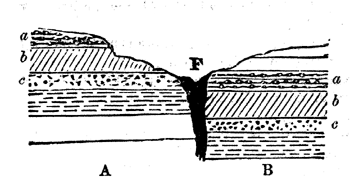
Fauna. The various kinds of animals peculiar to a country constitute its Fauna, as the various kinds of plants constitute its Flora. The term is derived from the Fauni, or rural deities, in Roman Mythology.
Felspar. A simple mineral, which, next to quartz, constitutes the chief material of rocks. The white angular portions in granite are felspar. This mineral always contains some alkali in its composition. In common felspar the alkali is potash; in another variety, called Albite or Cleavlandite, it is soda. Glassy felspar is a term applied when the crystals have a considerable degree of transparency. Compact felspar is a name of more vague signification. The substance so called appears to contain both potash and soda.
Felspathic. Of or belonging to felspar.
Ferruginous. Any thing containing iron. Etym., ferrum, iron.
Fissile, easily cleft, dividing readily into an indefinite number of parallel laminæ, like slates.
Floetz Rocks. A German term applied to the secondary strata by the geologists of that country, because these rocks were supposed to occur most frequently in flat horizontal beds. Etym., flotz, a layer or stratum.
Flora. The various kinds of trees and plants found in any country constitute the Flora of that country in the language of botanists.
Fluviatile. Belonging to a river. Etym., fluvius, a river.
Foraminifera. A name given by D'Orbigny to a family of microscopic shells. Their different chambers are united by a small perforation or foramen. Recent observation has shown that some at least are not Cephalopoda, as D'Orbigny supposed.
Formation. A group, whether of alluvial deposits, sedimentary strata, or igneous rocks, referred to a common origin or period.
Fossil. All minerals were once called fossils, but geologists now use the word only to express the remains of animals and plants found buried in the earth. Etym., fossilis, any thing that may be dug out of the earth.
Fossiliferous. Containing organic remains.
Galena. A metallic ore, a compound of lead and sulphur. It has often the appearance of highly polished lead. Etym., γαλεω, galeo, to shine.
Garnet. A simple mineral, generally of a deep red color, crystallized; most commonly met with in mica slate, but also in granite and other igneous rocks.
Gasteropods. A division of the Testacea, in which, as in the limpet, the foot is attached to the body. Etym., γαστηρ, gaster, belly, and ποδα, poda, feet.
Gault. A provincial name in the east of England for a series of beds of clay and marl, the geological position of which is between the Upper and Lower Greensand.
Gavial. A kind of crocodile found in India.
Gem, or Gemmule, from the Latin gemma, a bud. The term, applied to zoophytes, means a young animal not confined within an envelope or egg.
Geology, Geognosy. Both mean the same thing; but with an unnecessary degree of refinement in terms, it has been proposed to call our description of the structure of the earth geognosy (Etym., γεα, gea, earth, and γινωσcω, ginosco, to know), and our theoretical speculations as to its formation geology (Etym., γεα, and λογος, logos, a discourse).
Glacier. Vast accumulations of ice and hardened snow in the Alps and other lofty mountains. Etym., glace, French for ice.
Glacis. A term borrowed from the language of fortification, where it means an easy insensible slope or declivity, less steep than a talus, which see.
Gneiss. A stratified primary rock, composed of the same materials as granite, but having usually a larger proportion of mica and a laminated texture. The word is a German miner's term.
Gramineæ. The order of plants to which grasses belong. Etym., gramen, grass.
Granite. An unstratified or igneous rock, generally found inferior to or associated with the oldest of the stratified rocks, and sometimes penetrating them in the form of dikes and veins. It is usually composed of three simple minerals, felspar, quartz, and mica, and derives its name from having a coarse granular structure; granum, Latin for grain. Waterloo bridge, and the paving-stones in the carriage-way of the London streets, afford good examples of the most common varieties of granite.
Greensand. Beds of sand, sandstone, limestone, belonging to the Cretaceous Period. The name is given to these beds because they often, but not always, contain an abundance of green earth or chlorite scattered through the substance of the sandstone, limestone, &c.
Greenstone. A variety of trap, composed of hornblende and felspar.
Greywacké. Grauwacke, a German name, generally adopted by geologists for some of the most ancient fossiliferous strata. The rock is very often of a gray color; hence the name, grau, being German for gray, and wacke, being a provincial miner's term.
Grit. A provincial name for a coarse-grained sandstone.
Gymnospermous. Etym., γυμνος, gymnos, naked, and σπερμα, sperma, a seed. (See Gymnogens.)
Gymnogens. A class of flowering plants, in which the ovules are not inclosed in an ovary. They are also called gymnosperms, the seeds in like manner not being inclosed in a pericarp. It includes all Coniferæ, as pine, fir, juniper, cypress, yew, cedar, &c., and Cycadeæ. All are Dicotyledonous (a few have many cotyledons), and all Exogenous, except Cycas, the growth of which is anomalous. The term is applied in contradistinction to Angiosperms, which see. Etym., γυμνος, naked, and γενεσις, increase.
Gypsum. A mineral composed of lime and sulphuric acid, hence called also sulphate of lime. Plaster and stucco are obtained by exposing gypsum to a strong heat. It is found so abundantly near Paris, that plaster of Paris is a common term in this country for the white powder of which casts are made. The term is used by Pliny for a stone used for the same purposes by the ancients. The derivation is unknown.
Gypseous, of or belonging to gypsum.
Gyrogonites. Bodies found in freshwater deposits, originally supposed to be microscopic shells, but subsequently discovered to be seed-vessels of freshwater plants of the genus Chara. See above p. 742. Etym., γυρος, gyros, curved, and γονος, gonos, seed, on account of their external structure.