Book 3 — CHAPTER L. (continued 2)
Reading edition
Hemiptera. An order of insects, so called from a peculiarity in their wings, the superior being coriaceous at the base and membranous at the apex, ἡμισυ, hemisu, half, and πτερον, pteron, wing.
Hornblende. A simple mineral of a dark green or black color, which enters largely into the composition of several varieties of the Trap-Rocks.
Hornstone. A siliceous mineral substance, sometimes approaching nearly to flint, or common quartz. It has a conchoidal fracture, and is infusible, which distinguishes it from compact felspar.
Humerus. The bone of the upper arm.
Hydrophytes. Plants which grow in water. Etym., ὑδωρ, hydor, water, and φυτον, phyton, plant.
Hypogene Rocks. Those rocks which are nether-formed, or which have not assumed their present form and structure at the surface, such as granite, gneiss, &c. The term, which includes both the plutonic and metamorphic rocks, is substituted for primary, because some members of both these classes, such as granite and gneiss, are posterior to many secondary or fossiliferous rocks. Etym., ὑπο, hypo, under, and γινομαι, ginomai, to be formed or produced.
Iceberg. Great masses of ice, often the size of hills, which float in the polar and adjacent seas. Etym., ice, and berg, German for hill.
Ichthyosaurus. A gigantic fossil marine reptile, allied in part of its structure to a fish. Etym., ιχθυς, ichthus, a fish, and σαυρα, saura, a lizard.
Igneous Rocks. All rocks, such as lava, trap, and granite, known or supposed to have been melted by volcanic heat.
Incandescent. White hot—having a more intense degree of heat than red heat.
Induction. A consequence, inference, or general principle drawn from a number of particular facts or phenomena. The inductive philosophy, says Mr. Whewell, has been rightly described as a science which ascends from particular facts to general principles, and then descends again from these general principles to particular applications.
Infusory Animalcules. Minute living creatures found in many infusions; and the term infusori has been given to all such animalcules, whether found in infusions or in stagnant water, vinegar, &c.
Inspissated. Thickened. Etym., spissus, thick.
Invertebrated Animals. Animals which are not furnished with a back-bone. For a further explanation, see "Vertebrated Animals."
Isothermal. Such zones or divisions of the land, ocean, or atmosphere, which have an equal degree of mean annual warmth, are said to be isothermal, from ισος, isos, equal, and θερμη, therme, heat.
Joints. Fissures or lines of parting in rocks, often at right angles to the planes of stratification. The partings which divide columnar basalt into prisms are joints.
Jura Limestone. The limestones belonging to the Oolite Group constitute the chief part of the mountains of Jura between France and Switzerland; and hence the geologists of the Continent have given the name to the group.
Keuper. A German name for a member of the Upper New Red Sandstone.
Kimmeridge Clay. A thick bed of clay, constituting a member of the Oolite Group. So called because it is found well developed at Kimmeridge, in the Isle of Purbeck, Dorsetshire.
Lacustrine. Belonging to a lake. Etym., lacus, a lake.
Lamantine. A living species of the herbivorous Cetacea or whale tribe which inhabits the mouth of rivers on the coasts of Africa and South America: the sea-cow.
Lamelliferous. Having a structure consisting of thin plates or leaves like paper. Etym., lamella, the diminutive of lamina, plate, and fero, to bear.
Laminæ. Latin for plates; used in geology for the smaller layers of which a stratum is frequently composed.
Landslip. A portion of land that has slid down in consequence of disturbance by an earthquake, or from being undermined by water washing away the lower beds which supported it.
Lapidification. Lapidifying process. Conversion into stone. Etym., lapis, stone, and fio, to make.
Lapilli. Small volcanic cinders. Lapillus, a little stone.
Lava. The stone which flows in a melted state from a volcano.
Lepidodendron, a genus of fossil plants of the Coal Measures, intermediate in character between the Lycopodiums and coniferous plants.
Leucite. A simple mineral found in volcanic rocks, crystallized, and of a white color. Etym., λευcος, leucos, white.
Lias. A provincial name for an argillaceous limestone, characterized together with its associated beds by peculiar fossils, and forming a particular group of strata, interposed between the Oolite and the New Red Sandstone.
Ligniperdous. A term applied to insects which destroy wood. Etym., lignum, wood, and perdo, to destroy.
Lignite. Wood converted into a kind of coal. Etym., lignum, wood.
Lithodomi. Molluscous animals which form holes in the solid rocks in which they lodge themselves. The holes are not perforated mechanically, but the rock appears to be dissolved. Etym., λιθος, lithos, stone, and δεμο, demo, to build.
Lithogenous Polyps. Animals which form coral.
Lithographic Stone. A slaty compact limestone, of a yellowish color and fine grain, used in lithography, which is the art of drawing upon and printing from stone Etym., λιθος, lithos, stone, and γραφο, grapho, to write.
Lithoidal. Having a stony structure.
Lithological. A term expressing the stony structure or character of a mineral mass. We speak of the lithological character of a stratum as distinguished from its zoological character. Etym., λιθος, lithos, stone, and λογος, logos, discourse.
Lithophagi. Molluscous animals which form holes in solid stones. See "Lithodomi." Etym., λιθος, lithos, stone, and φαγειν, phagein, to eat.
Lithophites. The animals which form Stone-coral.
Littoral. Belonging to the shore. Etym., littus, the shore.
Loam. A mixture of sand and clay.
Lophiodon. A genus of extinct quadrupeds, allied to the tapir, named from eminences on the teeth.
Lycopodiaceæ. Plants of an inferior degree of organization to Coniferæ, some of which they very much resemble in foliage, but all recent species are infinitely smaller. Many of the fossil species are as gigantic as recent Coniferæ. Their mode of reproduction is analogous to that of ferns. In English they are called club-mosses, generally found in mountainous heaths in the north of England.
Lydian Stone. Flinty slate; a kind of quartz or flint, allied to Hornstone, but of a grayish black color.
Macigno. In Italy this term has been applied to a siliceous sandstone sometimes containing calcareous grains, mica, &c.
Madrepore. A genus of corals, but generally applied to all the corals distinguished by superficial star-shaped cavities. There are several fossil species.
Magnesian Limestone. An extensive series of beds, the geological position of which is immediately above the Coal Measures; so called, because the limestone, the principal member of the series, contains much of the earth magnesia as a constituent part.
Mammiferous. Mammifers. Animals which give suck to their young. To this class all the warm-blooded quadrupeds, and the Cetacea, or whales, belong. Etym., mamma, a breast, fero, to bear.
Mammillary. A surface which is studded over with rounded projections. Etym., mammilla, a little breast or pap.
Mammoth. An extinct species of the elephant (E. primigenius), of which the fossil bones are frequently met with in various countries. The name is of Tartar origin, and is used in Siberia for animals that burrow under ground.
Manati. One of the Cetacea, the sea-cow, or lamantine (Trichechus manatus, Lin.)
Marl. A mixture of clay and lime; usually soft, but sometimes hard, in which case it is called indurated marl.
Marsupial Animals. A tribe of quadrupeds having a sack or pouch under the belly, in which they carry their young. The kangaroo is a well-known example. Etym., marsupium, a purse.
Mastodon. A genus of fossil extinct quadrupeds allied to the elephants; so called from the form of the hind teeth or grinders, which have their surface covered with conical mammillary crests. Etym., μαστος, mastos, pap, and οδων, odon, tooth.
Matrix. If a simple mineral or shell, in place of being detached, be still fixed in a portion of rock, it is said to be in its matrix. Matrix, womb.
Mechanical Origin, Rocks of. Rocks composed of sand, pebbles, or fragments, are so called to distinguish them from those of a uniform crystalline texture, which are of chemical origin.
Medusæ. A genus of marine radiated animals, without shells; so called, because their organs of motion spread out like the snaky hair of the fabulous Medusa.
Megalosaurus. A fossil gigantic amphibious animal of the saurian or lizard and crocodile tribe. Etym., μεγαλη, megale, great, and σαυρα, saura, lizard.
Megatherium. A fossil extinct quadruped, resembling a gigantic sloth. Etym., μεγα, mega, great, and θηριον, therion, wild beast.
Melastoma. A genus of Melastomacea, an order of exotic plants of the evergreen tree and shrubby kinds. Etym., μελας, melas, black, and στομα, stoma, mouth; because the fruit of one of these species stains the lips.
Mesotype. A simple mineral, white, and needle-shaped, one of the Zeolite family, frequently met with in the Trap-rocks.
Metamorphic Rocks. A stratified division of hypogene rocks, highly crystalline, such as gneiss and mica-schist, and so named because they have been altered by plutonic action. Etym., μετα, meta, trans, and μορφη, morphe, form.
Mica. A simple mineral, having a shining silvery surface, and capable of being split into very thin elastic leaves or scales. It is often called talc in common life; but mineralogists apply the term talc to a different mineral. The brilliant scales in granite are mica. Etym., mico, to shine.
Mica-slate, Mica-Schist, Micaceous Schistus. One of the metamorphic or crystalline stratified rocks of the hypogene class, which is characterized by being composed of a large proportion of mica united with quartz.
Miocene. A division of tertiary strata intervening between the Eocene and Pliocene formations; so called, because a minority of its fossil shells are referable to living species. Etym., μειων, meion, less, and καινος, kainos, recent.
Molasse. A provincial name for a soft green sandstone, associated with marl and conglomerates, belonging to the Miocene Tertiary Period, extensively developed in the lower country of Switzerland. Etym., French, molle, soft.
Mollusca, Molluscous Animals. Animals, such as shell-fish, which, being devoid of bones, have soft bodies. Etym., mollis, soft.
Monad. The smallest of visible animalcules, spoken of by Buffon and his followers as constituting the elementary molecules of organic beings.
Monitor. An animal of the saurian or lizard tribe, species of which are found in both the fossil and recent state.
Monocotyledonous. A grand division of the vegetable kingdom (including palms, grasses, Lilaceæ, &c.), founded on the plant having only one cotyledon, or seed-lobe. Etym., μονος, monos, single.
Moraine, a Swiss term for the débris of rocks brought into valleys by glaciers. See p. 228.
Moschus. A quadruped resembling the chamois or mountain goat, from which the perfume musk is obtained.
Mountain Limestone, or Carboniferous Limestone. A series of limestone strata of marine origin, usually forming the lowest member of the Coal Measures.
Moya. A term applied in South America to mud poured out from volcanoes during eruptions.
Multilocular. Many-chambered; a term applied to those shells which, like the nautilus, ammonite, and others, are divided into many compartments. Etym., multus, many, and loculus, a partition.
Muriate of Soda. The scientific name for common culinary salt, because it is composed of muriatic acid and the alkali soda.
Musaceæ. A family of tropical monocotyledonous plants, including the banana and plantains.
Muschelkalk. A limestone, belonging to the Upper New Red Sandstone group. Its position is between the Magnesian Limestone and the Lias. This formation has not yet been found in England, and the German name is adopted by English geologists. The word means shell limestone. Etym., muschel, shell, and kalkstein, limestone.
Naphtha. A very thin, volatile, inflammable, and fluid mineral substance, of which there are springs in many countries, particularly in volcanic districts.
Nenuphar. A yellow water-lily. P. 618.
New Red Sandstone. A formation so named, because it consists chiefly of sandy and argillaceous strata, the predominant color of which is brick-red, but containing portions which are of a greenish-gray. These occur often in spots and stripes, so that the series has sometimes been called the variegated sandstone. This formation is divided into the Upper New Red in which the Muschelkalk is included, and the Lower New Red, of which the Magnesian Limestone is a member.
Nodule. A rounded irregular-shaped lump or mass. Etym., diminutive of nodus, knot.
Normal Groups. Groups of certain rocks taken as a rule or standard. Etym., norma, rule or pattern.
Nucleus. A solid central piece, around which other matter is collected. The word is Latin for kernel.
Nummulites. An extinct genus of the order of molluscous animals, called Cephalopoda, of a thin lenticular shape, internally divided into small chambers. Etym., nummus, Latin for money, and λιθος, lithos, stone, from its resemblance to a coin.
Obsidian. A volcanic product, or species of lava, very like common green bottle glass, which is almost black in large masses, but semi-transparent in thin fragments. Pumice-stone is obsidian in a frothy state; produced, most probably, by water that was contained in or had access to the melted stone, and converted into steam. There are very often portions in masses of solid obsidian, which are partially converted into pumice.
Ochre. A yellow powder, a combination of some earth with oxide of iron.
Ogygian Deluge. A great inundation mentioned in fabulous history, supposed to have taken place in the reign of Ogyges in Attica, whose death is fixed in Blair's Chronological Tables in the year 1764 before Christ. See p. 341.
Old Red Sandstone. A formation immediately below the Carboniferous Group. The term Devonian has been recently proposed for strata of this age, because in Devonshire they are largely developed, and contain many organic remains.
Oligoclase. A mineral of the felspar family.
Olivine. An olive-colored, semi-transparent, simple mineral, very often occurring in the form of grains and of crystals in basalt and lava.
Oolite, Oolitic. A limestone; so named because it is composed of rounded particles like the roe or eggs of a fish. The name is also applied to a large group of strata, characterized by peculiar fossils, in which limestone of this texture occurs. Etym., ωον, oon, egg, and λιθος, lithos, stone.
Opalized Wood. Wood petrified by siliceous earth, and acquiring a structure similar to the simple mineral called opal.
Ophidious Reptiles. Vertebrated animals, such as snakes and serpents. Etym., οφις, ophis, a serpent.
Organic Remains. The remains of animals and plants (organized bodies) found in a fossil state.
Orthocerata or Ohthoceræ. An extinct genus of the order of molluscous animals, called Cephalopoda, that inhabited a long-chambered conical shell, like a straight horn. Etym., ορθος, orthos, straight, and κερας, ceras, horn.
Osseous Breccia. The cemented mass of fragments of bones of extinct animals found in caverns and fissures. Osseous is a Latin adjective, signifying bony.
Osteology. That division of anatomy which treats of the bones; from οστεον, osteon, bone, and λογος, logos, a discourse.
Outliers. When a portion of a stratum occurs at some distance, detached from the general mass of the formation to which it belongs, some practical mineral surveyors call it an outlier, and the term is adopted in geological language.
Ovate. The shape of an egg. Etym., ovum, egg.
Ovipositing. The laying of eggs.
Oxide. The combination of a metal with oxygen; rust is oxide of iron.
Oxygen. One of the constituent parts of the air of the atmosphere; that part which supports life. For a farther explanation of the word, consult elementary works on chemistry.
Pachydermata. An order of quadrupeds, including the elephant, rhinoceros, horse, pig, &c., distinguished by having thick skins. Etym., παχυς, pachus, thick, and δερμα, derma, skin, or hide.
Pachydermatous. Belonging to Pachydermata.
Palæotherium, Paleothere. A fossil extinct quadruped, belonging to the order Pachydermata, resembling a pig, or tapir, but of great size. Etym., παλαιος, palaios, ancient, and θηριον, therion, wild beast.
Paleontology. The science which treats of fossil remains, both animal and vegetable. Etym., παλαιος, palaios, ancient, οντα, onta, beings, and λογος, logos, a discourse.
Pelagian, Pelagic. Belonging to the deep sea. Etym., pelagus, sea.
Peperino. An Italian name for a particular kind of volcanic rock, formed like tuff, by the cementing together of volcanic sand, cinders, or scoriæ, &c.
Petroleum. A liquid mineral pitch, so called because it is seen to ooze like oil out of the rock. Etym., petra, rock, and oleum, oil.
Phænogamous or Phanerogamic Plants. A name given by Linnæus to those plants in which the reproductive organs are apparent. Etym., φανερος, phaneros, evident, or φαινω, phaino, to show, and γαμος, gamos, marriage.
Phlegræan Fields. Campi Phlegræi, or "the Burnt Fields." The country around Naples, so named by the Greeks, from the traces of igneous action everywhere visible.
Phonolite. See "Clinkstone."
Phryganea. A genus of four-winged insects, the larvæ of which, called caddis-worms, are used by anglers as a bait.
Physics. The department of science which treats of the properties of natural bodies, laws of motion, &c.; sometimes called natural philosophy and mechanical philosophy. Etym., φυσις, physis, nature.
Phytology, Phytological. The department of science which relates to plants—synonymous with, botany and botanical. Etym., φυτον, phyton, plant, and λογος, logos, discourse.
Phytophagous. Plant-eating. Etym., φυτον, phyton, plant, and φαγειν, phagein, to eat.
Pisolite. A stone possessing a structure like an agglutination of peas. Etym., πισον, pison, pea, and λιθος, lithos, stone.
Pistia. P. 618. The plant mentioned by Malte-Brun is probably the Pistia Stratiotes, a floating plant, related to English duckweed, but very much larger.
Pit Coal. Ordinary coal; called so, because it is obtained by sinking pits in the ground.
Pitchstone. A rock of a uniform texture, belonging to the unstratified and volcanic classes, which has an unctuous appearance like indurated pitch.
Plastic Clay. One of the beds of the Eocene Tertiary Period; so called, because it is used for making pottery. The formation to which this name is applied is a series of beds chiefly sands, with which the clay is associated. Etym., πλασσω, plasso, to form or fashion.
Plesiosaurus. A fossil extinct amphibious animal, resembling the saurian, or lizard and crocodile tribe. Etym., πλησιον, plesion, near to, and σαυρα, saura, a lizard.
Pliocene, Older and Newer. Two divisions of the Tertiary Period which are the most modern, and of which the largest part of the fossil shells are of recent species. Etym., πλειων, pleion, more, and καινος, kainos, recent.
Plutonic Action. The influence of volcanic heat and other subterranean causes under pressure.
Plutonic Rocks. Granite, porphyry, and other igneous rocks supposed to have consolidated from a melted state at a great depth from the surface.
Poliparia. Corals. A numerous class of invertehrated animals, belonging to the great division called Radiata.
Porphyry. An unstratified or igneous rock. The term is as old as the time of Pliny, and was applied to a red rock with small, angular, white bodies diffused through it, which are crystallized felspar, brought from Egypt. The term is hence applied to every species of unstratifled rock in which detached crystals or felspar or some other mineral are diffused through a base of other mineral composition. Etym., πορφυρα, porphyra, purple.
Portland Limestone, Portland Beds. A series of limestone strata, belonging to the upper part of the Oolite Group, found chiefly in England in the Island of Portland on the coast of Dorsetshire. The great supply of the building-stone used in London is from these quarries.
Pozzuolana. Volcanic ashes, largely used as mortar for buildings, similar in nature to what is called in this country Roman cement. It gets its name from Puzzuoli, a town in the Bay of Naples, from which it is shipped in large quantities to all parts of the Mediterranean.
Precipitate. Substances which, having been dissolved in a fluid, are separated from it by combining chemically and forming a solid, which falls to the bottom of the fluid. This process is the opposite to that of chemical solution.
Producta. An extinct genus of fossil bivalve shells occurring only in the older secondary rocks. It is closely allied to the living genus Terebratula.
Pterodactyl. A flying reptile: species of this genus have been found in the Oolite and Muschelkalk. Some of the finger-joints are lengthened, so as to serve as the expansors of a membranous wing. Hence the name wing-fingered. Etym., πτερον, pteron, a wing, and δακτυλος, dactylos, a finger.
Pubescence. The soft hairy down on insects. Etym., pubesco, the first growth of the beard.
Puddingstone. See "Conglomerate."
Pumice. A light spongy lava, chiefly felspathic, of a white color, produced by gases or watery vapor getting access to the particular kind of glassy lava called obsidian, when in a state of fusion; it may be called the froth of melted volcanic glass. The word comes from the Latin name of the stone, pumex.
Purbeck Limestone, Purbeck Beds. Limestone strata, belonging to the Wealden Group, which intervenes between the Greensand and the Oolite.
Pyrites. (Iron.) A compound of sulphur and iron, found usually in yellow shining-crystals like brass, and in almost every rock, stratified and unstratifled. The shining metallic bodies so often seen in common roofing slate are a familiar example of the mineral. The word is Greek, and comes from πυρ, pyr, fire; because tinder particular circumstances, the stone produces spontaneous heat, and even inflammation.
Pyrometer. An instrument for measuring intense degrees of heat.
Quadrumana. The order of mammiferous animals to which apes belong. Etym., quadrus, a derivative of the Latin word for the number four, and manus, hand, the four feet of those animals being in some degree usable as hands.
Qua-qua-versal Dip. The dip of beds to all points of the compass around a centre, as in the case of beds of lava round the crater of a volcano. Etym., quâ-quâ-versum, on every side.
Quartz. A German provincial term, universally adopted in scientific language for a simple mineral composed of pure silex, or earth of flints: rock-crystal is an example.
Quartzite or Quartz Rock. An aggregate of grains of quartz, sometimes passing into compact quartz.
Red Marl. A term often applied to the New Red Sandstone.
Reticulate. A structure of cross lines, like a net, is said to be reticulated, from rete, a net.
Rock Salt. Common culinary salt, or muriate of soda, found in vast solid masses or beds, in different formations, extensively in the New Red Sandstone formation, as in Cheshire; and it is then called rock-salt.
Rubble. A term applied by quarry-men to the upper fragmentary and decomposed portion of a mass of stone.
Ruminantia. Animals which ruminate or chew the cud, such as the ox, deer, &c. Etym., the Latin verb rumino, meaning the same thing.
Saccharoid, Saccharine. When a stone has a texture resembling that of loaf-sugar. Etym., σακχαρ, sacchar, sugar, and ειδος, eidos, form. Fig. 100.
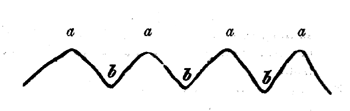
Salient Angle. In a zigzag line a a are the salient angles, b b the re-entering angles. Etym., salire, to leap or bound forward.
Salt Springs. Springs of water containing a large quantity of common salt. They are very abundant in Cheshire and Worcestershire, and culinary salt is obtained from them by mere evaporation.
Sandstone. Any stone which is composed of an agglutination of grains of sand, whether calcareous, siliceous, or of any other mineral nature.
Saurian. Any animal belonging to the lizard tribe. Etym., σαυρα, saura, a lizard.
Saxicavous. Hollowing out stone.
Schist is often used as synonymous with slate; but it may be very useful to distinguish between a schistose and a slaty structure. The hypogene or primary schists, as they are termed, such as gneiss, mica-schist, and others, cannot be split into an indefinite number of parallel laminæ like rocks which have a true slaty cleavage. The uneven schistose layers of mica-schist and gneiss are probably layers of deposition, which have assumed a crystalline texture. See "Cleavage." Etym., schistus, adj. Latin, that which may be split.
Schistose Rocks. See "Schist."
Scoriæ. Volcanic cinders. The word is Latin for cinders.
Seams. Thin layers which separate two strata of greater magnitude.
Secondary Strata. An extensive series of the stratified rocks which compose the crust of the globe, with certain characters in common, which distinguish them from another series below them called primary, and from a third series above them called tertiary.
Secular Refrigeration. The periodical cooling and consolidation of the globe from a supposed original state of fluidity from heat. Sæculum, age or period.
Sedimentary Rocks are those which have been formed by their materials having been thrown down from a state of suspension or solution in water.
Selenite. Crystallized gypsum, or sulphate of lime—a simple mineral.
Septaria. Flattened balls of stone, generally a kind of iron-stone, which, on being split, are seen to be separated in their interior into irregular masses. Etym., septa, inclosures.
Serpentine. A rock usually containing much magnesian earth, for the most part unstratified, but sometimes appearing to be an altered or metamorphic stratified rock. Its name is derived from frequently presenting contrasts of color, like the skin of some serpents.
Shale. A provincial term, adopted by geologists, to express an indurated slaty clay. Etym., German schalen, to peel, to split.
Shell Marl. A deposit of clay, peat, and other substances mixed with shells, which collects at the bottom of lakes.
Shingle. The loose and completely water-worn gravel on the sea-shore.
Silex. The name of one of the pure earths, being the Latin word for flint, which is wholly composed of that earth. French geologists have applied it as a generic name for all minerals composed entirely of that earth, of which there are many of different external forms.
Silica. One of the pure earths. Etym., silex, flint, because found in that mineral.
Silicate. A chemical compound of silica and another substance, such as silicate of iron. Consult elementary works on chemistry.
Siliceous. Of or belonging to the earth of flint. Etym., silex, which see. A siliceous rock is one mainly composed of silex.
Silicified. Any substance that is petrified or mineralized by siliceous earth.
Silt. The more comminuted sand, clay, and earth, which is transported by running water. It is often accumulated by currents in banks. Thus the mouth of a river is silted up when its entrance into the sea is impeded by such accumulation of loose materials.
Simple Mineral. Individual mineral substances, as distinguished from rocks, which last are usually an aggregation of simple minerals. They are not simple in regard to their nature; for when subjected to chemical analysis, they are found to consist of a variety of different substances. Pyrites is a simple mineral in the sense we use the term, but it is a chemical compound of sulphur and iron.
Sinter, Calcareous or Siliceous. A German name for a rock precipitated from mineral waters. Etym., sintern, to drop.
Slate. See "Cleavage" and "Schist."
Solfatara. A volcanic vent from which sulphur, sulphureous, watery, and acid vapors and gases are emitted.
Sporules. The reproductory corpuscula (minute bodies) of cryptogamic plants. Etym., σπορα, spora, a seed.
Stalactite. When water holding lime in solution deposits it as it drops from the roof of a cavern, long rods of stone hang down like icicles, and these are called stalactites. Etym., σταλαζω, stalazo, to drop.
Stalagmite. When water holding lime in solution drops on the floor of a cavern, the water evaporating leaves a crust composed of layers of limestone: such a crust is called stalagmite, from σταλαγμα, stalagma, a drop, in opposition to stalactite, which see.
Statical Figure. The figure which results from the equilibrium of forces. From στατος, statos, stable, or standing still.
Sternum. The breast-bone, or the flat bone occupying the front of the chest.
Stilbite. A crystallized simple mineral, usually white, one of the Zeolite family, frequently included in the mass of the Trap-rocks.
Stratified. Rocks arranged in the form of strata, which see.
Stratification. An arrangement of rocks in strata, which see.
Strata, Stratum. The term stratum, derived from the Latin verb struo, to strew or lay out, means a bed or mass of matter spread out over a certain surface by the action of water, or in some cases by wind. The deposition of successive layers of sand and gravel in the bed of a river, or in a canal, affords a perfect illustration both of the form and origin of stratification. A large portion of the masses constituting the earth's crust are thus stratified, the successive strata of a given rock preserving a general parallelism to each other; but the planes of stratification not being perfectly parallel throughout a great extent like the planes of cleavage, which see.
Strike. The direction or line of bearing of strata, which is always at right angles to their prevailing dip.
Stufas. Jets of steam issuing from fissures in volcanic regions at a temperature often above the boiling point.
Subapennines. Low hills which skirt or lie at the foot of the great chain of the Apennines in Italy. The term. Subapennine is applied geologically to a series of strata of the Older Pliocene Period.
Syenite. A kind of granite; so called, because it was brought from Syene in Egypt.
Talus. When fragments are broken off by the action of the weather from the face of a steep rock, as they accumulate at its foot, they form a sloping heap, called a talus. The term is borrowed from the language of fortification, where talus means the outside of a wall of which the thickness is diminished by degrees, as it rises in height, to make it the firmer.
Tarsi. The feet in insects, which are articulated, and formed of five or a less number of joints.
Tertiary Strata. A series of sedimentary rocks, with characters which distinguish them from two other great series of strata—the secondary and primary—which lie beneath them.
Testacea. Molluscous animals, having a shelly covering. Etym., testa, a shell, such as snails, whelks, oysters, &c.
Thallogens. A class of flowerless plants including all those that have no defined axis, stem, or leaves; as Lichens, Seaweeds, and Fungi. Etym., θαλλος, thallos, a branch, and γενεσις, genesis, increase.
Thermal. Hot. Etym., θερμος, thermos, hot.
Thermo-electricity. Electricity developed by heat.
Thin Out. When a stratum, in the course of its prolongation in any direction, becomes gradually less in thickness, the two surfaces approach nearer and nearer; and when at last they meet, the stratum is said to thin out or disappear.
Trachyte. A variety of lava essentially composed of glassy felspar, and frequently having detached crystals of felspar in the base or body of the stone, giving it the structure of porphyry. It sometimes contains hornblende and augite; and when these last predominate, the trachyte passes into the varieties of trap, called Greenstone, Basalt, Dolorite, &c. The term is derived from τραχυς, trachus, rough, because the rock has a peculiar rough feel.
Trap and Trappean Rocks. Volcanic rocks composed of felspar, augite, and hornblende. The various proportions and state of aggregation of these simple minerals, and differences in external forms, give rise to varieties, which have received distinct appellations, such as Basalt, Amygdaloid, Dolorite, Greenstone, and others. The term is derived from trappa, a Swedish word for stair, because the rocks of this class sometimes occur in large tabular masses, rising one above another like steps.
Travertin. A white concretionary limestone, usually hard and semi-crystalline, deposited from the water of springs holding lime in solution.—Etym. This stone was called by the ancients Lapis Tiburtinus, the stone being formed in great quantity by the river Anio, at Tibur, near Rome. Some suppose travertin to be an abbreviation of trasterverino from transtiburtinus.
Tripoli. The name of a powder used for polishing metals and stones, first imported from Tripoli, which, as well as a certain kind of siliceous stone of the same name, has been lately found to be composed of the flinty cases of Infusoria.
Trophi, of Insects. Organs which form the mouth, consisting of an upper and under lip, and comprising the parts called mandibles, maxillæ, and palpi.
Tufa, Calcareous. A porous rock deposited by calcareous waters on their exposure to the air, and usually containing portions of plants and other organic substances incrusted with carbonate of lime. The more solid form of the same deposit is called "travertin," into which it passes.
Tufa, Volcanic. See "Tuff."
Tufaceous. A rock with the texture of tuff, or tufa, which see.
Tuff, or Tufa Volcanic. An Italian name for a variety of volcanic rock of an earthy texture, seldom very compact, and composed of an agglutination of fragments of scoriæ and loose materials ejected from a volcano.
Turbinated. Shells which have a spiral or screw-form structure. Etym., turbinatus, made like a top.
Turrilite. An extinct genus of chambered shells, allied to the Ammonites, having the siphuncle near the dorsal margin.
Unconformable. See "Conformable."
Unoxidized, Unoxidated. Not combined with oxygen.
Veins, Mineral. Cracks in rocks filled up by substances different from the rock, which may either be earthy or metallic. Veins are sometimes many yards wide; and they ramify or branch off into innumerable smaller parts, often as slender as threads, like the veins in an animal, hence their name.
Vertebrated Animals. A great division of the animal kingdom, including all those which are furnished with a back-bone, as the mammalia, birds, reptiles, and fishes. The separate joints of the back-bone are called vertebræ, from the Latin verb verto, to turn.
Vesicle. A small, circular, inclosed space, like a little bladder. Etym., diminutive of vesica, Latin for a bladder.
Vitrification. The conversion of a body into glass by heat.
Volcanic Bombs. Volcanoes throw out sometimes detached masses of melted lava, which, as they fall, assume rounded forms (like bomb-shells), and are often elongated into a pear-shape.
Volcanic Foci. The subterranean centres of action in volcanoes, where the heat is supposed to be in the highest degree of energy.
Wacke. A rock nearly allied to basalt, of which it may be regarded as a soft and earthy variety.
Warp. The deposit of muddy waters, artificially introduced into low lands. See p. 326.
Zeolite. A family of simple minerals, including stilbite, mesotype, analcime, and some others, usually found in the trap or volcanic rocks. Some of the most common varieties swell or boil up when exposed to the blow-pipe, and hence the name of ζεο, zeô, to boil, and λιθος, lithos, stone.
Zoophites. Corals, sponges, and other aquatic animals allied to them; so called because, while they are the habitation of animals, they are fixed to the ground, and have the form of plants. Etym., ζωον, zoon, animal, and φυτον, phyton, plant.
FOOTNOTES:
INDEX.
A.
Abich, M., on eruption of Vesuvius in 1834, 378, 380,, 550.
Abo, 522, 523.
Acosta cited, 499, 502.
Adams, Mr., on fossil elephant, 80.
Adanson on age of the baobab tree, 422.
Addison on Burnet's theory, 32.
Adige, embankment of the, 255.
——, delta of the, 257.
Adour, R., new passage formed by, 338.
Adria, formerly a seaport, 256.
Adriatic, deposits in, 36, 88, 71, 257, 774.
Ægean Sea, Prof. E. Forbes dredging in, 649.
Africa, fossil shells of, mentioned by ancients, 15.
——, indigenous quadrupeds of, 82.
——, heat radiated by, 94.
——, currents on coast of, 292, 342.
——, drift sands of deserts, 726.
——, devastations of locusts in, 674.
——, strata forming off tropical coast of, 774.
——, desert of its area, 694.
Agassiz, M., on fish of coal formation, 136.
——, on abrupt transition from one fossil fauna to another, 184.
——, on motion, &c., of glaciers, 224, 226.
Agricola on fossil remains, 21.
Airthrey, fossil whale found at, 771.
Alabama, coal plants, 88.
Alaska, volcanoes in, 352.
Aldborough, incursions of sea at, 311.
Alderney, race of, 293.
Aleutian Isles, eruptions, &c., in, 352, 468.
Alexandria, temple of Serapis at, 512.
Algæ, known provinces of, 617.
Allan, Dr., on coral in Madagascar, 778.
Alloa, whale cast ashore at, 771.
Alluvium, imbedding of organic remains in, 780.
——, volcanic, 386.
——, stalagmite, alternating with, in caves, 736.
Alps, Saussure on the, 45.
——, tertiary rocks of the, 119.
——, greatly raised during tertiary epoch, 124.
——, signs of lateral pressure in the, 171.
Altered rocks, 177.
Amazon, R., land formed by its deposits, 342.
——, animals floated down on drift-wood by, 640.
America, its coast undermined, 331.
——, recent strata in lakes of, 254, 768.
——, specific distinctness of animals of, 612, 629.
——, domesticated animals run wild in, 585, 685.
——, N., continuous beds of coal in, 115.
——, N., deposit "New red" like English, 158.
——, N. and S., mammiferous fauna of, 633.
Ammonia in lavas, 550.
Amonoosuck, flood in valley of, 209.
Ampère, M., on electric currents in the earth, 543.
Amphitherium, in oolite of Stonesfleld, 138.
Andes, changes of level in, 762.
——, height of perpetual snow on, 112.
——, volcanoes of, 346
——, sudden upheaval of, 170.
——, signs of lateral pressure in, 171.
Andesite, rock described, 347.
Angiospermous plants wanting in older rocks, 133.
Animals, extinction of, 700.
——, quantity of food required by large, 82.
——, Lamarck on production of new organs in, 568.
——, imported into America have ran wild, 585, 685.
——, aptitude of some kinds to domestication, 593, 598.
——, hereditary instincts of, 593.
——, domestic qualities of, 592, 595.
——, their acquired habits rarely transmissible, 595, 600.
——, changes in brain of fœtus in, 609.
——, plants diffused by, 623.
——, their geographical distribution, 76, 77.
——, migrations of, 685.
——, causes which determine the stations of, 669, 676.
——, influence of man on their distribution, 682.
——, fossil, in peat caves, &c., 722, 725, 730, 732, 749, 752.
Anio, R., flood of the, 212.
——, travertin formed by, 244.
Anoplotherium, fossil of Isle of Wight, 142.
Antarctic circle, area still unexplored, 99.
Antwerp, sunk region near, 327.
Apennines, their relative age, 119, 124
Aphides, account of a shower of, 656.
——, their multiplication, 673.
Aqueous causes, supposed former intensity of, 153.
——, their action described, 198.
Aqueous lavas, description of, 374, 385, 728.
Arabian Gulf filling with coral, 776.
Arabian writers, 17.
Arago, M., on influence of forests on climate, 715.
——, on solar radiation, 127.
——, on level of Mediterranean and Red Sea, 294.
——, on formation of ground ice, 221.
Araucanian tradition of a flood, 499.
Araucaria, fir in coal, 88.
Arbroath, houses, &c., swept away by sea at, 302.
Archiac, M., 257.
Arctic fauna extended farther south than now, 125.
Arduino, memoirs of, 41.
——, on submarine volcanoes, 41, 71.
Areas of elevation and subsidence proved by coral islands, 792.
Aristarchus, 212.
Aristotle, opinions of, 12.
——, on spontaneous generation, 22.
——, on deluge of Deucalion, 356.
Arkansas, R., 264
——, floods of, 270.
Arso, volcanic eruption of, in Ischia, 365.
Artesian well at Paris, temperature of water, 234.
——, well, at Fort William, near Calcutta, 280.
——, well in delta of Po, 257.
Artesian wells near London, 234.
——, wells, phenomena brought to light by, 233, 538.
Arve, sediment transported by the, 258.
——, section of débris deposited by, 289.
Ascension, Island of, bounded by lofty shores, 622.
——, fossil eggs of turtle from, 771.
Ashes, volcanic, transported to great distances, 106, 349, 464.
Asia, subject to earthquakes, 9.
——, coast of, changed, 18.
——, causes of extreme cold of part of, 94.
——, Minor, gain of land on coast of, 260.
——, Western, great cavity in, 692.
Ass, wild, 638, 686.
Astruc on Delta of Rhone, 258.
Atchafalaya, R., 264.
——, drift-wood in, 267.
Atlantic, mean depth of, 104.
——, its relative level, 294.
——, rise of the tide in, 295.
——, absence of coral reefs in, 796.
Atlantis, submersion of, 9.
Atolls described, 782, 786.
——, theory of, Mr. Maclaren's objections to, 792.
Atrio del Cavallo, 381.
Aubenas, fissures filled with breccia near, 741.
Austen, Mr. R. A. C., on shores of English Channel, 319.
——, on new strata formed in, 341.
Australia, animals of, 139, 143, 684.
——, coral reefs of, 776, 784
——, land quadrupeds of, 633.
Auvergne, salt springs in, 248.
——, carbonic acid gas disengaged in, 248.
——, state of in tertiary period, 122.
——, fossils in volcanic ashes of, 349.
——, volcanic rocks of, 48.
——, tertiary red marl and sandstone of, 158.
Ava, fossils of, 28.
Avantipura, in Cashmere, 763.
Avernus lake, 368.
Avicenna on cause of mountains, 17.
Axmouth, great landslip near, 321.
Azores, icebergs drifted to, 99.
——, volcanic line from, to central Asia, 354
——, siliceous springs of, 246.
B.
Babbage, Mr., on the coast near Puzzuoli, 507.
——, on Temple of Serapis, 517.
——, on expansion of rocks by heat, 562.
Bachman, Mr., on birds, 643, 644.
Bacon, Lord, cited, 765.
Baden, gypseous springs of, 245.
Baffin's Bay, icebergs in, 96.
Bagnes, valley of, bursting of a lake in the, 210.
Baiæ, changes on coast of the bay of, 507.
——, ground plan of the coast of, 507.
——, sections in bay of, 508, 510.
Baker, on Caspian, mud volcanoes at, 448.
Baker, Lieut., on fossil quadrumana, 144.
Bakewell, Mr., on formation of soils, 709.
——, on fall of Mount Grenier, 782.
Bakewell, Mr. jun., on Falls of Niagara, 217.
Bakie loch, charæ fossil in, 767.
Baku, inflammable gas of, 11, 355.
Balaruc, thermal waters of, 259.
Baldassari, on Sienese fossils, 39.
Balize, mouth of Mississippi, 263, 272.
Baltic Sea, lowering of level of, 520.
——, drifting of rocks by ice in, 219, 231.
——, currents on its shores, 330.
Banks of Mississippi higher than alluvial plain, 266.
Baobab tree, its size, probable age, &c., 422.
Barbadoes, rain diminished by felling of forests in, 713.
Barren Island described, 447.
Barrow, Mr., on a bank formed in sea by locusts, 675.
Barrow, Mr. jun., on the Geysers of Iceland, 247.
Barton, Mr., on geography of plants, 612.
Basalt, opinions of the early writers on, 48, 71.
Batavia, effects of earthquake at, 502.
Baton Rouge, in Louisiana, 265.
Bay of Bengal, its depth, recent deposits in, &c., 279.
Bayfield, Capt., on geology of Lake Superior, 254.
——, on drifting of rock by ice, 221, 230.
——, on bursting of a peninsula by Lake Erie, 333.
——, on earthquakes in Canada, 470.
Beaches, raised, 184.
Beachey Head, 317.
Bears, once numerous in Wales, 683.
——, black, migrations of, 637.
——, drifted on ice, 679.
Beaufort, Sir F., on gain of land in Asia Minor, 260.
——, on rise of tides, 291.
Beaumont, M. Elie de, geological map of France, 122.
——, on pentagonal network of mountain chains, 170.
——, his theory of contemporaneous origin of parallel mountain chains considered, 163.
——, on structure and origin of Etna, 400, 416.
——, on sand-dunes, 307.
——, on inroads of sea in Holland, 327.
Beaver once inhabited Scotland and Wales, 683.
——, fossil in Perthshire, 752.
——, lake formed by, in New Brunswick, 716.
Beche, Sir H. de la. See De la Beche.
Bee, migrations of the, 655.
Beechey, Capt., upheaval of Bay of Conception, 500.
——, on drifting of canoes, 662.
——, on temple of Ipsambul, 727.
——, on coral islands, 780, 782, 787.
——, on changes of level in Pacific, 788.
——, on dead coral in Elizabeth Island, 794.
Beila, in India, mud volcanoes, 449.
Belcher, Sir E., on upheaval of Conception, 500.
——, on strata forming off coast of Africa, 774.
Bell, Mr., on the Dog, 585.
Bell rock, stones thrown up by storms on, 302.
Belzoni, on temple of Ipsambul, 726.
——, on a flood of the Nile, 753.
Benin, currents in Bay of, 292.
Bérard, M., on depth and temperature of Mediterranean, 296, 336.
Berkeley, on recent origin of man, 764.
Bermudas, only coral reef far out in Atlantic, 796.
——, coral reefs of the, 776, 778.
Bewick cited, 310, 643, 683.
Bhooj, in Cutch, destroyed by earthquake, 459.
——, volcanic eruption at, 460, 729.
Bies Bosch formed, 328.
Bigsby, Dr., on North American lakes, 768.
Birds, diffusion of plants by, 624.
——, geographical distribution of, 642, 663.
——, fossils in secondary rocks, 137.
——, tameness of, in uninhabited Islands, 597.
——, rate of flight of, 644.
——, migrations of, 643.
——, recent extermination of some species of, 683.
——, bones of, in Gibraltar breccia, 741.
——, rarity of their remains in new strata, 748.
——, rare in deposits of all ages, 137.
Bischoff, Professor, on volcanoes, 551.
——, on carbonic acid in extinct craters on Rhine, 248.
Biscoe, Capt., discoveries in south Polar Seas, 99.
Bison, fossil, in Yorkshire, 76.
Bisons, in Mississippi valley, 636.
Bistineau lake, 269.
Bitumen, oozing from bottom of sea, near Trinidad, 250.
Bituminous springs, 250.
Black Sea, salt by evaporation in, 335.
——. See Euxine.
Blue mountains in Jamaica, 505.
Bluffs of Mississippi described, 264.
Boa constrictor, migration of, 646.
Boase, Mr., on inroads of sea in Cornwall, 323.
——, on drift-sand in Cornwall, 728.
Boblaye, M., on ceramique, in Morea, 731.
——, on engulfed rivers and caves in Morea, 734.
——, on earthquakes in Greece, 736.
Bog iron-ore, whence derived, 722.
Bogota, earthquake of, 457.
Bonpland, on plants common to Old and New World, 614.
Bore, a tidal wave frequent in Bristol Channel and Ganges, 332.
Bory de St. Vincent, M., on isle of Santorin, 445.
Bosphorus, 334.
——, traditions of deluges on shores of the, 356.
Botanical evidence bearing on theory of progressive development, 133.
——, geography, 613.
——, provinces, their number, 616, 666, 668.
Bothnia, Gulf, gradual elevation of coast of, 520.
Bourbon, island, volcanic, 546.
Bournmouth, submarine forest at, 746.
Boussingault. M., on volcanoes in Andes, 348.
——, on gases evolved by volcanoes, 549.
Bowen, Lieut., on drifting of rocks by ice, 220, 230.
Boyle, on bottom of the sea, 26.
Bracini, on Vesuvius before 1631, 374.
Brahmapootra, delta of, 275, 278.
Brahmins, their doctrines, 4.
Brander, on fossils of Hampshire, 46.
Brandt, Professor, cited, 80.
——, on Wilui rhinoceros, 80.
Bravais, M., on upraised sea-coast in Finmark, 530.
Breccias, in Val del Bove, 411.
——, in caves now forming in the Morea, 734.
Brenta, delta of the, 256.
Brieslak, on temple of Serapis, 517.
——, on Vesuvius, 381, 384.
Briggs, Mr., his discovery of water in African desert, 235.
Brighton, waste of cliffs of, 317.
Brine springs, 247.
Bristol Channel, currents in, 293.
Brittany, village, buried under blown sand, 727.
——, marine tertiary strata of, 122.
——, waste of coast of, 324.
Brocchi, on fossil conchology, 20.
——, on Burnet's theory, 34.
——, on delta of Po, 257.
——, on extinction of species, 668.
——, on the Subapennines, 118.
Broderip, Mr., on opossum of Stonesfield, 139.
——, on shells from Conception Bay, 500.
——, on bulimi revived, 650.
——, on moulting of crabs, 653.
——, on naturalization of a foreign landshell, 664.
——, on the Dodo, 684.
Brongniart, M. Adolphe, 87.
——, on fossil plants of coal, 88, 117, 133.
——, on plants in islands, 112.
Brongniart, M. Alex., on modern lava streams, 427.
——, on elevated beaches in Sweden, 527.
Brown, Mr. R., on structure of vessels in myzodendron, 88.
——, on plants common to Africa, Guiana, and
Brazil, 621.
——, on wheat in Egyptian tombs, 587.
Buch. See Von Buch.
Buckland, Rev. Dr., on landslip near Axmouth, 321.
——, on fossil elephants, &c., in India, 7.
——, on fossils from Eschscholtz's Bay, 82.
——, on fossils in caves and fissures, 739, 740.
——, on Val del Bove, 402.
Buffon, his theory of the earth, 39.
——, reproved by the Sorbonne, 39.
——, on geographical distribution of animals, 590, 612, 629.
——, on extinction of species, 701.
Buist, Mr., on submarine forests in the estuary of Tay, 303.
——, on mud volcanoes in India, 448.
Bunbury, Mr., on coal plants of Alabama, 88.
——, on ferns in carboniferous era, 87.
Bunsen, Chevalier, on Ancient Egypt, 659.
Bunsen, Professor, on Geysers of Iceland, 558.
——, on mineral springs in Iceland, 246.
——, on mud volcanoes of Iceland, 447.
——, on solfataras of Iceland, 551.
Bunter Sandstein, fossils of, 193.
Bura, submerged Grecian town, 15, 762.
Buried cones on Etna, section of, 397.
——, temples of Cashmere, 762.
Burnes, Sir A., on Cutch, earthquake of, 461, 464.
Burnet, his theory of the earth, 31.
Burntisland, whale cast ashore near, 771.
Burrampooter, R., delta of the, 275. See Brahmapootra.
——, bodies of men, deer, &c. floated off by, 751.
Bustards recently extirpated in England, 688.
C.
Calabria, geological description of, 474.
——, earthquake of 1783 in, 471.
——, tertiary strata of, 74.
Calanna, lava of Etna turned from its course by hill of, 409, 410.
——, valley of, 402, 404.
Calcareous springs, 239.
Calcutta, artesian well at, 280.
Caldcleugh, Mr., on earthquake in Chili, 1835, 453.
——, on eruption of Coseguina, 349.
California, volcanoes in, 349.
Callao town destroyed by sea, 502.
——, changes caused by earthquakes at, 501, 761.
Camels, carcasses of, imbedded in drift sand, 727.
Campagna di Roma, calcareous deposits of, 242.
Campania, aqueous lavas in, 728.
Camper, on facial angle, 608.
Canada, earthquakes frequent in, 470.
——, climate of, 582.
——, probably colder in newest tertiary period, 125.
Canary Islands, eruptions in, 436.
Cannon in calcareous rock, 759.
——, account of one taken up near the Downs, 726.
Canoes drifted to great distances, 661.
——, fossil, 759.
Cape May, encroachment of sea at, 332.
——, of Good Hope, icebergs seen off, 100.
Capocci, M., on temple of Serapis, 518.
Caraccas, earthquakes in, 465, 470.
Carang Assam volcano, 465.
Carbonated springs, 248.
Carbonic acid, supposed atmosphere of, 248.
——, gas, its effects on rocks, 249.
Carboniferous series, 115, 137.
——, era, predominance of ferns in, 87.
——, era, climate in, 87.
——, flora, knowledge of, recently acquired, 126.
——, period, vast duration of, 249.
——, See Coal.
Cardiganshire, tradition of loss of land in, 324.
Cardium, locomotive powers when young, 652.
Caribbean Sea, tides in, 342.
Carpenter, Dr., observations on Mississippi R., 272.
——, on encroachment of sea at Lyme Regis, 321.
Carrara marble, 177.
Cashmere, temples buried in freshwater strata, 762.
Caspian, Pallas on former extent of, 45.
——, evaporation of the, 260.
——, its level, 156, 692.
Catalonia, devastation of torrents in, 713.
Catania, in part overwhelmed by lava, 400, 728.
——, destroyed by earthquakes, 503.
——, tools discovered in digging a well at, 753.
Catastrophes, theories respecting, 7.
Catcott, on deluges in different countries, 42.
Cattegat, devastations caused by current in the, 331.
Cautley, Capt., on buried Hindoo town, 731.
——, on fossil quadrumana, 144.
——, on bones in ancient wells, 740.
Caves, organic remains in, 732.
——, alternations of, and stalagmite in, 736.
——, on Etna, 401.
Celestial Mountains, 77, 355.
Celsius, on diminution of Baltic, 33, 521.
Central America, volcanoes of, 349.
——, Asia, volcanic line from, to the Azores, 354.
——, France, lavas excavated in, 213.
——, France, comparison between the lavas of Iceland and, 426, 427.
Centres, specific doctrine of, 630.
Centrifugal force, 534, 544.
Cephalonia, earthquakes in, 474.
——, infusoria in submarine caverns in, 389.
Cesalpino, on organic remains, 22.
Cetacea, geographical range of, 635.
——, migrations of the, 642.
——, imbedding of, in recent strata, 770.
——, fossil, absence of in secondary rocks, 145.
——, fossil in New Jersey chalk, 145.
——, rarity of in secondary rocks, 145.
Chagos coral isles, 783.
Chaluzet, calcareous spring at, 239.
——, volcanic cone of, 248.
Chambers, Robert, cited, 530.
Chamisso, M., on coral islands, 781.
Chamouni, glaciers of, 223.
Chara, growing in lakes of N. America, 768.
Charæ, fossilized, 767.
Charlevoix, chart of coast of Gulf of Mexico, 272.
Charpentier, M., on glaciers, 223, 227.
Cheirotherium, in old red sandstone and coal, 136.
Chemical theory of volcanoes, 542, 546.
Chepstow, rise of the tides at, 291.
Cheshire, brine springs of, 247.
——, waste of coast of, 324.
Chesil bank, 320.
Chesilton, overwhelmed by sea, 320.
Chili, earthquakes in, 65, 347, 357, 453, 457.
——, numerous volcanoes in, 346.
——, coast of, upheaved, 170, 172, 347, 455, 457.
Chiloe, 349.
Chimborazo, height of, 102.
China, climate of, 95.
——, earthquakes in, 355.
Chinese deluge, 7.
Chines, or narrow ravines, described, 319.
Chittagong, earthquakes at, 476.
Chockier, cave at, 736.
Chonos archipelago, rise of land in, 453.
Christchurch Head promontory, 319.
Christie, Mr., on plasticity of ice, 226.
Christol, M. de, on fossils in caves, 738, 739.
Chronology of Hebrew Scriptures, 659.
——, of Dr. Hales, 659.
Cimbrian deluge, 331.
Cisterna on Etna, how formed, 414.
Cities engulfed, 173.
Civita Vecchia, springs at, 243.
Clarke, Dr., on lava in motion, 377.
Cleavage, or slaty structure, 176.
Clermont, calcareous springs at, 239.
Climate of Europe, Raspe on former, 43.
——, changes of 75, 86.
——, change of, in northern hemisphere, 73, 123.
——, on causes of vicissitudes in, 92.
——, astronomical causes of fluctuations in, 126.
——, its influence on distribution of plants, 613.
——, effect of changes in, on range of species, 696.
——, influence of vegetation on, 713.
Climates, insular and excessive, 94.
Coal, modern, at mouths of Mackenzie, 743.
——, ancient beds, formed of plants, 90.
——, ancient, formed in deltas, 116.
——, fields, American, 115.
——, formed by plants which grow on the spot, 115.
——, period, warmth, moisture, &c. of climate, 126.
——, formation, fossil plants of the, 88, 115, 133.
——, climate indicated by, 91.
——, reptilian fossils in, 136.
——. See Carboniferous.
Colchester, Mr. W., on fossil quadrumana, 144.
Colebrooke, Mr. H. T., on age of Vedas, 4.
——, on crocodiles of the Ganges, 277.
——, Major R. H., on the Ganges, 277.
Colle, travertin of, 240.
Colombia, earthquakes in, 456.
Colonna, on organic remains, 23.
Columbia, R., submerged forest in, 270.
Conception, earthquakes at, 453, 456, 499, 761.
Conglomerates, now formed by rivers, &c., 289.
——, volcanic, 411, 438.
Coniferæ of coal, 133.
——, Araucarian, in coal, 88.
Consolidation of strata, 175.
Conybeare, Rev. W. D., on Lister, 26.
——, on landslip near Axmouth, 321, 322
Cook, Captain, on drifting of canoes far, 661.
——, on highland near the South Pole, 98, 99.
Copaic lake, 735.
Copernican theory, edicts against, repealed at Rome, 56.
Copiapo, earthquakes at, 347.
——, raised banks of shells at, 458.
Coral islands, 775, 776, 793.
——, origin of their circular form, 783.
——, linear direction of, 782.
——, rate of growth, 776.
——, downward movement slow and uniform, 791.
——, absence of, in Atlantic, &c., 796.
Coralline crag fossils, 142.
Corda, on palm wood in Bohemian coal, 88.
——, cited, 133.
Cordier, M., on rate of increase of heat in mines, 538, 539.
——, his theory on central heat and fluidity, 540.
——, on tides in the internal melted ocean, 541.
Cordilleras shaken by earthquakes, 457, 466.
——, parallel ridges successively upheaved, 170.
Corinth, decomposition of rocks in, 733.
Cornwall, waste of cliffs of, 323.
——, land inundated by drift-sand in, 727.
——, temperature of mines in, 538.
Coromandel, inundations of sea on coast of, 730.
Coseguina volcano, great eruption of, 347.
Cosmogony distinct from geology, 3.
——, of the Hindoos, 4.
——, Egyptian, 8.
——, of the Koran, 18.
Cosmopolite shells, 650.
Coste, Capt., on elevation caused by earthquakes, 453.
Cotopaxi, 348, 560.
Covelli, M., on hot spring in Ischia, 456.
——, on Vesuvian minerals, 385.
Cowper, the poet, on age of earth, 55.
Crag strata, fossils of the, 142.
Craters of elevation, theory of, 371, 380, 415.
Crawfurd, Mr., his discovery of fossils in Ava, 28.
——, on eruption in Sumbawa, 106, 464, 465.
——, on drifting of canoes, 662.
Creation, supposed centres or foci of, 667.
——, epoch of, difference of opinion on, 660.
Cremona, lakes filled up near, 255.
Crocodiles imbedded by a river inundation in Java, 503, 748.
Cromer, waste of cliffs of, 306.
Cropthorn, fossils found at, 76.
Cruickshanks, Mr. A., on Chilian earthquake, 457.
Cuba, fossils in caves of, 741.
Culver, cliff, 318.
Cumana, earthquake of, 470.
Cunningham, Major, on buried temples of Cashmere, 764.
Cupressus thyoides, 725.
Currents from equatorial regions, 96.
——, from the pole to the equator, 107.
——, causes and velocity of, 293.
——, polar and tropical, direction of, 295.
——, destroying and transporting power of, 297, 340.
——, in estuaries, their power, 337.
——, in the Straits of Gibraltar, 333.
Currents, reproductive effects of, 337.
——, on the British shores, 339.
——, convey species from Antarctic to Arctic Ocean, 622.
Curtis, Mr., on ravages caused by aphides, 674.
——, on power of the Tipulæ to cross the sea, 657.
——, on number of British insects, 705.
——, on fossil insects, 748.
Curves of the Mississippi, 265.
Cutch, changes caused by earthquake of 1819 in, 469, 761.
Cuvier on durability of bones of men, 147, 757.
——, on crocodiles of Ganges, 277.
——, on variability in species, 583, 584.
——, on fish not crossing the Atlantic, 647.
——, on identity of Egyptian mummies with living species, 586.
——, on number of fishes, 705.
Cuvier, M. F., on aptitude of some animals to domestication, 593.
——, on influence of domestication, 595.
Cypris, fossil and living, 768.
D.
Dana, Mr., on Sandwich Islands, 354, 372, 383, 548.
——, on fragments of recent coral thrown up by Polynesian volcanoes, 372.
——, on Mount Loa, volcano, 552.
——, on "volcanoes no safety-valves," 552.
Dangerfield, Capt F., on buried cities In India, 729.
——, on Onjein, 729.
Daniell, Professor, on the trade winds, 106.
——, on melting point of iron, 539.
Dante cited, 52, 256.
Dantzic, waste of land near, 331.
Darby, on lakes formed by Red River, 269.
——, on delta of Mississippi, 272.
Darwin, Mr. C., on distribution of animals and plants, 77, 98, 141.
——, on vegetation required for support of large quadrupeds, 82.
——, Mr. C., on drifting of rocks by ice, 228.
——, on earthquakes, 347, 458, 456, 476, 753.
——, on earthquake waves, 497.
——, on rise of land, 458, 502.
——, on oolitic travertin, 439.
——, on great droughts in S. America, 696.
——, on peat of S. America, 719.
——, on coral islands, 779, 780, 782, 785, 789.
——, geology of S. America, 170.
——, on recent shells in Chili, 190.
——, on shingle on coast of S. America, 342.
——, map of coral reefs, 352, 791, 794.
——, on crateriform hills of Galapagos, 372.
——, infusoria brought home by, 388.
——, on new islands forming in Atlantic, 436.
——, on nat. hist. of Galapagos, 141, 597, 615, 616, 642.
——, on extinction of animals, 700.
Daubeny, Dr., on springs, 237.
——, on Mount Vultur, 356.
——, on Vesuvius, 380.
——, on decomposition of trachyte, 385.
——, on flowing of lava under water, 383.
——, on volcanoes, 548, 549, 550, 551.
D'Aubuisson cited, 58, 411.
Davis, Mr., on Chinese deluge, 7.
Davy, Sir H., on lake of the Solfatara, 243.
——, on formation of travertin, 243.
——, on theory of progressive development, 131.
——, on eruption of Vesuvius, 378.
——, on chemical agency of electricity, 542.
——, his theory of unoxidated metallic nucleus, 546.
——, on agency of air and water in volcanoes, 548, 550.
——, his analysis of peat, 718.
Davy, Dr., on Graham Island, 436, 549.
——, on helmet taken from sea near Corfu, 760.
De Beaumont. See Beaumont, De.
Debey, Dr., of Aix, on cretaceous dicotyledons, 133.
De Candolle, on hybrid plants, 605.
——, on distribution of plants, 613, 616.
——, on agency of man in dispersion of plants, 625.
——, on stations of plants, 670.
——, on barriers separating botanical provinces, 703.
——, on number of land plants, 705.
——, on longevity of trees, 422.
Dechen, Von, map of Germany, &c., 123.
Dee, R., bridge over, swept away by floods, 208.
Deer, their powers of swimming, 636.
——, diminished number in Great Britain, 683.
——, remains of, in marl lakes, 752.
De la Beche, Sir H., on rocks in S. Wales, 91.
——, on delta of Rhone in Lake of Geneva, 253.
——, on storm of Nov., 1824, 321.
——, on submarine forests, 323.
——, on earthquake of Jamaica, 1692, 504.
——, on action of rain in the tropics, 713.
De la Hire, on fossil wood from Ava, 1692, 28.
Delhi territory, elephants in, 81.
Delta of the Adige and Brenta, 256.
——, of the Brahmapootra or Burrampooter, 275.
——, of the Ganges, 275 to 284.
——, of the Mississippi, 263 to 275.
——, of the Mississippi, antiquity of. 271.
——, of the Nile, 261.
——, of the Po, 256.
——, of Rhone, in Lake of Geneva, 252.
——, of Rhone, in Mediterranean, 258.
Deltas, chronological computations of age of, 253, 285.
——, of Lake Superior, 253.
——, grouping of strata in, 286.
De Luc, his treatise on Geology, 56.
——, on conversion of forests into peat mosses, 721.
De Luc, M. G. A., his natural chronometers, 726.
Deluge, ancient theories on, 18, 23, 25, 31, 42, 155.
——, fossil shells referred to the, 20.
Deluges, local, how caused, 7, 269.
——, traditions of different, 7, 11, 42, 331, 356, 500, 501.
Demaillet, speculative views of, 572.
Denudation can only keep pace with deposition, 154.
——, effects of, 708.
Deposition of sediment, shifting of the area of, 188.
——, and denudation parts of the same process, 154.
Deshayes, M., on fossils of tertiary, 184.
Desmarest, his definition of geology, 3.
——, on Auvergne, 49.
Desnoyers, M., on human remains in caves, 739.
Desor, M., on glacier motion, 224.
Deucalion's deluge, 12.
Deville, M., on contraction of granite, 173.
——, on trachytes, 440.
Devonian strata formed in deep seas, 117.
Diatomaceæ, 388.
Dikes, composition and position of, 379.
——, how caused, 379.
Diluvial waves, no signs of on Etna, 423.
——, theory of earlier geologists, 25.
Diodorus Siculus cited, 357.
Dion Cassius cited, 364.
Dodo, recent extinction of the, 684.
Dog, varieties of the, 570, 584.
——, hybrids between wolf and, 601.
——, acquired instincts hereditary in, 593.
——, has run wild in America, 686.
Doggerbank, 340.
Dollart, formation of estuary of the, 329.
Dolomieu on Val di Noto, Vicentin, and Tyrol, 49.
——, on lavas of Etna, 49.
——, on decomposition of granite, 249.
——, on earthquake of 1783 in Calabria, 473, 475, 478, 480.
Domestication, aptitude of some animals for, 593, 599.
——, influence of, 595.
Don, river, rocks transported by, 208.
Donati on bed of Adriatic, 38, 71, 774.
Donny, Mr., cited, 557.
D'Orbigny, M. A., on abrupt transition from one fossil fauna to another, 184.
Dorsetshire, landslip in, 321.
——, waste of cliffs of, 319.
Dove, Mr., map of isothermal lines, 93.
Dover, waste of chalk cliffs of, 314.
——, depth of sea near, 315.
——, formation of Straits of, 315.
——, strata at foot of cliffs of, 314.
Downham buried by blown sand, 727.
Dranse, R., 210.
Drift, northern, fossil marine shells in, 186.
Drift-sand, fossils in, 727.
Drift-wood of Mississippi, 268.
——, abundant in North Sea, 744.
Drontheim, 529.
Droughts in S. America, animals destroyed by, 696.
Druids, their doctrines, 16.
Dufresnoy, M., geological map of France, 122.
——, on formation of Monte Nuovo, 371, 372.
——, on tuffs of Somma, 382.
——, on lavas of Vesuvius, 384.
Dujardin, M., on shells, &c., brought up by artesian well at Tours, 236.
Dumont, M., cited, 120, 328.
Dumoulin, M.. on earthquakes in Chili, 453.
Dunes, hills of blown sand, 305, 307.
Dunwich destroyed by the sea, 310.
Durand, Lieut., on fossil quadrumana, 144
Dureau de la Malle, M., cited, 584, 593.
Durham, waste of coast of, 303.
D'Urville, Capt, on temperature of Mediterranean, 296.
E.
Earth, antiquity of the, 21.
——, on changes in its axis, 80.
——, proportion of land and sea on surface, 125.
——, spheroidal form of the, 534.
——, mean density of the, 535.
——, attempt to calculate thickness of its crust, 536.
Earth, electric currents in the, 543.
——, sections of the (see figs. 70, 71), 539.
——, effects produced by powers of vitality on surface, 708.
Earthquakes, chronologically described, 458, et seq.
——, energy of, probably uniform, 58.
——, earth's surface continually remodelled by, 102.
——, recurrence of, at stated periods, accidental, 345.
——, felt at sea, 358.
——, land elevated by, 458, 455, 457, 462.
——, all countries liable to slight shocks of, 358.
——, phenomena attending, 452.
——, in Cutch, 1819 (see Map), 460.
——, in Calabria, 1783, 471.
——, difficulty of measuring the effects of, 477.
——, chasms formed by, 479.
——, excavation of valleys aided by, 488.
——, renovating effects of, 565.
——, cause of the wave-like motion of, 475, 558.
——, cause of great waves and retreat of sea during, 496, 498.
——, ravages caused by sea during, 499, 501, 730.
——, connection between state of atmosphere and, 561.
——, people entombed in caverns during, 736.
——, causes of volcanoes and, 533.
——, recurrence of, in certain zones of country, 172.
——, of Lisbon, area over which it extended, 496.
——, more frequent in winter, 561.
Eccles, old church of, buried under blown sand, 306.
Edmonstone Island, 279.
Eels, migration of, 647.
Egypt nearly exempt from earthquakes, 9, 358.
Egypt, towns buried under drift-sand in, 726.
——, date of civilization of, according to Bunsen, 636.
Egyptian cosmogony, 8.
——, mummies identical with living species, 585
Ehrenberg, on Bengal tiger in Siberia, 77.
——, on origin of bog-iron ore, 722.
——, on corals of Red Sea, 777.
——, on ashes enveloping Pompeii, 388.
——, on infusoria in volcanic tuff, 389.
Electricity, a source of volcanic heat, 542.
——, whence derived, 543.
Elephant, fossil, in ice, 45, 80.
——, covered with hair in Delhi, 81.
——, sagacity of, not attributable to intercourse with man, 598.
——, their powers of swimming, 636.
Elevation of land, how caused, 29, 448, 444, 453, 455, 457.
——, proofs of, slow and gradual, 170, 184, 518, 563.
Elevation and subsidence, proportion of, 564.
——, alternate areas of, in Pacific, 790.
Elevation crater theory, 371, 380, 420.
Elevation, valleys of, 420.
Elizabeth or Henderson's Island, upraised atoll of, 788, 794.
Elsa, travertin formed by the, 239.
Embankment, system of, in Italy, 255.
Emu in Australia will become exterminated, 684.
Englehardt on the Caspian Sea, 157.
England, waste of cliffs on coast of, 303.
——, slight earthquakes felt in, 358.
——, height of tides on coast of, 291, 308.
——, tertiary strata of, 76.
Eocene period, fossils of the, 142, 144, 183.
Epomeo, Mount, in Ischia, 362.
Equatorial current, 95.
Equinoxes, precession of the, 100, 537.
Erebus, Mount, the active volcano of, 99.
Erie, Lake, peninsula cut through by, 333.
——, waste of cliffs in, 333.
Erman, M., on eruptions in Kamschatka, 353.
Erratic blocks, 122, 154, 220.
——, icebergs charged with, 86.
Erratic blocks, submarine, laid dry by upheaval, 229.
Eruptions, volcanic, number of per year, 450.
——, cause of, 533.
Erzgebirge, mica slate of the, 48.
Escher, M., on flood in valley of Bagnes, 211.
Eschscholtz Bay, fossils of, 82.
Essex, tertiary strata of, 76.
——, inroads of sea on coast of, 311.
Estuaries, how formed, 327, 337.
——, imbedding of freshwater species in, 768.
Etna, description of and its eruptions, 396 to 424.
——, towns overflowed by lava of, 400, 728.
——, subterranean caverns on, 401.
——, a glacier under lava on, 412.
——, marine formations at its base, 401.
——, antiquity of cone of, 422.
Euganean Hills, lavas of, 359.
Euphrates, delta of advancing rapidly, 284.
Euxine burst its barrier, according to Strabo, 14.
——, gradually filling up, 14.
——. See Black Sea.
Evaporation, water carried off by, 260, 294, 334.
——, currents caused by, 294.
Everest, Rev. E., on climate of fossil elephant, 81.
——, on sediment of Ganges, 282.
Excavation of valleys, 488.
Expansion of rocks by heat, 560.
Extinction of species, 697, 701.
——, of animals, 700, 702.
F.
Fabio Colonna, 23.
Facial angle, 608.
Fair Island, action of the sea on, 301.
Falconer, Dr., on fossil quadrumana, 144.
——, on crocodiles of Ganges, 277.
Falconer, Dr., on peat near Calcutta, 280.
Falconi on elevation of coast of Baiæ, 367.
Falkland Islands, quadrupeds of, 141, 635.
Falloppio on fossils, 21.
Falls of Niagara, 214.
——, of St. Mary, 254.
Faluns of Touraine, 142.
Faraday, Mr., on water of the Geysers, 246.
——, on slow deposition of sulphate of baryta, 343.
——, on electric currents In the earth, 543.
——, on metallic reduction by voltaic agency, 548.
——, on liquefaction of gases, 560.
Faroe Islands, deposits forming near the, 774.
Farquharson, Rev. J., on floods in Scotland, 208.
——, on formation of ground ice, 222.
Faujas, on Velay and Vivarais, 1779, 49.
Faults, 162.
Fauna formerly as diversified as now, 160.
——, arctic, described by Sir J. Richardson, 634
Felspar, decomposition of, 247.
Ferrara on lavas of Etna, 283.
——, on floods on Etna, 412.
——, on earthquake in Sicily, 471.
Ferruginous springs, 247.
Fez, earthquakes in, 358.
Fife, trap rocks of, 160.
——, coast of, submarine forests on, 303.
——, encroachments of sea on, 203.
Findhorn town swept away by sea, 302.
Fish, their distribution, and migrations, 646.
——, fossil, 745.
——, fossil of coal formation, 136.
Fissures, sulphur, &c., ejected by, 470.
——, caused by Calabrian earthquake, 479, 480, 481.
——, caused by earthquake near New Madrid, 468.
——, preservation of organic remains in, 732.
Fitton, Dr., on history of English geology, 51.
Fitzroy, Capt., on earthquake in Chili, 1835, 453, 455.
Flamborough Head, waste of, 303.
Fleming, Dr., on uniformity in climate, 74.
——, on fossil elephant, 76.
——, on submarine forests, 303.
——, on rapid flight of birds, 646.
——, on turtles taken on coast of England, 645.
——, on changes in the animal kingdom caused by man, 683.
——, on stranding of cetacea, 771.
Flinders on coral reefs, 776, 791.
Flint on course of Mississippi, &c., 264, 265.
——, on earthquakes in Mississippi valley, 466.
Floods, by bursting of lakes, 269.
——, in North America, 209.
——, in valley of Bagnes, 210.
——, in Scotland, 207, 750.
——, traditions of, 499, 501.
——, causes which may give rise to, 156.
——, at Tivoli, 211.
——, caused by melting of snow by lava, 348, 411.
——. See Deluge.
Flysch, of the Alps, eocene, 124.
Folkstone, subsidence of land at, 316.
Fontenelle, his eulogy on Palissy, 23.
Foot-marks, fossil, in North America, 136.
Forbes, Prof. E., on glacial epoch, 86.
——, on fossils of tertiary, 184.
——, on new island in Gulf of Santorin, 443.
——, on regions of depth in Ægean Sea, 649.
——, on migration of mollusca, 651.
——, cited, 703.
Forbes, Prof. J. D., on glacier motion, 224.
——, on rate of flowing of lava, 378, 400.
——, on temple of Serapis, 515, 517.
Forchhammer, Dr., on boulders drifted by ice, 231.
——, on peat, 719.
Forests, influence of, 712, 713, 715.
——, sites of, now covered by peat, 720.
——, destroyed by insects, 717.
——, submarine, 303, 323, 746.
Forests, submerged. In Colombia R. by landslides, 215.
Forfarshire, waste of coast of, 302.
——, marl lakes of, 766, 796.
Forshey, Mr., on Mississippi, 264, 271.
Forster, Mr., on coral reefs, 778.
Forsyth on climate of Italy, 395.
Fortis cited, 42.
——, views of Arduino confirmed by, 48.
——, and Testa on fossil fish, 44.
Fort William, near Calcutta, artesian well, 280.
Fossiliferous formations, breaks in the series, 180.
Fossilization of organic remains on emerged land, 718, 775.
——, in peat mosses, 722.
——, In caves and fissures, 732.
——, in alluvium and landslips, 730.
——, in volcanic formations on land, 349, 728.
——, in subaqueous deposits, 742, 753.
——, in marl lakes, 752.
Fossils, early speculations concerning their nature, 19, 24 to 27.
——, distinctness of secondary and tertiary, 119.
——, mammiferous of tertiary eras, 137, 140.
——, why distinct in successive groups, 190.
——, See Organic Remains.
Fossil trees, upright position of some, 91.
Fourier, Baron, on temperature of spaces surrounding our atmosphere, 108.
——, on central heat, 127.
——, on radiation of heat, 127.
Fox, Mr., on heat in mines, 538.
——, on electric currents in the earth, 543.
France, waste of coast of, 324.
——, caves of, 737.
Franconia, caves of, 736.
Franklin, on a whirlwind in Maryland, 619.
Fremont, Capt., on submerged forests in Columbia, 270.
Freshwater plants and animals fossilized, 766, 768.
——, strata in Cashmere, 762.
Freyberg, school at, 46, 52.
Fries, on dispersion of cryptogamic plants, 620.
Fringing reef, nature and origin of, 785.
——, upraised, 794.
Fuchsel, opinions of, 1762, 43.
Funchal. rise of sea at, during earthquake, 496.
Fundy, Bay of, wave called the "bore" in, 332.
G.
Gaillonella ferruginea, 722.
Galapagos, peculiar character of the fauna of 139, 635, 643.
——, island, tameness of birds in, 597.
——, Archipelago, craters form hills in, 372.
Galongoon, great eruption of, 353, 430.
Gambier coral island, 783, 787.
Ganges, delta of, and Brahmapootra, 275 to 284.
——, antiquity of delta of, 281.
——, quantity of sediment in waters of, 278.
——, islands formed by the, 276.
——, bones of men found in delta of. 757.
——, artesian borings in delta of, 268.
Gardner, Mr., on unexplored Antarctic land, 99.
Gases, liquefaction of, 560.
——, evolved by volcanoes, 549.
Gefle, upraised shelly deposits near, 526, 528.
Gemmellaro on Etna, 408.
——, on ice under lava, 412.
Generation, spontaneous, theory of, 22.
Generelli. on state of geology in Europe in middle of eighteenth century, 35, 53.
Geneva, lake of, delta of Rhone in, 252.
Geognosy of Werner, 46.
Geographical distribution of plants, 613.
——, of animals, 629.
——, of birds, 642.
——, of reptiles, 644.
——, of fishes, 646.
——, of testacea. 649.
——, of zoophytes, 653.
Geographical distribution of insects, 654.
——, of man, 659.
Geography, proofs of former changes in physical, 114, 121.
——, effect of changes in, on species, 690.
Geological society of London, 59.
——, theories, causes of error in, 61.
Geology defined, 1.
——, distinct from cosmogony, 3.
——, causes of its retardation, 24, 55, 61.
——, state of, before eighteenth century, 86.
——, modern progress of, 58.
Georgia, Island of, snow to level of sea in, 99, 108.
——, U. S., new ravines formed in, 205.
Gerbanites, an Arabian sect, their doctrines, 14.
German Ocean, filling up, 340.
Gesner, John, on organic remains, 41.
Geysers of Iceland, 533, 553.
——, cause of their intermittent action, 555.
Gibraltar, birds' bones in breccia at, 740.
——, Straits of, 383.
Gironde, tides in its estuary, 338.
Glacial epoch, 75.
Glacier under lava, on Etna, 412.
——, moraines of, 223.
——, view of, 223.
Glaciers, formation of, 222 to 227.
——, motion of, 228.
——, of Spitzbergen, 96.
——, transportation of rocks by, 155.
Glen Tilt, granite veins of, 51.
Gloucestershire, gain of land in, 324.
Gmelin on distribution of fish, 648.
Goats, multiplication of, in South America, 686.
Goeppert, Prof., 87.
——, on fossilization of plants, 747.
Golden age, doctrine whence derived, 9.
Goodwin Sands, 314.
Gothenburg, rise of land near, 526.
Graab, Capt., on subsidence of Greenland, 530.
Graham, Mrs., on earthquake of Chili in 1822, 459.
Graham Island, newly formed in 1831, 432.
——, supposed section of, 435.
Granite of the Hartz, Werner on, 47.
——, disintegration of, 221, 346.
——, formed at different periods, 177.
——, veins observed by Hutton in Glen Tilt, 51.
Grant, Capt., on Chilian earthquake, 462.
Graves, Capt., on diffusion of insects by winds, 656.
——, survey of Santorin by, 441.
Gray, Mr., on Mytilus polymorphus, 658.
Great Dismal Swamp, Virginia, 724.
Grecian Archipelago, new isles of the, 43.
——, volcanoes of the, 355, 442, 450.
Greece, earthquakes in, 355.
——, traditions of deluges in, 356.
Greeks, geology of, 13.
Greenland, why colder than Lapland, 94.
——, gradual subsidence of, 530, 562.
——, timber drifted to shores of, 745.
Grevllle, Dr., on drift sea-weed, 623.
Groins described, 818.
Grooves in rocks formed by glaciers, 155, 227, 228.
Grotto del Cane, 248.
Ground ice, 221.
——, transporting rocks in Baltic, 231.
Guadalonpe, human skeletons of 757.
Guatemala, active volcanoes in, 349.
Gulana, partly formed by sediment of Amazon, 342.
Guilding, Rev. L., on migration of Boa Constrictor, 646.
Guinea current, 296.
Guinea, New, mammalia of, 682.
Gulf stream, 96, 292, 294. 621.
——, stream aids migration of fish, 648.
Guyot, M., on glacier motion, 224.
Gyrogonite described, 766.
H.
Habitations of plants described, 614.
Hales, Dr., on epoch of the creation, 659.
Hall, Sir J., his experiments on rocks, 51.
——, Captain B., on flood in valley of Bagnes, 211.
——, on the trade-winds, 295.
——, on temple of Serapis, 512.
——, Mr., State Geologist of New York, 216, 218.
——, Mr. J., on temple of Serapis, 512.
Hamilton, Mr. W. J., on volcanoes near Smyrna, 355.
——, Sir W., on Herculaneum, 389.
——, on earthquake in Calabria, 473, 483, 485.
——, Sir W., on formation of Monte Nuovo, 367.
——, on eruption of Vesuvius in 1779, 377.
Hamilton, Sir C., on submerged houses in Port Royal, 504.
Hampshire, Brander on fossils of, 44.
——, submarine forest on coast of, 746.
Harcourt, Rev. W. V. V., on bones of mammoth, &c., in Yorkshire, 76.
Harris, Hon. C., on sunk vessel near Poole, 758.
——, on submarine forest, Hampshire, 746.
Hartmann, Dr., on fossils of Hartz, 48.
Hartz mountains, 48.
Harwich, waste of cliffs at, 811.
Hatfleld moss, trees found in, 721.
Head, Sir Edmund, on temple of Serapis, 512.
Heat, laws which govern the diffusion of, 93.
Heat, whether gradual decline of, in globe, 129.
——, expansion of rocks by, 561.
Heber, Bishop, on animals of Himalaya, 81.
Hecla, columnar basalt of, 48.
——, eruptions of, 424.
Helena, St, bounded by lofty shores, 622.
Heligoland, inroads of sea on, 329.
Helix, range of species of, 650.
Henderson on eruption of Skaptar Jokul, 1783, 425.
Henderson's Island described, 788.
Henslow, Rev. Prof., on the cowslip, 590.
——, on diffusion of plants, 624.
Herbert, Hon. Mr., on varieties and hybrids in plants, 590, 605.
Herculaneum, 385, 389.
Herne Bay, waste of cliffs in, 312.
Herodotus cited, 8, 261.
Herschel, Sir J. F. W, on varying heat received
by the two hemispheres, 100.
——, on astronomical causes of changes in climate, 126.
——, on variable splendor of stars, 128.
——, on the trade-winds, 297.
——, on height of Etna, 396.
——, on form of the earth, 534.
——, on Geysers of Iceland, 555.
——, on the effects of heat on seeds, 621.
——, on the author's theory of climate, 92.
Herschel, Sir W., on the elementary matter of the earth, 533.
Hewett, Capt, on rise of tides, 291.
——, on currents, 293.
——, on banks in North Sea, 308, 340.
Hibbert, Dr., on the Shetland Islands, 299, 300.
Hilaire, M. Geof. St., on animal kingdom, 567.
Himalaya mountains, animals inhabiting the, 81.
——, height of perpetual snow on, 112.
Hindoo cosmogony, 4.
——, town buried, 731.
Hindostan, earthquakes in, 494.
Hippopotamus indicates warmth of river, 75.
Hitchcock, Report on Geol. of Massachusetts, 137.
Hoff, Von, on level of Caspian, 18.
——, on encroachments of sea, 331, 332.
——, on earthquakes, 359.
——, on human remains in delta of Ganges, 757.
——, on a buried vessel, 758.
Hoffmann, M., on lavas of Vesuvius, 379.
——, on Etna, 415, 416.
Holland, gradual sinking of coast, 327.
——, inroads of sea in, 328.
——, submarine peat in, 770.
Hooke on duration of species, 27, 28.
——, on earthquakes, 27, 29, 503.
Hooker, Dr. J., on Icebergs in antarctic seas, 229.
——, on tropical plants, 614.
——, floras of islands in Southern Ocean, 615.
——, on flora of Galapagos Islands, 616.
——, on wide range of certain plants, 618, 621, 623.
——, on delta of Ganges, 280.
——, on rain in India, 200.
Hocker, Sir W., on eruption of Skaptar Jokul, 425.
——, his view of the crater of the great Geyser, 554.
——, on drifting of a fox on ice, 680.
Hopkins, Mr., on glacier motion, 224, 225.
——, on thickness of earth's crust, 536.
Hopkins, Mr., on astronomical causes of change of climate, 128.
——, on changes of climate, 93.
——, on earthquakes, 453.
——, on M. E. de Beaumont's theory of mountain chains, 170.
Hordwell, loss of land at, 318.
Horner, Mr., on brine springs, 247.
——, on submarine forest in Somersetshire, 323.
——, dissertation on coal, 91.
Horsburgh, Capt, on icebergs in low latitudes, 99.
Horsburgh on coral islands, 782, 787.
Horses drowned in rivers in South America, 750.
Horsfield, Dr., on earthquakes in Java, 471, 494.
——, on distribution of Mydaus meliceps in Java, 639.
Hubbard, Prof., cited, 210.
Huc, on Yaks frozen in ice in Thibet, 85.
Human race geologically modern, 660.
Human remains in peat mosses, 722.
——, in caves, 735, 736, 739.
——, their durability, 147, 757.
——, in delta of Ganges, 757.
——, in calcareous rock at Guadaloupe, 757.
——, in breccias in the Morea, 735.
Humber, warp of the, 288.
——, encroachment of sea in its estuary, 304
Humboldt on laws regulating diffusion of heat, 93.
——, on preservation of animals in frozen mud, 85.
——, on distribution of land and sea, 109.
——, on transportation of sediment by currents, 342.
——, his definition of volcanic action, 345.
——, on mud eruptions in the Andes, 348.
——, on volcanic eruptions in Tartary, 355.
——, on eruption of Jorullo, 428.
——, on earthquakes, 466, 470.
——, on distribution of species, 613, 614.
——, on migrations of animals, 644, 656, 685.
——, cited, 8, 77, 84.
——, on earthquake in New Madrid, 466.
——, on earthquake of Lisbon, 495.
——, on mud volcanoes, 448.
Humboldt, W. von, on dawn of oriental civilization, 659.
Humming-birds, distribution, &c., 97, 643.
Hunter, John, on mule animals, 601.
Huron, Lake, recent strata of, 768.
Hurricanes connected with earthquakes, 731.
——, plants drifted to sea by, 745.
Hurst Castle shingle bank, 318.
Hutchinson, John, his "Moses's Principia," 33.
Hutton, distinguished geology from cosmogony, 3.
——, on igneous rocks and granite, 51.
——, represented oldest rock as derivatives, 52.
Huttonian theory, 51, 57.
Hybrid races, Lamarck on, 572.
——, animals, 600.
——, plants, 602.
Hydrogen, deoxidating power of, 547.
——, flame of; seen in eruption of Vesuvius, 378.
——, why not found in a separate form among volcanic gases, 548.
Hydrophytes, distribution of, 617, 623.
Hydrostatic pressure of ascending lava, 416, 553.
Hypogene rocks, 178.
Hyracotherium, Eocene mammifer, 142.
Hythe, encroachments of sea at, 316.
I.
Ianthina fragilis, its range, &c., 650.
Ice, animals imbedded in, 83.
Ice of rivers, transporting power of, 219.
——, drift, influence of, on temperature, 95.
——, predominance of, in antarctic circle, 98.
——, formation of field, 107.
——, transportation of rocks by, 155, 219, 521.
Icebergs, formation of, 96, 97.
——, distance to which they float, 100, 227.
——, limits of glaciers and, 228.
——, plants and animals transported by, 622, 639.
——, action of, when stranded, 228.
——, rocks transported by. See Ice.
——, floating in Northern hemisphere, 86.
——, not all formed by glaciers, 228.
Iceland, icebergs stranded on, 97.
——, geysers of, 246, 553, 555.
Iceland, volcanic eruptions in, 424.
——, comparison between the lavas of Central France and, 426.
——, new island near, 425.
——, polar bear drifted to, 679.
Igneous action. See Volcanic.
Igneous causes. See Book II.
——, the antagonist power to action of running water, 198, 563, 711.
Ilford, tertiary strata at, 76.
Imbedding of organic remains. See Fossilization.
India, buried cities in, 729, 731.
——, terrestrial mammalia of, 632.
Indo-pacific province of mollusca, 649.
Indus, delta of. recent changes in, 459, 769.
——, buried ships in, 758.
Infusoria in bog iron-ore, 722.
——, in volcanic rocks in Mexico, Peru, &c., 388.
Infusorial tuff, Pompeii, 388.
Inland cliffs, no proof of sudden elevation, 531.
——, seas, deltas of, 255.
Insects, geographical distribution of, 654.
——, certain types of, distinguish particular countries, 655.
——, their agency in preserving an equilibrium of species, 671.
——, fossil, 748.
Instincts, migratory, occasional development of, in animals, 642.
——, hereditary, 593, 596.
——, modified by domestication, 595.
Insular climates, description of, 94.
Inverness-shire, inroads of sea on coast of, 302.
Irawadi, R., silicified wood of, noticed in 1692, 28.
Ireland, raised beaches on coast of, 122.
——, reptiles of, 645.
——, peat of, and fossils in, 719, 720, 724
——, deposits in progress off coast of, 774.
Iron, melting point of, 539.
——, in wood, peat, &c., 722.
——, instruments taken up from sea, 760.
Ischia, hot springs of, 247, 456.
——, eruptions and earthquakes in, 360, 365, 456.
Islands, vegetation of small, 112, 615, 667.
——, animals in, 635.
——, formed by the Ganges, 276.
——, migrations of plants aided by, 622.
——, new volcanic, 43, 425, 432, 468.
——, coral, 775.
——, of driftwood, 640.
Isle of Purbeck, vertical chalk in, 318.
Isle of Wight, mammiferous fossils of, 142.
——, waste of its shores, 317.
Isothermal lines, Humboldt on, 95.
Italian geologists, their priority, 19, 23.
——, of the 18th century, 33.
Italy, tertiary strata of, 64, 74.
J.
Jack, Dr., on island of Pulo Nias, 794.
Jamaica, earthquakes in, 350, 504, 517.
——, subsidence in, 504, 517.
——, rain diminished in, by felling of forests, 713.
——, a town swept away by sea in, 731.
Java, volcanoes and earthquakes in, 354, 464, 498, 502.
——, valley of poison in, 353.
——, subsidence of volcano of Papandayang in, 493.
——, river-floods in, 503, 748, 751.
Jones, Sir W., on Institutes of Hindoo law, 5.
Jorullo, eruption of, 349, 428.
Juan Fernandez, 357, 453, 499, 686.
Jukes, Mr., on cliffs in Island of Timor, 794.
——, on volcanic islands near Java, 354.
——, on coral reef, 784.
Jura, Saussure on the, 45.
Jutland, inroads of sea in, 330.
K.
Kamtschatka, volcanoes in, 353.
——, new island near, 468.
Kangaroo, extirpation of; to Australia, 684.
Kashmir. See Cashmere.
Katavothrons of Greece, breccias formed in, 734.
Kazwini on changes in position of land and sea, 19.
Keilhan, Prof., of Christiana, on changes of level in Norway, 529, 531.
Keith on dispersion of plants, 620.
Kent, loss of land on coast of, 312.
Kentucky, caves in limestone, 733.
Keyserling, Count, on lowland of Siberia, 84.
Kincardineshire, village in, washed away by sea, 302.
King, Captain P., on humming birds in Tierra del Fuego, 97, 643.
——, on currents in Straits of Magellan, 293.
——, on coral reefs, 788.
King, Mr., on cattle lost in bogs in Ireland, 723.
——, on submerged cannon, 759.
Kinnordy, Loch of, insects in marl in, 748.
——, canoe in peat of, 759.
Kirby, Rev. Mr., on insects, 606, 655, 673, 674.
Kirwan, his geological Essays, 56.
——, on connection of geology and religion, 56.
Knight, Mr., on varieties of fruit trees, 589.
König, Mr., on Guadaloupe human skeleton, 757.
——, on fossils from Melville Island, 88.
Koran, cosmogony of the, 17.
Kotzebue on drifted canoe, 662.
Kunker, concretionary limestone of Ganges, 280.
Kurile Isles, active volcanoes in, 353.
L.
Labrador, drift-timber of, 745.
——, rocks drifted by ice on coast of, 230.
Laccadive Islands, 782.
Lagoons, or salt lakes, in delta of Rhone, 259.
——, of coral islands, 780.
Lagullas current, 95.
Lagunes on coast of Adriatic, 256.
Lake Erie. See Erie, Lake.
——, of Geneva. See Geneva, Lake of.
——, Maeler, 524, 528.
——, Superior. See Superior, Lake.
Lakes, filling up of 252.
——, formation of; in basin of Mississippi, 466, 269.
——, formed by earthquakes, 466, 481, 505.
——, crescent-shaped, in plain of Mississippi, 266.
——, Canadian, strata forming in, 768.
Lamarck, his definition of species, 567.
——, on transmutation of species, 567, 587, 696, 699.
——, on conversion of orang into man, 575.
——, on numbers of polyps, 706.
Lancashire, fossil canoes in, 759.
Lancerote, eruptions in, 436, 439.
Land, quantity of, in northern and southern hemispheres, 102, 109, 110.
——, upraised at successive periods, 118, 119.
——, proofs of existence of, at all periods, 188.
——, proportion of sea and, 124.
——, elevation of, how caused, 171, 453, 457, 459, 562.
Landslips, 319, 321, 485, 505.
——, imbedding of organic remains by, 732.
Languedoc, deposits on coast of, 260.
Laplace on change in the earth's axis, 32.
——, on mean depth of Atlantic and Pacific, 104.
——, on no contraction of globe, 129.
——, on mean density of the earth, 536.
Lapland, why milder than Greenland, 94.
——, migrations of animals in, 637.
Lateral pressure caused by landslips, 322.
——, pressure in Andes and Alps, 171.
Latham, Dr. R. G., on Natural History of Man, 609.
Lauder, Sir T. D., on floods in Scotland, 208, 686, 730, 748.
Lava excavated by rivers, 213.
——, effects of decomposition on, 385.
——, flowing of, under water, 383.
——, hydrostatic pressure of ascending, 552.
——, of Iceland and Central France, 426, 427.
——, comparative volume of ancient and modern, 161, 427.
——, pretended distinction between ancient and modern, 438.
——, mineral composition of, 449, 551.
——, rate of flowing, 378, 400.
Lazzaro Moro, See Moro.
Lehman, treatise of, 1759, 40.
Leibnitz, theory of, 26.
Leidy, Dr., on Priscodelphinus, 145.
Lemings, migrations of, 637.
Lena, R., fossil bones on banks of, 78, 80.
Leonardo da Vinci, 19.
Lewes, human bones in tumulus near, 739.
——, estuary recently filled up near, 748, 768.
Liege, caves near, 737.
Light, influence of, on plants, 89.
Lightning, effect of, in Shetland Islands, 299.
Lignite, conversion of wood into, 759.
Lima destroyed by earthquake, 501.
——, elevated recent marine strata at, 502.
Lime, whence derived, 796.
Lincolnshire, inroads of sea on coast of, 304.
Lindley, Dr., on fossil plants of Melville Islands, 88.
——, on number of plants, 705.
——, on dispersion of plants, 620.
——, on fossil plants of coal, 88, 133.
——, cited, 133.
Linnæus on filling up of Gulf of Bothnia, 521.
——, on subsidence of Scania, 530.
——, on constancy of species, 568.
——, on real existence of genera, 578.
——, on diffusion of plants, 624, 626.
——, on introduction of species, 665.
——, cited, 671.
Lionnesse tradition in Cornwall, 324.
Lippi on Herculaneum and Pompeii, 387.
Lipsius, 12.
Lisbon, earthquakes at, 358, 495.
Lister, first proposed geological maps, 26.
——, on fossil shells, 26.
Lloyd, Mr., on levels of Atlantic and Pacific, 294.
Loa, Mount, volcano of Sandwich Isles, 552.
Locusts, devastations of, 674.
——, bank formed in sea by, 675.
Loess of the Rhine, 185.
——, of the Mississippi valley, 265.
Loire, tertiary strata of the, 142.
London, artesian wells near, 234.
London basin, tertiary deposits of, 121.
——, clay, its fossils, 142, 144.
Lowestoff Ness described, 309.
——, cliffs undermined near, 309.
Lowland of Siberia, 78, 80, 83, 85.
Luckipour, on the Ganges, 276, 277.
——, new islands formed near, 276.
Luckput, subsidence near, 460.
Lund, Dr., on fossil quadrumana, 144.
Lybian sands, caravans overwhelmed by, 727.
Lyme Regis, waste of cliffs at, 321.
Lym-Fiord, breaches made by the sea in, 330.
M.
MacClelland, Dr., on earthquakes In Chittagong, 494.
——, on volcanic line In Bay of Bengal, 354.
MacCulloch, Dr., on gradation from peat to coal, 719.
——, on origin of limestones, 796.
Macacus pliocenus of Owen, fossil in valley of Thames, 144.
——, Suffolk Eocene species, 144.
Macaluba, in Sicily, mud volcanoes, 447.
Mackenzie, Sir G., his section of geyser, 556.
——, on reindeer in Iceland, 686.
Mackenzie River, driftwood of, 90, 743.
——, floods of, 84.
Maclaren, Mr. C., on Graham Island, 435.
——, on quantity of useful soil in America, 687.
——, on position of American forests, 714
——, remarks, theory of atolls, 792.
Macmurdo, Captain, on earthquake of Cutch, 460.
Madagascar, extent of coral near, 776.
——, assemblage of quadrupeds in, 632.
Madrid, New, great earthquake at, 466.
——, sunk country near it, 270.
Maeler, lake, 524, 528.
Magellan, Straits of, tides in, 291, 293.
Magnesia deposited by springs, 283.
Magnesian limestone and travertin compared, 240.
Magnetism, terrestrial, phenomena of, 543.
——, solar, 129.
Mahomet, his cosmogony, 18.
Malabar, coral near, 776.
Maldive Islands, coral reefs of, 778, 782.
Mallet, Captain, on petroleum of Trinidad, 250.
Mallet, Mr., on the dynamics of earthquakes, 453, 475.
——, on whirling motion during earthquakes, 476.
——, cited, 560.
——, on transit of the earth-wave, 483.
——, on theory of waves, 498.
Mammalia, different regions of indigenous, 629.
——, fossil, of successive tertiary periods. 138, 139.
——, imbedding of, in subaqueous strata, 749, 753.
Mammifer, fossil of trias, 137.
Mammoth, Siberian, 75.
——, bones of, in Yorkshire, 76.
Man, recent origin of, 147, 182, 687, 764.
——, why able to live in all climates, 609.
——, diffusion of, 657.
——, changes caused by, 150, 182, 630, 663, 681, 713.
——, durability of the bones of, 147, 757.
——, remains of, in osseous breccias of Morea, 735.
——, his remains and works fossil, 753.
Manetho, 63.
Mantell, Dr., on bones from Saxon tumulus, 788.
——, on Lewes levels, 748, 768.
Map of Siberia, 79.
——, of World, showing present unequal distribution of land and sea, 110.
——, showing position of land and sea, which might produce extremes of heat and cold, 111.
——, of Europe, showing extent of land covered by sea since commencement of tertiary period (Pl. I.), 121.
Map of coast from Nieuport to mouth of Elbe, 326.
——, of volcanoes from Philippine Islands to Bengal, 351.
——, of volcanic district of Naples, 361.
——, of Gulf of Santorin, 442.
——, of Chili, 454, 455.
——, of Cutch, 460.
——, of Calabria, 472.
——, of Sweden, 522.
Maracaybo, Lake, 466.
Marine deposits, imbedding of land quadrupeds in, 749, 752.
——, of human remains and works of art in, 756.
——, of freshwater species in, 768.
——, plants and animals imbedded in, 770.
Marine vegetation. 617, 622.
Marl lakes of Scotland, animals and plants fossilized in, 752, 766.
Marsili, on arrangement of shells in Adriatic, 36, 38, 40.
——, on deposits of coasts of Languedoc, 260.
Marsupial animals, distribution of, 633.
——, fossil, 138.
Martigny destroyed by floods, 211.
Martius, on drifting of animals by the Amazon, 641.
——, on Brazil, 682.
Maryland, whirlwind in, 619.
Mattani on fossils of Volterra, 34.
Mattioli on organic remains, 21.
Mauritius, reef uplifted above level of sea, 794.
Mediterranean, microscopic testacea of, 44.
——, deposition of salt in the, 334.
——, new island in, 432.
——, its temperature, depth, level, &c., 45, 294, 334, 510.
——, same level as Red Sea, 294
Megna, R., arm of Brahmapootra, 279.
Melville Island, fossils of, 90.
——, migrations of animals into, 640.
Melville, Dr., on dodo, 684.
Memphis, in delta of Nile, 261.
Mendip Hills, caves of, 737.
Menu's Institutes, 4, 5.
Mercati on organic remains, 22.
Mersey, vessel in bed of, 758.
Messina, tide in Straits of, 290.
——, earthquakes at, 477, 488, 490.
Metallic nucleus, theory of an unoxidated, 545.
Metallic substances changed by submersion, 759.
Metamorphic rocks, how formed, 177.
——, of the Alps, 178.
——, why those visible to us must be very ancient, 178.
Mexico, Gulf of, tides in, 295.
——, currents in, 96, 292.
——, volcanoes of, 349, 546.
Meyen, Dr., on earthquake in Chili, 1822, 458.
Michell on phenomena of earthquakes, 41.
——, on the geology of Yorkshire, 42.
——, on earthquake at Lisbon, 358, 497.
——, on retreat of the sea during earthquakes, 498.
——, on wave-like motion of earthquakes, 558.
——, on earthquakes cited, 499.
Microlestes, triassic mammifer, 138, 145.
Middendorf, Mr., on Siberian mammoth, 81.
Migrations of plants, 618.
——, of animals, 635, 636.
——, of cetacea, 642.
——, of birds, 642.
——, of fish, 646.
——, of zoophytes, 653.
——, of insects, 655.
Migratory powers indispensable to animals, 689.
Milford Haven, rise of tides at, 291.
Millennium, 20, 32.
Mineral waters, their connection with volcanoes, 237.
——, ingredients most common in. See Springs, 237.
Mineralization of plants, 747.
Mines, heat in, augments with the depth, 538.
Miocene strata of Suffolk, fossils of, 142.
——, proportion of living species in fossil shells of the, 183.
Mississippi, its course, delta, &c., 268, 275.
——, drift-wood of the, 261.
——, earthquakes in valley of, 270, 350.
——, antiquity of delta of, 272.
——, earthquake region of, 467.
——, banks higher than swamps, 266.
Missouri, R., 264.
Mitchell, Dr., on waste of cliffs, 311.
Moel Tryfane, recent marine shells on, 122.
Mollusca. See Testacea.
——, provinces of, 649.
Molluscous animals, longevity of species of, 76.
Moluccas, eruptions in the, 504.
Monkeys, fossil, 144.
Monte Barbaro, description of, 373.
——, Bolca, fossil fish of, 44
——, Nuovo, formation of, 369, 518.
——, Somma, structure of, 382.
Monti Rossi on Etna described, 397, 399, 422.
Montlosier, on Auvergne, 49.
Moraines of glaciers, 223, 226, 228.
Morayshire, town in, destroyed by sea, 302.
——, effect of floods in, 208, 730.
Morea, Céramiqne of, 731.
——, osseous breccias now forming in the, 734.
——, human remains imbedded in, 735.
Moriot, on subsidence in Adriatic, 257.
Moro, Lazzaro, his geological views, 34.
——, on primary rocks, 52.