Volume 1 / Part 2 — *97. ANALYSIS OF THE FIELD OF A RELATION INTO FAMILIES.
Reading edition
*97. ANALYSIS OF THE FIELD OF A RELATION INTO FAMILIES.
Summary of *97.
In this number, we consider not only the posterity of a term, but the ancestry and posterity together, i.e. . We put
Thus the whole family of a term, i.e. its ancestry and posterity together, is . The most important case here is when ; in this case families are mutually exclusive, i.e. we have
In case and belongs to a family which has a beginning, i.e. in case , the whole family of consists of the posterity of the beginning, i.e. we have whence
*97·21.
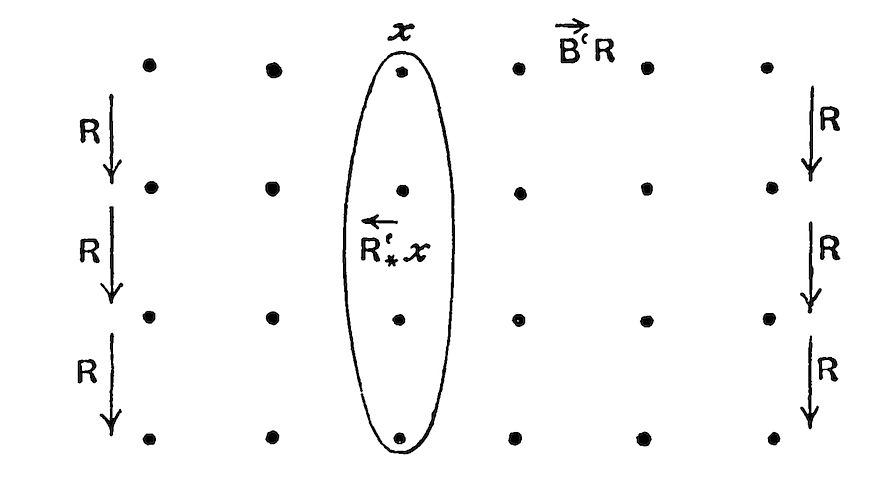
When , the relation of to may be pictured as the relation of rows to columns. E.g. let the field of consist of the dots in the accompanying rectangle, and let each dot have the relation to the dot below it. Then the top row is , the second row is , the third is , and so on; thus the rows are the generations of . Again, if is any dot in the top row, the column beginning with is , and if is any member of this column, the column is . Thus the columns are the families of . It will be seen that in the case represented by the above figure, every family consists of a selection from the generations, and every generation consists of a selection from the families, i.e.
The circumstances under which this occurs will be considered in the present number (*97·3—·47). The results are summed up in *97·47.
The remaining propositions (*97·5—·58) are concerned with circular families of one-one relations. If , is a circular family if . In that case, we have ; moreover there is a definite power of , say , such that every member of the family of has the relation to itself (*97·54). (The same will hold, of course, of all powers of .) The families of a are all either circular or open, i.e. we have (*97·55) either , or . The -shaped families considered in *96 are not possible for a , since in such families the term at the junction of the tail and the circle has two predecessors. The family of any member of must be open (*97·57). The family of a member of need not be closed, but cannot have a beginning; if open, it forms a series of type or , according as it has or has not an end[68]. Finite open families are contained in ; families of type are contained in ; those of type , in ; those of type and circular families are contained in . Those of type are distinguished from circular families by the fact that in the former we do not have , while in the latter we do have this.
In addition to the propositions already mentioned, the most useful propositions of the present number are the following:
*97·13.
*97·17.
*97·5.
*97·501.
*97·01.
Observe that "" means that is to be included if it is a member of , but not otherwise; for if , and otherwise .
*97·1.
Dem.
*97·101.
Dem.
*97·11.
Dem.
*97·111.
\text{D}em.
*97·12.
Dem.
*97·13.
Note. is to mean (, not (. The latter is unmeaning, since is never a homogeneous relation, and therefore its square and higher powers are unmeaning.
Dem.
*97·14.
*97·15.
Dem.
*97·16.
Dem.
*97·17.
Dem.
*97·18.
Dem.
*97·2.
Dem.
*97·21.
Dem.
*97·22.
*97·23.
Dem.
*97·231.
Dem.
*97·24.
Dem.
*97·241.
Dem.
*97·242.
The remaining propositions of this number (except *97·5 ff.) are concerned with proving that, under certain hypotheses,
These propositions have the merit of proving the existence of selections in the cases to which they apply.
*97·3.
Dem.
*97·301.
Dem.
*97·31.
Dem.
*97·32.
*97·33.
Dem.
*97·34.
Dem.
*97·341.
*97·35.
Dem.
*97·36.
*97·37.
Dem.
*97·38.
Dem.
*97·4.
Dem.
*97·401.
Dem.
*97·402.
Dem.
*97·403.
Dem.
*97·41.
*97·42.
Dem.
*97·43.
Dem.
*97·44.
Dem.
*97·45.
Dem.
*97·46.
Dem.
*97·47.
Dem.
*97·5.
Dem.
*97·501.
*97·51.
*97·52.
*97·53.
*97·54.
*97·55.
Dem.
*97·56.
*97·57.
*97·58.
Dem.
It follows from this proposition that every family is either wholly contained in the generations of or wholly contained in , which may be called the residue of the field of .
FOOTNOTES:
CAMBRIDGE: PRINTED BY JOHN CLAY, M.A. AT THE UNIVERSITY PRESS