Volume 1 / Part 2 — *94. ON POWERS OF RELATIVE PRODUCTS.
Reading edition
*94. ON POWERS OF RELATIVE PRODUCTS.
Summary of *94.
In this number we shall be chiefly concerned with propositions connecting powers of with powers of . If is a power of , will be a power of . If is a power of , it is a product of the form
If we transfer the initial to the end, we get a power of . Thus there is a power of , say , such that
If , we find by rearranging and observing that . Thus
Expressions of the form are constantly needed. They will be specially dealt with in *150, and will occur constantly in the sequel.
The above connections of and are embodied in the following propositions:
*94·14.
*94·21.
*94·31.
From *94·4 to *94·54, the propositions are all concerned with and . We prove
*94·5.
*94·51.
Finally we prove (*94·53·54) that if either is one-one and , or is one-one and , then is similar to .
The only proposition of this number which is ever subsequently referred to is the last, *94·64, which, owing to the fact that the Schröder-Bernstein theorem has been already proved (*73·88), is only used in *95·23. But *95·23 itself is never referred to again. The reader may therefore omit the reading of the propositions of this number (as also of *95) without detriment to the understanding of what follows; he should, however, read the summaries.
The chief importance of the propositions in the present number is when and fulfil the hypothesis of the Schröder-Bernstein theorem, i.e.
In this case, gives what we may call a "reflexion" of into part of itself; this part may be again reflected by into a part of itself, and so on. The terms in which are eliminated sooner or later by this process of reflexion constitute , since any one reflexion eliminates terms which constitute one generation of . The terms not eliminated by any number of reflexions constitute . These two sets of terms together constitute , i.e. . In this number and *95 we shall prove that, with the Schröder-Bernstein hypothesis,
These two propositions together yield a proof of the Schröder-Bernstein theorem, in virtue of *93·274·275. This proof is essentially the same as Bernsteinʻs published originally by Borel[66].
The nature of the two proofs of the Schröder-Bernstein theorem, namely Zermelo's (that given in *73) and Bernstein's (that to be given in this number and *95) will be best apprehended by means of figures.
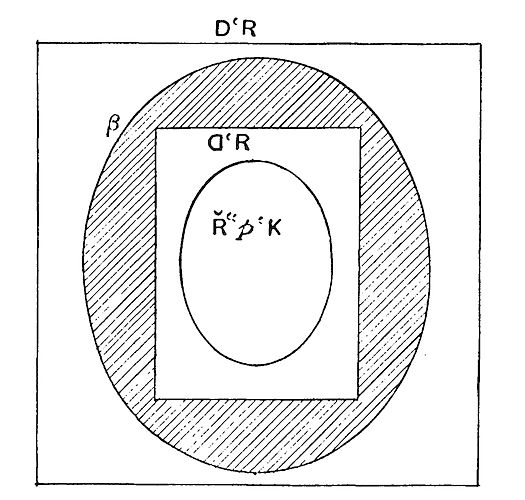
In Zermelo's proof, we first prove that if is one-one, and is a class contained in and containing , then is similar both to and to . In the figure, the points of the outer rectangle form , those of the inner rectangle form , and those of the outer oval form . Thus the shaded portion of the figure is . We now define a class of classes by the following characteristics: is a member of if (1) is contained in , (2) contains the whole of the shaded area, (3) , i.e. if is a member of , so is any term to which has the relation . Our proposition is obtained by considering , i.e. the area common to all the members of . We prove (*73·81) that and (*73·811) that does not contain any of the shaded area. In the figure, is the smaller oval. We then prove (*73·83) that consists entirely of the shaded portion and the smaller oval. Hence (the larger oval) consists of two mutually exclusive parts, namely and , the latter being that part of the inner rectangle which lies outside the inner oval. Assuming now that is one-one, is similar to ; hence, adding , it follows that is similar to , and therefore to .
In order to obtain hence the Schröder-Bernstein theorem, it is only necessary to replace by and by , and to assume further that is a one-one whose domain contains . Then , and we obtain (*73·87) , and therefore , which was to be proved.
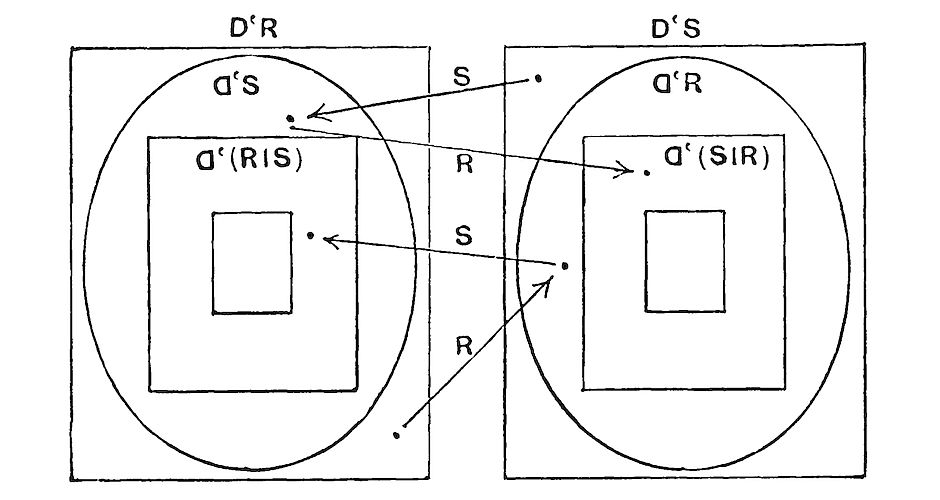
In Bernstein's proof, we have the two relations and from the beginning. In the left-hand part of the figure, the outer rectangle is , which = , the oval is , and the second rectangle is . Thus the points of the outer but not the second rectangle form the first generation of . Within we can form a third rectangle, which will be , i.e. . The points belonging to the second rectangle but not to the third form the second generation of . We can proceed in this way to continually smaller rectangles. The points which sooner or later are left outside some rectangle form ; those which are common to all the rectangles form . A similar analysis, exhibited in the right-hand part of the figure, may be applied to , which is thus divided into and . We prove in this number (*94·53) that, with a hypothesis which is part of the hypothesis of the Schröder-Bernstein theorem, ; in the next number (*95·71) we prove that with the hypothesis of the Schröder-Bernstein theorem, . Hence by addition, .
*94·12.
Dem.
*94·13.
*94·14.
Dem.
*94·2.
Dem.
*94·201.
Dem.
*94·21.
Dem.
*94·22.
Dem.
*94·3.
Dem.
*94·31.
The following series of propositions lead up to the proof that when , or , we have
*94·4.
Dem.
*94·401.
Dem.
*94·402.
Dem.
*94·41.
Dem.
*94·42.
Dem.
*94·43.
*94·441.
*94·442.
*94·5.
Dem.
*94·51.
*94·52.
*94·53.
Dem.
*94·54.
*94·6.
Dem.
*94·61.
Dem.
*94·62.
Dem.
*94·63.
Dem.
*94·64.
Dem.