Front matter
Reading edition
Cover
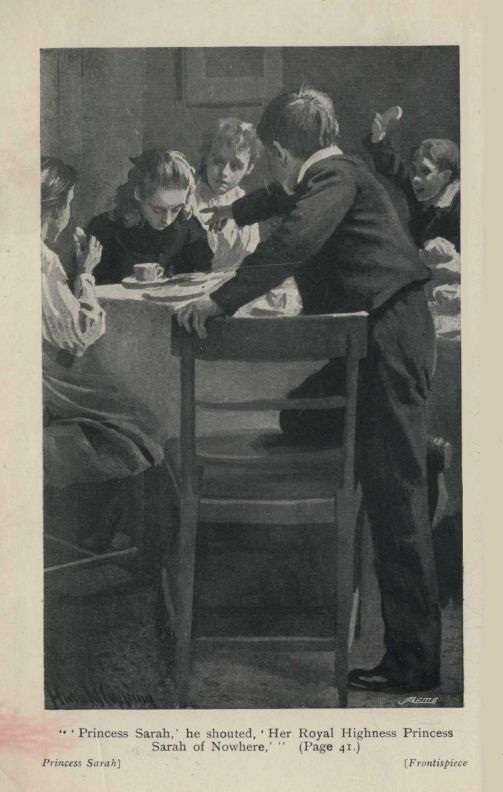
"'Princess Sarah,' he shouted, 'Her Royal Highness Princess Sarah of Nowhere.'" (Page 41.)
PRINCESS SARAH
AND OTHER STORIES
BY
JOHN STRANGE WINTER
AUTHOR OF "BOOTLES' BABY" "MIGNON'S SECRET" "MY POOR DICK" "HE WENT FOR A SOLDIER" ETC ETC
LONDON WARD, LOCK & CO LIMITED WARWICK HOUSE SALISBURY SQUARE E C NEW YORK AND MELBOURNE 1897
Contents
Princess Sarah
CHAPTER I
ORPHANED
CHAPTER II
HER NEW-FOUND AUNT
CHAPTER III
SARAH'S FUTURE IS ARRANGED
CHAPTER IV
HER NEW HOME
CHAPTER V
A TASTE OF THE FUTURE
CHAPTER VI
THE AMIABLE FLOSSIE
CHAPTER VII
COUSINLY AMENITIES
CHAPTER VIII
FLOSSIE'S GRIEVANCES
CHAPTER IX
AN ASTUTE TELL-PIE
CHAPTER X
A PLEASANT RAILWAY JOURNEY
CHAPTER XI
AUNT GEORGE
CHAPTER XII
SARAH MAKES AN IMPRESSION
CHAPTER XIII
THE TURNING POINT OF HER LIFE
CHAPTER XIV
A BRILLIANT MARRIAGE
CHAPTER XV
A FAMILY CATASTROPHE
CHAPTER XVI
A CHANGE OF CIRCUMSTANCES
CHAPTER XVII
SARAH'S OPPORTUNITY
MISS MIGNON
BOY'S LOVE
YUM-YUM: A PUG
OUR ADA ELIZABETH
HALT!
THE LITTLE LADY WITH THE VOICE
JEWELS TO WEAR
Princess Sarah
"Take this lesson to thy heart;
That is best which lieth nearest."
--Gasper Bacerra
CHAPTER I
ORPHANED
In a poor little street in a crowded city there stood a small house, not alone, but in the middle of a row of other houses exactly like it. There was a tiny bow window on the left of the door, and two very small sash windows in the storey above; the frames were warped, and the paint, like that of the door, was blistered and cracked in many places. And the doorstep looked as if it had been cleaned a week or so before with whiting instead of pipe-clay, and evidently the person who had done it had, doubtless with the very best intentions in the world, given the lower part of the door a few daubs with the same cloth, which had not at all improved its shabby surface.
Between the house and the pavement there was a small garden, a very humble attempt at a garden, with a rockery in one corner and a raised bed in the middle.
It was a noisy street, though it was not a thoroughfare, for on that hot, sultry day the doors and windows were all open and the children were all playing about pavements and road, caring little for the heat and dust, screaming, laughing, shouting, crying, as children will, except when they found themselves within reach of the house which I have described; then their voices were hushed, their tones sobered; then they stood to gaze up at the closed blinds which beat now and then against the open windows, as if a door had been opened and allowed a draught of air to sweep through the house; then one little maid of ten years old or so lifted a warning finger to check a lesser child, upon whom the fear and knowledge of death had not yet fallen. "Hush--sh! Don't make a noise, Annie," she said. "Mr. Gray is dead."
The younger child, Annie, ceased her laughter, turning from the closed house to stare at two ladies who came slowly down the street, looking from side to side as if they sought one of the houses in particular.
"This must be it," said one, as her eyes fell upon the closed blinds.
"Yes," returned the other; "that must be it."
So they passed in at the little gate and knocked softly at the shabby door.
"Poor fellow!" said one, with a glance at the bit of garden before the bow window, "his doing, evidently; there's not another garden in the street like it."
"No. And what pains he must have taken with it. Poor fellow!" echoed the other.
There was a moment's scuffle within the house, the sound of loudly-whispering voices; then a heavy footstep, and the door was opened by a stout, elderly person in a shabby black gown and white apron--a person who was unmistakably a nurse. She curtsied as she saw the ladies, and the one who had spoken last addressed her.
"We heard early this morning. I see the sad news is too true," she began.
"Yes'm," shaking her head. "He went off quite quiet about ten o'clock last night. Ah, I've seen a-many, but I never saw a more peaceful end--never!"
The two ladies each made a murmur of sympathy.
"And the little girl?" said one of them.
"Well, mum, she do fret a good bit," replied the nurse pityingly.
"Poor little thing! We have brought some fruit and some other little things," said the lady, handing a basket to the nurse.
"It's real kind of you, mum!" the old woman cried. "She'll be rare and pleased, she will, poor little missy! You see, mum, it's been a queer, strange life for a child, for she's been everything to him, and she never could go out and play in the street with the other children. That couldn't be, and it was hard for the little thing to see 'em and be shut off from 'em all day as she was; and the master on that account used to make hisself more to her, which will make it all the harder for her now, poor fatherless, motherless lamb that she is!"
"Of course, of course. Poor little maid! And what will become of her, do you think?"
"I can't say for certain, mum; but the mistress, she had relations, and the master wrote to one of them on Thursday. He was sore troubled about little missy, was the master--aye, sore troubled. The letter was sent, and an answer came this morning to say that one of missy's aunts was coming to-day. The vicar opened it."
"Oh, well, I'm glad somebody is coming to the poor child," said the lady who had brought the basket of fruit. "I hope it will be all right. And you will give her the things, nurse?" with a look at the basket.
"Oh, yes, mum," with a curtsey.
There was not only some fruit in the basket, but a pot of jam and a jar of potted meat, a glass of jelly, some sponge cakes, and a packet of sweeties, such as little folk love.
The old nurse carried them into the sitting-room and set them down on the table before a little girl who was sitting beside it.
"See, missy, what a nice basket of good things Mrs. Tracy has brought for you!" the old woman cried. "Wasn't it kind of her?"
"Very kind," said the little girl, brightening up somewhat at the unexpected kindness from one almost a stranger to her.
"Grapes, Miss Sarah, and peaches, and Orleans plums; and see--potted meat! Now how could she know you're so fond of potted meat?"
"I don't know, nurse; he liked potted meat too, you know."
"Yes, dear, yes; but he's gone where he has all he's most fond of, you know."
"Except me," murmured Sarah, under her breath.
"Ah, that's true, my lamb; but you mustn't repine. Him as took the master away so calm and peaceful last night knew just what was best to do, and He'll do it, never fear! It's hard to bear, my honey, and sure," with a sigh, "no one knows better what bearing such is than old nurse. And--hark! to think of any one coming with a knock like that! enough to waken the----" But then she broke off short, and went to open the door.
CHAPTER II
HER NEW-FOUND AUNT
A short, stout, well-dressed woman stood upon the door-step, and the cabman was just hauling a box off the roof of his cab.
"Mr. Gray's 'ouse?" demanded the stout lady. "Ah, pore thing! I see it's all over. Pore thing! Well, I'm sorry, of course, though I don't suppose 'e'll be much loss to any one; pore, dreaming, shiftless thing!"
"Miss Sarah is here, mum," said the old nurse, pointing severely towards the door of the sitting-room.
"Miss Sarah--oh, the child! Eh, well, my dear," going into the room, and taking Sarah's limp and shaking hand, "I'm sorry to come on such an errand the first time ever I see you; but that was your pore pa's fault, not mine. I never was one to turn my back on my own flesh and blood--never, though perhaps I say it that shouldn't; but your pore pa, he was that awkward when he got a crotchet into his 'ead, that there was no doing aught with him. I think you favour your ma, my dear," she continued, with a complete change of tone. "Your pore pa-- Eh? What? oh, the cab! Yes, I'll come," and then she bustled out, fumbling at the fastening of a small leather bag which hung over her wrist, and leaving poor Sarah struck dumb with astonishment.
The child crept to the door and watched her new-found aunt settle with the cabman; and it is certain that never had Sarah seen a cabman settled with in that fashion before. They had not indulged in many cabs during the course of her short life; but, on the few occasions that they had enjoyed such luxuries, her father had paid for them with the air of a prince, and with a liberality such as made dispute out of the question. Alas, poor child! if the loving father now lying white and silent in the room above had had less of that princely air, and still less of that princely instinct of hospitality and generosity, life would at that moment probably have been very different for her. But all this was beyond Sarah, who was very young, and therefore not likely to see the advantages of the lengthened haggling process going on just then at the gate. A moment later Mrs. Stubbs entered the house again in triumph.
"Lot of thieving vagabonds them cabmen are, to be sure!" she remarked, with an air of indignation mingled with satisfaction. "But he don't get the better of me, not if I know it; and so I told him. But, dear! dear! 'Ow like your pore ma you are, child! Stubbs 'll be glad of it--he never could abide him as is gone, pore thing! Well, well, we needn't say aught again him now, for he won't trouble us no more; only, as I say, Stubbs 'll be glad of it."
"Please, who is Mr. Stubbs?" Sarah asked plaintively, feeling instinctively that she had better not try to argue with this strange relative.
Mrs. Stubbs, however, was so taken aback at so unexpected a question, that she was obliged to sit down, the better to show the extent of her astonishment.
"Well, I don't 'old with it!" she exclaimed to the nurse, who had come in to spread the cloth for a cup of tea which the visitor had expressed herself able and willing to take. "It's bringing up the child like a 'eathen in ignorance of what her own flesh and blood's very names is--'pon my word it is; it's 'eathenish."
"Miss Sarah doesn't understand," put in the old nurse pointedly.
For a moment Mrs. Stubbs gasped, much as she might have done if the older woman had dashed a pail of water in her face; but she took the hint with a very good grace, and turned to Sarah again.
"Your pore ma, my dear, was Stubbs' own sister," she said.
"Then Mr. Stubbs is my uncle--my own uncle?" Sarah asked.
"Your own uncle, and I'm your aunt; not your own aunt, of course, Sarah, but that's no matter. I've a good and a feeling 'eart, whatever other faults I may have to carry; and what's Stubbs' flesh and blood is my flesh and blood, and so you'll find. Besides, I've seven children of my own, and my 'eart feels for them that has no father nor mother to stand by 'em. And I believe in sticking to your own--everybody's not like that, Sarah, though maybe I say it that shouldn't. There is folks that believes in wearing yourself to the bone for other people's advantage, and letting your own flesh and blood starve in the gutter, so to speak. Ah, well, I ain't one of that sort, and I'm thankful for it, Sarah."
Poor little desolate Sarah, with her suddenly empty life and great aching void in her heart, crept a shade closer to her new-found aunt, and rested her tired head against her substantial arm.
"And I have seven cousins of my own?" she said, the shadows in her eyes clearing away for a moment.
"Seven cousins of your own!" cried Mrs. Stubbs, in an ecstasy of enjoyment. "Seven, Sarah, my dear! Why, I have seven children!"
"And have I some more aunts and uncles?" Sarah asked, feeling not a little bewildered.
"Why, dear, yes, three aunts and two uncles on your pore ma's side, to say naught of all there may be on your pa's side, with which I'm not familiar," said Mrs. Stubbs, with a certain air such as conveyed to Sarah that her ignorance was a decided loss to her father's family in general.
"There's your Uncle Joe--he 'as five boys, and lives at 'Ampstead; and there's your Uncle George--he 'as only three girls, and lives in great style at Brighton. He's in the corn trade, is your Uncle George."
Instinctively Sarah realized why once, when they had been going to the seaside for a fortnight, her father had said, "No, no, not Brighton," when that town was suggested; and as instinctively she kept the recollection to herself.
"And then there's Polly--your Aunt Mary, Sarah! She's the fine lady of the family--very 'aughty, she is, though her and me 'as always been very good friends, always. Still, she's uncommon 'aughty, and maybe she 'as a right, for she married a gentleman in the City, and keeps her carriage and pair and a footman, too. Ah, well! she 'asn't a family, 'asn't Mrs. Lennard; perhaps if she 'ad 'ad seven children, like me, she'd have 'ad to be content with a broom, as I am."
"We have a broom, too," said Sarah, watching the visitor stir her tea round and round; "indeed, we have two, and a very old one that Jane uses to sweep out the yard with."
For a minute Mrs. Stubbs was too thoroughly astounded to speak; then she subsided into weak fits of laughter, such as told Sarah she had made a terrible mistake somehow.
"A very old one to sweep out the yard with!" Mrs. Stubbs cried in gasps. "Oh, dear, dear! Why, child, you're just like a little 'eathen. A broom is a carriage, a close carriage, something like a four-wheel cab, only better. Oh, dear, dear! and we keep three, do we? Oh, what a joke to tell Stubbs!"
"Miss Sarah knows," struck in the old nurse, with some indignation; "the doctor's carriage is what Mrs. Stubbs calls a broom, dearie."
Sarah turned her crimson face from one to the other. "But Father always called that kind of carriage a bro-am," she emphasized, "and I didn't know you meant the same, Aunt."
"Well, never mind, my dear; I shouldn't 'ave laughed at you," returned Mrs. Stubbs, stirring her tea again with fat complaisance. "Little folks can't be expected to know everything, though there are some as does expect it, and most unreasonable it is of 'em. Only, Sarah, it's more stylish to say broom, so try to think of it, there's a good girl."
"I'll try," said Sarah, hoping that she had somewhat retrieved her character by knowing what kind of carriage her aunt meant by a "broom."
Then Mrs. Stubbs had another cup of tea, which she seemed to enjoy particularly.
"And you would like to go upstairs, mum?" said the nurse, as she set the cup down.
"Why, yes, nurse, it's my duty to go, and I'm not one as is ever backward in doing 'er duty," Mrs. Stubbs replied, upheaving herself from the somewhat uncertain depths of the big chair, the only easy chair in the house.
So the two women went up above together to visit that something which Sarah had not seen since the moment of death.
She sat just where they left her--a way she had, for Sarah was a very quiet child--wondering how life would be with this new-found aunt of hers. She was very kind, Sarah decided, and would be very good to her, she knew; and yet--yet--there was something about her from which she shrank instinctively--something she knew would have offended her father beyond everything.
Poor Sarah! At that moment Mrs. Stubbs was standing beside all that was left of him that had loved her so dearly during all the years of her short life.
"Pore thing!" she was saying. "Pore thing! We weren't good friends, nurse, but we must not think of that now; and I'll be a mother to his little girl just as if there'd never been a cloud between us. Pore thing, only thirty-six! Ah, well, pore thing; but he makes a pretty corpse!"
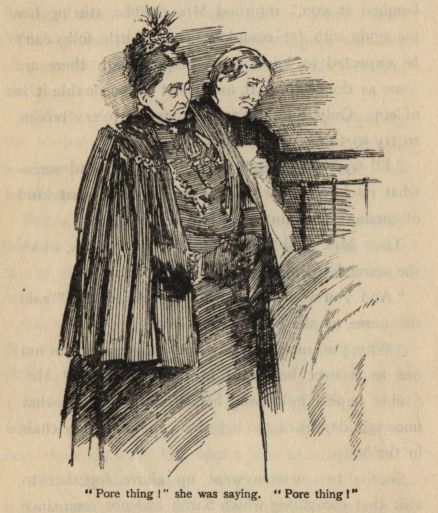
"Pore thing!" she was saying. "Pore thing!"
CHAPTER III
SARAH'S FUTURE IS ARRANGED
Two days later Sarah's father was buried, laid quietly away in a pretty little churchyard two miles outside the town, beside the young wife who had died nine years before.
The funeral was a very unostentatious affair; only one cab followed the coffin, and contained Sarah and Mrs. Stubbs, the old nurse, and Jane, the untidy little maid, who, after the manner of her sort, wept and sobbed and choked, until Mrs. Stubbs would right willingly have given her a good shaking.
Sarah was very subdued and quiet, and Mrs. Stubbs cried a little, and would have cried more had she not been so taken up with keeping an eye on "that stupid ninny Jane."
And then they went back to the little hot, stuffy house, and had a cup of tea, after which the vicar of the parish called and had a long talk with Mrs. Stubbs about Sarah's future.
"I can't say we was good friends with him, pore thing," Mrs. Stubbs explained; "but when death comes between, little differences should be forgotten. And Stubbs and me will forget all our differences now; it's Stubbs' wish as well as mine. I believe in sticking to your own flesh and blood, for if your own won't, whose can you expect to do it? So Sarah and me is the best of friends, and she is going back with me to share and share alike with my own children."
"Oh, you are going to take Sarah," said the vicar, who had felt a great interest in the dreamy artist whom they had just left to his last long rest in the quiet country churchyard; "that is very good of you, very good of you. I have been wondering what would become of the poor little woman."
"Why, what should become of her?" Mrs. Stubbs said indignantly. "Her mother was Stubbs' own sister."
"Yes," said the vicar, smiling; "but it is not every lady who would at all encourage the idea of bringing up a child because her mother happened to be her husband's sister."
"You're right there, Mr. Moore; you are right," Mrs. Stubbs cried; "but some women 'ave 'earts of stone instead of flesh and blood. I'm not one of that sort."
"And about the furniture, and so on," the vicar broke in, having heard Mrs. Stubbs's remarks about her own good qualities several times already.
Mrs. Stubbs looked round the room in good-natured contempt. "There's nothing to speak of," she answered--and she was right enough--"but what there is 'll have to go to paying for the doctor and the undertaker. If there's a few pounds left over, Stubbs says put it into the savings bank and let the child 'ave it when she grows up. She'll want to buy a ring or something to remember her father by."
"And you are going to take the sole charge and expense of her?" the vicar exclaimed.
"Oh, yes. We've seven of our own, and when you've so many, one more or less makes very little difference. But I wanted to ask you something else, Mr. Moore, and I'll ask it before it slips my memory. You know Mr. Gray--'e's gone now, pore thing, and I don't wish to say aught against him--brought Sarah up in a very strange way; indeed, as I said at the time to the nurse, it's quite 'eathenish; and, it you'll believe me, sir, she didn't even know how many aunts and uncles she 'ad, nor what our very names were. But he 'as taught her some things, and playing the fiddle is one."
"Yes, Sarah plays the violin remarkably well for her age," said the vicar promptly.
"Yes, so the old nurse says," returned Mrs. Stubbs, with an air of melancholy. "But I don't altogether 'old with it myself; it seems to me such an outlandish thing for a little girl to play on. I wish it had been the piano or the 'arp! There's so much more style about them."
"The violin is the most fashionable instrument a lady can learn just now, Mrs. Stubbs," put in the clergyman hastily, wishing to secure Sarah the free use of her beloved violin, if it were possible.
"Dear me. You don't say so. What, are young ladies about 'ere learning it?" Mrs. Stubbs asked, with interest.
"Yes. I was dining at Lord Allington's last week, and in the evening one of his daughters played a violin solo; but she doesn't play nearly as well as Sarah," he replied.
"Then Sarah shall keep her violin and play to her 'eart's content," Mrs. Stubbs cried enthusiastically. "That was what I wanted to ask you--if you thought I should encourage or discourage the child in keeping it up. But, as you say so plainly encourage, I will; and Sarah shall 'ave good lessons as soon as she's fairly settled down at 'ome."
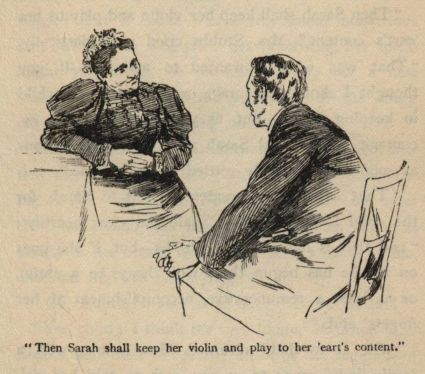
"Then Sarah shall keep her violin and play to her 'eart's content."
"That will be the greatest delight to Sarah, for the child loves her violin," said the vicar heartily; "and that is not all, Mrs. Stubbs--but, if she goes on as she has begun, there will always be a useful, or at least a remunerative, accomplishment at her fingers' ends."
"Oh, as to that," returned Mrs. Stubbs, with a lordly indifference to money such as told her visitor that she was well blessed with worldly goods, "Stubbs 'll provide for the child along with his own, and maybe her other uncles and aunts 'll do something for her, too. I will say that for his family, as a family they're not mean. I will say that for 'em."
So Sarah's future was arranged. She was to go home with Mrs. Stubbs, who lived at South Kensington, and be one with her children. She was to have the best violin lessons to be had for love or money; and Mrs. Stubbs, in the warmth of her kindly but vulgar heart, even went so far as to suggest that if Sarah was a very good, industrious girl, and got on well with her practising, her uncle might very likely be induced to buy her a new violin for her next birthday, instead of the dingy old thing she was playing on now.
Poor, well-meaning Mrs. Stubbs! She little knew that the whole of Sarah's grateful soul rose in loathing at the suggestion. She dropped her bow upon the nearest chair, and hugged her precious violin as closely to her breast as if it had been a thing of life, and that life was threatened.
"Oh, Auntie!" she burst out; "a new violin!"
"Yes, child; I think it's very likely," returned Mrs. Stubbs, delighted to see the effect of her suggestion upon her pale little niece, and quite mistaking the meaning of her emotion. "Your uncle is very fond of making nice presents. He gave May a new piano last Christmas."
"But," gasped Sarah, "my violin is a real Amati! It belonged to my grandfather."
"And if it did, what then?" ejaculated Mrs. Stubbs, in no way impressed by the information. "All the more reason why you should 'ave a new one. The wonder to me is you play half as well as you do on an old thing like that."
"It's--it's worth five hundred pounds!" Sarah cried, her face in a flame.
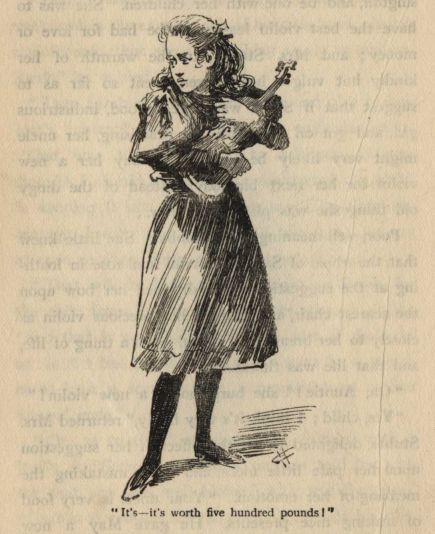
"It's--it's worth five hundred pounds!"
Mrs. Stubbs fairly gasped in her surprise. "Sarah," she said, "what are you saying? Little girls ought not to tell stories; it's wicked. Do you know where you'll go to? Sarah, I'm shocked and surprised at you!"
"Auntie, dear," said Sarah, "it's true--all true. It is, indeed! Ask the doctor, ask the vicar--ask any one who knows about violins, and they'll tell you! It's a real Amati; it's worth five hundred pounds--perhaps more. I'm not telling stories, Auntie, but Father was offered that much for it, only he wouldn't take it because he said it was all he had to give me, and that it would be worth more to me some day."
Never had Mrs. Stubbs heard Sarah say so much at one time before; but her earnest face and manner carried conviction with them, and she saw that the child knew what she was talking about, and was speaking only what she believed to be the truth.
"You really mean it, Sarah?" she asked, putting out a hand to touch the wonderful instrument.
"Oh, yes, Auntie, it's absolutely true," returned Sarah, using the longest adjective she could think of the better to impress her aunt.
"Then," exclaimed the good lady, with radiant triumph, "you'd better 'old your tongue about it, Sarah, and not say a word about it--or you'll be 'aving the Probate people down on you, robbing the fatherless and the orphan."
CHAPTER IV
HER NEW HOME
At last Mr. Gray's affairs were all cleared up, and Sarah was about to leave dingy old Bridgehampton behind for ever to take up her new life in London, the great city of the world.
There were some very sad farewells to be made still; and Mrs. Stubbs was a woman of very good feeling, and encouraged the child to go and say good-bye to everybody who had been kind to her in the past.
"There is Mrs. Tracy," said Sarah on the last day. "She brought me all that fruit and jam and the other things, Auntie."
"Oh, you must go and say good-bye to 'er, of course," returned Mrs. Stubbs; "and we must go and see your pore pa's grave, for 'eaven knows when you'll see it again."
"I should like to do that, please," said Sarah in a very low voice.
"Well, I can't drag out all that way," remarked Mrs. Stubbs, who, being stout, was not good at walking exercise. "We'll have an open carriage if nurse can get one; and nurse shall go too."
So Sarah went and said "good-bye" to her father's grave; and the wise old nurse, after a minute spent beside it, drew Mrs. Stubbs away to the other side of the pretty churchyard to show her a curious tombstone about which she had been telling her as they drove along. So Sarah, for a few minutes, was left alone--free to kneel down and bid her farewell in peace.
It was a relief to the child to be alone, for Mrs. Stubbs, though meaning to be kindness itself, was not a woman in whose presence it was possible to grieve in comfort. Her remarks about "your pore pa" invariably had the effect of stifling any feeling of emotion which was aroused in her childish heart.
She was very good. Sarah knew that she meant to be so.
"I'll try not to mind the difference, dear Father," she whispered to the brown sods above his dear head. "It's all so different to you, so different to when there was just you and I together. Nobody will ever understand me like you, dear Daddy; but Auntie means to be very kind, and I'll try my hardest to grow up so that you'll love me better when we meet again."
As she rose up, Mrs. Stubbs and the nurse were coming across the grass between the graves to fetch her. Mrs. Stubbs noticed the tears on her cheeks and still flooding her eyes.
"Nay, now, you mustn't fret, Sarah," she said kindly; "'e's better off, pore thing, than when he was 'ere, so you mustn't fret for 'im, there's a good girl."
Sarah wiped her eyes, and turned to go away. She said nothing, for she knew it was no use trying to make her aunt understand that her tears had not been so much for him as for herself. And Mrs. Stubbs stood for a moment looking down upon the mould, with its covering of brown, disjointed sods and its faded wreaths.
"Pore thing!" she murmured; "it's a sad end to 'ave. And he must 'ave felt leaving the little one badly 'fore he brought himself to write that letter! Pore thing! Well, I'm not one to bear ill-will for what's past and gone, and so beyond 'elp now; and I'll be as much a mother to Sarah as if 'im and me had always been the best of friends. 'E once said I was vulgar--and perhaps I am--it's vulgar to 'ave 'earts and such like, and he knows better now, pore thing! For I have a 'eart. Yes, and the Queen upon 'er throne, she has a 'eart, too, bless her."
There were tears on the good soul's cheeks as she turned to follow Sarah, whom she found at the gate waiting for her. By the time she had reached the child she had wiped them, but Sarah saw that they had been there.
"Dear Auntie," she said. "He wasn't friends with you, but he knows how good you are now,"--and then she flung her arms round her, and her victory over her uncle's wife was complete.
"Sarah," she said, when they were nearly at the end of their journey, "you have never 'ad any playfellows, have you, dear?"
"Never, Auntie--not real playfellows," Sarah answered, and flushing up with joy at the anticipation of those who were in store for her.
"Well, I'd better warn you, Sarah--it may not be all sugar and honey till you get used to them," said Mrs. Stubbs solemnly. "There's a good deal of give and take about children's ways; that is, if you want to get on peaceable. If you get a knock, you must just bear it without telling, or else you get called a 'tell-pie,' and treated according. It's what I've never encouraged, and I must do my children the justice to say if they gets a knock they gives it back again, and there's no more about it."
Thus Sarah was somewhat prepared for the darker side of her new life, though she gathered no true idea of the nest of young ruffians to whom she was made known an hour later.
They came out with a rush to the door when the carriage stopped, and welcomed their mother home again with a fluent and boisterous torrent of joy truly appalling to the little quiet and retiring Sarah, who was not accustomed to the domestic manners of children of the Stubbs class.
"Ma, what have you brought me?"
"Is that Sarah, Ma? My, ain't she a littl'un!"
"Ma, Mary was late this morning. Yes, and our kao-kao was burnt--I told her I should tell you."
"Pa slapped Johnnie last night, because he wouldn't be washed to come down to dessert."
"And Flossie has torn her best frock."
"And May----"
"Hush! Be quiet, children!" exclaimed Mrs. Stubbs, holding her hands to her ears. "'Pon my word, you're like a lot of young savages. Miss Clark can't have taken much care of you whilst I've bin away. Really, you're enough to frighten Sarah out of her senses. This is your cousin Sarah. She's going to live 'ere in future, so come and say ''Ow d'ye do?' to her nicely."
Thus bidden, the young Stubbses all turned their attention on their new cousin, and said their greeting and shook hands with various kinds of manner.
There was May, aged fourteen, a very consequential young person, with an inclination to be short and stout, like her mother, and had her nice fair hair plaited into a tail behind and tied with a bunch of mauve ribbon, worn with a white frock in memory of the uncle by marriage whom she had never seen.
"How d'you do, Cousin Sarah?" she said, with a fine-lady air which petrified poor Sarah, who thought that and her cousin's earrings and watch-chain the finest things she had ever beheld about any human being before. Then there came the redoubtable Flossie, who had torn her best frock, and was twelve and a half. Flossie, who was nearly as big as May, came forward with a giggle, and said "How----" and went off into fits of laughter at some private joke of her own.
"I'm ashamed of you, Flossie," cried Mrs. Stubbs sharply; "shake 'ands with your cousin Sarah at once. Ah! this is Lily--Lily's five and a 'alf, Sarah--she's the baby."
Then there was Tom, the eldest boy, who gripped hold of Sarah's hand and wrung it until she could have shrieked with the pain, but, taking it as an expression of kindness and welcome, she bore it bravely and looked at him with a smiling face; she knew better afterwards.
After Tom came the twins, Minnie and the Johnnie who had been slapped the day before; and last of all, Janey, the prettiest, and Sarah fancied the sweetest, of them all. Janey was seven, or, as she said herself, nearly eight.
"I suppose," said Mrs. Stubbs, addressing herself to Flossie, "that your pa 'asn't got 'ome yet?"
"No, Ma, not yet," returned Flossie.
But, presently, when Mrs. Stubbs had changed her dress for a garment such as Sarah had never beheld before, and which May told her was a tea-gown, and was enjoying a cup of sweet-smelling tea in the large and shady drawing-room--to Sarah a perfect dream of beauty--he came! Came with a bustle and noise like a tempest, and caught his stout wife round the waist, with a "Hulloa, old woman, it's a sight for sore eyes to see you 'ome again!"
Sarah had determined to be surprised at nothing, but her Uncle Stubbs was altogether too much for her resolution. In apologising to herself afterwards, she said she was obliged to stare.
"And where's the little lass?" Mr. Stubbs asked when he had kissed his wife. "Oh, there! Well, aren't you going to speak to your uncle, eh?"
"Yes, Uncle," said Sarah shyly.
He drew her nearer to him, and turned her face to the light.
"Like her dear ma," put in Mrs. Stubbs.
"Yes," said Mr. Stubbs shortly.
"Not like her pa at all," Mrs. Stubbs persisted.
"No!" more shortly still; then, after a pause, "I 'ope you'll be a good gal, Sarah, and remember, though your father and me wasn't friends, yet, as long as I've a 'ome to call my own, you're welcome to a shelter in it. Your mother was my favourite sister, and though she turned 'er back on me, I'll never do that on you, never."
"Father knows better now, Uncle," said the child, with an effort; "he knows how good you and Auntie are to me. You'd be friends now, wouldn't you?" earnestly.
"I don't know--I don't know at all," replied Mr. Stubbs shortly; then, struck by the pleading look on the child's wistful face, added gruffly, "I suppose we should; any way, I hope so."
At this point Mrs. Stubbs broke in,--
"Any way, it's no fault of Sarah's that we wasn't all the very best of friends, Stubbs; and Sarah and me's real fond of one another already, aren't we, Sarah? So say no more about it; what's past and gone is beyond 'elp. Flossie, you can take Sarah upstairs now. It's just six--time for your tea. Be sure she gets a good tea."
CHAPTER V
A TASTE OF THE FUTURE
Thus bidden, Flossie took Sarah's hand and led her upstairs. "You won't like Miss Clark," she remarked, as they went. "We don't like her, not any of us. She's so mean; always telling tales about somebody. She got Johnnie slapped and sent off to bed last night; it was all spite--nasty old thing!"
"Who is Miss Clark?" Sarah asked, feeling rather bewildered.
"Miss Clark! What! didn't Ma tell you about her?" ejaculated Miss Flossie, in surprise.
"No; Auntie never told me about her at all."
"Lor! There, that shows Ma herself don't think much of her! I'll tell Miss Clark, any way."
"Don't, don't!" Sarah cried, in an agony.
"Yes, I shall," the amiable Flossie returned, suddenly opening a door and dragging her cousin into the midst of a noisy crew, all squabbling round a tea-table. "Miss Clark, what d'you think? Ma actually never told Sarah a single word about you!"
"Well, my dear, never mind; perhaps Mrs. Stubbs didn't say very much about any of us."
"She didn't," put in Sarah hastily.
"I suppose this is Sarah?" Miss Clark went on.
"Yes," answered Flossie, adding, under her breath to Johnnie, "Stupid little thing!"
"How do you do, Sarah?" asked the governess, with the air of primness which had made her unruly young pupils dislike her. "I hope we shall be very good friends, and that you will do your best to be a very tidy and industrious little girl."
This rather took Sarah's breath away, but she replied, politely, that she would try her best.
"Come and sit by me, Sarah," said May, with a very condescending air of protection.
"Yes, sit by May," added Miss Clark. "May is my right hand; without May I could not endure all the worry and trial of the others. Copy May, and you will be quite right."
So Sarah watched May mincing with her knife and fork, and conscientiously tried to do likewise, to the infinite amusement of the younger ones, of whom May took no notice whatever, and to whose jibing remarks she showed a superb indifference.
"Sarah," shouted Tom, stuffing his mouth so full of pressed tongue and bread-and-butter that Sarah's heart stood still for fear of his choking, "how many pieces of bread-and-butter can you put into your mouth at once?"
"Disgusting boy!" remarked May disdainfully, without giving Sarah time to reply. "You grow more atrociously vulgar every day you live!"
"Hi, hi!" shouted Tom, seizing a tablespoon and ramming it down his throat until even boy's nature revolted and expressed disapproval.
"Put that spoon down," cried Miss Clark authoritatively. "If I see you do that again, Tom, you shall not go down to dessert."
Now this was almost the only threat by which poor Miss Clark, whose life was one long-continued struggle and fight, was able to hold her own over Tom when he was at home for his holidays. Not going down to dessert meant, not only the punishment of losing a share of the good things below, but also it meant inquiry as to the cause of absence, and other effects according to evidence.
Tom's exuberance of spirits settled down promptly into discreet behaviour, and Miss Clark had time to look round the table.
"Johnnie, you are forbidden to eat jam for a week," she burst out. "Minnie, take his plate away."
"It's a shame poor Johnnie isn't to have any jam," Minnie began whining--"all for nothing, too. It's a real downright shame, it is," and forthwith she took the opportunity of daubing a thick slice of bread-and-butter with jam off her own plate, and smuggling it into the luckless Johnnie's hand in such a way that he might eat it upside down, to the intense delight of Tom opposite, who had seen the little manoeuvre, and was bursting to disclose it.
For once nodding and winking had no effect, for nobody happened to be looking at him. So Tom, in despair lest such an amusing incident should be altogether lost, began vigorously nudging Flossie, who sat next to him, with his elbow. Flossie, unfortunately, was in the act of raising a large cup of very hot tea to her lips, and Tom's nudge causing the hot cup to touch her knuckle, made her jerk violently, and over the tea went in a deluge on to her lap.
It is almost impossible to give an adequate description of the scene which followed. Flossie shrieked and screamed as if she was being murdered by a slow process; Tom vowed and protested that it was not his fault; Janey had pushed him over against Flossie; Janey appealed to Miss Clark to remember that at the very moment she was handing her cup in the opposite direction; and Miss Clark began to wring her hands and exclaim that she would ask to have Tom sent back to school again, for stand his cruel and unbrotherly behaviour she neither could nor would. And in the midst of it all, young Johnnie seized the opportunity of helping Minnie freely to jam and eating off her plate, as if he were eating for a wager.
Sarah sat looking, as she was, scared; and May calmly surveyed the scene of uproar with disdainful face.
"Disgusting boy!" she said to the still protesting Tom. "You get more vulgar every day. Don't take any notice, Sarah; you will get used to it by-and-by."
Eventually Miss Clark began to cry weakly.
"It's too much for me; how am I to bear four weeks more of this dreadful boy?" she sobbed.
"Do like me, take no notice," suggested May.
"But I must take notice," Miss Clark cried desperately. "My only comfort is that you do sit still, May dear. As for Sarah, she is a good girl, a pattern to you," with a withering glance at Tom. "I feel sure Sarah has never seen such a disgraceful scene before; have you, Sarah?"
"No," whispered Sarah, wishing fervently that Miss Clark had been pleased to leave her out of the discussion.
"I thought so. I knew Sarah's manners were far too good for her to have been brought up among this sort of thing. Sarah is like a young princess."
By this time the tumult had subsided a little. Flossie had recovered from her fright, and was consoling herself with buttered scones and honey, looking darkly at Tom the while, just by way of reminding him that she had not by any means forgotten. But Tom was unconscious of her wrath--a fresh idea had presented itself to his volatile mind, and for the moment he had utterly forgotten not only Flossie's wrath, but also that other probable wrath to come.
"Princess Sarah!" he shouted, pointing at his cousin. "Her Royal Highness Princess Sarah--of Nowhere. Princess Sarah!"
"Princess Sarah!" cried Johnnie, taking up the taunt, and waving his bread-and-butter like a flag. "Three cheers for Princess Sarah!"
CHAPTER VI
THE AMIABLE FLOSSIE
Miss Clark did not tell that time. It was not Flossie, but May, who poured oil on the troubled waters.
"It's no use making a fuss, Flossie," she said wisely. "Tom didn't mean to spill your tea; he only wanted you to look at Johnnie cribbing jam when he'd been told not to have any. And it's the first night Ma's at home, and Tom's her favourite; and if you get him into trouble with Pa, she'll give what she's brought for you to somebody else. So you just hold your tongue, Flossie, and be a bit nice to Miss Clark, and get her to say nothing about it. It isn't as if you were hurt--and besides, you can't pretend you're hurt and then go down to dessert. It's your turn to go down to-night." Thus advised, Flossie went to Miss Clark and begged her to say nothing more about Tom's unfortunate accident.
"Tom says he didn't mean to, Miss Clark, and Ma's tired, I dare say; so you won't say anything about it, will you?"
"I think I ought to say something about it, Flossie," said Miss Clark severely, though in her heart she was as glad to get off telling as even Tom himself could be.
"No, Miss Clark, I don't think you ought. Ma always gets a headache after a long journey, and if Pa's put out with Tom, and perhaps whips him, Ma 'll go to bed and cry all night. And it wasn't as if Tom meant to spill the tea over me--it was quite an accident. He was only jogging me to look at Johnnie."
With much apparent reluctance, Miss Clark at last consented to say no more about it; and so occupied was she in making Flossie feel how great a concession it was for her to do so, that she forgot to ask what Johnnie had happened to be doing to attract Tom's attention.
So Johnnie escaped scot free also, and Flossie and Tom went off to prepare for going down to dessert, which the young Stubbses did in strict turn, two at a time.
As soon as the table was cleared, Miss Clark got out a little work-box and began a delicate piece of embroidery. Sarah kept close to May, whom at present she liked best of any of the young people and May sat down with a piece of fancy work also, of which she did very little.
"Miss Clark," she began, after she had done a few stitches, "isn't it jolly without Tom?"
"Very," said Miss Clark, with a great sigh of relief.
"I don't think Tom meant to be disagreeable," said May, turning Miss Clark's silks over with careless fingers; "but he's a boy, and boys are very tiresome animals, Miss Clark."
"Yes," Miss Clark replied.
"How many times have you been engaged?" and May leant her elbows upon the table and regarded the governess with interested eyes.
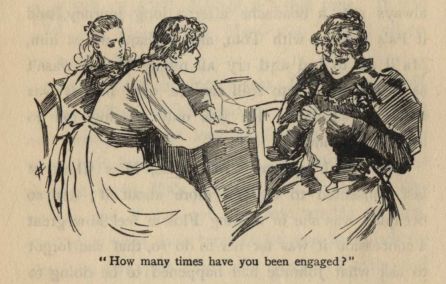
"How many times have you been engaged?"
"Twice," answered Miss Clark, in a low voice.
"And he was nice?" May inquired, with vivid interest.
"I thought them both nice at the time," Miss Clark returned, with a sigh and a smile. "But--oh, here is Flossie ready to go down. Flossie, my dear, how quick you have been!"
"But I'm quite tidy, Miss Clark," Flossie replied. "I wish Tom would be quick. I say, Sarah, don't you wish you were going down, too?"
"Sarah's quite happy with Miss Clark and me," put in May; "ain't you, Sarah?"
"Yes, quite," Sarah replied.
"Oh, are you? Then I shall tell Ma you said you didn't want to go down to see her, then," Flossie retorted.
Poor Sarah's eyes filled with tears, and she turned to May in the hope of getting protection from her.
"Take no notice," said May superbly. "You'll get used to Flossie after a bit. She's a regular tell-tale; but she won't tell Ma, for Ma won't listen. She never does. Ma never will listen to tales, not even from Tom."
Flossie began to laugh uproariously, as if it was the greatest joke in the world to tease Sarah, who had yet to learn the peculiar workings of a Stubbs character. Then Miss Clark interrupted with a remark that Flossie's sash was not very well tied.
"Come here and let me tie it properly," she said sharply; and, as Flossie knew that any shortcoming would be sharply noticed and commented upon when she got downstairs, she turned obediently round and allowed Miss Clark to arrange her garments to her satisfaction. By that time Tom was ready, and the two went down together.
"Thank goodness," remarked May piously. "Now, Miss Clark, we shall have a little peace."
May was destined to have even a greater peace for her little chat with the governess than she had anticipated, for a few minutes after Flossie and Tom had gone downstairs one of the maids came up and said that the mistress wished Miss Sarah to come down at once. Miss Sarah, she added, was not to stay to dress more than she was then.
"Mayn't I just wash my hands?" Sarah asked imploringly of May.
"Of course," May answered, good-naturedly. "I'll go with you and make you straight."
May was very good-natured, though it is true that she was somewhat condescending; and she went with Sarah and showed her the room she was to share with Janey and Lily, showed her where to wash her face and hands, and herself combed her hair and made her look quite presentable.
"There! you look all right; let Miss Clark see you," she said. And, after Sarah had been for inspection and approval, she followed the maid, and went down, for the first time in her life, to dessert.
"'Ere she is!" Mrs. Stubbs exclaimed, as the little figure in black appeared in the doorway. "Flossie ought to have known you would come down to dessert the first evening; and, after that, you must take it in turn with the others."
"Yes, Auntie," said Sarah shyly, taking the chair next to Mrs. Stubbs, for which she was thankful.
"Will you 'ave some grapes, my dear?" Mrs. Stubbs asked kindly.
"Sarah 'd like a nectarine," said Mr. Stubbs, who made a god of his stomach, and loved good things.
"I doubt if she will," his wife said; "they're bitter to a child's taste; but 'ave which you like best, Sarah."
"Grapes, please, Auntie," said Sarah promptly.
As a matter of fact, Sarah did not exactly know what nectarines were; and, not liking to confess her ignorance, lest by doing so she should bring on herself sarcastic glances, to be followed later by sarcastic remarks from Flossie and Tom, she chose what she was sure of; besides, she did not want to run the risk of getting something upon her plate which she did not like, and perhaps could not eat. Poor Sarah still had a lively recollection of once helping herself to a piece of crystallised ginger when out to tea with her father. She could not bear hot things, and it seemed to her that that piece of ginger was the hottest morsel she had ever put in her mouth. She sucked and sucked in the hope of reducing it, and so getting rid of it, and the harder she sucked the hotter it grew. She tried crushing it between her sharp young teeth, but that process only seemed to bring out the heat more and more.
And at last, in sheer desperation, Sarah bethought herself of her pocket-handkerchief, and, putting it up as if to wipe her lips, ejected the pungent morsel, and at the same time seized the opportunity of putting her poor little burning tongue out to cool.
"Have another piece of ginger, dear," the lady of the house had said, seeing that her plate was empty.
CHAPTER VII
COUSINLY AMENITIES
The following morning Mrs. Stubbs began preparing vigorously for the move to Brighton, which the family invariably made at this time of the year. Usually, indeed, they went a week or so earlier, but Mrs. Stubbs being at Bridgehampton, Miss Clark had done no more towards going than to see that the children's summer and seaside frocks and other clothes were all ready.
"I think May and Flossie must 'ave new white best frocks," Mrs. Stubbs remarked; "and Sarah's things must be attended to. I knew it was no use getting the child anything but a black frock in that old-fashioned Bridge'ampton. I'd better go and see about them this morning; and if they're not done by Thursday they can come after us."
So Sarah was dressed, and with May went out in the neat "broom" with Mrs. Stubbs; and when she had arranged about the white frocks for her own children, Mrs. Stubbs began to lay in a stock of clothes for Sarah. Poor Sarah was bewildered, and felt more ready to cry than anything else.
"Am I to wear all these?" she asked, with what was almost horror, as she surveyed the pile of stockings, petticoats, gloves, sash-ribbons, pocket-handkerchiefs, and such things, which quickly accumulated upon the counter.
Mrs. Stubbs laughed good-naturedly. "You won't say 'all' when you've been a month at Brighton grubbing about on the shingle and going donkey-rides, and such like. You must be tidy, you know, Sarah. And I told you" (in an undertone) "that you would be the same as my own. I never do things by 'alves; I'm not one of that sort, thank 'eaven."
So, to Sarah's dismay, she bought lavishly of many things--frocks, boots, smart pinafores, a pretty, light summer jacket, and two hats, one a white sailor hat, the other a black trimmed one for best.
"Do you take cold easy, Sarah?" Mrs. Stubbs inquired, pausing as they went out of the showroom before a huge pile of furs.
"I think I do rather, Auntie; and I had bronchitis last year."
"That settles it!" her aunt exclaimed. "I don't believe in bronchitis and doctors' bills; waste of money, I call it. You shall 'ave a fur cape."
Now for two years past the dream of Sarah's life had been to possess a fur cape--"a beautiful, warm, soft, and lovely fur cape," as she expressed it; but until now, poor child, she had never dared to think it might ever be more than a dream--that it might come to be a possibility or a reality. The sudden realization was almost too much for her. She gave a little gasp of delight, and squeezed her aunt's arm hard.
"Oh, Auntie!" she whispered, with a sob of delight, "what shall I ever do for you?"
"Nay, nay! don't, Sarah!" Mrs. Stubbs expostulated, fearing the child was going to break down. "Be a good girl and love your aunt, that's all, dear."
"Oh, Auntie, I do, I do!" Sarah whispered back; "but if only Father knew--if only he knew!"
"Why, maybe he does," said Mrs. Stubbs kindly. "But come, Sarah, my dear, let us try your cape on. We are wasting this gentleman's time."
The gentleman in question protested that it was of no consequence, and begged Mrs. Stubbs not to hurry herself. But time was passing, and Mrs. Stubbs wanted to get home again, so she urged Sarah to be quick.
Ten minutes later Sarah was the proud possessor of a beautiful brown fur cape, just a little large for her, "that she might have room to grow," but so warm and cosy, and so entirely to her liking, that, in spite of the sultry day, the child would willingly have kept it on and gone home in it. She did not, however, dare to propose it to her aunt, and if she had done so Mrs. Stubbs had far too much good sense to have allowed it.
So they went home gaily enough to lunch, which was the young folk's dinner, but not without a petition from May that they should stop at some nice shop and have ices.
"It will spoil your dinner!" exclaimed Mrs. Stubbs.
"Oh, no, Mother," said May, who sometimes called her mother so. "And Sarah ought to have an ice the very first time she has ever had a drive with you."
Thus pressed, Mrs. Stubbs gave in, and stopped the carriage at a confectioner's in Regent Street.
"I'll have Vanilla," said May. "Which are you going to have, Sarah?"
"Whichever you like," said Sarah, who had never tasted an ice in her life, and was thus gaining another new experience.
"Try strawberry, then," said May, "and then we can help one another to a spoonful."
Sarah did try strawberry, and very good she found it. And then, when they had each eaten about half of their ices, May proposed that they should change about. Sarah did not find the Vanilla ice nearly so much to her liking as the strawberry one had been; but not liking to say so, as her cousin seemed to appreciate the change, she finished her portion, and said she had enjoyed herself very much.
"You'll buy us some sweets, Ma?" said May.
Sarah stared aghast; it seemed to her a terrible extravagance to have had the ices, particularly after having spent so much money as her aunt must have done for the clothes that morning. And then to ask for sweets! It seemed to her that May had no conscience.
And perhaps she was not very far wrong. But May, if she had no conscience, had a wonderful knack of smoothing the path of daily life for herself. Mrs. Stubbs demurred decidedly to buying sweets; but May gave a good reason for her demand.
"Oh, Ma, dear, do! Flossie 'll be as cross as two sticks at Sarah being out with you instead of her. And she's sure to ask if we had ices, and, you know we can't either of us tell a story about it--at least, I can't, and I don't think Sarah's at all the story-telling sort--are you, Sarah?"
"Oh no, indeed, Auntie, I'll never tell you a story," Sarah protested.
"And Flossie will go on anyhow, and taunt her; I know she will. She and Tom were at it last night--calling her Princess Sarah--her Royal Highness Princess Sarah," May went on--"didn't they, Sarah?"
"Never mind," said Sarah, trying to make light of it.
"But what did they call her that for?" Mrs. Stubbs asked, listening in a way that was rare with her to a bit of tittle-tattle from the schoolroom.
"Well, Ma, dear, you know what Tom is. He doesn't mean to be rough or rude, but he's just a boy home for the holidays; and after she's had the little ones all day, and perhaps not me to talk to at all, Tom does get a bit too much for Miss Clark's nerves. And last night Tom was just a bit more boisterous than usual, and poor Miss Clark didn't feel very well, and it tried her, you know. And Sarah was sitting by me, and very quiet, and Miss Clark happened to say she behaved like a princess--and so she did. And Tom took it up--Princess Sarah, of Nowhere; her Royal Highness Princess Sarah, of Nowhere, and such-like. I don't think Tom meant to be unkind, but it wasn't very nice for Sarah, being strange to us all; and then Flossie took it up, and Johnnie, but Miss Clark told Johnnie he should go to bed if he said it again, so he soon shut up."
"Well, it's no use taking any notice of it," said Mrs. Stubbs, stroking Sarah's hand kindly, "but you'd better put a stop to it whenever you hear 'em at it, May. I only 'ope Tom won't let his pa 'ear him. He'd be very angry, for Sarah's pore ma, that's dead and gone, was 'is favourite sister, and Pa'd never forgive a slight that was put on her little girl. It isn't," said Mrs. Stubbs, warming to her subject, "any fault of Sarah's that she's left, at nine years old, without a father, or a mother, or a 'ome; and it's no credit of any of yours that you've got a kind pa and ma, and a lux'r'ous 'ome, and a broom to ride about in. So, Sarah, my dear, don't take no notice if they begin teasing you about anything. Remember, your ma was your uncle's favourite sister, and that you was as welcome as flowers in May to him when I brought you 'ome."
Sarah looked up. "I don't mind anything, Auntie, dear," she said bravely, though her lips were trembling and her eyes were moist. "I'll remember what you told me when we were coming--give and take."
"That's a brave little woman!" Mrs. Stubbs exclaimed. "Yes, you'd better go and choose some sweets, May. Perhaps it was a little 'ard on Flossie she should have to stop at 'ome, but I can't do with more than three in the broom--it gets so 'ot and so stuffy. Perhaps, some day, your pa 'll buy us an open carriage, and then I don't mind 'ow many there are."
May went out into the shop--for they had been sitting alone in an inner room--to choose the sweets, and Mrs. Stubbs continued her talk to Sarah.
"I don't 'old with telling, as a rule; I want my children to be better than tell-pies," she said; "but I am glad May told me of this. If anything goes wrong with you, you tell May about it, Sarah; she's my right 'and; I don't know what I should do without her."
CHAPTER VIII
FLOSSIE'S GRIEVANCES
It was just as well that May had had sufficient forethought to provide herself with a bundle of sweets in the shape of a peace-offering for Flossie, for when they got in they found Flossie in anything but an amiable mood.
And when Flossie was not in an amiable mood, she was anything but an agreeable young person.
She was sitting in the schoolroom, staring sullenly out of the window and kicking impatiently against the window-board in a way which upset Miss Clark's nerves until they could only be fairly described as "shattered."
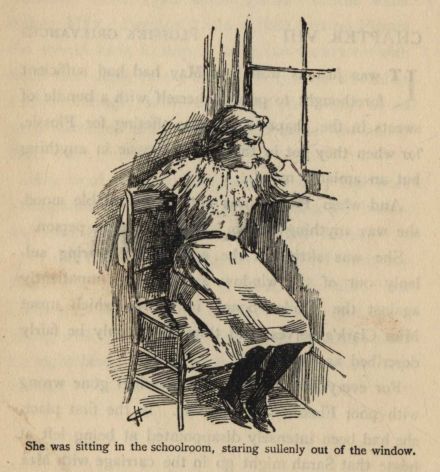
She was sitting in the schoolroom, staring sullenly out of the window.
For everything from first to last had gone wrong with poor Flossie that morning. In the first place, she had been intensely disappointed at being left at home that Sarah might go in the carriage with Mrs. Stubbs. Flossie was particularly fond of going out with her mother in the carriage, and was also very fond of shopping. It was, therefore, quite in vain that Miss Clark tried to make her understand that Sarah had not been taken for favouritism, but simply in order that her aunt might buy her the clothes necessary for their trip to Brighton. Flossie thought and said it was a horrid shame, and vowed vengeance on the unfortunate and inoffensive, though offending, Sarah in consequence.
"Nasty little mean white-faced thing!" she exclaimed. "I suppose I shall always be shoved into the background now, just that she may be coddled up and made to think herself better than anybody else. Princess Sarah! Yes, that's to be the new idea. We're all to be put on one side for Princess Sarah."
"Flossie," said Miss Clark, very severely, "you ought to be thoroughly ashamed of yourself. To be jealous of a poor little girl who has no father or mother, who has come among strangers at nine years old, and is fretting her poor little heart out for the sake of the father who loved her better than any one in all the world; to be jealous of her being taken out once when you know it is only on business they have gone--oh! for shame, Flossie! for shame!"
"Oh, well, she needn't fret after her pa so much," Flossie retorted, not taking Miss Clark's remarks to heart at all. "He didn't do so much for her. He wasn't a gentleman like Pa. If he had been, he'd have left her some money of her own."
Miss Clark's whole soul rose up in absolute loathing within her.
"You vulgar, vulgar child!" she thought. Aloud she said, "Flossie, my dear, a lady would not say such a thing as that. Your mother would be very, very angry if she heard it. Come, it is useless to stay grumbling and sulking here; you will have to accept the situation. Mrs. Stubbs is your mother, and the mistress of this house and family. She does not ask your leave whether she shall take you out with her or not. She would be a very bad mother to you if she did, instead of being, as she is now, a very good one. Let me hear not another word, but put your things on to go out with me."
"Is Tom going?" Flossie inquired, not daring to refuse, though she would dearly have liked to do so.
"No. Tom and Johnnie are going out with Charles."
"And I have to just go out with you and three stupid girls?"
"With your three sisters, certainly."
"It's a beastly shame," Flossie burst out.
"Not another word," said the governess sharply. "Go and get ready at once."
And poor Flossie had to go. Of course it happened that as she began wrong at the beginning nothing went very well with her during the rest of the morning. Miss Clark went the one way she hated above all others; but Miss Clark had to do a small but important commission for Mrs. Stubbs, and was obliged to take it.
Then her sisters, whom she heartily despised--Tom being her favourite--annoyed her excessively. Janey would persist in lagging behind, and Minnie got a stone in her shoe and had to stop and take it off and shake out the pebble; and then, of course, she had to stop also to have her shoe tied again, and one or two people stopped to see what was amiss, as people do stop when they see any impediment to the general traffic in the London streets. "Making a perfect show of them all," Flossie said angrily.
And when they got home, Flossie not feeling quite so bad as when they set off, Mrs. Stubbs and May and "that Sarah" actually had not come back. It really was too bad, and Flossie sat down in the schoolroom window to watch for them with a face like a thunder cloud and a heart in which every outraged and injured feeling capable of being felt by weak human nature seemed to be seething and struggling at once.
If only Tom had come back, it would not have been so bad. But Charles, the indoor servant, had taken him and Johnnie down to Seven Dials to buy some guinea-pigs, and Seven Dials being a long way from South Kensington, they could not possibly have got back by that time if they had tried ever so. Poor Flossie!
So she sat and brooded--brooded over what she was pleased to call her wrongs. She would not so much have minded not going out with the "broom" if only she might have gone with Charles and Tom and Johnnie to enjoy the somewhat doubtful delights of Seven Dials. That, however, Mrs. Stubbs had resolutely and peremptorily refused to allow. So it happened that Flossie sat in the window waiting for their return.
At last they came. She saw them get out of the carriage and disappear within the house; she saw the carriage drive round to the stables.
And then there was a long pause. But they none of them seemed to think of coming upstairs, even then. Poor Flossie kicked at the window-board more noisily than ever, and in vain Miss Clark, driven almost to desperation, cried, "Flossie, will you be quiet?"
And then the door opened quietly, and May came in, looking radiant. Flossie felt more ill-used even than before.
"Oh, you are here, Flossie. I've been looking for you everywhere," she remarked.
"Well, you can't have looked very hard, or you'd have found me," Flossie snapped. Then with a fierce glance at the parcel in her sister's hand, she blurted out, "You've been having ices!"
"Yes, we have," answered May; "but you needn't look like that, Flossie; I've brought you back a great deal more than both our ices cost."
"What have you brought?" half mollified.
"Caramels in chocolate."
"I hate caramels!" Flossie declared, fearing, with the old clinging to ungraciousness that sulky people have, that her last reply had sounded too much like coming round, a concession which Flossie never made too soon or made too cheap.
"Nougât?" said May, putting the caramels on one side.
"You know I can't eat nougât; it always makes my teeth ache!" Flossie cried.
"Fondants?" May knew that her sister was passionately fond of that form of sweetmeats. But Flossie would have none of it.
"I detest fondants!" she said, with an impressiveness which would have been worthy of the occasion had she said that she detested--well, prussic acid, or some pleasant and deadly preparation of that kind.
"Well, it's a pity I worried Ma for them at all," May remarked with her usual placid air of disgust. "Perhaps, though, you'll think differently after lunch. Come down, and pray don't look like that! Pa's at home."
CHAPTER IX
AN ASTUTE TELL-PIE
But not even the presence of Mr. Stubbs, who was held in great awe by his sons and daughters, and was most emphatically what is known as "master in his own house," was sufficient to restore the redoubtable Flossie to her usual careless, happy-go-lucky, giggling sauciness.
She went down and took her seat at table, speaking only when spoken to, but nevertheless contriving to eat an uncommonly good meal. And Tom entertained her with an account of his excursion to the Dials; and although Flossie had spent the last three hours in a passion of jealousy, envy, and unhappiness too great for alleviation, even when it came in the shape of caramels, nougât, and fondants, yet she could not resist the temptation of hearing all that Tom had to say, and of arranging to go round to the stables with him to see his new pets when lunch should be over.
And presently she was graciously pleased to accept the caramels and nougât and the fondants. But for some hours she did not forgive Sarah--"Princess Sarah" she unceasingly called her, although solemnly warned by May that "Ma" had already heard of the name, and that if "Pa" heard it the consequences would indeed be dreadful.
"Ah, I suppose Miss Tell-pie has been making up to Ma this morning!" suggested Flossie, with a frightful sneer.
"Nothing of the kind!" returned May quickly, but in her most condescending tone; "it was quite another person. Sarah has never said a word, not even when she was asked. But, any way, Ma did hear it, and she's very angry about it. And Ma says if Pa gets to know about it he'll be fearfully angry, for Sarah's ma was his favourite sister. And so you'd better just mind what you're doing, Miss Flossie!"
"I do hate that Miss Clark!" Flossie remarked.
"Miss Clark!" exclaimed May. "Why, whatever for?"
"Nasty, mean, spiteful tell-pie!" Flossie explained.
"It wasn't Miss Clark. I tell you Ma got to hear about it."
"Who was it then?"
"Ah, that I can't tell you; but, any way, Ma got to hear of it, and she told me to put a stop to it, and so you'd better be careful, that's all."
And never for a moment did Flossie suspect that some blades are so sharp that they can cut two ways, and that her informant was quite as clever at carrying tales to one side as to the other. Ah! but blundering, boisterous Flossie was not nearly so astute as Mrs. Stubbs's right hand--May.
When they had come from Bridgehampton Mrs. Stubbs had only brought her own box and one which contained Sarah's modest wardrobe with them. Her father's pictures and the precious Amati, with one or two bits of old carved oak, a chair, a table, a little chest, and a stool, with one or two bits of armour and a few pieces of very good china, were all packed and sent off by goods train.
They arrived that afternoon, and Mrs. Stubbs had them all unpacked, and declared her intention of putting them into the little bedroom which, after they came back from Brighton, should be Sarah's own.
"They're lovely things, and belong to the child herself, and it's right she should have them kept for 'er, you know, Stubbs."
"Quite right, quite right," returned Mr. Stubbs promptly, and turning to see the effect of his wife's consideration on Sarah, whose character he was studying earnestly and diligently for the purpose of finding out whether any taint of what he called her "fine gentleman father" was about her.
But Sarah was quite oblivious. She had got hold of her beloved violin, from which she had never been parted before in all her life, and was dusting it jealously with her little pocket-handkerchief.
Mrs. Stubbs saw the look and understood it
"The child didn't 'ear," she explained; and having attracted Sarah's attention, told her what her plans were for her future comfort. "You'll like that, won't you?" she ended.
Sarah's reply was as astounding as it was prompt. "Oh, no, dear Auntie, not at all," she said earnestly.
"And why not?" Mrs. Stubbs inquired, while her husband stared as if he thought the world might be coming to an end.
"Why, Auntie, didn't you say your own self how beautiful they were, and how well they would set off a hall? I'd much rather you'd put them downstairs than in a bedroom, for you would see them every time you went in and out, and that would please me."
"There's unselfishness for you!" Mrs. Stubbs cried.
"No, Auntie. I don't think it is," said Sarah in her sweet, humble voice. "It's nothing so grand as unselfishness; it's just because I love you."
"Kiss me, my woman," cried Mrs. Stubbs with rapture.
"And come and kiss me," said Mr. Stubbs. "You're a good girl, Sarah, your mother's own daughter. She was right, my lass, to stick to the husband she loved and married, though I never thought so till this moment."
"Oh, Uncle!" Sarah gasped, for to hear him speak so of the mother she had never seen, but whom she had been taught to love from her babyhood, was joy almost greater than her child's heart could bear.
"There, there! If aught goes wrong, come to me," Mr. Stubbs murmured. "And if you always speak to your aunt as you've done to-day, I shall think your pore father must have been a fine fellow, or you'd never be what you are."
Oh, Sarah was so happy! After all, what could, what did it matter if Flossie and Tom did call her Princess Sarah of Nowhere? Why, just nothing at all--nothing at all.
"Uncle," she said, after a moment or two, "may I play you something on my violin?"
"Yes," he answered.
"That," remarked Mrs. Stubbs, as Sarah opened the piano and began to tune up in a way which made her uncle open his eyes with astonishment, "is the fiddle Sarah says is worth five hundred pounds."
"Like enough. Some of 'em are," he answered.
And then Sarah played a German lied and a Hungarian dance; then "Home, Sweet Home."
"Well," said Mrs. Stubbs, looking at him, when she ceased, "what do you think of it?"
"I think she's--a genius," answered Mr. Stubbs.
CHAPTER X
A PLEASANT RAILWAY JOURNEY
On the Thursday following the whole Stubbs family went to Brighton. Sarah enjoyed the journey intensely, journeys being still almost a novelty with her. She would have enjoyed it more if May had not grumbled at going second-class, and if Flossie and Tom had not vied with one another in trying how far they could lean out of either window of the carriage. Poor Miss Clark was almost beside herself with fright.
"Tom, put your head in immediately," she cried in desperation, and expecting every moment to see the door fly open and Tom shoot out headlong, to be picked up a mangled corpse or in actual fragments. "Tom, do you hear me? Tom, I insist upon it."
But if Miss Clark had shouted till she had killed herself with shouting, Tom, leaning half his body out of the window, with the wind whistling in his ears and the roar and rattle of the engine and wheels all helping to deaden any such small sounds as that of a human voice, and that the voice of a weak and rather helpless woman, could not have heard her, and Miss Clark had no choice but, with May's help, to tug Tom in by the nether part of his garments. This done, she pulled up the window with a jerk.
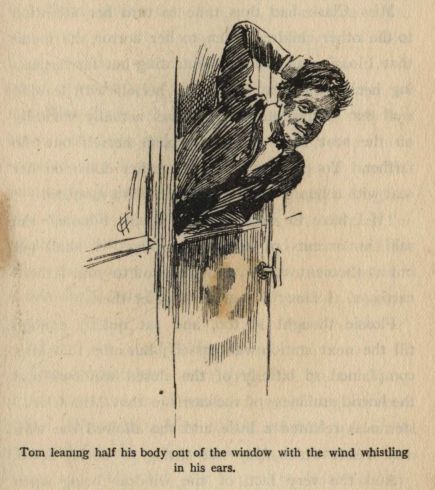
Tom leaning half his body out of the window with the wind whistling in his ears.
"I forbid you to open that window again," she said with such severity that even Tom was cowed, and sat meekly down with a somewhat sulky air.
Miss Clark had thus time to turn her attention to the other children, when, to her horror, she found that Flossie was not only emulating but far surpassing her brother, not contenting herself with leaning well out of the window, but was actually standing on the seat that she might push herself out the farther. To pull her in and put her down on her seat with a bump was the work of but a moment.
"If I have to speak to you again, Flossie," she said in accents of solemn warning, "I shall get out at the next station and take you to your father's carriage. I fancy you will sit quiet there."
Flossie thought so too, and sat quietly enough till the next station was passed; but after that May complained so bitterly of the closed windows and the horrid stuffiness of the carriage that Miss Clark's sternness relented a little, and she allowed the window beside which May was sitting to be let down. And the very fact of the window being open seemed to set all Tom's nerves, and muscles, and longings tingling. He moved about uneasily in his seat, kept dodging round to look sideways through the glass at the side, and finally jumped up in a hurry and pushed his head and shoulders through the window. In vain did Miss Clark tug and pull at him and his garments alike. Tom had his elbows out of the window this time, and, as he chose not to give way, not all the combined strength of Miss Clark and May, with such help as Sarah and Minnie could give, had the smallest effect upon him. At last Miss Clark, who, as I have said, was not very strong, sat down and began to sniff in a way which sounded very hysterical, for she really was horribly afraid some dreadful accident would happen long before they got to their destination. However, as the suspicious little sob was heard and understood by May, that young lady took the law into her own hands and administered a sharp corrective immediately.
"Tom," she shouted, "come in."
Tom did not hear more than that he was being shouted at, and, as a natural consequence, did not move. Whereupon May quietly reached up to the rack and fished out Tom's own, his very own, riding-whip, and with that she began to belabour him soundly.
It had effect! After half a dozen cuts, Tom began to struggle in, but May was a stout and heavily-set young lady, and as resolute in will as ever was her father, when she was once fairly roused. So she calmly held him by his neck and went on administering her corrective until she was utterly tired.
Then she let him go, and when he, blind with rage and fury, and vowing vengeance upon her, made for her, and would have fought her, she sprang up at the knob by which you can signal to the driver and stop a train, and threatened to pull it if he touched her.
And oh, Tom was angry! Angry--he was furious; but he was mastered. For it happened that on the very day that he and Johnnie had gone with Charles to Seven Dials, he had asked Charles all about the alarm bell, by means of which trains may be stopped if necessary, and Charles had explained the matter in a clear and lucid way peculiar to himself--a talent which made him especially valuable in a home where there were boys.
"Why, Master Tom," he exclaimed, "you see that's a indicator. If you wants to storp the trayin you just pulls that knob, and it rings a bell on the engine somewhere, and the driver storps the trayin at once."
"Let's stop it," suggested Tom, in high glee at the prospect of a walk through a dark and dangerous tunnel.
It must be admitted that Charles's heart fairly stood still at the thought of what his explanation had suggested.
"Master Tom," said he, with a face of horror which was so expressive that Tom was greatly impressed by it, "don't you go for to do nothing of the kind! It's almost a 'anging matter is storping of trayins--useless like. If you was took ill, or 'ad a fit, or somebody was a-murdering of you, why, it would be all right; but to storp a trayin when there's naught wrong, is--well, I believe, as a matter of fact, it's seven years."
"Seven years--seven years what?" Tom asked, thinking the whole thing a grand joke.
"Prison," returned Charles laconically; "that is, if it was me. If it was you, Master Tom, it would mean reformatory school, with plenty of stick and no meat, nor no 'olidays. No, I wouldn't go for to storp no trayins if I was you, Master Tom."
"But we needn't say it was us that rang," pleaded Tom, whose fingers were just itching to ring that bell.
Charles laughed. "Lor! Master Tom, they're up to that game!" he answered. "Bless you! they 'ave a lot of numbers, and they'd know in a minute which carriage it was that rang. No, Master Tom, don't you go for to ring no bells and storp no trayins. I lived servant with a young fellow once as had had five years of a reformatory school, and the tales he used to tell of what went on there was enough to make your blood curdle and your very 'air stand on end--mine did many a time!"
"Which--your blood or your hair, Charles?" Tom inquired, with keen interest.
"Both!" returned Charles, in a tone which carried conviction with it.
Thus Tom had no further resource, when May vowed to ring the bell and stop the train if he touched her, but to sit down and bear his aches and his defeat in silence. But, oh, he was angry! To be beaten and beaten again by a girl! It was too humiliating, too lowering to bear. Yet poor Tom had to bear it--that was the worst of it. So they eventually got to Brighton in safety.
CHAPTER XI
AUNT GEORGE
It would be hard for me to tell of all the joys and pleasures which Brighton gave to the Stubbs family and to Sarah in particular. To the younger of the Stubbs children all was joy and delight, though they had been there several times before; to Miss Clark it was rest and peace, because she was not much troubled with Tom; and Flossie, too, was allowed to go about with him and Johnnie a great deal more freely than she ever was at home. May--always Miss Clark's favourite--spent much of her time beside her, though she went shopping sometimes with her mother, and also driving. But, on the whole, Mrs. Stubbs did not give up very much of her time just then to her children.
For Mr. Stubbs was taking his holiday, and Mr. Stubbs was troubled with a threatened fit of the gout, and do with the sound of the children's racket and bustle he simply could not. He was often threatened with the gout, though the threatenings seldom came to anything more than temper. So, whilst they were at Brighton, Mrs. Stubbs--who was as good a wife as she was a mother--devoted herself to him, and left the children to take care of themselves a good deal.
Their life was naturally quite a different one to what it was in town. They had a furnished house in which they slept and took their meals, but which at other times they did not much affect--they had early dinner there, and a high tea at seven o'clock, at which they all ate like ravenous wolves, Sarah amongst the number. This was a very happy, free-and-easy meal; for, though Mr. and Mrs. Stubbs joined in the early dinner, and called it lunch, they did not go in for the high tea but invariably went to the Grand Hotel and had dinner there.
Oh, what happy, happy days they were! There was the early run out on the Parade or the Sea Wall before breakfast; then the delicious seaside breakfast, with fresh whitings every morning. There was the daily dip in the sea, and the daily donkey ride or goat-chaise drive. There was the ever new and delightful shingle, on which they played and skipped, and dug and delved to their hearts' content. There were the niggers, and the blind man who sang to his own accompaniment on a sort of hand-organ, and wore a smart blue necktie, and a flower in his button-hole. There was a sweet little child, too, wearing a big sun-bonnet, whom they used to watch for every morning, who came with toddling three-year-old gravity with a penny for the niggers, to the infinite amusement of the bystanders.
"Here, black man."
"Thank you, my little Snowdrop," was the invariable reply of the nigger minstrel; and then the little wee "Snowdrop" would make a stately bow. The nigger would take off his hat with a bow to match it, and the little scene was over till the morrow.
Then there was the Aquarium, and the delightful shop, which they called "The Creameries," a little way past Mutton's; and once or twice they all, except Mr. Stubbs, went for a trip in the steamer, when Mrs. Stubbs took chief charge, and Miss Clark was so horribly ill that she thought she would have died.
And once Mr. and Mrs. Stubbs went to Newhaven, and thence to Dieppe, taking Tom with them--not at all because Tom wanted to go, but because May represented to her mother that neither she nor Miss Clark were feeling very well, and that without "Pa's" restraining influence she was sure Tom would not only worry them all to death, but would also incite Flossie into all manner of dreadful pranks, the consequences of which might be dire and terrible.
So Tom went with them over the water on to French soil, and May remarked, triumphantly, to the governess, "I've got rid of him, Miss Clark, so now we shall have a little peace, and enjoy ourselves."
And so they did. To be without Tom was like the enjoyment of the calm which comes after a storm; and they, one and all, with the exception of Flossie, enjoyed it to the full. Flossie was very much aggrieved at being thus deprived of her playfellow.
"It is too bad that Tom should have to go with Pa and Ma," she complained. "He won't have a soul to speak to or a boy to play with, or anything, except some stupid little French boy, perhaps, who can't speak a word of anything but gibberish. I call it a beastly shame. I suppose it's old Clark's doing, and that she was just afraid Tom would get an extra good time while they were away. Nasty old cat!"
"Miss Clark had no more to do with it than you had," May replied. "Ma chose to take him, and that's enough."
As Tom was actually gone, there was not the smallest use in grumbling. So Flossie, thus left idle, turned her attention upon Sarah. It is needless to say that very, very soon Flossie also began to tease her, and, in consequence, Sarah's life became more or less of a burden to her. In this way Sarah, who was a singularly uncomplaining child, crept nearer and nearer to Miss Clark and May, as there she was safe from Flossie's taunts and jeers; and it was in this way that some notice was taken of her by one of the great lights of the Stubbs family, Mrs. George Stubbs, the corn-factor's wife, who lived in great style at Brighton.
It happened that one morning Sarah and May were waiting for Miss Clark to come out with the younger children, when Mrs. George came slowly along in a bath-chair. As she passed by them she called to the man to stop. "Dear me, is that you, May?" she remarked; "how you've grown. Your papa and mamma came to see us the other day, but I was not at home. I was out."
"They have gone over to Dieppe," said May, "and Tom with them. This is our cousin, Sarah, Aunt George."
"Oh! is it? Yes, your mamma told me when she wrote last that she was coming to live with you. How do you do, Sarah?"
All this was uttered in a languid tone, as if, on the whole, life was too much trouble to be lived at all. Sarah had met with nothing of this kind in all her life before, and looked only impressed; in truth, she looked a good deal more impressed than she was, or rather she looked differently impressed to what she was, and Mrs. George Stubbs was pleased to be a little flattered thereby.
"You must come and have tea with me," she observed graciously to May. "I have not been able to get out except the day your mamma called--my unfortunate neuralgia has been so very trying. You may bring Sarah. Would you like to come to-night?
"Very much indeed, thank you, Aunt George," responded May.
"Very much indeed," echoed Sarah.
"Your cousins are, of course, all at school in Paris, and your uncle is in London, so we will have high tea at seven o'clock. Bring your music with you."
"Sarah plays the violin," said May, who hated playing in company herself. "She plays it beautifully. She's going to have lessons."
"Then bring your violin and let me hear you," said Mrs. George to Sarah; "it is a most stylish instrument."
"I will," said Sarah.
"Oh, is Flossie to come, Aunt George?" asked May, as they shook hands.
"Flossie? No. I can-not do with Flossie," replied Mrs. George, in a tone which was enough to remind May that the very last time they had visited their aunt, Flossie had been clever enough to break a beautiful Venetian glass, which was, as Mrs. George had remarked pathetically over the fragments, simply of priceless value.
CHAPTER XII
SARAH MAKES AN IMPRESSION
"What a shame!" said Flossie, when she heard of the invitation. "Just like the nasty old thing, to remember an accident that I couldn't help. Not that I care! I shall enjoy myself far better at home"; and Flossie caught hold of Minnie's arm, and stalked along the Parade as if she cared so little that she did not want to hear any more about that great lady, her Aunt George.
"What did you think of her?" May asked of Sarah.
"Is she very ill?" Sarah asked, thinking of the bath-chair and her aunt's languid wrists and tones.
"Ill?--no! Ma says she's a hy-po-chon-driac," returned May, pronouncing the long word in syllables. "That's fancying yourself ill when you ain't. See? But all the same, Aunt George is very stylish."
"She's not half so nice as Auntie," Sarah flashed out.
"No, she isn't! But she's a great deal stylisher than Ma is," May returned. "Didn't you hear the way she told the man to go on? 'Go-on-Chawles!'" and May leant back on the seat, slightly waved a languid hand, flickered her drooping eyelids, and gave a half-languid, half-supercilious smile.
It was a fine imitation of Mrs. George's stylish airs, and Sarah was lost in admiration of it.
"I wonder," she remarked presently, after thinking the question over, "I wonder if she eats her dinner like that; because, if she does, it must generally get cold before she has half finished it."
"Oh, Aunt's much too stylish to eat much," May explained. "She nibbles at this and picks at that. You'll see to-night."
And Sarah did see--saw that, in spite of her airs and her nibbling and her picking, Mrs. George contrived to put a good meal out of sight--quite as much as ever her sister-in-law could manage to do. That evening was also a new experience to Sarah; it was so much more stately than anything she had seen before.
Mr. and Mrs. George Stubbs lived in a very large house in a large square in the best part of Brighton. A resplendent footman received them when they got out of the cab--yes, they had a cab, though it was only a short way from their own house--and a solemn butler ushered them into Mrs. George's presence. She wore a tea-gown of soft yellow silk, with a very voluminous trailing skirt, and showers of white lace and broad yellow ribbons about it. It was a garment that suited the languid air, the quivering eye-lids, the weak wrists, and the soft, drawling voice to perfection.
The resplendent footman had relieved Sarah of her violin-case and carried it upstairs for her. Mrs. George motioned to it as he announced her visitors. "With great care, Chawles," and "Chawles" put it down on a chair beside the inlaid grand piano as if it were a baby and might squeal.
"With great care, Chawles."
"How are you, dears?" Mrs. George said, giving each a limp and languid hand. "How oppressive the evening is!" Then to "Chawles," "Let tea be served."
Very soon tea was announced, and they went downstairs. It was all new to Sarah--the large, spacious dining-room, with its rich, costly art-furniture; the pretty round table, with flowers and pretty-coloured glasses, with quaint little figures holding trays of sweets or preserves, or wheeling barrows of tiny ferns or miniature palms.
And the board was well-spread, too. There was salmon, salad, and a boiled chicken covered with white, frothy sauce. There was an aspic jelly, with eggs and green peas, and certain dark things which May told her afterwards were truffles; and there were several kinds of sweet dishes, and more than one kind of wine.
To Sarah it was a resplendent feast--as resplendent as the gorgeous footman who stood midway between her chair and May's, only a little in the rear; the solemn butler keeping guard over his mistress, whom he served first, as if she had been a royal queen.
"Now you shall play to me," Mrs. George said to Sarah, when they had got back to the drawing-room again.
Sarah rose obediently
"What shall I play?" she asked.
"What can you play?" Mrs. George asked, in reply.
"Oh, a great many things," Sarah said modestly.
"Let Sarah play what she fancies," put in May, who had established herself in a low, lounging chair, and was fanning herself with a fan she had found on a table at hand with the closest imitation of Mrs. George she could manage; "she always plays the best then."
"Very well," Mrs. George said graciously. So Sarah began.
She felt that in all her life before she had never played as she played then. The influence of the luxurious meal of which they had just partaken was upon her. The exquisite coloured glass, the sweet-scented flowers, the smell of the fragrant coffee, the stately servants moving softly about with quiet footsteps and smooth gestures, each and all had made her feel calm and peaceful; and now the soft-toned drawing-room, with its plush and lace hangings, its delicate china, its Indian embroideries, and those two quiet figures lying back in the half light, making no movement except the slow waving to and fro of their fans, completed the influence. It was all food to Sarah's artistic soul, and she made the Amati speak for her all that was passing through her mind. Mrs. George was spell-bound. She actually forgot to fan herself in the desire not to miss a single note. Nay, she did more, she forgot to be languid, and sat bolt upright in her chair, her head moving to and fro in time with Sarah's music.