Front matter (continued 2)
Reading edition
"Why, child, you are a genius!" she exclaimed, as Sarah came to a close and turned her speaking eyes upon her for comment.
"That's just what Papa said," put in May, adjusting her language to her company.
"If you go on--if you work," Mrs. George continued, "your violin will be your fortune. You will be a great woman some day."
Sarah's great eyes blazed at the thought of it; her heart began to beat hard and fast.
"Do you really think so, Aunt George?" she asked.
"I really do. I am sure of it. But, child, your violin seems to me a very good one. Where did you get it?"
"Father gave it to me; it was his grandfather's," said Sarah, holding it out for inspection. "It is an Amati."
"It is worth five hundred pounds," said May, who was eminently practical, and measured most things by a pounds, shillings, and pence standard.
"Of course--if it is an Amati," murmured Mrs. George, becoming languid again. "But go on, my child. I should like a little more."
So Sarah played and played until the room grew darker and darker, and gradually the shadows deepened, until it was only by the lamps from the square that she could distinguish the outlines of the figure in the yellow sweeping robes.
It was like a shock when the door was gently opened and the footman came in, bearing a huge lamp with a crimson shade. Then the coffee followed, and before very long one of the servants came back, and said that the cab for the young ladies had come.
"You have given me great pleasure," said Mrs. George to Sarah; "and when Mrs. Stubbs comes back I must make an afternoon party, and Sarah shall play at it. I have not been so pleased for a long time." And then she kissed them both, and with "good-night" they left her.
"Won't Ma be pleased!" remarked May, with great satisfaction, as they drove along the Parade. "I shan't mind a bit her being vexed that Flossie wasn't asked. Really, Sarah, I never saw Aunt George so excited before. She's generally so die-away and all that."
But Sarah was hardly listening, and not heeding at all. With her precious Amati on her knee, she was looking away over the moonlit sea, thinking of what her aunt had said to her. "If you go on--if you work--your violin will be your fortune. You will be a great woman."
"I will go on; I will work," she said to herself. "If I can be a great woman, I will."
CHAPTER XIII
THE TURNING POINT OF HER LIFE
Mrs. George's opinion of Sarah's violin-playing proved to be the turning point of her life as a violin-player. A few days later, when Mr. and Mrs. Stubbs had returned from Dieppe, she gave a large afternoon reception, to which Sarah took her violin, and played--her best. And the visitors--elegant ladies and gentlemen--crowded round the child, and would have turned her head with praises, had it not been such a sensible little head that they had no sort of effect upon it.
"They talked such a lot," she said to her aunt afterwards, "that I felt frightened at first; but I found that they didn't really know much about it, for one of my strings got flat, and they praised that more than anything."
But her aunt, Mrs. Stubbs, was proud enough and elated enough for a dozen violin-players, and she stood beside Sarah, explaining who she was and how she was going to have lessons from the best master they could get, until Mrs. George felt sick to think that her grand friends should know "that dreadful woman" was a relation of hers.
"Sarah, my dear, Lady Golladay wishes you to play again. Something pathetic."
So Sarah tuned up again, and Mrs. Stubbs was silent.
"She can't talk when the child is playing," murmured Mrs. George to her husband. "Do take her down to have some tea or something, and keep her as long as you can--anything to keep her out of sight."
"All right," he answered, and immediately that Sarah's melody came to an end, followed by a burst of applause, he offered his arm to his sister-in-law, and begged her to go with him and have some refreshments.
This reception completely opened Mrs. Stubbs's eyes, and she went back to London strangely impressed with a belief that Sarah was not only a genius, but a new fashion. She gave a party, too--not an afternoon party, for she wanted her husband to be there, and he was never at home before six o'clock. No, it was not an afternoon, but an evening party, at which the elder children were all present, and at which Sarah played.
And then Sarah began with her violin lessons, and worked hard, very hard. Mrs. George wrote from Brighton that she would provide all the new music she required, and that her Uncle George enclosed a sovereign for herself.
So time went on. Sarah had two lessons a week, and improved daily in her playing. Tom went back to school, and Johnnie with him, and Flossie's turbulent spirit became a good deal subdued, though she never forgot to keep Sarah reminded that she was "Princess Sarah of Nowhere."
The weeks rolled into months, and months into years. Miss Clark went away and got married--to May's mingled sorrow and delight, and to Flossie's unfeigned and unutterable disgust--for Mrs. Stubbs chose a lady to fill her place, who was what she called "a strict disciplinarian," and Flossie had considerably less freedom and fun than she had aforetime. For Miss Best had not only a strong mind and a strong will, but also a remarkably strong body, and seemed able to be on the alert at all times and seasons. She had, too, not the smallest objection to telling tales in school or out of it. The slightest infringement of her rules was visited with heavy punishment in the form of extra lessons, and the least attempt to shirk them was reported to headquarters immediately. In fact, Miss Best was a power, a power to be felt and feared, and Flossie did both accordingly.
Of all her pupils, Sarah was Miss Best's favourite. In her she recognised the only worker. May was good-tempered, and possessed the blessing of a placid and dignified disposition; but May's capacity for learning was not great, and Miss Best soon found that it was no use trying to drive her a shade faster along the royal road to knowledge. She went at a willing jog-trot; she could not gallop because she had not the power. With Flossie it was different. Flossie had brilliant capacities which she would not use. Miss Best was determined that she should use them and exert them. Flossie was equally determined that she would not; and so for the first few months life in the Stubbs's schoolroom was a hand-to-hand fight between Flossie and Miss Best; and Miss Best came off winner.
Yet, though she got the better of Flossie and made her work, she never gave her the same place in her heart that she gave to Sarah, who worked with all her heart and soul, because she was impressed with the idea that if she only worked hard enough she might be a great woman one day.
And as she was a favourite with Miss Best, so was she a favourite with Signor Capri, the master who taught her the violin. He was quick to recognise the true artist soul that dwelt within her, and gave her all the help that lay in his power; in fact, Sarah was his favourite pupil, his pet, and he put many chances of advancement toward her great ambition in her way.
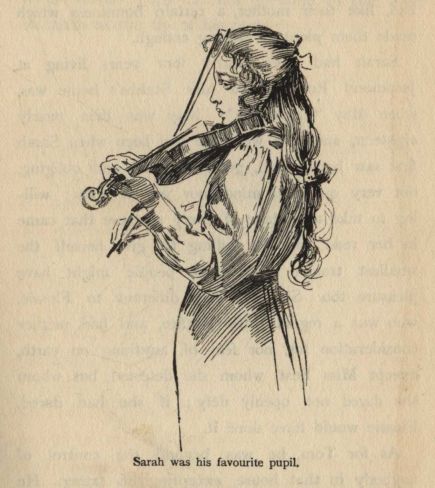
Sarah was his favourite pupil.
For instance, many times he took her out with him to play at concerts and private houses, so that she might grow accustomed to playing before an audience of strangers and also that she might become known.
And known very soon Sarah was, and welcomed to many a noble house for the sake of the exquisite sounds she was able to draw from the strings of the Amati. Besides that, Sarah was a very pretty child, and, as she grew older, was an equally pretty girl. She never had that gawky legginess which distinguishes so many girls in their teens--there was nothing awkward about her, nothing rough or boisterous. All her movements were soft and gentle; her voice was sweet, and her laugh very musical, but not loud; and with her tall, slim figure, and the great, grey, earnest eyes looking out from under the shining masses of sunny hair, she was, indeed, an uncommon-looking girl, and a great contrast to the young Stubbses, who were all short, and inclined to be stout, and had twine-coloured hair, and pale, pasty complexions; though, in spite of that, they all had, like their mother, a certain bonniness which made them pleasant looking enough.
Sarah had been nearly four years living at Jesamond Road, where Mrs. Stubbs's home was, when May "came out." May was then nearly eighteen, and just what she had been when Sarah first saw her--placid, good-tempered, and obliging, not very quick in mind, nor yet in body; willing to take advantage of every pleasure that came in her road, but not willing to give herself the smallest trouble that other people might have pleasure too. She was very different to Flossie, who was a regular little spitfire, and had neither consideration for, nor fear of, anything on earth, except Miss Best, whom she detested, but whom she dared not openly defy; if she had dared, Flossie would have done it.
As for Tom, he was beyond the control of anybody in that house, excepting his father. He was wilder, rougher, more unmerciful, and more impudent than ever; and whenever Tom's holidays drew near, Sarah used to quake for fear lest her precious Amati should not survive the visit; and invariably she carried it to the cupboard in Miss Best's room for safety. Happily, into that room Master Tom did not presume to put even so much as the tip of his nose.
CHAPTER XIV
A BRILLIANT MARRIAGE
When May left the schoolroom behind her, Sarah found a great difference in her life. In her placid, good-natured way, May had always been fond of her, and had in a great measure stood between her and Flossie; but Flossie, when she became the senior of the schoolroom, took every opportunity she had of making the younger ones, particularly Sarah, aware of that fact.
Sarah was then nearly fourteen, and rather taller than Flossie, who was turned sixteen; so, had she chosen to do so, she could easily have got the best of her; but Sarah never forgot--never, indeed, was allowed to forget--that she was not a daughter of the house, and was not, therefore, free to fight and wrangle as much and as disagreeably as the others allowed themselves to do.
Very, very often, in those days, did she have the old taunt of Princess Sarah thrown at her. "Oh! Princess Sarah is quite too high and mighty to quarrel over it. Princess Sarah is going to do the mute martyr style of thing."
So Flossie would--though she did not know it--encourage her cousin to work harder than ever, just by way of showing that she had something more in her than to spend her life in bickering and snarling. Stay! I do Sarah an injustice there--she was moved by another and a better motive, both in trying to keep peace and in trying to get on with her work, for she had always the grateful feeling, "It will please Auntie so," and always a feeling that it was a slight return to her uncle's wife if she bore Flossie's attentions without complaining.
They did not see much of May; all day she was in the drawing-room with her mother, if she was not out on some errand of pleasure. And at night, when the schoolroom tea was over, she used to come down for a minute and show herself, a vision of comeliness--for May was considered a great beauty in the Stubbs' set--in white or roseate airy garments, with hair crimpled and fluffy, feathers and flowers, fans and bangles, pearls and diamonds, and all the other necessaries for a young lady of fashion in her first season.
Some time previously Mr. Stubbs had made his wife a present of an elegant landau and a pair of high-stepping horses. But Flossie, to her disgust, found that her drives were no more frequent than they had been in the days of the one-horse "broom." Then her mother had not unreasonably declared herself unable to bear the stuffiness of a carriage full of people. Now May objected to any one going with them on the score of her dress being crushed and the unpleasantness of "looking like a family ark."
They had become very gay. Scarcely a night passed but they went out to some gay entertainment or other, and many parties were given at home, when the elder of the younger members of the family had the pleasure of participating in them.
Flossie was terribly indignant at being kept at home that May might have more room in the luxurious and roomy carriage.
"Just you wait till I come out, Miss May." She said one day, "and then see if your airs and graces will keep me in the background! The fact is, you're afraid to show off against me; you know as well as I do that, with all your fine dress and your finer airs, you are not half so much noticed as I am! And as for that Sarah----"
"Leave Sarah out of it!" laughed May; "she doesn't want to go."
"I'd soon stop it if she did!" growled Flossie.
It was really very hard, and Flossie thought and said so. But May was inflexible, and long before Flossie was ready to come out May became engaged to be married.
It was a very brilliant marriage indeed, and the entire family were wonderfully elated about it. True, the bridegroom was a good deal older than May, and was pompous to a degree. But then he was enormously rich, and had a great cheap clothes manufactory down the East End somewhere, and could give May bigger diamonds than anybody they knew. He had, too, a house in Palace Gardens and a retinue of silk-stockinged servants, in comparison with whom Mrs. George's footman at Brighton was a mere country clod.
So in time May was married--married with such pomp and ceremony that feelings seemed left out altogether, and if tender-hearted Mrs. Stubbs shed a few tears at parting with the first of all her brood, they were smothered among the billows of lace which bedecked her, and nobody but herself was any the wiser.
After this it became an established custom that Flossie should take May's place in the carriage; and it was not long before she managed to persuade her mother that it was time for her to throw off Miss Best's yoke altogether, and go out as a young lady of fashion.
Before very long Mrs. Stubbs began dearly to repent herself of her weakness; for Flossie, with her emancipation, seemed to have left her old self in the schoolroom, and to have taken up a new character altogether. She became very refined, very fashionable, very elegant in all her ideas and desires.
"My mother really is a great trial to me," she said one day to Sarah. "She's very good, and all that, you know; but she's so--well, there's no sort of style about poor mother. And it is trying to have to take men up and introduce them to her. And they look at her, don't you know, as if she were something new, something strange--as if they hadn't seen anything like her before. It's annoying, to say the least of it."
"Well, if I were you," retorted Sarah hotly, "I should say to such people, and pretty sharply, 'If my mother is not good enough for you, why, neither am I.'"
"But then, you see, I am," remarked Flossie, with ineffable conceit.
"You don't understand what I mean," said Sarah, with a patient sigh.
"That's because you're so bad at expressing yourself, my dear," said Flossie, with a fine air of condescension. "It all comes out of shutting yourself up so much with that squeaking old violin of yours. I can't think why you didn't go in for the guitar--it's such a pretty instrument to play, and it backs up a voice so well."
"But I haven't got a voice," cried Sarah, laughing.
"Oh, that doesn't matter. Lady Lomys hasn't a voice either, but she sings everywhere--everywhere."
"Where did you hear her?" Sarah asked.
"Oh, well, I haven't heard her myself," Flossie admitted; "but then, that's what everybody says about Lady Lomys."
"Oh! I see," murmured Sarah, not at all impressed by the mention of her ladyship's accomplishments.
It happened not very long after this that the Stubbses gave a ball--not just a dance, but a regular ball, with every available room in the house cleared and specially decorated, with the balconies covered in with awnings, and with every window and chimney-shelf, every fireplace and corner, filled with banks of flowers or stacks of exquisite palms or ferns. The entire house looked like fairyland, and Mrs. Stubbs went to and fro like a substantial fairy godmother, who was not quite sure how her charms were going to work.
May came, with her elderly husband, from her great mansion in Palace Gardens, wearing a white velvet gown and such a blaze of diamonds that the mind refused to estimate their real value, and ran instinctively to paste. And Mrs. George, who was in town for "the season," came with her daughters, and languidly patronised everything but those diamonds, which she cheapened at once as being a little "off colour" and a "trifle overdone." Mrs. George herself had put on every single stone she was possessed of--even to making use of her husband's breast-pin to fasten a stray end of lace on the bosom of her gown; but that, of course, had nothing really to do with her remarks on her niece's taste--oh, no!
Flossie had a new dress for the occasion, of course; and she had coaxed a beautiful diamond arrow out of her father on some pretext or other. Sarah thought she had never seen her look so charming before, and she told her so; it was with a smile and a conscious toss of her head that Flossie received the information, and looked at herself once more in the glass of her wardrobe.
As she stood there, with Sarah, in a simple white muslin gown, watching her, a maid entered with a large white cardboard box.
"For Miss Flossie," she said.
The box contained a beautiful bouquet of rare and fragrant hothouse flowers, and attached to the stem was a small parcel. The parcel proved to contain a superb diamond bangle, and Flossie went proudly downstairs, wearing it upon her arm.
And that night it crept out among the young ones in the Stubbs' schoolroom that Flossie was going to be married.
CHAPTER XV
A FAMILY CATASTROPHE
I am bound to say that Flossie's brothers and sisters (and Sarah) received the news of her approaching departure from her father's roof with unmixed feelings. Not a drop of sorrow was there to mar the cup of joy which the occasion presented to every one. Not a regret at the blank her going would cause leavened the general satisfaction at her happiness. And Flossie herself was the least sorrowful, the least regretful, and the most satisfied of all.
Like May, she was marrying well--that is to say, she was marrying money. But, unlike May's husband, who was old, her future lord and master was young--only five years older than herself. It is true he was not much to look at; but then, as Mrs. Stubbs remarked to her husband, that was Flossie's business. It was equally true that he was reputed to be a young scamp, with an atrocious temper; but then, as Tom said, that was Flossie's look-out, and decidedly Flossie was not without little failings of that kind--though why, if one bad-tempered person decides upon marrying another bad-tempered person, it is generally considered by the world to be all right, because the one is as bad to get on with as the other, it would be hard to say; perhaps it is on the principle of two negatives making an affirmative, or in the belief that two wrongs will make eventually a right; I cannot say. But, odd as it is, that is the very general opinion.
The engagement was an unusually short one. Indeed, the bride had barely time to get her things ready by the day, and a great part of her trousseau was not able to be ready before her return from her honeymoon. But still they never seemed to think of putting off the wedding for a single day, although it was fixed to take place just six weeks from the day of the ball, when the engagement had begun.
It seemed to Sarah, well used as she had become to seeing liberal expenditure, that at this time the entire family seemed to be spending money like water! May's wedding had been a very grand one, but Flossie's outshone it in every way--in the number of the bridesmaids, in the number of the guests, in the number of the carriages, and the servants, and the flowers, in the splendour of the presents and the dresses of the trousseau, nay, in the very length of the bride's train.
The presents were gorgeous! Mr. Stubbs gave his daughter a gold-mounted dressing-case and a cheque for a thousand pounds; Mrs. Stubbs gave a diamond star, and May a necklace of such magnificence that even Flossie was astounded when she saw it.
So Flossie became Mrs. Jones, and passed away from her old home; and when it was all over, and the tokens of the great feast and merry-making had been cleared away, the household for a few days settled down into comparative quietude.
Only for a few days, however. With the exception of Sarah, who was too deeply engrossed in her work to care much for passing pleasures, the entire family seemed to have caught a fever of restlessness and love of excitement. After ten days the bride and bridegroom returned, and there were great parties to welcome them. Every day there seemed some reason why they should launch out a little further, and yet a little further, and instead of the family being less expensive now that two daughters were married, the general expenditure was far more lavish than it had ever been before. They had a second man-servant and another maid, and then they found that it was impossible to get on any longer without a second "broom" horse for night-work.
They did, indeed, begin to talk about leaving Jesamond Road, and going into a larger house. The boys--Tom was just seventeen, and Johnnie only fifteen--wanted a billiard-room, and Minnie wanted a boudoir, and Mr. Stubbs wanted a larger study, and Mrs. Stubbs wanted a double hall. That change, however, was never made, although Mrs. Stubbs and Minnie had seen and set their hearts upon a mansion in Earl's Court at a modest rental of five hundred a year, which they thought quite a reasonable rent--for one awful night the senior clerk came tearing up to the door in a cab, with the horse all in a lather and his own face like chalk, and asked for the master.
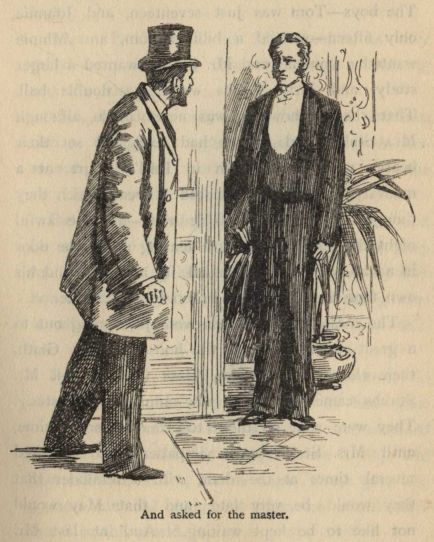
And asked for the master.
The master and mistress were just going out to a great dinner-party at the house of Mrs. Giath, their eldest daughter, in Palace Gardens, but Mr. Stubbs came down and saw him in the study. They were shut up there together for some time, until Mrs. Stubbs grew impatient, and knocked several times at the door, with a reminder that they would be very late, and that May would not like to be kept waiting. And at last Mr. Stubbs opened the door and came out.
"Get my coat, James," he said to the servant; then, as he buttoned it, added, "Mr. Senior will have a glass of wine and a biscuit before he goes. Good-night, Senior. See you in the morning."
"Lor, Pa!" exclaimed Mrs. Stubbs, as they rolled away from the door, "I thought something was the matter."
"No, my dear, only some important business Senior thought I ought to know about," he answered; and Mr. Stubbs that evening was the very light and life of his daughter's party.
But in the morning the crash came! Not that he was there to see it, though; for just as they reached home again, and he passed into his own house, Mr. Stubbs reeled and fell to the ground in all the hideousness of a severe paralytic seizure.
Nor did he ever, even partially, recover his senses; before the day was done he had gone out of the sea of trouble which overwhelmed him, to answer for his doings before a high and just tribunal, which, let us hope, would give him a more merciful judgment than he would have found in this world.
Mrs. Stubbs was broken-hearted and inconsolable. "If he had only been spared for a bit," she sobbed to her married daughters, who came to her in her trouble; "but to be taken sudden like that! oh, it is 'ard--it is 'ard."
"Poor Pa," murmured May; "he was so active, he couldn't have borne to be ill and helpless, as he would have been if he'd lived. I wouldn't fret so, if I were you, Ma, dear, I really wouldn't."
"There's nothing dishonourable," Mrs. Stubbs sobbed; "all's gone, but your poor Pa's good name's 'ere still. I do thank 'eaven for that--yes, I do."
"H'm! If Pa'd been half sharp," Flossie remarked, "he'd have taken care there was something left."
"He's left his good name and his good deeds behind him--that's better than mere money," said Sarah softly, holding her aunt's hand very tightly in both of hers.
"Oh, well, as to that, Sarah," said Flossie, "of course it isn't likely you'll blame Pa for being so lavish as he was; dressed just the same as us, and expensive violin lessons twice a week, and all that."
Mrs. Stubbs and May both cried out upon Flossie for her words.
"Cruel, cruel!" Mrs. Stubbs exclaimed; "when you've had every lux'ry you could wish, to blame your poor Pa for his charity before he's laid in his grave. I'm ashamed of you, Flossie, I am!" And then she hid her face on Sarah's slim young shoulder, and broke into bitter sobs and tears.
CHAPTER XVI
A CHANGE OF CIRCUMSTANCES
When her husband's affairs were all investigated and arranged, it was found, to Mrs. Stubbs's great joy, that matters were scarcely quite so bad as had at first been anticipated. True everything--or what she called everything--was gone; but no stain was there to sully a name which had always been held among City men as a blameless and honourable one.
The actual cause of the crash had been the failure of a large bank, which had ruined two important houses with which the firm of Stubbs & Co. had very large dealings; these houses were unable to pay their debts to Stubbs & Co.; and Stubbs & Co., having been living in great extravagance up to the last penny which could be squeezed out of the business, were not able to stand the strain of the unexpected losses.
But when everything was arranged, it was found that, with careful nursing and management, the business could be carried on for the benefit of the children until such time as the boys should be of an age to take the management of it themselves. Meanwhile, the trustees took Tom away from the expensive public school at which he was at the time of his father's death, and, instead of sending him to Oxford, as his father intended to have done a few months later, put him into the clerks' department of a large mercantile house, where they made him work--as Tom himself said indignantly--as if he were a mere under-clerk at a few shillings a week.
It happened that the trustees were both bachelors, who understood the management of a large and expensive household just about as well as they sympathised with the desire for social prominence. Therefore, they believed themselves to be doing a really generous and almost unheard-of action when they agreed to allow Mrs. Stubbs three hundred a year out of the proceeds of the business. "And the lad will have his pound a week," they said to one another, as a further proof of their consideration for their old friend's widow.
But to Mrs. Stubbs it seemed as if the future was all so black that she could not even see where she was to get food for herself and her children. Poor soul! she had forgotten what the old friends of her dead husband remembered only too well--the days when she had run up and down stairs after her mother's lodgers, of whom poor John Stubbs was one. On the whole, it is pretty certain that we rise much more easily than we fall. We find climbing up much easier than we find slipping down. And Mrs. Stubbs had got so used to spending twice three thousand a year, that to her a descent to three hundred seemed but very little better than the workhouse.
"A nice little 'ouse at Fulham!" she exclaimed, when Flossie tried to paint such a home in glowing colours. "You know I never could a-bear little 'ouses. Besides, 'ow am I to get them all into a nice little 'ouse? There's Sarah and me----"
"Oh, Sarah first, of course!" snapped Flossie.
"For shame, Flossie; you seem as if you don't know how to be mean enough to Sarah. I said 'er name first because she's my right 'and just now, and I lean on her for everything. There's Sarah and me, and Tom and Johnnie, and there's Minnie, and Janey, and Lily--that's seven. 'Ow am I to put seven of us away in what you call a nice little 'ouse?"
"Why, you'll have five bedrooms," Flossie cried.
"And where are the servants to go?" Mrs. Stubbs demanded. "Oh, I suppose I'm to do without a servant at all!"
"Well, I shouldn't think you'll want more than one," returned Flossie, who had six.
Mrs. Stubbs rocked herself to and fro in the depth of her misery and despair.
"And what's to become of me when Lily comes of age?" she cried.
For, by Mr. Stubbs's will, the business was to be carried on for the benefit of his children until the youngest should come of age, when the two boys were to have it as partners.
He had believed his wife and children were safely provided for out of his property, which had nothing to do with the business, of which Mrs. Stubbs was to take half absolutely, and the other half was to go equally among the children. Every penny of this had, however, been swallowed up by the losses which had in reality killed him; so that, though there was a provision for the children, Mrs. Stubbs was, except through the favour of the trustees, absolutely unprovided for.
"Oh, well, it's a good long time till then," Flossie returned coldly. "And really, Ma, I do think it's ungrateful of you to make such a fuss, when things might be so different. Just supposing, now, May and I weren't married; you might grumble then."
"I 'aven't as much," Mrs. Stubbs cried, "to bring up five children on as you and May each 'ave to dress on."
"Perhaps not; but then, we have to go into a great deal of society; and look what that costs," Flossie retorted. "Any way, Mr. Jones is too much disgusted at all this happening just now to let me help you. And as for my allowance, I have to pay my maid out of it, so I really don't see that you can expect me to do anything for you."
"I don't think Auntie wants you to do anything for her; I'm sure she doesn't expect it," put in Sarah, who was so utterly disgusted that she could keep silence no longer, though she had determined not to speak at all.
"Well, Sarah, I really can't see what occasion there is for you to put your word in," said Mrs. Jones, with an air of dignity. "We have heard a great deal about what you were going to do; perhaps now you will do it, and let us see whether the princess is going to turn out a real princess after all or not."
For a moment Sarah looked at her with such utter disdain in her grey eyes that the redoubtable Flossie fairly quailed beneath her gaze.
"I am going always to treat my dear aunt with the respect and love she deserves, Flossie," she said gravely; "and, even if I prove an utter failure in every other way, you might still take a lesson from me with great improvement to yourself."
"Oh, you think so, do you?" sneered Flossie.
"Yes, I do," said Sarah promptly.
"Then let me tell you, Miss Sarah Gray, that I think your tone and manner exceedingly impertinent and familiar. In future, call me Mrs. Jones, if you please, and try if you can remember to keep your place."
"Mrs. Jones, I will; and do you remember to keep yours," Sarah replied; "and do you remember, too, that you need not insult my aunt any further."
"I shall speak as I like to my own mother," Flossie cried furiously.
Sarah opened her eyes wide.
"If I do put you out of the house, Mrs. Jones," she said, speaking with ominous calmness, "I may be a little rough with you." And then the door opened, and May came languidly in.
"What is the matter?" she cried. "Flossie, is that you--at it again? Do go away, please. I am not well. I came to have a little talk to Ma, and I can't bear quarrelling. Do go away, Flossie, I beg."
"That Sarah has insulted me," Flossie gasped--but May was remarkably unsympathetic.
"Oh, I've no doubt--a very good thing, too, for you've insulted her ever since you first saw her. Do go away. I'm sure I shall faint. I never could bear wrangling and fighting; and poor Pa's going off like that has upset me so--I just feel as if I could burst out crying if any one speaks to me."
On this, Flossie, finding that May was unmistakably preparing herself for a nice comfortable faint, went stormily away, and rolled off in her grand carriage, looking like a thunder-cloud. May recovered immediately.
"I really don't envy Flossie's husband the rest of his life," she remarked. "What a comfort she has gone away! Well, Ma, dear, I came in to have a quiet talk with you, and that tiresome girl has upset you. I would not take any notice if I were you, dear. I don't suppose Flossie means it. But she is so impetuous, and she's so jealous of Sarah. I'm sure I don't know what you ever did to upset her, Sarah; but you and I were always the best of friends."
"The best of friends, May," said Sarah; then bent down and kissed her cousin's soft ungloved hand. "I didn't mean to speak, not to say a word--but she was so unkind to poor Auntie--and, May, it is hard on Auntie after all this"--looking round the room--"and her beautiful carriages and horses, and her kind husband who was so fond of her, to have just three hundred a year to keep five children on. It is hard."
Poor Mrs. Stubbs broke down and began to sob instantly. "Sarah puts it all so beautifully," she said. "That's just as it was--your poor Pa--and----" but then she stopped, unable to go on, choked by her tears.
"Now, Ma, dear, don't," May entreated; "we don't know why everything is. It might have been worse, you know, dear; just think, if you'd had Flossie at home."
"Ah! it is a comfort to me to think Flossie is married," said Mrs. Stubbs, drying her eyes; "she's never been like a child to me."
"And there might have been nothing, you know; after all there is something, and you'll be able to keep them all together. I shall help you all I can, Ma, dear; you know I shall do that! And if I can't do much else, I can take you for drives, and see if I can't help Minnie to get married. You'll think it queer, Ma, dear, that I'm not just able to say 'I'll give you a cheque for a hundred now and then.' But I can't. Life isn't all roses for me either. Of course I have a grand house in Palace Gardens, and diamonds, and carriages, and all that; but Mr. Giath doesn't give me much money; he isn't like poor dear Pa. Of course he made a very big settlement--Pa insisted on that--but only at his death. I don't get it now, and he pays my dress bills himself; and," with a sob, "I don't find it all roses to be an old man's darling. But I don't want to trouble you with all that, Ma, dear; you've got enough troubles and worries of your own. But you'll understand just how it is, won't you, dear? And, of course, there'll be many little ways that I shall be able to help you."
"Well, I have got my troubles," said Mrs. Stubbs, drying her eyes, and looking at her daughter's pretty flushed face; "but others has them as well. You were always my right 'and, May, from the time you was a little girl in short petticoats; and you're more comfort to me now than all my other children put together, all of them. Flossie's been 'ere turning up her nose at her mother and insulting Sarah shameful; and Tom's grumbling all day long at what he calls his 'beggarly screw'; and saying it won't pay for 'is cigars and cabs and such-like; and Minnie's been crying all this morning because it's her birthday and nobody's remembered it; and, really, altogether I feel as if it wouldn't take much more to send me off my head altogether."
"But I did remember it," cried May; "I've brought her a birthday present, poor child."
"I'm sure it is good of you, May," poor Mrs. Stubbs cried. "Minnie 'll be a bit comforted now. You know it is 'ard on her, for we used to make so much of birthdays. But neither she nor the little ones ever seem to think of what they've 'ad--and no more I do myself for that matter--only of what they 'aven't got. 'Pon my word, there is but one in the 'ouse to-day who hasn' 'ad their grumble over something or other, and that's Sarah."
Sarah laughed as she patted her aunt's fat hand. "I've got something else to do just now, Auntie," she said bravely. "I've got to put my shoulder to the wheel now. I've been riding on the top of the wagon all along."
CHAPTER XVII
SARAH'S OPPORTUNITY
A few days later they made the move to the little house at Fulham, which, in poor lavish Mrs. Stubbs's eyes, was but a degree better than a removal to the workhouse.
But Sarah--who somehow seemed to have naturally the management of everything--worked like a slave to get everything into good order before her aunt should set foot in the place at all. She turned the house in Jesamond Road out that she might take the prettiest and most suitable things for the little Queen Anne box to which they were going, and, with the help of Johnnie and the new servant, succeeded in having everything in perfect order by the time of Mrs. Stubbs's arrival.
But it was very, very small. Mrs. Stubbs looked hopelessly at the narrow passage and the narrower doorways when she entered, sobbed as she recognised one article of furniture after another, or missed such as Sarah had not thought it wise or in good taste to bring.
"Oh, dear, dear! I ought to think it all very pretty and nice," she wailed; "I left it all to you, Sarah, and I know you've done your best--I know it; but I did think I should have been able to keep my own inlaid market writing-table that Stubbs gave me on my last wedding-day--I did."
"Dear Auntie, you shall have it," Sarah explained, soothingly. "I couldn't get you to choose just what you would have, and I had to be guided by size a good deal. But we can fetch the table easily enough; it will stand here in the window beautifully, and just finish off the room nicely."
"Flossie says she'll not be able to come and see us very often." Mrs. Stubbs wandered off again. "She says it knocks the carriage about so, coming down these new neighbourhoods. Ah, I never used to think of my carriages before my relations, never!"
"Flossie will have more sense by-and-by," said Sarah, who had but small patience with Mrs. Jones's airs and graces.
Poor Sarah was so tired of Flossie and her airs! To her mind, she was hardly worth a moment's consideration or regret; to her she was just an ungenerous, self-sufficient, very vulgar and heartless young person, who would have been more in her place had she been scrubbing floors or washing dishes than she was, or ever would be, riding in her own carriage behind a pair of high-stepping horses that had cost four hundred guineas.
"Don't think about Flossie at all, dear," she said to her aunt. "Some day she'll be sorry for all that has happened lately; perhaps some day she may have trouble herself, and then she will understand how unkind she has been to you. But May is always sweet and good, though she is tied up by that horrid old man, and can't help you as she would like; and the little ones are different--they would never hurt your feelings willingly."
Poor Mrs. Stubbs shook her head sadly. She had said nothing to Sarah, for a wonder--for as a rule she carried all her troubles to her--but only that morning Tom had flung off to "his beastly office" in a rage, because she had not been able to give him a sovereign and had suggested that the pound a week he was receiving ought to be more than enough for his personal expenses; and Minnie had pouted and cried because she could not have a pair of new gloves; and the little ones had looked at her in utter dismay because there was not a fresh pot of jam for their breakfast. Perhaps Mrs. Stubbs felt that Sarah was young, and must not be disheartened when she was doing her best; I know not. Any way, she kept these things to herself, and after shaking her head as a sort of tribute to her troubles, promised that she would try to make herself happy in her new home.
And then Sarah felt herself at liberty to go and pay a visit to Signor Capri, her violin master, one she had been wishing to pay ever since her uncle's death. She went at a time when she knew he would be alone, and indeed she found him so.
"Ah, my little Sara!" he cried; "I was hoping to see you again soon. And tell me, you have lost the good uncle, eh?"
"Yes, Signor," she answered, and briefly told him all the story of her uncle's misfortune and death. "And now," she ended, "I want to make money. They have done everything for me; now I want to do something for them. Can you help me?"
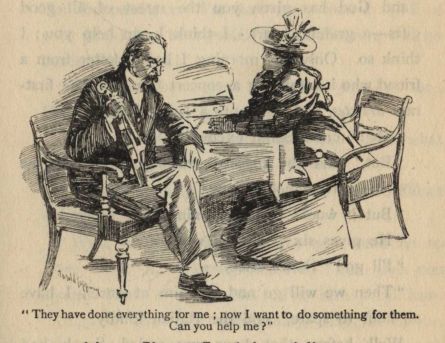
"They have done everything for me; now I want to do something for them. Can you help me?"
"You are a brave child!" the violin-master cried; "and God has given you the rarest of all good gifts--a grateful heart. I think I can help you; I think so. Only this morning I had a letter from a friend who is arranging a concert tour; he has first-rate artistes, and he wants a lady violinist."
"Me!" cried Sarah excitedly.
"But," said the maestro, raising his hand, "he does not give much money."
"But it would be a beginning," she broke in.
"He gives six pounds a week."
"I'll go!" Sarah cried.
"Then we will go and see him at once; I have an hour to spare," said the Italian kindly.
Well, before that hour was ended, Sarah had engaged herself to go on a twelve weeks' tour, at a salary of six pounds a week and her travelling expenses; and before ten days more had gone over her head, she had set off on her travels in search of fame and fortune.
Flossie's remarks were very pious. "I'm sure, Sarah," she said, setting her rich folds of crape and silk straight, "I am heartily glad to find that you have so much good feeling as to wish to relieve poor Ma of the expense of keeping you. How much happier you will be to feel you are no longer a burden on anybody! There's nothing like independence. I'm sure every time I think of poor Ma, I say to myself, 'Thank Heaven, I'm no burden upon her!"
"That must be a great comfort to you, I'm sure, Flossie," said Sarah gravely.
"Yes; I often tell Mr. Jones so. And what salary are you going to have, Sarah?"
"Enough to help my aunt a little," replied Sarah coldly.
"Well, really, I can't see why you need be so close about it," Flossie observed, "nor why you should want to help Ma. I'm sure she'll have enough to live very comfortably, only, of course, she must be content to live a little less extravagantly than she did before. I do believe," she added, with a superb air, "in people being content and happy with what they have; it's so much more sensible than always pining after what they haven't got. By the bye, Sarah, we are going to have a dinner-party to-morrow night; I couldn't ask Ma because of her mourning, but if you like to come in in the evening, and bring your violin, we shall be very pleased, I'm sure."
"If you like to ask me as a professional, and pay my fee," began Sarah mischievously.
"Pay your fee! Well, I never! To your own cousin, and when you owe us so much!" Flossie exclaimed.
"I don't think I owe you anything, Flossie, not even civility or kindness," said Sarah coldly; but Mrs. Jones had flounced away in a huff.
"Such impudence!" as she said to her husband afterwards.
Well, Sarah went off on her tour, and won a fair amount of success--enough to make her manager anxious to secure her for the following winter on the same terms. But Sarah had promised Signor Capri to do nothing without his knowledge, and he wrote back, "Wait! Before next winter you may be famous."
But the months passed over, and still fame had not come, except in a moderate degree. The manager was very glad to take Sarah on tour again at a salary advanced to seven pounds a week instead of six, and Sarah was equally glad to go.
In the meantime, she had made a good deal of money by playing at private houses and at concerts. She had taken a well-earned holiday to the Channel Islands, and had given her aunt and the little ones a very good time there, all out of her own pocket, and had added a very liberal sum to the housekeeping purse of the little Queen Anne house at Fulham.
Twice she had dined with the Giaths in Palace Gardens, and had taken her violin because May had not asked her to do so. And more than once she had been asked to go in the evening to grace the rooms of Mrs. Jones--an honour which she persistently declined.
So time went on, and Sarah worked late and early, hoping, longing, praying to be one day a great woman.
Thus several years went by, and at last there came a glad and joyous day when she received a command to play at a State concert--a day when she woke to find herself looked upon as one of the first violinists of the age. It was wonderful, then, how engagements crowded in upon her; how she was sought out, flattered, and made much of; how even the redoubtable Flossie was proud to go about saying that she was Miss Gray's cousin.
Not that she ever owned it to Sarah; but Sarah heard from time to time that Mrs. Jones had spread the fact of the relationship abroad. The object of Flossie's life now seemed to be to get Sarah to play at her house; for, as she explained to her mother and May--now a rich young widow--"Of course it looks odd to other people that they never see Sarah at my house, and I don't wish to do Sarah harm by saying that I don't care to have her there. But sometimes when she's staying with you, May, you might bring her."
"I don't think she would come," laughed May. "You see, you sat upon Sarah so frightfully when she wasn't anybody in particular, that now, when she is somebody of more consequence than all the lot of us put together, she naturally doesn't feel inclined to have anything to do with you. I know I shouldn't."
"And Lady Bright asked particularly if she was going to play on the 9th," said Flossie, with a rueful face, and not attempting to deny the past in any way.
"And what did you say?"
"I said I hoped so."
"Oh, well, that will be all the same. Lady Bright will understand after a time that 'Hope deferred maketh the heart sick.'" May laughed. "And perhaps it will be as well to remember in future that ugly ducklings may turn out swans some day, and that if they do, they are sometimes painfully aware of the fact that some people would have kept them ducklings for ever. You see, you and Tom, who is more horrid now even than he was as a boy--yes, I see you agree with me--gave her the name of Princess Sarah! She has grown up to the name, that is all."
THE END
Miss Mignon
It was a week before Christmas. There were no visitors at Ferrers Court, although a couple of days later the great hall would be filled to overflowing with a happy, light-hearted set of people, all bent, as they always were at Ferrers Court, on enjoying themselves to the uttermost.
The weather was cold and cheerless, though not cold enough to stop the hunting, and Captain Ferrers had been absent all day, and might now come home at any moment. Mrs. Ferrers was, in fact, rather putting on the time, hoping he might return before Browne brought in the tea. The children meantime were clamouring loudly for a story.
"A story?" said Mrs. Ferrers doubtfully; she never thought herself very good at story-telling, and often wondered that the children seemed to like hearing her so much.
"Yes, a story," cried three or four fresh young voices in a breath.
"I'm afraid I've told you all my stories," Mrs. Ferrers said apologetically. "And I have told them all so many times."
"Tell us about Mignon," cried Maud, for Mignon, their half-sister, was still their favourite heroine.
Mrs. Ferrers pondered for a moment. "I don't believe," she remarked, "that I have ever told you about Mignon being lost."
"Mignon--lost!" cried Maud. "Oh! never."
"Lost!" echoed Pearl. "And where was she lost, Mother?"
"Tell us," cried Bertie.
"Yes; do tell us," echoed Cecil.
"Tell us," cried Madge and Baby in the same breath.
So Mrs. Ferrers gathered her thoughts together and began.
"It was when Pearl was about four months old"--at which Pearl drew herself up and looked important, as if she, too, had had a share in the adventure--"we went to London for the season. That was in April. We had not the house we have now, for that was let for a term, so your father took a house near the top of Queen's Gate."
"That's where the memorial is," said Pearl. "I know."
"Yes; we know," echoed Maud.
"Well, Humphie, who had attended Mignon ever since she was a year old, had, of course, the entire care of Pearl, and I engaged a very nice French maid--half-maid, half-nurse--for Mignon. She was under Humphie, of course, but she had to take Mignon out--not very often, for she was accustomed to going out a great deal with your father--and to dress her, and so on.
"Well, one day your father and I were going to a large afternoon party where we couldn't very well take Mignon. We stayed rather late, rushed back and dressed and went to a dinner-party, not really having time to see the children at all. We had a party or two later on, but to them we never went, for just as we ladies were going through the hall on our way up into the drawing-room, I caught sight of Browne at the door of the inner hall. I turned aside at once.
"'Is anything the matter, Browne?' I asked. Indeed, I saw by his white face that something dreadful had happened.
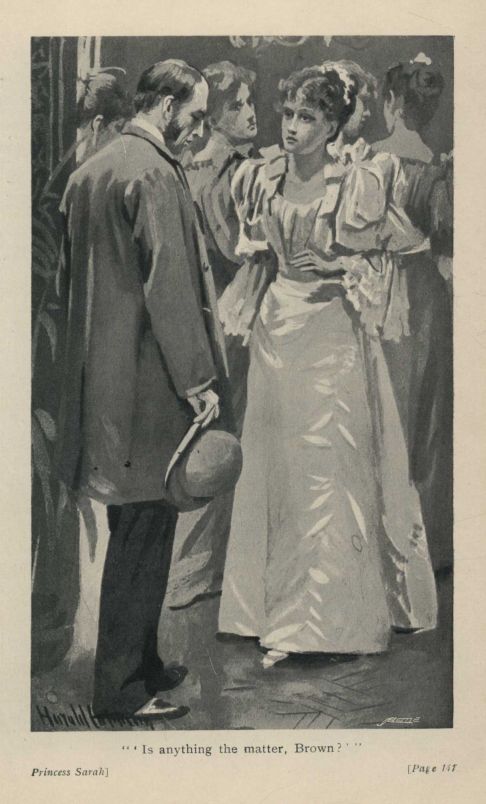
"'Is anything the matter, Brown?'" (Page 141)
"'Oh, yes, ma'am, something dreadful!' he answered. 'I scarcely know how to tell you. Miss Mignon is lost.'
"'Miss Mignon lost, Browne! What do you mean?' I said. 'How can she be lost?'
"'I only know she is,' he said, in a shaking voice. 'That silly idiot Hortense went out with her about three o'clock, with orders to go into the Park. She--this is her story, I cannot vouch for the truth of it, ma'am--she admits that she took her first to look at the shop-windows in the High Street, and that then she thought she would like to go into the Gardens, and that while there she fell asleep. The afternoon being so warm, she sat on a bench asleep till half-past five, and when she woke up with a start, feeling very shivery and cold--and serve her right, too!--Miss Mignon was gone; there was not a trace of her to be seen.'
"'If the silly creature had come straight home,' Browne went on, 'something might have been done; but instead of doing that, she must go into hysterics--with nobody to see her, even!--and then go crying about from one gate to the other, wandering about, as if Miss Mignon would be likely to be sitting on the edge of the pavement waiting for her. At last--I suppose when she began to get hungry'--Browne went on savagely, 'she bethought herself of coming home, and there she landed herself at nine o'clock, and has been steadily going out of one faint into another ever since. I have sent James round to the police station,' he said, 'but I thought I had better come straight away and fetch you, ma'am.'
"Well," Mrs. Ferrers went on, "I said good-night to our hostess and sent for your father, and we went back at once. We were five miles from home, and it was half-past eleven when we got there. And there was no trace of Mignon. James had taken a cab and gone round to all the police stations within reach of the house, and Humphie was waiting for us, shaking like a leaf and as white as death, and at the sight of us Hortense went off into wild hysterics again and shrieked till--till--I could have shaken her," Mrs. Ferrers ended severely.
"Well, your father and I just stood and looked at one another. 'Where can she be?' I said. 'Can't you get any information out of Hortense? Surely the woman must know where she was last with her.'
"But, as your father said, the Gardens were all deserted and closed hours ago. She was not at all likely to be there. Almost without doubt she had strayed out into the busy street, had then found herself in a strange neighbourhood, and--and I simply shuddered to think what might have happened to her after that.
"For the time we were helpless; we did not know, we could not think what to do next. A policeman came up from the nearest station as we stood considering what we should do. But he had no news; he shook his head at my eager inquiry. 'No, madam,' he said, 'I'm sorry we have no news of the little lady; but we telegraphed to all the stations near, but no lost child has been brought in. She must have fallen in with some private person.'
"As you may imagine," Mrs. Ferrers went on, "I felt dreadfully blank--indeed, your father and I simply stood and looked at one another. What should we, what could we do next? To go out and search about the streets at nearly midnight would be like looking for a needle in a truss of hay--we could not send a crier out with a bell--we were at our wits' end. Indeed, it seemed as if we could do nothing but wait till morning, when we might advertise.
"Then just as the policeman was turning away, another policeman came and knocked at the door. A little girl had been taken into the police station at Hammersmith, a pretty fair-haired child about six years old, who did not know where she lived, and could not make the men there understand who she was.
"'That's not Miss Mignon,' cried Humphie indignantly; 'Miss Mignon knows perfectly well who she is and who she belongs to. That's never Miss Mignon.'
"'Ah, well, Humphie,' said your father, 'Miss Mignon has never been lost at dead of night before; it's enough to frighten any child, and though she's as quick as a needle, she's only a baby after all.'
"The carriage was still at the door, and we went down as quickly as the horses could go to Hammersmith, feeling sure that we should find Mignon there, frightened and tired, but safe. And when we got there the child wasn't Mignon at all, but a little, commonly-dressed thing who didn't seem even to know what her name was. However, its mother came whilst we were there, and scolded her properly for what she called 'running away.'
"I couldn't help it," Mrs. Ferrers went on. "I was in such trouble, wondering what had got Mignon, and I just spoke to her straight. 'Oh,' I said, 'you ought only to be thankful your little girl is safe and sound, and not be scolding the poor little frightened thing like that. How can your speak to her so?'
"'Well,' she said, 'if you had seven of them always up to some mischief or other, and you'd been running about for hours till you were fit to drop, and you hadn't a carriage to take her home in, I daresay you'd feel a bit cross, too.'
"And I felt," Mrs. Ferrers went on reflectively, "that there was a great deal in what she said. They didn't live more than a mile off, and it was our way back, so we drove them home, and the little girl went to sleep on her mother's knee; and I told her what trouble we were in about Mignon. She was quite grateful for the lift, and I promised to let her know if we found Mignon all right.
"Well, we reached home again, and there wasn't a sign of Mignon anywhere. With every moment I got more and more uneasy, for Mignon was turned six years old, and was well used to going about and seeing strange people. I knew she wasn't a child to get nervous unduly, or be frightened of any one who offered to take care of her, only I was so afraid that the wrong sort of people might have got hold of her, and might have decoyed her away for the sake of her clothes or a reward.
"Oh, dear, what a dreadful night it was! Your father went out and got a cab and went round to all the police-stations, inquiring everywhere for traces of her. And then he went and knocked up all the park-keepers, but none of them had noticed her either.
"And Humphie and I sat up by the nursery fire; and about two in the morning, Hortense crept down and went on her knees to me, praying and imploring me to forgive her, and saying that if anything had happened to little missie, she would make away with herself."
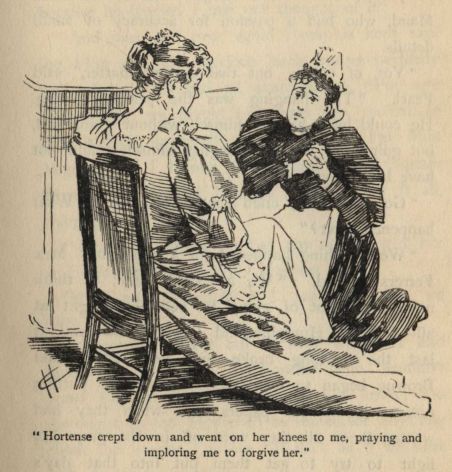
"Hortense crept down and went on her knees to me, praying and imploring me to forgive her."
"What's that?" asked Madge suddenly.
"Hanging herself," answered Pearl. "Judas hanged himself."
"Judas went out and hanged himself," corrected Maud, who had a passion for accuracy of small details.
"Yes, of course, but that doesn't matter," said Pearl. "The hanging was the principal thing. He could have hanged himself without going out, but going out without hanging himself would not have been anything."
"Go on, Mother," cried a chorus of voices. "What happened next?"
"Well, nothing happened for a long time," Mrs. Ferrers replied. "We all stayed up; I think nobody thought of going to bed that night at all--I know Humphie and I never did--and at last the morning broke, and your father and Browne began to make arrangements for putting notices in all the papers, and when they had written them all, they went off in the grey dim light to try to get them put into that day's papers. Oh! it was a most dreadful night, and a terrible morning.
"I didn't like to put it into words, but all night long I had thought of the Round Pond, and wondered if my Mignon was in there. I found out afterwards that your father had thought of it too, and had made all arrangements for having it dragged, though he wouldn't speak of it to me, because he fancied I had not thought of it.
"And over and over again Humphie kept saying, 'I'm sure my precious lamb knows perfectly well who she is and all about herself. I'm sure of it. Why, we taught her years ago, ma'am, in case it ever happened she got lost. "I'm Miss Mignon, and I belong to Booties," and "Captain Ferrers, the Scarlet Lancers." She knew it all, years since.'
"'Yes, but, Humphie, has any one taught her 304, Queen's Gate, S.W.?' I asked.
"'No,' said Humphie. 'I can't say that we have.'
"'Then she might fall in with hundreds and thousands of people in London who wouldn't know Captain Ferrers from Captain Jones; and she might be too frightened to remember anything about the Scarlet Lancers. It isn't as if we were with the regiment still.'
"The morning wore on; nothing happened. Your father went to Scotland Yard, and detectives came down and examined Hortense, who went off into fresh hysterics, and threatened to go right away and drown herself there and then; but there was no news of Mignon. And then Algy came in and told me they had dragged the pond, and, thank God, she wasn't there; though the suspense was almost unbearable as it was.
"But we seemed no nearer to hearing anything of her, and hardly knew what to be doing next, though the day was wearing away, and it was horrible to think of going through such another night as the one we had just passed.
"And then--just at four o'clock--a handsome carriage drew up at the door, and I heard Mignon's voice: 'Yes, I'm sure that's the house,' she said.
"Oh! I don't know how I got to the door; I think I tore it open, and ran down the steps to meet her. I don't remember what I said--I think I cried. I'm sure your father nearly choked himself in trying to keep his sobs back. We nearly smothered Mignon with kisses, and it was ever so long before we had time to take any notice of the strange lady who had brought her home.
"'I'm afraid you've had a terrible night,' she said, with tears in her eyes. 'I found your dear little maid wandering about in South Kensington--oh! right down in Onslow Gardens. I saw that she was not a child accustomed to being out alone, and I asked her how it was. She was perfectly cool and unconcerned.
"'"I've lost my maid," she said. "She sat down on a seat, and I was picking daisies, and I don't know how, but I couldn't find her again."
"'"And what is your name?" I asked her.
"'"Oh! I'm Miss Mignon," she answered.
"'"And where do you live?" I inquired.
"'"Well, that's just what I can't remember. When I'm at home I live at Ferrers Court, and when we were with the regiment, our address was, "The Scarlet Lancers"--just that. But now we are in Town, I can't remember the name of the street. I thought when I lost Hortense that I should know my way back, but I missed it somehow. And Mother will be so uneasy," she ended.
"'Well,' said the lady, 'I told her she had much better come home with me, and that I would try to find out Captain Ferrers; and so I did, but without success. Then it occurred to me that as soon as the offices were open I would telegraph to the Scarlet Lancers, asking for Captain Ferrers' address. And so I did; and when the answer came back, it was your country address--
"CAPTAIN FERRERS, Ferrers Court,
Farlington, Blankshire."
"'So I had no choice but to telegraph to Ferrers Court for your town address. And oh, dear lady! my heart was aching for you all the time, for I knew you must be suffering agonies," she ended, holding out her hands to me.
"And so, of course, I had been," Mrs. Ferrers went on; "but 'all's well that ends well'; and we at once taught Mignon the name of the house she lived in, and, indeed, for a long time we sewed a little ticket on to the hem of her frock, so that if she did forget it, she would easily make some one understand where she wished to be taken."
"And Hortense--what did you do with her?" Pearl asked.
"Oh! we gave her a month's wages, and sent her away," Mrs. Ferrers answered; "and now here is Browne with the tea, Pearl. Can you manage it?"
"Oh! yes, Mother," Pearl answered. She was nearly fourteen, and loved to make the tea now and then. "Oh! here's Miss Maitland coming! Miss Maitland, I am to pour out the tea. Mother says so."
"Willingly, so long as you don't scald yourself," said Miss Maitland, smiling.
"And here is Father," cried Maud. "Bootles, Mother has been telling us the dreadful story of how Mignon was lost."
"Has she, sweetheart? Well, we don't want to go through that particular experience any more, do we, darling?"
"No! once was once too often," said Mrs. Ferrers, slipping her hand into his.
"Two lumps of sugar," said Pearl, bringing her father his cup.
"And muffins!" added Maud.
Boy's Love
PART I
It was towards the close of the afternoon of a warm June day that a short, sturdy, fair-haired boy, wearing a dark blue uniform with a touch of scarlet here and there about it, sat down at a long desk to write a letter. It was headed, "Duke of York's School, Chelsea, S.W.," and began, "My dear Mother."
When he had got thus far, the boy paused, leaned his elbow upon the desk, and rested his head upon his hand. And then after a minute the hand slipped downward, and rubbed something out of his eyes--something hard to get rid of, apparently--for presently one bright drop after another forced its way through his fingers and fell on to the desk beneath.
And yet, truth to tell, even those bright drops did not help to get rid of the something, the something which had a firm foothold in the heart below, making it swell till it was well-nigh to bursting. This was his letter:--
"My DEAR MOTHER,--This is my last day at school. To-morrow I am going to Warnecliffe to join the 25th Dragoons; they call them the Black Horse. I am very glad to leave school and be a soldier like my father, but,"--and here the blurred writing was an evidence of the trouble in the boy's heart--"but I don't like losing my chum. You know, he is Tom Boynton, and we have been chums for more than three years. He is orderly to the dispenser, and has leave to go out almost any time. I am very fond of him, and haven't any other chum, though he has another chum besides me. I think he likes me best. I do love him, mother; and I lay awake all last night crying. Tom cried, too, a little. He is going to the Scarlet Lancers, and I don't know when I shall see him any more. I wish we were going into the same regiment.
"I got your letter on my fourteenth birthday, the day before yesterday. Tom is seven months older than me. He would have left school before if he had not been orderly to the dispenser. We both got the V.G. Jack Green is going into my regiment. I shall come home when I get my furlough--and if Tom gets his at the same time, can I bring him too? Tom hasn't any father or mother at all. This is a very long letter. I hope you are very well.
"I am your affectionate son,
EDWARD PETRES."
He read the letter over, brushing his cuff across his eyes when he came to that part of the paper which showed traces of tears, and then he folded it and directed the envelope, after which he had finished. Then he got up, took his cap, and with the letter in his hand, went forlornly out of the large room.
When he had got rid of it, he went in search of his chum, Tom Boynton, whom he met just coming away from his last service as "Dispenser's Orderly" with a heaving chest and eyes almost as red and swollen as poor Ted's own.
Ted turned back with him and took hold of his arm.
"Taken your last physic out, Tom?" said he, with a gallant attempt at manly indifference to the dreaded parting of the morrow.
"Aye," returned Tom in a choking voice and with eyes carefully averted.
The dispenser had just bade him "good-bye," and had told him in wishing him "God speed" that he was very sorry to lose him, and would most likely have to wait a long time before he again had help as efficient; and then he had given him a tip of half-a-crown, and had shaken hands with him. So Tom's heart was quite as full as Ted's, and of the two, being the older and bigger and stronger, he was far the most anxious to hide the emotion he felt.
"Have you seen Jack?" he asked, giving his head a bit of a shake and crushing his trouble down right bravely.
"Jack Green?" asked Ted shortly. He was not a little jealous of Jack Green, who was his chum's other chum.
"Aye! Where is he?"
"I haven't seen him--not all the afternoon," returned Ted curtly.
"I'll go and find him," said Tom, disengaging his arm from Ted's close grasp.
The two lads parted then, for Tom swung away in the direction of the playground, leaving Ted staring blankly after him; and there he stood for full five minutes, until, his eyes blinded with pain, he could see no longer, and then he turned away and hid his face upon his arm against a friendly sheltering wall.
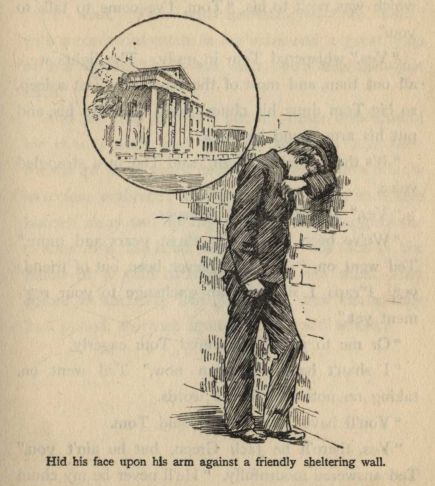
Hid his face upon his arm against a friendly sheltering wall
But by-and-by his jealousy of Jack Green began to wear away. Perhaps, after all, he argued, Tom only wanted to hide his trouble. Tom was a big lad, and was even more ashamed than Ted of being betrayed into weeping and such-like exhibitions of weakness. So, by the time they turned in for the night--the last night--Ted had forgotten the pain of the afternoon.
"Tom," said he, going over to his chum's bed, which was next to his, "Tom, I've come to talk to you."
"Yes," whispered Tom in reply. The lights were all out then, and most of the boys were fast asleep, so big Tom drew his chum's head down to his, and put his arm round his neck.
"It's the last night, Tom," said Ted in a strangled voice.
"Yes," said Tom, in a whisper.
"We've been chums for three years and more," Ted went on, "and we've never been out of friends yet. P'raps I shall get an exchange to your reg'ment yet."
"Or me to yours," answered Tom eagerly.
"I shan't have no chum now," Ted went on, taking no notice of Tom's words.
"You'll have Jack Green," said Tom.
"Yes, there'll be Jack Green, but he ain't you," Ted answered mournfully. "He'll never be my chum like you was, Tom; but if ever I've a chance of doing him a good turn, I will, 'cause you liked him."
"Will you, Ted?" eagerly.
"Yes, I will," answered Ted steadily. "And, Tom, it's our last time together to-night--we mayn't ever get together again."
"I know," sighed Tom.
"I wish," Ted said hesitatingly--"oh, Tom," with a sorrowful catch in his voice and a great gulp in his throat, "I--I--do wish you'd kiss me--just once."
And so Tom Boynton put his other arm around his chum's neck, and the two lads, who had been friends for three years, held one another for a minute in a close embrace; an instant later Ted Petres tore himself away and sprang into his bed, dragging the clothes over his head, and burying his face in the pillow in a vain attempt to stifle his sobs. And before another day had gone over their heads they had parted, to meet again--when--and where?
PART II
Seven years had gone by. A fierce and scorching sun shone down with glaring radiance upon long stretches of arid and sandy country, covered sparsely with coarse rank grass and brushwood--the country which is called the Soudan; the country where so many brilliant lives ended, sacrificed in the cause of a crusade as hopeless as the crusade of the children--who sought to win Heaven with glory where the flower of the nations had failed--sacrificed to the death in the too late attempt to succour a gallant soldier, the noble victim of an ignoble policy.
And between the brilliant glaring sky and the sun-scorched arid earth, there hung a heavy cloud of gunpowder smoke while the flower of two races fought desperately for conquest. In the midst a square of British troops, with set white faces and sternly compressed lips, with watchful eyes well on the alert, and in each brave heart the knowledge that the fight was for life or death. And on all hands swarms of stalwart Soudanese, reckless of life and counting death their chiefest gain, shouting on Allah and the prophet to aid them, and dying happy in the certain faith of entering paradise if but one Christian dog should fall to their hand.
Oh, what a scene it was! Only a handful of men at bay, while mass after mass of the enemy came down upon them like the waves of the incoming tide upon the sea shore; and as at times a rock-bound coast gives way and falls before the encroaching advances of the ocean, so that ill-fated square gave way before the overwhelming numbers of the soldiers of the Prophet, and in a moment all chance for our men seemed over.
Ay; but the British lion can up and fight again after he has had a roll over which would crush the life out of most of his foes. And so that day, by sheer hard desperate fighting, the square closed up and was formed again, and of all the enemy who had dashed into the midst of it, not one lived to tell the tale.
But, oh! what though the enemy fell half a score to one? How many a brave life was laid down that day, and how many a bullet had found its billet was proved by the shrieks of agony which rose and rang above all the tumult of the fight.
It happened that our old friend, Ted Petres, no longer a short and sturdy boy but a fine-grown young fellow of one-and-twenty now, found himself not very far from the place where the square had been broken--found himself fighting hard to win the day and check the mad on-rush of the sons of the Prophet. As the ranks closed up once more, he, as did most others who were in the rear, turned his attention to the seething mass of blacks thus trapped, and to his horror saw his comrade, Jack Green, down on his knees, striking wildly here and there against the attacks of three Soudanese. Quick as thought--the thought that this was the first time he had ever had a chance of fulfilling his last promise to his boy's love, Tom--Ted flew to his aid, sent one shouting gentleman to paradise, and neatly disabled the right arm of a second just as the third put his spear through poor Jack's lungs.
To cleave him to the teeth was but the work of a moment, and Ted Petres accomplished it before the follower of the Prophet had time to withdraw his spear! but, alas! poor Jack's life was welling out of him faster than the sands run out of a broken hour-glass! It was no use to lift him up and look round for help; Jack Green had seen his last service, and Ted knew it. But he did his best for him in those last moments, and help came in the person of one of their officers, one D'Arcy de Bolingbroke who, though badly wounded in the arm himself, was yet able to lend a hand.
"Petres, you're a splendid fellow," he exclaimed. "I shall recommend you if we live to get out of this. You ought to get the Cross for this."
"Thank you, sir," returned Ted gratefully.
And then between them they managed to get the poor fellow to the doctors, who were hard at work behind a poor shelter of wagons and store-cases. But it was too late, for when they laid him down Jack Green was dead and at ease for ever.
One of the hospital orderlies turned from a case at hand, and Ted uttered a cry of surprise at the sight of him. "Why, Tom!" he cried, starting up to take his hand, "I didn't even know you were with us."
There was no answering gleam of pleasure on Tom Boynton's face; he stared at Ted, stared at the face of the dead man lying at their feet, then dropped upon his knees beside him. "Oh, Jack, Jack, speak to me," he cried imploringly.
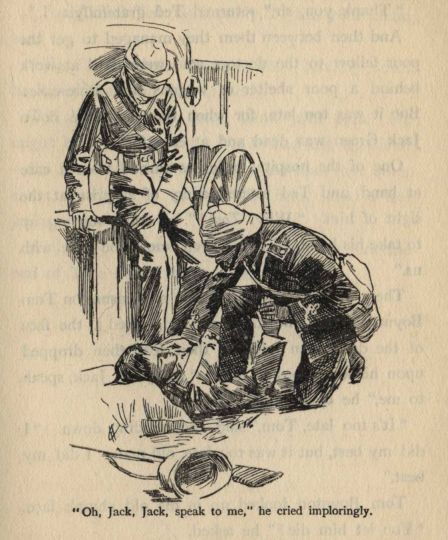
"Oh, Jack, Jack, speak to me," he cried imploringly.
"It's too late, Tom," said Ted, bending down. "I did my best, but it was too late, old man. I did my best."
Tom Boynton looked up in his old chum's face. "You let him die?" he asked.
"We were three to one," returned the other humbly.
"You did your best, and you let him die," repeated Tom blankly. "And he was my chum," he added miserably.
"Tom," cried Ted passionately, "I was your chum too."
"You!" with infinite scorn; then bending down he kissed the dead face tenderly.
Ted Petres turned away, blind with pain. He might have won the Cross, but he had lost his friend--the friend who had loved him less than that other chum of whom he had not the heart now to feel jealous.
And that was how they met again--that was the end of Tom Petres' boy's love.
Yum-Yum: A Pug
CHAPTER I
For a pug Yum-Yum was perfect, and let me tell you it takes a great many special sorts of beauty to give you a pug which in any way approaches perfection.
First, your true pug must be of a certain colour, a warm fawn-colour; it must have a proper width of chest and a bull-doggish bandiness about the legs; it must have a dark streak from the top of its head along its back towards the tail; it must have a double twist to that same tail, and three rolls of fat or loose skin, set like a collar about its throat; it must have a square mouth, an ink-black--no, no, a soot-black mask (that is, face) adorned with an infinitesimal nose, a pair of large and lustrous goggle-eyes, and five moles. I believe, too, that there is something very important about the shape and colouring of its toes; but I really don't know much about pugs, and this list of perfections is only what I have been able to gather from various friends who do understand the subject.
So let me get on with my story, and say at once that Yum-Yum possessed all these perfections. She may have had others, for she was without doubt a great beauty of her kind, and she certainly was blessed with an admirable temper, an angelic temper, mild as new milk, and as patient as Job's.
And Yum-Yum belonged to a little lady called Nannie Mackenzie.
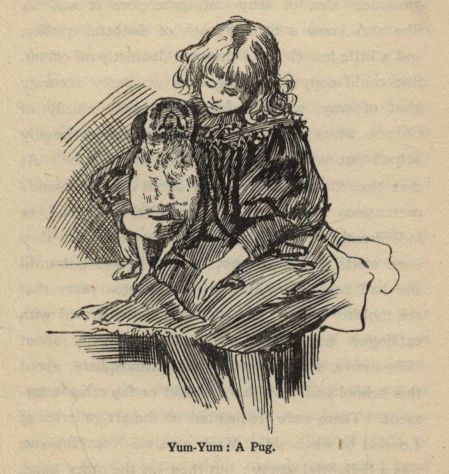
Yum-Yum: A Pug.
The Mackenzies, I must tell you, were not rich people, or in any way persons of importance; they had no relations, and apparently belonged to no particular family; but they were very nice people, and very good people, and lived in one of a large row of houses on the Surrey side of the river Thames, at that part which is called Putney.
Mr. Mackenzie was something in the city, and had not apparently hit upon a good thing, for there was not much money to spare in the house at Putney. I rather fancy that he was managing clerk to a tea-warehouse, but am not sure upon that point. Mrs. Mackenzie had been a governess, but of course she had not started life as a teacher of small children; no, she had come into the world in an upper room of a pretty country vicarage, where the olive branches grew like stonecrop, and most visitors were in the habit of reminding the vicar of certain lines in the hundred and twenty-seventh Psalm.
In course of time this particular olive plant, like her sisters, picked up a smattering of certain branches of knowledge, and, armed thus, went out into the wide world to make her own way. Her knowledge was not extensive; it comprised a fluent power of speaking her mother-tongue with a pleasant tone and correct accent, but without any very well-grounded idea of why and wherefore it was so. She also knew a little French of doubtful quality, and a little less German that was distinctly off colour. She could copy a drawing in a woodenly accurate kind of way, with stodgy skies made chiefly of Chinese white, and exceedingly woolly trees largely helped out with the same useful composition. At that time there was no sham about Nora Browne's pretensions to art--there they were, good, bad, or indifferent, and you might take them for what they were worth, which was not much. It was not until she had been Mrs. Mackenzie for some years that she took to "doing" the picture-galleries armed with catalogue and pencil, and talked learnedly about chiar-oscuro, about distance and atmosphere, about this school and that, this method or the other treatment. There were frequenters of the art-galleries of London to whom Mrs. Mackenzie, née Nora Browne, was a delightful study; but then, on the other hand, there was a much larger number of persons than these whom she impressed deeply, and who even went so far as to speak of her with bated breath as "a power" on the press, while, as a matter of fact, Mrs. Mackenzie's little paragraphs were very innocent, and not very remunerative, and generally won for the more or less weekly society papers in which they appeared a reputation for employing an art-critic who knew a good deal more about the frames than about the pictures within them.
However, all this is a little by the way! I really only give these details of Mrs. Mackenzie's doings to show that the family was, by virtue of their mother being a dabbler in journalism, in touch with the set which I saw the other day elegantly described as "Upper Bohemia."
Now in the circles of "Upper Bohemia" nobody is anybody unless they can do something--unless they can paint pictures or umbrella vases and milking-stools, unless they can sing attractively, or play some instrument beyond the ordinary average of skill, unless they can write novels or make paragraphs for the newspapers, unless they can act or give conjuring entertainments, or unless they can compose pretty little songs with a distinct motif, or pieces for the piano which nobody can make head or tail of. It is very funny that there should be so wide a difference necessary between the composition of music for the voice and music for the piano. For the first there must be a little something to catch the ear, a little swing in the refrain, a something to make the head wag to and fro; the words may be ever so silly if they are only bordering on the pathetic, and if the catch in the refrain is taking enough the rest of the song may be as silly as the words, and still it will be a success. But with a piece it is different. For that the air must be resolutely turned inside out, as it were, and apparently if the composer chances to light on one or two pretty bits, he goes back again and touches them up so as to make them match all the rest. It seems odd this, but the world does not stop to listen, but talks its hardest, and as at the end it says "How lovely!" I suppose it is all right.
But all these people stand in the very middle of "Upper Bohemia," and, as a pebble dropped into the water makes circles and ever-widening circles on the smooth surface, so do the circles which constitute "Upper Bohemia" widen and widen until eventually they merge into the world beyond! There are the amateurs and the reciters, and the artists who put "decorative" in front of the word which denotes their calling, and then put a hyphen between the two! And there are the thought-readers, and the palmists, and the people who have invented a new religion! All these are in the ever-widening circles of "Upper Bohemia." And outside these again come the fashionable lady-dressmakers and the art-milliners, the trained nurses and the professors of cooking. After these you may go on almost ad libitum, until the circle melts into professional life on the one hand and fashionable life on the other.
You have perhaps been wondering, my gentle reader, what all this can possibly have to do with the pug, Yum-Yum, which belonged to a little girl named Nannie Mackenzie. Well, it really has something to do with it, as I will show you. First, because it tells you that this was the set of people to whom the Mackenzies belonged and took a pride in belonging. It is true that they had a stronger claim to belong to a city set; but you see Mrs. Mackenzie had been brought up in the bosom of the Church, and thought more of the refined society in "Upper Bohemia" than she did of all the money bags to be found east of Temple Bar! In this I think she was right; in modern London it does not do for the lion to lie down with the lamb, or for earthenware pipkins to try sailing down the stream with the iron pots. In "Upper Bohemia," owing to the haziness of her right of entry, Mrs. Mackenzie was quite an important person; in the city, owing to various circumstances--shortness of money, most of all--Mrs. Mackenzie was nowhere.
Mrs. Mackenzie had not followed the example of her father and mother with regard to the size of her family; she had only three children, two girls and a boy--Rosalind, Wilfrid, and Nannie.
At this time Nannie was only ten years old, a pretty, sweet, engaging child, with frank blue eyes and her mother's pretty trick of manner, a child who was never so happy as when she had a smart sash on with a clean white frock in readiness for any form of party that had happened to come in her way.
Wilf was different. He was a grave, quiet boy of thirteen, already working for a scholarship at St. Paul's School, and meaning to be a great man some day, and meanwhile spending all his spare hours collecting insects and gathering specimens of fern leaves together.
Above Wilf was Rosalind, and Rosalind was sixteen, a tall, willowy slip of a girl, with a pair of fine eyes and a passion for art. I do not mean a passion for making the woodenly accurate drawings with stodgy clouds and woolly trees which had satisfied her mother's soul and made her so eminently competent to criticise the work of other folk--no, not that, but a real passion for real art.
Now the two Mackenzie girls had had a governess for several years, a mildly amiable young lady of the same class, and possessed of about the same amount of knowledge as Mrs. Mackenzie herself had been. She too made wooden drawings with stodgy clouds and woolly trees, and she painted flowers--such flowers as made Rosalind's artistic soul rise within her and loathe Miss Temple and all her works, nay, sometimes loathe even those good qualities which were her chiefest charm.
Rosalind wanted to go further a-field in the art world than either her mother's paragraphs or Miss Temple's copies; she wanted to join some well-known art-class, and, giving up everything else, go in for real hard, grinding work.
But it could not be done, for, as I have said, money was not plentiful in the house at Putney, and there was always the boy to be thought of, and also there was Nannie's education to finish. To let Rosalind join an expensive art-class would mean being without Miss Temple, and Mrs. Mackenzie felt that to do that would be to put a great wrong upon little Nannie, for which she would justly be able to reproach her all her life long.
"It would not do, my dear," she said to Rosalind, when her elder daughter was one day holding forth on the glories which might one day be hers if only she could get her foot upon this, the lowest rung of the ladder by which she would fain climb to fame and fortune; "and really I don't see the sense or reason of your being so anxious to follow art as a profession. I am sure you paint very well. That little sketch of wild roses you did last week was exquisite; indeed, I showed it to Miss Dumerique when I was looking over her new art-studio in Bond Street. She said it would be charming painted on a thrush's-egg ground for a milking-stool or a tall table, or used for a whole suite of bedroom or boudoir furniture. I'm sure, my dear, you might make quite an income----"
"Did Miss Dumerique offer to do one--to let me do any work of that kind for her?" Rosalind broke in impatiently.
"No, she did not," Mrs. Mackenzie admitted, "but----"
"But, depend upon it, she is at work on the idea long before this," cried Rosalind. She knew Miss Dumerique, and had but small faith in any income from that quarter, several of her most cherished designs having suggested ideas to that gifted lady.
"If I only had twenty pounds, twenty pounds," Rosalind went on, "it would give me such a help, such a lift I should learn so much if I could spend twenty pounds; and it's such a little, only the price of the dress Mrs. Arlington had on the other day, and she said it was so cheap--'Just a cheap little gown, my dear, to wear in the morning.' Oh! if only I had the price of that gown."
"Rosalind, my dear," cried Mrs. Mackenzie, "don't say that--it sounds so like envy, and envy is a hateful quality."
"Yes, I know it is, but I do want twenty pounds so badly," answered Rosalind in a hopeless tone.
Mrs. Mackenzie began to sob weakly. "If I could give it to you, Rosalind, you know I would," she wailed, "but I haven't got it. I work and work and work and strain every nerve to give you the advantages; ay, and more than the advantages that I had when I was your age. But I can't give you what I haven't got--it's unreasonable to ask it or to expect it."
"I didn't either ask or expect it," said Rosalind; but she said it under her breath, and felt that, after all, her mother was right--she could not give what she had not got.
It was hard on them both--on the girl that she could not have, on the mother that she could not give! Rosalind from this time forth kept silence about her art, because she knew that it was useless to hope for the impossible--kept silence, that is, from all but one person. And yet she could not keep her thoughts from flying ever and again to the art-classes and the twenty pounds which would do so much for her. So up in the room at the top of the house, where she dabbled among her scanty paints and sketched out pictures in any colours that she happened to have, and even went so far in the way of economy as to utilize the leavings of her mother's decorative paints--hedge-sparrow's-egg-blue, Arabian brown, eau de Nil, Gobelin, and others equally unsuitable for her purpose,--Rosalind Mackenzie dreamed dreams and saw visions--visions of a great day when she would have paints in profusion and art-teaching galore. There was not the smallest prospect of her dreams and visions coming true, any more than, without teaching and without paints, there was of her daubs growing into pictures, and finding places on the line at the Academy and the New. It is always so with youth. It hopes and hopes against hope, and when hope is dead, there is no longer any youth; it is dead too.