Front matter (continued 3)
Reading edition
"There are youthful dreamers,
Building castles fair, with stately stairways;
Asking blindly
Of the Future what it cannot give them."
CHAPTER II
But there was one person to whom Rosalind Mackenzie poured out all that was in her mind,--that was her ten-year-old sister, Nannie. In Nannie she found a ready and a sympathetic listener; moreover, in Nannie's mind there was no doubt, no hesitation in believing that if Rosalind only had that twenty pounds there would be nothing to keep her back, nothing to prevent her sailing on right ahead into the roseate realms of fame and glory! If only she had that twenty pounds!
Now Nannie undoubtedly had a very gay and jovial disposition. She was always ready for fun and excitement, and had no tendency or any desire to carve out a line for herself, as her brother and sister had both had before they had reached her age. Yet she had what was better in many people's eyes, a very tender heart and a very affectionate nature; and her tender heart was wrung and wrung again at the thought of her sister's unsatisfied longings and the great future that was being blighted, all for the want of twenty pounds.
Yet what could a little girl of ten years old do towards getting such a sum as that together? Just nothing! Why, if the sum was shillings instead of pounds, she would still find it utterly beyond her power and out of her grasp! She thought and she thought, but thinking did not help matters! She lay awake at night puzzling her little brain, but that did no good, and Nannie's face grew a good deal paler, and set her mother wondering if the house was unhealthy, or thinking that perhaps the air from the river was damp and injurious.
It was about this time that Yum-Yum, the pug which had been given to Nannie by one of her mother's friends two years before, suddenly became the person of the most importance in the household at Putney; for behold one fine morning when Nannie came down to breakfast, Yum-Yum presented her with three babies, three dear wee pugs, which sent Nannie into ecstasies and made her forget for a few days all about Rosalind's unsatisfied longings, and her craving after higher things than at present were attainable to her.
"You think they're real beauties, don't you, Father?" said Nannie anxiously.
"Yes, they are great beauties," said Mr. Mackenzie, holding one little snub-nosed pug up and examining it closely.
"And what should you think that they are worth, Father?" Nannie asked.
"Worth? Oh! that would depend a good deal on how they turn out. Their pedigree is a very fair one; and at the end of six weeks or two months they might be worth three or four guineas apiece--more, for that matter."
Nannie fairly gasped, and she clutched hold of her father's arm. "Oh! daddy dear," she exclaimed, "do you really, really think I might be able to get any thing like that for them?"
"Oh! yes, I think so," he answered, smiling at her earnestness. "But, Nannie, why do you want this money so much? Have you set your mind on a watch and chain?"
"Oh! no, dear daddy," she answered eagerly, "it's not for myself at all; it's poor Rosalind I'm thinking of"--and forthwith she poured into her father's surprised but sympathetic ear all the story of Rosalind's artistic longings, her craving for better art-lessons, for all the good things that may be had for the sum of twenty pounds.
Long before the story came to an end Mr. Mackenzie had drawn his little daughter very closely to him, and I fancy he was thinking, when she came to the end of it, more of the goodness of his Nannie's heart than of the greatness of Rosalind's future.
"My Nannie," he said tenderly, "my generous, kind-hearted little woman! Rosalind ought to love you dearly for----"
"Rosalind does love me dearly, daddy," Nannie explained; "only she can't help wanting to be a painter--it's in her, you know, and it's choking her. And Rosalind doesn't know a word about it. She wouldn't want me to sell Yummy's pups for her. Only you know, daddy, we can't keep three dogs besides Yummy; and we may just as well sell them as give them away, and then Rosalind would be able to have some of the lessons that she wants so badly."
Mr. Mackenzie smiled at Nannie's voluble information. "Well, well, you shall sell the pups and make Rosalind happy," he said; then after a moment added, "You know, Nannie, that I am not rich--in fact, I am very poor, but I will make the sum up to ten pounds, and Rosalind can go on thus far, at all events."
Well, a few weeks passed over, and the secret was rigidly kept between Mr. Mackenzie and Nannie. More than once Mrs. Mackenzie grumbled at the expense and the trouble Yummy's three babies were in the kitchen, and one afternoon when she came in from Town, she said--"Oh, Nannie, Lady Gray would like to have one of Yummy's puppies. I told her I thought you would let her have first choice."
"Then her ladyship must pay five guineas for it, my dear," said Mr. Mackenzie promptly. "Nannie and I are going to sell the puppies this time."
Mrs. Mackenzie rather lifted her eyebrows. "Oh! if that is so," she said, "of course Lady Gray must stand on one side. But what are you going to do with the money, Nannie? Buy yourself a watch?"
"No, Mother, but----" and Nannie looked anxiously at her father, who quickly came to the rescue, and evaded the question--which at that moment was an awkward one, for Rosalind was present.
It is probable that Mr. Mackenzie gave his wife just a hint of what was a-foot, for she asked no more questions about the puppies, and made no further complaints of the extra food and milk which Yummy required at this time.
And in due course, after a good deal of correspondence through the columns of the Queen and the Exchange and Mart, one by one the three little pugs went away from the house at Putney to homes of their own, and Nannie in return became the proud possessor of no fewer than eight golden sovereigns.
To these Mr. Mackenzie added the two which he had promised to make up the sum of ten pounds, and then Nannie had the supreme joy of going to Rosalind--who was hard at work in her studio painting a sunset in tints so startling that her artist soul was sick within her--and flinging her offering in a shower into her lap.
"Why, what is this, Nannie?" Rosalind cried, half frightened.
"It's your lessons, Rosie," Nannie cried, "or at least as much of them as you can get for ten pounds; and I'm so glad, dear, dear Rosie, to be able to help you, you don't know," and happy Nannie flung her arms round her sister, almost crying for joy.
"But where did you get it? Oh, the pugs! I forgot them," Rosalind cried. "Oh! but Nannie, my dear, darling, unselfish sister, I can't take your money in this way----"
"You must," Nannie answered promptly.
"But your watch--you've longed so for a watch, you know," said the elder girl.
"Well, I have, but I can long a bit more," returned Nannie philosophically. "I shall like it all the better when I do get it."
"I can't take it, darling," Rosalind urged.
"Oh! yes, you can, if you try," continued Nannie. "And as for my watch, why, when you are a great swell painter you can buy me one--a real beauty--and I shall like it ever so much better than any other one in all the world."
Rosalind clasped Nannie close to her heart.
"My Nannie, my Nannie," she cried, "I shall never be as brave and helpful as you are. While I have been grumbling, and growling, and railing at fate, you have been putting your shoulder to the wheel, and----. Oh! Nannie, Nannie, it is good of you! It is good! I shall never forget it. The first penny I earn, dear, shall be yours; and I will never forget what my dear little sister has done for me, never--never, as long as I live."
A few days after this Rosalind was hard at work in the studio of the artist for whose teaching she had longed for so many weary months. And how she did work!
"I have one pupil who works," her maestro got into the habit of saying. "Some of you have a natural gift; you have a correct eye, and you have firm touch. Every one of you might make progress if you tried. But there is only one of you all who works. That is Miss Mackenzie."
But, all too soon, Rosalind's ten pounds melted away, until they had all gone. And, as there was no more where they had come from, Rosalind's lessons must also come to an end!
"Oh! Mother, can't you do anything to help Rosie?" Nannie cried in piteously beseeching accents the night before Rosalind was to go to the studio for the last time.
"Nannie," answered Mrs. Mackenzie reproachfully, "don't you think I would if I could?"
"Daddy, can you do nothing?" Nannie implored.
"My little one, I am so poor just now," he answered.
So poor Nannie went to bed in bitter disappointment for her sister's trial. She felt that it was very, very hard upon Rosalind, who had worked almost day and night that she might profit by every moment of the time she was at the studio. Yes, it was very, very hard.
However, Rosalind was brave, and put a good face upon the matter.
"Don't worry about it, my Nannie," she said just before she got into bed. "After all, I've learnt a great deal while I have been able to go to Mr. Raymond, and perhaps, after a time, daddy may be able to help me to go again, and I may do some work that will sell, and then I shall be able to go again. So don't worry yourself, my darling, for you can't help me this time. You see, Yummy hasn't got any more pups to sell."
But Nannie had got an idea, and all through the hours of that long night it stayed with her with the pertinacity of a nightmare. Still, whatever it was, she did not say a word about it to Rosalind, and when Rosalind looked round for her when she was ready to start for the studio in the morning, she was nowhere to be seen.
"Where is Nannie?" she asked.
"Oh! she's out in the garden," Mrs. Mackenzie answered.
"Well, I haven't time to go down; but don't let her worry about me, will you, Mother?" said Rosalind anxiously.
"No, no; I will look after her," Mrs. Mackenzie answered vaguely.
So Rosalind went off fairly satisfied.
"I have come for my last lesson, Mr. Raymond," she said, with rather an uncertain smile, as she bade the maestro good-morning.
"Oh! well, well; we must have a talk about that," he answered good-naturedly.
Rosalind shook her head a little sadly, and took her place without delay--to her every moment was precious.
But, though this was her last lesson, she was not destined to do much work that day, for, as soon as she opened her little paint-box, which she had taken home the previous day that she might do some work in the early morning, she saw lying on the top of the paints a little note, addressed in Nannie's round child's hand to "Rosalind."
The next moment maestro and pupils were alike startled by the sight of Rosalind Mackenzie with her face hidden in her hands, sobbing as if her heart would break.
"My dear child," cried the maestro, running to her side, "how now! What is the matter? Pray tell me, my dear, tell me."
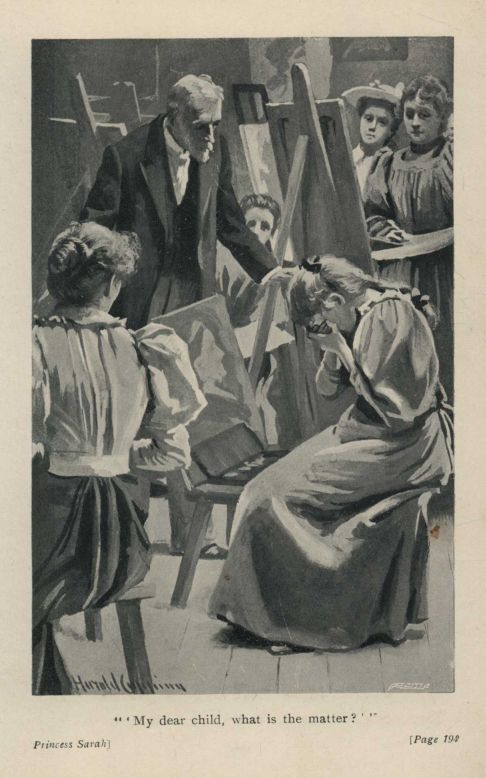
"'My dear child, what is the matter?'"
Then little by little Rosalind sobbed out the whole story--how she had longed and pined for these lessons, how her little sister Nannie had sacrificed herself to help her, and then at last she put into the maestro's hand the little note which she had brought from home in the paint-box.
"Darling Rosalind," the maestro read aloud, "I thought of a way to help you last night, but I did not tell you about it, because I know you would stop it. You know that Mrs. Clarke, who bought Yummy's little son, said she would give ten guineas for her any day, so I'm going to get Father to take her there this afternoon, and you shall have the money. I don't think I shall mind parting with her much.--NANNIE."
Mr. Raymond took off his glasses and wiped them.
"Upon my word," he muttered in an uncertain voice; "upon my word!"
"The darling!" cried one pupil.
"Is she fond of the dog?" asked another.
"Fond of her!" Rosalind echoed; "why, Yummy is the very idol of her heart. She has had her from a puppy; it would break the child's heart to part with her. Why, I would die," she said passionately, "before I would let her do it. I would go out as a charwoman, and scrub floors for my living all the days of my life, rather than do such a mean thing. Mr. Raymond," she went on, "I must go back at once, or I may be too late. I must lose my lesson--I can't help that. But I must go back--for, look at the poor little letter; all tears and----" and there Rosalind broke down into tears and sobs again; but, all the same, she gathered her brushes together, and began to pack up all her belongings.
The maestro stood for a moment in deep thought, but, as Rosalind put her hat on and resolutely dried her eyes, he spoke to the others who were standing around.
"I should very much like to see this out," he said, "and, if you will set me free this morning, I will give you each an extra lesson to make up for the interrupted one to-day. What do you say?"
"Yes! yes!" they all cried.
So the old painter and Rosalind went back to the house at Putney together, and at the door Rosalind put an eager question to the maid who opened it for them.
"My mother?" she asked.
"Mrs. Mackenzie is dressing to go out, Miss Rosalind," the maid answered.
"And Miss Nannie?"
"I believe Miss Nannie is in the garden," was the reply.
So Rosalind led the maestro out into the garden, where they soon espied Nannie curled up in a big chair, with Yummy in her arms. She did not notice their approach; indeed, she was almost asleep, worn out by the violence of her grief at the coming parting with Yummy, and was lying with her eyes closed, her cheek resting against the dog's satin-smooth head.
Rosalind flung herself down upon her knees before the chair, and took child and dog into her arms.
"My own precious little sister, my unselfish darling," she cried; "as if I would let you part with the dear doggy for my sake! I couldn't, Nannie, my dear, I couldn't--I couldn't part with Yummy myself. But I shall never forget it, Nannie--my dear, unselfish Nannie."
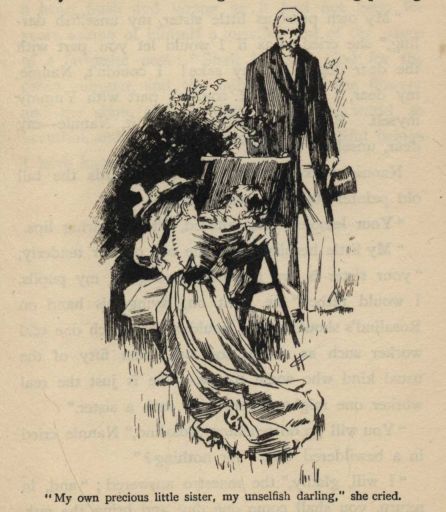
"My own precious little sister, my unselfish darling," she cried.
Nannie looked past her sister towards the tall old painter standing behind her.
"Your lessons," she faltered, with quivering lips.
"My little heroine," said the old painter tenderly, "your sister is my favourite among all my pupils. I would rather," he went on, laying his hand on Rosalind's shoulder--"I would rather teach one real worker such as she is for love, than fifty of the usual kind who come to me. She is just the real worker one might expect with such a sister."
"You will go on teaching Rosalind," Nannie cried in a bewildered way, "for nothing?"
"I will, gladly," the maestro answered; "and, in return, you shall come one day, and bring the pug, and let me paint a picture of you both."
And then the old man went away, leaving the sisters, in the fulness of their joy, together.
For him this had been somewhat of a new experience--a pleasant one. They were young, and he was old; but he went back to his pictures with a heart fresh and young as it had not been for years, asking of himself a question out of the pages of a favourite poet: "Shall I thank God for the green summer, and the mild air, and the flowers, and the stars, and all that makes the world so beautiful, and not for the good and beautiful beings I have known in it?"
Our Ada Elizabeth
"The sublime mystery of Providence goes on in silence, and gives no explanation of itself, no answer to our impatient questionings."--Hyperion.
CHAPTER I
The Dicki'sons lived in Blankhampton. Not in the fashionable suburb of Greater Gate, for the Dicki'sons were not fashionable people--far from it, indeed. Nor yet in that exclusive part which immediately surrounds the cathedral, which Blankhampton folk familiarly call "the Parish." No; they lived in neither of these, but away on the poorer side of the town and in the narrowest of narrow lanes--so narrow, indeed, that if a cart came along the passer-by was glad to get into a doorway, and stand there trembling until the danger was past and the road free again.
I must tell you that, although they were always called the Dicki'sons, their name was spelt in the usual way, with an "n" in the middle and without an apostrophe; but, as their neighbours made an invariable rule of pronouncing the word, as they did themselves, in the way in which I have written it, I will take the liberty of continuing the custom in this story.
For their position, they were rather well-to-do. Mr. Dicki'son, the father of the family, was a plumber and glazier--not in business for himself, but the foreman of a business of some importance in the town; and Mr. Dicki'son was a plain man of somewhat reserved disposition. There were ill-natured and rude persons in that neighbourhood who did not hesitate to describe Mr. Dicki'son as "a sulky beast"; but then the opinion of such was scarcely worth having, and even they had not a word to say against him beyond a general complaint of his unsociable temper.
They were lively people who lived round about Gardener's Lane. The fathers worked hard all the week, and mostly got frightfully drunk on Saturday nights, when they went home and knocked their dirty, slipshod wives about, just by way of letting them know their duty to their lords and masters. And after this sort of thing had subsided, the wives generally gave the children a good cuffing all round, just by way of letting them know that they need not hope to take any liberties with their mothers because of their fathers' little ways; and then they all got quieted down for the night, and got up late on Sunday morning with headaches. If the day was fine, the men sat dull and sodden in the sunshine on the pavement in the wide street out of which Gardener's Lane ran, propping their backs against the wall and stretching their legs out, greatly to the danger and annoyance of passers-by; and while the men thus smoked the pipe of peace, the women stood in groups at their doorways, scratching their elbows and comparing their bruises; and the children, who had gone to sleep the previous night in tears and tribulation, found keen enjoyment in watching for the parson and the few people who went to the church round the corner, and called names and uncomplimentary terms after them as they turned in at the gates which led thereto.
Now, as Mr. Dicki'son was a person of a reserved and taciturn disposition, who was distinctly respectable in all his doings, who never got drunk, and openly despised any one else who did, it will readily be believed that he was not popular in the neighbourhood of Gardener's Lane. He was not anxious to be popular, and had it not been that the house in which he lived was his own, and that it suited his family as a home, Gardener's Lane would not have counted him among its inhabitants.
Mrs. Dicki'son was a good deal younger than her husband--a pretty, weak, sentimental woman, rather gushing in disposition, and very injudicious. She was always overwhelmed with troubles and babies; although, as a matter of fact, she had but six children altogether, and one of them died while still an infant. Gerty was twelve years old, and Ada Elizabeth just a year younger; then came a gap of two years ere a boy, William Thomas, was born. William Thomas, if he had lived, would, I fancy, have inherited his father's reserved disposition, for, I must say, a more taciturn babe it has never at any time been my lot to encounter. He was a dreadful trouble to his dissatisfied mother, who felt, and said, that there was something uncanny about a child who objected to nothing--who seemed to know no difference between his own thumb and the bottle which fed him, and would go on sucking as patiently at the one as at the other; who would lie with as much apparent comfort on his face as on his back, and seemed to find no distinction between his mother's arms and a corner of the wide old sofa, which earlier and later babies resented as a personal insult, and made remarks accordingly. However, after six months of this monotonous existence, William Thomas was removed from this lower sphere, passing away with the same dignity as he had lived, after which he served a good purpose still, which was to act as a model to all the other babies who resented the corner of the sofa and declined to accept the substitution of their thumbs, or any other makeshift, for the bottle of their desires.
Two years later was a girl, called Polly, and two years later again was Georgie; and then, for a time, Mrs. Dicki'son being free from the cares of a baby, fretted and worried that "'ome isn't like 'ome without a baby in it." But when Georgie was just turned three little Miriam arrived, and Mrs. Dicki'son was able to change her complaint, and tell all her acquaintance that she did think Georgie was going to be the last, and she was sure she was "just wore out."
Most of the children took after their mother. True, as I have already said, William Thomas had given signs of not doing so; but William Thomas had not really lived long enough for any one to speak definitely on the subject. All the rest thrived and grew apace, and they all took after their mother, both in looks and character, with the exception of the second girl, "our Ada Elizabeth."
"The very moral of her father," Mrs. Dicki'son was accustomed to sigh, as she tried in vain to trim Ada Elizabeth's hat so that the plain little face underneath it should look as bright and fresh as the rosy faces of her sisters. But it was a hopeless task, and Mrs. Dicki'son had to give it up in despair and with many a long speech full of pity for herself that she, of all people in the world, should have such a hard trial put upon her as a child who was undeniably plain.
For the child was plain. She had been a plain, featureless baby, of uncertain colour, inclining to drab--very much, indeed, what William Thomas was after her. A baby who, even when newly washed, never looked quite clean; a little girl whose pinafore never hung right, and with tow-coloured hair which no amount of hair-oil or curl-papers could make anything but lank and unornamental! A child with a heavy, dull face, and a mouth that seldom relaxed into a smile though there were people (not Mrs. Dicki'son among them, though) who did not fail to notice that the rare smile was a very sweet one, infinitely sweeter than ever was seen on the four pretty rosy faces of the other children.
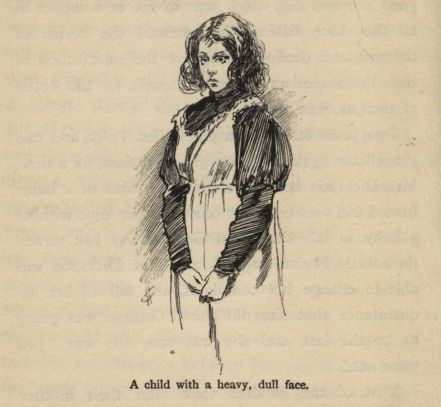
A child with a heavy, dull face.
Mrs. Dicki'son was eloquent about Ada Elizabeth's looks and temper. "I'm sure," she cried one day to Gerty, who was pretty, and quick of wit, and knew to a hair's-breadth how far she could go with her mother, "it's 'ard upon me I should have such a plain-looking child as our Ada Elizabeth. It's no use me trying to trim her hat so as to make her look a credit to us. I'm sure it's aggravating, it is. I've trimmed your two hats just alike, and she looks no better in hers than she does in her old school hat, and I got two nice curly tips just alike. 'Pon my word, it's quite thrown away on her."
"And I want another feather in mine to make it perfect, Mother," murmured Gerty, with insinuating suggestiveness.
Mrs. Dicki'son caught at the bait thus held out to her. "I've a good mind to take the tip out," she said hesitatingly.
"Yes, do, Mother; our Ada Elizabeth won't care. Will you, Ada Elizabeth?" appealingly to the child who had had the misfortune to be born plain.
"No, I don't care," returned Ada Elizabeth, whose heart was bursting, not with jealousy, but with a crushing sense of her own shortcomings.
"Just like her father," remarked Mrs. Dicki'son, loosening the feather from its place with one snip of her scissors. "He never cares 'ow he looks! ''Andsome is as 'andsome does,' is his motto; and though he's been a good 'usband to me, and I'd be the last to go again' him, yet I must say I do like a bit of smartness myself. But Ada Elizabeth's the very moral of her father--as much in her ways as she is in her looks."
So gradually it got to be an established custom that Ada Elizabeth's attire should be shorn of those little decorations with which Mrs. Dicki'son delighted to add effect to her eldest child's prettiness; it was felt to be quite useless to spend money over curly tips and artificial roses to put above such a plain little face, or "waste" it, as her mother put it, in the not very delicate way in which she tried to excuse herself to the child when some more obvious difference than usual between her clothes and Gerty's was contemplated.
Ada Elizabeth made no complaint. If asked her mind by the officious Gerty, she said she did not care, and the answer was accepted as literal truth by her mother and sister. But Ada Elizabeth did care. She was not jealous, mind--alas! no, poor child--she was only miserable, crushed with an ever-present consciousness of her own deficiencies and shortcomings, with a sense that in having been born plain and in having taken after her father she had done her mother an irreparable injury, had offered her the deepest insult possible! She honestly felt that it was a hard trial to her mother that she should have such a plain and dull child. More than once she made a desperate effort to chatter after Gerty's fashion, but somehow the Dicki'son family did not appreciate the attempt. Gerty stared at her and sniggered, and her mother told her with fretful promptness that she did not know what she was talking about; and poor Ada Elizabeth withdrew into herself, as it were, and became more reserved--"more like her father"--than ever, cherishing no resentment against those who had so mercilessly snubbed her, but only feeling more intensely than ever that she was unlike the rest of the world, and that her fate was to be seen as little as possible and not heard at all.
CHAPTER II
The time had come round for the great annual examination of the National Schools where the young Dicki'sons received their education, and on the great day itself the children came in at tea-time full to overflowing with the results of their efforts. And Ada Elizabeth was full of it too, but not to overflowing; on the contrary, she crept into the kitchen, where her father and mother and little two-year-old Miriam--commonly called "Mirry"--were already seated at the table, and put her school-bag away in its place with a shamefaced air, as if she, being an ignominious failure, could have no news to bring.
"Well," exclaimed Mrs. Dicki'son to Gerty, who threw her hat and bag down and wriggled into her seat with her mouth already open to tell her tale, "did you get a prize?"
"No, I didn't, Mother," returned Gerty glibly. "A nasty old crosspatch Miss Simmonds is; she always did hate me, and I think she hates me worse than ever now. Anyway, she didn't give me a prize--just to show her spite, nasty thing!"
Mrs. Dicki'son always declared that her husband was a slow man; and he looked up slowly then and fixed his dull eyes upon Gerty's flushed face.
"H'm!" he remarked, in a dry tone, and then closed his lips tight and helped himself to another slice of bread and butter.
Gerty's flushed face grew a fine scarlet. She knew only too well what the "h'm" and the dry tone and the tightly-closed lips meant, and made haste to change the subject, or, at least, to turn the interest of the conversation from herself to her sister.
"But our Ada Elizabeth's got the first prize of all," she informed them; and in her eagerness to divert her father's slow attention from herself, she spoke with such an air of pride in the unlooked-for result of the examination that Ada Elizabeth cast a glance of passionate gratitude towards her, and then visibly shrank into herself, as if, in having won so prominent a place, she had done something to make her mother's trials harder to bear than ever. "And there's going to be a grander treat than we've ever had this year," Gerty went on, in her glibest tones. "And the dean's lady, Lady Margaret, is going to give the prizes away, and all the company is going to be at the treat, and--and----"
"Oh! what a pity!" exclaimed Mrs. Dicki'son, turning a hopeless gaze upon poor Ada Elizabeth. "Our Ada Elizabeth 'll never show up properly, as you would, Gerty."
"Our Ada Elizabeth's lesson-books 'll show up better than Gerty's, may be," put in Mr. Dicki'son, in his quietest tone and with his driest manner.
"Oh! Ada Elizabeth's not clever like Gerty," returned Mrs. Dicki'son, utterly ignorant as she was indifferent to the fact that she was rapidly taking all the savour out of the child's hour of triumph. "And you were so sure of it too, Gerty."
"So was the hare of winning the race; but the tortoise won, after all," remarked Mr. Dicki'son sententiously.
"What are you talking about, Father?" his wife demanded. "I'm sure if tidy 'air has anything to do with it, Gerty ought to be at the top of the tree, for, try as I will, I can't make Ada Elizabeth's 'air ever look aught like, wash it and brush it and curl it as ever I will; and as for 'air-oil----"
Mr. Dicki'son interrupted his wife by a short laugh. "I didn't mean that at all"--he knew by long experience that it was useless to try to make her understand what he did mean--"but, now you speak of it, perhaps Ada Elizabeth's 'air don't make so much show as some of the others; it's like mine, and mine never was up to much--not but what there's scarcely enough left to tell what sort it is."
It was quite a long speech for the unsociable and quiet Mr. Dicki'son to come out with, and his wife passed it by without comment, only making a fretful reiteration of Ada Elizabeth's plainness and a complaint of the sorry figure she would cut among the great doings on the day of the school treat and distribution of prizes.
"Is our Ada Elizabeth a plain one?" said Mr. Dicki'son, with an air of astonishment which conveyed a genuine desire for information, then turned and scanned the child's burning face, after which he looked closely at the faces of the other children, so little like hers, and so nearly like that of his pretty, mindless, complaining wife. "Well, yes, little 'un, I suppose you're not exactly pretty," he admitted unwillingly; "you're like me, and I never was a beauty to look at. But, there, 'handsome is as handsome does,' and you've brought home first prize to-day, which you wouldn't have done, may be, if you'd always been on the grin, like Gerty there. Seems to me," he went on reflectively, "that that there first prize 'll stand by you when folks has got tired of Gerty's grin, that's what seems to me. I don't know," he went on, "that I set so much store by looks. I never was aught but a plain man, but I've made you a good husband, Em'ly, and you can't deny it. You'll mind that good-looking chap, Joe Webster, that you kept company with before you took up with me? He chucked you up for Eliza Moriarty. Well, I met her this morning, poor soul! with two black eyes and her lips strapped up with plaster. H'm!" with a sniff of self-approval, "seems to me I'd not care to change my plain looks for his handsome ones. 'Handsome is as handsome does' is my motto; and if I want aught doing for me, it's our Ada Elizabeth I asks to do it, that's all I know."
The great day of the school treat came and went. The dean's wife, Lady Margaret Adair, gave away the prizes, as she had promised, and was so struck with "our Ada Elizabeth's" timid and shrinking air that she kept her for a few minutes, while she told her that she had heard a very good account of her, and that she hoped she would go on and work harder than ever. "For I see," said Lady Margaret, looking at a paper in her hand, "that you are the first in your class for these subjects, and that you have carried off the regular attendance and good-conduct prize as well. I am sure you must be a very good little woman, and be a great favourite with your schoolmistress."
Mrs. Dicki'son--who, as the mother of the show pupil of the day, and as a person of much respectability in the neighbourhood, which was not famous for that old-fashioned virtue, had been given a seat as near as possible to the daïs on which Lady Margaret and the table of prizes were accommodated--heard the pleasant words of praise, which would have made most mothers' hearts throb with exultant pride, with but little of such a feeling; on the contrary, her whole mind was filled with regret that it was not Gerty standing on the edge of the daïs, instead of the unfortunate Ada Elizabeth, who did not show off well. If only it had been Gerty! Gerty would have answered my lady with a pretty blush and smile, and would have dropped her courtesy at the right moment, and would have been a credit to her mother generally.
But, alas! Gerty's glib tongue and ready smiles had not won her the prizes which had fallen to poor little plain Ada Elizabeth's share, and Gerty was out in the cold, so to speak, among the other scholars, while Ada Elizabeth, in an agony of shyness and confusion, stood on the edge of the daïs, first on one foot and then on the other, conscious that her mother's eyes were upon her and that their expression was not an approving one, feeling, though she would hardly have been able to put it into words, that in cutting so sorry a figure she was making her poor mother's trials more hard to bear than ever. Poor little plain child, she kept courtesying up and down like a mechanical doll, and saying, "Yes, 'm," and "No, 'm," at the wrong moments, and she altogether forgot that the fresh-coloured, buxom lady in the neat black gown and with only a bit of blue feather to relieve her black bonnet was not a "ma'am" at all, but a "my lady," who ought to have been addressed as such. At last, however, the ceremony, and the games and sports, and the big tea were all over, and Ada Elizabeth went home with her prizes to be a heroine no longer, for she soon, very soon, in the presence of Gerty's prettiness and Gerty's glib tongue and ready smiles, sank into the insignificance which had been her portion aforetime. She had not much encouragement to go on trying to be a credit to the family which she had so hardly tried by taking after her father, for nobody seemed to remember that she had been at the top of the tree at the great examination, or, if they did recall it, it was generally as an example of the schoolmistress's "awkwardness" of disposition in having passed over the hare for the tortoise. Yet sometimes, when Gerty was extra hard upon Ada Elizabeth's dulness, or Mrs. Dicki'son found the trial of her life more heavy to bear than usual, her father would look up from his dinner or his tea, as it might happen to be, and fix his slow gaze upon his eldest daughter's vivacious countenance.
"H'm! Our Ada Elizabeth's too stupid to live, is she? Well, you're like to know, Gerty; it was you won three first prizes last half, wasn't it? A great credit to you, to say nought about the 'good conduct and regular attendance.' Yes, you're like to know all about it, you are."
"Dear me, Gerty," Mrs. Dicki'son would as often as not chime in fretfully, having just wit enough to keep on the blind side of "Father," "eat your tea, and let our Ada Elizabeth alone, do; it isn't pretty of you to be always calling her for something. Our Ada Elizabeth's plain-looking, there's no saying aught again' it, but stupid she isn't, and never was; and, as Father says, ''andsome is as 'andsome does'; so don't let me hear any more of it."
And all the time the poor little subject of discussion would sit writhing upon her chair, feeling that, after all, Gerty was quite right, and that she was not only unfortunately plain to look at, but that, in spite of the handsome prizes laid out in state on the top of the chest of drawers, there was little doubt that she was just too stupid to live.
CHAPTER III
It was a very mild and damp autumn that year, and the autumn was succeeded by an equally mild winter; therefore it is not surprising that the truth of the old saying, "A green Christmas makes a fat kirkyard," became sadly realized in the neighbourhood of Gardener's Lane.
For about the middle of December a dangerous low fever, with some leaning towards typhoid, broke out in the parish, and the men being mostly hard-drinkers, and the majority of the women idle drabs who did not use half-a-pound of soap in a month, it flew from house to house until half the population was down with it; ay, and, as nearly always happens, not only the hard-drinkers and the idle drabs were those to suffer, but the steady, respectable workmen and the good housewives came in for more than their just share of the tribulation also. And, among others, the Dicki'son family paid dearly for the sins and shortcomings of their fellow-creatures, for the first to fall sick was the pretty, complaining mother, of whom not even her detractors could say other than that she was cleanliness itself in all her ways. And it was a very bad case. The good parson came down with offers of help, and sent in a couple of nurses, whom he paid out of his own pocket--though, if he had but known it, he would have done much more wisely to have spent the same amount of money on one with more knowledge of her business and less power of speech--and the doctor and his partner came and went with grave and anxious faces, which did not say too much for the sick woman's chance of recovery.
Mr. Dicki'son stayed at home from his work for a whole week, and spent his time about equally between anxiously watching his wife's fever-flushed face and sitting with his children, trying to keep them quiet--no easy task, let me tell you, in a house where every movement could be heard in every corner; and, as the schools were promptly closed, for fear of spreading the epidemic, the children were on hand during the whole day, and, poor little things, were as sorely tried by the silence they were compelled to keep as they tried the quiet, dull man whose heart was full almost to bursting.
But he was very patient and good with them, and Ada Elizabeth was his right hand in everything. For the first time in her life she forgot her plain looks and her mother's trials, and felt that she had been born to some purpose, and that purpose a good one. And then there came an awful day, when the mother's illness was at the worst, when the two nurses stood one on each side of the bed and freely discussed her state, in utter indifference to the husband standing miserably by, with Gerty's little sharp face peeping from behind him.
"Eh, pore thing, I'm sure!" with a sniff and a sob, "it is 'ard at 'er age to go i' this way--pore thing, it is 'ard. Which ring did you say Gerty was to 'ave, love?" bending down over the sick woman, who was just conscious enough to know that some one was speaking to her--"the keeper? Yes, love; I'll see to it. And which is for Ada Elizabeth?"
"Her breathing's getting much harder," put in the woman on the other side; "it won't be long now. T' doctor said there was a chance with care, but I know better. I've seen so many, and if it's the Lord's will to take her, He'll take her. We may do all we can, but it's no use, for I've seen so many."
Mr. Dicki'son gave a smothered groan, and turning sharply round went out of the room and down the narrow creaking stairs, with a great lump in his throat and a thick mist in front of his eyes. A fretful wail from little Mirry had fallen upon his ear, and he found her sobbing piteously, while Ada Elizabeth tried in vain to pacify her. She was more quiet when she found herself in his arms; and then he noticed, with a sudden and awful fear knocking at his heart, that there was something wrong with his right hand, Ada Elizabeth--that she looked fagged and white, and that there was a brilliancy in her dull grey eyes such as he had never seen there before.
"Ada Elizabeth, what ails you?" he asked anxiously.
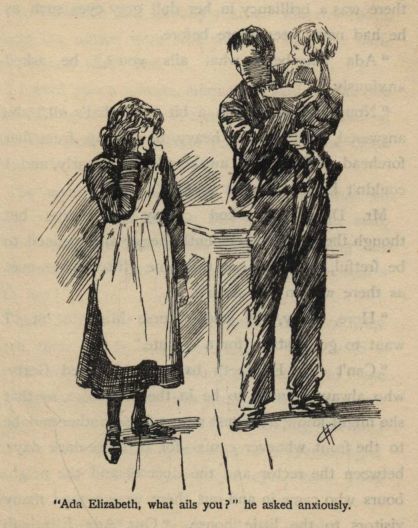
"Ada Elizabeth, what ails you?" he asked anxiously.
"Nought, Father; I'm a bit tired, that's all," she answered, pushing her heavy hair away from her forehead. "Mirry was awake all night nearly, and I couldn't keep her quiet hardly."
Mr. Dicki'son looked closely at Mirry; but though the child was evidently heavy and inclined to be fretful, there was not the same glitter in her eyes as there was in her sister's.
"Here, Gerty," he said, "nurse Mirry a bit. I want to go upstairs for a minute."
"Can't Ada Elizabeth have her?" asked Gerty, who always wanted to be in the sick-room, so that she might know the latest news of her mother and be to the front whoever came--for in those dark days, between the rector and the doctors and the neighbours who came in and out, there were a good many visitors to the little house. "Our Ada Elizabeth always keeps Mirry quiet better than I can, father."
"Do as I bid you," returned Mr. Dicki'son sharply; and thus rebuked, Gerty sat crossly down and bumped little Mirry on to her knee with a burst of temper, which set the child wailing again.
Mr. Dicki'son had already reached the sick-room, where the nurses were still standing over his half-unconscious wife's bed.
"I want you a minute, missus," he said to the one who had been so anxious concerning the disposal of Mrs. Dicki'son's few bits of jewellery. "Just come downstairs a minute."
The woman followed him, wondering what he could want. "Just look at this little lass," he said, taking Ada Elizabeth by the hand and leading her to the window. "Do you think there is aught amiss with her?"
There is little or no reserve among the poor, they speak their minds, and they tell ill news with a terrible bluntness which is simply appalling to those of a higher station; and this woman did not hesitate to say what she thought, notwithstanding the fact that she knew that the man was utterly overwrought, and that the child's fever-bright eyes were fixed earnestly upon her.
"Mr. Dicki'son," she cried, "I'll not deceive you, no; some folks would tell you as nought ailed, but not me--wi' her pore mother dying upstairs. I couldn't find it in my 'eart to do it; I couldn't indeed. Pore Ada Elizabeth's took, and you'd better run round to Widow Martin's and see if t' doctor's been there this morning. He telled me I might send there for him up to one o'clock, and it's only ten minutes past. Ada Elizabeth, lie down on t' sofa, honey, and keep yourself quiet. Gerty, can't you keep Mirry at t' window? Ada Elizabeth's took with the fever, and can't bear being tewed about wi' her."
Mr. Dicki'son was off after the doctor like a shot, and less than a quarter of an hour brought him back to see if the nurse's fiat was a true one. Alas! it proved to be too true, and the kind-hearted doctor drew the grief-stricken man on one side.
"Look here, Dicki'son," he said, "your wife is very ill indeed; it's no use my deceiving you--her life hangs on a thread, and it will be only by the greatest care if she is pulled through this. The child has undoubtedly got the fever upon her, and she cannot have the attention she ought to have here. There is not room enough nor quiet enough, and there's nobody to attend to her. Get her off to the hospital at once."
"The hospital!" repeated Mr. Dicki'son blankly. He had all the horror of a hospital that so many of his class have.
"It's the child's best chance," answered the doctor. "Of course, it may turn out only a mild attack. All the better that she should be in the hospital, in any case; in fact, I wish your wife was there this minute."
"Doctor," said Mr. Dicki'son hoarsely, "I don't like my little lass going to the hospital. I don't like it."
"But there is no help for it, and she'll be far better off there than she would be at home," the doctor answered; "but, all the same, they'd better not talk about it before your wife. Even when she is delirious or half-unconscious she knows a good deal of what's going on about her. I'll step up and have a look at her, and will speak to the women myself."
Before a couple of hours were over, Ada Elizabeth was comfortably in bed in the quiet and shady ward of the well-managed hospital, and in the little house in Gardener's Lane the struggle between life and death went on, while Gerty had to devote herself as best she could to the children. Gerty felt that it was desperately hard upon her, for Mirry and six-year-old Georgie fretted without ceasing for "our Ada Elizabeth," and would not be comforted; not, all the same, that Gerty's ideas of comfort were very soothing ones--a bump and a shake, and divers threatenings of Bogle-Bo, and a black man who came down chimneys to carry naughty children away, being about her form; and little Mirry and Georgie found it but a poor substitute for the tender if dull patience of "our Ada Elizabeth."
However, in spite of all the very real drawbacks which she had to fight against, Mrs. Dicki'son did not die; slowly and painfully she struggled back to her own senses again, with a dim realization of how very near the gate of death she had wandered. But, alas! by the time the doctor had, with a kindly pat upon his shoulder, told Mr. Dicki'son that his wife would live if no very serious relapse took place, the fever had fastened on another victim, and little Mirry was tossing to and fro with fever-flushed face, and the same unnatural brilliancy in her bonny blue eyes as had lighted up Ada Elizabeth's dull, grey ones.
They had not taken her to the hospital; it was so full that only urgent cases were admitted now: and since the mother was on the road to recovery, there was time to attend to the child. And so she lay in the next room to her mother, whose weakened senses gradually awoke to the knowledge of what was going on about her.
"Is that Mirry crying?" she asked, on the morning when the child was at its worst.
"Now don't you fret yourself, love," returned the nurse evasively. "T' bairn's being took care of right enough; they will cry a bit sometimes, you know"; and then she shut the door, and the mother dozed off to sleep again.
But in the evening the pitiful wail reached her ears again. "I want our Ada 'Liz'bet'," the child's fretful voice cried; "Mirry do want our Ada 'Liz'bet' so bad-a-ly--me want our Ada 'Liz'bet'."
Mrs. Dicki'son started nervously and tried to lift herself in her bed. "I'm sure Mirry's ill," she gasped. "Mrs. Barker, don't deceive me. Tell me, is she ill?"
"Well, my dear, I won't deceive yer," the nurse answered; "poor little Mirry's been took with the fever--yes, but don't you go and fret yourself. Mrs. Bell's waiting of her, and she wants for nought, and t' doctor says it's only a mild attack; only children runs up and down so quick, and she's a bit more fretful than usual to-night, that's all."
"Mirry do want our Ada 'Liz'bet'," wailed the sick child in the next room.
Mrs. Dicki'son turned her head weakly from side to side and trembled in every limb.
"Why can't Ada Elizabeth go to her?" she burst out at last.
The nurse coughed awkwardly. "Well, my dear," she began, "poor Ada Elizabeth isn't 'ere."
"Isn't 'ere!" repeated Mrs. Dicki'son wildly, and just then her husband walked into the room and up to the bedside.
She clutched hold of him with frantic eagerness. "Father," she cried hysterically, "is it true our Mirry's took with the fever?"
"Yes, Em'ly; but it's a very mild case," he answered, feeling that it was best in her excited and nervous condition to tell her the exact truth at once. "She's fretty to-night, but she's not so ill that you need worry about her; she's being took every care of."
"But she's crying for our Ada Elizabeth," Mrs. Dicki'son persisted. "Hark! There she is again. Why can't Ada Elizabeth be quick and go to her? Where is she? What does Mrs. Barker mean by saying she isn't 'ere?"
Mr. Dicki'son cast a wrathful glance at the nurse, but he did not attempt to hide from his wife any longer the fact that Ada Elizabeth was not in the house. "You know you was very ill, Em'ly, a bit back," he said, with an air and tone of humble apology, "and our Ada Elizabeth was taken with the fever just the day you was at the worst; and there was no one to wait on her, and the doctor would have her go to the hospital, and--what was I to do, Em'ly? It went against my very heart to let the little lass go, but she was willing, and you was taking all our time. I was very near beside myself, Em'ly I was, or I'd never have consented."
Mrs. Dicki'son lay for some minutes in silence, exhausted by the violence of her agitation; then the fretful wail in the adjoining room broke the stillness again.
"I do want our Ada 'Liz'bet'," the child cried piteously. Mrs. Dicki'son burst out into passionate sobbing. "I lie 'ere and I can't lift my finger for 'er," she gasped out, "and--and--it was just like Ada Elizabeth to go and get the fever when she was most wanted; she always was the contrariest child that I had, always."
Mr. Dicki'son drew his breath sharply, as if some one had struck him in the face, but with an effort he pulled himself together and answered her gently: "Nay, wife--Emily, don't say that. The little lass held up until she couldn't hold up no longer. I'll go and quiet Mirry. She's always quiet enough with me. Keep yourself still, and I'll stop with the bairn until she's asleep"; and then he bent and kissed her forehead, and passed softly out of the room, only whispering, "Not one word" to the nurse as he passed her.
But, dear Heaven! how that man's heart ached as he sat soothing his little fever-flushed child into quietness! I said but now that he drew his breath sharply as if some one had struck him in the face. Alas! it was worse than that, for the wife of his bosom, the mother of his children, had struck him, stabbed him, to the lowest depths of his heart by her querulous complaint against the child who had gone from him only a few hours before, on whose little white, plain face he had just looked for the last time, and on which his scalding tears had fallen, for he knew that, plain, and dull, and unobtrusive as she had always been--the butt of her sister's sharp tongue, the trial of his wife's whole existence--he knew that with the closing of the heavy eyes the brightest light of his life had gone out.
And little Mirry, wrapped in a blanket, lay upon his breast soothed into slumber. Did something fall from his eyes upon her face, that she started and looked up at him? She must have mistaken the one plain face for the other, for she put up her little hot hand and stroked his cheek. "You tum back, Ada 'Liz'bet'?" she murmured, as she sank off to sleep again; "Mirry did want you so bad-a-ly." The sick child's tender words took away half the bitterness of the sting which his wife had thrust into his heart, and his whole soul seemed to overflow with a great gush of love as he swayed her gently to and fro. She had loved the unattractive face, and missed it bitterly; she had wearied for the rare, patient smile and the slow, gentle voice, and, to Mr. Dicki'son's dull mind, the child's craving had bound Ada Elizabeth's heavy brows with a crown of pure gold, with the truest proof that "affection never was wasted."
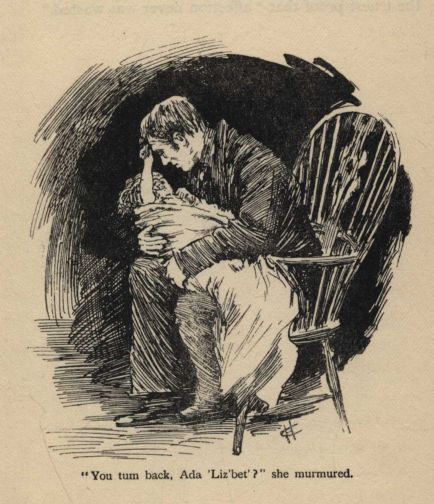
"You tum back, Ada 'Liz'bet'?" she murmured.
Halt!
"Halt! Who goes there?" cried a man's voice through the thick gloom of the dark night.
There was no answer save silence; and, after listening for a moment, Private Flinders turned, and began to tramp once more along the ten paces which extended from his sentry-box. "I could have sworn I heard a footstep," he said to himself. "It's curious how one's ears deceive one on a night like this."
Ten paces one way, ten paces the other; turn, and back again, and begin your ten paces over again. Yes, it is monotonous, there is no doubt of that; but it is the bounden duty of a sentry, unless he happens to prefer standing still in his box, getting stiff and chill, and perhaps running the risk of being caught asleep at his post--no light offence in a barrack, I can tell you. Ten paces one way, ten paces the other--a rustling, a mere movement, such as would scarcely have attracted the attention of most people, but which caught Private Flinders' sharp ears, and brought him up to a standstill again in an attitude of strict watchfulness.
"Halt! Who goes there?" he cried again, and listened once more. Again silence met him, and again he stood, alert and suspicious, waiting for the reply, "Friend."
"By Gum, this is queer," he thought, as he stood listening. "I'll search to the bottom of it though. I daresay it's only some of the chaps getting at me; but I'll be even with 'em, if it is."
He groped about in rather an aimless sort of way, for the night was black as pitch; and his eyes, though they had grown used to the inky want of light, could distinguish nothing of his surroundings.
"Now, where are you, you beggar?" he remarked, beginning to lose his habitual serenity, and laying about him with his carbine. After a stroke or two the weapon touched something, though not heavily, and a howl followed--a howl which was unmistakably that of a small child. It conveyed both fear and bodily pain. Private Flinders followed up the howl by feeling cautiously in the part whence the sounds had come. His hand closed upon something soft and shrinking, and the howls were redoubled.
"Hollo! what the deuce are you?" he exclaimed, drawing the shrieking captive nearer to him. "Why, I'm blessed if it ain't a kid--and a girl, too. Well, I'm blowed! And where did you happen to come from?"
The howl by this time had developed into a faint sniffing, for Private Flinders' voice was neither harsh nor forbidding. But the creature did not venture on speech.
"Where did you come from, and what are you doing here?" he asked. "Do you belong to the barricks, and has your mammy been wollopping of you? Or did you stray in from outside?"
"Lost my mammy," the small creature burst out, finding that she was expected to say something.
"What's your mammy's name?" Flinders asked.
"Mammy, of course," was the reply.
"And what's your name?"
"Susy."
"Susy. Aye, but Susy what?"
"Susy," repeated the little person, beginning to whimper again.
"Where do you live?"
"At home," said Susy, in an insulted tone, as if all these questions were quite superfluous.
"Well! blest if I know what to do with you," said Flinders, pushing his busby on one side, and scratching his head vigorously. "I don't believe you belong to the barricks--your speech haven't got the twang of it. And if you've strayed in from outside, Gord knows what 'll become of you. Certain it is that you won't be let to stop here."
"Susy so cold," whimpered the mite pitifully.
"I should think you was cold," returned Private Flinders sympathetically. "I'm none too warm myself; and the fog seems to fair eat into one's bones. Well, little 'un, I can't carry you back to where you came from, that's very certain. I can't even take you round to the guard-room. Now, what the deuce am I to do with you? And I shan't be relieved for over a hour."
Private Flinders being one of the most good-natured men in creation, it ended by his gathering the child in his arms, and carrying her up and down on his beat until the relief came.
"Why, what's the meaning of this?" demanded the corporal of the guard, when he perceived the unusual encumbrance to the private's movements.
"Ah! Corporal, that's more than I can tell you," responded the other promptly. "This here kid toddled along over a hour ago; and as she don't seem to know what her name is, or where she come from, I just walked about with her, that she mightn't be froze to death. I suppose we'd best carry her to the guard-room fire, and keep her warm till morning."
"And then?" asked the corporal, with a twinkle in his eye, which the dark night effectually hid.
"Gord knows," was the private's quick reply.
Eventually, the mite who rejoiced in the name of Susy, and did not know whence she had come or whither she was going, was carried off to the guard-room and made as comfortable as circumstances would permit--that being the only course, indeed, at that hour of the night, or, to be quite correct, of the morning--which could with reason be followed.
She slept, as healthy children do, like a top or dog, and when she awoke in the morning she expressed no fear or very much surprise, and, having enquired in a casual kind of way for her mammy, she partook of a very good breakfast of bread and milk, followed by a drink of coffee and a taste or two of such other provisions as were going round. Later on Private Flinders was sent for to the orderly-room, and told to give the commanding officer such information as he was in possession of concerning the stray mite, who was still in the warm guard-room.
Now it happened that the commanding officer of the 9th Hussars was a gentleman to whom routine was a religion and discipline a salvation, and he expressed himself sharply enough as to the only course which could possibly be pursued under the present circumstances.
"We had better send down to the workhouse people to come and remove the child at once. Otherwise, we may have endless trouble with the mother; and, moreover, if it once got about that these barracks were open to that kind of thing, the regiment would soon be turned into a regular foundling hospital. Let the workhouse people be sent for at once. What did you say, Mr. Jervis? That the child might be quartered for a few hours among the married people. Yes, I daresay, but if the mother is on the look-out, which is very doubtful, she is more likely to go to the police-station than she is to come here. As to any stigma, the mother should have borne that in mind when she lost the child. On second thoughts, I think it is to the police-station that we should send; yes, that will be quite the best thing to do."
A few hours later the child Susy was transferred from the guard-room to the police-station, and there she made herself equally at home, only asking occasionally, in a perfunctory kind of way, for "Mammy," and being quite easily satisfied when she was told that she would be coming along by-and-by.
During the few hours that she was at the police-station she became quite a favourite, and made friends with all the stalwart constables, just as she had done with one and all of the strapping Hussars at the cavalry barracks. She was not shy, for she answered the magistrate in quite a friendly way, though she gave no information as to her belongings, simply because she had no information to give. And the end was that she was condemned to the workhouse, and was carried off to that undesirable haven as soon as the interview with the magistrate was over.
"A blooming shame, I call it, poor little kid," said Private Flinders that evening to a group of his friends, in the comfortable safety of the troop-room. "She was a jolly little lass; and if I'd been a married man, I'd have kept her myself, dashed if I wouldn't!"
"Perhaps your missis might 'ave 'ad a word or two to say to that, Flinders," cried a natty fellow, just up to the standard in height, and no more.
"Oh, I'd have made it all right with her," returned Flinders, with that easy assurance of everything good that want of experience gives. "But to send it to the workhouse--it's a blooming shame! They treat kids anyhow in them places. Now then, Thomson, what are you a-grinning at? Perhaps you know as much about workhouses as I can tell you."
"Perhaps I do, and perhaps I don't," replied Thomson, with provoking good temper. "I wasn't a-laughing at the workhouse; cussing them is more like what one feels. But to think of you, old chap, tramping up and down with the blessed kid asleep--well, it beats everything I ever heard tell of, blame me if it don't."
Private Flinders, however, was not to be laughed out of his interest in the little child Susy; and regularly every week he walked down to the workhouse, and asked to see her taking always a few sweeties, bought out of his scanty pay, the cost of which meant his going without some small luxury for himself. And Susy, who was miserably unhappy in that abode of sorrow which we provide in this country for the destitute, grew to look eagerly for his visits, and sobbed out all her little troubles and trials to his sympathetic ears.
"Susy don't like her," she confided to him one day when the matron had left them alone together. "She slaps me. Susy don't love her."
"But Susy will learn to be a good girl, and not get slapped," the soldier said, with something suspiciously like a lump in his throat. "See, I've brought you some lollipops--you'll like them, won't you?"
He happened to run up against the matron as he walked away toward the door. "She's a tender little thing, missis," he remarked, with a vague kind of notion that even workhouse matrons have hearts sometimes. And so some of them have, though not many. This particular one was among the many.
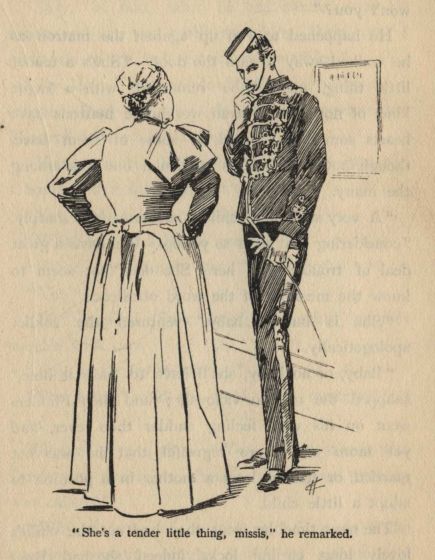
"She's a tender little thing, missis," he remarked.
"A very self-willed child," she remarked sharply, "considering that she's so young. We have a great deal of trouble with her. She does not seem to know the meaning of the word obedience."
"She is but a baby," ventured the soldier apologetically.
"Baby, or no baby, she'll have to learn it here," snapped the matron viciously; and then Flinders went on his way, feeling sadder than ever, and yet more and more regretful that he was not married, or had at least a mother in a position to adopt a little child.
The next time he went they had cut the child's lovely long, curling locks, indeed, she had been shorn like a sheep in spring-time. Flinders' soft heart gave a great throb, and he cuddled the mite to his broad breast, as if by so doing he could undo the indignity that had been put upon her.
"Susy," he said, when he had handed over his sweets and she was busily munching them up, "I want you to try and remember something."
Susy looked at him doubtfully, but nodded her cropped head with an air of wise acquiescence. Flinders went on talking quietly.
"You remember before you came here--you had a home and a mammy, don't you?"
"Yes," said Susy promptly.
"What sort of a house was it?"
"Where my mammy was?" she asked.
"Yes."
"Big," replied Susy briefly, selecting another sweetie with care.
"And what was it called?"
"The house," said the child, in a matter-of-fact tone.
Flinders gave a sigh. "Yes, I dare say it was. Don't you remember, though, what your mammy was called?"
"Why mammy, of course," said Susy, as if the question was too utterly foolish for serious consideration.
"Yes, but other people didn't call her mammy--it was only you did that," said Flinders desperately. "What did other people call her? Can't you remember that?"
It happened that Susy not only remembered, but immediately gave utterance to her recollections in such a way as fairly made the soldier jump. "They called my mammy 'my lady,'" she said simply.
Private Flinders gave the child a great hug, and put her down off his knee. "Gord bless you, little 'un," he ejaculated. "And see if I don't ferret that mammy of yours out before I'm many days older--see if I don't."
He met the matron as he went towards the entrance. "Missis," he said, stopping, "I've got a clue to that little 'un's belongings. I'm off to the police station now about it. I'd advise you to treat her as tender as you can. It'll come home to you, mark my words."
"Dear me," snapped the matron; "is she going to turn out a princess in disguise, then?"
"It'll perhaps turn out a pity you was in such a hurry to crop her hair," said Private Flinders, with dignity.
In the face of that sudden recollection of the child's, he felt that he could afford to be, to a certain extent, stand-offish to the cold-eyed, unloving woman before him.
"Oh, rules are rules," said the matron, with an air of fine disdain; "and, in an institution like ours, all must be served alike. It would be a pretty thing if we had to spend half of every day curling the children's hair. Good-day to you."
He felt that he had got the worst of it, and that it was more than possible that little Susy would pay the penalty of his indiscretion. Fool that he had been not to hold his tongue until he had something more tangible to say. Well, it was done now, and could not be undone, and it behoved him to lose no time, but to find out the truth as soon as possible.
The inspector whom he found in charge of the police-station listened to his tale with a strictly professional demeanour.
"Yes, I remember the little girl coming in and being taken to the workhouse. I remember the case right enough. You'd better leave it to us, and we will find out whether such a child is missing anywhere in the country."
I need hardly say that in Private Flinders' mind there lurked that deep-rooted distrust of a policeman that lives somewhere or other in the heart of every soldier. It came uppermost in his mind at that moment.
"You'll do your best?" he said, a little wistfully. "You'll not let time go by, and--and----?"
"We shall be in communication with every police-station in the kingdom in a few hours," returned the inspector, who knew pretty well what was passing in the soldier's mind. "But, all the same, you mustn't be over-much disappointed if there proves to be nothing in it. You see, if such a child was being inquired for, we should have heard of it before this. However, we'll do our best; you may be very sure of that."
With that Private Flinders was obliged to rest content. He made inquiries from day to day, and eventually this advertisement appeared in the leading daily papers:--
TO PARENTS AND GUARDIANS.--A little girl, apparently about three years old, is in charge of the police at Bridbrook. She says her name is Susy, and appears to be the child of well-to-do parents. Very fair hair, blue eyes, features small and pretty. Clothes very good, but much soiled.--Address, POLICE STATION, BRIDBROOK.
A few hours after the appearance of the advertisement, a telegram arrived at the police-station:--
"Keep child. Will come as soon as possible.--JACKSON."
* * * * *
Less than three hours afterwards, an excited woman rushed into the station, having precipitated herself out of a cab, and almost flung herself upon the astonished inspector.
"I've come for the child--the little girl," she gasped, as if she had run at racing speed direct from the place indicated by the telegram.
"Oh, she belongs to you, does she?" remarked the inspector coolly. "Well, you've no call to be in such a 'urry; you've been very comfortable about her for the last six weeks."
"Comfortable!" echoed the excited one; "why, I've been very near out of my mind. I thought she was drowned, and I was so frightened, I daren't say a word to any one about it. And my lady away----"
"Then you're not the mother?" said the inspector sharply.
"The mother!--my goodness, no! I'm the head nurse. My young lady's mother is the Countess of Morecambe."
"Then what does she say to all this, pray?" he asked.
"My lady went abroad two months ago to one of those foreign cure places, and she doesn't know but what Lady Susy is safe with me at this minute," the woman replied.
The inspector gave a prolonged whistle.
"Well, you're a pretty sort of nurse to leave in charge of a child," he remarked. "I shouldn't wonder if you get the sack for this. Do you know the child's at the workhouse, and that they've cropped her head as bare as mine?"
At this the woman simply sat down and sobbed aloud.
"Aye, you may well cry," said the inspector grimly. "I should if I was in your shoes."
She finally told how the child had been missed; how she had refrained from giving notice to the police through fear of publicity, and believing she could find her by diligent search in the locality; how "my lady" was a widow, with only this one little child; how she had been advised to go for this cure; how she had consented to the nurse taking Lady Susy to the seaside meantime, well knowing that she would be safe and happy with her.
"Yes, you may laugh at that," she wound up; "but my dear lamb has often called me 'mammy' as anything else, and my lady has often said she was quite jealous of me."
"All the same, I shouldn't wonder if you get the sack," repeated the inspector, who was not troubled with much sentiment.
I scarcely know how to tell the rest--how Jackson went off to the workhouse, and enlightened the matron and others as to the child's station in life; how she seized her little ladyship, and almost smothered her with kisses; how she bewailed her shorn locks, and wondered and conjectured as to how she could possibly have got to a place so far from her home as Bridbrook.
But, a few weeks later, a lovely woman in mourning came to the cavalry barracks, and inquired for Private Flinders. She wept during the interview, this lovely lady; and when she had gone away, Private Flinders opened the packet she had put into his hands, to find a cheque for a hundred pounds, and a handsome gold watch and chain. And at the end of the chain was a plain gold locket, on one side of which was engraved Private Flinders' initials, whilst on the other was written the single word, "Halt!"
The Little Lady with the Voice
A FAIRY TALE
Marjory Drummond was sitting on the bank of the river, and, if the whole truth must be owned, she was crying. She was not crying loudly or passionately, but as she rested her cheek on her hand, the sad salt tears slowly gathered in her eyes, and brimmed over one by one, falling each with a separate splash upon the blue cotton gown which she wore.
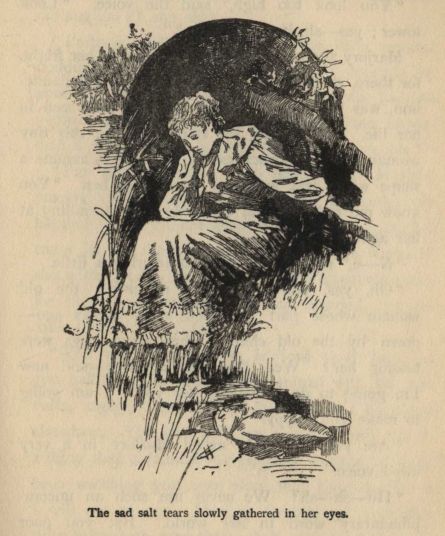
The sad salt tears slowly gathered in her eyes.
The sun was shining high in the blue heavens, the river danced and sang merrily as it went rippling by, and all the hedgerows were alive with flowers, and the air was full of the scent of the new-cut hay. Yet Marjory was very miserable, and for her the skies looked dark and dull, the river only gave her even sadder thoughts than she already had, and the new-cut hay seemed quite scentless and dead. And all because a man had failed her--a man had proved to be clay instead of gold. And so she sat there in the gay summer sunshine and wished that she had never been born, or that she were dead, or some such folly, and the butterflies fluttered about, and the bees hummed, and all nature, excepting herself, seemed to be radiant and joyous. An old water-vole came out of his hiding-place by the river and watched her with a wise air, and a dragon-fly whizzed past and hovered over the surface of the sunlit water, but Marjory's eyes were blind to each and all of these things, and still the tears welled up and overflowed their bounds, and she wept on.
"What is the matter?" said a voice just at her ear.
Marjory gave a jump, and dashed her tears away; it was one thing to indulge herself in her grief, but it was quite another to let any one else, and that a stranger, see her. "What is wrong with you, Marjory?" said the voice once more.
"Nothing!" answered Marjory shortly.
"I may, perhaps, be able to help you," the gentle little voice persisted.
"Nobody can help me," said Marjory, with a great sigh, "nobody can help me--nobody."
"Don't be so sure of that," said the voice. "Why do you keep this curl of hair? Why do you turn so persistently away from me? Why don't you look at me?"
Marjory turned her head, but she could see no one near. "Who are you? Why do you hide?" she asked in turn.
"You look too high," said the voice. "Look lower; yes--ah, how d'you do?"
Marjory almost jumped into the river in her fright, for there, standing under the shade of a big dandelion, was the smallest being she had ever seen in her life. Yet, as she sat staring at her, this tiny woman seemed to increase in size, and to assume a shape which was somehow familiar to her. "You know me now?" asked the little woman, smiling at her again.
"N--o," replied Marjory, stammering a little.
"Oh, yes, you do. You remember the old woman whose part you took a few weeks ago--down by the old church, when some boys were teasing her? Well, that was me--me--and now I'm going to do something for you. I am going to make you happy."
"Are you a witch?" asked Marjory, in a very awed voice.
"Hu--sh--sh! We never use such an uncomplimentary word in our world. But you poor mortals are often very rude, even without knowing it. I am not what is called a witch, young lady. I am a familiar."
Marjory's eyes opened wider than ever; she bent forward and asked an earnest question: "Are you my familiar?" she said.
"Perhaps, perhaps," answered the little woman, nodding her head wisely. "That all depends on yourself. If you are good, yes; if you are bad, no--most emphatically, no. I am much too important a person to be familiar to worthless people."
"I'm sure you are very kind," said Marjory meekly. "But what will you do to make me happy? You cannot give me back my Jack, because he has married some one else--the wretch!" she added under her breath, but the ejaculation was for the woman whom Jack had married, not for Jack himself.
"You will learn to live without your Jack, as you call him," said the little woman with the soft voice, sagely, "and to feel thankful that he chose elsewhere. You once did me a service, and that is a thing that a familiar never, never forgets. I have been watching you ever since that time, and now I will reward you. Marjory Drummond, from this time henceforth everything shall prosper with you; everything you touch shall turn to gold, everything you wish shall come to pass; what you strive after you shall have; your greatest desires shall be realised; and you shall have power to draw tears from all eyes whenever you choose. This last I give you in compensation for the tears that you have shed this day. Farewell!"
"Stay!" cried Marjory. "Won't you even tell me your name? May I not thank you?"
"No. The thanks are mine," said the little lady. "When we meet again I will tell you my name--not before."
In a moment she was gone, and so quickly and mysteriously did she go that Marjory did not see her disappear. She rubbed her eyes and looked round. "I must have been asleep!" she exclaimed. "I must have dreamt it."
* * * * *
Several years had gone by. With Marjory Drummond everything had prospered, and she was on the high road to success, and fame, and fortune. Whenever her name was spoken, people nodded their heads wisely, and said: "A wonderful girl, nothing she cannot do"; and they mostly said it as if each one of them had had a hand in making her the clever girl that she was.
As an artist she was extremely gifted, being well hung in the Academy of the year; as an actress, though only playing with that form of art, she was hard to beat; and she had written stories and tales which were so infinitely above the average that editors were one and all delighted at any time to have the chance of a story signed with the initials "M.D.," initials which the world thought and declared were those of one of the most fashionable doctors of the day.
And at last the world of letters woke up and rubbed its eyes very much as Marjory had rubbed her eyes that day on the river's bank, and the world said, "We have a great and gifted man among us." "'M.D.' is the writer of the time." And slowly, little by little, the secret crept out, and Marjory was fêted and flattered, and made the star of the season. Her name was in every one's mouth, and her work was sought after eagerly and read by all. And among those who worshipped at her shrine was the "Jack" who had flouted her in the old days, yet not quite the same, but a "Jack" very much altered and world-worn, so that Marjory could no longer regret or wish that the lines of her life had fallen otherwise than they had done.
And often and often, as the years rolled by, and she was still the darling star of the people who love to live in the realms of fiction, did Marjory ponder over that vivid dream by the riverside, and try to satisfy herself that it really was no more than a dream, and that the old lady with the sweet clear voice had had no being except in her excited brain. "I wish," she said aloud one day, when she was sitting by the fire after finishing the most important work that had ever yet come from her pen, "I wish that she would come back and satisfy me about it. It seemed so real, so vivid, so distinct, and yet it is so impossible----"
"Not impossible at all," said a familiar voice at her elbow.
Marjory looked round with a start. "Oh! is it you?" she cried. "Then it was all true! I have never been able to make up my mind whether it was true or only a dream. Now I know that it was quite real, and everything that you promised me has come about. I am the happiest woman in all the world to-day, and, dear friend, if ever I did a service to you, you have amply repaid me."
"We never stint thanks in our world," said the little old lady, smiling. "Then there is nothing more that you want?"
"Yes, kind friend, just one thing," said Marjory. "You promised me that when we met again you would tell me your name."
The little woman melted away instantly, but somewhere out of the shadows came a small sweet sighing voice, which said softly, "My name is--Genius!"
Jewels to Wear
"Torches are made to burn;
jewels to wear."--Shakespeare
CHAPTER I
"I can't think, Nancy, why you cannot get something useful to occupy yourself with. It seems to me that I have slaved and sacrificed myself all my life, in every possible direction, simply that you may waste your whole time spoiling good paper, scribbling, scribbling, scribbling, from morning till night, with your fingers inky, and your thoughts in the clouds, and your attention on nothing that I want you to attend to. I don't call it a good reward to make to me. You will never do any good with that ridiculous scribbling--never! When I think of what you might save me, of how you might spare me in my anxious and busy life, it makes me positively ill to think I am your mother. Here have I been thinking of you, Nancy, and working for you, and struggling, and fighting, and slaving for you for twenty years, and now that the time has come when you might do something for me, you have only one idea in your head, and that is writing rubbishy stories that nobody will ever want to buy!"
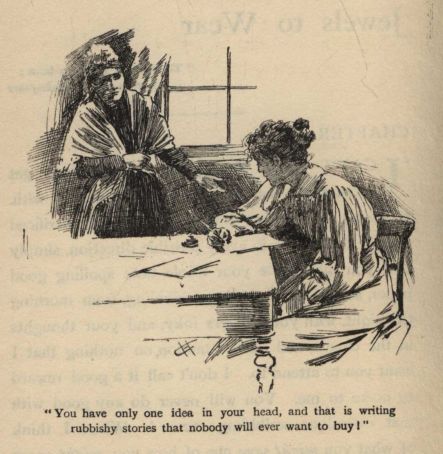
"You have only one idea in your head, and that is writing rubbishy stories that nobody will ever want to buy!"
The girl thus addressed turned and looked at her mother.
"Mother, dear," she said depreciatingly, "I am sorry that I am not more useful. I can't help it. I do think of you, I try to do everything I can to relieve you, and help you; but these stories will come into my head. They won't be put out of it. What am I to do?"
"What are you to do?" echoed the mother. "Why, look at that basket of stockings to darn!"
"I am quite willing to darn them," said Nancy meekly.
"Yes, you are quite willing, I daresay. You are quite willing when I tell you. But you don't seem to see what a burden it is to me to have to tell you everything as if you were a baby. There are the stockings, and there are you; at your age, you don't surely need me to tell you that the stockings need mending!"
"I will do them at once," said Nancy. "I will do them this minute."
"Yes, with your thoughts in the clouds, and your mind fixed on scribbling. What, may I ask you, Nancy, do you think you will ever do with it?"
"I don't know," said Nancy desperately. "Perhaps I may make some money some day."
"Never, never! Waste it, you mean. Waste it over pens, ink, paper and tablecloths. There is the tablecloth in your bedroom spotted with ink from end to end. It is heart-breaking."
"Well, Mother, what do you wish me to do?" the girl asked in desperation.
"Your plain and simple duty. I would like you to give up all idea of wasting your time in that way from now on," said the mother deliberately.
"Won't you even let me write a little to amuse myself in my spare time?" asked the girl piteously.
"Your spare time!" echoed the mother impatiently. "What spare time have poor people such as we are? What spare time have I? Here are we with this great boarding-house on our hands, twenty-three boarders to be made comfortable, kept in good temper, fed, housed, boarded--everything to be done for them, and I have to do it. Why, in the time that you waste over those stories, you might make yourself a brilliant pianist, and play in the evening to them. Then you would be of some use."
"I don't think," said Nancy, "that anything will ever make me a brilliant pianist, Mother. There's no music in me--not of that kind, and I don't think that the boarders would like me half as well if I went and strummed on the drawing-room piano every evening for an hour or two, I really don't, Mother."
"No, you know better than I do, of course. That is the way with the young people of the present day. You are all alike. Ah, it was different when I was a girl. I would no more have dreamed of defying my mother as you defy me----"
"Mother, I don't defy you," Nancy broke in indignantly. "I never defied you in my life. I never thought of such a thing."
"Don't you write stories in defiance of my wishes?" Mrs. Macdonald asked, dropping the tragedy air, and putting the question in a plain, every-day, businesslike tone.
At this, Nancy Macdonald flushed a deep full red, a blush of shame it was, or what felt like shame, and as it slowly faded away until her face was a dull greyish white, all hope for that gift which was as the very mainspring of her life, seemed to shrink and die within her.
"Mother," she said at last, in a firm tone, "I will do what you wish. I will give up writing, I promise you, from this time forward, and I will not write at all while I have any duty left in the day. You will not mind my doing a little when I have seen the after dinner coffee served, will you?"
"That means, I suppose," said Mrs. Macdonald rather tartly, "that you will sit up half the night ruining your health, spoiling your eyesight, wasting my gas, and making it perfectly impossible that you should get up in good time in the morning."
"Mother," said the girl, in a most piteous tone, "when I am once late in the morning, I will promise you to give it up altogether, and for ever; more than that I cannot say. As you said just now, it is a hard life here, and we have not very much leisure time; but, I implore you, do not take my one delight and pleasure from me altogether!"
"If you put it in that way," said Mrs. Macdonald rather grudgingly, "of course, we can but try the experiment; but what good, I ask you, Nancy, do you think will ever come of it!"
"I don't know," said Nancy; "I can't say. Other people have made fortunes; other people have done well by writing; why should not I?"
"As if you would ever make a fortune!" said Mrs. Macdonald, with the contemptuousness of a woman to whom the struggle of life had been hard and to whom pounds, shillings and pence in the very hand were the only proofs of reason for what she called "wasting time" over story-writing.
"Well, if not a fortune, at least a comfortable income," said Nancy eagerly; "and if I did, Mother, I should give it all to you!"
"Thank you for nothing, my dear," was the ungracious reply.
To this Nancy made no answer. She carried the big basket of stockings to the window, and sat down in the cold winter light to do such repairs as were necessary. Poor child! It was a hard fate for her. She was the eldest of a family of five, all dependent on the exertions of her widowed mother in keeping afloat the big boarding-house by which they lived. For a boarding-house, be it ever so liberally managed, be the receipts ever so generous, is but a sordid abode, especially to those who have the trouble and care of managing it; and to an eldest daughter, and one who stands between the anxious mother and the younger children, who mostly resemble young rooks with mouths chronically open, such a life appears perhaps more sordid than it does to any one else.
To Nancy Macdonald, with her mind full of visionary beauty, and living daily in a world of her own--not a world of boarding-houses--the life they lived seemed even more sordid, more trivial, more petty, than it was in reality. Her wants were not many; she was never inclined to rail at fate because she had not been born with a silver spoon in her mouth, not at all. But if only she could have a quiet home, with an assured income, just sufficient to cover their modest wants, to provide good wholesome food, to buy boots and shoes for the little ones, to pay the wages of a good servant, to take those lines of anxious care from her mother's forehead, so that she could employ her leisure in cultivating her Art--she always called it her Art, poor child!--she would have been perfectly happy, or she thought she would have been perfectly happy, which, in the main, amounted to the same thing. As she sat in the cold light of that winter's afternoon, darning, as if for dear life, the great pile of stockings which were her portion, she soon drifted away from the tall Bloomsbury dwelling into a bright, brilliant land of romance, where there were no troubles, no cares, where nothing was sordid, and everything was bright and rosy, and even troubles and worries might have been adequately described as "double water gilt."
Young writers do indulge in these blessed dreams of fancy, and Nancy, remember, was only twenty. Her heroines were always lovely, always extravagantly rich or picturesquely poor; her heroes were all lithe and long, and most of them had tawny moustaches, and violet eyes like a girl's. They were all guardsmen or noblemen. They knew not the want of money; if they were called poor, they went everywhere in hansoms, and had valets and gambling debts. It was an ideal world, and Nancy Macdonald was very happy in it.
From that time forward a new life began for the girl. The household certainly went more smoothly, because of that promise to her mother; and Mrs. Macdonald's sharp tongue whetted itself on other grievances more frequently than on that old one about Nancy's scribbling propensities. It was irritating to Nancy, of course, to hear her mother continually nagging about something or other; but then, as she reminded herself very often during the day, her mother had great anxieties and grievous worries. She was a sort of double-distilled Martha, "careful and troubled," not about many things, but about everything--everything that did happen, or might happen, even what could happen under given circumstances which might and probably never would occur. Still, it was not so trying to bear when the shafts of sarcasm and complaining were aimed at others instead of herself, and to do Nancy strict justice, she did try honestly to do the work which lay to her hand.
In the midst of the multitudinous cares of the large household it must be owned that the girl's writing suffered. It is all very well for a girl in fiction to do scullery work all day long, and write the brilliant novel of a season in odd moments, in a cold and cheerless bedroom, but in real life it is very different. Nancy Macdonald gave her attention to stockings and table-linen, and shopping and ordering and dusting; to keeping boarders in good temper, and making herself generally useful; to superintending the education and manners of the little ones, to smoothing down the rough edges of her mother's chronic asperity--in short, to being a real help; but her much loved work practically went to the wall. She dreamed a good deal while she was doing other things, but mere dreaming is not of much help towards making name or fortune; work is the only road which leads to either. Still, you cannot do your duty without improving your character, and Nancy Macdonald's character was strengthening and softening every day. She worked a little at night, but often she was far too tired and weary to attempt it. Very often when she did so, she found that the words would not run, the incidents would not connect themselves, and frequently that her eyes would not keep open; and then I am obliged to say that it was not an uncommon thing for Nancy Macdonald to get into bed and cry herself to sleep.