SELECTION OF SEMEN FOR FREEZING
Reading edition
One of the first considerations in freezing semen is that of deciding which semen samples are to be frozen. Since preservation of the semen—the maintenance of the potential motility and especially the fertility of the sperm—is the primary aim, some attention should be directed to the kind of semen sample that will withstand freezing. Do the initial characteristics of the sample indicate whether the sperm will withstand freezing? Does maturity of the sperm affect their freezability?
Predicting freezability. Estimates of semen quality in the past have been based in part on the numbers of sperm present in a fresh sample and on the percentage and rate of motility shown by the sperm. These characteristics were used to determine the relationship between the original concentration of sperm (in the fresh, undiluted sample), the percentage and rate of sperm motility in the diluted samples just prior to freezing, and the percentage and rate of sperm motility following freezing and thawing. From data collected before and after freezing and thawing 54 ejaculates, it was found that there was not a significant correlation between the number of sperm present in the original sample and the percent of motile sperm present after freezing and thawing (r = 0.03). A highly significant correlation (r = 0.45) was found, however, between the percentages before freezing and after thawing. While this correlation coefficient was highly significant, its magnitude indicates that only about one fifth of the variation in percentage of motile sperm observed after freezing was accounted for by the motility of the sperm prior to freezing.
Freezability of first and second ejaculates. In the early days of artificial breeding in this country, it was commonly believed that a second ejaculate collected a few minutes after the first resulted in a larger ejaculate containing more sperm. With the development of the procedure of stimulating sexual excitement by restraint prior to collecting semen, this difference between first and second ejaculates has been greatly reduced. Still it was noted that second ejaculates frequently withstood freezing better than first ejaculates, even though restraint and stimulation of the bull occurred prior to collection of the first ejaculate. During the course of a number of experiments, it was possible to compare the freezability of 2 ejaculates that were collected a few minutes apart from the same bull. Two consecutive ejaculates were obtained one or more times from 24 bulls so that a total of 58 comparisons could be made. The mean prefreezing and post-thawing percentages of motile sperm in first and second ejaculates are presented in Table 1.
An analysis of variance showed that in this comparison the differences between first and second ejaculates in sperm survival during freezing were highly significant. A later comparison of 27 first and second ejaculates from 26 bulls did not show as great a difference between first and second ejaculates in their ability to withstand freezing (Table 1).
Table 1.—Comparison of the Freezability of First and Second Ejaculates Taken a Few Minutes Apart From the Same Bull
Number of bulls Number of ejaculates Ejaculate Prefreezing motility (percent) Post-thawing motility (percent) Survival (percent)
24 58 1st 60 39 65
2d 62 45 74
26 27 1st 60 36 60
2d 65 40 61
Freezability of several consecutive ejaculates. The fact that second ejaculates sometimes withstood freezing better than first ejaculates suggested that the maturity of the sperm might be a factor affecting freezability. An opportunity to check this idea came when 20 consecutive ejaculates were collected from each of 6 bulls within a 4-hour period. The sperm in samples collected in this manner might be expected to be less mature with each additional collection.
The results obtained in freezing several consecutive ejaculates are shown in Figure 1 as averages for the ejaculates from 6 bulls. In same instances, there was an insufficient quantity of semen available to test the freezability. (Procedure: Diluted to 30 × 106 sperm per ml. with 1:1 yolk-citrate, then cooled and glycerolated with an equal volume of 14 percent glycerol (percent by volume) in 2.9 percent sodium citrate. Final sperm concentration, 15 × 106. Equilibration time, 15 hours. Freezing rate, 2° C. per minute from +5° to -19° C. then 4° C. per minute from -19° to -79° C. Held frozen for 5 or more hours then thawed in water at 5° C. and checked for motility.)
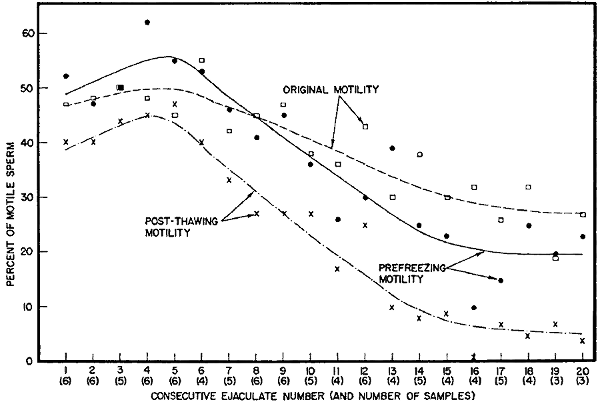
Percent of motile sperm before and after freezing consecutive ejaculates collected within a 4-hour period
from each of 6 bulls (Fig. 1)
In general, the motility before freezing improved slightly from the first to the fourth to sixth ejaculate and then declined until about the 12th or 14th ejaculate, at which point the prefreezing motility seemed to level off through the 20th ejaculate (Fig. 1). The percentage of motile sperm found after freezing and thawing followed the same trend at an average level 10 to 15 percent lower than the prefreezing level. As is readily seen from the trend lines in Fig. 1, the difference between the prefreezing motility and the post-thawing motility increased gradually after about the fifth ejaculate. Although the absolute difference did not increase greatly, the percentage of survival after freezing dropped from 81 percent on the first 5 ejaculates to 26.5 percent on the last 5 (Table 2).
Table 2.—Comparison of the Freezability of 20 Consecutive Ejaculates Collected Within a 4-Hour Period
(Weighted averages for 6 bulls)
Ejaculate Number of ejaculates Prefreezing motility (percent) Post-thawing motility (percent) Survival (Percent)
1st to 5th 29 53.3 43.2 81.0
6th to 10th 26 43.8 30.2 69.0
11th to 15th 23 28.6 14.5 50.7
16th to 20th 19 18.1 4.8 26.5
Freezability of epididymal sperm. Since the freezability of bull semen seemed to be better in second than in first ejaculates and some improvement in freezability was evident through the first 4 to 6 ejaculates taken consecutively, the question of whether epididymal sperm would withstand freezing seemed to be important. Although when 20 collections were made, the later ejaculates no doubt contained fewer mature sperm, the lowered freezability could have been due to accessory gland secretions rather than changes in the sperm themselves. Removing sperm directly from the epididymis would eliminate any effect that the accessory gland secretions could be exerting. Further, if epididymal sperm could be frozen, obtaining and using semen from a bull shortly after his death should be possible.
Table 3.—Freezability of Sperm in Samples Taken From the Epididymides
Bull Prefreezing motility (percent) Post-thawing motility (percent) Survival (percent)
1 50 40 80
2 40 13 32
3 60 15 25
4 30 15 50
5+6 40 25 62
Average 44 22 50
To determine whether epididymal sperm would withstand freezing, the 12 epididymides (cauda only) of 6 slaughtered bulls were flushed with saline (0.9 percent) and the sperm obtained were frozen using the same procedure as was used with the 20 consecutive ejaculates discussed earlier. Averages of the 2 epididymides from each bull are given in Table 3; the samples from bulls 5 and 6 were combined. From the data in Table 3, it is obvious that motile sperm were present after freezing and thawing epididymal samples. It is likely that further experience in handling epididymal sperm may lead to improved results. Using frozen epididymal sperm from 2 bulls, Canadian workers have produced confirmed pregnancies in 8 out of 12 cows.[8]
Freezability of washed sperm. In the laboratory it is frequently desirable to study sperm free of the seminal plasma in which they are ejaculated. Sperm can be separated from the seminal plasma by centrifugation, removal of the supernatant plasma, and resuspension in a salt solution of known composition. Sometimes it is desirable to repeat the process. This tends to wash the sperm with the salt solution and sperm handled in this way are called washed sperm.
Sperm cells centrifuged three times and washed twice in 0.9 percent sodium chloride solution withstood freezing well when finally resuspended and frozen in yolk-citrate diluent. The percentage of survival in three samples subjected to this treatment was 60 percent. Thus it appears that the seminal plasma itself is not essential for ejaculated sperm to survive the rigors of freezing. This is not surprising, since it had already been found that epididymal sperm, which also are free of accessory gland secretions, can withstand freezing and thawing.