EFFECTS OF FREEZING PROCEDURES ON METABOLIC ACTIVITY OF BULL SPERM
Reading edition
By finding how methods of handling affect the sperm cells, one can sometimes improve the procedures to avoid harmful effects. Some attempts have been made in this laboratory to determine the effects of the freezing procedures on the metabolic activity of bull spermatozoa. These investigations have been limited in scope, involving the measurement of oxygen-consumption and estimates of sperm motility during and after incubation at 37° C. in a Warburg apparatus.
Effect of glycerol additions on oxygen uptake of diluted semen at 37° C. The effect of adding glycerol to diluted semen on oxygen consumption of the sperm was tested in a Warburg apparatus, using semen diluted with an extender consisting of one part egg yolk and one part 2.9 percent sodium citrate dihydrate. The yolk-citrate extender was added to the semen at a rate which brought the sperm concentration in 0.5 milliliter to 200 million to 500 million. An exact count was used to calculate the oxygen uptake per 108 sperm per hour (ZO2).
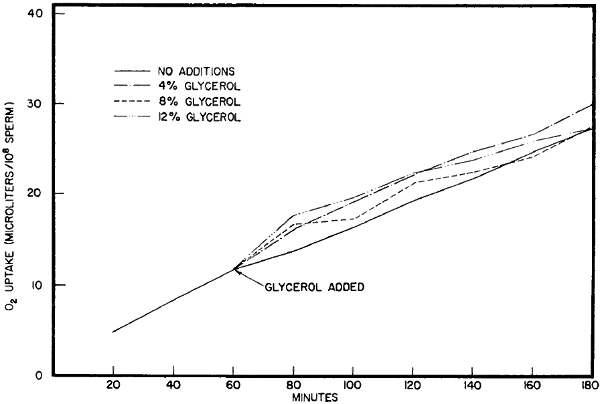
Effect of glycerol additions on oxygen consumption of sperm at 37° C. (Fig. 9)
Glycerol in various percentages in 2.9 percent sodium citrate dihydrate solution was placed in the sidearm of the Warburg flasks. The diluted semen was held in the main compartment. After a 60-minute preliminary run, in which the rate of oxygen uptake of the sperm in yolk-citrate diluent was determined, the contents of the sidearm were tipped into the main compartment. The resulting glycerol percentages after mixing the sidearm and main compartment contents were 0, 4, 8, and 12 percent. Ten samples of semen were subsampled and the oxygen uptake of each was determined at all four levels of glycerol.
Oxygen uptake was increasingly stimulated during the first 20-minute interval by each increase in the amount of glycerol added (Fig. 9). After the first 20 minutes, the rate of oxygen utilization decreased at the two higher levels of glycerol but persisted at 4 percent. The rate of oxygen consumption for the first 20-minute period at the 4-percent glycerol level was 130 percent that of the control to which only sodium citrate had been added. At 8 and 12 percent the values for the period were 144 and 192 percent, respectively, of the control rate.
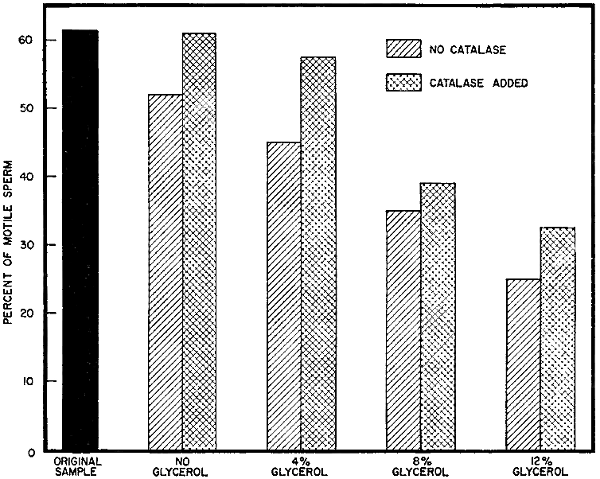
Effect of glycerol and glycerol-plus-catalase additions on sperm motility during incubation at 37° C.
(Fig. 10)
With each increase in glycerol level, motility was reduced during the incubation period. This is shown in Figure 10 along with the effect on motility of adding catalase, which is discussed in the next section.
Effect of glycerol-plus-catalase on oxygen uptake of diluted semen. Certain bacteria have been shown to break glycerol down, forming hydrogen peroxide as follows:
Glycerol + oxygen → lactic acid + hydrogen peroxide.
Hydrogen peroxide is known to be detrimental to sperm. The addition of glycerol to diluted semen first increased oxygen uptake and then reduced it. Since a reduction in sperm survival followed, some harmful action must have taken place with the addition of glycerol at 37° C. To test whether this action could be due to the release of hydrogen peroxide as occurs in certain bacteria, glycerol with catalase—the enzyme which breaks down hydrogen peroxide—was added to a portion of 8 diluted semen samples and the oxygen uptake was recorded. Comparison of the resulting oxygen uptake with glycerol and with glycerol plus catalase is shown in Figure 11.
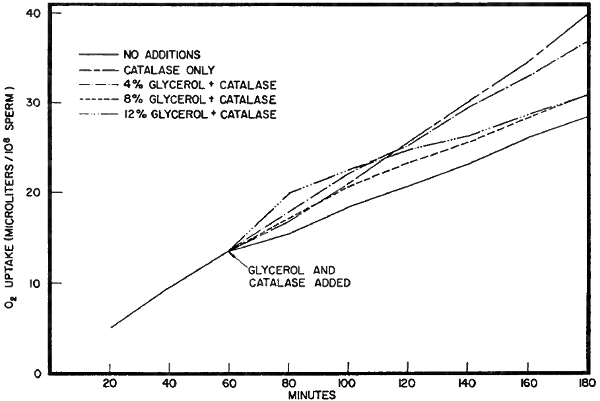
Effect of additions of glycerol-plus-catalase on oxygen consumption of sperm at 37° C. (Fig. 11)
Oxygen consumption was increased by the presence of added catalase at all glycerol levels and in the control. Sperm survival during the 3-hour period at 37° C. also was improved by the presence of catalase (Fig. 10). However, the general trend in oxygen consumption produced by the addition of glycerol was not changed greatly. The higher levels of glycerol still stimulated oxygen uptake during the first 20-minute period after the additions and then slowed the rate of oxygen utilization. The rate of utilization was generally higher during the test period in the presence of catalase than without added catalase. It appeared that a part of the harmful effect of glycerol might be due to the formation of hydrogen peroxide. Still, the detrimental effects of the higher levels of glycerol were not completely removed.
Table 16.—Effect of Freezing Procedures on Oxygen Utilization of Bull Sperm in Yolk-Citrate Extender
(Average of 5 ejaculates)
Semen sample tested Microliters of oxygen utilized per 108 sperm
First hour Second hour
Fresh diluted semen 10.3 8.1
Aged 20 to 24 hours at 5° C. 11.2 8.3
After freezing and thawing 9.7 6.3
Effect of freezing procedures on oxygen utilization by sperm. Limited data have been obtained on the effects of some of the freezing procedures on the oxygen utilization of bull sperm. The results obtained in these experiments confirmed the earlier findings that tipping glycerol directly into the diluted semen at 37° C. caused an increase in oxygen consumption (Table 16). All other steps in the freezing procedure had little effect on oxygen consumption by the sperm. Except where glycerol was added during the determination, the rate of oxygen utilization was lower the second hour than during the first. The oxygen uptake of semen that had been frozen and thawed seemed to drop faster than that of unfrozen samples.
Effect of freezing procedures on methylene-blue reduction time. The methylene-blue reduction test has been used as a means of measuring semen quality and is dependent on the metabolic activity of the sperm. The effects of various freezing procedures on the ability of samples to decolorize methylene blue were determined with 10 semen samples. Sperm numbers were standardized to 300 × 106 cells per milliliter and the time required for these cells to reduce a 1:40,000 solution of methylene blue was determined on freshly diluted semen, after the addition of glycerol, after equilibration, and after freezing and thawing. Portions of each diluted sample were tested at these stages of the procedure with glycerol alone added and with glycerol and various sugars added.
A marked increase in the time required for the sperm to reduce methylene blue occurred when the glycerol was added (Table 17). This increase was greatest in the portions with glycerol alone and with glycerol and glucose. The time increase was less pronounced in the presence of the three pentose sugars used. Following equilibration, the samples regained the ability to reduce methylene blue at a rate only slightly slower than when they were fresh. Freezing and storage of semen resulted in slower reduction of the methylene blue than was shown after equilibration with glycerol. Since freezing usually kills some of the sperm, a slowing of the reduction time after freezing would be expected.
Table 17.—Effect of Freezing Procedures on the Methylene-Blue Reduction Time of Bull Semen With and Without the Addition of Sugars[M]
(Average of 10 ejaculates)
Methylene-blue reduction time (minutes)
Glycerol only Glycerol and glucose Glycerol and arabinose Glycerol and xylose Glycerol and rhamnose
Fresh semen 5.2 5.2 5.2 5.2 5.2
After glycerolization 26.4 25.2 17.3 14.3 19.4
After 18 hours equilibration 7.4 6.5 6.4 5.3 6.2
Thawed immediately after freezing 11.5 10.5 9.4 9.0 9.4
Thawed 48 hours after freezing 14.3 10.2 11.3 10.1 9.5