EXTENDERS FOR FREEZING BULL SEMEN
Reading edition
Both of the extenders that are widely used in routine storage of bull semen at 5° C. are used for freezing semen. These are the egg yolk-sodium citrate and whole or skimmilk extenders. Most of the research with extenders for freezing bull semen in this laboratory has been done with the yolk-citrate diluents.
Proportion of egg yolk in the final diluent. Some early experiences with a diluent consisting of one part yolk and one part 2.9 percent sodium citrate dihydrate in distilled water showed poor sperm survival following freezing. The final mixture with this diluent consisted of about 45 percent yolk. In other attempts at adding glycerol in order to freeze semen, the final proportion of yolk was diminished and better sperm survival was obtained. Several experiments were carried out to test the effect of varying levels of egg yolk.
In the first efforts to find the optimum level of egg yolk, the level of yolk in the final frozen mixture was varied from about 6 to 46 percent. These levels were obtained by varying the proportion of yolk to 2.9 percent citrate solution in the original extending media and also in the media added in glycerolating the samples.
Split portions of 20 semen samples were frozen in each of the extender combinations indicated in Table 4. The mean percentages of motile sperm found before and after freezing and thawing are shown also. The highest percentages were found with extenders containing 23 and 24 percent yolk. The highest percentage of yolk, resulting when a 1:1 (yolk to citrate) extender was used for both extending and glycerolating, proved to be most detrimental to sperm survival during freezing. The lowest percentage of yolk used (6 percent) was not as effective in protecting sperm during freezing as the intermediate levels tested (Fig. 2).
Table 4.—Effect of Egg-Yolk Level in Diluent on Freezability of Semen
(Average of 20 semen samples)
Diluent Medium Yolk in final mixture[D] (percent) Pre- freezing motility (percent) Post- thawing motility (percent) Survival (percent)
Extending Glycerolating[C]
yolk : citrate yolk : citrate
1 1 : 1 1 : 1 45.7 65 5 8
2 1 : 1 1 : 3 34.9 64 27 42
3 1 : 3 1 : 1 33.6 63 33 52
4 1 : 1 0 : 1 24.2 64 39 61
5 1 : 3 1 : 3 22.8 63 37 59
6 1 : 3 0 : 1 12.1 59 33 56
7 1 : 7 1 : 7 11.4 56 35 62
8 1 : 7 0 : 1 6.0 52 26 50
9 1 : 15 1 : 15 5.7 49 25 51
Since rather large changes in the percentages of yolk were used in this experiment, two further trials were conducted in which 16, 24, and 32 percent yolk in the final mixture were compared, with the final citrate percentages held constant. In these tests, 16 and 24 percent yolk maintained sperm better at all citrate levels tried than 32 percent yolk. The 16 percent level was slightly better at most of the levels of citrate tested (Fig. 3).
Citrate level in the final diluent. The early work of the British indicated that a final citrate level near 2 percent in the diluent was satisfactory for freezing bull sperm. Later, in a personal communication, Polge of the British group suggested that a citrate level of about 2.35 percent might be best with a final glycerol concentration of 7 percent. Some of the first attempts in this laboratory at establishing the optimum yolk-to-citrate ratios are shown in Fig. 3. In these experiments, the optimum levels of citrate appeared to be lower than anticipated from the British work. Thus a more complex experiment was set up to test a wider range of citrate levels using 16 and 24 percent egg yolk in the final freezing mixture. The average percentages of motile sperm found after freezing 10 semen samples at each of the citrate and yolk levels in this experiment are shown also in Fig. 3. Little difference in freezability was found between citrate percentages of 1.55 and 1.95. When the rate of sperm motility following freezing and thawing was considered along with the percent of motile sperm, a slight advantage was found with 16 percent yolk and a citrate concentration of 1.55 percent.
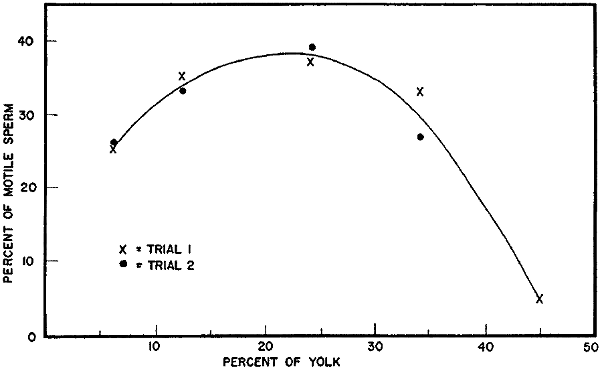
Percent of motile sperm after freezing and thawing semen in diluents containing various levels of egg
yolk (Fig. 2)
From the results of these experiments, and from several reports in the literature, [5], [6], [7], [9], [10] it appears that a diluting medium resulting in a final concentration of 16 to 25 percent yolk and 1.55 to 2.2 percent sodium citrate dihydrate is highly satisfactory for freezing.
Storing and freezing diluent. In some instances it would be advantageous to have prepared diluent on hand for use at any time. The suitability of stored diluent was tested with a yolk-citrate (equal parts yolk and citrate without antibiotics added) diluent prepared and stored at 5° C. for 0, 2, 5, 7, and 9 days. Seven semen samples were diluted and frozen in these diluents. No difference was noted in the survival of sperm that could be attributed to the age of the diluent.
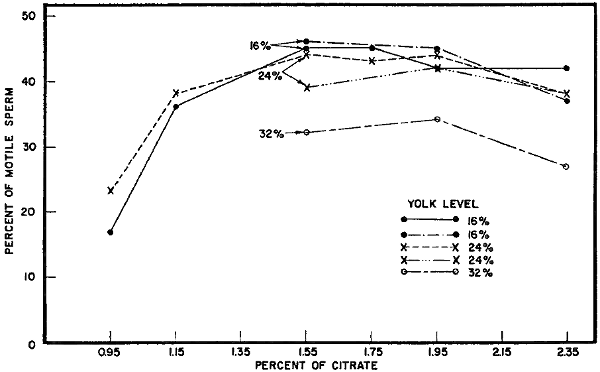
Percent of motile sperm after freezing and thawing semen in diluents containing various levels of egg
yolk and various percentages of sodium citrate (Fig. 3)
In another trial, a similar diluent (1:1 yolk to citrate with 1000 units of penicillin and 5000 units of streptomycin) was prepared and stored in the freezer compartment of a refrigerator at -15° C. Upon thawing, it was whitish in color and more viscous than freshly prepared diluent. Except for the fact that the viscosity seemed to reduce the rate of sperm motility, this frozen diluent stored for 65 days compared favorably with freshly prepared diluent for freezing semen.
Other diluents. Without the protective action of egg yolk or milk, few bull sperm will survive freezing. Several diluents were compared on a limited scale for freezing bull sperm. The results of these trials are compiled in Table 5. In this trial the yolk-citrate extender served best in maintaining sperm motility during freezing. Yolk-phosphate and homogenized whole milk were slightly less protective and yolk-saline seemed to furnish the least protection to sperm during freezing.
A number of investigations in other laboratories have now proven that milk can be used as effectively as the yolk-citrate diluent for freezing bull sperm.[6], [7]
Table 5.—Comparison of the Freezability of 4 Semen Samples in Different Extenders
Extender Dilution rate (semen: extender) Pre- freezing motility (percent) Post- thawing motility (percent) Survival (percent) Motility after storage[E] (percent)
Yolk-citrate 1:1 60 49 82 46
1:10 53 45 85 36
Yolk-saline 1:1 57 29 51 28
1:10 60 31 52 24
Yolk-phosphate 1:1 55 33 64 25
1:10 60 43 72 25
Whole milk 1:1 60 40 67 35
1:10 60 35 58 16