19th-Century Pieces
Reading edition
The collections of the United States National Museum that cover the political, cultural, military, and technological history of America in the 19th century are probably without rival, and the collection of presentation silver is no exception. The recognition of military prowess by the presentation of silver objects was especially popular during this century.
FOR SERVICE IN WAR OF 1812
Some handsome pieces of silver of the federal style were given for service in the War of 1812. Historically the most important of these is a mammoth punch set (fig. 4) presented to Colonel George Armistead by the citizens of Baltimore in recognition of his services in the defense of Fort McHenry against the British attack in 1814. The service includes an oval silver tray with a handle on each end, the whole of which is supported on six winged-claw feet. The tray is 29 inches long and 22 inches wide.
The ball-shaped punch bowl, 121⁄2 inches in diameter, is supported by four eagles mounted on a round base. There is a loop handle of silver rope on each side. The bowl is an exact copy in size and design of the mortar bombs the British hurled at the fort. On one side of the bowl is the following inscription:
Presented by a number of the citizens of Baltimore to Lieutenant Colonel George Armistead for his gallant and successful defense of Fort McHenry during the bombardment by a large British Force, on the 12th and 13th September 1814 when upwards of 1500 shells were thrown; 400 of which fell within the area of the Fort and some of them of the diameter of this vase.
(Note the discrepancy in the dates of the inscription. The Battle of Fort McHenry was fought on the 13th and 14th of September 1814.)
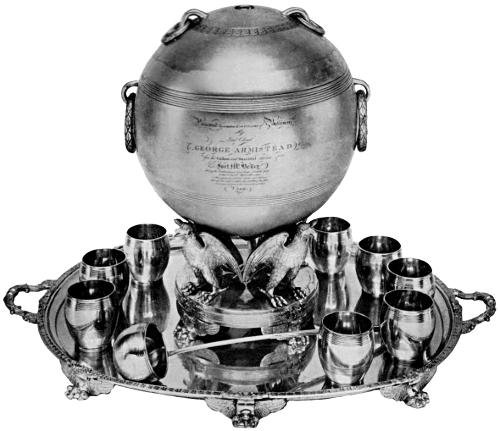
Figure 4.––Punch set presented to Col. George Armistead by the citizens of Baltimore in recognition of his services in the defense of Fort McHenry against the British in 1814. Gift of Alexander Gordon, Jr., great-grandson of the recipient. In Division of Political History. (Acc. 6642, cats. 30914-17; Smithsonian photo P-64357.)
On the other side is engraved a view of Fort McHenry and Baltimore Harbor. The bowl is marked by Thomas Fletcher and Sidney Gardiner, silversmiths who worked in Philadelphia from 1814 to 1838. In regard to the excellence of the work of these silversmiths, there is an interesting comment in a diary of Philip Hone that is owned by the New-York Historical Society. On February 14, 1838, Hone wrote:
Fletcher and Co. are the artist who made the Clinton vases. Nobody in this “world” of ours hereabouts can compete with them in their kind of work.[4]
In the set are ten silver cups, each 31⁄4 inches high and 3 inches in diameter. The cups have the same rounded shape as the bowl, without the loop handles, and are marked on the bottom by Andrew E. Warner, a silversmith who was working in Baltimore from 1805 until his death in 1870.
The ladle, in the same shape as the cups, is also marked by Warner.
During the defense of Fort McHenry Colonel Armistead had under him about 1,000 men, including soldiers, sailors, and volunteers. It is said he was the only man aware of the alarming fact that the powder magazine was not bombproof. During the night of September 13 the fort was under constant bombardment by the enemy, but the attack failed. Discouraged by the loss of the British general in land action, and finding that the shallow water and sunken ships prevented a close approach to the city by water, the British fleet withdrew. Fort McHenry was but little damaged and loss of life was small.
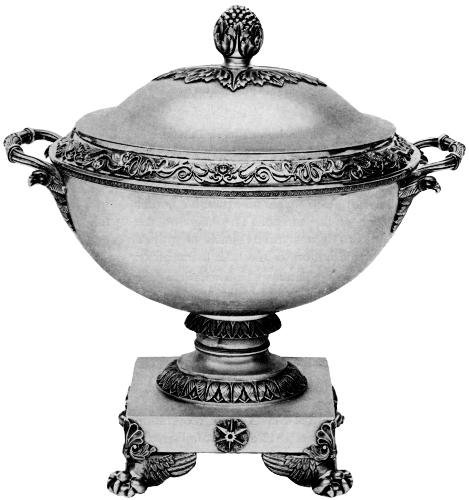
Figure 5.––Tureen presented to Com. John Rodgers by the citizens of Baltimore for his part in the defense of the city against the British in 1814. Bequest of Gen. M. C. Meigs. In Division of Political History. (Acc. 25386, cat. 5863; Smithsonian photo P-64357-A.)
Closely related to this punch set is a covered tureen (fig. 5) that the citizens of Baltimore gave to Commodore John Rodgers, U.S.N., for his part in the defense of Baltimore in September 1814. During the battle of North Point and the attack on Fort McHenry, the naval forces under Commodore Rodgers defended the water battery, the auxiliary forts Covington and Babcock, and the barges of the naval flotilla.
The oval-shaped tureen is mounted on a square base that stands on four winged feet. The piece is 15 inches high. The handles at each end are supported by eagles’ heads. An applied design of flying horses and winged cherub heads makes an attractive border around the edge of the tureen. The knob on the cover of the tureen is a stylized bunch of grapes. On the inside of the bottom of the base is inscribed:
Presented by the citizens of Baltimore to Commodore John Rodgers in testimony of their sense of the important aid afforded by him in the defense of Baltimore on the 12th and 13th of Sept’r, 1814.
This piece too bears the mark of Philadelphia silversmiths Fletcher and Gardiner.
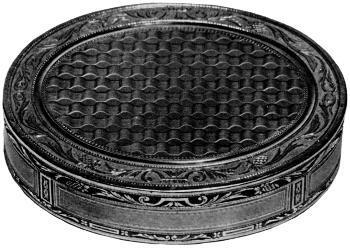
Figure 6.––Gold snuffbox presented to Maj. Gen. Jacob Brown by the City of New York in recognition of his services in the War of 1812. Gift of Mrs. Susan Brown Chase. In Division of Political History. (Acc. 116682, cat. 37664; Smithsonian photo 57009.)
The gold snuffbox presented to Major General Jacob Brown by the City of New York in recognition of his services in the War of 1812 does not fall strictly within the province of this article, but it is included because it is similar to the silver pieces just described. The exterior of the box (fig. 6) is beautifully chased in a line design. The inside of the lid is inscribed as follows:
The Corporation of the City of New York to Major General Jacob Brown in testimony of the high sense they entertain of his valor and skill in defeating the British forces superior in number, at the battles of Chippewa and Bridgewater on the 5th and 25th of July, 1814.
FOR PEACE AND FRIENDSHIP
Unusual in the Museum’s collection of presentation silver is the treaty pipe (fig. 7) formally presented to the Delaware Indians in 1814 by General William Henry Harrison at the conclusion of the second Treaty of Greenville.
The treaty was intended to commit the Indians to active resistance in the American cause during the War of 1812. General Harrison and Lewis Cass had been appointed commissioners by the U.S. Government to conclude the treaty. On July 8, 1814, General Harrison read to the Indians a message from the President of the United States, and afterward he presented to the Wyandotte, Delaware, and Shawnee Indian tribes large silver pipes elegantly ornamented and engraved with emblems signifying the protection and friendship of the United States.[5]
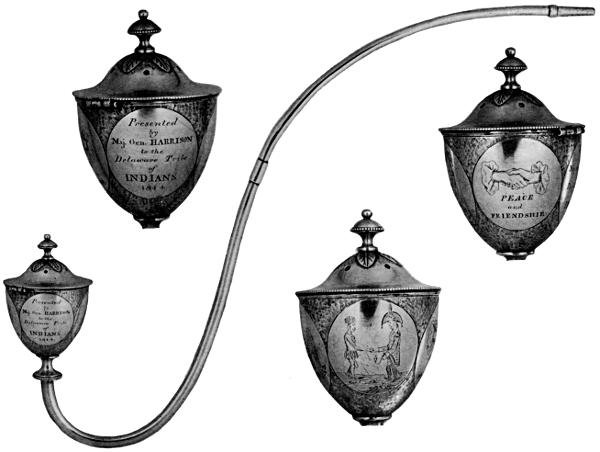
Figure 7.––Peace pipe presented to the Delaware Indians by Gen. William Henry Harrison in 1814. Bequest of Victor J. Evans. In Bureau of American Ethnology. (Acc. 113604, cat. 362061; Smithsonian photos 44571, 44571-A.)
The pipe presented to the Delaware Indians has an urn-shaped bowl with a bead-edged cover bearing acanthus-leaf decorations. The S-shaped stem is 21 inches long and only one-fourth inch in diameter. The great length of the stem was necessary to cool the smoke; the S-shape added rigidity to the silver. The piece undoubtedly is the work of a competent craftsman but it bears no identifying mark.[6]
Although not exactly a pipe of peace, another pipe in the collections of the Museum represents a gesture of friendship between nations. It is a meerschaum pipe[7] with a silver lid on the bowl and with a silver mouthpiece. The lid bears this inscription:
This pipe was presented to Sir Frederick Hankey by the Grand Vizier of Turkey at Constantinople in the year 1830 and to Thomas Hankey Esqre by the Daughter of Sir Frederick and by him to Charles Alexander Esqre 9th March, 1873.
The only information that has been obtained about Hankey is that he held an official position as Chief Secretary of Malta for the British Government.
FOR POLITICS
In 1838 the Whig Young Men of New York City presented to Robert Charles Wetmore a pair of large, ornate, silver pitchers[8] inscribed:
To Robert Charles Wetmore their late Chairman from the General Committee of Whig Young Men of the City of New York a Memorial of political fellowship, a token of personal esteem and a tribute of patriotic service 1838.
The bases of the pitchers are engraved:
Presented to Chas Fredk Wetmore by his father, January 1st, 1840.
These pitchers were made by Geradus Boyce, a New York silversmith who worked in the first half of the 19th century.
FOR SERVICE IN THE MEXICAN, CIVIL, AND INDIAN WARS
Most of these pieces, like the pitchers mentioned above, are not as pleasing aesthetically as the earlier ones, and they are much more closely allied with the exuberance of the Victorian era than they are with the classical lines of the Federal period.
A large, elaborate vase[9] with two handles and a cover was presented to Major General Silas Casey, U.S.A., in recognition of his services during the Mexican War. The vase is inscribed:
To Capt. Silas Casey, 2 inf. U.S.A. For his bravery and skill at Contreras, Churubusco and other battles of Mexico; for his gallant leading of the storming party of Regulars at Chapultepec where he was severely wounded. The gift of citizens of his native town and others, E. Greenwich, Rhode Island, August 1848.
The vase is marked on the bottom with box-enclosed letters “G & H” and “1848.” The letters probably refer to Gale and Hughes, New York silversmiths, or perhaps to Gale and Hayden, who were in business about the same time.
Casey, a graduate of the U.S. Military Academy, received votes of thanks from the Rhode Island legislature for his services in both the Mexican and Civil Wars.
Lieutenant Colonel John Bankhead Magruder was given a silver pitcher by his friends in Baltimore for his Mexican War service. The pitcher[10] is urn-shaped, has a long, narrow neck, and stands on a tall base. The entire pitcher is elaborate repoussé in a design of roses, sunflowers, and grapes. An arched and turreted castle is depicted on each side, and on the center front is the inscription:
Presented to Lt. Col. J. Bankhead Magruder by his Baltimore friends as a token of their appreciation of his Meritorious Services in the Mexican War, October 16, 1849.
On the inside of the base are the marks “S. Kirk & Son” and “11 oz.”
Magruder graduated from the U.S. Military Academy in 1830, and his military career encompassed service under three flags within a period of 35 years. In the Mexican War he was brevetted major for gallantry at Cerro Gordo and lieutenant colonel for Chapultepec, where he was severely wounded. At the outbreak of the Civil War, Colonel Magruder, a native of Virginia, entered the Confederate Army and was soon placed in command of the Department of Texas, where he served until the close of the war. He then entered the army of Maximilian in Mexico as major general and was in active service until Maximilian’s capture and execution. When he returned to the United States he settled in Houston and died there in 1871.
A silver service (fig. 8) consisting of four goblets, pitcher, and tray, presented to Brevet Major General John Porter Hatch, U.S. Volunteers, is interesting because it was given in recognition of services during the Mexican War, the Indian expeditions of 1857-1859, and the Civil War. The gift is from Hatch’s fellow citizens of Oswego, New York.
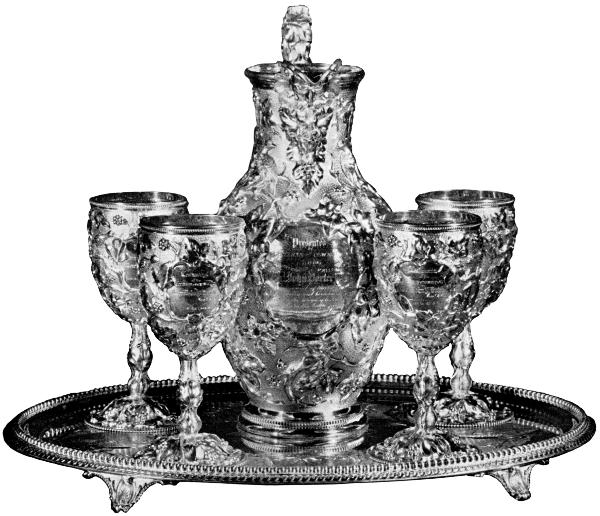
Figure 8.––Silver service given to Maj. Gen. John Hatch by the citizens of Oswego, New York. Gift of Mark Burckle Hatch. In Division of Political History. (Acc. 59476, cats. 16024-16026; Smithsonian photo 38259.)
The silver tray measures 15 by 20 inches and is decorated with four small waterscapes and a flower design. It is raised on four short scroll feet. The inscription reads:
Genl. John Porter Hatch Presented by Citizens of Oswego, Jany 1863
The pitcher (14 inches high and 7 inches in diameter) has a design of grapevines and birds. The spout is in the form of a face, and the handle represents entwined vines. It is inscribed:
Presented by citizens of Oswego, N.Y. to their esteemed fellow citizen Genl. John Porter Hatch as a testimonial of their appreciation of the gallantry and heroism displayed by him in the service of his country especially on the battle fields of Mexico and in the Army of the Potomac Jany 1863.
The mark is “Tiffany & Co., 7899, G. & W., English Sterling 925-1000, 550 Broadway N.Y.”
The four silver goblets are also decorated with grape vines and birds, and they have gilt interiors. They are 8 inches high and 31⁄4 inches in diameter. Each goblet has the inscription:
Testimonial of the Citizens of Oswego, N.Y. to Genl. John P. Hatch, Jan. 1863.
Below this inscription each goblet is marked with one of the following:
Mexico 1846-7 New Mexico 1857-8-9 Shenandoah Valley, May 25, 1862 South Mountain, Sep. 14, 1862
Each goblet is marked “Tiffany & Co.”
Hatch graduated from the Academy in 1845 and immediately saw active service in the Mexican War. He fought not only in General Taylor’s campaign in northern Mexico but also in General Scott’s campaign to capture Mexico City. In the years intervening before the Civil War he saw active service in Indian campaigns and took part in a number of scouting expeditions. With the outbreak of the Civil War he was assigned with the Volunteers in the Army of the Potomac until he was severely wounded at South Mountain, for which action he received the Congressional Medal of Honor. He spent the rest of the Civil War on duty behind the lines where he was in command of various districts in the Department of the South following Sherman’s campaign.
The largest and most elaborate set of presentation silver in the Museum is a complete table service (fig. 9) that was given to General Judson Kilpatrick by the Veterans Association of Connecticut on the occasion of his marriage to a Chilean in 1868 while he was serving as U.S. Minister to Chile. The set is engraved with emblems of the United States, Chile, the U.S. Army, and the U.S. Navy. The monograms on the individual pieces are in gold of four colors. More than any other silver service in the Museum this one may be said to epitomize the elaborate realism so popular during the height of the Victorian era.
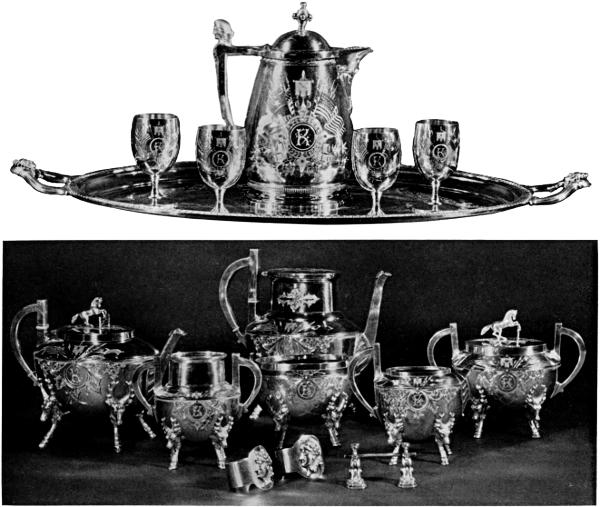
Figure 9.––Silver service presented to Gen. Judson Kilpatrick by the Veterans Association of Connecticut. Loan of the estate of Mrs. Luisa V. Kilpatrick. In Division of Political History. (Acc. 57292, cats. 15145-15167; Smithsonian photo 28067.)
The pieces are marked “Meriden B * Company *” in a circle around a shield surmounted by balanced scales. This mark was used in the second half of the 19th century by the Meriden Britannia Company for its high-grade, silver-plated hollow-ware made on a base of silver nickel.[11]
There are two trays in the set. The smaller tray is shown in figure 9. The larger one measures 221⁄2 inches by 38 inches and is inscribed:
The Veteran Soldiers of Connecticut to Kilpatrick
It is engraved in gold and silver with flags of the United States and Chile crossed with bayonets and spears. On one side there is a center medallion in gold with the monogram “L V K” (for Luisa V. Kilpatrick) in a circle surmounted on a shield of stars and stripes. Above the monogram there is a banner with three stars and a triangle. On the other side of the standing piece two eagles in fighting position are shown in front of a sunburst design. The United States flag can be seen directly behind the victorious eagle. The motto “Tuebor” is at the top of the sunburst. The entire design is encircled by a ring of stars, and there is a shield of stars and stripes at the top. This same design is repeated on all 40 pieces.
The service contains napkin rings, vegetable dishes, syrup jar, spoon holder, large centerpiece, porcelain-lined pitcher, and other miscellaneous pieces of silver used for table service. The pieces of the tea and coffee service are mounted on four feet that are fastened to the bowl with cattle heads with branched horns. Each foot stands on a cloven hoof. The knob of each of the pots is a tiny horse jumping over a four-bar hurdle.
One of the most interesting military presentation pieces in the collection is a silver and copper shield presented to Lieutenant General Nelson A. Miles, U.S. Army, by the officers of the 5th Infantry Regiment. General Miles served for many years as colonel of the regiment and led it in a number of notable Indian engagements. Beginning in 1869 his regiment defeated the Cheyenne, Kiowa, Comanche, Sioux, Nez Percé, and Bannock Indians, and, in 1886, after a long and difficult campaign, Miles compelled the surrender of the Apaches under Geronimo and Natchez.
The heart-shaped shield[12] is surrounded by a rolled edge made of copper which originally had a gold wash. Inscribed on the inside of the rolled edge are the names “New Mexico,” “Kansas,” “Wyoming,” “Montana,” “Dakota,” “Colorado,” “Indian Territory,” and “Texas.” A profile portrait of General Miles, in relief, is suspended from an eagle’s beak in the center, and below are the crossed weapons of the U.S. Army and the Indians surmounted by a peace pipe.
The background of the shield is silver with etched scenes depicting incidents of the career of General Miles in the states named. The scenes depicted are of a buffalo hunt, a covered wagon on the trail, wild horses with Indian tepees in the background, an Army council of war, General Miles receiving the surrender of Chief Joseph of the Nez Percé Indians, and a peaceful agricultural scene.
The plaque is inscribed as follows:
Presented to General Nelson A. Miles, U.S. Army, by the officers of the fifth U.S. Infantry. As a token of personal esteem and their estimate of his distinguished services in which unequaled successes over savages in war were paralleled by humanity and justice towards the thousands of Indians whom he took captive and instructed in the Arts of Civilization.
The plaque, measuring 181⁄2 by 23 inches overall, is marked “Tiffany & Co., 6565. Makers 2, Sterling Silver, 926-1000 and Other Metals, M.”
General Miles was colonel of the 5th Infantry Regiment for so many years that a modification of his family crest was selected as the crest on the coat of arms of the regiment. The Miles family crest is an arm in armor grasping an anchor. Arrows for each Indian campaign in which the regiment took part are substituted for the anchor in the regimental crest.[13]
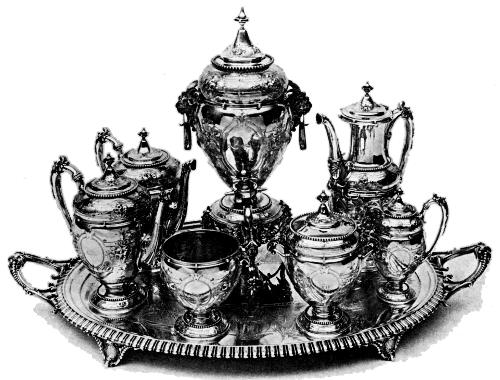
Figure 10.––Silver service presented to Mrs. Abraham Lincoln when she was First Lady. Gift of Mr. Lincoln Isham. In Division of Political History. (Acc. 216335.6-.13; Smithsonian photo 44851-B.)
TO MARY TODD LINCOLN
The Museum recently received a silver service (fig. 10) that belonged to Mary Todd Lincoln. The service consists of a large oval tray, a hot-water urn on a stand with a burner, coffeepot, teapot, hot-water pot, cream pitcher, sugar urn, and waste bowl. All the pieces have an overall repoussé floral and strapwork pattern with the monogram “MTL” on one side and an engraved crest on the other. The crest seems to be an adaptation of the Todd family crest. The pieces are marked with a lion, an anchor, and an old English “G,” which are the early marks of the Gorham Silver Company. It is assumed that this silver service was a presentation gift to Mrs. Lincoln during the time she was First Lady of the White House, as a letter dated July 19, 1876, from her to her son Robert Todd Lincoln calls his attention to a silver service in his possession that was a gift to her from “the Citizens of New York.”
FOR ENGINEERING
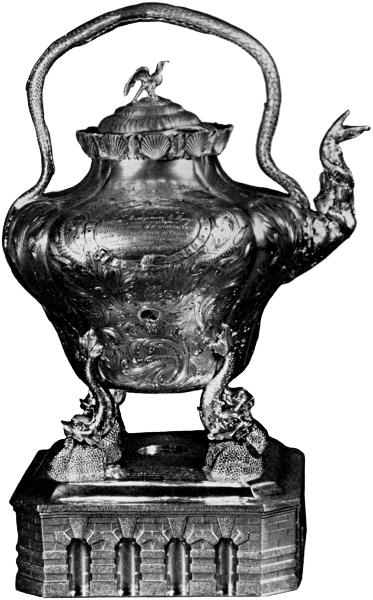
Figure 11.––Teakettle and stand given to Gen. Montgomery C. Meigs in 1853 by the citizens of Washington for his work on the Washington Aqueduct. Gift of Gen. M. C. Meigs. In Division of Political History. (Acc. 25386, cat. 5864; Smithsonian photo 57008.)
By far the most fanciful of all the mid-19th-century pieces is the silver teakettle and stand (fig. 11) given to General Montgomery C. Meigs by the citizens of Washington for his work on the Washington Aqueduct. The kettle, 18 inches high, is mounted on a base that is 81⁄2 inches square and 31⁄4 inches high. The base is made in the shape of the stone arches of the aqueduct, and the head of George Washington, in profile, is depicted on the center front. There is a depression in the top of the base for holding a small alcohol lamp. Four rocks, one on each corner of the base, provide support for the kettle. The kettle’s feet, in the form of fish, rest on the rocks and are fastened to them with hinges held by a chain and silver pin. The pins can be released so that the kettle can be tilted for pouring without moving it from the base. By withdrawing all four pins, the kettle can be completely detached from the base. The body of the kettle is decorated with nautical designs––waves, fish, shells, etc.––and cattails and lily pads. Under the spout is an anchor entwined with a fish over the initial “M.” A belt ornamented with stars encloses the castellated towers of the Army Engineers symbol with the letters “U,” “S,” and “E” on one side of the kettle. On the other side is the inscription:
Presented to Captain Montgomery C. Meigs U.S. Engineers by the Corporation of Washington with a Resolution of Thanks approved 12th March 1853 for his Report on the Washington Aqueduct.
The handle of the kettle is in the form of a serpent’s tail, and the spout is the serpent’s open mouth. The lid is a nautilus shell on which stands an eagle with raised wings. On one side of the base is inscribed:
Presented 9th June 1854 by John W. Maury––Mayor, Joseph Borrows of Bd Ald., A. W. Miller of Bd Com. C. Committee of the Corporation.
The piece is marked “M. W. Galt & Bro.,” a firm established in Washington in 1802 that has been in continuous business since that time.
Montgomery Cunningham Meigs graduated from the U.S. Military Academy in 1836 and was soon assigned to the Engineer Corps. Thereafter, for a quarter of a century his outstanding talents were devoted to many important engineering projects. His favorite was the construction of the Washington Aqueduct, which carried a large part of Washington’s water supply from the Great Falls of the Potomac to the city. This work, under his direction between 1852 and 1860, involved devising ingenious methods of controlling the flow and distribution of the water and also the design of a monumental bridge across the Cabin John Branch––a bridge that for 50 years was the longest masonry arch in the world. At the same time Meigs was supervising the building of wings and a new dome on the Capitol and an extension on the General Post Office Building.
During the Civil War, Meigs served as quartermaster general, and in 1864 he was brevetted major general. As quartermaster general he supervised plans for the War Department Building, 1866-1867; the National Museum Building, 1876; and an extension of the Washington Aqueduct, 1876.
After his retirement, in 1882, General Meigs became architect of the Pension Office Building. He served as a regent of the Smithsonian Institution, was a member of the American Philosophical Society, and one of the earliest members of the National Academy of Sciences.
General Meigs himself gave the Museum this interesting piece of presentation silver. He also gave the previously described tureen (fig. 5) that had belonged to Commodore John Rodgers, who was General Meigs’ father-in-law.
Cyrus W. Field became interested in the idea of a cable across the Atlantic between Newfoundland and Ireland in 1854. It was not a new idea, and other shorter submarine cables had been successful, but this was the first time a transatlantic cable had been promoted by a man of Field’s business ability and financial standing. Through his efforts, a governmental charter was secured and a company of prominent New Yorkers was formed to underwrite the venture. An unsuccessful attempt to lay the cable was made by the company in 1857. Field tried again in 1858; on the fourth attempt he was successful and immediately acclaimed as the “genius of the age.”
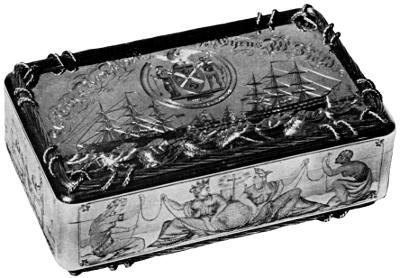
Figure 12.––Gold box presented to Cyrus W. Field by the City of New York. Loan of Metropolitan Museum of Art. In Division of Political History. (Acc. 64761, cat. 26209; Smithsonian photo 57010.)
New York greeted Field with wild rejoicing, and the city authorities set September 1, 1858, as a day of celebration to give him an official public ovation. The celebration surpassed anything the city had ever before witnessed. Mr. Field and the officers of the cable fleet landed at Castle Garden and received a national salute. From there the procession progressed through crowded and gaily decorated streets to the crowd-filled Crystal Palace, where an address was given on the history of the cable. Then the mayor of New York gave an address honoring Mr. Field and presented him with a gold box stating:
The municipal government of this city instructs me to present to you a gold box with the arms of the city engraved thereon, in testimony of the fact that to you mainly, under Divine Providence, the world is indebted for the successful execution of the grandest enterprise of our day and generation; and in behalf of the Mayor, Aldermen and Commonalty of the City of New York I now request your acceptance of this token of their approbation.
The gold box (fig. 12) presented to Field by the City of New York is in the collections of the United States National Museum.[14] It measures 41⁄2 inches by 3 inches. On the lid and around an engraved representation of the cable fleet is inscribed:
The City of New York to Cyrus W. Field
The sides of the box are engraved with vignettes depicting the landing of the cable, the planning group at work, science and industry united, and Europe and America united. The bottom is engraved with the American eagle and the British shield. The inside lid of the box is inscribed:
The City of New York to Cyrus W. Field commemorating his skill, fortitude and perseverance in originating and completing the first enterprise for an ocean telegraph successfully accomplished Aug. 5, 1858 uniting Europe and America.
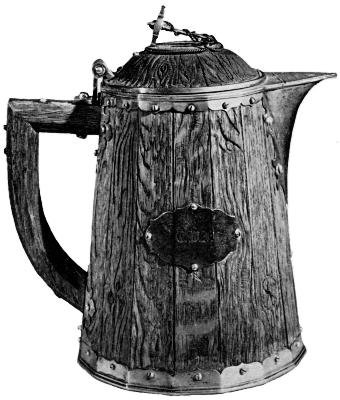
Figure 13.––Silver-mounted tankard presented to Cyrus W. Field by the workmen of Central Park, New York City. Loan of Metropolitan Museum of Art. In Division of Political History. (Acc. 64761, cat. 26209; Smithsonian photo 45992-H.)
Significant of the enthusiasm with which Field was greeted in 1858 is a silver-mounted tankard, made from the wood of the Charter Oak, that was given to him in December by the workmen of Central Park. On August 18, seemingly without advance publicity or elaborate preparations, there was a parade on Broadway of the workmen of Central Park. The procession was headed by a squad of policemen in full uniform, a band, and a standard bearer with a muslin banner inscribed “The Central Park People.” The men marched in squads of four, and wore their everyday work clothes with evergreens stuck in their hats. Each squad carried a banner giving the name of its boss-workman. The procession included four-horse teams drawing wagons in which rode the workmen of the Engineers’ Department. The parade was composed of 1,100 laborers and 800 carts from Central Park and 700 laborers and carts from the new Croton Reservoir, making a procession three miles long. Since it was altogether unexpected, it created no little excitement and inquiry.[15]
The tankard (fig. 13) has a silver spout inscribed:
The Oak of this Tankard is a part of the tree in which was preserved the Charter of the Liberties of the People of Connecticut during a temporary success of tyranny A.D. 1687.
There is a silver shield on the left side with the monogram “C. W. F.” and a silver shield on the right inscribed:
The men, working in the Central Park Augst 17th 1858 Present this tankard to Cyrus W. Field, as an expression of their respect, for the untiring labor which on that Day resulted in proving the practicability of Trans-Atlantic Communication, by the Electric Telegraph.
The knob on the lid is made of silver and is decorated with an anchor and a rope in silver. No maker’s mark is discernible.
While the public adulation was at its peak the cable suddenly stopped working. Immediately public opinion changed and Field was accused of being a fake. He suffered severe business reverses and in 1860 went into bankruptcy. The outbreak of the Civil War prevented any further activity on the cable until 1865. Field engaged the world’s largest steamer, the Great Eastern, to make the next attempt. The cable of 1865 parted in midocean during the laying operations, but in 1866 experience and technical improvements won the fight. The cable was laid and this time it continued to operate.
Again Field was the darling of the American people and he was greeted with enthusiasm. Immediately on his return to New York in 1866 he sold enough of his cable stock to enable him early in November to write to those who had been hurt by his bankruptcy in 1860 and send to each the full amount of his indebtedness with 7 percent interest. The full amount paid out reached about $200,000. For this action George Peabody of New York City gave Field a silver service.
The silver cake basket[16] from this service is in the United States National Museum. The shallow basket is on a pedestal with handles on each side. The inside of the basket is gilded. Inscribed on a plaque on one side is:
George Peabody to Cyrus W. Field in testimony and commemoration of an act of very high Commercial integrity and honor, New York, 24 Nov. 1866.
The inside of the foot of the basket is marked with the lion, anchor, and “G” of the Gorham Silver Company.
Field continued to be active in many business enterprises but the last years of his life were again beset with severe financial difficulties. He and his wife celebrated their golden wedding anniversary in 1890, and in honor of this occasion their children presented them with a silver gilt vase.[17] The vase contains a portion of the first Atlantic cable mounted in the base, a part of the steamship Great Eastern, by which the cable was laid, and the inscribed names of all the Field’s children and grandchildren. It is marked “Tiffany & Co. Sterling Silver, M.”
FOR DIPLOMACY AND LEGISLATION
In January 1861, Dr. Samuel Lilly, physician, politician, and judge, was sent to British India as consul general from the United States. Dr. Lilly had been elected a representative to the 33d Congress as a Whig, and he served from 1853 to 1855. He also served as a judge of various lower courts in New Jersey. On his appointment as consul general he was given a silver goblet[18] 8 inches tall and 41⁄4 inches in diameter, having an embossed design of fruits, nuts, and flowers. On the goblet is inscribed:
A Testimonial of Respect and Esteem Presented to Hon. Samuel Lilly by a few of his Fellow Citizens without distinction of Party; on the eve of his departure for Calcutta as Consul-General to British India January 29, 1861.
The inside of the stem is marked with the lion, anchor, and “G” of the Gorham Silver Company, the word “coin,” and the figure “8.”
When Dr. Lilly left India in 1862 he was given a silver pitcher and a silver tray.[19] The pitcher (13 inches high and 71⁄2 inches in diameter) has a tall, slender neck with a decided downturn to the pouring lip and a hinged lid with a thistle flower as a knob. The neck is engraved on each side with a design of grape leaves and grapes. The bowl of the pitcher has eight panels embossed with scrolls of vines and flowers. Both the tray and the pitcher are marked “Allen and Hayes.” One side is engraved:
To the Hon. Samuel Lilly, M.D.
The other side is engraved:
By the American Merchants in Calcutta July 1862.
The silver tray (18 inches in diameter) has a scroll-leaf and flower design in relief around the edge. The scroll-leaf design is repeated on the surface. The tray is inscribed as follows:
Presented to the Hon. Samuel Lilly M.D. by the American Merchants Resident in Calcutta as a token of regard and acknowledgment of the creditable manner with which he has upheld the dignity of the office and executed the duties appertaining to the post of Consul-General of the United States of America in British India, Calcutta, July 4th, 1862.
American interest in European affairs, considerably increased by the middle of the century, is also reflected in the collection. In 1866 the life of the Czar of Russia was saved from a Nihilist’s bullet by the brave action of one of the serfs who had recently been emancipated by royal decree. Czar Alexander II was well liked by his own people and was regarded as an enlightened ruler by the other nations of the West. He was especially respected in the United States because of the open support he gave to the Union side during the Civil War. His escape from death was a cause for official rejoicing in this country, and the Congress of the United States passed a resolution of congratulations on the deliverance of the life of the Czar and commissioned Gustavus Vasa Fox, Assistant Secretary of the Navy, to deliver it to the Czar. Fox set out for Europe in one of the newly designed Monitor ships that had proved so effective in naval fighting during the Civil War. His Monitor was escorted by other ships of the fleet with a large delegation of naval officers. The party was greeted by the Russians with great acclaim, and it was showered with gifts and honors. Many of the interesting items given to Fox personally were bequeathed to the United States National Museum by his widow, Mrs. V. L. W. Fox (accession 50021, Division of Political History). Among these objects are a silver tray (fig. 14), a silver saltcellar in the shape of a chair (fig. 14), and a gold snuffbox.
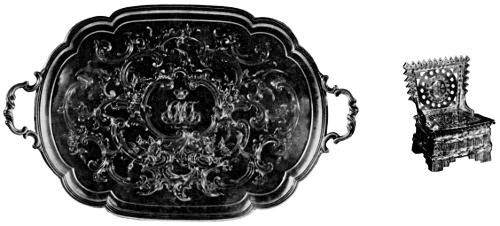
Figure 14.––Tray and saltcellar in shape of chair that were among items presented to Gustavus Vasa Fox on his visit to Russia in 1866. The tray measures 24 × 15 × 11⁄2 inches, and the saltcellar is 35⁄8 inches high, 49⁄10 inches long, and 23⁄4 inches wide. They were made by Sazkoff, St. Petersburg, 1863. Bequest of Mrs. V. L. W. Fox. In Division of Political History. (Acc. 50021, cats. 11267, 11263; Smithsonian photos 45602-A, 45602-H.)
The tray and saltcellar were presented to Fox on the estate of Prince Galitzine, one of the wealthiest members of the Russian nobility. These two items bear the marks of a Russian maker and are engraved “July 5, 1864,” which date marked the coming-of-age of the Prince. On August 26, shortly after the American delegation arrived in Russia, Fox and his party drove to the beautiful Galitzine estate, about 12 miles from Moscow. The members of the party were met by the Prince and went with him to a part of the park where a deputation of peasants awaited them. Leader of the peasant group was the mayor of the neighboring village, an emancipated serf, who presented Fox with bread and salt––traditional symbols of Russian hospitality––on a silver salver and said:
We wish to tell the envoy that we are come to congratulate him on his arrival, and to present him with bread and salt and also to say that we love him, and that we shall remember the love of his people for our country and our sovereign.[20]
Two days later, on August 28, Fox met Prince Gortchakoff by appointment at the foreign office. After various complimentary allusions to the manner in which Mr. Fox had performed the delicate duties entrusted to him by his government, the Prince, in the name of the Emperor, presented a gold snuffbox set with diamonds.[21] The box, exquisitely chased, had the Emperor’s miniature on the top surrounded by 26 diamonds. Six larger diamonds were set three on each side at equal distances from the inner circle. The Emperor was pictured in full military uniform with various orders on his breast.[22] The snuffbox minus its decorations is part of the Gustavus Vasa Fox collection in the Museum. The precious stones on the lid and the miniature in the center were bequeathed by Mrs. Fox to various members of the family when the box (cat. 11268) was willed to the Museum.
A large and elaborate silver vase was presented by the members of the U.S. Life-Saving Service to Mrs. Samuel S. Cox in honor of the outstanding work of her husband, who as a congressman supported various bills for the improvement of the Service. Mr. Cox served as Congressman for 20 years, first from Ohio and later from New York State. He died in New York City in 1889. Two years later General Superintendent S. I. Kimball, in behalf of a committee representing the Service, presented the vase to Mrs. Cox. The ceremony took place at Mrs. Cox’s home in Washington on December 12, 1891, in the presence of a gathering of relatives and friends.
The vase[23] is 2 feet tall and 2 feet 1 inch in diameter; it weighs almost 8 pounds. Its design was selected by a subcommittee appointed by the Life-Saving Service, and the job was awarded to the Gorham Silver Company. The chasing is entirely the work of one man. The base of the vase has a design of clusters of acorns and oak leaves, and above these are dolphins sporting in billowing waves. The body of the vase begins with wide flutings between the tops of which are shells and seaweed. These are surrounded by a ring of marine cable. On the front, a scene represents the lifesavers at work. In perspective some distance out, where the sea rises in mountainous waves, there is a wrecked vessel, and in the foreground lifesavers are carrying the rescued to the beach. The ornamentation that covers the top of the body of the vase consists of a cable net in which are starfish, seaweed, and other marine flora and fauna. A ledge formed by a ship’s chain surmounts the net, and above this is a profile of Mr. Cox circled with laurel. A lifebuoy crossed with a boat hook and oar ornaments the other side. Handles at the sides are two mermaids who with bowed heads and curved bodies hold in their upraised hands sea plants growing from the side of the top of the vase. The mermaids are the only portion of the ornamentation that was cast.
The vase is inscribed as follows:
This Memorial Vase is presented to Mrs. Samuel S. Cox by the members of The Life-Saving Service of the United States in Grateful Remembrance of the tireless and successful efforts of her Distinguished husband The Honorable Samuel Sullivan Cox to promote the interests and advance the efficiency and glory of the Life-Saving Service.
He was its early and constant friend; Its earnest and eloquent advocate; Its fearless and faithful Champion.
I have spent the best part of my life in the public service; most of it has been like writing in water. The reminiscences of party wrangling and political strife seem to me like nebulae of the past, without form and almost void. But what little I have accomplished in connection with this Life-Saving Service is compensation “sweeter than the honey in the honeycomb.” It is its own exceeding great reward.[24]
Tangible evidence of the increased role that the United States was beginning to play in international affairs is a silver pitcher and salver[25] presented to Judge George S. Batcheller in appreciation of his services as president of the International Postal Congress, which was held in Washington, D.C., in 1897. Judge Batcheller’s international career began when President Ulysses Grant appointed him as the U.S. judge in the newly created International Tribunal for legal administration of Egypt. The Tribunal had jurisdiction in cases between foreigners of different nationalities and also in cases of foreigners versus Egyptians. Batcheller later served as minister to Portugal and then as manager of European interests for various American companies.
The International Postal Congress presented Judge Batcheller, its presiding officer, with a handsome urn-shaped pitcher with the following inscription engraved on the center front:
Le Congrès postal de Washington à son Président le Général George S. Batcheller Juin 1897.
The pitcher, 141⁄4 inches high, is marked inside the base “Galt & Bros., Sterling, 925––0––1879, 277, 71⁄2 pts.” The “925” is circled, and the date is boxed. Accompanying the pitcher is a silver tray with the monogram “G S B” in script in the center. The tray is marked on the back with an eagle in a circle to the left, an “A” in a shield in the center, and a hammer and sickle in a circle to the right (an unidentified mark).