Front matter (continued 4)
Reading edition
More likely he was simply proceeding along what must always have been his basic assumption: The truth is wasted on the people.
Zorchi said with heavy irony, "If my guest is quite finished with the instrument, perhaps he will be gracious enough to permit me to resume Aïda."
I woke Rena and told her about the evacuation. She said, yawning, "But of course, Tom. What else could they do?" And she began discussing breakfast.
I went with her, but not to eat; in the dining hall was a small television set, and on it I could listen to the same repeat broadcasts over and over to my heart's content. It was—in a way—a thrilling sight. It is always impressive to see a giant machine in operation, and there was no machine bigger than the Company.
The idea of suspending a whole world, even piecemeal, was staggering. But if there had been panic at first in the offices of the Company, none of it showed. The announcers were harried and there was bustle and strain, but order presided.
Those long lines of vehicles outside the window; they were going somewhere; they were each one, I could see by the medallion slung across each radiator front, on the payroll of the Company.
Perhaps the trick of pretending to each section that only it would be affected was wise—I don't know. It was working, and I suppose that is the touchstone of wisdom. Naples knew that something was going on in Rome, of course, but was doubtful about the Milanese Republic. The Romans were in no doubt at all about Milan, but weren't sure about the Duchy of Monaco, down the Riviera shore. And the man on the street, if he gave it a thought at all, must have been sure that such faraway places as America and China were escaping entirely.
I suppose it was clever—there was no apparent panic. The trick took away the psychological horror of world catastrophe and replaced it with only a local terror, no different in kind than an earthquake or a flood. And there was always the sack of gold at the end of every catastrophe: Blue Bolt would pay for damage, with a free and uncounting hand.
Except that this time, of course, Blue Bolt would not, could not, pay at all.
By noon, Benedetto was out of bed.
He shouldn't have been, but he was conscious and we could not make him stay put—short of chains.
He watched the television and then listened as Rena and I brought him up to date. Like me, he was shocked and then encouraged to find that Millen Carmody was in the vaults—encouraged because it was at least a handle for us to grasp the problem with; if we could get at Carmody, perhaps we could break Defoe's usurped power. Without him, Defoe would simply use the years while the world slept to forge a permanent dictatorship.
We got the old man to lie down, and left him. But not for long. Within the hour he came tottering to where we were sitting, staring at the television. He waved aside Rena's quick protest.
"There is no time for rest, my daughter," he said. "Do not scold me. I have a task."
Rena said worriedly, "Dear, you must stay in bed. The doctor said—"
"The doctor," Benedetto said formally, "is a fool. Shall I allow us to die here? Am I an ancient idiot, or am I Benedetto dell'Angela who with Slovetski led twenty thousand men?"
Rena said, "Please! You're sick!"
"Enough." Benedetto wavered, but stood erect. "I have telephoned. I have learned a great deal. The movement—" he leaned against the wall for support—"was not planned by fools. We knew there might be bad days; we do not collapse because a few of us are put out of service by the Company. I have certain emergency numbers to call; I call them. And I find—" he paused dramatically—"that there is news. Slovetski has escaped!"
I said, "That's impossible! Defoe wouldn't let him go!"
"Perhaps Slovetski did not consult him," Benedetto said with dignity. "At any rate, he is free and not far from here. And he is the answer we have sought, you understand."
"How?" I demanded. "What can he do that we can't?"
Benedetto smiled indulgently, though the smile was strained. His wound must have been giving him hell; it had had just enough time to stiffen up. He said, "Leave that to Slovetski, Thomas. It is his métier, not yours. I shall go to him now."
Well, I did what I could; but Benedetto was an iron-necked old man. I forbade him to leave and he laughed at me. I begged him to stay and he thanked me—and refused. Finally I abandoned him to Rena and Zorchi.
Zorchi gave up almost at once. "A majestic man!" he said admiringly, as he rolled into the room where I was waiting, on his little power cart. "One cannot reason with him."
And Rena, in time, gave up, too. But not easily. She was weeping when she rejoined me.
She had been unable even to get him to let her join him, or to consider taking someone else with him; he said it was his job alone. She didn't even know where he was going. He had said it was not permissible, in so critical a situation, for him to tell where Slovetski was.
Zorchi coughed. "As to that," he said, "I have already taken the liberty of instructing one of my associates to be ready. If the Signore has gone to meet Slovetski, my man is following him...."
So we waited, while the television announcers grew more and more grim-lipped and imperative.
I listened with only half my mind. Part of my thoughts were with Benedetto, who should have been in a hospital instead of wandering around on some dangerous mission. And partly I was still filled with the spectacle that was unfolding before us.
It was not merely a matter of preserving human lives. It was almost as important to provide the newly awakened men and women, fifty years from now, with food to eat and the homes and tools and other things that would be needed.
Factories and transportation gear—according to the telecasts—were being shut down and sealed to stand up under the time that would pass—"weeks," according to the telecast, but who needed to seal a tool in oil for a few weeks? Instructions were coming hourly over the air on what should be protected in each home, and how it was to be done. Probably even fifty years would not seriously damage most of the world's equipment—if the plans we heard on the air could be efficiently carried out.
But the farms were another matter. The preserving of seeds was routine, but I couldn't help wondering what these flat Italian fields would look like in fifty untended years. Would the radiocobalt sterilize even the weeds? I didn't think so, but I didn't know. If not, would the Italian peninsula once again find itself covered with the dense forests that Caesar had marched through, where Spartacus and his runaway slaves had lurked and struck out against the Senators?
And how many millions would die while the forests were being cleared off the face of the Earth again to make way for grain? Synthetic foods and food from the sea might solve that—the Company could find a way. But what about the mines—three, four and five thousand feet down—when the pumps were shut off and the underground water seeped in? What about the rails that the trains rode on? You could cosmoline the engines, perhaps, but how could you protect a million miles of track from the rains of fifty years?
So I sat there, watching the television and waiting. Rena was too nervous to stay in one place. Zorchi had mysterious occupations of his own. I sat and stared at the cathode screen.
Until the door opened behind me, and I turned to look.
Rena was standing there. Her face was an ivory mask. She clutched the door as her father had a few hours before; I think she looked weaker and sicker than he.
I said, for the first time, "Darling!" She stood silent, staring at me. I asked apprehensively, "What is it?"
The pale lips opened, but it was a moment before she could frame the words. Then her voice was hard to hear. "My father," she said. "He reached the place where he was meeting Slovetski, but the expediters were there before him. They shot him down in the street. And they are on their way here."
XVI
It was quick and brutal. Somehow Benedetto had been betrayed; the expediters had known where he had come from. And that was the end of that.
They came swarming down on us in waves, at least a hundred of them, to capture a man, a girl and a cripple—Zorchi's servants had deserted us, melting into the hemp fields like roaches into a garbage dump. Zorchi had a little gun, a Beretta; he fired it once and wounded a man.
The rest was short and unpleasant.
They bound us and gagged us and flew us, trussed like game for the spit, to the clinic. I caught a glimpse of milling mobs outside the long, low walls as we came down. Then all I could see was the roof of the copter garage.
We were brought to a tiny room where Defoe sat at a desk. The Underwriter was smiling. "Hello, Thomas," he said, his eyes studying the bruise on my cheek. He turned toward Rena consideringly. "So this is your choice, eh, Thomas?" He studied Rena coolly. "Hardly my type. Still, by sticking with me, you could have had a harem."
Bound as I was, I started forward. Something hit me in the back at my first step, driving a hot rush of agony up from my kidneys. Defoe watched me catch my breath without a change of expression.
"My men are quite alert, Thomas. Please do not try that again. Once is amusing, but twice would annoy me." He sighed. "I seem to have been wrong about you, Thomas. Perhaps because I needed someone's help, I overestimated you. I thought long ago that beneath your conditioning you had brains. Manning is a machine, good for taking orders. Dr. Lawton is loyal, but not intelligent. And between loyalty and intelligence, I'll take brains. Loyalty I can provide for myself." He nodded gravely at the armed expediters.
Zorchi spat. "Kill us, butcher," he ordered. "It is enough I die without listening to your foolish babbling."
Defoe considered him. "You interest me, Signore. A surprise, finding you revived and with Wills. Before we're finished, you must tell me about that."
I saw Zorchi bristle and open his mouth, but a cold, suddenly calculating idea made me interrupt. "To get dell'Angela out as an attendant, I needed a patient for him to wheel. Zorchi had money, and I expected gratitude when I revived him later. It wasn't hard getting Lawton's assistant to stack his cocoon near Benedetto's."
"Lawton!" Defoe grimaced, but seemed to accept the story. He smiled at me suddenly. "I had hopes for you, then. That escape was well done—simple, direct. A little crude, but a good beginning. You could have been my number one assistant, Thomas. I thought of that when I heard of the things you were saying after Marianna died—I thought you might be awaking."
I licked my lips. "And when you picked me up after Marianna's death, and bailed me out of jail, you made sure the expediter corps had information that I was possibly not reliable. You made sure the information reached the underground, so they would approach me and I could spy for you. You wanted a patsy!"
The smile was gleaming this time. "Naturally, until you could prove yourself. And of course, I had you jailed for the things you said because I wanted it that way. A pity all my efforts were wasted on you, Thomas. I'm afraid you're not equipped to be a spy."
It took everything I had, but this time I managed to smile back. "On which side, Defoe? How many spies know you've got Millen Carmody down in Bay—"
That hit him. But I didn't have time to enjoy it. He made a sudden gesture, and the expediters moved. This time, when they dragged me down, it was very bad.
When I came to, I was in another room. Zorchi and Rena were with me, but not Defoe. It was a preparation chamber, racked with instruments, furnished with surgical benches.
A telescreen was flickering and blaring unheeded at one end of the room. I caught a glimpse of scenes of men, women and children standing in line, going in orderly queues through the medical inspections, filing into the clinic and its local branch stations for the sleep drug. The scenes were all in Naples; but they must have been, with local variations, on every telescreen on the globe.
Dr. Lawton appeared. He commanded coldly: "Take your clothes off."
I think that was the most humiliating moment of all.
It was, of course, only a medical formality. I knew that the suspendees had to be nude in their racks. But the very impersonality of the proceeding made it ugly. Reluctantly I began to undress, as did Rena, silent and withdrawn, and Zorchi, sputtering anger and threats. My whole body was a mass of redness; in a few hours the red would turn to purple and black, where the hoses of the expediters had caressed me.
Or did a suspendee bruise? Probably not. But it was small satisfaction.
Lawton was looking smug; no doubt he had insisted on the privilege of putting us under himself after I'd blamed him for Zorchi's escape. I couldn't blame him; I would have returned the favor with great joy.
Well, I had wanted to reach Millen Carmody, and Defoe was granting my wish. We might even lie on adjacent racks in Bay 100. After what I'd told Defoe, we should rate such reserved space!
Lawton approached with the hypospray, and a pair of expediters grabbed my arms. He said: "I want to leave one thought with you, Wills. Maybe it will give you some comfort." His smirk told me that it certainly would not. "Only Defoe and I can open Bay 100," he reminded me. "I don't think either of us will; and I expect you will stay there a long, long time."
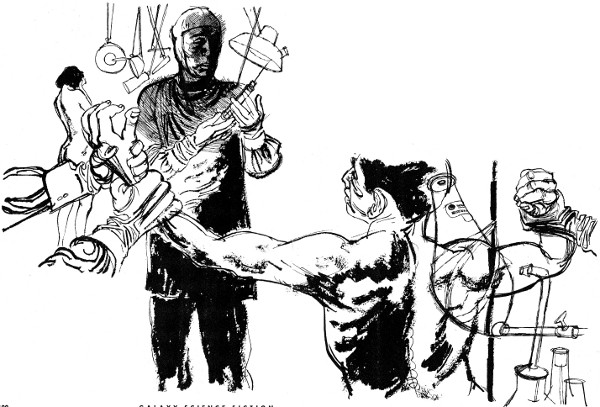
He experimentally squirted a faint mist from the tip of the hypospray and nodded satisfaction. He went on: "The suspension is effective for a long time—several hundred years, perhaps. But not forever. In time the enzymes of the body begin to digest the body itself." He pursed his lips thoughtfully. "I don't know if the sleeping brain knows it is pain or not. If it does, you'll know what it feels like to dissolve in your own gutwash...."
He smiled. "Good night," he crooned, and bent over my arm.
The spray from the end of the hypo felt chilly, but not at all painful. It was as though I had been touched with ice; the cold clung, and spread.
I was vaguely conscious of being dumped on one of the surgical tables, even more vaguely aware of seeing Rena slumping across another.
The light in the room yellowed, flickered and went out.
I thought I heard Rena's voice....
Then I heard nothing. And I saw nothing. And I felt nothing, except the penetrating cold, and then even the cold was gone.
XVII
My nerves throbbed with the prickling of an infinity of needles. I was cold—colder than I had ever been. And over everything else came the insistent, blurred voice of Luigi Zorchi.
"Weels! Weels!"
At first it was an annoyance. Then, abruptly, full consciousness came rushing back, bringing some measure of triumph with it. It had worked! My needling of Defoe and my concealing of Zorchi's ability to revive himself had succeeded in getting us all put into Bay 100, where the precious hypodermic and fluid were hidden. After being pushed from pillar to post and back, even that much success was enough to shock me into awareness.
My heart was thumping like a rusty cargo steamer in a high sea. My lungs ached for air and burned when they got it. But I managed to open my eyes to see Zorchi bending over me. Beyond him, I saw the blue-lighted sterilizing lamps, the door that opened from inside, and the racked suspendees of Bay 100.
"It is time! But now finally you awake, you move!" Zorchi grumbled. "The body of Zorchi does not surrender to poisons; it throws them off. But then because of these small weak legs, I must wait for you! Come, Weels, no more dallying! We have still work to do to escape this abomination!"
I sat up clumsily, but the drugs seemed to have been neutralized. I was on the bottom tier, and I managed to locate the floor with my legs and stand up. "Thanks, Zorchi," I told him, trying to avoid looking at his ugly, naked body and the things that were almost his legs.
"Thanks are due," he admitted. "I am a modest man who expects no praise, but I have done much. I cannot deny it. It took greatness to crawl through this bay to find you. On my hands and these baby knees, Weels, I crawled. Almost. I am overcome with wonder at so heroic—But I digress. Weels, waste no more time in talking. We must revive the others who are above my reach. Then let us, for God, go and find food."
Somehow, though I was still weak, I managed to follow Zorchi and drag down the sacks containing Rena and Carmody. And while waiting for them to revive, I began to realize how little chance we would have to escape this time, naked and uncertain of what state affairs were in. I also realized what might happen if Lawton or Defoe decided to check up on Bay 100 now!
For the few minutes while Rena revived and recognized me, and while I explained how I'd figured it out, it was worth any risk. Then finally, Carmody stirred and sat up. Maybe we looked enough like devils in a blue hell to justify his first expression.
He wasn't much like my mental image of the great Millen Carmody. His face was like his picture, but it was an older face and haggard under the ugly light. Age was heavy on him, and he couldn't have been a noble figure at any time. Now he was a pot-bellied little man with scrawny legs and a faint tremble to his hands.
But there was no fat in his mind as he tried to absorb our explanations while he answered our questions in turn. He'd come to Naples, bringing his personal physician, Dr. Lawton. His last memory was of Lawton giving him a shot to relieve his indigestion.
It must have been rough to wake up here after that and find what a mess had been made of the world. But he took it, and his questions became sharper as he groped for the truth. Finally he sat back, nodding sickly. "Defoe!" he said bitterly. "Well, what do we do now, Mr. Wills?"
It shook me. I'd unconsciously expected him to take over at once. But the eyes of Rena and Zorchi also turned to me. Well, there wasn't much choice. We couldn't stay here and risk discovery. Nor could we hide anywhere in the clinic; when Defoe found us gone, no place would be safe.
"We pray," I decided. "And if prayers help, maybe we'll find some way out."
"I can help," Carmody offered. He grimaced. "I know this place and the combination to the private doors. Would it help if we reached the garage?"
I didn't know, but the garage was half a mile beyond the main entrance. If we could steal a car, we might make it. We had to try.
There were sounds of activity when we opened the door, but the section we were in seemed to be filled, and the storing of suspendees had moved elsewhere.
We shut and relocked the door and followed Carmody through the seemingly endless corridors, with Zorchi hobbling along, leaning on Rena and me and sweating in agony. We offered to carry him, but he would have none of that. We moved further and further back, while the sight of Carmody's round, bare bottom ahead ripped my feeling of awe for him into smaller and smaller shreds.
He stopped at a door I had almost missed and his fingers tapped out something on what looked like an ornamental pattern. The door opened to reveal stairs that led down two flights, winding around a small elevator shaft. At the bottom was a long corridor that must be the one leading underground to the garage. Opposite the elevator was another door, and Carmody worked its combination to reveal a storeroom, loaded with supplies the expediters might need.
He ripped a suit of the heavy gray coveralls off the wall and began donning them. "Radiation suits," he explained. They were ugly things, but better than nothing. Anyone seeing us in them might think we were on official business. Zorchi shook off our help and somehow got into a pair. Then he grunted and began pulling hard-pellet rifles and bandoliers of ammunition off the wall.
"Now, Weels, we are prepared. Let them come against us. Zorchi is ready!"
"Ready to kill yourself!" I said roughly. "Those things take practice!"
"And again I am the freak—the case who can do nothing that humans can do, eh, Weels?" He swore thickly, and there was something in his voice that abruptly roughened it. "Never Zorchi the man! There are Sicilians who would tell you different, could they open dead mouths to speak of their downed planes!"
"He was the best jet pilot Naples had," Rena said quietly.
It was my turn to curse. He was right; I hadn't thought of him as a man, or considered that he could do anything but regrow damaged tissues. "I'm sorry, Luigi!"
"No matter." He sighed, and then shrugged. "Come, take arms and ammunition and let us be out of this place. Even the nose of Zorchi can stand only so much of the smell of assassins!"
We moved down the passage, staggering along for what seemed to be hours, expecting every second to run into some official or expediter force. But apparently the passage wasn't being used much during the emergency. We finally reached stairs at the other end and headed up, afraid to attract attention by taking the waiting elevator.
At the top, Carmody frowned as he studied the side passages and doors. "Here, I guess," he decided. "This may still be a less used part of the garage." He reached for the door.
I stopped him. "Wait a minute. Is there any way back in, once we leave?"
"The combination will work—the master combination used by the Company heads. Otherwise, these doors are practically bomb-proof!" He pressed the combination and opened the door a crack.
Outside, I could see what seemed to be a small section of the Company car pool. There were sounds of trucks, but none were moving nearby. I saw a few men working on trucks a distance from us. Maybe luck was on our side.
I pointed to the nearest expediter patrol wagon—a small truck, really, enclosed except for the driver's seat. "That one, if there's fuel. We'll have to act as if we had a right to it, and hope for the best. Zorchi, can you manage it that far?"
"I shall walk like a born assassin," he assured me, but sweat began popping onto his forehead at what he was offering. Yet there was no sign of the agony he must have felt as he followed and managed to climb into the back with Rena and Carmody.
The fuel gauge was at the half mark and, as yet, there was no cry of alarm. I gunned the motor into life, watching the nearest workmen. They looked up casually, and then went back to their business. Ahead, I could see a clear lane toward the exit, with a few other trucks moving in and out. I headed for it, my hair prickling at the back of my neck.
We reached the entrance, passed through it, and were soon blending into the stream of cars that were passing the clinic on their way out for more suspension cases.
The glass doors of the entrance were gone now, and workmen were putting up huge steel ones in their place, even while a steady stream of cases were hobbling or being carried into the clinic. Most of them were old or shabby, I noticed. The class-D type. The last ones to be admitted. We must have spent more time in the vault than I'd thought, and zero hour was drawing near.
Beyond the clinic, the whole of Anzio was a mass of abandoned cars that seemed to stretch for miles, and the few buildings not boarded up were obviously class-D dwellings, too poor to worry about. I cursed my way through a jam-up of trucks, and managed to find one of the side roads.
Then I pressed down on the throttle as far as I dared without attracting attention, until I could find a safe place to turn off with no other cars near to see me.
"Where to?" I asked. We couldn't go back to Zorchi's, since any expediter investigation would start there. Maybe we'd never be missed, but I couldn't risk it. If we had to, we could use some abandoned villa and hide out, but I was hoping for a better suggestion.
Zorchi looked blank, and Rena shrugged. "If we could only find Nikolas—" she suggested doubtfully.
I shook my head. I'd had a chance to think about that a little while the expediters took us to see Defoe, and I didn't like it. The leader of the revolution had apparently been captured by Defoe. According to Benedetto dell'Angela, he'd escaped. Yet Defoe hadn't tried to pump us about him. And when Benedetto set out to meet him, the expediters had descended at once.
It made an ugly picture. I had no wish to go looking for the man.
"There's my place," Carmody said finally. "I had places all over the world, kept ready for me and stocked. If Defoe let it be thought that I had retired, he must have kept them all up as I'd have done. Wait, let me orient myself. Up that road."
Places all over the world, with food that was wasted, and with servants who might never see their master! And I'd been brought up believing that the Underwriters were men of quiet, simple tastes! Carmody's clay feet were beginning to crumble up to the navel!
The villa was surrounded by trees, on a low hill that overlooked an artificial lake. It had been sealed off, but the combination lock yielded to Carmody's touch. There were beds made up and waiting, freezers stocked with food that sent Zorchi into ecstasy, and even a complete file of back issues of the Company paper. Carmody headed for those, with the look of a man hunting his lost past. He had a lot of catching up to do.
But it was the television set that interested me. It was still working, with taped material being broadcast. The appeal had been stepped up, asking for order and cooperation; I recognized the language as being pitched toward the lower classes now, though. And the clicking of a radiation-counter sounded as a constant background, with occasional shots of its meter, the needle well into the danger area.
Zorchi joined me and Rena, dribbling crumbs of meat down his beard. He snorted as he caught sight of the counter. "There is a real one in the other room, and it registers higher," he said. "It is interesting. For me, of no import. Doctors whom I trust have said Defoe is wrong; my body can resist damage from radiation—and perhaps even from old age. But for you and the young lady...."
He shut up at my expression, but the tape cut off and a live announcer came on before I could say anything. "A bulletin just in," he said, "shows that the government of Naples has unanimously passed a moritorium on all contracts, obligations and indebtedness for the duration of the emergency. The Company has just followed this with a declaration that it will extend the moritorium to include all crimes against the Company. During the emergency, the clinics will be available to all without prejudice, Director Defoe said today."
"A trap," Rena guessed. "We wouldn't have a chance, anyhow. But, Tom, does the other mean that—"
"It means your father was wrong," I answered. "As of right now—and probably in every government at the same time—the Company has been freed from any responsibility."
It didn't make any difference, of course. Benedetto had expected that everyone must secretly hate the Company as he did; he hadn't realized that men who have just been saved from the horrible danger of radiation death aren't going to turn against the agency that saved them. And damn it, the Company was saving them, after its opponents had risked annihilation of the race. Defoe would probably make sure the suspendees were awakened at a rate where he could keep absolute power, but not from any danger of bankruptcy.
Carmody had come out and listened, attracted by the broadcast radiation clicking, apparently. Now he asked enough questions to discover Benedetto's idea, and shook his head.
"It wouldn't work," he agreed with me. "Even if I still had control, I couldn't permit such a thing. What good would it do? Could money payments make food for a revived world, Miss dell'Angela? Would bankrupting the only agency capable of rebuilding the Earth be a thing of honor? Besides, even with what I've read, I can see no hope. There's nothing we can do."
"But if you can arouse the other Underwriters against Defoe," she insisted, "at least you can prevent his type of world!"
He shook his head. "How? All communications are in his hands. Even if I could fly to the Home Office, most of the ones I could trust—and there apparently are a few Defoe hasn't been able to retire—would be scattered, out of my reach. A week ago, there might have been a chance. Now, it's impossible. Impossible."
He shook his head sadly and wandered back toward the library. I could see that in his secret thoughts, he was wishing we'd left him safely in the vault. Maybe it would have been just as well.
"Cheer up," I told Rena. "Carmody's an old man—too old to think in terms of direct action, even when it's necessary. Defoe doesn't own the world yet!"
But later, when I located the books I wanted in the library and went out into the vine-covered bower in the formal garden, I wasn't as confident as I'd pretended.
Thinking wasn't a pleasant job, after all the years when I'd let others do my thinking for me. But now I had to do it for myself. Otherwise, the only alternative was to plan some means of quick death for us all before the radiation got too intense. And I couldn't accept that.
Rena had managed something Marianna couldn't have conceived—she'd quietly relinquished her fate into my hands, gambling on me with everything she had. Whether I wanted to or not, I'd taken the responsibility. Carmody was an old man; one who hadn't been able to keep Defoe from taking over in the first place. And Zorchi—well, he was Zorchi.
That night, the radiation detector suddenly took a sharp lift, its needle crossing over into the red. It was probably only a local rise. But it didn't make my thinking any more comfortable.
It was at breakfast that next morning when I finally took it up with Carmody. "Just what will the situation be at the clinic after they close down? How many will be kept awake? And what about their defenses?"
He frowned, trying to see my idea. Then he shrugged. "Too many, Tom. We had plotted out a course for such things as this a number of times in Planning. And our mob psychologists warned that there'd inevitably be a few who for one reason or another wouldn't come in in time, but who would then grow desperate and try to break in. Outlaws, looters, procrastinators, fanatics. That sort. So for some time, there should be at least twenty guards kept alert. And that's enough to defend a clinic. Atomic cannon at every entrance, of course, and the clinics are bomb-proof."
"Twenty, eh? And how about Defoe and Lawton? Will they sleep?" It seemed logical that they couldn't stay out of suspension for the whole fifty years or so. There'd be no profit to gaining a world after they were too old to use it.
"Not at first. There's a great deal of final administrative work to be done. There's a chamber equipped to keep a hundred or so men awake with radiation washed from the air, and containing adequate supplies, in cable contact with other clinics. They'll be there. Later, they'll take shifts, with only a couple of men awake at a time, I suppose. They may age a little that way, but not much."
He frowned again, and then slowly nodded. "It could be done, if we had some way to wait safely for six months. Getting back in is no problem for me."
"It's going to be done," I told him. "And a lot sooner. Are you willing to take the chance?"
"Have I any choice?" He shrugged again. "Do you think I haven't been sick at the idea of a man like Defoe in command of the Company for as long as he lives? Tom, my family started the Company. I've got an obligation to restore it to its right course. If there's any chance of keeping Defoe from being emperor of the world, I've got to take it. If you can put me in a position where I can get the honest Underwriters together again, where we can set up the Company as it was—"
"Why? So this will happen all over again?"
He looked shocked at Rena's question. "I don't blame you for being bitter, Miss dell'Angela. But with Defoe gone—"
"The Company made Defoe possible. In fact, it made him and Slovetski inevitable," I told him flatly. "That's its one great crime. Whenever you take power completely out of the hands of the many, it winds up in fewer and fewer hands. Those histories I was reading last night prove that. Carmody, what do you know about your own Company? Or the world? Leave the consolidation of power in Company hands out of it, and what has happened to progress?"
He frowned. "Well, we've leveled off a bit. We had to. We couldn't risk—"
"Exactly. You couldn't risk research that would lead to increased longevity—too many pensioners. You couldn't risk going to Mars—unpredictable dangers. You had to make the world fit actuarial charts. I remember seeing one of the first suspendees awakened. He expected things we could have done fifty years ago—and never will do. How many men today work their way out of their class? And why have classes so rigidly stratified? I've been reading your own speeches of nearly fifty years ago. I've got them here, together with some tables. Like to see them?"
He took the papers silently and began going through them, his shock giving way to a grudging realization. Maybe without the jolt of his awakening, he'd have laughed them off, but nothing was easy to dismiss with the hell brewing outside. At last he looked up.
"Tom, I'll admit the many times when I've been worried. I've considered starting research again countless times. I've been aware that dependence was growing too heavy on the Company. But we can't just toss it aside. It did bring an end to major war, when such a war would have ruined the Earth completely. It showed that nobody had to starve—that hardly anyone had to lack for any necessity, or die for lack of care. You can't throw that away."
"You can throw away its unrelated power." I knew I didn't have the answers. All this had been growing slowly in my mind since I'd first found Benedetto a political prisoner, but a lifetime wasn't enough to think it out, even with the books I'd found.
But I had to try. "In the middle ages, they had morality and politics tied into one bundle, Carmody. The church ruled. It wasn't good and they finally had to divorce church and state. Maybe the same applies to administrative politics and economics. The Company has shown what can be done economically. The church has survived as a great moral force outside material power. Now let's see if we can't put things in perspective.
"There's a precedent. The United States—the old government—was set up on the idea of balance of power: an elected Congress for the people to handle legislative tasks, a selected President to handle executive affairs, and a Judiciary mostly independent. On a world scale, as it can be done today—since the Company has really made it one world—the same can be done, with something like the Company to insure economics."
"I suppose every man who had any idealism has thought the same," Carmody said slowly. He sighed softly. "I remember trying to preach it to my father when I was just out of college. You're right. But can you set up such a perfect government? Can I? Tell me how, Tom, and I'll give you your chance, if I can."
Zorchi laughed cynically, but that was what I'd hoped Carmody might say.
"All right," I told him. "We can't do it. No one man is fit to rule, ever, or to establish rule. Oh, I had wish-dreams, a few days ago, I suppose, about what I'd do, if! But men have set out to establish new systems before, and done good jobs of it. Read the Constitution—a system put together artificially by expert political thinkers, and good for two hundred years, at least! And they didn't have our opportunities. For the first time, the world has to wait. Get the best minds you can, Carmody. Give them twenty-five years to work it out. They can come up with an answer. And then, when the world is awakened, you can start with it, fresh, without upsetting any old order. Is that your answer?"
"Most of it." There was a sudden light in his old eyes. "Yes, the sleep does make the chance possible. But how are you going to get the experts and assemble them?"
I pointed to Zorchi. "Hermes, the messenger of the gods. He's a jet pilot who can get all over the world. And he can move outside, without needing to worry about radiation."
"So?" Zorchi snorted again. "So, I am now your messenger, Weels! Do you think I would trouble myself so much for all of you, Weels?"
I grinned at him. "You defiantly speak of being a man. That makes you part of the human race. I'm simply taking you at your word."
"So?" he repeated, his face wooden. "Such a messenger would have much power, Weels. Suppose I choose to be Zorchi the ruler?"
"Not while Zorchi the man is also Zorchi the freak," I said with deliberate cruelty. "Go look at yourself."
And suddenly he smiled, his lips drawing back from his teeth. "Weels, for the first time you are honest. And for that as well as that I am a man, I will be Zorchi the messenger. But first, should we not decide on a plan of action? Or do we first rule and then conquer?"
"We wait first," I told him.
On the wall, the radiation indicator clicked steadily, its needle moving further into the red.
XVIII
The second day, the television went off the air with the final curt announcement that anyone not inside the clinics at noon would be left outside permanently. Then the set went dead, leaving only the clucking and beeping of our own radiation indicator. I'd thrown it out twice and brought it back both times.
Civilization had ended on the third day, though all the conveniences in the villa went on smoothly, except for the meter reading that told us nothing could be smooth. It was higher than the predictions I had heard, though I still hoped that was only a sporadic local phenomenon that would level out later. In the face of that, it was hard to believe that even a few men would remain outside the clinics, though I was counting on it.
We waited another twenty-four hours, forcing ourselves to sit in the villa, discussing plans, when our nerves were yelling for action. We had only an estimate to go on. If we got there too soon, there would be more awake than we could handle. Too late and we'd be radiation cases, good for nothing but the vaults.
It was a relief to leave at last, taking our weapons in the truck. We were wearing the radiation suits, hoping they'd protect us, and Zorchi spent the last two days devising pads and straps to cushion and strengthen his developing legs.
The world was dead. Cars had been abandoned in the middle of the road, making driving difficult.
The towns and villas were deserted, boarded up or simply abandoned. We might have been the last men on Earth, and we felt that we were as we headed for Anzio. This wasn't just a road, or Naples—or all of Italy. It was the world.
Then Rena pointed. Ahead, a boy was walking beside a dog, the animal's left rear leg bound and split as if it had been broken. I started to slow, then forced myself to drive on. As we passed, I saw that the boy was about fourteen, and his face was dirty and tear-streaked. He shook one fist at us, and came trudging on.
"If we win, we'll have the door open when he gets there," Rena said. "For him and his dog! If not, it won't matter how long it takes him. You couldn't stop, Tom."
It didn't make me feel any better. But now dusk was falling, and we slowed, waiting until it was dark to park quietly near the garage. In front of the entrance, I could see a small ring of fires, and by their light a few figures moving about. They were madmen, of course—and yet, probably less mad than others who must be prowling through the towns, looting for things they could never use.
It seemed incredible that any one could be outside, but the psychologists had apparently been right. These were determined men, willing to wait for the forlorn chance that some miracle might give them a futile, even more forlorn chance to try battering down the great doors. Maybe somewhere in the world, such a group might succeed. But not here. As I watched, there was a crackle of automatic gunfire from the entrance. The guards were awake, all right, and not taking chances on any poor devil getting too close.
There were no guards in the vault garage. We were prepared in case someone might be stationed inside the private entrance, as much prepared as we could be; since Carmody had been listed as still living, an ordinary guard who recognized him would probably let us in first and then try to report—giving us time to handle him. But we were lucky. The door opened to Carmody's top-secret combination.
"We designed such combinations into a few doors in case of internal revolution locally while no Underwriters were around. We never considered having an Underwriter lead a revolution from outside," he whispered to us.
The underground passage was deserted, and this time Carmody led through another corridor, to a stairs that seemed to wind up forever. Zorchi groaned, then caught himself.
"It leads to the main reception room," Carmody said.
With the men outside, most of the guards who still remained awake might be there. But we had to chance it. We stopped when we reached the top, catching our breath while Zorchi sank to the floor, writhing silently.
Then Rena threw back the door, Zorchi's rifle poked through, and I was leaping for the main door controls, hoping the memory I had was accurate. I was nearly to them when the two guards standing beside them turned.
They yelled, just as my rifle spat. At that range, I couldn't miss. And behind, I heard Zorchi's gun spit. The second guard slumped sickly to the floor, holding his stomach. I grabbed for the controls, while other yells sounded, and feet began pounding toward me.
There was no time to look back. The doors were slowly moving apart and Carmody was beside me, smashing a maul from the storeroom onto the electronic controls of the atomic cannon. I twisted between the opening doors.
"We've seized the vaults," I shouted. "We need help. Any man who joins us will be saved!"
I couldn't wait to watch, but I heard a hoarse, answering shout, and the sound of feet.
Carmody's maul had ruined the door controls. But the other guards were nearly on us. I saw two more sprawled on the floor. Zorchi hadn't missed. Then Carmody's fingers had found another of the private doors that looked like simple panels here. Rena and Carmody were through, and I yanked Zorchi after me, just as a bullet whined over his head. Behind us, I heard uncontrolled yelling as men from outside began pouring in.
It was our only hope. They had to take care of the guards, who were still probably shocked at finding us inside. We headed for the private quarters where Defoe would be, praying that there would be only a few there.
This passage was useless to us, though. It led from office to office for the doctors who superintended here. We came out into an office, watching our chance for the hall we had to take. I could see the men who had been outside in action now. A few had guns of some kind, but the clubs in the hands of the others were just as deadly in such a desperation attack; men who had seen themselves already dead weren't afraid of chances. About a score of the expediter guards were trying to hold off at least twice their number.
Then the hall seemed clear and we leaped into it. Suddenly gongs began ringing everywhere. Some guard had finally reached or remembered the alarm system. Carmody cursed, and tried to move faster.
The small private vault for the executives lay through the administration quarters and down several levels, before it was entered through a short passageway. Carmody had mapped it for me often enough. But he knew it by physical memory, which was better than my training. He'd also taught me the combination, but I left the door to his practiced fingers when we came to it.
The elevator wasn't up. We couldn't wait. We raced down the stairs that circled it. Here Carmody's age told against him, and he fell behind. Rena and I were going down neck and neck with Zorchi throwing himself along with us. He had dropped his rifle and picked up a sub-machine gun from one of the fallen guards, and he clung to it now, using only one hand on the rail.
It was a reflection on a gun-barrel that saved us. The picked expediters were hidden in the dark mouth of the passageway, waiting for us to turn the stairs. But I caught a gleam of metal, and threw up my gun. Instantly, Zorchi was beside me, the sub-machine spitting as quickly as I could fire the first shot. "Aim for the wall. Ricochet!"
The ambushers had counted too much on surprise. They weren't ready to have the tables turned, nor for the trick Zorchi had suggested. Here we couldn't fire directly, but the bouncing shots worked almost as well. There were screams of men being hit, and the crazed pandemonium of others suddenly afraid.
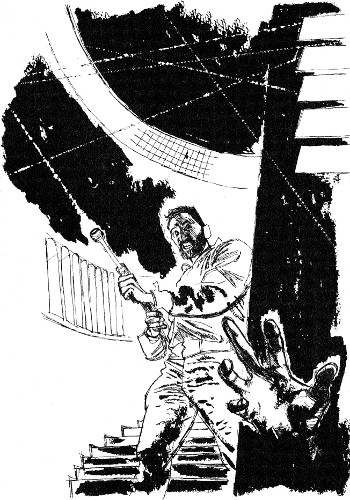
Shots came toward us, but the wall that protected them—or was supposed to—ruined their shooting.
Zorchi abruptly dropped, landing with a thud on his side. I grunted sickly, thinking he was hit.
Then I saw the sub-machine gun point squarely into the passageway. It began spitting out death. By the time we could reach him, the expediters were dead or dying. There had been seven of them.
Zorchi staggered into the passage, through the bodies, crying something. I jumped after him, blinking my eyes to make out what he had seen. Then I caught sight of a door at the back being silently closed. It was a thick, massive slab, like the door to a bank vault.
Zorchi made a final leap that brought a sob of anguish as he landed on his weak legs, but his gun barrel slapped into the slit of opening. The door ground against it, strained and stopped. Zorchi pulled the trigger briefly.
For a second, then, there was silence. A second later, Defoe's voice came out through the thin slit. "You win. Dr. Lawton and I are alone and unarmed. We're coming out."
The door began opening again, somewhat jerkily this time. I watched it, expecting a trick, but there was none.
Inside the vault, the first room was obviously for guards and for the control of the equipment needed to wash all contamination out of the air and to provide the place with security for a century, even if all the rest of the Earth turned into a radioactive hell.
Lawton was slumped beside the controls, his head cradled in his arms. But at the sight of us, he stood up groggily, his mouth open, and shock on his face.
Defoe's eyes widened a trifle, but he stood quietly, and the bleak smile never faltered. "Congratulations, Thomas," he said. "My one fault again—I underrated the opposition. I wasn't expecting miracles. Hello, Millen. Fancy meeting you here."
"Search the place," I ordered.
Carmody went past the two without looking at them, with Rena close behind. A minute later, I heard a triumphant shout. They came back with a cringing man who seemed totally unlike the genial Sam Gogarty who had first introduced me to fine food and to Rena. His eyes were on Carmody, and his skin was gray white. He started to babble incoherently.
Carmody grinned at him. "You've got things twisted, Gogarty. Tom Wills is in charge of this affair." He turned toward one of the smaller offices. "As I remember it, there should be a transmitting setup in here. I want to make sure it works. If it does, some of the Underwriters are going to get a surprise, unless they're suspended."
Gogarty watched him go, and then sank slowly to a chair, shaking his head as he looked up at me. His lips twisted into bitter resignation. "You wouldn't understand, Tom. All my life, worked for things. Class-C, digging in a mine, eating Class-D, getting no fun, so I could buy Class-B employment. Then Class-A. Not many can do it, but I sweated it out. Thirty years living like a dog and killing myself with work and study. Not even a real woman until I met Susan, and she went to Defoe. But I wanted it easier for the young men. I wanted everybody to have a good life. No harm to anyone. Pull together, and forget the tough times. Then you had to come and blow the roof off...."
I felt sick. It was probably all true, and few men could make it. But if that's what it took to advance under the Company rules, it was justification enough for our fight. "You'll be all right, Sam," I told him. "You'll go to sleep with the others. And when you wake up, you may have to work like hell again, but it'll be to rebuild the Earth, not to ruin it. Maybe there'll even be a chance with Susan again."
Defoe laughed sardonically. "Very nice, Thomas. And I suppose you mean it. What's in the future for me?"
"Suspension until the new government gets organized and can decide your case. I'd like to vote now for permanent suspension."
His face lost some of his amusement. Then he shrugged. "All right, I suppose I knew that. But now will you satisfy my curiosity? Just how did you work the business with Bay 100?"
"What happened to Slovetski?" I asked. I couldn't be sure about some of my suspicions over Benedetto's death, but I couldn't take chances that the man might still be loose somewhere, or else hiding out here until we were off guard.
He shook his head. "I can answer, but I'm waiting for a better offer."
"Sam?" I asked.
Gogarty nodded slowly. "All right, Tom. I guess you're the boss now. And I think I'm even glad of it. I always liked you. I'll answer about Slovetski."
Defoe snarled and swung, then saw my rifle coming up, and straightened again. "You win once more, Thomas. Your great international rebel cooperated with us very nicely after we caught him. We arranged for him to receive all calls to his most secret hideout right here in this room. It netted us his fellow conspirators—including your father, Miss dell'Angela!"
She gasped faintly, but her head came up at once. "Nikolas was no traitor. You're lying!"
"Why should I lie?" he asked. "With the right use of certain drugs, any man can become a traitor. And Dr. Lawton is an expert on drugs."
"Where is he?" I asked.
He shrugged. "How should I know? He wanted a radioactive world, so I let him enjoy it. We put him outside just before we closed the doors permanently."
Gogarty nodded confirmation. I turned it over. He might even have been one of the men waiting outside. But it wouldn't matter. Without his organization and with a world where life outside was impossible, Slovetski's power was finished.
I turned to Zorchi. "The men who broke in will be going crazy soon," I told him. "While Rena finds the paging system and reassures them they'll all be treated in the reception room, how about getting Lawton to locate and revive a couple of the doctors you know and trust?"
Rena came back from the paging system, and Zorchi prodded Lawton with the gun, heading him toward the files that would show the location of the doctors. Gogarty stood up doubtfully, but I shook my head. Zorchi was able to handle a man of Lawton's type, even without full use of his legs, and I couldn't trust Gogarty yet.
"You can give me a hand with Defoe, Sam," I suggested. "We'd better strap him down first."
Gogarty nodded, and then suddenly let out a shocked cry, and was cringing back!
In the split second when both Rena and I had looked away, Defoe had whipped out an automatic and was now covering us, his teeth exposed in a taut smile. "Never underestimate an opponent, Thomas," he said. "And never believe what he says. You should have searched me, you know."
The gun was centered on Rena and he waited, as if expecting me to make some move. All I could do was stand there, cursing myself. I'd thought of everything—except the obvious!
Defoe backed toward the door and slipped around it, drawing its heavy weight slowly shut until only a crack showed. Then he laughed. "Give my love to Millen," he said, and laughed softly.
I jumped for the door, but his feet were already moving out of the passage. The door began opening again, but I knew it was too late. Then, it was open. And amazingly, Defoe stood not ten feet away.
At the other end of the passage, a ragged bloody figure was standing, swaying slowly from side to side, holding a rifle. I took a second look to recognize Nikolas Slovetski. He was moving slowly toward Defoe. And now Defoe jerked back and began frantically digging for the automatic he must have pocketed.
Slovetski leaped, tossing the gun aside in a way that indicated it must have been empty. A bullet from Defoe's automatic caught his shoulder in mid-leap, but it couldn't stop him. He crashed squarely on Defoe, swinging a knife as the other went down. It missed, ringing against the hard floor.
I'd come unfrozen by then. I kicked the knife aside and grabbed the gun from Defoe's hands. Slovetski lay limp on him, and I rolled the smaller man aside.
Defoe was out cold from the blow of his head hitting the floor. Gogarty had come out behind me and now began binding him up. He opened his eyes slowly, blinked, and tried to grin as he stared at the bonds. He swung his head to the figure on the floor beside him. "Shall we go quietly, Nikolas?" he asked, as Gogarty picked him up and carried him back to the private vault.
But his sarcasm was wasted on Slovetski. The man must have been dying as he stumbled and groped his way toward the place where he knew Defoe must be. And the bullet in the shoulder had finished him. Rena bent over him, a faint sob on her lips.
Surprisingly, he fought his way back to consciousness, staring up at her. "Rena," he said weakly. "Benedetto! I loved him. I—" Then his head rolled toward me. "At least, I lived to die in a revolution, Thomas. Dirty business, revolution. When in the course of human events, it becomes—"
He died before he could finish. I went looking for Lawton, to make sure Defoe was suspended at once. He'd be the last political suspendee, if I had anything to do with it, but there would be a certain pleasure in watching Lawton do the job.
XIX
The doors of the reception hall were closed again, but there was no lock now. One of the two doctors whom Zorchi had trusted was there now, waiting for the stragglers who came in slowly as a result of our broadcast. We couldn't reach them all, of course, but some could be saved. The men who had fought with us were treated and suspended. Even the boy and his dog had finally reached us and been put away.
In the main room of the executive vault, Carmody was waiting for Rena and me as we came in, haggard from lack of sleep, but somehow younger-looking than he had been since we had first revived him.
He stood up, managing a tired smile. "The first work's done, Tom," he said. "It wasn't too hard, once they learned Defoe was suspended; a lot of the others were afraid of him, I guess. So far, I've only contacted the ones I can trust, but it's a beginning. I've gotten tapes of their delegation of authority to you as acting assistant Chief Underwriter. I guess the factor that influenced them most was your willingness to give up all hopes of suspension for the emergency. And having Zorchi was a help, too—one man like him is worth an army now. I'll introduce you tomorrow."
He stumbled out, heading toward the sleeping quarters.
Well, I had the chance I'd wanted. And I had his promise to put off suspension until things were running properly. With time to develop a small staff, and with a chance to begin the work of locating the men to study the problems that had to be solved, I couldn't ask for much more.
Zorchi grinned at me. "Emperor Weels!" he mocked.
I grinned back. "If you ever say that seriously, Luigi, I want you to say it with a bullet through my brain. I've seen enough cases of power corrupting."
For a second, he studied me. "If that day should come, then there shall be the bullet. But now, even I must sleep," he said.
Then he glanced at Rena. "I have left orders that a priest should be wakened."
She colored faintly.
"You'll be best man, I suppose?" I asked.
This time, even his beard couldn't conceal his amusement. "Is Zorchi not always the best man?" he asked as he left us alone.
I stared at the vault that would be my home for the next twenty-five or fifty years—until I was an old man, and the rest of the world was ready to be awakened. "It's a lousy place to spend a honeymoon," I told Rena.
She leaned against me. "But perhaps a good place to bring up children," she said. "A place to teach them that their children will have a good world, Tom. That's all a woman ever wants, I guess."
I drew her to me. It was a good way to think of the future, whatever happened. And it would be a better world, where the virtues of the Company could be used.
Probably it wouldn't be perfect.
Even the best form of government all the experts could devise couldn't offer a permanent solution. But it could give men a chance to fight their way to a still better world.
[Transcriber's Note: There are two section V headings as per the orginal publication.]