Front matter (continued 3)
Reading edition
I didn't regret rescuing Zorchi from the clinic—it was a matter of simple justice since I had helped trick him into it. But I did wish that it had been some more companionable personality that I had been obligated to.
Benedetto, on the other hand, shook my hand and said: "For God, I thank you," and I felt well repaid. But he was in the back seat being brought up to date by his daughter; I had the honor of Zorchi's company next to me....
There was a long Latin period from the church, a response from the altar boy, and then the final Ite, missa est. We heard the worshippers moving out of the church.
The priest came through the room we were waiting in, his robes swirling. He didn't look around, or give any sign that he knew we were there, though he almost stepped on Zorchi, sitting propped against a wall.
A moment later, another man in vaguely clerical robes entered and nodded to us. "Now we go below," he ordered.
Benedetto and I flanked Zorchi and carried him, an arm around each of our necks. We followed the sexton, or whatever he was, back into the church, before the altar—Benedetto automatically genuflected with the others, nearly making me spill Zorchi onto the floor—to a tapestry-hung door. He pushed aside the tapestry, and a cool, musty draft came up from darkness.
The sexton lit a taper with a pocket cigarette lighter and led us down winding, rickety steps. There was no one left in the church to notice us; if anyone had walked in, we were tourists, doing as countless millions of tourists had done before us over the centuries.
We were visiting the Catacombs.
Around us were the bones of the Christians of a very different Rome. Rena had told me about them: How they rambled under the modern city, the only entrances where churches had been built over them. How they had been nearly untouched for two thousand years. I even felt a little as though I really were a tourist as we descended, she had made me that curious to see them.
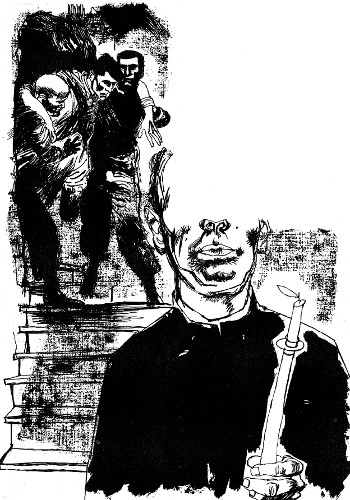
But I was disappointed. We lugged the muttering Zorchi through the narrow, musty corridors, with the bones of martyrs at our elbows, in the flickering light of the taper, and I had the curious feeling that I had been there before.
As, in a way, I had: I had been in the vaults of the Company's clinic at Anzio, in some ways very closely resembling these Catacombs—
Even to the bones of the martyrs.
I was almost expecting to see plastic sacks.
We picked our way through the warrens for several minutes, turning this way and that. I was lost in the first minute. Then the sexton stopped before a flat stone that had a crude, faded sketch of a fish on it; he leaned on it, and the stone discovered itself to be a door. We followed him through it into a metal-walled, high-ceilinged tunnel, utterly unlike the meandering Catacombs. I began to hear sounds; we went through another door, and light struck at our eyes.
I blinked and focused on a long room, half a dozen yards wide, almost as tall, at least fifty yards long. It appeared to be a section of an enormous tunnel; it appeared to be, and it was. Benedetto and I set Zorchi—still cursing—down on the floor and stared around.
There were people in the tunnel, dozens of them. There were desks and tables and file cabinets; it looked almost like any branch of the Company, with whirring mimeographs and clattering typewriters.
The sexton pinched out the taper and dropped it on the floor, as people came toward us.
"So now you are in our headquarters in Rome," said the man dressed as a sexton. "It is good to see you again, Benedetto."
"And it is much better to see you, Slovetski," the old man answered warmly.
This man Slovetski—I do not think I can say what he looked like.
He was, I found, the very leader of the "friends," the monarch of this underground headquarters. But he was a far cry from the image I had formed of a bearded agitator. There was a hint of something bright and fearful in his eyes, but his voice was warm and deep, his manner was reassuring, his face was friendly. Still—there was that cat-spark in his eyes.
Slovetski, that first day, gave me an hour of his time. He answered some of my questions—not all. The ones he smiled at, and shook his head, were about numbers and people. The ones he answered were about principles and things.
He would tell me, for instance, what he thought of the Company—endlessly. But he wouldn't say how many persons in the world were his followers. He wouldn't name any of the persons who were all around us. But he gladly told me about the place itself.
"History, Mr. Wills," he said politely. "History tells a man everything he needs to know. You look in the books, and you will learn of Mussolini, when this peninsula was all one state; he lived in Rome, and he started a subway. The archives even have maps. It is almost all abandoned now. Most of it was never finished. But the shafts are here, and the wiring that lights us still comes from the electric mains."
"And the only entrance is through the Catacombs?"
The spark gleamed bright in his eye for a second. Then he shrugged. "Why shouldn't I tell you? No. There are several others, but they are not all convenient." He chuckled. "For instance, one goes through a station on the part of the subway that is still in operation. But it would not have done for you, you see; Rena could not have used it. It goes through the gentlemen's washroom."
We chuckled, Slovetski and I. I liked him. He looked like what he once had been: a history teacher in a Company school, somewhere in Europe. We talked about History, and Civilization, and Mankind, and all the other capitalized subjects. He was very didactic and positive in what he said, just like a history teacher. But he was understanding. He made allowances for my background; he did not call me a fool. He was a patient monk instructing a novice in the mysteries of the order, and I was at ease with him.
But there was still that spark in his eye.
Rena disappeared almost as soon as we were safely in the tunnels. Benedetto was around, but he was as busy as Slovetski, and just as mysterious about what occupied him. So I had for company Zorchi.
We had lunch. "Food!" he said, and the word was an epithet. "They offer this to me for food! For pigs, Weels. Not for Zorchi!" He pushed the plate away from him and stared morosely at the table.
We were given a room to share, and one of Slovetski's men fixed up a rope-and-pulley affair so Zorchi could climb into his bed unaided. He was used to the help of a valet; the first time he tried it, he slipped and fell on the stumps of his legs. It must have hurt.
He shrieked, "Assassins! All of them! They put me in a kennel with the apprentice assassin, and the other assassins make a guillotine for me to kill myself on!"
We had a long talk with Slovetski, on the ideals and principles of his movement. Zorchi stared mutinously at the wall. I found the whole thing very interesting—shocking, but interesting. But Zorchi was immune to shock—"Perhaps it is news to you, Weels, that the Company is a big beast?"—and he was interested in nothing in all the world but Zorchi.
By the end of the second day I stopped talking to him entirely. It wasn't kind. He disliked me, but he hated everyone else in the tunnel, so he had no one to talk to. But it was either that or hit him in the face, and—although many of my mores had changed overnight—I still did not think I could strike a man without legs.
And besides, the less I saw of Zorchi, the more time I had to think about Rena.
She returned on the third day, without a word of explanation to me of where she had been or what she had done. She greeted me and disappeared again, this time only for hours. Then she came back and said, "Now I am through, for a time. How have you liked our little hideaway?"
I said, "It gets lonesome."
"Lonesome?" Her brown eyes were wide and perfectly serious. "I had thought it would be otherwise, Tom. So many of us in this little space, how could you be lonesome?"
I took her hand. "I'm not lonesome now," I told her. We found a place to sit in a corner of the communal dining hall. Around us the life of the underground movement buzzed and swirled. It was much like a branch of the Company, as I have said; the work of this secret section seemed to be mostly a record-keeping depot for the activities that took place on the surface. But no one paid much attention to Rena and me.
What did we talk about? What couples have always talked about: Each other, and everything, and nothing. The only thing we did not talk about was my basic beliefs in regard to the Company. For I was too troubled in my mind to talk about them, and Rena sensitive enough not to bring them up.
For I had, with all honor, sworn an oath of allegiance to the Company; and I had not kept it.
I could not, even then, see any possibility of a world where the Company did not exist. For what the Company said of itself was true: Before the Company existed, men lived like beasts. There was always the instant danger of war and disease. No plan could be made, no hope could be held, that could not be wiped out by blind accident.
And yet, were men better off today? I could not doubt the truths I had been told. The Company permitted wars—I had seen it. The Company permitted disease—my own wife had died.
Somewhere there was an answer, but I couldn't find it. It was not, I was sure, in Slovetski's burning hatred of everything the Company stood for. But it could not be, either, in the unquestioning belief that I had once given.
But my views, it turned out, hardly mattered any more; the die was cast. Benedetto appeared in the entrance to the dining hall, peering about. He saw us and came over, his face grave.
"I am sorry, Mr. Wills," he said. "I have been listening to Radio Napoli. It has just come over the air: A description of you, and an order for your arrest. The charge is—murder!"
I gaped at him, hardly believing. "Murder! But that's not true; I certainly never—"
Benedetto laid a hand on my shoulder. "Of course not, Mr. Wills. It is a fiction of the Company's, beyond doubt. But it is a fiction that may cause your death if you are discovered, do not doubt that."
I swallowed. "Who—whom did I murder?"
Benedetto shrugged. "I do not know who he is. The name they gave was Elio Barletteria."
That was the suspendee whose place Zorchi had usurped. I sat back, bewildered. It was true, at least, that I had had some connection with the man. But—kill him? Was it possible, I asked myself, that the mere act of taking him out of his plastic sack endangered his life? I doubted it, but still—
I asked Benedetto. He frowned. "It is—possible," he admitted at last. "We do not know much about the suspendees, Mr. Wills. The Company has seen to that. It is my opinion—only an opinion, I am afraid—that if this man Barletteria is dead, it had nothing to do with anything you did. Still—" he shrugged—"what difference does it make? If the Company calls you a murderer, you must be one, for the Company is always right. Is that not so?"
We left it at that, but I was far from easy in my mind. The dining hall filled, and we ate our evening meal, but I hardly noticed what I ate and I took no part in the conversation. Rena and her father considerately left me alone; Zorchi was, it seemed, sulking in our room, for he did not appear. But I was not concerned with him, for I had troubles of my own. I should have been....
After dinner was over, I excused myself and went to the tiny cubicle that had been assigned to Zorchi and myself. He wasn't there. Then I began to think: Would Zorchi miss a meal?
The answer was unquestionably no. With his metabolism, he needed many times the food of an ordinary person; his performance at table, in fact, was spectacular.
Something was wrong. I was shaken out of my self-absorption; I hurried to find Benedetto dell'Angela, and told him that Zorchi was gone.
It didn't take long for us to find the answer. The underground hideout was not large; it had only so many exits. It was only a matter of moments before one of the men Benedetto had ordered to search returned with an alarmed expression.
The exit that led through the subway station was ajar. Somehow Zorchi had hitched himself, on his stumps, down the long corridor and out the exit. It had to be while we were eating; he could never have made it except when everyone was in one room.
How he had done it did not matter. The fact remained that Zorchi was gone and, with him, the secrecy of our hiding place.
X
We had to move. There was no way out of it.
"Zorchi hates the Company," I protested. "I don't think he'll go to them and—"
"No, Wills." Slovetski patiently shook his head. "We can't take a chance. If we had been able to recapture him, then we could stay here. But he got clean away." There was admiration in his eyes. "What a conspirator he would have made! Such strength and determination! Think of it, Wills, a legless man in the city of Rome. He cannot avoid attracting attention. He can barely move by himself. And yet, our men track him into the subway station, to a telephone ... and that is all. Someone picks him up. Who? A friend, one supposes—certainly not the Company, or they would have been here before this. But to act so quickly, Wills!"
Benedetto dell'Angela coughed. "Perhaps more to the point, Slovetski, is how quickly we ourselves shall now act."
Slovetski grinned. "All is ready," he promised. "See, evacuation already has begun!"
Groups of men were quickly placing file folders into cartons and carrying them off. They were not going far, I found later, only to a deserted section of the ancient Roman Catacombs, from which they could be retrieved and transported, little by little, at a later date.
By sundown, Rena and I were standing outside the little church which contained the entrance to the Catacombs. The two of us went together; only two. It would look quite normal, it was agreed, for a young man and a girl to travel together, particularly after my complexion had been suitably stained and my Company clothes discarded and replaced with a set of Rome's best ready-to-wears.
It did not occur to me at the time, but Rena must have known that her own safety was made precarious by being with me. Rena alone had nothing to fear, even if she had been caught and questioned by an agent of the Company. They would suspect her, because of her father, but suspicion would do her no harm. But Rena in the company of a wanted "murderer"—and one traveling in disguise—was far less safe....
We found an ancient piston-driven cab and threaded through almost all of Rome. We spun around the ancient stone hulk of the Colosseum, passed the balcony where a sign stated the dictator, Mussolini, used to harangue the crowds, and climbed a winding, expensive-looking street to the Borghese Gardens.
Rena consulted her watch. "We're early," she said. We had gelati in an open-air pavilion, listening to the wheezing of a sweating band; then, in the twilight, we wandered hand in hand under trees for half an hour.
Then Rena said, "Now it is time." We walked to the far end of the Gardens where a small copter-field served the Class-A residential area of Rome. A dozen copters were lined up at the end of the take-off hardstand. Rena led me to the nearest of them.
I looked at it casually, and stopped dead.
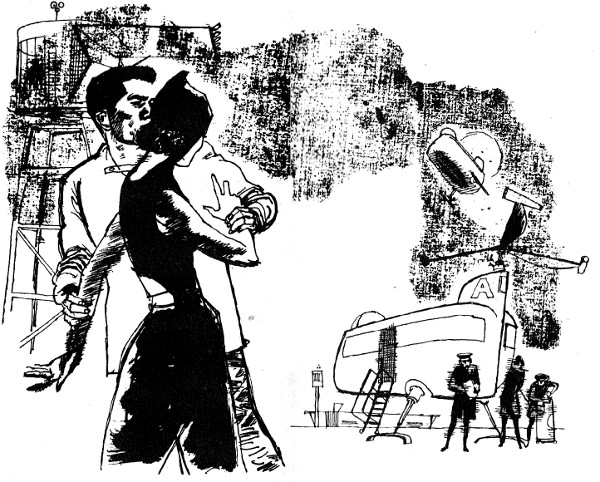
"Rena!" I whispered violently. "Watch out!" The copter was black and purple; it bore on its flank the marking of the Swiss Guard, the Roman police force.
She pressed my hand. "Poor Tom," she said. She walked boldly up to one of the officers lounging beside the copter and spoke briefly to him, too low for me to hear.
It was only when the big vanes overhead had sucked us a hundred yards into the air, and we were leveling off and heading south, that she said: "These are friends too, you see. Does it surprise you?"
I swallowed, staring at the hissing jets at the ends of the swirling vanes. "Well," I said, "I'm not exactly surprised, but I thought that your friends were, well, more likely to be—"
"To be rabble?" I started to protest, but she was not angry. She was looking at me with gentle amusement. "Still you believe, Tom. Deep inside you: An enemy of the Company must be, at the best, a silly zealot like my father and me—and at the worst, rabble." She laughed as I started to answer her. "No, Tom, if you are right, you should not deny it; and if you are wrong—you will see."
I sat back and stared, disgruntled, at the purple sunset over the Mediterranean. I never saw such a girl for taking the wind out of your sails.
Once across the border, the Guards had no status, and it was necessary for them to swing inland, threading through mountains and passes, remaining as inconspicuous as possible.
It was little more than an hour's flight until I found landmarks I could recognize. To our right was the bright bowl of Naples; far to our left, the eerie glow that, marked bombed-out New Caserta. And ahead, barely visible, the faint glowing plume that hung over Mount Vesuvius.
Neither Rena nor the Guards spoke, but I could feel in their tense attitudes that this was the danger-point. We were in the lair of the enemy. Undoubtedly we were being followed in a hundred radars, and the frequency-pattern would reveal our copter for what it was—a Roman police plane that had no business in that area. Even if the Company let us pass, there was always the chance that some Neapolitan radarman, more efficient, or more anxious for a promotion, than his peers would alert an interceptor and order us down. Certainly, in the old days, interception would have been inevitable; for Naples had just completed a war, and only short weeks back an unidentified aircraft would have been blasted out of the sky.
But we were ignored.
And that, I thought to myself, was another facet to the paradox. For when, in all the world's years before these days of the Company, was there such complacency, such deep-rooted security, that a nation just out of a war should have soothed its combat-jangled nerves overnight? Perhaps the Company had not ended wars. But the fear of wars was utterly gone.
We fluttered once around the volcano, and dipped in to a landing on a gentle hump of earth halfway up its slope, facing Naples and the Bay. We were a few hundred yards from a cluster of buildings—perhaps a dozen, in all.
I jumped out, stumbling and recovering myself. Rena stepped lightly into my arms. And without a word, the Guards fed fuel to the jets, the rotor whirled, and the copter lifted away from us and was gone.
Rena peered about us, getting her bearings. There was a sliver of a moon in the eastern sky, enough light to make it possible to get about. She pointed to a dark hulk of a building far up the slope. "The Observatory. Come, Tom."
The volcanic soil was rich, but not very useful to farmers. It was not only the question of an eruption of the cone, for that sort of hazard was no different in kind than the risk of hailstorm or drought. But the mountain sides did not till easily, its volcanic slopes being perhaps steeper than those of most mountains.
The ground under our feet had never been in cultivation. It was pitted and rough, and grown up in a tangle of unfamiliar weeds. And it was also, I discovered with considerable shock, warm to the touch.
I saw a plume of vapor, faintly silver in the weak light, hovering over a hummock. Mist, I thought. Then it occurred to me that there was too much wind for mist. It was steam! I touched the soil. Blood heat, at least.
I said, with some difficulty, "Rena, look!"
She laughed. "Oh, it is an eruption, Tom. Of course it is. But not a new one. It is lava, you see, from the little blast the Sicilians touched off. Do not worry about it...."
We clambered over the slippery cogs of a funicular railway and circled the ancient stone base of the building she had pointed to. There was no light visible; but Rena found a small door, rapped on it and presently it opened.
Out of the darkness came Slovetski's voice: "Welcome."
Once this building had been the Royal Vulcanological Observatory of the Kingdom of Italy. Now it was a museum on the surface, and underneath another of the hideouts of Rena's "friends."
But this was a hideout somewhat more important than the one in the Roman Catacombs, I found. Slovetski made no bones about it.
He said, "Wills, you shouldn't be here. We don't know you. We can't trust you." He held up a hand. "I know that you rescued dell'Angela. But that could all be an involved scheme of the Company. You could be a Company spy. You wouldn't be the first, Wills. And this particular installation is, shall I say, important. You may even find why, though I hope not. If we hadn't had to move so rapidly, you would never have been brought here. Now you're here, though, and we'll make the best of it." He looked at me carefully, then, and the glinting spark in the back of his eyes flared wickedly for a moment. "Don't try to leave. And don't go anywhere in this building where Rena or dell'Angela or I don't take you."
And that was that. I found myself assigned to the usual sort of sleeping accommodations I had come to expect in this group. Underground—cramped—and a bed harder than the Class-C Blue Heaven minimum.
The next morning, Rena breakfasted with me, just the two of us in a tower room looking down over the round slope of Vesuvius and the Bay beneath. She said: "The museum has been closed since the bomb landed near, so you can roam around the exhibits if you wish. There are a couple of caretakers, but they're with us. The rest of us will be in conference. I'll try to see you for lunch."
And she conducted me to an upper level of the Observatory and left me by myself. I had my orders—stay in the public area of the museum. I didn't like them. I wasn't used to being treated like a small boy, left by his mother in a Company day nursery while she busied herself with the important and incomprehensible affairs of adults.
Still, the museum was interesting enough, in a way. It had been taken over by the Company, it appeared, and although the legend frescoed around the main gallery indicated that it was supposed to be a historical museum of the Principality of Naples, it appeared by examination of the exhibits that the "history" involved was that of Naples vis-a-vis the Company.
Not, of course, that such an approach was entirely unfair. If it had not been for the intervention of the Company, after the Short War, it is more than possible that Naples as an independent state would never have existed.
It was the Company's insistence on the dismantling of power centers (as Millen Carmody himself had described it) that had created Naples and Sicily and Prague and Quebec and Baja California and all the others.
Only the United States had been left alone—and that, I think, only because nobody dared to operate on a wounded tiger. In the temper of the nation after the Short War, the Company would have survived less than a minute if it had proposed severing any of the fifty-one states....
The museum was interesting enough, for anyone with a taste for horrors. It showed the changes in Neapolitan life over the past century or so. There was a reconstruction of a typical Neapolitan home of the early Nineteen-forties: a squalid hovel, packed ten persons to the room, with an American G.I., precursor of the Company expediters, spraying DDT into the bedding. There was, by comparison, a typical Class-B Blue Heaven modern allotment—with a certain amount of poetic license; few Class-B homes really had polyscent showers and auto-cooks.
It was the section on warfare, however, that was most impressive. It was in the far back of the building, in a large chamber anchored to bedrock. It held a frightening display of weapons, from a Tiger Tank to a gas-gun. Bulking over everything else in the room, even the tank, was the thirty-foot height of a Hell-bomb in a four-story display. I looked at it a second time, vaguely disturbed by something I hadn't quite placed—an indigo gleam to the metal of the warhead, with a hint of evil under its lacquered sheen....
It was cobalt. I bent to read the legend: This is the casing of the actual cobalt bomb that would have been used on Washington if the Short War had lasted one more day. It is calculated that, loaded with a Mark XII hydrogen-lithium bomb, sufficient radioactive Cobalt-60 would have been transmuted to end all life on Earth within thirty days.
I looked at it again, shuddering.
Oh, it was safe enough now. Until the hydrogen reaction could turn the ordinary cobalt sheathing into the deadly isotope-60, it was just such stuff as was used to alloy magnets and make cobalt glass. It was even more valuable as a museum piece than as the highly purified metal.
Score one for the Company. They'd put a stop to that danger. Nobody would have a chance to arm it and send it off now. No small war would find it more useful than the bomb it would need—and no principality would risk the Company's wrath in using it. And while the conspiracy might have planes and helicopters, the fissionable material was too rigidly under Company control for them to have a chance. The Super Hell-bomb would never go off. And that was something that might mean more to the Company's credit than anything else.
Maybe it was possible that in this controversy both sides were right. And, of course, there was the obvious corollary.
I continued my wandering, looking at the exhibits, the rubble of the museum's previous history. The cast of the Pompeiian gladiator, caught by the cinder-fall in full flight, his straining body reproduced to every contorted line by the incandescent ashes that had encased him. The carefully chipped and labeled samples from the lava flows of the past two centuries. The awe-inspiring photographs of Vesuvius in eruption.
But something about the bomb casing kept bothering me. I wandered around a bit longer and then turned back to the main exhibit. The big casing stretched upward and downward, with narrow stairs leading down to the lower level at its base. It was on the staircase I'd noticed something before. Now I hesitated, trying to spot whatever it was. There was a hint of something down there. Finally, I shrugged and went down to inspect it more closely.
Lying at the base was a heavy radiation glove. A used, workman's glove, dirty with grease. And as my eyes darted up, I could see that the bolts on the lower servicing hatches were half-unscrewed.
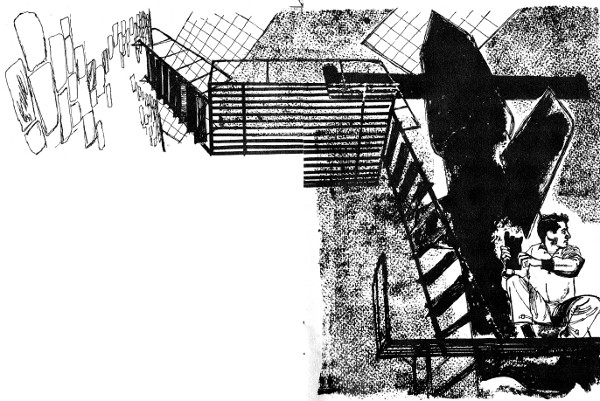
Radiation gloves and tampering with the casing!
There were two doors to the pit for the bomb casing, but either one was better than risking the stairs again where someone might see me. Or so I figured. If they found I'd learned anything....
I grabbed for the nearer door, threw it open. I knew it was a mistake when the voice reached my ears.
"—after hitting the Home office with a Thousand-kiloton bomb. It's going to take fast work. Now the schedule I've figured out so far—God's damnation! How did you get in here, Wills?"
It was Slovetski, leaning across a table, staring at me. Around the table were Benedetto and four or five others I did not recognize. All of them looked at me as though I were the Antichrist, popped out of the marble at St. Peter's Basilica on Easter Sunday.
The spark was a raging flame in Slovetski's eyes. Benedetto dell'Angela said sharply, "Wait!" He strode over to me, half shielding me from Slovetski. "Explain this, Thomas," he demanded.
"I thought this was the hall door," I stammered, spilling the first words I could while I tried to find any excuse....
"Wills! I tell you, answer me!"
I said, "Look, did you expect me to carry a bell and cry unclean? I didn't mean to break in. I'll go at once...."
In a voice that shook, Slovetski said: "Wait one moment." He pressed a bell-button on the wall; we all stood there silent, the five of them staring at me, me wishing I was dead.
There was a patter of feet outside, and Rena peered in. She saw me and her hand went to her heart.
"Tom! But—"
Slovetski said commandingly, "Why did you permit him his liberty?"
Rena looked at him wide-eyed. "But, please, I asked you. You suggested letting him study the exhibits."
Benedetto nodded. "True, Slovetski," he said gravely. "You ordered her to attend until our—conference was over."
The flame surged wildly in Slovetski's eyes—not at me. But he got it under control. He said, "Take him away." He did not do me the courtesy of looking my way again. Rena took me by the hand and led me off, closing the door behind us.
As soon as we were outside, I heard a sharp babble of argument, but I could make out no words through the door. I didn't need to; I knew exactly what they were saying.
This was the proposition: Resolved, that the easiest thing to do is put Wills out of the way permanently. And with Slovetski's fiery eyes urging the positive, what eager debater would say him nay?
Rena said: "I can't tell you, Tom. Please don't ask me!"
I said, "This is no kid's game, Rena! They're talking about bombing the Home Office!"
She shook her head. "Tom, Tom. You must have misunderstood."
"I heard them!"
"Tom, please don't ask me any more questions."
I slammed my hand down on the table and swore. It didn't do any good. She didn't even look up from the remains of her dinner.
It had been like that all afternoon. The Great Ones brooded in secret. Rena and I waited in her room, until the museum's public visiting hours were over and we could go up into the freer atmosphere of the reception lounge. And then we waited there.
I said mulishly: "Ever since I met you, Rena, I've been doing nothing but wait. I'm not built that way!"
No answer.
I said, with all of my patience: "Rena, I heard them talking about bombing the Home Office. Do you think I am going to forget that?"
Leadenly: "No, Tom."
"So what does it matter if you tell me more? If I cannot be trusted, I already know too much. If I can be trusted, what does it matter if I know the rest?"
Again tears. "Please don't ask me!"
I yelled: "At least you can tell me what we're waiting for!"
She dabbed at her eyes. "Please, Tom, I don't know much more than you do. Slovetski, he is like this sometimes. He gets, I suppose you would say, thoughtful. He concentrates so very much on one thing, you see, that he forgets everything around him. It is possible that he has forgotten that we are waiting. I don't know."
I snarled, "I'm tired of this. Go in and remind him!"
"No, Tom!" There was fright in her voice; and I found that she had told me one of the things I wanted to know. If it was not wise to remind Slovetski that I was waiting his pleasure, the probability was that it would not be pleasant for me when he remembered.
I said, "But you must know something, Rena. Don't you see that it could do no harm to tell me?"
She said miserably, "Tom, I know very little. I did not—did not know as much as you found out." I stared at her. She nodded. "I had perhaps a suspicion, it is true. Yes, I suspected. But I did not really think, Tom, that there was a question of bombing. It is not how we were taught. It is not what Slovetski promised, when we began."
"You mean you didn't know Slovetski was planning violence?"
She shook her head. "And even now, I think, perhaps you heard wrong, perhaps there was a mistake."
I stood up and leaned over her. "Rena, listen to me. There was no mistake. They're working on that casing. Tell me what you know!"
She shook her head, weeping freely.
I raged: "This is asinine! What can there be that you will not tell? The Company supply base that Slovetski hopes to raid to get a bomb? The officers he plans to bribe, to divert some other nation's quota of plutonium?"
She took a deep breath. "Not that, Tom."
"Then what? You don't mean to say that he has a complete underground separator plant—that he is making his own plutonium!"
She was silent for a long time, looking at me. Then she sighed. "I will tell you, Tom. No, he does not have a plant. He doesn't need one, you see. He already has a bomb."
I straightened. "That's impossible."
She was shaking her head. I protested, "But the—the quotas, Rena. The Company tracks every milligram of fissionable material from the moment it leaves the reactor! The inspections! Expediters with Geiger counters cover every city in the world!"
"Not here, Tom. You remember that the Sicilians bombed Vesuvius? There is a high level of radioactivity all up and down the mountain. Not enough to be dangerous, but enough to mask a buried bomb." She closed her eyes. "And—well, you are right, Tom. I might as well tell you. In that same war, you see, there was a bomb that did not explode. You recall?"
"Yes, but—"
"But it couldn't explode, Tom. It was a dummy. Slovetski is a brilliant man. Before that bomb left the ground, he had diverted it. What went up was a hollow shell. What is left—the heart of the bomb—is buried forty feet beneath us."
I stared at her, the room reeling. I was clutching at straws. I whispered, "But that was only a fission bomb, Rena. Slovetski—I heard him—he said a Thousand-kiloton bomb. That means hydrogen, don't you see? Surely he hasn't tucked one of those away."
Rena's face was an agony of regret. "I do not understand all these things, so you must bear with me. I know this; there has been secret talk about the Milanese generators, and I know that the talk has to do with heavy water. And I am not stupid altogether, I know that from heavy water one can get what is used in a hydrogen bomb. And there is more, of course—lithium, perhaps? But he has that. You have seen it, I think. It is on a pedestal in this building."
I sat down hard. It was impossible. But it all fell into place. Given the fissionable core of the bomb—plus the deuterium, plus the lithium-bearing shell—it was no great feat to put the parts together and make a Hell-bomb.
The mind rejected it; it was too fantastic. It was frightful and terrifying, and worst of all was that something lurking at the threshold of memory, something about that bomb on display in the museum....
And, of course, I remembered.
"Rena!" I said, struggling for breath. I nearly could not go on, it was too dreadful to say. "Rena! Have you ever looked at that bomb? Have you read the placard on it? That bomb is cobalt!"
XI
From the moment I had heard those piercing words from Slovetski's mouth, I had been obsessed with a vision. A Hell-bomb on the Home Office. America's eastern seaboard split open. New York a hole in the ocean, from Kingston to Sandy Hook; orange flames spreading across Connecticut and the Pennsylvania corner.
That was gone—and in its place was something worse.
Radiocobalt bombing wouldn't simply kill locally by a gout of flaring radiation. It would leave the atmosphere filled with colloidal particles of deadly, radioactive Cobalt-60. A little of that could be used to cure cancers and perform miracles. The amount released from the sheathing of cobalt—normal, "safe" cobalt—around a fissioning hydrogen bomb could kill a world. A single bomb of that kind could wipe out all life on Earth, as I remembered my schooling.
I'm no physicist; I didn't know what the quantities involved might mean, once the equations came off the drafting paper and settled like a ravening storm on the human race. But I had a glimpse of radioactive dust in every breeze, in every corner of every land. Perhaps a handful of persons in Cambodia or Vladivostok or Melbourne might live through it. But there was no question in my mind: If that bomb went off, it was the end of our civilization.
I saw it clearly.
And so, having betrayed the Company to Slovetski's gang, I came full circle.
Even Judas betrayed only One.
Getting away from the Observatory was simple enough, with Rena shocked and confused enough to look the other way. Finding a telephone near Mount Vesuvius was much harder.
I was two miles from the mountain before I found what I was looking for—a Blue Wing fully-automatic filling station. The electronic scanners clucked worriedly, as they searched for the car I should have been driving, and the policy-punching slot glowed red and receptive, waiting for my order. I ignored them.
What I wanted was inside the little unlocked building—A hushaphone-booth with vision attachment. The important thing was to talk direct to Defoe and only to Defoe. In the vision screen, impedance mismatch would make the picture waver if there was anyone uninvited listening in.
But I left the screen off while I put through my call. The office servo-operator (it was well after business hours) answered blandly, and I said: "Connect me with Defoe, crash priority."
It was set to handle priority matters on a priority basis; there was neither fuss nor argument, though a persistent buzzing in the innards of the phone showed that, even while the robot was locating Defoe for me, it was double-checking the connection to find out why there was no vision on the screen.
It said briskly, "Stand by, sir," and I was connected with Defoe's line—on a remote hookup with the hotel where he was staying, I guessed. I flicked the screen open.
But it wasn't Defoe on the other end of the line. It was Susan Manchester, with that uncharacteristic, oddly efficient look she had shown at the vaults.
She said crisply, and not at all surprised: "Tom Wills."
"That's right," I said, thinking quickly. Well, it didn't much matter. I should have realized that Defoe's secretary, howsoever temporary, would be taking his calls. I said rapidly: "Susan, I can't talk to you. It has to be Defoe. Take my word for it, it's important. Please put him on."
She gave me no more of an argument than the robot had.
In a second, Defoe was on the screen, and I put Susan out of my mind. She must have said something to him, because the big, handsome face was unsurprised, though the eyes were contracted. "Wills!" he snapped. "You fool! Where are you?"
I said, "Mr. Defoe, I have to talk to you. It's a very urgent matter."
"Come in and do it, Wills! Not over the telephone."
I shook my head. "No, sir. I can't. It's too, well, risky."
"Risky for you, you mean!" The words were icily disgusted. "Wills, you have betrayed me. No man ever got away with that. You're imposing on me, playing on my family loyalty to your dead wife, and I want to tell you that you won't get away with it. There's a murder charge against you, Wills! Come in and talk to me—or else the police will pick you up before noon."
I said with an effort, "I don't mean to impose on any loyalty, but, in common decency, you ought to hear—"
"Decency!" His face was cold. "You talk about decency! You and that dell'Angela traitor you joined. Decency! Wills, you're a disgrace to the memory of a decent and honest woman like Marianna. I can only say that I am glad—glad, do you hear me?—that she's dead and rid of you."
I said, "Wait a minute, Defoe! Leave Marianna out of this. I only—"
"Don't interrupt me! God, to think a man I trusted should turn out to be Judas himself! You animal, the Company has protected you from the day you were born, and you try to destroy it. Why, you pitiful idiot, you aren't fit to associate with the dogs in the kennel of a decent human being!"
There was more. Much, much more. It was a flow of abuse that paralyzed me, less because of what he said than because of who was saying it. Suave, competent Defoe, ranting at me like a wounded Gogarty! I couldn't have been more astonished if the portrait of Millen Carmody had whispered a bawdy joke from the frontispiece of the Handbook.
I stood there, too amazed to be furious, listening to the tirade from the midget image in the viewplate. It must have lasted for three or four minutes; then, almost in mid-breath, Defoe glanced at something outside my range of vision, and stopped his stream of abuse. I started to cut in while I could, but he held up one hand quickly.
He smiled gently. Very calmly, as though he had not been damning me a moment before, he said: "I shall be very interested to hear what you have to say."
That floored me. It took me a second to shake the cobwebs out of my brain before I said waspishly, "If you hadn't gone through all that jabber, you would have heard it long ago."
The midget in the scanner shrugged urbanely. "True," he conceded. "But then, Thomas, I wouldn't have had you."
And he reached forward and clicked off the phone. Tricked! Tricked and trapped! I cursed myself for stupidity. While he kept me on the line, the call was being traced—there was no other explanation. And I had fallen for it!
I slapped the door of the booth open and leaped out.
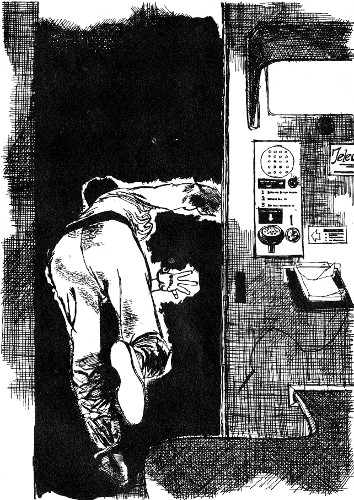
I got perhaps ten feet from the booth.
Then a rope dropped over my shoulders. Its noose yanked tight around my arms, and I was being dragged up, kicking futilely. I caught a glimpse of the broad Latin faces gaping at me from below, then two men on a rope ladder had me.
I was dragged in through the bottom hatch of a big helicopter with no markings. The hatch closed. Facing me was a lieutenant of expediters.
The two men tumbled in after me and reeled in the rope ladder, as the copter dipped and swerved away. I let myself go limp as the rope was loosened around me; when my hands were free I made my bid.
I leaped for the lieutenant; my fist caught him glancingly on the throat, sending him reeling and choking backward. I grabbed for the hard-pellet gun at his hip—he was pawing at it—and we tumbled across the floor.
It was, for one brief moment, a chance. I was no copter pilot, but the gun was all the pilot I'd need—if only I got it out.
But the expediters behind me were no amateurs. I ducked as the knotted end of the rope whipped savagely toward me. Then one of the other expediters was on my back; the gun came out, and flew free. And that was the end of that.
I had, I knew, been a fool to try it. But I wasn't sorry. They had too much rough-and-tumble training for me to handle. But that one blow had felt good.
It didn't seem as worth while a few moments later. I was fastened to a seat, while the wheezing lieutenant gave orders in a strangled voice. "Not too many marks on him," he was saying. "Try it over the kidneys again...."
I never even thought of maintaining a heroic silence. They had had plenty of experience with the padded club, too, and I started to black out twice before finally I went all the way down.
I came to with a light shining in my eyes.
There was a doctor putting his equipment away. "He'll be all right, Mr. Defoe," he said, and snapped his bag shut and left the circle of light.
I felt terrible, but my head was clearing.
I managed to focus my eyes. Defoe was there, and a couple of other men. I recognized Gogarty, looking sick and dejected, and another face I knew—it was out of my Home Office training—an officer whose name I didn't recall, wearing the uniform of a lieutenant-general of expediters. That meant at least an expediter corps in Naples!
I said weakly, "Hi."
Defoe stood over me. He said, "I'm very glad to see you, Thomas. Coffee?"
He steadied my hands as I gulped it. When I had managed a few swallows, he took the cup away.
"I did not think you would resist arrest, Thomas," he said in a parental tone.
I said, "Damn it, you didn't have to arrest me! I came down here of my own free will!"
"Down?" His eyebrows rose. "Down from where do you mean, Thomas?"
"Down from Mount—" I hesitated, then finished. "All right. Down from Mount Vesuvius. The museum, where I was hiding out with the ringleaders of the anti-Company movement. Is that what you want to know?"
Defoe crackled: "Manning!" The lieutenant-general saluted and left the room. Defoe said, "That was the first thing I wanted, yes. But now I want much more. Please begin talking, Thomas. I will listen."
I talked. There was nothing to stop me. Even with my body a mass of aches and pains from the tender care of the Company's expediters, I still had to side with the Company in this. For the Cobalt-bomb ended all loyalties.
I left nothing important out, not even Rena. I admitted that I had taken Benedetto from the clinic, how we had escaped to Rome, how we had fled to Vesuvius ... and what I had learned. I made it short, skipping a few unimportant things like Zorchi.
And Defoe sat sipping his coffee, listening, his warm eyes twinkling.
I stopped. He pursed his lips, considering.
"Silly," he said at last.
"Silly? What's silly!"
He said, "Thomas, I don't care about your casual affairs. And I would have excused your—precipitousness—since you have brought back certain useful information. Quite useful. I don't deny it. But I don't like being lied to, Thomas."
"I haven't lied!"
He said sharply, "There is no way to get fissionable material except through the Company!"
"Oh, hell!" I shook my head. "How about a dud bomb, Defoe?"
For the first time he looked puzzled. "Dud bomb?"
Gogarty looked sick. "There's—there's a report on your desk, Mr. Defoe," he said worriedly. "We—well—figured the half-masses just got close enough to boil instead of to explode. We—"
"I see." Defoe looked at him for a long moment. Then, disregarding Gogarty, he turned back to me, shoved the coffee at me. "All right, Thomas. They've got the warhead. Hydrogen? Cobalt? What about fuel?"
I told him what I knew. Gogarty, listening, licked his lips. I didn't envy him. I could see the worry in him, the fear of Defoe's later wrath. For in Defoe, as in Slovetski, there was that deadly fire. It blazed only when it was allowed to; but what it touched withered and died. I had not seen Defoe as tightly concentrated, as drivingly intent, before. I was sorry for Gogarty when at last, having drained me dry, Defoe left. But I was glad for me.
He was gone less than an hour—just time for me to eat a Class-C meal a silent expediter brought.
He thrust the door open and stared at me with whitely glaring eyes. "If I thought you were lying, Thomas ..." His voice was cracking with suppressed emotion.
"What happened?" I demanded.
"Don't you know?" He stood trembling, staring at me. "You told the truth—or part of the truth. There was a hideout on Vesuvius. But an hour ago they got away—while you were wasting time. Was it a stall, Thomas? Did you know they would run?"
I said, "Defoe, don't you see, that's all to the good? If they had to run, they couldn't possibly take the bomb with them. That means—"
He was shaking head. "Oh, but you're wrong, Thomas. According to the director of the albergo down the hill, three skyhook helicopters came over—big ones. They peeled the roof off, as easy as you please, and they lifted the bomb out and then flew away."
I said stupidly, "Where?" He nodded. There was no emotion in his voice, only in his eyes. He might have been discussing the weather. "Where? That is a good question. I hope we will find it out, Thomas. We're checking the radar charts; they can't hide for long. But how did they get away at all? Why did you give them the time?"
He left me. Perversely, I was almost glad. It was part of the price of switching allegiance, I was learning, that shreds and tatters of loyalties cling to you and carry over. When I went against the Company to rescue Benedetto, I still carried with me my Adjusters' Handbook. And I confess that I never lost the habit of reading a page or two in it, even in the Catacombs, when things looked bad. And when I saw the murderous goal that Slovetski's men were marching toward, and I returned to Defoe, I still could feel glad that Benedetto, at least, had got away.
But not far.
It was only a few hours, but already broad daylight when Gogarty, looking shaken, came into the room. He said testily, "Damn it, Wills, I wish I'd never seen you! Come on! Defoe wants you with us."
"Come on where?" I got up as he gestured furiously for haste.
"Where do you think? Did you think your pals would be able to stay out of sight forever? We've got them pinpointed, bomb and all."
He was almost dragging me down the corridor, toward a courtyard. I limped out into the bright morning and blinked. The court was swarming with armed expediters, clambering into personnel-carrying copters marked with the vivid truce-team insignia of the Company. Gogarty hustled me into the nearest and the jets sizzled and we leaped into the air.
I shouted, over the screaming of the jets, "Where are we going?"
Gogarty spat and pointed down the long purple coastline. "To their hideout—Pompeii!"
XII
No one discussed tactics with me, but it was clear that this operation was carefully planned. Our copter was second in a long string of at least a dozen that whirled down the coastline, past the foothills of Vesuvius, over the clusters of fishing villages and vineyards.
I had never seen Pompeii, but I caught a glimpse of something glittering and needle-nosed, up-thrust in the middle of a cluster of stone buildings that might have been the ruins.
Then the first ten of the copters spun down to a landing, while two or three more flew a covering mission overhead.
The expediters, hard-pellet guns at the ready, leaped out and formed in a skirmish line. Gogarty and a pair of expediters stayed close by me, behind the line of attack; we followed the troops as they dog-trotted through a field of some sort of grain, around fresh excavations, down a defile into the shallow pit that held the ruins of first-century Pompeii.
I had no time for archeology, but I remember tripping over wide, shallow gutters in the stone-paved streets, and cutting through a tiny villa of some sort whose plaster walls still were decorated with faded frescoes.
Then we heard the spatter of gunfire and Gogarty, clutching at me, skidded to a halt. "This is specialist work," he panted. "Best thing we can do is stay out of it."
I peered around a column and saw a wide open stretch. Beyond it was a Roman arch and the ruined marble front of what once had been a temple of some sort; in the open ground lay the three gigantic copters Defoe had mentioned.
The vanes of one of them were spinning slowly, and it lurched and quivered as someone tried to get it off the ground under fire. But the big thing was in the middle of the area: The bomb, enormous and terrifying as its venomous nose thrust up into the sky. By its side was a tank truck, the side of it painted with the undoubtedly untrue legend that it contained crude olive oil. Hydrazine, more likely!
Hoses connected it with the base of the guided-missile bomb; and a knot of men were feverishly in action around it, some clawing desperately at the fittings of the bomb, some returning the skirmish fire of the expediters.
We had the advantage of surprise, but not very much of that. From the top of the ancient temple a rapid-fire pellet gun sprayed into the flank of the skirmish line, which immediately broke up as the expediters leaped for cover.
One man fell screaming out of the big skyhook copter, but someone remained inside, for it lurched and dipped and roared crazily across the field in as ragged a take-off as I ever saw, until its pilot got it under control. It bobbed over the skirmish line under fire, but returning the fire as whatever few persons were inside it leaned out and strafed the expediters. Then the skyhook itself came under attack as the patrol copters swooped in.
The big ship staggered toward the nearest of them. It must have been intentional: We could see the faint flare of muzzle-blast as the two copters fired on each other; they closed, and there was a brutal rending noise as they collided. They were barely a hundred feet in the air; they crashed in a breath, and flames spread out from the wreckage.
And Slovetski's resources still had not run out. There was a roar and a screech of metal, and a one-man cobra tank slithered out of one of the buildings and came rapidly across the field toward the expediters.
Gogarty, beside me, was sobbing with fear; that little tank carried self-loading rockets. It blasted a tiny shrine into rubble, spun and came directly toward us.
We ran. I didn't even see the second expediter aircraft come whirling in and put the cobra tank out of action with its heavy weapons. I heard the firing, but it was swallowed up in a louder screaming roar.
Gogarty stared at me from the drainage trench we had flung ourselves into. We both leaped up and ran back toward the open field.
There was an explosion as we got there—the fake "olive-oil" truck, now twenty yards from the bomb, had gone up in a violent blast. But we hardly noticed. For at the base of the bomb itself red-purple fire was billowing out. It screamed and howled and changed color to a blinding blue as the ugly squat shape danced and jiggled. The roar screamed up from a bull-bass to a shrieking coloratura and beyond as the bomb lifted and gained speed and, in the blink of an eye, was gone.
I hardly noticed that the sound of gunfire died raggedly away. We were not the only ones staring unbelievingly at the sky where that deadly shape had disappeared. Of the scores of men on both sides in that area, not a single eye was anywhere else.
The bomb had been fueled; we were too late. Its servitors, perhaps at the cost of their own lives, had torched it off. It was on its way.
The cobalt bomb—the single weapon that could poison the world and wipe out the human race—was on its way.
XIII
What can you do after the end? What becomes of any plot or plan, when an indigo-gleaming missile sprays murder into the sky and puts a period to planning?
I do not think there ever was a battlefield as abruptly quiet as that square in old Pompeii. Once the bomb had gone, there was not a sound. The men who had been firing on each other were standing still, jaws hanging, eyes on the sky.
But it couldn't last. For one man was not surprised; one man knew what was happening and was ready for it.
A crouching figure at the top of the ruined temple gesticulated and shouted through a power-megaphone: "Give it up, Defoe! You've lost, you've lost!" It was Slovetski, and beside him a machine-gun crew sighted in on the nearest knot of expediters.
Pause, while the Universe waited. And then his answer came; it was a shot that screamed off a cracked capital, missing him by millimeters. He dropped from sight, and the battle was raging.
Human beings are odd. Now that the cause of the fight was meaningless, it doubled in violence. There were fewer than a hundred of Slovetski's men involved, and not much more than that many expediters. But for concentrated violence I think they must have overmatched anything in the Short War's ending.
I was a non-combatant; but the zinging of the hard-pellet fire swarmed all around me. Gogarty, in his storm sewer, was safe enough, but I was more exposed. While the rapid-fire weapons pattered all around me, I jumped up and zigzagged for the shelter of a low-roofed building.
The walls were little enough protection, but at least I had the illusion of safety. Most of all, I was out of sight.
I wormed my way through a gap in the wall to an inner chamber. It was as tiny a room as ever I have been in; less than six feet in its greatest dimension—length—and with most of its floor area taken up by what seemed to be a rude built-in bed. Claustrophobia hit me there; the wall on the other side was broken too, and I wriggled through.
The next room was larger; and it was occupied.
A man lay, panting heavily, in a corner. He pushed himself up on an elbow to look at me. In a ragged voice he said: "Thomas!" And he slumped back, exhausted by the effort, blood dripping from his shirt.
I leaped over to the side of Benedetto dell'Angela. The noise of the battle outside rose to a high pitch and dwindled raggedly away.
I suppose it was inertia that kept me going—certainly I could see with my mind's vision no reason to keep struggling. The world was at an end. There was no reason to try again to escape from the rubber hoses of the expediters—and, after I had seen the resistance end, and an expediter-officer appeared atop the temple where Slovetski had shouted his defiance, no possibility of rejoining the rebels.
Without Slovetski, they were lost.
But I kept on.
Benedetto helped. He knew every snake-hole entrance and exit of all the hideouts of Slovetski's group. They had not survived against the strength of the Company without acquiring skill in escape routes; and here, too, they had a way out. It required a risky dash across open ground but, even with Benedetto on my back, I made it.
And then we were in old Pompeii's drainage sewer, the arched stone tunnel that once had carried sewage from the Roman town to the sea. It was a hiding place, and then a tunnel to freedom, for the two of us.
We waited there all of that day, Benedetto mumbling almost inaudibly beside me. In lucid moments, he told me the name of the hotel where Rena had gone when the Observatory was abandoned, but there seemed few lucid moments. Toward evening, he began to recover.
We found our way to the seashore just as darkness fell. There was a lateen-rigged fishing vessel of some sort left untended. I do not suppose the owner was far away, but he did not return in time to stop us.
Benedetto was very weak. He was muttering to himself, words that I could hardly understand. "Wasted, wasted, wasted," was the burden of his complaint. I did not know what he thought was wasted—except, perhaps, the world.
We slipped in to one of the deserted wharves under cover of darkness, and I left Benedetto to find a phone. It was risky, but what risk mattered when the world was at an end?
Rena was waiting at the hotel. She answered at once. I did not think the call had been intercepted—or that it would mean anything to anyone if it had. I went back to the boat to wait with Benedetto for Rena to arrive, in a rented car. We didn't dare chance a cab.
Benedetto was sitting up, propped rigidly against the mast, staring off across the water. Perhaps I startled him as I came to the boat; he turned awkwardly and cried out weakly.
Then he saw that it was I. He said something I could not understand and pointed out toward the west, where the Sun had gone down long before.
But there was still light there—though certainly not sunset.
Far off over the horizon was a faint glow! I couldn't understand at first, since I was sure the bomb had been zeroed-in on the Home Offices in New York; but something must have happened. From that glow, still showing in the darkness so many hours after the explosion as the dust particles gleamed bluely, it must have gone off over the Atlantic.
There was no doubt in my mind any longer. The most deadly weapon the world had ever known had gone off!
XIV
The hotel was not safe, of course, but what place was when the world was at an end? Rena and I, between us, got her father, Benedetto, upstairs into her room without attracting too much attention. We put him on the bed and peeled back his jacket.
The bullet had gone into his shoulder, a few inches above the heart. The bone was splintered, but the bleeding was not too much. Rena did what she could and, for the first time in what seemed like years, we had a moment's breathing space.
I said, "I'll phone for a doctor."
Benedetto said faintly, "No, Thomas! The Company!"
I protested, "What's the difference? We're all dead, now. You've seen—" I hesitated and changed it. "Slovetski has seen to that. There was cobalt in that bomb."
He peered curiously at me. "Slovetski? Did you suppose it was Slovetski who planned it so?" He shook his head—and winced at the pain. He whispered, "Thomas, you do not understand. It was my project, not Slovetski's. That one, he proposed to destroy the Company's Home Office; it was his thought that killing them would bring an end to evil. I persuaded him there was no need to kill—only to gamble."
I stared at him. "You're delirious!"
"Oh, no." He shook his head and succeeded in a tiny smile. "Do you not see it, Thomas? The great explosion goes off, the world is showered with particles of death. And then—what then?"
"We die!"
"Die? No! Have you forgotten the vaults of the clinics?"
It staggered me. I'd been reciting all the pat phrases from early schooling about the bomb! If it had gone off in the Short War, of course, it would have ended the human race! But I'd been a fool.
The vaults had been built to handle the extreme emergencies that couldn't be foreseen—even one that knocked out nearly the whole race. They hadn't expected that a cobalt-cased bomb would ever be used. Only the conspirators would have tried, and how could they get fissionables? But they were ready for even that. I'd been expecting universal doom.
"The clinics," Benedetto repeated as I stared at him.
It was the answer. Even radio-poisons of cobalt do not live forever. Five years, and nearly half of them would be gone; eleven years, and more than three-quarters would be dissipated. In fifty years, the residual activity would be down to a fraction of one per cent—and the human race could come back to the surface.
"But why?" I demanded. "Suppose the Company can handle the population of the whole world? Granted, they've space enough and one year is the same as fifty when you're on ice. But what's the use?"
He smiled faintly. "Bankruptcy, Thomas," he whispered. "So you see, we do not wish to fall into the Company's hands right now. For there is a chance that we will live ... and perhaps the very faintest of chances that we will win!"
It wasn't even a faint chance—I kept telling myself that.
But, if anything could hurt the Company, the area in which it was vulnerable was money. Benedetto had been intelligent in that. Bombing the Home Office would have been an inconvenience, no more. But to disrupt the world's work with a fifty-year hiatus, while the air purged itself of the radioactive cobalt from the bomb, would mean fifty years while the Company lay dormant; fifty years while the policies ran their course and became due.
For that was the wonder of Benedetto's scheme: The Company insured against everything. If a man were to be exposed to radiation and needed to be put away, he automatically went on "disability" benefits, while his policy paid its own premiums!
Multiply this single man by nearly four billion. The sum came out to a bankrupt Company.
It seemed a thin thread with which to strangle a monster. And yet, I thought of the picture of Millen Carmody in my Adjuster's Manual. There was the embodiment of honor. Where a Defoe might cut through the legalities and flout the letter of the agreements, Carmody would be bound by his given word. The question, then, was whether Defoe would dare to act against Carmody.
Everything else made sense. Even exploding the bomb high over the Atlantic: It would be days before the first fall-out came wind-borne to the land, and in those days there would be time for the beginnings of the mass migration to the vaults.
Wait and see, I told myself. Wait and see. It was flimsy, but it was hope, and I had thought all hope was dead.
We could not stay in the hotel, and there was only one place for us to go. Slovetski captured, the Company after our scalps, the whole world about to be plunged into confusion—we had to get out of sight.
It took time. Zorchi's hospital gave me a clue; I tracked it down and located the secretary.
The secretary spat at me over the phone and hung up, but the second time I called him he grudgingly consented to give me another number to call. The new number was Zorchi's lawyer. The lawyer was opaque and uncommunicative, but proposed that I call him back in a quarter of an hour. In a quarter of an hour, I was on the phone. He said guardedly: "What was left in Bay 100?"
"A hypodermic and a bottle of fluid," I said promptly.
"That checks," he confirmed, and gave me a number.
And on the other end of that number I reached Zorchi.
"The junior assassin," he sneered. "And calling for help? How is that possible, Weels? Did my avocatto lie?"
I said stiffly, "If you don't want to help me, say so."
"Oh—" he shrugged. "I have not said that. What do you want?"
"Food, a doctor, and a place for three of us to hide for a while."
He pursed his lips. "To hide, is it?" He frowned. "That is very grave, Weels. Why should I hide you from what is undoubtedly your just punishment?"
"Because," I said steadily, "I have a telephone number. Which can be traced. Defoe doesn't know you've escaped, but that can be fixed!"
He laughed angrily. "Oh-ho. The assassin turns to blackmail, is that it?"
I said furiously, "Damn you, Zorchi, you know I won't turn you in. I only point out that I can—and that I will not. Now, will you help us or not?"
He said mildly, "Oh, of course. I only wished you to say 'please'—but it is not a trick you Company men are good at. Signore, believe me, I perish with loneliness for you and your two friends, whoever they may be. Listen to me, now." He gave me an address and directions for finding it. And he hung up.
Zorchi's house was far outside the city, along the road to New Caserta. It lay at the bend of the main highway, and I suppose I could have passed it a hundred thousand times without looking inside, it was so clearly the white-stuccoed, large but crumbling home of a mildly prosperous peasant. It was large enough to have a central court partly concealed from the road.
The secretary, spectacles and all, met us at the door—and that was a shock. "You must have roller skates," I told him.
He shrugged. "My employer is too forgiving," he said, with ice on his voice. "I had hoped to reach him before he made an error. As you see, I was too late."
We lifted Benedetto off the seat; he was just barely conscious by now, and his face was ivory under the Mediterranean tan. I shook the secretary off and held Benedetto carefully in my arms as Rena held the door before me.
The secretary said, "A moment. I presume the car is stolen. You must dispose of it at once."
I snarled over my shoulder, "It isn't stolen, but the people that own it will be looking for it all right. You get rid of it."
He spluttered and squirmed, but I saw him climbing into the seat as I went inside. Zorchi was there waiting, in a fancy motorized wheelchair. He had legs! Apparently they were not fully developed as yet, but in the short few days since I had rescued him something had grown that looked like nearly normal limbs. He had also grown, in that short time, a heavy beard.
The sneer, however, was the same.
I made the error of saying, "Signore Zorchi, will you call a doctor for this man?"
The thick lips writhed under the beard. "Signore it is now, is it? No longer the freak Zorchi, the case Zorchi, the half-man? God works many miracles, Weels. See the greatest of them all—it has transmuted the dog into a signore!"
I grated, "For God's sake, Zorchi, call a doctor!"
He said coldly, "You mentioned this over the phone, did you not? If you would merely walk on instead of bickering, you would find the doctor already here."
Plasma and antibiotics: They flowed into Benedetto from half a dozen plastic tubes like oil into the hold of a tanker. And I could see, in the moments when I watched, the color come back into his face, and the sunken eyes seem to come back to life.
The doctor gave him a sedative that made him sleep, and explained to us that Benedetto was an old man for such goings-on. But if he could be kept still for three or four weeks, the doctor said, counting the lire Zorchi's secretary paid him, there was no great danger.
If he could be kept still for three or four weeks. In scarcely ten days, the atmosphere of the planet would be death to breathe! Many things might happen to Benedetto in that time, but remaining still was not one of them.
Zorchi retired to his own quarters, once the doctor was gone, and Rena and I left Benedetto to sleep.
We found a television set and turned it on, listening for word of the cobalt-bomb. We got recorded canzoni sung by a reedy tenor. We dialed, and found the Neapolitan equivalent of a soap opera, complete with the wise, fat old mother and the sobbing new daughter-in-law. It was like that on all the stations, while Rena and I stared at each other in disbelief.
Finally, at the regular hourly newscast, we got a flicker: "An unidentified explosion," the announcer was saying, "far out at sea, caused alarm to many persons last night. Although the origins are not known, it is thought that there is no danger. However, there has been temporary disturbance to all long-lines communications, and air travel is grounded while the explosion is being investigated."
We switched to the radio: it was true. Only the UHF television bands were on the air.
I said, "I can't figure that. If there's enough disturbance to ruin long-distance transmission, it ought to show up on the television."
Rena said doubtfully, "I do not remember for sure, Tom, but is there not something about television which limits its distance?"
"Well—I suppose so, yes. It's a line of sight transmission, on these frequencies at any rate. I don't suppose it has to be, except that all the television bands fall in VHF or UHF channels."
"Yes. And then, is it not possible that only the distance transmission is interrupted? On purpose, I mean?"
I slammed my hand on the arm of the chair. "On purpose! The Company—they are trying to keep this thing localized. But the idiots, don't they know that's impossible? Does Defoe think he can let the world burn up without doing anything to stop it—just by keeping the people from knowing what happened?"
She shrugged. "I don't know, Tom."
I didn't know either, but I suspected—and so did she. It was out of the question that the Company, with its infinite resources, its nerve-fibers running into every part of the world, should not know just what that bomb was, and what it would do. And what few days the world had—before the fall-out became dangerous—were none too many.
Already the word should have been spread, and the first groups alerted for movement into the vaults, to wait out the day when the air would be pure again. If it was being delayed, there could be no good reason for it.
The only reason was Defoe. But what, I asked myself miserably, was Millen Carmody doing all this while? Was he going to sit back and placidly permit Defoe to pervert every ideal of the Company?
I could not believe it. It was not possible that the man who had written the inspiring words in the Handbook could be guilty of genocide.
Rena excused herself to look in on her father. Almost ashamed of myself, I took the battered book from my pocket and opened it to check on Millen Carmody's own preface.
It was hard to reconcile the immensely reassuring words with what I had seen. And, as I read them, I no longer felt safe and comforted.
There seemed to be no immediate danger, and Rena needed to get out of that house. There was nothing for Benedetto to do but wait, and Zorchi's servants could help him when it was necessary.
I took her by the arm and we strolled out into the garden, breathing deeply. That was a mistake. I had forgotten, in the inconspicuous air conditioning of Zorchi's home, that we were in the center of the hemp fields that had nearly cost me my dinner, so long ago, with Hammond. I wondered if I ever would know just why Hammond was killed. Playing both ends against the middle, it seemed—he had undoubtedly been in with Slovetski's group. Rena had admitted as much, and I was privately certain that he had been killed by them.
But of more importance was the stench in our nostrils. "Perhaps," said Rena, "across the road, in the walnut grove, it will not be as bad."
I hesitated, but it felt safe in the warm Italian night, and so we tried it. The sharp scent of the walnut trees helped a little; what helped even more was that the turbinates of the nostril can stand just so much, and when their tolerance is exceeded they surrender. So that it wasn't too long before, though the stench was as strong as ever, we hardly noticed it.
We sat against the thick trunk of a tree, and Rena's head fitted naturally against my shoulder. She was silent for a time, and so was I—it seemed good to have silence, after violent struggle and death.
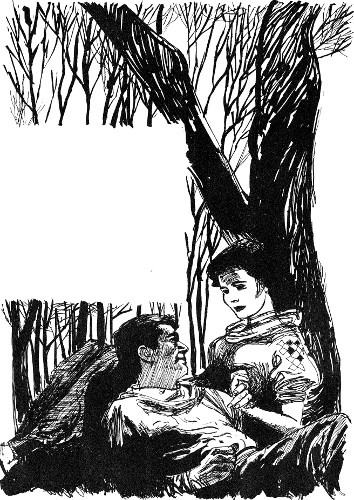
Then she said: "Strange man."
"Me?"
"No. Oh, yes, Tom, if it comes to that, you, too. But I was thinking just now of Zorchi. Is it true, what you told me of his growing legs and arms so freely?"
"I thought everyone in Naples knew that. I thought he was a national hero."
"Of course, but I have never really known that the stories were true. How does it happen, Tom?"
I shrugged. "Heaven knows, I don't. I doubt if even Zorchi knows. His parents might have been involved in some sort of atomic business and got radiated, and so they produced a mutation. It's perfectly possible, you know."
"I have heard so, Tom."
"Or else it just happened. Something in his diet, in the way his glands responded to a sickness, some sort of medicine. No one knows."
"Cannot scientists hope to tell?"
"Well—" it was beginning to sound like the seeds of one of our old arguments—"well, I suppose so. Pure research isn't much encouraged, these days."
"But it should be, you think?"
"Of course it should. The only hope of the world—" I trailed off. Through the trees was a bright, distant glare, and I had just remembered what it was.
"Is what, Tom?"
"There isn't any," I said, but only to myself. She didn't press me; she merely burrowed into my arm.
Perhaps the wind shifted, and the smell of the hemp fields grew stronger; perhaps it was only the foul thought that the glaring sky had triggered that contaminated my mood. But where I had been happy and relaxed—the C-bomb completely out of my mind for the moment—now I was too fully aware of what was ahead for all of us.
"Let's go back, Rena," I said. She didn't ask why. Perhaps she, too, was feeling the weight of our death sentence.
We caught the evening newscast; its story varied little from the early ones.
Benedetto still slept, but Zorchi joined us as we watched it.
The announcer, face stamped with the careful blend of gravity and confidence that marks tele-casters all over the world, was saying: "Late word on the bomb exploded over the North Atlantic indicates that there is some danger that radioactive ash may be carried to this area. The danger zones are now being mapped and surveyed, and residents of all such sections will be evacuated or placed in deep sleep until the danger is over.
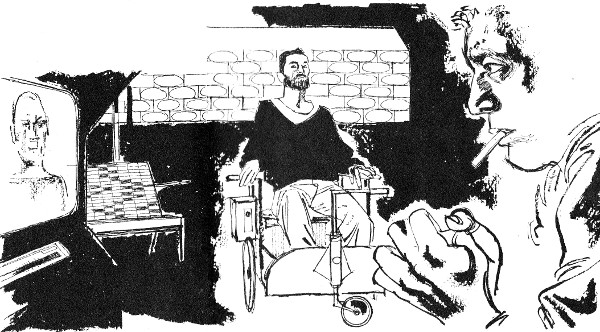
"Blue Bolt policies give you complete protection against all hazards from this explosion. I repeat, Blue Bolt policies give you complete protection against all hazards from this explosion. Check your policies and be sure of your status. There is absolutely no risk for any person carrying the basic Blue Bolt minimum coverage or better."
I clicked off the set. "I wonder what the people in Shanghai are hearing tonight," I said.
Zorchi had only listened without comment, when I told him about the bomb that afternoon; he listened without comment now.
Rena said: "Tom, I've been wondering. You know, I—I don't have any insurance. Neither has my father, since we were canceled. And we're not the only ones without it, either."
I patted her hand. "We'll straighten this out," I promised. "You'll get your coverage back."
She gave me a skeptical look, but shook her head. "I don't mean just about father and me. What about all of the uninsurables, all over the world? The bomb goes off, and everybody with a policy files down into the vaults, but what about the others?"
I explained, "There are provisions for them. Some of them can be cared for under the dependency-clauses in the policies of their next of kin. Others have various charitable arrangements—some localities, for instance, carry blanket floater policies for their paupers and prisoners and so on. And—well, I don't suppose it would ever come to that, but if someone turned up who had no coverage at all, he could be cared for out of the loss-pool that the Company carries for such contingencies. It wouldn't be luxurious, but he'd live.
"You see," I went on, warming to my subject, "the Company is set up so the actual premiums paid are meaningless. The whole objective of the Company is service; the premiums are only a way to that goal. The Company has no interest other than the good of the world, and—"
I stopped, feeling like a fool. Zorchi was laughing raucously.
I said resentfully, "I guess I asked for that, Zorchi. Well, perhaps what I said sounds funny. But, before God, Zorchi, that's the way the Company is set up. Here—" I picked the Handbook from the end-table beside me and tossed it to him—"read what Millen Carmody says. I won't try to convince you. Just read it."
He caught it expertly and dropped it on the floor before him. "So much for your Chief Assassin," he remarked pleasantly. "The words are no doubt honied, Weels, but I am not at this moment interested to read them."
I shrugged. It was peculiar how even a reasonable man—I have always thought of myself as a reasonable man—could make a fool of himself. It was no sin that habit had betrayed me into exalting the Company; but it was, at the least, quite silly of me to take offense when my audience disagreed with me.
I said, in what must have been a surly tone, "I don't suppose you are—why should you? You hate the Company from the word go."
He shook his head mildly. "I? No, Weels. Believe me, I am the Company's most devoted friend. Without it, how would I feed my five-times-a-day appetite?"
I sneered at him. "If you're a friend to the Company, then my best buddy is a tapeworm."
"Meaning that Zorchi is a parasite?" His eyes were furious. "Weels, you impose on me too far! Be careful! Is it the act of a tapeworm that I bleed and die, over and over? Is it something I chose, did I pray to the saints, before my mother spawned me, that I should be born a monster? No, Weels! We are alike, you gentlemen of the Company and I—we live on blood money, it is true. But the blood I live on, man—it is my own!"
I said mollifyingly, "Zorchi, I've had a hard day. I didn't mean to be nasty. I apologize."
"Hah!"
"No, really."
He shrugged, abruptly quiet. "It is of no importance," he said. "If I wished to bear you a grudge, Weels, I would have more than that to give me cause." He sighed. "It all looked quite simple twenty-four hours ago, Weels. True, I had worked my little profession in this area as far as it might go—with your help, of course. But the world was before me—I had arranged to fly next week to the Parisian Anarch, to change my name and, perhaps within a month, with a new policy, suffer a severe accident that would provide me with francs for my hobbies. Why is it that you bring bad news always?"
I said, "Wasn't I of some little assistance to you at one time?"
"In helping me from the deep-freeze? Oh, yes, perhaps. But didn't you help me into it in the first place, as well? And surely you have already had sufficient credit for aiding my escape—I observe the young lady looking at you with the eyes of one who sees a hero."
I said in irritation, "You're infuriating, Zorchi. I suppose you know that. I never claimed any credit for helping you out of the clinic. As a matter of fact, I don't think I ever mentioned it. Everyone assumed that I had just happened to bring you along—no one questioned it."
He flared, "You let them assume, Weels? You let them assume that Zorchi was as helpless a side of pork as those other dead ones—you let them guess that you stuck me with a needle, so that it would seem how brave you were? Is it not true that I had revived by myself, Weels?"
I felt myself growing angry. "Of course! But I just didn't see any reason to—"
"To divide the credit, is that it, Weels? No, say no more; I have closed the subject. However, I point out that there is a difference between the rescue of a helpless hulk and the mere casual assistance one may be invited to give to a Zorchi."
I let it go at that. There was no point in arguing with that man, ever.
So I left the room—ostensibly to look in on Benedetto, actually to cool off a little. Benedetto seemed fine—that is, the dressings were still in place, he had not moved, his breath and pulse were slow and regular. I took my time before I went back to the room where Zorchi still sat waiting.
He had taken advantage of the time to improve his mind. The man's curiosity was insatiable; the more he denied it, the more it stuck out all over him. He had thrown the Handbook on the floor when I gave it to him, but as soon as I was out of sight he was leafing through it. He had it open on his lap, face down, as he faced me.
"Weels." There was, for once, no sardonic rasp to his voice. And his face, I saw, was bone-white. "Weels, permit me to be sure I understand you. It is your belief that this intelligent plan of seeding the world with poison to make it well will succeed, because you believe that a Signore Carmody will evict Defoe from power?"
I said, "Well, not exactly—"
"But almost exactly? That is, you require this Millen Carmody for your plan?"
"It wasn't my plan. But you're right about the other."
"Very good." He extended the Handbook to me. "There is here a picture which calls itself Millen Carmody. Is that the man?"
I glanced at the familiar warm eyes on the frontispiece. "That's right. Have you seen him?"
"I have, indeed." The shaggy beard was twitching—I did not know whether with laughter or the coming of tears. "I saw him not long ago, Weels. It was in what they call Bay 100—you remember? He was in a little bag like the pasta one carries home from a store. He was quite sound asleep, Weels, in the shelf just below the one I woke up in."
XV
So now at last I knew why Millen Carmody had permitted Defoe to turn the Company into a prison cell for the world. He couldn't forbid it, because the dead can forbid nothing, and Carmody was sleeping with the dead. No wonder Defoe was so concerned with the Naples sector!
How long? How long had Carmody been quietly out of the way, while Defoe made his plans and took his steps, and someone in a little room somewhere confected "statements" with Millen Carmody's signature on them and "interviews" that involved only one man?
It could not have been less than five or six years, I thought, counting back to the time when Defoe's name first began to register with me as an ordinary citizen, before I had married his cousin. Six years. That was the date of the Prague-Vienna war. And the year following, Hanoi clashed with Cebu. And the year after that, Auckland and Adelaide.
What in God's name was Defoe's plan? Nothing as simple as putting Carmody out of the way so that he could loot the Company. No man could wish to be that rich! It was meaningless....
Defoe could be playing for only one thing—power.
But it didn't matter; all that mattered was that now I knew that Carmody was an enemy to Defoe. He was therefore an ally to Rena and to me, and we needed allies. But how might we get Carmody out of Bay 100?
There weren't any good answers, though Rena and I, with the help of grumbling comments from Zorchi, debated it until the morning light began to shine. Frontal assault on the clinic was ridiculous. Even a diversionary raid such as Rena had staged to try to rescue her father—only ten days before!—would hardly get us in through the triple-locked door of Bay 100. Even if Slovetski's movement had still been able to muster the strength to do it, which was not likely.
It was maddening. I had hidden the hypodermic Rena had brought in Bay 100 to get it out of the way. Undoubtedly it was there still—perhaps only a few yards from Millen Carmody. If fifty cubic centimeters of a watery purplish liquid could have been plucked from the little glass bottle and moved the mere inches to the veins of his arms, the problem would be solved—for he could open the door from inside as easily as Zorchi had, and certainly once he was that far we could manage to get him out.
But the thing was impossible, no matter how we looked at it.
I suppose I fell asleep sitting in that chair, because I woke up in it. It was in the middle of a crazy nightmare about an avenging angel with cobalt-blue eyes burning at me out of heaven; and I wanted to run from him, but I was frozen by a little man with a hypodermic of ice. I woke up, and I was facing the television set. Someone—Rena, I suppose—had covered me with a light spread. The set was blaring a strident tenor voice. Zorchi was hunched over, watching some opera; I might as well have been a thousand miles away.
I lay blearily watching the tiny figures flickering around the screen, not so much forgetting all the things that were on my mind as knowing what they were and that they existed, but lacking the strength to pick them up and look at them. The opera seemed to concern an Egyptian queen and a priest of some sort; I was not very interested in it, though it seemed odd that Zorchi should watch it so eagerly.
Perhaps, after all, there was something to his maudlin self-pity—perhaps I really did think of him as a monster or a dog, for I was as uneasy to see him watching an opera as I would have been to see an ape play the flute.
I heard trucks going by on the highway. By and by it began to penetrate through the haze that I was hearing a lot of trucks going by on the highway. I had no idea how heavily traveled the Naples-Caserta road might be, but from the sound, they seemed nearly bumper to bumper, whizzing along at seventy or eighty miles an hour.
I got up stiffly and walked over to the window.
I had not been far wrong. There was a steady stream of traffic in both directions—not only trucks but buses and private cars, everything from late-model gyromaxions to ancient piston-driven farm trucks.
Zorchi heard me move, and turned toward me with a hooded expression. I pointed to the window.
"What's up?" I asked.
He said levelly, "The end of the world. It is now official; it has been on the television. Oh, they do not say it in just so many words, but it is there."
I turned to the television set and flicked off the tape-relay switch—apparently the opera had been recorded. Zorchi glared, but didn't try to stop me as I hunted on the broadcast bands for a news announcer.
I didn't have far to hunt. Every channel was the same: The Company was issuing orders and instructions. Every man, woman and child was to be ready within ten days for commitment to the clinic....
I tried to imagine the scenes of panic and turmoil that would be going on in downtown Naples at that moment.
The newscaster was saying: "Remember, if your Basic Blue Bolt policy number begins with the letters A, B or C—if it begins with the letters A, B or C—you are to report to the local first aid or emergency post at six hundred hours tomorrow. There is no danger. I repeat, there is no danger. This is merely a precaution taken by the Company for your protection." He didn't really look as though there were no danger, however. He looked like a man confronted by a ghost.
I switched to another channel. An equally harried-looking announcer: "—reported by a team of four physicists from the Royal University to have produced a serious concentration of radioactive byproducts in the upper atmosphere. It is hoped that the cloud of dangerous gases will veer southward and pass harmlessly through the Eastern Mediterranean; however, strictly as a precautionary measure, it is essential that every person in this area be placed in a safety zone during the danger period, the peak of which is estimated to come within the next fourteen days. If there is any damage, it will be only local and confined to livestock—for which you will be reimbursed under your Blue Bolt coverage."
I switched to another channel. Local damage! Local to the face of the Earth!
I tried all the channels; they were all the same.
The Company had evidently decided to lie to the human race. Keep them in the dark—make each little section believe that only it was affected—persuade them that they would be under for, at most, a few weeks or months.
Was that, I wondered, Defoe's scheme? Was he planning to try somehow to convince four billion people that fifty years were only a few weeks? It would never work—the first astronomer to look at a star, the first seaman to discover impossible errors in his tide table, would spot the lie.