Front matter (continued 2)
Reading edition
I accepted the rebuke, but I was puzzled in my mind as I tried to get some sleep for myself.
What kind of a place was this Naples, where mobs rioted against the Company and even intelligent-seeming persons like Renata dell'Angela appeared to have some reservations about it?
V
I slept, more or less, for an hour or so in that cramped coach seat. I was half asleep when the train-expediter nudged my elbow and said, "Anzio."
It was early—barely past daybreak. It was much too early to find a cab. I got directions from a drowsing stationmaster and walked toward the vaults.
The "clinic," as the official term went, was buried in the feet of the hills just beyond the beaches. I was astonished at the size of it. Not because it was so large; on the contrary. It was, as far as I could see, only a broad, low shed.
Then it occurred to me that the vaults were necessarily almost entirely underground, for the sake of economy in keeping them down to the optimum suspendee temperature. It was safe enough and simple enough to put a man in suspended animation but, as I understood it, it was necessary to be sure that the suspendees never got much above fifty degrees temperature for any length of time. Above that, they had an unwelcome tendency to decay.
This was, I realized, the first full-scale "clinic" I had ever seen. I had known that the Company had hundreds, perhaps thousands, of them scattered all over the world.
I had heard that the Company had enough of them, mostly in out-of-the-way locations, to deep-freeze the entire human race at once, though that seemed hardly reasonable.
I had even heard some ugly, never-quite-made-clear stories about why the Company had so many clinics ... but when people began hinting at such ridiculous unpleasantness, I felt it was my duty to make it clear that I wanted to hear no subversive talk. So I had never got the details—and certainly would never have believed them for a moment if I had.
It was very early in the morning, as I say, but it seemed that I was not the first to arrive at the clinic. On the sparse grass before the main entrance, half a dozen knots of men and women were standing around apathetically. Some of them glared at me as I came near them, for reasons I did not understand; others merely stared.
I heard a hoarse whisper as I passed one group of middle-aged women. One of them was saying, "Benedetto non é morte." She seemed to be directing it to me; but it meant nothing. The only comment that came to my somewhat weary mind was, "So what if Benedetto isn't dead?"
A huge armed expediter, yawning and scratching, let me in to the executive office. I explained that I had been sent for by Mr. Defoe. I had to wait until Mr. Defoe was ready to receive me and was finally conducted to a suite of rooms.
This might have once been an authentic clinic; it had the aseptic appearance of a depressing hospital room. One for, say, Class-Cs with terminal myasthenia. Now, though, it had been refitted as a private guest suite, with an attempt at luxurious drapes and deep stuffed armchairs superimposed on the basic adjustable beds and stainless steel plumbing.
I hadn't seen Defoe in some time, but he hadn't changed at all. He was, as always, the perfect model of a Company executive of general-officer rank. He was formal, but not unyielding. He was tall, distinguished-gray at the temples, spare, immaculately outfitted in the traditional vest and bow tie.
I recalled our first meeting. He was from the side of Marianna's family that she talked about, and she fluttered around for three whole days, checking our Blue Plate policies for every last exotic dish we could squeeze out to offer him, planning the television programs allowed under our entertainment policies, selecting the most respectable of our friends—"acquaintances" would be a better description; Marianna didn't make friends easily—to make up a dinner party. He'd arrived at the stroke of the hour he was due, and had brought with him what was undoubtedly his idea of a princely gift for newly-weds—a paid-up extra-coverage maternity benefit rider on our Blue Blanket policies.
We thanked him effusively. And, for my part, sincerely. That was before I had known Marianna's views on children; she had no intentions of raising a family.
As I walked in on Defoe in his private suite at the clinic, he was standing with his back to me, at a small washstand, peering at his reflection in a mirror. He appeared to have finished shaving. I rubbed my own bristled chin uneasily.
He said over his shoulder, "Good morning, Thomas. Sit down."
I sat on the edge of an enormous wing chair. He pursed his lips, stretched the skin under his chin and, when he seemed perfectly satisfied the job was complete, he said as though he were continuing a conversation, "Fill me in on your interview with Zorchi, Thomas."
It was the first I'd known he'd ever heard of Zorchi. I hesitantly began to tell him about the meeting in the hospital. It did not, I knew, do me very much credit, but it simply didn't occur to me to try to make my own part look better. I suppose that if I thought of the matter at all, I simply thought that Defoe would instantly detect any attempt to gloss things over. He hardly seemed to be paying attention to me, though; he was preoccupied with the remainder of his morning ritual—carefully massaging his face with something fragrant, brushing his teeth with a maddening, old-fashioned insistence on careful strokes, combing his hair almost strand by strand.
Then he took a small bottle with a daub attached to the stopper and touched it to the distinguished gray at his temples.
I spluttered in the middle of a word; I had never thought of the possibility that the handsomely grayed temples of the Company's senior executives, as inevitable as the vest or the watch chain, were equally a part of the uniform! Defoe gave me a long inquiring look in the mirror; I coughed and went on with a careful description of Zorchi's temper tantrum.
Defoe turned to me and nodded gravely. There was neither approval nor disapproval. He had asked for information and the information had been received.
He pressed a communicator button and ordered breakfast. The microphone must have been there, but it was invisible. He sat down at a small, surgical-looking table, leaned back and folded his hands.
"Now," he said, "tell me what happened in Caserta just before Hammond disappeared."
Talking to Defoe had something of the quality of shouting down a well. I collected my thoughts and told him all I knew on the riot at the branch office.
While I was talking, Defoe's breakfast arrived. He didn't know I hadn't eaten anything, of course—I say "of course" because I know he couldn't have known, he didn't ask. I looked at it longingly, but all my looking didn't alter the fact that there was only one plate, one cup, one set of silverware.
He ate his breakfast as methodically as he'd brushed his teeth. I doubt if it took him five minutes. Since I finished the Caserta story in about three, the last couple of minutes were in dead silence, Defoe eating, me sitting mute as a disconnected jukebox.
Then he pushed the little table away, lit a cigarette and said, "You may smoke if you wish, Thomas. Come in, Susan."
He didn't raise his voice; and when, fifteen seconds later, Susan Manchester walked in, he didn't look at all impressed with the efficiency of his secretary, his intercom system, or himself. The concealed microphone, it occurred to me, had heard him order breakfast and request his secretary to walk in. It had undoubtedly heard—and most probably recorded—every word I had said.
How well they did things on the upper echelon of the Company!
Susan looked—different. She was as blonde and pretty as ever. But she wasn't bubbly. She smiled at me in passing and handed Defoe a typed script, which he scanned carefully.
He asked, "Nothing new on Hammond?"
"No, sir," she said.
"All right. You may leave this." She nodded and left. Defoe turned back to me. "I have some news for you, Thomas. Hammond has been located."
"That's good," I said. "Not too badly hung over, I hope."
He gave me an arctic smile. "Hardly. He was found by a couple of peasants who were picking grapes. He's dead."
V
Hammond dead! He had had his faults, but he was an officer of the Company and a man I had met. Dead!
I asked, "How? What happened?"
"Perhaps you can tell me that, Thomas," said Defoe.
I sat startledly erect, shocked by the significance of the words. I said hotly, "Damn it, Mr. Defoe, you know I had nothing to do with this! I've been all over the whole thing with you and I thought you were on my side! Just because I said a lot of crazy things after Marianna died doesn't mean I'm anti-Company—and it certainly doesn't mean I'd commit murder. If you think that, then why the devil did you put me in cadet school?"
Defoe merely raised his hand by bending the wrist slightly; it was enough to stop me, though. "Gently, Thomas. I don't think you did it—that much should be obvious. And I put you in cadet school because I had work for you."
"But you said I knew something I was holding back."
Defoe waggled the hand reprovingly. "I said you might be able to tell me who killed Hammond. And so you might—but not yet. I count heavily on you for help in this area, Thomas. There are two urgent tasks to be done. Hammond's death—" he paused and shrugged, and the shrug was all of Hammond's epitaph—"is only an incident in a larger pattern; we need to work out the pattern itself."
He glanced again at the typed list Susan had handed him. "I find that I can stay in the Naples area for only a short time; the two tasks must be done before I leave. I shall handle one myself. The other I intend to delegate to you.
"First we have the unfortunate situation in regard to the state of public morale. Unfortunate? Perhaps I should say disgraceful. There is quite obviously a nucleus of troublemakers at work, Thomas, and Gogarty has not had the wit to find them and take the appropriate steps. Someone else must. Second, this Zorchi is an unnecessary annoyance. I do not propose to let the Company be annoyed, Thomas. Which assignment would you prefer?"
I said hesitantly, "I don't know if Mr. Gogarty would like me to—"
"Gogarty is an ass! If he had not blundered incessantly since he took over the district, I should not have had to drop important work to come here."
I thought for a second. Digging out an undercover ring of troublemakers didn't sound particularly easy. On the other hand, I had already tried my luck with Zorchi.
"Perhaps you'd better try Zorchi," I said.
"Try?" Defoe allowed himself to look surprised. "As you wish. I think you will learn something from watching me handle it, Thomas. Shall we join Signore Zorchi now?"
"He's here?"
Defoe said impatiently, "Of course, Thomas. Come along."
Zorchi's secretary was there, too. He was in a small anteroom, sitting on a hard wooden chair; as we passed him, I saw the hostility in his eyes. He didn't say a word.
Beyond him, in an examination room, was Zorchi, slim, naked and hideous, sitting on the edge of a surgical cot and trying not to look ill at ease. He had been shaved from head to knee stumps. Esthetically, at least, it had been a mistake. I never saw such a collection of skin eruptions on a human.
He burst out, faster than my language-school Italian could follow, in a stream of argument and abuse. Defoe listened icily for a moment, then shut him up in Italian as good as his own. "Answer questions; otherwise keep quiet. I will not warn you again."
I don't know if even Defoe could have stopped Zorchi under normal conditions. But there is something about being naked in the presence of fully dressed opponents that saps the will; and I guessed, too, that the shaving had made Zorchi feel nakeder than ever before in his life. I could see why he'd worn a beard and I wished he still had it.
"Dr. Lawton," said Defoe, "have you completed your examination of the insured?"
A youngish medical officer of the Company said, "Yes, sir. I have the slides and reports right here; they just came up from the laboratory." He handed a stapled collection of photographic prints and papers to Defoe, who took his own good time to examine them while the rest of us stood and waited.
Defoe finally put the papers down and nodded. "In a word, this bears out our previous discussion."
Lawton nodded. "If you will observe his legs, you will see that the skin healing is complete; already a blastema has formed and—"
"I know," Defoe said impatiently. "Signore Zorchi, I regret to say that I have bad news for you."
Zorchi waved his hand defiantly. "You are the bad news."
Defoe ignored him. "You have a grave systemic imbalance. There is great danger of serious ill effects."
"To what?" snarled Zorchi. "The Company's bank account?"
"No, Zorchi. To your life." Defoe shook his head. "There are indications of malignancy."
"Malignancy?" Zorchi looked startled. "What kind? Do you mean cancer?"
"Exactly." Defoe patted his papers. "You see, Zorchi, healthy human flesh does not grow like a salamander's tail."
The phone rang; impeccable in everything, Defoe waited while Dr. Lawton nervously answered it. Lawton said a few short words, listened for a moment and hung up, looking worried.
He said: "The crowd outside is getting rather large. That was the expediter-captain from the main gate. He says—"
"I presume he has standing orders," Defoe said. "We need not concern ourselves with that, need we?"
"Well—" The doctor looked unhappy.
"Now, Zorchi," Defoe went on, dismissing Lawton utterly, "do you enjoy life?"
"I despise it!" Zorchi spat to emphasize how much.
"But you cling to it. You would not like to die, would you? Worse still, you would not care to live indefinitely with carcinoma eating you piece by piece."
Zorchi just glowered suspiciously.
"Perhaps we can cure you, however," Defoe went on reflectively. "It is by no means certain. I don't want to raise false hopes. But there is the possibility—"
"The possibility that you will cure me of collecting on my policies, eh?" Zorchi demanded belligerently. "You are crazy, Defoe. Never!"
Defoe looked at him for a thoughtful moment. To Lawton, he said: "Have you this man's claim warranty? It has the usual application for medical treatment, I presume?" He nodded as Lawton confirmed it. "You see, Mr. Zorchi? As a matter of routine, no claim can be paid unless the policyholder submits to our medical care. You signed the usual form, so—"
"One moment! You people never put me through this before! Did you change the contract on me?"
"No, Signore Zorchi. The same contract, but this time we will enforce it. I think I should warn you of something, though."
He riffled through the papers and found a photographic print to show Zorchi. "This picture isn't you, Signore. It is a picture of a newt. The doctor will explain it to you."
The print was an eight-by-ten glossy of a little lizard with something odd about its legs. Puzzled, Zorchi held it as though the lizard were alive and venomous. But as the doctor spoke, the puzzlement turned into horror and fury.
"What Mr. Defoe means," said Lawton, "is that totipotency—that is, the ability to regenerate lost tissues, as you can, even when entire members are involved—is full of unanswered riddles. We have found, for instance, that X-ray treatment on your leg helps a new leg to form rapidly, just as it does on the leg of the salamanders. The radiation appears to stimulate the formation of the blastema, which—well, never mind the technical part. It speeds things up."
His eyes gleamed with scientific interest. "But we tried the experiment of irradiating limbs that had not been severed. It worked the same way, oddly enough. New limbs were generated even though the old ones were still there. That's why the salamander in the photo has four hands on one of its limbs—nine legs altogether, counting that half-formed one just beside the tail. Curious-looking little beast, isn't it?"
Defoe cleared his throat. "I only mention, Signore, that the standard treatment for malignancy is X-radiation."
Zorchi's eyes flamed—rage battling it out with terror. He said shrilly, "But you can't make a laboratory animal out of me! I'm a policyholder!"
"Nature did it, Signore Zorchi, not us," Defoe said.
Zorchi's eyes rolled up in his head and closed; for a moment, I thought he had fainted and leaped forward to catch him rather than let his legless body crash to the floor. But he hadn't fainted. He was muttering, half aloud, sick with fear, "For the love of Mary, Defoe! Please, please, I beg you! Please!"
It was too much for me. I said, shaking with rage, "Mr. Defoe, you can't force this man to undergo experimental radiation that might make a monster out of him! I insist that you reconsider!"
Defoe threw his head back. "What, Thomas?" he snapped.
I said firmly, "He has no one here to advise him—I'll take the job. Zorchi, listen to me! You've signed the treatment application and he's right enough about that—you can't get out of it. But you don't have to take this treatment! Every policyholder has the right to refuse any new and unguaranteed course of treatment, no matter what the circumstances. All you've got to do is agree to go into suspension in the va—in the clinic here, pending such time as your condition can be infallibly cured. Do it, man! Don't let them make you a freak—demand suspension! What have you got to lose?"
I never saw a man go so to pieces as Zorchi, when he realized how nearly Defoe had trapped him into becoming a guinea pig. Whimpering thanks to me, he hastily signed the optional agreement for suspended animation and, as quickly as I could, I left him there.
Defoe followed me. We passed the secretary in the anteroom while Dr. Lawton was explaining the circumstances to him; the man was stricken with astonishment, almost too paralyzed to sign the witnessing form Defoe had insisted on. I knew the form well—I had been about to sign one for Marianna when, at the last moment, she decided against the vaults in favor of the experimental therapy that hadn't worked.
Outside in the hall, Defoe stopped and confronted me. I braced myself for the blast to end all blasts.
I could hardly believe my eyes. The great stone face was smiling!
"Thomas," he said inexplicably, "that was masterful. I couldn't have done better myself."
VI
We walked silently through the huge central waiting room of the clinic.
There should have been scores of relatives of suspendees milling around, seeking information—there was, I knew, still a steady shipment of suspendees coming in from the local hospitals; I had seen it myself. But there were hardly more than a dozen or so persons in sight, with a single clerk checking their forms and answering their questions.
It was too quiet. Defoe thought so, too; I saw his frown.
Now that I had had a few moments to catch my breath, I realized that I had seen a master judoist at work. It was all out of the textbooks—as a fledgling Claims Adjuster, I had had the basic courses in handling difficult cases—but not one man in a million could apply textbook rules as skillfully and successfully as Defoe did with Zorchi.
Push a man hard and he will lunge back; push him hard enough and persistently enough, and he will lunge back farther than his vision carries him, right to the position you planned for him in the first place. And I, of course, had been only a tool in Defoe's hand; by interceding for Zorchi, I had tricked the man into the surrender Defoe wanted.
And he had complimented me for it!
I couldn't help wondering, though, whether the compliment Defoe gave me was part of some still subtler scheme....
Defoe nodded curtly to the expediter-captain at the door, who saluted and pressed the teleswitch that summoned Defoe's limousine.
Defoe turned to me. "I have business in Rome and must leave at once. You will have to certify Zorchi's suspension this afternoon; since I won't be here, you'll have to come back to the clinic for it. After that, Thomas, you can begin your assignment."
I said uncertainly, "What—where shall I begin?"
One eyebrow lifted a trifle. "Where? Wherever you think proper, Thomas. Or must I handle this myself?"
The proper answer, and the one I longed to make, was "Yes." Instead I said, "Not at all, Mr. Defoe. It's only that I didn't even know there was an undercover group until you told me about it a few moments ago; I don't know exactly where to start. Gogarty never mentioned—"
"Gogarty," he cut in, "is very likely to be relieved as District Administrator before long. I should like to replace him with someone already on the scene—" he glanced at me to be sure I understood—"provided, that is, that I can find someone of proven competence. Someone who has the ability to handle this situation without the necessity of my personal intervention."
The limousine arrived then, with an armed expediter riding beside the chauffeur. Defoe allowed me to open the door for him and follow him in.
"Do you understand me?" he asked as the driver started off.
"I think so," I said.
"Good. I do not suppose that Gogarty has given you any information about the malcontents in this area."
"No."
"It may be for the best; his information is clearly not good." Defoe stared broodingly out the window at the silent groups of men and women on the grass before the clinic. "Your information is there," he said as they passed out of sight. "Learn what you can. Act when you know enough. And, Thomas—"
"Yes?"
"Have you given thought to your future?"
I shifted uncomfortably. "Well, I've only been a Claims Adjuster a little while, you know. I suppose that perhaps I might eventually get promoted, even become a District Administrator—"
He looked at me impersonally. "Dream higher," he advised.
I stood watching after Defoe's limousine, from the marquee of the hotel where he had left me to take a room and freshen up. Dream higher. He had the gift of intoxication.
Higher than a District Administrator! It could mean only—the Home Office.
Well, it was not impossible, after all. The Home Office jobs had to go to someone; the super-men who held them now—the Defoes and the Carmodys and the dozen or more others who headed up departments or filled seats on the Council of Underwriters—couldn't live forever. And the jobs had to be filled by someone.
Why not me? Only one reason, really. I was not a career man. I hadn't had the early academy training from adolescence on; I had come to the service of the Company itself relatively late in life. The calendar legislated against me.
Of course, I thought to myself, I was in a pretty good position, in a way, because of Defoe's evident interest in me. With him helping and counseling me, it might be easier.
I thought that and then I stopped myself, shocked. I was thinking in terms of personal preferment. That was not the Company way! If I had learned anything in my training, I had learned that Advancement was on merit alone.
Advancement had to be on merit alone ... else the Company became an oligarchy, deadly and self-perpetuating.
Shaken, I sat in the dingy little hotel room that was the best the town of Anzio had for me and opened my little Black Book. I thumbed through the fine-printed pages of actuarial tables and turned to the words of Millen Carmody, Chief Underwriter, in the preface. They were the words that had been read to me and the others at our graduation at the Home Office, according to the tradition:
Remember always that the Company serves humanity, not the reverse. The Company's work is the world's work. The Company can end, forever, the menace of war and devastation; but it must not substitute a tyranny of its own. Corruption breeds tyrants. Corruption has no place in the Company.
They were glorious words. I read them over again, and stared at the portrait of Underwriter Carmody that was the frontispiece of the handbook. It was a face to inspire trust—wise and human, grave, but with warmth in the wide-spaced eyes.
Millen Carmody was not a man you could doubt. As long as men like him ran the Company—and he was the boss of them all, the Chief Underwriter, the highest position the Company had to offer—there could be no question of favoritism or corruption.
After eating, I shaved, cleaned up a little and went back to the clinic.
There was trouble in the air, no question of it. More expediters were in view, scattered around the entrance, a dozen, cautious yards away from the nearest knots of civilians. Cars with no official company markings, but with armor-glass so thick that it seemed yellow, were parked at the corners. And people were everywhere.
People who were quiet. Too quiet. There were some women—but not enough to make the proportion right. And there were no children.
I could almost feel the thrust of their eyes as I entered the clinic.
Inside, the aura of strain was even denser. If anything, the place looked more normal than it had earlier; there were more people. The huge waiting room was packed and a dozen sweating clerks were interviewing long lines of persons. But here, as outside, the feeling was wrong; the crowds weren't noisy enough; they lacked the nervous boisterousness they should have had.
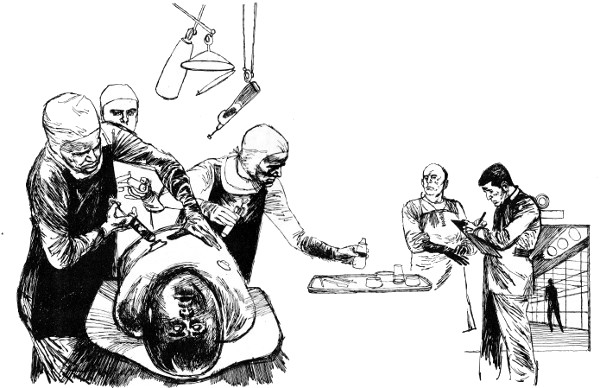
Dr. Lawton looked worried. He greeted me and showed me to a small room near the elevators. There was a cocoon of milky plastic on a wheeled table; I looked closer, and inside the cocoon, recognizable through the clear plastic over the face, was the waxlike body of Luigi Zorchi. The eyes were closed and he was completely still. I would have thought him dead if I had not known he was under the influence of the drugs used in the suspension of life in the vaults.
I said: "Am I supposed to identify him or something?"
"We know who he is," Lawton snorted. "Sign the commitment, that's all."
I signed the form he handed me, attesting that Luigi Zorchi, serial number such-and-such, had requested and was being granted immobilization and suspension in lieu of cash medical benefits. They rolled the stretcher-cart away, with its thick foam-plastic sack containing the inanimate Zorchi.
"Anything else?" I asked.
Lawton shook his head moodily. "Nothing you can help with. I told Defoe this was going to happen!"
"What?"
He glared at me. "Man, didn't you just come in through the main entrance? Didn't you see that mob?"
"Well, I wouldn't call it a mob," I began.
"You wouldn't now," he broke in. "But you will soon enough. They're working themselves up. Or maybe they're waiting for something. But it means trouble, I promise, and I warned Defoe about it. And he just stared at me as if I was some kind of degenerate."
I said sharply, "What are you afraid of? Right outside, you've got enough expediters to fight a war."
"Afraid? Me?" He looked insulted. "Do you think I'm worried about my own skin, Wills? No, sir. But do you realize that we have suspendees here who need protection? Eighty thousand of them. A mob like that—"
"Eighty thousand?" I stared at him. The war had lasted only a few weeks!
"Eighty thousand. A little more, if anything. And every one of them is a ward of the Company as long as he's suspended. Just think of the damage suits, Wills."
I said, still marveling at the enormous number of casualties out of that little war, "Surely the suspendees are safe here, aren't they?"
"Not against mobs. The vaults can handle anything that might happen in the way of disaster. I don't think an H-bomb right smack on top of them would disturb more than the top two or three decks at most. But you never know what mobs will do. If they once get in here—And Defoe wouldn't listen to me!"
As I went back into the hall, passing the main entrance, the explosion burst.
I stared out over the heads of the dreadfully silent throng in the entrance hall, looking toward the glass doors, as was everyone else inside. Beyond the doors, an arc of expediters was retreating toward us; they paused, fired a round of gas-shells over the heads of the mob outside, and retreated again.
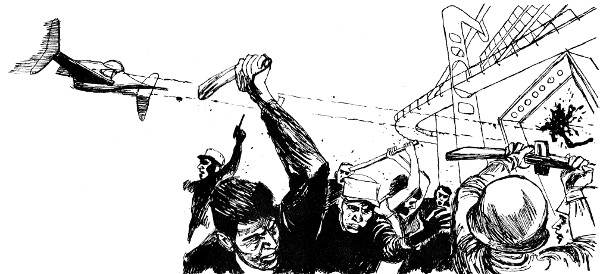
Then the mob was on them, in a burst of screaming fury. Hidden gas guns appeared, and clubs, and curious things that looked like slingshots. The crowd broke for the entrance. The line of expediters wavered but held. There was a tangle of hand-to-hand fights, each one a vicious struggle. But the expediters were professionals; outnumbered forty to one, they savagely chopped down their attackers with their hands, their feet and the stocks of their guns. The crowd hesitated. No shot had yet been fired, except toward the sky.
The air whined and shook. From low on the horizon, a needle-nosed jet thundered in. A plane! Aircraft never flew in the restricted area over the Company's major installations. Aircraft didn't barrel in at treetop height, fast and low, without a hint of the recognition numbers every aircraft had to carry.
From its belly sluiced a silvery milt of explosives as it came in over the heads of the mob, peeled off and up and away, then circled out toward the sea for another approach. A hail of tiny blasts rattled in the clear space between the line of expediters and the entrance. The big doors shook and cracked.
The expediters stared white-faced at the ship. And the crowd began firing. An illegal hard-pellet gun peppered the glass of the doors with pock-marks. The guarding line of expediters was simply overrun.
Inside the waiting room, where I stood frozen, hell broke out. The detachment of expediters, supervising the hundreds inside leaped for the doors to fight back the surging mob. But the mob inside the doors, the long orderly lines before the interviewing clerks, now split into a hundred screaming, milling centers of panic. Some rushed toward the doors; some broke for the halls of the vaults themselves. I couldn't see what was going on outside any more. I was swamped in a rush of women panicked out of their senses.
Panic was like a plague. I saw doctors and orderlies struggling against the tide, a few scattered expediters battling to turn back the terrified rush. But I was swept along ahead of them all, barely able to keep my feet. An expediter fell a yard from me. I caught up his gun and began striking out. For this was what Lawton had feared—the mob loose in the vaults!
I raced down a side corridor, around a corner, to the banked elevators that led to the deeps of the clinic. There was fighting there, but the elevator doors were closed. Someone had had the wit to lock them against the mob. But there were stairs; I saw an emergency door only a few yards away. I hesitated only long enough to convince myself, through the fear, that my duty was to the Company and to the protection of its helpless wards below. I bolted through the door and slammed it behind me, spun the levers over and locked it. In a moment, I was running down a long ramp toward the cool immensities of the vaults.
If Lawton had not mentioned the possible consequences of violence to the suspendees, I suppose I would have worried only about my own skin. But here I was. I stared around, trying to get my bearings. I was in a sort of plexus of hallways, an open area with doors on all sides leading off to the vaults. I was alone; the noise from above and outside was cut off completely.
No, I was not alone! I heard running footsteps, light and quick, from another ramp. I turned in time to see a figure speed down it, pause only a second at its base, and disappear into one of the vaults. It was a woman, but not a woman in nurse's uniform. Her back had been to me, yet I could see that one hand held a gas gun, the other something glittering and small.
I followed, not quite believing what I had seen. For I had caught only a glimpse of her face, far off and from a bad angle—but I was as sure as ever I could be that it was Rena dell'Angela!
She didn't look back. She was hurrying against time, hurrying toward a destination that obsessed her thoughts. I followed quietly enough, but I think I might have thundered like an elephant herd and still been unheard.
We passed a strange double-walled door with a warning of some sort lettered on it in red; then she swung into a side corridor where the passage was just wide enough for one. On either side were empty tiers of shelves waiting for suspendees. I speeded up to reach the corner before she could disappear.
But she wasn't hurrying now. She had come to a bay of shelves where a hundred or so bodies lay wrapped in their plastic sacks, each to his own shelf. Dropping to her knees, she began checking the tags on the cocoons at the lowest level.
She whispered something sharp and imploring. Then, straightening abruptly, she dropped the gas gun and took up the glittering thing in her other hand. Now I could see that it was a hypodermic kit in a crystal case. From it she took a little flask of purplish liquid and, fingers shaking, shoved the needle of the hypodermic into the plastic stopper of the vial.
Moving closer, I said: "It won't work, Rena."
She jumped and swung to face me, holding the hypodermic like a stiletto. Seeing my face, she gasped and wavered.
I stepped by her and looked down at the tag on the cocooned figure. Benedetto dell'Angela, Napoli, it said, and then the long string of serial numbers that identified him.
It was what I had guessed.
"It won't work," I repeated. "Be smart about this, Rena. You can't revive him without killing him."
Rena half-closed her eyes. She whispered, "Would death be worse than this?"
I hadn't expected this sort of superstitious nonsense from her. I started to answer, but she had me off guard. In a flash, she raked the glittering needle toward my face and, as I stumbled back involuntarily, her other hand lunged for the gas gun I had thrust into my belt.
Only luck saved me. Not being in a holster, the gun's front sight caught and I had the moment I needed to cuff her away. She gasped and spun up against the tiers of shelves. The filled hypodermic shattered against the floor, spilling the contents into a purple, gleaming pool of fluorescence.
Rena took a deep breath and stood erect. There were tears in her eyes again.
She said in a detached voice: "Well done, Mr. Wills."
"Are you crazy?" I crackled. "This is your father. Do you want to kill him? It takes a doctor to revive him. You're an educated woman, Rena, not a witch-ridden peasant! You know better than this!"
She laughed—a cold laugh. "Educated! A peasant woman would have kicked you to death and succeeded. I'm educated, all right! Two hundred men, a plane, twenty women risking themselves up there to get me through the door. All our plans—and I can't remember a way to kill you in time. I'm too educated to hate you, Claims Adjuster Wills!" She choked on the words. Then she shook her head dully. "Go ahead, turn me in and get it over with."
I took a deep breath. Turn her in? I hadn't thought that far ahead. True, that was the obvious thing to do; she had confessed that the whole riot outside was a diversion to get her down in the vaults, and anyone who could summon up that sort of organized anti-Company violence was someone who automatically became my natural enemy.
But perhaps I was too educated and too soft as well. There had been tears on her face, over her father's body. I could not remember having heard that conspirators cried.
And I sympathized a little. I had known what it was like to weep over the body of someone I loved. Despite our difficulties, despite everything, I would have done anything in the world to bring Marianna back to life. I couldn't. Rena—she believed—could revive her father.
I didn't want to turn her in.
I shouldn't turn her in. It was my duty not to turn her in, for hadn't Defoe himself ordered me to investigate the dissident movement of which she was clearly a part? Wouldn't it be easier for me to win her confidence, and trick her into revealing its secrets, than to have her arrested?
The answer, in all truth, was No. She was not a trickable girl, I was sure. But it was, at least, a rationale, and I clung to it.
I coughed and said: "Rena, will you make a bargain?"
She stared drearily. "Bargain?"
"I have a room at the Umberto. If I get you out of here, will you go to my room and wait for me there?"
Her eyes narrowed sharply for a second. She parted her lips to say something, but only nodded.
"Your word, Rena? I don't want to turn you in."
She looked helplessly at the purple spilled pool on the floor, and wistfully at the sack that held her father. Then she said, "My word on it. But you're a fool, Tom!"
"I know it!" I admitted.
I hurried her back up the ramp, back toward the violence upstairs. If it was over, I would have to talk her out of the clinic, somehow cover up the fact that she had been in the vaults. If it was still going on, though—
It was.
We blended ourselves with the shouting, rioting knots. I dragged her into the main waiting room, saw her thrust through the doors. Things were quieting even then. And I saw two women hastening toward her through the fight, and I do not think it was a coincidence that the steam went out of the rioters almost at once.
I stayed at the clinic until everything was peaceful again, though it was hours.
I wasn't fooling myself. I didn't have a shred of real reason for not having her arrested. If she had information to give, I was not the type to trick it out of her—even if she really was waiting at the Umberto, which was, in itself, not likely. If I had turned her in, Defoe would have had the information out of her in moments; but not I.
She was an enemy of the Company.
And I was unable to betray her.
VII
Dr. Lawton, who seemed to be Chief Medical Officer for Anzio Clinic, said grimly: "This wasn't an accident. It was planned. The question is, why?"
The expediters had finished driving the rioters out of the clinic itself, and gas guns were rapidly dispersing the few left outside the entrance. At least thirty unconscious forms were scattered around—and one or two that were worse than unconscious.
I said, "Maybe they were hoping to loot the clinic." It wasn't a very good lie. But then, I hadn't had much practice in telling lies to an officer of the Company.
Lawton pursed his lips and ignored the suggestion. "Tell me something, Wills. What were you doing down below?"
I said quickly, "Below? You mean a half an hour ago?"
"That's what I mean." He was gentle, but—well, not exactly suspicious. Curious.
I improvised: "I—I thought I saw someone running down there. One of the rioters. So I chased after her—after him," I corrected, swallowing the word just barely in time.
He nodded. "Find anything?"
It was a tough question. Had I been seen going in or coming out? If it was coming out—Rena had been with me.
I took what we called a "calculated risk"—that is, I got a firm grip on my courage and told a big fat and possibly detectable lie. I said, "Nobody that I could find. But I still think I heard something. The trouble is, I don't know the vaults very well. I was afraid I'd get lost."
Apparently it was on the way in that I had been spotted, for Lawton said thoughtfully, "Let's take a look."
We took a couple of battered expediters with us—I didn't regard them as exactly necessary, but I couldn't see how I could tell Lawton that. The elevators were working again, so we came out in a slightly different part of the vaults than I had seen before; it was not entirely acting on my part when I peered around.
Lawton accepted my statement that I wasn't quite sure where I had heard the noises, without argument. He accepted it all too easily; he sent the expediters scouring the corridors at random.
And, of course, one of them found the pool of spilled fluorescence from the hypodermic needle I had knocked out of Rena's hand.
We stood there peering at the smear of purplish color, the shattered hypodermic, Rena's gas gun.
Lawton mused, "Looks like someone's trying to wake up some of our sleepers. That's our standard antilytic, if I'm not mistaken." He scanned the shelves. "Nobody missing around here. Take a look in the next few sections of the tiers."
The expediters saluted and left.
"They won't find anyone missing," Lawton predicted. "And that means we have to take a physical inventory of the whole damn clinic. Over eighty thousand suspendees to check." He made a disgusted noise.
I said, "Maybe they were scared off before they finished."
"Maybe. Maybe not. We'll have to check, that's all."
"Are you sure that stuff is to revive the suspendees?" I persisted. "Couldn't it just have been someone wandering down here by mistake during the commotion and—"
"And carrying a hypodermic needle by mistake, and armed with a gas gun by mistake. Sure, Wills."
The expediters returned and Lawton looked at them sourly.
They shook their heads. He shrugged. "Tell you what, Wills," he said. "Let's go back to the office and—"
He stopped, peering down the corridor. The last of our expediters was coming toward us—not alone.
"Well, what do you know!" said Lawton. "Wills, it looks like he's got your fugitive!"
The expediter was dragging a small writhing figure behind him; we could hear whines and pleading. For a heart-stopping second, I thought it was Rena, against all logic.
But it wasn't. It was a quavery ancient, a bleary-eyed wreck of a man, long past retirement age, shabbily dressed and obviously the sort who cut his pension policies to the barest minimum—and then whined when his old age was poverty-stricken.
Lawton asked me: "This the man?"
"I—I couldn't recognize him," I said.
Lawton turned to the weeping old man. "Who were you after?" he demanded. All he got was sobbing pleas to let him go; all he was likely to get was more of the same. The man was in pure panic.
We got him up to one of the receiving offices on the upper level, half carried by the expediters. Lawton questioned him mercilessly for half an hour before giving up. The man was by then incapable of speech.
He had said, as nearly as we could figure it out, only that he was sorry he had gone into the forbidden place, he didn't mean to go into the forbidden place, he had been sleeping in the shadow of the forbidden place when fighting began and he fled inside.
It was perfectly apparent to me that he was telling the truth—and, more, that any diversionary riot designed to get him inside with a hypodermic and gas gun would have been planned by maniacs, for I doubted he could have found the trigger of the gun. But Lawton seemed to think he was lying.
It was growing late. Lawton offered to drive me to my hotel, leaving the man in the custody of the expediters. On the way, out of curiosity, I asked: "Suppose he had succeeded? Can you revive a suspendee as easily as that, just by sticking a needle in his arm?"
Lawton grunted. "Pretty near, that and artificial respiration. One case in a hundred might need something else—heart massage or an incubator, for instance. But most of the time an antilytic shot is enough."
Then Rena had not been as mad as I thought.
I said: "And do you think that old man could have accomplished anything?"
Lawton looked at me curiously. "Maybe."
"Who do you suppose he was after?"
Lawton said off-handedly. "He was right near Bay 100, wasn't he?"
"Bay 100?" Something struck a chord; I remembered following Rena down the corridor, passing a door that was odd in some way. Was the number 100 on that door? "Is that the one that's locked off, with the sign on it that says anybody who goes in is asking for trouble?"
"That's the one. Though," he added, "nobody is going to get in. That door is triple-plate armor; the lock opens only to the personal fingerprint pattern of Defoe and two or three others."
"What's inside it that's so important?"
He said coldly, "How would I know? I can't open the door." And that was the end of the conversation. I knew he was lying.
I had changed my bet with myself on the way. I won it. Rena was in the room waiting for me. She was sound asleep, stretched out on the bed. She looked as sober-faced and intent in her sleep as a little girl—a look I had noticed in Marianna's sleeping face once.
It was astonishing how little I thought about Marianna any more.
I considered very carefully before I rang for a bellboy, but it seemed wisest to let her sleep and take my chances with the house detective, if any. There was none, it turned out. In fact, the bellboy hardly noticed her—whether out of indifference or because he was well aware that I had signed for the room with an official travel-credit card of the Company, it didn't much matter. He succeeded in conveying, without saying a word, that the Blue Sky was the limit.
I ordered dinner, waving away the menu and telling him to let the chef decide. The chef decided well. Among other things, there was a bottle of champagne in a bucket of ice.
Rena woke up slowly at first, and then popped to a sitting position, eyes wide. I said quickly, "Everything's all right. No one saw you at the clinic."
She blinked once. In a soft voice, she said, "Thank you." She sighed a very small sigh and slipped off the bed.
I realized as Rena was washing up, comparisons were always odious, but—Well, if a strange man had found Marianna with her dress hitched halfway up her thigh, asleep on his bed, he'd have been in for something. What the "something" would be might depend on circumstances; it might be a raging order to knock before he came in, it might only be a storm of blushes and a couple of hours of meticulously prissy behavior. But she wouldn't just let it slide. And Rena, by simply disregarding it, was as modest as any girl could be.
After all, I told myself, warming to the subject, it wasn't as if I were some excitable adolescent. I could see a lovely girl's legs without getting all stirred up. For that matter, I hardly even noticed them, come to think of it. And if I did notice them, it was certainly nothing of any importance; I had dismissed it casually, practically forgotten it, in fact.
She came back and said cheerfully, "I'm hungry!" And so, I realized, was I.
We started to eat without much discussion, except for the necessary talk of the table. I felt very much at ease sitting across from her, in spite of the fact that she had placed herself in opposition to the Company. I felt relaxed and comfortable; nothing bothered me. Certainly, I went on in my mind, I was as free and easy with her as with any man; it didn't matter that she was an attractive girl at all. I wasn't thinking of her in that way, only as someone who needed some help.
I came to. She was looking at me with friendly curiosity. She said, "Is that an American idiom, Tom, when you said, 'Please pass the legs'?"
We didn't open the champagne: it didn't seem quite appropriate. We had not discussed anything of importance while we were eating, except that I had told her about the old man; she evidently knew nothing about him. She was concerned, but I assured her he was safe with the Company—what did she think they were, barbarians? She didn't answer.
But after dinner, with our coffee, I said: "Now let's get down to business. What were you doing in the clinic?"
"I was trying to rescue my father," she said.
"Rescue, Rena? Rescue from what?"
"Tom, please. You believe in the Company, do you not?"
"Of course!"
"And I do not. We shall never agree. I am grateful to you for not turning me in, and I think perhaps I know what it cost you to do it. But that is all, Tom."
"But the Company—"
"When you speak of the Company, what is it you see? Something shining and wonderful? It is not that way with me; what I see is—rows of my friends, frozen in the vaults or the expediters and that poor old man you caught."
There was no reasoning with her. She had fixed in her mind that all the suspendees were the victims of some sinister brutality. Of course, it wasn't like that at all.
Suspension wasn't death; everyone knew that. In fact, it was the antithesis of death. It saved lives by taking the maimed and sick and putting them mercifully to sleep, until they could be repaired.
True, their bodies grew cold, the lungs stopped pumping, the heart stopped throbbing; true, no doctor could tell, on sight, whether a suspendee was "alive" or "dead." The life processes were not entirely halted, but they were slowed enormously—enough so that chemical diffusion in the jellylike blood carried all the oxygen the body needed. But there was a difference: The dead were dead, whereas the suspendees could be brought back to life at any moment the Company chose.
But I couldn't make her see that. I couldn't even console her by reminding her that the old man was a mere Class E. For so was she.
I urged reasonably: "Rena, you think something is going on under the surface. Tell me about it. Why do you think your father was put in suspension?"
"To keep him out of the way. Because the Company is afraid of him."
I played a trump card: "Suppose I told you the real reason he's in the vaults."
She was hit by that, I could tell. She was staring at me with wonder in her eyes.
"You don't have to speculate about it, Rena. I looked up his record, you see."
"You—you—"
I nodded. "It's right there in black and white. They're trying to save his life. He has radiation poisoning. He was a war casualty. It's standard medical practice in cases like his to put them in suspension for a while, until the level of radioactivity dies down and they can safely be revived. Now what do you say?"
She merely stared at me.
I pressed on persuasively: "Rena, I don't mean to call your beliefs superstitions or anything like that. Please understand me. You have your own cultural heritage and—well, I know that it looks as though he is some kind of 'undead,' or however you put it, in your folk stories. I know there are legends of vampires and zombies and so on, but—"
She was actually laughing. "You're thinking of Central Europe, Tom, not Naples. And anyway—" she was laughing only with her eyes now—"I do not believe that the legends say that vampires are produced by intravenous injections of chlorpromazine and pethidine in a lytic solution—which is, I believe, the current technique at the clinics."
I flared peevishly: "Damn it, don't you want him saved?"
The laughter was gone. She gently touched my hand. "I'm sorry. I don't mean to be a shrew and that remark wasn't kind. Must we discuss it?"
"Yes!"
"Very well." She faced me, chin out and fierce. "My father does not have radiation poisoning, Tom."
"He does."
"He does not! He is a prisoner, not a patient. He loved Naples. That's why he was put to sleep—for fifty years, or a hundred, until everything he knew and loved grows away from him and nobody cares what he has to say any more. They won't kill him—they don't have to! They just want him out of the way, because he sees the Company for what it is."
"And what is that?"
"Tyranny, Tom," she said quietly.
I burst out, "Rena, that's silly! The Company is the hope of the world. If you talk like that, you'll be in trouble. That's dangerous thinking, young lady. It attacks the foundations of our whole society!"
"Good! I was hoping it would!"
We were shouting at each other like children. I took time to remember one of the priceless rules out of the Adjusters' Handbook: Never lose your temper; think before you speak. We glared at each other in furious silence for a moment before I forced myself to simmer down.
Only then did I remember that I needed to know something she might be able to tell me. Organization, Defoe had said—an organization that opposed the Company, that was behind Hammond's death and the riot at the clinic and more, much more.
"Rena, why did your friends kill Hammond?"
Her poise was shaken. "Who?" she asked.
"Hammond. In Caserta. By a gang of anti-Company hoodlums."
Her eyes flashed, but she only said: "I know nothing of any killings."
"Yet you admit you belong to a subversive group?"
"I admit nothing," she said shortly.
"But you do. I know you do. You said as much to me, when you were prevented from reviving your father."
She shrugged.
I went on: "Why did you call me at the office, Rena? Was it to get me to help you work against the Company?"
She looked at me for a long moment. Then she said: "It was. And would you like to know why I picked you?"
"Well, I suppose—"
"Don't suppose, Tom." Her nostrils were white. She said coldly: "You seemed like a very good bet, as far as we could tell. I will tell you something you don't know. There is a memorandum regarding you in the office of the Chief of Expediters in Naples. I do not choose to tell you how I know of it, but even your Mr. Gogarty doesn't know it exists. It is private and secret, and it says of you, 'Loyalty doubtful. Believed in contact with underground movement. Keep under close but secret surveillance'."
That one rocked me, I admit. "But that's all wrong!" I finally burst out. "I admit I went through a bad time after Marianna died, but—"
She was smiling, though still angry. "Are you apologizing to me?"
"No, but—" I stopped. That was a matter to be taken up with Defoe, I told myself, and I was beginning to feel a little angry, too.
"All right," I said. "There's been a mistake; I'll see that it's straightened out. But even if it was true, did you think I was the kind of man to join a bunch of murderers?"
"We are not murderers!"
"Hammond's body says different."
"We had nothing to do with that, Tom!"
"Your friend Slovetski did." It was a shot in the dark. It missed by a mile.
She said loftily: "If he is such a killer, how did you escape? When I had my interview with you, and it became apparent that the expediters were less than accurate, the information came a little late. You could easily have given us trouble—Slovetski was in the next room. Why didn't he shoot you dead?"
"Maybe he didn't want to be bothered with my body."
"And maybe you are all wrong about us!"
"No! If you're against the Company, I can't be wrong. The Company is the greatest blessing the world has ever known—it's made the world a paradise!"
"It has?" She made a snorting sound. "How?"
"By bringing countless blessings to all of us. Countless!"
She was shaking with the effort of controlling her temper. "Name one!"
I swore in exasperation. "All right," I said. "It ended war."
She nodded—not a nod of agreement, but because she had expected that answer. "Right out of the textbooks and propaganda pieces, Tom. Tell me, why is my father in the vaults?"
"Because he has radiation poisoning!"
"And how did he get this radiation poisoning?"
"How?" I blinked at her. "You know how, Rena. In the war between Naples and—the war—"
Rena said remorselessly, "That's right, Tom, the war. The war that couldn't have existed, because the Company ended war—everybody knows that. Ah, Tom! For God, tell me, why is the world blind? Everyone believes, no one questions. The Company ended war—it says so itself. And the blind world never sees the little wars that rage, all the time, one upon the heels of another. The Company has ended disease. But how many deaths are there? The Company has abolished poverty. But am I living in riches, Tom? Was the old man who ran into the vaults?"
I stammered, "But—but, Rena, the statistical charts show very clearly—"
"No, Tom," she said, gentle again. "The statistical charts show less war, not no war. They show less disease."
She rubbed her eyes wearily—and even then I thought: Marianna wouldn't have dared; it would have smeared her mascara.
"The trouble with you, Tom, is that you're an American. You don't know how it is in the world, only in America. You don't know what it was like after the Short War, when America won and the flying squads of Senators came over and the governments that were left agreed to defederate. You're used to a big and united country, not little city-states. You don't have thousands of years of intrigue and tyranny and plot behind you, so you close your eyes and plunge ahead, and if the charts show things are getting a little better, you think they are perfect."
She shook her head. "But not us, Tom. We can't afford that. We walk with eyes that dart about, seeking danger. Sometimes we see ghosts, but sometimes we see real menace. You look at the charts and you see that there are fewer wars than before. We—we look at the charts and we see our fathers and brothers dead in a little war that hardly makes a ripple on the graph. You don't even see them, Tom. You don't even see the disease cases that don't get cured—because the techniques are 'still experimental,' they say. You don't—Tom! What is it?"
I suppose I showed the pain of remembrance. I said with an effort, "Sorry, Rena. You made me think of something. Please go on."
"That's all of it, Tom. You in America can't be blamed. The big lie—the lie so preposterous that it cannot be questioned, the thing that proves itself because it is so unbelievable that no one would say it if it weren't true—is not an American invention. It is European, Tom. You aren't inoculated against it. We are."
I took a deep breath. "What about your father, Rena? Do you really think the Company is out to get him?"
She looked at me searchingly, then looked hopelessly away. "Not as you mean it, Tom," she said at last. "No, I am no paranoid. I think he is—inconvenient. I think the Company finds him less trouble in the deep-freeze than he would be walking around."
"But don't you agree that he needs treatment?"
"For what? For the radiation poisoning that he got from the atomic explosion he was nowhere near, Tom? Remember, he is my father! I was with him in the war—and he never stirred a kilometer from our home. You've been there, the big house where my aunt Luisa now lives. Did you see bomb craters there?"
"That's a lie!" I had to confess it to myself: Rena was beginning to mean something to me. But there were emotional buttons that even she couldn't push. If she had been a man, any man, I would have had my fist in her face before she had said that much; treason against the Company was more than I could take. "You can't convince me that the Company deliberately falsifies records. Don't forget, Rena, I'm an executive of the Company! Nothing like that could go on!"
Her eyes flared, but her lips were rebelliously silent.
I said furiously: "I'll hear no more of that. Theoretical discussions are all right; I'm as broad-minded as the next man. But when you accuse the Company of outright fraud, you—well, you're mistaken."
We glowered at each other for a long moment. My eyes fell first.
I said sourly, "I'm sorry if I called you a liar. I—I didn't mean to be offensive."
"Nor I, Tom," she hesitated. "Will you remember that I asked you not to make me discuss it?"
She stood up. "Thank you very much for a dinner. And for listening. And most of all, for giving me another chance to rescue my father."
I looked at my watch automatically—and incredulously. "It's late, Rena. Have you a place to stay?"
She shrugged. "N—yes, of course, Tom. Don't worry about me; I'll be all right."
"Are you sure?"
"Very sure."
Her manner was completely confident—so much so that I knew it for an act.
I said: "Please, Rena, you've been through a tough time and I don't want you wandering around. You can't get back to Naples tonight."
"I know."
"Well?"
"Well what, Tom?" she said. "I won't lie to you—I haven't a place to go to here. I would have had, this afternoon, if I had succeeded. But by now, everything has changed. They—that is, my friends will assume that I have been captured by the Company. They won't be where I could find them, Tom. Say they are silly if you wish. But they will fear that the Company might—request me to give their names."
I said crisply, "Stay here, Rena. No—listen to me. You stay here. I'll get another room."
"Thank you, Tom, but you can't. There isn't a room in Anzio; there are families of suspendees sleeping in the grass tonight."
"I can sleep in the grass if I have to."
She shook her head. "Thank you," she repeated.
I stood between her and the door. "Then we'll both stay here. I'll sleep on the couch. You can have the bed." I hesitated, then added, "You can trust me, Rena."
She looked at me gravely for a moment. Then she smiled. "I'm sure I can, Tom. I appreciate your offer. I accept."
I am built too long for a hotel-room couch, particularly a room in a Mediterranean coastal fleabag. I lay staring into the white Italian night; the Moon brightened the clouds outside the window, and the room was clearly enough illuminated to show me the bed and the slight, motionless form in it. Rena was not a restless sleeper, I thought. Nor did she snore.
Rena was a most self-possessed girl, in fact. She had overruled me when I tried to keep the bellboy from clearing away the dinner service. "Do you think no other Company man ever had a girl in his room?" she innocently asked. She borrowed a pair of the new pajamas Defoe's thoughtful expediters had bought and put in the bureau. But I hadn't expected that, while the bellboy was clearing away, she would be softly singing to herself in the bath.
He had seemed not even to hear.
He had also leaped to conclusions—not that it was much of a leap, I suppose. But he had conspicuously not removed the bottle of champagne and its silver bucket of melting ice.
It felt good, being in the same room with Rena.
I shifted again, hunching up my torso to give my legs a chance to stretch out. I looked anxiously to see if the movement had disturbed her.
There is a story about an animal experimenter who left a chimpanzee in an empty room. He closed the door on the ape and bent to look through the key-hole, to see what the animal would do. But all he saw was an eye—because the chimp was just as curious about the experimenter.
In the half-light, I saw a sparkle of moonlight in Rena's eye; she was watching me. She half-giggled, a smothered sound.
"You ought to be asleep," I accused.
"And you, Tom."
I obediently closed my eyes, but I didn't stop seeing her.
It only she weren't a fanatic.
And if she had to be a fanatic, why did she have to be the one kind that was my natural enemy, a member of the group of irresponsible troublemakers that Defoe had ordered me to "handle"?
What, I wondered, did he mean by "handle"? Did it include chlorpromazine in a lytic solution and a plastic cocoon?
I put that thought out of my mind; there was no chance whatever that her crazy belief, that the Company was using suspension as a retaliatory measure, was correct. But thinking of Defoe made me think of my work. After all, I told myself, Rena was more than a person. She was a key that could unlock the whole riddle. She had the answers—if there was a movement of any size, she would know its structure.
I thought for a moment and withdrew the "if." She had admitted the riot of that afternoon was planned. It had to be a tightly organized group.
And she had to have the key.
At last, I had been getting slightly drowsy, but suddenly I was wide awake.
There were two possibilities. I faced the first of them shakily—she might be right. Everything within me revolted against the notion, but I accepted it as a theoretical possibility. If so, I would, of course, have to revise some basic notions.
On the other hand, she might be wrong. I was certain she was wrong. But I was equally certain she was no raddled malcontent and if she was wrong, and I could prove it to her, she herself might make some revisions.
Propped on one elbow, I peered at her. "Rena?" I whispered questioningly.
She stirred. "Yes, Tom?"
"If you're not asleep, can we take a couple more minutes to talk?"
"Of course." I sat up and reached for the light switch, but she said, "Must we have the lights? The Moon is very bright."
"Sure." I sat on the edge of the couch and reached for a cigarette. "Can I offer you a deal, Rena?"
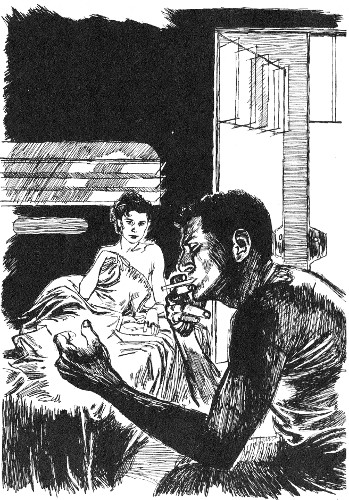
"What sort of deal?"
"A horsetrade. You think the Company is corrupt and your father is not a casualty, right?"
"Correct, Tom."
"And I think the Company is not corrupt and your father has radiation poisoning. One of us has to be wrong, right?"
"Correct, Tom."
"Let's find out. There are ways of testing for radiation-sickness. I'll go into the clinic in the morning and get the answer."
She also lifted up on one elbow, peering at me, her long hair braided down her back. "Will you?"
"Sure. And we'll make bets on it, Rena. If you are wrong—if your father has radiation poisoning—I want you to tell me everything there is to tell about the riot today and the people behind it. If I'm wrong—" I swallowed—"if I'm wrong, I'll get your father out of there for you. Somehow. I promise it, Rena."
There was absolute silence for a long time. Then she swung out of the bed and hurried over to me, her hands on mine. She looked at me and again I saw tears. "Will you do that, Tom?" she asked, hardly audible.
"Why, sure," I said awkwardly. "But you have to promise—"
"I promise!"
She was staring at me, at arm's length. And then something happened. She wasn't staring and she wasn't at arm's length.
Kissing her was like tasting candied violets; and the Moon made her lovelier than anything human; and the bellboy had not been so presumptuous, after all, when he left us the champagne.
VIII
Dr. Lawton was "away from his desk" the next morning. That was all to the good. I was not a hardened enough conspirator to seek out chances to make mistakes, and although I had a perfectly good excuse for wanting to go down into the vaults again, I wasn't anxious to have to use it.
The expediter-officer in charge, though, didn't even ask for reasons. He furnished me with what I wanted—a map of the vaults and a radiation-counter—and turned me loose.
Looking at the map, I was astonished at the size of this subterranean pyramid. Lawton had said we had eighty-odd thousand sleepers filed away and that had surprised me, but by the chart I held in my hand, there was space for perhaps ten times that many. It was beyond belief that so much space was really needed, I thought—unless there was some truth to Rena's belief that the Company used the clinics for prisons....
I applied myself to the map.
And, naturally, I read it wrong. It was very simple; I merely went to the wrong level, that was all.
It looked wrong as soon as I stepped out of the elevator. An elderly, officious civilian with a British accent barred my way. "You aren't one of us, are you?"
I said, "I doubt it."
"Then would you mind?" he asked politely, and indicated a spot on the side of the hall. Perhaps I was suggestible, but I obeyed his request without question. It was just as well, because a sort of procession rounded a bend and came down the corridor. There was a wheeled stretcher, with three elderly civilians puttering around it, and a bored medic following with a jar of something held aloft, feeding through a thin plastic tube into the arm of the man on the stretcher, as well as half a dozen others of more nondescript types.
The man who had stopped me nearly ran to meet the stretcher. He stared into the waxy face and whispered, "It's he! Oh, absolutely, it is he!"
I looked and the face was oddly familiar. It reminded me of my childhood; it had a link with school days and the excitement of turning twelve. By the way the four old men were carrying on, however, it meant more than that to them. It meant, if not the Second Coming, at least something close to it.
By then I had figured out that this was that rare event in the day of a clinic—a revival. I had never seen one. I suppose I could have got out of the way and gone about my conspiratorial business, and it is no credit to me as a conspirator that I did not. But I was fascinated.
Too fascinated to wonder why revivals were so rare....
The medic looked at his watch and, with careless efficiency, plucked the tube out of the waxy man's arm.
"Two minutes," he said to one of the civilians. "Then he'll be as good as he ever was. You've got his clothes and release papers?"
"Oh, definitely," said the civilian, beaming.
"Okay. And you understand that the Company takes no responsibility beyond the policy covering? After all, he was one of the first men suspended. We think we can give him another year or so—which is a year more than he would have had, at that—but he's not what you'd call a Grade A risk."
"Certainly," agreed the civilian. "Can we talk to him now?"
"As soon as he opens his eyes."
The civilian bent over the man, who no longer looked waxy. His face was now a mottled gray and his eyelids were flickering. He had begun to breathe heavily and irregularly, and he was mumbling something I couldn't understand. The civilian whispered in his ear and the revived man opened his eyes and looked at him.
It was like seeing the dead come to life. It was exactly that, in fact; twenty minutes before, no chemical test, no stethoscope or probing thumb in the eye socket could have detected the faint living glow in the almost-dead cells. And yet—now he looked, he breathed, he spoke.
"I made it," were his first understandable words.
"Indeed you did!" crowed the civilian in charge, while all of the others murmured happily to each other. "Sir, it is my pleasure to welcome you back to us. You are in Anzio, Italy. And I am Thomas Welbourne, at your service."
The faint eyes sparkled. Dead, near-dead or merely decrepit, this was a man who wanted to enjoy life. Minutes out of the tomb, he said: "No! Not young Tommy Welbourne!"
"His grandson, sir," said the civilian.
I had it just then—that face had watched me through a whole year of school. It had been in a frame at the front of the room, with half a dozen other faces. It had a name under it, which, try as I might, I couldn't recall; but the face was there all the same. It was an easy one to keep in mind—strong though sunken, ancient but very much alive.
He was saying, in a voice as confident as any youth's, "Ah, Tommy, I've lived to see it! Tell me, have you been to Mars? What is on the other side of the Moon? And the Russians—what are the Russians up to these days?"
The civilian coughed and tried to interrupt, but the figure on the stretcher went on heedlessly: "All those years gone—what wonders must we have. A tunnel under the Atlantic, I'll wager! And ships that fly a hundred times the speed of sound. Tell me, Tommy Welbourne! Don't keep an old man waiting!"
The civilian said reluctantly, but patiently, "Perhaps it will take a little explaining, sir. You see, there have been changes—"
"I know it, boy! That's what I'm asking you!"
"Well, not that sort of changes, sir. We've learned new virtues since your time—patience and stability, things of that sort. You see—"
The interesting part was over and the glances of the others in the party reminded me that I didn't belong here. I stole off, but not before the man on the stretcher noticed me and made a sort of clumsy two-fingered salute of hail and farewell as I left. It was exactly like the gesture in his picture on that schoolroom wall, up next to the presidents and the greatest of kings.
I found a staircase and climbed to another level of the boxlike clinic.
The local peasants called the vaults "coolers" or "ice cubes." I suppose the reason had something to do with the fact that they were cool and rectangular, on the whole—perhaps because, like icebergs, the great bulk of the vaults was below the surface. But whatever you called them, they were huge. And the clinic at Anzio was only one out of hundreds scattered all over the world.
It was all a matter of viewpoint. To me, the clinics were emblems of the Company's concern for the world. In any imaginable disaster—even if some fantastic plague struck the entire race at once—the affected population could be neatly and effectively preserved until medicine could catch up with their cures.
To Rena, they were prisons big enough to hold the human race.
It was time to find out which of us was right. I hurried through the corridors, between the tiers of sleepers, almost touching them on both sides. I saw the faint purplish gleam where Rena had spilled the fluid, and knelt beside the cocoon that held her father.
The UV sterilizers overhead made everything look ghastly violet, but in any light, the waxy face under the plastic would have looked dead as death itself. I couldn't blame Rena for weeping.
I took out the little radiation counter and looked at it awkwardly. There was nothing complicated about the device—fortunately, because I had had little experience with them. It was a cylinder with a flaring snout at one end, a calibrated gauge at the side, marked in micro-roentgens. The little needle flickered in the green area of the dial. I held it to myself and the reading didn't change. I pointed it up and pointed it down; it didn't change.
I held it to the radiation-seared body of Benedetto dell'Angela.
And it didn't change.
Radiation-seared? Not unless the instrument lied! If dell'Angela had ever in his life been within the disaster radius of an atomic explosion, it had been so long before that every trace of radioactive byproduct was gone!
Rena was right!
I worked like a machine, hardly thinking. I stood up and hurriedly touched the ion-tasting snout of the counter to the body on the shelf above Benedetto, the one above that, a dozen chosen at random up and down the aisle.
Two of them sent the needle surging clear off the scale; three were as untainted by radioactivity as Benedetto himself. A few others gave readings from "mild" to "lethal"—but all in the danger area.
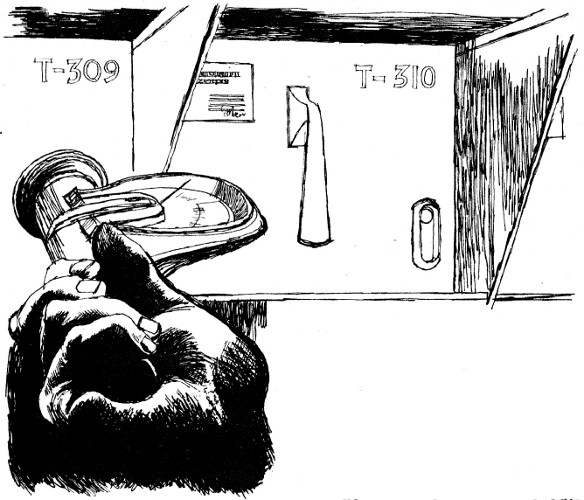
Most were as untainted by radiation as Benedetto himself.
It was possible, I told myself frantically, that there were mysteries here I did not understand. Perhaps after a few months or a year, the radiation level would drop, so that the victim was still in deadly danger while the emitted radiation of his body was too slight to affect the counter. I didn't see how, but it was worth a thought. Anything was worth a thought that promised another explanation to this than the one Rena had given!
There had been, I remembered, a score or more of new suspendees in the main receiving vault at the juncture of the corridors. I hurried back to it. Here were fresh cases, bound to show on the gauge.
I leaned over the nearest one, first checking to make sure its identification tag was the cross-hatched red one that marked "radiation." I brought the counter close to the shriveled face—
But I didn't read the dial, not at first. I didn't have to. For I recognized that face. I had seen it, contorted in terror, mumbling frantic pleas for mercy, weeping and howling, on the old Class E uninsurable the expediters had found hiding in the vaults.
He had no radiation poisoning ... unless a bomb had exploded in these very vaults in the past twelve hours.
It wasn't pleasant to stand there and stare around the vaults that were designed for the single purpose of saving human life—and to wonder how many of the eighty thousand souls it held were also prisoners.
And it wasn't even tolerable to think the thought that followed. If the Company was corrupt, and I had worked to do the Company's business, how much of this guilt was mine?
The Company, I had said and thought and tried to force others to agree, was the hope of humanity—the force that had permanently ended war (almost), driven out disease (nearly), destroyed the threat to any human of hunger or homelessness (in spite of the starving old man who slept in the shadow of the crypt, and others like him).
But I had to face the facts that controverted the Big Lie. If war was ended, what about Naples and Sicily, and Prague and Vienna, and all the squabbles in the Far East? If there was no danger from disease, why had Marianna died?
Rena had said that if there was no danger of disaster, no one would have paid their premiums. Obviously the Company could not have wanted that, but why had I never seen it before? Sample wars, sample deaths—the Company needed them. And no one, least of all me, fretted about how the samples felt about it.
Well, that was behind me. I'd made a bet with Rena, and I'd lost, and I had to pay off.
I opened the cased hypodermic kit Rena had given me and examined it uncomfortably. I had never used the old-fashioned sort of needle hypodermic; I knew a little something about the high-pressure spray type that forced its contents into the skin without leaving a mark, but I was very far from sure that I could manage this one without doing something wrong. Besides, there wasn't much of the fluid left, only the few drops left in the bottom of the bottle after Rena had loaded the needle that had been smashed.
I hurried back along the corridor toward Benedetto dell'Angela. I neared again the red-labeled door marked Bay 100, glanced at it in passing—and stopped.
This was the door that only a handful of people could open. It was labeled in five languages: "Entrance Strictly Prohibited. Experimental Section."
Why was it standing ajar?
And I heard a faint whisper of a moan: "Aiutemi, aiutemi."
Someone inside was calling for help!
If I had been a hardened conspirator, I would never have stopped to investigate. But, of course, I wasn't. I pushed the door aside, against resistance, and peered in.
And that was my third major shock in the past quarter of an hour, because, writhing feebly just inside the door, staring up at me with an expression of pain and anger, was Luigi Zorchi.
He propped himself up on his hands, the rags of his plastic cocoon dangling from his shoulders.
"Oho," he said faintly. "The apprentice assassin again."
I found water for him at a bubble-fountain by the ramp; he drank at least a quart before I made him stop. Then he lay back, panting, staring at me. Except for the shreds of plastic and the bandages around the stumps of his legs, he was nude, like all the other suspendees inside their sacks. The luxuriant hair had already begun to grow back.
He licked his lips. More vigorous now, he snarled: "The plan fails, does it not? You think you have Zorchi out of the way, but he will not stay there."
I said, "Zorchi, I'm sorry about all this I—I know more now than I did yesterday."
He gaped. "Yesterday? Only yesterday?" He shook his head. "I would have thought a month, at the least. I have been crawling, assassin. Crawling for days, I thought." He tried to shrug—not easy, because he was leaning on his elbows. "Very well, Weels. You may take me back to finish the job now. Sticking me with a needle and putting me on ice will not work. Perhaps you should kill me outright."
"Listen, Zorchi, I said I was sorry. Let's let it go at that for a moment. I—I admit you shouldn't be here. The question is, how do you come to be awake?"
"How not? I am Zorchi, Weels. Cut me and I heal; poison me and I cure myself." He spat furiously. "Starve me, however, and I no doubt will die, and it is true that you have come very near to starving me down here." He glowered at the shelves of cocooned bodies in the locked bay. "A pity, with all this pork and beef on the rack, waiting for me, but I find I am not a monster, Weels. It is a weakness; I do not suppose it would stop any Company man for a moment."
"Look, Zorchi," I begged, "take my word for it—I want to help you. You might as well believe me, you know. You can't be any worse off than you are."
He stared at me sullenly for a moment. Then, "True enough," he admitted. "What then, Weels?"
I said hesitantly, "Well, I'd like to get you out of here...."
"Oh, yes. I would like that, too. How shall we do it?"
I rubbed the back of my neck thoughtfully, staring at him. I had had a sort of half-baked, partly worked out plan for rescuing Benedetto. Wake him up with the needle; find a medical orderly's whites somewhere; dress him; and walk him out.
It wasn't the best of all possible plans, but I had rank enough, particularly with Defoe off in Rome, to take a few liberties or stop questions if it became necessary. And besides, I hadn't really thought I'd have to do it. I had fully expected—as recently as half an hour ago!—that I would find Benedetto raddled with gamma rays, a certainty for death if revived before the half-life period of the radioelements in his body had brought the level down to safety.
That plan might work for Benedetto. But Zorchi, to mention only one possible obstacle, couldn't walk. And Benedetto, once I took off his beard with the razor Rena had insisted I bring for that purpose, would not be likely to be recognized by anyone.
Zorchi, on the other hand, was very nearly unforgettable.
I said honestly, "I don't know."
He nodded. "Nor do I, Weels. Take me then to your Defoe." His face wrinkled in an expression of fury and fear. "Die I can, if I must, but I do not wish to starve. It is good to be able to grow a leg, but do you understand that the leg must come from somewhere? I cannot make it out of air, Weels—I must eat. When I am in my home at Naples, I eat five, six, eight times a day; it is the way my body must have it. So if Defoe wishes to kill me, we will let him, but I must leave here now."
I shook my head. "Please understand me, Zorchi—I can't even do that for you. I can't have anybody asking me what I was doing down in this level." I hesitated only briefly; then, realizing that I was already in so deeply that secrecy no longer mattered, I told him about Benedetto dell'Angela, and the riot that failed, and my promise.
His reaction was incredulity. "You did not know, Weels? The arms and legs of the Company do not know what thoughts pass through its brain? Truly, the Company is a wonderful thing! Even the peasants know this much—the Company will do anything it must."
"I admit I never guessed. Now what?"
"That is up to you, Weels. If you try to take the two of us out, it endangers you. It is for you to decide."
So, of course, I could decide only one way.
I hid the hypodermic behind one of the bodies in Bay 100; it was no longer useful to me. I persuaded Zorchi to lie quietly in one of the tiers near Benedetto, slammed the heavy door to Bay 100, and heard the locks snap. That was the crossing of the Rubicon. You could open that door easily enough from inside—that was to protect any personnel who might be caught in there. But only Defoe and a couple of others could open it from without, and the hypodermic was now as far out of reach as the Moon.
I opened Benedetto dell'Angela's face mask and shaved him, then sealed it again. I found another suspendee of about the same build, made sure the man was not radioactive, and transferred them. I switched tags: Benedetto dell'Angela was now Elio Barletteria. Then I walked unsteadily to the ramp, picked up the intercom and ordered the medical officer in charge to come down.
It was not Dr. Lawton who came, fortunately, but one of his helpers who had seen me before. I pointed to the pseudo-Barletteria. "I want this man revived."
He sputtered, "You—you can't just take a suspendee out of his trance, Mr. Wills. It's a violation of medical ethics! These men are sick. They—"
"They'll be sicker still if we don't get some information from this one," I said grimly. "Are you going to obey Mr. Defoe's orders or not?"
He sputtered some more, but he gave in. His orderlies took Benedetto to the receiving station at the foot of the vault; one of them stood by while the doctor worriedly went through his routine. I sat and smoked, watching the procedure.
It was simple enough. One injection, a little chafing of the hands and feet by the bored orderly while the doctor glowered and I stonily refused to answer his questions, and a lot of waiting. And then the "casualty" stirred and moaned.
All the stand-by apparatus was there—the oxygen tent and the pulmotor and the heart stimulator and so on. But none of it was needed.
I said: "Fine, Doctor. Now send the orderly to have an ambulance standing by at the main entrance, and make out an exit pass for this casualty."
"No!" the doctor shouted. "This is against every rule, Mr. Wills. I insist on calling Dr. Lawton—"
"By all means," I said. "But there isn't much time. Make out the pass and get the ambulance, and we'll clear it with Dr. Lawton on the way out." He was all ready to say no again when I added: "This is by direct order of Mr. Defoe. Are you questioning his orders?"
He wasn't—not as long as I was going to clear it with Dr. Lawton. He did as I asked. One of the advantages of the Company's rigid regulations was that it was hard to enforce strict security on its personnel. If you didn't tell the staff that they were working for something needing covering up, you couldn't expect them to be constantly on guard.
When the orderly was gone and the doctor had scrawled out the pass, I said cordially, "Thank you, Doctor. Now would you like to know what all the fuss was about?"
"I certainly would," he snapped. "If you think—"
"I'm sorry," I apologized. "Come over here and take a look at this man."
I juggled the radiation counter in my hand as he stalked over. "Take a look at his eyes," I invited.
"Are you trying to tell me that this is a dangerously radioactive case? I warn you, Mr. Wills—"
"No, no," I said. "See for yourself. Look at the right eye, just beside the nose."
He bent over the awakening body, searchingly.
I clonked him with the radiation counter on the back of the head. They must have retired that particular counter from service after that; it wasn't likely to be very accurate any more.
The orderly found me bending over the doctor's body and calling for help. He bent, too, and he got the same treatment. Benedetto by then was awake; he listened to me and didn't ask questions. The blessings of dealing with conspirators—it was not necessary to explain things more than once.
And so, with a correctly uniformed orderly, who happened to be Benedetto dell'Angela, pushing the stretcher, and with myself displaying a properly made out pass to the expediter at the door, we rolled the sham-unconscious body of Luigi Zorchi out to a waiting ambulance.
I felt my pulse hammering as we passed the expediter at the door. I had thrown my coat over the place where legs should have been on "Barletteria," and Benedetto's old plastic cocoon, into which we had squeezed Zorchi, concealed most of him.
I needn't have worried. The expediter not only wasn't suspicious, he wasn't even interested.
Benedetto and I lifted Zorchi into the ambulance. Benedetto climbed in after him and closed the doors, and I went to the front. "You're dismissed," I told the driver. "I'll drive."
As soon as we were out of sight of the clinic, I found a phone, got Rena at the hotel, told her to meet me under the marquee. In five minutes, she was beside me and we were heading for the roads to the north.
"You win," I told her. "Your father's in back—along with somebody else. Now what? Do we just try to get lost in the hills somewhere?"
"No, Tom," she said breathlessly. "I—I have made arrangements." She giggled. "I walked around the square and around, until someone came up to me. You do not know how many gentlemen came before that! But then one of my—friends showed up, to see if I was all right, and I arranged it. We go up the Rome highway two miles and there will be a truck."
"Fine," I said, stepping on the gas. "Now do you want to climb back and tell your father—"
I stopped in the middle of the word. Rena peered at me. "Tom," she asked anxiously, "is something wrong?"
I swallowed, staring after a disappearing limousine in the rear-view mirror. "I—hope not," I said. "But your friends had better be there, because we don't have much time. I saw Defoe in the back of that limousine."
IX
Rena craned her neck around the door and peered into the nave of the church. "He's kissing the Book," she reported. "It will be perhaps twenty minutes yet."
Her father said mildly, "I am in no hurry. It is good to rest here. Though truthfully, Mr. Wills, I thought I had been rested sufficiently by your Company."
I think we were all grateful for the rest. It had been a hectic drive up from Anzio. Even though Rena's "friends" were thoughtful people, they had not anticipated that we would have a legless man with us.
They had passports for Rena and myself and Benedetto; for Zorchi they had none. It had been necessary for him to hide under a dirty tarpaulin in the trunk of the ancient charcoal-burning car, while Rena charmed the Swiss Guards at the border. And it was risky. But the Guards charmed easily, and we got through.
Zorchi did not much appreciate it. He swore a ragged blue streak when we stopped in the shade of an olive grove and lugged him to the front seat again, and he didn't stop swearing until we hit the Appian Way. When the old gas-generator limped up a hill, he swore at its slowness; when it whizzed along the downgrades and level stretches, he swore at the way he was being bounced around.