Gleanings by an Old Florist.
Reading edition
THE PANSY.
Gray, in his Manual, says: "Viola tricolor (pansy or heart's-ease) is common in dry or sandy soil. From New York to Kentucky and southward, doubtless only a small portion of the garden pansy runs wild. Naturalized from Europe."
Seen in this condition the flowers are very small, not more than one-half an inch across and oblong in shape. Cultivated at its best it has a flower two inches in diameter, almost an exact circle in outline.
All this has been brought about by lovers of flowers during a long period of years, by saving the seed of only the best, a sort of survival of the fittest, and only to be kept up by rich soil and constant cultivation, for if left to itself the pansy dwindles back into its original nature.
It has another peculiarity also: the young plants always bring the largest flowers, so that if the extra large flowers are wanted they can be obtained only by seed annually, or a division of the old roots by cuttings. The latter is too much trouble for most cultivators in the country, and named kinds are never thought of, while in the old they used to be; perhaps it is still common for the pansy grower to name his pets, and reproduce them each year by cuttings or division of the roots.
The seed that brings the largest and best flowers generally come from Germany, although some of our own florists save them themselves for several consecutive years. I was a long time before any fixed character was maintained in color in this flower, but now seed from certain kinds will mainly reproduce its like, hence are often so used for massing kinds of a color. The plant being a native of the cooler and moister parts of Europe is better adapted to their climate than ours, and hence as our spring weather is more nearly like their original climate than our other seasons, they luxuriate in it; it is the only season in which the florist finds much of a market for his goods, and even then he receives some round abuse for selling very large noble flowers that quickly deteriorate after leaving his hands. This, however, is not his fault, the hot weather being one cause, the other that the plant refuses to produce large flowers except in its young state.
There are two methods adopted by a florist in the preparation of his stock; one, by sowing the seed in the fall and wintering the young plants in cold frames, or even by means of a slight protection of brush. The other by sowing the seed on a bench in the green-house in January. If sown in the fall early enough to get well into rough leaf, if they do not flower in the fall, which they usually will do, they are ready to do so at the first peep of spring, as they flower at a comparatively low temperature. If sown in January, they are transplanted once on other benches, from which they are lifted and transferred either to the outside borders or to other cold frames as the case may be. It is not best to keep them in a green-house longer than necessary, say the first of March, as the conditions of a green-house will bring about the small flowers similar to the hot weather of the summer.
THE PANSY.
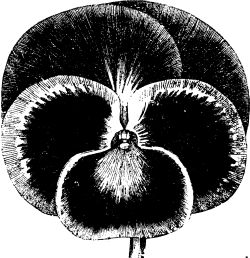
By the different systems the market florist can have his goods always at their best during the selling season, which ranges from the first of March up to the first of June. They are so easily grown he can afford to sell cheap, even if his goods are of the very best, and will usually bring about seventy-five cents by the single dozen, down to as low as three dollars by the hundred. Enough sod should hang to the roots to keep them fresh, and they will, after planting, go on flowering just as though they had never been disturbed. Nothing can be done with this plant, at least worthy of the name, in the window, hence it should not be attempted. To enjoy the large flowers as long as possible during summer, if there is any choice of position, give them the coolest and moistest place in the garden, not forgetting plenty of watering in dry spells. A rich, loamy soil, inclined to be porous, will give the best satisfaction, but almost any garden soil will grow them.
Edgar Sanders.
DRAINAGE.
PRACTICAL FARM DRAINAGE. WHY, WHEN, and HOW TO TILE-DRAIN —AND THE— MANUFACTURE OF DRAIN-TILE.
By C. G. ELLIOTT and J. J. W. BILLINGSLEY
PRICE, ONE DOLLAR.
For sale by
THE PRAIRIE FARMER PUBLISHING CO., 150 Monroe St., Chicago, Ill.
THE SHEPHERD'S MANUAL A PRACTICAL TREATISE ON THE SHEEP. Designed Especially for American Shepherds BY HENRY STEWART.
Finely Illustrated
Price, $1.50, by mail, postpaid. Address
PRAIRIE FARMER PUBLISHING CO., Chicago.
$2.00. FOR THIS AMOUNT WE WILL send a copy of THE PRAIRIE FARMER for one year, also a handsome Colored Map of the United States and Canada—size, 4×2½ feet.
OUR New Clubbing List FOR 1884. THE PRAIRIE FARMER IN CONNECTION WITH OTHER JOURNALS.
We offer more liberal terms than ever before to those who desire to take, in connection with The Prairie Farmer, either of the following weekly or monthly periodicals. In all cases the order for The Prairie Farmer and either of the following named journals must be sent together, accompanied by the money; but we do not require both papers to be sent to the same person or to the same post-office.
We send specimen copies only of The Prairie Farmer.
Our responsibility for other publications ceases on the receipt of the first number; when such journals are not received within a reasonable time, notify us, giving date of your order, also full name and address of subscriber.
WEEKLIES.
Price of the two.The two for
Harper's Weekly$6 00$4 60
Harper's Bazar6 004 60
Harper's Young People3 502 55
New York Tribune4 002 50
Toledo Blade4 002 20
Chicago Times3 252 50
Chicago Tribune3 502 50
Chicago Inter-Ocean3 152 50
Chicago Journal3 252 50
Peck's Sun3 753 00
Milwaukee Sentinel3 002 50
Western Farmer (Madison, Wis.)3 002 00
Burlington Hawkeye4 003 00
The Continent (Weekly Magazine)6 005 00
Detroit Free Press, with Supplement4 002 50
Detroit Free Press, State edition3 502 20
Louisville Courier-Journal3 753 00
St. Louis Globe-Democrat3 002 15
St. Louis Republican3 002 15
Scientific American5 204 15
Interior (Presbyterian)4 503 60
Standard (Baptist)4 703 60
Advance (Congregational)5 003 35
Alliance4 003 00
New York Independent5 004 00
Christian Union5 004 00
Boston Pilot (Catholic)4 503 50
American Bee Journal4 003 50
Florida Agriculturist4 002 75
Breeder's Gazette5 003 50
Witness (N.Y.)3 503 00
Methodist (N.Y.)4 003 50
Chicago News3 002 50
Globe (Boston)3 002 75
Youth's Companion, new subs.3 753 00
Youth's Companion, renewals3 853 25
Weekly Novelist5 004 25
Ledger (Chicago)3 002 90
American Bee Journal4 003 25
MONTHLIES.
Harper's Monthly$6 00$4 50
Atlantic Monthly6 004 50
Appleton's Journal5 004 25
The Century6 004 50
North American Review7 005 50
Popular Science Monthly7 005 50
Lippincott's Magazine5 004 50
Godey's Lady's Book4 003 00
St. Nicholas5 003 50
Vick's Illustrated Magazine3 252 25
Am. Poultry Journal (Chicago)3 252 75
American Bee Journal3 002 25
Gardener's Monthly4 003 00
Wide Awake4 503 00
Phrenological Journal4 003 00
American Agriculturist3 502 50
Poultry World3 252 75
Arthur's Home Magazine4 003 00
Andrews' Bazar3 002 40
Frank Leslie's Popular Monthly5 004 00
Frank Leslie's Sunday Magazine5 004 00
Frank Leslie's Ladies' Magazine4 504 00
Our Little Ones3 503 00
Peterson's Magazine4 003 30
Art Amateur6 005 00
Demorest's Magazine4 003 00
Dio Lewis' Monthly4 503 50
For clubbing price with any publication in the United States not included in the above list send us inquiry on postal card.
SEEDS, Etc.

Will be mailed FREE to all applicants and to customers of last year without ordering it. It contains illustrations, prices, descriptions and directions for planting all Vegetable and Flower Seeds, Plants, etc. Invaluable to all.
D. M. FERRY & CO. DETROIT, Mich.

J. B. ROOT & CO.'S
Illustr'd Garden Manual of VEGETABLE and FLOWER SEEDS, ready for all applicants. Market Gardeners SEEDS a Specialty. Write for Wholesale Price-List, ☞ SENT FREE ROCKFORD, ILLINOIS.
CONSUMPTION.
I have a positive remedy for the above disease; by its use thousands of cases of the worst kind and of long standing have been cured. Indeed, so strong is my faith in its efficacy, that I will send TWO BOTTLES FREE, together with a VALUABLE TREATISE on this disease, to any sufferer. Give Express & P.O. address. DR. T. A. SLOCUM, 181 Pearl St., N.Y.
"THE BEST IS THE CHEAPEST."
ENGINES, SAW MILLS, THRESHERS, HORSE POWERS,
(For all sections and purposes.) Write for Free Pamphlet and Prices to The Aultman & Taylor Co., Mansfield, Ohio.
PUBLISHERS' NOTICE.
THE PRAIRIE FARMER is printed and published by The Prairie Farmer Publishing Company, every Saturday, at No. 150 Monroe Street.
Subscription, $2.00 per year, in advance, postage prepaid. Subscribers wishing their addresses changed should give their old as well as new addresses.
Advertising, 25 cents per line on inside pages; 30 cents per line on last page—agate measure; 14 lines to the inch. No less charge than $2.00.
All Communications, Remittances, etc., should be addressed to The Prairie Farmer Publishing Company, Chicago, Ill.

Entered at the Chicago Office as Second-Class Matter.
CHICAGO, JANUARY 26, 1884.
WHEN SUBSCRIPTIONS EXPIRE.
We have several calls for an explanation of the figures following the name of subscribers as printed upon this paper each week. The first two figures indicate the volume, and the last figure or figures the number of the last paper of that volume for which the subscriber has paid: EXAMPLE: John Smith, 56-26. John has paid for THE PRAIRIE FARMER to the first of July of the present year, volume 56. Any subscriber can at once tell when his subscription expires by referring to volume and number as given on first page of the paper.
[Transcriber's Note: Original location of Table of Contents.]
1841.1884.
The Prairie Farmer
PROSPECTUS FOR 1884.
SEE INDUCEMENTS OFFERED
SUBSCRIBE NOW.
For forty-three years The Prairie Farmer has stood at the front in agricultural journalism. It has kept pace with the progress and development of the country, holding its steady course through all these forty-three years, encouraging, counseling, and educating its thousands of readers. It has labored earnestly in the interest of all who are engaged in the rural industries of the country, and that it has labored successfully is abundantly shown by the prominence and prestige it has achieved, and the hold it has upon the agricultural classes.
Its managers are conscious from comparison with other journals of its class, and from the uniform testimony of its readers, that it is foremost among the farm and home papers of the country. It will not be permitted to lose this proud position; we shall spare no efforts to maintain its usefulness and make it indispensable to farmers, stock-raisers, feeders, dairymen, horticulturalists, gardeners, and all others engaged in rural pursuits. It will enter upon its forty-fourth year under auspices, in every point of view, more encouraging than ever before in its history. Its mission has always been, and will continue to be—
To discuss the most approved practices in all agricultural and horticultural pursuits.
To set forth the merits of the best breeds of domestic animals, and to elucidate the principles of correct breeding and management.
To further the work of agricultural and horticultural organization.
To advocate industrial education in the correct sense of the term.
To lead the van in the great contest of the people against monopolies and the unjust encroachments of capital.
To discuss the events and questions of the day without fear or favor.
To provide information concerning the public domain, Western soil, climate, water, railroads, schools, churches, and society.
To answer inquiries on all manner of subjects coming within its sphere.
To furnish the latest and most important industrial news at home and abroad.
To give full and reliable crop, weather, and market reports.
To present the family with pure, choice, and interesting literature.
To amuse and instruct the young folks.
To gather and condense the general news of the day.
To be, in brief, an indispensable and unexceptionable farm and home companion for the people of the whole country.
The style and form of the paper are now exactly what they should be. The paper used is of superior quality. The type is bold and clear. The illustrations are superb. The departments are varied and carefully arranged. The editorial force is large and capable. The list of contributors is greatly increased, and embraces a stronger array of talent than is employed on any similar paper in this country. We challenge comparison with any agricultural journal in the land.
The Prairie Farmer is designed for all sections of the country. In entering upon the campaign of 1884, we urge all patrons and friends to continue their good works in extending the circulation of our paper. On our part we promise to leave nothing undone that it is possible for faithful, earnest work—aided by money and every needed mechanical facility—to do to make the paper in every respect still better than it has ever been before.
SPECIAL NOTICE
To each Subscriber who will remit us $2.00 between now and February 1st, 1884, we will mail a copy of THE PRAIRIE FARMER for One Year, and one of our New Standard Time Commercial Maps of the United States and Canada—showing all the Counties, Railroads, and Principal Towns up to date. This comprehensive map embraces all the country from the Pacific Coast to Eastern New Brunswick, and as far north as the parallel of 52 deg., crossing Hudson's Bay. British Columbia; Manitoba, with its many new settlements; and the line of the Canadian Pacific Railway, completed and under construction, are accurately and distinctly delineated. It extends so far south as to include Key West and more than half of the Republic of Mexico. It is eminently adapted for home, school, and office purposes. The retail price of the Map alone is $2.00. Size, 58 × 41 inches. Scale, about sixty miles to one inch.
READ THIS.
Another Special Offer.
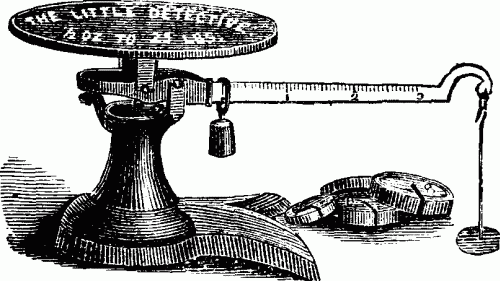
"The Little Detective."
Weighs 1-4 oz. to 25 lbs.
Every housekeeper ought to have this very useful scale. The weight of article bought or sold may readily be known. Required proportions in culinary operations are accurately ascertained. We have furnished hundreds of them to subscribers, and they give entire satisfaction. During January, 1884, to any person sending us THREE SUBSCRIBERS, at $2.00 each, we will give one of these scales, and to each of the three subscribers Ropp's Calculator, No. 1.
OUR PREMIUM LIST.
Revised, extended, and properly illustrated will this week be sent to every subscriber. There must be something offered in it that every one needs or would like to have. The terms are the most liberal ever offered. All readers are hereby constituted agents to solicit subscriptions to The Prairie Farmer. If those who can not enlist in the work will hand the Premium List to some person who will do so, they will confer a great favor upon the publishers and editors. What we all want is to double our present list before the first day of April.
RENEW! RENEW!!
Remember that every yearly subscriber, either new or renewing, sending us $2, receives a splendid new map of the United States and Canada—58×41 inches—FREE. Or, if preferred, one of the books offered in another column. It is not necessary to wait until a subscription expires before renewing.
WE WANT AGENTS
in every locality. We offer very liberal terms and good pay. Send for sample copies and terms to agents.
The Adams County (Ill.) Fair at Camp Point will be held the first week in September. The premium list is out.
The seventh annual fair at Jerseyville, Ill., will be held commencing Tuesday, October 14, 1884, and continue four days, with $5,000 premiums.
At the Cape of Good Hope Agricultural Society's trials, November 11, 1883, the Johnston Harvester Company were 1st in the trial field, and also for the machine best adapted for the colony.
The growth of the Western live stock business has stimulated parties to organize a Union Stock Yards Company at Sioux City, Iowa. The company has a capital of $100,000. The shipping of dressed beef may become a branch of its business.
One of the most popular and instructive essays at the late Wisconsin Dairymen's Convention was entitled "The Farmer's Garden," contributed by J. M. Smith, Esq., of Green Bay. This essay will appear, in full, in the next issue of the Prairie Farmer.
French papers declare that the Government crop reports for 1883 are exaggerations. If land has risen in value and stock doubled in price, the extra cost of running a farm more than makes up for it. The impost duty on all agricultural products has also alarmingly increased.
Mr. Merritt, United States Consul General at London, directs attention to the falling off in the value of exports from Great Britain to the United States during the fiscal year ended September 30, 1883. The total value of declared exports from the various United States consular districts in Great Britain and Ireland during the year was $165,207,987, a reduction from the figures for the preceding year of $14,231,858.
Mr. Calkins, member of Congress from Indiana, succeeded on Monday in getting a suspension of the rules and the passage of a bill providing that in any suit against an innocent purchaser of an article manufactured in violation of the patent law, if the plaintiff shall not recover twenty dollars or over, he shall recover no costs. This bill is a blow aimed at the drive-well patent agents, and others of that ilk who are perambulating the country to the annoyance of farmers. If the bill passes the Senate, and there appears no valid reason why it shall not, it will put an end to this species of robbery now so prevalent.
The only general advices we have regarding winter wheat come through the extensive grain commission house of W. T. Baker & Co., Chicago. They have private reports which indicate that the crop maintains a very high average, and, with the exception of a few points in Southern Illinois, Kentucky, and Tennessee, is doing as well as could be expected at this season of the year. In Kentucky and Tennessee the ground is quite bare of snow, but north of the Ohio river, from Kansas to Ohio, the wheat, as a general thing, is well covered. The crop, however, was generally sown late, and in many quarters fears are entertained of the final outcome.
The Nebraska State Farmers' Alliance held a meeting at Kearney on Wednesday of last week. A platform was adopted declaring in favor of national legislation to regulate railway traffic, demanding the abolition of national banks and the substitution of Government currency, demanding a tariff for revenue only, expressing sympathy with labor, asking protection to labor organizations, recommending the abolition of convict labor, asking Congress to reclaim all unclaimed land grants and reserve the public domain for actual settlers, and opposing the acquisition of public land by foreigners.
Do not forget that the Annual Farmers' Institute, or Agricultural Lecture Course, at the Illinois Industrial University will be held from Tuesday, January 29th, to Friday, February 1, 1884. Four lectures will be given each day, at 10 a.m., 11 a.m., 2 p.m. and 3 p.m., by Dr. Peabody, Regent of the University, Professors Burrill, Jillson, McMurtrie, Morrow and others. The topics discussed will be: Soils—Their Origin, Physical Characteristics, Chemical Composition, Drainage, Cultivation, Fertilization; Plants—Their Structure, Growth, Nutrition, Seeds, Movement of Sap, Development and Distribution, Economic Products. Addresses will be given in the evenings by Dr. Peabody, Governor Hamilton and others. These lectures and addresses are given as a part of the work of the College of Agriculture of the University. No fees or examinations are required. All interested are cordially invited to attend.