Field and Furrow.
Reading edition
All manures deposited by nature are left on or near the surface. The whole tendency of manure is to go down into the soil rather than to rise from it. There is probably very little if any loss of nitrogen from evaporation of manure, unless it is put in piles so as to foment. Rains and dews return to the soil as much ammonia in a year as is carried off in the atmosphere.
Rice contains more starch than either wheat, rye, barley, oats or corn. Of these grains oats carry the least starch, but by far the largest proportion of cellulose. In nitrogenous substances wheat leads, followed by barley, oats, rye and corn, while rice is most deficient. Corn leads in fat, and oats in relative proportion of water. Wheat leads in gum and rice in salt.
Convenience of farm buildings is an important aid to good farming, especially where much stock is kept and there are many chores. Water should always be provided in the barn-yard, the feeding boxes should be near where the feed is kept, and the buildings should not be very far removed from the house. If this results in more neatness about barns and barnyards than has been thought necessary, it will be another important advantage gained.
The President of the Elmira Farmers' Club tells the Husbandman that his crop of sorghum got caught by the frost, and too much injured to be of value as a sirup-producing substance. But he fed it to his cows which ate it greedily, and soon began to gain in milk. He thinks he got about as much profit from the crop as if it had been devoted to the original intent.
Governor Glick, in a short address before the State Board of Agriculture, last week, stated that Kansas history is the most remarkable on record; that in 1883 her people had more money to the head than any other people under heaven; that the State had received 60,000 immigrant population in 1883; that it will receive 160,000 in 1884; that in ten years it will have 2,000,000 people, and that thereafter Kansas will not care anything about bureaus of immigration—it will have people enough to work with, and the rest will come as fast as they are needed.
Farmers' Call: The experiments conducted during the last season at the Missouri State Agricultural College fully demonstrate the advisability of mulching potatoes. We believe every experiment so far reported gave a similar result. The cost of the materials for mulching is usually very small, leaves or straw being plentiful and cheap upon the farm. The materials manure the ground; and mulching saves hoeing. The potato requires a cooler climate and moister soil than our latitude affords. Mulching tends to secure both. The result in every case has been largely increased yields of superior quality.
The old saying, no grass no cattle, no cattle no manure, no manure no crops, is as true to-day as when first spoken. Grass takes care of him who sows it. The meadow is the master mine of wealth. Strong meadows fill big barns. Fat pastures make fat pockets. The acre that will carry a steer carries wealth. Flush pastures make fat stock. Heavy meadows make happy farmers. Up to my ears in soft grass laughs the fat ox. Sweet pastures make sound butter. Soft hay makes strong wool. These are some of the maxims of the meadow. The grass seed to sow depends upon the soil and here every man must be his own judge. Not every farmer, however, knows the grass adapted to his soil. If he does and seeds by the bushel, or other measures, he is apt to be misled.
Including millet and Hungarian there were in Kansas this year 3,730,150 acres of land devoted to the raising of hay. The yield per acre was 1.61 tons, or a total product of 6,002,576 tons. None of the tame grasses have as yet attained a large area in this State, the most extensively grown being timothy which has an area of 95,844 acres. The great bulk of the grass lands mentioned above is the prairie, protected by fence. The eastern third of the State probably contains four fifths of the tame grass area. The question of the growing of tame grasses in Kansas is receiving much attention from farmers, it becoming of vast importance as people increase the number of their farm animals. The question no doubt will be satisfactorily solved within a few years, and the tame grass area will increase to its just proportion.
The agricultural changes in Great Britain continue to be of a marked character. The area devoted to grain crops the past year was 8,618,675 acres, which is 214,705 acres less than in 1882. Potatoes were planted on 543,000 acres, and turnips and Swedes on 2,029,000 acres—all showing a slight increase; but mangolds, vetches and other green crops have declined by 21,000 acres on the figures for the previous year. Clover and the grasses show an increase of 58,500 acres. The change from tilth to permanent pasturage is again conspicuous, there being 15,065,300 acres as compared with 14,821,600 last year. Ten years ago grass covered 13,000,000 acres, while arable land has fallen during that period from 18,186,000 to 17,319,000 acres. Orchards are on the increase, and also market gardening. In the matter of live stock there is an improvement which leads to the hope that the heavy losses of recent years will be made up.
Illinois Central Railroad.
The elegant equipment of coaches and sleepers being added to its various through routes is gaining it many friends. Its patrons fear no accidents. Its perfect track of steel, and solid road-bed, are a guarantee against them.
FARM MACHINERY, Etc.

NICHOLS & MURPHY'S
CENTENNIAL WIND MILL.
Contains all the valuable features of his old "Nichols' Mills" with none of their defects. This is the only balanced mill without a vane. It is the only mill balanced on its center. It is the only mill built on correct scientific principles so as to govern perfectly.
ALL VANES
Are mechanical devices used to overcome the mechanical defect of forcing the wheel to run out of its natural position.
A wind wheel becomes its own vane if no vane is used, hence, vanes—save only to balance the wheel—are useless for good, and are only useful to help blow the mill down.
This mill will stand a heavier wind, run steadier, last longer, and crow louder than any other mill built. Our confidence in the mill warrants us in offering the first mill in each county where we have no agent, at agents' prices and on 30 days' trial.
Our power mills have 25 per cent more power than any mill with a vane. We have also a superior feed mill adapted to wind or other power. It is cheap, durable, efficient. For circulars, mills, and agencies, address
NICHOLS & MURPHY, Elgin, Ill.
(Successors to the Batavia Manf. Co., of Batavia, Ill.)
Sawing Made Easy
Monarch Lightning Sawing Machine!
Sent on 30 Days test Trial.
A Great Saving of Labor & Money.
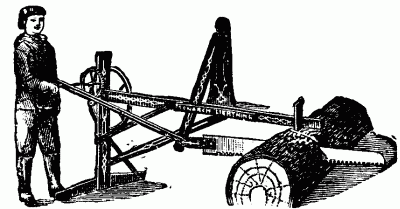
A boy 16 years old can saw logs FAST and EASY. Miles Murray, Portage, Mich. writes, "Am much pleased with the MONARCH LIGHTNING SAWING MACHINE. I sawed off a 30-inch log in 2 minutes." For sawing logs into suitable lengths for family stove-wood, and all sorts of log-cutting, it is peerless and unrivaled. Illustrated Catalogue, Free. AGENTS WANTED. Mention this paper. Address MONARCH MANUFACTURING CO., 163 N. Randolph St., Chicago, Ill.

CHICAGO SCALE CO.
2 TON WAGON SCALE, $40. 3 TON, $50.
4 Ton $60, Beam Box Included.
240 lb. FARMER'S SCALE, $5.
The "Little Detective," ¼ oz. to 25 lb. $3.
300 OTHER SIZES. Reduced PRICE LIST FREE.
FORGES, TOOLS, &c.
BEST FORGE MADE FOR LIGHT WORK, $10,
40 lb. Anvil and Kit of Tools. $10.
Farmers save time and money doing odd jobs.
Blowers, Anvils, Vices & Other Articles
AT LOWEST PRICES, WHOLESALE & RETAIL.
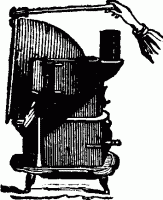
THE PROFIT FARM BOILER
is simple, perfect, and cheap; the BEST FEED COOKER; the only dumping boiler; empties its kettle in a minute. Over 5,000 in use; Cook your corn and potatoes, and save one-half the cost of pork. Send for circular. D.R. SPERRY & CO., Batavia, Illinois.
HOOSIER AUGER TILE MILL.
Mills on hand.

Prompt delivery.
FOR PRICES AND CIRCULARS, ADDRESS
NOLAN, MADDEN & CO., Rushville, Ind.
MISCELLANEOUS.

EVAPORATING FRUIT
Full treatise on improved methods, yields, profits, prices and general statistics, free.
AMERICAN M'FG CO. WAYNESBORO FRANKLIN COUNTY, PA.
Self Cure Free
NervousLostWeakness
DebilityManhoodand Decay
A favorite prescription of a noted specialist (now retired.) Druggists can fill it. Address
DR. WARD & CO., LOUISIANA, MO.
40 (1884) Chromo Cards, no 2 alike, with name, 10c., 13 pks, $1. GEORGE I. REED & CO., Nassau, N.Y.
REMEMBER that $2.00 pays for The Prairie Farmer from this date to January 1, 1885; For $2.00 you get it for one year and a copy of The Prairie Farmer County Map of the United States, free! This is the most liberal offer ever made by any first-class weekly agricultural paper in this country.

American breeders imported from Scotland 850 head of polled cattle last year.
W. C. Vandercook, Secretary of the Northern Illinois Merino Sheep Breeders' Association, recently took 900 Merino sheep to his recently purchased ranch in Norton county, Kansas.
Mr. Estill, of Estill, Mo., passed through Chicago, a few days ago, with forty head of Angus-Aberdeen and Hereford cattle. Estill & Elliott now own one of the best polled herds in the West.
The second regular annual meeting of the Kansas State Short-horn Breeders' Association will be held in the Senate Chamber of the Capitol, Topeka, Kan., during February 12 and 13, beginning at 7 P. M. of the 12th.
The seventh annual meeting of the Dutch-Fresian Association of America will be held at the Butterfield House, Utica, N. Y., February 6, 1884. Essays and addresses are expected from a number of distinguished stock breeders.
The Lafayette County Thoroughbred Live Stock Breeders' Association was recently organized at Higginsville, Mo. They will hold annual public sales and otherwise advance the improved stock interest. Their first sale will be held at Higginsville, October 15 and 16, 1884.
The following is a list of Jerseys exported from the island during the past year: Mr. Francis Le Brocq exported 848 cows, bulls, 28—total, 876. Mr. Eugene J. Arnold sent out 656 cows, 47 bulls—total, 703. Sundry shippers sold 158 cows and 7 bulls—total, 165. Grand total, 1,744 head.
Our readers will not fail to notice the public sale ad. of Mr. Wm. Yule, of Somers, Wis., who will, on the 19th day of March, disperse his entire herd of thoroughbred Short-horn cattle. The herd numbers forty head, and is the opening sale of the season, and will be one of the most attractive ones of the year. They are all of his own breeding. Send for catalogue, which will be ready about February 15.
Horse-stealing seems to be as prevalent in England as in this country. A late London live-stock journal says there is as much of it going on as there was half a century ago. A gang has recently been operating in Kent, Essex, and Surrey quite extensively. The thieves are no respecters of breeds, taking hunters, cart horses and carriage horses with equal boldness. Arrests are becoming frequent, and it seems likely the gang will soon be broken up.