Front matter (continued 4)
Reading edition
"You've probably pounds and pounds, but I brought some over, just because I was so painfully proud of its colour!" said Aileen, beginning to unpack her basket swiftly. "It wouldn't 'come' last night; I churned it until my arm wouldn't churn any more, and then I hung it in the well all night, and attacked it again at six o'clock this morning. Then it came quite meekly. It's the only way to deal with it in summer, isn't it?" The butter emerged, firm and yellow, from a wrapping of wet cloths and cabbage leaves. "Put that meat in the safe, Bertha, like a good girl—it's a great day for flies. Polly, that's cake; you unwrap it, and if you don't say it's a good cake, I won't be friends with you. Now we'll have scones to try my butter. What have you eaten to-day, 'Possum?"
"Well, I ain't had much feelin' of fancyin' anything," 'Possum admitted. "I tried me porridge, but it was too hot; this ain't much of a day for hot things, is it? You can't eat much on a blazin' day like this."
"She won't eat nothin'," said Bertha, in a high, miserable voice. "I tried an' tried, an' fried her an aig, an' it wasn't any good. Leastways, the aig was good, but she wouldn't eat it. I dunno what to do with her."
"We brought you some of my jelly, and you've just got to eat it," said Garth happily. The jelly glass came from its jar of wet salt, with its contents clear and golden and quivering. 'Possum's eyes rested on it hungrily.
"Now!" said Garth. He demanded a teaspoon of Bertha, and advanced upon the sofa, jelly in hand, and looking ridiculously like his father. "Just you behave yourself, and eat this!"
"It's lovely!" 'Possum whispered to him gratefully.
Aileen, after the first glance, did not look at the sofa. 'Possum never liked eating with an audience—but Garth did not count. He leaned against her, chattering in his eager little voice; and the jelly was disappearing. So Aileen busied herself with Bertha and Polly, making tea and buttering scones. Everything was ready when Tom loomed in the doorway, with young Bill at his heels.
"Bill and I think you people don't understand calves," Tom announced. "You don't take them properly. That fellow leaned up against us, and kissed us, and drank his bottle like any other nice, well-behaved baby. Now Bill and I want ours—don't we, Bill?"
Bill chuckled deeply, casting adoring glances at this cheerful person, who might be "a gent," but nevertheless treated him as a man and a brother. Garth brought the jelly-glass triumphantly to the table.
"She's eaten every bit!" he cried.
"That's lovely!" said Aileen, and smiled at her. "Now she's going to eat my sponge cake and tell me if it isn't good." She took it to 'Possum's side, with a cup of tea, and turned an empty box into a bedside table; and they were all very merry, and ate enormously, while 'Possum nibbled her cake and watched Aileen's smallest movement, and sighed now and then with a content that not even bandaged, aching feet could take away.
"You will take care of yourself, won't you, 'Possum?" Aileen said, when the time came for good-byes. They had all washed up together, and Tom had insisted on sweeping the kitchen, to the great anguish of mind of the sisters O'Connor. "Don't try to walk too soon; and promise to get Bertha to rub you twice a day. You will, Bertha, won't you?"
"My oath!" said Bertha, firmly. "No matter what she says!"
"That's quite right," said Aileen, laughing. "And hide her clothes, Bertha, if she tries to get about before she should!"
"I'll plant 'er boots," said Bertha. "That'll fix 'er!"
Young Bill had helped Tom to put in Roany, and the buggy waited, with the O'Connor family in extended order to bid them good-bye: 'Possum watching from her window, while Bertha helped to stow the empty basket under the seat and tuck in the dust-rug; and Polly was at the gate of the yard, her curls shining in the sun, and ahead, Bill, on a bare-backed pony, careered across the paddock to let down the sliprails. It was something like a Royal Progress; and from the shed came a loud "Ma-a-a-a!" as though in farewell. It was the calf!
CHAPTER XIV
A BOATING HOLIDAY
"Dad!"
"Yes?" Tom Macleod paused in his task of staking peas, and looked inquiringly at his little son.
"It's a lovely day," Garth said, conversationally. "Isn't it?"
"It is. Did you come out to tell me that?"
"Well, not exactly," Garth hesitated. "Only, it is a nice day. And mother and I were thinking we hadn't had any fish for ages. And we thought it wouldn't be any wonder if the motor got indigestion again, through not being used!"
Macleod grinned.
"You and mother are a pair of old conspirators, and I am your unhappy victim!" he said. "This means, I suppose, that I am to stop earning both your livings and play about in a silly motor-boat all day!"
"You know it isn't a silly boat—it's a beauty!" Garth protested. "And it isn't waste of time, 'cause we'll catch such a lot of fish that it'll save the butcher's bill no end. And there's meat-pies to take out for lunch: mother made 'em yesterday, and they're lovely!"
"I never heard a more convincing set of reasons," Tom said. "Well, if I don't come I suppose you and mother will go off by your wild lones, and eat all the pies, so I suppose I'd better be meek. I say, though, what about bait?"
"'Possum and I caught a lovely lot of shrimps yesterday," said his son demurely.
"Oh, did you? I'd like to know was it the sight of your shrimps that made mother make the pies, or the sight of the pies that sent you after shrimps?"
"It wasn't neither, truly," Garth answered. "She made 'em while I was away. She says it was a brain-wave!"
"I have noticed mother have that species of brain-wave before," said Tom, staking vigorously. "Well, I'll come; but I must finish this row first. Even to catch fish and eat pies I won't leave my precious peas to trail in the dust. Peas are money, young Garth!"
"I'll help you," Garth said eagerly. "If I hand you stakes you'll get on ever so quicker."
"True for you," said his father. They worked together until they came to the end of the row, and Tom stood up, glad to stretch his aching back.
"People with long cheap backs like mine ought never to be asked to double them up," he remarked.
A grey horse and a flapping blue skirt came into view, mounting the hill towards the house.
"There's 'Possum!" Garth-cried. "I wonder would she come with us? May I ask her, Dad?"
"Yes, of course," Tom answered. Garth shot across to the garden gate, and he followed more slowly.
'Possum had lost all outward traces of her accident, except that she walked a little stiffly, and was not yet capable of any hard work. She did as much as possible in the saddle; but for the most part her father had suddenly put down his foot where work for her was concerned—the result of a conversation with Aileen—and the girl was experiencing a most unusual holiday. It almost troubled her: leisure had so little come her way. Now, her father performed all her rough tasks; and Bertha and young Bill gathered the fruit and vegetables, and prepared them for market, while Polly and little Joe tended the fowls, fed the broods of baby chickens, and gathered the eggs. As a kind of favour, 'Possum was permitted to market her produce—with Bill or Bertha as attendant, to jump in and out of the cart and carry the loads into the houses. 'Possum did not enjoy it. "I ain't used to being a lady," she said.
She fell back thankfully on the Macleods; and there were few days when she did not ride up to the cottage on the hill—to potter about the farm with Tom and Garth, and look at the crops and the stock, or to watch Aileen as she worked in the garden or in the house. Aileen was busy with a good deal of sewing in those days, most of which she was careful to conceal when she heard 'Possum's step. One day 'Possum surprised her in the act of working at some pale pink print, and laid her hand gently on the stuff. "Your things is always so pretty," she said wistfully. Whereat Aileen smiled, and remarked vaguely that pink was a good washing colour.
To-day 'Possum professed herself as very willing to join the fishing party: and they set off happily, laden with baskets and quart-pot, to the boat-shed, where Tom dealt mysteriously with the motor. The launch was only a tiny one, fitted up by Mr. Gordon for his fishing expeditions: five or six people filled it comfortably, and it drew so little water that it could be run into the shallowest of bays and creeks. Tom settled 'Possum and Aileen comfortably in the stern, and Garth took up his usual position, as far out of the bow as he could hang his small person with safety. Bran whined distressfully on the shore. Ordinary boating-trips were permitted him; but to bring leaping fish into the boat upset all his calmness, and sent him into such paroxysms of barking that when fishing was part of the programme he had been condemned to remain at home. Garth sorrowed over it, and talked severely to him on the subject of gaining more sense: orations which Bran heard with respect, but which had so far produced no effect.
"Orders, please, ma'am," Tom said, looking up from the digestive apparatus of the little engine. "Where do you want to go?"
"I want to explore this arm of the lake," Aileen replied promptly. "You know, we have never been up to the end, and we've always planned to do so. We might get some fishing in the pools, 'Possum says; and if we don't, we could go down to the lake itself after lunch and fish in earnest. Does that meet with your worshipful approval?"
"Sounds very jolly," Tom said. "All right, then, we'll go exploring first. Ready?"
They slid away from the little jetty, and turned up the arm of the lake. It was like a river pushing itself in among the hills. Near its outlet it was wide, and on stormy days there was a choppy sea at its mouth; but as it wound its sinuous course inland it grew smooth and tranquil and even narrower, save that now and then at a sudden turn it broadened into a deep and quiet pool. Then it would wind away again, each time seeming the last, until at length it narrowed to nothing, and the blue water vanished in a tangle of driftwood and rubbish brought by the slow tide to the end of its tortuous journey.
They swung round bend after bend. Gum and wattle trees bordered the water: and sometimes they came to a little clearing, where a settler's cottage stood, trim and neat in its setting of orchard and garden, with fowls pecking contentedly near the homestead fences, and perhaps barefooted children running about. One such clearing led to 'Possum's home, though the trees hid the house; they passed the little jetty where lay the sailing boat which had so nearly cost two lives—little the worse apparently for its long immersion. Two fishermen had towed it in next day and righted it—empty of all spare gear, but without damage. 'Possum gave a little shudder as she looked at it.
"No more sailing for me just yet awhile!" she uttered. "I seem to have lost me taste for it!"
They went on and on, winding and twisting through the forest, which grew thicker and thicker. Often it seemed certain that they had come to the end, as they entered a pool with no apparent outlet; but, as they glided farther, the water opened before them in another bend, and yet another, and another. Deep fern gullies came down to the water's edge, dark and beautiful, and full of the chiming of bell-birds: and sometimes they heard the quick swish and crack of the stockwhip bird. They landed in one gully, where 'Possum said she had twice seen lyre-birds: and by great good luck, and patiently sitting on a log for twenty minutes, they actually caught a glimpse of a pair of the queer, shy birds, dancing solemnly on a mound, uttering strange sounds.
"They're copyin'—they're just born mimics," 'Possum whispered. "Listen—they've heard a sawmill somewhere!" And indeed the sounds were nothing but the harsh rip of a saw through timber. They changed in a moment to the yap of a dog: which so enchanted Garth that he fell bodily off the log, and the lyre-birds promptly disappeared.
"Well, you are a goat!" said Tom.
"I just am," Garth admitted penitently: "I don't know what made me overbalance. I'm sorry."
"Well, you hadn't much log to lie on," Tom said, relenting as he looked at the tiny limb where the small boy had been perched. "Can't be helped, at all events."
"You had jolly good luck to see 'em at all," 'Possum said. "I been about the Bush all me life, an' I haven't seen 'em half a dozen times. But that gully's always a haunt for birds—nobody hardly ever goes there. Look—there's a blue wren."
"Oh!—the lovely thing!" Aileen breathed.
He was certainly a lovely thing—a proud little person of black and enamel-blue, with a blue cap and a deep-blue tail nearly as long as his whole body. He was very busy, strutting happily about the ground or fluttering from twig to twig with a rapid flight that made him look like a glancing jewel. Finally he perched on a bough and broke into a little song as exquisite as himself: and then dashed off in a great hurry to find his mate.
"What a jolly little chap!" Garth uttered.
"He's a dear, ain't he?" 'Possum said. "An' his little mate's as plain as he's pretty, but she's a dear, too. Look—there's a couple of honey-eaters!" She pointed out a pair of dainty black and yellow birds, hanging head downwards under a patch of eucalyptus blossom. They had long, curved, slender beaks, in and out of which darted busy tongues ending in little brushes that swept the honey from the flowers.
"But they're exquisite!" Aileen uttered. "I didn't know we had anything so lovely."
"There's dozens of different sorts of honey-eaters, an' they're all lovely," 'Possum said. "Some day we'll go out, will we, Missus, an' spend a whole day watchin' birds?"
"I would love to," Aileen said.
"Bert came home from school once, an' said they'd been reading a bit o' poitry by some bloke that said Australian birds hadn't any songs," 'Possum said, with disgust. "Well, I s'pose a bloke has to be clever to write poitry, but I don't reckon he knew much about Australia. I wouldn't ask anything better than our own of magpie singin' in the early morning, or the thrush, or that little blue wren, or any of the warblers—an' there's dozens an' dozens of others.. Even the ol' butcher-bird can sing a fair treat. I reckon he was a silly bloke, don't you?"
Aileen ventured a mild defence of the poet.
"I don't think he meant that we have no songbirds," she said. "I think he only tried to say that some of our handsomest birds were songless."
'Possum tilted her nose.
"Well, people that make up poitry have a right to be careful," she said severely. "Kids in schools pay an awful lot of attention to what they say, an' it's up to them not to lead 'em wrong!" After which Aileen defended no more.
They went back to the boat, and journeyed on, presently coming on a new sight for the Macleods. A blacks' camp stood on a natural clearing near a creek that ran down into the lake-arm: a rough "wurley," built of interlaced boughs, with a bit of sacking hanging down for a door. Hot as the day was, a little fire smouldered between two big stones. The only person visible, at first, was a tiny black baby, tumbling about on the ground without a rag of clothing; but as Tom stopped the engine, the sacking over the door was lifted, and a man and a woman came out. They were young, and the woman was not bad-looking, and her dress was fairly neat; but the man was an evil-looking creature, ragged and slouching, with a furtive, unpleasant gaze.
The woman picked up the baby, and they came down to the water's edge, looking curiously at the boat and its occupants. The man held out a rough boomerang he was making, and offered it for sale.
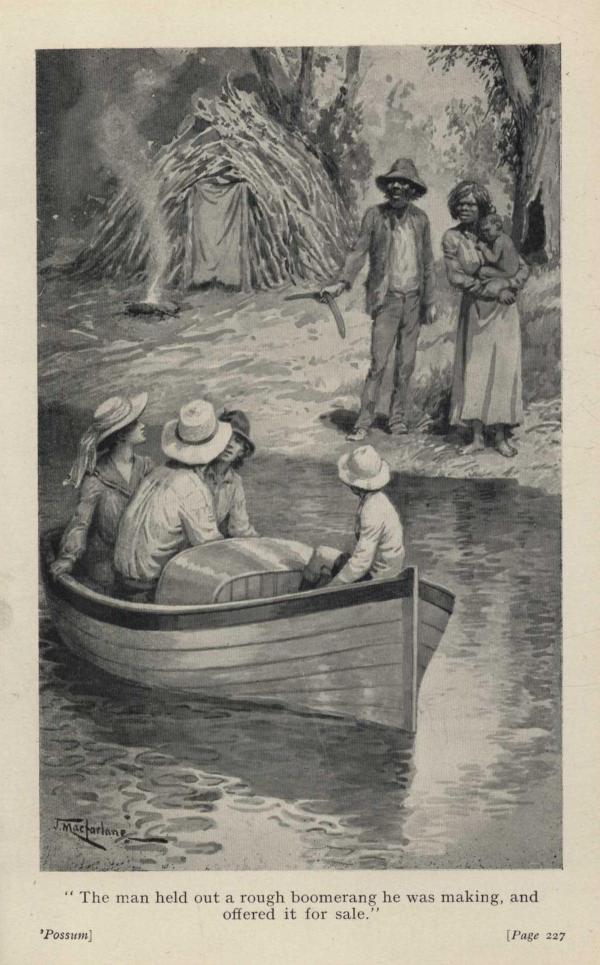
"The man held out a rough boomerang he was making, and offered it for sale."
"I've no money with me," Tom said. "Would you like it, Garth? I can tell him to come to the house to be paid, if you would."
"Don't you!" said 'Possum, in a quick whisper. "It ain't worth buyin'—those fellers don't know how to make a decent boomerang. They're on'y sham things, made to catch silly visitors——" She pulled herself up, and turned scarlet. Tom laughed.
"Bless you, 'Possum, I always get truth from you," he said. He shook his head at the man. "No, thanks," he said; and the black fellow looked surlier than ever. The woman uttered a quick jabber of words that included something about "bacca."
"Oh, they can have that," Tom said. He took a piece of tobacco from his pocket and tossed it to the man, who caught it deftly, his heavy face lightening for a moment. Then the boat chugged her way onward, and they lost sight of the little clearing.
"'Fraid I was a bit rude that time," said 'Possum. "But if you once let one of those fellers come to your house, you're never free of them. They'll turn up at any hour and want tucker and baccy; an' what's more, they'll tell their friends, and you'll have them callin' too. And they'd steal the very clothes off your back. Nothin's safe from them—the washin' out on the line, an' the chickens, an' the things in the shed. They're a caution when they take to hangin' round a place."
"But won't they come in any case?" asked Aileen.
"Oh, they may, of course. But they're queer people; if once they're told to call at a place they seem to think they've got a hold on it for keeps, an' they'll come back for years an' years."
"Where do they live, 'Possum?"
"Those people have most likely been in one of the settlements—Ramahyuck or Lake Tyers. The woman's dress looks like it: she'd never be as neat as that if she hadn't been in a mission station. They treat 'em jolly well there—give 'em decent little cottages to live in, an' just enough work to keep 'em going. But they always break out now an' then, an' one or two'll clear out to the Bush an' camp for a while. They'll go back when the cold weather comes—or before that, if they aren't pickin' up enough food. An' they don't much mind where an' how they pick it up, I can tell you."
"Why wouldn't you let Dad buy the boomerang, 'Poss?" asked Garth.
"I'd make you a better one meself," 'Possum answered. "It's really only the old men who know much about either makin' or throwin' boomerangs: none of these young ones'll bother themselves. You could throw that affair he was makin' into the air, same as you could any old stick, but it wouldn't return to you. Most people don't know the difference"—she grinned at Tom shamefacedly—"an' they get a sale for all sorts of rubbishy stuff among the summer visitors. But it's no more real black's stuff than I am. That gets harder to buy every year, because the old men who used to make the things are dying out."
They had been gliding along gently, the water growing steadily shallower. Suddenly, they came upon the end of the arm—a pool like hundreds of other pools through which they had passed, save that in each of the others there had been an outlet, and here there was none. The water ended. All round them the trees frowned down upon the still surface, where leaves and sticks floated idly, never to get away: doomed to wash into the rubbish along the shore, or to become water-logged, and finally to sink to the muddy bottom. There was something unnaturally eerie and still about the place. Even the birds had deserted it: there was no longer the happy sound of their singing and twittering. Far overhead a fish-hawk sailed lazily.
"Ugh!" said Aileen, shivering a little. "I don't like this place. Let us turn back."
So they turned and drifted into wholesome blue water, passing the blacks' little camp and the gullies and clearings that led back to the country they knew. In one gully they moored the boat and made their fire, eating their luncheon among the limbs of a fine old tree that had fallen and lay upon its side, its gnarled-boughs making splendid natural arm-chairs. The birds were very tame: one little brown honey-eater came hopping near them for crumbs, and finally perched on the toe of Tom's boot, where it remained in a quaint attitude of alert attention. Then they fished the pools, with varying success, and at last gave it up and travelled swiftly down the arm until they reached the lake itself. For the last half-mile there was little need for the engine. The current had been steadily growing in power; at length it whisked them round bend after band, until it brought them out into the open water, and set swiftly towards the Entrance, where the great grey piers guarded the lane of water that led out to the breakers.
"You wouldn't have much chance if you drifted out here without oars," 'Possum remarked. "The current joins the one that sweeps down the lakes from ever so far up, an' don't they just race out to sea! There was a party of girls in a boat—visitors—got into that current last year, an' went bobbin' along towards the Entrance. They'd been told it was risky, so they lost their heads an' dropped an oar, an' then, of course, they had no chance at all."
"Were they taken out?" Aileen asked.
"No, but it was luck they weren't. They were mighty close to the Entrance when some people in a motor-boat saw 'em an' chased 'em—just managed to stop 'em in time. They'd have been in the surf in three minutes, an' no boat could live there unless it was jolly well handled. You'll see the fishing-boats comin' in sometimes, when they've been out with the nets after a shoal of salmon, and it just is exciting! Even with four good men pullin', it's risky enough to bring a big boat through those breakers. Dad seen one turned clean over one day, an' one man was caught underneath it an' killed. An' that was a great big sea-goin' fishin'-boat, not the sort of little cockle-shell thing that people pull round on the lakes."
"Poor chap! I did not know that the fishermen went outside the entrance: I thought they only fished in the lakes," Tom remarked.
"They fish wherever they can earn a livin'," said 'Possum drily.
They came out upon the wide surface of the lake, and ran across to a bay that nearly always held fish. To-day it lived up to its reputation, and soon they were hauling out whiting and big pink schnapper, whose sides were like live opal as they came out of the water. Tom fished scientifically, with a rod that was the pride of his heart: the others bobbed cheerfully with hand lines and sinkers, and were filled with joy because their results were as good. Their basket was full when they turned homewards in the evening.
"Tell about the time when Joe got bushed, 'Possum," Garth pleaded.
"That ain't anything to tell about," said 'Possum reprovingly. "And besides, you know already."
"Yes, but I like to hear it again," Garth begged.
"We haven't heard, at all events," Tom said. "Go on, 'Possum."
"Well, it's nothin' much," 'Possum said, reluctantly: to tell Garth stories was one thing, but it was quite another to be forced to retail them to Garth's parents. "Joe went off on his own into the Bush one afternoon—on'y four, he was—an' next thing I knew was, it was near dark, an' no Joe. Dad was out in the boat that night, so I left word for him, an' put all the other kids to bed an' made the fire safe, an' started off."
"Into the Bush?"
"Yes, of course. That's where Joe was. Well, I pounded through the jolly old scrub all night—no luck, an' I was pretty worried, 'cause Joe wasn't no more'n four. An' all me clothes got tore, an' I was scratched near to bits, an' I kept thinkin', if that was all the fun I was gettin' out of it, an' me past fourteen, how about poor old Joe?"
"But you found him, 'Possum?" Garth cried eagerly.
"Just about daybreak, I did—in an old hollow stump. Crawled in, he had, an' there he was, lyin' asleep, happy as Larry. Not any trouble for Joe. He woke up, an' I was the first thing he saw, an' he laughed all over his dear old dirty face. 'Where's me porridge, 'Poss?' he says. He always was just about the limit!"
"What about your father?" Aileen asked.
"Oh, he got home about two o'clock, an' seen the note I left, but he reckoned if I couldn't find Joe he couldn't, so he turned in. Dad never worries about things. He says everything'll come out in the wash, if you leave it long enough."
They reached the jetty, and ran gently alongside. 'Possum hopped out nimbly, in spite of her sore feet, and helped to steady the boat while Aileen followed more carefully with the fish and the empty luncheon baskets. They left Tom to put the engine to bed, aided by Garth, and went slowly up the hill.
"Christmas will be in three days," Aileen said.
"I suppose so," 'Possum answered. "It don't make much difference to us. I'll have to kill a turkey for the kids' dinner, I suppose." She paused at the gate. "I won't come in, Missus: it's late, an' I better be gettin' home."
"You must take some fish," said Aileen, quickly halving the catch and placing 'Possum's share in an old sugar-bag. "No, that's not too much at all: there are more of you to eat it. And you know Polly loves fish!" They exchanged a fishy hand-grip. "Oh, and, 'Possum, come over to see us on Christmas afternoon, won't you?"
"Seems to me I come most days," said 'Possum, laughing.
"But we want you on Christmas Day. Will you come?"
"Why, yes, I'll come—thanks," said the girl, laughing. "Catch me stayin' away, when you'll be bothered with me. Well, so long!" She limped off to where her old horse slept peacefully under the quince tree.
CHAPTER XV
SANTA CLAUS AND CLOTHES
Garth woke to a blissful Christmas morning.
The end of his bed gave ample proof that his father's dismal forebodings about Santa Claus had not been needed: a bulky stocking, with strange hollows and protuberances, ornamented one post and yielded such treasures as a new bridle, a pair of leather leggings, and a stockwhip, with other offerings showing clearly that the saint fully realized that this particular boy had moved from the city. That was good: and good it was, on his way to his bath, to meet Bran, resplendent in a new collar. But when an enormous bundle on his chair at breakfast-time revealed the very desire of his heart, a dainty, light saddle, Garth was speechless. He could only hug his father and mother again and again, and feel the saddle lovingly, and smile at them in a silence that they quite understood.
Aileen was smiling, too, at what she found on her plate: books and music, a very new aluminium saucepan, a soap-saver for the kitchen, and, tucked away under the rest, a little brooch within which a black opal gleamed mysteriously, full of dark fire. Aileen loved black opals: but she regarded them as belonging to the old times when evening dress and balls and theatres were as common as working overalls and fowl-rearing and hoeing now. She shook her head at Tom.
"You shouldn't—bless you!"
"Oh, I had to!" he said; "I couldn't help it. I haven't altogether forgotten the girl who liked pretty things."
"She's very contented to have put them away," said Aileen.
"I know. But I wanted to see her in one," he said obstinately. Whereupon Aileen, to please him, pinned the brooch in her overall, and found herself greatly enjoying it as she prepared dinner.
They jogged to church behind Roany, and exchanged greetings with a few people they knew and with many to whom they were strangers—except that every one knew that they were "the new, hard-working lot that's come to Gordon's farm," and being simple, kindly-minded Gippsland settlers, saw no reason why they should wait to be formally introduced. Then they came home to a happy Christmas dinner—everything cold, and therefore as it should be, with the thermometer at 95°—after which, by mere force of habit, Aileen was about to go to work in the garden, but was restrained by Tom, who remarked that there were some things not done in decent families, and placed her forcibly in a long chair on the veranda with a new book.
'Possum came through the house presently. A feeling that something was due to a day which evidently meant far more to the Macleods than it had ever done to her, had induced her to put on her new dungaree dress, and she was stiffly uncomfortable. Dungaree obligingly fades as soon as it is washed: when new it is a rather deep hard blue, and the wearer looked hot and red-faced, and crackled as she walked. She stood in the doorway looking down at Aileen, who had put on a white frock in honour of Christmas, and, with her shining hair against the pale green canvas of her long chair, was like the spirit of spring and coolness. She put up a slim hand and took 'Possum's work-roughened one.
"I'm too lazy to get up, 'Possum," she said. "Come and sit down."
"It ain't often one sees you lazy," 'Possum answered, leaning back in a chair, and promptly sitting up again, since the position brought her great boots too baldly into view.
"I have been bullied shamefully," Aileen said, casting a severe glance at Tom, who bore it with cheerfulness. "Goodness knows my broad beans are calling for me, but I'm not allowed to go near them. What have you been doing, 'Possum?"
"Oh, the usual thing. Dad's away shearin', so I've got to be pretty busy again: and anyhow, it's about time I was; my feet are all right, an' I'm full-up of loafin'. Seems to me," said 'Possum, "that loafin's all very well for a bit, an' then it gets on your nerves. The kids have been jolly good, an' I pretend not to see a lot o' things they do or they don't do; but there's lots o' times I'd give me ears to be doin' the work myself."
"That is pride, which is a thing all you women suffer from," Tom said. "She"—indicating Aileen—"has violent attacks of it whenever I wash up, or sweep a room, or do any of the things she imagines she does better than I do. Of course, it's only a delusion on her part, because I'm really a first-class housemaid: but there it is. It's a pity, because otherwise she has rather a nice character!"
'Possum grinned. She was beginning to understand what she called Tom's "foolin'," and was no longer bewildered and slightly alarmed when he chaffed her. Nevertheless, she had not yet come to the point of chaffing in return, and so she thought it more prudent to change the subject.
"Where's Garth?" she asked.
"Garth is careering over the hills and far away on a brand-new saddle—and Jane," said Tom. "There is also a new bridle, and he has new leggings—the latter must be exceedingly uncomfortable on a day like this, but he insisted on putting them on. He's awfully pleased with himself. I don't think it's much of a Christmas for Jane; she probably prefers him bare back."
"My word, he must be proud!" 'Possum uttered. "He told me the other day he was goin' to save up for a saddle, 'cause he couldn't go askin' you to get it, with you buyin' so much fertilizer: an' he wanted to know how long it would take him. Said he'd got ninepence. I didn't know what to say to the poor little kid."
"Well, he has the saddle now, and I sincerely trust I won't have so many pairs of knickerbockers to mend," Aileen remarked. "Bare back riding may be fun for a boy, but it's destruction to his trousers!"
"Yes, ain't it?" 'Possum agreed. "I'm always preachin' to Bill, but of course he don't take any notice—you wouldn't expect him to!"
"You wouldn't let young Bill hear you say that," Tom remarked.
"Not much I wouldn't," 'Possum grinned. "Bill's too much inclined to kick over the traces as it is, without me givin' him any encouragement. I reckon I'll have me hands full with him yet."
"Poor old Bill! I see storms ahead for him," said Tom, rising and stretching his long form. "This is a hard country for men since women got the vote! I think I'll go and find Garth, and we'll compare notes on our troubles."
"Don't be late for tea, or 'Possum and I will eat all the Christmas cake!" Aileen called after him. "You'll feel that more than anything I can do with my old vote!" He flung a laughing rejoinder at her, and vanished round the corner of the veranda.
For a few minutes after his footsteps died away Aileen was silent. She was wondering how to make her gifts to 'Possum without hurting the girl's feelings. Underneath the queer, abrupt exterior she knew there lay a sensitiveness so easily wounded that only the most delicate handling would succeed—and 'Possum's independence was a sturdy growth. She might resent the presents altogether: for a moment Aileen grew almost sorry that she had prepared them, now that the time came for them to be given.
"I believe I've got stage-fright," she thought.
'Possum opened the way herself.
"I wish we bothered more about Christmas—the way you do," she said. "It'd be nice for the kids. I remember we used to keep it up before Mother died. But now we never bother."
"I love Christmas," said Aileen, "especially since I had Garth. He makes a great difference, because he believes in every bit of it, particularly Santa Claus! And it's such fun, preparing presents, even if you spend very little on them: it's the doing it that is the fun." She hesitated. "I wanted you to be in our Christmas, Possum."
"Jolly good of you," said 'Possum gruffly. "But I'm not much good to any one."
"That isn't for you to say," Aileen rejoined. "Come into my room, 'Possum." She led the way.
"I say!" said 'Possum, entering. "Oh, ain't that pretty!"
There was a dainty pink frock on the bed, with white cuffs and collar: very simply and plainly made, but well cut in every line. Near it was underwear: plain also, but good, and beautifully ironed. A pair of black shoes accompanied neat black stockings: a straw hat, swathed with palest pink muslin, lay on the pillow. There was even a pretty handkerchief on the frock. Nothing had been forgotten.
"Do you like it?"
"Like it! Why, it's like the inside of a shell! I never seen such a lovely colour. But you do always have pretty things, Missus."
"I'm glad you like it," Aileen said. "Because it isn't mine, 'Possum. I made it for you."
'Possum flushed to the roots of her hair, staring at her.
"Me!" she said at last. "I say, you're gammoning, aren't you, Missus?"
"No, I'm not," Aileen said. "I've had terrible work keeping those things out of your sight—and it has been such fun making them!" She watched the flushed face uneasily. "You're not cross with me, 'Possum?"
"Cross with you!" 'Possum uttered. "Well, I would be a beast. But I'd rather not take them, thank you very much, all the same."
"But why?" Aileen flushed in her turn.
There was a pause.
"I'm not the sort as wears those sort of clothes," 'Possum burst out at last. "I'm just a workin' hand, same as a man: this old dungaree's my style, not lovely things like that. It's no good me thinkin' I could pretend I was a lady—an' them's only a lady's things." Her voice broke, and she stood staring at her rough boots.
"Aren't you just a dear old stupid!" Aileen said softly. "We're all working-hands, and we wear old clothes at our work because any other things would be silly. But you haven't been just a working-hand to us: you've been more like a godsend. You put heart into me, when I hadn't any. I didn't love making those things because you had helped us, but because you're my friend."
'Possum's eyes glowed suddenly.
"Me your friend!" she said. "I'd sooner be that than any blessed thing on earth. But I ain't fit."
"You might let me pick my own friends without sitting on me!" Aileen said, laughing. "Ah, 'Possum dear, don't be a duffer! You can't refuse to be friends, for if you do I shall go over and sit in your kitchen, and talk to you, and be extremely in the way; and you simply won't be able to shake me off. 'Possum, be nice to me: I do want to see you in those clothes!"
'Possum gave a long sigh. It was the sigh of capitulation. She picked up the dress and held it against her cheek.
"It's just the loveliest ever!" she said. "And I just can't say thank you, but I reckon you know. Will I put them on an' come over to-morrow, Missus?"
"No—I can't wait for to-morrow!" Aileen cried. "You're going to look so nice that I've got to see you at once! I'll go and get tea, 'Possum, and you can put them on."
"What—now!" 'Possum's tone was doubtful, but her eyes were eager.
"Yes. Hurry!"
"I wouldn't put them lovely things on unless I had just had a bath," 'Possum declared. "I had one last night, but that's not the same. I reckon it 'ud be a sin to put 'em on after these hot ol' things. New dungaree's such smelly stuff, an' these just smell of freshness, the way all your things do!"
"Well, there's the bathroom," Aileen said, laughing. "I'll leave a towel in there. Run along!" She gathered up the new things in her arms. "Don't forget the shoes, 'Possum!" she cried, and hurried off.
It was half an hour later that Tom Macleod, coming in from the paddocks with Garth at his heels, stopped abruptly at the sight of two figures standing near the window. A stranger had called, he reflected; he looked hard at the tall girl in pink standing by his wife, wondering who she was. Then she turned, and he saw that it was 'Possum.
But a new 'Possum. The pink dress fell in soft folds, hiding the angularities that the dungaree horrors always accentuated. Its extra length made her yet more tall and slender, and the colour was reflected in her cheeks, while the light in her eyes had never been there before. The white collar fell away from a neck that was brown, but very shapely. Her fair hair was parted a little at the side, and brushed until it shone like Aileen's. Now that the old felt hat was removed, it showed a crisp little wave that made amends for its shortness.
For a moment Tom forgot his manners, and stared. Then, as a hot wave of colour surged into 'Possum's face, he recovered himself, and came into the room, making a casual remark upon the lucerne crop—even as he spoke, it seemed incredible that the pink vision before him and the girl who had ploughed the ground and helped to put in the crop were the same person. He tried to make the remark sound ordinary, but Garth interrupted him. Garth, as his parents afterwards remarked, had small occasion for tact.
"I say, 'Possum, I didn't know you!" cried the small boy. "Isn't she swagger! Mother, doesn't she look ripping! 'Possum, weren't you awfully s'prised?"
"I just was," said 'Possum. Even her voice seemed different: it was somehow softer. When she smiled down at Garth she was very winning.
"Well, as these matters have been mentioned so boldly, I don't see why I should stand out," said Tom. "I won't, either! 'Possum, you look nicer than nice, and pink's your colour. Isn't it, Aileen? Carried unanimously. Is tea ready?"
Tea was ready, and they made it a merry meal—longer than usual, because no work was to be done on Christmas Day, save by the luckless Horrors, who could be heard, bucket-laden, clanking his way towards the cow-yard. 'Possum did not talk much. But her face was so happy that words did not matter!
She went with Aileen into her room when it was time to change into the old dungaree and go home: poor little Cinderella! Aileen thought, wondering if she had done well to be fairy godmother. There seemed no prospect of any Prince waiting for the Cinderella of the Bush.
"I was wonderin'," said 'Possum, and hesitated—"if you'd very much mind me leavin' these things here. You see, if I take 'em home I'll never wear 'em, an' they'll get grubby an' crushed. But if I could put 'em on sometimes when I come over—not to feel such a pig when you make me come into tea, say. Then they'd be a terrible comfort to me! I do love 'em so, but it's here I want to wear 'em. If I take 'em home I'd take 'em out every day an' look at 'em, but I'd never put 'em on, for fear of spoilin' 'em."
"But, 'Possum, it's only cheap print," Aileen protested. "It will wash beautifully. Why should you be so particular about it?"
"Well, you see, it's all I got," 'Possum returned. "Oh, I simply couldn't bear to spoil 'em, Missus!"
Aileen pondered.
"Of course you can leave them here," she said. "That's quite easy. But, 'Possum, why should it be your only pretty dress? Can't you buy some print, and bring it to me, and we will make it together? You've no idea how easy it is, with a few lessons. Then you could keep your dungarees for work, but put on fresh frocks in the evening, or when you went out."
"Print costs money," said 'Possum.
"But your father——"
"Dad 'ud take a fit if I asked him for any," said the girl. "He thought he was doin' a tremenjous thing when he give me this dungaree the other day."
"Well, you have your own money. You earn it thoroughly enough. Surely you could spend a few shillings of that."
'Possum drew a long breath. Then she put the temptation from her.
"I don't reckon it's mine: it's the kids'," she said. ("It was as though she had said, 'Get thee behind me, Satan!'" said Aileen to Tom later on.) "I couldn't touch it. That bit o' money's a big comfort to me."
"Bill is twelve, and you can't let him go to the Cup by himself until he's grown-up—and you're saving for it now!" said Aileen. "Oh, 'Possum, be sensible!"
"I reckon I am," said 'Possum firmly. "There's other, things besides Cups. I couldn't do it." There was a hint of a sob in her voice. "Please don't ask me, Missus; you're a brick to say you'd help me, an' you don't know how I want them dresses. But I got to go without. Don't you worry about me—you been awful good to me already."
"Now I wonder would O'Connor mind?" Tom reflected, when they discussed the matter after Garth had gone to bed. "I don't believe he's close-fisted—and, though he probably wouldn't admit it, he's very proud of 'Possum. Do you know, I think a lot of women are afraid to ask their men-folk for money, when there's really no need to be afraid? Most men like to see their daughters decently turned out."
"Then I'll ask Mr. O'Connor myself!" said Aileen decidedly.
She did so some days later, meeting the big man on the road to Cuninghame, where she was hunting for strayed turkeys; and, having explained the matter, had the satisfaction of seeing Nick flare up, as his daughter would have said, "like a packet of crackers."
"'Possum's got no need to be badly dressed!" he said angrily, quite ignoring the fact that it was his own talk about money that kept the girl from asking him for an unnecessary sixpence. "I was on'y the other day talkin' to her about her clothes. I'll tell her she ought to have more sense than to talk to you like that."
"Please don't," Aileen said quickly. "I felt sure it was just that you didn't understand; but 'Possum hates to ask you for anything for herself. She will ask for things for Bertha and Polly, but she doesn't realize that she has also an example to set them of turning out neatly."
"That's right," the big man agreed. "Well, what am I to do, if you won't let me talk to her, Mrs. Macleod?"
"If you would give me the money, I would buy the materials, and then teach 'Possum to make them," said Aileen. "Then, if you show her that you notice and approve when she goes home in a new frock, it will do more good than a great deal of talking now. And you will be surprised to find what a good-looking daughter you have, Mr. O'Connor!"
"She used to be an awful jolly little kid—before her mother died," Nick said. "I'm afraid she's had a tough time ever since. She's just too useful—that's what's the matter with 'Possum!" He put some money into, her hand. "Will that do?"
"It is too much," Aileen said.
"Oh, you'll use it up soon enough. Tell me when you want more. And thank you, Mrs. Macleod. You've made a mighty lot of difference to 'Poss. I reckon the day you came here was a lucky day for her!"
Thus it was that 'Possum, summoned by Aileen, beheld dress-lengths of material of divers colours, and learned, to her utter amazement, that they were hers.
"Dad give you the money!" she gasped. "Dad? Well, that just beats everything!"
"Of course he gave it to me," Aileen said.
"An' never made a fuss?".
"No—why should he. I don't think you're quite fair to your father, 'Possum. You have made him think you care for nothing but work. Doesn't it ever occur to you that he would like to see his eldest daughter nicely dressed?"
"No, it don't," said 'Possum firmly. "I think he'd a jolly sight sooner see me on top of a plough!" Which view held so much truth that Aileen was compelled to laugh. Nevertheless, she held to her point.
"If he does, it's your own doing," she said. "Men are queer creatures: they always think what a woman encourages them to think. You have let him imagine that dungaree was the only thing to dress in. But once he sees you in something prettier, he won't be satisfied with the old dresses any more, except just for working."
"Well, I'd like to believe it," 'Possum said, drawing a long breath. "But I've known Dad a long time!"
"You'll know him much better when you have accustomed him to a well-turned-out daughter. And think of the children, 'Possum. How do you expect Bertha and Polly to be dainty and fresh if you don't set them the example?"
"Well, I seem to have been making a mighty lot of mistakes," 'Possum said ruefully. "I thought I was doin' the best for those kids, but I suppose I'm all wrong."
"I think you're wrong in one or two things, and just a wonder in everything else," said Aileen warmly. "And they love you just as if you were their mother, 'Possum. Now you have got to make them very proud of you."
So they worked at the new frocks together: Aileen patient in explaining, and swift at planning, while 'Possum grasped her needle as if it were a bradawl, and drove it through the stuff with much muscular effort, producing stitches of a size truly majestic. "Blest if I can handle the silly little thing!" said she, laboriously unpicking: "ploughin's a jolly sight easier!" But in time her natural deftness came to her aid, and when Aileen had succeeded in making her forget the methods by which she had "clamped" together the garments of her family, and inducing her to use a needle less thick than a skewer, she arrived at creditable results. The finished pile of dresses contained plenty of her work, and she gloated over them proudly, though most of her pride was reserved for the frocks for the little girls, and the cool suits for the boys, that had been "managed" out of the stock of material.
"We put 'em all on for tea," she told Aileen on the day following the great occasion of the finishing of the work. "I had the kitchen very dossy, an' a vawse o' flowers on the table, an' there we were when Dad came in. He just looked at us careless-like, an' then he seemed to take notice, an' he stared an' stared. An' of course the kids giggled. Then he said, 'Well!' just like that, an' stopped, like as if he hadn't any more ideas. An' he kep' on starin'. At last he says, 'I suppose this is Mrs. Macleod's doin'?' An' I says, 'Yes.' 'Who made 'em all?' he says. An' I told him. An' he says, 'Well, I'm proud of you, 'Poss—an' all my kids!' An' he got up an' went out. An' presently he come back—an' if you'll b'lieve me, Missus, he'd acshally gorn an' put on a clean shirt!"
CHAPTER XVI
A LITTLE BOY
"What are you going to do with the old boat, Dad?"
"Why, I really don't know that she's worth bothering about," Torn Macleod answered, looking up from the dinghy he was examining. "She's very ancient and leaky: I suppose Gordon used her before he got the new skiff. He was apparently quite satisfied to let her go to pieces, and I don't think I'll interfere with his intentions."
"Oh!" said Garth, somewhat disappointed. "I thought you were going to mend her; and it would be such an int'rusting job."
Tom laughed.
"Well, that was rather what I was thinking myself," he answered. "If I had nothing else to do I would like nothing better than to patch up the old thing. But then I have about fifty-seven other jobs waiting for me, most of them not nearly so interesting, but all more important. So I'm afraid the old dinghy must stand aside, son. Perhaps, if work is slack in the winter, I may get at her."
"I wish you would," Garth said. "I love helping you with carpent'ring jobs."
"Well, we'll see," said Tom. "But really, I'm afraid she's too rotten." He hauled the dinghy to the end of the jetty and moored her to a post, returning to his task of cleaning the skiff and the motor-launch. It was an idle morning, and to overhaul the contents of the boathouse had been a good way of using a few hours.
February had come, with a last burst of heat, after a cool January; and February heat has a vicious quality all its own, perhaps because it comes when people are beginning to hope that summer is over. Therefore, it induces much slackness, and makes a toil of work that in ordinary weather is only pastime.
The little household of Gordon's Farm had felt the influence of the weather. Garth's ability for work and play had slackened, and Aileen had begun to administer a tonic: herself white and heavy-eyed, and with little inclination for work. The cottage was stifling in the long, hot days; luckily, the nights helped them, for they all slept on the veranda, as they had done throughout the summer, and the fresh night breeze from the lake never failed. Tom watched his wife carefully, knowing that her spirit would keep her going long after her tired body needed rest. His own work in the paddocks was lessening as the season advanced; he had more time to give to the house, and spent many days ostensibly in the garden, but, in reality, ready to lend a hand at a hundred tasks. It was the constant thought, even more than the actual help, that carried Aileen on from day to day.
'Possum helped, too. There was little outside work for her, but she rode over often, and delighted in forcibly compelling Aileen to rest while she made light of housework and cooking. To cook with Aileen's patent stove was always a peculiar joy to her, and no inducement would draw her from the glass-fronted oven while she could watch her scones or pastry developing from dough to crisp perfection. To Aileen's remonstrances at being forced to be idle she turned a deaf ear.
"Just you don't worry," she would say. "You got to remember you've had a hard summer—workin' like a carthorse, an' you never used to work in your life before. It's bound to tell, 'specially with this beastly heat. You'll be all right once we get the autumn."
She came over early to-day, and hearing from Aileen that Tom was working at the boats, rode down to the jetty with a message. Nick O'Connor was going to a farm at Metung to look at store calves, which they both needed: he proposed to ride over presently and ask Tom to accompany him, making the journey in Tom's motor-launch. Macleod assented heartily.
"Nothing I'd like better," he said. "I was wondering where I could get hold of some young stock." His face clouded a little. "My wife isn't looking very fit to-day—I had planned to take her out this afternoon on the lake. Still, it's business, and she won't mind."
"Not she," said 'Possum. "I say, though, I haven't got anything special to do to-day: how'd it be if I was to stay and do a few odd jobs about the house, an' then take her an' Garth out in the skiff when it gets cooler? We could drift down to the lake, an' then just mooch along until we met you comin' home from Metung; an' you could bring us home in the launch an' tow the skiff."
"That's as brilliant as most of your ideas, 'Possum," Tom exclaimed. "I would be very glad to think Aileen had your company to-day, and she'll get her outing after all. It won't be hard work for you, either, for the current will take you down to the lake, and if you don't start until it's cool we ought to meet you soon after."
"Oh, that'll be all right," 'Possum answered. "Goodness knows, I'm used to pullin', an' that skiff of yours is just a beauty to pull—she's diff'rent from our old tub. Well, I'll get along, an' let me horse go."
It was an unusually stifling day, and Aileen was tired enough to be meek when 'Possum bullied her into subsiding into a long chair. She had risen at five o'clock, having found that the only way to work comfortably in such weather was to do so before the sun had time to grow vicious: therefore, the housework was done, and lunch prepared. 'Possum was slightly disgusted. "I came hopin' to be useful," she said, arranging Aileen's feet comfortably.
"You're always useful," Aileen said, smiling up at her. "Come and sit down, too, and we'll sew."
'Possum shook her head.
"No good me tryin' to sew in this weather," she said. "The jolly old needle simply sticks in the stuff, like as if you'd rubbed glue on it. It's a marvel to me how you manage it, Missus. Never mind; I'll go on makin' the cage for that parrot we're goin' to catch for Garth some day. I won't make much mess, an' I'll sweep it up." She busied herself with tools deftly, while Garth watched and tried to help.
No one wanted much lunch: it was too hot to eat. They made what pretence they could, and soon went back to the veranda. At their feet Bran panted, open-mouthed; outside the fences they could see the fowls, with gaping beaks, standing about under the trees.
"I say," said Garth suddenly, "what about a bathe?"
"Isn't it too hot?" Aileen said.
"It's too hot, here, but it would be lovely down there," Garth answered wisely. "Do come, mother; we'd all feel heaps better."
"I believe it's sound advice," Aileen said. "Come on, 'Possum."
They put on their bathing-dresses in the house and, with sand-shoes on bare feet, went down the slope to the lake. There was a tiny sand-bank near the jetty, shelving gently under the water: a good place for Garth to splash and paddle when he was tired of swimming. He had not been a very apt pupil in the water—perhaps because his swimming lessons were somewhat haphazard, given when either Tom or Aileen had time. To swim half a dozen strokes was an achievement for him, and he accomplished it to-day with much puffing and blowing. Then he returned to the shallows and played with Bran, while 'Possum dived off a log into a deep pool, and Aileen swam about lazily—she was not a strong swimmer, and the day was not one for exertion, even in the water. However, they were all refreshed, when at length Garth clamoured that he was hungry, and the three dripping figures climbed the hill to the house.
It was tea-time when they were dressed, and after tea they made ready to start. The sun was hotter than ever, it seemed: a mist that had hung over the sky all day had cleared away, and had left blazing heat behind it.
"I don't think I would go, if we had not said we would," Aileen said. "But I suppose Tom might be anxious if we didn't appear."
"Afraid he would," 'Possum agreed. "They might go lookin' for us, too, thinkin' they'd missed us. Oh, you'll feel better on the water, Missus; an' ten to one we'll get a breeze when we come out on the lake."
"Yes, perhaps we will," Aileen said. "I really think it's wiser to go—one shouldn't let hot days make one too lazy."
"You ain't got a lazy bone in your body," 'Possum averred stoutly.
"Indeed, I don't feel as if I had a bone at all, on days like these," Aileen said. "It worries me that I should feel so useless, 'Possum. I haven't time to be useless!"
"Ah, you—useless! Not much you ain't!" said 'Possum. "Every one feels beastly weather like this—unless it's Garth. He don't seem to be sufferin' from loss of energy, just now at all events."
She nodded at the small boy, who was racing ahead—a gallant little figure in white shirt and brief knickerbockers, with a wide felt hat. He took a flying leap upon the jetty, where the water swished softly on the pebbles, and capered beside the old dinghy that Tom had left moored near the skiff.
"Come on!" he shouted. "You're too slow. I'm going off to meet Daddy by myself!"
As he spoke, he planted one foot gingerly in the old boat. It rocked and swayed, and he almost overbalanced. 'Possum sprang forward with a quick catch of her breath, but the little fellow righted himself with a mighty wriggle, and sat down abruptly in the dinghy. 'Possum turned to Aileen with a relieved, half-shamefaced laugh.
"He jolly near sat down in the water that time," she said. "It give me a start—lucky he managed to hit the boat." She raised her voice. "Keep still, Garth; let me steady her while you get out."
There came a queer little cry from Garth.
"But it's going away with me!"
Aileen saw, and screamed, and ran. She was too far away. The sudden jerk had parted the rotten strands of the old rope that held the boat, and slowly, yet all too quickly for 'Possum's wild rush, the dinghy swung out into the stream. The tide was running out, and the current was very swift. It seemed in but a second; while they cried out and ran, that the current caught the old boat and whisked it swiftly away.
"Come on," 'Possum said, "quick! Don't worry, Missus, we'll catch him."
She leapt upon the jetty. Aileen followed, and flung herself into the skiff, thrusting the oars into the rowlocks. 'Possum tugged at the painter, and abused Tom's knots under her breath. They yielded at last, and she sprang in, pushing off with a force that sent the boat spinning down-stream. 'Possum grasped the oars, Aileen was already at the tiller—staring ahead in utter silence, seeing nothing but the little blue and white figure. It swung round a bend, and was out of sight.
"Keep her out in the middle, where the tide's swiftest, Missus," 'Possum said. "Don't look like that—it's all right—we'll get him."
She was rowing desperately, with sharp, quick strokes under which the boat flew through the water. They rounded the turn, and ahead—but how far ahead!—was the dinghy, with Garth sitting upright and very still. Faster and faster, as they neared the mouth, the current set out to sea.
"It's very light, you know," 'Possum said, between strokes, in answer to Aileen's look. "An' it got a good start. We're gainin', though, you notice." She was flinging quick looks backward as she rowed. "Ain't he sittin' still—my word, he's good! He's got sense enough for ten!"
Garth's clear little voice came back to them over the dancing water. They could not hear his words, but there was no fear in the tone. Aileen felt almost ashamed of her own sick terror, hearing that brave, childish voice: but the stories of the danger of the current echoed in her mind, and if once the dinghy gained the lake before them she knew that hope was slight. And he was such a little, little boy!
The high banks seemed to fly past. Afterwards, in her dreams, she saw them always: flickering visions of yellow banks and dark green masses of wattle-trees. But at the moment she saw only what lay ahead: glancing water, and swift oars flashing, and 'Possum's flushed, strained face; and the boat that rocked and fled from them with its tiny burden.
But they gained. As they swung round turn after turn, they crept nearer and nearer to the dinghy. Surely they must win! And yet, 'Possum was afraid—looking at her, with senses sharpened by terror, the mother saw the fear in her eyes. She met Aileen's glance with a forced smile, but it could not hide her fear. Her arms never ceased their rapid, mechanical strokes—under the thin blouse her muscles rose and fell as she opened her shoulders with long, powerful swings.
"Can you stand it?" Aileen whispered. "Oh, why can't I row decently!"
"You're ... far more use steerin'," 'Possum gasped. "I'm all right. See how we're gainin'."
"Then why are you afraid?" Aileen cried.
'Possum shook her head, and forced a smile—a smile that brought no conviction. Then Garth cried out again, something about "water," and "wet," and 'Possum's anxious look grew sharper. Her voice was shrill and strained as she called back to the child.
"I know, dearie—sit still!"
"What is it?" Aileen gasped: and suddenly knew. They were gaining rapidly now, but the dinghy was settling down in the water. The leaks! the wonder was that it had floated so long. Now the water rippled almost level with its edge. For an instant Aileen lost her head in her agony of terror. She screamed, starting half up.
"Sit down!" 'Possum's voice, stern in its anxiety, brought her to her senses. She flung a backward glance. "Near down," she gasped; "I knew, when we gained so quick."
Garth's voice came again, and this time with a sob of fear. The dinghy was almost sinking. For another moment the skiff spun through the water, rounding a bend, and there, ahead, lay the open water of the lake. 'Possum shipped the oars with a sudden jerk.
"Try 'n' keep her straight"—she flung the words at Aileen. "There's one chance——"
Ahead, the dinghy seemed to stop. There was a slow, sickening swirl, and, even as 'Possum screamed to Garth to jump, the water closed over the little boat. There was a cry—a cry that choked suddenly. Then the skiff quivered and stopped as 'Possum dived into the stream.
The water lay blank and desolate before the woman who sat staring in the skiff—blank but for the widening ripples that spread across the pathway of the current. So it lay for a dragging moment that was years, and then 'Possum's head broke it, and, but farther away, Garth's upturned face. They disappeared again.
When she saw them once more, they were together—'Possum gripping the boy tightly, and keeping afloat with one hand. The skiff was drifting down towards them. Aileen grasped an oar and tried to bring it closer, loathing the helpless ignorance that made her efforts awkward. Close—closer, but still too far. She thrust the oar towards them, leaning over the side. It was too short.
The current whisked her away—still stretching vainly towards the two faces in the water, crying to them, calling to God. Then she flung herself into the water, striving, with desperate helpless strokes, against the racing tide.
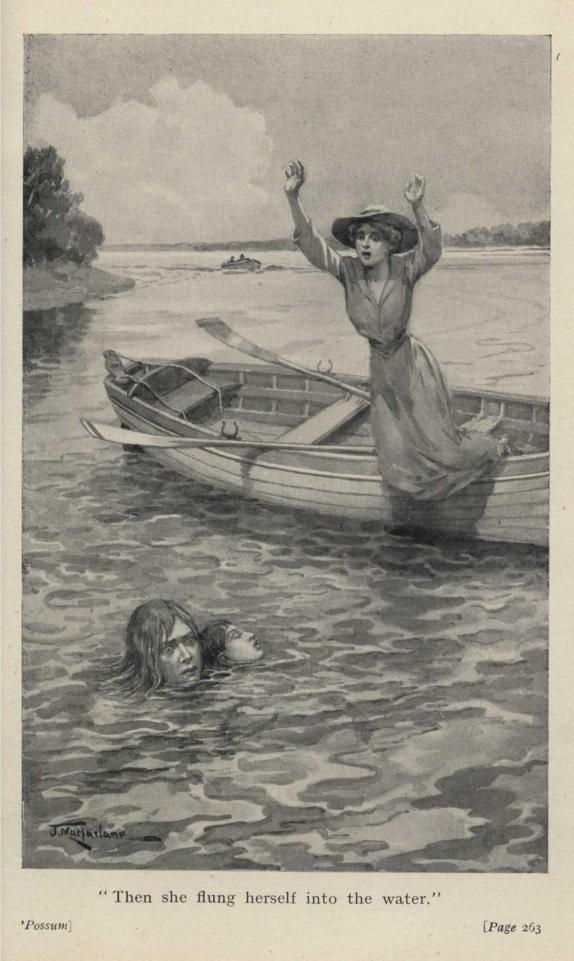
"Then she flung herself into the water."
A motor-launch came swiftly round from the lake, the two men in her talking and smoking. They saw the empty boat first, and the words died upon their lips.
"My goodness!" said Tom Macleod, and sprang to his engine. The launch leaped like a live thing, tearing through the water. The skiff danced past them, rocking upon the waves.
"Can you see them?" he asked, between his teeth.
"One of 'em's close," Nick said. "Steady—starboard a little. Be ready to back if I miss." He hung over the side and clutched at the fair head near the boat. "Ah—got her. It's your wife." His great shoulders quivered as he dragged her in, looking wildly ahead as he did so. A cry broke from him.
"There's my girl—she's got your kid. Hold on, 'Poss! Get on with you, man—starboard, starboard!"
He flung Aileen into the boat, and turned again swiftly. 'Possum was paddling feebly with one hand, almost done. She met his eyes and her lips parted.
"Take the kid," she gasped. But he took both, catching them with his great arms, and holding them out of the water until Tom could get to his side. He caught his boy from 'Possum's tired hands and laid him in the boat beside his mother, while Nick O'Connor dragged at the girl.
"I believe we're too late," Tom said in a terrible voice. "Aileen! Aileen!"
Her eyes opened, and in them was an agony of fear. She tried to speak, but only a whisper would come.
"Garth!" And Garth half turned and cuddled in to her with a little sleepy sigh.
* * * * *
The current fled onward, and on its breast the empty skiff danced as though the little waves were playfellows that had come to greet it and to carry it away to join their game. They rocked it gently until it neared the lake; then they grew choppy, and the skiff bobbed and swayed until it was drawn out upon the bosom of the water. It was calm there; but still the tide set seawards, carrying the skiff away and away—over the lake, hurrying, hurrying, until the great grey piers loomed ahead, with the grey waste of the sea dark between them. The roar of the breakers boomed, rising and falling. The lane of water between the piers was smooth: there were no waves; but under the surface were deep eddies, and the skiff spun and quivered over them, still drawn onward and outward towards the bar that leaped and thundered beyond the end of the piers. It reached the bar, and the breakers took it and played with it, flinging it up and down. Their curling crests tossed their spray into it; and still the little boat rode bravely, now in the hollow trough of a wave, now rising on a great curving wall of green water, and dashing forward with the tide out to sea. So, by some strange chance it passed the bar into the long, smooth ocean swells, and drifted to the horizon.
But when, in the night, the tide turned, it brought the little boat back. The pale moon that smiled over the Bush cottage where Garth lay, sleeping calmly, saw it also: a tiny thing on the great waste of waters, desolate and alone. Slowly it drifted landwards until the roar of the surf sounded near, and then it was hurried forward, towards the forsaken beach west of the piers, until a mighty roller caught it on its crest and bore it, mounting ever higher, at racing speed to the shore. It was high in the air when the great wave crashed downwards, and when its hundreds of tons of green water thundered to the sand, the skiff, bottom upwards, was dashed ashore in a swirl of white surf. Once the undertow caught it, dragging it back, but another roller flung itself down, and when its wild rush along the beach had spent itself, the little boat, battered and broken, lay half buried in the sand. The tide ebbed out, leaving it there; and a seabird, screaming by, saw it and perched upon it, calling to its mate.
In the little cottage, Garth slept on: and beside him his mother knelt, one arm flung across the warm, childish body, listening to his soft breathing: dumb with thankfulness.
CHAPTER XVII
'POSSUM BECOMES A PUPIL
"If you could spare a day or two," said Tom Macleod, and looked anxiously at 'Possum. "I think it's fairly rough on you to have to save my son's life one day, and nurse his mother the next, but a woman about the place would be a tremendous comfort, and Aileen would rather have you than any one she knows. She can't lift her head."
"Well, you didn't need to drive over yourself," 'Possum said. "You had no right to leave her! If you'd sent that kid Horrors with a bit of a note, you might a' known I'd be there as quick as old Greystones 'ud bring me. How on earth is she managin', with you traipsin' over here?"
"She was asleep, and Garth is sitting with her," Tom said meekly. "She can't bear him out of her sight; and you know he's pretty handy. Then you'll come back with me, 'Possum?"
"My gracious, yes!" 'Possum answered. "I won't be five minutes—just wait till I sling some clothes into a basket. You go an' tell Dad I'm goin', will you, Mr. Macleod?" She hurried out of the room, and he heard her calling Bertha urgently.
Nick O'Connor never thought of questioning 'Possum's movements. If she said she was going anywhere, well, she was going, and that was all there was about it. Bertha was an able lieutenant to leave in charge, and it was certain that food would appear upon the table at the usual hours, which, after all, was the only thing that mattered.
Even if it had been uncertain, or dependent on his own efforts, it would have been unthinkable that 'Possum should not go to a neighbour in distress. He would; in that case, have said, "Git along; I'll look after the kids," and would have done so to the best of his ability, though the staple diet of the said kids and himself would probably have been corned beef.
"Just you keep her as long as ever the missus wants her," he said, packing 'Possum's basket into the back of the buggy. "An' if you want more help, send over for me. I could run your place all right if you want to be in the house." He brushed aside Tom's grateful disclaimer, of needing more aid with, "Well, you know where to find me if you want me." The buggy bumped away over the paddock while he watched it, Bertha silent beside him. When it turned out of sight round a clump of tea-trees, he looked down at her from his great height.
"Sure you can manage things?"
"My word!" said Bertha. "I like it. On'y you tell Bill to cut me stove-wood." She marched into the kitchen with high enterprise in her heart.
Aileen was still asleep when they reached the farm. Tom peeped into her room, and saw Garth sitting by her bedside, very upright and alert. He shook his head frantically at his father, and Tom took the hint, and withdrew.
"Well, I'll just get things straightened up," said 'Possum, receiving his report. "Then she'll be glad of a cup o' tea when she wakes."
"Don't do too much," Tom said. "Remember you had a pretty tough time yesterday."
"Me?" said 'Possum, wide-eyed. "Bless you, it was on'y another bathe for me!" She disappeared into the spare room.
So it was that Aileen, waking from a troubled sleep that was full of sinking boats and dancing water, found Garth beside her, his tremulous little smile welcoming her back to consciousness; and presently, after an unseen hurried glance and withdrawal, 'Possum came in, bearing a little tray with tea and dainty strips of golden-brown toast; and in one corner of the tray an exquisite rosebud, nodding in a vase.
"Oh, 'Possum!" she said, "'Possum!" The tears choked her.
"I say, don't look like that, Missus, dear—please don't!" said poor 'Possum miserably. She put her tray on a table and caught Aileen's hand in hers, and Aileen drew the rough hand against her cheek and held it there.
"Now you ain't goin' to talk of it, nor to think of it, neither," 'Possum said presently. "You ain't got nothin' to worry about, 'cause it's all over, an' there's old Garth grinnin' at you, an jus' as right as pie. An' all you got to do is to get well, 'cause the Boss is that bothered about you he's right off his feed. I think if you was to let me help you sit up, you could have this." She raised her gently; and somewhat to her surprise Aileen could eat and drink a little.
"If only I weren't so stupidly tired," Aileen whispered, lying down. "And my head buzzes—it buzzed all night as if an engine were let loose inside it."
"Course it would," said 'Possum soothingly. "But it's goin' to be all right now."
"You're sure Garth is well?"
"Now, look here, Missus," said the girl decidedly. "If I wasn't sure, you might just jolly well know I wouldn't have him up, even to let you see him—he'd be in bed with a hot bottle, an' a jolly good go of med'cine. But you'd never think he'd had a duckin' at all. Bless you, what's an extra duckin' to a boy? Our kids is in an' out of the lake all day long."
Something in the rough, homely words soothed the mother more than a hundred more polished speeches. She nestled into her pillow sleepily with a little smile, her eyes never wandering from Garth for more than a moment. But presently the heavy lids drooped, and sleep came to her: deep, refreshing sleep, this time, unbroken by the weary maze of dreams that had tortured her before. She did not stir when 'Possum and Garth tip-toed from the room.
"Bettern't I stay with her?" the small boy asked anxiously.
"No; you go out, old son. She's goin' to sleep for a long while, this time, an' what's more, she's goin' to be better when she wakes."
"Sure, 'Poss?" he asked eagerly.
"Dead certain. An' it'll be miles nicer for her to see you with a bit of colour in your washy old cheeks than lookin' white from sittin' all day in her room. You go an' find your dad, an' tell him not to worry about her, an' give him a hand in the garden. I'll be on the listen, an' I'll call you the d'reckly minute she wakes." She watched the little fellow catch his felt hat from its peg and run out with his news.
"My word, he's a dear kid!" she muttered.
For all her brave words to Tom, she was very tired. The shock of the child's danger had told on her: her arms and shoulders ached cruelly from the long, hard pull, and from the wild struggle to keep afloat, with Garth a dead weight upon her and the current tearing at them, sucking them away from the shore she had tried so vainly to reach. She, too, had had her dreams of horror—in which she had fought wildly to land on a shore that had continually slipped away, and had felt choking waters rising over her head. She shivered now, as the thought of them came over her, and then fought it back resolutely.
"Don't you be a silly ass, 'Possum O'Connor!" she told herself. "A little bit o' work's what you want." Thus dealing with herself, she seized a broom, and made a furious onslaught upon the kitchen; and having valiantly routed seven hens that had come uninvited into the back yard, felt considerably better.
It was afternoon when Aileen awoke—this time with light in her eyes and colour in her cheeks:—able to take the soup that 'Possum brought her, and to smile at Garth and Tom as they perched on her bed and entertained her with news of the estate, as Tom gravely called it. There was always so much to tell of the estate each day; news of garden, or fowl-run, or pigsty; fresh flowers blossoming, a panel of fencing broken down by a cow with a thirst for exploring, or a raid after calves that had escaped through the gap and distributed themselves up the most scrub-grown gully they could find. To-day the pigs had taken advantage of Horrors having opened the gate of their sty and then fallen to dreaming; with the result that Garth and his father had had a long hunt, and were considerably heated.
"But we got them back, all right," Garth said triumphantly. "Daddy let me go pig-sticking with a long bit of tea-tree, and you should have seen them run! It was awful fun, but I never got near them!"
"I don't reckon you would—much!" said 'Possum. "Now, how about tea?"
"Ah, do have it in here!" Aileen begged. "If you don't mind, that is?" A supposition which induced mirth on the part of her hearers.
So they nursed her back to quietness of mind, which brought healing to her tired body, filling her days with laughter and the interests of the farm, until the dreams left her and she ceased to look at Garth with a shudder of remembrance. They kept her busy, as soon as she could sit up, finding urgent requirements of patches and buttons, and a hundred little things that only she could understand and arrange. "Best thing for her," said 'Possum, and they saw that her words were true.
Messengers came from 'Possum's home very often—Bill or little Joe riding over with news of the farm and inquiries for the Missus. Bertha was doin' fine, they said. "Never puts her nose outside the kitchen, an' my word! she cooks a treat!" was Bill's verdict. "Yes, the house looks all right—why wouldn't it? Dad was busy all day harvestin' at Mackenzie's, but he came home at night. An' the wool was sold, an' Dad said to tell Mr. Macleod it was the best price he'd had for years, so Mr. Macleod's wool, bein' along with it, must have brought him luck." After which recitals Bill and Joe would consume enormous quantities of tea and cake and reluctantly take the track for home. They confided to Garth that Bert was a pretty good cook, an' all that, but it wasn't like havin' 'Poss.
In a few days Aileen was able to get up—too weak to work, but glad to be about once more, even if being "about" meant only sitting still. Then came 'Possum to her, with a request.
"If you wouldn't mind," she said, and flushed scarlet, "I thought it 'ud be such a chance for me, when I was knockin' about here, an' you not busy, if you'd put me up to a few things."
"What sort of things, 'Possum?" Aileen asked.
"Oh, just odd things. You know—like the way you have the house. I don't know a thing, except how to cook, after a fashion, and land what I've cooked on the table; an' that's after a fashion, too. You have everything so pretty an' nice: I'd like to learn how."
"You would be just the easiest person to teach." Aileen told her.
"Would I?" 'Possum's face was eager. "I'd try not to be too much of a duffer. It's like me old dungarees. Before you come, I thought they were all right; now I can't stand 'em, except just for rough work. I think it 'ud be nice if I could get like that about other things—if I could feel as if I couldn't stand food slung on the table anyhow, or rooms all messy an' hideous. Then I could teach the kids."
"But once you feel like that, it leaves very little for me to teach you," she said. "Your mind is dainty in itself, so you like everything about you to be dainty."
'Possum drew a long breath.
"That's the nicest thing ever I had said to me in me life," she said softly. "I will try, Missus—like fury. An' there's another thing; on'y it's givin' you a lot of bother——"
"Rubbish!" said Aileen, laughing. "What is it, 'Possum, dear?"
But this was harder to say. 'Possum made several false starts before the words came at last.
"It's—well, you know, I know I speak jolly rough. Since you come I have tried to keep me voice softer——"
"I know," Aileen said.
"Did you? I'm so glad. But I make awful mistakes, I know. Even the kids tell me that—they've had more schoolin'. But the trouble is, they pick up things from me. If you could just drop on me now an' then when I say anything all wrong? I know I ain't got enough grammar to keep meself warm. But I'd try an' get better. I truly would."
"And you wouldn't mind being told little things? They're such little things, really, 'Possum."
"Mind?" said 'Possum. "Oh, I'd give me ears if you'd teach me. Like as if I was Garth I've heard you tell him when he pernounced a word skew-whiff!"
"Then I will tell you," Aileen said. "I know you'll make it easy for me—because I will be dreadfully afraid of hurting you, 'Possum."
"Lor'!" said 'Possum. "You couldn't hurt me, not if you tried with a meat-axe!"
Aileen laughed.
"Very well. Then we'll cut out 'Lor'!' for the future, 'Possum, shall We?"
'Possum stared.
"Ain't I a silly chump?" she said. "I might a known it was wrong, 'cause you never say it. Right-oh, Missus!" And it said something for her determination that no one ever heard her say it again.
It was speech that was the only stumbling-block. Little daintinesses of living came to her naturally, with only a hint, just as daintiness of person had come. Her eye for colour was sure, and she had a natural instinct for arranging flowers and for brightening a room that developed daily under Aileen's gentle tuition. Beginning with perfect cleanliness as the basis of perfection, it was easy to work up and up, learning a little more each day—and 'Possum never had to be told a thing twice. But her unchecked speech was a harder matter, and often the cheeks of both girls burned, until the idea came to Aileen to make a joke of it, when they got on much better. Tom, privately consulted, suggested making 'Possum read aloud, for which she proved to have a natural aptitude, and the exercise taught her more than many lessons.
"You know," she said, one day, "Mother wasn't rough. I was only a bit of a nipper when she died——"
She pulled up, observing Aileen's face.
"Kid, I suppose I should say," she said, grinning broadly. Aileen burst out laughing.
"Try, 'little girl,'" she suggested.
"H'm," said 'Possum critically. "Doesn't sound very satisfyin', does it? Well, I was, anyhow; but I remember a lot about her, an' I know she always had the house dossy——"
Pause.
"Pretty, I mean; an' things more like you have 'em—them, an' her voice was soft an' gentle. But I was only eleven, an' there was a good lot to do, an' I got careless, 'specially with her not there to tell me anything. All the same, I knew things weren't the way she'd like to have them, and it worried me, when I had time to think of it. I'm afraid," she added, honestly, "that that got to be not very often. When you're always wonderin' how you're goin' to get all your jobs done, you can't worry an awful lot over things like that."
"Indeed, you can't. I often wonder how you managed everything—and you such a wee thing," Aileen said. "I think your mother knew and was pleased, 'Possum."
"Do you, truly?" 'Possum asked wistfully. "I used to wonder if she did. I never could feel that she'd got far away, 'cause she didn't want to go. But once I said that to the woman Dad got to look after us, an' she hit me a clip on the ear, an' said I was a wicked little wretch to talk like that."
Aileen's eyes blazed.
"Oh, it was she who was wicked!" she cried. "How could she!"
"If you'd known her, you wouldn't have asked how," 'Possum said grimly. "She was a fair terror, she was. At least"—she stopped and pondered, searching in her mind for an expression at once forcible and refined—"she was a very ... disagreeable person!"
Aileen fell into peals of laughter.
"Oh, it won't do, 'Possum—do say 'a fair terror!'" she begged.
"Well, I guess I'll have to," 'Possum grinned. "Somehow, when you say things, they sound just what you want 'em to say. But unless I make my remarks pretty strong they sound as silly as a wet hen!" With which pearl of speech the conversation came to an abrupt conclusion.
CHAPTER XVIII
THE REGATTA
Cuninghame wore an air of unwonted festivity. There were flags flying from the stores and hotels, and from many of the private houses; little pennons fluttering at the mastheads of the sailing-boats that were dotted all along the shore. All over the lagoon could be seen other boats, arriving: yachts, motor-launches, smart skiffs, skiffs that were not smart, and ancient tubs bound from every little lake settlement or lonely farm. For this was the day on which Cuninghame burst into clouds of glory, and drew unto itself crowds that turned it into something between a whirlpool and an excited ant-heap. It is only on one day in the year that Cuninghame holds its regatta, and the occasion is one to be treated with respect.
New Year's Day had been fixed originally for the great event: but the Clerk of the Weather had been singularly tactless, and had ushered in the New Year with such deluges of rain that hurried telegrams had been sent to Sale and Bairnsdale and other district towns, postponing the regatta; and hundreds of would-be excursionists had unpacked their luncheon-baskets and remained at home. But to-day was to make amends for all disappointments. Rain had fallen, just enough to clear the air and secure the very perfection of autumn weather, while laying the dust on the roads for the folk who rode and drove. The sands were dry and firm: the hummocks shone white against the sky, across the lagoon. There was just enough breeze for sailing—enough to dot the lake with tiny wavelets, gleaming and dancing in the sun. Just to look at that blue, restless surface was enough to set the heart dancing, too.
The Macleods came early, since Garth's impatience was a thing not to be gainsaid. He had never seen a regatta, and the stories told him by the young O'Connors had set him dreaming of nothing else for weeks past. Soon after breakfast he arrayed himself, emerging from his room shining and speckless in white duck, with white sand-shoes and bare brown legs, and a white felt hat held in readiness. After which, his attitude began with sublime patience, which collapsed after a time and merged into trenchant inquiries as to why people couldn't be ready as soon as he was, and lugubrious certainty that they were missing all the best of the fun. Eventually they found themselves driving into the township quite an hour earlier than they had thought of starting, while Horrors, on Jane, jogged in the rear, and wondered how soon he might begin to eat the enormous packet of lunch with which he had been provided.
Early as they were, the O'Connors were before them. It was a day of which no young O'Connor was willing to miss a minute. What was it to them that the regatta itself did not really begin—save for a few sailing races, which nobody noticed—until one o'clock? Was there not all the unusual stir and bustle of the town to see?—the gay shops, decked for the occasion with brave displays of fruit and sweets and cakes, to tempt hungry picnickers; the gallant array of boats, glistening with new paint and varnish, and as bright as "elbow-grease" would make them: the crowds arriving from all the countryside by land and water—people they knew, to greet and by whom to be greeted—schoolfellows, curiously unfamiliar in their best clothes—school teachers, even more curiously human and approachable, and not at all suggesting the week-day discipline of desk and ruler? Not a yard of the esplanade was without its excitements. There were the summer visitors from the houses that were shuttered and gloomy all the winter, and from the tiny cottages under the hummocks across the lagoon, owned by people from Sale and Bairnsdale, who lived a camping existence from Christmas until Easter, with the breakers pounding almost at their back doors. These considered themselves part and parcel of the place, as indeed they were, and looked with something of disparagement at the folk from Melbourne and Sydney who filled the hotels, and who might never come again, and who, at the best, lived a luxurious and pampered life, and did not know the joys of a picnic existence, with no servants and no worries—every one working in the same way, and every one ready for every kind of fun, from big surf-bathing parties or moonlight swims in the lake, to rushing over the hummocks in a body to lend a hand with the hauling of a shoal of salmon brought in through the breakers. Then there were other visitors—blacks from the Lake Tyers Mission Station; principally lithe young men keen on taking part in the regatta, with a sprinkling of older men, and a few young women and boys. They moved here and there among the crowd on noiseless bare feet.
Never had the O'Connor family looked so resplendent. Nick, to begin with, was a majestic figure in his best suit, with a "boiled" shirt, and a tartan tie which appeared only on great occasions. Bertha and Polly were in fresh washing frocks, and the boys in suits of blue-striped galatea, very smart and summer-like. But 'Possum, in Aileen's Christmas gift of the dress that was like the inside of a shell, tall and slender, her face half-eager and half-shy, was an unfamiliar figure at whom many people turned to glance. Never before had 'Possum been to a regatta, and her inward excitement was almost as keen as Garth's. "The kids always went," she had told Aileen. "I didn't. The old dungarees didn't seem to fit in."
To-day no one "fitted in" better than 'Possum: and Nick O'Connor found himself casting glances of pride at his brood, while mothers from "up the lake" gazed upon the O'Connor tribe with blank amazement, and came to the conclusion that Nick must have found a gold-mine on the farm. "Not that the whole lot of them dresses ain't cheaper than my Albert's plush," said one matron, regarding her son's green sailor suit of that opulent material, with its lace collar. "But it ain't exactly that—on'y they look like toffs!"
They all lunched together at the buggies, in the shade of some gum trees—hurriedly, for the children wanted to see the steamers come in from Sale and Bairnsdale, with their big crowds of excursionists. The first far-off hoot came just as they had finished, and they hurried to the packed wharf. Across the lagoon, at the Entrance wharf, the steamer was discharging a throng of the people to whom regattas are nothing, but the open sea and the Ninety-Mile Beach everything—townsfolk, weary of the long summer, and longing for the sands and the clean breeze from the ocean. They pressed up the steps leading to the hummocks, a black swarm. Then the steamer came slowly across the little strip of water to Cuninghame, her decks still dark with people. She was gaily decked with flags, and on her bows could be seen girls in light summer frocks, like a fluttering garden. Faint at first, but gradually growing louder and louder, a band was playing a swinging waltz: the music chimed in with the plash of the water as the boat slackened speed and churned her way to the wharf. Impatient boys sprang ashore without waiting for the gangway to be lowered; then the great plank came down and the excursionists trooped across it, gay and chattering; some laden with rugs and luncheon-hampers, while others had prudently saved time by lunching on board during the long trip through the lakes—a plan fraught with danger, since people were crowded like sardines in a tin, and an unwary movement of a neighbour was apt to send tea-cups flying. But then no one ever minded such insignificant occurrences on a lake excursion. When you rise at six o'clock, drive some miles to a boat that starts at eight, with a five hours' water-journey each way, for the sake of three hours on the beach,—what is a spilt tea-cup?