Front matter (continued 3)
Reading edition
"Can't 'Poss come an' sit at the table too?" queried Joe suddenly, with his mouth full. "It's comf't'fler: an' she'll spill her tea, to a dead cert., if she sits over there!"
"Joe!" burst from his sister. "Haven't you any manners?"
"Well, you always say you like sittin' up to a table," Joe defended himself. "Come along."
Aileen laughed delightedly.
"It's not a bit of good to hope that small brothers will behave the way one expects them to, 'Possum," she said, pitying the girl's scarlet face. "Never mind, he's full of good sense. Come, and we will all sit up to the table; it is comf't'fler."
"I always told you it was," Tom said, drawing up his chair with joy. "I never could see why people should be condemned to do circus performances, balancing cups and plates, when there was a good sound table near. Good man, Joe. Pass him the scones, Garth."
'Possum's hot flush died away. These people were comprehending, even if their room was "sweller" than any room she had ever seen: and now that she was at the table her blucher boots and patched skirt were hidden, and that was a comfort. She wondered if she ought to have removed her hat: but the certainty that her short yellow hair would be standing on end—it always did—made her feel safe in having kept it on. She decided that she might as well eat, and bit into her scone gingerly. It was a good scone, and the tea was good, but very hot—and she was thirsty. She poured some into her saucer and blew upon it to cool it—and then turned a hotter scarlet than ever, finding Garth's eyes on her curiously, and realizing that she was the only one so employed.
"Cake, Garth?" said Tom. He secured his son's attention to his plate, giving him a warning glance. "Aileen, you've made this tea awfully hot."
"More milk?" queried Aileen.
"No, thanks: it's very good." He poured some deliberately into his saucer, and blew upon it—and gave inward thanks that 'Possum did not perceive Garth's glance of utter bewilderment. Over the saucer he met the girl's eyes calmly. "How long do you think it will take to plough that paddock, 'Possum?"
"Oh, a few days," 'Possum answered. "The rain will have made it easier work: the ground was jolly hard before that." She had regained her calmness; the trick of the useful saucer was evidently familiar to Melbourne tea-tables.
"And can you plough it all?"
"Well, I sh'd hope so," 'Possum said. "I bin ploughing since I was thirteen—you've only to sit on the seat and keep the horses straight. It's a bit hard on hills, but it's easy as wink on plain ground."
"'Possum ploughs straighter furrers than Dad!" volunteered Joe. "You ask any one!"
"Keep quiet!" said his sister.
"Well, you do." He turned to Tom, secure of a sympathetic hearing. "An' 'Poss never does what Dad did—he was ploughin' on the side of a hill, an' he let the ol' plough topple over, and him an' the plough went rollin' down like fun. You orter seen him!" The memory induced deep chuckles. "C'n I have some more cake?"
"Joe, you ain't got no manners!" said his sister miserably.
"I got cake," said Joe, with great cheerfulness.
Tom and Aileen burst out laughing.
"Don't worry about him, 'Possum," said Aileen. "Do have another cup. And I want to know how many of you there are at home."
"Well, there's Dad," said 'Possum, bestowing a glance of great scorn on her brother. "Mother died when Joe was a baby. Joe's six, even if he ain't got no manners, an' Polly's seven, an' Bill's ten, and Bertha's twelve. The twins 'ud be fourteen, on'y they died on us when they were kids."
"And who looks after the children?"
"Why, I do—on'y mostly they looks after themselves."
"But who cooks and looks after the house?"
"Me an' Bertha. I used to do it all till Bertha lef' school: she's quick, an' she passed all her exams., an' got her certif'cate last year. Now she helps, an' I will say she's as handy as a pocket in a shirt. Never saw a kid take to cookin' like Bert. That's all she cares about—as long as she can dodge round in the kitchen she never wants to put her nose outside."
"But you did it all until last year?" Aileen asked in amazement. "And brought up the children?"
"With a bit of ploughing thrown in!" came from Tom.
'Possum flushed. She was not quite sure that they were not laughing at her. But their faces were very kind.
"Well, y' see, there wasn't any one else," she said. "Dad was too busy on the place. He got a woman at first, but she was always drunk, an' stole things, an' hit us, an' bossed us round. I tol' Dad I'd run the house if he'd send her away, so he did. My word, we was glad! She never passed any of the kids without givin' them a clip on the ear for luck!" Her head went up. "An' they're good kids, mind y'—'cept Joe!"
Joe grinned happily.
"But how did you manage everything?"
"Oh, I dunno. It wasn't hard. Kids in the Bush look after themselves a lot, y' know. They get handy in no time. Bill's cut all the wood for me since he was seven, an' he an' Bert milked before they wont to school. Bill an' Polly's goin' still, of course. I had to leave school when Mother died, an' I was on'y eleven then, so I hadn't learned much. I was always a fool, too!"
"A fool!" said Tom. "Good Heavens!"
"Oh, I was—true. I never could make head or tail of books. More I tried, the stupider I got. Sums, too: ain't they silly things? But I used to wish I'd had time to learn a bit more, 'cause I did want to bring the kids up decent. Mother was very partic'lar. But I jolly well seen to it that they went to school reg'lar. Joe's goin' next year. I s'pose I oughter sent him this year, but he was the baby, so he's got a bit spoilt."
The queer, disjointed speech stopped, and 'Possum disappeared behind her tea-cup.
"And what does your father do?"
"Dad? Oh, he looks after the place, an' goes to sales, an' does a bit of dealin'. Dad's a great judge of stock," said 'Possum proudly. "He does a lot of odd jobs of shearin' too—he used to be ringer in a shed on the Murray before he married Mother. He makes the place pay, all right—lucky he does, with all of us to buy clothes and tucker for! An' he potters round an' talks to men over the back gate. Men always have a heap to talk about, don't they?"
"They do," said Aileen promptly, sending a laughing glance at Tom. "It is their nature to."
"Well, you can't blame 'em," said 'Possum. "But I do think it's a good thing women aren't like that."
"But they are!" wailed Tom.
"Not in the Bush, anyhow. They simply wouldn't have time. It's a funny thing—no matter how busy a man is, he's always got time to prop up a gate an' yarn if any other man comes along. But a woman just can't—she'd think of the dinner not cooked, an' the spuds not dug, an' the washin' up not done, an' like as not no wood for the fire if she didn't cut it herself, an' the kids' pants not patched. An' they're all things that can't be left, 'cause men expects to be fed, an' if you leave pants when they begin to need patchin', there's mighty soon no pants to patch. Joe's pants, anyhow—an' Bill's."
"Did you do all the sewing, 'Possum?"
"Most of it," said 'Possum—"'cept what I just couldn't do, an' Dad had to buy those at the store. Then when Bert an' Polly started goin' to school I made him buy their dresses—I couldn't have 'em laughed at for being howlin' frights! There's always something very bad about the clothes I make: y' see, I never learned how, prop'ly. I just clamp 'em together somehow. It don't matter so much when no one ever sees them."
She flushed a little.
"I make all me own," she said. "It don't matter about me—an' I'd wear out anything but dungaree with the rough work outside. Dad's away a good bit, y' see, so then I have to run the place; an' when you're doin' odd bits of ploughin' or fencin' or scrub-cuttin', you can't bother about clothes. I know mine are pretty rum."
"I think you manage them wonderfully," said Aileen, her eyes suddenly dim. "You make me ashamed of doing so little."
"Lor', we all think this is awful rough on you!" exclaimed 'Possum. "You ain't used to it—an' I know this place was a fair pigsty. I saw it once, an' it was a disgrace." Her eyes wandered to the door.
"Would you like to see how I have arranged it?" Aileen asked, fathoming the glance.
"My word, wouldn't I!" 'Possum jumped up eagerly. "I think this is the nicest room I ever saw! Would it be botherin' you, Missus?"
"I'd like to," said Aileen. She led the way out of the sitting-room.
It smote her heart to see the girl's frank delight in the little rooms. To her, fresh from the "House Beautiful," they seemed unutterably small and poky: but to 'Possum they were visions of bewildering splendour. Most of all, to Aileen's astonishment, she admired the bright new bedsteads.
"They are pretty," she said. "There ain't one in our house that ain't home-made, mattresses and all. Dad made 'em out of packin'-cases. I taught the kids some of their letters off 'Johnson's Whiskey' brand on the end o' mine. An' you have such pretty things on 'em." She touched the Indian coverlets lightly. "Fancy a tiny little chap with a grand bed like this! Do all the people in Melbourne have this kind, Missus?"
"A good many, I think," Aileen said. "But I dare say they are not one bit more comfortable than yours, 'Possum."
"No, but they're awful pretty!" 'Possum said. "You must feel so jolly nice when you wake up in 'em. An' everything is just as pretty as the beds." Her glance travelled over the fresh curtains, the pretty cretonnes on the box-tables, and the pictures on the walls. "It's the loveliest house I ever was in, since you came."
"Don't you know any of the houses in the township, 'Possum?"
'Possum shook her head.
"Never go there, 'nless I can't help meself. It's five miles from us, y' see, an' I'm too busy, gen'lly-as-a-rule: an' I don't like goin'. They laugh at me, 'cause me clothes are queer, an' me hair's short. Well, I just hadn't time to keep it tidy, so I got Dad to cut it. But Bert's and Polly's is awful pretty hair. Polly's is that curly you couldn't think. So they can laugh. I got to go in the summer, when there's veg'tables an' things to sell, but I just get me business done an' cut straight home again. I say, I must be gettin' home now: it's gettin' awful late."
A sudden thought struck Aileen as she followed the girl out to the yard.
"Are you coming every day to plough, 'Possum? Then, wouldn't you like to sleep here and save yourself the trouble of going home each night?"
'Possum's shyness returned in full blast.
"'Fraid I couldn't," she said, her voice abrupt. "I got me own work at home, an' some one must keep an eye on the kids. Thanks awfully." Then her face grew suddenly wistful. "Not but I'd like ever so to sleep in one of them lovely beds!" she added. "Well, I'll just fix up that third ol' setty hen for you, while I'm thinkin' of it, an' then I'll make tracks for home."
She fell upon the hen swiftly, and transferred it to the eggs. Joe, recalled with difficulty from the hay-loft, appeared with his person largely concealed under straw, and had to submit to a vigorous brushing-down by his sister. Then they jogged off together in the twilight.
CHAPTER XI
FARMERS IN EARNEST
Two months passed, and spring deepened into summer. The gold of the wattle, which had covered the hills when the strangers came to Gippsland, faded; its tiny yellow balls floated down on the surface of the river, carpeting it with a rippling sheet of gold, until the current took them away to sea. The hot winds breathed upon the creamy tangles of clematis, and turned them to hanging masses of dull brown. The tiny orchids in the gullies sighed for the wet spring, drooped, and died. But the convolvulus and the purple sarsaparilla went on blossoming bravely, climbing through the densest masses of the scrub; and the tiny eucalyptus capsules burst, flinging their wee caps afar, and releasing bunches of perfumed stamens, so that all the air was filled with sweetness. Out on the hills the grass turned yellow and the ground was hard. But the gullies were always cool, their rich earth moist under the great green tree-ferns, about whose roots the little streams gurgled, winding away to the lake.
Garth loved the gullies. Now that Mother and Daddy were so busy all day there was much time on his hands. A small boy of seven cannot always help, no matter how willing he may be; there were times when all his jobs—and they were many—were done, and he was free to wander off into the paddocks, where the cool fern-glades were storehouses of wonder for the little city lad. Books were forbidden him nowadays; but his brain held old stories of fairies and elves and gnomes, and it was easy to people this new country with them all.
Best of all he loved the days when 'Possum worked upon the little farm. 'Possum never was too busy for a small boy. Her day's work was a generous one, for she came early—rising at no one knew what unearthly hour to finish her home-tasks first—and stayed late, riding away in the dusk with her blue skirt flapping against the side of the old grey; and she was a swift, tireless worker, with a rare ability for using her head as well as her hands, so that she never made two strokes where one would suffice. But she managed to include Garth in most things. If she were ploughing, he knew that by waiting at the end of the furrow he could have a few words with her as he watched the fascinating business of turning the big disc-plough; and if the going were good, there might even be the wild joy of sitting in its curved iron seat, and holding the reins while 'Possum turned the horses. Always at the end of the day he was there to help her take them out of the plough; and then, each mounted on a broad bare back, with the harness jingling, they would jog home together to the stable, and he would help to rub down the horses and feed them. 'Possum always let him help. It was one of the things Garth liked best about her.
He was fast turning into a country boy. All the dull business of putting in the crops was a gloriously interesting matter to him—partly because it was so interesting to Daddy, and because Daddy was learning, even as he was. They watched together for the first shoots of the oats, the tiny tender leaves of the field-peas, and the slender spears of the maize; and Garth was a proud boy because it was he who first found the potatoes sending green messages above the brown soil he had helped to prepare. Later, 'Possum showed them how to "hill" them, so as to protect the tender stems: just as she taught them the points of the new calves that were now running in the paddocks, turning from good veal into better beef, and of the sheep that dotted the rises. Her father showed Tom how to buy them: or rather, he bought them while Tom looked on, vainly trying to see why a beast should be good value at 30*s*., and another, looking—to him—very like the first, should be ruination at 35*s*. Nick O'Connor, for all his kindliness, was not good at explaining. But 'Possum knew almost as much as her father about stock, and her knowledge was always at their disposal: so that light gradually broke upon Tom, and with it an added interest in his new work. Garth listened with all his ears, and picked up crumbs of information. Already he knew a Hereford from a Shorthorn, and could tell you which was likely to turn into the best beef.
But there were times when 'Possum laid aside business, and became simply the best mate imaginable. Sometimes it would be when she had come especially early, and so could squeeze a spare hour out of the tail of the day: sometimes on a Sunday afternoon she would appear, and take possession of Garth, and they would vanish into the Bush. 'Possum taught him all her own learning: how to find all manner of birds' nests, for which she would climb like a monkey; where the wallaby and wombat hid by day, and which were the holes that might hide her namesakes, the 'possums. She had queer stories of the Bush fairies, and taught him to recognize the rings their dancing left in the grass, where mushrooms would come up in the autumn. They came back from these rambles laden with treasures: yams, dug with sharp sticks, which 'Possum cooked in the fashion of the blacks; clumps of rare fern; strange fungi; cool mosses; birds' eggs of delicate hues. 'Possum would never take more than one egg from a nest. "Don't you reckon a bird's got feelin's, same's you?" she would ask the abashed Garth.
She was always a little shy of Tom, even while she taught him his new trade of farmer. There was a twinkle in his eye that was disconcerting moreover, his manners were so good, and his politeness so invariable, that she never got over an uneasy feeling that he might be laughing at her. She liked him very much, and referred to him in her own mind as "a real gent." But the shyness was always there.
She worshipped Aileen frankly. Something in the dainty sweetness of Garth's mother appealed to the Bush girl who had never known daintiness. Not a line of the slender body in the fresh print frocks was lost upon her: not a ripple of the smooth, shining hair. Even in the midst of hard country work Aileen's well-groomed look never left her—partly because of the extreme simplicity of her dress; and it was this quality of fresh neatness that captivated 'Possum most. It never occurred to her that it would be possible to imitate it. Torn and shapeless dungaree frocks were her portion in life, and though she hated them she regarded them as inevitable.
Already Aileen's poultry farm was flourishing. The three bad-tempered hens had applied themselves to their duties with such concentration that three dozen half-fledged chicks now followed them about. Others had been set to rear turkeys and ducks, and these, too, flourished; although the unpleasant propensity of young turkeys for expiring without warning had done much to age Garth, who fed them once an hour with clockwork regularity. The fowls purchased from Mother Coffey had done well. Garth knew all their nests which was saying something, as the Bush fowl changes her nest frequently, in the hope of finding a corner sufficiently well concealed to prevent prying humans from robbing her of her eggs. In the store-room kerosene tins in steadily increasing numbers held eggs, put by in waterglass to sell in the winter; and meanwhile the hotels and stores, and the summer visitors, demanded all that could be spared, and paid good prices for vegetables, at which Tom and Aileen worked early and late. 'Possum did the marketing, with her own goods, unwillingly accepting a small commission. "I won't let you do it unless we pay you," Aileen had said. "And think of the wretched prices I should get! I should never have courage to ask half the money you make people pay!"
"I'm gettin' more meself than I ever did," 'Possum had answered. "Look how you've learnt me to get things up dossy, to sell—strawb'ries an' gooseb'ries in little nests of leaves, an' veg'tables lookin' pretty enough to put in vawses in a parlour! I used to dump me things in anyhow. It's no wonder they fall over themselves to buy things like you send 'em in. Flowers, too; it never even entered me head that summer visitors 'ud like 'em—an' they rush me for 'em! I do think I was a silly ass all these years!"
Melbourne seemed to have faded away. Sometimes, even yet, a pang of homesickness swept over Aileen; but for the most part she was too busy and too interested in her new rife to spare time for hankering after vanished fleshpots. Outside occupations had taught her the folly of cooping herself too much in the house. Work, too, had grown easier as method developed; she was just as "house-proud" as ever, and the little cottage shone throughout, but it no longer claimed all her time. Garth was an excellent helper, and Tom always willing to lend a hand; and a woman had been found to give a day weekly to washing and scrubbing. Even Horrors was responding to training which had demanded the patience of Job, and could be trusted to wash dishes and scour saucepans, getting himself extremely wet in the process, but arriving, in the fullness of time, at cleanliness. Cooking was simple, for they lived mainly on their own produce, and had appetites that required no tempting. They took many meals in the open: grilling chops over a fire in the Bush, boiling the billy, and making the most ordinary meal into a picnic. "Saves a heap of washing-up, and it's healthy," said Tom.
It was certainly healthy. Already the simple life had set its seal on them all. Garth had grown and broadened, and his brown face and clear eyes were sufficient proof of the wisdom of Dr. Metcalfe's advice. Aileen, Tom declared, grew younger and prettier every day, and was herself astonished at her muscular development; while Tom, lean and bronzed, and hard as nails, showed the perfect physical condition of a young colt. They rose early, and went to bed early: worked hard, lived in the open air, and had appetites that would have alarmed the Julia of old days. Interests which had meant much to them once upon a time were now small matters beside the rain that came when the crops were just needing it, the price of eggs and vegetables, or the calf that strayed away into the scrub and remained lost for three days. It was Garth who found it, at last, and his pride was all but sinful—not that he had found it, but because he managed to follow its tracks along the bed of a creek!
Life on the whole was very happy. There were bad days, of course; days when the oil for the stove failed, and all the firewood was wet and declined to burn—or when there was none at all, and Tom and Horrors were away in the paddocks, so that there was nothing for Aileen to do but take the axe and go for some herself. She developed a queer fondness for using the axe, and preferred it to any other form of exercise; it was so interesting, she said, to see how seldom you could hit twice in the same place! Days came, too, when, everything went wrong: when cooking was a failure, and ironing only scorched the clothes, and the baker failed to come and the milk turned sour for no apparent reason; and worse days still, when, perhaps, a headache or a bad night made the world go awry, and everything seemed to conspire to irritate; when Garth might be provoking or Tom be so busy in the paddocks as to forget dinner-time, arriving in a leisurely fashion half an hour late. Those were days when sharp words sprang to the lips unbidden, and had to be fought back. It was sometimes necessary to pray very hard at her quaint little supplication—"Lord, keep me from gettin' sour!"
She helped herself by contrasting her lot with that of hundreds of women whose life was so much harder—who had half a dozen little children about therr busy feet, and perhaps half a dozen rough men for whom to cook and clean. She knew what therr homes were like—comfortless, rough, and bare, with neither daintiness nor convenience. She had every labour-saving device that Tom could procure her: they had nothing but such primitive arrangements as their grandmothers had had when the country was new. They worked early and late and grew old and worn-out long before their time; but still, they worried along, and reared their swarm of babies into tall men and women, a credit to their country: and they were happy, and would not change their lot, so long as the babies lived, and the husband was kind. She felt herself a butterfly beside them—even when she looked at her roughened hands, stained with earth, and contrasted them with the memory of the pink nails she used to manicure in the "House Beautiful."
Life was not all work. They took long drives into the country, jogging behind Roany along lanes where the narrow track wound in and out among clumps of tea-tree and stunted gums, skirting fallen logs and ancient stumps. Aileen and Garth learned to drive, as well as to harness Roany and get the buggy ready. Tom laughed at her for insisting on the last, but Aileen stuck to her point—a woman in the Bush could not be too independent, she said. Garth's education in riding had gone ahead as soon as his wrist was strong enough; and now he and Jane had fought many a tussle together until Jane unwillingly admitted that the small boy was master, and submitted with meekness, if not with enjoyment, to being galloped round the paddocks barebacked. Best of all was the motor-boat—no new thing to them, since in the old days they had often made excursions in one up and down the Yarra and into the great, placid expanse of Port Phillip Bay. But boating near the city was a different matter to exploring the by-ways of the lakes, away from the track of steamers and fishing-boats, finding little hidden bays and islands, and coming home brown and hungry, and laden with fish. On the hot days they bathed in these quiet corners: or sometimes, landing on the farther shore, climbed the hummocks until they came in sight of the Southern Ocean, pounding on the narrow strip of land which holds it back from the lakes. Then came the most glorious bathes of all—when they ran down the sand-hills and into the sea, each holding a hand of Garth's—and the great rollers came curling in and took them and buffeted and battered them, until they were swept far up on the smooth beach, breathless and laughing, and ready to run back and dive into the next breaker. Then, when they were too breathless to fight the rollers any more, it was good to dress quickly in nooks in the hot sand; to climb back to a sheltered hollow in the hummocks, where the sea-breeze could not scatter the ashes of their fire, and boil the billy and grill fish over driftwood embers—fish that had been swimming in the lake an hour before.
Once or twice they made a day's excursion to Bairnsdale—going up by the early steamer through the morning freshness of lake and river, spending a few hours in the pleasant town on the bank of the Mitchell, and returning in the afternoon—no longer the tired strangers that had made the first journey in the spring, but worthy settlers happily coming home. The peach orchards had flung a dress of palest pink over the sunny Bairnsdale hillsides when they first came: now they were densely green, with splendid fruit turning rosy under the leaves; and the flats along the backwater were bearing stately crops of maize. It was pleasant to be in a town again; to wander about the wide streets and trim gardens, and to see new faces; and to dine at an hotel was a real excitement—not to know, as Aileen said joyfully, what the pudding would be, nor to care who would wash up afterwards! But there was happiness in going home to the little house on the hill, where the bright sitting-room smiled a welcome, and even Horrors' stolid face would expand into a grin as they approached. Nothing would ever make Horrors intelligent. But kindness and cleanliness had had a softening effect upon him, and he had developed a queer, dog-like affection for them all.
The farm showed signs of paying. Fruit and vegetables brought in a small but steady income, and as fast as one crop was exhausted another was sown. Ignorance and brains combined do not make a bad working outfit. Tom Macleod knew his limitations, and was thankful for Nick O'Connor's guidance and 'Possum's helping hand; but in addition he read widely on farming matters, studied his land, and sent samples of the different soils to Melbourne for analysis. Expert advice as to manures came back; and since his business training had taught him what many farmers never learn—that it is wise to spend money in order to gather it—he bought artificial fertilizers for his land and food for his calves, and already had some reward in the promise of heavy crops and in sleek, quickly-growing animals. It left them with very little money to spend. But then, it was comforting that there was not much chance of spending. The farm gave them butter and milk and cream, fresh eggs and chickens, fruit and vegetables and honey. One pig had already been converted into pork and bacon, under the direction of Mr. O'Connor; another promised a further supply for the winter. The lake was close at hand, swarming with fish; occasionally a rabbit fell to Tom's gun, and there were visions of duck-shooting ahead. Garth and Aileen scarcely ate meat at all: Tom ate less than he had ever done, and felt all the better for his change of food. Except for their modest supply of groceries, there was little need to spend.
Meanwhile, their coming meant wealth to 'Possum. When she worked for them, using her father's horses, she carefully handed half her day's pay to Nick; but on the days when she jogged over on her own old grey and used only her own muscles, the money went to swell her little account in the Savings Bank—the only building in the township that she was supposed to enter with pleasure. The account had grown but slowly before the Macleods came; now it was swelling in the most delightful fashion.
"What are you going to do with it, 'Possum?" Aileen asked her.
"Oh, I d'no," 'Possum answered. "You never know when you'll want a bit of money. Me Dad's all right about payin' for boots an' things, so long as we don't come it too strong; but he'd never understand some ways of spendin' money."
"What ways? Tell me, 'Possum."
"Well, there's the kids. Bill may want to go to Melbourne for the Show some day, or to the Cup; an' Bert an' Polly'll be gettin' bigger, an' p'raps there'll be parties an' darnces comin' along, an' they got to have decent clothes. Dad 'ud never understand; he'd think they could go all right in whatever they happened to have on. But they got ideas. They been with other girls at the school, y' see. I couldn't have 'em cut out by a parcel of kids not half as good-lookin' as they are. I'm goin' to get them dresses for the regatta on New Year's Day. All Sale an' Bairnsdale comes down then, an' my kids got to look as well as any of 'em."
"What about yourself, 'Possum?" Aileen asked. "Don't you ever want to go to regattas and dances and jollifications?"
"Me?" said 'Possum, with blank amazement. "Oh, I'm too old—an' I ain't got no time." She stuck out a roughly-booted foot and looked at it critically; then gave an irrepressible little chuckle. "Wouldn't I be a rummy spectacle at a darnce, now, Missus?" But the laugh did not last long, and Aileen thought it was followed by a sigh.
CHAPTER XII
SAILING
"Christmas is coming!" announced Garth at the tea-table. "Isn't it scrummy?"
"Very scrummy," said his father; "but then, Christmas always is. Still, I'm a little worried about old Santa Claus."
"Why, Dad?" Garth's tone showed swift alarm. Santa Claus was absolutely real to him, and his visit was one of the very greatest events of the year.
"Well, it was all right in Melbourne, of course," Tom answered gravely. "He knew his way about there; and then, it's very easy to get about, in decent streets—don't you remember how you thought you heard the feet of his reindeer trotting along Orrong Road? But it's a very different matter to be here in the Bush, where there are mostly no tracks at all. I don't believe reindeer could haul his sleigh round here. Why, Nick O'Connor couldn't manage a sledge with a team of bullocks the other day—it simply rolled over on the hill-sides. Santa Claus' sleigh is much more lightly built than a sledge, I should think."
Tom ceased, and retired behind his tea-cup. Garth's face had lengthened.
"I never thought of that, but I suppose it would be hard for him," said the small boy dolefully. "And of course, he doesn't know we've moved! It's—it's pretty hard luck, isn't it?" He tried to make his tone unconcerned, and Aileen's mother-heart rebelled.
"I think you're two very foolish people, and you don't deserve to have Santa Claus come at all, for not trusting him!" she remarked. "Do you suppose he neglects all the little children in the Bush?"
"Well, Joe's never heard of him," said Garth; which was something of a poser, but Aileen rose to it manfully.
"I believe he does miss out some people who have never believed in him," she said. "But he very seldom forgets any one he has been good to. I wouldn't worry, if I were you, sonnie. I think he'll come."
Garth still looked doubtful.
"But how about his reindeer? It is bad country for them, isn't it?"
Aileen pondered.
"I don't believe he has reindeer at all in rough country," she said. "I believe he has a team of big black swans, and his sleigh will float; and when he comes to the lake, or to a river, the swans just swim and pull the sleigh along the water, but when he has to cross mountains or rough parts of the Bush they mount into the air, and fly over with him. Don't you think that would be a really sensible plan for him, in Australia?"
Garth bounded in his seat.
"Oh, that's a ripping idea, Mother! Of course he must do it!"
"Well, we know he must be a sensible old chap, or he never could get through all the jobs he has on Christmas Eve," said his mother. "I've often thought he must have a wonderful head for business. So it's only natural to think that he accommodates himself to different countries. I dare say he uses elephants in India, and camels in the desert of Gobi."
"Or whales in the Red Sea!" suggested Tom dreamily.
"Certainly not—he has Pharaoh's chariots there, all handy!" rejoined Aileen. "At all events, he won't neglect his jobs for little difficulties about transport. So I would just not worry if I were you, Garth."
"You're an awful comfort, Mother!" said Garth gratefully. "I've finished—can I go, please?"
"Where are you off to?" asked his father.
"Got to shut up the young turkeys. 'Possum said she heard a fox last night, so we can't be too careful." They heard him race through the back yard, whistling for Bran, then the bang of the gate in his wake.
"Isn't he getting a man?" Aileen said, laughing. "Why do you torment the poor soul?"
"Just to give you a chance of smoothing away his difficulties," he said, and smiled at her. "Isn't that what you're for?"
She smiled in return, and then grew thoughtful.
"I've been thinking about Christmas, Tom," she said. "Have we any money?"
"Not a heap, when I've paid for the last lot of fertilizer," he said. "Not enough to give you a diamond necklace, I'm afraid—I'm sorry!"
"It would be so handy to me here that it seems a pity," she rejoined. "The spectacle of Mrs. Macleod hoeing turnips in a diamond necklace would be interesting, to say the least of it!"
"It would," he agreed. "But, apart from diamonds, I can give you a little money, dear. How much do you want?"
"Oh, a very little," she answered. "We'll plan Garth's presents together, of course; but I want to do something for 'Possum, Tom. 'Possum has been very good to us."
"I quite agree—she has done a great deal more than she has been paid for," Tom said heartily. "What do you want to give her?"
"I want to give her a pretty, dainty print frock," said Aileen, leaning her elbows on the table, and speaking rapidly, with shining eyes. "Not blue—she never wears anything but blue dungaree: pink, I think, with a little white collar and cuffs. And some simple pretty under-things and a petticoat to wear with it, and a pair of nice stockings and neat shoes, and a simple, pretty hat. Is that too much, Tom?"
"If you mentioned how much these glories would cost——" he began, laughing.
"Oh, very little. I'll make all the things myself, and the material will cost hardly anything. I have a hat that will do—she has never seen it: and the shoes and stockings will be very plain. Would about a pound for the whole be too much?"
"I'll give you thirty shillings," he said. "Then you can buy yourself chocolates with what is left. How about fitting her?"
"Oh, I can guess about the dress," Aileen answered. "And she can wear my size shoes, though you would never guess it to see her feet in those enormous boots. I made her put on one of my slippers the other day when she lost a boot in the creek, and we had to dry it after we had fished it up. And I saw her looking at her foot in my slipper with a kind of hungry expression in her eyes. She does love pretty things, Tom; I think one reason why she likes coming here is because I have them."
Tom laughed.
"She likes coming here because she has fallen badly in love with you and Garth," he said. "But she's a good sort, and I'm grateful for all she has taught me. Do you know, I think she tries to imitate you. She looks cleaner, somehow—and I'll swear she brushes that queer short mop of hers more than she used."
"I know she does," Aileen said. "I've seen a difference ever since I told her casually that I gave mine at least a hundred strokes with the brush every night. And she has a tub regularly—she told Garth so—and I know she scrubs her hands. But her terrible clothes don't give her a chance; and, of course, she spends nearly all her spare time on the children."
"She's a queer mixture," Tom said.
"Isn't she? She has mothered those babies, kept house, cooked and washed, cut scrub, fenced and drained paddocks, put in crops, and broken in horses; and she can hardly sew on a button—decently, I mean; she 'clamps 'em on,' she says; she has never made a pudding or a cake, never been to Church, and never ten miles from her home. She told me all the religion she had. 'Mother learnt me to say prayers, so I says 'em; and I learnt the kids. Father, he don't care. The kids goes to school, so they picked up more'n me; but I keep 'em up to the mark. Mother said you say prayers to God, so that's how I know He's there, an' that's all there is about it—there'd have to be Some One somewhere, wouldn't there—no get-out of that!"
"Poor little soul! Well, she's straight enough, whatever her religion may be, and she's bringing up those kids uncommonly well," Tom said. "A man was telling me that young Bill stole some apples, and told a lie about it; 'Possum found it out, and dragged him five miles to the owner of the fruit to own up and ask for a thrashing! Said she couldn't look their mother in the face if they grew up liars and thieves. I believe young Bill has been extremely reliable since!"
"It's like her," Aileen said.
"The same man told me that she can swim like a fish, and handle a boat as well as any fisherman on the lakes. Her father used to own part of a fishing-boat, and she has been out with him on the wildest nights. Yes, you'd certainly call our 'Possum a young lady of mixed accomplishments. But I suppose one would find a good many like her, if one went hunting in the Bush districts. She's just what her upbringing has made her."
"I don't think you'd find many with 'Possum's straight, clean soul," Aileen said slowly. She went to the doorway, and stood looking out across the paddocks to the blue glimpse of the lake, where 'Possum, had she known it, was at the moment fighting one of the toughest battles of her life.
It was at breakfast that morning that Nick O'Connor had announced his intention of taking his small sailing-boat and crossing Lake King to a settler's farm on the farther shore. There were pigs to be looked at: if he approved of them he might even bring a couple home in the boat. Therefore he would need help.
"Suppose you can come, 'Poss?" he said.
"Oh, I s'pose so," 'Possum answered. "I was goin' over to the Macleods' to look how their lucerne's comin' on, but I guess that'll keep till to-morrow. Bertha'll look after the kids."
Bertha nodded. She was a small stout person of few words, who had been born old, and had never become young.
"Right," said her father. "You get in wood, Bill, an' milk in good-time if I'm not back; an' don't you forget them pigs an' calves."
Bill nodded also. He was deeply engaged with his third plate of porridge, and relieved, on the whole, that no more tasks had come his way.
"Then we'll hurry up, 'Poss," said Nick. He got up from the table, his great form seeming to fill the little kitchen. "When'll you be ready?"
"Oh, as soon as you get the boat, I expect," she said. "Just give a coo-ee when you're ready to start."
"Right," said her father. He gathered up pipe, tobacco and matches, and strode from the house, and 'Possum disappeared in the direction of the shed. There was a sick calf to be tended, and instructions to be given to Bertha and young Bill as to its feeding during the day, with a dozen other jobs that needed her before she could leave the house with an easy mind. She was not, indeed, finished when she heard her father's coo-ee, after which there was a wild rush, which did not include time to make any additions to her toilet. Not that it mattered, she reflected; the Simpsons would not be likely to know whether she had a dress on or not. Blue dungaree was good enough for them.
Nick O'Connor, for a wonder, looked at his daughter, when they had pushed out from shore and were gliding gently down the arm of the lake to the broader water beyond.
"That ol' dress of yours has seen its best days, hasn't it?" he said. "Seems to me it's more patch than dress."
"It is so," 'Possum answered. "Can't make 'em last for ever. Anyhow, dungaree lasts twice as long as anything else."
"What else 've you got?" inquired her father.
"Why, I ain't got nothin' else but dungaree, except me oilskin, an' me old thick skirt," 'Possum answered, in some astonishment. "It's the most useful; an' I never have time to put on other clothes. I got three of these—enough to get 'em washed when they want it."
"H'm," said her father thoughtfully. "Well, it looks a bit rum. You'd better get a new one, I think, an' give that ol' rag a rest: it looks about fit to make good floorcloths."
"Right," said 'Possum cheerfully. Even of dungaree, a new dress was a pleasant, almost exciting experience: albeit dungaree when new is more like petrified wood-pulp than anything else, and only ceases to scratch the wearer severely after many washings. She wondered, would she depart from her usual custom of buying a man's jumper for the blouse, and, instead, try to make it a little like some of Mrs. Macleod's working dresses Then, with a shrug, she gave up the idea. She knew she could not fashion the harsh, unyielding material into anything pretty—even if she could sew well enough. "An' you jolly well can't," she told herself. "You ain't the kind to wear pretty things, anyhow."
They had reached the lake, and were running along half a mile from the shore. It was a hot day, with a fitful wind coming in puffs off the land, where, probably, it was scorching things considerably; but here, tempered by their swift motion, and by its path over the water, it was only cool and refreshing, and made their journey an easy matter. 'Possum had done a hard week's work: it was pleasant to sit idly in the boat, watching the water cream away from the bow, and the waves sparkle under the sun's rays. They passed fishing boats, hurrying in to hand over their catch to the Bairnsdale steamer; and one or two motor-launches from the hotels, crammed with gaily-dressed summer visitors bent on a long day's picnic, crossed their bows, the occupants glancing curiously at the unkempt girl in the sailing boat, who drew her battered felt hat over her brows, and concealed herself after the fashion of the ostrich. 'Possum disliked all summer visitors. They were a useful species, in providing a market for eggs and vegetables, but nothing could have induced her to believe that they did not laugh at her.
They reached their destination in good time, and received the usual Bush welcome from Mr. Simpson, a lean and silent settler, and Mrs. Simpson, who was also lean, but not at all silent, as well as from a large horde of little Simpsons, to whom visitors were an infrequent and glorious excitement. Nick disappeared with his host in the direction of the pigsty, while 'Possum remained in the kitchen and nursed the last baby and the last but one, between whom there seemed but a slight difference in point of age. In the intervals of this employment she peeled potatoes, washed cabbages, and gave slices of bread and treacle to any little Simpson who demanded them—which occurred with extraordinary frequency; and later, finding her hostess' bed still unmade, rectified this, and swept the room. Mrs. Simpson was grateful.
"There's some people comes into the house and they wouldn't lift a finger to do a hand's turn for you," she remarked. "But I do say you're not like that, 'Possum O'Connor. I never seen your equal for findin' out things to be done. It's a comfort to see how that baby takes to you, like. She ain't been well, an' she howls the whole blessed night an' most of the day. Makes you fair tired. Not as what you ain't always tired, with seven of 'em under your feet all day. But a woman's born to be tired, so it ain't no use to grumble. Delia O'Hea, across the lake, she grumbles, an' her husband he up an' hit her the other day. Said he was full up. I wouldn't blame him, neither. Well, thank goodness, Jim ain't never lifted a hand to me yet. I wouldn't advise him to, neither—he's smaller'n me. Well, ain't you got any news, 'Possum? Might as well be in the Equator for all the news we get here."
"No, I don't think there's any," 'Possum answered, dancing the last baby until it roared with joy. "I never go anywhere, except to sell aigs an' veg'tables. Sellin' flowers, too, this year. Mrs. Macleod put me up to that."
"Oh, tell us about the Macleods," Mrs. Simpson begged, pausing, rolling-pin in hand, in smoothing out dough. "Jim, he saw Mr. Macleod at the sales one day with your father, an' he said there was none of old Gordon's style about him. Said he was a toff, all right, but none o' your stand-off toffs. Jolly, too, Jim said, an' didn't mind sayin' straight out that he didn't know a thing about calves. Nor he didn't neither, Jim said."
"Well, you wouldn't expect him to," 'Possum said. "And it don't matter not to know anything, if you know you don't know. It's when you think you do that you fall in."
"That's right," agreed Mrs. Simpson, falling anew upon the dough. "Tell us about Mrs. Macleod, 'Poss. I s'pose she's a toff, too. Does she dress very swell?"
"Yes, she's a toff," 'Possum said slowly. "But she dresses as plain as you or me, almost. Just print things, an' not one scrap of trimmin'."
"No trimmin'! But I s'pose she has lace collars an' things?"
"No, she hasn't. I never see her with a bit of lace on. Just plain white collars. Washes an' irons 'em herself, too—leastways, she did till she got ol' Mrs. Todd to do the washin'. But she irons 'em. I seen her."
"Fancy her dressin' like that, an' comin' straight from Melbun," said Mrs. Simpson, marvelling on such misuse of opportunities. "But what's she wear when she goes out, 'Poss?"
"Well, sometimes she just wears her old prints. If it's cold she puts on a coat an' skirt—made most awful plain."
"An' a trimmed hat?" said her hostess eagerly.
"No. Her hats is plain, too."
"Well, I never! She must look queer!"
"No, she don't," said 'Possum hotly. "She—she'd look lovely, no matter what she had on. An' even if her clothes is plain, they're just right. You'd say so, if you saw 'em on her."
"Is that so? Well, I s'pose I would, if you say so, but I must say I do like a bit of trimmin'," said Mrs. Simpson. "I seen a picksher of a dress in a paper Jim brought home the other day: marone, it was, with a vest an' collar of tartan silk, an' some cawffee lace on it, an' big pearl buttons. My, it did look a treat! You'd think any one comin' from those big shops in Melbun 'ud have lots of dresses that sort. But is she as pretty as all that, really, 'Poss?"
"She's awful pretty," 'Possum said. "Very tall, an' yeller hair, an' blue eyes. An' whatever she puts on seems just like it ought to be."
"Go on!" said Mrs. Simpson, greatly interested. "Fancy, now! An' she's doin' her own work?"
"My word, she is. Inside an' outside, too—an' she's got that place a picksher," said 'Possum. "An' the veg'tables she grows! you'd ought to seen them. Works in the garden like a cart-horse. An' fowls, an' all sorts. They're goin' to make money off that place, you take my word!"
"Lor'!" said Mrs. Simpson. "Jim was sayin' you've been workin' there, 'Poss?"
"I been doin' a bit o' ploughin' an' odd jobs."
"An' they do treat you nice?"
"Couldn't treat me nicer, not if I was a member of Parliament!"
"Go on! Well, that sort is real toffs, an' no mistake! An' what about the kid?"
"He's a darlin'," 'Possum said. "I never seen a boy with such nice manners. Well, you'd hardly believe it, but that boy's seven, an' I ain't seen 'im rude to any one yet!"
"Well, I never!" said her hostess feebly.
"No. An' he looks after his mother as if she was a bit of china an' might break. He'd look after me, too, if I'd let him. Many's the time when I've been workin' there on a hot day he come down the paddock to me with a billy of tea or a bottle of lemon syrup. An' they'd no more let me go without havin' me afternoon tea than they'd fly!"
"Brings it out to you?"
"Not they; they come an' haul me into their sittin'-room. My word, you ought to see it—all pickshers, an' books, an' flowers, an' a lovely pianner. An' she plays a fair treat."
"But aren't they awful well off?"
"No, they ain't. They got jolly little money. They had plenty in Melbourne, but he had to give up his billet there when they come here. An' they say they don't care a button, 'cause the kid's gettin' strong, an' he nearly died in Melbourne."
"Don't s'pose they would," said Mrs. Simpson, rescuing the last-but-one baby from the wood-box, and bestowing it outside the door, with a spank and a kiss, both of which it received without emotion. "Oh, lor'! here's your dad an' Jim, an' I'll bet the potatoes ain't cooked!"
Dinner at the Simpsons', being complicated by the seven little Simpsons, was a long and stormy affair, from which 'Possum and her father escaped before it had raged its way to a close. Nick O'Connor had bought a pig, and was anxious to get home. Mr. Simpson conveyed it to the water's edge in a wheelbarrow, tied in a sack, through a hole in which its head protruded, while it emitted the agonized shrieks peculiar to pigs. It redoubled these on being dumped into the boat, having, apparently, an aversion to a sea-faring life; and under cover of its wails 'Possum and Nick screamed their farewells to their host, and pushed off.
The breeze was still choppy, and they made but slow progress, tacking frequently. On land, it had been very hot, and the Simpsons' crowded kitchen had been stifling. Even on the lake, when the breeze fell, the sun was hot enough to make Nick throw off his coat. They zigzagged backwards and forwards across the lake; the boat went sluggishly, and both her passengers were sleepy. The only wakeful individual was the pig, who had ceased to yell, more from lack of breath than from any pleasant inclination, and was steadily employed in widening the hole cut for its head.
A sharp puff of wind came off the land. Simultaneously, the pig freed himself from the sack, and started for home, oblivious of the fact that his hind legs were still tied together—a fact which checked its first leap, and sent it rolling, with an ear-splitting yell, against Nick's legs. That gentleman awoke with a start, and instinctively put the helm over, just at the wrong moment. The gust of wind struck them suddenly, and the boat heeled over, too far to right itself. The sail struck the water, and in an instant Nick, 'Possum and the pig were struggling together in the waves.
The pig's troubles were quickly over. The rope round its hind legs, knotted by the capable Mr. Simpson, held firmly, and the water soon choked its cries as it sank for the last time. 'Possum and her father swam to the boat, which lay on its side, and clung to it, looking at each other.
"Well, of all the born fools!" spluttered Mr. O'Connor, a vision of soaked wrath. "I oughtn't to be let out. D'you know what happened?"
"I don't—I was asleep," 'Possum admitted. "First thing I knew, I was swimmin'."
"Well, you'd a right to go to sleep, but I hadn't," said Nick furiously. "That darned pig got loose, an' barged into me just as the wind struck us. Now we're in a lovely fix, an' I've lost a jolly good pig, an' it hardly paid for an hour. And me hat. Well, I ought to be kicked for a careless fool!"
"Can't be helped," said 'Possum cheerfully. "It was awful easy to go to sleep, sittin' still after havin' dinner in that hot kitchen."
"All very well for you to talk—you ain't got to pay for the pig!" said her father morosely. "I say, you climb up on the boat."
'Possum scrambled upon the boat, which lay on its side, held in position by the sail under the water. Then her father tried to follow her example; but the little craft ducked so ominously under his great weight that he slipped back into the lake.
"That'll never do—she won't hold both of us," he said.
"Then I'll get off," said 'Possum. "I can easy hold on."
"You will not," said her father decidedly. "Sit where you are, an' behave yourself. Tell you what—I'll work round an' stand on the mast: that'll be some support, an' it'll divide the weight better."
He made his way round the bow until he could feel the mast with his feet, and gingerly stood on it. It creaked, and the boat swayed over; and for a moment Nick prepared to jump off again. Then, however, as the boat showed no further sign of sinking, he sighed with relief.
"You wouldn't call it exactly comf'table, but it's better than hangin' on in the water," he said. "Can you see any sign of bein' picked up?"
'Possum scanned the lake.
"Not any one in sight," she said. "We're a bit off the usual track, aren't we? Do you reckon we'll drift into shore? It ain't far away."
"I don't," said Nick. "We're out o' the way o' currents, as well as boats. Still, you never can tell where people'll cut across the lake; an' them hotel launches ought to be comin' home about this way. Well, we just got to stick it out. I'd give a dollar if me matches an' baccy hadn't got wet!"
The slow hours of the afternoon crept on. No one came near the castaways. Once or twice their hopes rose high, as a fishing-boat or a launch crossed the lake; but they were not seen, and their shouts died unheeded on the water. It seemed extraordinary that they should not be perceived, for the shore was not a mile away, and houses looked peacefully down upon them; it was maddening to see the cheery smoke curling upward from the chimneys, and to realize how near lay deliverance.
They changed places after a while. Nick's great height made his position on the mast unbearably cramped, and when he had slipped off twice, 'Possum became firm.
"It's silly," she said. "I can stand on that stick quite easy; it's different for you, an' you six feet four. Why, it doubles you up something cruel." She descended into the water, and occupied the position on the mast before the cramped man could regain it.
"I b'lieve the boat'll hold you all right, if you get up gently," said she. "Go on—you're about due for a rest."
Nick scrambled to her former seat, the boat merely swaying beneath him. He looked at her gratefully.
"My word, it's good to sit down!" he said. "That place is a fair terror, 'Poss; I ain't goin' to let you stay there long. Hot above an' cold below, it is—your feet an' legs is near froze, an' on top you're gettin' sunstroke. You just tell me when you want a spell."
"Oh, I'll stick it all right," said 'Possum. "I had a mighty long spell already." They relapsed into silence. There was nothing to talk about.
They shouted, from time to time, until they were hoarse and weary; but no one heard them, and at last they ceased. Nick was growing very weary. Once he slipped off, half asleep, and 'Possum had to swim after him and bring him back to the boat. He seemed half-dazed, and a sick fear came over her that the heat of the sun on his bare head had been too much for him. She splashed water over his face, and he became more alive.
"Thought I might swim ashore," he said thickly. "But I s'pose I'd better get back." He climbed laboriously upon the boat once more, and 'Possum returned to her perch on the submerged mast.
The sun went down slowly, a red ball of fire, into the lake. It was a relief to be without its fierce rays; but as the short Australian twilight deepened into dusk the wind blew coldly on their soaked garments, and they shivered. O'Connor opened his heavy eyes, and looked at his daughter.
"I dunno how you can keep on there," he said. "I'm near done, an' I'm twice as comf't'ble up here. Well, if you come out of it an' I don't, 'Poss, there's a sort of a will in the drawer where I keep the strychnine for the foxes. It'll fix up all about the farm."
"I say, chuck it, Dad!" 'Possum said unsteadily. "You ain't goin' to give in."
"Not if I can help it," he said. "But I'm not far off done."
There came across the water the dull beat of a screw and a red light showed faintly through the dusk. It was the Bairnsdale boat hurrying down to her night's rest; and the sight galvanized the weary castaways into fresh efforts. But the steamer passed them half a mile away, deaf to their shouts. Her gleaming lights fell across them as in mockery before she throbbed away towards the Entrance.
"Well, that does me," O'Connor said, after a long, silent pause. "I'll drop off soon, 'Poss. Then you come an' perch up here."
"I won't," 'Possum said, with a sob. "You ain't goin' to give in, Dad. Think of the kids—I can't manage them boys."
"I'm near done, 'Poss."
"No, you're not. The Sale boat'll be along in less than an hour now. She'll pick us up, I bet you."
"It'd be a miracle if she did," Nick said. "What with the row of her engines, an' her passengers all talkin', how on earth's any one to hear us in the dark? It's no good, my girl. I'll drop off."
"If you do, I'll only come in after you, an' finish the way you do," said 'Possum between her teeth. "It ain't like you, Dad, to be such a jolly old coward. You got to hang on, for the kids' sake."
"I'll try a bit longer," said her father meekly. "But I'm dead beat, 'Poss."
They fell silent again, save for the water lapping gently against their poor place of refuge. Unbearable pains were beginning to torment 'Possum; her feet, from standing on the narrow mast, were swollen and agonizingly painful, and pains like red-hot wires shot up her legs. Sometimes she let herself go into the water altogether, holding to the boat; but she was too weak to cling for long, and soon she was forced to climb back to her place of torture. Her father no longer spoke. She could see him dimly, leaning forward astride of the boat, and breathing heavily.
Somehow the hour dragged by, and again the low throb came across the lake. 'Possum strained her eyes. At first the gloom was too thick to pierce, but presently she made out a dull glow from the steamer's lights, and could see the red gleam of the lantern at her mast. 'Possum cried to her father.
"Dad! It's the Sale boat. Yell!"
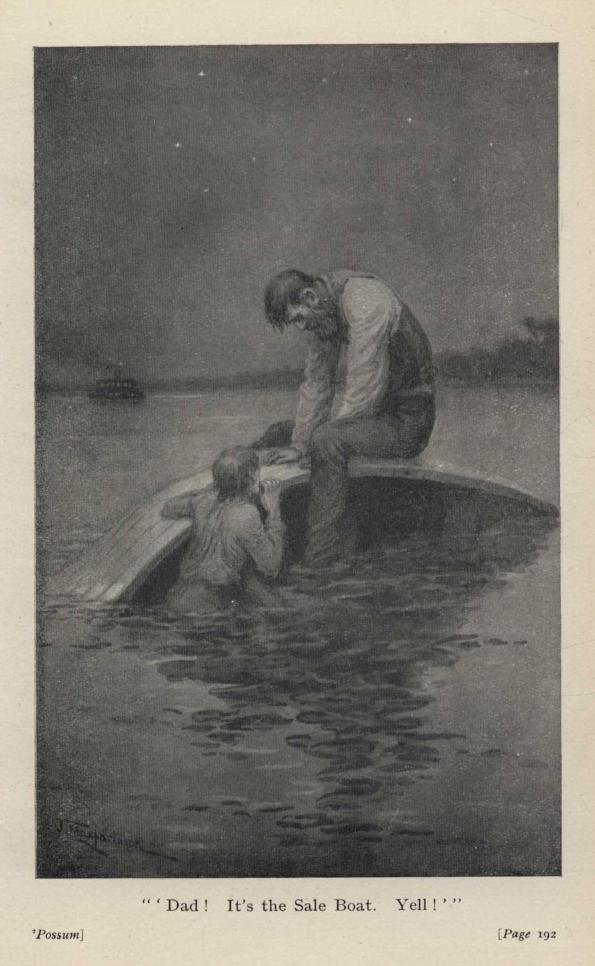
"'Dad! It's the Sale Boat. Yell!'"
O'Connor grunted heavily, half asleep, and utterly exhausted. She could get nothing more from him; and as the steamer drew nearer, she left the half-conscious man alone and uttered cry upon cry for help. Nearer and nearer yet the gleaming lights rushed upon her. She spent all her strength in a last cry, which ended in a sob as the steamer passed on.
"They've gone!" she gasped. "Well, we're done, anyhow!"
A bell clanged sharply, and with it a shout.
"Coo-ee! Who's there?"
She screamed in answer. The steamer was slackening speed, coming round in a half-circle; she could hear each clang of her telegraph. Voices came loudly.
"Who's there?"
"Any one in trouble?"
"Want help?"
But 'Possum had no words. She could only utter broken cries, that grew fainter and fainter. Her feet were slipping from the mast: she clung to the side of the boat with nerveless fingers that slipped and clawed for a fresh hold, and slipped again. Then, very dimly, it seemed, she heard the clash of oars in rowlocks, and a deep voice close to her. And then—nothing more.
She woke in a little cabin. There was a faint light. Her feet and legs were full of pain, but she was wrapped in blankets, and even the pain could not keep her from feeling gloriously warm and comfortable. A kind-faced woman came forward.
"Where's 'Dad?" 'Possum asked feebly.
"He's all right—asleep in a cabin."
"Where am I?"
"You're in the ladies' cabin on the Omeo," said the woman. "And I'm the stewardess, and we're tied up at Cuninghame, and you're not to worry about anything, you poor child. Drink this."
'Possum did not know what it was: but it was hot and pleasant and soothing, and the woman's kind voice was like music. There did not seem anything to worry about; she might as well go to sleep—and did so.
CHAPTER XIII
AMATEUR SURGERY
"Aileen! Aileen! Are you there?"
It was very early on a hot December morning. Tom Macleod came up the yard hurriedly. His wife appeared at the back door, broom in hand.
"What is it, Tom?"
"It's a poor beggar of a scrub-cutter," Tom said hurriedly. "You know there are two men working up the Lake? Well, one has just been down to borrow a pony. He says his mate has broken his leg—the limb of a tree fell on him: and he's gone to bring him in here: we're the nearest people. I say, you studied first aid, didn't you?"
Aileen's heart turned to water.
"I did—but it's ages ago," she said. "And I have never had any practical experience. I would be afraid to touch him."
"Well, something ought to be done," Tom said, obviously disappointed. "Don't you remember anything about it?"
Aileen racked her memory.
"I could try, of course," she said slowly. "But I should be terrified of making it worse."
"I think any sort of bandaging is better than leaving it altogether," said Tom. "Let's try, at all events. It's the lower part of the leg that's broken."
"That's easier than the thigh, at all events. Come on. I'll leave you to chop out splints while I run for an old sheet for bandages." She ran towards the wood-heap, but paused on the way to pick up an old paling. "That will do, I think," she said, and knitted her brows, striving to think of long-forgotten instructions. "I can't be perfectly certain of the lengths, but if you will cut it here—and here—it should be about right."
She came back in a few moments, and together they tore and rolled bandages swiftly.
"It's the worst of luck that the motor has gone wrong, and I can't take the poor chap down in the launch," Tom said. "It would have been such easy travelling. Now we'll have to lay him flat in the buggy, and you know what the jolting of that road is."
Aileen thought a moment.
"There's a better way than letting him lie down," she said. "I read of it the other day. You lash a padded board, stretching across from the seat to the splashboard, and let the patient sit up in the ordinary way—the good leg hanging down, and the broken one strapped to the board. The paper said the patient would hardly feel a jolt."
"Well, I know the lying-down position is simply torture, so we'll try your way," Tom said. "With luck, we may catch the Bairnsdale boat with him—it doesn't go until nine, and it's only seven o'clock now. I hope they won't be long. The fellow who came in said he could manage to get him here on the pony, so I thought it was better for me to wait and get things ready here. I'll fix that board, if you will find something to pad it. Is Garth up?"
"He's in his bath, I think."
"You might tell him to hurry and run the horses up as soon as he's dressed. I'll get the buggy out. I expect the poor beggar will want some nourishment—and a drink."
"We'll give him brandy before I touch the leg; and I have some strong soup I can 'hot up' for him to take afterwards."
"That's good," Tom said approvingly. "If time is short, you could drive him in, couldn't you? and I'd ride ahead and try to hold the steamer back. I'm sure the captain would wait, under the circumstances."
"Splendid idea! I'm certain he would wait. But perhaps we won't need to," Aileen said. "I'll go and get everything ready, and fix up some breakfast for Garth."
"Get something to eat yourself," Tom called after her. She shook her head, smiling, as she hurried in: breakfast for herself was the last thing to be thought of. But Tom came after her with long strides.
"Be sensible, dear," he said. "It may be an ugly job; and you don't want to turn faint or have unsteady hands, for the poor chap's sake."
"That's true," Aileen admitted. "Aren't you sensible! Well, I will eat something." She smiled into his eyes, and was gone.
Garth, half-dressed, went flying down the paddock, and was soon urging the horses up the hill, with shrill shouts, to the stockyard. In a few minutes the buggy was ready, with the padded board in position. Just as Tom tied up the horses Roany whinneyed; and turning, he saw Jane, led by the scrub-cutter, coming up the hill, the injured man riding. A "Coo-ee!" brought Aileen hurrying out. She ran to the gate.
The patient was little more than a boy. He was crouched on the pony, leaning forward: one hand steadying himself on Jane's withers, the other under his knee, supporting the broken leg. As he saw Aileen his white face twisted into a smile, and he freed the hand under his knee that he might lift his hat. The leg sagged downwards. A cry broke from her.
"Oh, please, don't! Take care of your leg!"
The effort was almost the finishing touch to the long agony of the ride. The boy went forward helplessly, and, abandoning Jane, Tom and his mate lifted him off and laid him on the grass under the quince-tree. A little colour came back to his lips, and he gasped, "Sorry!" Tom slipped a hand under his head, holding brandy to his lips.
"Cow of a trip!" said the other scrub-cutter. "Had to carry him downhill and across the creek on me back, an' you know what the scrub is there! I fell twice with him. Mighty good luck the bone ain't through the skin, but it ain't. It's broke in two places, though."
Aileen was on her knees on the grass, feeling the leg gently. Before, she had been sick with nervousness; but in the presence of the boy's agony, every thought but one fled from her—to help him. She was perfectly cool.
"I'm afraid I've got to hurt you," she said. "I'll be as quick as I can."
She ran her hands up and down the leg, feeling, with an involuntary shudder, the bones grate under the skin, She must get it straight, she knew. Gently, but firmly, she pulled it into position. Once she heard him gasp, but her hands did not falter. It was straight at last, and she signed to Tom. "Hold it—just like that."
She laid the splints in position, and bandaged them tightly, forgotten deftness coming back to her. Round and round the firm hands went steadily, until the leg, swathed like a mummy, stuck out stiffly before her. Then she sat back on her heels.
"That's all I can do," she said, finding her lips stiff and dry. The voice was not like her own. "Look carefully, Tom, and tell me if you think it is straight."
"As far as I can see—perfectly," Tom said, peering at the leg.
"I guess it's straight," said the patient cheerfully, "'cause it don't hurt now, hardly a bit. An' it was a fair caution before you touched it. Where'd you learn how, mum?"
But Aileen had no power to answer. She found herself suddenly shuddering, and drenched in perspiration. Tom put his hand on her shoulders, and made her drink a little brandy.
"Oh, I was so afraid!" she whispered, "so dreadfully afraid! Are you sure it's straight?"
"It must be," he said gently, "or he wouldn't be out of pain. Pull yourself together, dear—remember we haven't much time. And he must have the soup."
"Oh, I'm sorry," she said. "I'm all right, Tom; don't worry. Will you two get him into the buggy while I bring the soup?" She hurried away.
When she came back, with the steaming cup in her hand, the patient was sitting up in the buggy, wearing a wide smile, while Tom strapped the leg to the board above the knee and at the foot. Garth stood sentry-fashion at the horse's head, his eyes shining with excitement.
"By Jove, that's good!" said the broken-legged one, tasting the soup. "And I'd hardly know me ol' laig was broke, I'm that comfortable. You're a great doctor, ain't you now, Mrs. Macleod?"
"I hope I didn't hurt you much," she said, smiling at him faintly. She was still trembling.
"Not you. That ol' pony hurt like fury, an' it was a fair caution when Bill fell down with me. Twice, he did; Bill's a great hand at fallin'." He grinned at Bill.
"Thank y'r lucky stars I was big enough to carry y'r great carcase," said that worthy, not at all abashed. "Might as well be decently grateful: I can tell you, you ain't no luxury to carry!"
"Finished?" Tom asked, handing the empty cup to Garth. "Get the place tidy, son; mother's going to drive in. We'll be back soon." He helped Aileen to the driver's seat, handing her the reins. "You haven't too much time. I'll go ahead and try to hold the boat. Jump up behind"—to the mate. "I'll leave the gates open as I go, and you can shut them." He swung himself upon the pony, and trotted down the hill.
It was with a shiver of dread that Aileen felt the first severe jolt as they jogged over the rough paddock track. She glanced anxiously at her patient.
"Did that hurt you much?"
"'Ardly felt it," said he. "This dodge of yours is the best ever I see. Every one else puts a man full length on a mattress, an' crikey! don't it hurt! Every little jolt'll make a man howl. But this is like bein' in an armchair, and the jolts don't seem to worry you at all." They bumped heavily over a tussock, and his calmness bore out the truth of his words.
She was thankful for it, for there was no time to waste. Her patient, smoking and chattering, was apparently indifferent as to whether he caught the steamer. "I don't reckon any ol' doctor is goin' to make a better job of this laig than you done," he said, carelessly. But to Aileen it was unthinkable that they should not catch it. She had no belief in her own ability to set a broken leg properly. That the boy should be cheerful, and almost out of pain, was a kind of pleasant miracle, but she could not realize that her unskilled hands could possibly have caused it. She would not have been surprised if, at any moment, he had broken down again in shivering agony. The dread lest she should have made some mistake almost choked her—how could she ever face him in the future if the leg she had doctored were crooked, or shorter than the other? He was such a boy! She could not bear to think that he might be crippled, and because of her.
"I say!" said the patient, suddenly alert. "There's a snake! Do stop, Mrs. Macleod, and let Bill kill the brute."
"Not for fifty snakes!" said Aileen firmly. She brought down the whip with emphasis on Roany's back. The snake, a big brown one, slid away into a patch of bracken.
"I don't believe in letting snakes go," said the patient severely. "You never can tell where it's going to turn up again. It's like leavin' poison lyin' about loose where there's kids. You wouldn't like your own kid to meet that chap if he was runnin' about in the scrub, not thinkin'."
Aileen had a feeling of having been put in the corner by a small boy.
"I know," she said meekly. "And I truly would not leave it, if we had time. But this is a lonely part, and there are no children—and it is very important to get you to a doctor quickly. If we miss the boat, you know, it means waiting a whole day."
"Ah, doctors!" said the boy scornfully. "I knew one once in South Gippsland where a chap broke his laig, same as me, and some one set it, and got him pretty right for the time bein'. They took him home an' wired for a doctor to a place ten mile away, tellin' him what was the matter, so's he'd bring the proper fixin's. He come along after a bit, took off the setting an' looked at the laig, an' said it was set all right, an' he'd left the splints an' things at the hotel, an' he must go an' get them. So he left that laig with nothin' on it but a blanket, an' went off; an' he didn't come back for seven hours!"
"But why?"
"Why? 'Cause he was playin' billiards an' havin' a good time. That's why. They sent ever so many messages to him, an' the poor chap lay there, with his laig swellin' something cruel. Then the doctor come back at last, an' if you'll believe me he'd never brought a thing with him! He took them old bandages an' rough bits of wood they'd used for splints—the things he'd taken off an' chucked aside in the morning—an' put 'em on the laig again: all dirty, they was, from bein' against his ol' workin' pants."
"But why did he not bring the proper things?"
"Nobody never knew. He didn't, anyhow. When that laig was set first, by the chap as did it in the Bush, it was as straight and comft'ble as anything could be. But when that beautiful doctor done it, it wasn't straight. He put on the things quite loose and careless. The man's mate was there, an' said so, an' the doctor flared up like & packet of crackers. 'Do you think I don't know me business?' says he. 'I'm blooming well sure you don't,' says the mate."
"What did he say to that?" Aileen asked.
"Not a thing. You couldn't insult him—he hadn't no decent pride. He just finished tyin' up the poor bloke's laig, an' went off, sayin' he'd come back in three days an' look at him. But the chap suffered very bitter in his heel all night, an' next morning his foot was stickin' out turned half-ways round. They sent five mile into the Bush for the man that had set it first, to come an' straighten it an' set it again."
"Did he?"
"No, he had sense. He said he couldn't take the responsibility of touching it. So they packed the poor chap an' his laig up on a stretcher, with the laig just as the doctor had left it, an' sent him up to the Melbourne Hospital. They said it was the laughin'-stock of the whole place—they asked was it a doctor as had done it, or a goanna?"
"I never heard of such a thing!" Aileen breathed. "Did he—was he lame afterwards?"
"Well, he wasn't, but it was luck. And it was ages before he was better, an' him out of work all the time. So that's why I ain't in any hurry to get to any ol' doctors. Me laig's comft'ble now, an' I'd like it to stay so."
"But all doctors aren't like that, thank goodness," Aileen said. "I know one who saved my boy's life. And when he comes into a house where there is sickness, you feel as if he had suddenly shouldered all your troubles."
"Oh, I suppose there's good and bad in all trades!" her patient admitted handsomely. "Only that fool Englishman in South Gippsland was the only one I ever met very intimate, so to speak. But I've heard they're good in Bairnsdale."
"I know they are," Aileen assured him. "And there's a big, comfortable hospital where you'll be splendidly looked after. You see, it's all very well now, when you haven't had time to get tired; but you will be glad enough to be in bed after a while."
"I s'pose I will; but I never was in bed a day in me life," he said ruefully. "Oh, well, if I'm fool enough to let a limb hit me, I got to pay for it."
They were approaching the outskirts of the township. Scattered houses came in view, and the roar of the surf grew plainer as they drew near to the narrow lagoon that lies between Cuninghame and the sand hummocks of the Ninety Mile Beach. Above it came three long discordant hoots.
"My word, that's the steamer!" said the man at the back. "Can you get a bit more out of that ol' pony, mum?"
Aileen was already plying the whip, much to Roany's disgust. He shook his head angrily from side to side, and finally broke into a lurching canter. Tom came in view, riding to meet them.
"Hurry all you can!" he said briefly. "The captain has kept the steamer almost as long as he dares; you see, he carries the mail from some places. I'll tell him you're coming."
They turned into the esplanade, and rocked down past the houses and the stores. Near the wharf a knot of people waited, gazing curiously at them. The paddle-steamer was at the wharf, smoke pouring from her funnel. Aileen could see the tall figure of the captain leaning over the railing. He shouted something she could not hear. She pulled up near the wharf, with a sigh of relief.
There were plenty of willing hands to help to carry the patient to the steamer. The captain had offered his cabin, but the boy begged to be left on deck.
"I'll be inside four walls long enough, I expect," he said. "Let's stop out here." So they propped him up where he could look across the lake, with his bandaged leg sticking stiffly out in front of him. He looked at it with a wry smile.
"A nice object, you are!" he said. He held out his hand to Aileen. "Thanks, Mrs. Macleod. If I've ever the luck to be able to do a good turn for you, I'll do it."
"But you would do that if you'd never hurt your leg," she said, laughing. "I think all Gippslanders are ready to do good turns! Take care of yourself, and good luck!" She turned to his mate. "You'll let us know how he gets on?"
"My word, yes," said Bill. He also shook hands vigorously. "Great bit of luck we struck you, mum, anyhow!"
The steamer gave an agonized hoot, and Tom and Aileen sought the wharf hurriedly. They stood, watching, while the big, top-heavy-looking, boat moved slowly out from the wharf, with great churnings of her paddles, and set off down the lagoon towards the lake opening out ahead. Aileen suddenly realized that she was very tired.
"And the washing-up not done!" she said. "It's very bad management to begin the day with such dissipation! Come home, Tom."
"Right-oh!" Tom answered. "I'll lead Jane, and come with you in the buggy." He helped her in, and they jogged back along the esplanade. "Are you very done up, my girl?"
"Oh, a little bit tired," she said. "I think it's more from fear than anything else."
"Well, you had no reason to be afraid," he said. "Your job was all right. I was proud of you! But it wasn't an easy thing to tackle. However, none of us need worry now when we break an odd limb or two: all we have to do is to get as comfortable as possible, light a pipe, and wait for you!"
"If you dare——!" said his wife, laughing.
"Why not? But apart from joking, Aileen, our 'Possum has been having adventures. They told me about it when I was waiting for you at the wharf." He told her the story of the wrecked boat.
"And where is she now?" Aileen asked anxiously. "Is she ill?"
"Her feet and legs are pretty painful, they said. But she wouldn't see a doctor, or stay in Cuninghame; and her father was better, so he took her home yesterday."
"I must go over and see if I can do anything," Aileen said decidedly.
"Well, I thought you'd like to. But are you fit for it, dear?"
"I shall be quite all right, especially when I have some tea!" she said. "Tea is the one thing my soul craves for."
"I'll brew the largest teapot in the house directly we get home," Tom said. "And you will just keep quiet and take things easy. You won't need to do any cooking, will you?"
"I should like to take a basket of things over to the O'Connors," she said. "But I won't do much, really, Tom. I'll starve my poor family on 'Possum's account!"
"If I believed that you would, I'd be contented," he said. "But I know you better. When shall we go over?"
"Oh, after dinner. We'll take Garth—the poor man has had a horrid morning."
Garth did not consider that he had had a horrid morning at all. It was not every day that the thrilling excitement of a broken leg came his way; and later, he had found enormous satisfaction in dusting and tidying the house, and in spurring Horrors to amazing efforts in the kitchen. The housework was done by the time the buggy drew up at the back gate—if the corners were not above reproach, Aileen knew better than to look at them. She looked instead at her little son's glowing face, and kissed him, with moist eyes; and Tom's deep "Well done, old man!" sent Garth into the seventh heaven.
There was a big basket stowed in the back of the buggy when they set off early in the afternoon: such things as might relieve the anxieties of a crippled housekeeper and of a cook of twelve. A big piece of cooked mutton; a crisp, brown loaf of soda bread, and a bundle of scones tied up in a fresh, white cloth; a big cake of the kind that invites hungry people to cut and come again, and, in a special corner, a glass of jelly and a sponge cake, warm yet, and light and puffy: things to tempt an invalid.
"Won't it be 'strordinary to see 'Possum in bed?" Garth chattered. "Do you think she has dungaree nighties, mother?"
O'Connor's farm lay two miles away, in a dark valley between hills covered with gum trees. There was no gate leading into it: only heavy slip-rails, fitting into rusty horse shoes nailed to posts on either side. Like their own farm, it had scarcely any homestead track: they bumped over tussocks and rough ground, and wriggled a tortuous way round logs and clumps of scrub. 'Possum and her father nearly always rode; and the children walked two miles across the paddocks to the little Bush school. There were few wheel-marks on O'Connor's land.
Little Joe was playing on the wood-heap near the door as the Macleods drove up. He greeted Garth with a grin of joy, and Garth's father and mother with shy pleasure.
"How is 'Possum, Joe?" asked Aileen, descending. "Is she asleep?"
"'Poss? Asleep? Gwacious, no!" said 'Possum's brother, in amazement. "She's feeding the calf. Come on down to the shed."
He led the way across the untidy yard. The shed was a half-open place, tenanted by a dray, two ploughs, a harrow, sundry old iron, and a calf. The calf was tied to the wheel of the dray, and at the moment was strenuously objecting to take nourishment, which 'Possum, seated on a wheelbarrow, was endeavouring to administer by means of a baby's bottle. The efforts of the calf to withdraw were frustrated by the combined muscles of Bertha, young Bill and little Polly, who held it firmly in position and talked to it in good plain terms. The calf, however, was obdurate, and at last 'Possum gave up the attempt.
"Oh, let him go!" she said, without noticing the new-comers. "I wouldn't mind if it was on'y his feed, but it's his med'cine as well. We'll hot it up after a bit, Bill, an' try him again."
"Might as well try 'n' pour milk into a gate-post!" said young Bill, disgustedly, prodding, with a bare toe, the calf, which had lain down thankfully on its straw. "Brute! I dunno how Daisy come to have such a mis'rable little runt of a thing!"
"Jolly careless of her," said 'Possum. "Now you just turn me round, an' wheel me up easy, Bert. Don't go an' pitch me out, like you near did comin' down!"
"Let me help," said Tom, stepping forward. Every one jumped, and 'Possum turned a lively pink.
"Sorry," she said gruffly, looking at her bandaged feet, which were thrust over the edge of the wheelbarrow, "I'm lame, like the silly ass I am, so the kids have to wheel me round—that fool of a calf won't drink for Bill, but he gen'lly-as-a-rule will for me. Don't you bother, Mr. Macleod; Bert can get me up all right."
"I don't believe Bertha's half as good in the shafts of a barrow as I am!" Tom retorted. "I've been broken in ever so much longer than she has; I wouldn't trust her not to kick!" Which pleasantry reduced Bertha to suppressed giggles, until she grew alarmingly red in the face.
Tom wheeled the barrow up the steep yard, and paused at the kitchen door. It was a dark, low room, lit only by one small window; but it was spotlessly neat and clean. A rough home-made sofa, from which a coarse rug had been flung back, stood under the window.
"Is that your camp?" Tom asked, indicating the sofa. 'Possum nodded, looking more wretchedly uncomfortable than before.
"If—if you'n' missus 'ud go into the front room, I can get to it," she muttered, crimsoning.
"You can't walk, 'Possum?" Aileen put a hand on her shoulder.
"No, but I can manage." She dropped her voice to a whisper. "Please do take the boss away!"
"I say!" said Tom unhappily. "It isn't fair to shunt me like that, 'Possum." He turned to the silent children. "How did she get to the barrow, Bill?"
"Crawled 'n' rolled," said young Bill briefly. "An' it hurt her like fury."
"Well, you aren't going to crawl and roll this time," said Tom, with decision. "And you can't sit in that barrow all day. Now you just behave yourself, 'Possum; I'm going to make believe you're Garth. You've no idea how handy I got as a nurse when he was ill."
Without giving her time to make any further protest he lifted her gently and carried her across to the sofa, putting her down as easily as though she had been a featherweight, and arranging the rug across her knees. He talked fluently all the time, without looking at her.
"This is a sort of hospital day for us," he said. "You've been trying to drown yourself and fill the lake with cold pork, and the Missus has been setting broken legs until her brain reeled. And Garth has been cook and bottle-washer, and what the family would have done without him I tremble to think. He even made Horrors hurry, and I guess you know what sort of a job that would be, 'Possum! Horrors showed signs of swooning from overwork and brain-fag by the time Garth had finished with him. The missus will tell you all about it. Now I'm off to talk to that calf, with Bill. Come along, Bill. I don't think the calf likes a crowd any more than I do when I've medicine to take." He took the calf's rejected bottle, to which 'Possum had clung instinctively, and went out, Bill at his heels.
"Jus' fancy him carryin' me like that!" 'Possum uttered, her eyes shining. "Ain't he the limit! Oh, you were good to come, Missus!"
"Of course we had to come," Aileen said, shaking up a cushion, and putting her back upon it gently. "Wasn't our station-manager ill!"
'Possum's pale face expanded in a delighted grin.
"Oh, I'm all right," she said. "Leastways, nearly! Me laigs'll be on strike for a few days, they say."
"No chill?" Aileen asked. "Are you truly all right, 'Possum, dear?"
It was not often that a word of endearment came in 'Possum's way. Her eyes, as she raised them to the tall girl bending over her, had something of the utter devotion of a dog.
"Lor, I dunno how to be ill!" she answered. "Don't you bother about me, Missus. If it wasn't for me silly old laigs I'd be as right as pie. I was a bit tired, but I slep' in this morning—never opened an eye till eight o'clock! Nice state the place 'ud get into if I was to do that often."
"And your father?"
"Oh, he's pretty right. Looks a bit washed out, but he's gone off to Coffey's to try an' get another pig. Did they tell you 'about it? Wasn't it rotten luck losin' that other one? He was a real good pig, too!"
"We might have lost you," Aileen said. She bent and kissed the girl lightly on the forehead. A swift wave of colour dyed 'Possum's face, and she caught Aileen's hand and held it tightly for a moment.
"Now we're going to have tea with you, and I'm going to help Bertha get it," said Aileen cheerfully.
"It ain't fit for you—we on'y got enamel cups," said 'Possum unhappily. "An' goodness on'y knows what there is to eat. To-day's bakin' day, by rights, but of course nothin's got done. Have we got any butter, Bert?"