Front matter (continued 2)
Reading edition
It was a strange day for a woman who had never before done an hour's hard work. Throughout her life she had known only ease and dainty comfort; now she found herself plunged into dirt and squalour, with no skilled aid, and handicapped by utter inexperience. It was the inexperience that almost angered her as the hours went on. By nature she was practical enough—it was hurting to her pride to make stupid mistakes that must be paid for by more hard work. She scrubbed a room without thinking of cleaning the walls and ceiling—which, when examined, yielded so much grime that her fastidiousness forthwith scrubbed the defiled floor again. Tom was greatly annoyed with her when he found her on her knees, wielding the scrubbing-brush anew. But at least there was comfort in having done the job thoroughly.
Horrors, as a scrubber, proved an utter failure. Tom said he "took the rough off"; but Aileen, looking at pools of filthy water which seemed to have flung up waves of dirt, decided that his methods were hopeless, and—when Tom was out of the way—went over the work again herself, and made the discovery that scrubbing is not so easy as it looks, and that it carries possibilities of backache undreamed of before. Indeed, as the day wore on, a thousand aches seemed situated in her back, and her shoulders grew so stiff that she could scarcely raise her arms. Like all enthusiastic beginners, she tried to do too much, and paid the penalty.
Yet throughout the hard day she was never unhappy. The work brought its own reward in the delight of feeling cleanliness about her again; and it was something to be working together, uniting their efforts in making the new home. Garth's happy face, as he appeared from time to time at a window, full of joyful tidings of new discoveries outside, was a never-failing tonic. And Tom was the best of mates; ignorant as herself, and much more unpractical, but full of energy, and with a joke always on his lips. Garth's voice singing, as he roamed in the garden, mingled with his father's, singing also, to the accompaniment of much rattling and banging, as he unpacked and erected the new oil-stove. It made her want to sing herself—only that her back ached too much.
They lunched in a scrappy fashion, very late which was foolish; and, having lunched late, let afternoon tea go altogether, which was more foolish still. They had yet to learn that hard work, without sufficient food, does not pay. Aileen was finishing bed-making, in a room that fairly smelt of cleanliness, when Tom appeared in the doorway.
"Six o'clock; and that's the last stroke of work you do this day," said he firmly. "Come and eat things: I've made an enormous pot of tea, and Garth has laid the table."
"How lovely! and what dears you both are!" she said, turning, and smiling at him. Then suddenly the room began to turn round, slowly at first, and then faster, and she was falling through space.
It seemed a very long while, though it was but a few moments, before she opened her eyes, to find herself on her bed, with Tom bending over her.
"What's the matter?" she asked. "I'm all right, Tom—let me get up." She struggled to rise.
"Lie still, dear," he said anxiously.
"Did I faint?—how silly of me!" she said disgustedly. "I'm so sorry; I must have frightened you."
"I'm glad I caught you," he said. "Isn't there some medicine I could give you? Sal volatile, or something? Tell me where to look."
Colour was coming back to her lips. She began to laugh.
"Oh, I don't want any medicine," she answered. "I haven't got any, either—you know I never faint, Tom. It's too stupid of me to do it now. I was only a little tired—and I think the idea of tea overcame me!"
"Keep quiet, then, and I'll bring you a cup," he said, disappearing. He was back in a moment, cup in hand, and made her lean against him as she drank it.
"That was lovely!" she said, lying back. "Oh, I've such a heavenly feeling of laziness, and of course, I must nip it in the bud! I'm all right now, Tom, and so hungry. Come along."
"Sure you are?" he said, regarding her doubtfully as she got up. "Well, don't go tumbling about like that any more: it scares one." He held her arm as they went along the narrow passage to the dining-room, and kept a wary eye upon her throughout the meal. Being well aware of this, she forced herself to be extremely merry, despite thee fact that red-hot knives seemed to be running in and out of her shoulders.
"It's just the beautifullest place that ever was!" Garth said, blissfully looking up from his bowl of bread and milk. "There's lovely sheds, and a big bench with tools—they's rustier than your tools, Daddy!—and a stable, and such a jolly loft, with hay in it, and rats!"
"It sounds a jolly place," said his father. "Are there more rats than hay, or vice versa?"
"I didn't see any—-any of those things you said," answered Garth, slightly puzzled. "Do they run about?"
"Not as a rule," said Tom gravely. "Never mind; I dare say there are none. But are there many rats?"
"I only saw three, but I heard lots." Garth's tone was hopeful. "And Bran was awful excited. He couldn't get up the ladder, but he raced about down below, and barked like fun. Do you think you could carry him up to-morrow, Daddy? I tried, but it's a very steep ladder, and he wriggled."
"And who said you could climb up steep ladders?" asked his mother.
"But I couldn't have got up into the loft if I hadn't," said her son.
"That seems to settle it," said Tom, beginning to laugh. "We'll have to get used to these things, I suppose."
"I suppose so," Aileen agreed. "We really don't want a prim suburban son now. Only make me one promise, Garth, to keep my old mind easy—don't go near the water until Daddy has time to teach you to swim."
"I did go, to-day," confessed her son, "but I won't again. You'll teach me pretty quick, won't you, Daddy? And can I go near the little creek in the gully? It's the littlest ever—I can jump across it anywhere."
"Oh, we can leave you the gully," Aileen answered. "And we'll make a swimmer of you just as soon as we can. Every one finished? Then we'll go and look at our work."
The house reeked pleasantly of soap and turpentine, and, so far as was possible, it shone. It had been fortunate for the workers that Mr. Gordon's furniture was both simple and scarce, and so had economized cleaning. They had arranged it to more advantage in the bare little rooms, and already they were homelike, though lacking as yet the smallest pretence at adornment. The cretonne petticoats had been ruthlessly torn from the packing-case dressing-tables, the shelves and tops of which were modestly covered, for the present, with newspapers. Gay Indian bedspreads lent a touch of colour to the prevailing dinginess of the brown walls and linoleum-covered floors of the two front rooms.
"Don't you feel a holy glow that we took up those linoleums?" Tom asked.
"When I think of what was under them, I do!" rejoined his wife grimly.
The lobby was still a scene of wild unpacking; but in the third bedroom, a tiny apartment off the dining-room, the American oil-stove stood in all its bravery of black paint and bright blue enamel, the glass door of the oven shining invitingly. A copper kettle simmered over the flame: on nails on the wall hung Aileen's aluminium pots and pans. A rough shelf held an imposing stack of cookery books, flanked by a big pile of dish towels.
"It does look jolly!" Garth said. "When are you going to begin to cook, Mother?"
"As soon as I have a clean house," Aileen answered. "To-morrow we'll have to attack that awful store-room: and I foresee heart-to-heart talks with Horrors on the subject of milk buckets. His look as if they were washed about once a month. Tom, how lovely you've made the bath!"
The tin sides of the bath fairly winked at them as they entered the little bathroom.
"Seeing that I used gallons of boiling water and about half a ton of soda to it, I should think it ought to look lovely," said Tom. "I doubled myself into the thing for so long that when I finally emerged, I thought I'd never straighten myself!" His eyes twinkled. "What a heap there is in housekeeping one never suspected! I've regarded Julia and Annie as quite ordinary people for years, but now they strike me as rather more than human!"
"But is you two people always going to work?" asked a small voice. "Nothin' else at all?"
Garth's father and mother exchanged glances over his head.
"Poor man! He has never seen us do anything but play!" Aileen murmured. She patted his head. "We'll have to work a good deal, sonnie, but there will be time for quite a lot of fun, too. That has simply got to be arranged. And to begin with, I think it's high time you showed me things outside. It's disgraceful to have come to a new home and not to have put one's nose out all day. And outside is so much lovelier than inside!"
"It just is—ever so much," Garth cried. "Come along! I wonder will the pigs have gone to bed!"
"Sure you're not too tired?" Tom asked, a little anxiously.
"I will be less tired if I go," she said. "He hasn't had us for a moment all day."
They went out together, but at the door Tom turned back.
"Go on," he said, "I want my pipe: I'll catch you up."
He watched them stray off into the twilight. Then he went to the forgotten tea-table, cleared it, and washed the dishes. He did it very badly, and with a great deal of mess, never having washed dishes before; but no one who saw him as he worked would have judged the work hardly. Having finished, he wiped up the mess—of which there was a good deal—with a clean towel, surveyed the result with pride, and strode forth to find his family.
"You've been ever so long!" Garth complained. "Whatever have you been doing, Daddy?"
"Just playing round," said Tom. "What a mercy the pigs aren't in bed!"
CHAPTER VII
THE RIDING OF JANE
A week went by—so swiftly that each day slipped away on wings, and yet, when they looked back, it seemed that years had passed since the grey morning when they left the "House Beautiful." It was a week of ceaseless hard work. At the end of it they looked at each other, toil-worn, but cheerful: in their hearts a queer pride in the new home that the "House Beautiful," with all its charm, had never succeeded in waking. There, it had been so easy to take things for granted. But here, only their own hands and their own brains counted; and they had used each to the full.
It had not been an easy week. The only really easy thing, Torn said, was to make mistakes; and of those, they had made enough and to spare. But they very rarely made the same mistake twice.
Now, within and without, the little bush home was spick-and-span. Everything had been scrubbed and re-scrubbed. Light streamed into it from wide-open doors and through brightly-polished windows. The packing-case furniture swaggered in new petticoats of gay colours. From the barrel-chairs the dingy coverings had been ruthlessly stripped, and they, too, rejoiced in fresh clothing. Dainty belongings were scattered here and there: Aileen's piano, having survived the long journey by steamer and bullock-dray, stood in a corner of the sitting-room; and there were books and pictures and fresh flowers. They felt that they had reached a high level of success when Garth sniffed approvingly, and remarked, "This house is beginning to smell like you, Mother!"
The kitchen had suffered a transformation. With the pained assistance of Horrors, it had been emptied and scraped and cleansed. Unceasing warfare had fallen upon the horrified tribe of cockroaches, and now not one was to be seen, either by night or day. No scrubbing would remove the marks of ancient filth from the walls, and in desperation, Tom had at length given them two coats of whitewash, and had painted the tin sink with white enamel. At the conclusion of the job it was hard to say whether more whitewash had fallen on the walls or the artist; but the general effect was beautiful.
The colonial oven had been so long a stranger to blacklead that the first two coats had merely made it look as if suffering from an attack of black measles: at which a streak of obstinacy in Tom's soul developed strongly, and he brushed it daily, until, at length, it shone with an ebony lustre most uplifting to behold. They had routed from its interior a large collection of socks, in the last stage of decay—the property of Horrors, who had a pleasing habit of drying wet and dirty garments on the warm oven shelves. The gloom which had been settling more and more profoundly on Horrors since their arrival deepened perceptibly when he discovered that this artless practice must in future be denied him; and when, in addition, he was set to scrub the oven with washing-soda and boiling water, despair seized upon him.
"He's got to the depths," Tom said, laughing. "Nothing can make him feel worse now. When I told him that in future he'd have to wipe his boots before coming in, he only uttered a hollow grunt. I think speech was beyond him!"
"He told me everything was a fair cow!" remarked Garth.
"That's not an expression you need pick up," was his father's comment.
"I didn't pick it up—I was only telling you what Horrors said," Garth rejoined, somewhat aggrieved. "And I asked him what was, and he said, 'Soap, an' scrubbin', an' all that rot!' He says Mr. Gordon never bothered him about things like that and he wishes he was back."
"I don't doubt it," said Tom. "Under Gordon Horrors seems to have done little except wax fat!"
"He isn't nearly as fat as he looks," Garth said. "He wears all the clothes he's got at once. He's got three suits on now, and lots of other things as well."
"Good gracious!". said Aileen. "But why?"
"I asked him, and he said 'cause then he knew where they were."
"Which nobody can deny," said Tom. "Now we understand why Horrors isn't what you might term lissom. Do you think you could speak to him like a mother, Aileen?"
"It's almost the only thing I don't feel like when I look at Horrors," she said. "No—I think it would come better from you. Be brave."
"We pay for his clothes, so I suppose we have a right to expect that he doesn't wear them out in batches," remarked Tom. "Did you gather whether he ever takes any of them off, Garth?"
"Only the top layer, if he gets very wet," Garth said. "But he said he fell into the creek one day before we came, and got soaked right through."
"He must have hated that!"
"Yes, he did. He said, 'Why, me skin was wet!'—just as if it hurt him. So he had to take them all off and put them in the oven, and he went to bed till they were dry."
"Well, you have got more interesting information out of Horrors than I should have believed possible," said Tom. "He never does more than grunt when I speak to him."
"He only speaks in grunts, any time," said Garth. "Only sometimes, if you listen hard, his grunts seem to mean something."
"You fill me with hope—I'll listen harder in future," said Aileen, laughing. "Sonnie, are my scones done?"
They were sitting in what Garth insisted on calling "the new kitchen"; Aileen darning socks swiftly, while Garth and his father sat on the table—which, having refused to look clean under any scrubbing, was now covered with white oilcloth. Preparations for afternoon tea were upon it, and a pleasant smell of baking filled the air.
Garth hopped down eagerly, and peeped through the glass door of the oven.
"They've risen ever so, and they're turning a lovely brown," he announced. "I'm so hungry, Mother—don't you think they're done?"
"Very nearly, I think," said his mother, coming to join the inspection, while Tom lent an inquiring eye over their shoulders. "They do look pretty good, don't they? Cooking is so exciting; I don't feel as if I would ever learn to feel calm while I turned out a pudding!"
"If you go on as well as you have begun you'll soon cease to worry," said Tom, preparing to make tea.
"I don't know." She shook her head. "Think of the pie the other day!"
They all laughed. The pie had certainly been rather peculiar. No one knew quite what had happened to it, but after sampling it, the family had fallen back on bread and jam. The pie had gone to Horrors, who had eaten it all at a sitting, with the nearest approach to happiness they had yet seen in him; and had afterwards become, as might have been expected, extremely unwell, his complexion for the rest of the day being a delicate green.
"The pie was an accident, but there's nothing accidental about those scones," said Tom, as the scones, light and puffy, emerged from the oven. "Tea is ready, and I'm hungry enough to eat the lot. Sick boys, of course, aren't allowed more than one, are they?"
Garth uttered a howl of protest.
"I'm not sick!"
He did not look sick now. Even a week of Gippsland air had put colour into his cheeks and brushed away the tired lines from his eyes. He was no longer a city boy. No snow-white collar encircled his neck; his good suits were packed away, and he lived in blue jerseys and extremely brief knickerbockers, beneath which his brown knees were scratched and bruised. From daylight until dark he was in the open air, exploring the country that was so new and so delightful. There were still traces of delicacy from his illness; but already, watching the light in his eyes and the spring in his step, the father and mother knew that the great sacrifice had been worth while.
"He ate two of my tarts yesterday; and as no ill effects followed I'm beginning to think that nothing could hurt him," Aileen said. "It's difficult to think that only a fortnight ago we were tempting him with delicate strips of toast!"
"They wouldn't be much good to me now," Garth uttered, accepting a large buttered scone with thankfulness. "This is the hungriest place I ever was in: and your scones are scrummy, Mother!"
"Hear, hear!" said Tom, and took another.
"You're such satisfactory people to cook for," Aileen said, "you like everything that is at all possible, and when it isn't—like the pie—you make a beautiful joke of it."
"Well, it was a beautiful joke—you ask Horrors!" said Tom, chuckling.
"Poor Horrors! I ought to have given him extra wages, I think, and instead all I gave him was Epsom salts!"
"He needed them more than wages, I should say," Tom said. "No money would have paid for that pain of Horrors'. Well, you didn't ask him to eat the whole of that pie, so I don't think you need worry. More milk, Garth?"
"Please," said Garth, surrendering a large empty mug. "Daddy, I've got the old pony up!"
"Eh?" said his father, starting. "How did you catch her?"
"I've caught her lots of times," said his son, slightly embarrassed. "She isn't any trouble if you take her a milk-thistle. So to-day I took a halter with me, only I didn't know how to put it on, so I just tied it round her neck and led her up. It's funny how difficult a halter is when it's in your hand—it's all twists and knots."
"H'm," said Tom. "Well, you'd better go and get on her if you want to."
"Oh, Tom——!" began Aileen; and then stopped. This was Tom's business.
Garth had flushed, and his eyes were very bright.
"Truly?"
"Certainly—if you like."
"I—I thought you meant to teach me," the boy said.
"Oh, there's not much teaching in getting on a pony," said his father unconcernedly. "You must find out some things for yourself. Take her into the little calf paddock—she can't get away from you there. Of course, I'll come and lift you up, if you'd rather."
"No, thanks," said Garth, his head well up. "I've finished—can I go, Mother?" She nodded, and he clattered out of the kitchen. The gate of the yard slammed behind him.
"Tom, is it safe?"
"Was I a brute?" he asked, and smiled at her. "I do want the little beggar to be independent—and he can't hurt himself on that old mare, in a little paddock. He'll manage all right, and be twice the boy for it."
"Come into the store-room—we can see him from the window," said Garth's mother. She caught Tom's hand, and they hurried into the store-room.
The window looked out upon a tiny paddock where the grass was green and thick, since its calf inhabitants had long been turned out into a wider run. Garth was leading old Jane, the brown pony, through the gate. Jane, it was evident, had no wish to be led; she hung back obstinately, until the long grass caught her eye. Then she became docile, and went through meekly, beginning to eat at once. Garth shut the gate, and, returning to his steed, looked at her. He wished he could remember how it was that people got on a horse. Finally he made a little run and sprang awkwardly in the direction where he would be.
There was never any sudden movement about Jane. Whether she stepped or swerved aside would have been difficult to say, for it was done unobtrusively; but the fact remained that when Garth was at the top of his spring, she was no longer there, but a yard or two away, eating peacefully. Garth came down on all fours in the grass, and arose, brushing his knees, his colour somewhat heightened. No four-footed beast had ever looked more innocent than Jane.
He twisted the halter round his wrist for his next attempt and clawed wildly at her withers. Jane gave a slow wriggle, and Garth found himself kneeling beside her, caressing his nose, which had bumped rather heavily against her plump side.
"Old beast—you did it on purpose!" they heard him say. He looked around him for means of help.
An old bucket in the corner caught his eye, and he went for it, placing it beside the unruly Jane, who still ate with a peaceful determination not to be worried by small boys. The bucket was rusty and ancient, but Garth was not in the mood to be delayed by trifles. He up-ended it, and hopped up nimbly, catching at the pony's mane.
Jane walked on sleepily, as if looking for another bite of grass. For a moment Garth struggled to hold her back; then the bucket gave way under his boots and he fell through the bottom, standing imprisoned in the rusty tin. His grasp on the halter brought Jane's head round, and they stood looking at each other—the small boy red-faced and angry, the pony with an air of meek surprise.
Tom burst into a fit of silent laughter, and Aileen, after a struggle, joined him.
"Tom, do you think he can manage it?" she asked.
"If he does, he's going to beat that pony permanently," said his father. "Let's see what his next move will be."
Garth's next move was to extricate himself from the bucket. It smote Aileen's heart to see long, red scratches on his legs, as they emerged—she sought in her memory for the correct treatment of blood-poisoning. The matter did not worry Garth. He stared for a moment at Jane, who cropped the grass placidly. Then he hauled her to the fence, and tied her to a post, bringing her as close to the rails as she would permit. Jane stood meekly until the boy inserted his small person between her and the fence, and mounted the second rail.
"He'll do it now," Aileen breathed.
Jane knew better. Just as he leaned towards her she slued round gently, so that she faced him again. Her nose drooped towards the grass so far as the restraining halter would allow. Garth poised on one foot for a moment; then, losing his balance, dropped off into the grass, his face redder than ever. It is regrettable to record that at this point he administered a hearty kick to Jane, who looked piously surprised, but otherwise took no notice.
"Well!" said Garth. "Of all the old pigs!"
He made a sudden angry rush at the pony, and was on her back before she realized it. Unfortunately he went a little too far. For a moment he lay across her, kicking and clawing to get his balance; then he shot down, head foremost, and again found himself in the grass. Jane stepped carefully away from him, and continued to eat.
"Shocking bad luck!" was Tom's comment. "What next?"
Garth pondered. That he was angrier than they had ever seen him was clear; but there was a set look about his lips that told of determination not to give in. At this point Horrors sauntered up from the milking-yard and put down his bucket joyfully.
"'Llo!" he said. "Give yer a laig up?"
"Hang that boy!" muttered Tom.
"No thanks," they heard Garth's clear little voice. "I want to get up myself."
"Oh, good kid!" Tom's whisper was joyful.
Garth thought deeply, his eye wandering round the little paddock. Once more interrupting Jane's meal, he dragged her to a corner, and tied her so that the fence would prevent her sidling away. Then he stepped back, took a little run, and landed on her back. There was a moment's struggle, bare legs waving in the air, while Jane hugged the fence as closely as possible in the hope of preventing him from getting his foot down on the off side. Unluckily for Jane, her rotund sides were against this plan. Garth struggled to a sitting position triumphantly, and uttered a whoop. It was echoed—silently—by his parents.
"Bless him, the darling!" breathed Aileen, after the fashion of mothers. "Come on, Tom—let's go and encourage him!"
"Wait a minute," said her husband, restraining her. "I want to see what will happen when he realizes he's tied up."
Garth was just realizing it; and so was Jane. He leaned forward, and, seizing the rope, tried to haul himself and his steed towards the post, that he might untie her; and might as well have tried to haul a mountain down into a plain. Jane stood passively, with no faintest indication of having noticed that any one was on her back. Garth struggled until he was scarlet, and at length gave it up.
A bright thought struck him. It might be dangerous and rash to be on a pony's back without even a halter, but that was better than being ignominiously tied to a post. Even if she wanted to run away, she could not, in so small a paddock, run far; and then, Jane had not shown any inclination to run at all. So he leaned forward again, managed to reach the knot of the halter on her neck, and began to untie it.
Jane moved forward gently—which Garth welcomed, since it allowed the rope to fall slack, and eased the tension on the knot. It seemed that she knew when she was beaten. Her head drooped lower and lower: sleep apparently stole over her. Garth went further and further forward, as her neck declined, his fingers busy with the knot.
There was the slightest upward movement of Jane's hind-quarters. It could hardly have been said that she kicked up; but there certainly was an elevation, and, slight as it was, it was sufficient for Garth. He was already precariously balanced, and he slid over her head, and landed on his back turning a neat somersault. Jane looked at him sadly.
"You—you old cow!" they heard him splutter.
He gathered himself up, a vision of red fury. To kick Jane was his first task, to untie the halter from the fence his second. Then he flung himself at her, and for once Jane was not ready. She backed and sidled, but her activities came a thought too late. Garth was already astride of her, gripping her with his legs, more in blind anger than in intention. He brought the end of the halter down on her neck with a resounding thwack.
"Get on, you old pig!" he shouted
Jane moved on slowly. This small insistent person on her back was no longer to be denied. The anger lingered in Garth's face for a moment; then, as he found he was actually riding—riding—it died out, and a wide, happy smile took is place. It was a vision of ecstatic triumph that waved gaily to his father and mother as they appeared at the back gate.
"Daddy—I can ride!"
He drummed his heels against Jane's sides and the pony, surprised and indignant, broke into a jog. Garth bumped happily for a little, not knowing that his heels were still assaulting Jane. Then the jog merged to a shambling trot, and he slipped first to one side, then to the other, went further, clutched at her mane to regain his balance, and, missing it, descended abruptly to the grass. Jane instantly stopped, and began to eat.
Garth picked himself up with a wry face. His father and mother were by the fence.
"Isn't she an old pig!" he said, his eyes still dancing. "I don't care—I did ride her right round the paddock, anyhow, didn't I, Dad? Glory, my wrist hurts!"
"Let's see it," his father said quickly.
Garth held up a wrist for inspection, catching his breath as he did so, unable to restrain himself from wincing. It was queerly twisted. Tom gave a short whistle.
"Oh, you poor little kid!" he said. "You've put it out, I believe!"
Aileen, white-faced, was through the gate, her arm round Garth's shoulders.
"Tom! What will we do?"
"There's a doctor staying at the hotel, I know," Tom said quickly. "I'm afraid to tackle it myself—I don't know enough about it. Don't worry old man, we'll have you right in no time. Get ready, Aileen, and put his arm in a sling. I'll run the horses up."
He flung himself on to the amazed Jane, who went out of the gate and across the paddock with more haste than she considered either pleasant or proper. Aileen caught sight of Horrors' gaping face.
"Get the buggy out—quickly!" she told him. "And have the harness ready." She watched him go shambling towards the harness-room before she turned to take Garth indoors.
"Does it hurt you much, little son?"
"A bit," said Garth briefly, with shut lips. "What is 'put it out,' Mother?"
"Oh, twisted a little," she told him. "A doctor will make it all right very quickly; only it will hurt you until we get to him." She looked at the set little face. "Garth dear—don't try not to cry, if it is very bad."
"I would be awful 'shamed if I howled," said Garth steadily. "And Dad would think I was a coward. Dad wouldn't howl."
"Dad is grown-up, and you are only seven," Aileen said. "He wouldn't expect you to be able to stand as much as he can. He will understand, if it's a bit too much for you, dear."
"I'd hate to howl," said Garth. "And howling wouldn't make it better."
"Let me see if this will ease it," she said, her own eyes full of tears. She folded a silk muffler into a sling, and raised his arm, very gently. Even under the soft mother-hands the child turned white.
"Oh, my little son, I wish I had it!" she said, under her breath.
"I'm ... jolly glad you haven't," panted Garth. His mother put him into a chair, watching him narrowly, lest he should be faint.
"Sure you're all right, sonnie?"
"I'm—pretty right," he said. "You'll come, Mother, won't you?"
"Of course I'm coming." She pinned on her hat quickly, throwing her apron into a corner. "I'll be back in a minute."
Running, she found Tom's flask, and mixed some weak brandy and water in it, slipping it into her pocket. Then there was nothing to be done until a "Coo-ee!" told them that the buggy was ready.
Tom lifted the boy very tenderly to the seat, and they drove out, trying vainly to avoid jolting on the rough track. Garth steadied the injured arm with his free hand, and tightened his lips, uttering no sound; but at an especially severe bump he gave a little sigh, and, half-turning, put his face against his mother's shoulder. She put hers down to him, murmuring broken words.
"I wish you'd howl, or something, old son," said Tom miserably. A muffled "Won't!" came from the hidden face. They drove on slowly bumping and jolting.
"Three miles of it!" Aileen thought, in despair.
"He can't stand it!" She pressed the little face closer to her.
They turned out of the paddock and down the lane, winding in and out among the trees. Presently Tom uttered an exclamation of impatience.
"Cattle! What beastly luck!"
Ahead, a small mob of half-grown calves blocked the narrow lane. A tall man on a brown cob came riding some distance behind them. The calves were feeding lazily, and took very little notice of Tom's angry shouts; nor did their driver hurry himself at first. Presently, however, he seemed to awaken to the fact that his property was in the way, and trotted lazily forward.
"I wish to goodness you'd clear your confounded cattle off this track!" Tom sang out wrathfully.
"One'd think you was in a hurry," said the tall man easily. "Ain't I got as much right to the road as yous?" Then his face changed as he looked at Aileen. "Beg pardon," he said, and they saw that he was their acquaintance of the steamer. "I didn't know it was you, Mr. Macleod. Is the kid hurt?"
"Dislocated wrist," was Tom's brief answer. "Do you happen to know if the doctor is still at the hotel?"
"I know he's not," was the unexpected answer; and Aileen felt Garth shiver. "Went away by this morning's boat."
"And there is no other doctor?" Tom's voice was sharp with anxiety.
"Not nearer than Bairnsdale." The man swung himself to the ground, leaving the reins trailing over the brown cob's head. "Can I have a look, son?"
Aileen slipped away the sling, and Garth held out his wrist mutely.
"H'm," said the man. "Rotten luck, eh, son? Fell down an' trod on it, did you? Think you can trust me to put it right?"
"Oh! can you?" The words came from Aileen in a gasp.
"I'd like a bob for every one I've done," said the new-comer. "Most chaps in the Bush know a bit o' surgery." He nodded to Tom. "Hold him steady."
He took the little wrist in weatherbeateh hands that were wonderfully gentle. "It won't take not half a second, son—just set your teeth."
There was a moment's quick manipulation, while Aileen turned sick: a smothered gasp from Garth, and then a sharp click.
"There!" said the tall man, "all over; and you stood it like a brick, old man. Oh, poor kid—hold him, missus!" For Garth had suddenly grown limp and helpless in her arms.
"On'y fainted—can't blame him, neither," their new friend said. "Give him to me, missus, an' I'll lay him flat."
Garth opened his eyes some minutes later to find himself staring at the sky, with uncomfortable spears of grass tickling the back of his neck. His wrist was tightly bandaged, and there was an extremely unpleasant taste of brandy in his mouth. He felt queer, and very lazy; even though the spears of grass were very uncomfortable, it was far too much trouble to move. Then he saw his mother's face, white and strained as he had learned to know it during his illness, and he smiled at her weakly.
"Hallo, Mother!"
"Dear little son!" she whispered, and a tear fell on his face.
"Had a stiff time, didn't y', ol' chap?" said the tall man, smiling down from a height which seemed to Garth about sixty feet in the air. "Well, you're a man, anyway. I tell you, I've pulled joints in for full-grown men an' heard 'em howl like a dingo over it."
Garth's eyes sought and found his father's.
"Didn't want to cry," he said feebly.
"I'm proud of you, my son," Tom said. They smiled at each other.
"An' you fell off of a pony, they tell me," said the tall man. "Well, we all do that, sometime or other. When are you goin' to ride her again?"
"To-morrow," Garth whispered. "Can I, Dad?"
For the second time that day Aileen checked herself in a quick protest. She looked at Tom.
"Certainly you can," he answered gravely. "We'll tackle her together, old son."
CHAPTER VIII
RAIN—AND A FRIEND
But it was not to-morrow, nor for a good many to-morrows, as Tom had probably foreseen, that Garth was in a position to apply himself anew to the education of Jane. He passed a restless night, and morning found him feverish and heavy-eyed, his wrist stiff and painful. He had neither appetite nor energy, and did not resist his mother's suggestion that he should stay in bed.
"You can't expect anything else," Tom said sagely. "He's had a nasty shock, poor youngster, and we must remember he isn't really strong yet, even if he has got a little colour in his cheeks."
"Indeed, he has none this morning," Aileen said.
"Don't worry; he'll get it back again." Tom was far from feeling as cheerful as his words, but to reassure the tired girl across the breakfast-table seemed necessary. "Just make a baby of him for a few days, and let the other work rip. Don't do any cooking except for the boy."
"And let you starve on tinned things? I don't want both of you ill," responded his wife, laughing. "You give me splendid advice except where you're concerned yourself: and there you are just no good at all. It's a pity, because it shakes my respect in you!"
"You might remember with advantage that I'm the head of the house, and treat me with reverence," he told her severely. "I'll be forced to take steps to make you obey me!"
"I would laugh very much if you did," said his wife, with conviction. "Run away and play in your garden; I'm going to make a pudding as soon as I have fixed up Garth's room, and I really can't be bothered with heads of houses!" She swept him a mock curtsey, and was gone.
When she emerged from Garth's room half an hour later the dining-room was neat and tidy and breakfast cleared away, save for a loaf of bread ornamenting the writing-table—since the best of men is apt to overlook such unconsidered trifles in tidying after a meal. She laughed softly, and restored it to the bread-crock. In the kitchen Tom was just finishing washing dishes.
"Oh, you blessed person!" Aileen said gratefully. "But you shouldn't, really, Tom!"
"Why shouldn't I?" asked her husband. "You're just jealous, because I wash up so much better than you!" A large fragment of ash from his pipe fell into his dish as he spoke, and clung lovingly to the saucepan he was cleansing.
"H'm!" said his wife. "Well, I don't drop tobacco ashes in, at all events!"
"That's more jealousy, because you can't smoke," said he loftily. "Every one who is well brought up knows that ashes are invaluable, for cleaning saucepans!" He polished vigorously. "There—look at your old porridge-pot!"—waving a wet and gleaming aluminium utensil at her, regardless of a shower of soapy drops.
"It's lovely," said his wife, accepting the saucepan and the shower with meekness. "And you're a dear, though in the interests of your character I generally try to conceal the fact. What vegetables do you intend to present to your starving family to-day?"
Tom fell into the speech of the Chinese gardener who had supplied them in the city.
"Cabbagee, cauliflow', gleen pea an' dly pea, Flench bean, bload bean, spallowglass!" he chanted. "No, not asparagus; but I felt so like old Ah Chee I couldn't stop! Just give your orders, ma'am. Whatever old Gordon didn't do on this place, he certainly left us a good vegetable garden."
"He did indeed," Aileen said. "Now, having dangled all these before my eyes, tell me what ought to be used first."
"Cauliflow'," said Tom promptly. "They're blooming like the rose, only more so."
"I'm so glad—it doesn't have to be shelled!" said his wife. "Peas or beans would have embarrassed me this morning. Where's the cookery book? I never can remember whether it goes into boiling water or cold."
"Does it matter, so long as you leave it there long enough?"
"I believe it matters exceedingly, though I don't see why," said she.
"Mere red tape," said Tom scornfully. "Why not try both ways, and see which comes out best?"
"Think of your feelings on the day when it happened to be wrong," said his wife absently, puckering her brows over her book.
Tom scalded his dish-cloth, wrung it out, and hung it on the rail he had erected for towels.
"There, that's done," he said. "Now I'd better go and catch a cauliflower, since my suggestions only meet with scorn. Want any potatoes?"
"Please," said Aileen. She watched him cross the yard to the shed, and return with his spade, and presently heard him singing as he worked—a gay little snatch of comic opera that was somehow oddly out of place in the Bush.
"He seems happy enough," she said to herself. "I wish I didn't hate it so."
She went out upon the veranda, and stared across the paddocks. The loveliness of the country always helped her—even when the realization was strong upon her that she hated her new life. Not for worlds would she have admitted it to either Tom or Garth; that would not have been playing the game—and to play the game had been instilled into her since her childhood as the one thing worth doing.
She did not always admit it to herself; then it was easier to be cheery for her two boys. She met each day with a laugh and tried to laugh until it ended. But sometimes it was hard. She missed the "House Beautiful," with its dainty comfort and luxuries; the ease of the old days, the little pleasures and excitements, the stir and bustle of city life. The loveliness of the country lay like a weight upon her. Beyond the blue hills her mind saw Melbourne, with its broad streets and great buildings in their setting of gleaming river, and jewelled parks; the huge shops, the gay streets, the "Block," with the familiar faces going up and down. There were all the friends who had helped to make life so merry; here was nothing but silence and green spaces—and work. How she hated the work! the dull repetition of each day's tasks, the grime, the greasy dishes, the hot kitchen, the sight and smell and touch of raw meat! In the first days, while they fought the dirt of the house together, it had been easier, hard as the fight was for her unaccustomed strength. Now she was settling down to a dull routine of daily tasks, and her existence seemed bounded by pots and pans and dish-mops. It was all very small and paltry: but then, life nowadays was made up of small and paltry things, which somehow mounted to a big whole. Perhaps it was because she was tired that morning that it seemed rather too big for her.
She shrugged her shoulders.
"Well, I suppose I'll get broken in, in time," she said. "I hope it won't take too long."
Tom came round the corner suddenly, and chaffed her for idling; and she answered him laughingly, until a call came from Garth's room, and, with a cheery, "Coming, sonnie!" she ran to him. Tom finished scorning his vegetables, and shouldered his spade once more.
"Well, it's a queer sort of a life to come to—and not much of a one," he muttered. "But thank goodness, Aileen's as happy as a cricket, so it's all right!"
There were days that followed when Aileen found it harder than ever to play at being happy.
The fine weather deserted them, and for nearly a week rain fell unceasingly. Mud came up to their very doors, so that to keep the house clean was no easy matter. The garden paths were muddy rivers, the flowers sodden with wet. Garth, a prisoner to the house, and with his bandaged arm in a sling, moped for lack of occupation, became as naughty as was possible to his sunny nature, and openly declared that the country was beastly, and he wanted to go home. Even Tom ceased to sing, and grew bored with long days in the house. The hills and the lake disappeared, blotted out behind a drifting veil of grey rain. The roof developed unsuspected leaks, which all Tom's untaught efforts failed to locate; and, to catch the drips, tubs and basins sat on the floor in the passage—traps for the unwary in the dark. Tradesmen, never very regular callers, ceased coming altogether. Their bread ran short, and Aileen tried her hand at baking, producing loaves that were responsible, through indigestion, for much of the family's low spirits. Tom tramped through the downpour to the township, and returned empty-handed and in disgust—it was the weekly half-holiday, and the baker's shop was shut! So Aileen baked again—this time the soda-bread of Ireland, as taught by Julia; and was more successful. Meat ran out; they would have killed fowls, but no one knew how to prepare them. It was a dreary time. They ate strange dishes made with lentils, and wondered how vegetarians contrived to look cheerful.
The days crawled by slowly, to the ceaseless sound of the drip-drip-drip on the corrugated iron roof. The tanks ran over, and made rivers about the house—-they were as yet too new to the country to be grateful for any sign of a superabundance of water. All the firewood was wet and sodden, and refused to burn: and the chimneys smoked furiously. Aileen found, to her horror, that there were signs that already her temper was beginning to feel "frayed at the edges"; more than once she caught herself up just in time to prevent herself making a sharp answer to some remark of Tom's. It made her afraid.
"If I'm like that within three weeks, what shall I be in three months?" she asked herself. "Aileen Macleod, you can't be a pig! I'll begin praying Mrs. Wiggs' prayer every day—'Lord, keep me from gettin' sour.' It wouldn't do, with two boys to look after."
A cry startled her, and a heavy splash, and the little mother dropped the food she was preparing and fled to the rescue. In the passage, now nearly dark, Garth's boots protruded from the largest of the tubs. There was water everywhere: and Garth, half-choked, and hampered by his slung arm, was endeavouring to struggle out of the tub. To her relief, he was laughing.
"I'm an awful goat!" he said, dripping, but cheerful. "Didn't it serve me jolly well right for being grumpy!"
"Did you hurt your arm?" asked his mother anxiously, helping him to his feet.
"Not a scrap—wasn't it luck! But I'm soaked, Mother." The small boy gave an irrepressible chuckle. "I say, I must have looked funny! Don't you wish you'd seen me!"
Suddenly, to her astonishment and disgust, Aileen found that she was crying. The stupid little accident was the last straw to her endurance: her self-control slipped from her in the relief of finding Garth unhurt. She struggled in vain to command her voice, and took refuge in silence; but presently a stifled sob made Garth lift his head in amazement, and a tear fell on his upturned face.
"Mother—you're not crying! Oh, Mother, darling, I was a pig—I'm so sorry!"
His arm was round her neck and his cheek pressed to her wet one. The clinging touch helped to calm her.
"I'm all right, sweetheart," she told him. "Don't worry—I was just a bit tired, that's all. You mustn't tell Daddy, or he'd be worried."
"Sure you aren't sick?" Garth asked, greatly alarmed. That mother should cry was sufficiently amazing to mean something very bad indeed.
"No, not a bit. I was only tired, and I was afraid you were hurt. I'm a silly old mother, that's all." She was helping him into dry clothes, handling his stiff arm very gently.
"I've been making you tired—cross beast I am!" said Garth penitently. "I won't be horrid any more, Mother!" He hugged her again violently.
"Poor old man; you've had a horrid week," she said. "Never mind; Daddy says he thinks it is going to clear up, and you may be able to get out to-morrow. Listen, Garth!" She raised her head as the sound of voices came through the thin boarding of the wall. "Daddy has a visitor. How exciting!"
"Who d'you think it is?" Garth asked eagerly. "Why, we haven't had a sign of a visitor since we've been here!"
"It sounds like your friend's voice," said Aileen, wrestling with his buttons.
"That nice man what pulled my arm straight?" Garth said. "I'd like to see him. He did hurt, but he was jolly quick. I was getting sick of that old arm. He's a—a very decent sort of chap, isn't he, Mother?"
"Very decent, I think," she said. "At least, I never was so glad of any one in my life. Let's go and see him, sonnie."
Tom rose as they entered the sitting-room.
"Here's Mr. O'Connor, Aileen."
"Thought it was about time I came to see how my patient was," said the big man. "Hullo, old chap; your Dad says you're nearly all right. Looks a bit washy yet, don't he?"
"I'm quite well," Garth said eagerly. "When can I take my arm out of this old sling?"
Nick O'Connor laughed.
"Seems to think I'm his doctor, don't he? Well, I wouldn't be in a hurry for a few days. You don't want a weak wrist, do you? And when you do take it out, mind you wear a wrist-strap." He turned back to Aileen. "And how d'you like Gippsland, Mrs. Macleod?"
"It's beautiful, isn't it?" she said. "I never saw such a lovely country."
"Oh, it's pretty enough. But there's no fortunes to be made here; it's hard scratchin' for a living. I was just askin' your husband what he was thinkin' of doin' with the place."
"I'm hanged if I know," said Tom. "My predecessor didn't do much."
"Queer chap, ol' Gordon," said their guest. "He wasn't the sort of fellow you could talk to at all: lived by himself, and never spoke to no one. Him and that kid Horrors. I wish I'd known you were coming in; some of us would a' done something to the house. Awful dirty, I suppose it was, Mrs. Macleod?"
"It was pretty bad," she said. She caught his eye, and laughed.
"Pretty bad!" said Tom explosively. "Of all the pigsties——!"
"I bet it was a pigsty," said O'Connor, chuckling. "I was on'y here once, about six months ago, lookin' for a stray calf: but then I poked me nose into the kitchen, an' mighty quick took it out again."
"Well, they hadn't washed it since," Tom remarked.
"Not they. Well, it's all very well to laugh, but it was jolly rough on you, Mrs. Macleod. My word, you've got the place nice now! And the garden's a fair credit to you: it was the on'y part of the place where old Gordon did any work. As long as he could go fishin', much he cared for anything else. What was you thinkin' of doin' with the land?"
Tom gave a short laugh.
"I'm blessed if I know," he said. "To tell you the truth, I don't know a thing about it. I've a little stock running on it, so I've just been pegging away at getting things ship-shape before I tackled farming in earnest. What would you advise me to do with it, Mr. O'Connor?"
The big man drew out his pipe.
"Mind me smokin'? Well, it all depends. If you'd bought the place it'd be different; then I'd start clearin' it up a bit, if I was you. But you've on'y got it on a lease, an' so that ain't worth your while. Ol' Gordon'd never appreciate it, if you did clear it for him. No; you might dairy in earnest—an' a dawg's life it is; or you might run sheep an' a few calves. That's easier, an' it pays. Young stock does pretty well on these hills."
"That would suit me better," Tom said. "I'm too old to start dairying, not knowing anything about the game: and labour is too hard to get.
"That's so," agreed O'Connor. "An' when you've got men to milk, ain't you fair under their heel! They're boss, an' they make you know it. Why, I knew one man employin' six milkers: Mr. Beresford, up Lindenow way. Mrs. Beresford was doin' all the cookin' for them, and she wasn't a bit strong, either—a delicate lady, she was, an' awful nice: an' it was hot weather. They was beasts. If she sent 'em down a stew they'd put earth in it an' send it back and tell her they wanted joints; and one day she made 'em a ginger pudding, an' they chose to think it wasn't good enough for them, so they plastered up the cracks in the walls of their hut with it, and sent up word she had to make something else. An' she had to."
"Had to! I'd have seen them shot first!" Tom exclaimed.
"So'd Mr. Beresford. But he couldn't see sixty cows left unmilked. An' those six beauties of his would have walked off like a shot an' left his cows. They've done it on lots of places. Once you start dairyin', you can be as proud as you like on your own account, but you've got to be jolly meek and humble on account of the cows."
"Is Beresford still at it?"
"Not he. He sold all his cows, and went back to sheep; it was a pity, too, 'cause he'd good land an' a lovely herd. But Mrs. Beresford was too delicate, an' he wouldn't have her worked to death. Anyhow, she did die, afterwards, poor thing!"
"Well!" said Tom expressively. "That puts dairying out of the question; one doesn't want to risk experiences of that kind."
"It's all very well if you're brought up to it," said the visitor. "Then you get used to all sorts of things. But you ain't." He looked at them reflectively. "You've both of you got 'city' written all over you, if you don't mind me sayin' so. That bein' so, I couldn't advise you to try cows."
"Well, look here," said Tom. "Say I go in for sheep and young stock, as you said—knowing nothing about them. Is there a reliable man—any settler living near—who would buy them for me—for a commission, of course—and advise me about selling, when they were fit to sell?"
"Bless you, I'd do that, without any ol' commission," said O'Connor cheerfully.
"I couldn't have that. If I take up your time I must pay you."
"Take up my time! Why, you've on'y got to come to sales with me—I'm always 'goin' to them—an' let me give you a word of advice: an' I can come over here now and then, to see how they were doin'. That ain't nothing to be paid for. You'll want to put in a bit of a crop for winter feed, an' I'll lend you my plough an' horses an' 'Possum—you can pay for them, if you like."
"Who is 'Possum?"
"'Possum's me right hand-man," said Nick O'Connor, with a twinkle. "Very useful, too. I can ride over an' help you get the crop in. You'll want to put in potatoes, too, won't you?"
"Yes, I suppose so," Tom said.
"Oh, there's money in spuds," said the big man. "And in fruit: you ought to make a bit off your orchard. And the hotels will always buy vegetables—likewise the summer visitors."
Aileen leant forward, a new light in her eyes.
"I can help in that," she said. "And, Mr. O'Connor, I want to go in for fowls—lots of fowls: chickens and ducks and turkeys."
"So you'd ought to. They take mighty little feeding: eat insecks and grasshoppers all the summer, an' they do fine on peas in the winter!"
"D'ly pea," said Tom, laughing at her.
"Yes, dry peas. We'll make him put in some for you, Mrs. Macleod—just a little crop."
"But how will I buy fowls? There are only a dozen or so here."
"Oh, 'Possum's the one to help you there," said the visitor. "What 'Possum don't know about fowls ain't worth finding out. Don't you worry, Mrs. Macleod, we'll fix it up all right."
"But we can't take up your time and 'Possum's without paying you," Tom said. "I know how valuable a man's time is."
Mr. O'Connor exhibited symptoms of impatience.
"Now, look here," he said. "You're neighbours; an' for five years we haven't had not what you could call a neighbour on this place. Nobody's very proud about here, but we do get full up of a man like ol' Gordon, who thinks himself too good to speak to any poor Australian. You ain't that sort, an' we're jolly glad to have you. If I needed advice about buyin' things in the city, wouldn't you give it to me?"
"Like a shot," said Tom. "But——"
"Well, thank goodness, I don't!" said Mr. O'Connor, pursuing his argument. "But I'll come to you when I need a lot of shares, or a swaller-tail coat an' hat, or anything fancy like that. Meanwhile, if you won't let us advise you about things like calves and spuds, where's the fairness come in? I've said I'll let you pay me for the ploughin', 'cause it's cheaper for you to do it that way than to buy an outfit an' start learnin' to use it. But the rest is on'y bein' neighbours. So s'pose we don't say any more about it. Eh, son—would you like to learn to be a farmer?"
"Rather!" said Garth, with shining eyes. "Am I big enough?"
"Oh, you're quite big enough for a start. I'll tell 'Possum to keep an eye on you." He rose, knocking the ashes from his pipe. "Well, they'll be waiting tea for me: I must get along home." He shook hands all round. "We'll make good Gippslanders of you in no time," he said. "Jolly nice drop o' rain we've had this last week, isn't it?—good thing for your ploughin', Mr. Macleod. Well, so long!" He was gone.
"Didn't I tell you he was a jolly decent sort of chap?" Garth said. "And he is, too!"
CHAPTER IX
"MAGGIE OR SOMETHING"
Morning broke clear and fine, with a golden sun smiling over a clean-washed world. Garth greeted it with a merry little shout.
"Hurrah, Mother! No more rain!"
"Not a drop," answered Aileen from the passage, where the steady swish of her broom could be heard. "It's going to be the most beautiful day!"
"Can I get up to breakfast?" Garth demanded. "I'm so sick of breakfast in bed, Mother."
"Oh, yes, I think so. I'll come and help you in a moment."
"I'm all right," Garth responded. "I'll be quite careful of my arm—don't you bother." He capered out into the passage, a cheery figure in pyjamas, flourishing a bath-towel; and disappeared into the bathroom, whence came presently much splashing, mingled with snatches of song.
"Bless him! I'm sure he's better," Aileen murmured. Something of the weight on her heart seemed to be lifted this morning. Perhaps it was the beauty of the day: perhaps an added hope and interest in life since their visitor of the night before. She sang as she swept. That in itself was not unusual, since singing was a cheerful exercise, and she believed in encouraging cheerfulness. "One's mouth can't turn down at the corners if one is singing," she was accustomed to think. But her song was not forced to-day: and Tom, coming up the path, caught the happy note in it, and smiled unconsciously.
"Look here," said he, later, at breakfast. "I want to draw the family attention to a painful fact. It's more than a fortnight since we came here; and for that whole fortnight Mother Aileen has not been outside the house!"
"Why, Tom, I've been——"
"You've been into the garden about three times, and once to the pigsty," he interrupted. "I knew that quite well, but it doesn't count. Does it, Garth?"
"'Course it doesn't," said Garth, his utterance impeded by porridge.
"Not at all. Your only other excursion was when you went to poke your nose into Horrors' room, and nearly fainted at what you saw there!"
"I didn't—though indeed, any one might well have fainted," Aileen defended herself. "It was like a charnel-house!"
"What's a charnel-house?" queried Garth, much interested.
"Horrors' room," said his father promptly. "At least, it was, until we went through it with fire and sword. Never mind; we're getting off the subject. Does the family think it's the square thing for Mother Aileen never to have been outside her gate?
"No!" from Garth.
"Certainly not!" from Aileen, amiably.
"I'm surprised to find you so sensible," said Tom, grinning at her. "Well, seeing that you have done nothing but scrub, and sweep, and cook, and generally behave like a galley-slave since we left Melbourne, it's time something was done about it. You're getting thin, and you've no colour, and if you're not very careful you'll get the blues; and where would Garth and I be then?"
"You needn't worry: I don't go in for such stupid things," said his wife, laughing. A shade of pink crept into her cheeks; behind the laugh it made her a little afraid, to think how near the surface blues had really been.
"Anyhow, it really won't do, old girl;" he said seriously. "No one could stand it: and this last week of wet weather has been enough to try any one. Therefore, I propose that to-day we leave the house to Horrors and the cats, and go exploring."
"Glory!" ejaculated Garth.
"It sounds nice," said Aileen. "Let me think if I can manage it."
"You're not to think at all. There's cold mutton, isn't there?
"Lots."
"Anything else?
"Cold odds and ends of pudding. And Garth's broth."
"There you are—what more do you want? That's supper, all ready. We can take out bread-and-butter and hard-boiled eggs, and make billy-tea: and that's lunch. We'll all hurry up, and finish the housework, so that you can go out without having awful thoughts of coming back to find the piano undusted!"
"I can do heaps with one hand," said Garth eagerly. "Oh, do say yes! Mother!"
"What a horrid mother I'd be if I didn't," she said, smiling at them both. "I think it would be perfectly lovely. Mind you eat a good breakfast, both of you, for it will be the only hot meal you'll get to-day."
"The same applies to you," said Tom, placing another slice of bacon on her plate. "No, you needn't dodge!—you know you haven't been eating enough lately to support a fly. Garth and I decline to have you swooning by the wayside from hunger."
"I wish you would be nice enough to forget the only occasion in my life when I did 'swoon,' as you call it," she said. "I truly won't do it again—I'm too ashamed of it. By the way, isn't that man of Mr. O'Connor's coming over to-day?"
"The chap he calls 'Possum? I'm not sure," Tom answered. "We won't stay at home on the chance of his coming, at any rate; we can tell Horrors to let him know what direction we take, and he wouldn't mind riding after us. After all, we can't go far. But even a little way will be better than nothing. I do want you to forget cooking-pots for a day."
It was still quite early when they left the house. The long grass was wet, but overhead fleecy white clouds swam in a sky of perfect blue, and were mirrored in the blue of the lake below. Just the day for a holiday, Garth said, capering ahead of his father and mother, while Bran raced in pursuit of skimming swallows, having been recalled sternly from the more hopeful pastime of chasing cows. The spirit of the morning had even entered into the elderly Jane, who was seen to kick up her heels and gallop across a hill-side, in stiff-legged imitation of the more youthful Roany. Everything was glad of the rain—especially now that the rain had ceased.
"Rain is like med'cine," Garth said sagely—"simply beastly when you're taking it, but it makes you feel better."
They followed the track leading down to the lake, skirting the fern gully, where the tiny creek had become a most excitable stream, leaping downward in a series of baby waterfalls, with all the ferns on its banks awash. The great tree-ferns overhead dripped steadily, but the sunlight lay upon their spreading fronds, turning the dewdrops into jewels. Far above them, bell-birds, hidden in the branches of a gum tree, chimed as if they could not be busy enough in ringing to welcome the glory of the morning.
The lake itself lay clear and blue, broken now and then by the splash of a leaping fish. Just below their land it turned, widening to a great pool: but they saw now that it was only an arm of the larger lake, and, beyond, it narrowed until it was like a river. A footpath led along its shores, and they followed it in single file. Sometimes the cleared paddocks came down to the water's edge, bare of timber: sometimes they passed through belts of forest where shy Bush creatures slipped noiselessly away through the undergrowth as they approached. They caught a glimpse of a wallaby hopping off to shelter; and once they came upon a native bear, sitting in a little gum tree, very still and solemn. Garth uttered a shout of delight.
"Oh, isn't he jolly, Daddy! What is he?"
"His book name is Koala, but we used to call him just 'monkey-bear' when I was your size," Tom answered. "He's a nice old chap, isn't he?"
"He just is!" breathed Garth, looking at the soft, grey, furry thing with its chubby body and wide, innocent face. "Daddy, do you think I could take him home and tame him?"
The monkey-bear looked with extreme disfavour at Bran, who was barking frantically at the foot of his tree and making ineffectual leaps towards him.
"Bran wouldn't agree," said Tom, laughing. "And anyhow, the old bear's no good as a pet. He's pretty, enough, but he's awfully stupid. The fact is, he's practically blind in the daytime—he can only see at night, and even then he hasn't much brain-power. Anything he meets—you, or a gate-post, or a house—he wants to climb up immediately, thinking it's a tree. He's really uninteresting; and he can scratch like fury!"
"What a pity!" Aileen said. "He looks such a dear."
"I don't think he means to be savage," Tom said. "He only claws in self-defence, if he's touched."
"Why shouldn't he?" said Garth. "Does he growl, or roar, or anything, Dad?"
"He may coo to his young, for all I know," said his father, laughing. "But he's generally considered a silent beggar; only if he's hurt or badly frightened, he cries exactly like a child. The blacks have a yarn that he was really a child, ages ago. I once saw some dogs attack an unlucky little fellow that was trying to get to a tree, and the way he cried made me shiver."
"Poor little chap!" Aileen said pityingly. "Does he ever get tame in captivity?"
"I don't think so: he's too stupid to be really tamed. You couldn't make a pet of him."
"Then it's really a pity he looks so jolly," was Garth's verdict; "'cause it only excites your hopes for nothing. I vote we go on; he doesn't look as if he'd move if we stopped here all day."
"He won't," said his father. "I always think he'd make an excellent heathen god, for he looks so wise, and it wouldn't matter in the least that he hasn't any brains at all. His great ability is for sitting still, and that's quite a desirable quality for a god."
They went on, through scrub that grew so closely that the path they followed became a mere sheep-track, and the bushes brushed their shoulders. Overhead a laughing-jackass broke into a peal of wild laughter, and was answered by another some distance off: and presently they saw one of the big brown birds alight on a bough, turning up his broad tail with a jerk as he came to rest, and then laughing as if the world were one huge joke.
"I'd like to see one of those fellows catch a snake," Tom said.
"Do they, truly, Daddy?"
"Nothing they like better, I believe. They drop on him like a stone, catch him in that big powerful beak, and take him up into a tree, where they batter him to death against a limb, and then eat him. I should think Mr. Snake must shudder, wherever he is, at the sound of a jackass's laugh."
"That's a nice, useful kind of a bird," Aileen said. "I would like to encourage a dozen or so to live round the house. I've never seen a snake, and I know I should run if I did."
"Not you," said Tom. "You'd try to kill it."
"Indeed, I would not. Snakes make me creepy all over," said his wife.
"I killed them as a boy, but I haven't seen any since, except in the Zoo," Tom said. "I suppose there are plenty in this district, so we shall have to make up our minds to meet them."
"Don't you try to attack them, Garth," said his mother anxiously. "If you meet one, get out of its way and let it pursue its business in peace."
"But if it came after me?"
"Run," said Tom. "But they don't, as a rule: they are only too anxious to avoid you. A tiger-snake may show fight, but not often: the others are of a retiring frame of mind, unless you happen to tread on them."
"Horrors found one in his boot," said Garth.
"How like Horrors!" remarked his father. "What did he do?"
"Oh, it was in the dark—he had put on one boot and was looking about for the other with his foot. But he couldn't find it, so he got matches and lit a candle. And there was his boot with a big snake in it!"
"Did he kill it?"
"No; he says he can't kill snakes 'cause it gives him the cold shudders. But he yelled, and Mr. Gordon came and killed it. And another time Mr. Gordon found one in his bed!"
"Ugh!" shuddered Aileen.
"He was going to bed, and he thought it looked lumpy, so he turned down the clothes, and there was old Mr. Snake coiled up, as happy as possible. Wouldn't he have felt funny if he'd gone to bed as usual and put his toes on him? I bet he'd have hopped!"
But the vision of the hopping Mr. Gordon was too much for Aileen, who declined to talk of snakes any more—much to the disappointment of her son, who had evidently learned many more stories from Horrors, and burned to impart them.
"I don't see why you don't like talking about snakes," he said, aggrieved. "I think they're jolly things to talk about. And so does Horrors. I wonder who that is?"
They were crossing a paddock towards a little lane that ran down to the water's edge; and riding along this, with reins loose on the neck of an old grey horse, was a girl. As they drew nearer she stopped, looking at them curiously—a curiosity which their glances echoed, for they had never before seen any one quite like her.
She was a tall, angular girl of about sixteen, dressed in faded blue dungaree—the thick, strong cotton material of which men's working clothes are made in the Bush. Her blouse was a man's jumper, the collar sagging open, showing her brown throat: her skirt, home-made, and ornamented with patches of varying size and different shades of blue, was short enough to reveal lean legs, and feet shod with men's blucher boots. On her head was a battered old black felt hat, from holes in which short wisps of yellow hair protruded oddly. Garth remarked later that you couldn't see much of her face for freckles: but somehow, when you had looked at her face you did not trouble about her clothes. For it was a pleasant face, shrewd and merry, if not at all beautiful. She had a wide mouth, showing perfect white teeth; a snub nose; and twinkling little grey eyes that were very cheery and friendly. The powdering of freckles, covered her brown skin as far as could be seen; but when she pushed her hat back, her brow was startlingly white, and without a stain. She greeted them with a cheery smile, as they came up to the fence, though her manner had a touch of shyness.
"Hullo!" she said: and then, looking at Aileen: "You're Mrs. Macleod, aren't you?"
"Yes," said Aileen, smiling in return. They looked at each other across the fence.
"Me Dad sent me over," said the stranger. "I went to your place, an' your boy Horrors told me you'd gone this way. I thought I might cut you off at this lane, if I had luck."
"It was very nice of you to come," Aileen said, faintly puzzled, not knowing whether to regard this business-like young person as a caller. She certainly did not look like an ordinary caller: but to Aileen all things were possible in the Bush. "Will you tell me your name?"
"Me?" said the girl. "Oh, I'm 'Possum."
"'Possum? But——"
"Me Dad always calls me that, so it's kind of stuck," said the owner of the name. "I b'lieve I got another, but it never seems to matter: it's Maggie or something." The puzzled faces before her seemed to demand further explanation. "Mr. O'Connor's me Dad," she added.
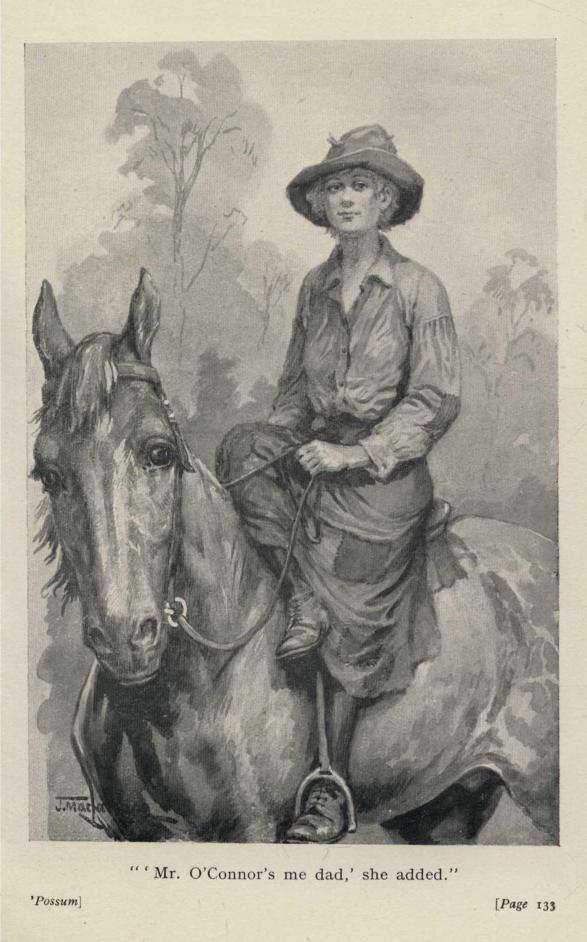
"'Mr. O'Connor's me dad,' she added."
Aileen began to laugh, and Tom followed suit.
"I'm sorry we were so stupid," Aileen said. "But from the way your father spoke we quite thought you were a man!"
"Blessed if I don't think he thinks so, most times," said 'Possum, her eyes twinkling. "It's a way Dad's got. An' I got to be a man, most times, so I s'pose he gets accustomed to it." She grinned at Garth. "How's the arm?"
"Better, thanks," Garth answered. "Did Mr. O'Connor tell you he cured it?"
"Said he pulled it straight. Hurts, don't it? I had mine put out when I was a kid." She grinned at him again; and from that moment Garth and 'Possum were friends. "You just knew," said Garth afterwards, "that she was a real decent sort."
"I'm so sorry you had the trouble of coming after us," Aileen said, "We were going for a day in the Bush: the rain has kept us indoors for a week. Won't you come, too?"
'Possum shook her head.
"Sorry," she said. "Me Dad's left me some sheep to bring home from Nelson's, an' it'll be a bit of a job, 'cause they're leavin' young lambs, an' drivin' 'em 'll be a caution. A mercy it ain't dusty an' hot; if it was they'd simply sit down in the road an' look at me. But it'll take me all me time, as it is. I just wanted to ask about that bit of ploughin' you wanted done."
Tom laughed.
"Hasn't your father told you how ignorant I am, Miss O'Connor? I don't know a thing about it."
There was a twinkle, polite, but irrepressible, in 'Possum's eye.
"Well, he did say you'd need a bit of coaching," she answered. "Him an' me had a yarn about your place last night, an' we reckoned that the little paddock where your calves are running now 'ud be about the best for cultivation. How about puttin' oats into the highest part, an' then some field-peas? An' maize ought to do real well on that low-lyin' strip goin' down to the creek. That 'ud give you about all the feed you'll need. And there's a corner beyond the creek I've had me eye on this long while. I'd like to try lucerne in it." She paused for breath, looking at him eagerly.
"It sounds attractive—but large," said Tom, hesitating. "I don't know that I can take all that on, Miss O'Connor."
"Why, it ain't much—the whole paddock's not that big," said 'Possum. "I'll get it ploughed in no time with our disc-plough. An' Dad'll come an' help us get the crops in. Then there's potatoes—I s'pose you'll put them in in Mr. Gordon's little potato paddock?"
"Yes, I thought so," he said. "Look here, I'm not proposing to stand by with my hands in my pockets while you and your father do my work. Can you teach me to take a hand? I mean"—he flushed—"will I be too much of a new chum to learn to be decently useful?"
"Why, we'll teach you as easy as wink," she said. "There ain't nothing difficult about it, if you ain't afraid of work. I only know what me Dad's taught me—you'll beat me in no time. We"—she paused, and for the first time looked embarrassed—"we think it's jolly rough on you people comin' into a place like this, not bein' used to anything. If there's anything we can do, you just let us know."
"It seems to me we're casting ourselves on your mercy," he said: at which 'Possum looked blank, and murmured something unintelligible. Aileen broke in.
"We're terribly ignorant people, but we do want to learn," she said. "What about me, Miss O'Connor? Can you teach me how to make an enormous fortune out of fowls?"
'Possum grinned.
"Well, I ain't learned that meself, yet. But there is a bit to be made out of 'em, if you go the right way about it, an' have decent luck. We'll try, Mrs. Macleod. Me Dad said you wanted to buy some?"
"Yes."
"Well, ol' Mother Coffey, up the lake, has plenty to sell. She's givin' up keepin' a lot—gettin' too rheumaticky. But if you don't mind me sayin' so, she'll raise the price on you if she thinks it's a new chum buyin'. Say you let me do the buyin'? I bet I'll get 'em pretty cheap."
"I'd be delighted," Aileen answered gratefully.
"Well now, look here," 'Possum said. "I'll come over to-morrow with the plough on the dray, an' then we can settle about the crops so's I can get straight ahead with the ploughin' next day. Then I'll jog on with the dray to ol' Mother Coffey's an' buy them chooks, an' bring 'em back. That gives us a good start. Got any setty hens?"
"There are three who sit on their nest—it's the same nest—all the time, and use very bad language if any one goes near them," Aileen said, laughing. "Is that being setty?"
"That's it," said 'Possum, grinning. "Well, wouldn't you like to start 'em on some aigs? Nothin' like rearin' chicks for yourself—-it's cheaper by a long way than buyin' other people's."
"It sounds tempting," said Aileen. "Can I learn how?"
"Bless you, yes," said 'Possum, startled by a depth of ignorance of which she had not dreamed, "I'll show you." She turned her friendly glance upon Garth. "We'll put you on that job—shall we?"
"Oh—could I!" exclaimed Garth, and capered. "I'd love to."
"Me little brother Joe always helps rear ours," said 'Possum. "An' he's only six." She gathered up her reins. "Well, I must be goin', if I want to get them old ewes home before dark. I'll be over to-morrow, Mrs. Macleod. So long." She dug her heel into the old grey horse, and wheeled round. Suddenly she looked over her shoulder.
"If you wouldn't mind just callin' me 'Possum," she said. She flushed hotly, and cantered away. They saw that she rode on a man's saddle, sitting easily sideways, with her leg crooked over the pommel.
Tom sat down on a log and stared at his family.
"Well, of all the amazing young women!" he said slowly. "Do you think there are any more at home like her?"
"I think she's ripping!" said Garth.
"I'm not sure that I don't agree with you," his father answered. "But.... Oh, my stars, Aileen, I never felt so small in mv life! She can't be seventeen—and I'm a baby beside her in everything that matters!"
"Well, so am I," said his wife, laughing. "But after all, it's in the bringing-up. We must just be grateful for having neighbours who are willing to take pity on our ignorance. And we're going to learn, Tom."
"There is certainly plenty to learn," he said, grimly. "However, we'll try. They're bricks, anyhow. Now I think it's time we found a good camping-place, and boiled the billy—and the first thing I've to learn is how to make a fire out of damp wood!"
They wandered home towards evening, tired, but content. Something of the homesickness that had lain like a cloud on Aileen's mind had passed away. Life did not seem so much a thing bounded by the four walls of a kitchen. Whether the long, peaceful day in the Bush had helped, or the tonic of 'Possum's cheery, practical voice, she did not know. But she felt better.
As she came through the yard a low snarl greeted her from a box. The three "setty" hens resented any one's passing by their seclusion.
"Hopeful old souls, those," said Tom, laughing. "They're sitting on a half-brick and a hard clod, and I think they expect to hatch out a half-acre allotment and a town hall. Goodness knows how long they have been doing it. No wonder they're bad-tempered."
"Well, we mean to give them eggs to sit on to-morrow," was Aileen's response. "I suppose 'Possum knows how to move them—I should have thought it as much as one's life was worth. Do hens bite deep, Tom?"
"I don't know," he said. "But I guess you'll know to-morrow!"
Meanwhile, Miss Maggie (or something) O'Connor, known as 'Possum, had collected her ewes and driven them slowly homeward through a long afternoon, during which they endeavoured unceasingly to return to their lambs, and bleated woe at being denied. It was dusk when the last entered the home paddock, leaping high in the gateway after the idiotic manner of sheep. 'Possum rode slowly down the hill to her home.
As she took the saddle off the old grey horse, her father came up.
"Well?" he said. "Ewes all right?"
"Yes. Travelled jolly badly."
"Sure to. See the Macleods?"
"'M." 'Possum nodded. "Goin' to take the plough over to-morrow."
"That's right. Nice people, aren't they?"
"Yes, they're nice." She moved towards the house, and then stopped. "But, Lor!—who ever let 'em out!" she said.
CHAPTER X
'POSSUM TAKES HOLD
'Possum arrived next morning with the old grey horse in a dray which contained, besides herself, a small, silent brother, a plough, and a box of eggs.
"They're me best Wyandottes' aigs," she explained. "Oh, yes, you can pay me for 'em. Will we set the hens now, Mrs. Macleod?"
They went off to the shed, the invariable storehouse of Bush lumber—containing much rubbish and many treasures. Among the latter were three small empty cases upon which 'Possum pounced.
"Do first-rate," she said.
She found her way, as if by instinct, to the tool-shed: and Garth and Aileen watched her as she split an old fruit-case into laths, nailing them on the open sides of her boxes, an inch apart. Larger pieces she reserved for doors, hanging them in position by short strips of leather cut from an old boot.
"Just you keep old boots like that," she said, tenderly regarding the green and mouldy relic she had disinterred from a rubbish-heap. "Never know when you won't want a bit of leather on a farm: and gen'lly-as-a-rule, when you most want it, it ain't there. Now that's all right. Any straw?"
Garth knew where there was straw, and fled for it delightedly: and 'Possum made a nest in each box, securing the straw from escaping by keeping it in place with bits of brick. It was all done very quickly. She carried a box to a quiet corner of the fowl-yard—and turned to remonstrate at finding Aileen bearing the second in the rear.
"I say—you oughtn't to do that!"
"Yes, I ought. It's my job," said Aileen, panting, but smiling.
"But you ain't used to it," said 'Possum unhappily.
"Then the sooner I get used to it, the better!" Aileen returned for the third box, but, being easily beaten by her determined assistant, had to content herself by bringing the eggs in her wake.
"Thirteen to each," said 'Possum, disposing the eggs swiftly in the nests. "There—look nice, don't they? Always makes me feel almost like setting myself. Now for them old hens. D'you want to learn to handle 'em, Missus?" It was clear that she abandoned "Mrs. Macleod" with relief.
Never had Aileen wanted anything less. The infuriated old hens filled her with such forebodings as might be felt on approaching an angry hyena.
"Yes, please," she said, with an effort.
"Then you get a pair of old gloves. Got any leather gardening gloves?"
"Oh, yes—run for them, Garth."
"Gives you great pluck, to have gloves on," remarked 'Possum. "Not that they'll peck you, if you're quick—but sometimes you ain't quick enough. Now, you watch."
She stooped before the box where the three hens clustered angrily, greeting her with hisses and snarls. For a moment she watched, then her hand shot out swiftly and grasped the nearest hen by the neck. Quick as she was, the second hen was quicker—a red mark showed on the brown hand as she rose with the struggling captive.
"Got me," she said cheerfully. "But it don't hurt. See, Missus—I just slip me hand under her, but I don't let go her neck. Then she travels nice an' easy, but she can't use her old beak. Come an' we'll put her on the aigs."
Snarling and struggling, the hen was gently deposited upon the nest, and the door secured. 'Possum covered the box with an old sack.
"There:—she'll get quiet enough when she can't see. Some people swears by settin' 'em at night, but it don't matter when they're as setty as these fellers. Like to try your hand with the next one, Missus?"
Aileen did her best. She plunged her hand at the second hen, but missed it, thanks to warlike action on its part; and the hen arose, bestowing a hearty peck on her glove as it passed, and fled into the open, uttering loud squawks. 'Possum grabbed the third as it was about to follow.
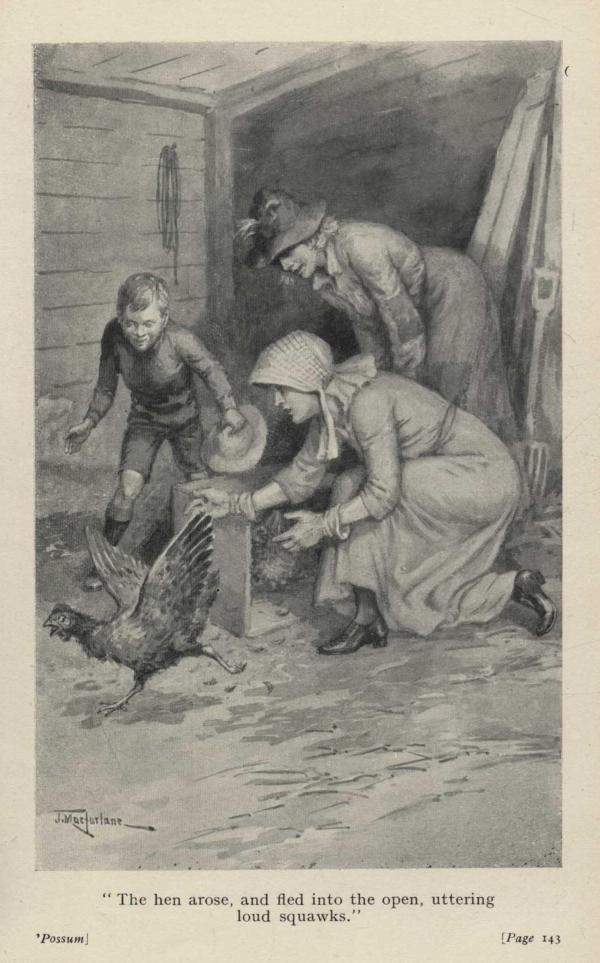
"The hen arose, and fled into the open, uttering loud squawks."
"That's the worst of catchin' 'em in daylight," she remarked. "They see too much of what you're after. Well, we'll have to leave her, Missus. She'll go back after awhile. D'you think you could get her to-night?"
"Yes, if it takes me all night!" said 'Aileen sturdily. Her attempt had failed, but it had taught her that the task held no especial terrors. "My husband will help me."
"Oh, you'll be all right," said 'Possum, securing her captive, and draping a sack over her wrathful protests. "Sit on them aigs, now, you silly old cuckoo, an' get busy! Well, that's that. Now, about buyin' them fowls?"
They discussed ways and means, and 'Possum made brief notes on the back of an old envelope—a laborious task.
"I'll get 'em," she said at length. "An' I must get along. I seen the Boss in the paddock as I come down, an' fixed up about them crops. Ploughin' to-morrow. So long, Missus—I'll be back this afternoon with them fowls. Come along, Joe."
"But your dinner—won't you stay?" Aileen protested.
"Got it in the cart," said 'Possum, indicating a newspaper parcel. "Catch young Joe starting out without his dinner! Thanks very much, all the same." She clicked to the grey horse, and he shambled off reluctantly.
It was some hours later when she returned, her arrival heralded by the voices of many birds. Ducks added their quackings to the notes of the hens; and a turkey's long neck protruded from a hole in a box, gazing on the scene with meek bewilderment. Aileen and Garth met the cart at the yard gate.
"You did get them!" said Aileen delightedly.
"You bet," said 'Possum briefly. "And they're good, too: you'll make plenty out of those chaps, 'cause I got 'em real cheap. Ol' Mother Coffey's anxious to get 'em off her hands: she's stiff as a poker with rheumatics. Them turkeys is a real bargain. They had her beat altogether, 'cause turkeys stray most awful, an' she couldn't get across the flats to yard 'em in." The simple joy of Miss O'Connor in the affliction of Mrs. Coffey was touching to behold.
"Well, let them go—and come and have some tea," Aileen said. "You must need it."
"I could do with a go of tea, but I can't let these fellers go without cuttin' a wing of each," said 'Possum. "Mother Coffey ain't got no garden to keep 'em out of, but 'you wouldn't care to have them rampagin' over yours. Got a strong pair o' scissors?".
They watched little Joe hold each bird while his sister deftly cut one wing as short as possible.
"Why not two wings?" Garth asked.
"'Cause they can fly as well as anything if you leave 'em both the same. They can balance, then. But you watch that chap."
"That chap" was a handsome young pullet, apparently maddened by her trials. She stared wildly for a moment when released: then, perceiving a quince tree, decided that safety lay in its branches, and endeavoured to fly thither. Her spring carried her a little way into the air: then, lacking one wing, she overbalanced and fell sideways, with terrified squawks. Reaching the ground, she bolted for shelter into Bran's kennel: and, being greeted with an amazed and indignant yap from Bran, who was already there, fluttered backwards in a state of horrified panic, and, shrieking her woes, fled down the hill-side and was lost to sight. The onlookers gave themselves up to laughter.
"Will she ever come back, do you think?"
"Oh, she'll come back all right when she feels a bit lonely," 'Possum rejoined. "Why, she ain't goin' to keep away from a place where she's had all that fun!"
Tom came up as the last of the fowls was released. Under 'Possum's advice he had spent the day in the cultivation paddock, with Roany harnessed to a sledge, picking up logs and roots which, would be in the way of the plough.
"That paddock looked quite clear: but I've a stack of wood that will last us for a fortnight, and an appetite to match it," he said. "That's a great lot of fowls! Are they what the fortune is to be made out of, 'Possum?"
"Some of it," said 'Possum. "The rest's coming out of that lucerne crop."
They went in to tea—and for the first time they saw 'Possum awkward. Outside, in the saddle, driving the heavy dray, or dealing with tools and fowls, she was simple, capable, and thoroughly at home; but the sitting-room, with its pleasant litter of books and papers and the music open on the piano, was evidently a strange world to her, and she became silent and ill at ease. The patched and faded blue dungaree, and the rough men's boots, which had fitted into the working scene, were suddenly all wrong: she looked at Aileen's dainty print frock, and felt the difference she could not put into words. It was in Aileen as well. Outside, she had been shy and awkward, ashamed of her own ignorance and helplessness: here, she was on her own ground, as she had been in the drawing-room of the "House Beautiful"; the perfect hostess, courteous and sweet-mannered. But all her tact failed, for a while, to loosen the mantle of shyness in which the unhappy 'Possum was wrapped.
Help came through little Joe. Nothing on earth could make Joe shy, though he was a gentleman of few words. Here, however, was tea, which he needed: with large fresh scones and a big cake which Mr. Macleod—a man of understanding, evidently—was cutting into generous, plummy slices. Cake did not often come in little Joe's way, and he greeted it with a wide smile.
"Ain't that scrummy, 'Poss?" he said, indicating the cake with a grubby finger.
"Be quiet!" said 'Possum in an agonized whisper. "Behave yourself!"
Joe's mouth drooped at the corners.
"Can't I have some?"
"But of course you can: and it is scrummy!" said Tom cheerfully. "I know, because I helped to make it! Don't you mind 'Possum, Joe: she can boss us when it comes to ploughing, but not when it's eating cake." He smiled at the girl over the small boy's head. "Have a scone, 'Possum."
'Possum accepted a scone unhappily, and held it as if doubtful of how to eat it, sitting miserably on the extreme edge of her chair, and grasping her cup with a clutch born of despair. Visions of flight stole across her: she wondered if it would look queer if she said that the old grey horse would not stand, and so might escape for home. But the grey was certainly asleep, with his nose against a post: and little Joe was sitting up to the table, eating scones and cake together with perfect contentment. Wild horses—let alone the old grey—would have found it difficult to move little Joe.