THE ENGRAVER.
Reading edition
Engraving is the art of cutting letters or figures in wood, metals, or stone. It was practised in very ancient times, and in different countries, for the purposes of ornament and monumental inscription; but the idea of taking impressions on paper, or on any other substance, from engraved surfaces, is comparatively modern.
THE WOOD ENGRAVER.
1. The Chinese are said to have been the first who engraved figures or letters on wood, for the purpose of printing. The precise time at which they commenced the practice, is totally unknown; but a book printed by them in the tenth century, is now extant. It is thought by some antiquarians, that the Europeans derived the art from the Chinese, through the Venitians, who traded in that part of the world earlier than any other Europeans.
2. This opinion is somewhat probable, from the circumstance that the tools employed by the early engravers in Europe, are similar to those used in China; and also, like the Chinese, they engraved on the side of the grain. However this may be, it is certain that the art was practised in various parts of Europe in the fourteenth century. The earliest subjects executed, were figures of saints, rudely engraved in outline. The prints taken from them were gaily colored, and sold to the common people as original paintings. The principal persons engaged in this traffic were monks, to whom the art was confined for a considerable time.
3. At length, larger subjects, with inscriptions in imitation of manuscript, were executed. The success of these prints gave rise to a more extensive application of the art. Scriptural subjects, of many figures, with texts of scripture, were engraved, and impressions were taken from them on one side of the paper, two sheets being pasted together to form a leaf. Entire sets were bound up together, and thus were formed the first printed books, which, being produced entirely from wood-cuts, are known by the name of block-books. These books made their appearance about the year 1420.
4. One of the earliest of these productions is denominated "The Apocalypse of St. John;" another, "The Poor Man's Bible." But one of the latest and most celebrated, is called "The Mirror of Salvation," published in 1440. Part of the text was printed from solid blocks, and part, from moveable wooden types. From this fact, it is easy to discover the origin of printing. After this, most, if not all, of the books, were printed from moveable types; but, as they were embellished with wood cuts, the demand for such engravings was very much increased, although they were, at first, by no means elegant.
5. Near the close of the fifteenth century, the art began to assume a higher character, principally by the talents of Michael Wolgermuth and William Pluydenwurf. Albert Durer made still greater improvements, and, in 1498, published his celebrated Apocalypse of St. John, printed from folio blocks. Other celebrated engravers succeeded him in the sixteenth century, which may be considered the era when wood engraving was at its highest point of elevation. After this, the art declined, and was considered of little importance, until it was revived in 1775, by the distinguished William Bewick, of Newcastle, England. It is still practised, especially in England and the United States, in a manner which reflects credit on the ingenuity of the age.
6. The earlier artists operated on various kinds of wood, such as the apple, pear, and beech; but these, being too soft, are now used only for calico-printing and other common purposes. Box-wood, on account of its superior texture, is used for every subject that can be termed a work of art. That from Turkey is the best.
7. The engravers, in the infancy of the art, prepared the wood as the common block-cutters now do. The tree was cut the way of the grain, in planks, and of course they engraved on the side of the grain, as upon a board. This mode of preparation enabled them to execute larger subjects. The engravers now prefer the end of the grain, and therefore cut the log transversely.
8. The end on which the engraver is to exert his skill, is planed and scraped, to render the surface smooth, and the block having been cut to the proper size, the drawing is made upon it in India ink, or with a lead-pencil. The block is now ready for the artist who, in executing the work, holds it with one hand, on a cushion made of sand and leather, while, with the other, he cuts away the superfluous wood. The part intended to make the impression in printing, is left standing.
9. Wood engravings, well executed, are scarcely inferior to those of copper and steel, and, for many purposes, they are preferred. They are remarkably convenient, since they can be inserted into a page of types, where illustrations or embellishments may be required, and be printed without separate expense. They will also bear a great number of impressions—generally 100,000. In this respect, they are decidedly superior to metallic plates. They can likewise be multiplied indefinitely by the process of stereotyping.
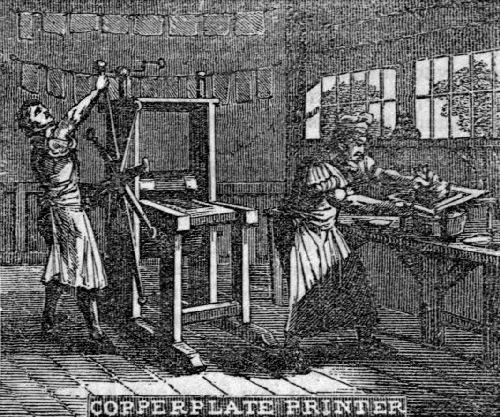
THE COPPERPLATE ENGRAVER.
1. The engravers on metallic surfaces are termed copperplate engravers, not because copper is the only metal on which they exert their skill, but because it is the one on which they usually operate. The plates are prepared for the artist by the coppersmith, by rubbing them with brickdust and charcoal, after having cut them of a proper size from sheets of copper.
2. The instruments employed by this artist are few and simple, the principal of which are, the graver, the dry-point, the scraper, and the burnisher. The graver is a small bar of steel, of a square or lozenge form, and, with the short handle into which it is inserted, about five inches in length. One of the angles of the bar is always on the under side of the instrument, and the point is formed by bevelling the end from the upper side, or angle. The square form is used for broad strokes, and the lozenge for fine ones.
3. The dry-point, or needle, is a steel wire with a long cylindrical handle; or it is simply a wire of sufficient length and size to be used without a handle. The scraper has nearly the form of a triangular pyramid; and the cutting part, which has three edges, is two or three inches long. The burnisher has a form nearly conical, and, without the handle, is about three inches long. The last two instruments are frequently made of the same piece of steel, properly forged at each end. In such case, the middle part of the steel is the handle by which they are held.
4. Of engraving on copper, the following are the principal varieties or styles: 1. Line engraving; 2. Stippling; 3. Etching; 4. Mezzotinto; 5. Aquatinta. For the purpose of conveying some idea of these different branches, we will describe them under distinct heads.
5. Line engraving. The first thing done, in this species of engraving, is to transfer to the plate an exact copy of the outlines of the design to be executed. In accomplishing this, the plate is moderately heated, and covered with a thin coating of white wax. A piece of transparent paper is then laid over the design to be copied, and traced in outline with a black-lead pencil. The outline thus sketched is turned down upon the coating of white wax, and the whole is subjected to the action of a rolling-press; or it is kept for a while under heavy weights. By the application of this pressure, the lines are transferred from the paper to the wax on the plate in a reversed position, which is necessary to make the impression of the finished plate resemble the original.
6. The pencil-marks on the wax having been lightly traced on the copper with the dry-point, and the wax having been melted off, a perfect outline is found on the plate. Small subordinate parts of the design are transferred to the plate in the same manner, except that the transparent paper is brought in forcible contact with the waxed surface by means of the burnisher.
7. At this stage of the process, the artist commences the use of the graver. While operating with this instrument, he holds the handle in the palm of his hand, and pushes the point forward with a firm and steady motion, until a line is produced by a removal of a portion of the metal. By a succession of such strokes, judiciously applied, the work is completed. The burrs, or little elevations of the copper, left by the graver on each side of the lines, are removed by means of the scraper and burnisher. Mistakes or blemishes are erased from the plate, either with the burnisher, or by friction with charcoal.
8. Stippling. The second mode of engraving is called stippling. This resembles the last method in its process, except that the effect is produced by means of minute punctures or excavations, instead of lines. These are made either with the dry-point or graver. When produced by the former instrument, they are of a circular form; when by the latter, they are rhomboidal or triangular. This style of work is always more slow, and consequently more expensive, than engraving in lines. It has, however, some advantages in the softness and delicacy of its lights and shades, and the prints struck from it approach more nearly to paintings.
9. Etching. This mode of engraving is far more easy than any other, being performed chiefly by chemical corrosion. In fact, any person who can draw, may etch coarse designs tolerably well, after having learned the theory of the operation. To perform it, the plate is first covered with a thin coating of some resinous substance, upon which the acid employed can have no action. The design, and all the lines it requires, are next traced on the plate with steel points, called etching needles, which are instruments similar to the dry-point.
10. The second part of the process is the corrosion, or, as it is technically called, biting in. This is effected by pouring upon the design a quantity of diluted nitric acid, after having surrounded the edges of the plate with a wall of soft wax, to prevent the escape of the fluid. A chemical action immediately takes place in all the lines or points where the copper has been denuded by the needle. After the first biting has been continued long enough, in the judgment of the operator, the acid is poured off, and the plate examined.
11. The light shades, if found sufficiently deep, are then covered with varnish, to protect them from further corrosion. The biting is then continued for the second shades, in the same manner, and afterwards, for the third and succeeding shades, until the piece shall have been finished. The plate having been cleaned, and carefully examined by the aid of a proof impression, the deficiencies which may be discovered are supplied with the graver.
12. Mezzotinto. In the production of this kind of engraving, the whole surface of the plate is first roughened, or covered with minute prominences and excavations too small to be obvious to the naked eye; so that an impression taken from it, in this state, would present a uniform velvety, black appearance. This roughness is produced mechanically by means of a small toothed instrument, called a cradle.
13. When the plate has been thus prepared, the rest of the process is comparatively easy. It consists in pressing down or rubbing out the roughness of certain parts of the plate, with the burnisher and scraper. Where strong lights are required, the plate is restored to a smooth surface; for a medium light, it is moderately burnished, or partially erased; and, for the deepest shades, the ground is left entire, and sometimes etched, and corroded with nitric acid. Impressions from mezzotinto plates approach more nearly to oil paintings than any other prints. This kind of engraving was invented by Prince Rupert, in 1649.
14. Aqua-tinta. There are several methods by which this kind of engraving can be executed; we, however, will describe the one which seems to be the most simple and obvious. The outline of the picture having been etched or engraved in the usual manner, the surface of the copper is sprinkled equally with minute particles of rosin. This dust is fixed to the surface by heating the plate until the rosin has melted.
15. The ground having been thus laid, the parts of the plates not intended to be occupied by the design are stopped out by means of thick varnish. The plate is now surrounded with a wall of wax, as for etching, and diluted nitric acid is poured upon it. A chemical action immediately takes place, by which the surface exposed between the resinous particles is minutely excavated.
16. The lighter shades are stopped out at an early stage of the process, and the biting in is continued for the darker ones. After the plate is judged to be sufficiently corroded, it is cleansed, and an impression is taken on paper. The process is finished by burnishing the shades, to give them greater softness, and by touching up the defective parts with the graver.
17. This mode of engraving is well adapted to light subjects, sketches, landscapes, &c.; but, owing to the fineness of the ground, the plates wear out rapidly, and seldom yield, when of ordinary strength, more than six hundred impressions. The prints taken from such plates bear a strong resemblance to paintings in Indian ink, or to drawings in black-lead pencil. Aqua-tinta is the most precarious kind of engraving, and requires much attention on the part of the artist. It was invented by a Frenchman, named Leprince, who, for a time, kept the process a secret, and sold his impressions for original drawings.
18. Steel engraving. The process of engraving on steel plates differs but little in its details from that on copper plates; and the chief advantage derived from this method, arises from the hardness or toughness of the material, which renders it capable of yielding a greater number of impressions.
19. This mode of engraving was first practised, in England, by the calico-printers; but steel was first employed for bank-notes, and for common designs, by Jacob Perkins, of Newburyport, Massachusetts; and by him, in conjunction with Asa Spencer, of New-London, and Gideon Fairman, of Philadelphia, the use of steel in this application was generally introduced, not only in the United States, but also in Great Britain, some time before the year 1820.
20. The plates are prepared for the engraver from sheets of steel about one-sixth of an inch in thickness. A plate cut from a sheet of this kind is first softened by heating it with charcoal, and suffering it to cool gradually in the atmosphere. It is next planished, or hammered on a peculiar kind of anvil, to make it perfectly level, and afterwards ground on one side upon a grindstone. The operation is completed by polishing it with Scotch stone and charcoal. When steel was first substituted for copper, it was hardened before it was used in printing; but it is now used in its soft state, as it comes from the hands of the artist.