THE BLACKSMITH, AND THE NAILER.
Reading edition
THE BLACKSMITH.
1. The blacksmith operates in wrought iron and steel, and, from these materials, he fabricates a great variety of articles, essential to domestic convenience, and to the arts generally.
2. This business is one of those trades essential in the rudest state of society. Even the American Indians are so sensible of its importance, that they cause to be inserted in the treaties which they make with the United States, an article stipulating for a blacksmith to be settled among them, and for a supply of iron.
3. The utility of this trade will be further manifest by the consideration, that almost every other business is carried on by its aid. The agriculturist is dependent on it for forming utensils, and mechanics and artists of every description, for the tools with which they operate; in short, we can scarcely fix upon a single utensil, vehicle, or instrument, which does not owe its origin, either directly or indirectly, to the blacksmith.
4. This business being thus extensive in its application, it cannot be presumed that any one person can be capable of executing every species of work. This, however, is not necessary, since the demand for particular articles is frequently so great, that the whole attention may be directed to the multiplication of individuals of the same kind. Some smiths make only anchors, axes, scythes, hoes, or shovels.
5. In such cases, the workmen acquire great skill and expedition in the manufacture. A tilt hammer is often used in forging large masses of iron, and even in making utensils as small as the hoe, the axe, and the sword; but the hammer which may be employed bears a due proportion in its weight to the mass of iron to be wrought. In all cases in which a tilt hammer is used, the bellows from which the blast proceeds is moved by water or steam power.
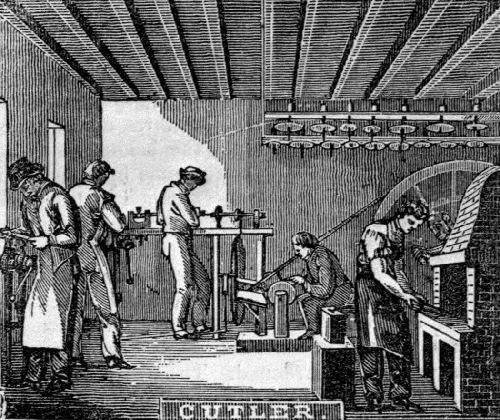
6. In the shop represented at the head of this article, sledges and hammers are used as forging instruments, and these are wielded by the workmen themselves. The head workman has hold of a piece of iron with a pair of tongs, and he, with a hammer, and two others, with each a sledge, are forging it upon an anvil. The two men are guided in their disposition of the strokes chiefly by the hammer of the master-workman.
7. In ordinary blacksmith shops, two persons commonly work at one forge, one of whom takes the lead in the operations, and the other works the bellows, and uses the sledge. From the part which the latter takes in the labor, he is called the blower and striker. A man or youth, who understands but little of the business, can, in many cases, act in this capacity tolerably well.
8. The iron is rendered malleable by heating it with charcoal or with stone coal, which is ignited intensely by means of a blast from a bellows. The iron is heated more or less, according to the particular object of the workman. When he wishes to reduce it into form, he raises it to a white heat. The welding heat is less intense, and is used when two pieces are to be united by welding. At a red heat, and at lower temperatures, the iron is rendered more compact in its internal texture, and more smooth upon its surface.
9. The joint action of the heat and air, while the temperature is rising, tends to produce a rapid oxydation of the surface. This result is measurably prevented by immersing the iron in sand and common salt, which, uniting, form a vitreous coating for its protection. This coating is no inconvenience in the forging, as its fluidity causes it to escape immediately under the action of the hammer.
10. Steel is combined with iron in the manufacture of cutting instruments, and other implements, as well as articles requiring, at certain parts, a great degree of hardness. This substance possesses the remarkable property of changing its degree of hardness by the influence of certain degrees of temperature. No other substance is known to possess this property; but it is the peculiar treatment which it receives from the workman that renders it available.
11. If steel is heated to redness, and suddenly plunged into cold water, it is rendered extremely hard, but, at the same time, too brittle for use. On the other hand, if it is suffered to cool gradually, it becomes too soft and ductile. The great object of the operator is to give to the steel a quality equally distant from brittleness and ductility. The treatment by which this is effected is called tempering, which will be more particularly treated in the article on the cutler, whose employment is a refined branch of this business.
THE NAILER.
1. Nail-making constitutes an extensive branch of the iron business, as vast quantities of nails are annually required by all civilized communities. They are divided into two classes, the names of which indicate the particular manner in which they are manufactured; viz., wrought nails and cut nails.
2. The former are usually forged on the anvil, and when a finished head is required, as is commonly the case, it is hammered on the larger end, after it has been inserted into a hole of an instrument formed for the purpose. Workmen by practice acquire surprising dispatch in this business; and this circumstance has prevented the general introduction of the machines which have been invented for making nails of this description. Wrought nails can be easily distinguished from cut nails, by the indentations of the hammer which have been left upon them.
3. In making cut nails, the iron is first brought into bars between grooved rollers. The size of the bars is varied in conformity with that of the proposed nails. These bars are again heated, and passed between smooth rollers, which soon spread them into thin strips of suitable width and thickness. These strips, having been cut into pieces two or three feet in length, are heated to a red heat in a furnace, to be immediately converted into nails, when designed for those of a large size. For small nails, the iron does not require heating.
4. The end of the plate is presented to the machine by the workman, who turns the material over, first one way and then the other; and at each turn a nail is produced. The machine has a rapid reciprocating motion, and cuts off, at every stroke, a wedge-like piece of iron, constituting a nail without a head. This is immediately caught near the head, and compressed between gripes; and, at the same time, a force is applied to a die at the end, which spreads the iron sufficiently to form the head. From one to two hundred can be thus formed in a minute. This fact accounts for the low rate at which cut nails are now sold, which, on an average, is not more than two cents per pound above that of bar iron.
5. On account of the greater expense of manufacturing wrought nails, they are sold much higher. It is said that nine-tenths of all the nails of this kind, used in the United States, are imported from Europe. We thus depend upon foreign countries for these and many other articles, because they can be imported cheaper than we can make them; and this circumstance arises chiefly from the difference in the price of labor.
6. The first machine for making cut nails was invented in Massachusetts about the year 1816, by a Mr. Odion, and soon afterwards another was contrived, by a Mr. Reed, of the same state. Other machines, for the same purpose, have likewise been constructed by different persons, but those by Odion and Reed are most commonly used. Before these machines were introduced, the strips of iron just described, were cut into wedgelike pieces by an instrument which acted on the principle of the shears; and these were afterwards headed, one by one, with a hammer in a vice. The fact, that the manufacture of this kind of nails originated in our country, is worthy of recollection.
7. In 1841, Walter Hunt, of New-York, invented a double reciprocating nail engine, which is owned by the New-York Patent Nail Company. This machine works with surprising rapidity, it being capable of cutting five or six hundred ten-penny nails in a minute. One hand can tend three engines, as he has nothing more to do than to place the heated plate in a perpendicular position in the machine.
8. This manufacture includes, also, that of tacks and spikes; but since, in the production of these, the same general methods are pursued, they need no particular notice. The different sizes of tacks are distinguished by a method which indicates the number per ounce; as two, three, or four hundred per ounce. Spikes are designated by their length in inches, and nails by the terms, two-penny, three-penny, four-penny, ten-penny, and so on up to sixty-penny.