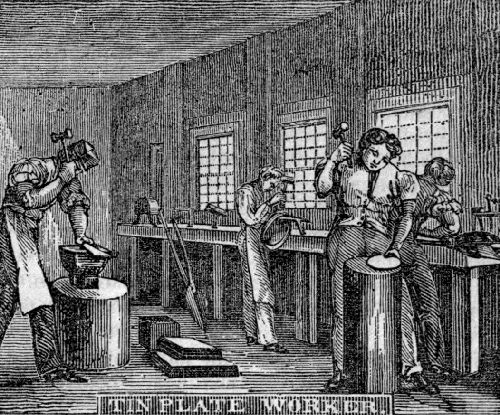
THE COPPERSMITH, THE BUTTON-MAKER, AND THE PIN-MAKER.
Reading edition
COPPER.
1. Copper is a ductile and malleable metal, of a pale yellowish red color. It is sometimes found in a native state, but not in great quantities. The copper of commerce is principally extracted from the ores called sulphurets. Copper mines are wrought in many countries; but those of Sweden are said to furnish the purest copper of commerce, although those of the island of Anglesea are said to be the richest.
2. In working sulphureted ore, it is first broken into pieces, and roasted with a moderate heat in a kiln, to free it from sulphur. When the ore is also largely combined with arsenic, a greater degree of heat is necessary. In such a case, it is spread upon a large floor of a reverberatory furnace, and exposed to a greater heat. By this treatment, the sulphur and arsenic are soon driven off.
3. The ore is then transferred to the fusing furnace, and smelted in contact with fuel. The specific gravity of the copper, causes it to sink beneath the scoria into a receptacle at the bottom of the furnace. To render the metal sufficiently pure, it requires repeated fusions, and, even after these, it usually contains a little lead, and a small portion of antimony.
4. Alloys of copper.—Copper is combined by fusion with a great number of metals, and, in such combinations, it is of great importance in the arts. When added in small quantities to gold and silver, it increases their hardness, without materially injuring their color, or diminishing their malleability. An alloy, called white copper, imported from China, and denominated, in that country, pakfong, is composed of copper, zinc, nickel, and iron. It is very tough and malleable, and is easily cast, hammered, and polished. When well manufactured, it is very white, and as little liable to oxydation as silver.
5. Copper, with about one-fourth of its weight of lead, forms pot-metal. Brass is an alloy of copper and zinc. The proportion of the latter metal varies from one-eighth to one-fourth. Mixtures, chiefly of these two metals, are also employed to form a variety of gold-colored alloys, among which are prince's metal, pinchbeck, tombac, and bath-metal.
6. A series of alloys is formed by a combination of tin and copper. They are all more or less brittle, rigid, and sonorous, according to the relative proportions of the two metals; these qualities increasing with the amount of tin. The principal of these alloys are, bronze, employed in the casting of statues; gun-metal, of which pieces of artillery are made; bell-metal, of which bells are made; and speculum-metal, which is used for the mirrors of reflecting telescopes.
7. The alloys of copper were very prevalent among the nations of antiquity, and were used, in many cases where iron would have answered a much better purpose. The instruments of husbandry and of war, as well as those for domestic uses generally, were usually made of bronze, a composition which furnishes the best substitute for iron and steel. The Corinthian brass, so celebrated in antiquity, was a mixture of copper, gold, and silver.
8. The earliest information of the use of this metal by mankind, is found in the fourth chapter of Genesis, in which it is stated, that "Tubal-Cain was the instructer of every artificer in brass and iron." This individual was the seventh generation from Adam, and was born about the year of the world 500.
THE COPPERSMITH.
1. Copper, being easily wrought, is applied to many useful purposes. It is formed into sheets by heating it in a furnace, and compressing it between steel rollers. The operation of rolling it constitutes a distinct business, and is performed in mills erected for the express purpose.
2. The rolled sheets are purchased according to weight by the coppersmith, who employs them in sheathing the bottoms of ships, in covering the roofs of houses, and in constructing steam-boilers and stills. He also fabricates them into a variety of household utensils, although the use of this metal in preparing and preserving food, is attended with some danger, on account of the poisonous quality of the verdigris which is produced on the surface.
3. An attempt has been made to obviate this difficulty, by lining the vessels with a thin coating of tin. This answers the purpose fully, so long as the covering of tin remains entire. But, in cases of exposure to heat, it is liable to be melted off, unless it is kept covered with water.
4. This metal can be reduced by forging to any shape; but, during the process, it will bear no heat greater than a red heat; and, as it does not admit of welding, like iron, different pieces are united with bolts, or rivets, of the same metal, as in the case of the larger kinds of vessels, or by means of solder made of brass and zinc, or zinc and lead, as in the case of those of smaller dimensions.
5. Brass is applied to a greater variety of purposes in the arts than copper. This preference has arisen from its superior beauty, from the greater facility with which it can be formed into any required shape, and from its being less influenced by exposure to the ordinary chemical agents.
6. Some of the articles manufactured of brass, are forged to the required form, and others are made of rolled sheets; but, in most cases, they pass through the hands of the brass-founder, who liquifies the metal, and pours it into moulds of sand. For the sake of lightness, and economy of material, many articles are made hollow; in such cases, they are cast in halves or pieces, and these are afterwards soldered together.
7. Pieces which have been cast are generally reduced in size, and brought more exactly to the proposed form, either in a lathe, with tools adapted to turning, or in the vice, with files and other suitable instruments. The operators in brass form a class of mechanics distinct from those who work in copper.
THE BUTTON-MAKER.
1. Trifling as the manufacture of buttons may appear, there are few which include a greater variety of operations. The number of substances of which they are made is very great, among which are gold, silver, various alloys of copper, steel, tin, glass, mother-of-pearl, bone, horn, and tortoise-shell, besides those which consist of moulds of wood or bone, covered with silk, mohair, or similar materials.
2. In making gilt buttons, the blanks, or bodies, are cut from rolled plates of brass, with a circular punch driven by means of a fly wheel. The blanks thus produced, are planished with a plain die, if they are intended for plain buttons; or with one having on it an engraved figure, if they are to be of the ornamental kind. In either case, the die is usually driven with a fly press.
3. The shanks are next placed on one side of the proposed button, and held there temporarily with a wire clasp. A small quantity of solder and rosin having been applied to each shank, the buttons are exposed to heat on an iron plate, until the solder shall have melted. The shanks having been thus firmly soldered on, the buttons are turned off smoothly on their edges in a lathe.
4. The buttons are next freed from oxyde, by immersing them in diluted nitric acid, and by friction in a lathe. They are then put into a vessel containing a quantity of nitric acid supersaturated with mercury. The superior attraction of the copper for the acid, causes a portion of it to be absorbed; and the mercury held in solution by it, is deposited on the buttons, which are next put into a vessel containing an amalgam of mercury and gold.
5. The amalgam is formed by melting the two metals together, and afterwards pouring them into cold water. The composition having been put into a bag of chamois leather, and a part of the mercury pressed through the pores, the remaining portion is left in a condition approaching the consistency of butter, and in a fit state for use. Before the buttons are put into the amalgam, a small quantity of nitric acid is added.
6. The buttons having been covered with the amalgam, as before stated, the mercury is discharged, that the gold may adhere directly to the brass. This object is effected by heating the buttons in an iron pan, until the amalgam begins to melt, when they are thrown into a large felt cap, and stirred with a brush. This operation is repeated several times, until all the mercury has been volatilized. The whole process is finished by again burnishing them, and putting them on cards for sale.
7. White metal buttons are made of brass alloyed with different proportions of tin. They are cast, ten or twelve dozens at a time, in moulds formed in sand, by means of a pattern. The shanks are placed in the centre of the moulds, so that, when the metal is poured in, they become a part of the buttons. The buttons are next polished in a lathe, with grindstone dust and oil, rotten stone and crocus martis. They are then boiled with a quantity of grained tin, in a solution of crude red tartar or argol, and lastly, finished with finely-pulverized crocus, applied with buff leather.
8. Glass buttons are made of various colors, in imitation of the opal and other precious stones. While manufacturing them, the glass is kept in a state of fusion, and a portion of it for each button is nipped off out of the crucible with a metallic mould, somewhat similar to that used for running bullets, the workman having previously inserted into it the shank.
THE PIN-MAKER.
1. There is scarcely any commodity cheaper than pins, and none which passes through the hands of a greater number of workmen in the manufacture, twenty-five persons being successively employed upon the material, before it appears in these useful articles, ready for sale.
2. The wire having been reduced to the required size, is cut into pieces long enough to make six pins. These pieces are brought to a point at each end by holding them, a handful at a time, on a grindstone. This part of the operation is performed with great rapidity, as a boy twelve years of age can sharpen 16,000 in an hour. When the wires have been thus pointed, the length of a pin is taken off at each end, by another hand. The grinding and cutting off are repeated, until the whole length has been used up.
3. The next operation is that of forming the heads, or, as the pin-makers term it, head-spinning. This is done with a spinning-wheel, by which one piece of wire is wound upon another, the former, by this means, being formed into a spiral coil similar to that of the springs formerly used in elastic suspenders. The coiled wire is cut into suitable portions with the shears, every two turns of it being designed for one head. These heads are fastened to the lengths by means of a hammer, which is put in motion with the foot, while the hands are employed in taking up, adjusting, and placing the parts upon the anvil.
4. The pins are now finished, as to their form; but still they are merely brass. To give them the requisite whiteness, they are thrown into a copper vessel, containing a solution of tin and the lees of wine. After a while, the tin leaves the liquid, and fastens on the pins, which, when taken out, assume a white appearance. They are next polished by agitating them with a quantity of bran in a vessel moved in a rotary manner. The bran is separated from them, as chaff is separated from wheat.
5. Pins are also made of iron wire, and colored black by a varnish composed of linseed oil and lamp-black. This kind is designed for persons in mourning. Pins are likewise made with a head at each end, to be used by females in adjusting the hair for the night, without the danger of pricking. Several machines have been invented for this manufacture, one of which makes a solid head from the body of the pin itself; but the method just described still continues to be the prevailing one.
6. Pins are made of various sizes. The smallest are called minikins, the next, short whites. The larger kinds are numbered from three to twenty, each size increasing one half from three to five, one from five to fourteen, and two from fourteen to twenty. They are put up in papers, according to their numbers, as we usually see them, or in papers containing all sizes. In the latter case, they are sold by weight.
7. It is difficult, or even impossible, to trace the origin of this useful little article. It is probable, however, that it was invented in France, in the fifteenth century. One of the prohibitions of a statute, relating to the pin-makers of Paris of the sixteenth century, forbid any manufacturer to open more than one shop for the sale of his wares, except on new-year's day, and on the day previous.
8. Hence we may infer, that it was customary to give pins as new-year's presents, or that it was the usual practice to make the chief purchases at this time. At length it became a practice, in many parts of Europe, for the husband to allow to his wife a sum of money for this purpose. We see here the origin of the phrase, pin-money, which is now applied to designate the sum allowed to the wife for her personal expenses generally.
9. Prior to the year 1443, the art of making pins from brass wire was not known in England. Until that period, they were made of bone, ivory, or box-wood. Brass pins are first mentioned in the English statute book, in 1483, when those of foreign manufacture were prohibited.
10. Although these useful implements are made in London, and in several other places in England, yet Gloucester is the principal seat of this manufacture in that kingdom. It was introduced into that place, in 1626, by John Silsby, and it now contains nine distinct manufactories, in which are employed about 1500 persons, chiefly women and children. Pins are also manufactured extensively in the villages near Paris, and in several other places in France, as well as in Germany.
11. The business of making pins has been lately commenced in the city of New-York, and it is said that the experiment has been so successful, both in the perfection of the workmanship, and in the rapidity of the production, that pins of American manufacture bid fair to compete, at least, with those of foreign countries.