SECTION I.—THE MAMMALS.
Reading edition
The Hoofed Animals.
The forming of a collection which shall fairly represent the hoofed animals of the world is necessarily a work of years. It is now (in 1915) fifteen years since the Zoological Society entered upon this task, and during that period the work of providing installations and living specimens has been pursued with unflagging industry. In no feature of our development has the Society been more liberal than in the purchase of specimens for this collection, and the gifts to it have been both numerous and valuable. In our 82 species and 330 specimens we feel that the Order Ungulata is strongly represented. On April 1, 1913, the summary of groups stood as follows:
Summary of the Ungulates.
Deer 24 species 164 specimens
Giraffes 1 “ 2 “
Bovines: Bison, etc. 3 “ 38 “
Musk Ox 1 “ 6 “
Wild Sheep, Goats, etc. 8 “ 41 “
Antelopes 22 “ 41 “
Hippopotamus 2 “ 4 “
Wild Swine 3 “ 5 “
Camels and Cameloids 5 “ 10 “
Rhinoceros 2 “ 2 “
Tapirs 2 “ 3 “
Wild Equines 6 “ 9 “
Elephants 3 “ 5 “
Total 82 “ 330 “
The arrangement of this section of the Guide Book begins at the Buffalo Entrance with the Bisons, and follows the ranges, corrals and buildings for Hoofed Animals, along the southern and western sides of the Park, to the Axis Deer Range. The Elephant House is introduced as the visitor leaves Baird Court, going south.
The large, open pastures are called “ranges,” and the smaller fenced enclosures are known as “corrals.” The fences are chiefly of hard steel wire, so strong and elastic that the animals cannot break through them.
26
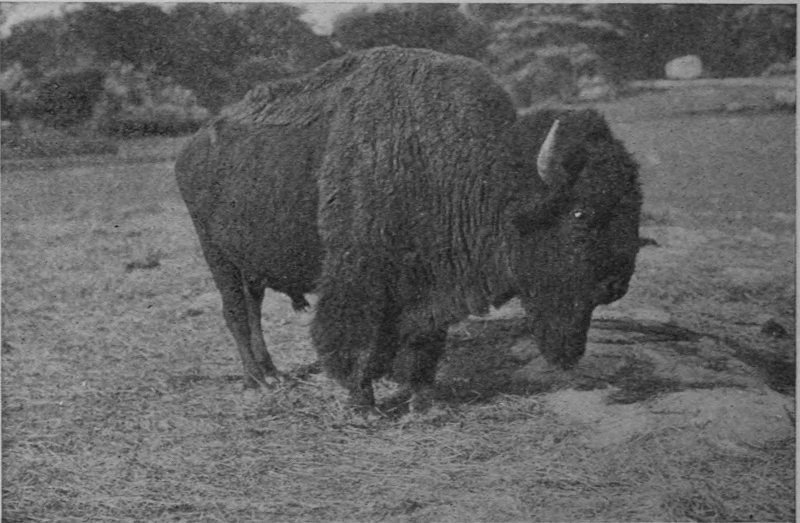
AMERICAN BISON: BULL.
Warning.—Visitors must never stand close beside a wire fence or gate, because its elasticity between posts might enable a charging animal to strike a person so standing and inflict a serious injury, even though the fence or gate is not in the least affected by the blow.
THE BISON RANGES, Nos. 51 and 52.
Stretching from the Boston Road to the large Antelope House (No. 50), and from the Rocking Stone to the southern boundary, lies an open expanse of rolling meadow land, with a total area of about twenty acres. It is almost surrounded by shade-trees. Its easterly edge is a low-lying strip of rich meadow, which lies under the shelter of the rocky, tree-covered ridge that forms the natural retaining wall of the higher plateau toward the west. This is the Bison Range. It is the first enclosure seen on the left as the visitor enters the Park from West Farms by way of the Boston Road.
On the north side of the main range, near the Rocking Stone, are the four corrals, and the Bison House. The latter is a rustic hillside barn, eighty feet in length, with a semicircular front, affording shelter and feed storage for thirty-four buffaloes. The flat roof of the Buffalo House is open to the public from the main walk, and has been specially designed as a convenient lookout over the main range 27 and corrals. There are other corrals, and a shelter shed, at the Buffalo Entrance.
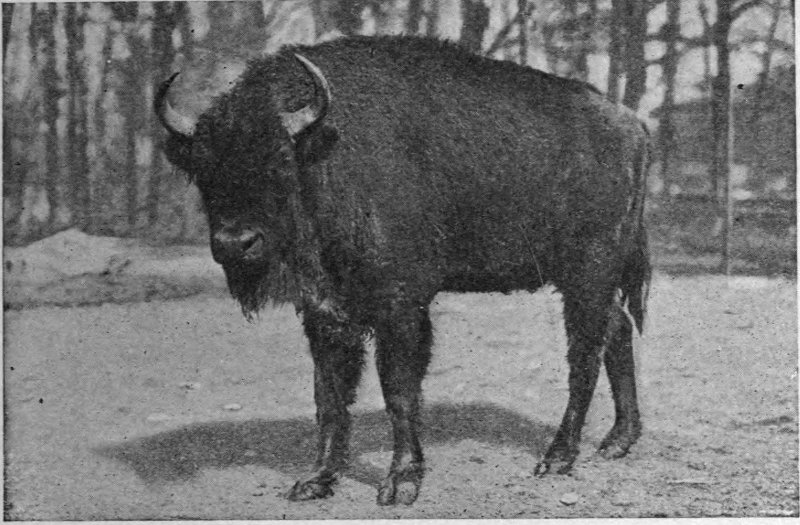
EUROPEAN BISON: BULL.
The American Bison, or Buffalo, (B. americanus), is the largest and the best known of all North American hoofed animals. What was once the universal herd, which occupied the whole pasture region of the West, was cut in twain in 1867, by the building of the first trans-continental railway. The great “southern herd,” of several millions of animals, was destroyed by skin hunters during the years 1871, 1872, 1873, and 1874, and the practical extinction of the northern herd was accomplished between 1880 and 1884.
At present there are but two herds of wild bison in existence. The largest band, now containing by estimate about 300 individuals, inhabits a wide stretch of barren and inhospitable territory southwest of Great Slave Lake. About twenty head remain in the Yellowstone Park, more than nine-tenths of the original herd having been slaughtered by poachers since 1890. There are now about 2000 bison alive in captivity, chiefly in large private game preserves.
Usually bison calves are born in May, June, and July. Full maturity is not reached until the end of the seventh year, when the horns of the male—at first a straight spike—have attained their full semi-circular curve. Like all thick-haired animals of the temperate zone, the American bison 28 sheds its coat in spring, and does not regain full pelage until October or November.
The bison breeds in confinement about as readily as domestic cattle. In appearance, it is the most imposing of all bovine animals, and with two exceptions it is also the largest. In captivity its disposition is mild, though inclined to stubbornness. Occasionally, however, an old bull becomes so vicious that it is necessary to seclude him from the herd, and treat him as a dangerous animal.
With the exception of a very few individuals, our entire bison herd is the gift of the late William C. Whitney, and the increase therefrom. The total number of head on hand on April 1, 1913, was forty-two.
In 1906, the New York Zoological Society presented to the United States Government a herd of fifteen bison to serve as a nucleus for an independent National herd. The Government very promptly fenced an area of twelve square miles of fine grazing grounds in the Wichita Forest and Game Reserve, for the proper reception of the herd. The plan was consummated during 1907. The effort has proven completely successful, and on April 1, 1913, the herd contained thirty-seven bison, all in fine condition.
European Bison.—In a corral adjoining the Buffalo Entrance, on the Boston Road, are to be found two specimens of the rare and almost extinct European Bison, (Bos bonasus). This species is the nearest living relative of the American bison, and the two specimens (male and female), now exhibited, came quite unexpectedly into the possession of the Zoological Society in April, 1904. They were acquired from the small captive herd in the forest of the Prince of Pless, in Silesia, south-eastern Germany, and are the first living specimens of the species to be exhibited in America. They were presented to the Society by Mr. Norman James, of Baltimore, Mr. Charles Sheldon and Dr. Leonard J. Sanford.
The distinguishing characters of this species are shorter and less abundant hair on the head, neck and shoulders than our bison, a tail densely covered with hair throughout its length, very long legs, and a short body.
But for royal protection, this species would long ere this have become extinct. In the year 1857, about 1,898 head were living, but in 1892 the total had decreased to 491. It 29 appears, however, that an increase can safely be announced. An estimate recently published (1906) places the total number of wild and semi-wild individuals at 1,400, while in the captive herds of the Czar and the Prince of Pless there are 46 more. About 700 of the survivors inhabit the forests of Bielowitza and Swisslotsch, Lithuania, west Russia, and are strictly protected by the Czar. Other bands still exist on the northern slope of the Caucasus Mountains around the sources of the Laba and Bjellaja, sometimes ranging up to an elevation of 8,000 feet. Wherever found, they live in scattered bands of from three to ten individuals. All the survivors of this species are so jealously guarded that very few of the zoological gardens of Europe have been able to procure specimens.
This animal is very often miscalled the “aurochs,” and from this error much confusion has arisen. The true aurochs, (Bos primigenius), was the wild progenitor of some of the existing breeds of domestic cattle, but it is now extinct.
MOUNTAIN SHEEP HILL, No. 44.
The wild sheep and goats of the world form an exceedingly interesting group of animals. In form they are odd and picturesque, and in temper and mentality they are everything that could be desired. All the year round, deer are either nervous or dangerous, and difficult to handle. Wild sheep, goats and ibex appreciate man’s interest in them, and even when not fond of attention, they act sensibly when it is necessary to handle them.
The Zoological Park collection of wild sheep and goats is one of the most interesting features of the Park. Mountain Sheep Hill is the first high ridge west of the Rocking Stone, and its northern end is very near the Bear Dens and Reptile House. It consists of a ridge of pink granite 500 feet long and 25 feet high, its southern end fully exposed, but the northern end well shaded by oaks and cedars. For grazing animals that love to climb, and pose on the sky line, the slopes of bare rock, set in patches of hard, green turf, are almost ideal. In the eastern face of the ridge, rock excavations have been made, and five roomy caves have been constructed in such a manner that they are cool in summer, warm in winter, and dry at all times. On April 1, 1913, the six wire enclosures on Mountain Sheep Hill contained the following species:
30
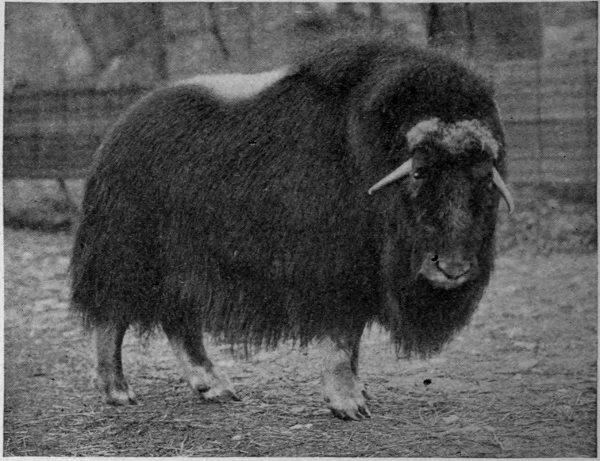
WHITE-FRONTED MUSK-OX.
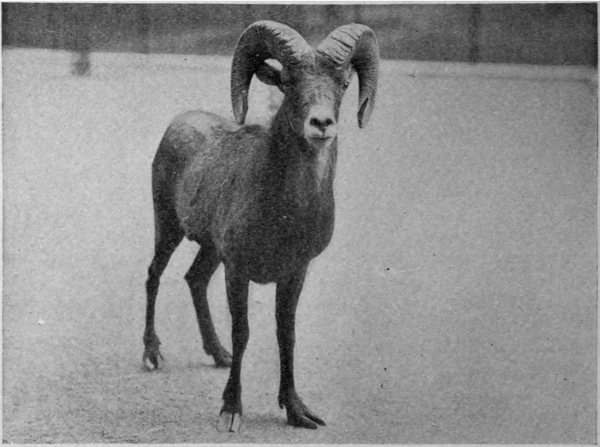
BIG-HORN MOUNTAIN SHEEP RAM.
31
Suleiman Markhor.
Arcal Mountain Sheep.
Mouflon.
Persian Wild Goat.
Himalayan Tahr.
Aoudad.
Because of the curious (and unaccountable) fact that they do not thrive on Mountain Sheep Hill, the Rocky Mountain Goat and Chamois are exhibited elsewhere. The former will be found near the Pheasant Aviary, next to the Musk-ox.
Visitors are requested to make note of the fact that in winter, the Arcal Sheep, Mouflon, and other delicate sheep are exhibited in the Small-Deer House.
The White-Fronted Musk-Ox, (Ovibos wardi, Lydekker), is represented in the Park by a herd of six specimens. Five of these animals were born in May, 1910, in Ellesmere Land, and captured in that year by Paul J. Rainey and Harry C. Whitney, and presented by Mr. Rainey. The sixth individual, a vigorous and rather vicious female, was born on Melville Island, in May, 1909, and captured by Captain Joseph Bernier. Owing to the domineering temper of “Miss Melville,” it is not possible to keep her with the animals a year younger than herself, because she resents their presence in her corral.
The Musk-Ox is an animal of strange form, inhabiting a small portion of the Arctic regions of the western hemisphere, up to the very northernmost points of land east of the Mackenzie River. At Fort Conger (Latitude 81°, 40′), its flesh was a godsend to General Greely, and later on to Commander Peary, also. Structurally, this animal stands in a genus of its own (Ovibos), midway between the cattle and the sheep, but it is unqualifiedly a misnomer to call it a “musk-sheep.”
An adult male Musk-Ox stands 4 ft. 5 in. high at the shoulders and is 6 ft. 7 in. in total length. Our first specimen was a female, two years old. She stood 3 ft. 2 in. high at the shoulders, and was 4 ft. 10 in. in total length. Her entire body was covered by a dense mass of fine light brown hair, of a woolly nature, overlaid by a thatch of very long, straight hair specially designed to shed rain.
The Musk-Ox inhabits the Barren Grounds of northern Canada north of Latitude 64° from Great Bear Lake to Hudson Bay, Grant Land, and the northeast coast of Greenland from Franz Josef Fiord (Latitude 70°) to the most 32 northerly point of land. About twenty living specimens have been taken when very young at Franz Josef Fiord, by Swedish and Norwegian whaling parties. The Peary Arctic Club, of New York, presented to the New York Zoological Society a young calf which was captured by Commander Peary at Fort Conger, in 1902, but it lived only a few months.
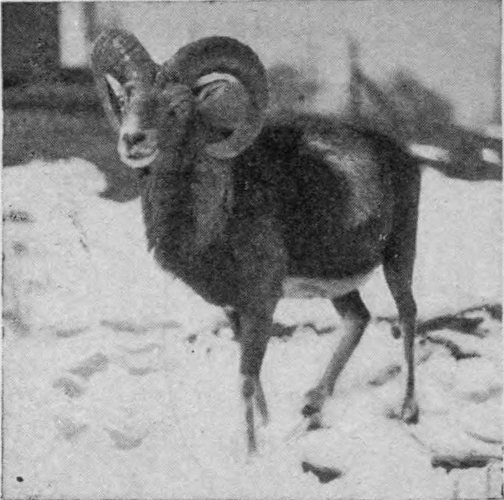
MOUFLON
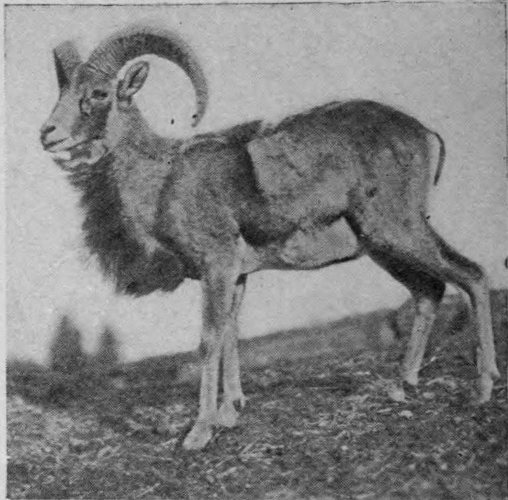
ARCAL SHEEP
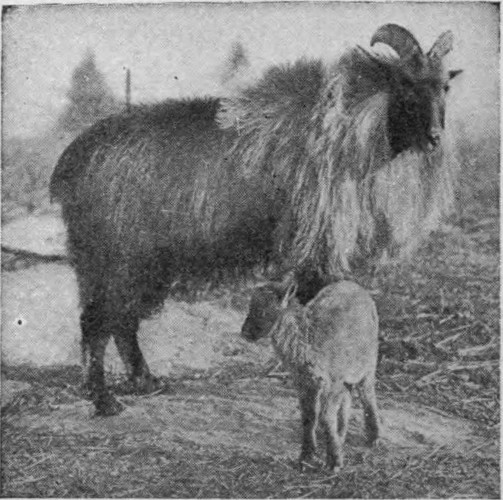
HIMALAYAN TAHR
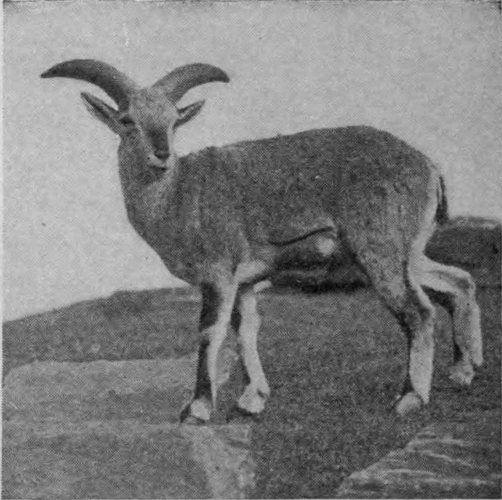
BURRHEL
The Big-Horn Mountain Sheep, (Ovis canadensis), is exhibited in the Zoological Park, whenever it may be obtained. The efforts that have been made in New York, Philadelphia, Washington and Chicago to acclimatize the Big-Horn of the Rocky Mountains have proven the extreme difficulty involved in keeping specimens of that species alive and in good condition anywhere in the Mississippi Valley, or on the Atlantic coast. The changes of atmosphere 33 and temperature seem more violent than American mountain sheep are fitted by nature to endure, and thus far all specimens tried have died within a comparatively few months.
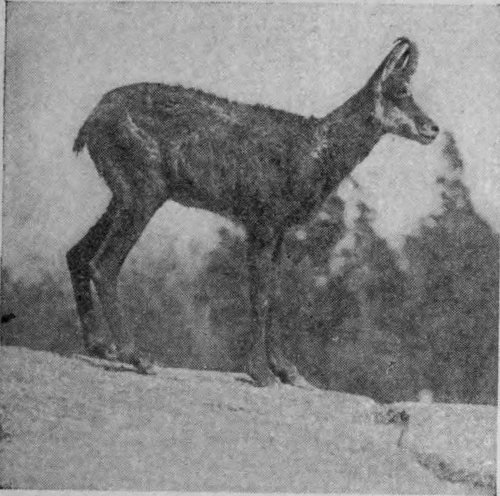
CHAMOIS
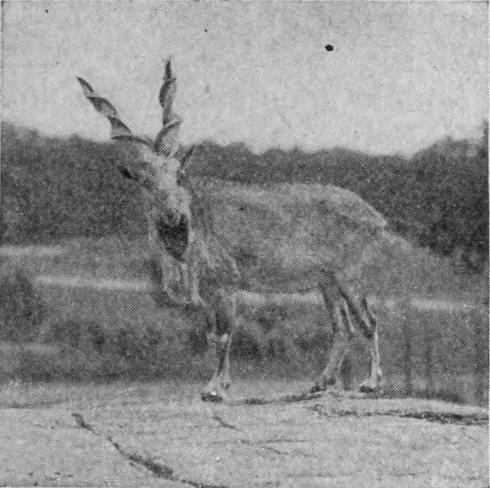
MARKHOR
In his own country, the Rocky Mountain Big-Horn is a bold, hardy and robust animal. He is high-headed, keen-sighted, and a sure-footed mountaineer. He dwells in the wildest and most picturesque country that he can find between the “bad-lands” of western North Dakota and the line of perpetual snow on the Rockies. His massive circling horns render his head a much-coveted trophy, and his flesh is most excellent food. A full-grown ram (Ovis canadensis) stands 41 inches in height at the shoulders, and weighs 316 pounds.
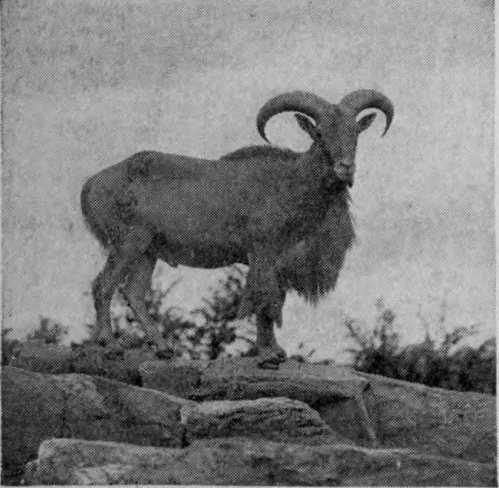
AOUDAD
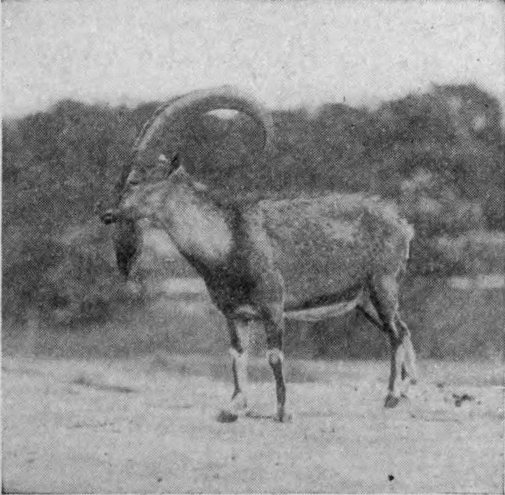
PERSIAN WILD GOAT
This species ranges from the northern states of Mexico to northern British Columbia and it culminates (i. e., 34 reaches its finest development) in southeastern British Columbia. In Northwest Alaska other related species occur. A female specimen from southeastern British Columbia was exhibited in the Zoological Park during 1905 and 1906, and in 1902, a male specimen of a closely related species (Ovis nelsoni) was also here.
As opportunities offer to procure male specimens, that have been kept in their home region until they are at least a year and a half old, they will be purchased and exhibited.
The Mouflon, (Ovis musimon), or Wild Sheep of Sardinia, is represented by a fine pair of specimens presented by Maurice Egerton, Esq., of London, and a young male born in the Park. The female of the adult pair was captured when a lamb in the mountains of Sardinia by Mr. Egerton. The ram of this species is handsomely colored, and this specimen is noted for his friendliness, and his fondness for admiration.
The Arcal Mountain Sheep, (Ovis cycloceros), is one of the smallest mountain sheep of India of the “big-horn” type (with circling horns). The fully adult male, with its long undermane of coarse, shaggy hair and proud postures, is a very noteworthy creature. This species inhabits the mountains of northern India, Tibet, Afghanistan, Beluchistan and southern Persia.
The Burrhel, or Blue Mountain Sheep, (Ovis burrhel), also of northern India, is of quite a different mould from the preceding species. Its countenance has almost a benign expression, and its curious out-pointing horns, of large size give it a most jaunty air. By some it is regarded as the most beautiful of all mountain sheep. In size, however, it is not imposing, for it is one of the smallest species. It is not so hardy as the preceding species, and there may be periods when there are no specimens on exhibition.
The Aoudad, or Barbary Wild Sheep, (Ovis tragelaphus), comes from the hot, dry mountains of northern Africa, and it endures the cold, wet climate of New York in a manner sufficient to put to shame our American mountain sheep, goat and other western ruminants. The largest male Aoudad of our herd is a very fine specimen of its kind. He is as fond of admiration as any peacock, and often poses in striking attitudes on the highest point of his rocks. He was born here on March 19, 1902.
The Himalayan Tahr, (Hemitragus jemlaicus), is really a wild goat, of very odd and picturesque aspect, native of 35 the higher ranges of the Himalayas of northern India. Its horns are short and thick, and its body is covered with long, purplish-brown hair which is much blown about by the wind. It dwells amongst the most dangerous crags and precipices, just below timber-line, and in reality is a forest-loving animal. Its hair is the longest to be found on any member of the two subfamilies of goats and goat-like animals. The pair on exhibition have bred here, and the young have been successfully reared to maturity. The young Tahr is very small, but remarkably nimble-footed and capable.
The Chamois, (Rupicapra tragus), has usually been represented in the hoofed-animal collection, but always out of its proper installation. Our individuals have not thriven on Mountain Sheep Hill, always becoming ill soon after being placed there. They thrive well, however, in a small wire pen with a sanded floor quite near the Puma and Lynx House (No. 33A), and there we keep them.
This animal is one of the rock antelopes, and is related to the American Mountain Goat. It is a bold mountaineer, and even to-day is pictorially represented as leaping “from crag to crag” across chasms apparently 200 feet wide! Its home is in the mountains of southern Europe, especially the Pyrenees, the Swiss Alps and the Caucasus Mountains. But it is not so exclusively a crag-dweller, as most persons have been led to suppose, for in many localities it inhabits mountain forests. Like most other mountain ungulates, the Chamois dwell high in summer, and in winter they seek lower and more sheltered situations. They are exceedingly wary and agile, and sure-footed on dangerous ground.
THE ANTELOPE HOUSE, NO. 50.
The Antelope House occupies a commanding situation on a high, tree-covered knoll at the south end of the Zoological Park. The situation seems as if specially formed by Nature to be occupied by this building, and its outside enclosures. The drainage is quite perfect, and the yards are well-shaded.
The building has been designed to meet the wants of giraffes and large African antelopes of all kinds, more especially those which require 60° of heat in winter.
36
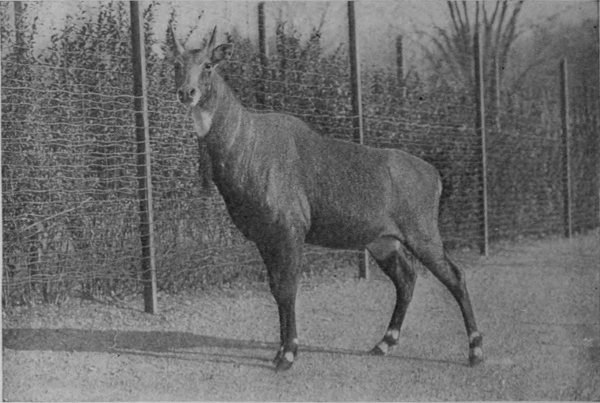
NILGAI: INDIAN ANTELOPE.
The Antelope House is 142 feet long by 78 feet in extreme width. In architectural style it conforms with the other large animal buildings of the Park. Both for visitors and for its animals, it is roomy and well lighted, and in every way fitted to house and display a large and valuable collection of tropical hoofed animals. It contains 24 interior compartments, directly connected with 23 open-air yards for use in mild weather. This building was completed and occupied on October 17, 1903, and with all its surrounding improvements has cost about $80,000.
As the visitor will observe from the following enumeration of species, our collection of large and rare African and Asiatic antelopes is very rich. Unfortunately, until the completion of the Zebra House releases the apartments now occupied by the equines, a number of species which belong in the Antelope House must temporarily be quartered elsewhere.
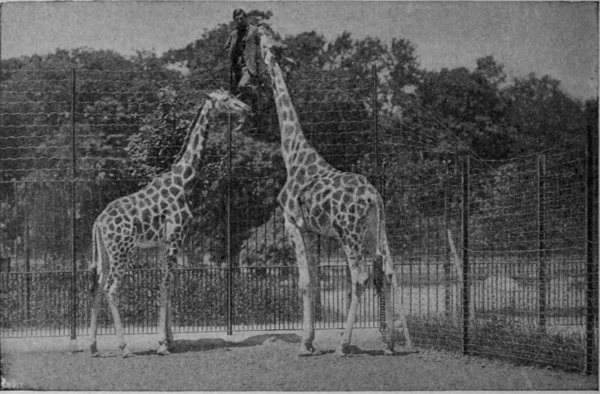
The Nubian or Three-Horned Giraffes, (Giraffa camelopardalis), are at present the most important and interesting animals in the building. The pair came from German East Africa, are now (April, 1913) about twelve years old, and cost $5,500. The male stands 14 feet 4 inches in height, and the female 12 feet 6 inches. Both are good-tempered 37 animals, and have been in good health ever since their arrival. Their food consists of clover hay, broken forage-biscuits, an assortment of raw vegetables carefully cut into small pieces, a small quantity of bran, and rock salt.
A study of the Giraffes reveals most interesting conditions. According to the point of view, the total number of species and subspecies may be reckoned at any number from three to six, inclusive. According to the specimens in hand, the Southern, or Two-Horned Giraffe, (Giraffa capensis), seems clearly defined from the Northern, or Three-Horned Giraffe, (G. camelopardalis). Next, the Somali Giraffe, (G. reticulata), of the Lake Rudolph region and northern British East Africa, seems fairly separable. At first the Five-Horned Giraffe, of western Uganda, seemed quite distinct, but now British naturalists hesitate about according to it rank as a separate species, because of its intergradation with the Nubian form, (camelopardalis).
Judging from all evidence now available, it seems that the Giraffes of to-day represent the midway stage of an effort to develop several species from the parent stock, the Three-Horned Giraffe, which is the species here represented. The existing forms, including all species and subspecies, intergrade and run together in a manner that is fairly bewildering; but if the Giraffes could remain uninfluenced by man for a sufficiently long period the probabilities are that the species now branching off would be clearly established.
The oldest, the best-known and the most common Giraffe is the three-horned species, found from central Uganda southward. The five-horned variety meets the former in Uganda, and occurs from that region westward to the edge of the great equatorial forest, and on westward even to Lake Tchad, and the lower Niger Valley. Excepting in Uganda, Kahma’s country, and a few other protected districts, the Giraffe is now rare, particularly throughout the regions that are accessible to hunters. Thousands of these wonderful creatures have been killed by hunters, both white and black, solely for the sake of seeing them dead, and leaving them as prey to the hyænas and hunting-dogs. It seems to be beyond the power of most men who can shoot to see living wild animals, no matter how large or wonderful, without desiring to reduce them to carcasses, fit only for scavengers.
38
NUBIAN GIRAFFES.
The Eland, (Taurotragus oryx), is the largest and most imposing of all antelopes. As might be inferred from its great size, it is now so nearly extinct that it has almost disappeared from the lists of dealers in wild animals. The fine young pair now in the Antelope House was presented by the Duke of Bedford, from his famous animal collection at Woburn Park. The fully adult female is the gift of Mr. C. Ledyard Blair.
Of Elands there are two well-marked species. That of eastern and southern Africa, here represented, was once numerous on many of the fertile plains of the great plateau now known as Rhodesia, and in fact throughout nearly the whole of the uplands of eastern Africa, from the Cape to the Sahara. Unfortunately, however, white hunters and modern firearms have reduced the countless thousands of the great herds to numbers so small that the capture and exportation of Elands have practically ceased.
Although a number of Elands have been born in captivity, the number on public exhibition still remain very small. The only captive herd known to the writer is that of the Duke of Bedford, in Woburn Park, England, which is at once the admiration and envy of all collectors of living wild animals.
The White-Tailed Gnu, (Connochaetes gnu), once was abundant in South Africa, south of the Vaal River. But it has shared the fate of all the other large mammals of that 39 region, and only a few scattered bands still exist. Nearly all of the specimens now living in captivity were born in captivity, for both species of Gnu take kindly to life in parks and gardens.
Every way considered, the Gnu is an animal of odd and remarkable form. It has a nose of strange shape, its horns are curiously formed, the hair on its head and neck exhibits various peculiarities, and its hips are oddly modeled. Its long, flowing tail is so horse-like that for many years this animal was pictured and popularly known as the “Horned Horse.”
The White-Bearded Gnu, (Connochaetes albojubatus), is noticeably larger than the white-tailed species, and in some respects it presents a finer appearance. Its bulk is considerably greater, and its color is more pleasing. This species bears a strong resemblance to the third species, which is known as the Brindled or Blue Gnu, (Connochaetes taurinus), from which the former is distinguished by its white mane and jaw-tufts, and generally paler color. At wide intervals the White-Bearded species inhabits southern East Africa, from about S. Lat. 23°, to the Albert Nyanza and Lake Rudolph, but chiefly near the coast. In only one locality do we learn of its occurrence west of the 30th meridian. To-day it is most numerous in German East Africa and the southern portions of Uganda.
The Addax Antelope, (Addax naso-maculatus), is a spiral-horned antelope which inhabits the southern edge of the Sahara Desert from Dongola quite across Africa to Senegal. Its extremely broad and spreading hoofs betoken a dweller upon sand, and are strongly suggestive of the snow-shoe hoofs of the caribou. It is said that this animal is not to be taken without making a journey into the desert, with camels.
The Leucoryx Antelope, (Oryx leucoryx), is the only member of its genus which has curved horns. Because of the length and very slight curvature of the horns, this species has by some writers been spoken of as the Sabre Antelope, and by a mischievous perversion that name has been turned into “Sable” Antelope, which refers to a totally different creature, (Hippotragus niger). Anyone who places an order for the purchase of a real Sable Antelope, and receives a Leucoryx instead of Hippotragus niger, is profoundly disappointed.
This species is a desert habitant, and its home is the desert region of North Africa from Dongola to the Senegal country. 40 It is breeding regularly here, and the offspring mature successfully. The largest Leucoryx horns on record measure 39⅝ inches.
BEATRIX ANTELOPE
BLESSBOK
The Beisa Antelope, (Oryx beisa), is a good representative of the group of straight-horned antelopes found in the genus Oryx. Of all the long-horned species, the two Beisas and the Gemsbok of Africa, and the Beatrix of Arabia, are the only species possessed of horns that are practically straight from base to tip. The Gemsbok is the largest and most showy species, being painted like a harlequin, in a startling pattern of roan, black and white. The Beisa is a good second, however. The horns of all these antelopes grow to great length, and are excellent weapons for use in encounters with the smaller game-killing carnivores. The largest horns of record measure 40 inches.
The Beisa inhabits eastern Central Africa, from Suakin on the Red Sea southward to the Equator.
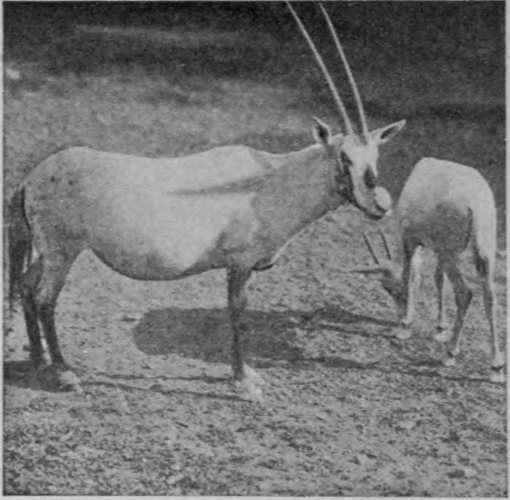
The Beatrix Antelope, (Oryx beatrix), of the Arabian Desert, is one of the rarest antelopes to be found in captivity, and at this date this interesting species is represented by a fine pair of specimens. The longest horns of record measure 26 inches. Very few sportsmen have seen this animal in its native haunts. Our pair has been breeding for three years, and has reared two young.
The Sable Antelope, (Hippotragus niger), is by many persons regarded as the handsomest of all the numerous species of African antelopes. In appearance it is very proud and high-headed; it has imposing horns that sweep backward in a semicircular curve; its large eyes and alert air betoken keen intelligence, and its glossy black coat, marked with pure 41 white, render it a most conspicuous animal. On its native veldt it has now become a very rare species, and seldom is taken by sportsmen. The fine male specimen in the Park was presented by Miss Jean Walker Simpson.
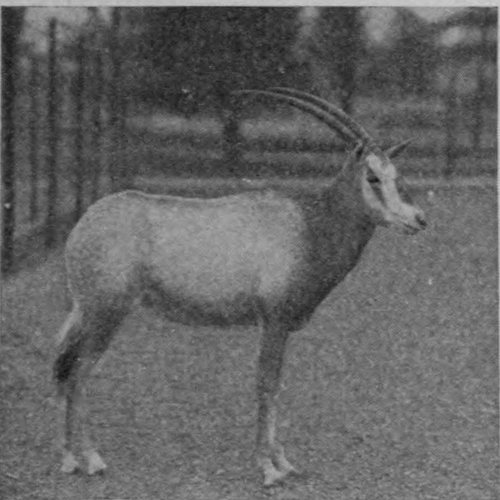
LEUCORYX ANTELOPE
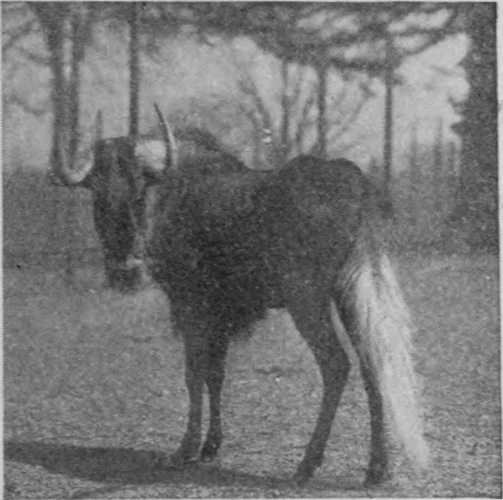
WHITE-TAILED GNU
The Sing-Sing Waterbuck, (Cobus unctuosus), is a creature of the lowlands, and frequents the dense tangles of tall reeds that border many of the rivers of West Africa, above the great equatorial forest. In captivity it sometimes is one of the most insanely nervous and irrational creatures imaginable, ever seeking self-inflicted injuries.
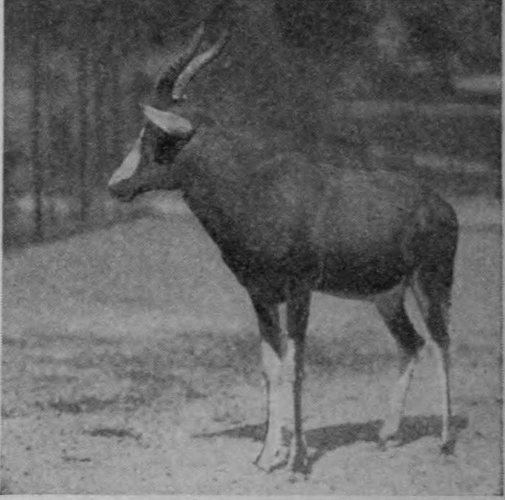
The Blessbok, (Damaliscus albifrons), is a small but handsome purple-and-white antelope which is now very nearly extinct. Formerly a number of herds were preserved on fenced farms in the Transvaal and Orange Free State, but it is feared that none of them survived the Boer War. This species never lived north of the Limpopo, but south of that river it once was so numerous that a truthful traveler described a vast plain as being “purple with Blessbok.”
The Nilgai, (Portax tragocamelus), is the largest of the Indian antelopes, and while it has the stature and the high shoulders of a Baker roan antelope, its absurdly small horns give it, beside the large antelopes of Africa, a very commonplace and unfinished appearance. The males and females are as differently colored as if they belonged to different species. This animal inhabits the roughest portions of the central plains of Hindustan, from Mysore to the Himalayas. In northern India it is found along the rivers Jumna and Ganges, in rugged and barren tracts of ravines which in character and origin resemble our western “bad-lands.”
42
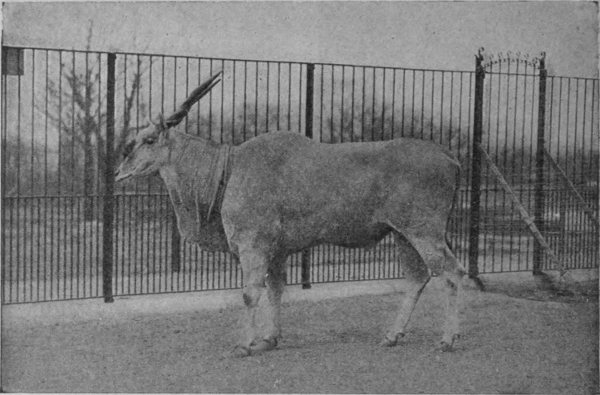
ELAND
The small antelopes will be found in the Small-Deer House, the next building in order.
THE SMALL-DEER HOUSE, No. 49.
In captivity the small and delicate species of deer, antelopes and gazelles are better cared for in enclosures that are not too large. For such creatures, freedom in a large enclosure usually means early death from accident or exposure.
The very important building called the Small-Deer House has been erected with special reference to the wants of the interesting little hoofed animals which are too small for the Antelope House and the large ranges. In winter it will shelter the small tropical mountain sheep and goats, which are unable to withstand the rigors of outdoor life on Mountain Sheep Hill, and the tropical swine may also be expected here.
The Small-Deer House is situated in close proximity to the Antelope House, and westward thereof. Of the buildings of secondary rank, it is one of the most satisfactory, being roomy, well-lighted and capable of comfortably housing and displaying a large and varied collection. The structure is 158 feet in length by 46 feet in width. It contains thirty compartments, each of which, under stress of necessity, 43 can be partitioned, and formed into two. The interior compartments are each 10 feet wide by 10 feet deep. The building is surrounded by a series of 34 corrals, connecting with the interior compartments, the average size of each being 75 feet long by 20 feet wide at the outer end. All the fences are of wire, and were specially designed in the Park for this installation.
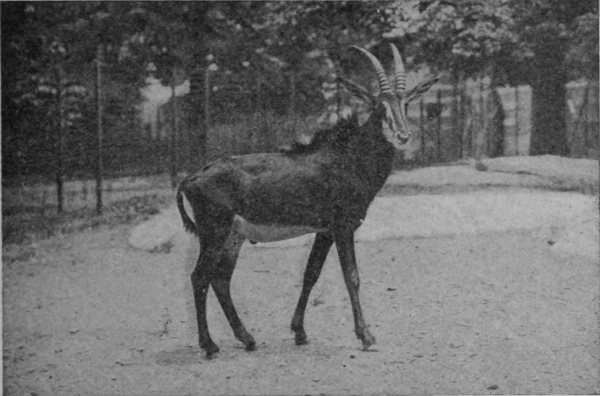
SABLE ANTELOPE.
It is a practical impossibility to offer an enumeration of the living animals in this building which will permanently apply, and the best that can be attempted is an approximation. It is an inexorable law of Nature that the smallest animals shall have the shortest periods of life, and in a zoological park a small hoofed animal may be here to-day and gone to-morrow. In the following enumeration, mention will be made only of those species which are likely to remain longest on exhibition; and it may be observed that in this building there will be found various animals which are neither deer nor antelopes.
The Small Deer.
Osceola White-Tailed Deer, (Odocoileus virginianus osceola), is an interesting geographic race of the northern White-Tailed Deer which forms the parent stem of a group of six or seven subspecies. The robust and hardy northern type, often with large and strong antlers, gradually diminishes 44 in size and in antlers, until in Mexico it becomes a small and delicate creature, with very small and light antlers bearing only two or three small tines. The next form has so widely diverged from the original type that it is necessary to accord it rank as a full species.
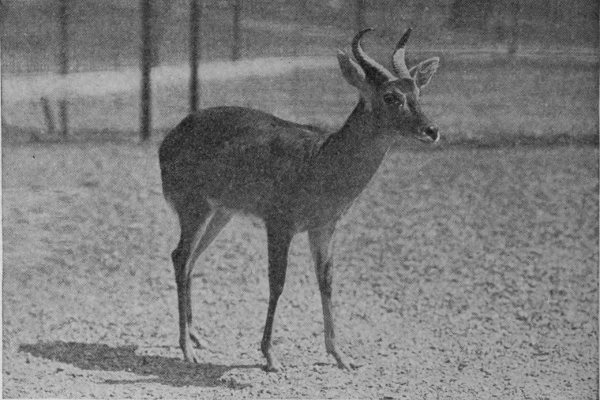
REDUNCA ANTELOPE.
The Sinaloa White-Tailed Deer, (Odocoileus sinaloae), is still smaller and weaker than the preceding. Our pair of specimens shown was obtained by Mr. and Mrs. C. William Beebe, in the State of Guadalajara, Mexico, and are highly interesting as a link near the lower terminus of the Odocoileus chain. On a majority of the antlers of this species there are no branches whatever, but simply a weak main beam, curving over at the tip, and terminating in a rounded point.
It should be noted here that the White-Tailed Deer group, (Odocoileus), is very well represented in South America by O. weigmanni of the Guianas.
The Marsh Deer, (Blastoceros paludosus), of eastern South America, is the largest South American deer. Our first specimen was obtained in 1904. Its antlers are strongly built but short, and in architecture resemble the antlers of a Siamese species known as Schomburgk Deer, (Cervus schomburgki); but the latter has on each beam three double bifurcations, while the former has but two. The Marsh Deer has very large, wide-spreading hoofs, which it would 45 seem have been developed by many generations of existence on soft ground. It inhabits the jungles along river banks, in Brazil. The head of this animal is of remarkable length.
This important species is rather weak in captivity, and it is by no means certain that it can constantly be exhibited here. There is another South American species, (Blastoceros campestris), which is a zoological understudy, or miniature, of the large Marsh Deer.
The Black-Faced Brocket, (Mazama tema), whenever it can be obtained, will represent a group of American deer which is as little known in the United States as if it inhabited the heart of Borneo. The Brockets are smaller than the Sinaloa white-tailed deer, and they are so nearly hornless that the antler is merely a small, straight, sharp-pointed spike of bone only three inches long. The adult animal is only 25 inches in shoulder height, which is about the size of the muntjac of India. Of the Brockets there are several species, mostly South American, but from skulls and horns received we now know that it is found as far north as the State of Puebla, Mexico. A correspondent in that locality is constantly endeavoring to secure specimens for us, and no doubt will shortly succeed. For the reason that we expect specimens in the near future, this species is included.
The Hog Deer, (Cervus porcinus), which is very unlike a hog, and is libeled by its name, is a small species from India, which is provided with long and well-shaped antlers having a total of six points. Sometimes the adult males are spotted in summer, and sometimes they are not. This species stands next to the beautiful axis deer. It breeds well in captivity, but is a very nervous and even hysterical animal.
The Molucca Deer, (Cervus moluccensis), is a thick-bodied, scantily-clad and coarse-haired understudy of the Malay sambar, (Cervus unicolor). Of all deer it is one of the least beautiful. Its hair resembles the bristles of a wild hog, and its color is a dull, raw-umber brown. It belongs to the sambar group of East Indian deer, and really marks, both geographically and in size, the farthest departure from the type species of the group.
The Muntjac or Rib-Faced Deer, (Cervus muntjac), is one of the most interesting of all species of small deer. In one respect it is unique. Its tiny antlers, which are only 4½ inches in length, are placed high up on stems of solid bone, which sometimes rise 3¾ inches clear of the cranium. 46 These pedicles of bone are covered with skin, quite up to the burr of the antler. The front angles of these pedicles are continued down the face to the nasal bones, and form the two sharply defined facial ridges which have given this creature one of its popular names.
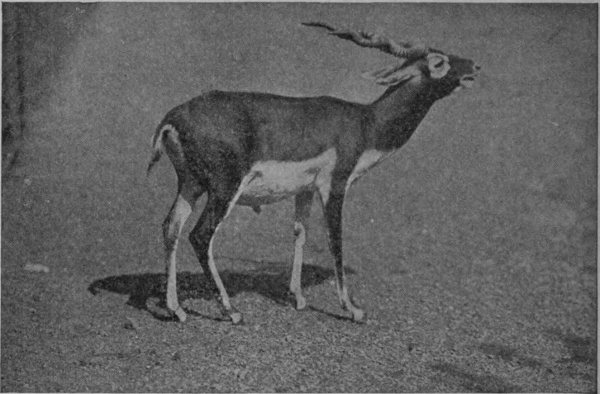
SASIN ANTELOPE.
In India the Muntjac inhabits the jungles of the tiger, the leopard, axis deer and sloth bear, and escapes from its numerous enemies by hiding behind logs, and scurrying through the thick underbush so swiftly that its pursuers can not keep it in view. Its flesh is most excellent food. From its peculiar, yapping cry, many times repeated, it is often called the Barking Deer. It breeds readily in captivity, and its bright fawn color attracts to it much attention.
The Musk Deer, (Moschus moschiferus), of northern India, Tibet and Southern China is the creature which produces the well-known musk perfume of commerce. The product is secreted by the male in the “rutting” season. This species is one of the smallest of the true deer. Its most remarkable anatomical feature is a pair of very long and sharp canine teeth in the upper jaw, the points of which project far below the lower jaw. No horns are present in this animal. Being short-lived in captivity, and also difficult to obtain, it must be classed as an intermittent exhibit.
The Small African Antelopes.
In addition to the grand array of large antelopes inhabiting 47 Africa, of which many fine examples will be found in the Antelope House, there is an extensive series of small species. Indeed, the richness of Africa in antelopes, great and small, is almost beyond belief. The species of Asia and Europe are so few, and so inconspicuous, that they seem like so many stray wanderers from the Dark Continent. The fertile, grassy plains of the great Central African plateau have cradled scores of species, some of which have wandered into the deserts, the forests and the fluviatile swamps, and there made their permanent homes.
The Black-Buck, or Sasin Antelope, (Antilope cervicapra), of the central plains of Hindustan, is one of the handsomest of the smaller antelopes. The horns of the male are long, strongly ringed, twisted spirally, and rise from the head in the shape of a V, sometimes to a length of 28 inches. At first the young males are fawn-colored, like the females, but as they grow older they steadily grow darker, until finally the whole upper body and lower neck are suffused with a rich, brown-black color. On the plains between the rivers Ganges and Jumna, herds of Black-Buck live in densely populated agricultural regions, and one of the greatest difficulties attendant upon its pursuit lies in shooting an animal without also shooting the native.
The Reedbuck, (Cervicapra arundinum), of South Africa, below Angola and Mozambique, is closely related to the larger and much more showy waterbucks, but is distinguished from them by the pronounced forward curve of its horns. In the western districts of Cape Colony, the number alive, in 1905, was estimated at 350 individuals.
The Common Duiker Antelope, (Cephalophus grimmi), or for that matter, any species of Duiker—may be regarded as the representative of a large group of very small African antelopes, of wide distribution. There are about twenty species in all, and the great majority of them are very modestly colored, in coats of one or two colors only. The prevailing tints are grayish brown and tawny red. The horns of the various species of Duikers are all very much alike. With but one or two exceptions, their horns are straight spikes from 3 to 5 inches in length. In shoulder height the Duikers vary from 14 to 30 inches, but the majority are between 17 and 22 inches. Only three or four species are strikingly colored.
The Four-Horned Antelope, (Tetraceros quadricornis) is a small creature which looks like a duiker, but is very far 48 from belonging to that genus. It is an inhabitant of the brushy plains of India, and enjoys the unique distinction of possessing two pairs of horns. In addition to the 4-inch pair, normally placed, it has a much smaller pair, usually only 1 inch in height, which rises from the central area of the forehead. I believe it is the only species of antelope which possesses two pairs of horns.
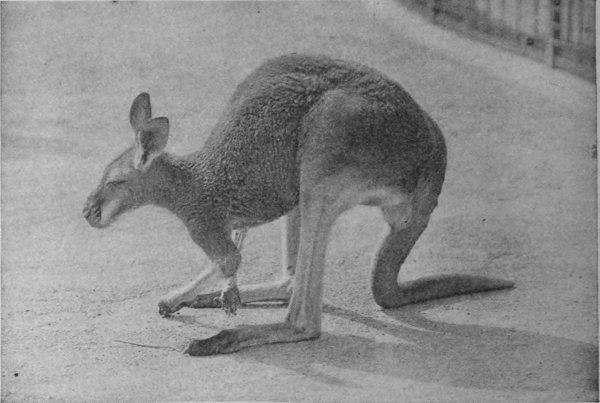
GREAT GRAY KANGAROO.
The Springbuck, (Antidorcas euchore), is to South Africa as the “prong-horn” is to our great western plains. Once, both were abundant, and the first hoofed animal to greet the traveler who entered their respective domains. To-day, both species are so nearly extinct that the hunter must search long before finding even one. The Springbuck received its name in recognition of its remarkable habit of leaping high into the air when running—a habit which also is displayed by the black-buck of India.
The Gazelles are found only in Asia and Africa, and the number of species is about 25. In general terms they may be described as dainty antelopes,—so slender and delicate in leg construction that it seems strange that such slender bones can support a tall animal without breaking.
The Dorcas Gazelle, of Arabia, (Gazella dorcas), is the species which most frequently finds its way into captivity, and it will serve very well as a specimen species for the whole group. Despite its delicate and frail appearance, it 49 is much more enduring in captivity than many animals which seem far more robust. A pair which entered the Park in 1900 is still living. The male has a temper which quite belies the reputation of the “gentle gazelle.” Although loyal and kind to his cage-mate, toward human beings generally he has manifested a very savage disposition, and in one of his fits of bad temper he broke off one of his own horns.
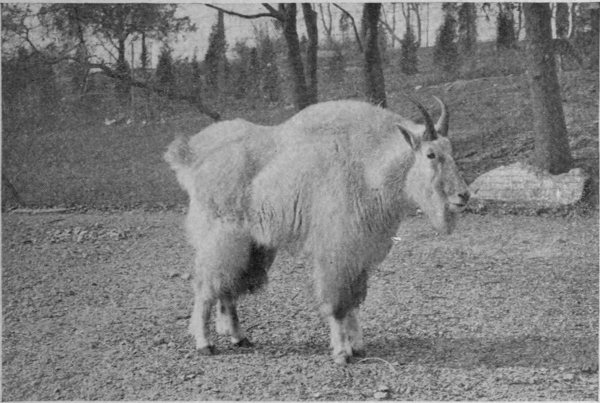
ROCKY MOUNTAIN GOAT.
The Indian Gazelle, (Gazella benneti),—frequently called in its home country Ravine “Deer,”—is a habitant of the sterile, water-washed ravines of northern and central India, which are the oriental counterpart of our western “badlands.” This animal inhabits the same regions as the black-buck, but because of the religious scruples of the Hindoos against the taking of life, both species are secure from attack—until the arrival among them of the white sahibs. A full-grown Indian Gazelle is 26 inches in shoulder height. The females of this species possess horns, which are very slender, and vary in length from 4 to 8½ inches.
Miscellaneous Mammals.
The Small-Deer House will at all times contain various mammals which are there shown because it is a practical impossibility to provide a separate building for each group.
50
The Wild Swine of the world are here represented by three noteworthy species:
The Red River-Hog, (Potamochaerus pencillatus), of West Africa, is about the only handsome species of swine that Nature has produced. In form it is compact and well-turned, its long pencil-tipped ears are of pleasing pattern, and its hair is a rich auburn color, and the temper of our specimen is everything that could be desired. Beside it is shown “Clarence,” the East African Wart-Hog, (Phacochaerus aethiopicus), who is equally interesting, but in a different way. This species is very weird in form. The Collared Peccary, (Tagassu angulatum), beside it is more like the wild swine of Europe and Japan, and is not nearly so dangerous as general reputation demands.
The Kangaroos.—Seldom is there found in Nature a group of large-animal species whose members are so monotonously similar in general appearance as are the Kangaroos and Wallabies, of Australia. The great majority are either gray or gray-brown, and the only striking variation is found in the big Red Kangaroo, (Macropus rufus).
THE WHITE MOUNTAIN GOAT, No. 48.
Fortunate indeed is the zoological park or garden which can exhibit even one living specimen of the White Mountain Goat. It is a very difficult matter to take an animal from a rarified dry atmosphere, at an elevation of 8,000 feet, and induce it to live at sea level, in a dense and humid atmosphere, on food to which it is by nature wholly unaccustomed.
We have been successful in establishing here, on a breeding basis this rare and difficult animal, (Oreamnos montanus). One kid was born in 1908 and another in 1910, and both have thriven, the former now being so large as to look like an adult specimen.
For some subtle reason which we can not explain, these animals—like the chamois and mouflon quartered in small pens near the Small-Mammal House—do not thrive in any of the large, rock-bound corrals of Mountain Sheep Hill. They are kept in a rock-paved corral near the Pheasant Aviary and the Crotona Entrance, and to their use has been devoted a rustic barn, which they shelter in or climb over, according to the weather. To see them walking nonchalantly 51 over the steep roof, or perching upon its peak, is one of the drollest sights of the Park.
The White Goat, sometimes mistakenly called “goat antelope,” belongs to a small group known as the Rupicaprines or rock antelopes. It inhabits many different kinds of territory, but usually the rugged sides and summits of high mountains, at irregular intervals from southwestern Montana and northern Washington, northward to the head of Cook Inlet on the coast of Alaska. (See map of distribution, with label.) The valley of the upper Yukon contains practically no goats. They are most abundant in southeastern British Columbia, where in a very small area, in September, 1905, Mr. John M. Phillips and the writer actually counted 239 individuals.
Of the five animals now exhibited in the Park, three were captured a few days after their birth, in May, 1905, about seventy miles north of Fort Steele, British Columbia. They arrived here October 9, 1905, and up to this date they have thriven as well, and grown as rapidly, as they would have in a state of nature. Their food consists of the best clover hay obtainable, and crushed oats. When they shed their coats, in the spring, they are almost as white as snow, but with months of use, their pelage becomes soiled and slightly discolored.
A fully adult male mountain goat stands from 39 to 41 inches in shoulder height, and weighs, on scales, from 258 to 300 pounds.
THE PRONG-HORNED ANTELOPE.
The Prong-Horned Antelope, (Antilocapra americana), is an animal in which Americans should now take special interest. Structurally, the Prong-Horn is so peculiar that it has been found necessary to create for it a special zoological family, called Antilocapridae, of which it is the sole member. This is due to the following facts: (1) This is the only living mammal possessing hollow horns (growing over a bony core) which sheds them annually; (2) it is the only animal possessing a hollow horn which bears a prong, or bifurcation; (3) it has no “dew claws,” as other ruminant animals have; (4) the horn is placed directly above the eye; (5) the long hair of the body and neck is tubular; and (6) that on the rump is erectile. Beyond all possibility of doubt, it will be our next large 52 species to become extinct, and if we may judge by the rate at which the bands have been disappearing during the last fifteen years, ten years more will, in all probability, witness the extermination of the last individuals now struggling to exist outside of rigidly protected areas. It was the intention of the Society to make liberal provision for the study of the species while it is yet possible to obtain living specimens, for fifty years hence our graceful and zoologically interesting Prong-Horn will be as extinct as the dodo. Unfortunately, however, it fares so badly on the Atlantic coast, there will, no doubt, be periods wherein this species will be temporarily absent from the Park.
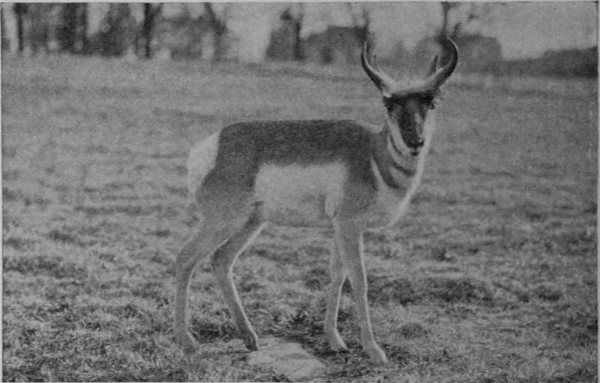
AMERICAN PRONG HORNED ANTELOPE.
Forty years ago this animal inhabited practically the whole of the great pasture region which stretches eastward from the Rocky Mountains to the western borders of Iowa and Missouri. Northward its range extended far into Manitoba; southward it went far beyond the Rio Grande, and it also ranged southwestward through Colorado and Nevada to southern California. Its chosen home was the treeless plains, where the rich buffalo grass and bunch grass afforded abundant food, but it also frequented the beautiful mountain parks of Wyoming and Colorado. It even lived contentedly in the deserts of the southwest, where its voluntary presence, coupled with the absence of water, constituted a problem which has puzzled the brain of many a desert traveller.
53
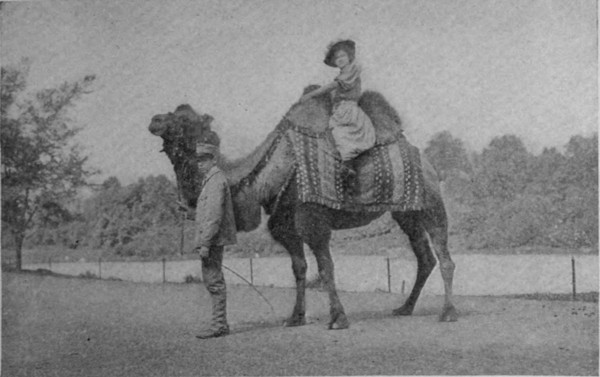
BACTRIAN CAMEL.
To-day, all observers agree that in all regions wherein the antelope are not rigidly protected, they are going fast. Those in the Yellowstone Park are protected against man only to be devoured by the wolves which infest the Park.
Unfortunately, the Prong-Horned Antelope is not a hardy animal. The kids are very difficult to rear; they are at all times easily hurt by accident, and even in a state of nature this species suffers more severely in winter than any other North American ruminant. Often the herds drift helplessly before the blizzards, with numerous deaths from freezing and starvation, and in spring the survivors come out thin and weak.
THE CAMEL HOUSE, No. 39.
Speaking in a collective sense, the Camel is much more than an ordinary animal unit in a zoological park. On the high plains of central and southwestern Asia, and throughout the arid regions of Africa, it is an institution. Without it, many portions of the Old World would be uninhabitable by man. Take either Dromedary or Bactrian Camel, and it is a sad-eyed, ungainly, slow-moving creature, full of plaints and objections; but remember that it goes so far back toward the foundations of man’s dynasty, that beside it the oldest American history seems but a record of yesterday. 54 It is only a species of the utmost tenacity which could for fifty centuries or more withstand constant use and abuse by man without being altered out of all resemblance to its original form. All races of mankind and all breeds of domestic animals save one, change and continue to change, indefinitely, but the Camels apparently go on the same, forever.
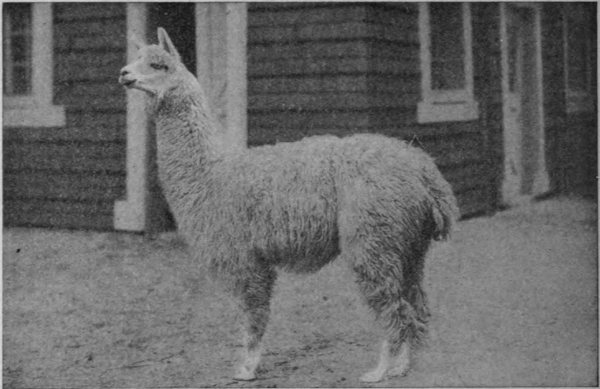
ALPACA.
The Bactrian Camel, (Camelus bactrianus), he of the long shaggy hair—when not shedding—and the two great humps, is the beast of heavy burden, the four-footed freight-car of the desert sands. He can carry 550 pounds of freight, for three or four days between drinks; but a swift pace is not for him. It is an animal of this remarkable species, from distant Turkestan, southwestern Asia, which daily in fine weather offers its services as a riding animal, at the stand near the Large Bird-House.
It is unfortunate that the Bactrian Camel is in its finest pelage only in winter, when visitors to the Park are few, and camel-riding is out of the question. Promptly upon the approach of warm weather and a million visitors, it sheds its long, shaggy brown coat, and stands forth as if shorn by a shearer. Of this species, the Zoological Society possesses two fine specimens (the gift of Captain John S. Barnes), one of which will at all times be found regularly exhibited at the Camel House, close by the Crotona (southwest) Entrance.
55
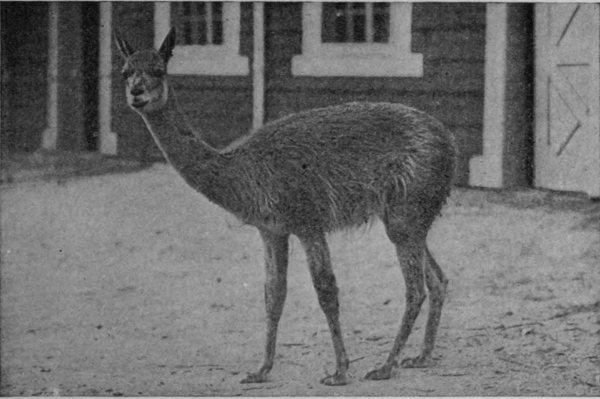
VICUNIA.
The Dromedary, or Single-Humped Camel, (Camelus dromedarius), is a smaller animal than the preceding, of lighter build, and therefore capable of much more speed in travelling. This species never is clothed with long hair.
Next to the Camel House and corrals is the installation for the nearest relatives of those species,—the Llamas, Guanacos and other cameloids of South America.
THE LLAMA HOUSE, No. 38.
Collection of Cameloids was presented by Mr. Robert S. Brewster.
The arid regions of South America are inhabited by four species of long-necked, long-haired, soft-footed animals, so closely related to the camels of the Old World that they are called cameloids. There are four species. The llama and alpaca are in a state of domestication, and are supposed to have been derived from the wild guanaco and vicunia. All of them might almost be described as small-sized, humpless camels; and their tempers and mental traits are as odd as their forms.
The ordinary cameloid is a quiet and inoffensive creature; but the exception is a rogue of rogues. It will bite with the persistence of a bull-dog, and with its massive, chisel-like 56 lower incisors inflicts ugly wounds. At times a llama or vicunia becomes actually insane, and seeks to destroy every living creature within its reach. Regardless of punishment, such creatures attack their keepers and their herd-mates, spit upon visitors, and rage up and down their corrals in most absurd fashion. Occasionally such individuals require to be completely isolated.
The Llama, (Lama glama), is the largest and strongest member of the group. Its body is covered with a thick mass of long, wavy hair of fine texture, which may be either brown, white, white and brown, or almost black. The head and legs are short-haired like those of the guanaco. From time immemorial, this animal has been used as a beast of burden, and in the Andes has played an important part in the mineral industry by carrying silver ore and bullion from the mines.
The Alpaca, (Lama pacos), is bred for its wool. It is smaller than the llama, but more abundantly haired on the legs, neck and head. Its fleece is long, and lies in stringy tufts. Usually its color is dark brown or black, but occasionally a white Alpaca is seen. A white specimen in the Zoological Park collection has blue eyes.
The Guanaco, (Lama guanacus), is one of the most interesting and valuable wild animals now found in Patagonia. Unfortunately, it is so stupid and incapable that it is easily killed. The natives of Terra del Fuego, themselves almost the lowest and most ignorant of men, slaughter Guanacos for food by surrounding groups of them and clubbing them to death.
In size the Guanaco is between the llama and vicunia, and its shoulder height is about 4 feet. Its hair is thick and woolly, of a pale reddish color, and there are naked patches on the legs. This species is found on the Andes, from Ecuador to Terra del Fuego, and appears to be most abundant in Patagonia.
The Vicunia, (Lama vicunia), is the only member of the cameloid group which is not clothed with a mass of long hair. It is the smallest member of the group, comparatively short-haired, its color is a uniform light brown, its head is small, and there are no callosities on the hind legs. The Vicunia is found from southern Ecuador, through Peru to central Bolivia.
57
NORTH AMERICAN DEER. Elk, Mule Deer, White-Tail, Caribou and Moose.
The American members of the Deer Family will be found in the ranges situated on the hill west of the Wild-Fowl Pond, stretching from the Llama House northward to the Service Road.
After several years of experiments, we must admit that to all the American members of the Deer Family save the wapiti white-tailed and mule deer, the climate of New York City is decidedly inimical. This densely humid and extremely saline atmosphere is about as deadly to the black-tail, caribou and moose as it is to the Eskimo; and thus far we have found it an absolute impossibility to maintain satisfactory herds of those species in the ranges available for them. In great tracts of forests, some of them might become acclimatized; but, be that as it may, all experiments made thus far both here and in two of the great game preserves of New England, prove conclusively that black-tail deer, mule deer, caribou, moose, and also prong-horned antelope, are among the most difficult of all ruminants to acclimatize anywhere in the United States eastward of the great plains.
Although the Zoological Society will continue its experiments with some of these preserve species, and will always strive to exhibit some of them, our original hopes regarding them have been abandoned. We are certain that the difficulty lies not in the food, but in climate conditions, that are beyond our control, and especially our very salty atmosphere.
The American Elk, or Wapiti, (Cervus canadensis.)—Of all the numerous members of the Deer Family, this animal is second in size to the moose only; and in the autumn, when its pelage is bright and luxuriant, its sides well rounded, its massive antlers clean and held conspicuously aloft, the elk may justly be called the king of the Cervidae. It is well that in the Yellowstone Park we have an unfailing supply of Elk, which bids fair to perpetuate this handsome species for another century.
Our Elk Range might well stand for a mountain park, in which is set a natural lakelet of real value. In October, when the splendid groves of beech, oak, and maple along the eastern ridge put on all the glorious tints of autumn, and the big thicket of sumacs, ash, and haw on the northern hill fairly blaze with scarlet—then are the elk also at their best. There is no finer picture in animate nature than a herd of elk in October, with such a setting of greensward, tree-trunk, and foliage.
58
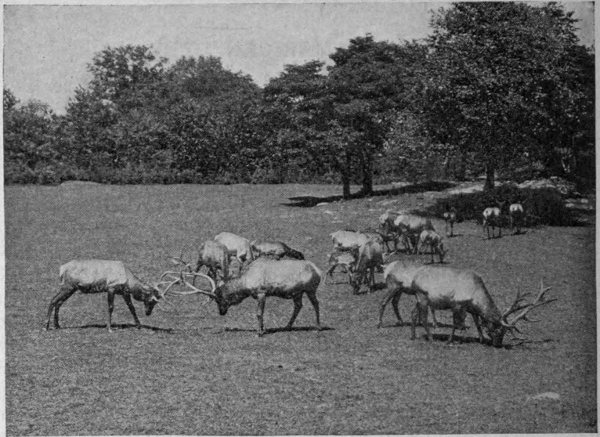
AMERICAN ELK.
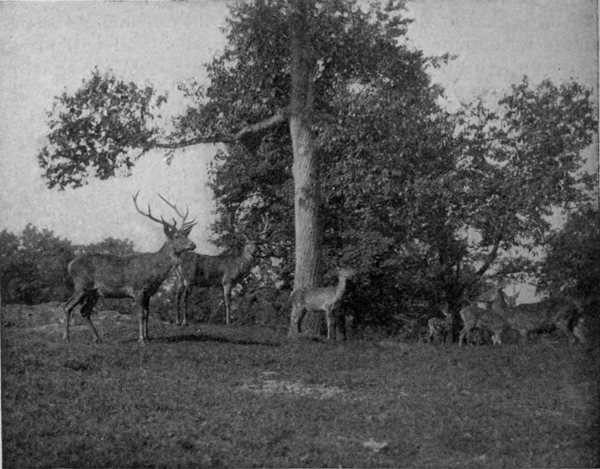
EUROPEAN RED DEER.
59
The maximum shoulder height of the Elk is 5 feet 4 inches, or thereabouts, and the heaviest weight noted thus far is 927 pounds.
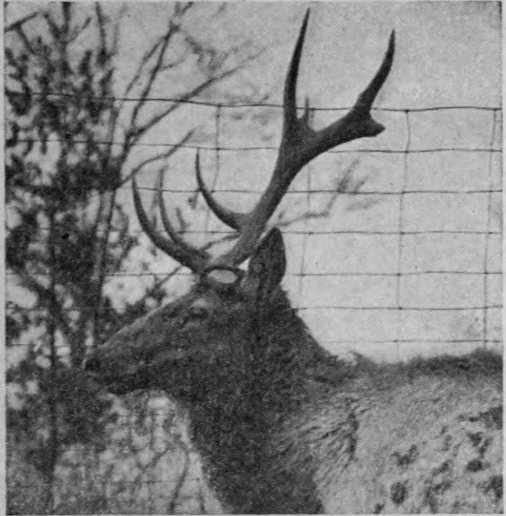
The calves are born from May to July, and are spotted during the first six months. During the first year the antlers are merely two straight spikes, called “dag antlers.” As in all members of the Deer Family, the antlers are shed every year—which to many persons is almost beyond belief. Any person who visits a zoological garden in midsummer will see that the old antlers have dropped off bodily, just below the burr, and that new antlers, covered with hair, soft, full of blood, and with club-like “points,” have sprung up like mushrooms in place of the old ones. In supplying the great drain on the system necessary to support this remarkable growth, the Elk grows thin, and the fear of hurting his tender young antlers makes him quite timid and inoffensive. He is no longer the tyrant of the herd, and a constant menace to his keepers.
At this point it is not amiss to call attention to the differences between horns and antlers.
A horn is a hollow sheath, growing over a bony core, and except in the case of the prong-horned antelope, is never shed. Horns are worn by both sexes of all bison, buffaloes, cattle, antelope, sheep, and goats.
An antler is of solid bone throughout, growing from the skull; it is shed every year close to the skull, and quickly renewed. Usually antlers have several branches. They are worn by nearly all male members of the Deer Family—moose, elk, caribou, deer, etc., and also by the female caribou. The prongs on an antler are no index of the wearer’s age. Some of the finest and most massive elk antlers have only twelve or fourteen points. During August and September the hairy covering, or “velvet,” of new antlers is rubbed off against trees and bushes. This period is quickly followed by the mating season, during which the neck of the bull becomes unusually large, and often the animal becomes dangerous.
Although the Elk is essentially a timber-loving animal, it also wandered far into the plains bordering the Rocky Mountains on the east—until driven from them by man. The ideal home of this animal is the timbered foothills of our western mountains, up to 8,000 feet. Although once 60 found from Virginia and New York to Oregon, and from northern Manitoba to the Gulf of Mexico, it is now numerous only in and adjacent to the Yellowstone Park, in central Colorado, where it is well protected, and in western Manitoba. The number of Elk in the National Park is variously estimated at from 10,000 head to a much larger number.
In a wild state, the Elk feeds on grasses, weeds, and the leaves and twigs of various trees and shrubs. Of all American deer, it is the most easy to acclimate and breed in captivity. Large herds are now being maintained and bred in numerous private game preserves in New Hampshire, New York, Minnesota, Massachusetts, and elsewhere. About 200 head have been released in the Adirondacks.
The Mule Deer, (Odocoileus hemionus.)—This fine animal is universally known throughout the Rocky Mountain region, which constitutes its home, as the “Black-Tailed Deer.” Because of its very large ears, and the absence of a black tail, it is known to naturalists as the Mule Deer. Inasmuch as its tail is not black, the above more common name properly applies to Odocoileus columbianus, the true black-tailed deer of the Pacific coast. In Manitoba this animal is called the “Jumping Deer,” because when running at a gallop, it makes a series of stiff-legged jumps, or “bucks,” of great length.
The weight of full-grown bucks ranges from 250 to 300 pounds, and specimens have been known to reach 325 pounds. The antlers of the Mule Deer are larger and handsomer than those of the white-tailed deer, and are much better poised on the head. Instead of dropping forward, they partake more of the set of an elk’s antlers, and many a “tenderfoot” hunter has mistaken a heavily-antlered Mule Deer for an elk. The antlers of a Mule Deer are easily distinguished from those of the white-tailed species by the two Y-shaped prongs on each antler. It will be remembered that instead of these, the white-tailed deer antler bears three straight, perpendicular spikes.
The Mule Deer makes its home in rugged ravines and bad lands so common along the creeks and rivers of the Rocky Mountain region, extending well eastward into the plains. Of late years it has been driven out of the most accessible of its former haunts, and forced to take shelter in the rugged fastnesses of the foothills and mountains. West of the Rocky Mountains it was formerly found along the whole Pacific slope, from Cape St. Lucas to British Columbia, although in northern California it is almost replaced by the Columbian Black-Tail, (O. columbianus).
61
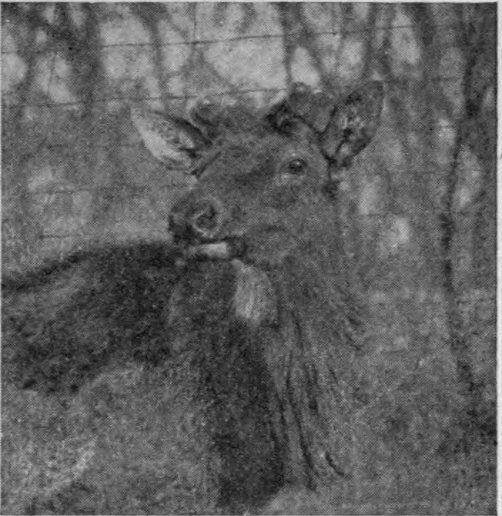
DEVELOPMENT OF THE ANTLERS OF A MALE DEER.
These pictures show the stages of growth of the antlers from the time the old ones are dropped, to the full development. Number 1 shows the bull with the one antler gone—picture made early in March. Number 6 shows the full grown antlers, with the velvet hanging in strips. Number 6 was made August 24 of the same year as Number 1. This remarkable antler development takes place every year in the life of all male deer.
1.
2.
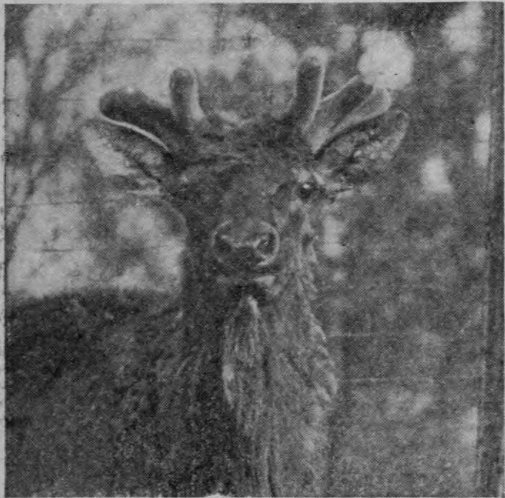
3.
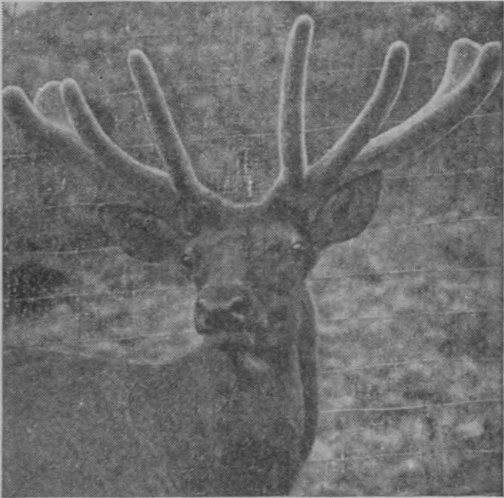
4.
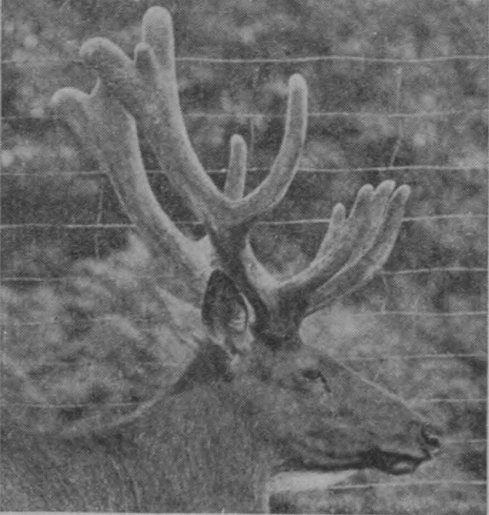
5.
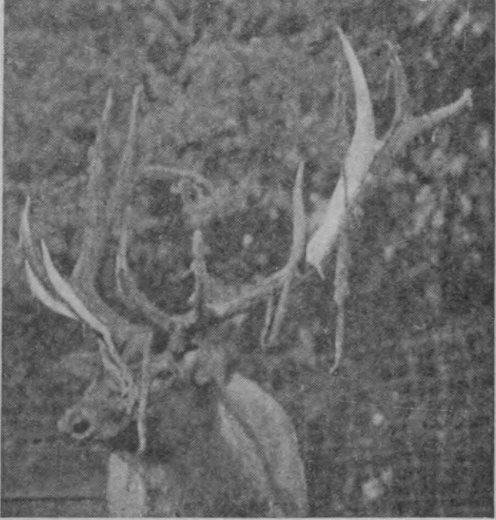
6.
62
The White-Tailed Deer, (Odocoileus virginianus), is the species most widely known throughout the United States, partly by reason of the fact that it was the first species with which the early settlers of America became acquainted, partly because of its wide distribution, and also its persistence in holding its own. In various localities this animal is known under various names, such as “White-Tailed Deer,” “Flag-Tailed Deer,” and “Fan-Tailed Deer.” Although not at all in need of it, quite recently it has received still another name—American Deer. The small deer of Florida, and also of New Mexico and the Southwest, have been described as separate forms; and if size is to be accepted as a factor in the differentiation of species, the diminutive proportions of the proposed southern species are quite sufficient to establish their separate identity.
The White-Tailed deer of Virginia and the northern United States is a fine animal—large, strong-limbed, heavily-antlered, and hardy. Between it and the deer of Florida the difference is as great as that between a setter dog and a mastiff. Thanks to the fact that this species is a born skulker and lives only in thick brush and timber, it still holds its own throughout the forest regions of the South generally, Pennsylvania, the Adirondacks, Maine, Michigan, Minnesota, the Dakotas, Montana, and Colorado. In the West it is often found inhabiting brushy ravines and river bottoms.
This species breeds readily in confinement, and when protected in any large tract of brush or timber, increases rapidly. During the months of September, October, and November, the bucks are dangerous and untrustworthy. The peculiar formation of the antlers—three strong, spear-like points thrust straight upward from the beam—makes them dangerous weapons; and when an ill-tempered buck lowers his chin and drives straight forward with eight sharp spears of solid bone, and nearly three hundred pounds of weight to back them, he may well be considered a dangerous animal. He is to be feared less than the elk only because he is smaller.
The Woodland Caribou, (Rangifer caribou).—The first hoofed animal to arrive at the Zoological Park was a young 63 female of this species, which was procured in Champlain County, Canada, and forwarded to the Society by one of our members, Mr. George S. Huntington. These animals, when present in the Park, will be kept in a small enclosure, because a large range containing an abundance of green grass is fatal to them.
The wild range of the Woodland Caribou extends from Newfoundland, Nova Scotia, and Maine, with many wide gaps, to the head waters of the Yukon River, in southern Alaska. The following localities are worthy of special mention: northern Quebec and Ontario; James Bay; the northern end of Lake Winnipeg (occasionally); Lake of Woods, Minnesota; Oregon near Mount Hood; northern Idaho; northwestern Montana, and the mountains of British Columbia.
Quite recently, three new species of caribou have been added to our fauna, one from the Alaskan Peninsula (Rangifer granti), one from the Kenai Peninsula (Rangifer stonei), and one from the Cassiar Mountains (Rangifer osborni).
The Woodland Caribou attains nearly twice the bodily bulk of its more northern congener, the Barren-Ground caribou. In a state of nature it lives on browse, reindeer moss, tree moss, and lichens, and it loves ice-covered lakes and ponds as much as any boy. Its loose-jointed and wide spreading hoofs and enormously developed “dew-claws” have been specially designed by Nature to enable this animal to run freely, as if on snow-shoes, over snow or bogs, which to any small-hoofed deer would be quite impassable.
The female Woodland Caribou is provided with small antlers, which, like those of the male, are shed and renewed annually.
In the absence of caribou in the Park, visitors are advised to look for specimens of the Lapland Reindeer, (Rangifer tarandus), for we shall endeavor to keep this genus represented.
THE ZEBRA HOUSES, No. 14.
Although the main building of this installation has not yet been erected, the plan for the various buildings and corrals has been approved, and the main building was begun in 1911 and completed in 1912. The three buildings, and the extensive corrals connecting with them, as a 64 whole, do justice to the important and picturesque Family Equidae, which includes all the zebras, wild asses and wild horses of the world.
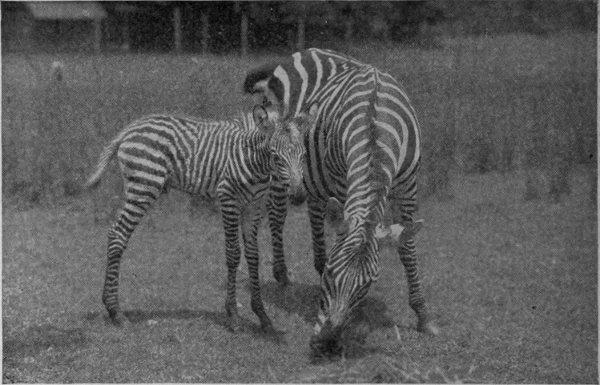
GRANT ZEBRA.
The Prjevalsky Horses, (Equus prjevalskii).—Of all the wild equines which either now or hereafter may be seen in the Zoological Park, the strange little wild horses from western Mongolia are, and probably will remain, the most interesting, from a zoological point of view. Broadly speaking, they are the connecting link between the many-striped zebras, the little-striped quaggas and the wild asses on one side, and the domestic, unstriped horse on the other. These wild horses possess a narrow, dark dorsal stripe, which, in the winter pelage is scarcely visible, but in summer is plainly evident. A perfect specimen has an erect mane, no long forelock and no “chestnuts” on its legs. On the upper half of its tail the hair is short, and mule-like, but on the lower, or terminal half, it is long and horse-like. The winter coat of this animal is very long and shaggy.
Mountain Zebra, (Equus zebra).—This species has been nearly exterminated by man, and is rarely seen in captivity. It inhabits the mountains of Cape Colony, and it is estimated that only 400 individuals remain, which now are carefully protected.
65
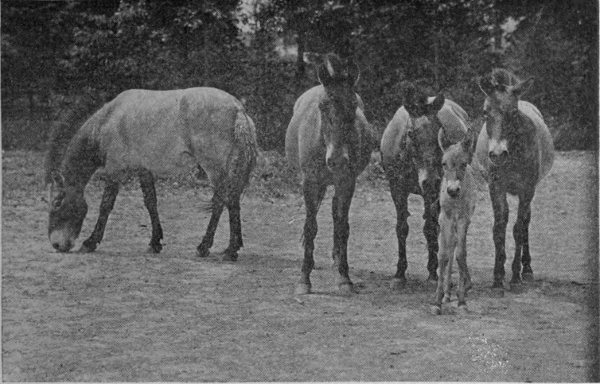
PRJEVALSKY HORSES.
Grevy Zebra, (Equus grevyi).—This picturesque species was discovered in Abyssinia, when Jules Grevy was president of France, and it was named in his honor. It is of large size, covered with very narrow stripes all over its body, head and limbs, and its huge ears are of remarkable form. This species is limited to southern Abyssinia and British East Africa southward to the Tana River.
Grant Zebra, (Equus burchelli granti).—Of all the zebras now seen in captivity, the great majority belong to what very properly may be designated as the group of Burchell Zebras. This group contains, besides the type species, which has practically no stripes on its legs, four subspecies, whose legs are more or less striped, and which may or may not possess “shadow stripes” on the hind-quarters. A “shadow stripe” is a faint, dark stripe in the middle of a wide white or pale yellow stripe which lies between two broad black stripes.
Grant Zebra is the most heavily striped of the subspecies composing the Burchell group. The visitor will observe that its horizontal leg-stripes are very pronounced, and so numerous that they are carried quite down to the hoofs. The ground-color of the animal is a cold white, and the thigh and body stripes are very wide and intense. This fine pair was captured in Masailand, East Africa, in 1902.
66
Chapman Zebra, (Equus burchelli chapmani), also belongs to the Burchell group, and in its color pattern it approaches quite nearly to the type. The legs of the male bear a few stripes, those of the female almost none. There are visible on the hind-quarters of the female a few faint shadow-stripes.
The Persian Wild Ass, (Equus persicus), is a very satisfactory representative of the wild asses generally. Its dorsal-stripe is very wide and sharply defined, but it bears no shoulder-stripe, and those that are faintly indicated on its legs are nothing more than oblong blotches of dark color. As its name implies, it inhabits Persia, and Syria, and a closely related form, the Onager, (E. onager), is found in Beluchistan and western India. A third species, the Kiang (E. hemionus), is found on the plains of Tibet.
THE ASIATIC AND EUROPEAN DEER, Nos. 1-3.
In representatives of the deer, (Family Cervidae), Asia far surpasses all other countries. Her species number about 38,—fully double that of any other continental area,—and from the great Altai wapiti to the tiny musk deer, the variations in size and form are fairly bewildering. The entire hill that rises between the Fordham Entrance and Bird Valley, from Cope Lake to the Zebra Houses, is devoted to the series of houses, corrals and ranges that are occupied by the deer of Asia and Europe.
It is quite certain that a number of desirable species of Asiatic deer can successfully be acclimatized in the parks and game preserves of America, and induced to breed. Almost without an exception they are strong and vigorous feeders, and they keep fat and sleek when our own black-tail, mule deer and white-tail mince like pampered epicures, grow thinner and thinner, and finally die of “malnutrition.”
Believing that the members of the group amply justify the effort, the Zoological Society has been at considerable pains to bring together a fine, representative collection of the Old World Cervidae and properly install its members. Although the series proposed is not quite complete, it contains such rarities as the Altai Wapiti, Barasingha, Burmese Thameng, Malay and Indian Sambar, and several others. 67 They are sheltered by four houses, the largest of which crowns the summit of the hill on the right of Osborn Walk as the visitor enters from Fordham. For the visitors’ convenience we will make note of the various species about in the order of their appearance, and not in zoological sequence.
The Axis Deer, (Axis axis), is the handsomest of all the tropical deer. Indeed, it may even be said to be the only species of the tropics possessing both form and pelage which are alike pleasing to the eye. In contrast with the many beautiful and splendidly colored antelopes of Africa, the deer of the tropics, all round the world, are poorly provided with those characters which make a handsome animal. With the sole exception of the Axis Deer, nearly all the other deer of the East Indies have thin, coarse, dull-colored hair, their antlers are small, and seldom have more than four points. This is equally true of the deer of Mexico, Central and South America. Even our own white-tailed deer, so lusty and fine in the North, becomes in Florida and Texas so dwarfed that it has now been called a subspecies.
Considering the severe plainness of all the other deer in the tropics, it is a little strange that the coat of the Axis should be the most beautiful possessed by any deer. But it is quite true; and apart from the majesty of the elk, there is no more beautiful sight in cervine life than the picture offered by a herd of Axis Deer feeding in a sunlit glade surrounded by forest.
This species adapts itself to out-door life in the temperate zone with surprising readiness, not even second in that respect to the eland. As a matter of course the Axis can not withstand the fierce blizzards of midwinter as do the elk and other northern deer; but a reasonable degree of care in providing it with a dry barn, and shelter from cold winds, enables it to live even as far north as northern Germany with perfect comfort. In winter our Axis Deer barn is moderately heated by a stove.
The Japanese Sika Deer, (Cervus sika typicus), is a small representative of a large group of deer species inhabiting far-eastern Asia, and known as the Sika Deer group. A ridiculous number of forms have been described as species and subspecies, of which possibly one-third are entitled to stand. Some of those on the Asian mainland, as the Pekin Sika Deer, are much larger than the Japanese Sika, and 68 also more strikingly colored. The latter species, shown in our northernmost corral, is about 33 inches in height, and of a dull and uninteresting smoky-brown color. Its antlers are quite large for a deer so small, and in the mating season males are sometimes dangerous. This species is very hardy, breeds persistently, requires no heat in winter, and very rarely sends a case to the hospital.
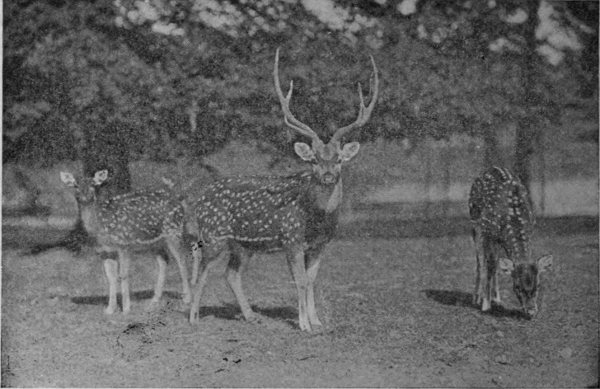
AXIS DEER.
The Fallow Deer, (Dama vulgaris), is the type of a distinct group of deer which are distinguished by the possession of antlers widely palmated throughout the upper half of the beam. In some old Fallow bucks the antlers are quite moose-like, and give this small deer an imposing appearance far out of proportion to its actual size. The weight of a large buck in prime condition generally is between 180 and 200 pounds, and its shoulder height is between 36 and 40 inches. The largest antlers recorded by Mr. J. G. Millais, in his beautiful work on “The British Deer,” measured 29½ inches in length, 28½ inches spread, width of palmation 8 inches, and the number of points 14. The extinct Irish elk, with the most colossal antlers ever carried by a cervine animal, was a near relative of the two living species of Fallow Deer.
Although a native of northern Africa and the north shore of the Mediterranean, the Fallow Deer was acclimatized in 69 England and northern Europe so long ago that the exact date records of the event have disappeared, and the species is now at home in very many European forests and game preserves. The deer parks in England possess many fine herds, but they sometimes exhibit one unfortunate result of long breeding in a semi-domesticated state—departure from the original type.
The typical Fallow Deer is in winter very dark brown, with light brown legs and under parts, and in summer light red with white spots—quite like the axis. From this standard, the variations run from pure white through the color of the wild type to jet black.
The fine herd in the Zoological Park is the gift of Mr. William Rockefeller. Six of its original members came from the donor’s herd at Greenwich, Connecticut, and six were purchased from one of the imperial parks of Russia, by consent of the Czar, and represent the most hardy stock obtainable.
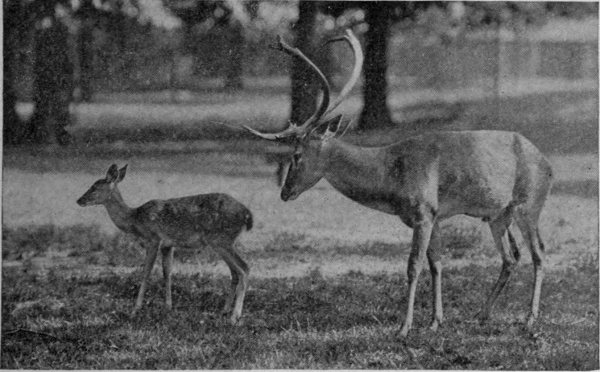
BURMESE DEER.
The Burmese, or Eld Deer, (Cervus eldi), also known as the Brow-Antler Deer, is one of the rarest species to be seen in captivity. Living specimens are acquired only through special expeditions to northern Burma. Its most characteristic feature is the antlers of the male, which sends forward a very long and almost straight brow tine, while 70 the main beam sweeps backward in the opposite direction, and describes a full semicircle. The antlers are both very heavy and long for the size of the animal. The specimens shown here, which are breeding satisfactorily, are the gift of Mr. William Rockefeller.
The Barasingha Deer, (Cervus duvauceli), also called the Swamp Deer, is to India what the mule deer is to North America. To my mind, the antlers of the former always suggests the latter species, and in size the two species are much alike. In summer the coat of the Barasingha is of a beautiful golden-yellow color, conspicuous from afar, and the antlers of old males reach a length of from 35 to 41 inches, with three bifurcations on each beam. The antlers sometimes are shed and renewed twice in twelve months. With us this species breeds very regularly, and the offspring mature well.
The Altai Wapiti, (Cervus canadensis asiaticus), is, in all probability, the parent stock of our American elk, but it happens to be a fact that our species was the first to be discovered by systematic zoologists, and described. To all visitors who are interested in deer, the Altai Wapiti—and also the Tashkent Wapiti—are a constant source of wonder, because of their well-nigh perfect similarity in all points to our own wapiti, or American elk. Our Asiatic wapiti are exhibited in ranges connecting with the western rooms of the Asiatic Deer House, where they have bred twice, and produced two fine fawns. In the rutting season the males are very cross and dangerous. They are hardy, and require no heat in winter.
The Indian Sambar, (Cervus unicolor), always suggests a tropical understudy of the Altai wapiti, clad with thin, coarse, bristly hair, and with shorter and smaller antlers, and a bristly mane all over the neck. Each antler possesses three points, only. Of all the Old World Cervidae, this species most nearly approaches the size of the Altai and Tashkent wapiti. It inhabits the hill forests of India, and in Burma, Siam and farther south it is replaced by the next species.
The Malay Sambar, (Cervus equinus), also called—most inappropriately—the “Horse-Tailed Deer,” very strongly resembles the preceding species, except that the bristly mane of the former is generally absent. The antlers of this species are shorter, also, but very thick in proportion to their length. The Malay Sambar is confined to the Malay 71 Peninsula and the countries immediately above, and Borneo and Sumatra.
This species possesses many admirable qualities, and it might be introduced to advantage in our southern states. It is very even-tempered and sensible, easily handled, is a vigorous feeder, breeds persistently, and matures very rapidly; but in every New York winter, it requires some heat in its barn.
The Maral Deer, (Cervus maral), is in appearance like an extra large red deer or a small elk. It is a midway member of the Wapiti group, which extends in a somewhat broken chain from Colorado, northward across Bering Strait to Asia, and thence across Asia and Europe to Scotland. We have owned a fine pair of Maral Deer, from the Caucasus district, but they have failed to breed as expected.
The European Red Deer, (Cervus elaphus), is an understudy of the American elk, which it much resembles in form and in habits. Next to the elk it is the finest living deer, and for many generations has held its own against the dangers of in-breeding. In the parks and forest preserves of Great Britain and Europe, it exists abundantly, but only as private property, subject to the guns of the owner and his friends. This species has been successfully crossed with the American elk.
Other Asiatic Deer will be found in the Small-Deer House, in the southern end of the Park.
THE LION HOUSE, No. 15.
As a spectacle of captive animal life, there is none more inspiring than a spacious, well-lighted and finely-appointed lion house, filled with a collection of the world’s greatest and handsomest wild beasts. To build an ideal lion house, and to fill it with a first-class collection of large felines, are matters involving no little time and much money; but the sight,—for the millions of visitors,—of lions, tigers, jaguars, pumas, leopards, cheetahs, black leopards, snow leopards and clouded leopards, all under one roof, surely is worth what it costs.
The Lion House of the Zoological Park was completed, excepting a few minor details, early in the year 1903, and was formally opened to the public in February. It is 244 feet long, 115 feet wide, including the outdoor cages, and its cost when completed reached $150,000. The materials of the building are the same kind as those used in the Reptile 72 House and Primate House, but the animal sculptures, all by Mr. Eli Harvey, are more abundant and conspicuous than on any other structure erected heretofore. The building contains 13 indoor cages, and 9 outdoor cages, and between the two there is free communication. The sizes of the various cages are as follows:
Interior cages: Largest, 14 feet wide, 22 feet deep; smallest, 13 feet wide, 14 feet high.
Exterior cages: two end cages, 40×44 feet, 17 feet high; central cage, 40 feet square, 14 feet high; smallest, 13 feet wide, 12 feet deep, 13 feet high.
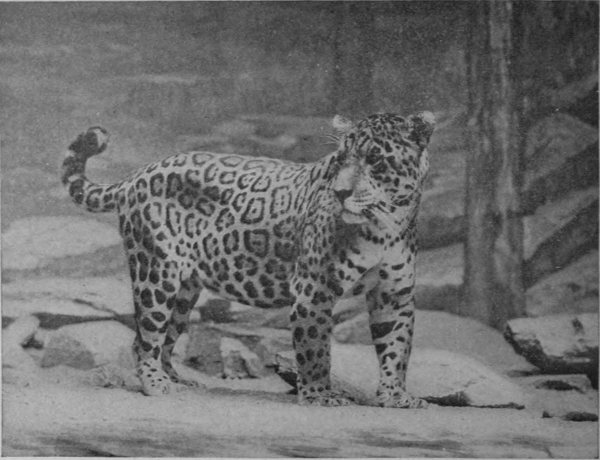
JAGUAR.
Excepting for the single fact of having interior and exterior cages, the Lion House of the Zoological Park is—like the Primate House—an entirely original development. Its most important new features are as follows:
All cage service, the introducing and withdrawal of animals, is conducted from the rear, by means of a track underneath the sleeping dens, and an elevating platform car.
The communication between indoor and outdoor cages is direct and continuous.
Instead of upright iron bars, all the cage fronts are of hard-steel wire netting, in rectangular pattern, attached to 73 wrought iron frames. This is considered by the Zoological Society a great improvement upon the heavy bar-work hitherto in universal use for cage fronts in lion houses.
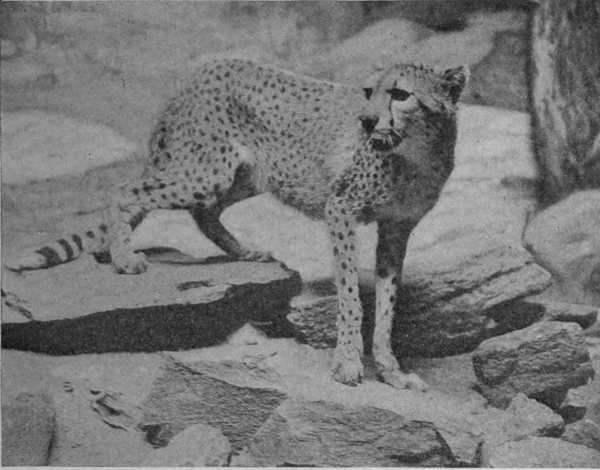
CHEETAH.
The space above the sleeping dens has been developed as a sunlit balcony, whereon the animals will be very conspicuous, even to large crowds of visitors.
Jungle-green tiling, impervious to moisture and dirt, is used as a back-ground for the animals.
The Lion is an animal of perpetual interest, but like every other noteworthy wild animal, its haunts are constantly being claimed by civilization, and its members are rapidly decreasing. It is not a difficult matter to exterminate or drive out from a given territory any large and conspicuous quadruped, and at the present rate of settlement and industrial development in Africa, it may easily come to pass that by the end of the present century, the king of beasts will be without a home, outside of zoological collections.
Like everything great, the Lion has his share of critics and detractors. A few writers have asserted that because he does not stalk through his native forests with head proudly erect, like a drum-major on parade, he is mean-spirited and cowardly. But the beast of noble countenance believes in 74 the survival of the fittest, and both by inheritance and observation he knows that a lion who needlessly exposes himself in the field captures the smallest amount of game, and attracts the greatest number of steel-tipped bullets.
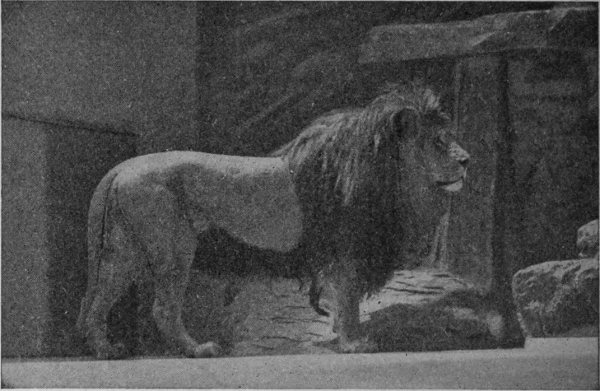
BARBARY LION.
Although Lions vary greatly in their color, and in the length of the mane, it is conceded by naturalists that only one species exists. In the same district and under precisely similar conditions are found short-maned and long-maned individuals, and all shades of color from tawny yellow to dark brown. The present geographic range of the species is from Southern Rhodesia to Persia and northwestern India, but in northern Egypt there is a large extent of territory which is lionless.
By reason of his heavy mane and massive countenance, supported by the grandest roar that issues from throat of beast, the Lion appears to be a larger animal than he really is. It is yet an unsettled question whether it exceeds the tiger in length, height or weight, and it is certainly true that in point of size these two species are very evenly matched.
In captivity, the Lion is reasonably contented, and under good conditions breeds readily, and lives a goodly number of years.
The Siberian Tiger.—Strange to say, the tiger ranges far to the northward of its proper home in Hindustan, even to Corea, Manchuria and Russian Siberia. In those cold 75 regions the tiger grows to its greatest size, and is clothed with a dense coat of long and shaggy hair. In collections, the great northern tigers are the most highly prized. The Zoological Park has recently acquired from East Siberia two fine young specimens, born early in 1909, and all the year round they inhabit the great northern outdoor cage attached to the Lion House. It is a strange sight to see tigers living outdoors in winter in New York.
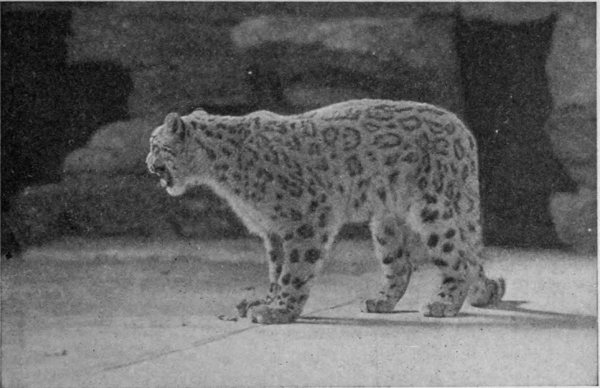
SNOW LEOPARD.
The Tiger will be found upon the earth long after the lion has disappeared. He is a far better hider, a more skillful hunter, less given to taking foolish risks, and he does not advertise his presence and invite his enemies by the bombastic roaring in which the lion delights to indulge. The Tiger is an animal of serious mind, and he attends strictly to business. A lion will stalk out into the open, in broad day, but the Tiger sticks closely to cover until the friendly darkness renders it safe to roam abroad.
Despite the density of the population of India, and the omnipresence of sahibs with rifles of large caliber, the Tiger still inhabits all India from Cape Comorin to the Himalayas, the Malay Peninsula, Sumatra, Burma, Siam, and certain portions of China up to the region of snows. Corean and Siberian Tigers are much sought after by zoological gardens, partly on account of their size, and also because they are so hardy they are able to live out doors all winter in 76 the temperate zone. The Tiger is not found in Africa, nor in any country westward of India.
The maximum length attained by this animal, head, body and tail, is 10 feet 2 inches. A very large specimen killed by Dr. Hornaday measured 9 feet 8½ inches in length, stood 3 feet 7 inches high at the shoulders, and weighed, on the scales, 495 pounds. In India, Tigers are classed according to their habits, as “game-killers,” “cattle-lifters,” or “man-eaters.” Fortunately, in comparison with the total number of these animals, the latter are few and far between.
Of yellow-coated felines, The Jaguar, (Felis onca), is next in size to the tiger. In South America, it is almost universally called “El Tigre” (pronounced Te’-gre), which is Spanish for tiger. Comparatively few Americans are aware that this superb animal belongs in the fauna of the United States, but such is the fact. The northern limit of its distribution is found in southern Texas, where it still exists in small numbers. In South America it extends to Patagonia.
The Jaguar is a stocky, heavily-built animal, with a massive head and powerful forearm. It is a good climber, and many wonderful stories of its strength have been told and printed. Among leopards of all kinds it can always be identified by the great size of the black rosettes on its body, as well as by its heavy build.
The splendid male specimen, named “Senor Lopez,” in honor of a former President of Paraguay, was the first to arrive for the new Lion House. It was captured in August, 1901, in the wilds of central Paraguay, expressly for us, through the efforts of Mr. William Mill Butler, of Philadelphia, and by him presented to the Zoological Park. After a long journey in small river craft, in a flimsy wooden cage that several times came near collapsing, the animal reached Asuncion, was taken to Liverpool by Mr. Butler, and finally reached New York.
The Leopard, (Felis pardus), is fourth in size from the lion, and is distinguished from the jaguar by smaller spots and less powerful form. It inhabits both Asia and Africa, from Japan to Cape Colony. While the species is regarded as the same throughout that vast extent of territory, it is undoubtedly true that the Leopards of Africa have smaller spots and more intense coloring than those of Asia. The maximum size for this species is a total length of 8 feet, which is attained only by a very large animal, with a long tail.
77
Naturally, the Leopard preys upon smaller animals than those most sought by the lion and tiger. It prefers small antelopes, and young animals generally, goats and sheep. When pursued, it is very skilful in hiding, and will shelter in brushy cover until fairly beaten out.
The Black Leopard is the most ill-tempered of all feline animals—perpetually snarling and growling, and seeking to do some one an injury. Naturalists regard it as of the same species as the common leopard, (Felis pardus), despite the fact that it is found only in southeastern Asia, and both in appearance and disposition is totally different from the typical pardus. With but few exceptions, the world’s supply of Black Leopards comes from Singapore.
The Cheetah, or Hunting Leopard, (Cynaelurus jubatus), is marked by its long legs, slender body, small head, small spots, and claws that are only partially retractile. Its structure suggests that of the dogs. It is distributed very irregularly through portions of Africa and southern Asia, and is by no means a common animal like the leopard and tiger.
In central India, this animal is trained to hunt the sasin antelope, a form of sport indulged in chiefly by native rajahs. The Cheetah takes kindly to captivity, and permits handling to an extent quite unknown with other large felines. Its keepers place the animal upon an open cart, blindfold it, and then drive to within 200 yards of a herd of antelope. At the point of nearest possible approach, the hood is removed, and the animal is set free. Leaping to the ground, the Cheetah stalks the herd of antelope as closely as possible, then makes a sudden rush forward, and endeavors to seize a victim. If successful, the animal is pulled down and killed. If not, the Cheetah sullenly retires, and again places itself in the hands of its friends.
The Snow Leopard, or Ounce, (Felis uncia), is the rarest, and also one of the most beautiful of all the large felines. It inhabits the high plateau of central Asia from the Himalayas to the Altai Mountains of Mongolia, above 9,000 feet. It is the neighbor of the Marco Polo sheep, the giant-horned argali, and the Siberian ibex. In its home country, this creature is sufficiently numerous that 2,000 tanned skins sometimes reach Shanghai in a single year, but owing to its great distance from railways and sea, not more than fifteen or twenty specimens have reached the zoological gardens of Europe and America. Some individuals are good-natured and playful, but others are morose.
78
The Puma, or Mountain Lion, (Felis concolor), is the most widely-known feline in North America. At present it is at home in Florida, Montana, Wyoming, Colorado, Texas, and all the states westward thereof. Southward it inhabits Mexico and Central America, and ranges through South America quite down to southern Patagonia. It attains its maximum size (8 feet in length, weight 225 pounds) in Colorado, where it appears to be more numerous than in any other state. In Routt County it is hunted very successfully with dogs. When pursued, it is compelled to take refuge in a low tree, in which it can be photographed or shot without danger.
Despite the numerous thrilling stories that have been written and published about the dangerous doings of this animal, it is by no means really dangerous to man. No Puma holding an option on a safe line of retreat ever stops to fight a man.
The Puma was formed for agility rather than strength. It swims well, and it is the most agile climber of all the large felines. The head of this animal is particularly beautiful, and its temper in captivity is entirely satisfactory. The first specimen of this species to enter the Zoological Park came from Peru, as a gift from Mr. Joseph P. Grace, and during the years 1901 and 1902 it lived out doors, constantly, in the Puma House (No. 33A), where its health was excellent.
THE SEA-LIONS, No. 12.
Of all animals which find permanent homes in zoological gardens and parks, very few afford the public more constant entertainment than Sea-Lions. They are delightfully active, and in one way or another—diving, swimming, climbing or hopping about—are nearly always “showing off.” No one within a quarter of a mile of their pool need inquire where they are, for their loud and cheerful “Hook! hook! hook,” is heard far and wide, and draws visitors like a magnet.
The Sea-Lion Pool is situated about in the center of Baird Court.
The California Sea-Lion, or “Barking Sea-Lion,” (Zalophus californianus), is the species most easily caught alive, and the one usually seen in captivity. Its home is the coast of California, but it is said to enter the Sacramento River and travel upward for a considerable distance in pursuit of 79 spawning salmon. Comparatively few Sea-Lions are now found on the mainland coast of California. On the United States Light-House reservations their slaughter is prohibited by the Light-House Board.
The California Sea-Lion is very similar in size, and, leaving the old males out of consideration, it is almost the exact counterpart in form of that apple of perpetual international discord—the Alaskan “fur seal.” The unfortunate fact that the latter animal has become known as a “seal,” has caused much confusion in people’s minds regarding the classification of pinnipeds (fin-footed animals) generally. For this reason, it is proper to observe at this point that:
Sea-Lions have flat, triangular, naked front flippers, without claws; they have long necks, and carry their heads high. There are nine species, of which the so-called “fur seal” is one.
Seals always have short and stubby front flippers, which are covered with hair, and provided with claws. In most species the hair is coarse and valueless. The seal has a very short neck and by reason of the weakness of its front flippers, it is not nearly so active nor so interesting as the sea-lion.
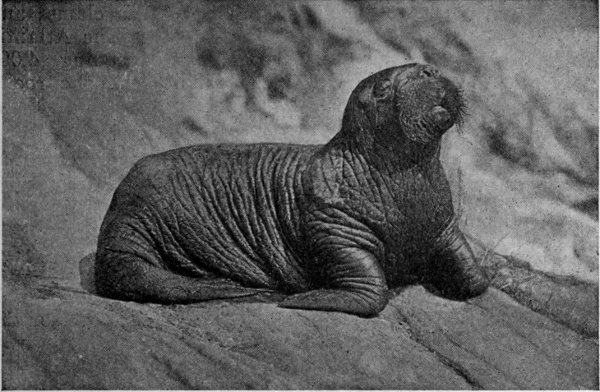
ATLANTIC WALRUS.
The Atlantic Walrus inhabits the arctic regions between America and Europe, and it is estimated that not more than ten specimens ever have been exhibited in captivity. Because of their unusual feeding habits, Walruses are very 80 difficult to keep alive. Their standard food is clams; and frequently clams are very difficult to obtain. The Atlantic Walrus grows to great size, probably exceeding 4,000 pounds in weight. The specimen exhibited in the rocky pool near the Reptile House was presented by Mr. Paul J. Rainey, in 1911, and has thriven continuously ever since its arrival. It was captured in Kane Basin, north of Baffin’s Bay.
The Harbor Seal, (Phoca vitulina), is the species common along our Atlantic coast, and since it serves so well as a type of hair seals, or true seals, it will occasionally be shown in the Park. In comparison with the active and vivacious sea-lion, it is a tame and rather uninteresting creature; but neither has any commercial value, save for the purposes of exhibition when alive.
THE PRIMATE HOUSE, No. 17.
The Primates are the four-handed animals belonging to the zoological order called by that name, which includes man, the anthropoid apes both great and small, the baboons, monkeys and lemurs. The word “monkey” is by no means sufficiently comprehensive to embrace all these forms. Were it otherwise, this building would be called, officially, the Monkey House.
The Primates include the creatures which stand nearest to man in the zoological scale, and in interest to all classes of humanity they stand above all others. There is no intelligent person, civilized or savage, to whom the humanlikeness of apes and monkeys does not appeal. On the other hand, some of the baboons are in feature and temper so thoroughly beast-like, their diabolism is almost as fascinating as the man-like character of the great apes. The variety of forms in the Order Primates, and the wide differences between the various groups, imperatively demand, for the proper representation of this Order, a large collection.