SECTION I.—THE MAMMALS. (continued 2)
Reading edition
The Primate House was erected in 1901, at a cost of $65,000, and opened to the public on December 22d, of that year. It is 162 feet in length, 74 feet in width, contains 16 large interior cages, 22 small cages, and 11 exterior cages, two of which are of great size. The points of special excellence in this building are as follows: An abundance of room for the animals, an abundance of sunlight, perfect ventilation, an extensive series of open-air cages, freedom 81 of communication between outside and inside cages, floors and walls impervious to moisture and disease germs, and the absence of iron bars from all cages save three.
During the months of mild weather, all the inmates of the large interior cages occupy, at will, corresponding cages in the outdoor series. It is also intended that certain hardy species of baboons, and the red-faced monkey of Japan, shall be provided with comfortable sleeping quarters and live outdoors, every winter. It is believed that they can do this, not only with comfort, but with great physical benefit.
For general convenience, and the promotion of a universal understanding of the primates, we propose to set them forth in four groups, a subdivision strictly according to Nature, readily comprehended, and easily remembered They are as follows, with typical examples of each:
I. Anthropoid Apes.
Chimpanzee Anthropopithecus calvus of Africa.
Orang-Utan Simia satyrus “ Borneo.
Gray Gibbon Hylobates leuciscus “ “
II. Old World Monkeys and Baboons.
Mona Monkey Cercopithecus mona “ Africa.
White-Collared Mangabey Cercocebus collaris “ “
Magot: Barbary “Ape” Macacus inuus “ N. Africa.
Japanese Red-Faced Monkey “fuscatus “ Japan.
Pig-Tailed Monkey “nemestrinus “ E. India.
Rhesus Monkey “rhesus “ India.
Entellus Monkey “entellus “ “
Black “Ape” Cynopithecus niger “ Celebes.
Golden Baboon Papio babuin “ N. Africa.
Hamadryas “hamadryas “ Arabia.
Mandrill “mormon “ W. Africa.
Gelada Theropithecus gelada “ Abyssinia.
III. New World Monkeys.
White-Throated Sapajou Cebus hypoleucus “ S. America.
Red-Faced Spider Monkey Ateles paniscus “ “ “
White-Headed Saki Pithecia leucocephala “ “ “
Yarkee: Short-Tailed Monkey Brachyurus calva “ “ “
Squirrel Monkey Chrysothrix sciurea “ “ “
Common Marmoset Hapale jacchus “ “ “
Douroucoli Nyctipithecus trivirgatus “ “ “
IV. Lemurs and Lemuroids.
Ring-Tailed Lemur Lemur catta “ Madagascar.
Indri Indri brevicaudata “ India.
Galago Galago galago “ Madagascar.
Slow Lemur Nycticebus tardigradus “ Madagascar.
Aye-Aye Cheiromys madagascariensis “ India.
82
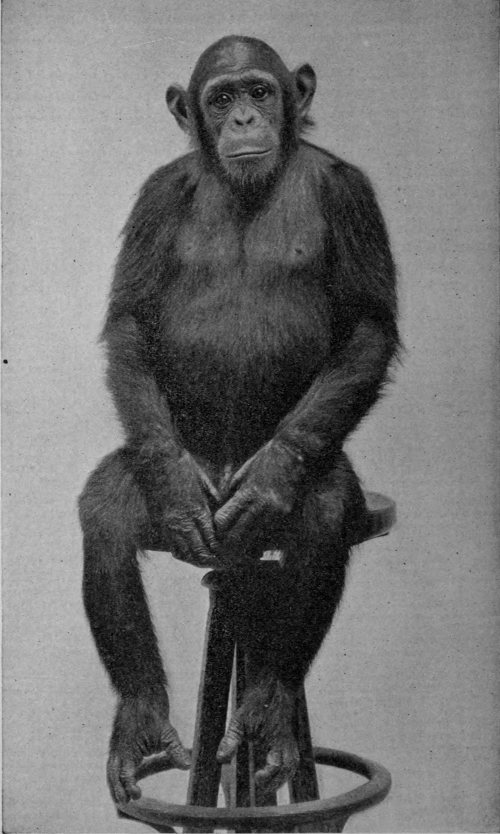
CHIMPANZEE BALDY.
83
Nearly all the above-named species are now living in the Primate House, besides which there are many others. So far as the available supply of captive primates will permit, these typical species will constantly be kept on exhibition, together with many others equally interesting. In this small volume it is possible to notice only the most important forms.
The Gorilla, (Gorilla savagei), of equatorial West Africa, is the largest and ugliest of the great apes, walks erect, and in form of body and limbs, it most resembles man. Its brain, however, is less man-like than that of the chimpanzee and orang-utan. It is very rarely seen in captivity. The only specimen which up to 1911 had reached America alive lived but five days after its arrival. Despite the fact that these creatures seldom live in captivity longer than a few months, they are always being sought by zoological gardens. The agents of the New York Zoological Society are constantly on the watch for an opportunity to procure and send hither a good specimen of this wonderful creature; and whenever one arrives, all persons interested are advised to see it immediately,—before it dies of sullenness, lack of exercise, and indigestion.
The Orang-Utan is intellectually superior to the gorilla, and is equalled only by the chimpanzee. Unfortunately, as a rule, none of the great apes are long-lived in captivity, and in zoological gardens they come and go. For this reason, it is seldom that an adult specimen, 4 feet in height, and weighing 150 pounds, is seen in captivity. Among other apes, the Orang-Utan is readily recognized by its brown skin, red hair and small ears.
In disposition this creature is naturally docile and affectionate. It is fond of the society of human beings, takes to training with wonderful readiness and success, and young specimens can easily be taught to wear clothes, sit at table, and eat with spoon and fork. In the summer of 1911, the daily open-air exhibition of nine apes dining at 4 o’clock on an elevated platform in the large outside cage at the Primate House, will long be remembered by the crowds of visitors who saw it. Such exhibitions are entirely germane to the educational purposes of a zoological garden or park, for they illustrate the mentality of animals and their wonderful likeness to man, far more forcibly than the best printed statements.
The north hall of the Primate House is specially intended for the anthropoid apes, and it is not likely that any 84 lengthy periods will elapse during which it contains neither orang-utans nor chimpanzees.
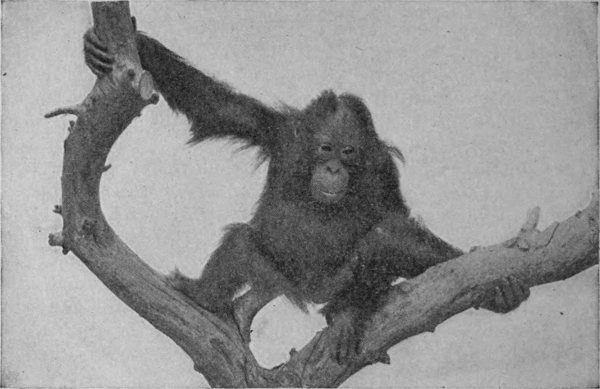
ORANG-UTAN.
The Chimpanzee, (Anthropopithecus calvus), of equatorial Africa from the west coast to the central lake region, is quite as common in captivity as the orang-utan. Both structurally and mentally this animal is very much like the orang-utan, and for keenness of intellect and susceptibility to training, it is second to none of the animals lower than man. A Chimpanzee is easily recognized by its black hair and large ears. There are two or three species.
The Gibbon shows off to poor advantage in a cage, but in the tree-tops it is a wonderful creature. It is like a long-armed skeleton clothed with skin and hair, animated by the spirit of an Ariel. In its home in the jungles of Borneo and southeastern Asia, it dwells in hilly forests, and never descends to the earth. When attacked, it flees down-hill, if possible, and it seems actually to fly through the tree-tops. It boldly flings itself forward through space, grasps with its hands the first available branch, swings underneath, feet foremost, and after another flight presently catches with its feet, thus actually making revolutions as it goes. Its progress is so swift and so silent that successful pursuit is impossible to any enemy not provided with wings.
This animal is naturally very timid, but does not hesitate to expose itself to mortal danger when its young are in 85 distress. In captivity gibbons are shy and nervous, and take life very seriously.
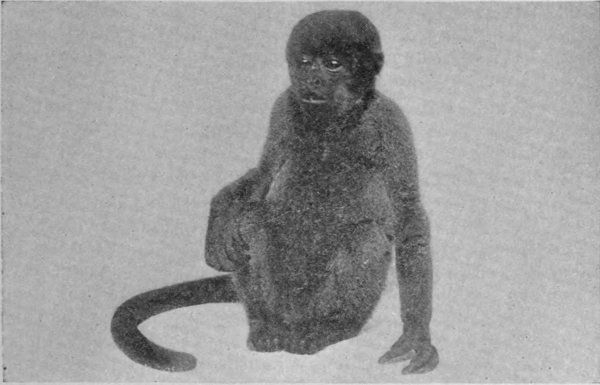
HUMBOLDT WOOLLY MONKEY.
Old-World Monkeys.
The Baboons have been specially designed by Nature for life upon the ground, surrounded by dangerous enemies. But for their big canine teeth, their fierce tempers and bull-dog courage, backed by a fine combination of strength and agility, the lions, leopards, hyenas and jackals of Africa would have exterminated them all, ages ago. They were not formed to become hand-organ beasts of burden, nor even companions to man, but rather to fight off their enemies, and bluff even the king of beasts when occasion requires. In captivity, their strength and ferocity always inspires respect, and sometimes genuine terror. At all times they require to be treated as dangerous animals.
Of the various species of baboons on exhibition in the Primate House, the full-grown Mandrill is the most interesting, and wonderful. It seems like an animal not of this earth, and reminds the visitor of one of the great beasts of the visions of St. John the Divine. The home of this species is in West Africa, and it is found from Senegambia to the Congo. The long shaggy hair, lion-like appearance, the peculiar color markings of the face, and the indescribable grimaces, instantly fix the attention of every visitor.
86
The Hamadryas Baboon, with long side whiskers and cape of long hair, is one of the handsomest animals of this group. Its explosive, ear-racking cry is almost as startling to visitors as a cannon-shot.
The Golden Baboon has the liveliest disposition and the best temper possessed by any baboon. Young specimens are full of good-natured mischief, and are much given to hectoring their cage-mates. The Long-Armed Yellow Baboon is quite at home in the Primate House, and has bred here. It is a good species to keep in captivity.
The Group of Old World Monkeys, in addition to the baboons, contains several species worthy of special remark. There are some which have tails so very short and insignificant that they seem to be tailless, and several of them are called “apes.” They are not true anthropoids (manlike apes), however, and it is a confusing error to designate any of them as “apes.” The species referred to are the following:
The Black “Ape,” of Celebes, exceedingly like a true baboon.
The Magot, or Barbary “Ape,” of North Africa and Gibraltar, which is a true macaque.
The Japanese Red-Faced Monkey, another macaque, with a brilliant red face, and long, thick coat of hair, which enables it to live out of doors all winter, even in this Zoological Park.
The Pig-Tailed Monkey, several species of which are found in Burma and other portions of southeastern Asia.
All the above are on exhibition in the Primate House, and the outdoor cages.
The Rhesus Monkey, of India, is one of the sacred species, and ages of immunity from molestation, or even wholesome discipline, have made this animal aggressive and domineering in temper.
The Bonneted Macaque is the best-tempered monkey of all the monkey species found in the East Indies, and it is by far the best to keep as a pet.
The Entellus Monkey, of India, is also a sacred species, and its natural seriousness of manner, and dignified bearing, quite befit the direct descendants of the original Hunuman, or monkey deity of the Hindoos, who helped to build Adam’s Bridge.
87
Of the many African monkeys, some of the most showy (such as the Guerzas and Colobos) are so difficult to procure they can not be set forth as permanent residents in the Primate House. The following species, however, may be classed with the reliables:
The White-Collared Mangabey and Sooty Mangabey are both so lively, so good-natured, and so free from the fighting habit, they are prime favorites with everybody.
The Mona Monkey is handsome and easily kept, and an excellent representative of the great African genus Cercopithecus.
The Green Monkey and the Vervet are lively but quarrelsome, and at times become dangerous. The Patas, or Red Monkey, is very sedate, and makes a good cage-mate for the mona.
The New World Monkeys, even at their best, never make a strong showing in a vivarium. The trouble is that many of the most interesting species are so delicate it is impossible to keep them alive in captivity. Fame awaits the man who can discover a bill of fare on which Howling Monkeys, Sakis and Yarkees can live in captivity to old age, and repay their cost and care. Their digestive organs are delicate, and are subject to derangement from causes so slight they can not be reckoned with.
The Sapajous are the hardiest, the most intelligent and in some respects the most interesting of the New World monkeys. They all possess the prehensile (or grasping) tail, which is not found on any Old World monkey, and the use made of it is a constant source of wonder. Monkeys of this species are quite common in captivity, and their wrinkled brows and serious countenances give them an appearance of being burdened with cares,—which most captive monkeys certainly are! These are the unfortunate creatures which so often come to grief on hand-organs.
The Black Spider Monkey and the Gray Spider Monkey represent a genus of animals quite as attenuated in form as the gibbons. Their slender bodies, exceedingly long and slender legs and tail,—the latter strongly prehensile, and better than a fifth arm and hand,—give them when in the tree-tops an appearance truly spider-like. They are agile climbers, but not rapid runners, and having no means of defense are very timid. Their stomachs are so simple they seem to lack some element or function that is necessary to 88 the life of the animal in captivity. Notwithstanding the fact that “Jess,” of Bath, New York, in defiance of all laws and precedents, lived thirteen years in a cold climate, the great majority of spider monkeys die before they reach full maturity, and nearly always of stomach troubles. Fortunately, however, there are exceptions to this rule.
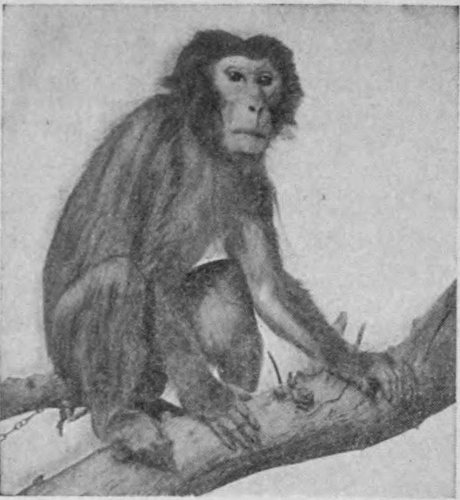
JAPANESE RED-FACED MONKEY.
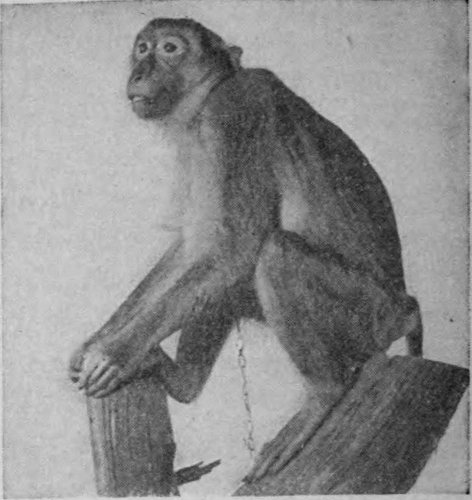
PIG-TAILED MACAQUE.
The Squirrel Monkey, often called a “Marmoset,” is a pretty little olive-yellow monkey, almost as delicate as the true Marmoset, and the Pinche. These diminutive creatures are so delicate they require the greatest care and tenderness, and thrive better in moderately small cages than in large ones. True marmosets are the smallest of American primates, being next in size to the Tarsier, of Borneo, smallest of all quadrumanes.
The Lemurs and Lemuroids.—A lemur is a monkey-like animal belonging to the lowest group of primates, but in some respects is so little like a typical monkey that the relationship is not always apparent. There are about thirty species, and all save a very few are found on the Island of Madagascar. They are gentle-spirited, harmless and inoffensive animals, and not being persecuted by their human neighbors, as all American wild animals are, they are quite numerous.
Nearly all the Lemurs have long tails, long and fine hair, large eyes and pointed muzzles. Many of them are strikingly colored in various shades of black, white and gray. All Lemurs are supposed to be of nocturnal habit, and in fact they really are; but the specimens in the large jungle cage of the Primate House are quite as lively and interesting 89 in the daytime as most of the monkeys. So far from manifesting a disposition to retire to dark corners, they love to lie in the sunshine.
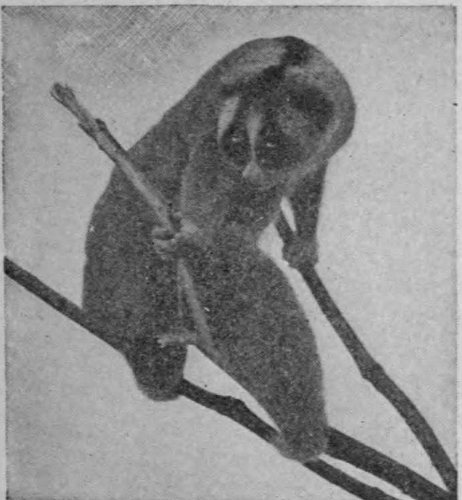
SLOW LEMUR.
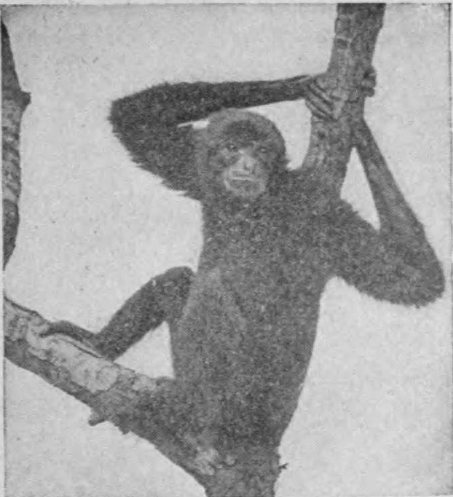
SIAMANG.
The Ruffed Lemur, or Black-and-White Lemur, (Lemur varia), is the handsomest member of this entire group. Its fur is very long, silky, and alternately pure white and jet black. The Ring-Tailed Lemur has a very long, pointed tail, ornamented with about 25 alternating rings of brown and gray, which it carries very gracefully. This species is of a more lively disposition than most others. The curious Indri has not up to this time come into the collection, but it is expected in the near future. When it arrives it can at once be recognized by the entire absence of a tail, except a mere stump, and by its large hands and feet.
ELEPHANT HOUSE, No. 20.
Of its buildings for animals, the Elephant House is the culminating feature of the Zoological Park, and it comes quite near to being the last of the series. In token of these facts, it is fittingly crowned with a dome. Through its position in the general plan it closes a wide gap, and effectively links together the northern and southern halves of the establishment.
The erection of this great structure began in 1907, and the building was completed and its inmates housed in the fall of 1908. The yards surrounding the structure were finished in 1909.
90
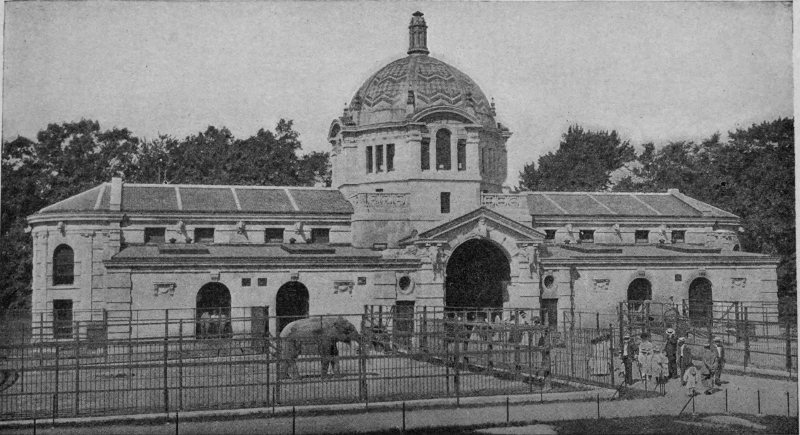
ELEPHANT HOUSE.
91
Any building which can comfortably accommodate a representative collection of the largest of all living land animals, must unquestionably be large and substantial. There is no pleasure in seeing a ponderous elephant chained to the floor of a small room, unable even to walk to and fro, and never permitted to roam at will in the open air and sunlight. It is no wonder that dungeon-kept elephants go mad, and do mischief. If an elephant—or for that matter any animal—cannot be kept in comfortable captivity, then let it not be kept at all.
The Elephant House of the City of New York is a large and roomy structure, built to render good service for two centuries. Its extreme length over all is 170 feet, and its width is 84 feet. Its two sides are divided into 8 huge compartments, of which 4 are for elephants, 2 for rhinoceroses, and 2 for hippopotami. Each of these is 24×21½ feet.
The Hippopotami have within the building a tank 24×21 feet, and 8 feet in total depth; and another will be constructed in their corral.
Each end of the building furnishes two cages of smaller dimensions, for tapirs, and young elephants. The whole area surrounding the building, excepting the axial walk, is devoted to open-air yards, so arranged that each cage in the interior connects directly with a corral which affords both sunshine and shade. Nature seems to have made this beautiful open grove—strangely free from trees in its center—especially for the purposes to which it now is devoted.
It is by no means the intention of the Zoological Society, that, because an axial walk leads through the Elephant House, the building shall be used as a thoroughfare for foot traffic between the northern and southern portions of the Park. Such use would surely defeat the main purpose of the structure. It is intended to be entered only by persons who desire to see the animals, and all others must pass around it, by one or the other of the two very direct promenades which will be provided. The employees of the Park are strictly forbidden to consider the walk through the building as a convenient highway, and visitors are requested to observe the obvious necessities of this case.
The Indian Elephant, (Elephas indicus), is the universal elephant of captivity, the African species being shown only as a great rarity. For every elephant that comes from Africa, about thirty come from India, and of those about twenty-nine are prosy and unromantic females. In order to secure a male Indian Elephant, it must be specially ordered.
92
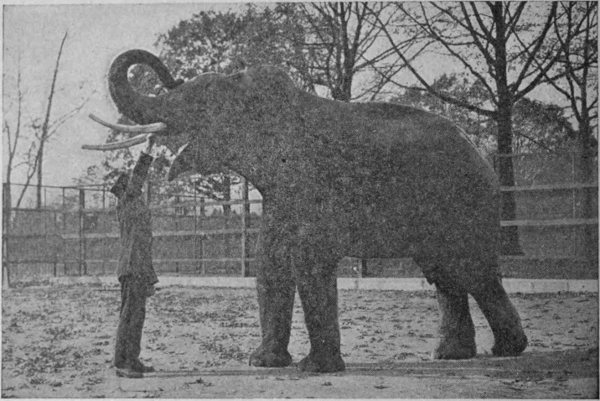
INDIAN ELEPHANT.
Our first Indian Elephant, a fine male named “Gunda,” was caught wild in the interior of Assam, northeastern India, and he arrived at the Zoological Park in May, 1904, as the gift of Col. Oliver H. Payne. He was then about seven years old. He stood 6 feet 7 inches in shoulder height, weighed 3,740 pounds, and had all the points of a “high-caste” elephant. His tusks were then 16 inches long. He is very mischievous about breaking anything in his quarters that is breakable, and he manifests special dislike toward certain individuals who come near him. Like most Indian elephants, “Gunda” is very intelligent. In two days he was taught to receive pennies, lift the lid of his “bank,” drop the coin within, and ring his bell.
Since his arrival here, in May, 1904, he has grown in height at the rate of about 5 inches each year. On November 1, 1910, he stood 8 feet 9 inches in shoulder height, his weight was 8100 pounds, and his tusks were 36 inches long.
The Sudan African Elephant, (Elephas oxyotis, Matschie), is the largest of the four species of African elephants now recognized. The other species are the South African Elephant, (E. capensis), the German-East-African Elephant, (E. knochenhaueri), and the West African Elephant, (E. cyclotis).
After some years of waiting, and many futile efforts, we have at last come into possession of a pair of young Sudan Elephants, representing, so we believe, the great species to 93 which belonged Jumbo, and also the bearer of the enormous tusks presented to the Zoological Society by Mr. Charles T. Barney. Like all elephants newly arrived from Africa, they are young, and small; but if they have good health they will grow very rapidly, and about A. D. 1927 they should attain full stature,—11 feet at the shoulders for the male, or thereabouts.
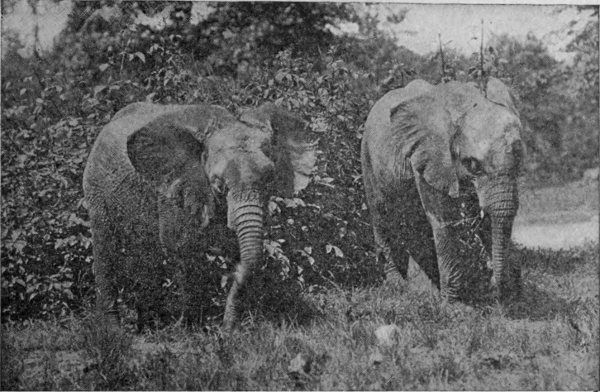
AFRICAN ELEPHANTS.
The different species of elephants are most easily recognized by their ears. Compare the enormous “sail-area” of the ears of this species with the small, triangular ear of the Indian elephant, and the small, round ear of the next species.
The West African Elephant, (Elephas cyclotis), of equatorial West Africa, especially the Congo country, is apparently a small species, not exceeding seven feet in height, even if that height is ever attained. Mr. Carl Hagenbeck reports that out of nearly 300 pairs of tusks of this species examined by him in the German ivory market, not one pair exceeded two feet in length, and many measured only 10 inches.
On July 25, 1905, we received a male specimen representing this species, as a gift from Mr. Barney. It is strikingly marked by its small round ears, and the presence of 5 toes on each fore-foot and 4 on the hind foot, the number in the East African species being 4 and 3, respectively. At the time of its arrival, little “Congo” stood 43 inches in shoulder height, his weight was precisely 600 pounds, and his tusks 94 were 4 inches long. On June 1, 1911, his shoulder height was 60 inches, and his weight was 1650 pounds, and his tusks were 23 inches long.
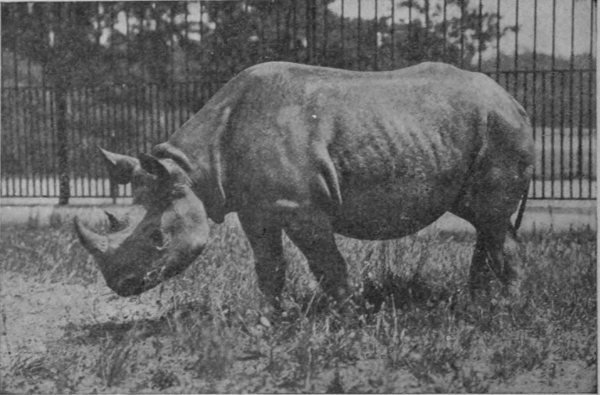
AFRICAN TWO-HORNED RHINOCEROS.
Regarding the life history and distribution of this odd species, much remains to be ascertained; and precise information is greatly desired.
The African Two-Horned Rhinoceros, (Rhinoceros bicornis), is already represented by a female specimen which was acquired in 1906. “Victoria” was captured in July, 1905, in the northern point of German East Africa, within about sixty miles of the head of Speke Gulf, which is the southeastern arm of Lake Victoria Nyanza. The elevation is between 4,000 and 5,000 feet. She was slung under a pole, and carried, six days’ journey on men’s shoulders, to the shore of the lake.
From thence she was transported by steamer to Port Florence, at the head of the Uganda Railway, thence by rail 500 miles to Mombasa. Ever since her arrival in New York, “Victoria” has developed rapidly. Captivity does not seem to fret her in the least. She is very docile, is very friendly toward her keeper, and it is quite apparent that she enjoys herself.
The African Two-Horned Rhinoceros once was very abundant throughout the whole of the fertile plains region of east and south Africa, but the onslaughts of hunters have exterminated it from probably nine-tenths of the territory 95 that it once occupied. To-day, the Englishmen of Africa are earnestly endeavoring to regulate and abate the slaughter of African big game, and beyond doubt safe, good results in that line are being accomplished. It is to be hoped that the protection lines will now be drawn so tightly around the game that remains that it will be perpetuated for centuries to come.
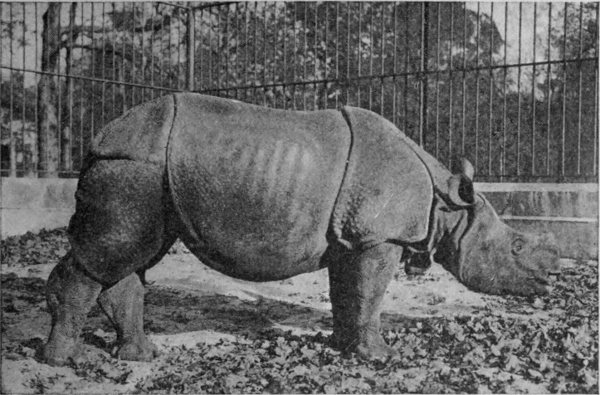
INDIAN RHINOCEROS.
The Indian Rhinoceros, (Rhinoceros unicornis).—A full-grown Indian Rhinoceros is one of the most wonderful of all living animals. It seems like a prehistoric monster, belonging to the days of the dinosaurs, rather than a creature of to-day; and the killing of so grand a creature solely for the sake of “sport,” and a stuffed head to hang upon a wall, is murder, no less. It is quite time that the most wonderful works of animated Nature should universally be recognized as safe from attack with the rifle and knife.
So pronounced is the rarity of the great Indian Rhinoceros, it is a fact that for nearly fifteen years no living specimens came into the wild-animal market. At last, however, the persistence and industry of the renowned Carl Hagenbeck was rewarded by the capture, in 1906, of four young specimens, all of which reached Hamburg in May, 1907. One of the best specimens of the quartette was purchased for the New York Zoological Park, and is now living in the Park in the quarters prepared for him at the Elephant House.
96
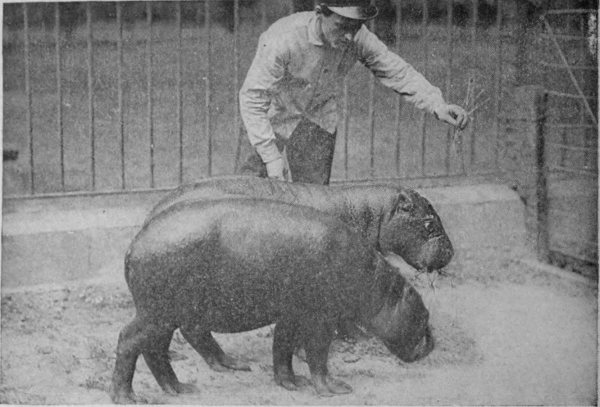
PYGMY HIPPOPOTAMI.
The Indian One-Horned Rhinoceros is the largest of all living rhinoceroses. A full-grown male is about 5 feet, 6 inches in shoulder height, and 10 feet 6 inches long from end of nose to root of tail. The length of the horn is not great, rarely exceeding 12 inches. The skin is very thick, and lies upon the animal in great rigid slabs which are divided by articulating areas of thinner skin.
The Hippopotamus, (Hippopotamus amphibius), is more frequently seen in captivity than any of the large rhinoceroses, or the African elephant. In the lakes and large rivers of central East Africa it still exists in fair numbers, and still is killed for “sport.”
Strange as it may seem, this very inert and usually lethargic monster can, under what it deems just provocation, become very angry, and even dangerous. Four years ago, in one of the rivers of Uganda, a hippopotamus not only overturned a boat, but killed one of its native occupants by biting him.
The Hippopotamus breeds readily in captivity, even under poor conditions, and the supply for the zoological gardens of the world is chiefly maintained in that way. The fine male specimen exhibited in the Zoological Park was purchased from the Central Park Menagerie, for $3,000, and is a gift from Mr. Samuel Thorne. He was born on July 13, 1904. His weight on November 1, 1909, at five years of age, was 3,114 pounds; and he is growing rapidly.
97
The Pygmy Hippopotamus (Hippopotamus liberiensis), is a great zoological novelty, and second in rarity only to the okapi. Thus far only five specimens ever have been exhibited. An adult Pygmy Hippo is only one-fourteenth the size of an adult Nile Hippo. Our three specimens, a female and two males, are exhibited in the Elephant House. They arrived in 1912, and were captured in Liberia, West Africa. The cost price of the trio was $15,000. They have excellent appetites, never have been ill, and they seem to enjoy their new home. Their habits, capture, and their home surroundings have been fully described in the Bulletin (No. 52) and the Annual Report for 1912 of the Zoological Society.
The Pygmy Hippopotamus is far more widely distributed throughout Liberia than might be inferred from the surprising scarcity of specimens in museums, and the long absence of the species from zoological gardens. It is an inhabitant of swampy forests, and while it frequents rivers it is not confined to them, like the large hippo. It seeks shelter from molestation in large cavities in river banks, usually under the roots of overhanging trees. These specimens were caught by digging pits in their runways, with sides so steep that the captives could not climb out. After capture, each animal was placed in a huge basket crate, slung under a pole, and carried by natives over the rough forest trails to the nearest river transportation.
The Tapirs.—Near the end of the Order of Hoofed Animals, (Ungulata), is found the Tapir Family, represented in both the old world and the new, by about five species. These very odd creatures inhabit the densest forests of the tropics, where vegetation grows rankly, and few other large hoofed animals can live. They are very fond of water, and swim well.
The South American Tapir, (Tapirus terrestris), takes kindly to captivity, breeds in confinement, and always manages to look well-fed and as sleek as a seal. Its color is a rich mahogany brown, and its long, prehensile nose is strongly suggestive of the end of an elephant’s trunk. The shoulder height of a full-grown animal is about 37 inches. This species inhabits Venezuela, the Guianas, Brazil, Paraguay, Uruguay and some other regions of South America. Some of the Central American Tapirs inhabit mountain regions, but all are exceedingly wary, and difficult to find without dogs.
98
The Malay Tapir, (Tapirus indicus), of the Malay Peninsula and Sumatra, may be recognized as far as it can be seen, by its colors. The front half of the animal, and its legs, are black or dark brown, and the rear half of the body is white. It is much larger than the preceding species.
THE WOLF DENS, No. 22.
At the northeastern corner of the Elk Range there is a huge, bare granite rock, two hundred feet long, shaped precisely like the hump of a bull buffalo. The high end of the hump is toward the north, and its crest is about fifteen feet above the ground on its eastern side. A fringe of small trees and bushes grows along its western side. On the east side, well sheltered by the rock itself from the cold west winds of winter, and also shaded by several fine trees which most opportunely grow close beside the ledge, the Wolf Dens and Fox Dens are situated.
In regard to the iron work, these dens are merely an understudy of the Bear Dens. The dimensions of each den of the series are 16 by 48 feet, and the height of the bars to the top of the overhang is 9 feet 6 inches. The sleeping dens are of simple construction, all save one being of wood, trimmed with bark-covered slabs. At present the Wolf Dens are divided into four compartments.
The Gray Wolf, (Canis nubilis), is known by as many names as it has color phases. In the North, where it is white, it is called the “White Wolf,” while in Florida it becomes the “Black Wolf.” In British Columbia and around Great Slave Lake, both white and black wolves abound, as well as the standard gray, but on the Barren Grounds the white phase predominates. In Texas a “Red Wolf” is found, but apparently the red phase is of somewhat rare occurrence, and is never found in the North.
In the West this animal has recently come into prominence in a way that is striking terror to the hearts of ranchmen and others who have stock to lose. While all kinds of desirable game animals are decreasing at an alarming rate, the Gray Wolf not only holds its own, but is multiplying rapidly. The destruction by it of calves, colts and sheep, has become so great that nearly every western State has placed on the head of this bold marauder a bounty varying from $2 to $10. In some States this law 99 has been in force for several years, but with no sensible diminution in the number of wolves.
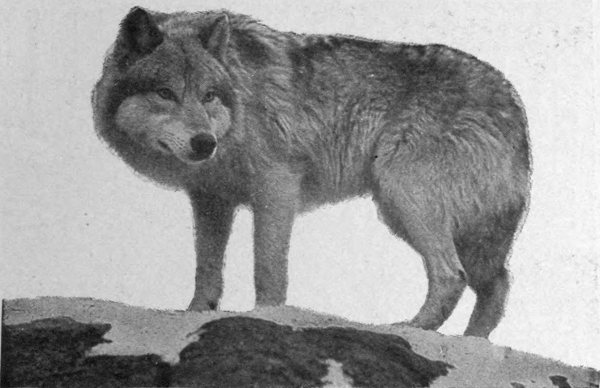
TIMBER WOLF.
The Gray Wolves which live in touch with civilization are by no means such bold and dangerous animals as they formerly were. In the early days, when wolves were numerous and fire-arms few and primitive, the Gray Wolf undoubtedly was a dangerous animal. But the breech-loading rifle has changed all this. Excepting for his stock-killing propensities, the Gray Wolf is now a skulking creature. In the United States this animal possesses the courage of a coyote, but in the Barren Grounds it is still fierce and dangerous. However much the wolf may skulk and flee when the way is open, when brought to bay he knows how to fight. One snap of his powerful jaws and shear-like teeth is enough to disable almost any dog, and send it howling to the rear. It is no wonder that western dogs of experience are shy of approaching a Gray Wolf within snapping distance.
Excepting the localities from which it has been driven out by civilization, the Gray Wolf ranges over the whole North American continent from central Mexico to 83° 24′ N.
The Coyote, or Prairie Wolf, (Canis latrans), is a personal acquaintance of nearly every trans-continental traveler. To those who have camped on the “plains,” he is quite like 100 an old friend; and the high-pitched, staccato cry—half howl and half bark—with which he announces the dawn, is associated with memories of vast stretches of open country, magnificent distances, sage-brush and freedom. Because of his fondness of barking, Thomas Say, the naturalist who first described this species, christened it, Canis latrans, which means “barking wolf.”
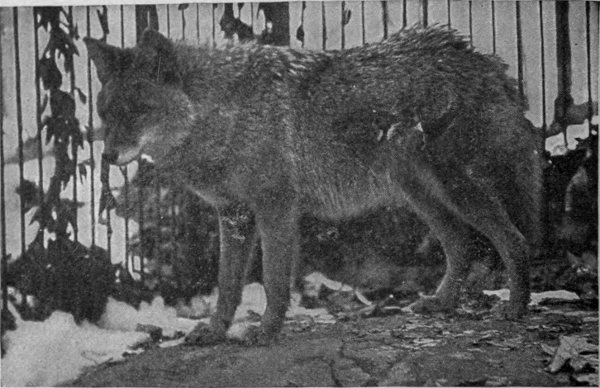
COYOTE: PRAIRIE WOLF.
This animal averages about one-third smaller than the gray wolf, and while the finest male specimens are, in the autumn, really handsome animals, at other times the majority are of very ordinary appearance. At no time, however, even in the dark, is a Coyote a courageous animal. So far as man is concerned, a band of a thousand coyotes would be as easily put to flight as one; but in hanging upon the ragged edges of civilization, and living by its wits, the Coyote is audacity itself. By inheritance, and also by personal experience, this animal knows to a rod how far it is safe to trust a man with a gun. If the hunter has left his gun behind him, the Coyote knows it at once, and boldly flaunts himself within stone’s throw of his enemy.
The Coyote varies in color quite markedly, exhibiting the gray, brown and black phases. Formerly it was supposed that one species comprehended all, but Dr. Merriam’s series of specimens from all parts of the West and Southwest have led him to separate these animals into eleven species.
101
THE FOX DENS, No. 23.
Of the many species of foxes found in North America, three species stand forth as the types of prominent groups, and it is very desirable that all three should be well known.
The Red Fox, (Vulpes fulvus), is the representative of the group which contains also the cross fox and black fox of the Northwest. In spite of dogs, traps, guns, spades and poison, this cunning creature persists in living in close touch with the poultry yards of civilized man. His perfect familiarity with old-fashioned dangers enables him to avoid them all, and no sooner does a new danger menace him than he promptly invents a way to escape it. The manner in which the Red Fox lives with civilization without being exterminated really is surprising, and speaks volumes for the astuteness of this animal.
The geographical range of the Red Fox is very wide, From North Carolina and Tennessee it extends northward through the whole northeastern United States, gradually bearing westward to Montana, and northward almost to the Arctic Ocean. It is the commonest species in Alaska, where it is found practically everywhere.
The typical Red Fox and its two subspecies, the Cross Fox, (Vulpes fulvus decussatus), and the Black Fox, (V. f. argentatus)—the latter many times miscalled the “Silver Fox”—vary in all possible gradations of color from bright red to pure black. Often it is difficult to decide where one type leaves off and another begins. The Cross Fox stands midway between the Red and Black, with some of the yellow color of the former on the sides of the neck and behind the foreleg, while the remainder of the general color is grizzled gray-brown laid across his shoulders in a more or less distinct cross. The Black Fox varies in color from very dark iron-gray to dark brown or black, with a slight wash of white-tipped hairs over the head, body and tail. The tip of the tail is always white, which is the only constant color mark about him.
The Swift, or Kit Fox, (Vulpes velox), is the daintiest, smallest and liveliest of all American foxes. From his delicate little nose to the tip of his well-trimmed tail, he is every inch a thoroughbred. His countenance is bright and pert, and when several specimens are kept together they are very playful. One striking feature of this little animal is what may well be termed its trimness. When in 102 fair condition, its coat of thick, silvery gray fur is as smooth and even as if recently trimmed by a barber.
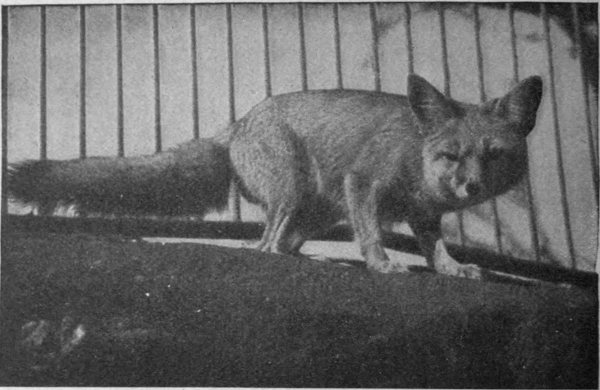
SWIFT OR KIT FOX.
On the western plains, where it once had for companions the buffalo and prong-horn, the Swift is becoming rare. Its worst enemy is the deadly strychnine bottle of the ranchman. This species does not thrive in the Fox Dens, and it will be found in the Burrowing Animal’s Quarters, where it seems pleased to consider itself at home.
In the Small-Mammal House is shown a new species, closely allied to the above, from Phoenix, Arizona, recently described by Dr. C. H. Merriam as Vulpes macrotis, or the Large-Eared Swift.
The Gray Fox, (Urocyon virginianus), is the fox of the South, even though it does range northward well into the territory of the red fox. This species is distinctly smaller and more lightly built than the red, its hair is not so luxuriant, it is more shy and retiring, and its colors change very little. When hotly pursued by dogs it often climbs trees that are quite perpendicular, to a height of twenty feet or more. In captivity Gray Foxes are forever trying to escape by climbing, instead of by burrowing, as would naturally be expected. In temper, they are treacherous to their keepers, and also to each other, and as “pets” are anything but desirable.
103
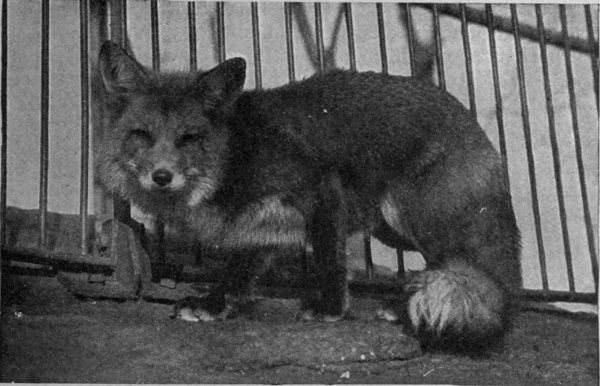
RED FOX.
The Tasmanian Wolf, or Thylacine, (Thylacinus cynocephalus), is a very strange-looking and interesting creature, about the size of a pointer dog. Its color is dark yellowish brown, and it has a series of broad black stripes, or bands, running across its hind quarters and loins. The wide gape of its mouth reminds one of an iguana or a monitor.
This animal, fully named above, is the largest of the carnivorous marsupials of Australia, and the female possesses an abdominal pouch in which she carries her young, like a kangaroo. It is now found only in Tasmania, and it dwells amongst rocks, in rugged and mountainous regions. Because of its depredations upon the sheep herds, the Thylacine has been diligently hunted and destroyed, and now living specimens rarely are taken.
In the zoological gardens of Europe and America, this species usually is kept in heated buildings, but it has been ascertained by experiment that this specimen thrives best in the open air. Living examples in captivity are now so very rare it is a difficult matter to keep one constantly on exhibition.
THE OTTER POOLS, No. 31.
The American Otter, (Lutra canadensis), is unfortunate in being the bearer of valuable fur; and in the northern regions, where the cold causes the development of fur that 104 is available for the use of the furrier, this creature is so nearly extinct that trappers no longer pursue it. In the southern States, where its fur is short, rather coarse and “off color,” the Otter still is found. In some portions of eastern Florida, and along the coast of South Carolina, it is frequently taken. In captivity, it often becomes quite tame, even affectionate, and always is interesting. Unless closely confined, however, it is prone to wander, and meet premature death.
In captivity the Otter usually is active and restless, and very much in evidence. Owing to the strength of its jaws, its ability to climb under certain conditions and its restless activity, it is difficult to confine a full-grown Otter in anything else than a complete box of iron cage-work.
Few persons save woodsmen and naturalists are aware of the fact that in a wild state the Otter is a very playful animal, and is as fond of sliding down hill, over a wet and muddy slide, with a water plunge at the bottom, as any young person is of “shooting the chutes.” Like the small boy with the sled and a snowy hillside, the Otter sometimes indulges in its sliding pastime for an hour at a time, with a keen relish for the sport that is quite evident to all who have ever watched it.
The Otter is a carnivorous animal, and in a wild state lives upon fish, frogs, crabs, young birds, small mammals, and, in fact, about any living thing which it can catch.
The Coypu Rat, (Myopotamus coypu), of Central and South America, is interesting because of the fact that it is the largest of all rats or rat-like animals. In its habits it is as fond of water as the musk-rat. It is sufficiently clothed with fur to endure outdoor life in the Park, even in winter, and it has been acclimatized here in one of the other pools. It breeds persistently, and thrives in captivity, provided it is treated as it should be.
THE SMALL-MAMMAL HOUSE, No. 35.
The new Small-Mammal House, erected and occupied in 1905, is a very different structure from the temporary building which formerly occupied the site. The present building is a twin of the Ostrich House, and in it much effort has been expended in devising ways and means to keep its living inhabitants clean, odorless and in good health. Owing, however, to the musky odors secreted by many of the civet 105 cats and members of the Marten Family, it is beyond human power to keep a large collection such as this building contains without a certain amount of wild-animal odor.
Most difficult of all collections to settle satisfactorily in a modern zoological park or garden is the great omnium gatherum of small species—and some large ones, also—which fall within the meaning of the term “small mammals.” The number of mammalian miscellanea which can not have buildings all their own is really very great. In addition to that there are always with us a considerable number of young and tender animals which require small quarters, and close attention. The visitor will therefore always find in the Small-Mammal House a great array of viverrine animals, of tropical squirrels and other small rodents, of mustelines, the nasuas, the small marsupials, young leopards, the lynxes and their relatives, baby bears, and many other species.
Attention is invited to the great variety of cages in and around this building, of which there are five different types. The total number is 176. All those on the western side are adjustable as to their bottoms and sides, so that it is easy to throw several cages into one, and make cages either very long or very high. The idea of the collapsible cage, and also the general plan of it, has been copied from the model developed and in use in the Zoological Garden of Frankfort, Germany, by Director A. Seitz, to whom this acknowledgment is justly due. It will be noticed that every animal in this building enjoys the use of an outdoor cage, which connects directly with its interior quarters.
Of such an odd mixture of animals as we are now to consider, anything like a perfect systematic zoological arrangement is a practical impossibility; but as far as it is possible, we will take up the animals by groups.
On the whole, the most striking animals in the Small-Mammal House are the small cats and lynxes. Of the spotted cats, the Serval, (Felis serval), of Africa, is one of the rarest. Its long, slender legs, small head, slender body and round spots proclaim it a near relative of the cheetah.
The Clouded Leopard, (Felis nebulosa).—The dense and humid jungles of Borneo contain a beautiful tree-climbing leopard whose markings are laid on its sides in large, elliptical patches of pleasing pattern. This is the Clouded Leopard, so delicate in captivity that only one out of every four or five becomes acclimatized outside its native jungles. 106 Our fine adult specimen, with very long canine teeth suggestive of those of the saber-toothed tiger, really belongs in the Lion House, but we dare not move it, for fear the change would in some manner prove fatal to it. It is an animal of vicious temper, and makes friends with no one. The half light of its cage is a welcome approach to the dense shadows in which it lives when at home.
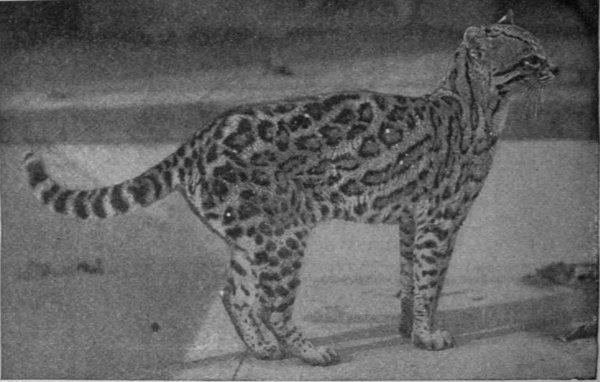
OCELOT.
The Jungle Cat, (F. bengalensis), is a small and inconspicuous type, as befits an animal which lives by stealth in densely populated regions. The Ocelot, (Felis pardalis), of South and Central America, is a small spotted cat which very often is called a “young jaguar.” In size it is the third largest Felis of the American continent; but for all that, it is so small that an adult specimen would not make more than one square meal for a hungry jaguar. It is found from southern Texas to southern Brazil.
The little Margay Cat, (F. tigrina), is our smallest and also rarest spotted cat. It is no larger than a good-sized domestic cat, and its tawny ground-color is marked all over with round spots. The rarest American feline in our possession is the queer, otter-like Yaguarundi Cat, (F. yaguarundi), of a uniform gray-brown color, without spots. It is found in southern Texas and Mexico, and is so seldom seen in captivity that comparatively few persons north of the Rio Grande are aware of its existence. Our specimen came from Brownsville, Texas.
107
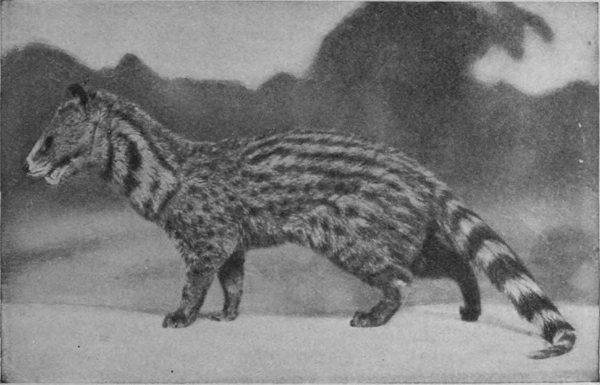
COMMON GENET.
The Bay Lynx, Red Lynx, or Wild Cat, (Lynx rufus), is the smallest of American Lynxes, and it is the one that inhabits the United States eastward of the great plains. Until further notice, this species will be found in the Small-Mammal House. It may have a few dark spots, or none at all. Its color varies so greatly that it is at times impossible to determine where this species leaves off, and the more heavily spotted subspecies of the southwest takes its place. The latter is known as the Spotted Lynx, (L. r. maculatus).
The large and important group of Viverrines, or long-faced cat-like carnivores of the East Indies, (Family Viverridae), is well represented. It is the true Civets which furnish—some of them—the evil-smelling civet of commerce—an odor which we would gladly do without. The Common Civet-Cat, (Viverra zibetha), is the best known member of this Family, and it is easily recognized by its large size, heavily-spotted body and ring-streaked tail. It is common throughout the Malay Peninsula, and in many other portions of the Malay Archipelago. The larger Malayan Civet-Cat, (V. malaccensis), strongly resembles its understudy, but its black spots and blotches are larger and more intense, and in form it is much more robust.
The large and handsome White-Whiskered Paradoxure, (Paradoxurus leucomystax), has been in the Park about six years, and to-day it coughs and snarls at the visitor just as it did in the beginning. It is a smooth-coated creature, 108 colored like a puma, and comes from northern China. Other members of the Family Viverridae contained in the collection are the Malayan Paradoxure, (P. hermaphroditus); the Black Paradoxure, (P. niger); the African Ichneumon, (Herpestes ichneumon), the strange black creature from the Malay Peninsula called the Binturong, or “Bear-Cat,” (Arctictis binturong), and the Suricate, or Slender-Tailed Meerkat, (Suricata tetradactyla), of South Africa.
Into the Small-Mammal House have drifted and comfortably settled down several canine species which are not so well satisfied, elsewhere. The Black-Backed Jackal, (Canis mesomelas), of Africa, is one of the most interesting, and it is also the one that thrives best in captivity. It is very much like a dark phase of the Azara Dog, of South America, and it is the handsomest of all the Jackals. The Cape Hunting Dog, of eastern Africa, has for years been present in this building, and it will be kept as continuously as circumstances will permit.
The New Mexico Desert Fox, (Vulpes macrotis neomexicanus), is a small understudy of the better known Swift or Kit Fox of the northern plains, but it has larger ears. Neither of these delicate little species seems to thrive in our large Fox Dens, which seem to be too large for them; but in this building they thrive and are quite content with life. The Swift Fox is the four-footed elf of the plains, and it is unfortunate that the poison laid for the fierce and cruel stock-killing wolves should prove its extermination—as it surely will, ere long.
The Arctic Fox, (Vulpes lagopus).—This creature of the polar world is a striking example of climatic influence on a species, and also of the danger that lies in describing a species from a single specimen. In the far north, the Arctic Fox is snow-white all the year round. Farther south it is white in winter, but in summer is bluish-brown. In the southern part of its range, the Aleutian Archipelago for example, except for an occasional white individual, it is dark all the year round, and is known only as the Blue Fox. At first it may seem difficult to believe that these two widely-different extremes are only color-phases of the same species; but it is quite true. The dark-colored animal is not even accorded subspecific rank.
On various islands along the Alaska coast, especially in the Aleutian Archipelago, about forty commercial companies are engaged in breeding Blue Foxes for their fur, some of 109 them with satisfactory success. The foxes are fed daily, on cooked corn meal and dried fish. They come up to be fed, and when the time comes to handle and sort them previous to killing the annual allotment, they greatly facilitate matters by the readiness with which they enter box traps.
The great decrease in the annual supply of good fur has caused many persons to hope that fox-breeding may be developed into a remunerative industry. Except in Alaska, no extensive experiments in that line have been made. It is quite desirable that fox-breeding in the United States should be taken up under state or national auspices, and worked out to a successful issue. There is good reason to hope and believe that it might be developed into an important industry.
From Argentina, South America, have come two fine specimens of the Azara Dog, (Canis azarae), which, but for their half dog-like tails might pass anywhere as rather odd-looking gray foxes. But they are a visible reminder of the fact that the pampas of South America contain an extensive series of foxes and wild dogs, which thus far is practically unknown everywhere north of the Amazon.
The Dingo, or Australian Wild Dog, (Canis dingo), is represented by two specimens which look like ordinary yellow dogs. By many persons it is believed that this animal was not indigenous to Australia, and was planted there by man, but the evidence in support of that supposition is by no means conclusive.
The Coati-Mundi, (pronounced coy-ty mon-day), is for its size one of the best exhibition animals that can be found outside of the Primate House. It is closely related to our raccoon, but is far more showy and interesting. It has a very lively and industrious disposition, is a good climber, and from dawn until dark is almost constantly on the move. Although it is a carnivorous animal, and provided with powerful canine teeth, it is not naturally quarrelsome, but on the contrary is quite gregarious in its habits. The genus Nasua inhabits Mexico, Central and South America. We have two species, the Red Coati-Mondi, (Nasua rufa), and the White-Nosed, (N. narica).
The Raccoon Dog, of Japan, (Nyctereutes procyonoides), is to all outward appearances a raccoon, but its feet are digitigrade, not plantigrade, and it is a true dog.
110
The American Badger, (Taxidea americana), is represented by a fine, large and very light-colored specimen that was presented by President Roosevelt. The European Badger, (Meles taxus), is shown near by.
Our collection of Rodents contains the following important and representative species of squirrels:
North American.
Gray Squirrel Sciurus carolinensis New York.
Black Squirrel “ “ Ohio.
Fox Squirrel “ ludovicianus Kansas.
Southern Fox Squirrel “ niger Louisiana.
Red Squirrel “ hudsonius New York.
Eastern Chipmunk Tamias striatus “
Western Chipmunk “ speciosus California.
Parry’s Spermophile Citellus parryi Alaska.
Thirteen-Lined Spermophile Spermophilus tridecem-lineatus Iowa.
Foreign Species.
Malabar Hill Squirrel Sciurus malabaricus S. India.
Indian Hill Squirrel “ bicolor N. India.
Prevost Squirrel “ prevosti Malayana.
Golden-Bellied Squirrel “ aureogaster Mexico.
Columbia Fire-Backed Squirrel “ variabilis S. America.
No collection of Rodents is worthy of acceptance by the public without a fair representation of Porcupines. The most wonderful species is the African Porcupine, (Hystrix cristata), which when disturbed erects a threatening array of enormously-long, shining black-and-white quills that are a wonder to behold. The lofty white crest of this animal is one of its most conspicuous features.
The Indian Crestless Hill Porcupine, (H. longicauda), usually present in our collection, is merely a quiet understudy of the former. Strange to say—and also provoking—our old friend of the North Woods, the Canada Porcupine, (Erethizon dorsatus), is much more capricious and difficult to keep for a long period than either of the fine foreign species already mentioned. It is only the men who know all about animals who can tell us why nothing seems to exactly satisfy them, and why they will not breed here, live ten years and be happy. Even the best cage life does not seem to be good enough for them; but we are still experimenting.
In order that visitors to the Park may at all times be able to see a Beaver, (Castor canadensis), and not be thwarted in that desire by the very shy habits of the animals 111 in the Beaver Pond, we have a specimen on exhibition in the Small-Mammal House. This individual came from the Rio Grande, as a small kit, and has been reared in its present quarters. It is kept constantly supplied with food--wood, chiefly of poplar and maple, and clean water in which to bathe.
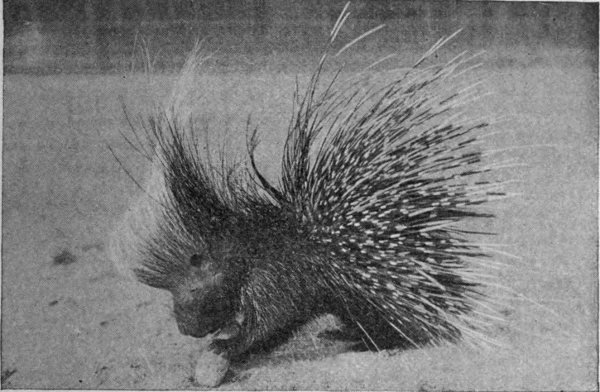
AFRICAN PORCUPINE.
The Capybara, (Hydrochaerus capybara), is the largest of all gnawing animals, and the most remarkable rodent in our collection. In form and size it suggests a large, gray, coarse-haired pig. It is a water-loving animal, of the American tropics, and lives on the grassy banks of the delta of the Orinoco, and similar places farther south. It is one of the best divers of all land animals, and when attacked on land always plunges into the water and dives for about 100 feet before coming to the surface. It is strictly a vegetable feeder, and its flesh is very palatable food. It takes kindly to captivity, and in disposition it is very affectionate.
The Agouti, (Dasyprocta), is to the jungles of South America as the cotton-tail rabbit is to the forests of the eastern United States; but structurally it is not closely related to the members of the Rabbit Family. It lives wholly on the ground, in dense cover, and is very difficult to shoot. As a rule, it is impossible for dogs to catch it because it runs so swiftly through the dense cover that they cannot keep it in sight. There are a number of species, varying in color from dark brown to golden yellow.
112
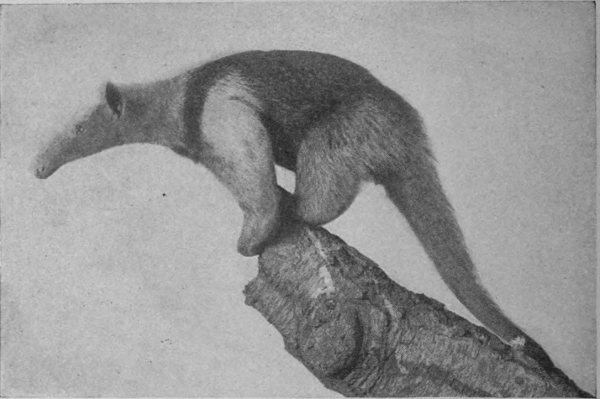
TAMANDUA.
The Toothless Mammals.—The Order Edentata contains some of the most odd and remarkable mammals that ever find their way into a zoological park. They are the armadilloes, ant-eaters and sloths. Without exception, they are delicate feeders, and difficult to keep for long periods, and for this reason the number on exhibition constantly varies between half a score and none at all! As far as it is possible, the species named below will be kept on exhibition; but these rarities are difficult to obtain, and the supply must be regarded as intermittent.
The Nine-Banded Armadillo, (Tatu novemcinctum), of southern Texas and Arizona, and southward, is the only edentate found in the United States. Its total length, from nose to tail-tip, is about 26 inches, and it is about as large as an opossum. Its strangest feature is the horny shell, with 9 jointed bands in the middle, which Nature has designed for the animal’s protection. It lives in burrows in the earth, and in a wild state it feeds on a mixed diet of worms, ants, snails, beetles, grasshoppers and other insects.
The Six-Banded Armadillo, (Dasypus sexcinctus), of South America, has a much stronger and more bony shell than the preceding species, but very similar habits. The Three-Banded Armadillo, (Tolypeutes tricinctus), is the most remarkable of all—and also the most difficult to obtain. It is able to convert itself into a round ball covered at all 113 points by bony armor, and remarkably well protected from the teeth of predatory animals.
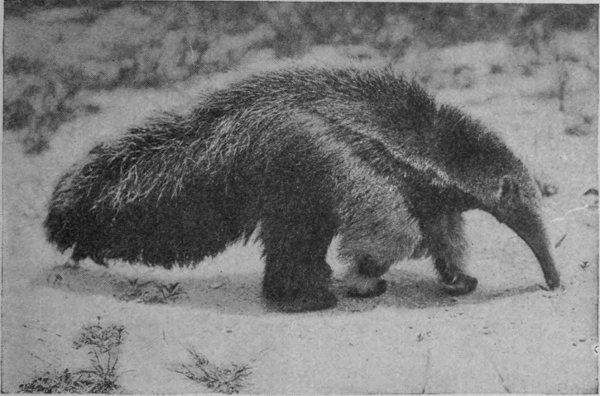
GREAT ANT-EATER.
The Great Ant-Eater, (Myrmecophaga jubata).—This is a very remarkable animal, and usually is to be found alive in the Small-Mammal House. Its anatomical peculiarities are apparent at a glance. Its toothless jaws are enormously elongated, and taper to a rounded point, where the mouth opens as a narrow slit, scarcely large enough to admit the large end of a lead pencil. Its front claws are large and strong, for use in tearing open ant-hills and decayed logs; and the creature walks upon them as if club-footed. Its tail is long and thick, and bears a luxuriant brush, of coarse, wavy hair more than a foot long. The negroes of British Guiana gravely inform travellers that the Ant-Eater uses his bushy tail as a broom, with which he sweeps up ants in order to devour them wholesale.
As may be inferred from the total absence of teeth, this strange creature lives chiefly upon crawling insects. In devouring the dreadful ants, which in a South American forest often make life a burden, it helps to preserve the balance of Nature. In captivity the food of this animal consists of milk, raw eggs and ground meat. In taking its food it thrusts out from four to eight inches of round, wormlike tongue, which contrary to many published statements, is not covered with sticky saliva.
114
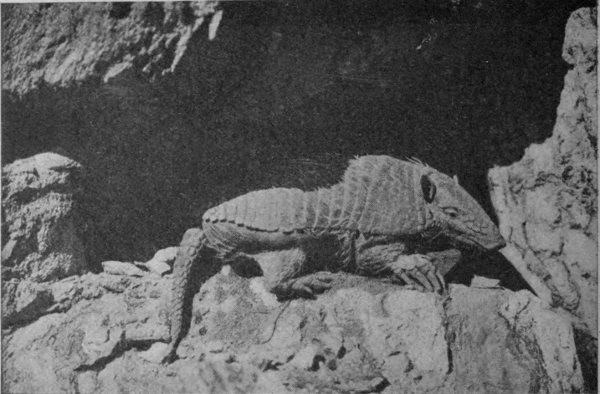
SIX-BANDED ARMADILLO.
The Tamandua, (Tamandua tetradactyla), is a smaller ant-eater than the preceding species, of tree-climbing habits, with a proportionately shorter head, no long hair on its tail, and extremely large front claws. It is found in Venezuela, the Guianas, Brazil, and in fact that greater portion of the region of tropical forests on this continent south of Mexico. Its tail is prehensile, or grasping, and in climbing is used almost constantly.
The Sloths are the slowest, the most helpless and defenseless of the edentates. They subsist chiefly upon leaves, they climb no more swiftly than a man, and they escape their enemies through the resemblance of their pelage to the rough bark of the tree-trunks among which they live. They have a few teeth, but none for defense, and their claws are of use only in climbing, except that they can pinch with them.
Two species of Sloth are occasionally seen in the Zoological Park, but usually in the Primate House, where the high temperature is better suited to their needs.
The Three-Toed Sloth, (Bradypus tridactylus), is the one with a brown “saddle-mark” of short hair in the middle of its back. The remainder of its pelage is coarse and long, and its greenish tint renders it a close imitation of algae-covered tree-bark. The Two-Toed Sloth, (Choloepus hoffmani), is much larger than the preceding, and lives longer in captivity. Four fine adult specimens occupy a large cage 115 at the Primate House, where they seem to be fully acclimatized. In form and habit they are remarkable animals, and well worthy of close attention.
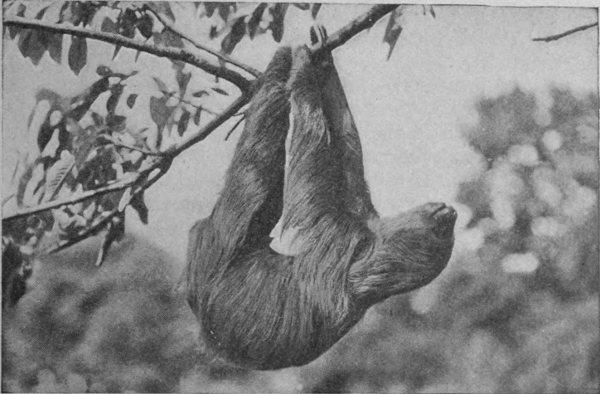
TWO-TOED SLOTH.
The Egg-Laying Mammals.—For several months there were exhibited here two Echidnas—of all small mammals ever seen alive in New York the most wonderful. The Echidna comes from Australia, the home of remarkable types of animals, and belongs to the lowest Order of Mammals, (Monotremata). Like its distant relative, the duck-billed platypus, it reproduces by laying eggs! Its back is covered with short but very thick spines, and its nose is a long, slender beak, absolutely unique. Other examples of this species will be exhibited whenever possible.
THE PUMA AND LYNX HOUSE, No. 33A.
Near the Small-Mammal House (No. 35) will be found a log cabin with its entire front opening into two wire-covered yards. The interior of the building is provided with sleeping-dens in which the occupants of the two enclosures can keep dry and warm. This installation is for lynxes, but half of it is occupied by pumas. Already it has fully proven the desirability of keeping lynxes and pumas constantly in the open air, and without artificial heat. To lynxes especially there is nothing more deadly than a well-heated room, indoors.
116
The Puma, (Felis concolor), is described in the section relating to the Lion House, where other Pumas are exhibited (page 78).
Of the Lynxes, we have two well-defined species, and one subspecies. The Canada Lynx, (Lynx canadensis), is well represented in the southern compartment of the Puma House, where a fine adult pair has become acclimatized. This is the Loup Cervier of the French Canadians, and it is truly the Lynx of Canada and the subarctic North. It has no spots on its body, and its pelage is a cold pepper-and-salt gray color. Its feet are large and heavily furred, and it has a long, black hair-pencil on the tip of each ear. A large specimen stands 18 inches high, and weighs 22 pounds. The food of the American Lynxes generally consists of hares and rabbits, ground birds of all kinds, and anything else that can be caught and killed, except porcupine. To man they are not “dangerous animals.”
THE BURROWING MAMMALS, AND OTHERS, No. 42.
North America is wonderfully rich in species of gnawing animals, and the end is not yet. The investigations of our mammalogists are adding new species with a degree of rapidity and parallelism that is fairly bewildering.
It is the duty of the Zoological Society to do its utmost to increase as much as possible the sum total of knowledge of our largest Order of Mammals. Manifestly, however, it is impracticable to do more than place before visitors a reasonable number of well-chosen types, which shall represent as many as possible of the twelve Families, and also the genera most worth knowing.
The most serious obstacle in the way of anyone who attempts to exhibit collections of living rodents lies in the natural propensity of so many species to keep out of sight during the daytime. This is particularly true of the members of the Mouse, Pocket Gopher, and Pouched Rat Families, comprising about three hundred species in all. With very few exceptions, the whole matter of the exhibition of collections of living rodents is something new, and every step is an experiment. In the belief that even the most shy burrowing animals will appreciate abundant room, perfectly natural surroundings, plenty of food, and immunity from annoyance, and eventually fall into the habit of spending many of the daylight hours above ground, as do prairie-dogs, 117 the Society has constructed a series of fifteen small yards, each 10×20 feet, bounded by walls going down to bedrock, and enclosed above by a box-like arrangement of very light wire-netting 5 feet high. The ground is chiefly undisturbed soil of a firm and gravelly nature, thoroughly drained, and all earth filling has been tightly rammed into place to prevent caving in the burrows. Above ground, each yard contains weathered rocks, stumps, and hollow logs in abundance.
In these fifteen yards, each of which will hold specimens of at least two or three species, will be placed strongly marked types of those families whose representatives are most numerous in North America, and also the least known, only a few of which may be mentioned here.
The Sewellel Family, (Aplodontidae), contains five or six species and is of unusual scientific interest. The Sewellel, Mountain Beaver, Farmer or “Showt’l” (Aplodontia rufus and major), is an animal of the size and general appearance of a large, short-tailed muskrat. It inhabits a few localities in remote regions in the mountain-valleys of northern California, Oregon, Washington, and southern British Columbia. It feeds like a beaver, climbs bushes four feet high, burrows in wet ground, and fights like a little fiend when brought to bay. Notwithstanding the size of this animal, it is very seldom seen, and is but little known.
The Squirrel Family, (Sciuridae), is large (one hundred and forty-one species), very interesting, and entitled to much consideration. In the present enclosure will be shown in summer many species of interesting ground squirrels, chipmunks, and marmots. In winter all the squirrels, save one or two hardy native species, will be found in the Small-Mammal House, near by.
The Rabbit Family, (Leporidae), is one of the most difficult to install and exhibit. Its members are large and showy, but for several reasons it is very difficult to keep them on exhibition in captivity. In time, however, all four of the great groups—Rabbit, Varying Hare, Jack Hare, and also the Pikas, forming the allied Family Ochotonidae—will be represented by specimens.
Just what can be accomplished satisfactorily with the most interesting members of the Jumping Mouse, Pouched Rat, and Pocket Gopher Families, remains to be determined by trial. If they can be induced to show themselves to 118 visitors, during daylight hours, they will be kept for exhibition; otherwise not. At present, some examples of these species can be seen in the Reptile House.
In Winter.—In the temperate zone, when “winter comes to rule the varied year,” all the burrowing animals must retire to their burrows, live upon their buried stores of winter food, and hibernate until spring. The tropical species do not know how to hibernate, and therefore they must be taken indoors, or they perish.
In order that our native species of rodents may be seen all winter, and that the tropical species may be kept alive, nearly all the animals that in summer live in the Burrowing Mammal Quarters are removed in autumn to the well-warmed Small-Mammal House. It also happens that in summer a few of the small carnivores, and all armadilloes, are kept in these Quarters.
In addition to the rodents which it is practicable to exhibit in these enclosures, the summer season will find some of them occupied by certain especially interesting species which need the soil of Mother Earth as well as sunlight and air. Here will be found the Armadilloes, the Nasuas, the Raccoon Dogs, the Swift Foxes and a few others, which in winter belong in the Small-Mammal House.
THE PRAIRIE-DOG VILLAGE, No. 41.
The Western Prairie-“Dog,” or Prairie Marmot, (Cynomys ludovicianus).—Occupying a conspicuous hill-top near the Small-Deer House, and overlooking the Wild-Fowl Pond, is a circular enclosure, 80 feet in diameter, surrounded by an iron fence with an overhang, with walls going down to bedrock. This contains about fifty fat and jolly little Prairie Marmots, one-half of which are the gift of a Montana ranchman, Mr. Howard Eaton. The soil of the enclosure has never been disturbed, and there is no danger that the little creatures ever will be smothered in their burrows, as frequently happens in earth that has once been dug up and filled in again.
Owing to its optimistic and even joyous disposition, the Prairie-“Dog” has many friends, and “happy as a Prairie-'Dog’” would be a far better comparison than “happy as a king.” His cousin, the woodchuck, has the air of being perpetually “in the dumps,” but the Prairie-“Dog”—never. His so-called bark is really a laugh, and his absurd little tail 119 was given to him solely as a means of visible expression of good nature. But he has his enemies and detractors. The coyote loves his plump and toothsome body; the “granger” hates him for the multitude of his holes, and puts spoonfuls of poisoned wheat into his burrow.
THE BEAR DENS, No. 37.
The bears of the world form a very interesting group; and when its representatives are properly installed—in large, open yards, with abundant sunlight, fresh air and room for exercise—they develop finely, live happily, and furnish endless entertainment. Under proper conditions, bears are cheerful animals, full of the playful spirit that robs captivity of its chief terror. To confine large bears singly, in small cages, or in wet-floored, high-walled dungeons, or in the unspeakable “pits” of mediaeval type, is a sin against Nature. It is to be noted, however, that small and timid bears, like Ursus japonicus, are better off in small cages than in the very large ones; and it is for this reason that eight small dens have been provided, opposite the original series.
The Zoological Society has put forth considerable effort in constructing a series of nine large Bear Dens which provide ideal conditions for their inmates. Bears do not need buildings! Their habits call for large, open yards, properly situated, with snug and dry sleeping-dens attached, to which they can retire whenever they wish. To them, masonry walls are worse than useless, for they cut off sunlight and promote dampness; but rocks and trees upon which to climb are very beneficial. In warm weather, all bears are fond of bathing, and a bathing pool in each cage is very necessary.
It is cruelty to animals for visitors to throw peanuts, or food of any kind, into our bear dens; and it is strictly forbidden. All persons who do not wish to be reprimanded in public, or arrested, are advised to refrain from it. Teasing with food always irritates bears, sets them to fighting, spoils their dispositions and renders them dangerous to the keepers who have to go in with them! All visitors who are law-abiding, and friendly to the Zoological Society, are requested to assist the keepers and policemen in preventing lawless persons from throwing food into the bear dens. A stern reprimand often prevents serious trouble.
120
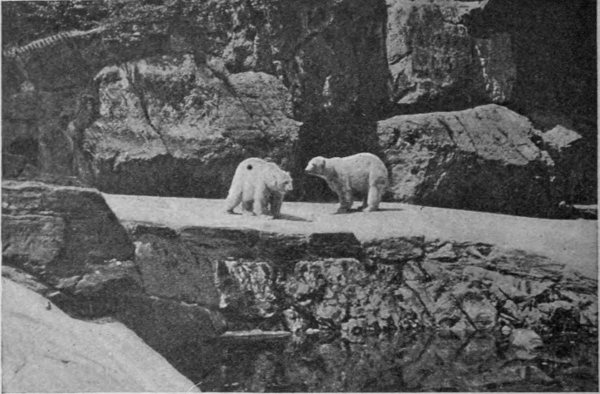
POLAR BEARS. Showing a portion of their den and pool cut from the solid rock.
The bears of North America form four well-defined groups, as follows:
The Polar Bear.
The Grizzly Bear.
The Alaskan Brown Bears.
The Black Bears, and their allies.
Up to this date (April 1, 1913), 24 species and subspecies have been described, and it is reasonably certain that much more work remains to be done on the members of this group of animals before the status of each valid and invalid species will be rendered thoroughly clear.
The most noteworthy species are as follows:
THE MOST IMPORTANT SPECIES OF NORTH AMERICAN BEARS.
Ursus maritimus, (Desm.), Polar Bear. Arctic regions generally.
The Brown Bears. Ursus middendorffi, (Merriam), Kadiak Bear. Kadiak Is., Alaska.
Ursus dalli, (Merr.), Yakutat Bear. Yakutat Bay, Alaska.
Ursus eulophus, (Merr.), Admiralty Bear. Admiralty Is., Alaska.
Ursus gyas, (Merr.), Peninsula Bear. Portage Bay, Alaska Peninsula.
The Grizzly Bears. Ursus Horribilis, (Ord.), Grizzly Bear: Silver-Tip. Wyoming and Utah to Alaska.
Ursas horribilis horriaeus, (Baird), Mexican Grizzly. Southwestern New Mexico.
Ursus richardsoni, (Swainson), Barren-Ground Grizzly. Great Slave Lake region, and Barren-Grounds.
The Black Bears. Ursus americanus, (Pallas), Black Bear. Eastern North America.
Ursus luteolus, (Griffith), Louisiana Bear. Louisiana and Texas.
Ursus floridanus, (Merr.), Everglade Bear. Florida.
Ursus emmonsi, (Dall), Glacier Bear. St. Elias Alps, Yakutat Bay.
Ursus kermodei, (Hornaday), Inland White Bear. Northwestern British Columbia.
121
The Polar Bear, (Ursus maritimus).—In nearly every collection of living bears the individuals of this species are the most showy and attractive. Their white coats quickly catch the eye of the visitor, and whether young or old, they are generally the most active and playful of all captive bears. In cold weather, when other bears lie in the sun, or, if permitted, curl up in the straw of their sleeping dens, the Polar Bear will disport himself in the freezing cold water of his swimming pool, and joyously play with a cake of ice until the sight of it makes one shiver.
The Polar Bear Den is situated at the north end of Rocking-Stone Hill, about two hundred feet from the north end of the main series of Bear Dens. It is reached by descending the steps leading toward the Beaver Pond, and turning to the right. From the Rocking-Stone Restaurant, the Polar Bears are quickly reached by descending the hill toward the north.
Although the Polar Bear inhabits practically the whole of the Arctic Ocean and its numerous islands, it is by no means the most northerly warm-blooded mammal. Nansen found fox tracks at 85° N., but the most northerly bear observed was on the 84th parallel. The favorite home of this animal is the edge of the great polar ice cap, where Neptune and the “Frost King” wage continuous warfare. He seldom ventures more than a day’s journey inland, on any shore. 122 In winter, as the edge of the ice-pack moves southward, and in summer when it retreats northward, he follows it in order to keep in touch with the ringed seals and walrus that also go with it.
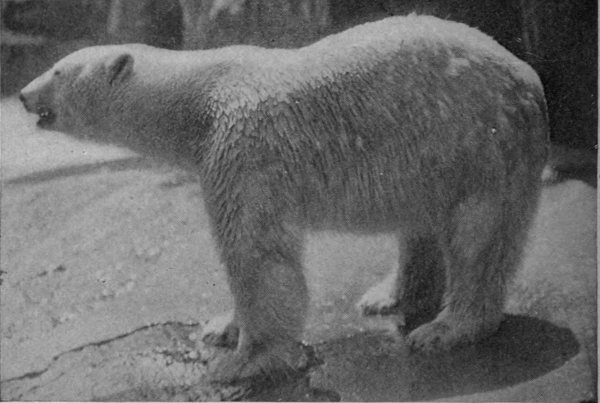
POLAR BEAR “SILVER KING.”
The power of the Polar Bear to resist ice-cold water—nay, even to enjoy it—may fairly be regarded as one of the wonders of Nature. On the coast of Alaska this strange creature will plunge into the Arctic Ocean and swim miles from shore, through tossing fields of broken ice, and wherever the mother leads, her cubs follow.
In the Autumn of 1910, the sealing steamer “Boethic” arrived at New York bringing two adult Polar Bears that were captured in the summer of that year by Mr. Paul J. Rainey. Both animals were presented to the Zoological Society, and the largest one called “Silver King” occupies the cage that was specially built for the polar bears, and the female is exhibited in very comfortable quarters, built for her near that installation. Owing to their savage temper neither of these bears ever can be kept with other bears, nor can any keeper ever enter the cage of either. “Silver King” weighs 880 pounds and is probably the largest Polar Bear ever captured alive and unhurt. While the female is not as large as “Silver King,” she is in every way as perfect a specimen.
The Yakutat Bear, (Ursus dalli).—In 1899, we received from Hudson Lake, Copper River District, Alaska, two 123 young Alaskan Brown Bears which for some time we believed would prove to represent the species found on Kadiak Island. In this belief they were for a time labeled as Kadiak Bears, (U. middendorffi), and so entered provisionally in previous editions of the Guide Book. The maturity of the animals has proven that this supposition was erroneous. The extremely short and thick muzzle of the adult male proves conclusively that they are not identical with the long-skulled species of Kadiak. This interesting pair, absolutely identical in color with middendorffi, are now identified, pending further revisions of our Urisdae, as Ursus dalli.
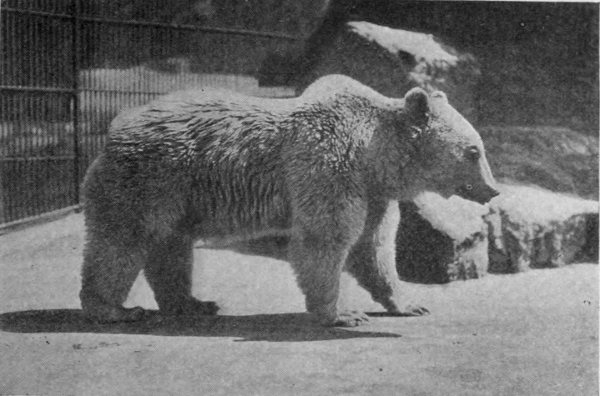
SYRIAN BEAR.
This species, and the two following, well represent the group of big Alaskan Brown Bears, which are quite distinct from the grizzlies and blacks. They are characterized by their great size, high shoulders, massive heads, shaggy brown pelage, and large claws. They live chiefly upon salmon, which they catch from the small streams, but they also devour great quantities of grass.
The Peninsula Bear, (Ursus gyas), of Moeller Bay, well down the Alaskan Peninsula, may at once be recognized by its light brownish-yellow color, and its great size for a bear born in 1904. Its claws are of enormous thickness.
This animal is now beyond doubt one of the two largest bears in captivity, his only rival being in the Zoological Park at Washington.
124
The Admiralty Bear, (Ursus eulophus), represents a large species originally discovered on Admiralty Island, southern Alaska. Its dark brown color is very much like that of the Yakutat and Kadiak bears.
The Grizzly Bear, or “Silver-Tip Grizzly,” (Ursus horribilis).—The rapid disappearance of this species from the United States renders all living examples of it specially interesting.
Of all bears, the Silver-Tip Grizzly is the most savage and dangerous. He is easily angered, and when wounded or harried not only becomes furiously vindictive, but he also possesses a degree of courage which renders him a dangerous antagonist. As a general thing, a Grizzly Bear, like a lion or tiger, will run as soon as he discovers the presence of his only enemy—man; but if he is wounded or cornered—or thinks he is cornered—he assumes the aggressive, without an instant’s delay. Unfortunately, the largest Silver-Tip Grizzlies ever killed have been too far from scales to make it possible to weigh them.
The most interesting specimen of the Rocky Mountain Silver-Tip now on exhibition is a dark-colored and very handsome specimen, named “Engineer,” obtained in Meeker, Colorado, by Professor Henry F. Osborn, and presented to the Society by the Engineers’ Club of New York City. The color of this individual is darker than the most common type of the Silver-Tip, which is sometimes almost as gray as a badger.
A very beautiful male Silver-Tip, from Wyoming, is much lighter in color than the Colorado specimen. Its face and head are so light-colored it would be called by Rocky Mountain hunters a “Bald-Faced” Grizzly. A third specimen was obtained for the Society at White Horse, Yukon Territory, in 1905, and its development will be watched with much interest. Throughout the Rocky Mountain region the “Silver-Tip” and the “Grizzly” are identical; but the color of the species varies considerably.
In a wild state Grizzly Bears live on berries and fruits of all kinds available, succulent roots, grubs, carrion if it comes handy, and live game if it can be killed. In the cattle-growing states bordering the Rocky Mountains, owing to their cattle-killing propensities, a bounty of from twelve to fifteen dollars per head is paid for their destruction.
The Black Bear, (Ursus americanus).—Until quite recently all black bears in North America were referred to a 125 single species, with the type of which most persons are familiar. Even during the last twenty years living representatives of the Black Bear group have been found in nearly every state and territory of the United States, and also in northern Mexico, Labrador, Province of Quebec, Alberta, Assiniboia, British Columbia, Alaska, and the Mackenzie River basin. Our collection contains Black Bears representing several widely separated localities.
The Spectacled Bear, (Ursus ornatus).—After ten years of constant effort the Zoological Park finally acquired late in 1910, a fine male specimen of the very rare and little known Spectacled Bear of the Andes of Ecuador and Peru. This zoological prize was procured for us in Quito, by Mr. Edgar Beecher Bronson (Author of “In Closed Territory,”) and by him presented to the Society. “Frederico” is distinguished by a glossy jet-black coat, very small ears, long feet and a large imperfect circle of white around each eye, with white bands down the cheeks and throat. In size it matches a small American black bear. As soon as the new bear dens are finished, this animal will be removed from the Small-Mammal House to one of them. If this species was ever before exhibited in North America, we have never heard of it.
The Andean Black Bear, (Ursus ornatus thomasi), from Southern Columbia, South America, is a subspecies of the spectacled bear, with no “spectacles” around its eyes, and no white markings save under its chin and throat. This specimen is smaller than the one from Quito. Practically nothing is known of the habits of these two species.
The Brown Bear of Europe, (Ursus arctos), is represented by two specimens from Central Russia which bear a general resemblance to Rocky Mountain grizzlies. This is so striking that were they not labeled very few persons would suspect their European birth. They have the high shoulders and grizzly brown coat of the silver-tip, and in the Rocky Mountains would be considered good examples of Ursus horribilis.
This pair has bred four times and reared some very fine cubs.
The Syrian Bear, (Ursus syriacus), is well represented by a fine specimen from Trebizond, Asia Minor. This bear is of a pale yellow color, with very high shoulders, narrow head and smooth pelage. The Syrian bear represents “the bears of the Bible,” which appeared in punishment of the 126 children who were disrespectful to the prophet Elisha. Bears of this species are often trained to dance, and perform various tricks at command, and usually lead very miserable lives at the hands of gypsies and other bear specialists of nomadic habits.
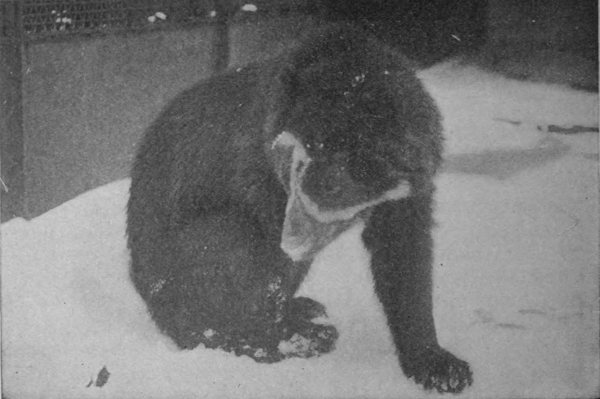
SPECTACLED BEAR.
The Hairy-Eared Bear, (Ursus piscator), a species very rarely seen in captivity, is represented by two fine specimens from the Altai Mountains, Central Asia. This animal is sometimes called, on account of its peculiar light brown color, the Isabella Bear. Its more correct name has been bestowed on account of its large and very hairy ears. It inhabits northeastern Asia, as far southwestward as the Altai Mountains. The fine pair exhibited were presented to the Society by Mr. Carl Hagenbeck.
The Himalayan Black Bear, (Ursus torquatus), is the handsomest of the four living species of black bears, and can easily be identified anywhere by three distinct characters, neither of which is possessed by any other black bear. They are, a pure white chin, long side-whiskers on the jaws and sides of the neck and very large ears. Up to this date the geographic range of this very interesting animal has been recorded as extending from eastern Persia through Beluchistan, Afghanistan, Assam, and South China to Formosa; but the three specimens exhibited were taken in northern Japan, where the existence of this species seems to be established beyond question.
127
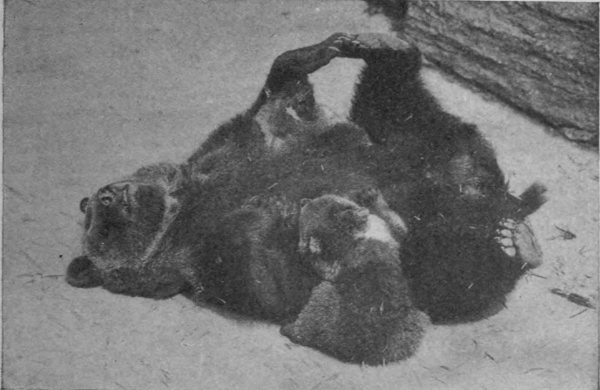
EUROPEAN BROWN BEAR. Two cubs are nursing.
The Japanese Black Bear, (Ursus japonicus), from northern Japan, is one of the smallest of living bears, being only slightly larger than the Malay sun bear. In general appearance it suggests a small edition of the American black bear. The first specimen exhibited at the Zoological Park was very good-natured, but all these received since are nervous and irritable, and also very timid.
The Sloth Bear, (Ursus labiatus), often called the Long-Lipped Bear, can be recognized as far as it can be seen by its shaggy mop of enormously long, black hair, its white muzzle, and its very long, white claws. It is a creature of many peculiarities. It inhabits India generally in forest regions. This is Kipling’s “Baloo.”
LIST OF BEARS IN THE ZOOLOGICAL PARK.
April 1, 1913.
2 Polar Bears Ursus maritimus from Ellesmere Land.
2 Yakutat Bears Ursus dalli “ Alaska.
1 Peninsula Bear Ursus gyas “ Alaska Peninsula.
1 Admiralty Bear Ursus eulophus “ Adm. Is., Alaska.
3 Kadiak Bears Ursus middendorffi “ Kadiak Island.
1 Kobuk Brown Bear Undetermined “ Kobuk River, AL
1 Grizzly Bear Ursus horribilis “ Colorado.
1 ““ ““ “ Yukon Terr.
1 ““ ““ “ Wyoming.
1 Spectacled Bear Ursus ornatus “ Equador.
1 Andean Black Bear Ursus ornatus thomasi “ Columbia, S. A.
1 Black Bear Ursus americanus “ Pennsylvania.
1 ““ ““ “ Virginia.
3 ““ ““ “ Alaska.
1 ““ ““ “ West Ontario.
1 ““ ““ “ Mexico.
1 Cinnamon Bear ““ “ Colorado.
1 ““ ““ “ Wyoming.
1 Syrian Bear Ursus syriacus “ Asiatic Turkey.
3 Brown Bears Ursus arctos “ Central Russia.
2 Hairy-Eared Bears Ursus piscator “ N. W. Mongolia.
1 Himalayan Black Bear Ursus torquatus “ Japan.
1 Japanese Bear Ursus japonicus “ Japan.
1 Sloth Bear Ursus labiatus “ India.
2 Yezo Bears Ursus ferox “ Yezo, Japan.
1 Malay Sun Bear Ursus malayanus “ Borneo.
36 specimens, representing 18 species.
128
The Malay Sun Bear, (Ursus malayanus), is the smallest bear in the world, also the ugliest and the most ill-tempered. When fully enraged, it sometimes barks like a dog. Its hair is very short and close, and its head and feet seem to be too large for its body. This species inhabits Borneo, Sumatra, the Malay Peninsula and Farther India. Two specimens will be found in the Small-Mammal House.
THE RACCOON TREE.
The Raccoon Tree.—A permanent installation for Raccoons has been established near the southern end of the Bear Dens, where its inmates will be near their plantigrade relatives. At the foot of the steps leading down from the Rocking Stone, a cedar-tree, forty feet in height, has been enclosed by an elliptical iron fence provided with a sheet-metal overhang which is not negotiable by any Procyon. Inside the fence is a dry yard, a pool of water for all purposes, and the trunk of the tree is surrounded by a rustic shelter house, divided into ten warm and dry compartments. Underneath the house is a clean and smooth wooden floor, on which the food is served.
The smooth, horizontal limbs of a cedar-tree are grateful and comforting to a dozing Raccoon, and the tree is not so high that the animals can climb beyond the visual power of the visitor.
THE BEAVER POND, No. 29.
Hidden away in the deep valley between high hills of virgin forest lies the Beaver Pond. The spot is so secluded, 129 so silent and primeval, that it seems like the heart of the Adirondack wilderness. Lying fairly in the lap of the granite hills is a three-acre oval of level swamp, which recently was full of woodland rubbish and choked by rank weeds. The seclusion of the spot, the splendid forest, the food-wood and the possibilities of the dam, all naturally suggested the beaver.
In order that the building of a dam by the beavers would not raise the water level so high as to flood the roots of a number of fine forest trees and destroy them, two feet of soil was taken out of the swamp, and at the same time a broad outlet was excavated. A fence of small iron bars, with an overhang, was designed to encircle an area of about three acres. Within the enclosure thus made, stand several large forest trees—chiefly oak, sweet gum, and maple—which have been protected by guards of wire and corrugated iron. The small maples, however, have been given over to the beavers, to cut down and use as food-wood and also in their dam-building operations.
The Beaver Colony in our pond is in good working order, and its display of work makes a highly satisfactory exhibit. The dam, about 40 feet long and 4 feet high, was built of poles and sticks which were cut, peeled, floated down and placed by the beavers, and pointed up with mud. There is a house 10 feet in diameter and 4 feet high, similarly constructed. Within the enclosure about twenty saplings and trees have been cut down by the beavers and used up for food and building materials.
For this colony the Society is indebted to Mr. Hugh J. Chisholm, who procured for it two specimens from Canada and three from Maine.
The American Beaver, (Castor canadensis), is a remarkable animal. In original thought it is equalled by few animals, and in industry by none. With the possible exception of the porcupine, it is the largest gnawing animal in North America, once was widely distributed, and its beautiful fur has been in demand ever since the days of the colonists. Unfortunately, the Beaver’s intelligence was directed chiefly to the building of dams, canals, and houses, and procuring an abundant supply of food-wood, rather than in providing itself with means of escape from its arch enemy—the man with a steel trap. Because of the constant demand for its fur, this animal has been so nearly exterminated throughout the United States that practically none remains save where 130 they are rigidly protected. At present the largest colonies known are those in the Yellowstone Park, although in Canada and the Northwest many still remain.
The most wonderful thing about the Beaver is the manner in which he builds dams, to make ponds deep enough for his timber-floating operations, and to afford him a submarine passage to his house. Give him a valley and a stream of water, and he will gladly make a pond out of whatever raw materials are at hand. He uses the four-foot sticks from which he has eaten the bark for food, and with these, and an abundance of mud, he will raise a good strong dam to a height of four feet, and a width on the ground of ten feet or more. The mud used is dug out of the bottom and sides of his pond, and carried, while swimming, between his paws, with his front feet holding it against his breast. The sticks used in the dam are thrust endwise into the mud on top of the dam, and the mud used is patted down with his fore feet. The tail is not used as a trowel, but in swimming it is the Beaver’s propeller.
In captivity the Beaver is not wholly a satisfactory animal. Like some human craftsmen, he positively declines to work under observation, and performs nearly all his tasks at night. He thinks nothing of gnawing down a tree a foot in diameter, and cutting its limbs into pieces which he can handle while swimming. If he can secure enough food-wood of kinds of his liking, he eats little else. Besides building dams to create ponds in which he can take refuge when hard pressed, he constructs canals, and houses for winter use. He also digs burrows into high banks; but his entrances to his various homes always are under water.
THE ECONOMIC RODENT-REPTILE COLLECTION.
As an answer to a frequent question—“Of what use are reptiles?”—a new collection has been installed in the Reptile House. It is supplied with descriptive labels, and serves several purposes. In the first place there is presented an elaborate series of the small gnawing animals, or rodents, a number of the species of which are highly injurious to the interests of agriculturists; secondly, the exhibition contains a large series of those species of snakes that prey upon the destructive rodents,—thus presenting for observation the serpents of marked economic value. Finally, the entire series stands as a clear demonstration of the perfect logic of 131 Nature in which the production of all animal life is carefully balanced; for a part of the exhibition is composed of representative species of mammals that, in turn, prey upon the serpents, thus keeping even the destroyers of the smaller injurious creatures within bounds!
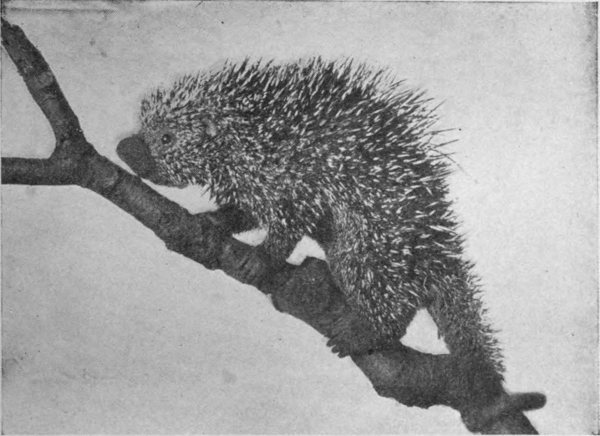
BRAZILIAN TREE PORCUPINE.
During the past two years the collection of rodents has been steadily growing in importance. The following is a list of the species on exhibition at the close of the year 1912:
132
RODENTS IN THE ZOOLOGICAL PARK.
HARES AND RABBITS (Leporidae)
Mexican Swamp Rabbit Lepus palustris.
Cotton-Tail Rabbit Lepus palustris mallurus.
Domestic Rabbits, various breeds (Nursery stock.)
SQUIRRELS AND MARMOTS (Sciuridae)
Thirteen-Lined Spermophile Spermophilus 13-lineatus.
Desert Spermophile Spermophilus leucurus.
Richardson Spermophile Spermophilus richardsoni.
Woodchuck Arctomys monax.
Prairie Dog Cynomys ludovicianus.
European Squirrel Sciurus vulgaris.
Mexican Squirrel Sciurus aureogaster.
Central American Squirrel Sciurus variabilis.
Cuban Squirrel Sciurus chrysurus.
Variable Squirrel Sciurus griseo-flavus.
Gray Squirrel Sciurus carolinensis.
Black Squirrel Sciurus carolinensis niger.
Fox Squirrel Sciurus ludovicianus.
White-Headed Squirrel Sciurus macrouroides.
Malabar Squirrel Sciurus malabaricus.
Chipmunk Tamicis striatus.
African Ground Squirrel Xerus capensis.
Flying Squirrel Sciuropterus volans.
BEAVERS (Castoridae)
American Beaver Castor canadensis.
KANGAROO RATS (Heteromyidae)
Kangaroo Rat Dipodomys merriami.
POCKET GOPHERS (Geomyidae)
Harsh-Coated Pocket Gopher Geomys hispidus.
DORMICE (Gliridae)
Squirrel-Tailed Dormouse Myoxus glis.
Lesser Dormouse Myoxus dryas.
English Dormouse Muscardinus avellanarius.
MICE AND RATS (Muridae)
Domestic Mouse—Unusual Color Phases Mus musculus.
Japanese Waltzing Mouse Mus musculus.
Black Rat Mus rattus.
Black-and-White Rat Mus norwegicus.
Gray-and-White Rat Mus norwegicus.
Porcupine Mouse Acomys cahirinus.
Egyptian Gerbille Gerbillus pyramidum.
Muskrat Fiber zibethicus.
Cotton Rat Sigmodon hispidus.
JERBOAS (Dipodidae)
Greater Jerboa Dipus aegyptius.
COYPU AND SPINY RATS (Octodontidae)
Coypu Rat Myocastor coypu.
Hutia: Cuban Tree Rat Capromys pilorides.
Short-Tailed Hutia Capromys browni.
PORCUPINES (Hystricidae)
Canada Porcupine Erethizon dorsatus.
Brazilian Porcupine Sphingurus prehensilis.
African Porcupine Hystrix cristata.
VISCACHAS AND CHINCHILLAS (Chinchillidae)
Viscacha Lagostoma trichodactylus.
AGOUTIS (Dasyproctidae)
Golden Agouti Dasyprocta agouti.
Gray Agouti Dasyprocta prymnolopha.
CAVIES (Caviidae)
Domestic Cavy Cavia porcellus.
Capybara Hydrochaerus capybara.
Patagonian Cavy Dolichotis patagonica.
133
MUTE AND TRUMPETER SWANS.