GENERAL STATUS OF THE ZOOLOGICAL PARK.
Reading edition
Origin.—The New York Zoological Park originated with the New York Zoological Society, a scientific body incorporated in 1895, under a special charter granted by the Legislature of the State of New York. The declared objects of the Society are three in number—“A public Zoological Park; the preservation of our native animals; the promotion of zoology.” The Society has enrolled among its various classes over 2,000 members.
Henry Fairfield Osborn is the President of the Society. The affairs of the Society are managed by a Board of Managers of thirty-six persons, which meets three times each year. The planning and general development of the Zoological Society is in the hands of an Executive Committee of eight members, as follows: Madison Grant, Chairman; Percy R. Pyne, Samuel Thorne, William White Niles, Watson B. Dickerman, Wm. Pierson Hamilton, Frank K. Sturgis, Lispenard Stewart and Henry Fairfield Osborn, ex-officio. Madison Grant, the Chairman of the Executive Committee, is also Secretary of the Society, and his office is at No. 11 Wall Street. Dr. William T. Hornaday is the Director and General Curator of the Zoological Park, and his office is now located in the Administration Building on Baird Court. The address is 185th Street and Southern Boulevard. The Society assumed control of the grounds on July 1, 1898, and began the first excavation, for the Bird House, on August 11th. The Park Department began work, on the Wild-Fowl Pond, on August 29, 1898.
Sources of Income.—The funds devoted to the development of the Zoological Park have been derived from the following sources:
1. From the Zoological Society, obtained by subscriptions from private citizens—funds for plans, for the erection of buildings, aviaries, dens and other accommodations for animals; and for the purchase of animals.
2. From the City of New York—by vote of the Board of Estimate and Apportionment—funds for the construction of walks, roads, sewers and drainage, water supply, public comfort buildings, entrances, grading, excavating of large ponds and lakes, annual maintenance, and also for animal buildings.
14
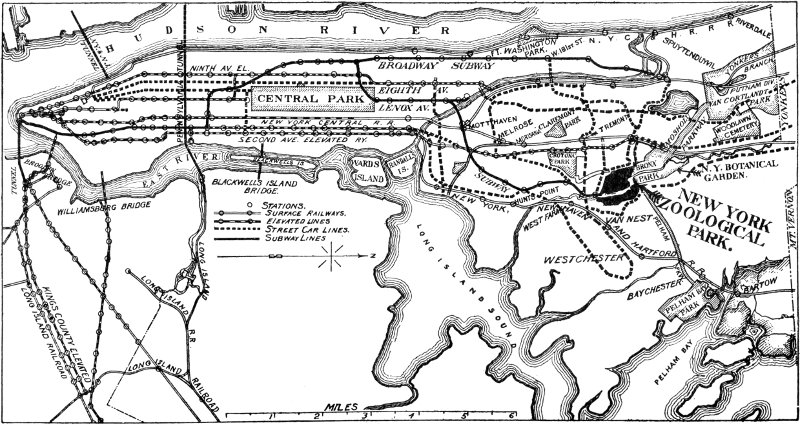
SKETCH MAP SHOWING LOCATION OF ZOOLOGICAL PARK.
15
The Zoological Society has expended, of its own funds, for plans, construction and live animals, over $641,000. This sum has been derived from its special subscription fund, and from the annual dues and fees of its members.
Privileges.—Because of the fact that the Zoological Society has undertaken to furnish all the animals for the Zoological Park, the City of New York has agreed that all the revenue-producing privileges of the Park shall be controlled by the Society. All net profits derived from the restaurants, boats, refreshments, riding animals, the sale of photographs, books, etc., and all admission fees, are expended by the Society in the purchase of animals for the Park. It is well that visitors should know that all net profits realized in the Park go directly toward the increase of the animal collections.
The Society maintains a supply of boats for hire, and riding animals of various kinds for the amusement of children.
Location.—The Zoological Park is the geographical center of that portion of Greater New York now known as Bronx County. From east to west it is half-way between the Hudson River and Long Island Sound, and from north to south it is midway between the mouth of the Harlem River and Mount Vernon. From the City Hall to the Reptile House the distance is eleven miles. The distance by automobile from the Central Park Plaza to the Concourse Entrance is 9½ miles. The Northwest Entrance is about half a mile from Fordham station on the Harlem Railway.
The area of the Park is 264 acres, divided as follows:
Land area west of the Boston Road 150 acres.
Land area east of the Boston Road 80 “
Bronx Lake 25 “
Lake Agassiz 5½ “
Aquatic Mammals’ Pond, Cope Lake and Beaver Pond 3½ “
Total area 264 acres.
16
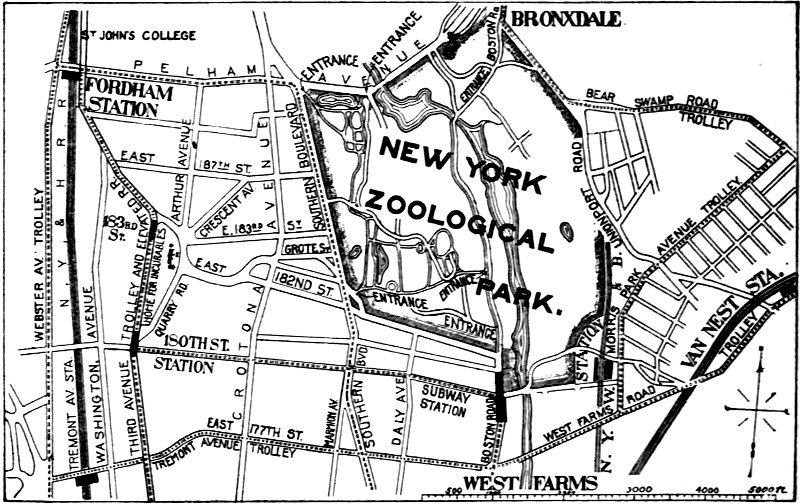
SKETCH MAP OF THE ZOOLOGICAL PARK AND VICINITY.
MEANS OF ACCESS.
Via the Subway, to the Boston Road Entrance.—The terminus of the eastern branch of the Subway, at “180th St., Zoological Park,” lands visitors at the southeastern entrances to the Zoological Park, at West Farms. Visitors from points below 96th Street must be careful to board the “Bronx Park” trains, and not the “Broadway” trains.
Routes for Automobiles or Carriages.—Via Central Park, Lenox Avenue, Macomb’s Dam Bridge and Jerome Avenue or Grand Concourse to Pelham Avenue, thence eastward to the Concourse Entrance, where motor cars and carriages are admitted to the Park.
Via the Third Avenue Elevated.—The Third Avenue Elevated Railway has been extended to Bedford Park, and visitors coming to the Zoological Park on it or on the Harlem Railroad should alight at Fordham Station, from which the northwest entrance is half a mile distant, due eastward, on Pelham Avenue, via the Union Railway surface cars.
Surface Cars.—The Southern Boulevard and the Zoological Park Cars of the Union Railway now run to both the Crotona (Southwest) Entrance and the Fordham Entrance. The Crosstown cars of the same line intersect the Southern Boulevard three blocks south of the Crotona Entrance.
17
ADMISSION.
Free Admission.—On all holidays, and on Sunday, Tuesday, Wednesday, Friday and Saturday, the Zoological Park is open free to the public.
Pay Admission.—On every Monday and Thursday, save when either of those days falls on a holiday, all members of the Zoological Society who surrender coupons from their membership tickets, and all other persons holding tickets from the Society, will be admitted free. All other persons seeking admission will be admitted on payment of twenty-five cents for each adult, and fifteen cents for each child under twelve years of age. Tickets are sold only at the entrance gates.
Holidays on Pay Days.—Whenever a legal holiday falls on a Monday or Thursday, admission to the Park will be free on that day.
Hours for Opening and Closing.—From May 1st to November 1st the gates will be opened at 9 A. M. daily, and closed half an hour before sunset. From November 1st to May 1st the gates will open at 10 A. M.
Entrances, Walks, etc.—The portion of the Zoological Park situated west of the Boston Road has been enclosed. Access to this area is provided by six entrances, one situated at each corner—one on the Boston Road and one at the bridge on Pelham Avenue. The latter is a carriage entrance for visitors wishing to drive to the north end of Baird Court. From all these entrances broad walks lead into the Park and through it, reaching all the collections of animals now installed.
Carriage Roads.—The only wagon road which enters the central portion of the Park now occupied by animals is the Service Road, which enters from the Southern Boulevard, at 185th Street, and runs eastward, to the Service Building, Reptile House, Bear Dens, and Rocking Stone Restaurant.
This road is for business purposes only, and is not open for the vehicles of visitors. It is utterly impossible to admit carriages to the center of the Park, save those of officers entering on business, and visitors must not ask for exceptions to this very necessary rule.
Automobile and Carriage Entrance.—A fine public carriage road and concourse, leading from Pelham Avenue Bridge and to the upper end of Baird Court, was completed in 1908. This drive is open to carriages or motors, daily, and it affords easy access to the most important group of buildings. It is subject to the same regulations as all other entrances, except that carriages and automobiles are admitted.
18
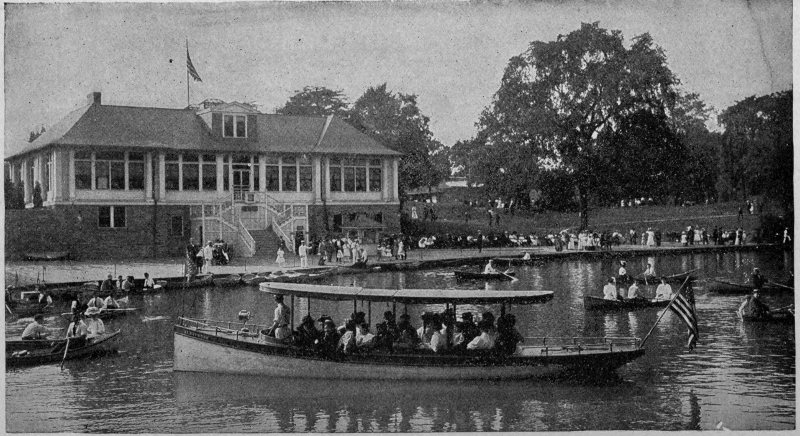
THE BOAT HOUSE, BRONX LAKE.
19
The Boston Road, which runs through the Park from south to north, near the western bank of the Bronx Lake, is open at all hours. It has recently—and for the first time—been finely improved by the Park Department for the Borough of the Bronx, and a drive through it affords a fine view of the eastern side of the Buffalo Range, and the finest portion of the heavy forest of the Zoological Park.
As a matter of course, the ranges of the buffalo, antelope, deer, moose, and elk, are in full view from the Kingsbridge Road and Southern Boulevard, and the Zoological Society has planned that the view from those avenues shall be left open sufficiently that the herds may be seen to good advantage.
The Rocking Stone Restaurant, No. 46, has been designed to serve all the purposes that its name implies. It contains dining-rooms in which full meals may be obtained, lunch-rooms wherein choice food will be served at popular prices, and in the basement, toilet-rooms will be found.
The Service Building, No. 28.—Near the Reptile House, and at the geographical center of the enclosed grounds, is situated a building which contains the Bureau of Administration of the Zoological Park. Here will be found the offices of the Chief Clerk, several other Park officers, and the workshops and storerooms.
Children lost in the Park, and property lost or found, should be reported without delay at the Chief Clerk’s office in this building. The telephone call of the Zoological Park is 953 Tremont.
Wheeled Chairs.—By persons desiring them, wheeled chairs can always be obtained at the entrances, by applying to gatekeepers, or at the office of the Chief Clerk, in the Service Building. The cost is 25 cents per hour; with an attendant, 50 cents per hour.
Arrangement of Collections.—Inasmuch as the physical features of the Zoological Park grounds were important factors in locating the various collections of animals, a perfect zoological arrangement was impossible. The existing plan represents the limit of acceptable possibilities in grouping related animals.
20
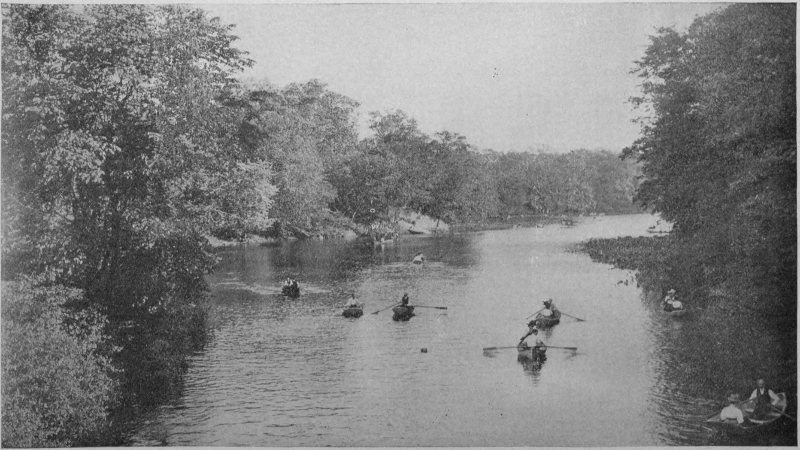
BOATING ON BRONX LAKE.
21
The entire southern and western sides of the Park are exclusively devoted to the Hoofed Animals, in addition to which other members of that Order will be found at the Elephant and Small-Mammal Houses. The Carnivorous Animals will be found at the Lion House, Wolf and Fox Dens, Small-Mammal House and Bear Dens. The Birds are in two groups; one in the lower end of Bird Valley, and the Large Bird-House on Baird Court; the other around the Wild-Fowl Pond, south of the Wolf Dens.
The existence of six entrances to the Park renders it impossible to lay out an all-embracing “tour” for the visitor, and develop the Guide Book accordingly. The various collections will be handled in zoological groups, but the various groups cannot follow each other in zoological sequence. The table of contents and a comprehensive index will render each item of the subject matter quickly available.
PHYSICAL ASPECT OF THE GROUNDS.
The extreme length of the Park from north to south is 4,950 feet, or 330 feet less than one mile; and its extreme width is 3,120 feet, or three-fifths of a mile. Roughly estimated, one-third of the land area is covered by heavy forest, one-third by open forest, and the remaining third consists of open meadows and glades. The highest point of land in the Park is the crest of Rocking Stone Hill, the elevation of which is 94.8 feet above sea level.
Topography.—Speaking broadly, the Zoological Park is composed of granite ridges running from north to south. In many places their crests have been denuded of earth by the great glacier which once pushed its edge as far south as New York City. In the valleys lying between these glacier-scraped ridges, great quantities of sandy, micaceous soil have been deposited; but in one spot—the Wild-Fowl Pond—what was once a green, glacial lake fifteen feet deep, presently became a vast rock-walled silo filled with vegetable matter and a trembling bog of peat. Everywhere in the Park glacial boulders of rough granite or smoothly rounded trap-rock, varying in size from a cobble-stone to the thirty-ton Rocking Stone, have been dropped just where the warm southern sun freed them from the ice. The Park contains thousands of them, many of which have been removed from walks and building sites only with great labor.
22
In three of the four principal valleys of the Park, bogs have been converted into ponds, and in the largest and deepest of all lie Bronx Lake and Lake Agassiz. The bed-rock underlying or cropping out in the Park exhibits pink granite, gray granite, rotten gneiss, and quartz in bewildering variety. Occasionally in trench-digging a ledge is encountered which yields good building-stone for rough work, but usually our rock is so full of mica as to be worthless.
The water-levels in the various portions of the Park are as follows:
Above Sea Level.
Surface of Bronx Lake 20.40 feet
Surface of Lake Agassiz 31.70 “
Surface of Cope Lake and Duck Ponds 47.00 “
Surface of Wild-Fowl Pond 65.00 “
Surface of Beaver Pond 44.00 “
The floor levels of some of the important buildings are as follows:
Above Sea Level.
Of the Antelope House 88 feet
Of the Reptile House 78 “
Of the Lion House 64 “
Of the Aquatic-Bird House 57 “
Soil.—The soil varies from rich black muck in the valleys, to light and very dry soil, full of mica and sand, on the ridges and meadows. Where not packed hard, the latter is very porous, and the heaviest rainfall is quickly absorbed, or carried away on the surface. As a result, the valleys are always moist and rich in grass, and the slopes and ridges are always dry and warm.
Streams and Ponds.—The Zoological Park contains about 34 acres of still water, of which Bronx Lake comprises 25 acres, Lake Agassiz 5½ acres, Cope Lake, the Wild-Fowl Pond, and Beaver Pond together, about 3½ acres. The two larger lakes are fed by the Bronx River, which drains a valley about 15 miles long. Even in the driest seasons the volume of water carried down by the Bronx River is sufficient to keep the lakes well filled. The areas of still water available for animal collections are very generous for an institution like this, and are highly prized.
The Waterfall.—At the lower end of Lake Agassiz, and about 300 feet above the Boston Road Bridge, is a natural waterfall nearly 12 feet in height, where the Bronx River falls over a rugged ledge of pink granite. In times of high 23 water the foaming flood that thunders over the rocks makes an imposing spectacle, and it constitutes a most unusual feature to be found in a city park. During the year 1901, an improvement was made which added very greatly to the beauty of this feature by extending the rock ledge about 200 feet farther, to the rocky side of Wilson Hill, thereby greatly increasing the water area of Lake Agassiz, and at the same time forming a beautiful island.
Forests.—The crowning glory of the Zoological Park is the magnificent forest growth which covers, thickly or sparsely, about two-thirds of its land area. It consists chiefly of white, scarlet, black, red and pin oaks, tulip, sweet gum, hickory, beech, sassafras, maple, wild cherry, hornbeam, dogwood, tupelo, hemlock and cedar; but there are at least thirty other species of trees and shrubs. Thanks to the wise foresight and broad views of David and Philip Lydig, who for about eighty years were the sole owners of nearly the whole of the Zoological Park site, the virgin forest was not cut down for firewood or lumber, but was carefully preserved for posterity. As the legal custodian of this splendid domain of Nature, the Zoological Society is as rapidly as possible going over the entire forest, to arrest decay and death, and take all needed measures for the preservation of the trees. It is safe to say that nowhere else within fifty miles of New York can there be found any more beautiful forests than those in the central and eastern portions of the Park. Throughout the enclosed grounds, it is absolutely necessary that visitors should be restricted to the walks; for otherwise the feet of our millions of visitors would quickly destroy every ground plant.
The Rocking Stone, No. 45, a colossal cube of pinkish granite, poised on one of its angles on a smooth pedestal of rock, is the Zoological Park’s most interesting souvenir of the glacial epoch. Across the bare face of the rocky hill in which lies the Crocodile Pool, there are several glacial scratches pointing directly toward the famous boulder; and who will say it had no part in making one of them?
The Rocking Stone stands on a smooth table of granite on the southern shoulder of the hill overlooking the Buffalo Range. Its extreme height is 7 feet 6 inches; breadth, 10 feet 1 inch; thickness, 8 feet 1 inch, and its weight, as roughly calculated, is 30 tons. A pressure of about 50 lbs. exerted on the most northern angle of the stone causes its apex to swing north and south about two inches.
24
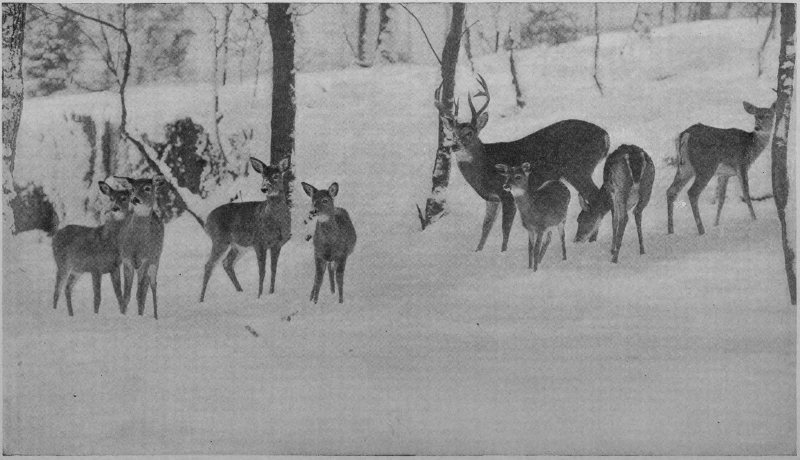
WHITE TAILED DEER.
25