ILLUSTRATIONS
Reading edition
Deserts of the Southwest Frontispiece
Map of western United States viii
Centipede 2
Enlarged view of under side of centipede’s head 2
Deadly and non-deadly scorpions 4
Giant desert hairy scorpion in alert position 5
Underside of black widow spider 8
Brown recluse spider 11
Tarantula 13
Conenose bugs 15
Common ant 16
Wasp 17
Velvet ant 18
Bumblebee 19
Honeybees on the honeycomb 20
Poison mechanism of worker bee 21
Puss caterpillar 23
Arizona coral snake 24
Western diamondback rattlesnake 25
Sidewinder or “horned” rattlesnake 27
Poison mechanism of the rattlesnake 28
Western black-headed snake 29
Sonora lyre snake 30
Gila monster 31
Underside of the Gila monster 32
Poison mechanism of the Gila monster 33
Two adult banded geckos 35
Solpugid or sun spider 36
Jerusalem cricket (sand cricket or chaco) 37
Vinegaroon 38
vii
EDITORIAL NOTE ABOUT INSECTICIDES
Recommendations given in previous editions of this book regarding use of DDT and other “hard” pesticides are withdrawn in this 12th edition. We advise, until questions about merits and dangers of these products are resolved, that you contact a local agency before deciding what pesticides, if any, to use.
We believe that every citizen should make a real effort to become informed about pesticides and potential changes in them, for use or non-use will likely have great impact on mankind’s future use of this earth.
ACKNOWLEDGEMENTS
The author has conducted no original research, but has simply assembled information provided by others who have made painstaking scientific investigations into the lives, habits, and poisons of desert creatures. To these men all credit for the information contained herein is due.
The writer considers it a privilege to present partially herein the results of work conducted by Dr. Herbert L. Stahnke, Poisonous Animals Laboratory, Arizona State University, on scorpions and other poisonous creatures.
Valuable assistance has been obtained from Dr. Howard K. Gloyd, former director of the Chicago Academy of Sciences. To Laurence M. Klauber and the late C. B. Perkins, formerly of the San Diego Museum of Natural History, are expressed our thanks for much valuable information relative to poisonous snakes.
The help and cooperation of Dr. Sherwin F. Wood of Los Angeles City College has made possible inclusion of the section on the conenose bug.
The late Dr. Forest Shreve, for many years director of the Desert Laboratory in Tucson, and the late Dr. Charles Vorhies, zoologist at the University of Arizona, proved to be founts of knowledge regarding plant and animal life of the desert. The late Dr. C. P. Russell, of the National Park Service, checked many statements to assure accuracy.
We are indebted to Dr. W. Ray Jones, physician and hobby beekeeper in Seattle, Washington for his findings on, and treatment of, bee-sting poisoning. Also to Dr. F. A. Shannon of Wickenburg, Arizona for his especially helpful commentary. We take this opportunity to thank Dr. Paul Wehrle, entomologist, University of Arizona, and Dr. W. J. Gertsch of the American Museum of Natural History, for kindly checking the contents for authenticity.
viii
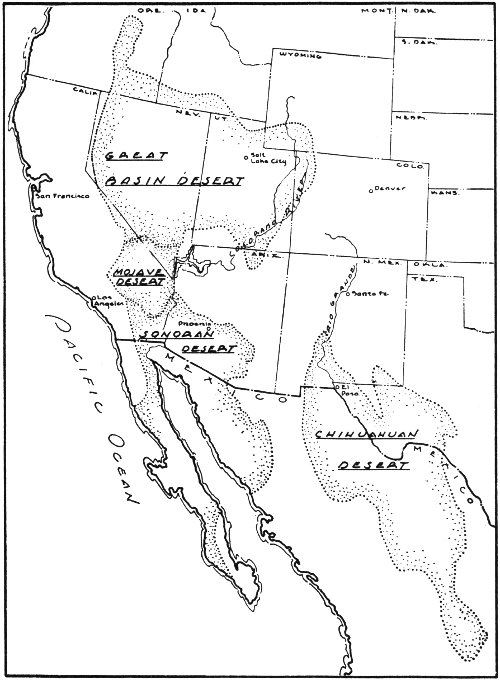
Map of western United States and Mexico showing location of deserts
1
Poisonous Dwellers of the Desert
The late Dr. Forrest Shreve of the Desert Laboratory in Tucson, Arizona, stated that the principal characteristic of a desert is “deficient and uncertain rainfall.” From our grammar school geographies we gained the impression that a desert is a great expanse of sand piled into dunes by the wind, without moisture or vegetation, a land of thirst, desolation, even death.
Although sand dunes devoid of vegetation are characteristic of the Sahara and some other deserts of the world, those of the United States support a variety of plant and animal life which, through generations of adaptation, are able to meet the conditions imposed by this environment (see frontispiece). Persons who misunderstand our deserts fear them, while others who have visited them become fascinated and return periodically or settle down and live in them.
Some of the creatures living in deserts are known to be poisonous to man. Western thriller fiction of press, screen, and TV has emphasized and exaggerated this fact, developing in many people a wholly mistaken fear of the desert and its inhabitants. In contrast, other persons may under-estimate the possibility of injury from these animals and become careless.
It is the purpose of this booklet to discuss accurately the various poisonous dwellers of the desert, as well as to debunk some of the superstitions and misunderstandings which have developed.
A majority of the poisonous creatures in the desert are by no means restricted to that environment. Rattlesnakes, for example, so often associated with the arid regions of the West, occur in nearly every section of the United States.
“A poison,” states Encyclopedia Brittanica, “is a substance which, by its direct action on the mucous membrane, tissues, or skin, or after absorption into the circulatory system can, in the way which it is administered, injuriously affect health or destroy life.” A poisonous creature may be defined as one which produces a poison for the administering of which it has developed a special mechanism.
Since, due to personal differences, the bite or sting of a poisonous creature may injuriously affect the health of one person and not that of another, and since the poison of one individual creature may be insufficient to cause an unpleasant reaction, while that from several hundred might produce severe illness or even death, it is difficult to determine which creature should be included in a publication of this nature. The writer, therefore, has exercised his judgment in discussing in the following pages such creatures as he feels may offer a menace to the welfare of a visitor to the desert. In addition, a few paragraphs are included for the defense of several harmless desert dwellers which are mistakenly believed poisonous and which, as a result, have been mercilessly persecuted.
2
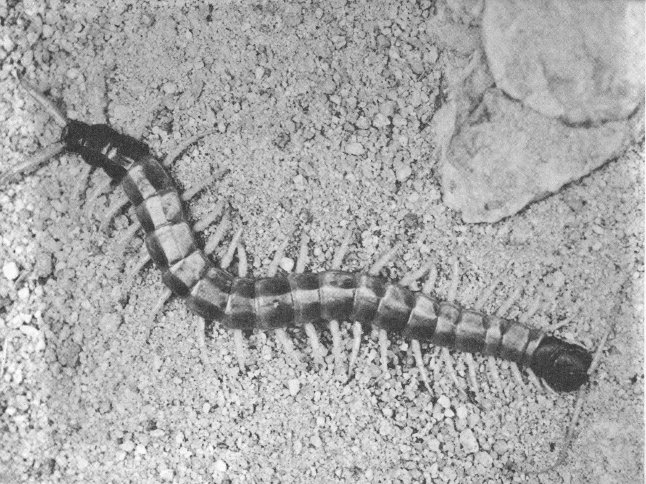
Giant desert centipede
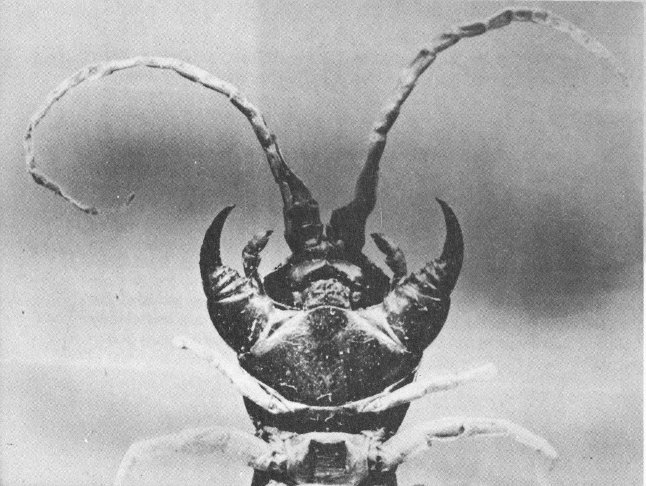
Enlarged view of underside of centipede’s head, showing the double pair of jaws. (Photographs by Marvin H. Frost Sr.)
3
It should be understood that the author has not himself conducted scientific research among the desert animals regarding which he writes. The material in this book is a digest of the findings of various competent scientific and medical authorities, and has been carefully checked for accuracy and authenticity.
Don’t be frightened as a result of reading this booklet. The desert is just as safe—perhaps safer—for homemaking as many other parts of our country.