Arizona coral snake (Micruroides euryxanthus)
Reading edition
The coral snake, of which there are two species in the United States, belongs to the Elapine group, which is represented in the Old World by the cobras and other poisonous snakes. These two species, the coral snake of the Gulf States, and the smaller Arizona coral snake whose range extends into the desert lands of southern New Mexico and Arizona, are the only representatives of the Elapine group found in this country.
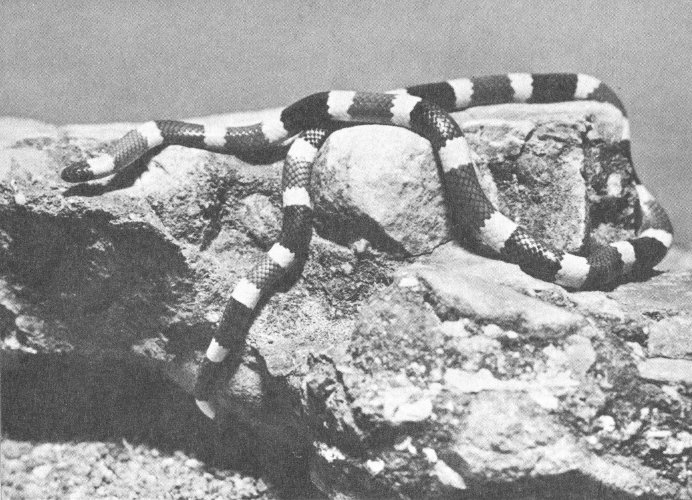
Arizona coral snake (Photo by Marvin H. Frost, Sr.)
The Arizona coral is shy and secretive in its habits, timid rather than pugnacious, and it is so rarely seen that little is known of its habits.
The poison mechanism of the coral snake is somewhat different from that of the pit viper group, to which the copperheads, cottonmouths, and rattlesnakes belong. The teeth of the coral are short, and to be effective the coral snake must chew rather than strike its victim.
The Arizona coral snake is so small—rarely reaching 2 feet in length—and its mouth is so tiny, that it would be very difficult for it to bite an adult human. It is conceivable that a small child playing with one might be bitten.
Because of its close resemblance to several ringed or banded snakes of the desert and also to the Arizona mountain kingsnake, or “coral” 25 kingsnake, of the ponderosa pine highlands of the Southwest, a brief description of the Arizona coral snake is indicated. One of the beautifully spectacular snakes of the desert, it is marked by bands of dark red, cream, and black, which encircle the body. Superficially the markings of the Arizona mountain kingsnake and other tricolored ringed snakes appear similar. However, the red of the kingsnake and of others is usually brighter, and the black bands narrower than those of the coral.
Definite identification is provided by the relationship of the colors to each other, the arrangement on the Arizona coral snake being red, cream, black, cream, red, cream, black, cream. The bands of the Arizona coral snake entirely circle the body and its snout is black.