Conenose bug (Kissing bug, Bellows bug, Walpai tiger, Cross bug, others) (Triatoma sp.)
Reading edition
Although not limited to the deserts of the Southwest, conenose bugs, of which there are several species, are commonly associated with subtropical climates.
Certain South American species of the family Reduviidae are disease carrying and there is evidence the conenoses in San Diego County, California, are infected with a disease-producing flagellate. Lack of large bug populations in close contact with man and ineffective transmission habits protect man in the Southwest from disease contacts. However, the site of the bug’s bite becomes inflamed, and swelling may spread over an area up to a foot in diameter.
In general appearance, conenose bugs resemble assassin and squash bugs, with protruding eyes at the base of a cone-shaped snout and are about the same size. Some species are considerably smaller, while others attain a length of an inch or more.
Habitat of conenose bugs
Since conenose bugs subsist upon animal blood which they suck from the capillaries by inserting the stylets of the proboscis, they seek locations where there is a source of blood. These include livestock barns, poultry houses, and human habitations.
15
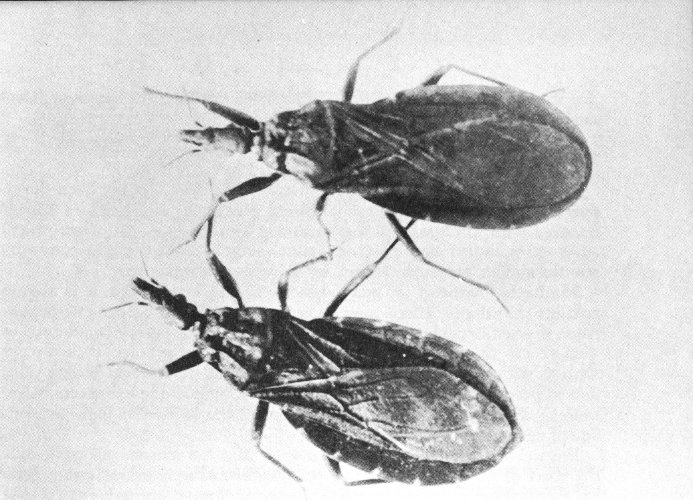
Conenose bugs—Triatoma protracta Adult male (rounded abdomen); Adult female (pointed abdomen) (Photo courtesy of Dr. Sherwin F. Wood)
Studies conducted by Wehrle[5] show that conenoses are parasitic on woodrats and breed in the dens of these rodents. They are also found in meadow vole (mouse) nests. Early in May the winged conenose adults begin dispersal flights, invading human habitations in the vicinity of woodrat dens. Although reported as most active in May and June, they may be expected throughout the summer until October, and are much more numerous in the country than in cities.
During the daytime, the insects remain hidden under rugs, between quilts, or even in bedding or behind drapes. They may be seen during the evening on ceiling beams, walls, curtains, and around windows. They are alert and difficult to catch.
Conenose bugs do not attack people until the victim is quiet or asleep, and may take blood without awakening the host. Immediately after being bitten, however, the victim is awakened by severe itching. The area about the puncture swells and becomes red and feverish. Welts at the point of puncture are hard, and may be 1 to 3 inches in diameter.
About 5% of the people repeatedly bitten develop severe allergic reactions with burning pain and itching at the site of the bite, itching on the palms of the hands, soles of the feet, neck, and groin; general body swelling, and a nettle-like rash over the body. Some persons feel ill, with light depression followed by quickening of the pulse. Others 16 are faint, weak, and nauseated. In very severe allergy these symptoms may lead to anaphylactic shock and unconsciousness.
Treatment of conenose bites
Although a specific treatment for conenose bites has not been developed, some physicians use epinephrine. More promising results appear possible with antihistamine preparations (under doctor’s prescription) such as benadryl and pyribenzamine, which have been effective by mouth, and in severe reactions, by intravenous injections.
Matheson[6] writes: “When a blood-sucking insect bites, it is always possible that the proboscis may be contaminated with pathogenic organisms. If such organisms become localized near the point of puncture or gain access to the blood stream, results may be serious. It is always wise to use some disinfectant such as alcohol, tincture of iodine, etc., and to press out the blood, if possible, from bites made by insects.” Antibiotics are frequently necessary to control the extremely high percentage of secondary infections.
Physicians recommend the application of a hot Epsom salt pack over the point of puncture as soon as possible after the bite has been received. Application of antiphlogistine alleviates the severe itching. ACTH is recommended by some physicians. Hydrocortizone ointments reduce the skin eruptions and local pain.
Control of conenose bugs
Prevention is more satisfactory than treatment, and since conenoses live in woodrat dens, these rodents should be eliminated from the vicinity. Weatherstripping around all permanent doors and screen doors, tight-fitting, holeless screens in all windows, and fine screens in fireplace chimneys will help to keep the bugs out of houses. Occasionally they may be seen on walls and ceilings in the evening, and may be killed with a flyswatter.
If impossible to keep the insects out of the house, sleeping persons may be protected by the use of mosquito netting. It is especially important that the beds of babies and young children should be safe-guarded because of the danger from scorpions.
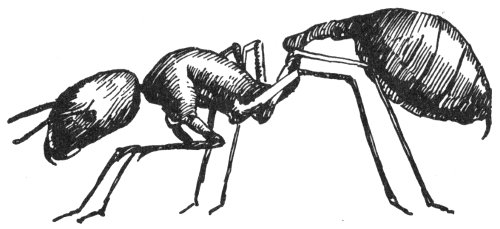
Common ant
17
Bedding should be shaken thoroughly just before children retire, because both scorpions and conenose bugs have a habit of concealing themselves in bedding during the daytime.