Chapter VIII · THE PLAN OF CHICAGO: THE RESULT OF SYSTEMATIC STUDY: THE COST INVOLVED IN CARRYING OUT THE WORK: THE PEOPLE ARE FINANCIALLY ABLE TO REALIZE THE PLAN: THE ELEMENTS INVOLVED: HOW THE COST MAY BE DIVIDED: THE FINAL RESULT.
Reading edition
The plan of Chicago as presented in illustration and text is the result of a systematic and comprehensive study, carried on during a period of thirty months, with the sole purpose of mapping out an ideal project for the physical development of this city. Perfection of detail is not claimed, but the design as a whole is placed before the public in the confident belief that it points the way to realize civic conditions of unusual economy, convenience, and beauty.
It is fully realized that a plan calling for improvements on a scale larger and more inclusive than any heretofore proposed seems, on first consideration, beyond the financial ability of the community. If, however, the plan meets public approval, it can be executed without seriously increasing present burdens. The very growth of the city, creating as it does wealth greater than mines can produce, gives a basis of bond issues in excess of the utmost cost involved in carrying out this plan. The increase in the assessed value of real estate in the city of Chicago for the past ten years exceeds the expense required to put the plan into execution; and at the same time the very character of the proposed changes is such as to stimulate the increase in wealth. The public, therefore, has the power to put the plan into effect if it shall determine to do so.
It is quite possible that some revision of existing laws may be necessary in order to enable the people to carry out this project; but this is clearly within the power of the people themselves. The realization of the plan, therefore, depends entirely on the strength of the public sentiment in its favor. And what hope is there that the people will desire to make Chicago an ideal city? A brief survey of the past will help to form an opinion on this subject.
Sixty years ago, when Chicago was scarcely more than a village, it became apparent that in order to secure proper drainage the street levels must be raised to a considerable extent throughout what we know as the old city, from the main river to Twelfth Street, and also for a distance on the West and North Sides. This project, albeit a very formidable one for that time, was promptly entered upon and duly carried out, although it involved raising all the streets and most of the buildings throughout that large territory. For that day and generation the undertaking was much more serious than the reconstruction of the city thoroughfares now proposed.
Again, some fifty years ago, when the idea of creating great metropolitan park areas was new, Chicago undertook to acquire and improve a chain of parks surrounding the city on three sides. This scheme, which has well supplied the needs of Chicago until recent times, was carried out in such a manner that it never was burdensome. The creation of a park system for Chicago was not undertaken from motives of utility, but purely because of a desire to make the city attractive; and the success was magnificent.
Later, in the Eighties, the purification of the water of Lake Michigan by the diversion of the sewage became a public issue. Once again the people of Chicago rose to the occasion; and after years of hard work the Drainage Canal, built at a cost of $60,000,000, has been completed.
Next came the World’s Fair, in the early Nineties, and here also a result was accomplished which has never been surpassed either in scope or in architectural beauty. The cost of the Fair (over $20,000,000 for grounds and buildings alone) was very large for that day. The fact that the Fair came into being here indicated that this people, generally regarded as a commercial community, were deeply appreciative of the higher forms of good order and municipal beauty.
The Chicago World’s Fair, like the raising of the grades of the city, the creation of a complete system of parks and boulevards, and the building of the Drainage Canal, went far beyond anything of the same kind ever before undertaken by a city. These four works are the greatest ones which have been achieved by Chicago. They have proved the readiness of the people to take up large schemes of public improvement which at the time of their inception required great foresight and great faith in the future. Two of them were demanded by considerations exclusively practical, while the other two were not so regarded, but on the other hand were the expression of the deeper sense in man of the value of delightful surroundings. If an accurate statement of the costs of the four improvements could be made, it would probably show that about equal sums have been spent on the practical and on the æsthetic side.
Besides the public enterprises mentioned, the people of Chicago, either collectively or as individuals, have established many agencies for the improvement of the intellectual, social, moral, and æsthetic conditions. The Chicago Orchestra occupies land and buildings on Michigan Avenue which have a present value of over a million and a quarter of dollars; and during the past twenty years private subscriptions have amounted to at least another million, all expended for an organization purely artistic. The Art Institute building in Grant Park cost $700,000, and since its completion, in 1893, it has never been closed for a day. Besides its large and excellent art school, there is a good collection of the works of old and modern masters, which is constantly receiving additions. The Crerar Library has an endowment fund of three and a half millions, besides a substantial building fund; and the Newberry Library and the Armour Institute of Technology are other worthy public benefactions.
Especially notable are the educational foundations which contribute so largely to the intellectual life of the city, and exert an influence throughout the Middle West,—Lake Forest University, Northwestern University, and the University of Chicago. The last-named institution, established in 1892, has already taken its place among the foremost universities in this country, not only by reason of its endowment and property (representing more than $23,000,000), but also because of wise administration along a well-considered plan.
Quite in accord with the plan of Chicago is the Benjamin Franklin Ferguson Monument Fund of a million dollars, the income of which is available for defraying the cost of statuary commemorating worthy men and women of America, or important events in American history, to be erected in the parks and boulevards of the city, under the direction of the trustees of the Art Institute. The Field Museum, representing gifts aggregating $9,000,000, is a further instance of loyalty to the city and a desire for its improvement.
Such enterprises and such gifts as those enumerated show what may be expected from individual benefactions as wealth increases and the idea of public service is encouraged. When opportunities for enriching the city are provided, individual citizens rise to the occasion, and find true satisfaction in leaving memorials useful or agreeable to the people.
Mere increase in numbers does not warrant the belief that public sentiment in favor of extensive public works will grow in proportion to the population; but the history of the past does prove that the people of Chicago are always ready and anxious to follow when the way to great benefits is plainly open. We believe that the tendency which the community has shown by its acts points hopefully to the adoption of a great scheme of public improvement. In other words, Chicago having already carried out large projects strictly on the lines of this report, may we not, therefore, confidently expect this people to go on doing as they have done?
There is a still stronger reason for the belief that the public will favor such a plan as is herein presented. It lies in the growing love of good order, due to the advance in education. Every one knows that the civic conditions which prevailed fifty years ago would not now be tolerated anywhere; and every one believes that conditions of to-day will not be tolerated by the men who shall follow us. This must be so, unless progress has ceased. The education of a community inevitably brings about a higher appreciation of the value of systematic improvement, and results in a strong desire on the part of the people to be surrounded by conditions in harmony with the growth of good taste; and as fast as the people can be brought to see the advantage to them of more orderly arrangement of the streets, transportation lines, and parks, it is well-nigh certain that they will bring about such desirable ends. Thus do the dreams of to-day become the commonplaces of to-morrow; and what we now deem fanciful will become mere matter-of-fact to the man of the future.
If the plan as a whole be approved by the majority of our citizens because it is found to be both practical and beautiful, the next question is as to what it commits us. In answering this query a general review of the principal elements composing the plan will be of value. The following list comprises the main items:
First. The improvement of the Lake front.
Second. The creation of a system of highways outside the city.
Third. The improvement of railway terminals, and the development of a complete traction system for both freight and passengers.
Fourth. The acquisition of an outer park system, and of parkway circuits.
Fifth. The systematic arrangement of the streets and avenues within the city, in order to facilitate the movement to and from the business district.
Sixth. The development of centers of intellectual life and of civic administration, so related as to give coherence and unity to the city.
The improvement of the Lake front from Winnetka to the Indiana line is an economic necessity. As has been stated, the aggregate of the waste material seeking dumping ground on the Lake shore because that is the cheapest place to deposit it, is not less than one million cubic yards per annum. This material is sufficient to produce annually from twenty-seven to thirty acres of land if used to build the Lake parkways and park strips herein recommended. The park authorities would only have to furnish breakwaters and bridges and to finish the grounds. The utilization of this material in thirty years would produce all the Lake front land recommended in the report for the region between Grant and Jackson parks. But long before the expiration of the thirty years the amount of filling urgently seeking the Lake front dump will be enormously increased. This dirt should be utilized for the public benefit, instead of being wasted as at present in the open Lake, where it becomes detrimental to health and an interference to navigation. The dirt to be disposed of in building new traction tunnels under the principal streets of the city will go far toward the completion of the new Lake shore parks. It is evident, therefore, that this improvement, involving the redemption of the entire Lake front from Winnetka to the Indiana state line, and the creation of an extremely beautiful and useful public recreation ground, will involve very little public expense. There can be no doubt that this part of the plan of Chicago will be carried through; and in fact much is already being accomplished along these lines.
The interurban highway system can be realized very cheaply. Ninety-five per cent of the necessary roads now exist as public highways, and the cost of acquiring the other five per cent will be merely nominal. The diagram (Plate XL) is laid out with a radius of approximately sixty miles from the city hall. The cost of widening that comparatively small portion of the roadways which require to be widened; the straightening of the few which need such treatment; the planting of trees along the highways; and the macadamizing of the roads are improvements that may be hastened by concerted intelligent action. The expense involved is comparatively small, but the economy and convenience to the public are very large. Is it not evident that this portion of the plan can be realized at no distant day provided a strong organization of active men shall be formed for the purpose of carrying it into effect?
The suggestions in regard to trunk lines, their rights-of-way, stations, and general conditions, are many and serious. The suggestions have been made for the purpose of bringing about the greatest economy of money and time, both in freight and passenger handling. If the recommendations herein contained will produce conditions really beneficial to the individual shipper and passenger, undoubtedly they will be found best for the railroads themselves. The direct object in view is to free a large portion of the South Side from tracks and stations and restore it to business use; to double the capacity of the streets of the whole city by opening circulation to the north, west, and south, and by connecting the outlying parts in the best possible manner with the heart of the city. Over and above all these considerations, highly important as they all are, is economy in the freight handling of Chicago as a shipping center. The object here has been to find that general principle which, if applied, will give to the merchants, manufacturers, and jobbers of this city all the advantages that should naturally be theirs throughout the great territory dominated by Chicago. If the general scheme herein proposed shall not be adopted by the public and the railroads, some other inevitably must be, because the very life of the community is involved in the solution of this problem. The commercial prosperity of the community is represented by the cost per ton of handling freight into and out of this territory as a shipping center. General changes in railroad conditions take years to accomplish. That will be the case if such a scheme as we recommend is carried out; but the public should remember that they will not be taxed to pay for it. When these improvements come they will be railroad enterprises, undertaken by the railroads and carried out by the railroads.
The traction recommendations contained in this report are already in progress, and no question need be raised as to whether or not this portion of work will be carried out. It has practically been decided upon, and no doubt will be accomplished. The cost will be borne in part by the traction lines themselves, and partly by the public.
The additional parks and parkways recommended are extensive, as should be the case. Although it is true that the men of forty years ago did devise a scheme which has been sufficient almost up to the present moment, it is also true that the number, location, and arrangement of the parks and parkways of Chicago to-day are entirely inadequate for its future development; and nothing is suggested in this report except what has seemed to be absolutely required. Fifty years ago, before population had become dense in certain portions of the city, people could live without parks; but we of to-day cannot. We now regard the promotion of robust health of body and mind as necessary public duties, in order that the individual may be benefited, and that the community at large may possess a higher average degree of good citizenship. And after all has been said, good citizenship is the prime object of good city planning. In some locations parks and parkways are sufficient to accommodate the people in the immediate neighborhoods; other sections of this city, and suburbs which will soon become parts of this city, should be equally well provided. “Nature,” says President Charles W. Eliot, “is the greatest factor in the continuous education of man and woman.” The extensive woodlands proposed are an addition not usually designed for American cities, although almost invariably used in Europe. The cost of these added parks and woodlands will be considerable, and it must be borne by the public; but it is a sane proposition that the people of Chicago and its suburbs should have the sixty thousand acres of wooded territory as well as the great Bow, (Plate CIII) which will occupy from six to eight hundred additional acres. The acquisition and completion of an outer park system may easily be carried through in ten years; and if the cost shall be distributed over that period of time, it will not prove burdensome. The returns will come in the shape of increase of health and joy of living for all the people; and incidentally the value of every real estate holding in the city will be enhanced.
The land necessary for the civic center should be secured at once, while values at the point proposed are reasonable. For the time being this land may be treated as park space; but the sites and the general scheme of grouping for the buildings should be approved, so that as the city, the county, and the general government outgrow their present structures, the new ones may take their appointed places, each one contributing its part to an orderly and convenient scheme. The adoption of such a scheme would save a very large amount of money in the purchase of public building sites; and would create stability in real estate values. To the West Side especially the development of a civic center along the lines indicated is a matter of prime importance; for it will give to that portion of the city the needed impetus towards higher standards than now prevail there. At the same time it will benefit all other parts of the city, since it is for the advantage of Chicago as a whole that each portion shall be developed equally with every other portion. The cost of the civic center should be paid by the whole community.
The street plan as laid out involves a very considerable amount of money; but it will be found that in Chicago as in other cities, the opening of new thoroughfares, although involving large initial expense, creates an increase in values, due to increase in convenience and the provision for adequate sites for the increasing retail traffic of the city. The cost will amount to many millions of dollars, but the result will be continuous prosperity for all who dwell here; and such prosperity the city cannot have unless it becomes a convenient and pleasant place in which to live.
Finally, it seems probable that the schemes of outer highways and of all the Lake front improvements may come about quite naturally and with very little expense to the city; that the railways will pay most of the expense of their changes and improvements, thus leaving a portion of the cost of the traction system and all of the cost of the civic center, of the parks and parkways, and of the street development for the general public to meet. The community has ample financial ability to do its part without placing undue burdens upon the people. Paris had not much more than half a million people, and her commercial prospects were far less than are ours to-day, when that municipality adopted a street improvement scheme involving over two hundred and sixty million dollars, and carried it to completion in thirty-five years. The motive of the French people in undertaking this enterprise was to create a great attraction for all men: a city so delightful as to insure continuous prosperity to the inhabitants. The success of the undertaking has amply justified the pains and the expense. People from all over the world visit and linger in Paris. No matter where they make their money, they go there to spend it; and every proprietor and workman in Paris benefits by reason of that fact. Conditions in Chicago are such as to repel outsiders and drive away those who are free to go. The cream of our own earnings should be spent here, while the city should become a magnet, drawing to us those who wish to enjoy life. The change would mean prosperity, effective, certain, and forever continuous.
If, therefore, the plan is a good one, its adoption and realization will produce for us conditions in which business enterprises can be carried on with the utmost economy, and with the certainty of successful issue, while we and our children can enjoy and improve life as we cannot now do. Then our own people will become home-keepers, and the stranger will seek our gates.
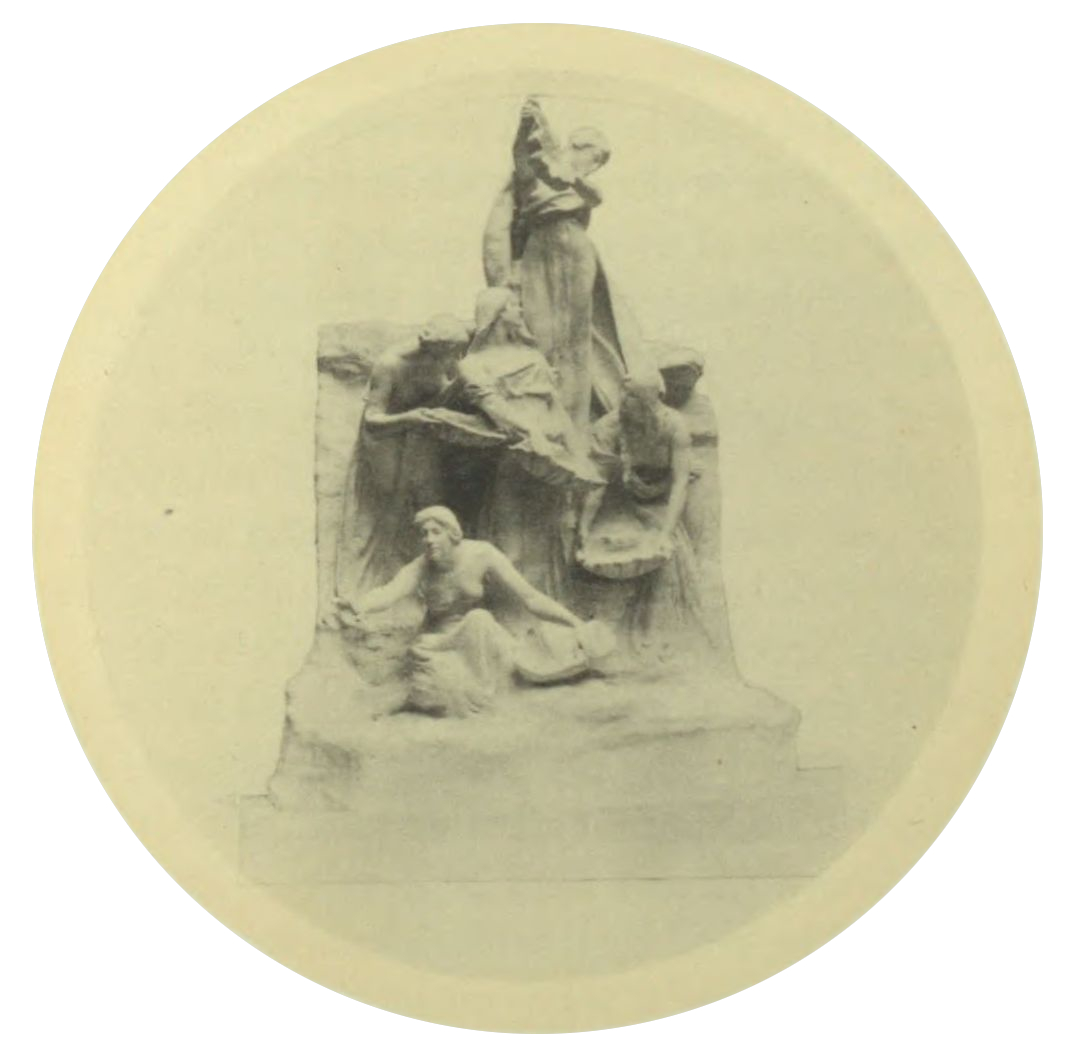
CXLII. THE GREAT LAKES.
From the group by Lorado Taft.
LEGAL ASPECTS OF THE PLAN OF CHICAGO
The following opinion, prepared by Walter L. Fisher, as counsel for the Plan Committee of the Commercial Club, has been submitted to Edward J. Brundage, Corporation Counsel for the City of Chicago, Harry A. Lewis, County Attorney of Cook County, Benjamin F. Richolson, Attorney for the West Chicago Park Commissioners, Charles A. Churan, Attorney for the Commissioners of Lincoln Park, Robert Redfield, Attorney for the South Park Commissioners, to Edgar B. Tolman, Frank L. Shepard, Harry S. Mecartney, Frank Hamlin, and R. P. Hollett, who have been counsel for these official bodies, respectively, and to Milton J. Foreman, Member of the City Council of Chicago, and George A. Mason, Special Assessment Attorney for the City, all of whom concur in the conclusions and recommendations stated. William W. Case assisted in the preparation of the opinion.