PART V Special Reports
Reading edition
THE MARKET
Two conclusive reasons point to the removal of the Diamond Square Market from its present site. First, it is an obstruction at a vital point to the development of the thoroughfare system of the city; second, it is too small and congested for the proper performance of its functions.
The ingenious proposition has been made, in order to secure more space for the business, that the whole of the square be excavated and a basement or underground market be built extending under the surrounding streets. This would permit the extension and widening of Diamond Street and Market Street through the square at the ground level, although these improvements were not contemplated by those who suggested the basement market. Such an arrangement, if not coupled with the erection of structures above ground in such a manner as to interfere with the free passage of the two streets through the space, would seem to meet the traffic problem; except that the massing of vehicles and people on the surface, in connection with the marketing, would be somewhat objectionable.
But from the market point of view such a solution seems wholly unsatisfactory and inadequate. There is no question that the space is now too small for handling the business in a comfortable, sanitary and decent manner, and the space now occupied is by no means confined to the two old buildings. The sidewalk stalls, so called, from which nearly half the rentals of the market are derived, occupy a large part of the surrounding streets, and at the busy hour there is hardly a square foot of those streets that is not in use by the dealers or their customers. To build a basement market occupying the whole of the square, after deducting the considerable space required for entrances, stairways or inclines, elevators, piers, ventilating shafts, etc., would not materially enlarge upon the present facilities; and it would put the market in a position where automatic means of relief, by overflow into the streets and into adjacent private stores, would be practically impossible. Moreover, the opinions of market-men and of experts on the values of retail trade locations seem to be that the chances are desperately against the commercial success of any basement or underground market, no matter what skill may be exercised in meeting the problems of lighting, ventilation, and means of access.
In judging other possible solutions of this very perplexing problem it is important to consider the experiences of other large cities of the northeast states with the market business.
With only two exceptions all the markets of Boston, New York, Philadelphia, Baltimore and Washington have become less and less profitable during recent years. In some cases the business has fallen off so much that half the stalls are vacant, and in others the markets have had to be abandoned. The reasons offered by market superintendents and others for this general decline, upon analysis, may be summarized as follows: (1) With the increase in size of cities and the general change in habits, retail purchasers find it increasingly troublesome to go to a central market, and attach an importance to the convenience of purchasing from neighboring local provision dealers, and of having the goods delivered. (2) Owing also to general changes in habits of life, especially to the increasing specialization of knowledge and skill of all kinds, the average retail purchaser is becoming constantly less competent to form an independent judgment of the quality of provisions offered for sale, is more conscious of this incompetency, and is more and more dependent upon the reliability of the dealer; he is therefore less able to get any advantage from purchasing in an open competitive market. This again obviously makes for the advantage of the local provision stores. An index of this tendency is the increasing amount of ordering by telephone and otherwise "sight unseen."
Both the above factors, but especially the latter, are reflected in the fact that such of the public markets as are falling off least in their business are taking on more of the character of wholesale markets where the purchasers are experts representing either local retail provision dealers, or hotels, clubs and restaurants.
The two markets which have proved exceptions to the general rule are the Reading Terminal Market in Philadelphia and the Center Market in Washington. The Reading Terminal Market is owned by the Reading Railroad and is managed by a superintendent who has absolute control. It has been built up from nothing, fifteen or twenty years ago, to a flourishing business at present, and this has all happened in the face of the general decline in the market business throughout this section of the country. Mr. McKay, the superintendent, attributes his success to three main causes. In the first place, every consideration possible is given to the farmers; stalls are rented to them at about one-third the prices paid by city dealers and they are never ousted in favor of the latter. Furthermore, Mr. McKay spends considerable time canvassing the agricultural sections of the country within fifty miles of Philadelphia, hobnobbing with the farmers, getting them interested in selling their produce to the best advantage through facilities which he can offer them. In fact he does everything possible to encourage the farmers to make use of the market both for their own advantage and for his. In the second place, direct railroad connections furnish the best possible transportation facilities. Produce can be collected from the surrounding country at the least possible cost, and can be delivered to suburban residences much cheaper than by independent city stores. The third reason for success is able management. The market business, like any other, needs able management, and without that it is probable that any market undertaking, no matter how favored in other circumstances, will run a large risk of financial failure.
The success of the Center Market in Washington is apparently due mainly to the close relation maintained with the farmers and to its efficient general management.
It may be noted further that in Germany practically all the large public market houses have direct railroad connections.
In Pittsburgh the market business is apparently flourishing; and this in spite of the facts that no special encouragement is given to the farmers, that there are no direct or convenient transportation facilities, and that the management is not especially able. Considering the experiences of other cities, it is hard to account for this condition, but it is only reasonable to take warning and to expect a decline in the business sooner or later unless radical improvements are made.
It is to be considered furthermore that the city is not in the market business simply for the sake of getting a little revenue out of it. It is justified in conducting such an enterprise only on the ground that it provides a facility for the people which can not otherwise be well and economically provided. In the first instance public market places have always been established as a convenient means of purchasing provisions in an "open market," a place where prices are supposed to be determined by free competition among the producers with the minimum absorption of profit by the agencies roughly indicated by the term "middlemen." Under modern conditions, as the gap between the producer and the consumer has grown steadily bigger, the mere providing of a convenient vacant space in the city, where producer and consumer could meet and do their bargaining, has proved utterly insufficient. Apparently the recognition of the changing conditions has been so tardy on the part of those representing our cities in the administration of public markets, and their action so timid and temporizing, that they have left the bridging of the gap to commercial middlemen. In the course of the last two or three generations, therefore, the public provision markets have become largely places for a special group of middlemen, or retailers, to display their wares; in essence not very different from the natural groupings of other classes of retailers' stores in various quarters of the business district.
It is, therefore, of peculiar interest to note that the only two public markets in the cities investigated which have not shown a decline of business are those in which special, constructive efforts have been made, by the market administration, to maintain a close relation with the producer and to minimize the growing obstacles that tend to impede and complicate and make costly the operation of transferring goods from him to the consumer. Not only do these two exceptional markets with increasing trade point this moral very clearly; but at Boston, where the market is still very successful, though in diminishing degree and with an increasing emphasis on the wholesale end of the business, the superintendent is very clear in his view that it is upon the facilities offered to the farmers for direct sale from their wagons that the continued success of the market largely depends.
It is one of the unfortunate features of the Diamond Square Market that it has been thought necessary to segregate the farmers' wagons in another locality, and a serious objection to the Square as a permanent market site is the impossibility of providing for them in connection with it. But while the farmers' wagons are important, even more important is the maintenance of facilities for the economical shipment, receipt, and sale of provisions from farmers who cannot bring their goods to market in their own wagons. Pittsburgh is not in the midst of an ideal farming country and an exceptionally large proportion of its food must come by rail. Even in Philadelphia, where the immediate surroundings of the city are much better adapted for the raising of provisions, the notable success of the Reading Market is largely due to the economical and convenient arrangements for getting produce to market by rail, and in Pittsburgh such facilities seem almost essential to any large and permanent success.
It seems clear then, that, if such a permanent success is to be made of the Pittsburgh Market, it must be moved from Diamond Square to a larger site with rail connections and room for farmers' wagons. Several localities have been studied with this idea in view and the best of them appears to be, as recommended earlier in this report, between Third and Fourth Streets and Penn and Liberty Avenues. The advantages of the site briefly are as follows: First, it is not far from Diamond Square, and is even more accessible from the cars passing over the Point Bridge by which a large proportion of the present patrons of the Market appear to arrive; and furthermore, the improvement of street railway transportation will undoubtedly mean the through-routing of cars, a change which will make this site directly accessible also from other sections of the city. Under the circumstances, to move the market so short a distance should not involve any serious loss of trade. Second, the land and the buildings are reasonably cheap although the frontage is on Liberty Avenue, one of the main arteries of travel in the Point District. Third, the area is large enough to allow a reasonable provision of space where farmers can remain and sell produce directly from their wagons and not be forced, as at present, to do business at a distance, on the Monongahela wharf; and furthermore there is plenty of room for expansion either across Penn Avenue or Fourth Street. Lastly, in this location, a direct connection already exists, via the Duquesne Elevated, with the Pennsylvania Railroad System, the most important freight carrier in the District; also the site is close to the Wabash Railroad, with which connection could be secured if further developments of the road should justify it; and being close to the Allegheny River all possible advantage can be taken of river transportation, especially for the receipt of produce.
It should be noted further that even with the best advantages of site and physical equipment a public market is by no means sure of success. More important probably than any other one element making for success is able and stable management. The market business is a large, intricate and many-sided business; and it is not reasonable to expect any very brilliant results under the management of a succession of superintendents rotating in office with political changes in the City Government, and not selected because of any special qualifications of experience or great business ability. A highly competent superintendent holding his office during good behavior will be essential to the success of the new market in Pittsburgh.
THE HUMP CUT
The purpose of this improvement, upon the successful attainment of which the plans must be judged, appears to be twofold: (1) To reduce the obstacle offered by the Hump to the general street traffic of the city, and (2) to reduce the obstacle which appears to be offered by the steep gradients to the expansion of the district available for high-class retail trade and offices.
The former is the larger consideration as regards the whole city. The latter is the main consideration as regards the locality itself and the interests of the owners of land therein.
The plan of the Bureau of Surveys, marked "Approved December 23, 1909," shows proposed gradients on the east and west streets ranging from 4.75 per cent on Sixth Avenue to 5.88 per cent on Diamond Street, Fifth Avenue being 5.52 per cent. On Grant Street the maximum gradient is proposed to be reduced from 4.8 per cent to 4.6 per cent. While these proposed gradients are undesirably heavy, it is believed that they would not in themselves offer a very serious obstacle to the advance of first-class business into the Hump District if for other reasons the growth should tend in that direction. Further, for automobiles, electric cars and light horse-drawn carriages the proposed gradients, while objectionable, are not, in view of the topography of Pittsburgh, very excessive. Such gradients, however, are prohibitive to economical teaming. They will be avoided by teamsters at the expense of a long detour if they can find a route of low gradient, and if there is no such route they mean the hauling of smaller loads, the making of more trips to do the same work, and a very appreciable tax upon the public, paid in the cost of coal, building material, household supplies, etc.
Almost at first sight there appear two important lines of travel which might naturally be expected to pass through the Hump District, and which would be seriously affected by gradients as heavy as those remaining under the Bureau of Surveys' plan. One is that leading from the Point District and from practically all the freight yards into the valley occupied by Fifth Avenue and Forbes Street. A second line which may be expected to have great importance is one connecting Second Avenue east of Try Street with Liberty and Penn Avenues in the vicinity of the Union Station—in other words, the most easterly line upon which a connection of easy gradient can be secured between the two valleys. The improvement of Forbes Street as the main artery of a large eastbound thoroughfare system, the location of the traffic artery to the South Hills region—the high-level bridge and tunnel—and the location of the proposed Municipal Building and Civic Center, which are all recommended in Parts I and II of this report, must inevitably add greatly to the importance of this region behind the Hump as a distributing point for traffic. Sixth Avenue, especially the diagonal portion, Fifth Avenue and Diamond Street are the thoroughfare lines to this point. Considered together with other improvements of the down town district, Diamond Street becomes perhaps the most important line over the Hump. From the point of view of the city as a whole, any plan for cutting the Hump which does not secure reasonable gradients on these thoroughfares must be regarded as ineffective.
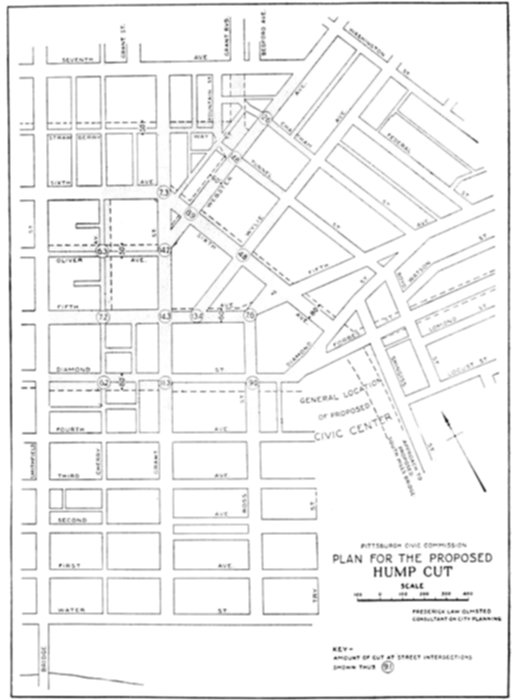
PLAN FOR THE PROPOSED HUMP CUT
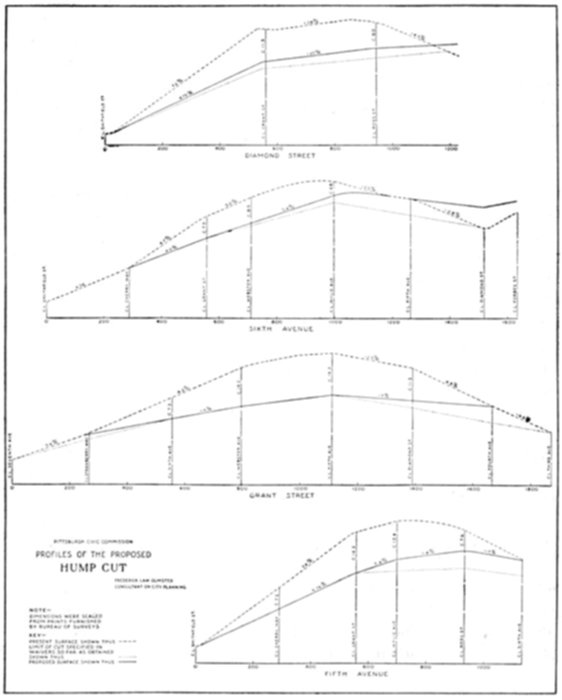
PROFILES OF THE PROPOSED HUMP CUT
The accompanying plan and profiles indicate the area and amount of cut which appears to be the least that should be undertaken. The area is practically the same as that proposed on the Bureau of Surveys' plan of December, 1909; the cut at certain places, however, is considerably deeper. A cut of 11.3 feet at Grant and Diamond Streets gives a maximum gradient of 4.75 per cent on the latter; a cut of 14.3 feet at Grant Street and Fifth Avenue gives a maximum gradient of 4.74 per cent on Fifth Avenue; and a cut of 8.9 feet at Webster and Sixth Avenues gives a maximum gradient of 4.34 per cent on the latter and 3.4 per cent on the Grant Street-Sixth Avenue cross-town route. These gradients are certainly not ideal, but it is believed that they are good enough to justify the undertaking, and deeper cuts are not urged chiefly because the area of cut would thereby be extended further into abutting regions where little or no benefit could be assessed and practically no damage-waivers could be obtained; the cost of the undertaking being thereby inordinately increased.
On Grant and Ross Streets the maximum gradients proposed are about 4.5 per cent, not excessive for lines which are not of the first importance. There is little advantage in extending the cutting any further on Wylie Avenue than is forced by the cut on Sixth Avenue, for there is no object in securing an easy gradient at one point when the gradient just beyond is over 7 per cent and cannot well be improved. The same applies to Webster Avenue east of Tunnel Street, but it must be cut heavily at this point partly on account of the cut at Sixth Avenue and partly to provide a good gradient on the extension of Grant Boulevard.
The extension of Grant Boulevard and the widening of Webster Avenue from Tunnel Street to Grant Street, the widening of Strawberry Way and Oliver Avenue and the widening of Sixth Avenue and Diamond Street have been recommended in the first part of this report. It is further recommended: (1) that Fifth Avenue between Ross and Grant Streets be widened to 60 feet; (2) that Cherry Alley be widened to 50 feet between Fifth Avenue and Sixth Avenue, and (3) that the westerly corner of Sixth Avenue and Grant Street be cut off enough to allow the passage of one line of vehicles between the curb and a car rounding the corner. These changes should all be incorporated in any general plan for cutting and improving the Hump District.
THE CITY AND THE ALLEGHENY RIVER BRIDGES Recommendations for Bridge Heights and Pier Location to Meet the Various Transportation Needs of Pittsburgh
By Colonel Thomas W. Symons and Frederick Law Olmsted
INTRODUCTION
March 15th, 1910, upon recommendation of the Committee on City Planning, the Pittsburgh Civic Commission authorized Colonel Thomas W. Symons, Corps Engineers, U. S. A. retired, and Mr. Frederick Law Olmsted to make a report upon desirable heights and pier locations for bridges over the Allegheny River. The purpose of the Commission was to secure a report which weighed the interests of all parties to the bridge question, and which would strike a balance to meet the various transportation needs of Pittsburgh.
The Commission asked the Committee on City Planning to direct the preparation of the report. The Committee consists of T. E. Billquist, chairman; Charles F. Chubb, H. J. Heinz, Benno Janssen, Richard Kiehnel, E. K. Morse. This committee passed upon the report April 18th and recommended it to the Commission for adoption. On April 25th the Commission received and adopted the report and voted their hearty appreciation of the work of Colonel Symons, Mr. Olmsted and the Committee on City Planning. This report was published separately in May 1910.
RECOMMENDATIONS
1. That the Sixteenth Street and Forty-third Street bridges, which are obstructions to navigation on account of their pier locations, narrow channels, and exceptionally low clearance height, be required to be rebuilt with their piers so located as to give channels conforming to the neighboring bridges, and that their elevation be fixed with regard to eliminating the railroad grade crossings on their approaches, but the minimum clearance shall be fixed in accordance with the closing paragraph below.
2. That the Ninth Street bridge should be rebuilt as soon as practicable with a central pier and two wide spans conforming to those of the Sixth Street and Seventh Street bridges. The design of the new Ninth Street bridge, however, should not be finally determined and erection begun until a definite plan for comprehensive improvements in the traction system between the two sides of the river has been decided upon. Unless new circumstances develop before the construction of this bridge is begun that materially affect the problem of clearance height, the elevation should be fixed in accordance with the closing paragraph below.
3. That all questions pertaining to changing the elevation of the Sixth Street, Seventh Street, Fort Wayne, Thirtieth Street and Junction Railroad bridges be deferred to await the report of the Pittsburgh Flood Commission and the resultant action; to await the report on a comprehensive plan for traction improvements; to await the completion of the work projected by the City in cutting down some streets and filling others; and to await the results of the investigation of river boat design and construction provided for in the River and Harbor bill just passed by Congress.
4. That if it is deemed essential and necessary at present to decide upon the elevation to which all Allegheny River bridges must be made to conform, this elevation be fixed so that there shall be a clear head room of substantially 37 feet above pool level, varied so as to give at each bridge a clear head room of 28 feet when the river is at a 15 foot flood stage. This height to be maintained over the entire main span where there is a central span and for 180 feet on each side of the central pier where there is a central pier.
FULL REPORT
April 19th, 1910
The Pittsburgh Civic Commission:
Gentlemen: In accordance with your expressed desire we have examined into the bridge problem on the Allegheny River now before the City, particularly in regard to the use of the bridges and their connections with the streets of the city and the use of the river for harbor and navigation purposes, and beg to submit the following report thereon:
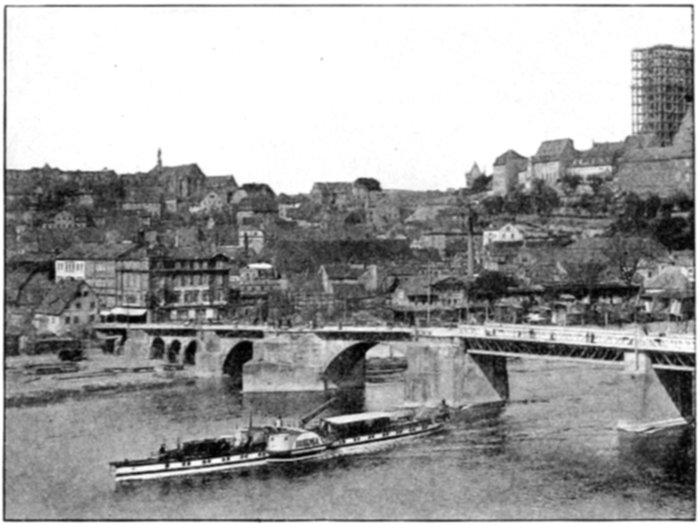
German side-wheel boat, common on European rivers
There are three great interests concerned in the problem of the bridges over the Allegheny River at Pittsburgh: (1) those who frequently cross the river or whose business requires the transportation of workmen, raw and manufactured material, and supplies from one side of the river to the other; (2) those concerned in the navigation of the river and harbor, and (3) those who own and operate the bridges.
In the hearings recently held on the subject much consideration has been given to the bridge owners and the navigation interests but comparatively little attention has been given, at first hand, to the interests of the general public, who in great numbers are interested in transportation across the river and for whose service both the bridges and river transportation exist.
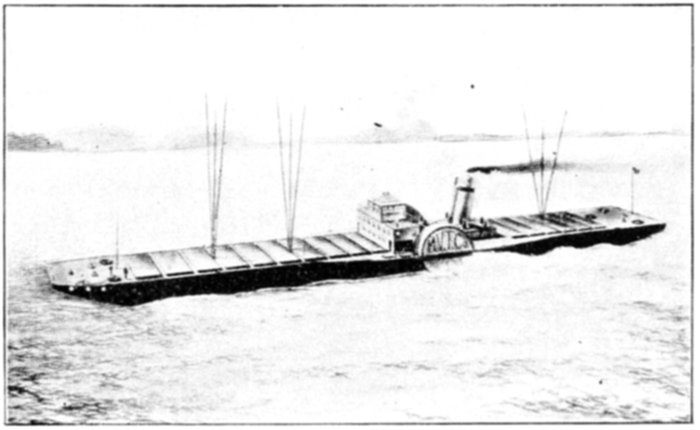
Design of boat for American rivers, adapted from European models
It is quite apparent, from a study of the situation and the interests involved, that changes might be demanded in the bridges which would give some added advantage to river navigation, but yet would place so great a burden upon the interests concerned in crossing the river that the result would be a net loss to the general public. The following are the two extreme positions somewhere between which all concerned would agree that a balance of interests most beneficial to the general public must be determined:
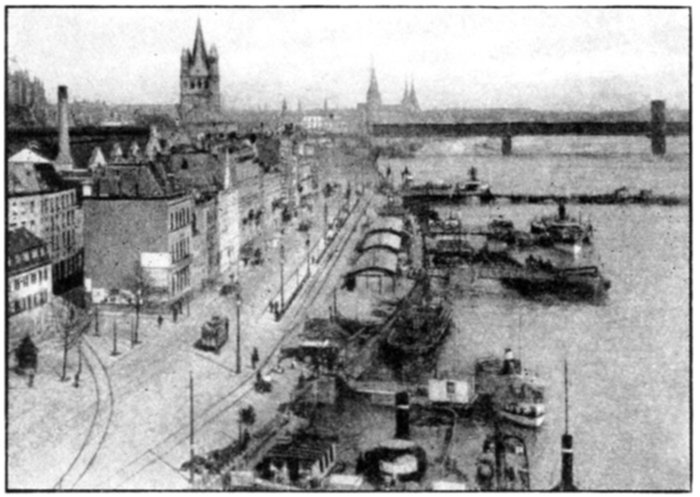
Wharf at Cologne, showing heights of boats
From the viewpoint of traffic across the river the best arrangement would be level bridges at the grade of the connecting streets, regardless of river traffic. The more bridges are raised above that standard, apart from any question of first cost, the greater will be the interference with travel across the river, up to the point of prohibitive grades on the bridges and their approaches. Before this point is reached drawbridges must be considered which, while often required and adopted, are objectionable to the interests using the bridges and those passing under or through the bridges.
From the viewpoint of the river interests the most complete improvement would be to do away with the bridges entirely, thus giving absolute freedom of navigation. This is out of the question. The next best thing from that point of view would be to change the bridges to one span each across the river from bank to bank with height enough for passage beneath of the highest floating structures at all stages of the river. This would be impracticable without remodeling the city along both sides of the river for long distances from the banks at an expense so great as to be almost beyond computation. Anything less than this will impose, at least in theory, some hindrance upon river navigation, and this hindrance will be greater in amount as the head room is decreased and as piers are introduced into the river.
The aim in arriving at a solution of the bridge problem must be to adjust these conflicting interests impartially; and the factors to be considered in arriving at such an adjustment are these: First, the amount and importance of the traffic likely to be affected in each case. Second, the extent to which any given solution would benefit or injure the bridge traffic and the river traffic, respectively.
1. Amount and Importance of Traffic Affected.—(a) Bridge Traffic.—There are in question six highway bridges and two railroad bridges.
UNDER BRIDGES OVER BRIDGES
TONNAGE IN MILLIONS
██ 2,344,398 SIXTH ST. 13,240,010 ████████
██ 2,796,122 NINTH ST. 14,732,130 █████████
█ 2,228,270 FT. WAYNE. 53,127,210 ████████████████████████████████████
▊ 1,045,570 THIRTIETH ST. 398,430 ▎
▋ 865,024 JUNCTION RR. 24,335,982 ████████████████▌
▐ 714,856 FORTY-THIRD ST. 311,090 ▎
PASSENGERS IN MILLIONS
▕ 25,680 SIXTH ST. 27,098,291 ████████████████████████████████████
▕ 30,567 NINTH ST. 24,325,900 ████████████████████████████████▌
▕ 24,408 FT. WAYNE. 4,877,495 ██████▌
▕ 11,455 THIRTIETH ST. 715,985 █
▕ 9,475 JUNCTION RR. 217,254 ▎
▕ 7,831 FORTY-THIRD ST. 816,333 █
UNDER BRIDGES OVER BRIDGES
Diagram No. 1, showing comparative importance of traffic over and under Allegheny river bridges
108,000,000 TONS OVER BRIDGES
1,500,000 TONS UNDER BRIDGES
COMPARATIVE DIAGRAM SHOWING TOTAL TONNAGE, OVER AND UNDER THE ALLEGHENY RIVER BRIDGES.
to accompany report of Col. Thomas W. Symons. Frederick Law Olmsted.
Before referring to the statistics in regard to traffic over these bridges we wish to point out that much the greater part of it is of a kind daily and intimately affecting the business and the convenience of a large population. Any delay affecting the transportation of passengers over any of these bridges, and any delay or any increase of cost in teaming package freight and supplies from freight stations and warehouses and stores on one side of the river to their destination on the other side, would be felt very sharply by a considerable fraction of the manufacturers, merchants and other citizens of Pittsburgh. The inconvenience arising from any interference with traffic of this class would clearly be greater in proportion to the volume and value of the traffic than in the case of the slower moving river traffic. Ten minutes' delay to people in reaching their offices or an hour's delay beyond the expected time in the delivering of household food supplies or express packages, etc., for a number of families, is a much more serious matter than a corresponding or even a greater delay in the delivery of a barge-load of gravel or coal, even though the barge-load were of equal value with the delayed lot of supplies.
Details in regard to the volume of traffic over the bridges and estimates of the value of the goods transported and the equipment engaged in the traffic are given in Appendix I and are summarized in graphical form in Diagrams 1, 2 and 3. The amount and importance of bridge traffic may be summarized by stating that there passes over the existing Allegheny River bridges each year about 108,000,000 tons of traffic roughly valued at $9,350,000,000; and about 62,700,000 human beings, passengers and pedestrians.
$9,366,973,935 OVER BRIDGES
$105,000,000 UNDER BRIDGES
COMPARATIVE DIAGRAM SHOWING TOTAL VALUE OF TRAFFIC OVER AND UNDER THE ALLEGHENY RIVER BRIDGES.
to accompany report of Col. Thomas W. Symons. Frederick Law Olmsted.
(b) River Traffic.—The data in regard to existing navigation under the Allegheny bridges consist of detailed reports of vessels and cargoes passing Dam No. 1 and counts of the number of vessels passing under the several bridges during representative periods of from one to two months in 1909. From these data we have estimated the annual river traffic under each of the bridges, and very roughly, its value.[32] These amounts are shown graphically in comparison with the corresponding figures for traffic over the bridges in Diagrams 1, 2 and 3. To briefly summarize, it may be stated that the river traffic of the Allegheny River in one year amounts in the aggregate to about 3,500,000 tons, including all freight carriers and power boats, roughly valued at about $105,000,000; and about 35,000 human beings, passengers by boat.
It seems well here to note that the water-borne traffic of the Allegheny River has been steadily decreasing for many years and is now but a small portion of that which once existed. That this decline in river traffic is not due to the interference of the bridges is shown by the statement that the navigation facilities are better than ever before. It is due to the lack of modern terminal facilities, boats and methods of carrying on business.
There is a possibility that, in case improved conditions are provided for Allegheny River navigation, the amount thereof may increase with the lapse of years, but for the reasons set forth in Appendix II, this increase is not likely to be so great in relation to the natural increase of the bridge traffic as to render the comparison of the existing facts in Diagrams 1, 2 and 3 inapplicable to the future.
(c) Comparison of Bridge and River Traffic.—To sum up, it may be said that each year the amount of traffic passing over the bridges is at least 30 times that floating on the water of the river, and about 90 times its value. The passenger traffic over the bridges is about 1800 times that on the water. The character of the traffic over the bridges is such that a given degree of interference with it is a far more serious annoyance to the public than the same degree of interference with river traffic.
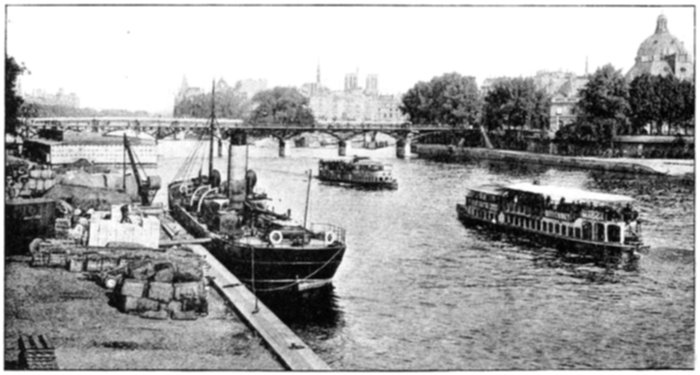
Paris passenger and freight boats
2. Effect of Various Solutions.—It remains to be considered to what degree the bridge traffic and the river traffic would be hampered or facilitated by various permanent solutions of the bridge problem. With a view to arriving at a plan as nearly ideal as the circumstances permit for a permanent arrangement of bridges over the Allegheny River, various projects have been put forward and considered. These concern two nearly independent matters, the elevation of the bridges above pool level and the location and design of the bridge piers. The former must be decided with regard to the effect upon both bridge and river traffic; the latter may be determined with regard solely to the navigation interests, giving due consideration to the cost and the appearance of the resulting bridges, as discussed below.
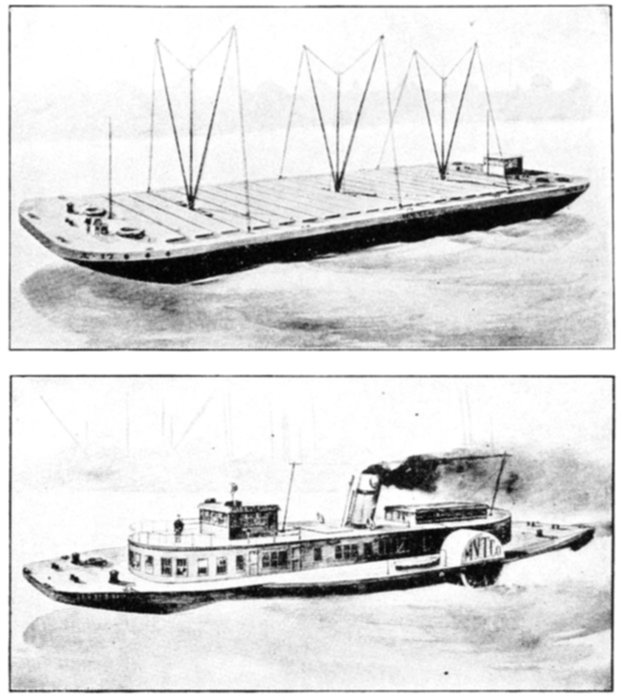
Barge and towboat designed for shallow rivers and low bridges in the United States
The plan upon which interest is now most centered is that officially recommended by the local office of the United States Engineer Corps. We shall consider the effect of the bridge heights proposed in this plan as compared with certain modifications thereof; first, upon the bridge traffic, and second, upon the river traffic.
(a) Effect of Various Possible Bridge Heights upon the Traffic over the Bridges.—Highway Bridges.—The highway bridges carry two principal classes of travel. The first consists of vehicles moved by power, electric cars and automobiles, and of pedestrians. With this class an increase of gradient on the bridges or their approaches, within reasonable limits, simply means the expenditure of a moderate amount of additional energy without material loss of time, or other difficulties. The second class consists of horse-drawn vehicles a large portion of which do not enter the hill districts but are limited in their movements to the large district lying on the lowlands of the three river valleys or accessible therefrom on moderate gradients. A great deal of this teaming consists of freight of all kinds received or shipped at the numerous freight stations on both sides of the river. The area accessible on roads of easy gradient from each end of these bridges is very great and includes nearly all the important industrial plants in Pittsburgh as well as all the freight stations and the principal warehouses, retail stores and other commercial establishments of Pittsburgh and Allegheny. Any considerable increase of gradient on these bridges means a reduction in average size of load hauled by vehicles of this important class, and a corresponding increase in the number of trips and in the number of teams required to do the work, making for increased cost and greater congestion of traffic. For all horse-drawn vehicles an increase of gradient on the bridges, beyond a certain limit, means, especially in wet or snowy or frosty weather, more slipping and falling, more stalling of all bridge traffic by such accidents, more wear and tear on horse flesh, and a resultant increased burden on the people. To raise the gradient of the bridges from those now existing to those indicated in the plans of the local United States Engineers' office would more than double the traction effort required in hauling over these bridges.
It must be borne in mind that, as the gradients increase, the cost of teaming and the wear and tear on teams increases much more rapidly than the theoretical effective horse power, because of the increased difficulty of foothold. It is impossible to measure the effect of any given increase of grade with precision, but a comparison of the existing conditions with those resulting from various possible bridge heights will give a good general idea of the effect as shown by the following tables:
Table Showing Bridge Grades Involved by the Adoption of Various Clearance Heights
Elevation in feet above pool level of under side of bridge over 360´ channel. Present 37´ 42´ 47´ Present 37´ 42´ 47´
[33]Maximum gradients Amount of rise in feet above Duquesne Way
Sixth Street bridge 2.3% 3.2% 4.5% 5.8%[34] 7.5 10.4 15.4 20.4
Seventh Street bridge 3.0% 3.7% 5% 6.3%[34] 10.0 14.2 19.2 24.2
Ninth Street bridge 2.8% 3.5% 5% 6.5%[34] 10.1 13.3 18.3 23.3
Table Showing Effective Energy Required to Overcome Rise over Bridges at Various Heights
Elevation in feet above pool level of under side of bridge over 360´ channel. Present 37´ 42´ 47´
Tons per annum Foot tons of effective energy
Sixth Street bridge 13,240,010 99,300,075 137,696,104 203,896,154 270,096,204
Ninth Street bridge 14,732,130 151,740,939 195,937,329 269,597,979 343,258,629
Per cent of increase of effective energy required
Sixth Street bridge 38.6% 105.3% 172.0%
Ninth Street bridge 29.1% 77.7% 126.2%
At the Sixth Street bridge there is at present an undesirably steep gradient[35] on the Allegheny, or North Side, approach, but it is only 230 feet long and being paved with stone gives a good foothold for horses. This is to be greatly benefited by filling up the street with material taken from the "Hump" grading, the plans on file in the City Bureau of Construction providing for an improved gradient of only 2.22 per cent. Many of the abutters have already waived their damages and there is no question that the improvement will be made. The present bridge gradients and those of the Pittsburgh approach are less than 3 per cent. At the Seventh Street bridge the gradients do not exceed 3 per cent, except on the Allegheny approach where it is now being reduced to 2 per cent. At Ninth Street, while the present bridge gradients do not exceed 2.8 per cent, there is a short pitch about 100 feet long in the approach on the Allegheny side with a grade of 5.24 per cent.[36] A small amount of regrading, involving no heavy property damages, will suffice to reduce these gradients to 1.3 per cent, and appropriations for this improvement have already been made by the City.
The existing grades at the Sixteenth Street, Thirtieth Street and Forty-third Street bridges are light, but it is not important to consider these bridges in detail in this connection as it is probable that the necessity for eliminating railroad grade crossings will sooner or later alter the existing approaches in such a manner that the resulting gradients would not be further increased by raising the bridges. It is to be noted, however, that the precise elevations recommended by the local office of the United States Engineers for these bridges would involve serious complications with the railroad tracks.
In many cities having similarly situated level business and manufacturing districts along rivers, very large sums of money have been spent to reduce the gradients on the connecting bridges to less than 3 per cent, and that figure is rather generally regarded by engineers as a maximum upon important traffic bridges.
People in Pittsburgh are so accustomed to steep gradients in the adjacent hill districts that they are apt to ignore the fact that there is a city within their city, and that this inner manufacturing and business city is closely confined to the long drawn-out, irregular, level river-bottoms and is much freer from hills than New York, almost as much so as Chicago.
The city has expressed its willingness to spend a large sum of money and undergo great inconvenience for the sake of a moderate reduction in the street gradients of the "Hump" at one of the gateways of the hill districts. Important as this work is, it cannot be compared for a moment as a matter of traffic improvement with the importance attaching to easy gradients on the bridges, for the streets of the "Hump" district lead in the main from the flat part of the city to the hilly part where average loads are limited by the prevailing steep gradients, whereas the bridges lie between two parts of the level industrial and commercial city. If at low gradients they serve to unite them; if at high gradients they divide them.
Railroad Bridges.—In so far as any changes in the railroad bridges produce conditions less convenient and expeditious for handling the business which the people have to do with the railroad, the public has a direct concern in the matter.
With regard to the Junction Railroad bridge of the Baltimore and Ohio Railroad System, the raising proposed by the local office of the United States Engineers, appears to involve no serious difficulties in operation which would affect the general public or the shippers.
With regard to the Pittsburgh, Fort Wayne and Chicago bridge of the Pennsylvania System, it is to be noted that this is a double-deck bridge, the upper tracks being used principally by passenger trains and the lower tracks by freight trains almost exclusively devoted to local freight business. The most serious consideration affecting this bridge is that any very considerable raising of the level of the lower tracks would throw them out of connection with the important local freight station to which those tracks run. Even if expense of reconstruction be wholly disregarded we believe no way can be devised by which the freight tracks of the Fort Wayne bridge, if raised as proposed by the local office of the United States Engineers can be connected with the freight station and industrial plants without involving greatly increased difficulty and delay in the handling of freight either on the tracks or in the station itself or in the teaming approaches to the station. When the large volume of local traffic handled at this station is considered, it is apparent that such a radical change is a serious matter for shippers and the great manufacturing and commercial industries of the city. Other than the expense of making changes in the bridge and its approaches no serious difficulty stands in the way of raising the clearance of the main span of the Fort Wayne bridge 2 or 3 feet to about 37 feet above pool level. To go above that figure involves the serious objections discussed above.
(b) Effect of Different Bridge Heights Upon River Traffic.—The effect upon river navigation of any standard that may be adopted for the heights of bridges depends upon the heights of the vessels using the river and the fluctuations of the river level itself. (See Diagrams 4 and 5.)
By means of Davis Island Dam in the Ohio River the water of Pittsburgh harbor is now kept practically at a minimum stage of six feet above the datum of zero at natural low water. This is the prevailing water level for the greater portion of the year. Floods come occasionally, produced by rains and melting snows, and, of course, with the floods come increased current velocities. These current velocities of each river depend upon the source of the flood. When the flood comes down the Allegheny River high velocities result. When the flood comes down the Monongahela the high water in the Allegheny is back-water without excessive currents. Under this condition the Allegheny becomes a harbor of refuge for Monongahela commerce; and the reverse is true that in an Allegheny River flood the Monongahela becomes a harbor of refuge for Allegheny commerce. The floods in the two rivers seldom come at the same time on account of the differences in the topography and climatic conditions along the two water-sheds. The most serious floods in the Allegheny generally come in the spring, when they are frequently accompanied with drift and ice to such an extent as to render navigation dangerous. At a stage of 15 feet in an Allegheny River flood the river current runs at rates of from 4 to 7 miles per hour. The record of fifty-five years shows that there is an average of 9 days each year when the river is above a 15-foot stage, and this is mostly in the winter and spring when navigation in the harbor is at its lowest ebb. There is presented herewith Diagram 4, showing graphically the average number of days each year during which the river has reached the various heights indicated.
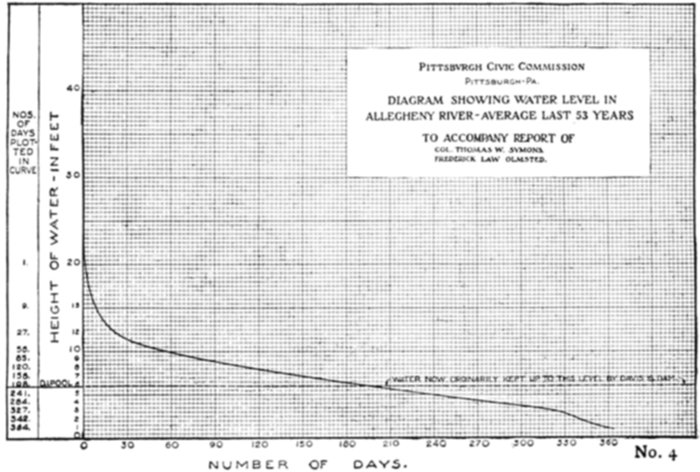
DIAGRAM SHOWING WATER LEVEL IN ALLEGHENY RIVER—AVERAGE LAST 53 YEARS
There is also presented a hydrograph record of the river for four years past which indicates the conditions ordinarily met with as regards river stages at various times of year.
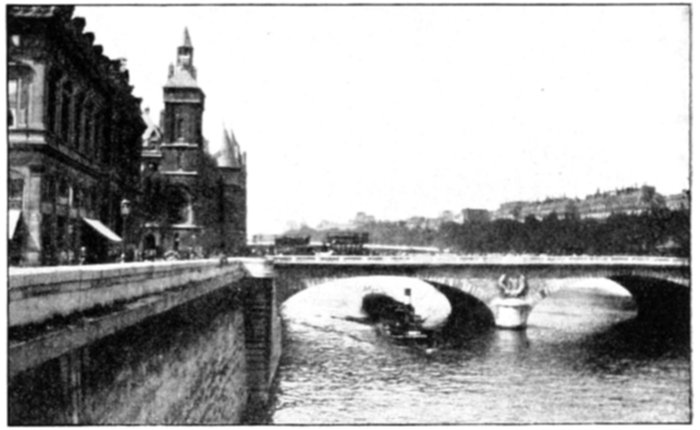
Towboat and barge passing under low bridge
In the balancing of interests between the traffic on the river and that across the bridges, it is believed to be fair and just that for boats of excessive size and height the navigation of the river above a 15-foot stage be eliminated from the problem; (1) because of the comparatively small number of these boats; (2) because of the questionable necessity of having such high boats at all; (3) because of the period of the year when these extreme stages are reached; (4) because these periods of time are so limited in length; (5) because of the generally accompanying swift currents, and (6) because of the oft-times accompanying dangerous floating drift and floating ice.
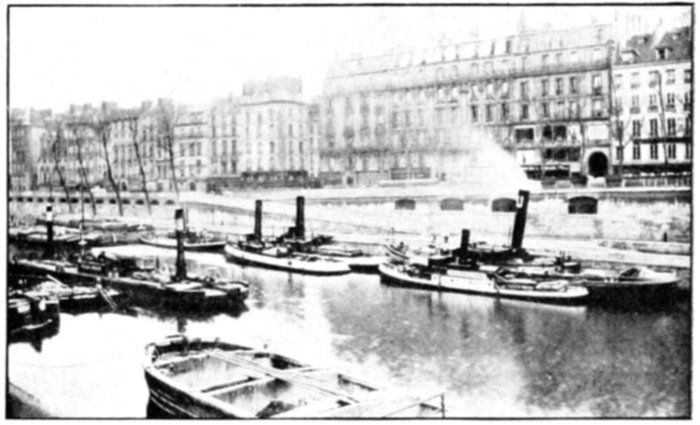
Closer view of such boats
As to the height of vessels, it is to be noted that the great bulk of navigation under the bridges is not through traffic, but is simply movements about in the lower stretch of the river which forms part of the harbor of Pittsburgh. The commodities moved are nearly all sand, gravel and coal in barges, which loads are almost invariably taken up stream while the downward movement is mostly of empty barges. These barges are mostly moved by harbor tugs. The harbor tugs actually in use are from 22 to 27 feet high, averaging about 24 feet.
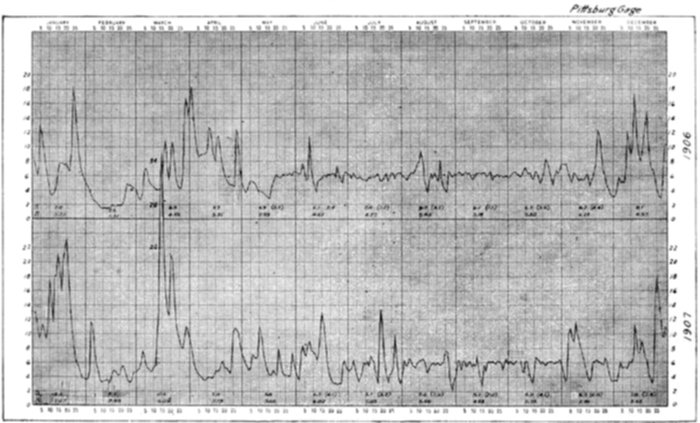
Allegheny River heights for each day, 1906-1907.—U. S. Engineers' Report (Diagram 5)
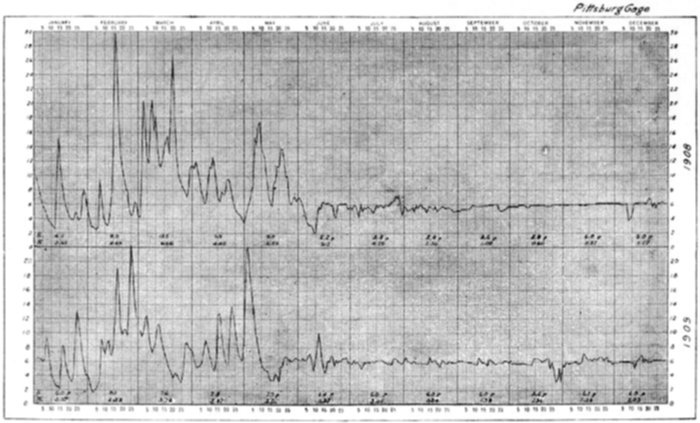
Allegheny River heights for each day, 1908-1909.—U. S. Engineers' Report (Diagram 5)
The heights of the Monongahela standard towboats vary from 24 to 32 feet, averaging about 28 feet. Out of a list of 28 such boats but 5 exceed 28 feet in height.
The few packet boats running on the river are of moderate height and can be accommodated in the harbor under the bridges at ordinary river stages. The amount of business that could be done by a few packet boats of extreme and unnecessary height is so small that to raise the bridges to a sufficient height to accommodate it would place an entirely unjustifiable tax and inconvenience upon the far greater business interest of the city concerned in crossing the river.
The following tables show the average number of days per annum during which various types of existing vessels would be prevented from navigation by bridges of various assumed heights above the Davis Island Pool:
Table Showing Effect of Various Clearance Heights under Bridges
Assumed bridge height above pool level in feet Present 6th St. bridge 33 37 42 47 Present 6th St. bridge 33 37 42 47
Types of Vessels Total number of days per annum when clearance would be insufficient. Total number of days per annum when clearance would be insufficient excluding days when river is above 15-foot stage.
Harbor tugs, average height 24´ 12 3 1 1 3 0 0 0
Harbor tugs, maximum height 27´ 36 9 1 1 28 0 0 0
Monongahela boats, ordinary maximum height 28´ 57 12 2 1 48 3 0 0
Monongahela boats, extreme maximum height 32´ 198 57 9 1 189 48 0 0
In drawing conclusions from the above table, as a basis for plans governing the expenditure of millions of dollars in construction and the permanent establishment of conditions of navigation and of traffic over the bridges and the enormous business interests concerned, it is important to bear in mind that the types of vessels here considered are antiquated, and can undoubtedly be materially changed in many particulars to the benefit of all interests.
As bearing directly on this question of boats and bridges, attention is invited to the following extract from the report of Hon. D. S. Alexander, chairman of the River and Harbor Committee of the United States House of Representatives, in submitting for action of the House the last River and Harbor bill on February 11th, 1910:
Modern Type of Boats for Non-tidal Rivers.—"The British Government has been designing shallow-draft boats for use on the Nile, and the German and Austrian governments have been working along similar lines with reference to methods of transportation on the Rhine, the Danube, the Elbe and other waterways. The boats designed have been very successful, having been used in connection with modern loading and unloading appliances. On our western rivers little change has been made in the design of towboats, barges, etc., since 1860, and it is believed that a design embodying the best points of modern vessels, with modern machinery and cargo handling devices, might lead to a marked increase in the traffic on the non-tidal rivers of the United States, especially after permanently improved channels are available.
"It is believed that the appropriation of $500,000 to be expended in the purchase of plant for use in connection with the work of improvement of the river will also provide for experiments to be carried on by the Government which will result in improving the present type of river freight carriers; and also that these tests can be made in no other way, since the expenditures and uncertainties involved preclude the use of private capital for the purpose. As a result of the tests or experiments it is hoped that a large saving to the country at large may accrue from decreased costs of transportation, and that a type of carrier may be developed which will also reduce the cost of all bridges across navigable streams due to lessened requirements in the matter of head room."
This report of Colonel Alexander, the very able Chairman of the River and Harbor Committee of the House of Representatives, is worthy of serious consideration. Such an investigation and experiments to determine the best type of carriers to use on the river seems certain to be provided for and may result in clearly demonstrating that no necessity exists for raising the Allegheny bridges at all, in accordance with the possibility outlined by the closing paragraph of Colonel Alexander's report above. The appropriation of $500,000 as recommended by Colonel Alexander is included in the River and Harbor bill which has passed the House of Representatives and Senate. There is every probability that it will become a law.
A vast amount of water traffic is carried on inland waterways all over the world under fixed bridges with far less head room than is provided for under the Allegheny River bridges. It is customary in other parts of the country and the world to establish for rivers a minimum head room for bridges at a high navigable stage, which stage is considerably lower than the maximum or even the ordinary high flood stage. For instance, in the new barge canal being built by the State of New York at a cost of $108,000,000 the minimum head room under all stationary bridges is fixed at 15½ feet at the high navigable stage of the water. The high navigable stage is based chiefly upon what is a safe navigable stage, taking everything into consideration. It is by no means a very high stage. As this canal runs through the canalized Mohawk, Oneida, Oswego, Seneca and Clyde rivers, the situation is comparable with that on the Allegheny. The depth of the canal at low water is to be 12 feet, so it is seen that the clear head room is but about 25 per cent greater than the minimum depth of the water. The boats must be made to fit the bridges, and not the bridges to fit the boats. It is estimated that the amount of traffic which will pass through these canals about 450 miles long and under these 15½-foot bridges will be about 20,000,000 tons annually, many times the amount making use of the Allegheny River. The present Erie, Champlain and Oswego canals in the State of New York, which have been in operation for about 80 years, are crossed by several hundred bridges giving a clear head room of 13 feet. No complaint about this head room is known to exist, notwithstanding that steam vessels are largely used for navigation purposes on the canals. The boats have to be made to fit the bridges and not the bridges to fit the boats.
At Paris, the river Seine running through the city carries a very large amount of business. Annually about 20,000,000 passengers, and about 11,000,000 tons of freight are carried on boats of various kinds. There are 36 bridges which span the river and must be passed by the water-borne traffic. The clear head room under these bridges at the highest navigable water varies from 11.25 feet to 21.88 feet. By highest navigable water is meant the stage of water when by reason of floods or currents, navigation ceases. This Paris water-borne freight traffic on the Seine amounts to fully 7 times that of the Allegheny River and passes under 5 times as many bridges, with minimum available head room at high navigable stages just about one half that under the present bridges over the Allegheny at a 15-foot stage. The conditions of navigation on the Seine at Paris are practically the same as those on the Allegheny at Pittsburgh. In Paris the boats are made to fit the bridges and not the bridges to fit the boats.
From these and many other illustrations that could be given it is evident that it is not universally or even commonly considered necessary or advisable to sacrifice business interests crossing the bridges to navigation interests using the waterways, to any such extent as that demanded by the navigation interests of the Allegheny River.
Conclusions as to Clearance Heights.—Disregarding for the moment the question of the time when changes in the present bridges should be required, it is believed, after very careful consideration, that the conditions brought out by our study of the problem would best be met by fixing the elevation for a substantial portion of each bridge in the center at a clear height above the pool level of substantially 37 feet, or 28 feet above the river at a 15-foot stage at each bridge. It is believed that this elevation will give fair, justifiable and all really needed accommodations to the navigation interests. This height can be attained without extravagant and unjustifiable expense and inconvenience to the business interests involved in crossing the river, and while it cannot be hoped that it would be satisfactory to the extreme advocates of river and harbor interests, it ought to satisfy those who are able and willing to give proper and fair consideration to other interests than their own. There are no reasonable navigation demands, with bridges at this elevation, that cannot be met if the water-borne commerce be conducted with vessels of the best modern accepted type and not of extreme or unnecessary height.
Piers and Channels.—For the benefit of the navigation interests there are certain changes in some of the bridges over the Allegheny that should be made without question. These relate to the location of piers and location and width of the navigable channels.
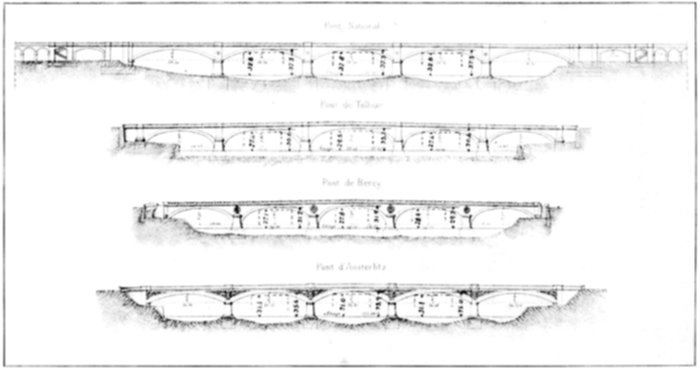
Bridges over the Seine, Paris, showing low clearance heights required and shallow water
At the extreme mouth of the Allegheny River a new bridge, the North Side Point bridge, has been approved by the War Department and is to be built. This is to have one central pier dividing the river into two channels.
A short distance above this North Side Point bridge is situated the Sixth Street bridge, in some respects the most important highway structure crossing the river. This bridge now corresponds to the North Side Point bridge in having a central pier and dividing the river into two main channels of ample width of over 400 feet.
The next bridge, the Seventh Street bridge, also has now a central pier with channels about 320 feet width on each side of it. The next bridge up the river, that at Ninth Street, has shorter spans, with the piers so unfortunately located as to be decidedly obstructive. As this bridge is of relatively light construction it is possible that the heavy and constantly increasing traffic which it is called upon to bear will before long necessitate its reconstruction anyway, and it will not be unreasonable to require it to be rebuilt with fewer piers properly located to conform to the plan adopted for the Sixth Street and Seventh Street bridges.
As a permanent arrangement of piers for the above three bridges either of two logical plans may be adopted. The first is to retain the existing two-spans center-pier arrangement of the Sixth Street and Seventh Street bridges, conforming to the center pier plan required by the United States Engineers for the new North Side Point bridge, and reconstruct the Ninth Street bridge upon the same general plan. The other is to reconstruct all three bridges with two piers and three spans each, as recommended by the local office of the United States Engineers. The first or central pier plan has the merit of economy of construction in that it involves the construction of no new piers for the Sixth Street and Seventh Street bridges, and permits the continued use of the existing superstructures of the Sixth Street and Seventh Street bridges by simply raising them to the elevation that may be decided upon and ordered. So far as we can ascertain, in view of the center pier plan adopted for the North Side Point bridge, the advantage to navigation appears to lie on the side of adhering to a center pier plan for these bridges also. On the other hand, there is no doubt that three-span bridges could be made more agreeable in appearance than two-span bridges. But the possible gain in appearance alone does not appear sufficient to justify the adoption of three spans.
The next bridge above Ninth Street is that of the Pittsburgh, Fort Wayne and Chicago Railroad. This has been constructed with two main piers providing one main central channel 337.5 feet wide and three other piers giving four channels from 155 to 163 feet wide. Owing to the bend in the river at the bridge and the distance above the Ninth Street bridge, there is no valid objection to this single main central channel at the railroad bridge connecting either with two channels divided by the central piers of the bridges below, or with a central channel if those bridges should be reconstructed on the three-span plan.
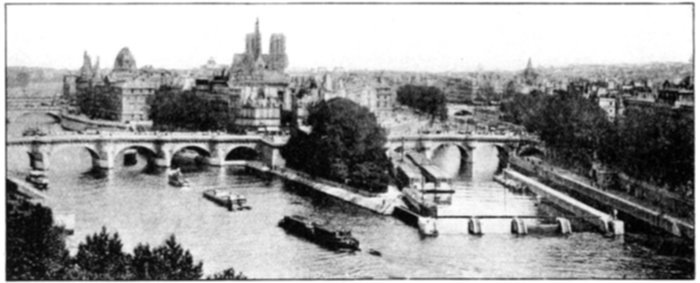
Paris bridges and boats—low boats to fit bridges
The Sixteenth Street bridge has been constructed with 3 piers dividing the river into 4 channels of about 150 feet each; the clear head room beneath it is less than that now given by the bridges below it. The best arrangement to be made with this bridge is to require it to be rebuilt without the central pier, leaving a central channel about 320 feet in width between the two side piers to correspond with the railroad bridge just below it. It is an old, covered, wooden bridge, in poor physical condition, and, as previously noted, it is probable that it must be raised anyhow in connection with eliminating railroad grade crossings on the approaches.
The Thirtieth Street bridge has its piers properly spaced to leave a central channel 285 feet in clear width and no changes are required in pier and channel location at this bridge.
The Thirty-third Street or Pittsburgh Junction Railroad bridge of the Baltimore and Ohio System has 3 piers, giving a main central channel of 232 feet wide, with side channels 195 feet wide, and on the Herrs Island side of 150 feet. No change is needed in the location of the piers and channels at this bridge.
The Forty-third Street bridge is built with 3 piers, making 4 channels each of about 160 feet wide. It gives less clear head room at high river stages than most of the lower river bridges. It is an old wooden bridge, in poor physical condition. The best arrangement for this bridge is to treat it as the Sixteenth Street bridge, and to require it to be rebuilt, omitting the central pier and leaving a central channel about 300 feet wide, to correspond with the bridges below it. The elimination of railroad grade crossings on the approaches to this bridge is already a pressing public need and must soon result in its raising or reconstruction at a higher level.
Considerations against Requiring Changes in Bridges To Be Made at Present.—The following important questions, having a direct bearing upon the proper design of permanent bridges across the Allegheny River, are now under consideration:
1. The Flood Commission is getting data for studying the question of a protective embankment along the river front, and of the proper grades of streets and bridge approaches in the region subject to inundation. The design of such flood-protection works should have important bearing upon the grade, location and design of the permanent bridge abutments. This Commission is also studying the question of impounding the flood waters of the Allegheny and Monongahela Rivers in their upper valleys, which may result in materially lessening the height and velocity of floods in the harbor of Pittsburgh, and consequently, simplify the bridge and navigation problems of the harbor.
2. The question of the best routes for surface cars and rapid transit lines crossing the Allegheny River is now being studied for the City as a part of a comprehensive plan for traction improvements. The result of these studies might readily affect the design of the new bridges.
3. The government experiments recommended by Colonel Alexander of the River and Harbor Committee and authorized in the River and Harbor bill just passed by Congress and providing for the development of a more economical and efficient type of river-boats, requiring less head room than the present antiquated types, may soon show results that would have a decided influence in determining the reasonable clearance heights of bridges.
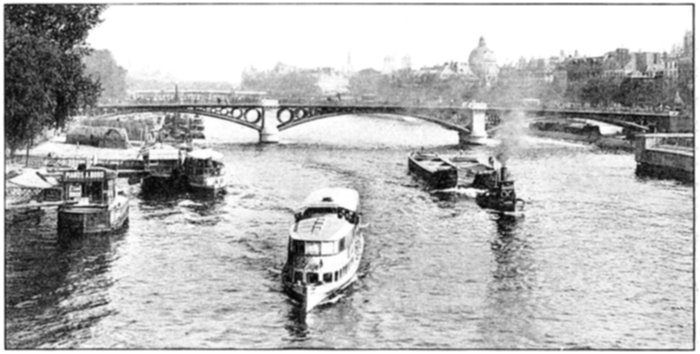
A typical Paris boat and tows
4. Attention is also invited to the fact that the people of Pittsburgh have voted to expend about $7,000,000 in certain public improvements. Among these are the cutting down of the "Hump," an obstructive hill in the city's midst, widening some streets and filling certain other streets in the North Side and West End that are flooded at high river stages. The material from the "Hump" in the vicinity of the Court House is to be hauled to these North Side streets across the lower Allegheny bridges under question. The work is of great magnitude and it will take at least two years to complete it. Any material alteration to the bridges such as proposed by the Board of Engineers will require a long time to be carried into effect. While this bridge work would be under way, the transportation of the material excavated from the "Hump" and the filling up of the low grade streets of the North Side would have to cease or would be carried on with great difficulty and inconvenience to other traffic. This would tie up the whole work while it is in progress, causing material injury to the city, for it is to be extremely annoying and bothersome while it is in progress, and the longer this period is strung out the worse it will be.
For all of the above reasons we believe that to precipitate the actual reconstruction of the bridges at this time would be most undesirable for the city and prejudicial to the best results, in the long run, for all concerned.
RECOMMENDATIONS
In conclusion we beg to recommend as follows: 1. That the Sixteenth Street and Forty-third Street bridges, which are obstructions to navigation on account of their pier locations, narrow channels, and exceptionally low clearance height, be required to be rebuilt with their piers so located as to give channels conforming to the neighboring bridges, and that their elevation be fixed with regard to eliminating the railroad grade crossings on their approaches, but the minimum clearance shall be fixed in accordance with the closing paragraph below.
2. That the Ninth Street bridge should be rebuilt as soon as practicable with a center pier and two wide spans conforming to those of the Sixth Street and Seventh Street bridges. The design of the new Ninth Street bridge, however, should not be finally determined and erection begun until a definite plan for comprehensive improvements in the traction system between the two sides of the river has been decided upon. Unless new circumstances develop before the construction of this bridge is begun that materially affect the problem of clearance height, the elevation should be fixed in accordance with the closing paragraph below.
3. That all questions pertaining to changing the elevation of the Sixth Street, Seventh Street, Fort Wayne, Thirtieth Street and Junction Railroad bridges be deferred to await the report of the Pittsburgh Flood Commission and the resultant action; to await the report on a comprehensive plan for traction improvements; to await the completion of the work projected by the City in cutting down some streets and filling others; and to await the results of investigation of river-boat design and construction provided for in the River and Harbor bill just passed by Congress.
4. That, if it is deemed essential and necessary at present to decide upon the elevation to which all Allegheny River bridges must be made to conform, this elevation be fixed so that there shall be a clear head room of substantially 37 feet above pool level, varied so as to give at each bridge a clear head room of 28 feet when the river is at a 15-foot flood stage. This height to be maintained over the entire main span where there is a central span and for 180 feet on each side of the central pier where there is a central pier.
We have the honor to be, very respectfully,
Your obedient servants,
Thomas W. Symons, Col. Corps Engineers U. S. A., retired, Frederick Law Olmsted.
APPENDIX I
Amount and Importance of Bridge Traffic.—Highway Bridges.—The following table gives the records of counts made in the fall of 1909, and spring of 1910 on the various bridges over the Allegheny River:
Record of Counts.—Table No. 1
Location of bridges Period of count Street cars Heavy wagons Light wagons Carriages Automobiles Pedestrians
Sixth Street Aug. 24-Oct. 23 89,354 55,791 79,247 9,534 24,583 1,605,793
Ninth Street Aug. 26-Sept. 30 72,854 8,961 14,846 613 960 185,158
Thirtieth Street Aug. 24-Oct. 23 9,844 10,184 667 447 96,485
Forty-third Street Aug, 23-Nov 1 8,159 8,165 987 2,179 130,744
Record of Counts.—Table No. 1A
Location of bridges Period of count Passenger vehicles Delivery vehicles Single trucks Double trucks Pedestrians
Seventh Street Feb. 28-Mar. 3, 4, 5, 7 401 4,800 273 1,035 29,146
Assuming that the average number of vehicles per day and the average tonnage per day are the same throughout the year as during the periods of counting, we deduce the following results:
Traffic for Year 1909.—Table No. 2
Location of bridges Period of count Street cars Heavy wagons Light wagons Carriages Automobiles Pedestrians [39]Gross tonnage [40]Total value
6th St. 1909 534,652 333,829 474,171 57,013 147,095 9,608,406 13,240,010 [41]1,879,140,750
9th St. 1909 738,650 90,812 150,490 6,205 9,709 1,877,268 14,732,130 2,201,473,500
16th St. 1909 115,851 202,429 1,991,988 967,544 102,201,375
30th St. 1909 58,875 60,919 3,979 2,664 577,320 398,430 44,233,500
43d St. 1909 42,522 42,559 5,147 11,351 681,710 311,090 32,478,500
Traffic for Year 1909.—Table No. 2A
[42]
Location of bridges Passenger vehicles Delivery vehicles Single trucks Double trucks Pedestrians [39]Gross tonnage [40]Total value
Seventh Street 29,273 351,400 19,929 75,555 2,127,585 1,159,084 149,862,600
Railroad Bridges.—The bridge carrying the heaviest traffic is that of the Pittsburgh, Fort Wayne and Chicago Railroad, a part of the Pennsylvania System, which forms one of the links in the main line of this railroad system between the East and West. Across this bridge are carried each year about 2,750,000 passengers, 32,000 tons of mail, and 53,000,000 tons of freight and general railroad traffic, besides about 2,135,000 pedestrians,[42] making it one of the greatest throats of commerce in the country. This is a double deck bridge of 4 tracks, 2 tracks on each deck, with a wide footway on the lower deck. It is to be noted that the amount of traffic passing over this bridge is about 25 times as much as that which floats on the water beneath it, and is far higher in quality and value per ton.
The other railroad bridge crossing the river within the city limits is the Thirty-third Street viaduct of the Baltimore and Ohio Railroad. This is a link in the Baltimore and Ohio Railroad between the East and the West and carries an enormous traffic amounting each year to about 217,000 passengers and 24,330,000 tons of freight, express and other trains.
Uniting this with the traffic over the Fort Wayne bridge of the Pennsylvania we have crossing the Allegheny River on the two railroad bridges a gross amount of 77,330,000 tons, and 5,102,000 passengers and pedestrians, with a value of tonnage traffic estimated at approximately $4,957,000,000.
APPENDIX II
Amount and Importance of River Traffic.—The following statistics were obtained from the United States Engineers' office and show the number of boats, net tonnage and number of passengers passing Dam No. 1 in the Allegheny River during the year 1909:
Table No. 1
Month No. vessels No. passengers Tonnage of cargoes
January 338 16 30,889
February 358 18 30,073
March 1,055 25 81,424
April 732 197 51,457
May 896 1,506 57,269
June 958 1,248 56,324
July 901 2,495 37,888
August 868 2,019 29,102
September 1,006 1,681 36,759
October 955 982 53,622
November 789 616 42,827
December 495 231 29,086
Total 9,351 11,034 536,720
The following are statistics of counts taken in 1909 at the different bridges:
Table No. 2
Location of count Period covered by count No. of vessels passing
Sixth Street Bridge Aug. 24-Oct. 23 (61 days) 4,534
Ninth Street Bridge Aug. 26-Sept. 30 (36 days) 3,279
Fort Wayne Bridge Aug. 20-Oct. 28 (70 days) 4,925
Thirtieth Street Bridge Aug. 24-Oct. 23 (61 days) 2,022
J. R. R. Bridge Sept. 13-Nov. 13 (60 days) 1,460
Forty-third Street Bridge Aug. 23-Nov. 1 (70 days) 1,580
Assuming that the ratio between the number of vessels during any given period and the total for the year is the same at all bridges as at Dam No. 1; and assuming that the relative number of different kinds of vessels are the same at all bridges; and further assuming that the average weight of cargo is the same at all bridges as recorded at Dam No. 1, we reach the estimates of total traffic under the bridges given in Table No. 3.
For the Year 1909—Table No. 3
Location of count No. of vessels [43]Weight of vessels Weight of cargoes [43]Wt. of vessels and cargoes
Sixth Street Bridge 21,763 1,097,378 1,247,020 2,344,398
Ninth Street Bridge 25,904 1,311,823 1,484,299 2,796,122
Fort Wayne Bridge 20,685 1,043,020 1,185,250 2,228,270
Thirtieth Street Bridge 9,706 489,416 556,154 1,045,570
J. R. R. Bridge 8,030 404,905 460,119 865,024
Forty-third Street Bridge 6,636 334,613 380,243 714,856
The largest total, that passing under the Ninth Street bridge, is without doubt somewhat less than the total traffic on the river, and a careful study of the figures would seem to indicate that the total water-borne traffic of the Allegheny River in 1909 amounted to about one and three-quarter (1¾) million tons of cargo or three and one-half (3½) million tons gross displacement, including cargoes, barges, tugs and all vessels.
The water-borne commerce on this river is of the cheapest character, consisting almost entirely of sand and gravel dredged from the rivers and coal floated down the Monongahela and delivered along the shores. All this sand, gravel and coal is carried in low-lying barges or scows moved by tugs or towboats.
A small amount of package freight comes in and leaves by packet boats.
Table No. 4
TONNAGE PASSING DAM NO. 1 DURING YEAR 1909. (OBTAINED FROM UNITED STATES ENGINEERS)
Coal 231,232 tons
Other iron or steel products 428 tons
Sand 132,894 tons
Gravel 123,579 tons
Brick 75 tons
Stone 3,869 tons
Timber 8,519 tons
Lumber 3,519 tons
Pit posts 13,950 tons
Braces 600 tons
Railroad ties 6,650 tons
Wood 45 tons
General merchandise 3,119 tons
New barges 2,628 tons
New boats (coal) 3,940 tons
Manure 1,000 tons
Bark 455 tons
The average value of the freight based on prices prevailing in 1910 is about $3 a ton. The average value of the carriers is about $65 a ton. As there is a slightly greater weight of freight than carrier, an average of $30 per ton would be a fair estimate of the value of freight and carriers. The total value of the water-borne traffic of the Allegheny River for the year under the various bridges would, therefore, be about $105,000,000.
The passenger traffic on the river is so small that it may be considered negligible. It is estimated at 35,000, largely pleasure traffic in small boats.
About one-third as much tonnage goes through Lock No. 2 as through Lock No. 1, and about one-sixteenth as much goes through Lock No. 3 as through Lock No. 1. There is no navigation on the river above the third pool. It is claimed, however, that with the further canalization of the river above Dam No. 3 and the raising of the bridges this traffic would be greatly increased. It is to be hoped that there will be a considerable increase, but there are distinct limitations on the probable amount of the increase. The Monongahela has a larger and more highly favored local territory to draw upon for freight than the Allegheny so that under the best of conditions, with every possible improvement of navigation, the traffic on the Allegheny can never be expected to approach that upon the Monongahela.
The total amount of freight of all kinds passing Dam No. 1 on the Monongahela in 1909, was 5,417,873, or a little more than ten times the amount on the Allegheny, while the tonnage passing over the Allegheny bridges is thirty times greater than the tonnage on the Allegheny River.[44] Yet, if conceivably the traffic on the Allegheny should equal that now on the Monongahela, it would still be only one-third that over the Allegheny bridges.
Since the figures for the present traffic over the Allegheny River bridges are used for comparison with the present river traffic, and since the former must continue to grow steadily with the growth of the Pittsburgh industrial district, it seems quite clear that no conceivable growth in the latter can seriously affect the overwhelming predominance of the bridge traffic in amount and value.[44]