WORD PLAY
Reading edition
1. A PARADOX
Two words in our region of puzzledom pose, And claim, through the passage of years That neither the pages of Johnson disclose, While either in Murray appears.
Solution
No. III.—A MULTIFOLD MAGIC SQUARE
Here is a magic square of 81 cells.
53 8 71 28 73 10 51 6 69
62 44 26 19 37 55 60 42 24
17 80 35 61 1 46 15 78 33
66 21 30 14 59 50 34 79 16
3 39 75 77 41 5 25 43 61
48 57 12 32 23 68 70 7 52
31 76 13 72 27 36 11 56 47
22 40 58 9 45 81 74 38 2
67 4 49 54 63 18 29 20 65
If divided, as is shown, into 9 small squares, each of these is also a magic square, and yet another magic square is formed by the totals of these 9 squares arranged thus:—
396 333 378
351 369 387
360 405 342
Images
No. IV.—A MODEL MAGIC SQUARE
This magic square, which has in its cells the first sixteen numbers, is so constructed that these add up to 34 in very many ways.
4 15 14 1
9 6 7 12
5 10 11 8
16 3 2 13
Image
How many of these, in addition to the usual rows, columns, and diagonals, can you discover? They must, of course, be in some sort symmetrical.
Solution
2. A PREDOMINANT VOWEL
Can you fill in the missing letters which are needed to turn the oft-repeated “u” below into rhyming verse:—
.u.. .u.u. .u..u.., ..u...u. .u.. u..u.., .u... .u.., .u. .u..u.. .u..u... ..u...u. ..u..; ...u.. .u...., .u.. .u..u.. ..u... .u... .u... u..u.., U. .u...., .u.. ..u..-.u.u., .u..u.’. .u...u. .u..
Solution
No. V.—TESSELATED DIAMOND By G. Slater
106
13 109
113 16 14
12 110 107 15
42 9 11 100 78
74 81 112 10 56 71
67 53 87 111 83 43 34
27 49 50 35 59 63 84 6
96 26 46 72 68 39 37 115 7
30 95 97 76 75 33 85 3 116 114
91 31 28 94 40 61 82 120 2 5 117
92 90 25 64 89 47 41 119 121 8
29 93 58 62 54 69 86 4 118
32 66 60 57 73 52 80 1
44 79 65 19 45 48 36
51 38 104 18 55 70
88 22 103 105 77
99 23 20 102
100 98 17
21 101
24
Image
In this ingenious diamond all rows and both diagonals add up to 671; in the four corner diamonds all add up to 244; and in the central diamond, and the 16 rows of threes surrounding it, to 183.
3. AN ENIGMA
I see my first, I see my next, And both I sigh and see Joined to my third, which much perplexed And sorely puzzled me. ’Twas fifty, and ’twas something more, Reversed ’twas scarce an ell, With first and next it forms a whole Clear as a crystal bell. What is my whole? A splendid tear Upheld in cruel thrall; Blow soft, ye gales, bright sun appear! And bid me gently fall.
Solution
No. VI.—MAGIC SQUARE BY MULTIPLICATION
Here is a magic square, in which the rows, columns, and diagonals yield the same product, 4096, by multiplication:—
128 1 32
4 16 64
8 256 2
Image
It will be seen that the numbers in this square, 1, 2, 4, 8, 16, 32, 64, 128, 256, are in regular progression, and 4096 is also the cube of the central 16.
No. VII.—ANOTHER BORDERED MAGIC SQUARE
Here is quite a good example of a bordered magic square of sixty-four cells:—
1 56 55 11 53 13 14 57
63 15 47 22 42 24 45 2
62 49 25 40 34 31 16 3
4 48 28 37 35 30 17 61
5 44 39 26 32 33 21 60
59 19 38 27 29 36 46 6
58 20 18 43 23 41 50 7
8 9 10 54 12 52 51 64
Image
It is a perfect specimen itself, and as each border is removed a fresh perfect magic square is revealed.
4. A CHARADE
Take for my first a quadruped, Transpose one for my second; My whole, a biped, quick or dead, Is dainty reckoned.
Solution
5. BYRON’S ENIGMA
I am not in youth, nor in manhood, nor age, But in infancy ever am known; I’m a stranger alike to the fool and the sage, And though I’m distinguish’d in history’s page I always am greatest alone. I am not in earth, nor the sun, nor the moon; You may search all the sky—I’m not there; In the morning and evening—though not in the noon— You may plainly perceive me—for, like a balloon, I am midway suspended in air. Though disease may possess me, and sickness and pain, I am never in sorrow nor gloom; Though in wit and in wisdom I equally reign, I’m the heart of all sin, and have long lived in vain, Yet I ne’er shall be found in the tomb!
Solution
No. VIII.—A HARDY ANNUAL
A magic square can be formed with the 81 numbers from 172 to 252 inclusive, which in all its rows, columns, and diagonals will total 1908. It may interest our solvers to complete the square.
216 175 224 240 199 248
247 215 174 190 239 207
206 246 214 230 198 238
213 172 221
244 212 180
203 252 211
186 226 194 210 178 218
217 185 234 250 209 177
176 225 184 200 249 208
Image
We have filled in, as a solid start, 45 of the 81 cells.
Solution
No. IX.—ANOTHER “ANNO DOMINI”
This magic square adds up in rows, columns, and diagonals to 1908:—
469 484 472 483
481 474 478 475
482 471 485 470
476 479 473 480
Image
Can you decide in how many other symmetrical ways the same total is to be made?
Solution
No. X.—A DOMINO MAGIC SQUARE
In this magic square the rows, columns, and diagonals add up always to 33.
● ● ● ● ● ● ● ● ●
● ● ● ● ● ●
● ● ● ● ● ● ● ● ●
● ● ●
● ● ●
● ● ●
● ● ● ● ●
● ●
● ● ● ● ●
● ● ● ● ● ● ● ●
● ● ● ● ●
● ● ● ● ● ● ● ●
● ● ● ● ● ●
● ●
● ● ● ● ● ●
● ● ● ● ● ● ● ●
● ● ●
● ● ● ● ● ● ● ●
● ● ● ●
● ● ● ● ●
● ● ● ●
● ● ● ● ● ● ● ●
● ● ● ●
● ● ● ● ● ● ● ●
● ● ● ● ● ● ●
● ● ● ● ●
● ● ● ● ● ● ●
● ● ● ● ● ●
● ●
● ● ● ● ● ●
Image
Can you rearrange it so that the first stone (three-ace) shall occupy the centre, now filled by the double six, and it shall still add up in all ways to 33?
Solution
6. SHIFTING LETTERS
I am bright as a whole Till you cut off my head; Then as black as a coal, Or a mortal instead. Shaken up and recast We with science are found, Read us back from the last And we live underground.
Solution
No. XI.—CHESS AND NUMBERS
The arrangement of numbers in the 36 cells of this square discloses a very close affinity between chess and arithmetic.
30 21 6 15 28 19
7 16 29 20 5 14
22 31 8 35 18 27
9 36 17 26 13 4
32 23 2 11 34 25
1 10 33 24 3 12
Image
Can you follow this out?
Solution
7. A GOOD CHARADE By Horace Smith, one of the authors of “Rejected Addresses.”
In arts and sciences behold my first the watchword still, All prejudice must bend the knee before its iron will; Yet “Onward!” is the Briton’s cry—a cry that doth express A holy work but half begun, and speaks of hopefulness. In palace or in lonely cot its name alike is heard, And in the Senate’s lordly halls sit my second and my third. Strange paradox, though for my first my total is designed, Sad marks of vice and ignorance we in that whole may find.
Solution
No. XII.—NUMBERS PATIENCE
Those who combine a fancy for “Patience” with some skill in numbers will find amusement in filling the empty cells of this diagram with appropriate numbers, each of which must consist of two figures:—
17 24
32 46
14
19 16
22 20
Image
It is required that each of the rows across from side to side shall add up, when all the cells are filled, to 143 exactly. No number must be used more than once.
Solution
No. XIII.—THE WINDMILL
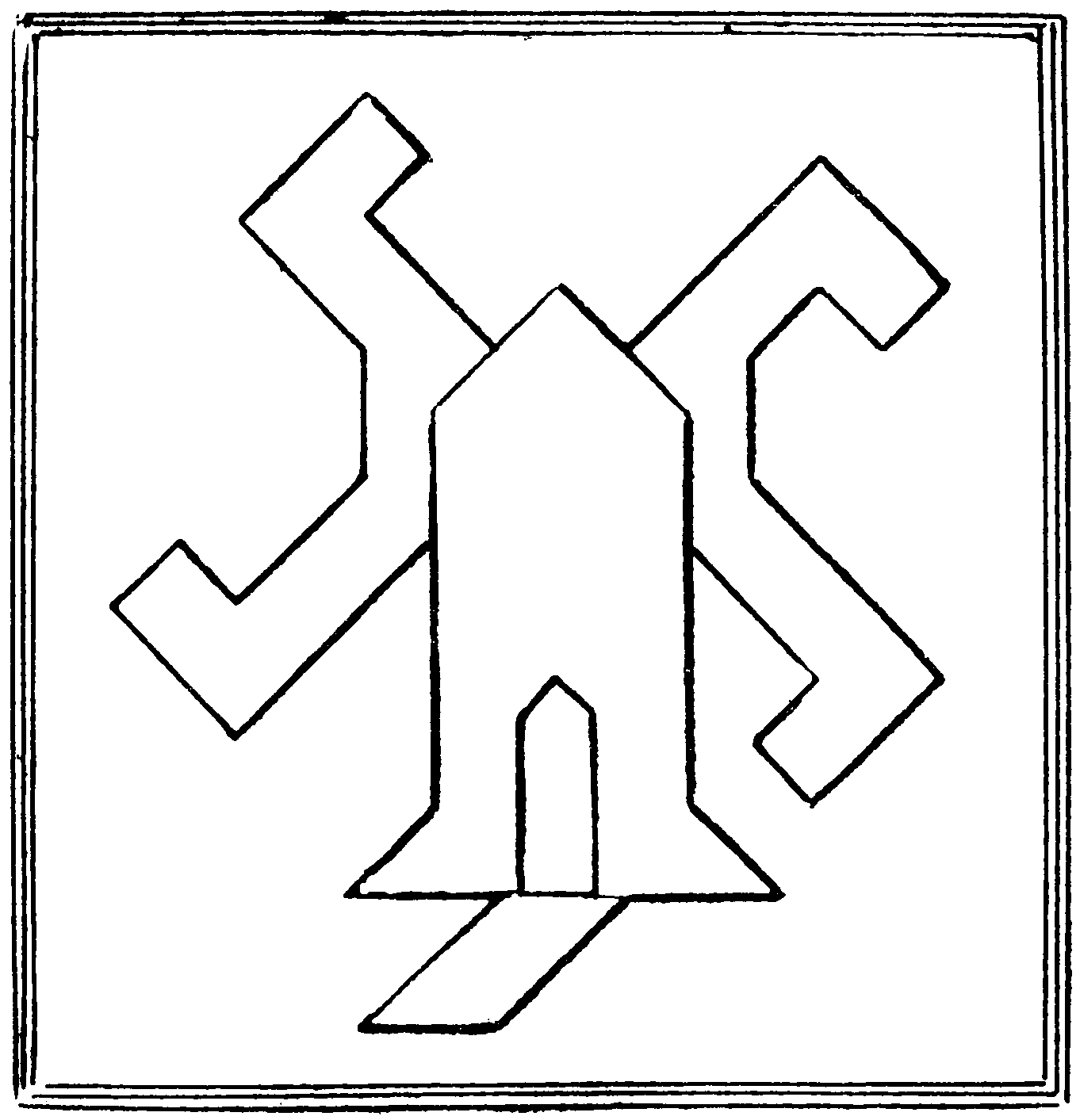
Can you divide a square into 15 parts, which can be built up into this windmill?
Solution
8. THRICE BEHEADED
Untouched I tell of budding growth and life; Beheaded I lead upward more or less; Again—with varied fragrance I am rife; Again—but little value I express.
Solution
No. XIV.—A NEST OF RECTANGLES
In this nest of 49 squares it is possible to count a great number of distinct and interlacing figures, whose opposite sides are equal, and whose angles are all right angles.
Image
Can you decide exactly the number of these rectangles, and say how many of them are square?
Solution
9. AN ENIGMA
Search Holy Writ and you will see A victory was won by me. Behead me, and I may be found In water or on hilly ground. Behead again, and then transpose, A snare my letters now disclose. If yet again my head you sever, No matter how sharp-set or clever ’Tis all in vain you look about, For no one yet has found me out.
Solution
No. XV.—ANOTHER DOMINO MAGIC SQUARE
Can you, using all the dominoes except double five, five-six, and double six, construct with the twenty-five stones a magic square that adds up in all rows, columns, and diagonals to 27, and in which the stones in the cells marked by the same figures in this diagram also add up to that number?
2 1 2
4 3 4
1 3 3 1
4 3 4
2 1 2
Image
Solution
No. XVI.—DOMINO PATIENCE
The problem is to construct, with all the twenty-eight stones, a domino pyramid of seven stages, starting with a single stone, and adding one stone on each successive stage.
The stones must be so arranged that the number of pips in any row or column are in all cases exactly three times the number of half-dominoes of which that line or column is composed. There are many solutions to exercise the solver’s patience.
Solution
10. LEGAL PLEASANTRIES
Said a lawyer aside to his friend in the court, “Now I’d bet, were we not in this place, That my first is my second a bottle of port,” Then bright with my whole shone his face.
Solution
11. RIVALS ON THE ROAD
Six horse buses and four motor buses travel each hour from Temple Bar to the Bank. The horses take 15 minutes, and the motors 10 minutes on the journey.
If I come to Temple Bar, and wish to reach the Bank as soon as possible, shall I take the first horse bus that turns up, or wait for a motor? It must be assumed that I can only see a bus as it actually passes me.
Solution
No. XVII.—A FRIENDLY HINT
The father of this venturesome lad, who was on the point of breaking out of bounds, came on the scene just in time to warn him in a sentence of nine words, five of which were “Never throw a leg, lad.”
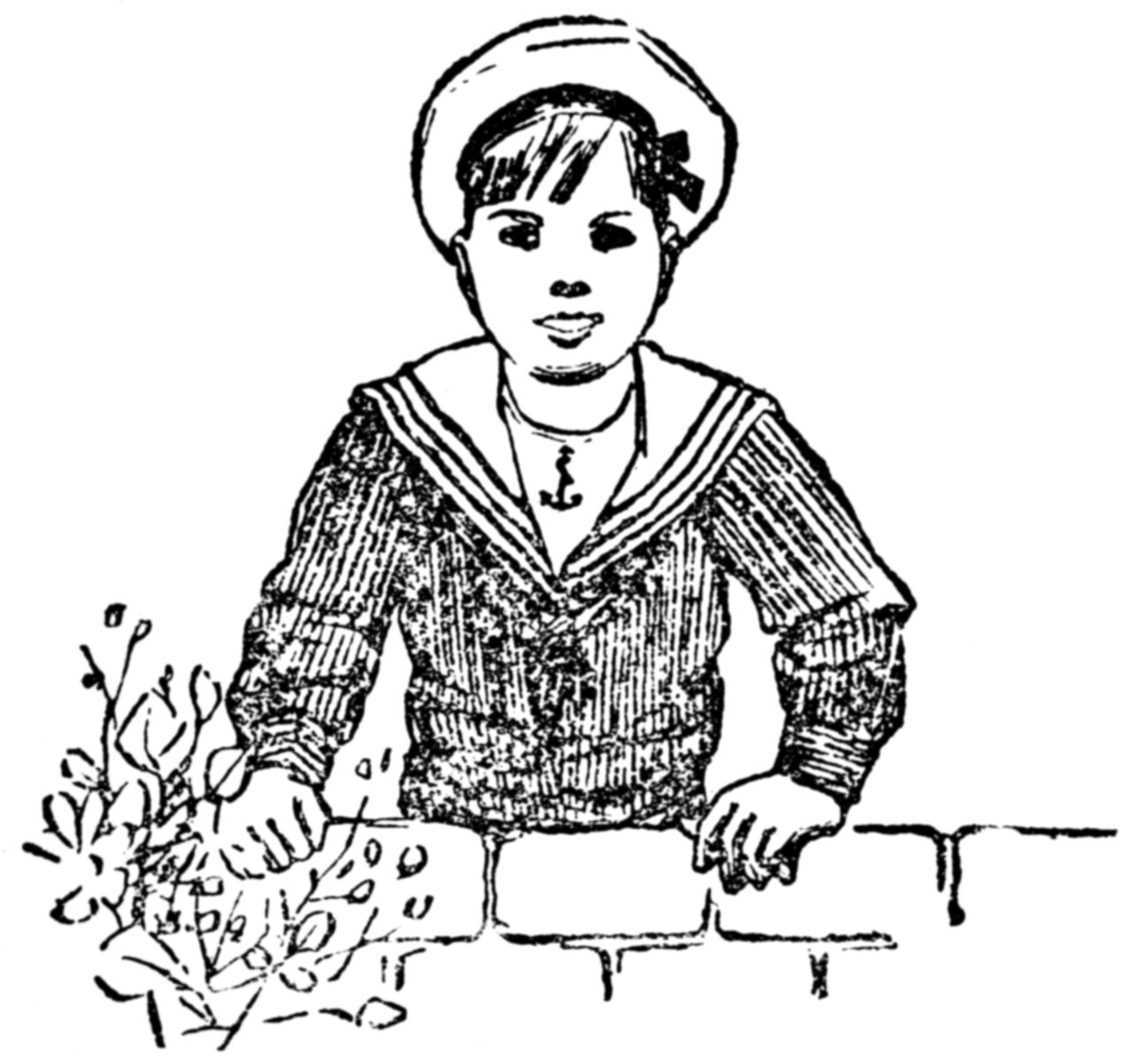
Can you supply the other four words, which are spelt with exactly the same letters?
Solution
No. XVIII.—CATASTROPHE
In this picture we see that a cat has sprung upon the table to interview the parrot.
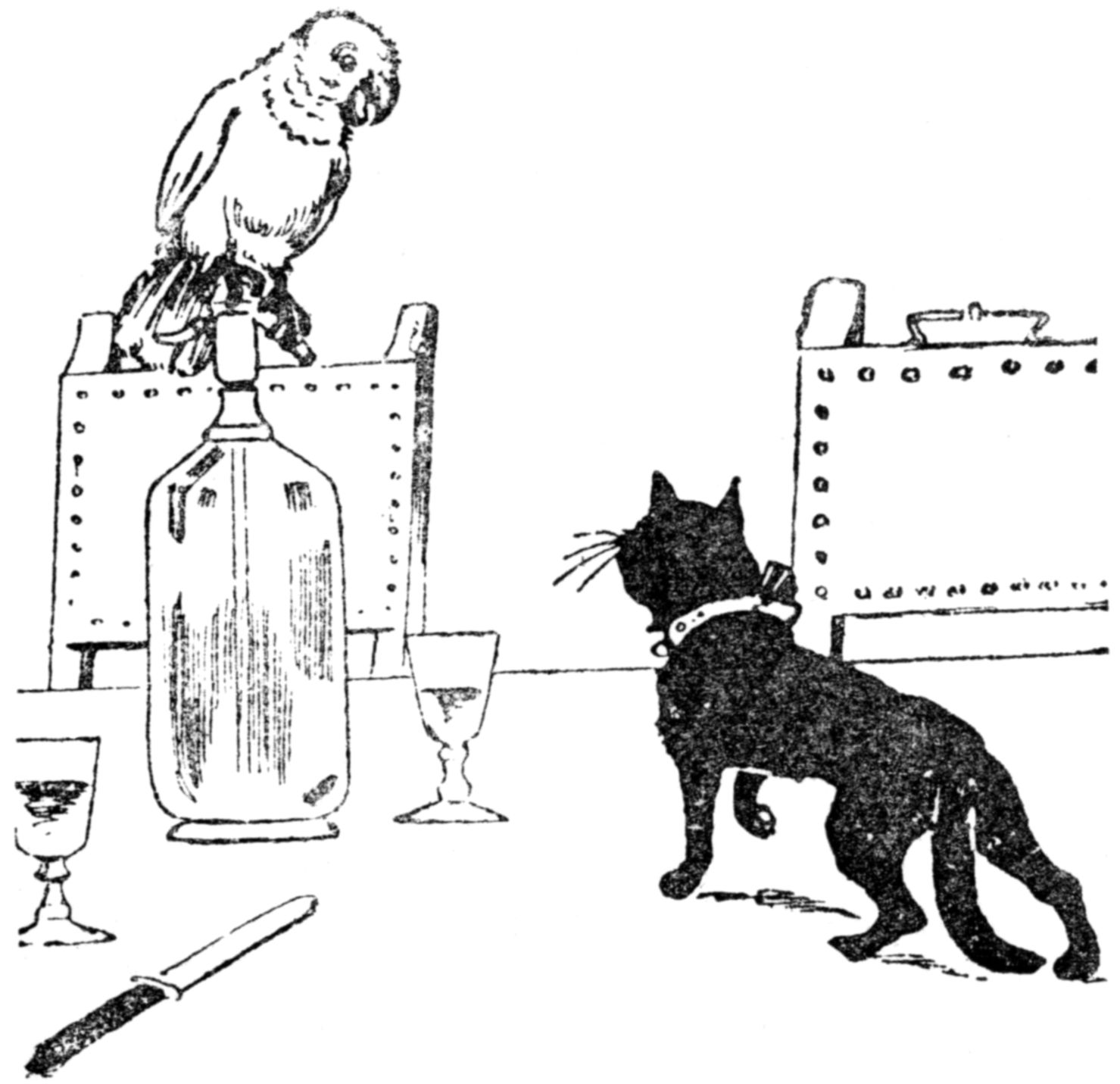
The title “Catastrophe” recast by anagram, tells the parrot’s happy thought at this critical moment, and the appropriate sentence,
“New parrot-stand in a house,”
tells, also by anagram, how he put this into instant operation.
Solution
12. A HISTORICAL CHARADE
My first, if foolishly or rashly taken, May mar the future prospects of your life. My second, by her fickle lord forsaken (Sad type of many a gentle, patient wife), May toil and moil to feed his many babies, While he goes flirting off with other ladies. The thrifty monarch of a former age My whole a place in Britain’s history fills. Immortalised in Shakespeare’s magic pages As one who’d fain reform his tailor’s bills!
Solution
No. XIX.—A PRECOCIOUS BOY
This is the picture of the first prize boy at a baby show. The judge, noticing the position of one chubby fist, said to the proud mother, “Your lad Tommy likes such tit-bits.”
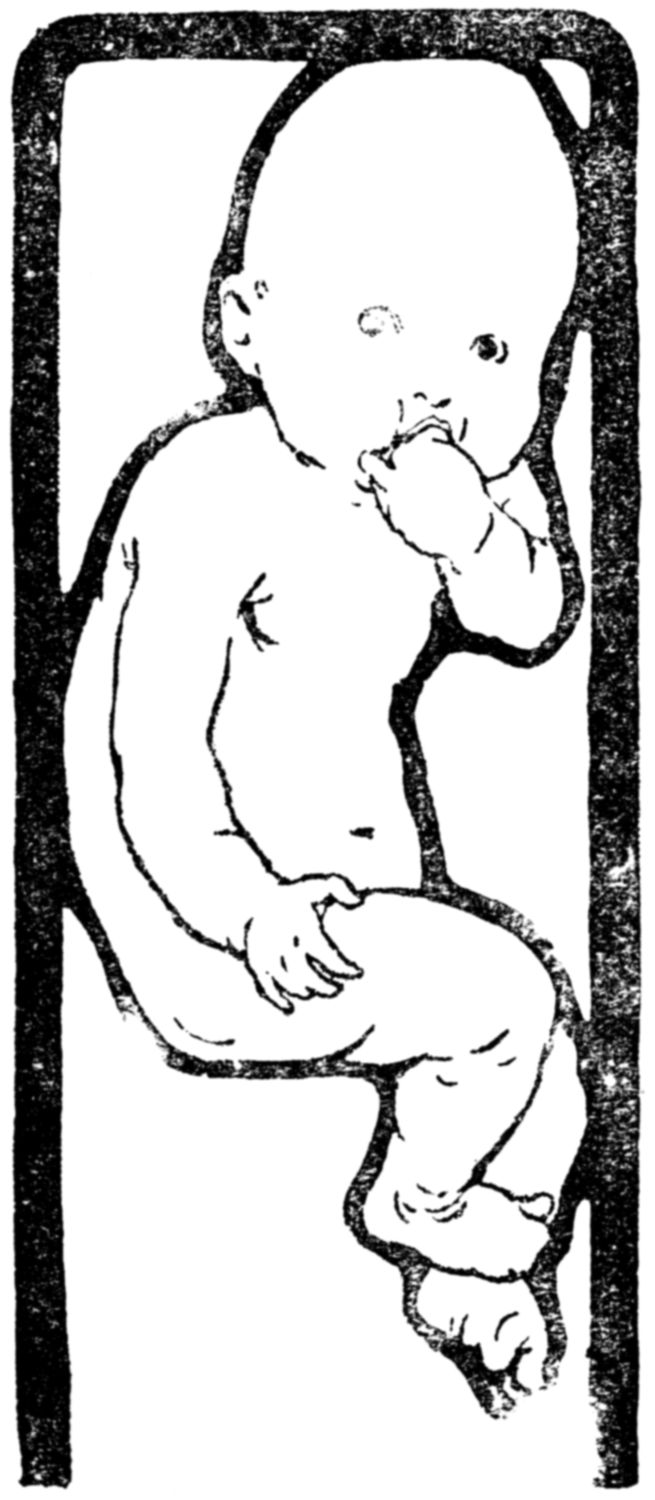
To his amazement the baby, removing the comforting hand, replied in eight words composed of exactly the same letters, “So to-day, sir, . .... .. ...... .....” Can you complete the sentence?
Solution
No. XX.—AGAINST THE COLLAR
The lady who is sitting at the back of this overloaded waggonette cries out, in her sympathy with the struggling horse, “This big load quite hinders his pull.”
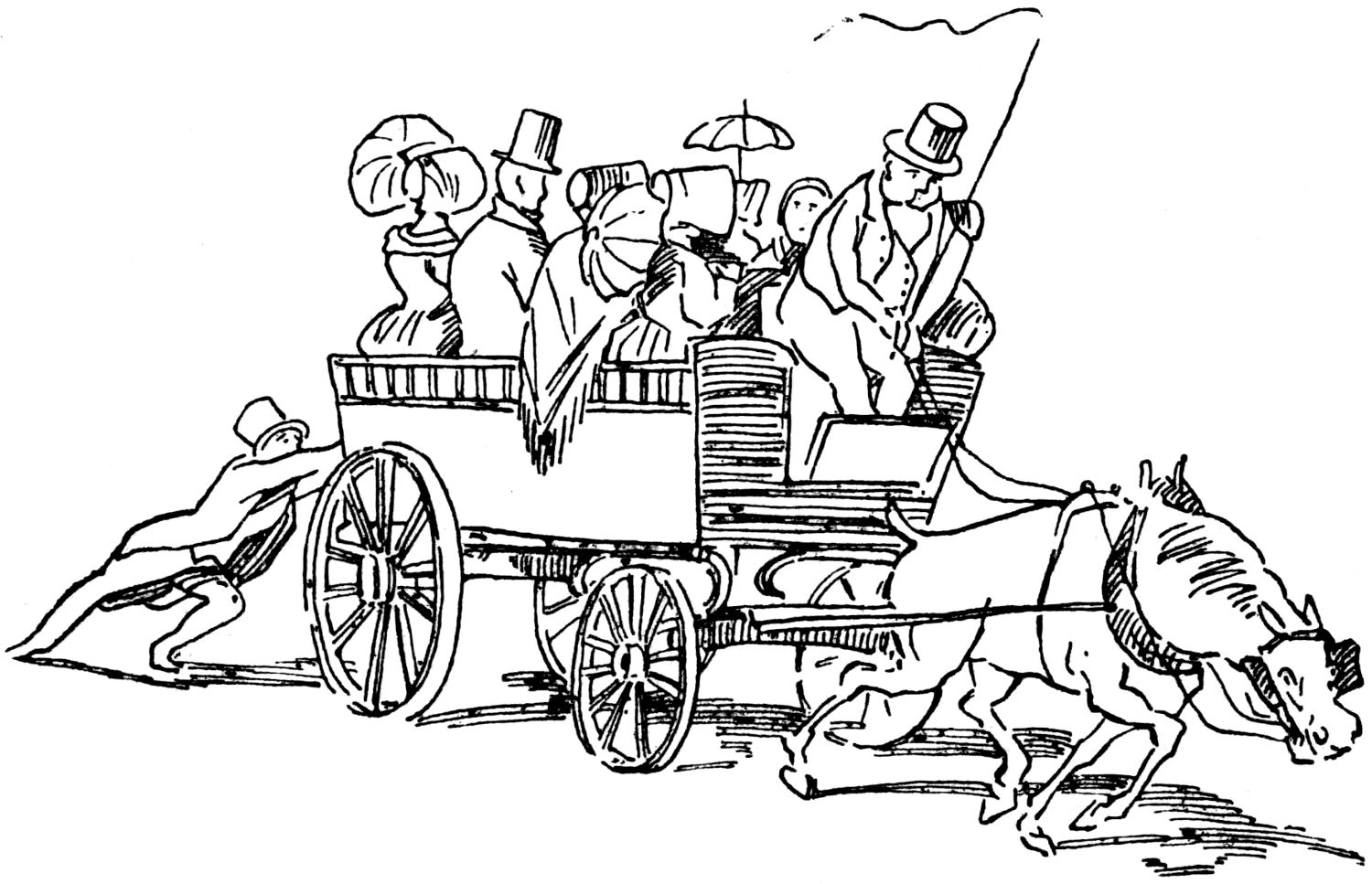
Her husband, full of holiday spirits and energy, answers her in a sentence of mingled reproof and determination, which forms a perfect anagram of the words of his wife, and describes his feelings and action. Can you recast the letters?
Solution
No. XXI.—IN A BILLIARD-ROOM
At the moment when a burly and keen player was in this strange and striking attitude,
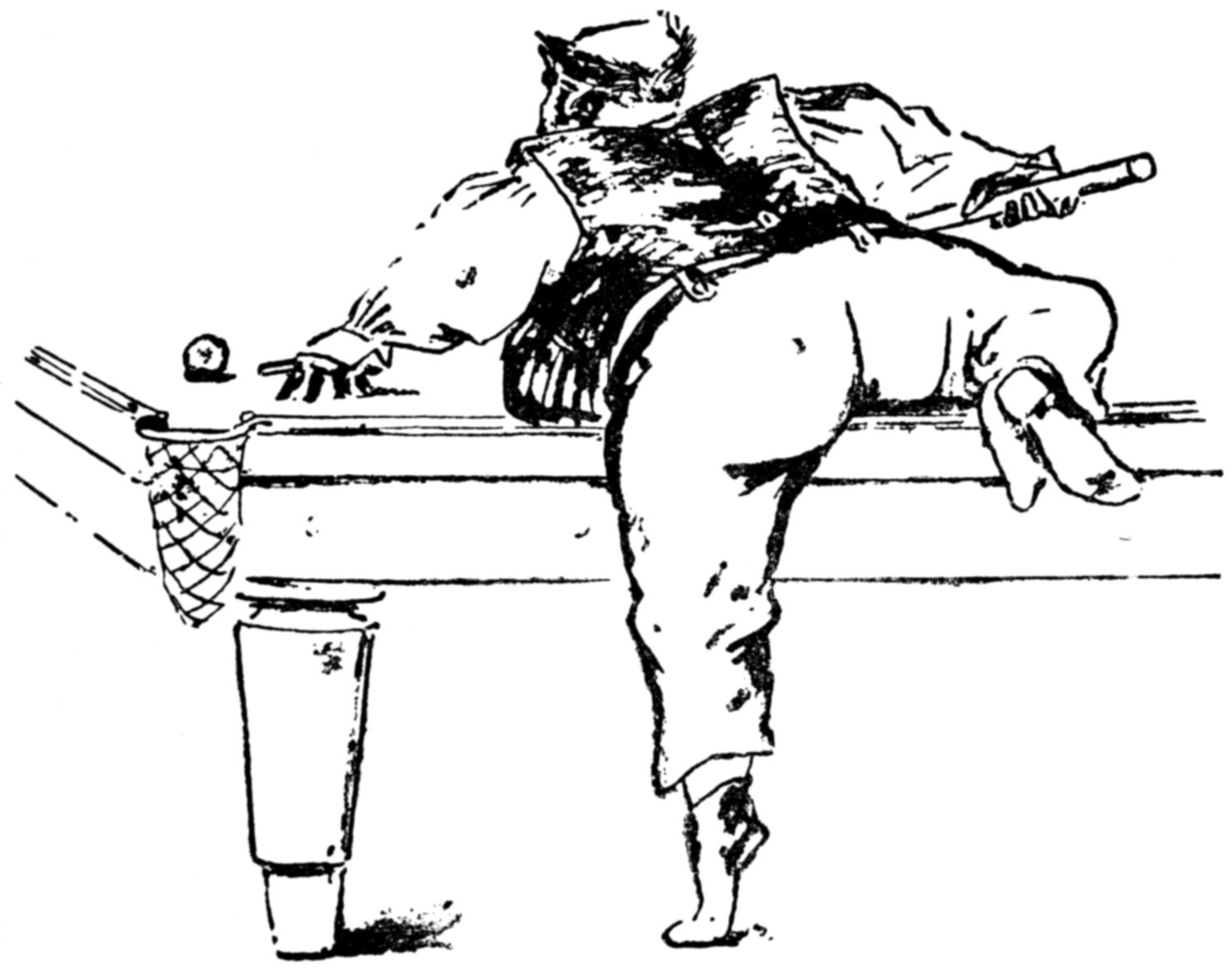
a bystander whispered to the marker, “Eh! what a stout player is striking!”
Can you, using exactly the same letters, put into the mouth of the marker a reply appropriate to the position?
Solution
13. A SAUCY MAIDEN
My second, worn with pompous pride, My first had dangling at his side, On chain securely hooked. My first he came from o’er the sea, A bundle of conceit looked he, And he was all he looked. She led him to the village green, Where in desponding mood was seen My whole, with drooping head. “Behold,” she said, “a perfect, true, And striking likeness, sir, of you!” And, laughing, gaily fled.
Solution
No. XXII.—EVOLVING A PAINTER
There are two English words which are appropriate to this picture—
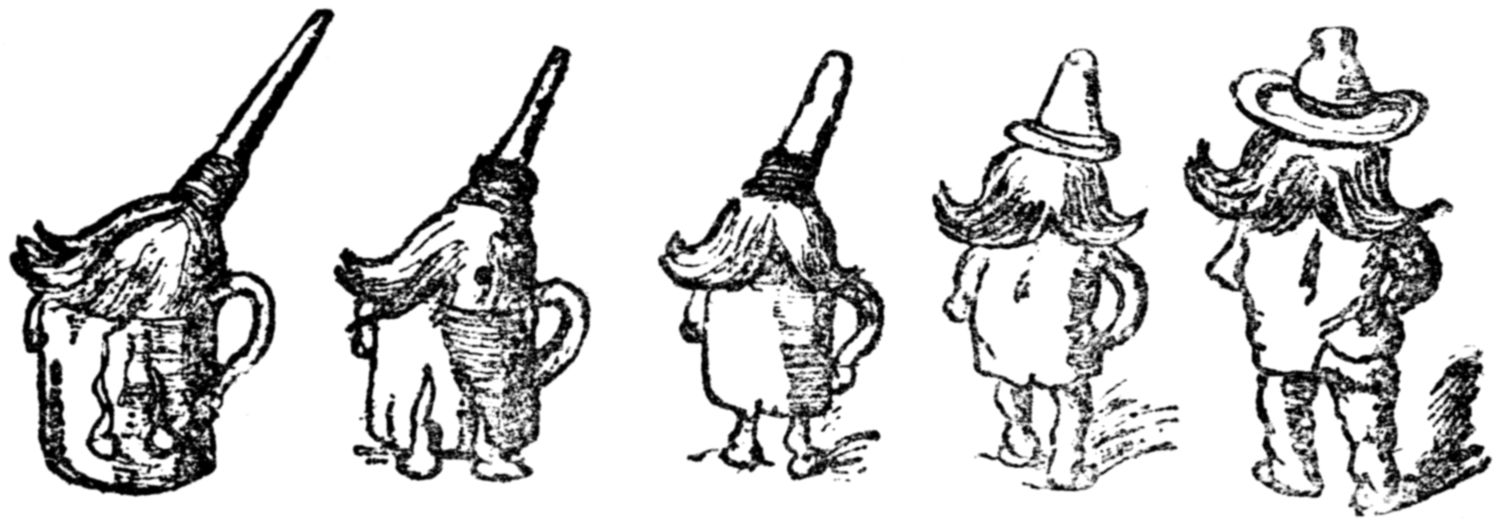
One of them has as its anagram the very apposite sentence, “Or not a man first;” the other treated in similar fashion becomes, “O I love nuts!” What are the two words?
Solution
14. DOUBLETS
Who can turn WHEAT into BREAD with six links, changing one letter each time, and preserving the general order of the letters throughout?
Solution
No. XXIII.—THE PICK OF THE PACK
How can we decide by anagram whether this is a fancy portrait of “William or dear Jack?”
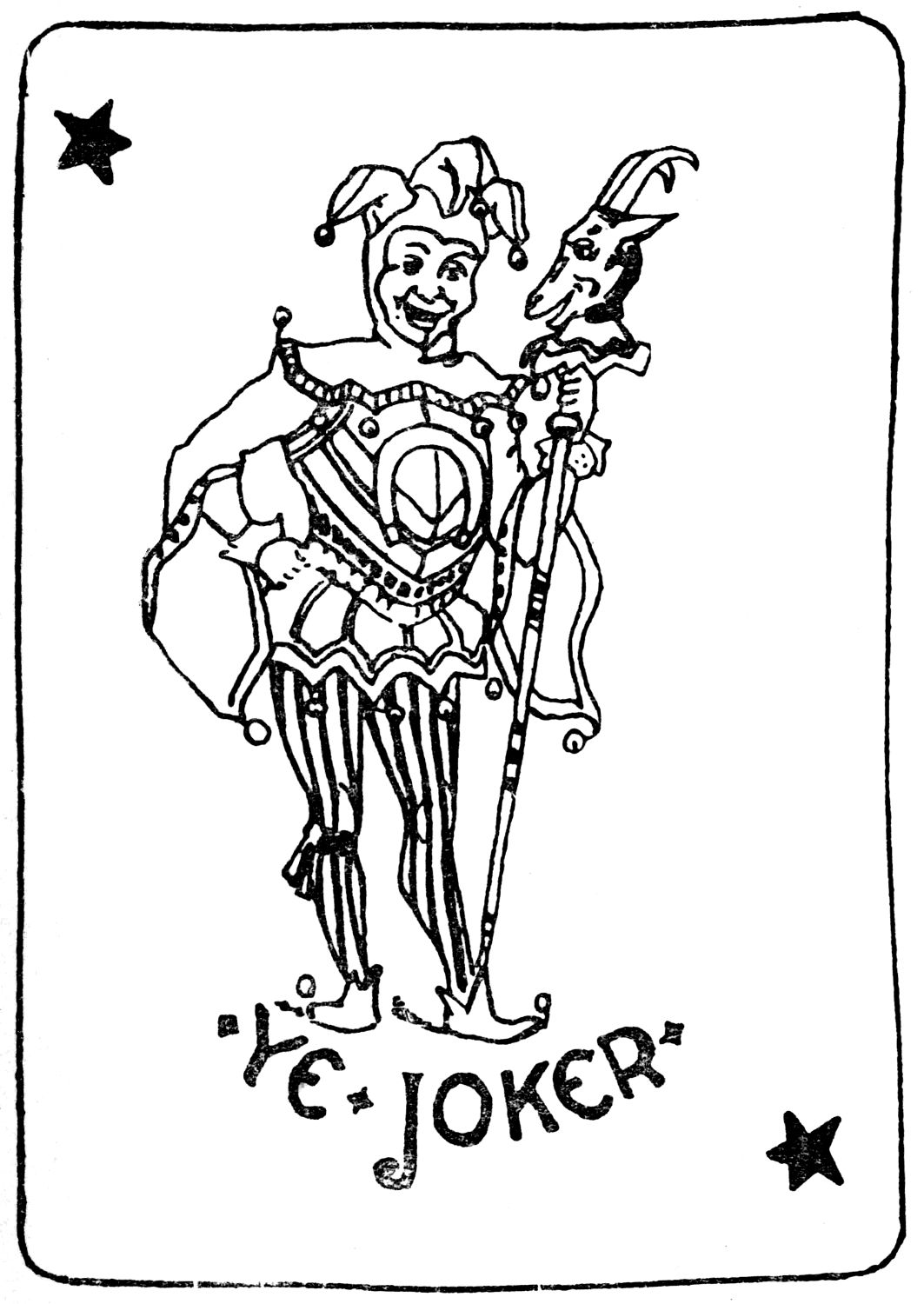
Shake up and recast the words in inverted commas.
Solution
15. AN OLD ENIGMA
Can our readers solve this enigma, which was published in 1811, and to which no answer seems to be known?
I’m one among a numerous host, And very useful in my post; There’s not a house in all the land Without me properly can stand. Though men disputed long ago Whether I did exist or no, Once more some thousands have been slain Because they could not me attain.
Solution
No. XXIV.—A PICTURE PUZZLE
Take this picture in connection with the lines below it, and find out what it represents.
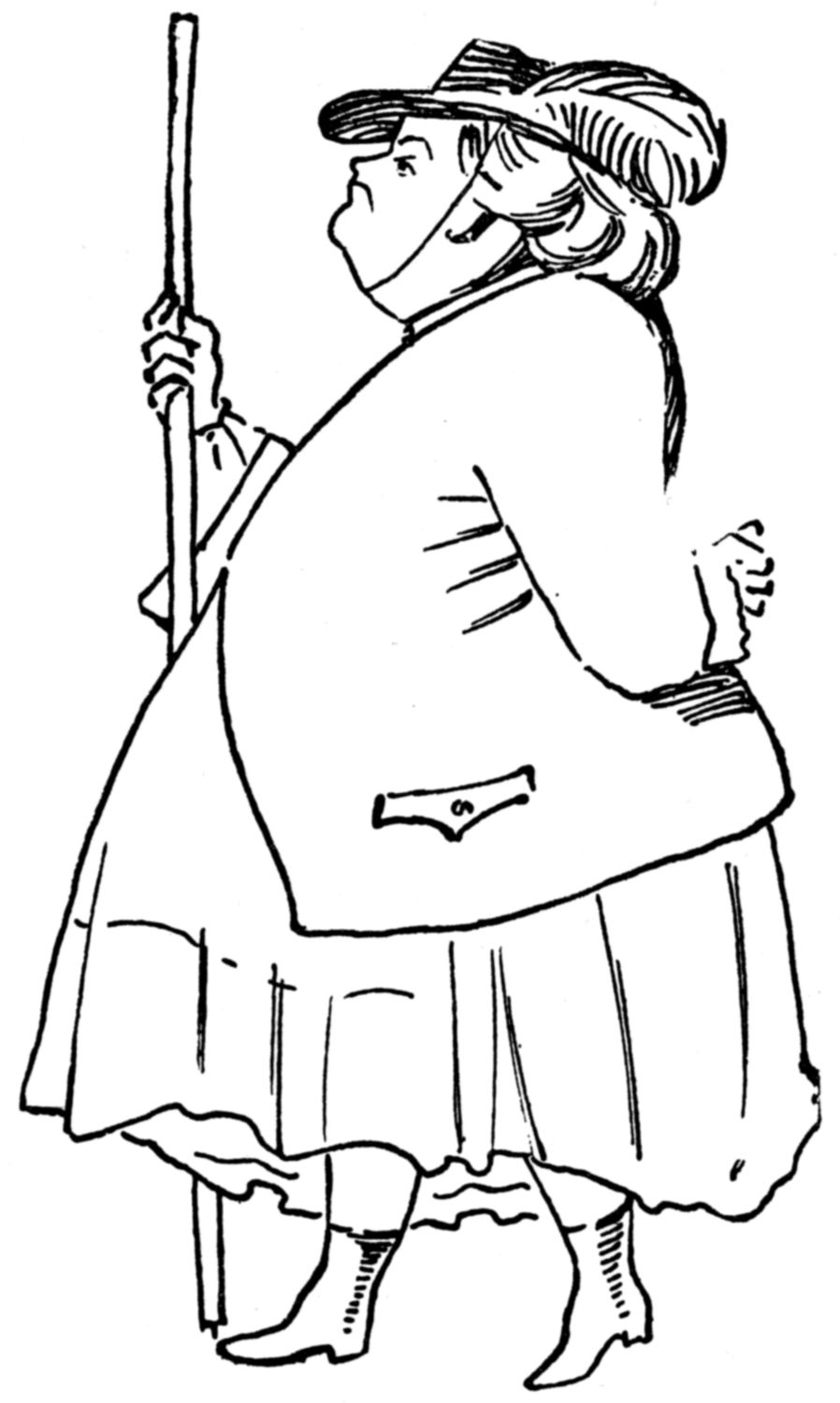
Begin with the end of my first, then you will find out the rest; For it all will appeal to your thirst, Or point to a ponderous guest.
Solution
No. XXV.—AN ANXIOUS POSE
His wife, who chanced to see Jiggers at the trying moment here depicted, said that he seemed to be in a “sad pet.”
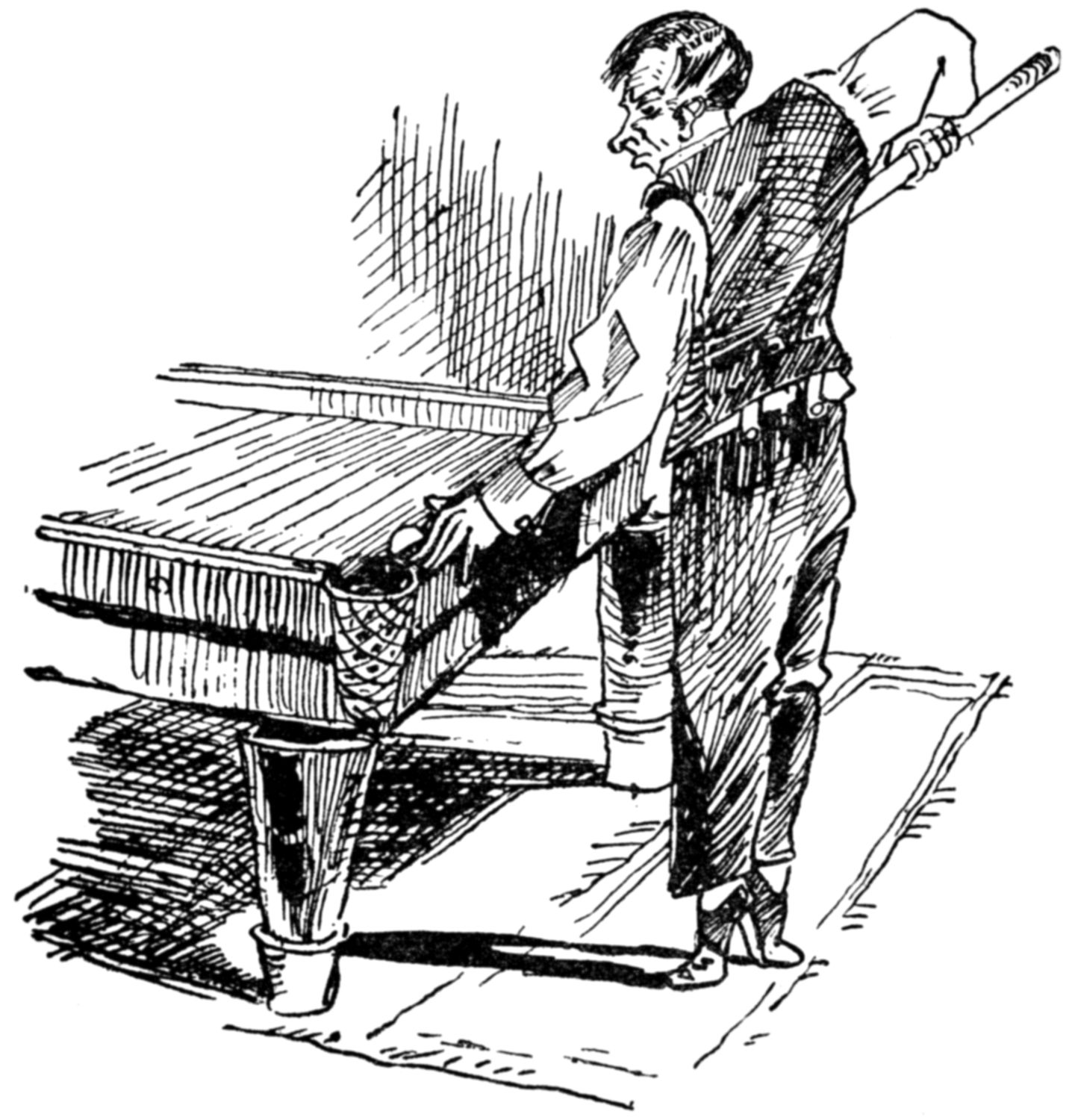
How was this literally true?
Solution
No. XXVI.—TOSS NEITHER HEAD NOR TAIL
Never was a cow so troublesome at milking-time.
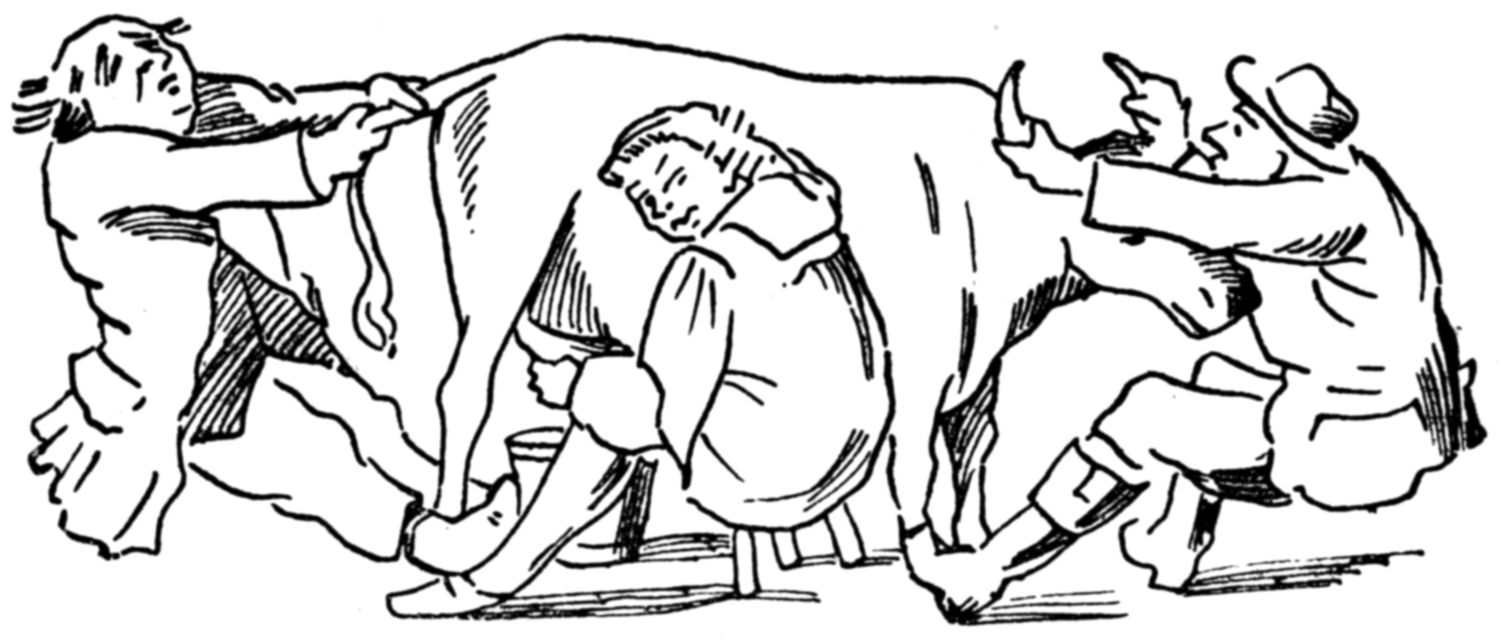
Our picture was taken at the moment when Farmer Hayseed was exclaiming, as he held on behind, “See, we hold this cow’s horns and tail!”
The same letters, recast by anagram, form this sentence spoken by his foreman—
“She cannot toss, ... .... .... .. ..”
Can you fill in the five missing words?
Solution
16. ANAGRAM PROVERBS
These grave lips chatter no ill. or Elephants, all to richest giver!
Can you recast the letters of these sentences so that either of them forms the same homely proverb, to which the first anagram is most akin?
Solution
No. XXVII.—ACTION AND PASSION
This very resolute horse and his anxious driver take quite different views of the situation shown in this picture.
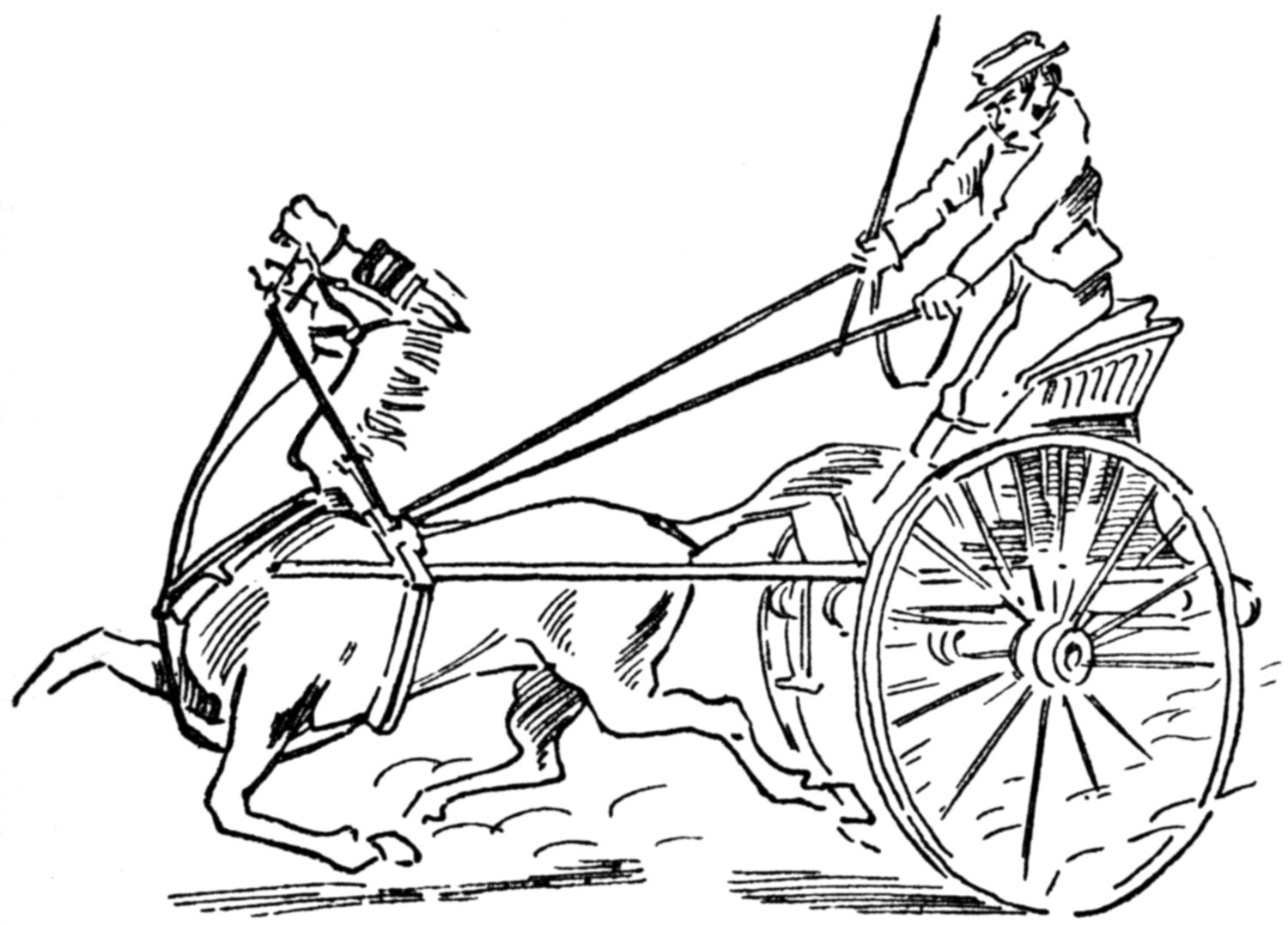
We can fancy that the fast trotter, if he could be endowed with speech, would say, “I’m a train’d stepper!”
Can you take these same letters, and recast them into a sentence which would seem to express the driver’s point of view?
Solution
17. A SHORT CHARADE
My first of rudeness has a sound; The rest is in a city found; My whole to win its way is bound.
Solution
No. XXVIII.—A FEAT WITHOUT ARMS
In this picture a clever artist who has no arms is seen calmly painting with his feet.
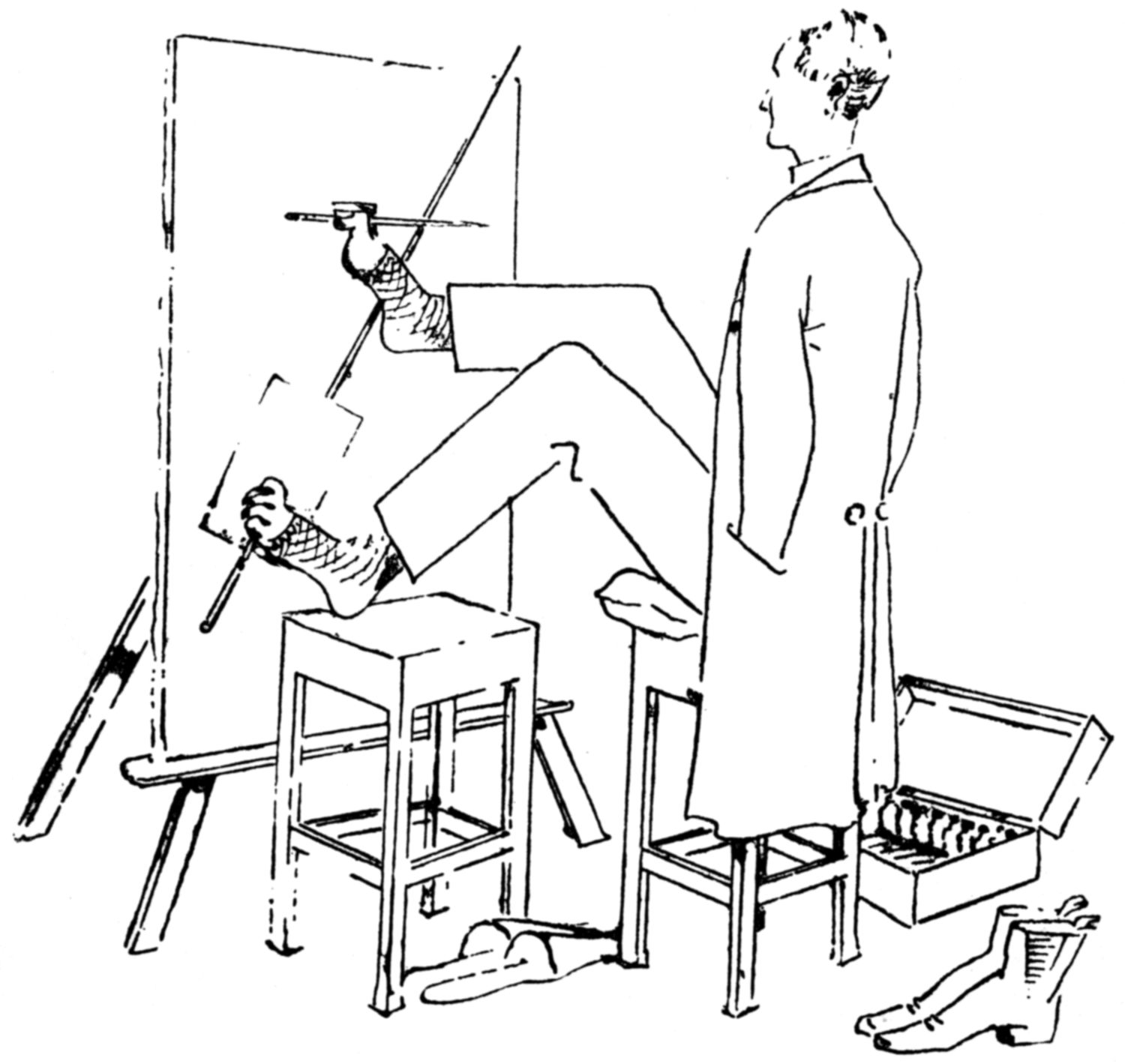
One onlooker says to another, “Why, now I see this fine artist has no hand!” The other replies in a sentence which contains exactly the same letters:
“He draws in any fashion .... ... ... ... .”
Can you fill in the four missing words?
Solution
No. XXIX.—NOT TAKING ANY
“This is a wine bottle, dear, on a lure,” said a crafty fisher of men to his better half, who was helping him, as he showed her this illustration of their aims.
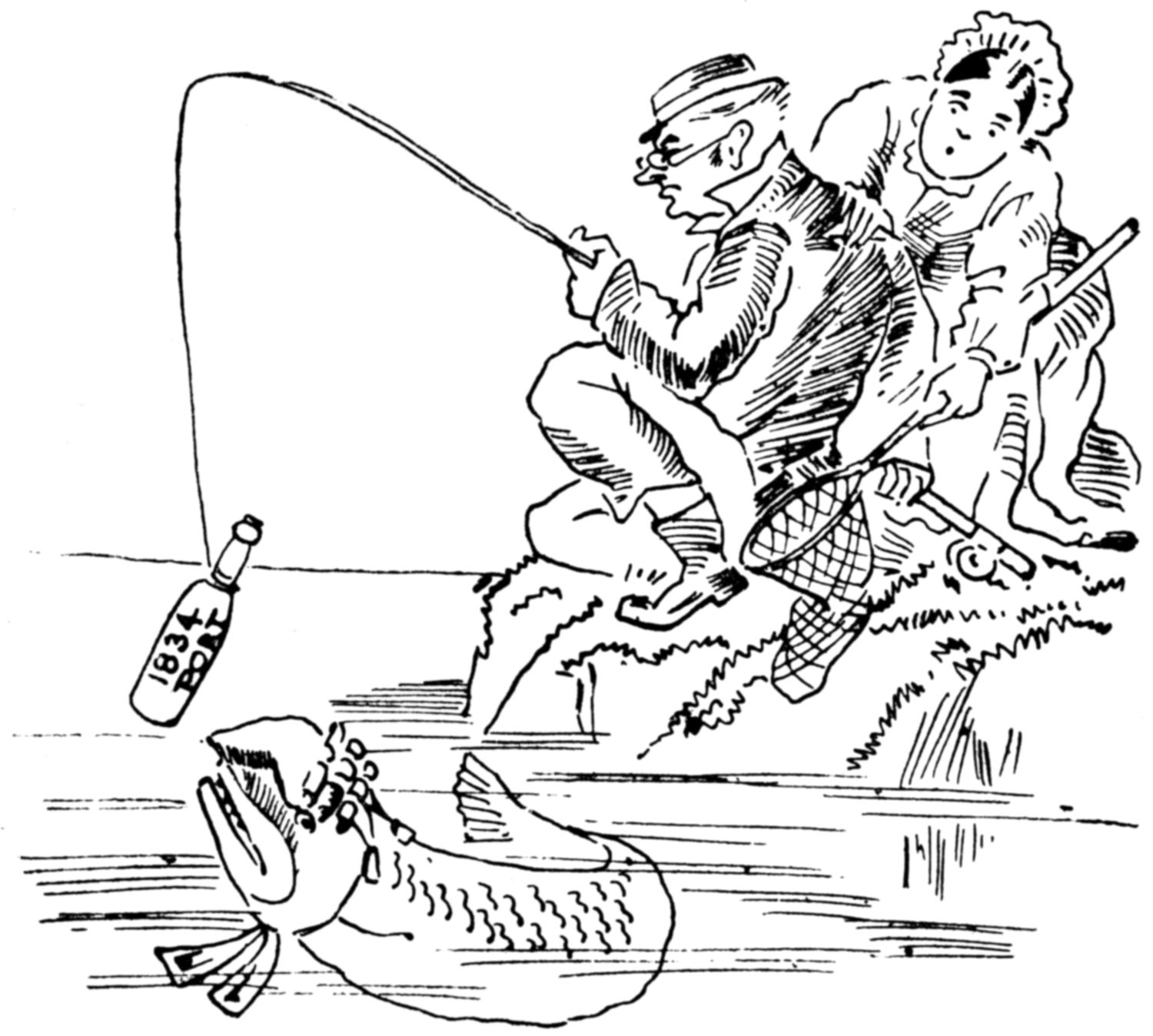
1834 PORT
She knew, however, that the fish he sought to catch was not to be tempted in this way, and she replied in words spelt with exactly the same letters, “And see, he will not .... .. ... ....!”
Can you fill in the four missing words?
Solution
No. XXX.—MUSIC HATH CHARMS
This sturdy musical enthusiast, as he settled himself upon his chair, said, “What shall I play?” and some one replied, “Any strains of Beethoven, he charms all!”
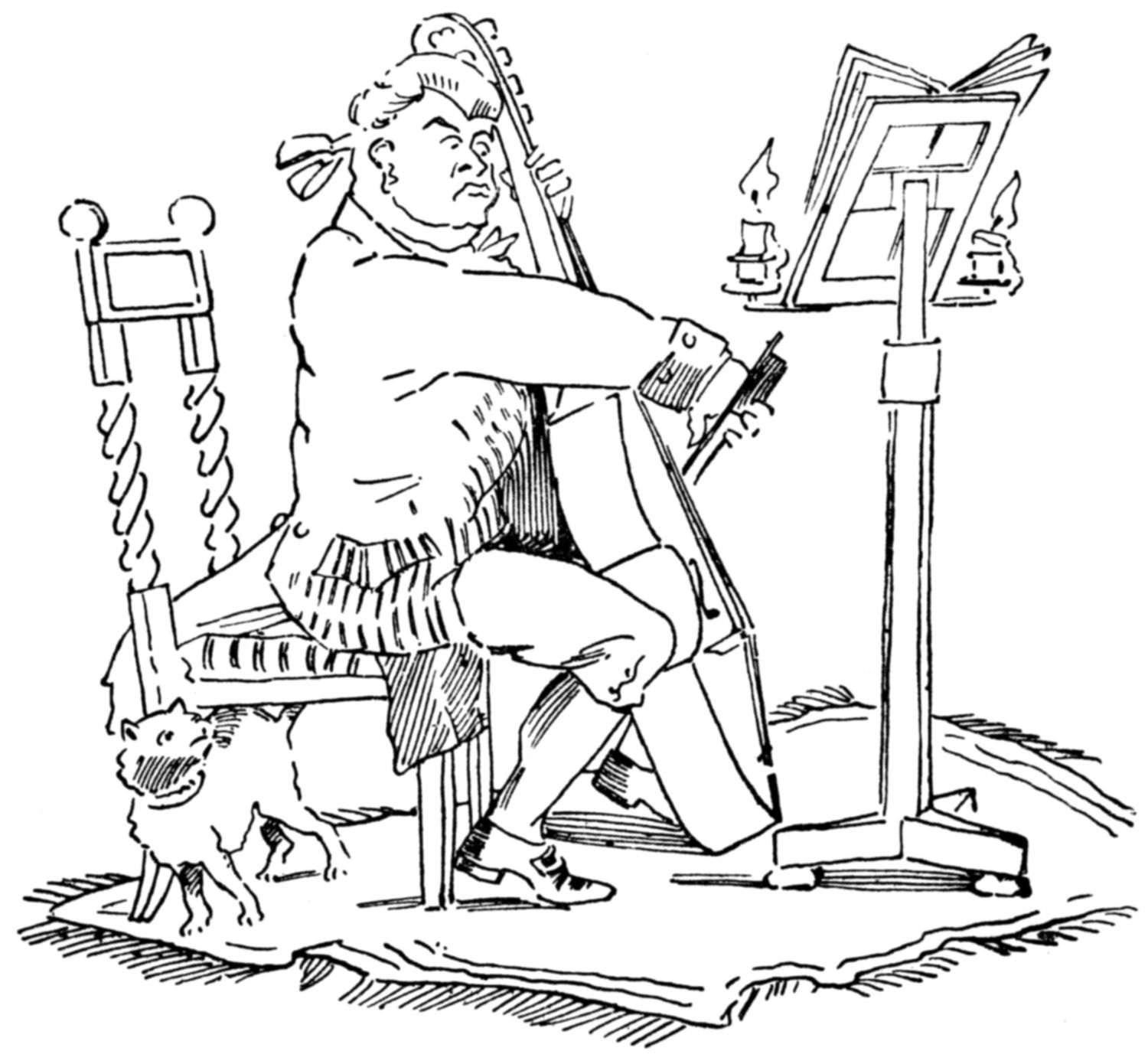
This suggestion, however, was not acceptable, and he, as he struck up a piece after his own heart, exclaimed, in a sentence composed of exactly the same letters—
“Nay, for this ’cello ...... .... . ......!”
Can you supply the missing words?
Solution
No. XXXI
This picture represents a parsnip lying across a sturdy swede.
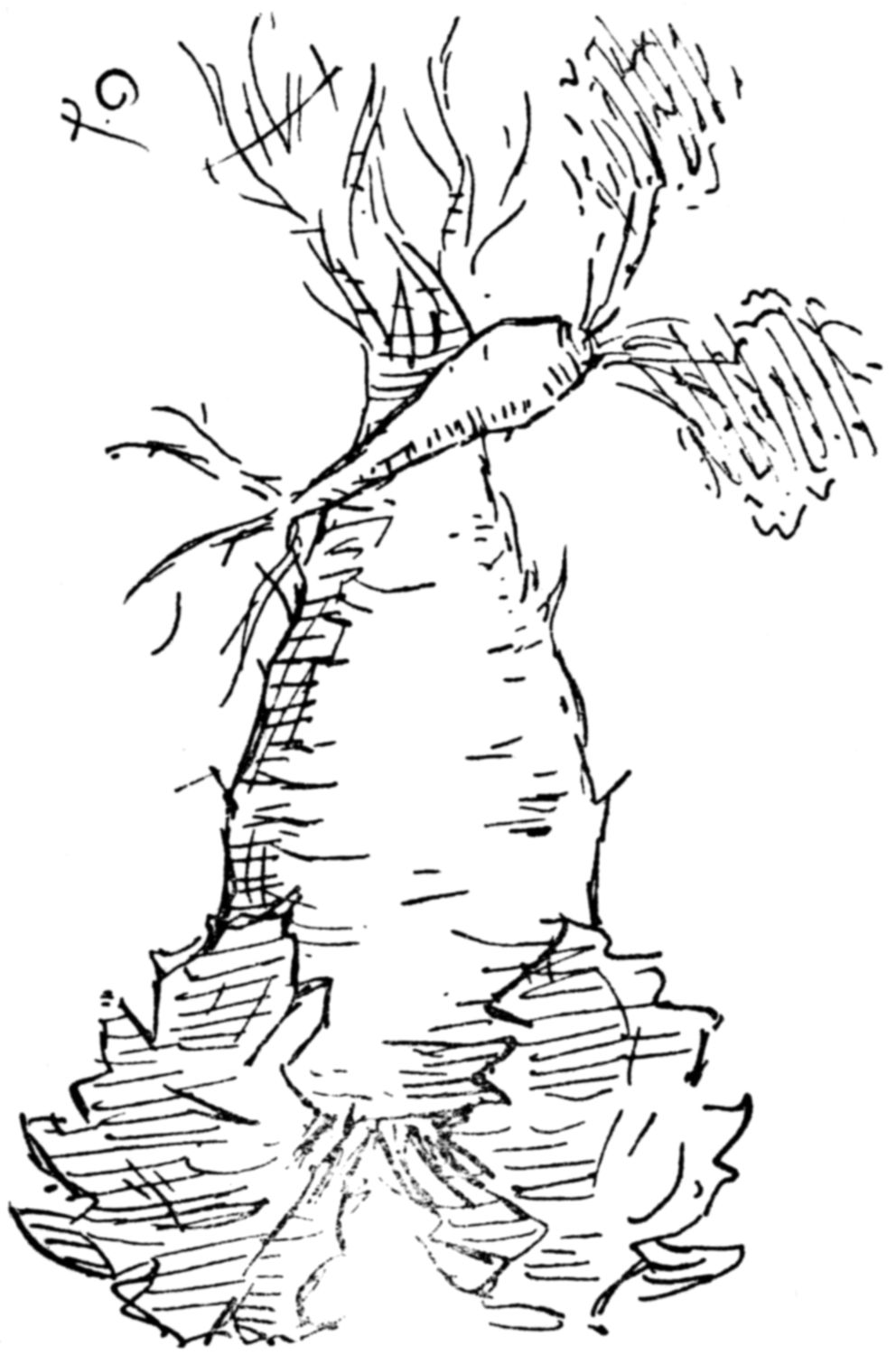
Can you so readjust them that they seem to suggest a successful dramatist of the day? We give this broad hint by anagram—
“Here is our parsnip on swede.” ANAGRAM Wise and superior person he!
Solution
No. XXXII.—A GOOD LETTER PUZZLE
Can you fill the places of these 21 asterisks with only three different letters, arranging them so that they spell a common English word in twelve different directions?
● ● ● ● ●
● ● ● ●
● ● ●
● ● ● ●
● ● ● ● ●
Image
Solution
18. A BURIED POTENTATE
My first is in cake, but not in bun; My second in light, but not in sun; My third is in night, but not in day; My fourth is in game, but not in play; My fifth is in head, but not in tail, My sixth is in wind, but not in sail; My seventh in wrong, but not in right, My eighth is in battle, but not in fight; My ninth is in sword, but not in knife, My tenth is in lady, but not in wife; My whole is a monarch at war with strife.
Solution
No. XXXIII.—ANAGRAM ARITHMETIC
First form a short sentence with the ten letters that are above the line in this diagram:—
S B
R E
Y D
O T
U O
O E E
Image
Next number the letters of the sentence consecutively 1, 2, 3, 4, 5, 6, 7, 8, 9, 0, and then work out a sum in addition with these numbers substituted for the letters with which they correspond.
Solution
No. XXXIV.—A BUNCH OF FLOWERS
Find within these borders twelve specimens of flowers and foliage:—
1L 2L 3B 4H 5P 6E 7F
8L 9Y 10E 11L 12O 13R 14N
15I 16V 17B 18R 19I 20V 21K
22A 23L 24E 25T 26O 27N 28I
29C 30N 31A 32S 33U 34L 35P
Image
Move in any direction one square at a time, and so spell out their names, using the same square only once in each case.
Solution
19. A CHARADE
My first except when it is old Is never seen or heard; When it is heard the sound is tolled Out of a Jewish beard. My next was in Imperial Rome, It was her power and might; Then you had but to write you wish, And straightway ’twas in sight. My whole was Frank Of royal rank.
Solution
No. XXXV.—ON A BLACKBOARD
To test the powers of his young pupils, Dr Puzzlewitz set the following little problem on his blackboard:—
A - B = 4
A ÷ B = 4
Image
What are the values of A and of B, when 4 is the result of dividing A by B, or of subtracting B from A?
Solution
20. RECAST
How great in olden days my power! Oft have I saved a castle tower From war’s invading tide. Transpose me, and how great my fall! I am then the smallest of the small, That nothing can divide.
Solution
21. WORD-BUILDING
This compact Enigma take, All apart its letters shake. Let your 6, 3, 5 be high, Like 5, 1, 2 do or die. Who 4, 6, 5, 1 enjoys More than 5, 6, 2 by boys? While 5, 3, 2, 1 are mine, May 4, 6, 3, 2 be thine. 4, 1, 5 is rich and rare, 6, 5, 1, 2 ends my prayer.
The figures indicate the position of the letters, which spell new words, in the original six-letter word.
Solution
No. XXXVI.—SQUARING A DIAMOND
Can you fill in the empty cells with letters, so that they form English words which read alike from top to bottom and from left to right?
s
s u s
s
Image
Solution
22. AN ENIGMA
“Charles the First walked and talked, Half an hour after his head was cut off.” Old Couplet. Cut off my head, I’m every inch a King, A warrior formed to deal a heavy blow. Halve what remains, my second is a thing Which nothing but my third can e’er make go. My third will vary as you take your line. This less than human, that way all divine!
Solution
No. XXXVII.
Taking the letters as arranged on this diagram for a starting point, can you place in some of the unoccupied cells five more of A, five of E, five of I, and five of O, making eight in all of each letter, so that in no case shall the same vowel be in the same row, column, or diagonal?
A I E O
O A
I E
E O A I
Image
Each vowel is to be regarded without any reference to the other vowels, and, of course, only one may be placed in a cell.
Solution
No. XXXVIII.—AN ANAGRAM SQUARE
Mix together the letters which form the eight words on this draught board—
V O T E
W O V E
P R O W
C A L L
S T E W
N E W S
C O R E
N A P E
Image
and recast them so that they form eight fresh words, which when placed in proper order on the white squares, are a word square in which each word reads alike from left to right, or from top to bottom. The first of the fresh words is CROW.
Solution
No. XXXIX.—ARITHMETIC BY ANAGRAM
Form a short sentence with the letters above the line in this diagram:—
D U
E H
E D
A P
S T
D E A
Image
Number the letters consecutively 1, 2, 3, 4, 5, 6, 7, 8, 9, 0, and then work a sum in addition, substituting these numbers for the letter with which they correspond.
Solution
23. A LOGOGRAPH
Touch me not, I’m firm and sure; Behead, I’m used by rich and poor; In house and cottage, hut and hall, I stand of service to them all. Behead again, in time of need I tell that strength and skill succeed.
Solution
No. XL.—ANAGRAMS SQUARED
Shake up the sixteen letters of these four words, and recast them into four other words:—
S E E K
S L A B
L E E K
M O A N
Image
These fresh words, placed on the white squares, must read alike from side to side, and zigzag from top to bottom. The first word is MASK.
Solution
24. A SINGLE ACROSTIC
What river is that, where it is found, Which Pope says does with eels abound? What Scottish lake, by high hills bounded, Is with bright birch and oak surrounded? What stream is said in Devon to run Into the sea near Otterton? What bay on Cuba’s distant coast Is justly deemed its pride and boast? The initials of these names will show A Scotch reformer, who, we know, Flourished three hundred years ago.
Solution
No. XLI.—A WORD SQUARE BY ANAGRAM
Take the letters which form the words in these sixteen cells—
A F A R
T A S K
S E A T
L E A L
Image
and recast them so that they form a perfect word square.
Solution
25. A CHARADE
My whole may be a mother, not a dad, So former may, or latter; But twist my tail, and I become as mad As any hatter! Behead me, and behold I am a man, Who never was called mister; Cut off my tail, and instantly I can Become a sister!
Solution
No. XLII.—QUITE A NOVELTY
There are five English words in this square:—
c h e s s
g r e e d
c a n e s
r e a r s
c h e e r
Image
Can you shake up their letters, and recast them into five other words which form a perfect word square, and read alike from top to bottom and from left to right? The first fresh word is CRESS.
Solution
No. XLIII.—HIDDEN PROVERBS
Five familiar proverbs are hidden in this square of 169 letters,
R E N O W N E D T H A N W
S Y O U R C A K E A N D A
S T E T O B E F E A R H R
E A R K S S P O I L E A F
L E O O H E R S N T D V O
O T M O T L I N O H T E U
N O S C A L A G M E H I R
S N I Y G O R S O B A T S
E N G N E N O T S R N P A
I A O A M O O T S O A E W
R C D E V I L A H T D A S
O U O Y N O I L D A E C A
T C I V R E H H T A H E Z
Image
The proverbs are arranged in a regular sequence.
Solution
26. RINGING SWEET CHANGES
We are familiar with the anagram that so charmingly points to the ministrations on the battle-field of Florence Nightingale—Flit on, cheering angel—but it is not so well known that her name can also be recast with an appropriate wish for her continuance in our loving memory. Can you frame this?
Solution
No. XLIV.—A CLEVER CRYPTOGRAM
A French sentence of 100 letters in twenty-two words is concealed in these 100 cells.
D L A N N E S M P A
L I R D L E E M L H
I L U E E A I N T J
C U R S E M N T U P
E U É S N P R E O S
O L I É D X S M A N
U D E A E É I X N T
T E T P E D N U Q E
B U U U F L I J I N
Z U E J I O E U N R
Image
It can be deciphered by means of a cardboard mask of similar size, with circular holes cut out in some of its cells. This is placed squarely over the diagram, turned round in four successive positions. And thus the sequence of letters is found, and falls into words.
Solution
No. XLV.—SAM LOYD’S PONY PUZZLE
The instant popularity of this clever puzzle was amazing, and its sale is said to have run into millions years ago in America.
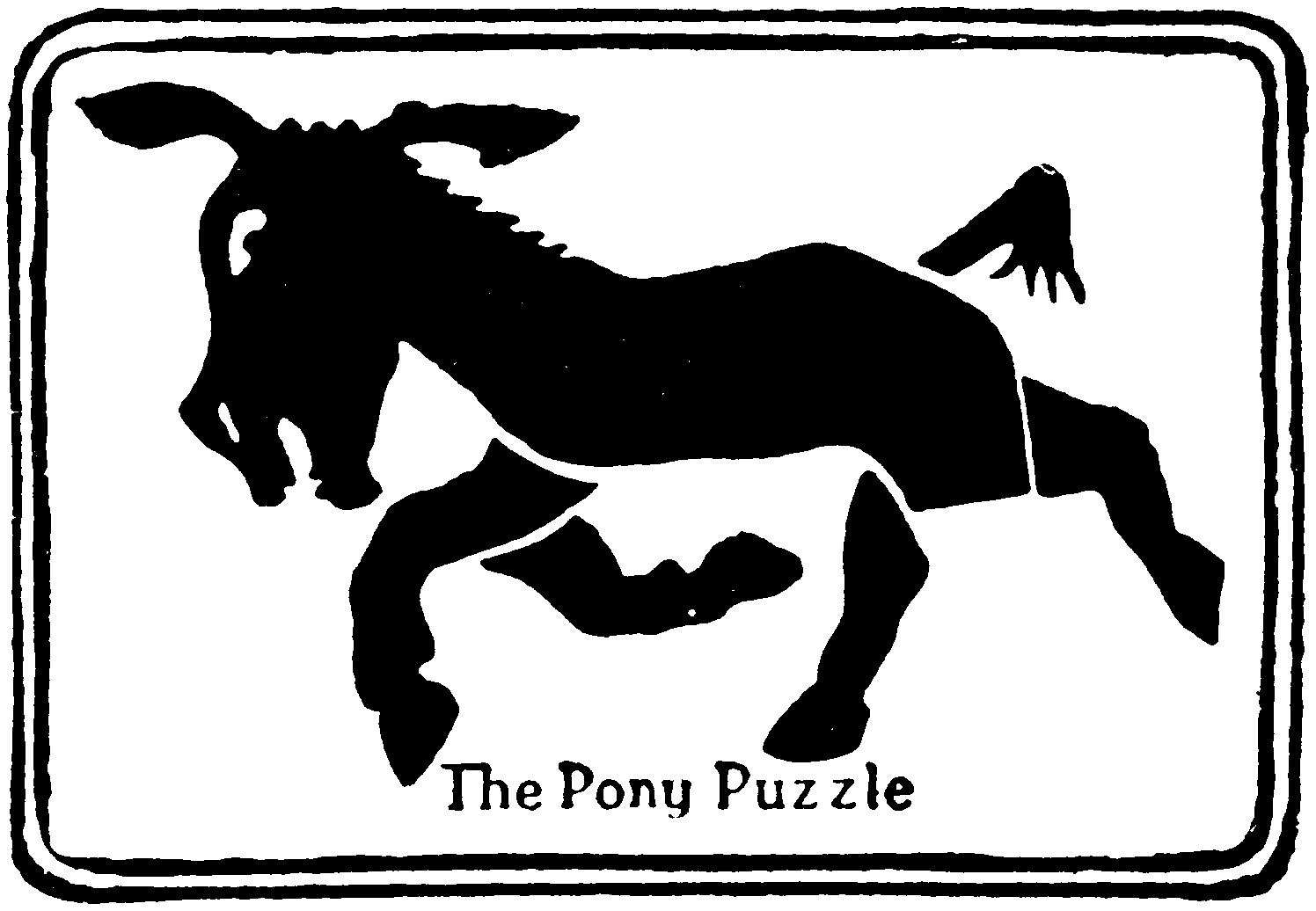
Cut the pony into six pieces, as is indicated in the picture, and rearrange these so that they show a trotting horse.
Solution
27. A REBUS
I am a man I rate you a beast You know me.
Can you put this into shape?
Solution
No. XLVI.—A CLEVER PUZZLE
Here is another of Sam Loyd’s famous trick pictures:—
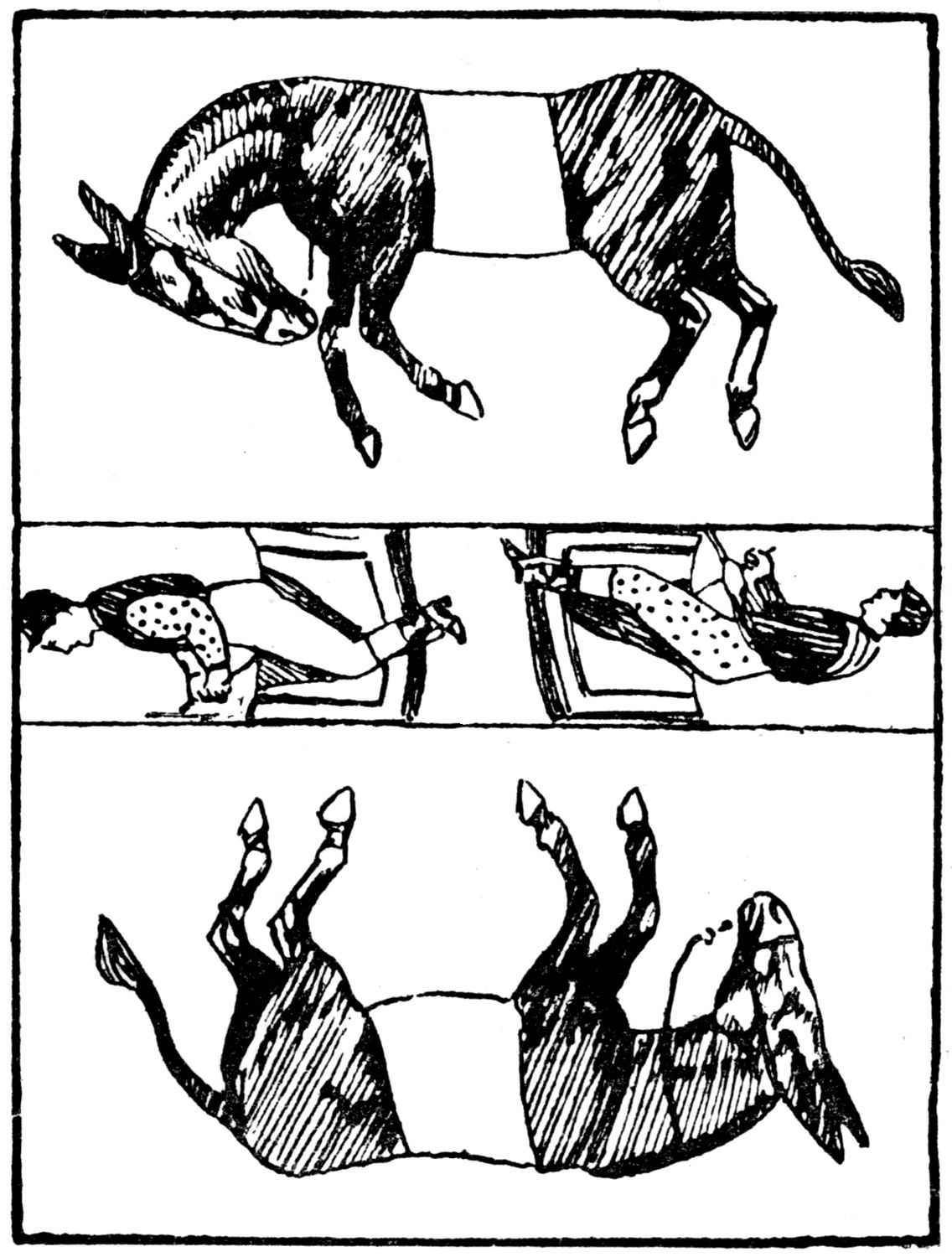
Can you rearrange the parts to show jockeys and horses in racing trim?
Solution
28. A CHARADE (With Latin parts.)
My first, thou knowest, was in ancient Rome, Rome’s fate my next, and one that all may dread. Long may it be before that fate shall come, And sever with my whole thy life’s last thread!
Solution
No. XLVII.—A NICE BALANCE
This boy is sure that if he takes his time, and watches his opportunity, he will be able to reach and secure with his mouth the sugar on the chair. Will he?
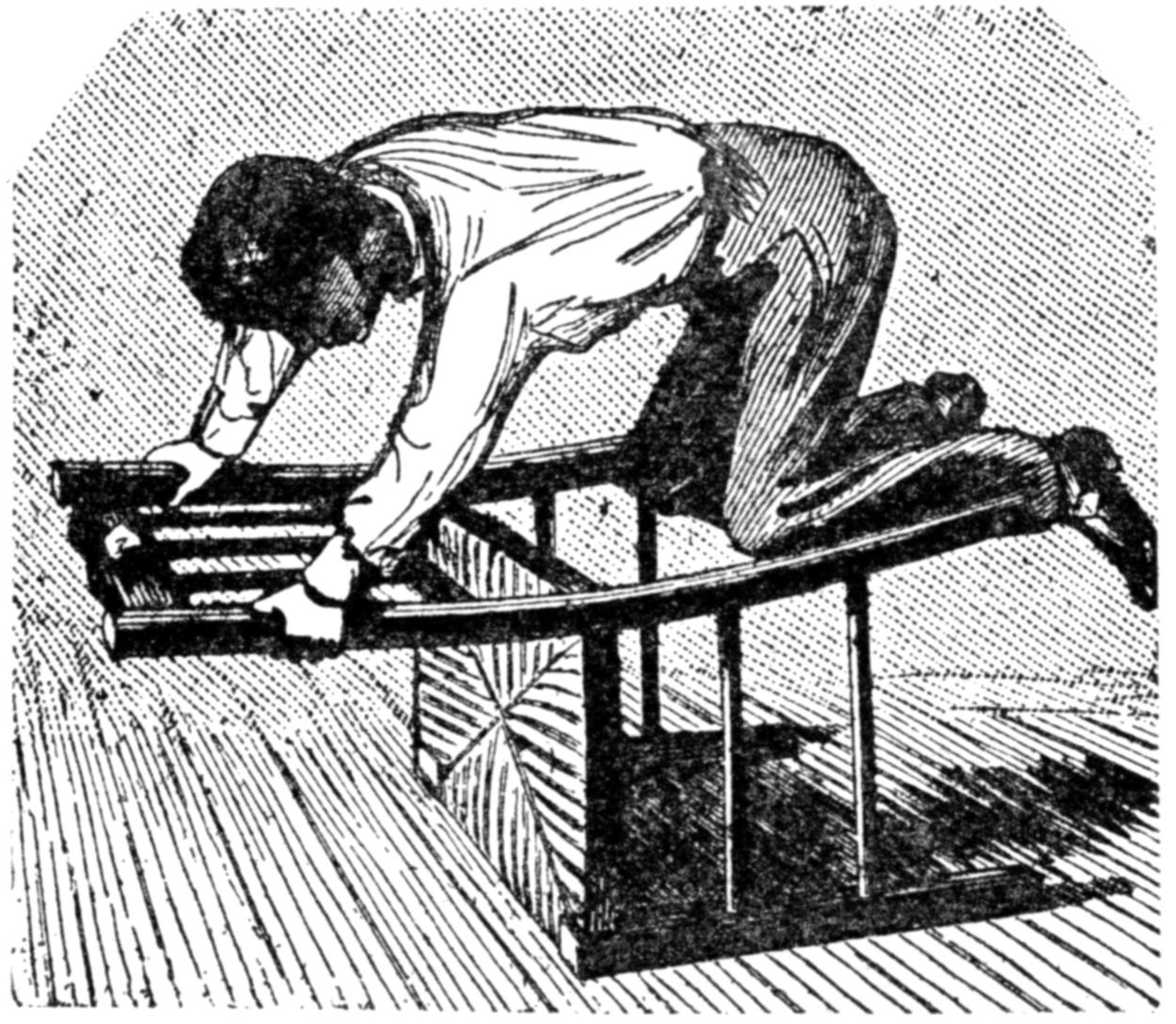
Solution
29. BURIED POETS
The names of eight famous British poets are buried in these lines—that is to say, the letters that spell the names form in their proper order parts of different words:—
The sun is darting rays of gold Upon the moor, enchanting spot, Whose purpled heights, by Ronald loved, Up open to his shepherd cot. And sundry denizens of air Are flying—aye, each to his nest; And eager make at such an hour All haste to reach the mansions blest.
Can you dig them up?
Solution
No. XLVIII.—LEAF-FROG
Here are six little hoptoads, as our cousins across the water call them, three white and three black, going in opposite directions. A frog may jump, one, two, or three steps, but no two may be together at any time.
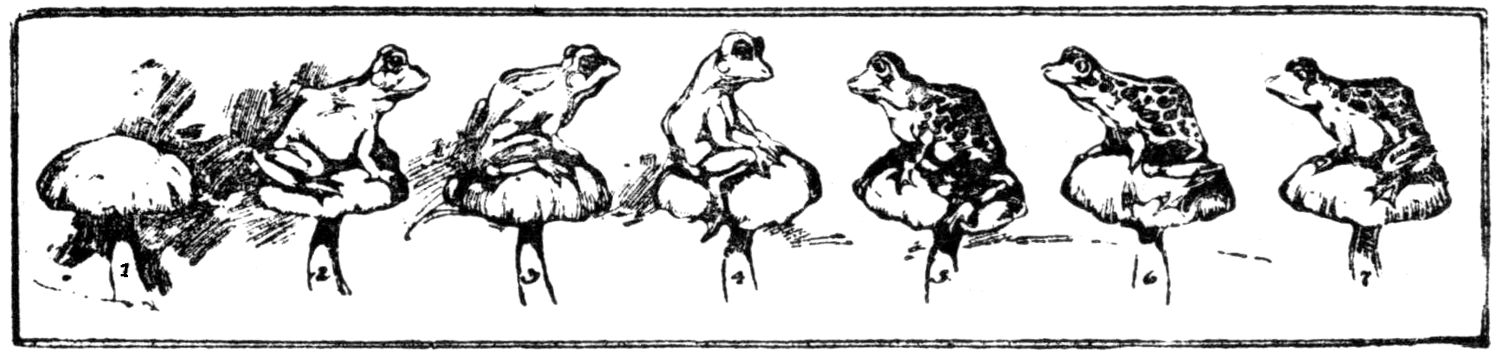
In how few jumps can the black frogs be seated to the left of their white brothers? It is obvious that one of the white frogs must jump first to the stool marked 1.
Solution
30. AN ENIGMA
This multiplies me, I declare, Though it reduces one; A sty is foul if it is there, By it a deed is done.
Solution
31. MISSING WORDS
Lennie ...... the words he read, Studying ...... fable; Lennie’s mother ...... the bread, Sophy ...... the table. “Work while you are ......,” they said “...... while you are able!”
Solution
No. XLIX.—DIGITS IN THE FIDGETS
A very curious old print, of which this might well be the title, was picked up on a bookstall. This picture shows clever designs for two of the digits:
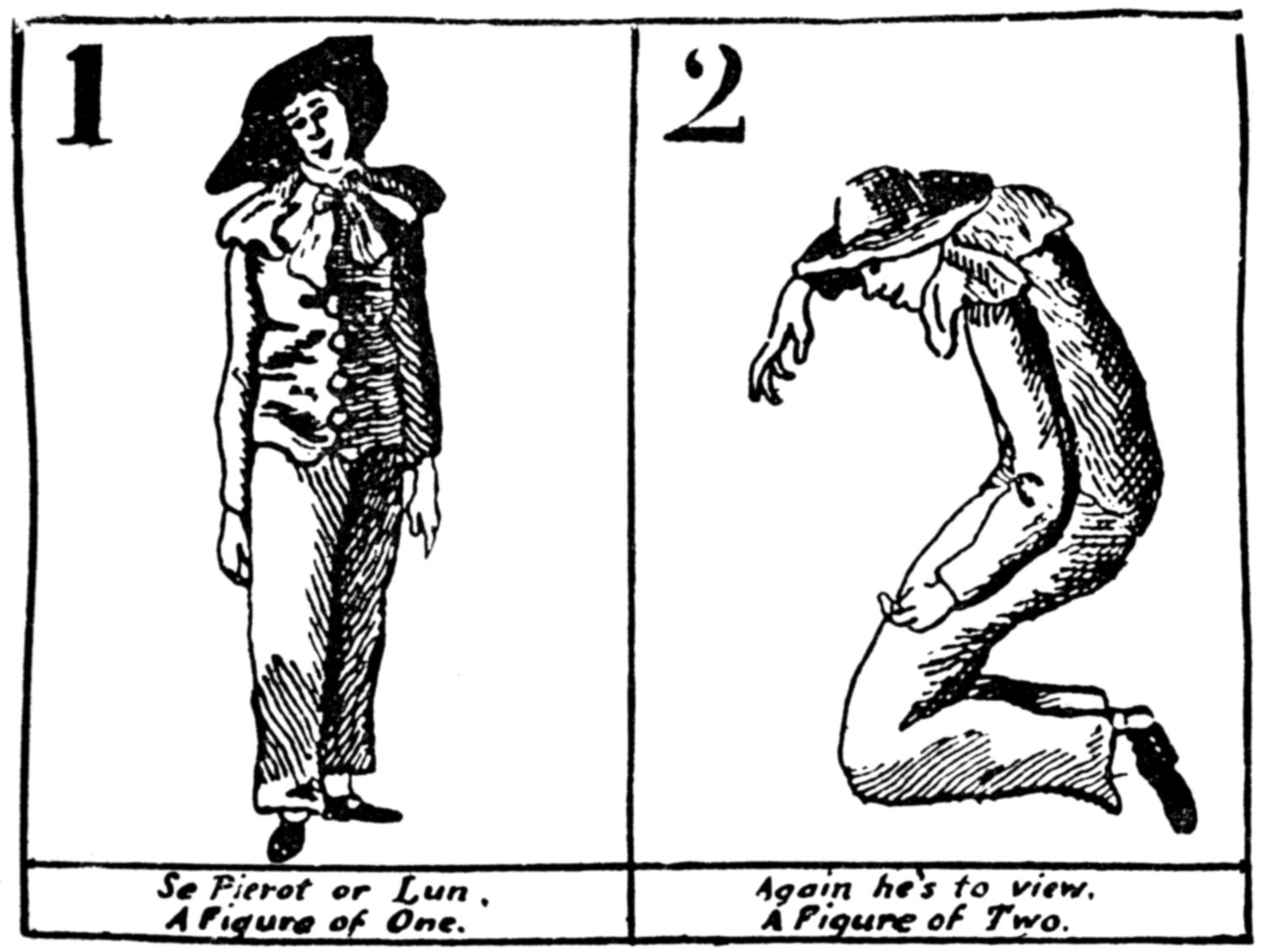
1
Se Pierot or Lun, A Figure of One.
2
Again he’s to view, A Figure of Two.
32. A CHARADE
When I write with my first in my second, My whole is quite sure to be in. Divided afresh, there is reckoned A wit, or a something that’s thin. Prefix a letter, and, as dear as paint, You see the name of an old English Saint.
Solution
No. L.—DIGITS IN THE FIDGETS
Here is the second pair of this queer company:—
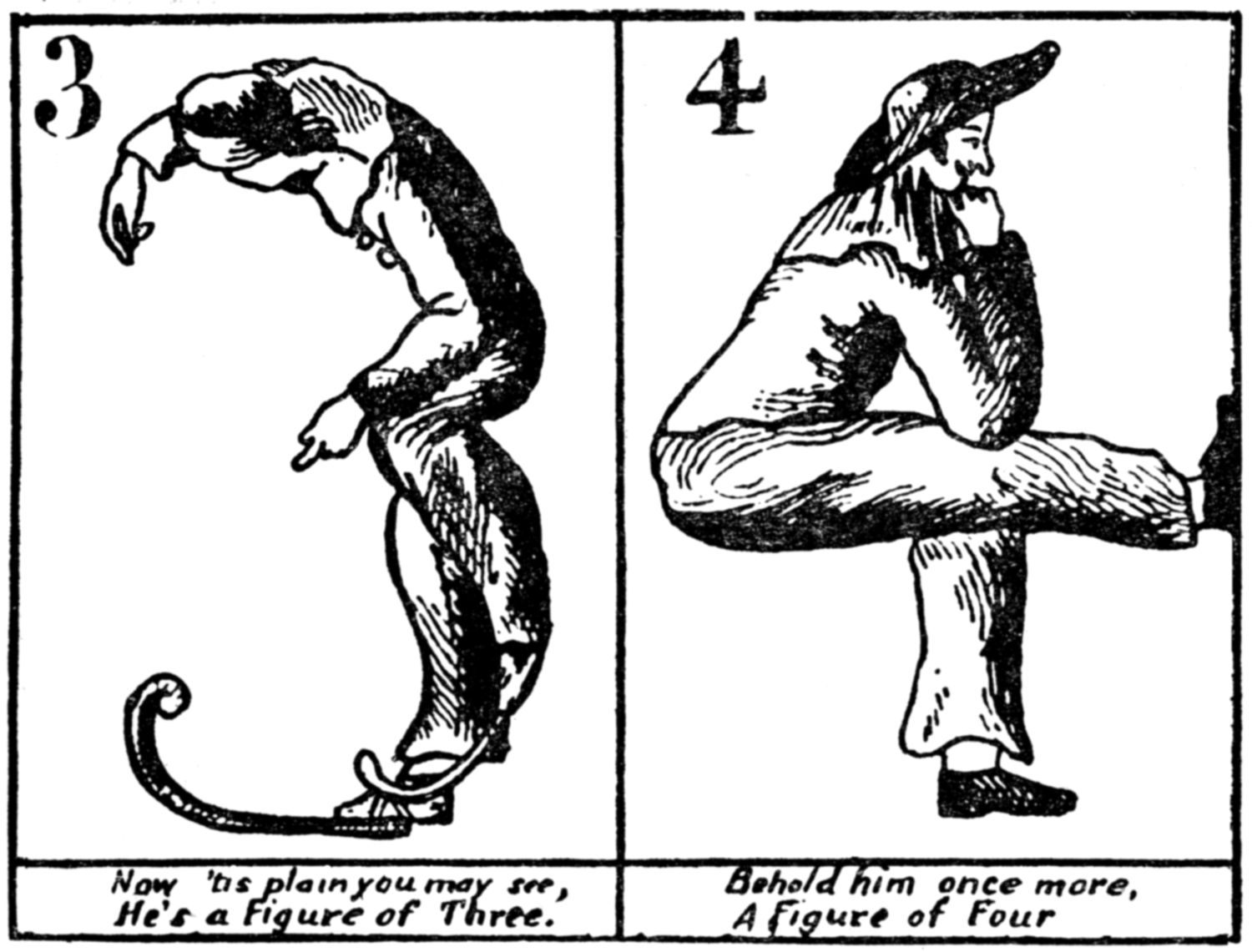
3
Now ’tis plain you may see, He’s a Figure of Three.
4
Behold him once more, A Figure of Four.
33. ONE GOOD TURN DESERVES ANOTHER
My first, though half a noisy bird, To a slight noise may turn; My second twist, a stately word, And it will bend we learn.
Solution
34. AN ENIGMA
To half of ten add one, Then half a score. When this is duly done Almost ten more. This can be good for none, But trial sore.
Solution
No. LI.—DIGITS IN THE FIDGETS
Here is the third pair of these quaint characters:—
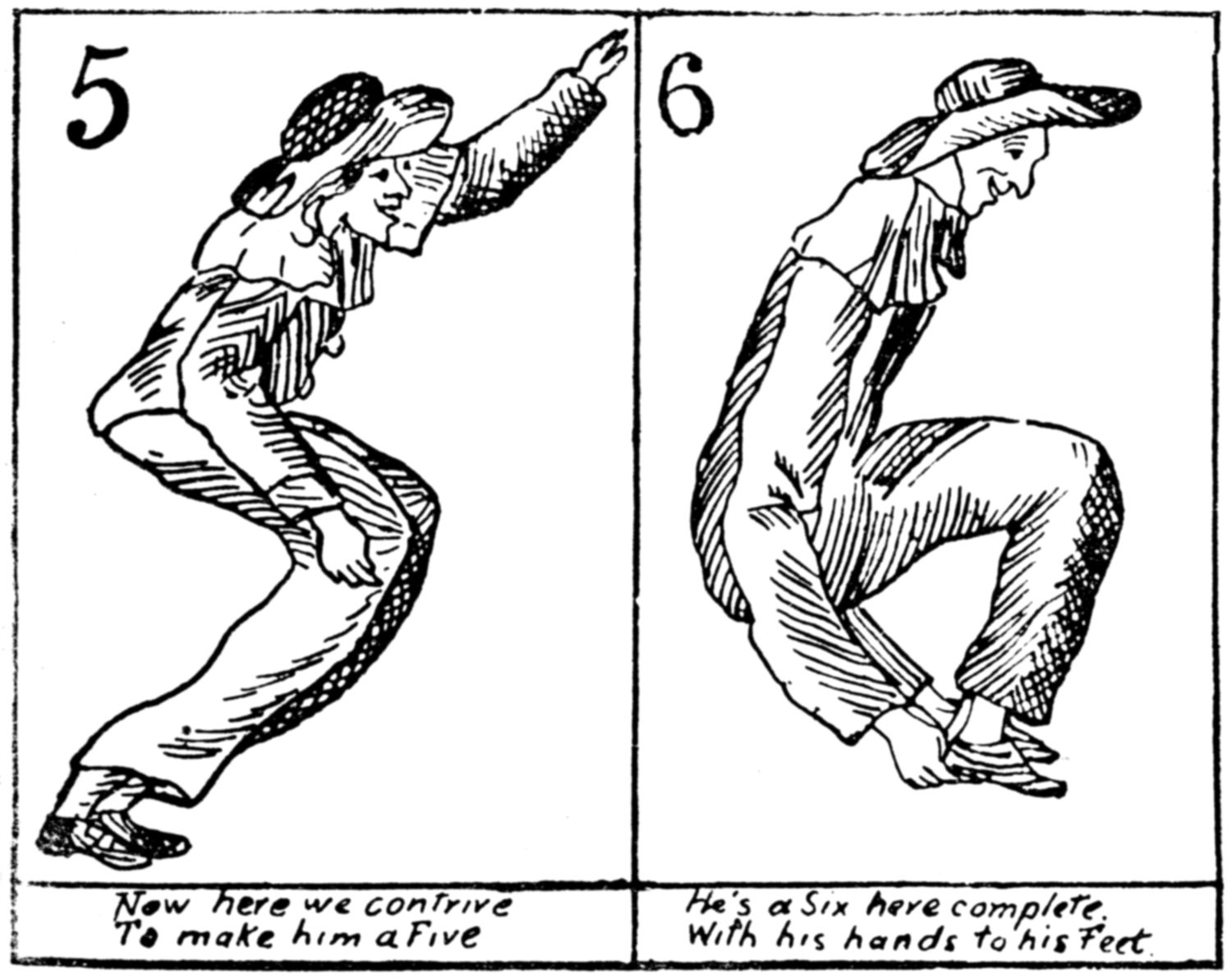
5
Now here we contrive To make him a Five
6
He’s a Six here complete, With his hands to his feet.
35. A BURIED PROVERB
A proverb of eight words is buried here:—
I fancy this Tory outcry, this weary outrageous attempt to show illegality, is as a cat chasing snow-flakes. I must be forgiven if I shun his example.
Solution
36. MISSING WORDS
Quick ....... in action, now timid, now bold, Like ....... of ropes far too rotten to hold, ....... a ....... ....... and disasters For a State that ....... not incapable masters.
The six missing words are spelt with the same seven letters.
Solution
No. LII.—DIGITS IN THE FIDGETS
Here is another pair of these quaint figures:—
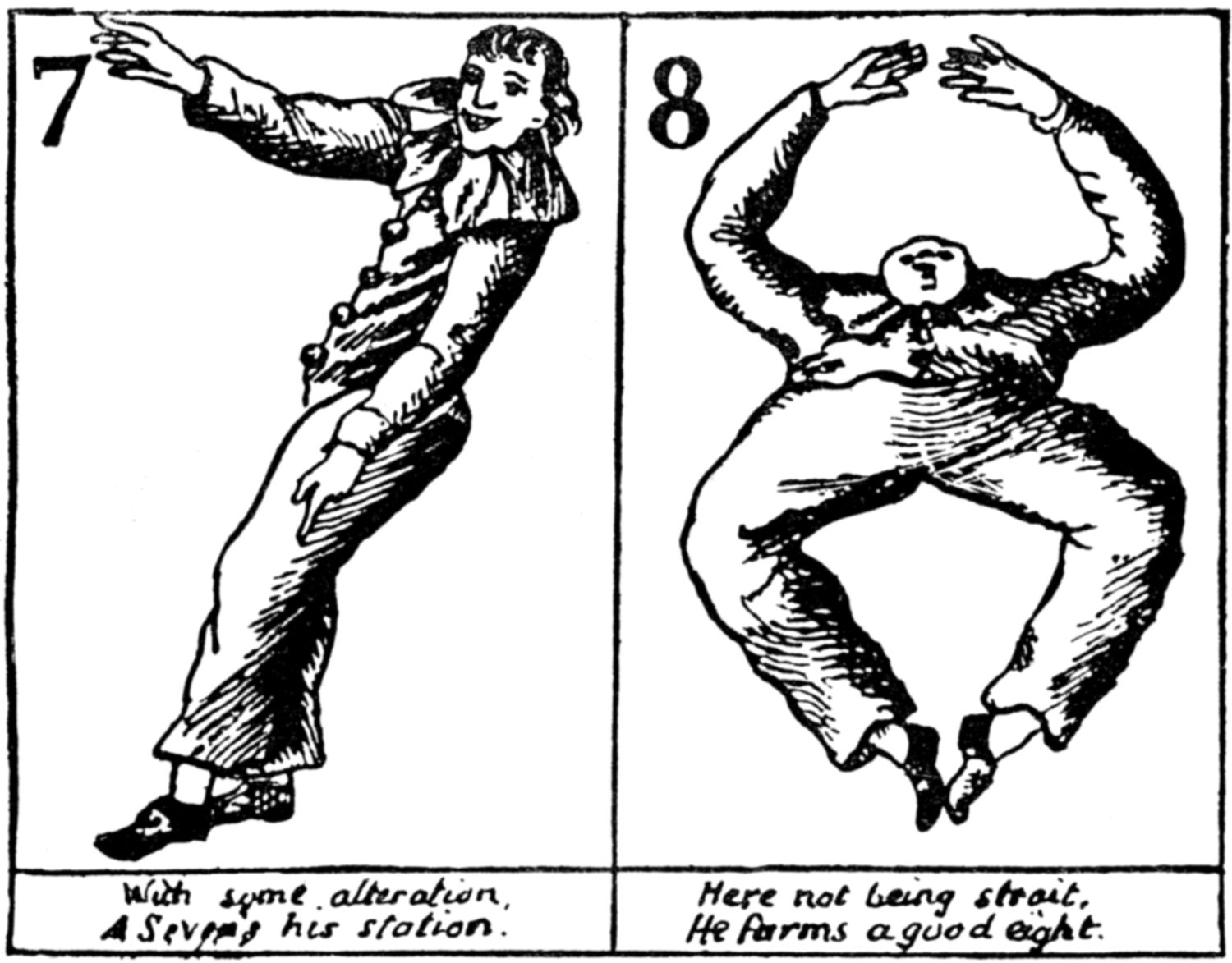
7
With some alteration, A Seven’s his station.
8
Here not being strait, He forms a good eight.
37. A CHARADE
My first as an heir, My second a snare, My whole is the offspring of fancy, Which I sent on its way Last Valentine’s Day, As a token of love to my Nancy.
Solution
38. A LOVER’S VOW
My love shall never know my first, Shall never be my second; It shall my all, come best, come worst, Be surely reckoned.
Solution
No. LIII.—DIGITS IN THE FIDGETS
Here is the final pair:—
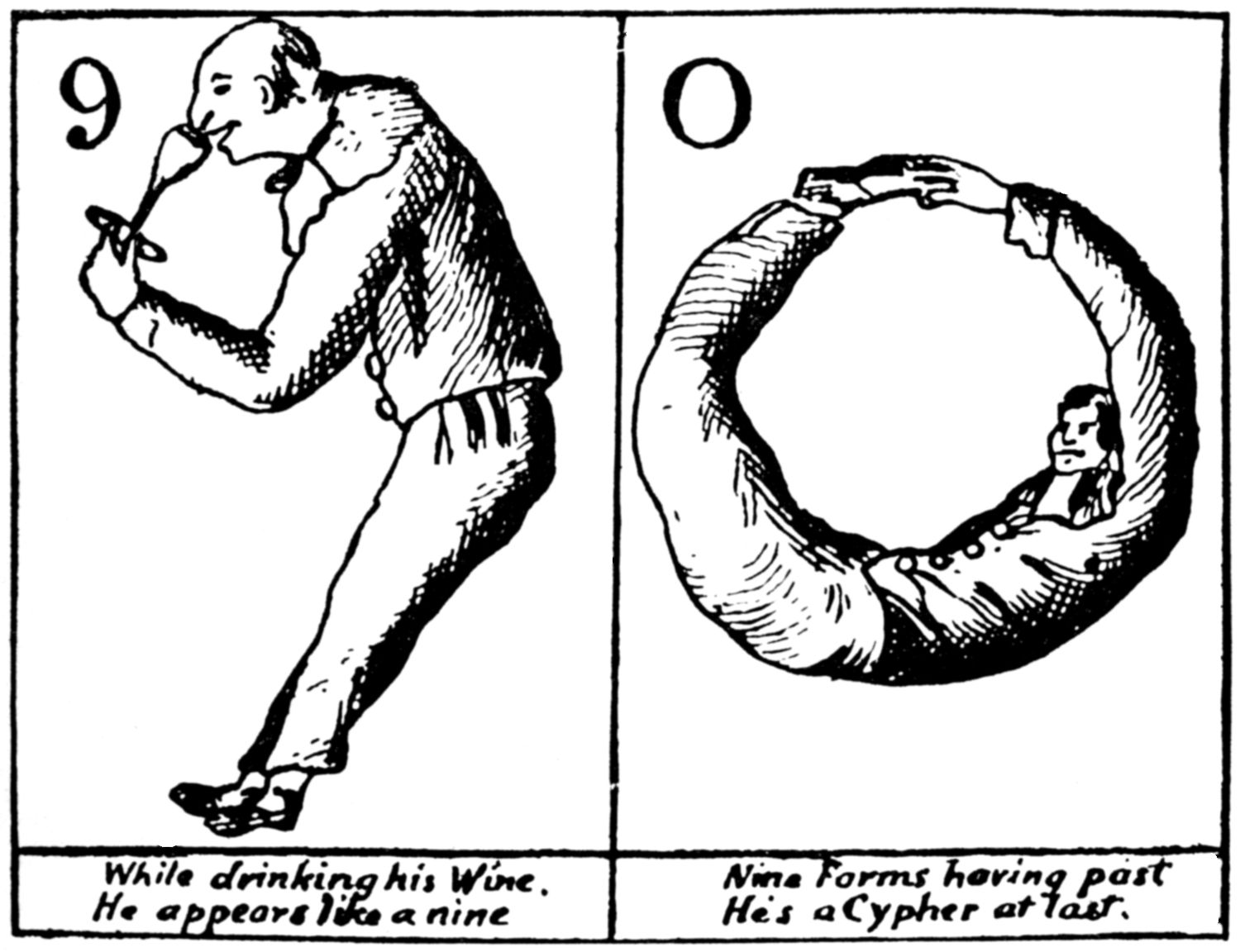
9
While drinking his Wine, He appears like a nine.
0
Nine Forms having past He’s a Cypher at last.
39. AN ENIGMA
I am a letter, and a word, I am a tree, I am a name, Cut me in pieces with a sword, You and your act would be the same. Thrice you must leave the aspirate in doubt, And use it twice if you would find me out.
Solution
40. ANSWER BY ANAGRAM
If you “resist disasters,” how may this affect one of your home circle?
Solution
No. LIV.—A FREAK OF FIGURES
1 × 8 + 1 = 9 12 × 8 + 2 = 98 123 × 8 + 3 = 987 1234 × 8 + 4 = 9876 12345 × 8 + 5 = 98765 123456 × 8 + 6 = 987654 1234567 × 8 + 7 = 9876543 12345678 × 8 + 8 = 98765432 123456789 × 8 + 9 = 987654321
41. A CHARADE
My first the rainbow shows When in rich hues it glows. My next has vowels three; My third was once a tree. My fourth begins the year, My whole the past makes clear.
Solution
42. ASK A SCHOOLBOY
If you tell a schoolboy that the longest side of a triangular field measures 100 rods, and that each of the other sides measures 50 rods, and ask him to estimate the value of its grass at £1 per acre, how should he answer?
Solution
43. A WHOLE LESS THAN ITS PART
Less than my last, my whole has place Between my first and second: Second has body, arms and face; First is by inches reckoned.
Solution
No. LV.—SPINNING WHEELS
What is the smallest number of straight lines which can be drawn within this square so as to enclose each of the wheels within separate boundaries?
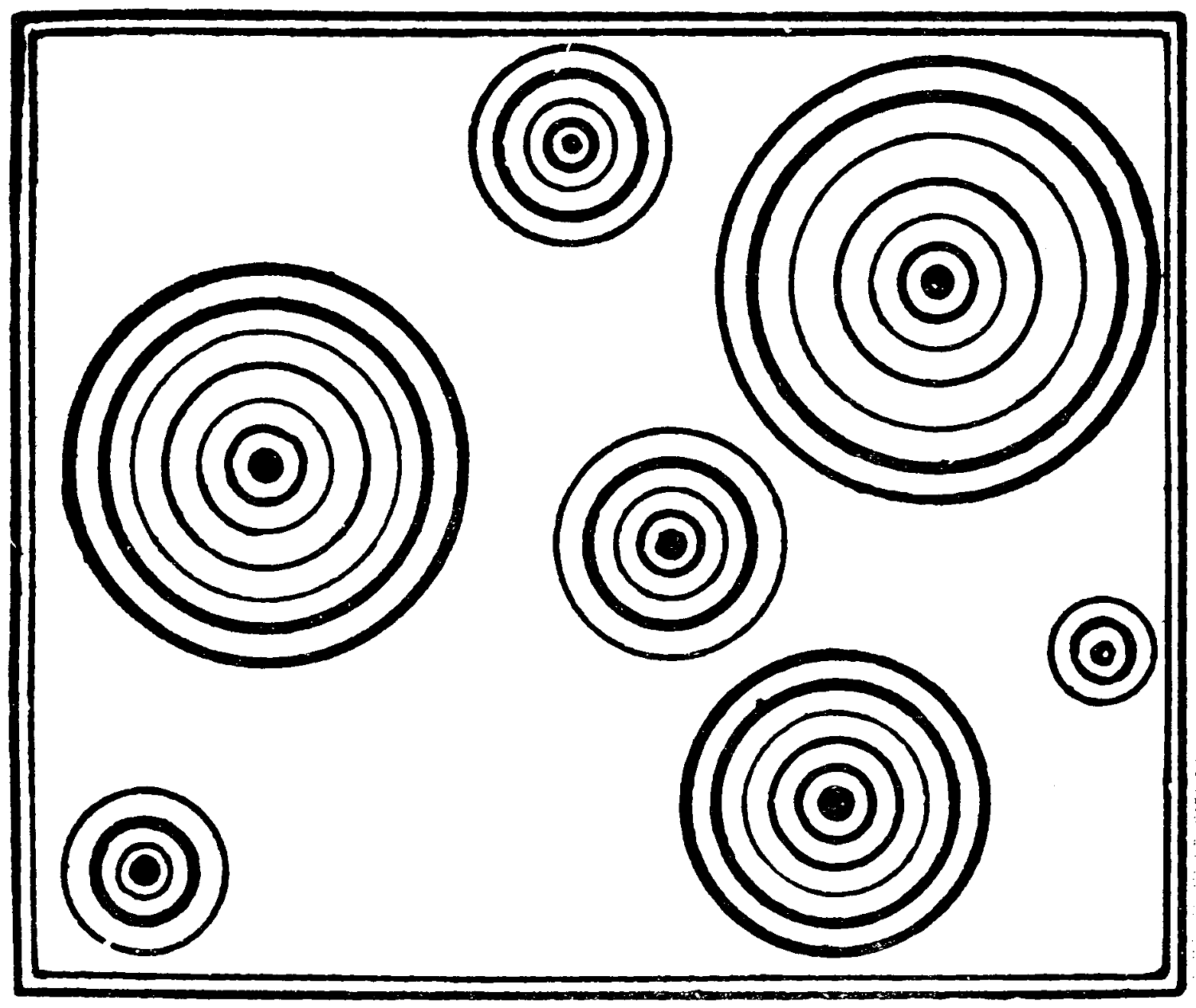
While solving this, rotate the paper in your hand, and see the wheels spin.
Solution
44. A HISTORICAL CHARADE
My first at early morn the camp alarms, And at its sound the soldier springs to arms; My second nowadays fair ladies scorn, Though in less dainty days it oft was worn. My whole, a battle fought on Scottish ground, With victory the rebel forces crowned.
Solution
No. LVI.—FOUR QUARTERS AMONG FIVE
A market gardener who has a large square plot of ground wishes to reserve a fourth of it in the shape of a triangle for himself, as is shown in the diagram—
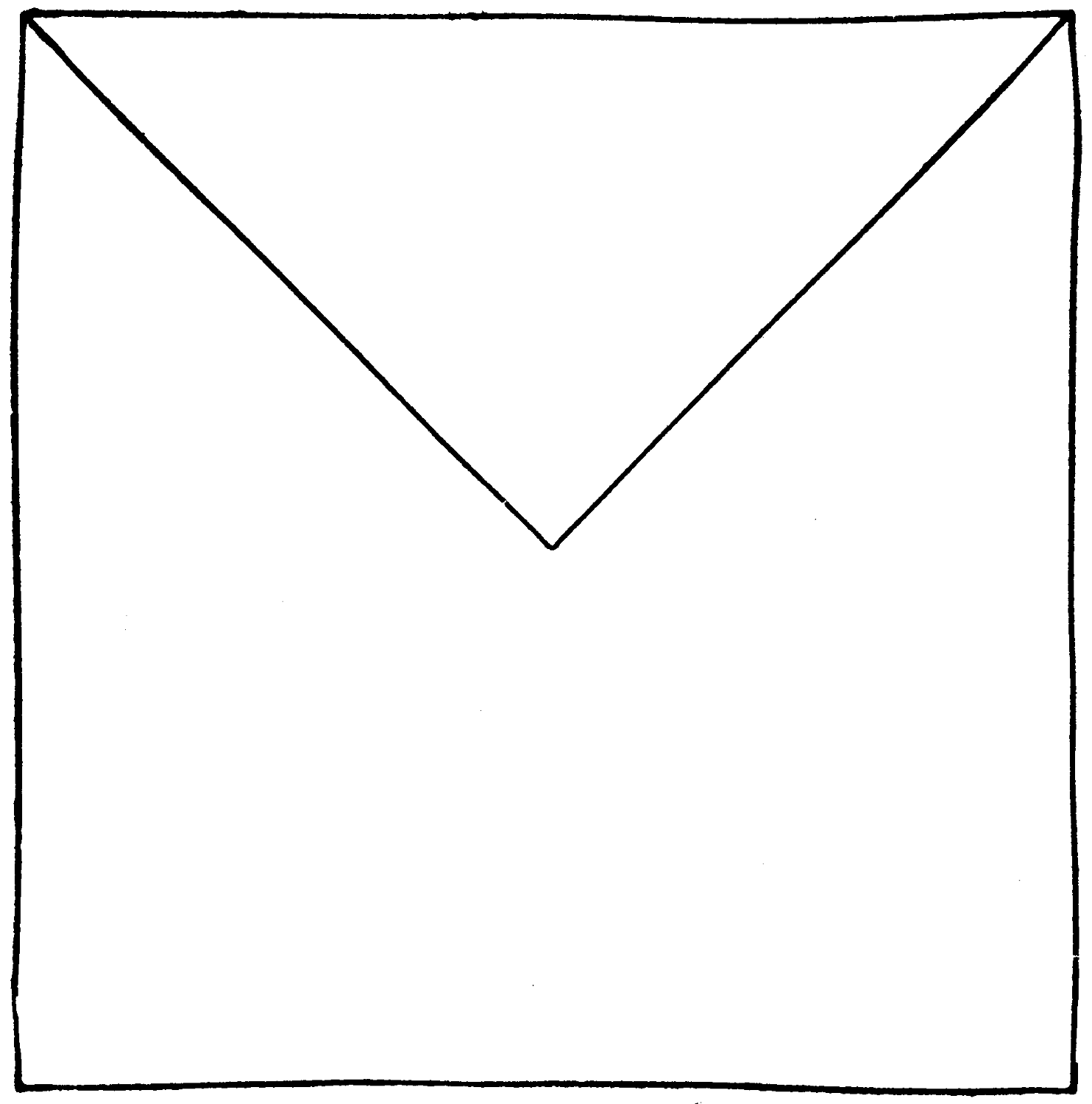
and to divide the remainder among his four sons, so that each shares equally, with plots of similar shape. How did he mark it out for them?
This appears in a less perfect form in “The Twentieth Century Standard Puzzle Book.”
Solution
No. LVII.—USE YOUR PENCIL
Here is a simple little puzzle which may amuse anyone who has paper and pencil at hand:—
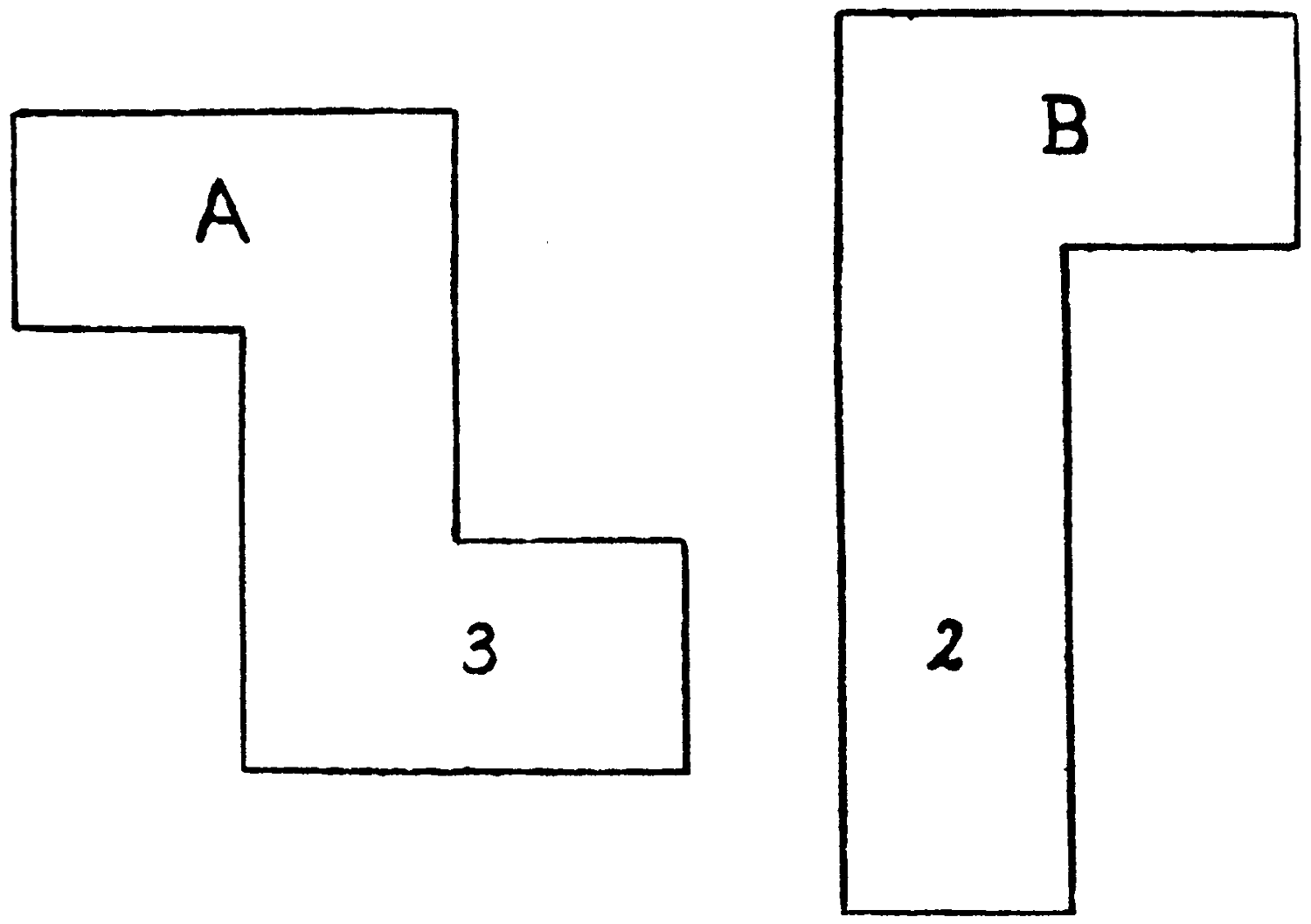
Can you combine three figures similar to Fig. A with two similar to Fig. B, so that a perfect Latin cross is formed?
It is, of course, an easier matter to cut out five such pieces in paper or cardboard, and arrange them in the form required.
Solution
45. MISSING WORDS
I love strolling ....... that wander around, Each ....... a ....... in versatile skill; Each ....... so quaint, each idea so profound, My barn’s at their service, whenever they will. A company played there last night, but to-day Ducks ......., and poultry have vanished away!
The missing words are spelt with the same seven letters.
Solution
No. LVIII.—SUBTLE SELFISHNESS
Four poor men were living in the cottages shown in this diagram, round a central lake well stocked with fish. Four rich men built their houses further afield, and selfishly determined to exclude their neighbours from access to the water.
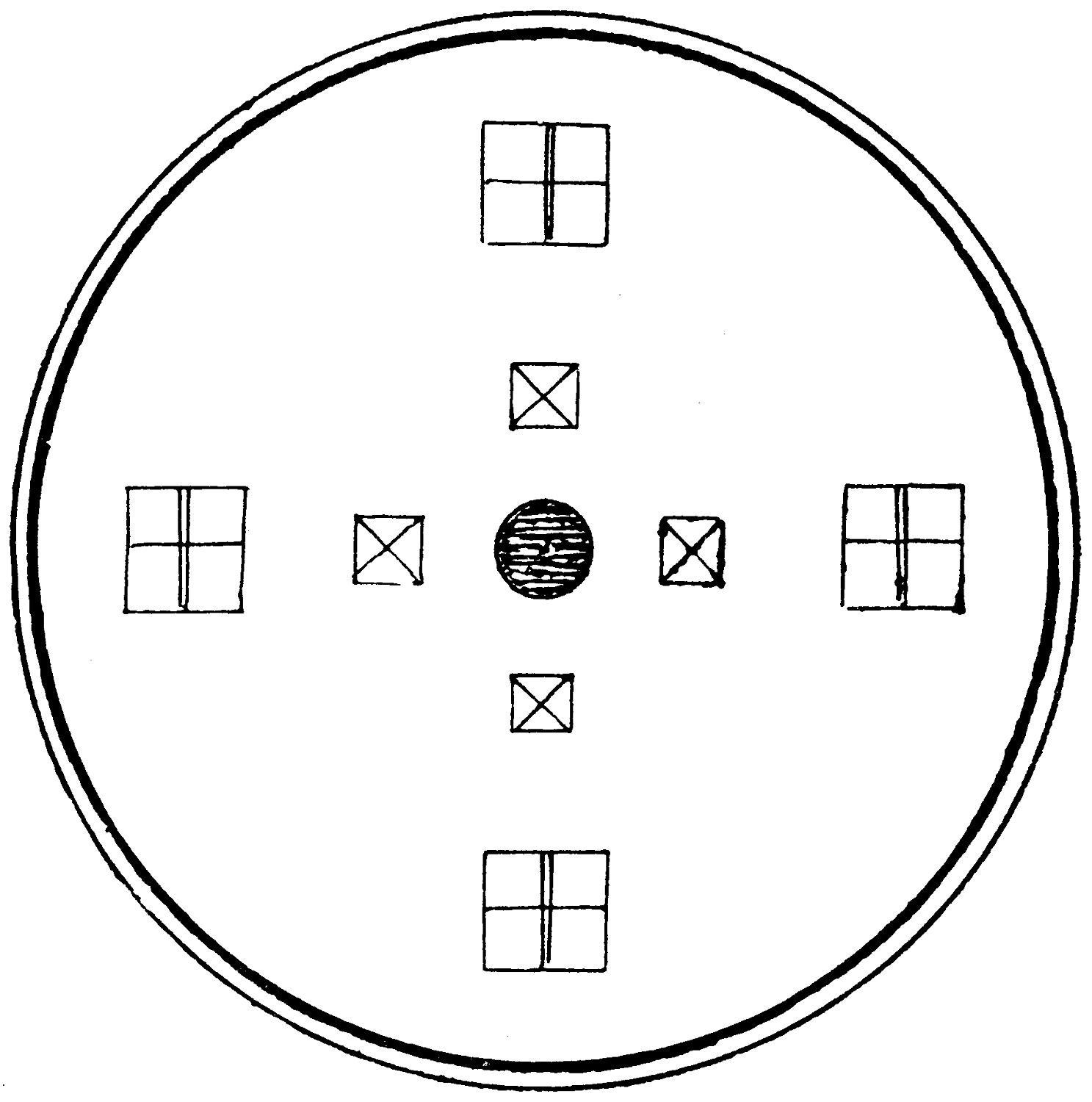
How could they do this effectually without cutting themselves off from the lake?
Solution
46. AN ARITHMOREM
150 hat robe or tent
Can you form from this the name of a famous British author, treating the 150 as Roman numerals?
Solution
No. LIX.—FOR THE CHILDREN
Cut out in cardboard four pieces of the shape and size of each of the large patterns, and two pieces of the small one:—
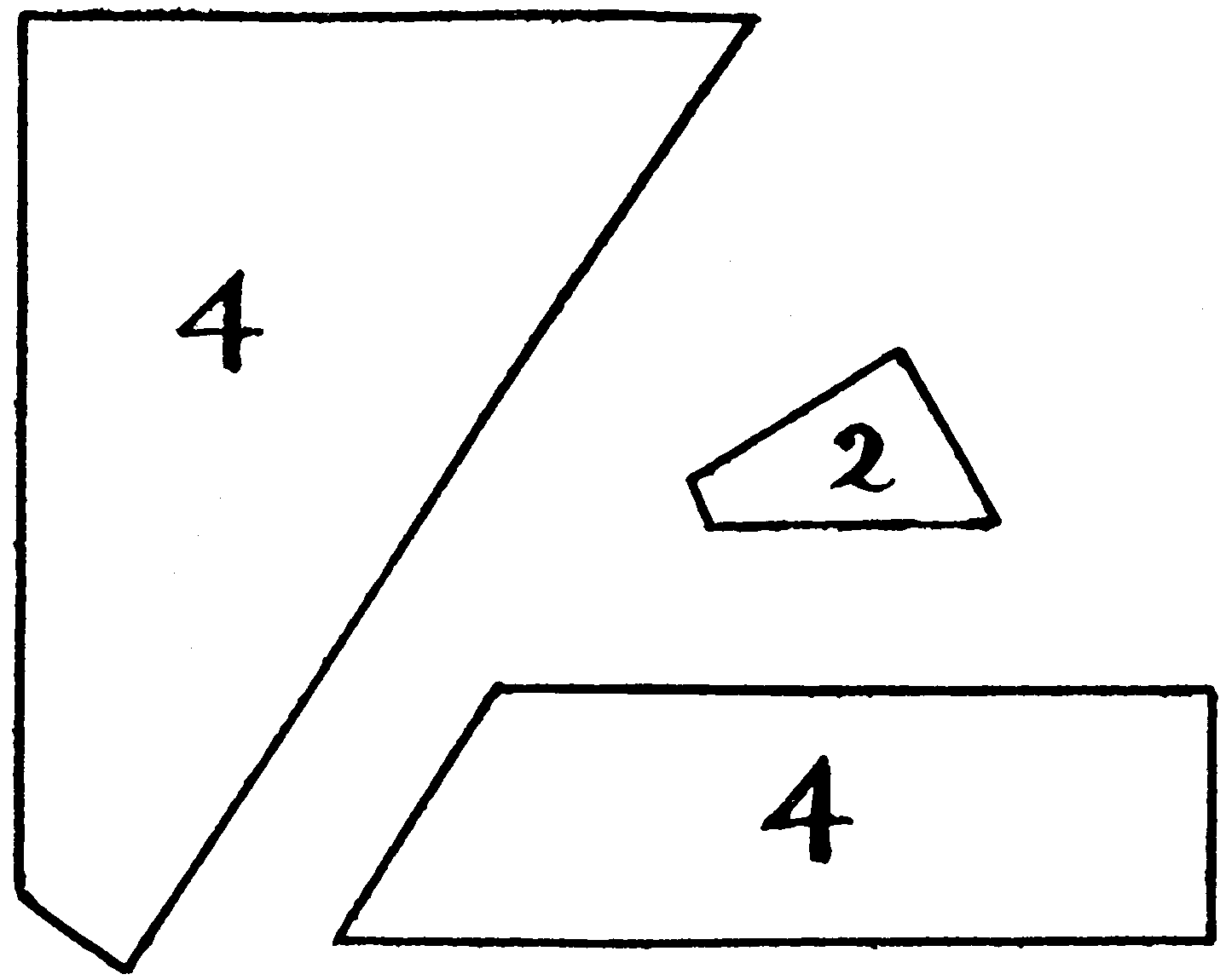
Now arrange these ten pieces so that they form a perfect square.
Solution
47. SHEDDING LETTERS
I’m a worker most active, most useful, most known, Of all that are busy in country and town. Take from me one letter, and yet my good name In spite of this loss will continue the same. Take from me two letters, and still you will see That precisely the same in effect I shall be. Take from me three letters, or even take more, Yet still I continue as sound as before.
Solution
No. LX.
The dotted lines in this diagram show how the figure can be divided into nine parts by four straight cuts

which can be reunited to form a perfect cross.
Solution
48. A SHARP BOY
Tom Larkins, proud of his prize for arithmetic, challenged his sisters to show on a blackboard that if 50 is subtracted from the sum of the nine digits, the result is equal to the number obtained by dividing their sum by 3. How did he prove his point?
Solution
No. LXI.—AN EASY ONE
Take in paper or cardboard a figure made up of a square and half of a similar square, thus:—
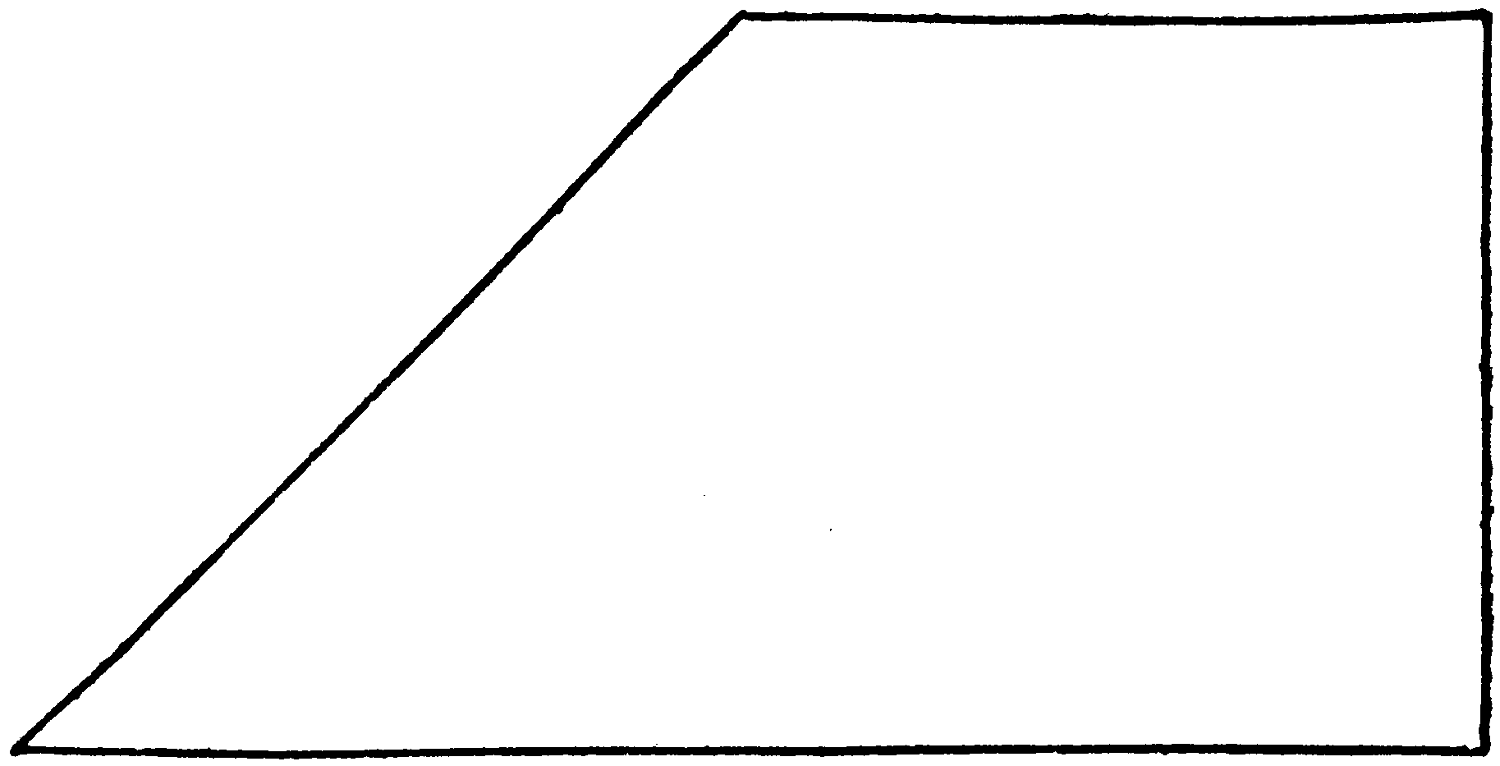
How can you, in the simplest way, divide it into four equal and similar parts by four straight cuts?
Solution
49. GEESE TO MARKET
B drove a goodly flock of geese, And met with Farmer A; Said Farmer A, “How much apiece For this lot did you pay?” Said B, “I paid for all I drive Just six pounds and a crown, And I am selling all but five At the next market town. If fifteen pence a head I charge Beyond the price I paid. I shall secure a sum as large As he who sold all made.”
Solution
No. LXII
Can you draw twenty-two straight lines within this circle so that they divide it into four similar parts, each having three of the dots within its borders?
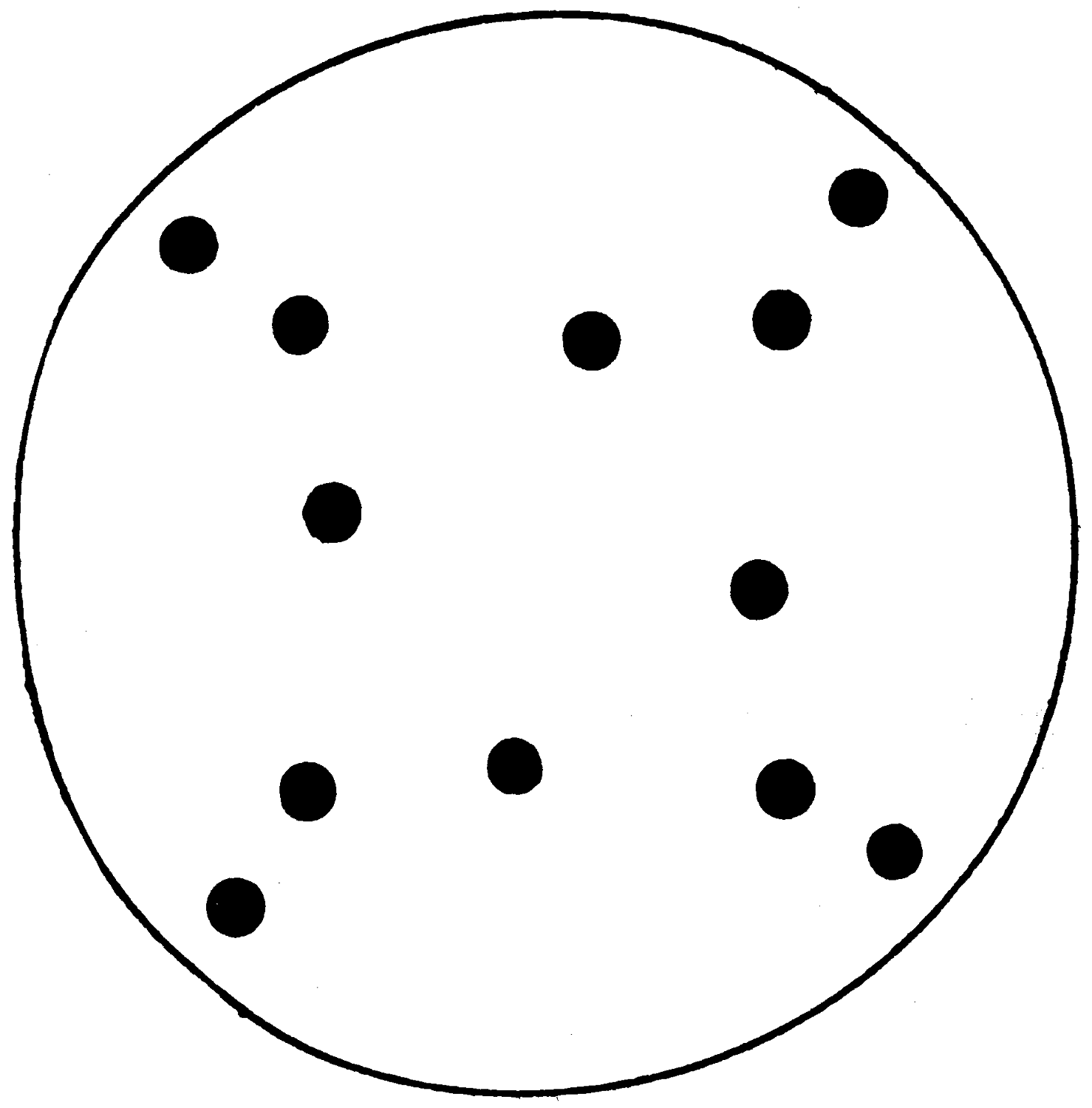
Each line must be at right angles to another.
Solution
50. A QUAINT CHARADE
When second held first For best or for worst, I thought myself happy to win her. But what could I say When the very next day She gave me the whole for my dinner?
Solution
No. LXIII
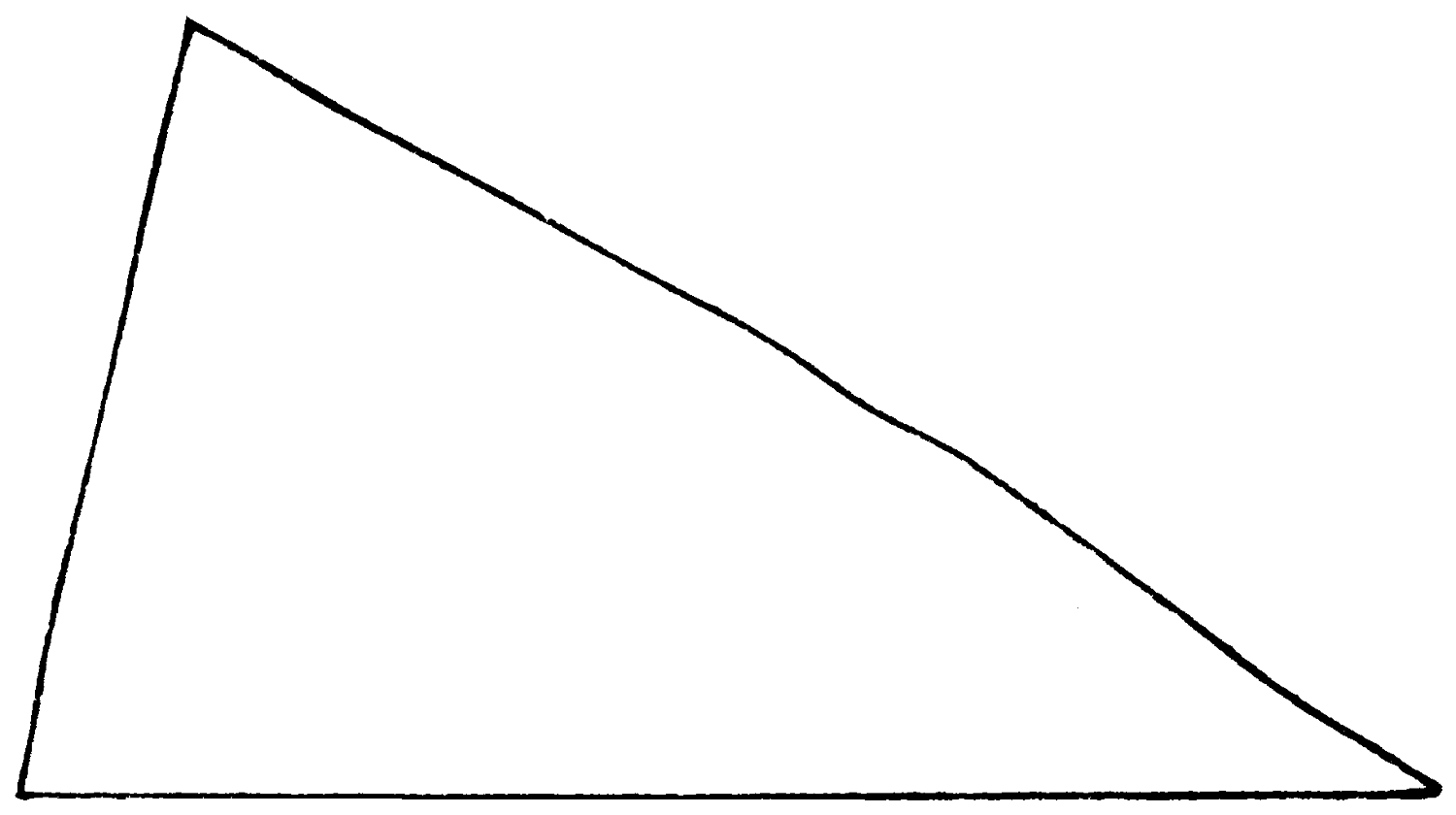
Cut up this triangle into 5 parts,
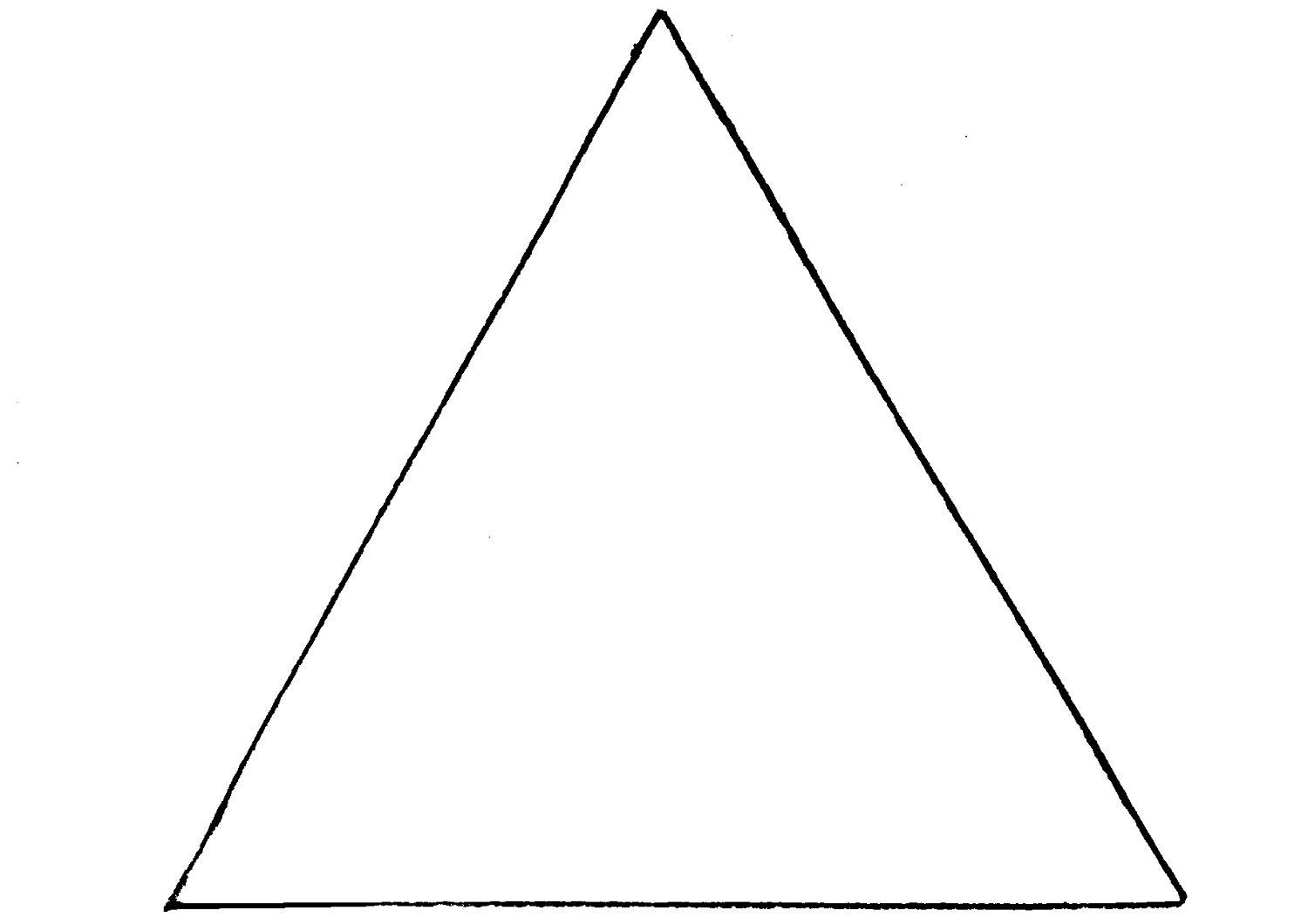
which can be reassembled to form this triangle.
Solution
No. LXIV.—ARITHMETICAL TRIANGLE
The peculiar series of numbers, as arranged in this triangular form, is said to have been perfected by Pascal.
1
2 1
3 3 1
4 6 4 1
5 10 10 5 1
6 15 20 15 6 1
7 21 35 35 21 7 1
8 28 56 70 56 28 8 1
Image
It has the property of showing, without calculation, how many selections or combinations can be made at a time out of a larger number. Thus to find how many selections of 3 at a time can be made out of 8 we look for the third number on the horizontal row that commences with 8, and find the answer 56.
The series is formed thus: Set down the numbers 1, 2, 3, etc., as far as you please, in a vertical row. To the right of 2 place 1, add them together, and set 3 under the 1. Then add 3 to 3, and set the result below, and so on, always placing the sum of two numbers that are side by side below the one on the right.
No. LXV.—MULTIPLICATION NO VEXATION
This diagram shows an ancient and curious method of multiplication, which will be novel to most of our readers.
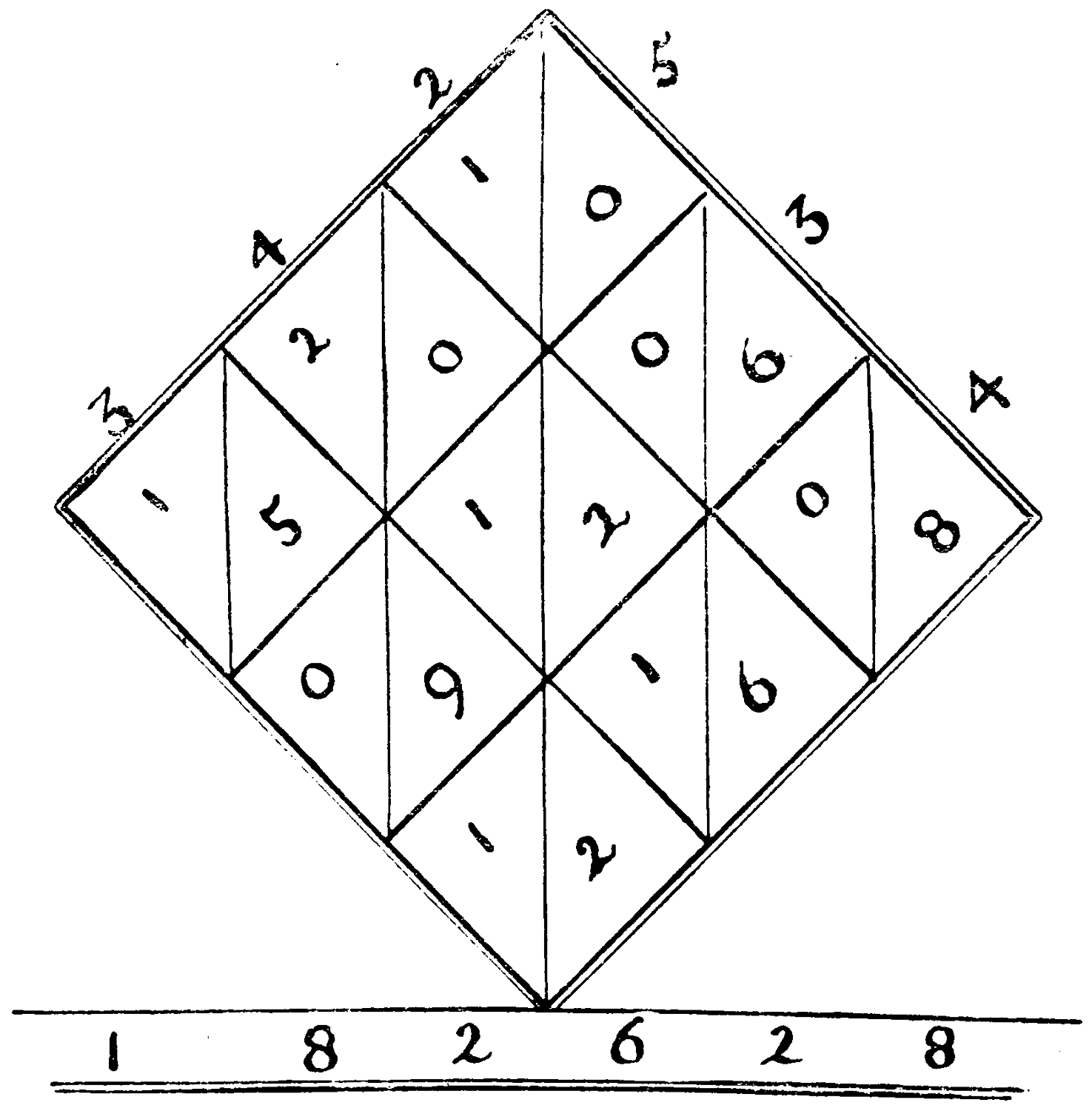
In this instance 534 is multiplied by 342. Draw a square of nine cells with diagonals, fill the three top cells, as is shown, by multiplying the 5 by the 3, the 4 and the 2. Then multiply in similar way the 3 and the 4 by these same figures. Turn the square round so that the diagonals are upright, and add. Of course, placing the numbers thus is the same practically as carrying them by our ordinary rule.
No. LXVI
In this diagram 27 counters are arranged in 9 rows, with 6 in each row.
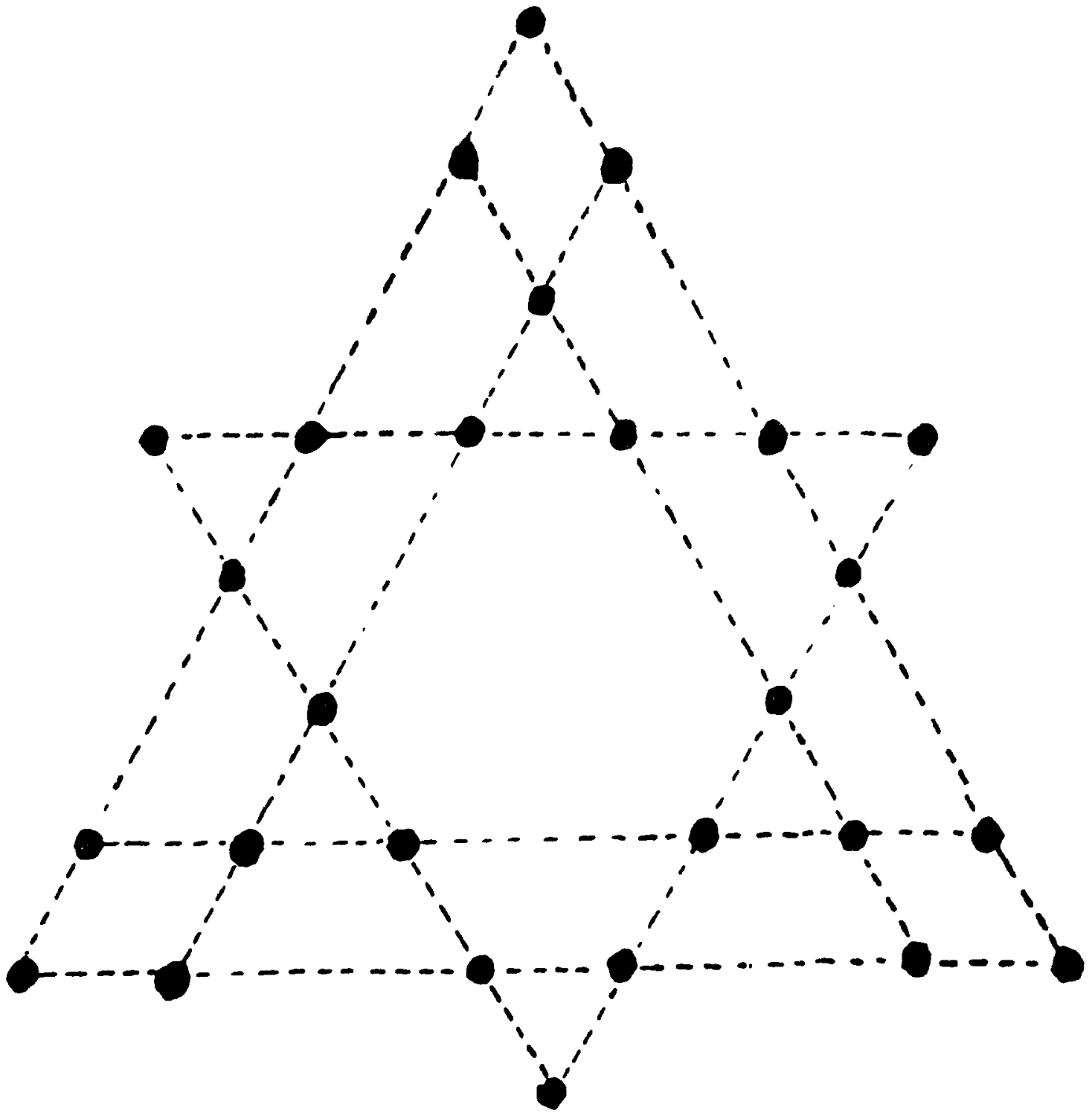
Can you rearrange them so that with similar conditions they all fall within the borders of one equilateral triangle?
Solution
51. A BURIED ADAGE
The bees’ blithe vernal love-songs softly hum, Blending so sweetly with the restful air; The noiseless, deep-laced twilight shadows come, And well I ken the lass who meets me there.
Can you discover a very familiar saying that is buried in these lines?
Solution
No. LXVII.—AN EIGHT-CARD PUZZLE
Place eight cards of two different colours alternately in one row, then with four moves bring all of one colour together.
A ♠ 2 ♡ 3 ♣ 4 ♢ 5 ♣ 6 ♢ 7 ♣ 8 ♡
Image
Two cards (without altering their relative position) are to be moved at a time, and placed somewhere in the same line, one of them at least touching another card.
Solution
52. MUTILATIONS
A little beast without its head Becomes a mighty beast instead; But then the subject of my riddle Is cut asunder in the middle; And nothing this division gains, Though unknown quantity remains.
Solution
53. MISSING WORDS
Mary sat with ..... in hand Writing ..... dramatic. Did she ..... the plots she planned? Negative emphatic! ..... to us the ..... may be But at ..... they’re new to she!
The missing words are spelt with the same five letters.
Solution
No. LXVIII.—THOUGHT READING
Cut out this diagram, and paste it on a card. Hand it to anyone, and ask him to fix upon whichever number he pleases, and merely to tell you in which columns this appears.
I. II. III. IV.
1 33 65 97 2 34 66 98 4 36 68 100 8 40 72 104
3 35 67 99 3 35 67 99 5 37 69 101 9 41 73 105
5 37 69 101 6 38 70 102 6 38 70 102 10 42 74 106
7 39 71 103 7 39 71 103 7 39 71 103 11 43 75 107
9 41 73 105 10 42 74 106 12 44 76 108 12 44 76 108
11 43 75 107 11 43 75 107 13 45 77 109 13 45 77 109
13 45 77 109 14 46 78 110 14 46 78 110 14 46 78 110
15 47 79 111 15 47 79 111 15 47 79 111 15 47 79 111
17 49 81 113 18 50 82 114 20 52 84 116 24 56 88 120
19 51 83 115 19 51 83 115 21 53 85 117 25 57 89 121
21 53 85 117 22 54 86 118 22 54 86 118 26 58 90 122
23 55 87 119 23 55 87 119 23 55 87 119 27 59 91 123
25 57 89 121 26 58 90 122 28 60 92 124 28 60 92 124
27 59 91 123 27 59 91 123 29 61 93 125 29 61 93 125
29 61 93 125 30 62 94 126 30 62 94 126 30 62 94 126
31 63 95 127 31 63 95 127 31 63 95 127 31 63 95 127
V. VI. VII.
16 48 80 112 32 48 96 112 64 80 96 112
17 49 81 113 33 49 97 113 65 81 97 113
18 50 82 114 34 50 98 114 66 82 98 114
19 51 83 115 35 51 99 115 67 83 99 115
20 52 84 116 36 52 100 116 68 84 100 116
21 53 85 117 37 53 101 117 69 85 101 117
22 54 86 118 38 54 102 118 70 86 102 118
23 55 87 119 39 55 103 119 71 87 103 119
24 56 88 120 40 56 104 120 72 88 104 120
25 57 89 121 41 57 105 121 73 89 105 121
26 58 90 122 42 58 106 122 74 90 106 122
27 59 91 123 43 59 107 123 75 91 107 123
28 60 92 124 44 60 108 124 76 92 108 124
29 61 93 125 45 61 109 125 77 93 109 125
30 62 94 126 46 62 110 126 78 94 110 126
31 63 95 127 47 63 111 127 79 95 111 127
Image
You can then in a moment, and at a glance, pick out the number that is chosen.
Solution
No. LXIX.—FROM PILLAR TO POST
Let us suppose that these black dots represent a succession of pillar boxes. It will be seen that a postman, starting from the circle, and going along the dotted lines, turns round 18 corners.
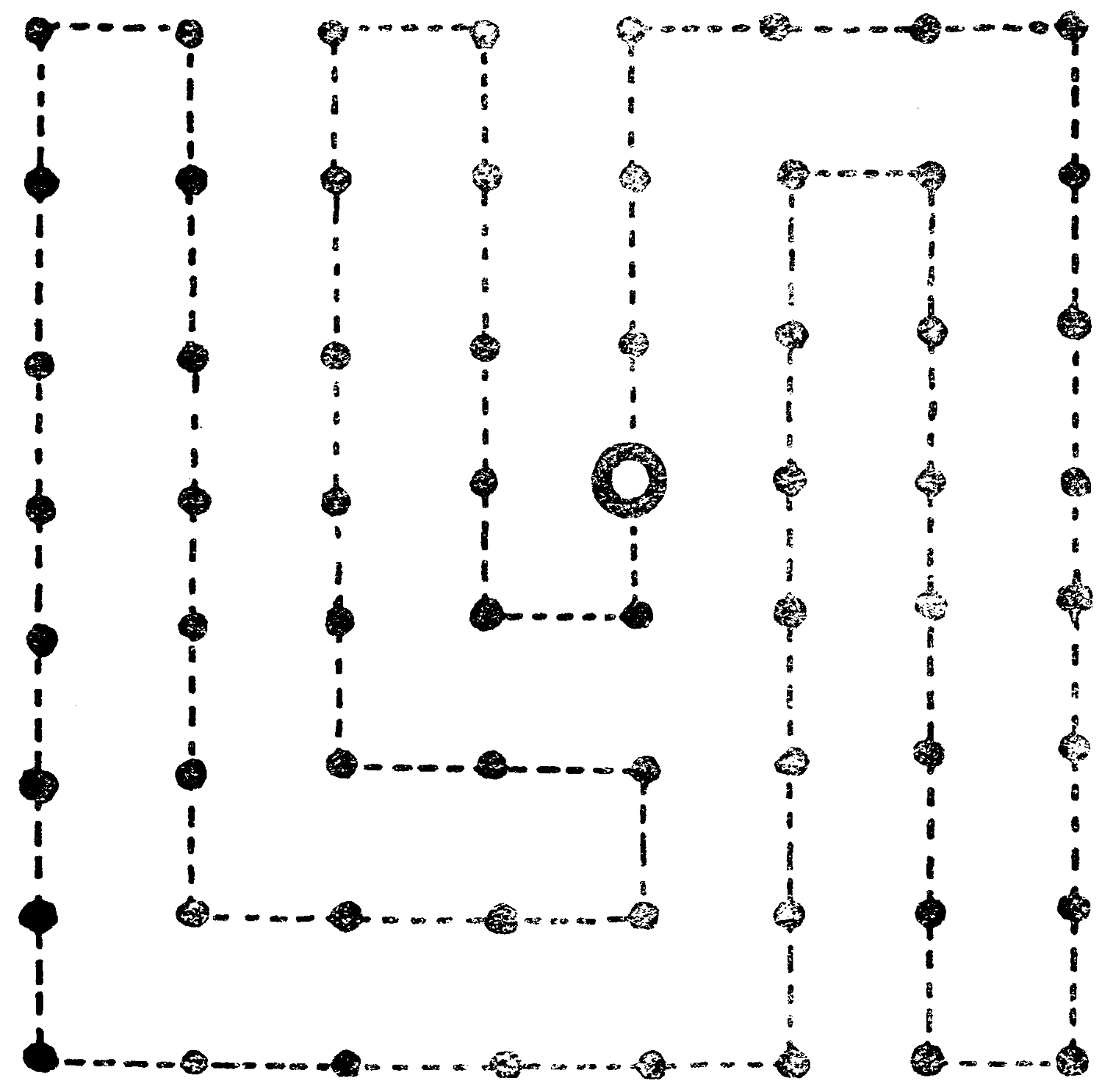
Can he take a course which involves fewer turnings?
Solution
No. LXX.—TRANSFORMATIONS
Here is an ingenious paper and scissors puzzle:—
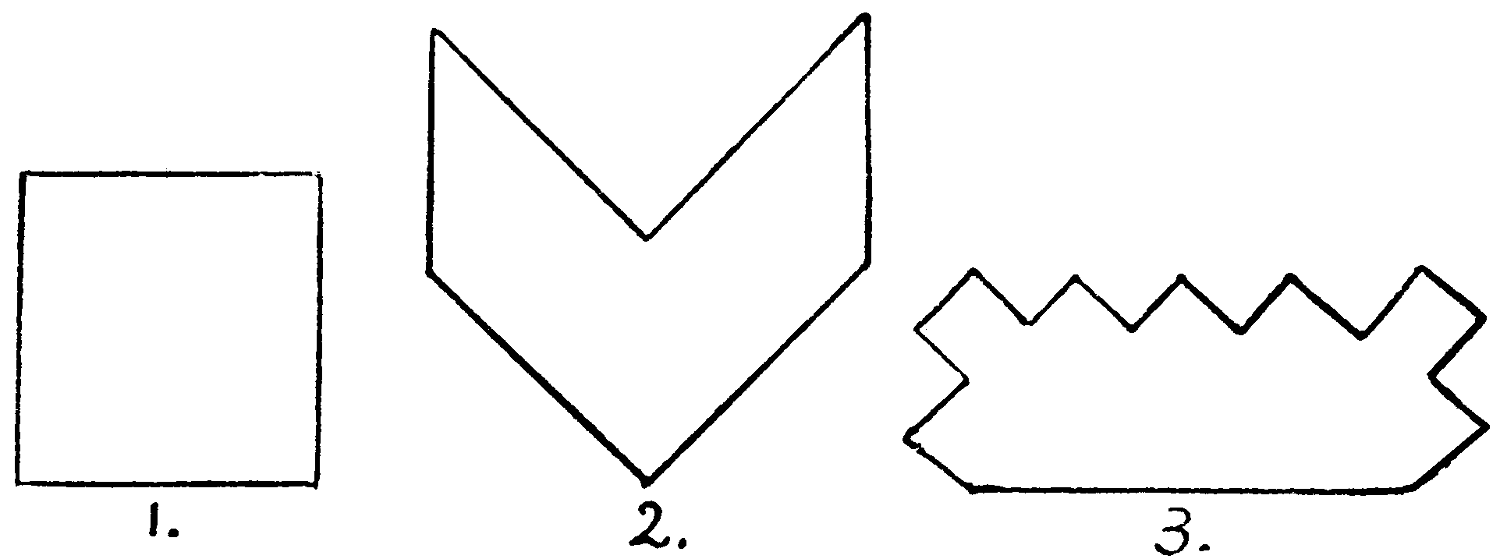
Divide a square card into three pieces, so that these can be reunited to form No. 2 or No. 3 of this diagram.
Solution
54. COUNTING THE GEESE
(From an old Sanscrit source, quoted by Longfellow in his “Kavanagh.”)
Ten times the square root of a flock of geese, seeing the clouds collect, flew to the Manus lake. One-eighth of the whole flew from the edge of the water among a tangle of water lilies, and three couples were seen playing in the water. Tell me, my young girl with beautiful locks, what was the whole number of geese?
Solution
55. A THIRD IS A HALF
Six hundred and sixty so ordered may be That if you divide the whole number by three You find the result will exactly express The half of six hundred and sixty, no less.
Solution
No. LXXI.—A PUZZLE WITH CHESS PIECES
♚
♖ ♘ ♖
Image
Leaving the Black King in his position, place the three white men so that he stands checkmated.
Solution
56. PRESS PARODIES
An American paper published the following:—
There was a young damsel, oh, bless her! It cost very little to dress her; She was sweet as a rose In her everyday clothes, But had no young man to caress her.
Next day this parody appeared in a rival paper:—
There was a young ......, oh, bless her! It cost very little to dress her; Some ........... and ..... About Thanksgiving time, And they ... the last bit from the ........
Can you fill in the missing words?
Solution
No. LXXII.—HEXAGONAL ILLUSIONS
If we look with one eye only, or with eyes half-closed, at these groups of circular dots, they assume the appearance familiar to us in honeycomb. This is an effect of the contrast and opposition of the black and white in the sensation of the retina.
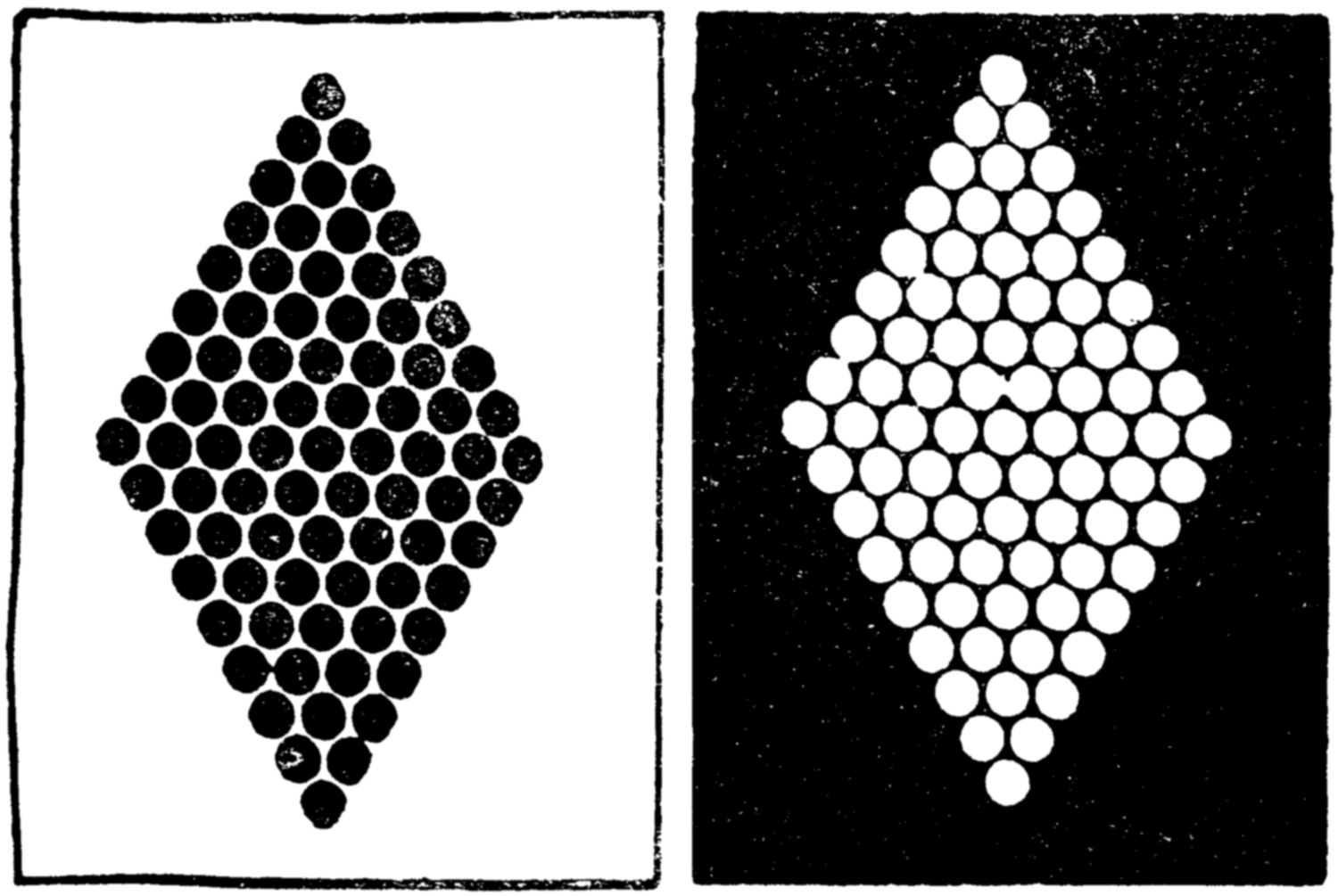
Although the black and the white circles are of the same diameter the irradiation is in their case so intense that the white circles appear to be larger than the black.
No. LXXIII.—AN ILLUSION OF ARCHES
This excellent illusion appeared in a recent number of the “Strand Magazine”:—
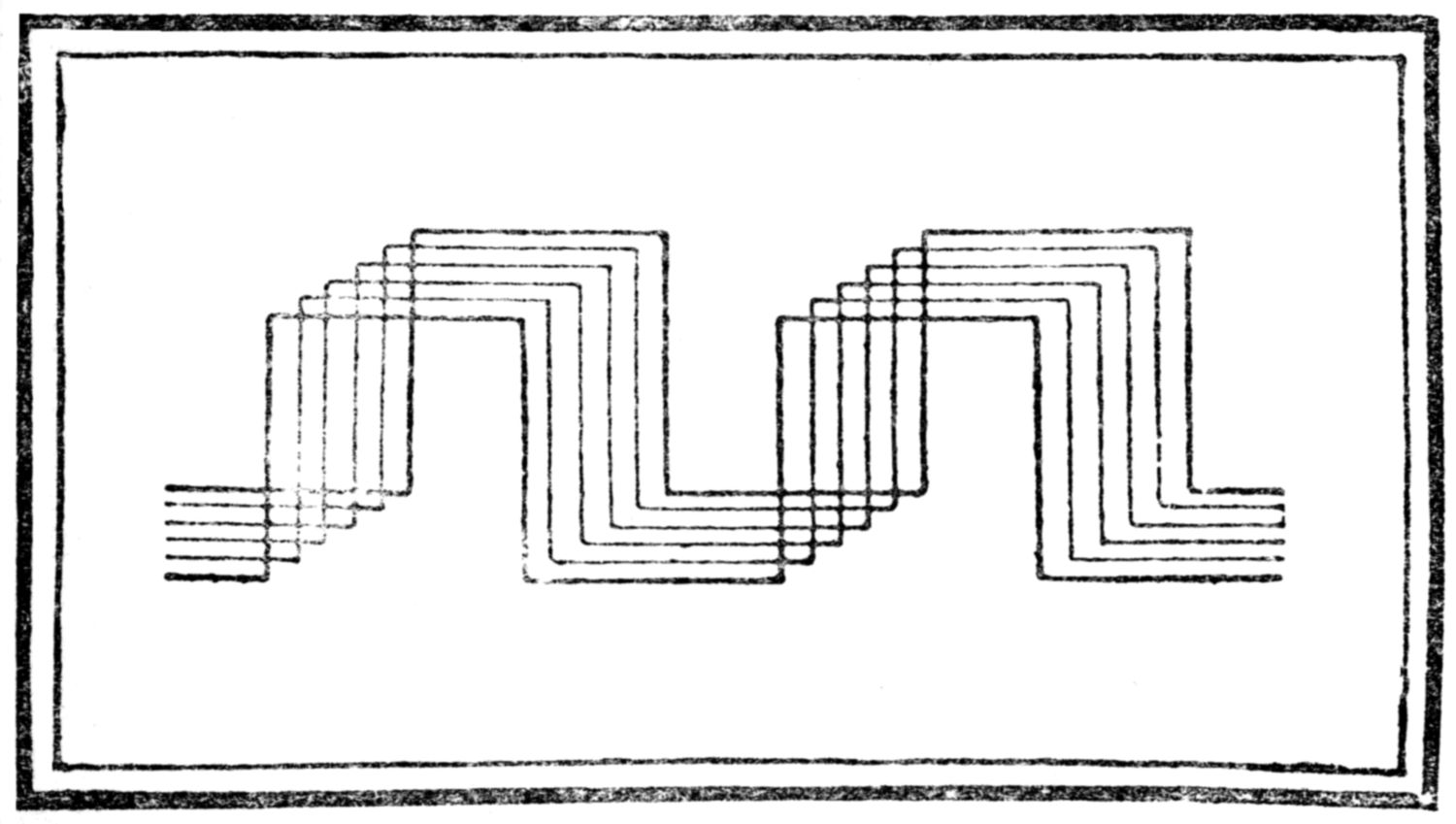
Most persons will at first see the passages under these arches as running upwards from left to right, but presently, as their line of vision shifts, the arches will take a downward course from right to left. This very curious effect will well repay a little patience, if it is not realised at once.
57. WHERE WAS THE WEDDING?
She loses her head when she joins the brides, He joins them after tea; But both are swept by ruthless tides Away on the western sea.
Solution
58. ON A BANANA BARROW
I have 91 bananas on my barrow, of two qualities; some I sell at four a penny, and the better sort at three a penny. If I had sold them in mixed lots at seven for twopence, I should have made a penny more. How many were there of each quality?
Solution
No. LXXIV.—IN THE TRAIN
The Puzzle Problem—
A passenger in a first-class railway carriage notices that the top of a factory window due S.W. of him coincides with a mark on the carriage window, and does not move from it while the train is running five and a half miles.
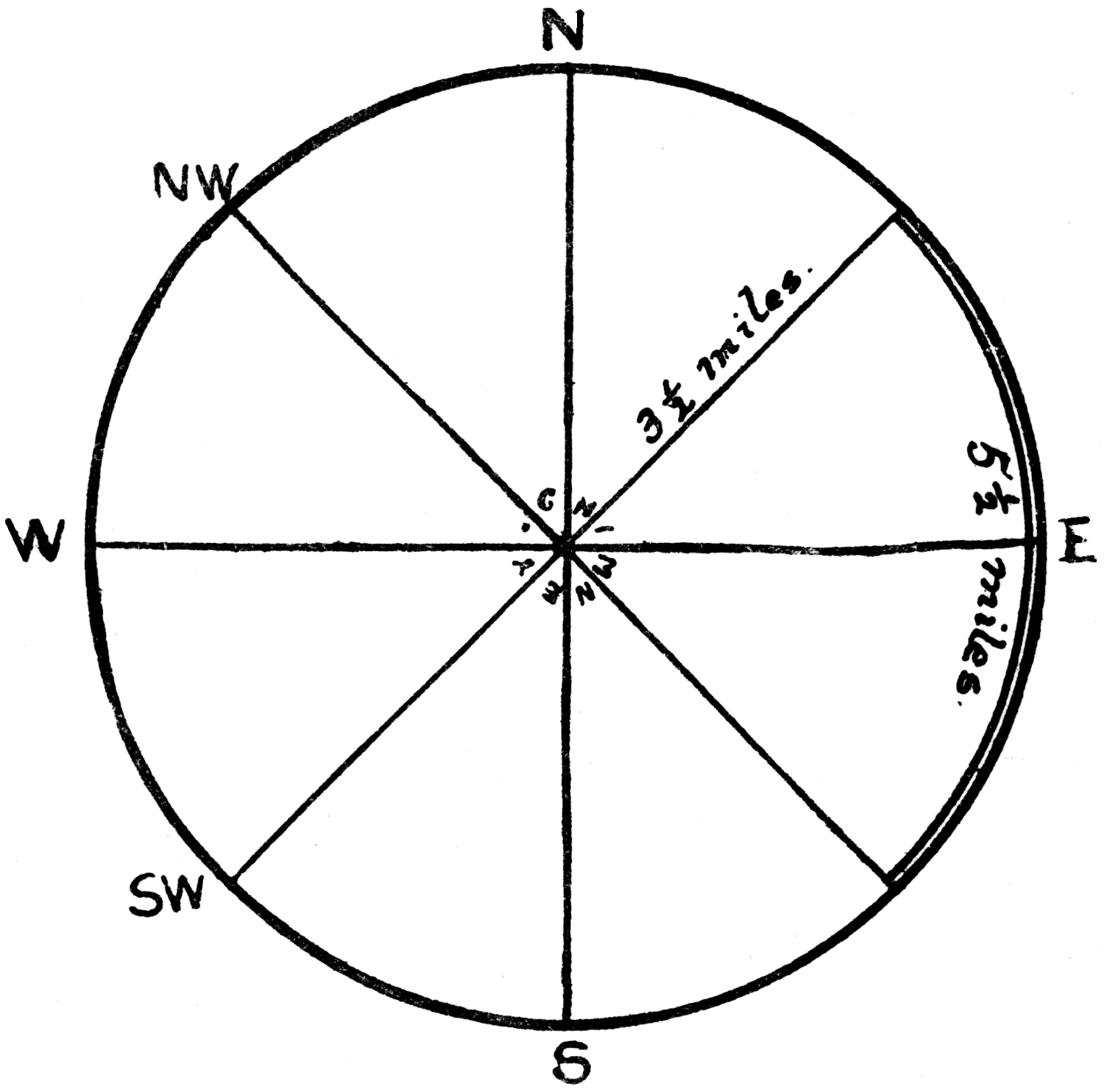
At the end of that distance the compass bearing of the chimney is due N.W. How far was the passenger from the chimney when he first noticed it?
is solved by 31⁄2 miles.
We give a diagram to make the points clear.
As the chimney top does not move from its place on the window, it is clear that the train is running on a segment of a circle having the chimney for its centre. It follows that the observer’s distance throughout is equal to the radius of that circle, and the radius of a circle of which the quadrant measures 51⁄2 miles is 31⁄2 miles within about 11 ft.
No. LXXV.—MENDING THE FLAG
The cross had been taken out from the centre of this flag, and its owner, who had an ingenious turn of mind, found that by cutting what remained into two pieces, and rejoining them, he could make it into a perfect flag without any waste of material.
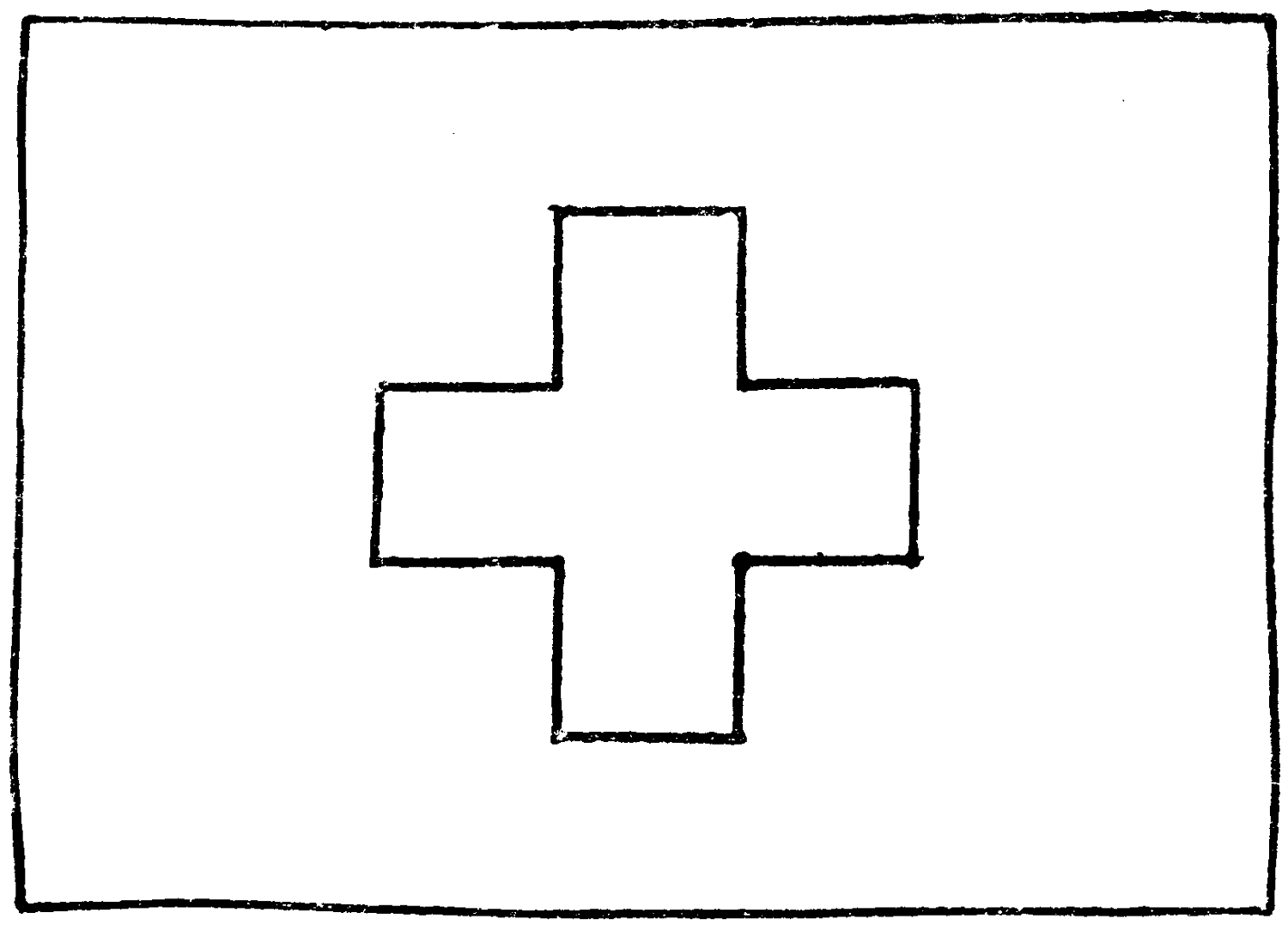
How did he accomplish this?
Solution
No. LXXVI.—FOR THE CHILDREN
Add two more pieces similar in shape and size to that marked A, and one similar to B, C, and D respectively, and then readjust the eleven parts so that they form a perfect square.
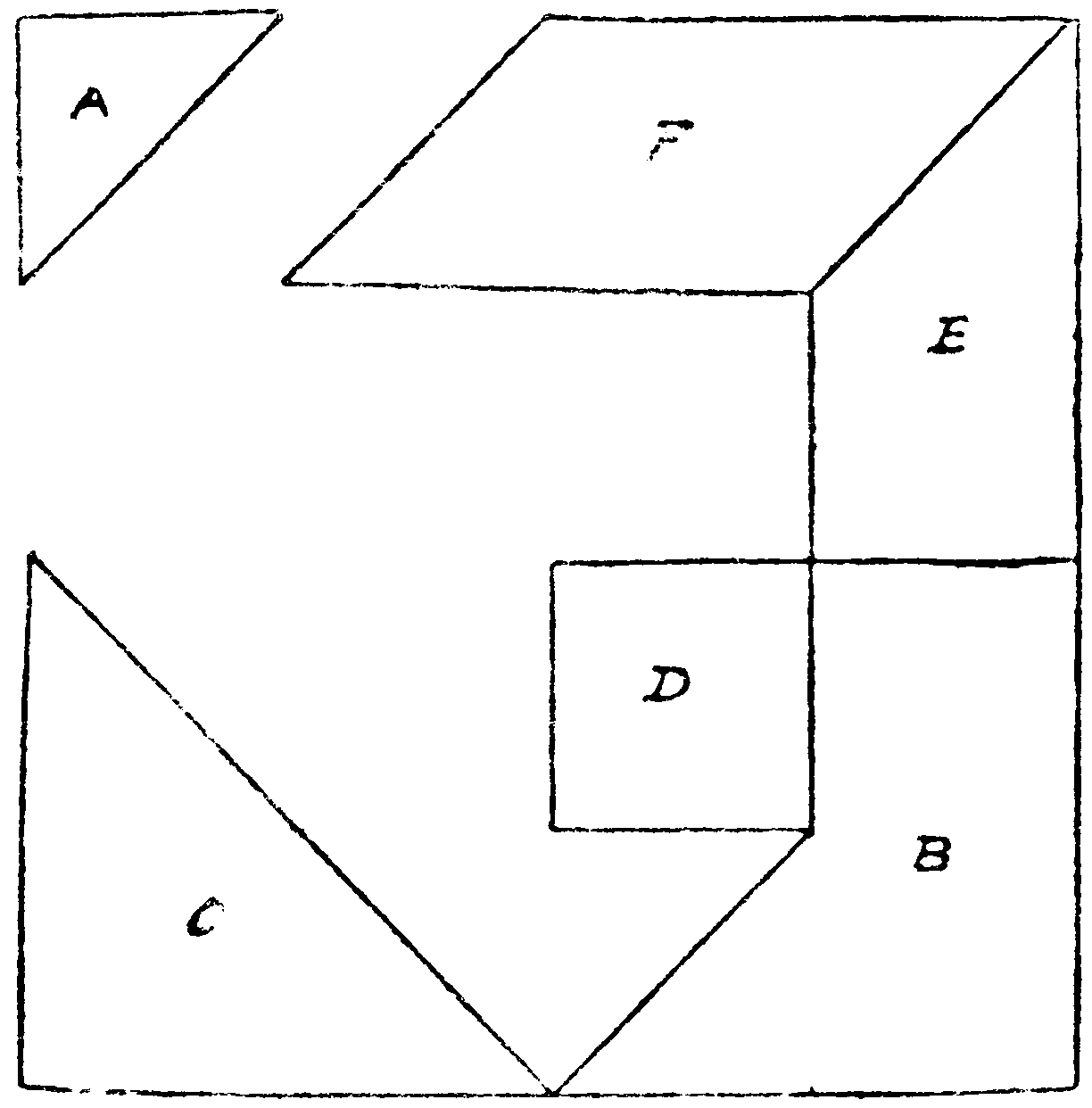
Solution
59. MISSING WORDS
How does the sluggard’s garden grow? When ..... are high results are low. His borders ..... and bindweed spoil, No careful culture ..... the soil; But weeds that ..... are all alive Where ..... pink or rose should thrive.
The missing words are spelt with the same letters.
Solution
No. LXXVII.—AN EASY MATCH PUZZLE
This is a simple arrangement of eight matches, by which two squares and four similar triangles are formed.
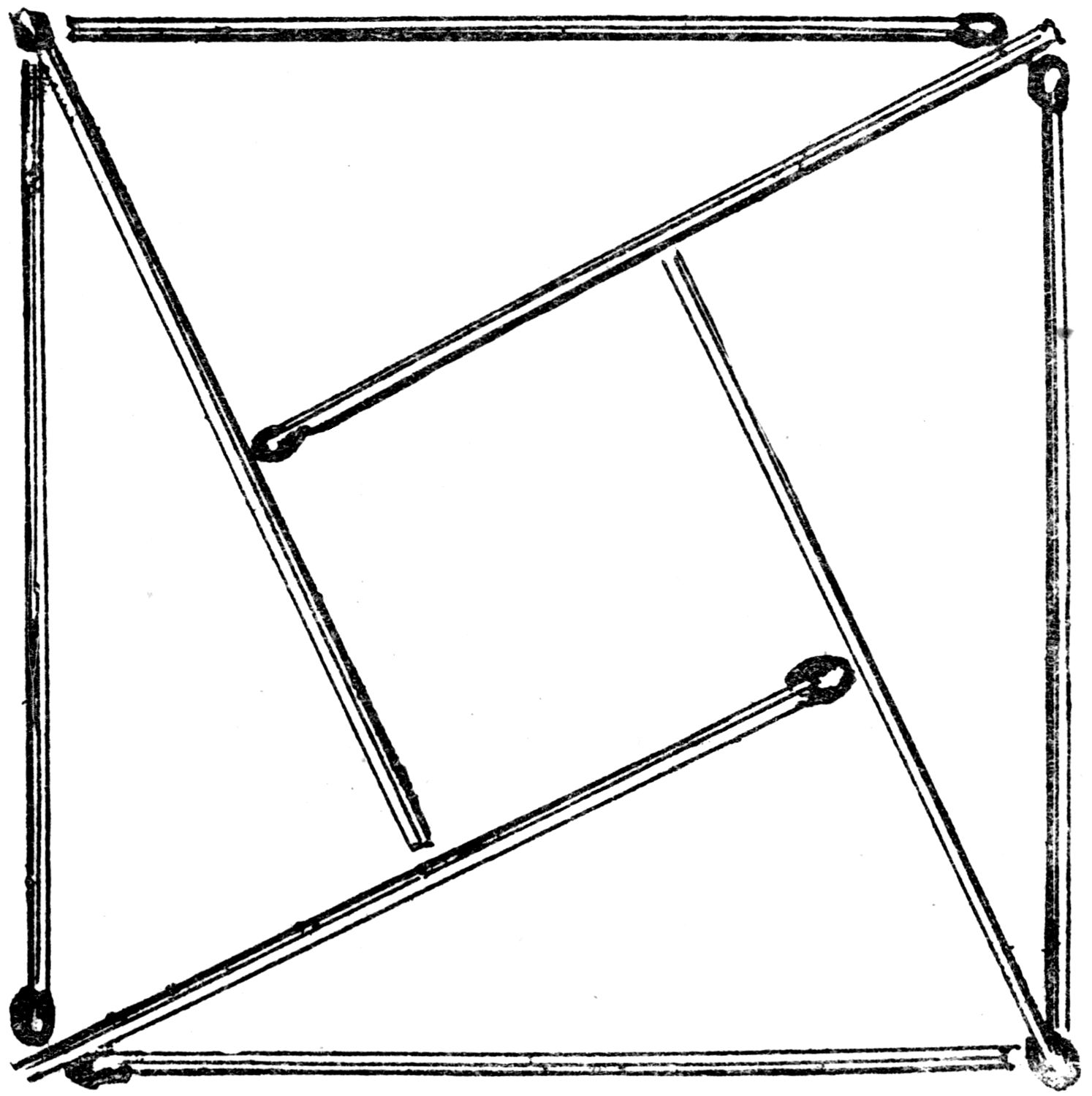
60. WHAT AM I?
Correctly drawn results I yield. Varied, but welcome everywhere; But met with in the open field I’m banned if frequent, blest if rare. To this peculiar difference the clue Is called with much significance the cue.
Solution
61. BURIED TOWNS
Wait while I think the matter over, On holiday intent; The best I’ve seen is surely Dover, That pretty port of Kent.
Three towns are buried in these lines.
Solution
No. LXXVIII.—WALKING THE ROUNDS
A hospital was built in six detached blocks, and it was the duty of the night watchman to go completely round every block at fixed hours to see that all was safe.
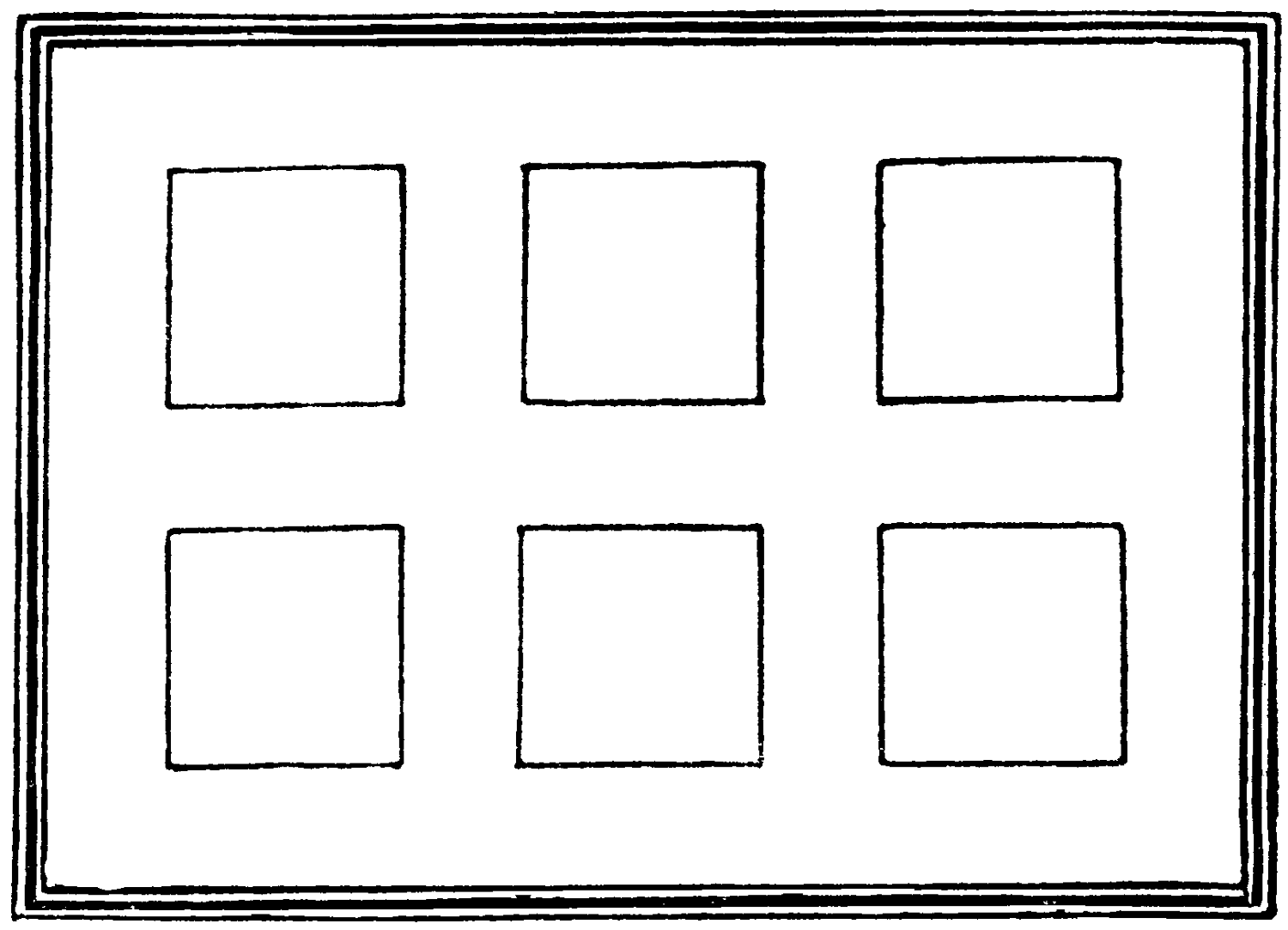
What was his shortest course?
Solution
62. THE ARAB AND HIS ASS
An Arab came to the river side With a donkey bearing an obelisk, But he did not venture to ford the tide, For he had too good an *. So he camped all night by that river side, Secure till the tide had ceased to swell, For he knew that whenever the donkey died No other could be its ‖.
Solution
No. LXXIX
Can you rearrange the twelve counters on this board of 36 squares so that there are two counters on each row, column, and diagonal?
◎ ◎ ◎ ◎ ◎ ◎
◎ ◎ ◎ ◎ ◎ ◎
Image
There must not be more than these two counters in the same straight line.
Solution
63. A CHARADE
What ho, my jolly second! never say my first While my final you can find in Amsterdam. Think how a sound whole stays your hunger and your thirst, Deftly readjusting bread and meat and jam.
Solution
No. LXXX.—THE QUEEN’S TOUR
This is a course by which the queen on a chessboard, starting from K R sq., passes over every square in fourteen moves.
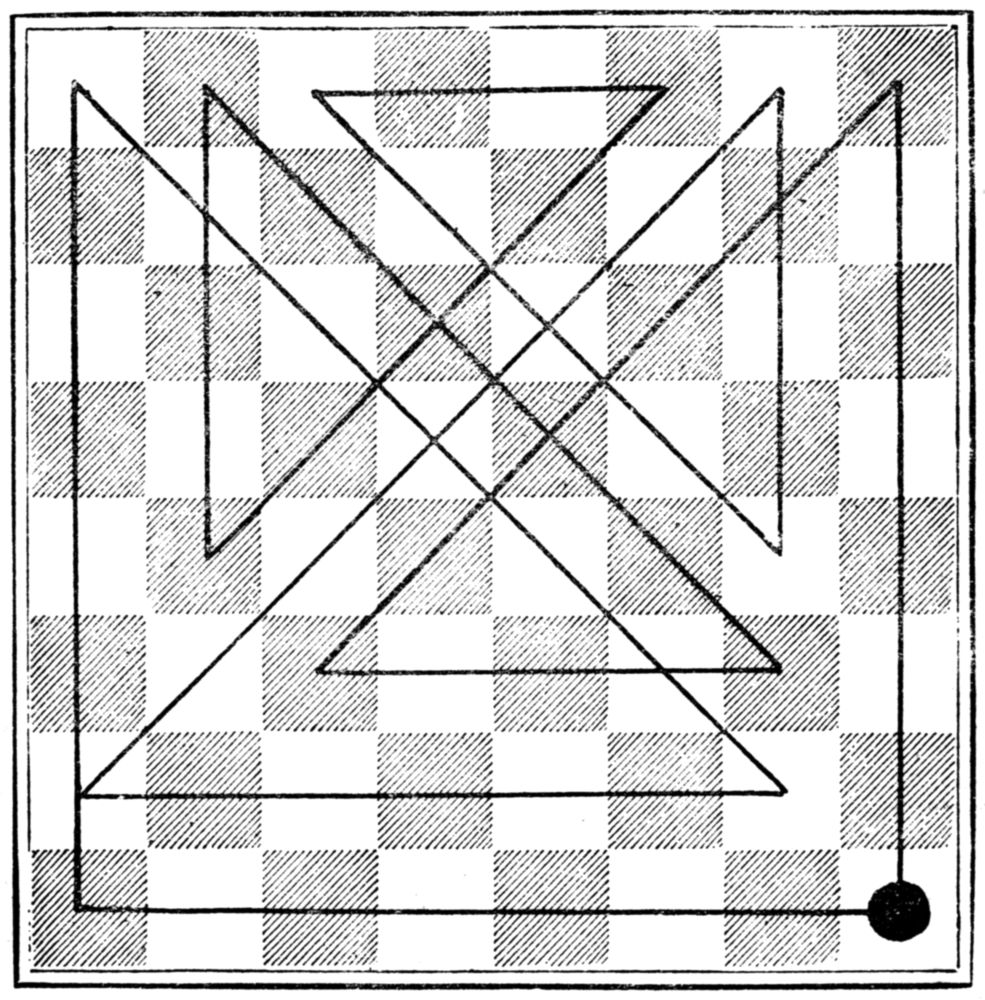
64. AFTER THE MATCH
“Did you score a score?” said Funniman to his schoolboy nephew, after a local cricket match. “No, uncle,” said the youngster, “but if I had made as many more runs, half as many more, and two runs and a half, I should have made my twenty.” How many runs did he get?
Solution
No. LXXXI.—A NEST OF TRIANGLES
In the “Twentieth Century Standard Puzzle Book” we gave a figure similar to this, in which there were 653 interlacing triangles in four tiers of this character.
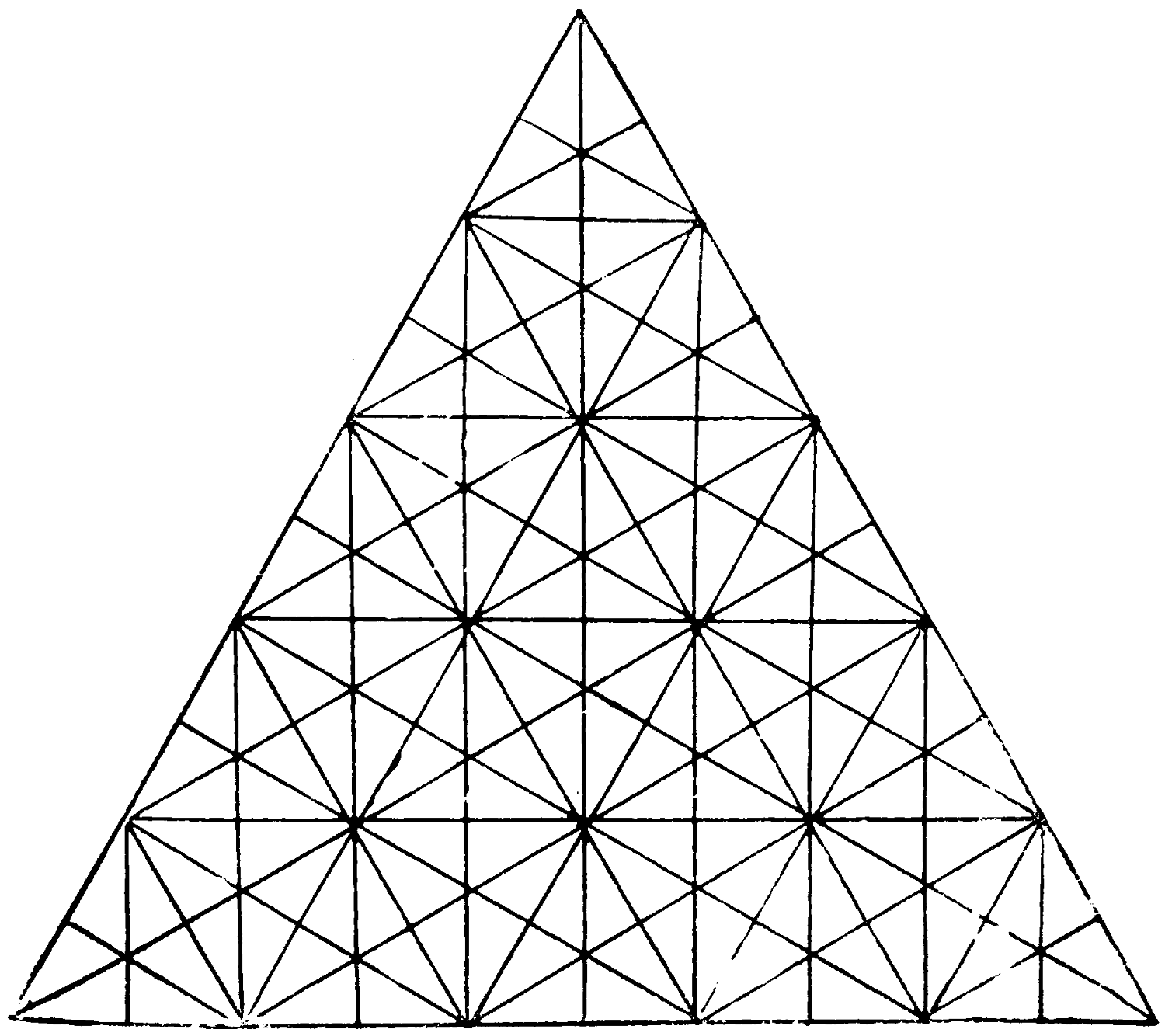
We now add a fifth tier at the base, and ask our solvers to determine how many triangles of all shapes and sizes can be counted within its enlarged borders.
Solution
65. AN ENIGMA
Six letters spell the happy state Of two in love made one. The same six letters tell the fate Of marriage ties undone.
Solution
No. LXXXII.—A SIMPLE MATCH PUZZLE
Place eight matches in a row, about an inch apart, as indicated in the diagram.
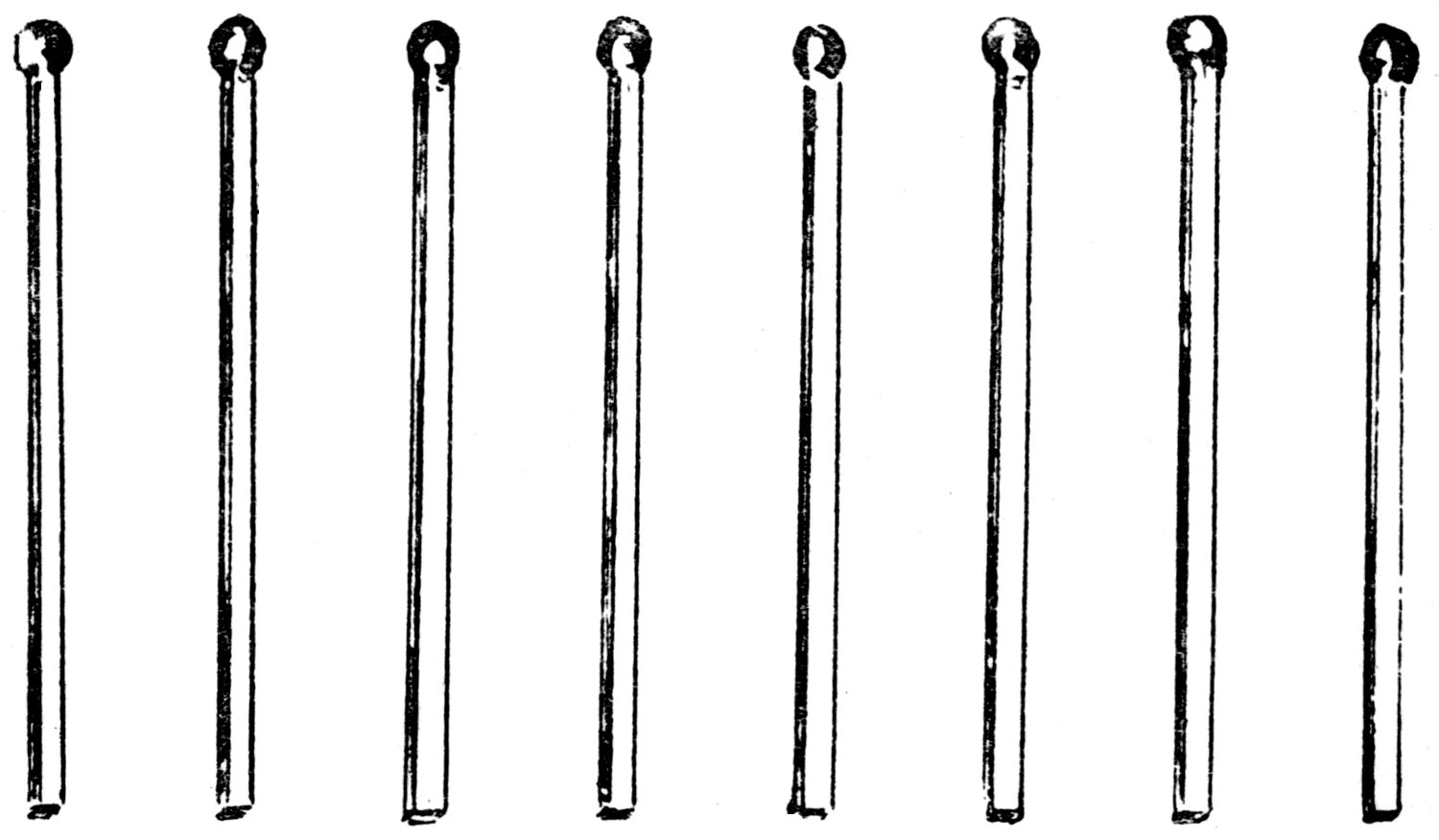
The puzzle is to form these into four pairs in four moves, by moving one match clear over two matches every time.
Solution
66. A TOPICAL RIDDLE
My First’s a bond, my Seconds weigh; These own the Rest of all my lay; Busy my Third; Fourth like the Pole, Whose opposite my Fifth makes goal.
Solution
67. MISSING WORDS
For two months at the .... we played, Ere we were .... to Lord’s; Alas! the score our champion made Was what a .... affords! The crowd in .... of thousands came But took scant notice of the game.
Solution
No. LXXXIII.—A MATCH PUZZLE
Place twelve matches, as is shown in the diagram, so that they form four squares.
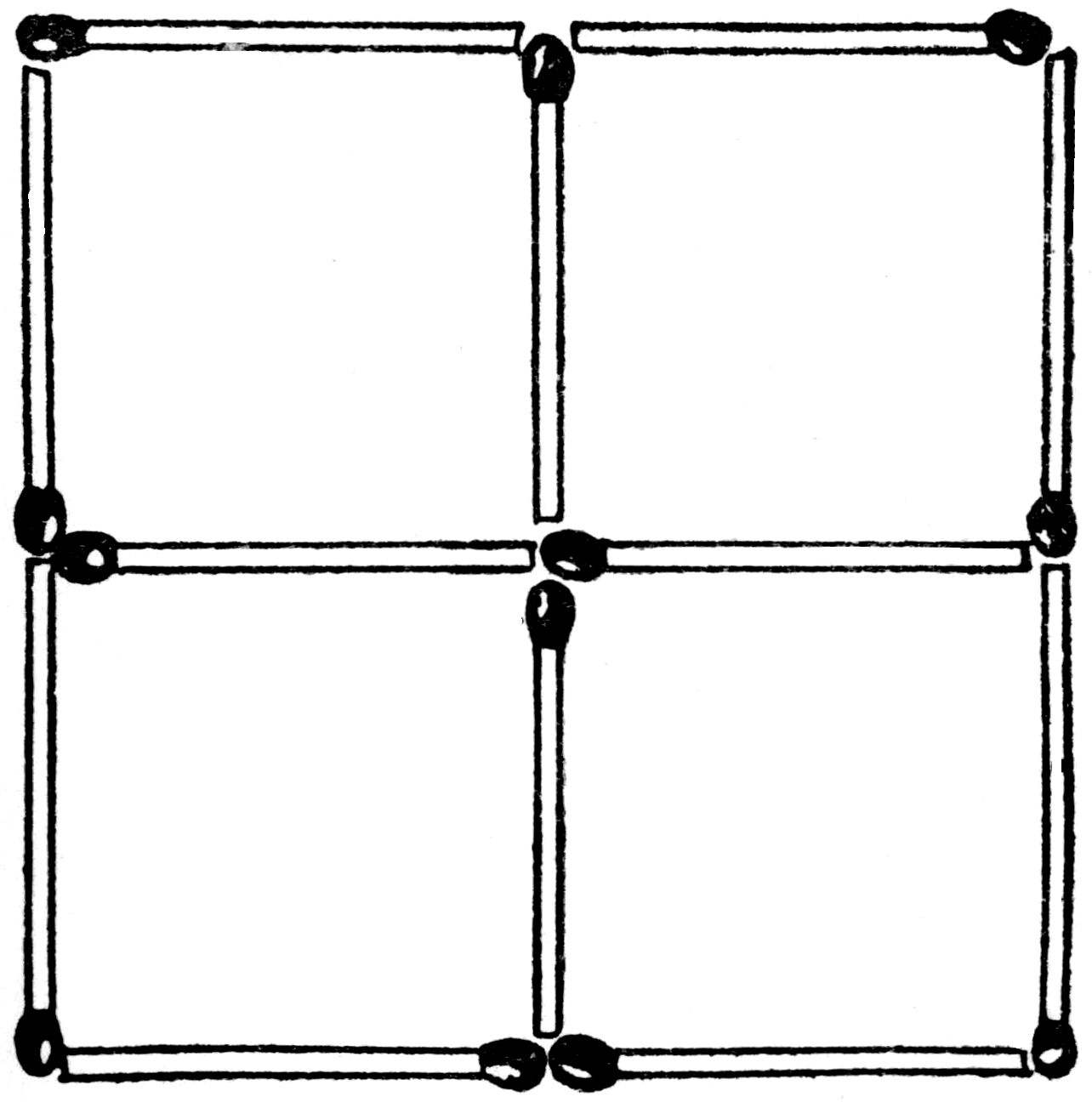
Now remove three of the matches, and readjust the nine that remain so that they represent three squares.
Solution
68. MARCONIGRAMS
Edwin and Angelina were far apart, when this message, with its touch of jealous resentment, reached her on the wings of a Marconigram—
“No fickle girl is bonnie to my mind!”
Quite equal to the occasion, she flashed back the reply—
“In love inconstant I no pleasure find!”
How did these messages reveal the places from which they were despatched?
Solution
No. LXXXIV.—MATHEMATICS WITH MATCHES
In the four corner and four central cells of this nest of squares four matches are so placed as to represent 1⁄2, 1, 4, 1⁄50, 11, 12, 41, and 49.
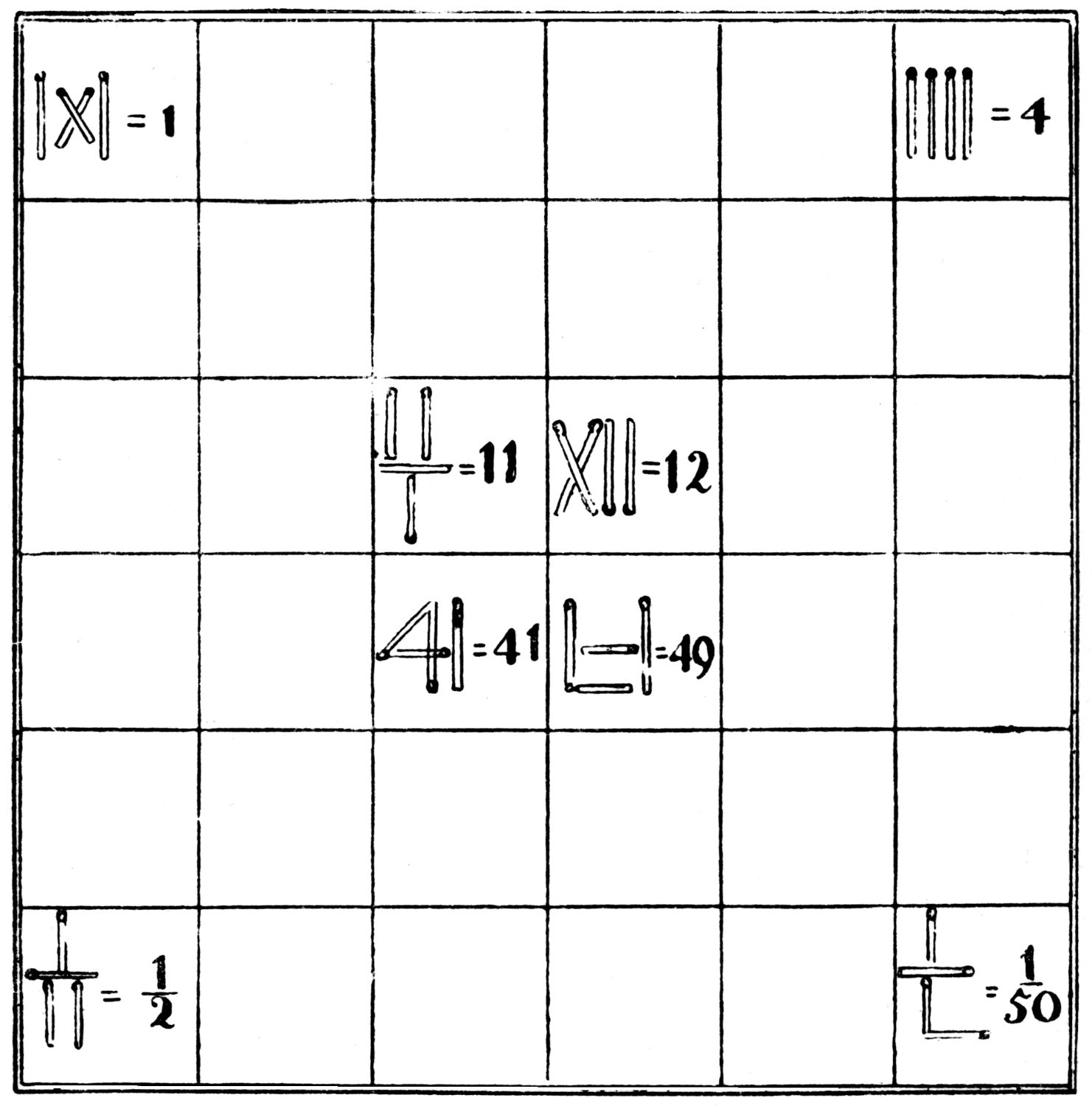
Can you, still using only four matches in each case, fit different whole numbers or fractions in similar fashion into the other 28 cells?
Solution
69. EASY MENTAL ARITHMETIC
Set down three figures in a line, Then multiply by four; This, if you use the proper sign, Makes five and nothing more.
Solution
No. LXXXV.—MANY READINGS
Can you complete the top and bottom rows, the two side columns, and the two diagonals of this square by forming in each of them the same sentence so that it can be read in twenty different directions?
R I V I R
I I I I
V V V
I I I I
R I V I R
Image
There are four words in the sentence of thirteen letters.
Solution
No. LXXXVI.—TOLD AT A GLANCE
Ask anyone to fix upon a number between 1 and 60 inclusive, and to point out to you the square or squares in which it appears:—
3 5 7 9 11 1 5 6 7 13 12 4
13 15 17 19 21 23 14 15 20 21 22 23
25 27 29 31 33 35 28 29 30 31 36 37
37 39 41 43 45 47 52 38 39 44 45 46
49 51 53 55 57 59 47 53 54 55 60 13
9 10 11 12 13 8 3 6 7 10 11 2
14 15 24 25 26 27 14 15 18 19 22 23
28 29 30 31 40 41 26 27 30 31 34 35
42 43 44 45 46 47 38 39 42 43 46 47
56 57 58 59 60 13 50 51 54 55 58 59
17 18 19 20 21 16 33 34 35 36 37 32
22 23 24 25 26 27 38 39 40 41 42 43
28 29 30 31 48 49 44 45 46 47 48 49
50 51 52 53 54 55 50 51 52 53 54 55
56 57 58 59 30 60 56 57 58 59 60 41
Image
You can find the number at a glance, by simply adding together the numbers in the right-hand top corner cells of the square indicated. Thus, if 45 has been chosen, 32 + 8 + 4 + 1 = 45.
No. LXXXVII.
Here is a little subtraction sum, which is not quite so simple as it appears to be:—
miles furlongs rods yards feet inches
1 „ 0 „ 0 „ 0 „ 0 „ 0
7 „ 39 „ 5 „ 1 „ 5
Image
Try it as it stands, without reducing the distance to inches.
Solution
70. A DOUBLET BY MISSING WORDS
Can you, by supplying the missing words, turn a grilse into a salmon? One letter is changed each time, and, except in one case, the order of the letters varies:—
To silver Tweed, or broader Spey, The grilse of ......, ...... gay, Glides on; the ...... ...... draws When salmon follows Nature’s laws.
Solution
71. AN ENIGMA
I never move, and yet I run From place to place all day; Some loving swain, hot foot for fun, Sees Dora in my way.
Solution
No. LXXXVIII.—RANGING THE DIGITS
These are the arrangements of the nine digits, by which they add up alike in rows, columns, and diagonals in a square; on all sides in a triangle; and from top to bottom and from side to side in a cross:—
8 1 6 3 5 7 4 9 2 5 3 7 4 6 8 1 9 2 5 4 3 6 9 7 2 8 1
Image
The totals are 15, 20, and 27 respectively.
72. WHAT IS THIS WORD?
HAATTCEUMSSSS
Solution
73. MULTUM IN PARVO
Seven words in one of letters five we fix, Five English, and one Latin; No need to twist them, or afresh to mix, If puzzles you are pat in.
Solution
74. THE GENTLE CRAFT
The question was asked in a puzzle competition—“Why is every angler ipso facto an Ananias?” Although no such method was asked for or expected, we find that the very letters of the question can be recast into a most apposite reply. Our answer by anagram runs thus—
A liar, .. ..... gay fancies to a ..... ....
Can you complete the sentence by filling in the missing words?
Solution
No. LXXXIX.—NO TWO IN A ROW
On a board of sixty-seven squares, arranged as is shown in the diagram, place nine counters, so that no two are in the same row, column, or diagonal.
Image
The indentations do not affect the simple conditions.
Solution
75. A QUAINT RIDDLE
Peter White Will never go right; Shall I tell you the reason why? Wherever he goes, He follows his nose; And that stands all awry! If this appendage had slanted more Why would it serve a hole to bore?
Solution
No. XC.—EXACT ALIGNMENT
Can you arrange these nine cards so that they form ten rows with three cards in each row?
A ♣
A ♢ 10 ♡ A ♠
Q ♠ K ♣ K ♢ J ♢
K ♡
Image
This may, of course, be done with any nine cards.
Solution
76. A MISSING LETTER
Thieaonunhinemileuchtormapa Aitutoaeucceorlo; Pringweetnetillpoeemoygra, Aummertreemaofthadeacro.
Separate these strings of letters into words that scan and rhyme, adding the same missing letter in 55 places.
Solution
No. XCI.—AT A FANCY BALL
Two ladies and their squires, here represented by the White Knights and the Black, were dressed to impersonate Light, Liberty, Love, and Learning, and took their places on the corners of a pavement chequered to represent a chessboard, as is shown below:—
♘ ♞
♞ ♘
Image
They undertook to step a figure which should exhibit at each pause a revolving square, and in three paces bring them together in the centre, by a course traced upon the lines of their combined monograms. What were their successive steps?
Solution
No. XCII.—PROVERBIAL PHILOSOPHY IN CELLS
Can you disentangle all this good advice?
tell you know tells knows tells he should not
do you think of does thinks of does is not good
believe you hear believes hears believes is false
spend you have spends has spends he needs
judge you see judges sees judges is not there
never all he who all he often what
Image
It forms 5 excellent maxims in its 36 cells.
Solution
77. THRICE DOCKED
Protected, open, plain, Without my tail I’m flat; I’m round curtailed again; Again, you have me pat.
Solution
No. XCIII.—A DISLOCATED CIRCLE
Study this quaint figure carefully, and try to discover how it can be divided into two pieces, so that these can be reunited to form a perfect circle.
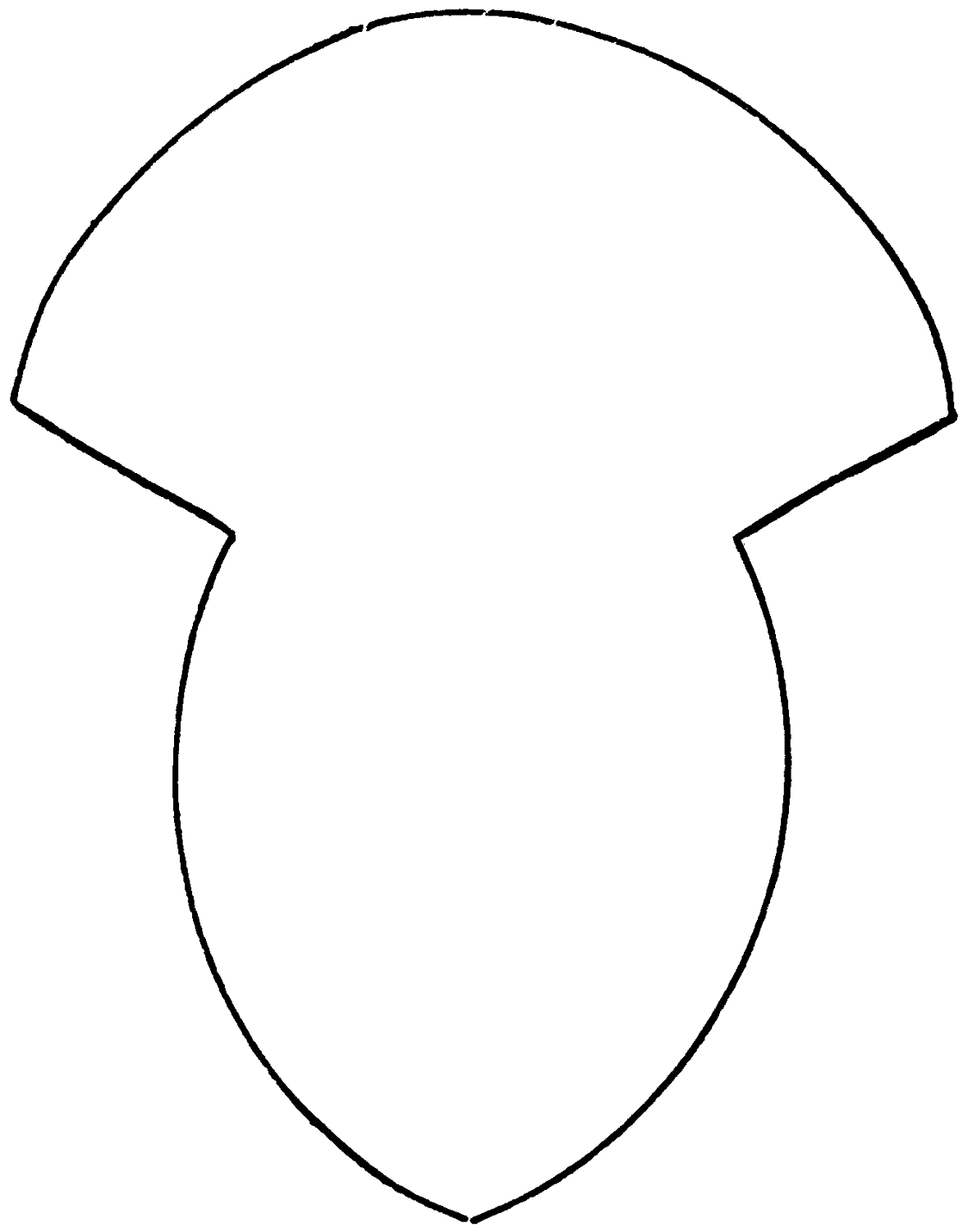
Solution
78. A LOGOGRIPH
When all are gay this holds the sway, But take a letter out, That change of fare is ruling there, You see, without a doubt. Behead me twice; it is not nice To have this in your skin; Lop head and tail, and find a nail Or tack to drive it in. Behind his right, and in your sight A little word you find; But you will never make it out, Though it is in your mind.
Solution
No. XCIV.
When Tommy was offered all the money by his uncle if he could place 15 half-crowns and 15 pennies in such order in a circle that, counting always by nines, and starting at a fixed point, he came always upon a penny, and removed it from the circle, he found the key to success in this Latin line, given to him by a school friend, who shared the spoil—“Populeam virgam mater regina ferebat.” The vowels, from a to u, are numbered from 1 to 5, and when they are thus marked in the sentence—
“ P o p u l e a m v i r g a m m a t e r r e g i n a f e r e b a t , ”
4 5 2 1 3 1 1 2 2 3 1 2 2 1
they show the necessary sequence of half-crowns and pennies.
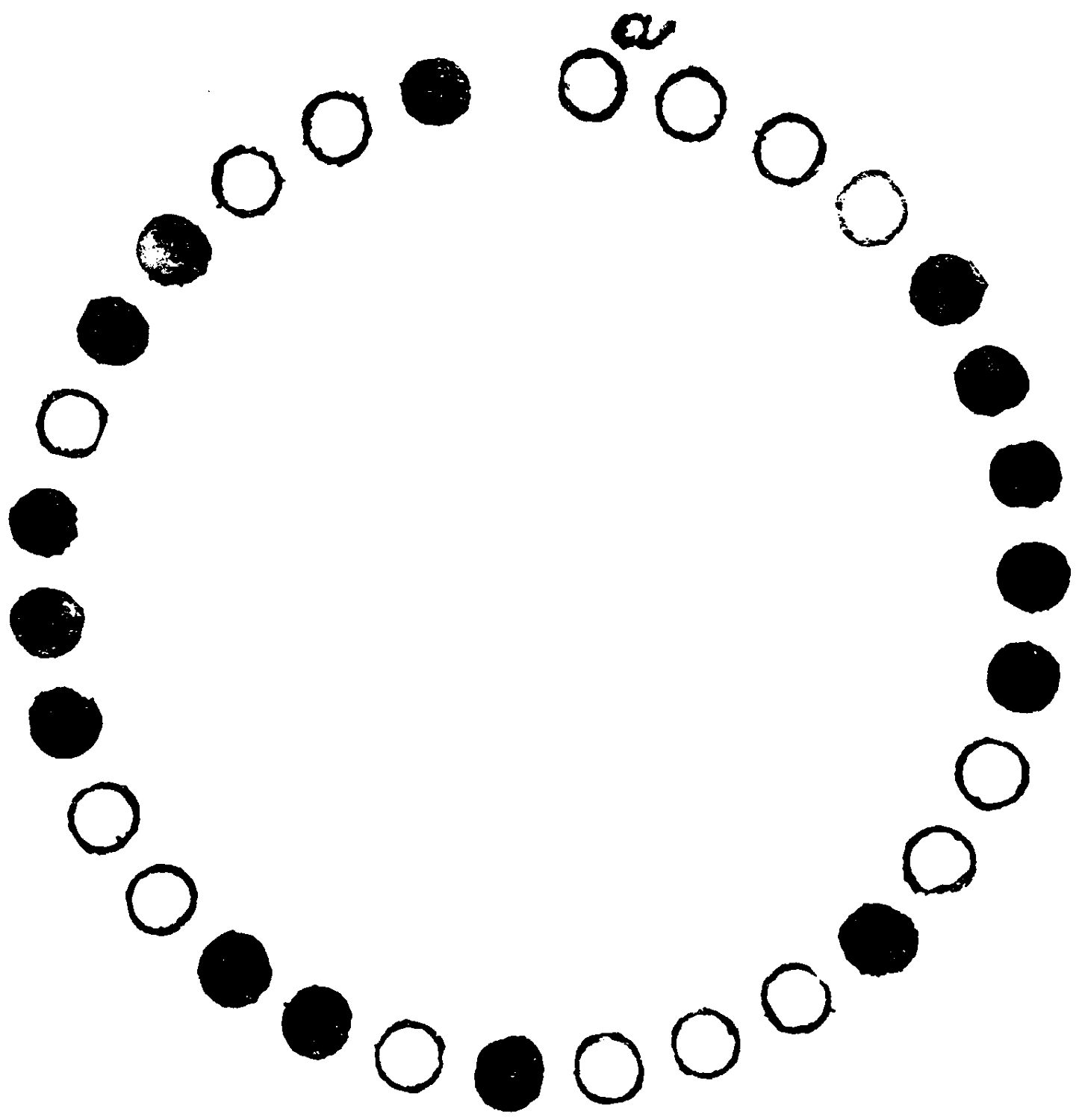
Start counting with the half-crown marked a, and remove each penny as you come to it on counting up to nine, and the conditions are fulfilled.
No. XCV.—A BUSINESS ANAGRAM
This smart advertisement of a polish known as “Old Dutch Cleanser” appeared in an American paper:—
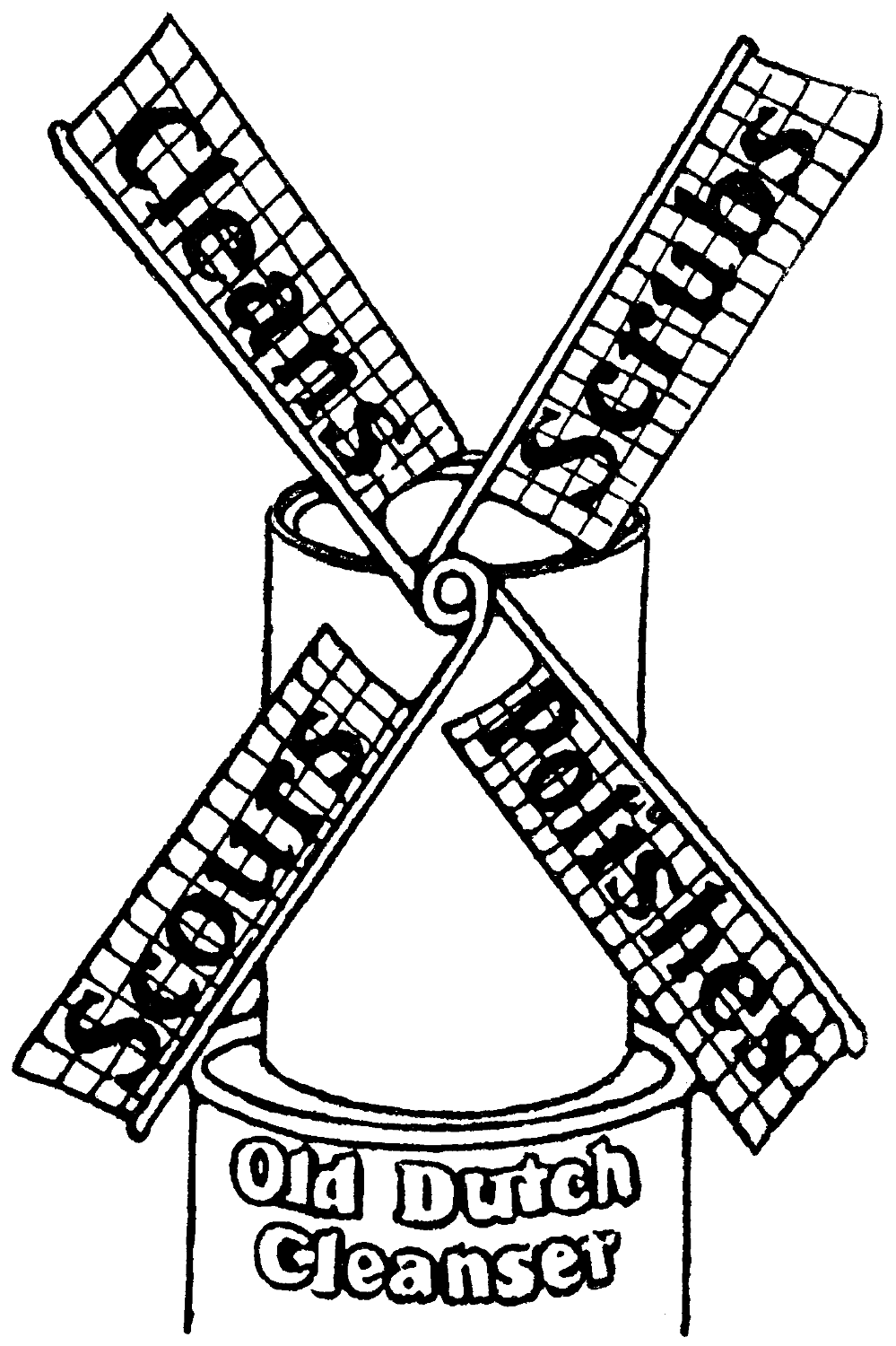
Cleans Scrubs Scours Polishes
Old Dutch Cleanser
If the eyes of the proprietor should fall upon this column, he will be surprised to find that his catch words Cleans, Scrubs, Scours, Polishes, can be recast into a perfect anagram, singularly appropriate to the powder advertised.
The opening words of the anagram are “O rub on, sir.”—Can our solvers complete the sentence?
Solution
No. XCVI.—A NEW CHESS PUZZLE By Henry E. Dudeney.
Replace all these 51 pieces on the chessboard, so that no Queen attacks another Queen, no Rook another Rook, no Bishop another Bishop, and no Knight another Knight.
Q Q Q Q Q Q Q Q
B B B B B B
B B
B B B B B B
R R R R R R R R
Kt Kt Kt Kt Kt
Kt Kt Kt Kt Kt Kt Kt Kt
Kt Kt Kt Kt Kt Kt Kt Kt
Image
No account is to be taken of the intervening pieces, but each type of piece is to be considered as if it stood alone upon the board.
Solution
No. XCVII.—A GOOD KNIGHT’S TOUR
Here is a beautifully symmetrical specimen of the Knight’s tour:—
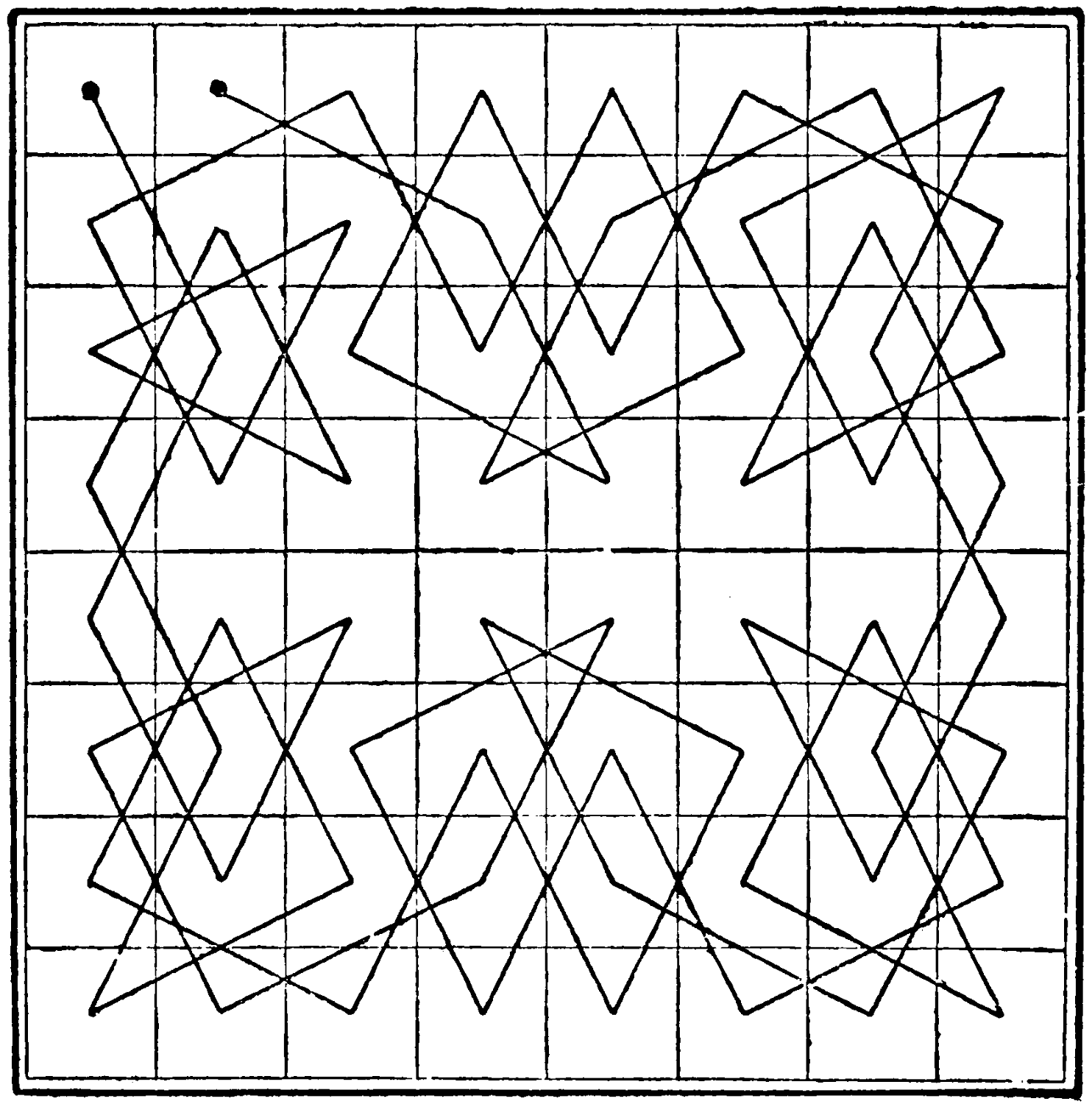
No. XCVIII.—A KNIGHT’S TOUR
Here is another beautifully symmetrical Knight’s tour:—
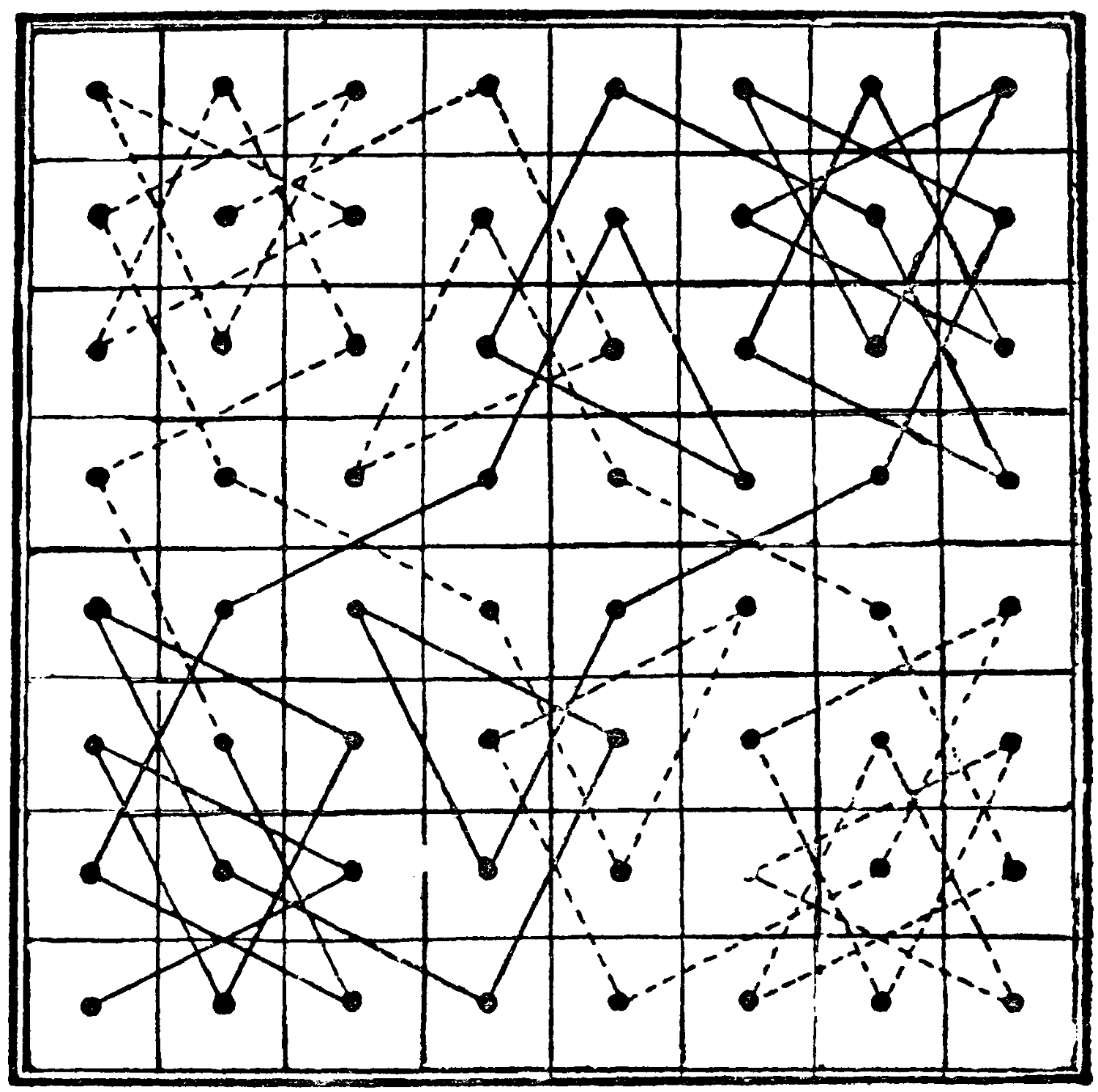
It starts from the corner square, and the second half of the course has dotted lines.
79. MISSING WORDS
He ...... himself much on his skill, In many a burglary tried; But when he ...... open the till There was only a ...... inside.
The missing words are spelt with the same six letters.
Solution
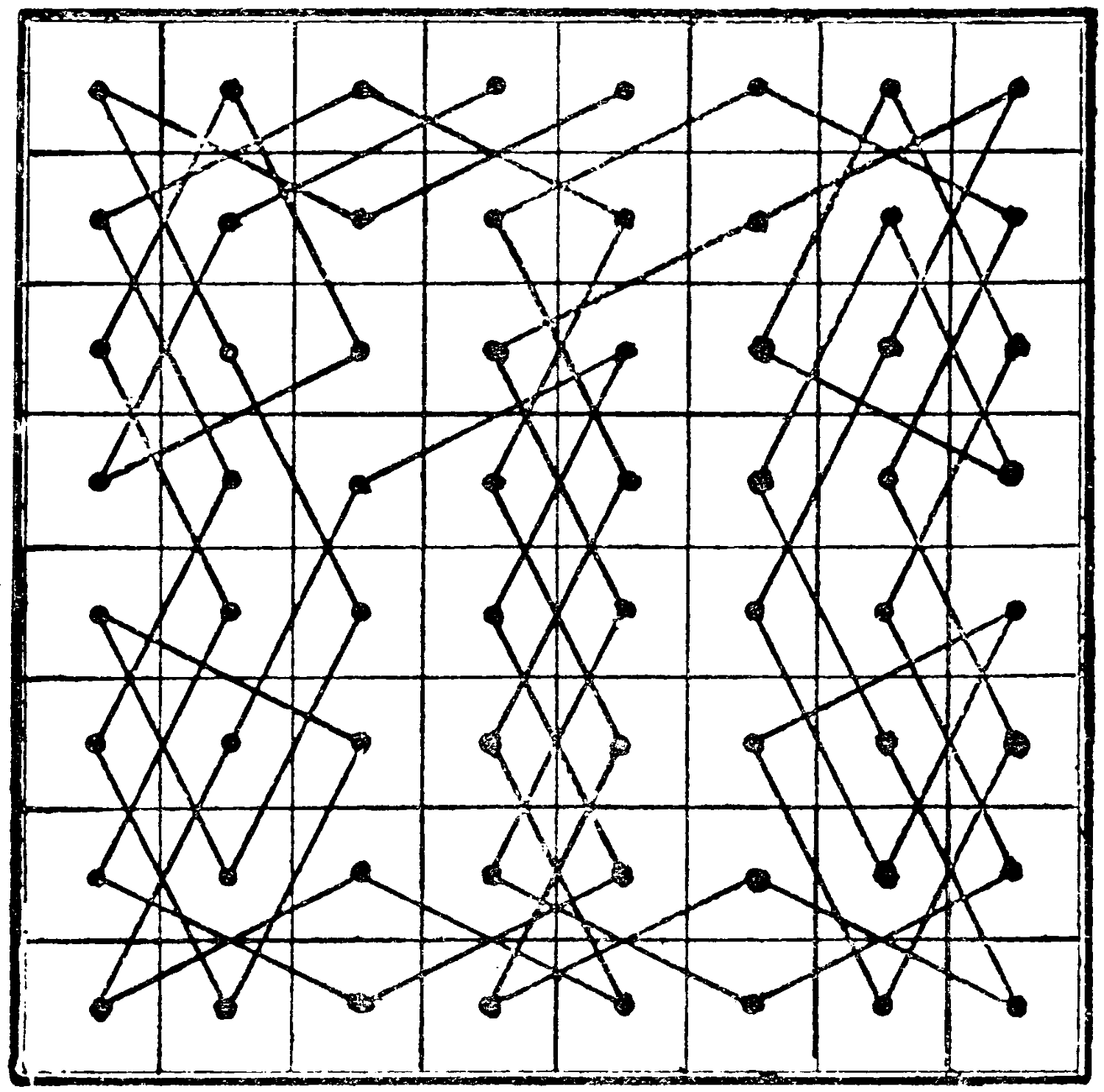
No. XCIX.—A KNIGHT’S TOUR
Here is quite a curious pattern described by another Knight’s tour:—
80. AN ENIGMA
Three-fourths of me an act display, Three-fourths a bed for man; Three-fourths have legs that cannot stray, Three-fourths have legs that can. I have a back without a spine; An arm without a bone is mine.
Solution
81. A CHARADE
My first is the French for my second, My whole a narcotic is reckoned.
Solution
No. C.—A GOOD PATTERN
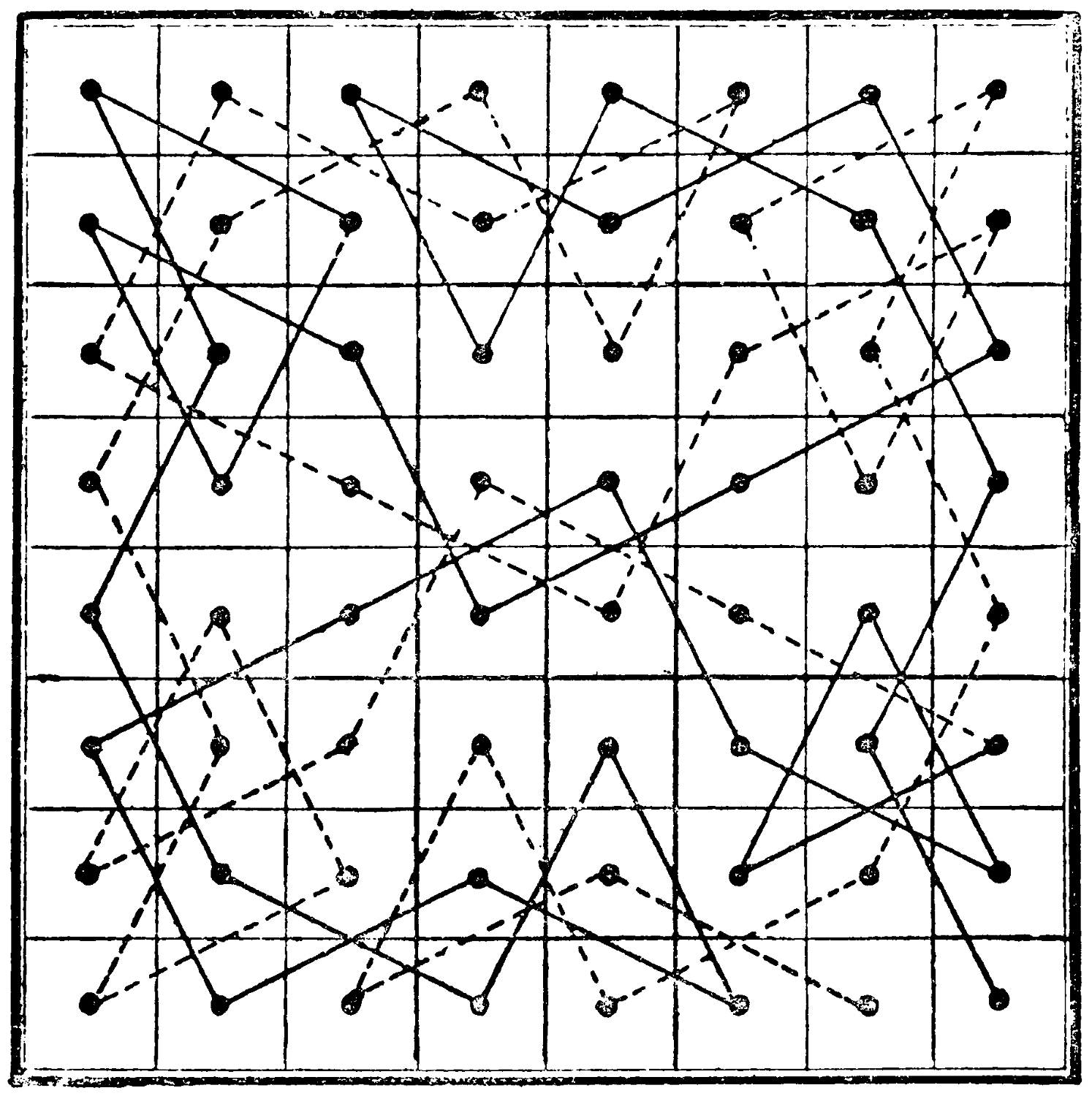
Here is a very symmetrical Knight’s tour, in which half of the moves are indicated by dotted, and half by unbroken lines:—
82. PALINDROME WORDS
The letters of this sentence “Arrive to vote at it,” can be so recast as to form two palindrome words, or words that read alike from either end. What are they?
Solution
No. CI.—A KNIGHT’S TOUR
Here is another specimen of the Knight’s tour, which is beautifully symmetrical—
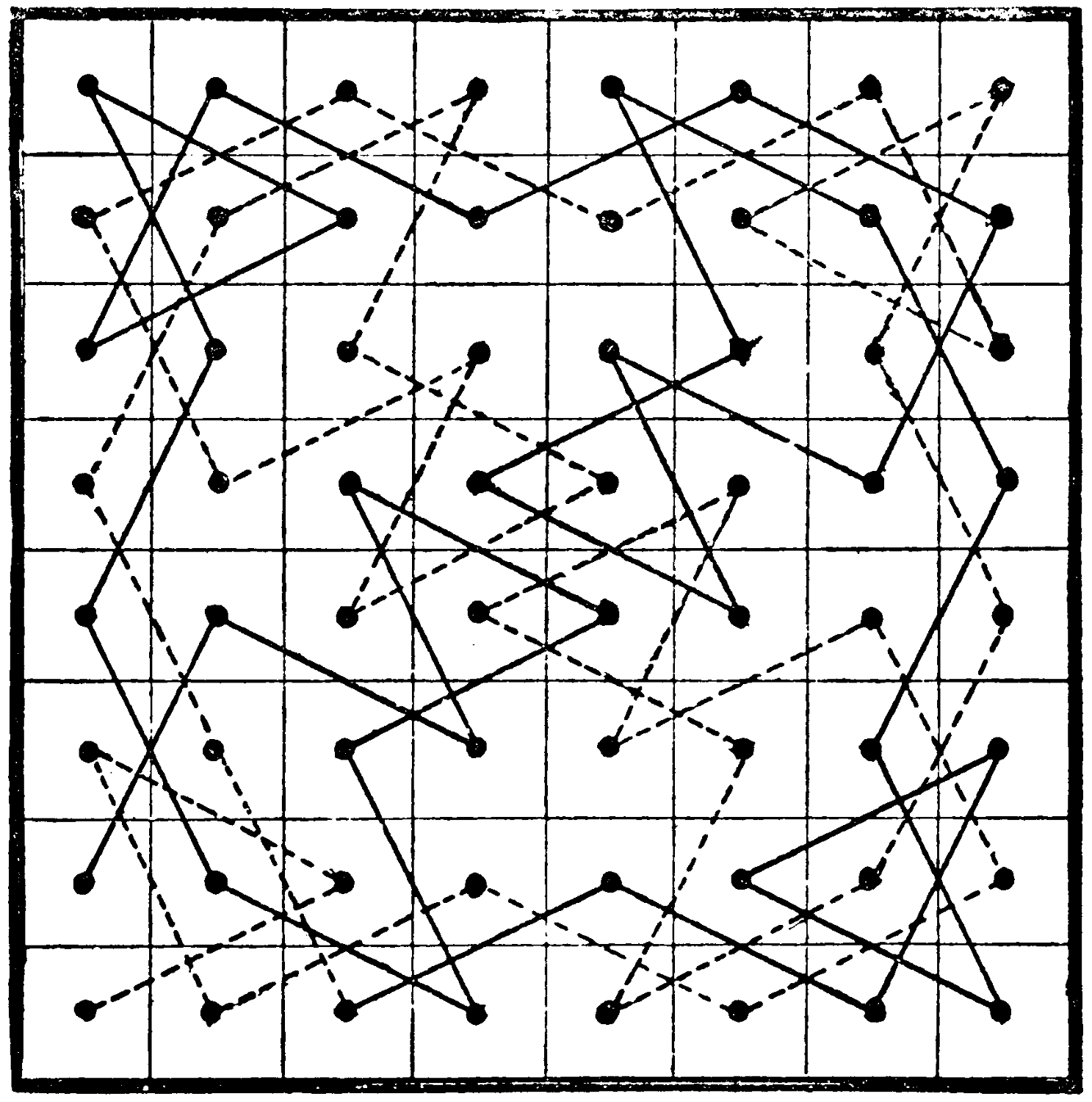
Half of the course is marked with dotted lines.
83. AN ENIGMA
Sweet till I lose my head, Sweet-hearted then I show; Decapitate again, I spread, And cannot be below. Served so once more, I am not dead, But with fresh beauty glow.
Solution
No. CII.—A KNIGHT’S POETIC TOUR
On the board below a verse of eight lines runs on the course of a Knight’s move from square to square:—
sor to king good say luck loy eth
and moth a soon dis our to bad
place ry church his force is hat al
er queen him wight he to may truth
man his and and chess es knight op’s
a sneer the and un lawn of tates
cas that at less pawn no bish lant
eth faith tles hath the gal in love
Image
Can you disentangle the little poem?
Solution
84. TOMMY’S MONEY BOX
“Dad,” said little Tommy, “give me as much as I have in my purse, and I will put a shilling in my money-box.” This was done, and the process was repeated for three more days. How much had Tommy originally in his purse, which was now quite empty?
Solution
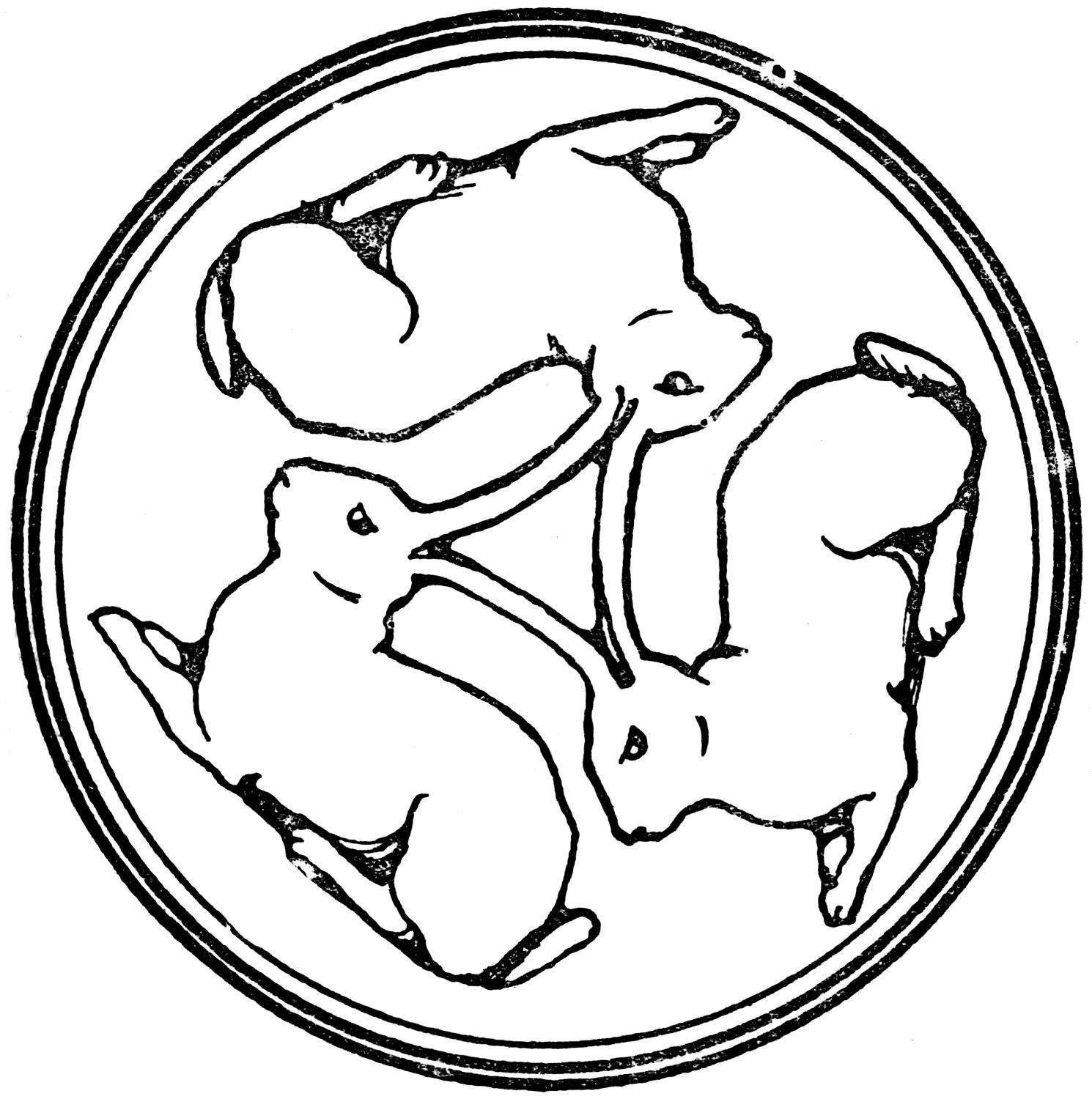
No. CIII.—THE MANX RABBITS
This is the way to draw three rabbits so that they have but three ears among them all:—
85. AN ENIGMA
Two articles of English make, And three from foreign source. All these together you must take Where dramas run their course.
Solution
No. CIV.—SCORING A CENTURY
On this table is shown in ten different ways how exactly 100 can be arrived at by the use of the nine digits, each appearing only once.
1 2 3 4 5 6 7 8 9
1 1 4 95 3⁄7 56 98 6 15 15
3 45 53 4 16⁄28 34 1 2 2 36
5 7 6 7 3⁄6 8 79 47
8 9 8 1 27⁄54 9 8⁄4 98
9 62 71 98 1 6⁄3 2
26 38 29 2 3
74 4
75
100 100 100 100 100 100 100 100 100
9 × 8 + 7 + 6 + 5 + 4 + 3 + 2 + 1 = 100.
Image
86. IF WE COULD CHOOSE
“If it were possible, I should choose,” said young Hopeful, “a life double as long.”
“Yes,” said old Sobersides, “and you might turn it to better account if it was also begun old.”
How did their actual words bear this out?
Solution
No. CV.—SEEING THROUGH A VEIL
On a piece of clear tracing paper draw with pen and ink a close network of lines, such as is shown in this diagram, near enough together to conceal type of ordinary size.
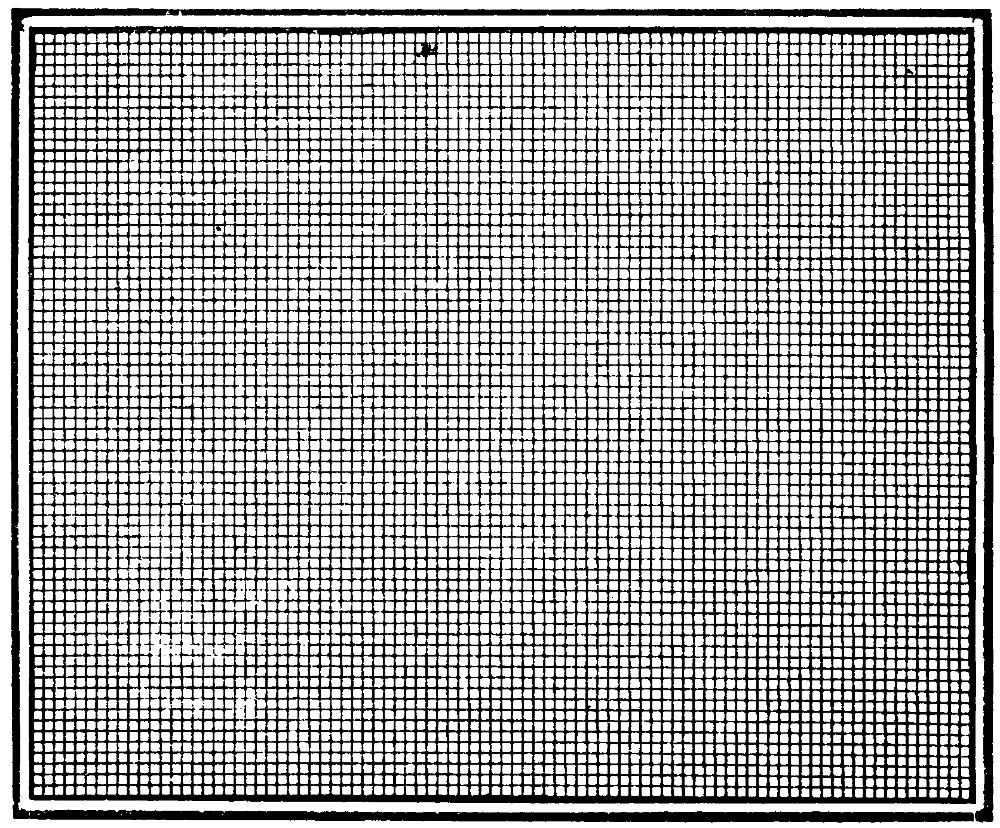
Place this on the page of a book, and challenge any one to read a sentence, or even a word, through it, saying that you can do so easily. How can you succeed?
Solution
87. A CHARADE
Lop head and tail, and you will find I have both tail and head. Or if for spirits you’ve a mind Set my tail first instead. Life, as “a vapour full of woes,” With many a darker page, My whole in picture will disclose, For “all the world’s a stage!”
Solution
No. CVI.—THE PAPER RINGS
In the diagram a strip of paper is shown (1), with its ends simply gummed together; (2), with a single twist; and (3), with a double twist. Can you decide, without actual experiment, what will be the result in each case if these are cut completely round, as is indicated by the dotted lines?
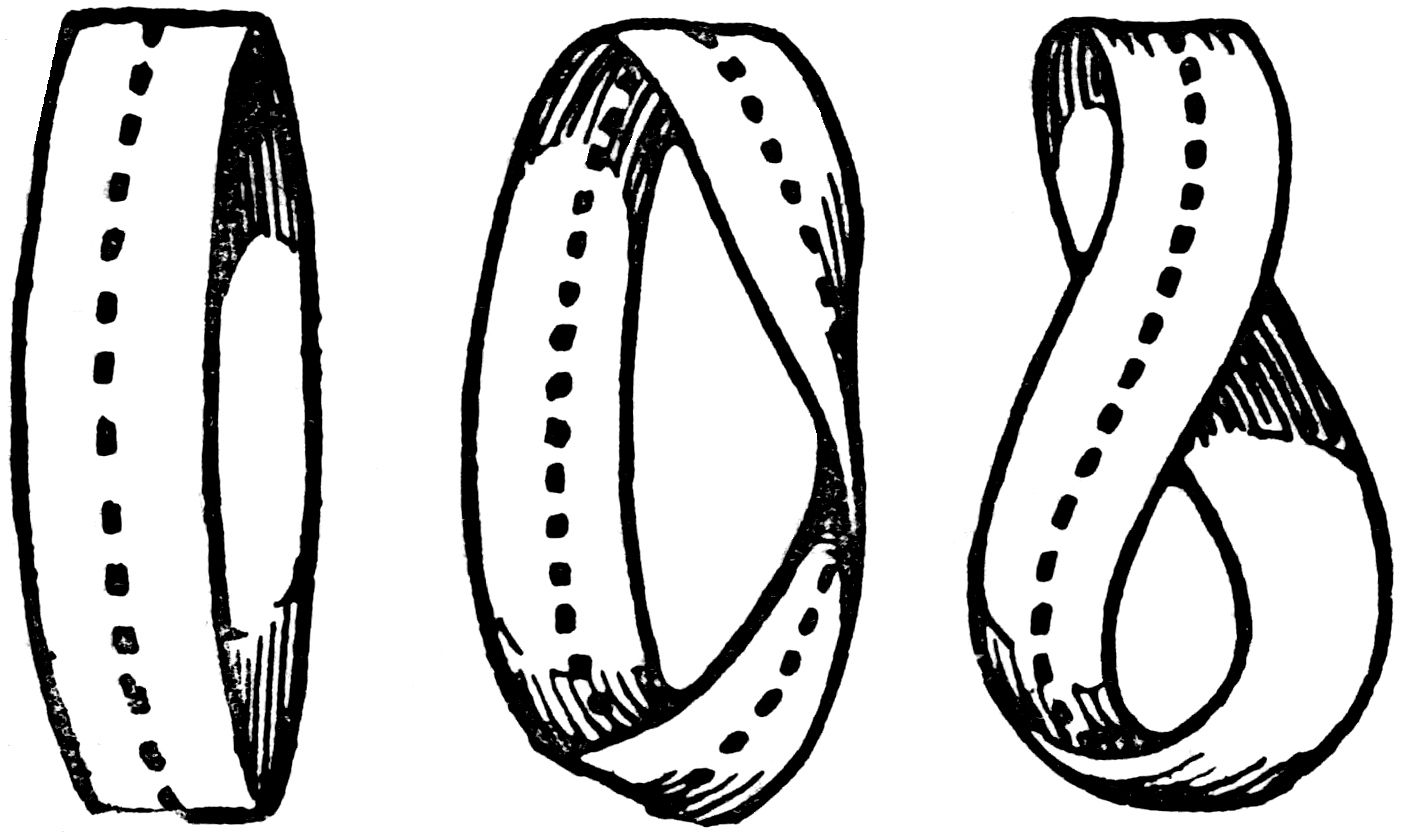
Solution
88. MISSING WORDS
A glowing ........ window, graced With ........ that true art has traced.
Solution
89. ANSWER BY ANAGRAM
How do the actual letters of these words in their union prove that anæsthetics are “blessed in pain?”
Solution
No. CVII.—THE MAGIC BUTTONS
Make two parallel cuts with a penknife along the centre of a slip of leather or other material, and below them a hole of the same width. Pass a piece of string under the slit, and through the hole, and tie two buttons, each much larger than the hole, to the ends of the string.
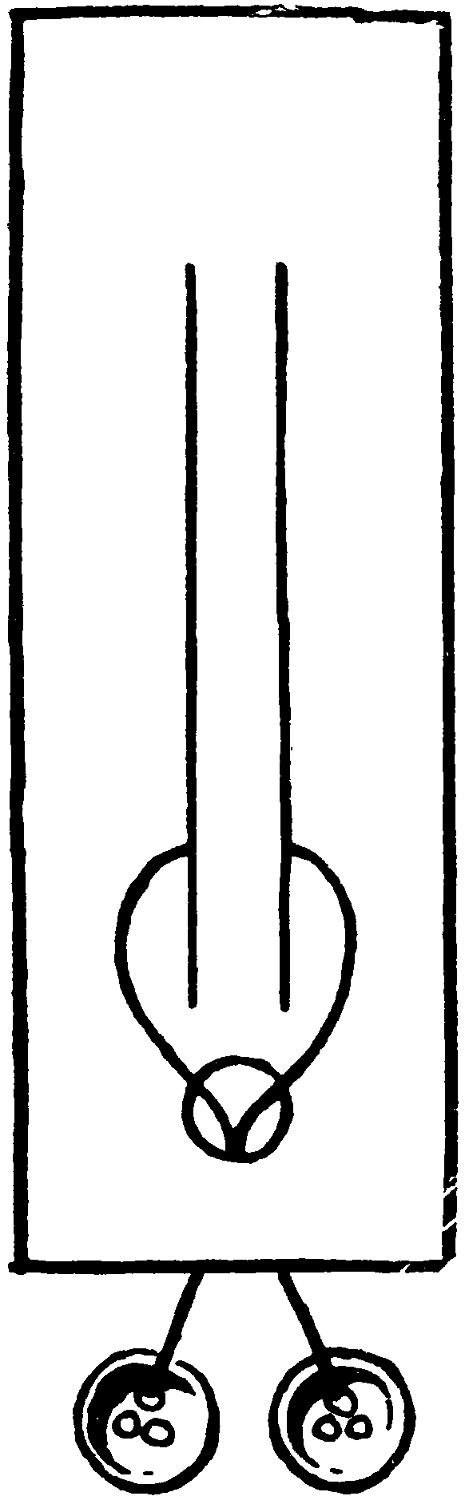
How can the string be released without removing either of the buttons?
Solution
No. CVIII.—THE CAPTIVE SCISSORS
Fasten a pair of scissors securely with a piece of string to some convenient article, as is shown in this diagram:—
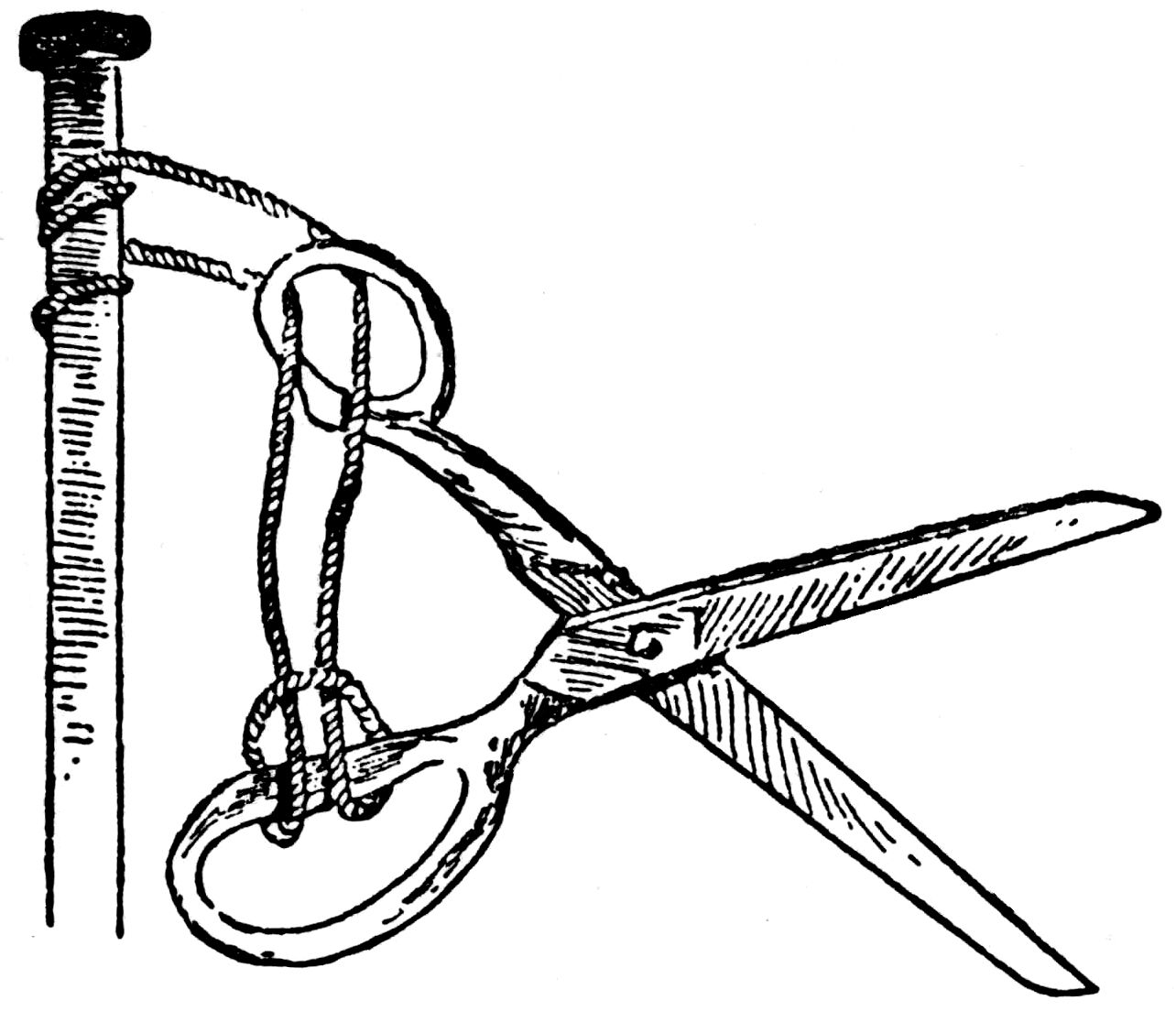
Can you release them without cutting or unfastening the string?
Solution
90. A BURIED QUOTATION
“What sin was it, sonny?” said an American negress to her lover, when she sat on his best hat, which was flattened. Wearily he heard her musical laugh, and arose to go. His hobby was botany, but not hers, for she was then a merry girl. “Bother the flowers! I would prefer this mellow pine-apple, Leonidas,” she said; “I guess we Ethiopians just love fruit!”
Solution
No. CIX.—A PRIMITIVE TRAP
This diagram represents in the simplest outline a primitive wolf-trap.
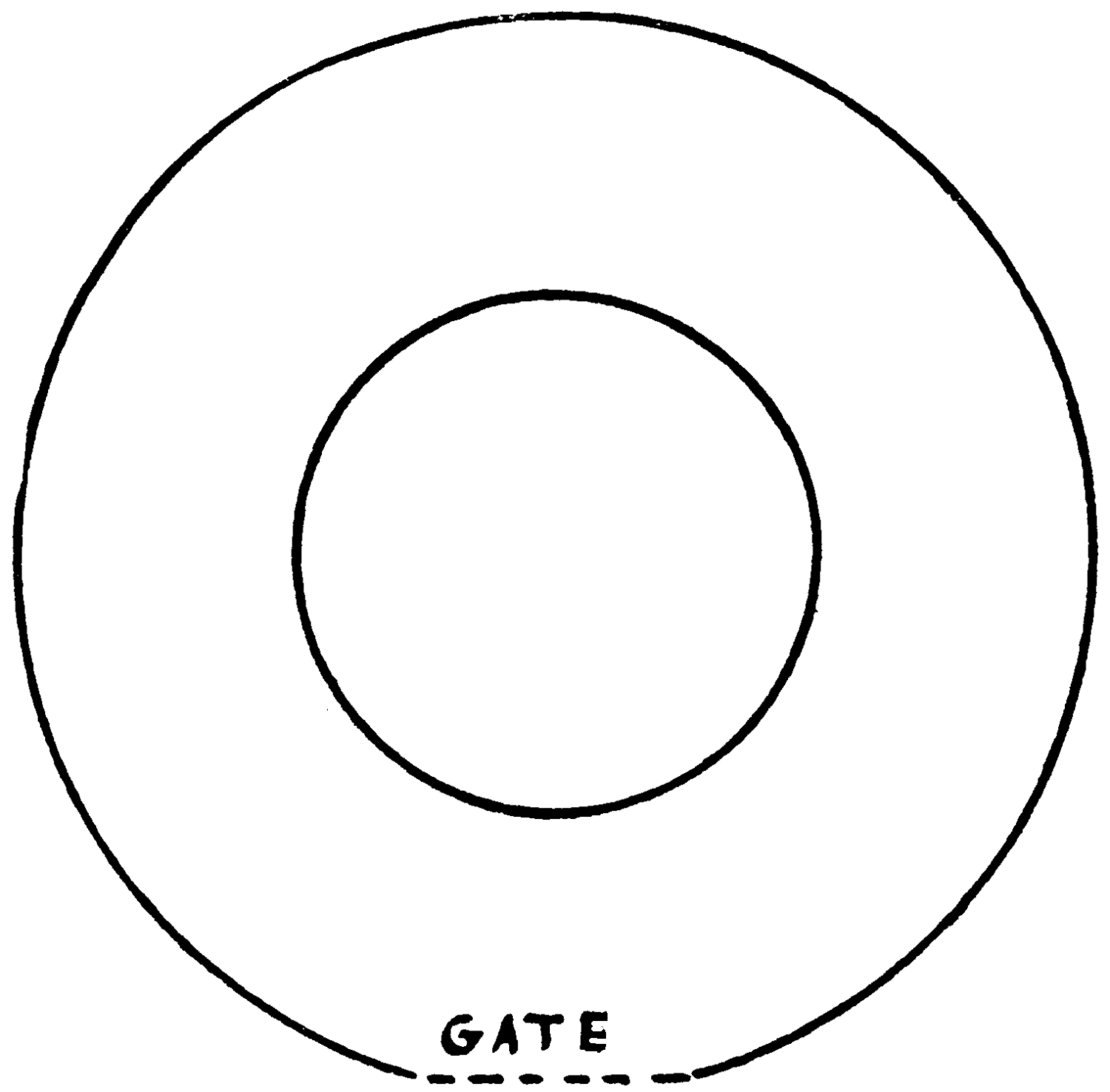
The dotted line is a gate opening into a circular enclosure. How was the trap set and the wolf caught?
Solution
91. LADIES AT A SALE
They .... the dress with grip so keen That half the .... gives way; And home return with purses lean To .... of “bargain-day!”
What are the missing words?
Solution
No. CX.—A SPINNING NEEDLE
To balance a needle on the head of a pin, push the pin into the cork of a wine bottle, and the needle into a separate cork.
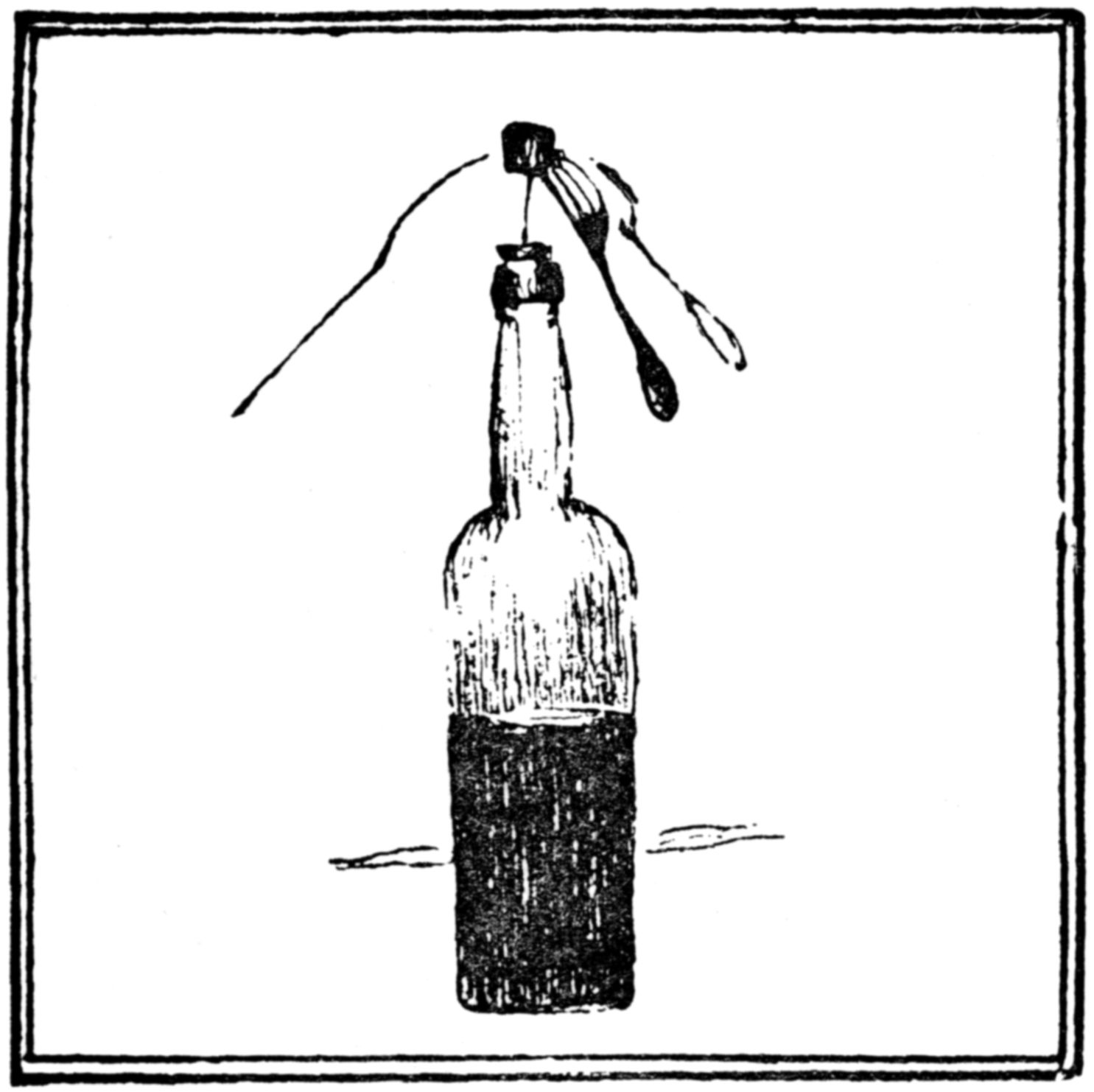
With the aid of three forks, as is shown in the picture, the needle may be balanced and spun round on the head of the pin.
92. MISSING WORDS
Air—“Three fishers went sailing.”
Three ...... went sailing out into the west, Out into the west as the sun sank low; Each thought as they ...... of the lad she loved best, For they all had ......, and each had a beau. But seas will rise, and spirits will sink, And they all were too ill of ...... to think, So these ...... ...... back moaning.
Each missing word has the same six letters.
Solution
No. CXI.—AFTER DINNER
This diagram shows how, as an after-dinner trick, four similar wineglasses can be placed on the table
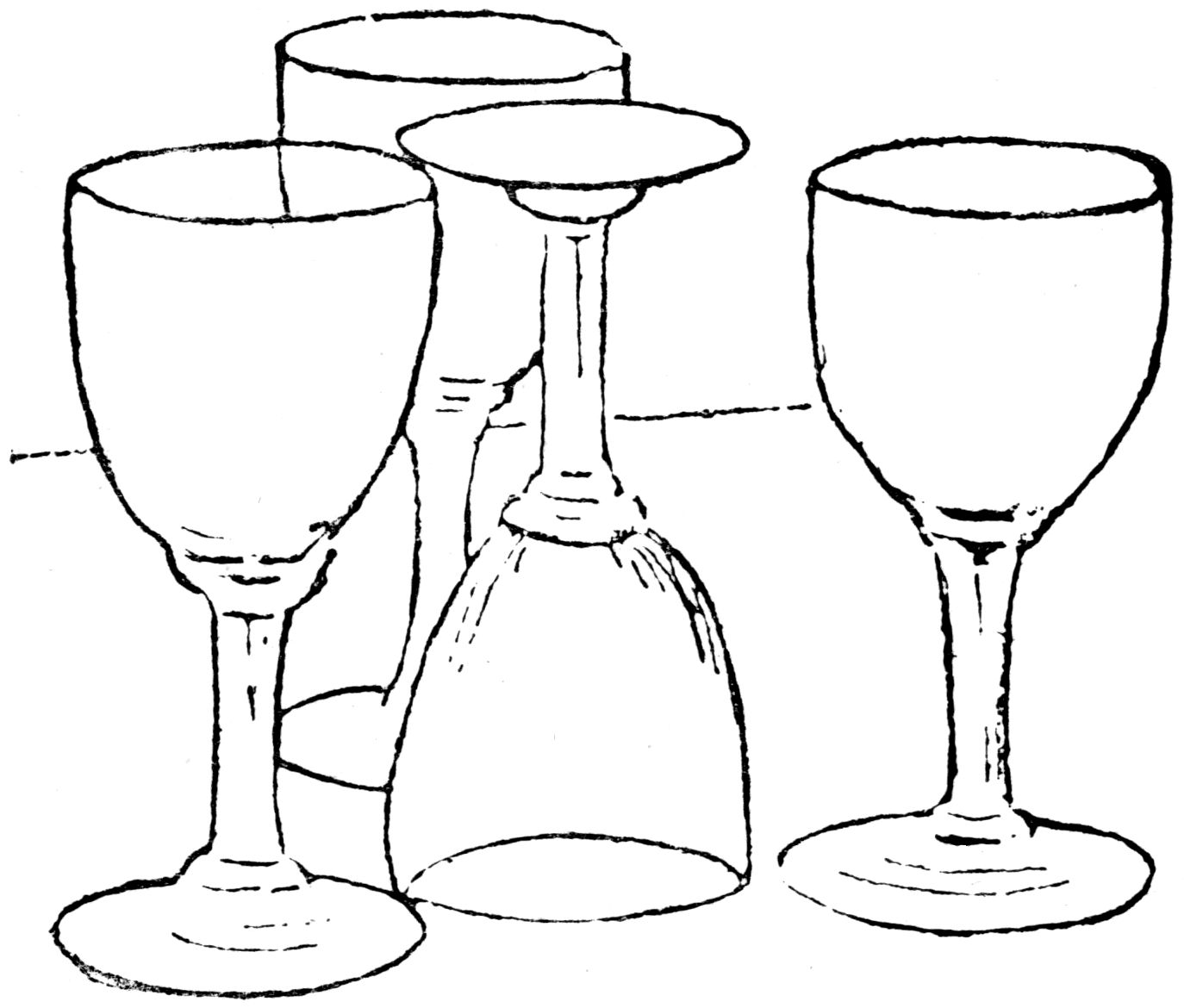
so that the centres of the lowest parts of their stems are equidistant from each other.
93. A CHARADE
Lurking in riddles oft my first is found; My second should in ample stores abound, Or help to make the sweetest songster heard. Peculiar, and quite proper, is my third. My whole has found with England’s monarch grace, The verdant home of many a goodly race.
Solution
No. CXII.—SECOND SIGHT
Ask any one, with this diagram to work upon, to think of any number between 5 and 15, and, while your back is turned, to count up to it, beginning at the lowest step, and saying one, two, three, four, and so on, as each step of cards or single card is reached in the direction indicated by the arrow. When the number thought of has been thus arrived at, tell him to stop, and beginning afresh on that card, to count one, two, three, etc., backwards, this time skipping over the double six and the 3 steps until he again reaches the number thought of, and notices which card he has touched last.
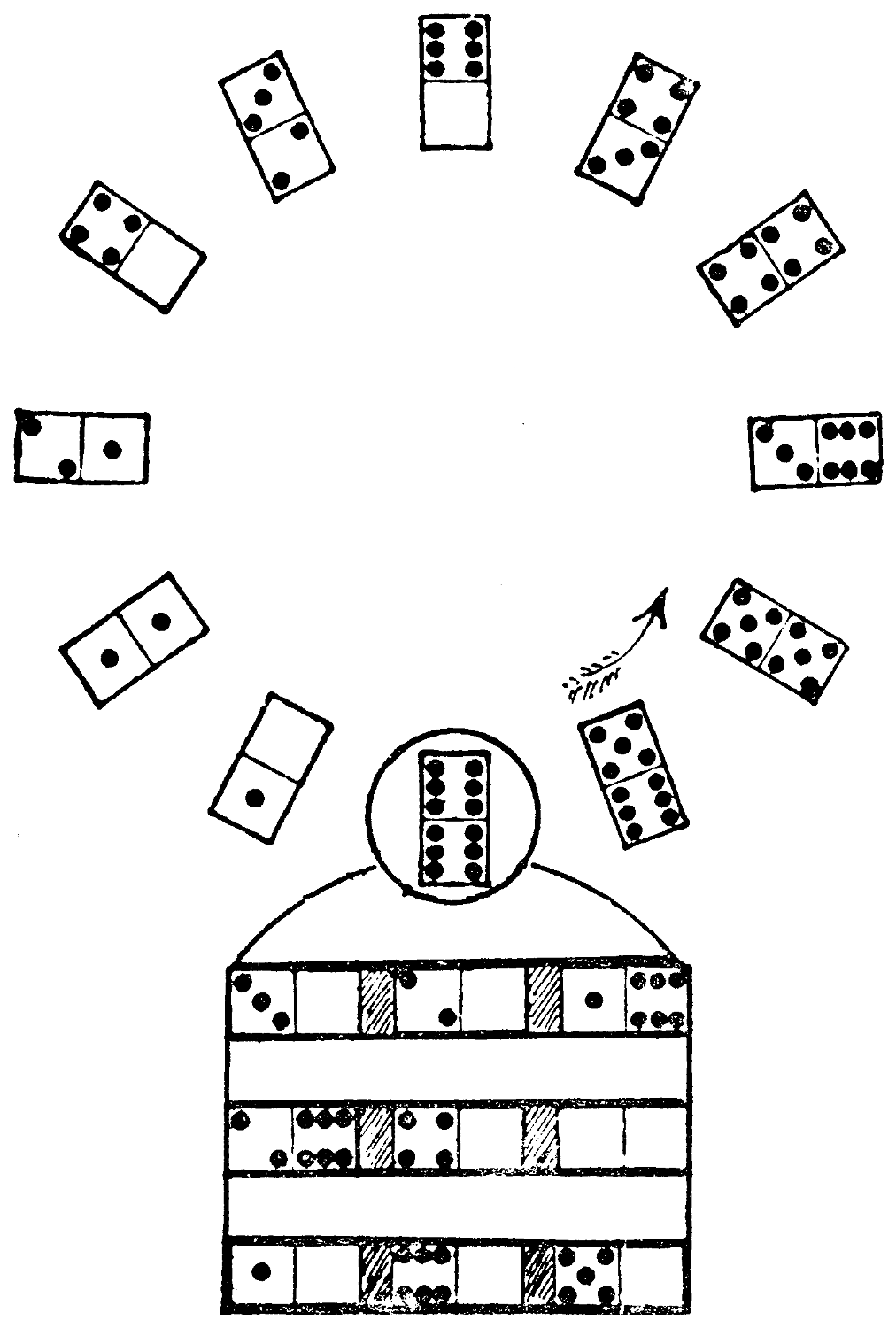
How can you, without having seen any of his movements, at once find that card?
Solution
No. CXIII.—AN AFTER DINNER TRICK
Cut a wedge out of an apple, as is indicated in the diagram, and make six gashes as is shown.
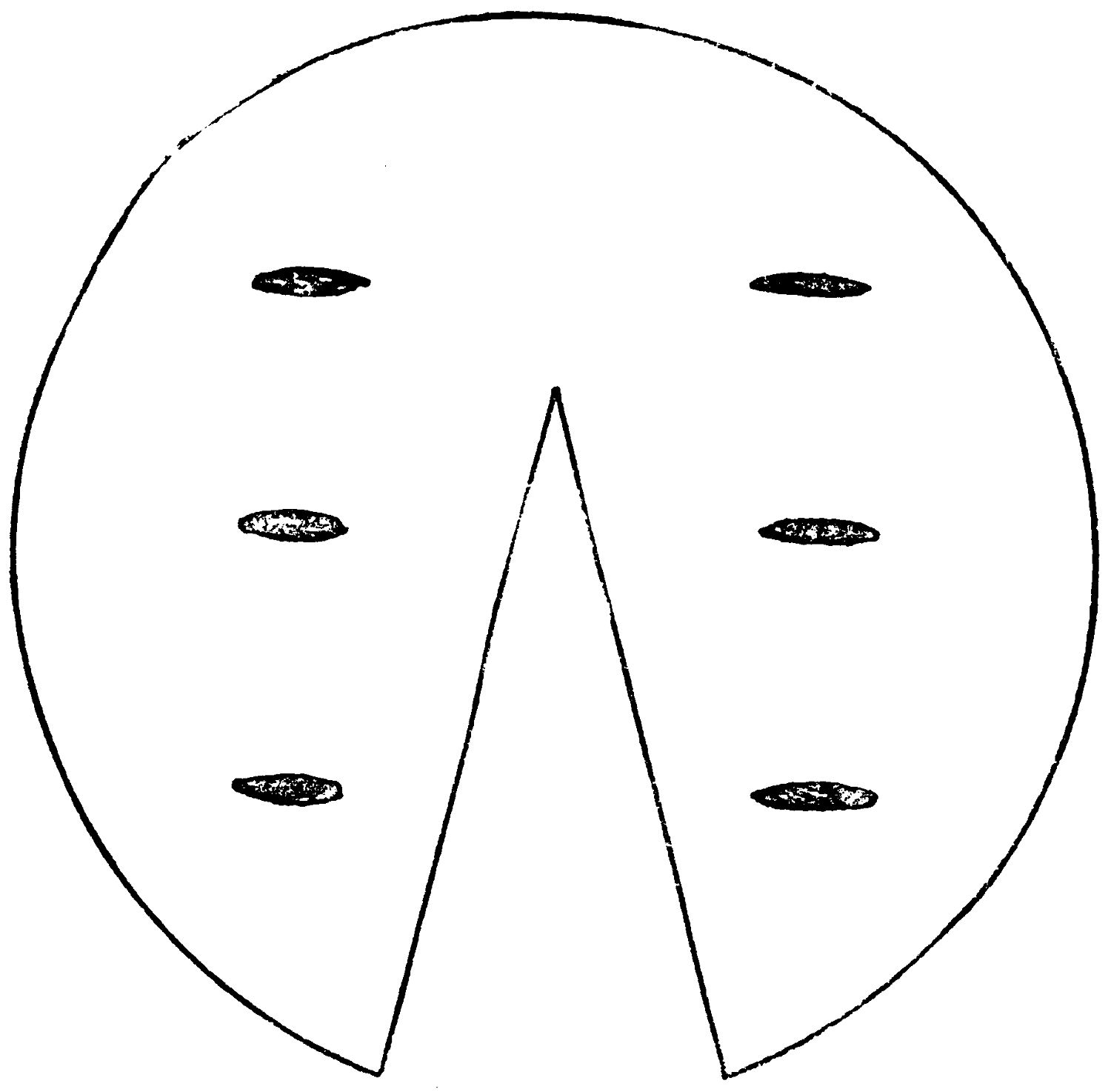
When this has been done, challenge anyone to divide the apple into six pieces by only two straight cuts, so that there shall be one of the gashes in each piece.
Solution
94. ALIKE TO THE EYE
Accent my head, An opening I appear In other fashions said I charm all far and near.
Solution
No. CXIV.—A TOY BOOMERANG
Cut out in cardboard a boomerang as nearly as possible of the size and pattern given here:—
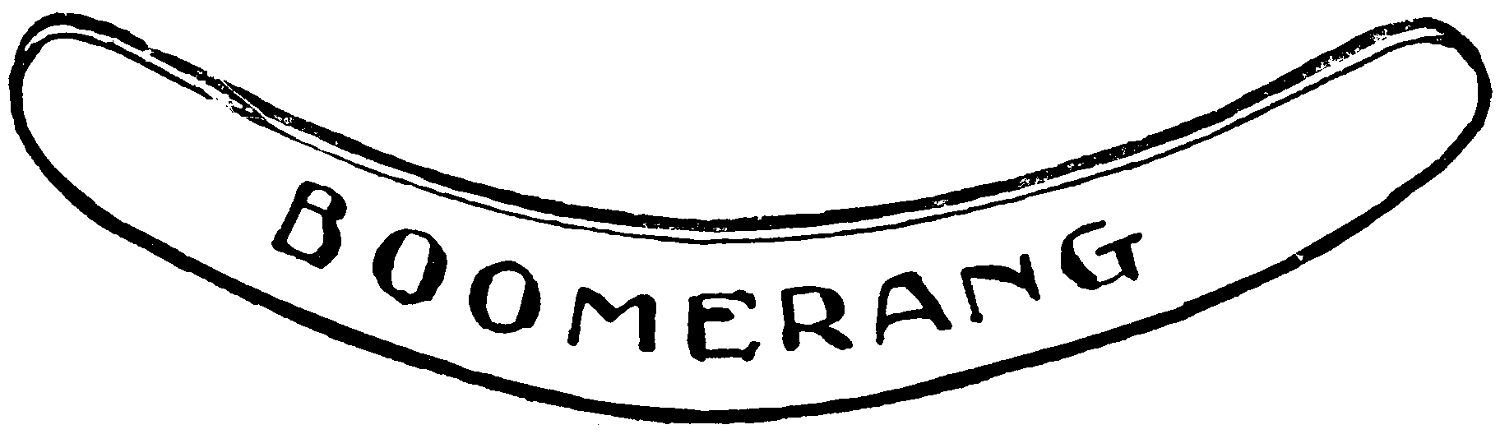
Place it flat on the back of the first three fingers of the left hand, sloping them upward; then flick it smartly with the second finger of the right hand. It will fly off and return to your lap. Try it.
95. LONDON BY ANAGRAM
Here are two simple sentences:—
A lamp shines out for thee. Win me best by tears.
Can you recast the letters, so that they form the names of two of the most important buildings in London?
Solution
96. HEARD ON THE BRIGHTON BEACH
It was low tide; two children were throwing pebbles into the sea, and sending their excited collie in pursuit of them. The Puzzle Editor, who was on holiday, quickened perhaps by the salt air, bethought him of this appropriate riddle:—What is the difference between that dog and a hungry man?
Solution
No. CXV.—IN THE GRIP OF A RADISH
Cut a radish in half, press the lower surface firmly against a plate, as is shown in the diagram:—
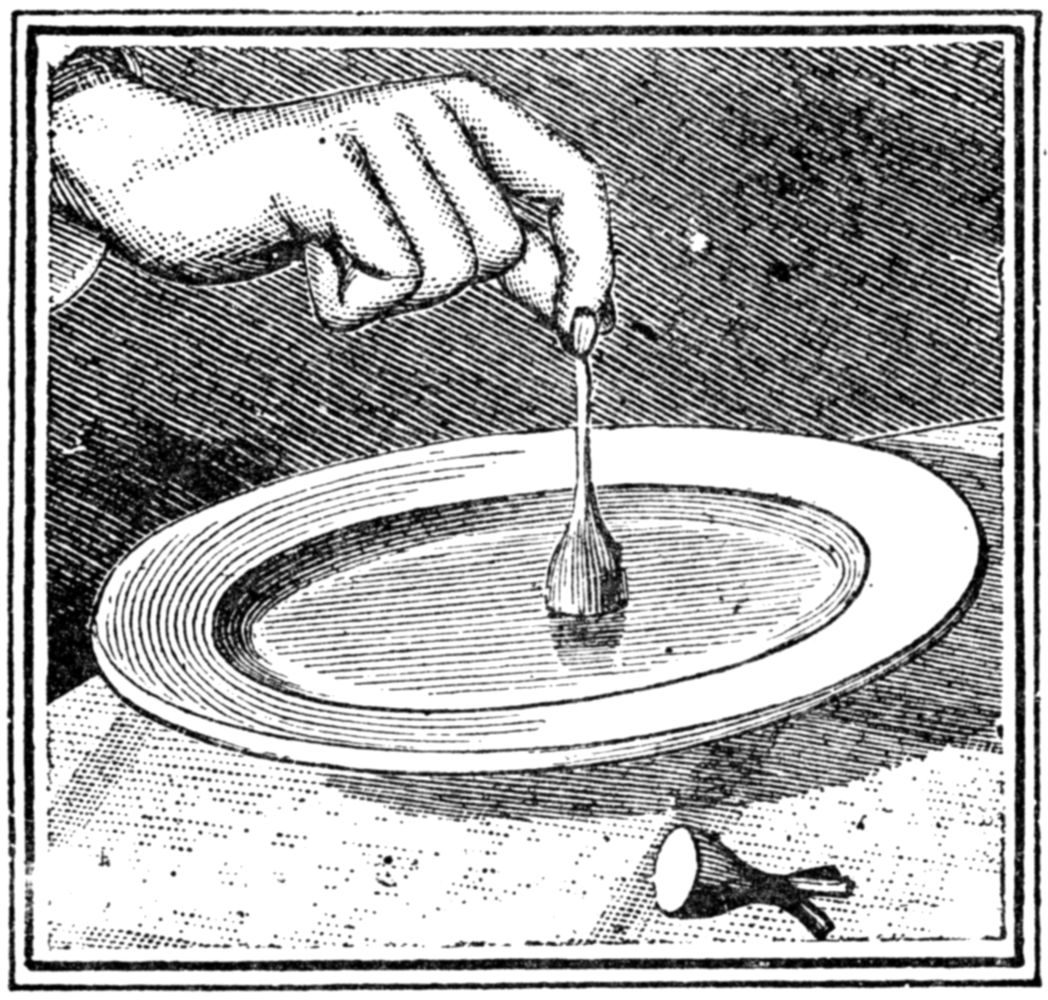
and you can lift the plate, to which it clings as closely as a boy’s wet leather disc to the pavement.
97. FIND THE ANIMAL
A part of me in rain, A part in hail must be, A part belongs to pain, A part in bones we see, A part in gleaming gold, A part in common copper. A part in peace behold, A part in any topper; Two parts are heard in sound, And in our finals found.
Solution
No. CXVI.—ELASTIC PAPER
The countryman who cut one hole in his door for the cat and another for the kitten would find it difficult to pass a penny through a hole the size of a shilling cut in a stout piece of paper.
This diagram shows how easily it can be done:—
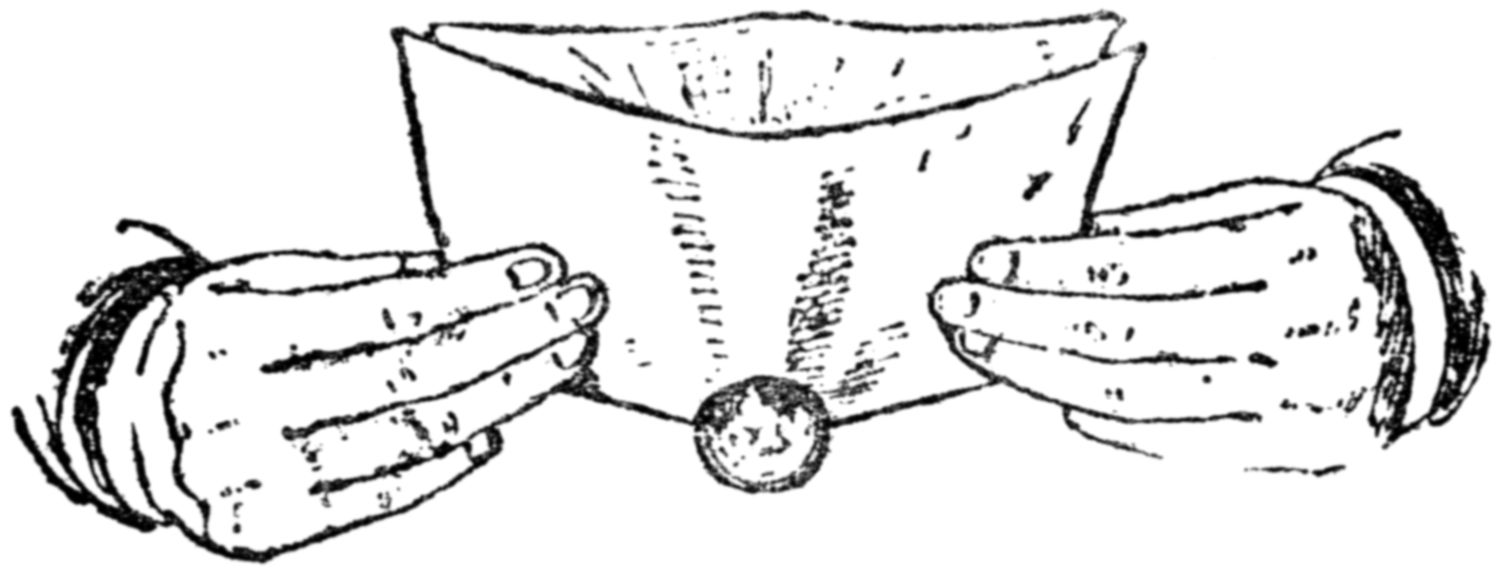
Fold the paper across the centre of the hole, place the penny in the fold, and bend the lower corners of the paper upwards. This elongates the opening, and the coin falls through.
98. A SMART ENIGMA
Men commonly say I am clever, Book-learning I never could boast; Yet I turn the leaves inside the cover, And when I am found I am lost.
Solution
99. MISSING WORDS
. ... is like a ..... or what is most Comparative, a ..... is like a . ...; For when their substances in liquor sink Both properly are said to be in drink.
One of the letters of the two short words is used twice in the longer word.
Solution
No. CXVII.—THE NIMBLE SIXPENCE
Place a sixpence on the tablecloth, and over it set a tumbler, as is shown in the picture below.
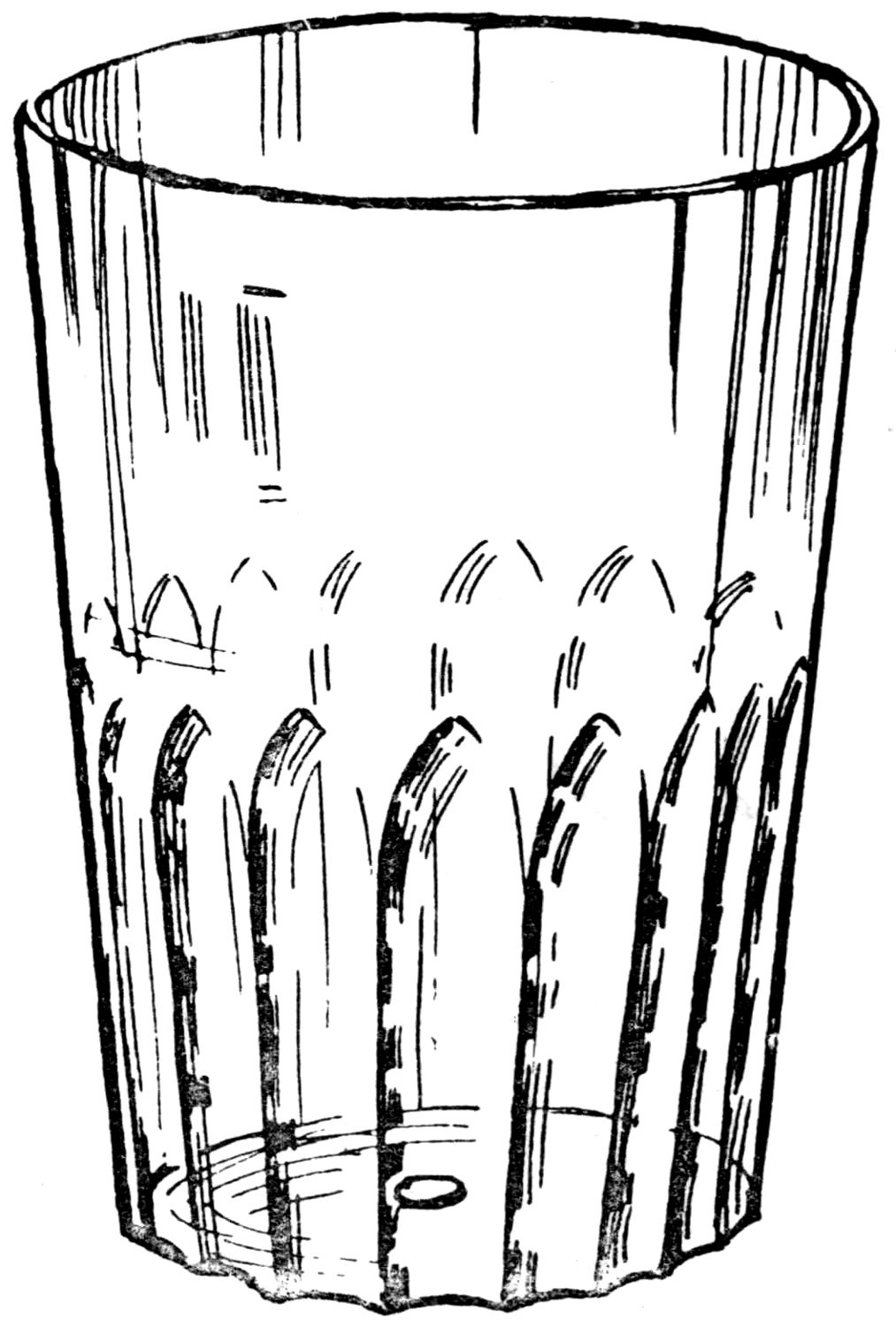
How can you pocket the sixpence without removing the glass, or having it removed?
Solution
100. A PIED PROVERB
abdeefiinnnoopprrrsssttuw
Solution
101. SELF-DEFINED
A wordy warfare waged with wit, In youth its joys none need descry; But where our elders take to it Its name points loss of dignity.
Solution
No. CXVIII.—HOW TO DRAW A SPIRAL
How can you draw such a spiral as this with very simple appliances?
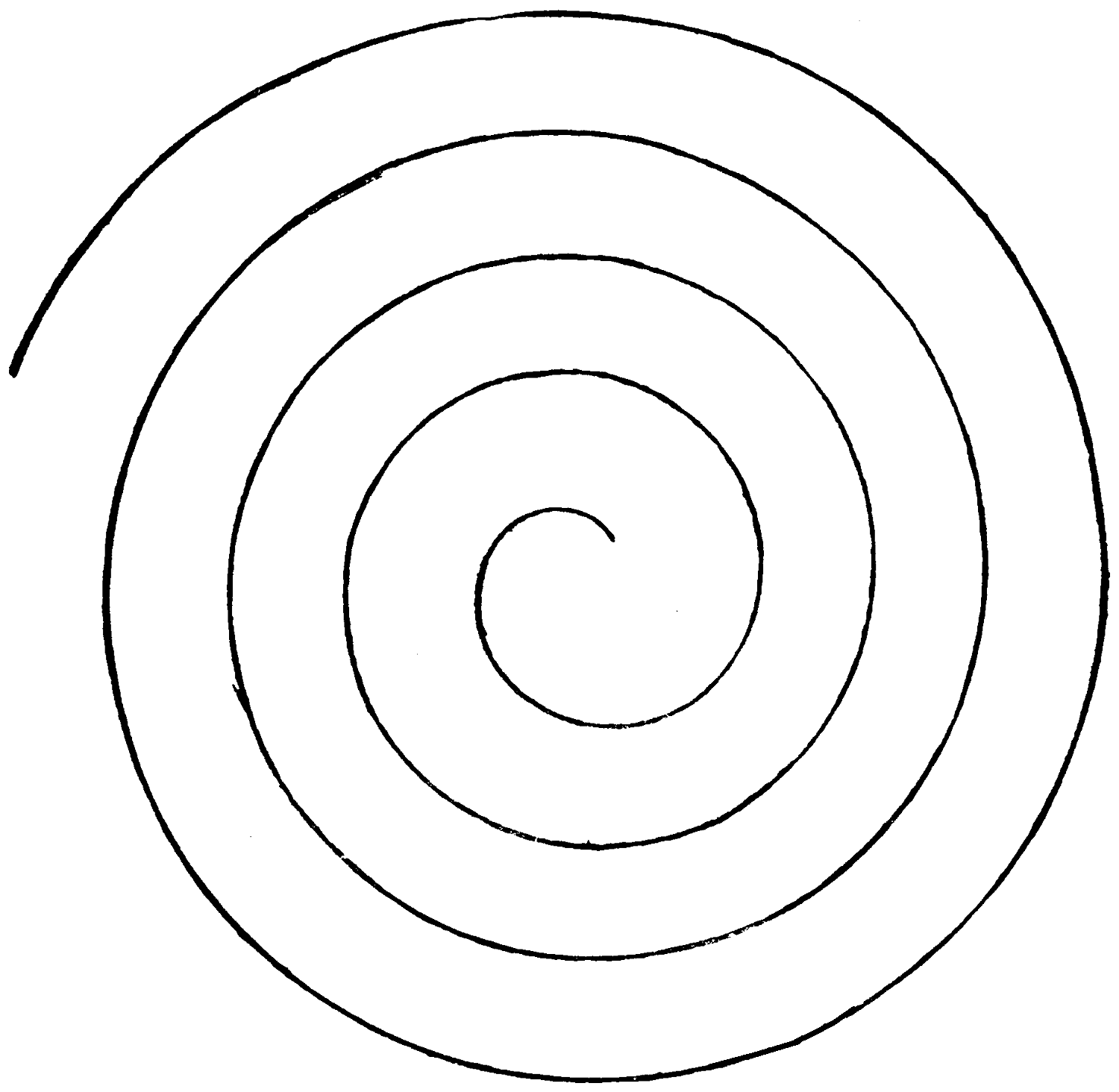
This spiral is drawn rapidly without removing the pencil from the paper.
Solution
102. FIND THE HERO
My first’s in garb, but not in dress; My next’s in praise, but not in bliss; My third’s in man, but not in miss; My fourth’s in we. My fifth’s in boar, but not in hog; My sixth’s in cat, but not in dog; My next’s in calm, but not in fog; My eighth’s in we. My ninth’s in rope, but not in twine; My tenth’s in light, but not in shine; My next’s in four, but not in nine; My twelfth’s in we.
Solution
No. CXIX.—FOR HANDY FINGERS
Take a piece of stout paper or thin cardboard, about 10 in. by 8 in., and cut it as is shown below, removing the parts that are shaded in the diagram.
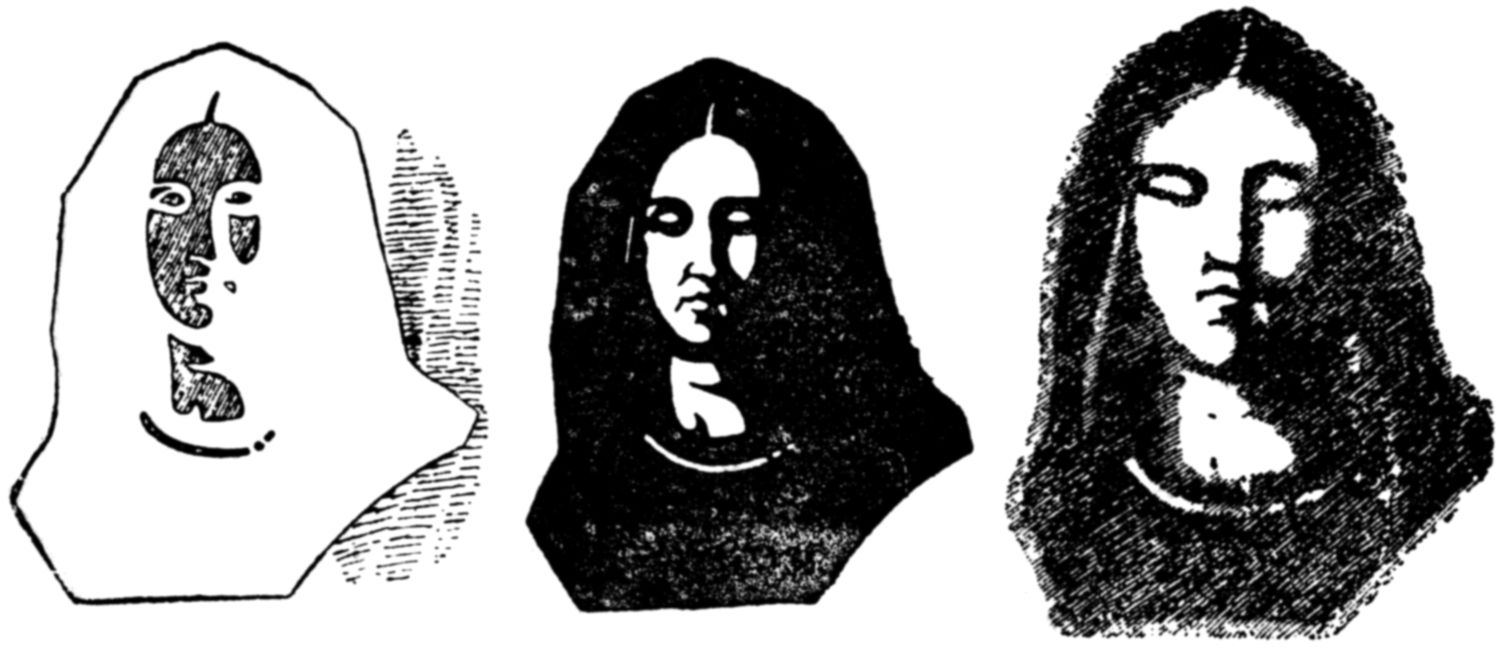
If you hold this between a plain wall, or other surface, and a strong light, you will, with a little practice, be able to cast a shadow similar to one or other of these Madonna heads, which will vary in intensity and expression with the positions of the paper and the light.
No. CXX.—THE FOUR KINGS
This excellent and easy little card trick will commend itself for fireside use in the long evenings.
Take the four Kings from a pack, and two other cards. Hold the Kings thus, in the form of a fan—
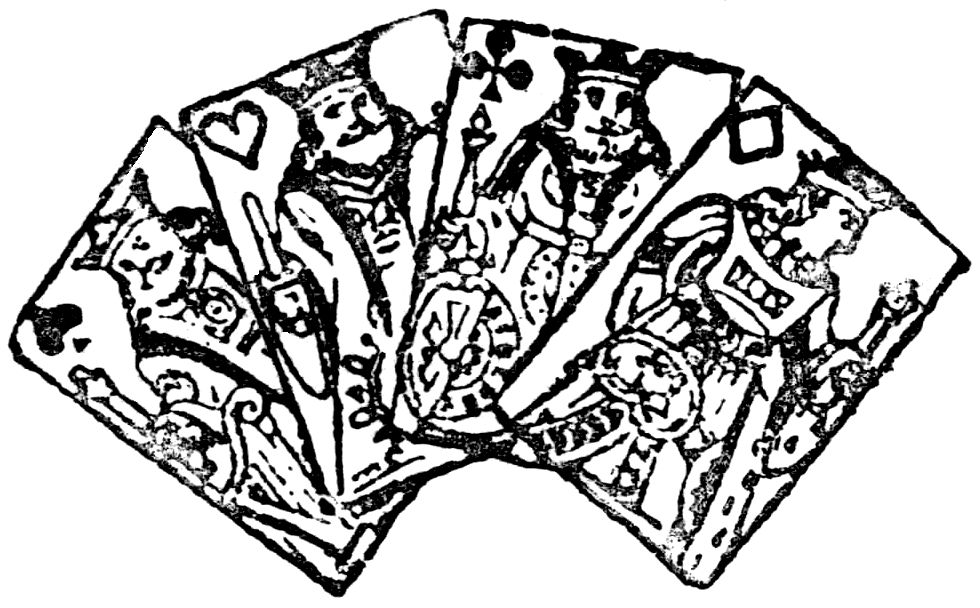
hiding the two other cards behind the King of Diamonds.
After showing them, place the six cards at the bottom of the pack. Now move the lowest card to the top, and the two next cards to any part of the pack, apparently leaving but one King at the bottom. Ask some one to cut the pack, and all the Kings will be found together. Some appropriate patter will help the effect.
103. PROVERB BY ANAGRAM
Can you recast this sentence—
A defeat whose test is very sure—
so that the same letters form an appropriate proverb?
Solution
No. CXXI.—DOMINO SQUARE
Its cells add up in columns and rows to 22, and those of the corner squares add up to 10 and 12 respectively.
● ● ● ● ● ● ● ● ●
● ● ● ●
● ● ● ● ● ● ● ● ●
● ● ● ● ● ● ● ●
● ● ● ● ● ●
● ● ● ● ● ● ● ●
● ● ● ● ● ● ● ● ●
● ● ● ●
● ● ● ● ● ● ● ● ●
● ● ● ● ● ● ● ● ●
● ● ● ●
● ● ● ● ● ● ● ● ●
● ● ● ● ● ● ● ● ●
● ● ● ●
● ● ● ● ● ● ● ● ●
● ● ● ● ● ● ●
● ● ● ● ● ● ● ●
● ● ● ● ● ● ●
Image
104. PHONETIC MISSING WORDS
’Tis ..... that no one takes a ..... To .... a .... of ....s; A .... may often take a .... To .... away the ....s.
Solution
No. CXXII.—THE TALKING HEAD
This, though quite an old illusion, may be a mystery to some of our readers, so we give it a place among our many curiosities.
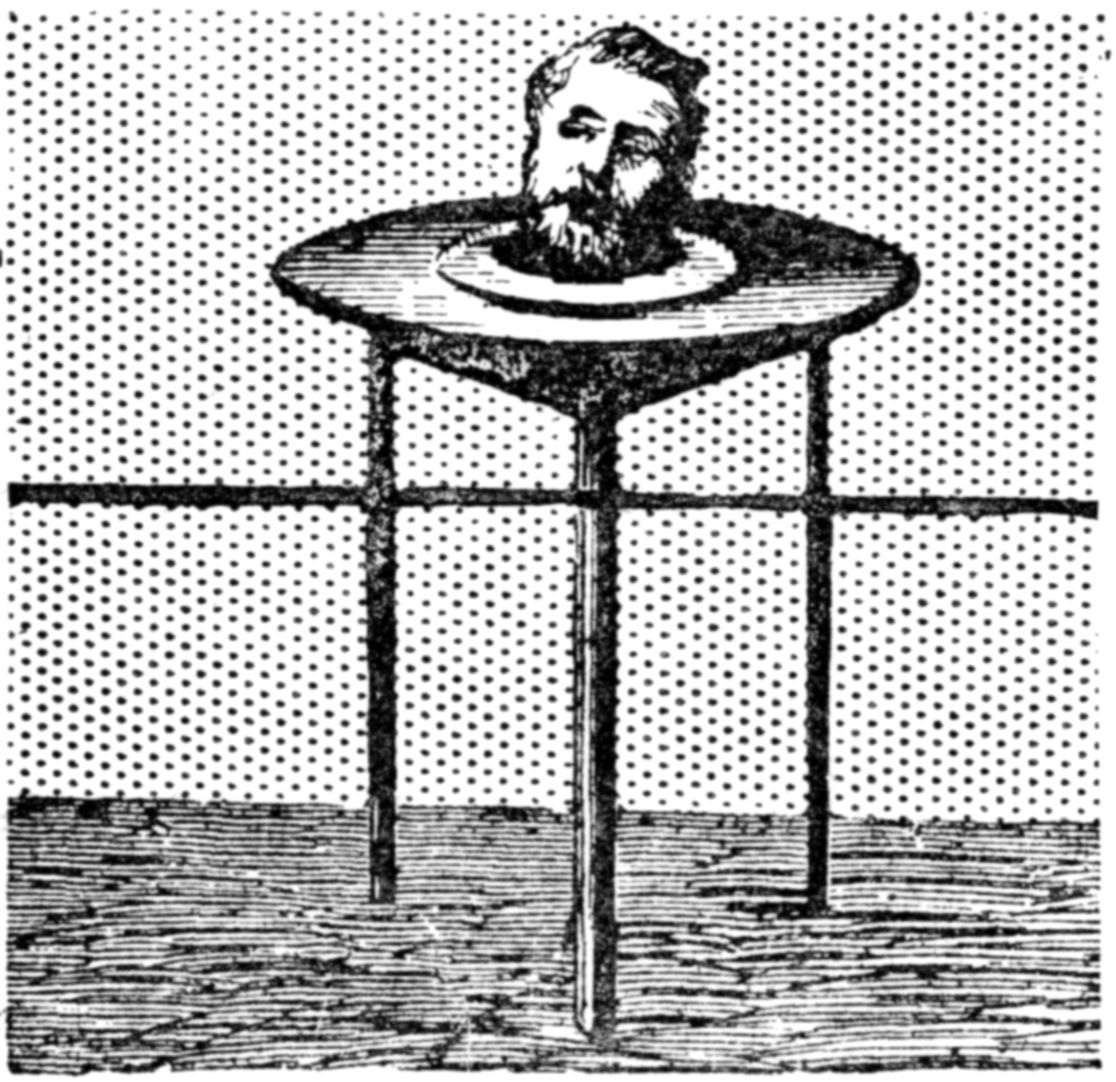
The table is placed on the middle of a platform, well away from the background, and the head, which is very much alive, is prepared to answer questions, or to whistle, or to sing, at the will of the audience. “How it is done” will be explained.
Solution
105. A QUEER OBSTACLE
I’m in everyone’s way, Yet no one I stop. My four horns each day Horizontally play, And my head is nailed on at the top.
Solution
No. CXXIII.—A GENERAL OF THE LIGHT BRIGADE
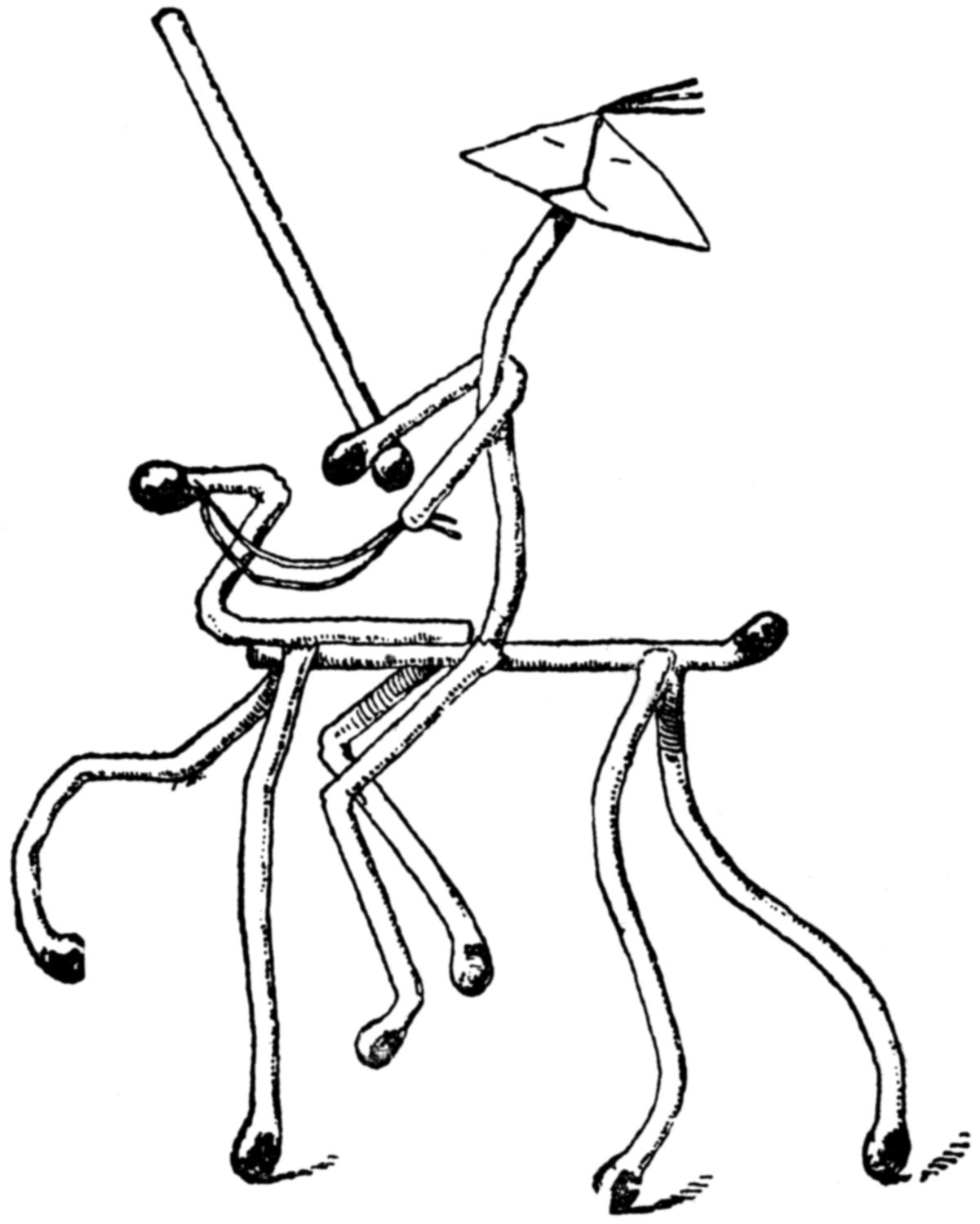
With a little ingenuity, and by slightly warming the wax, and shredding the matches for some effects, all sorts of comical figures can be contrived, similar in character to this dignified general on his high-stepping charger.
106. AN OLD ENIGMA (By a former Fellow of Trinity College, Dublin.)
Take five from five, and then Put fifty in the middle; Twice ten times five times ten Will finish off my riddle, And bring it to your ken As fit as any fiddle!
Solution
No. CXXIV.—ANOTHER BOOMERANG
Cut out in cardboard a cross similar to that shown in this diagram:—
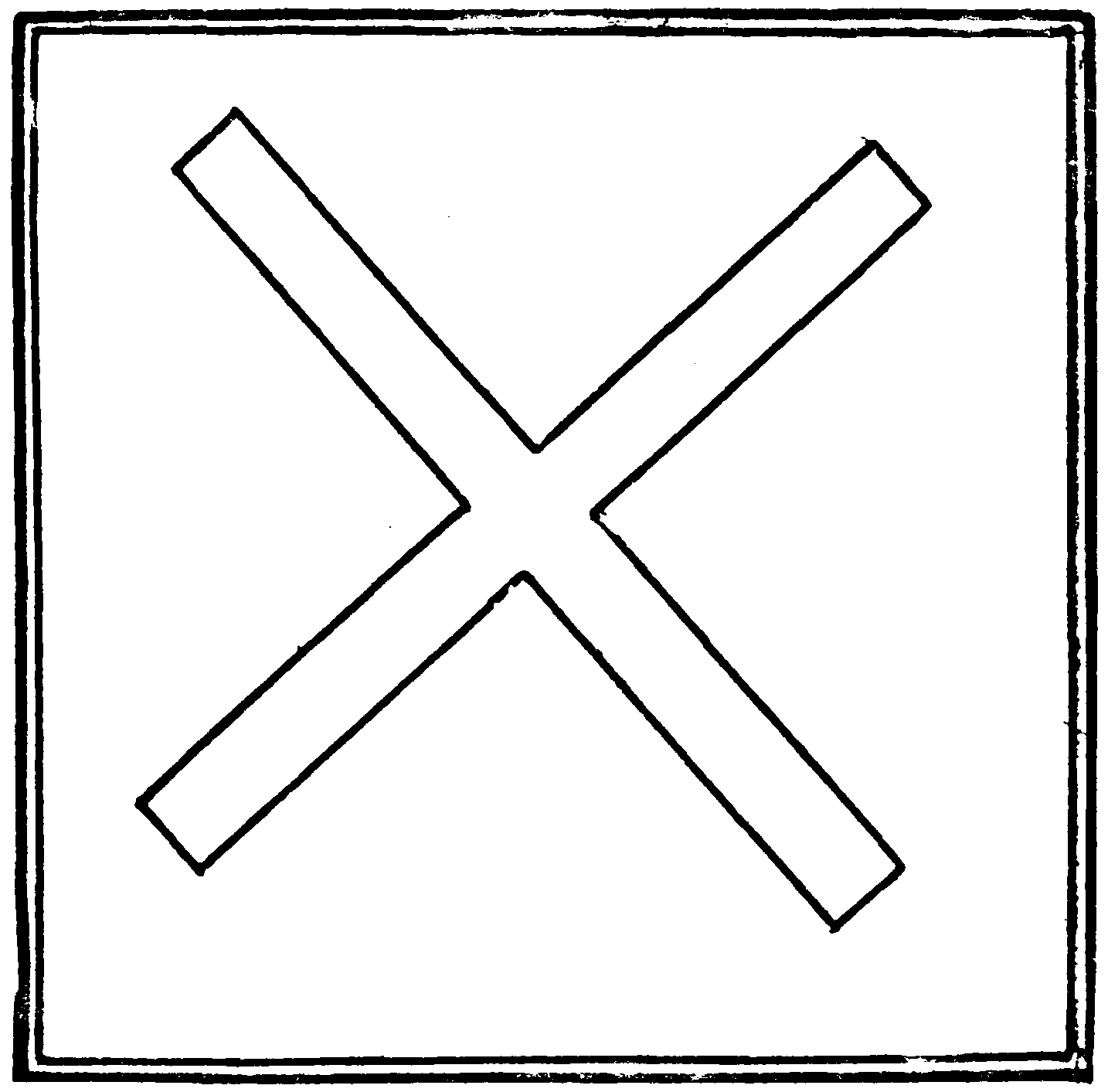
Place one of its limbs under the thumbnail of the left hand, and give the next projecting limb a sharp flick with the middle finger of the right hand. The little boomerang will fly sharply forward, and invariably return rapidly on its tracks. Try it.
107. PHONETIC GAPS
Can you fill these gaps with words of similar sound?
No ..... will ..... before the wind A ..... will ... before it; We cannot .... the ...., or find That earthly powers ..... o’er it.
The gaps in line 1 take words that sound alike; so do those in line 2; and so do the other three in lines 3 and 4.
Solution
No. CXXV.—A PICTURE CHARADE
Can you fill in the missing words so as to complete this picture charade?
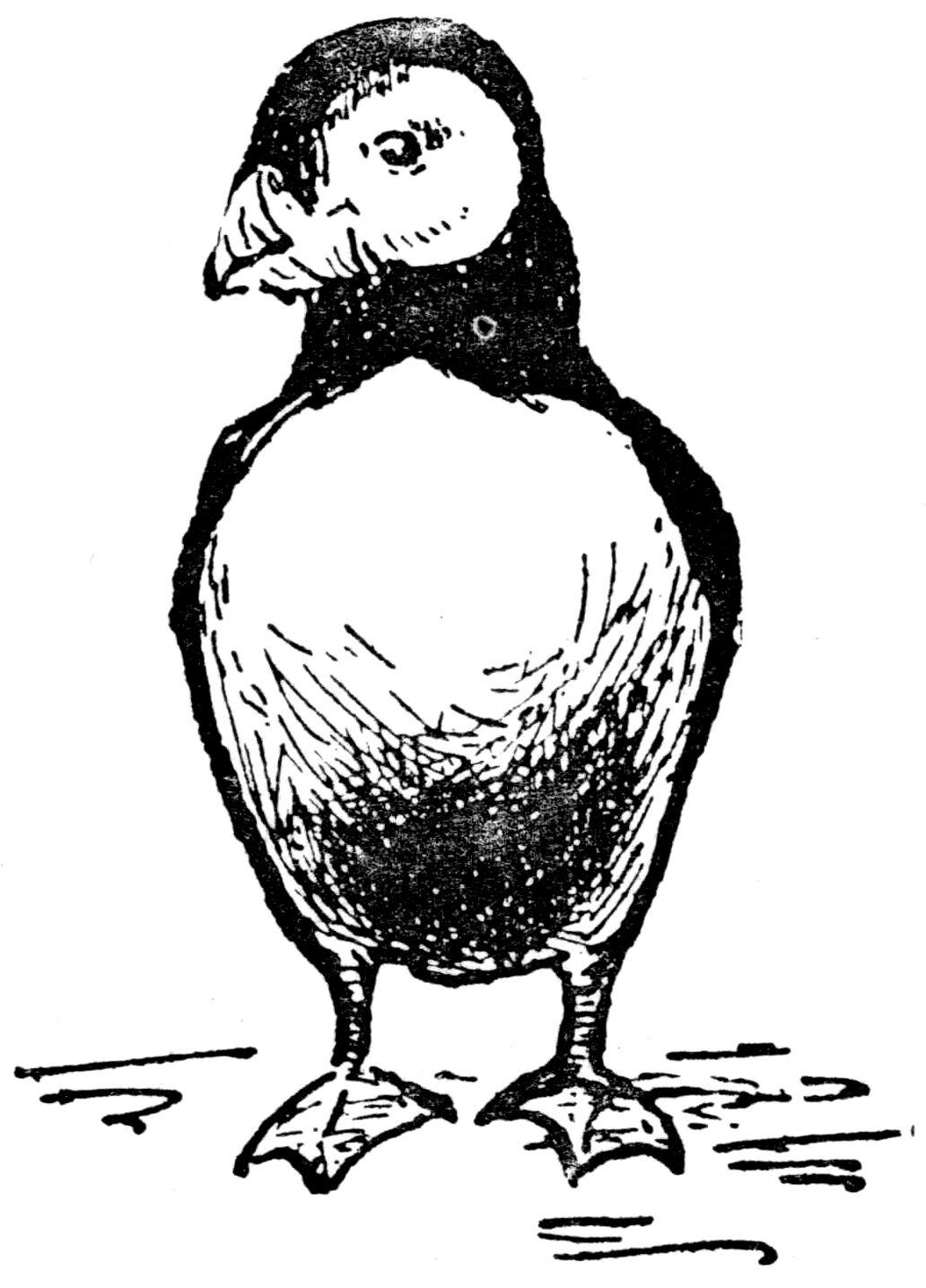
My first may .... candle ..., My second then ..... ..; My whole in ..... moves ..... ....... an oar or ...
Solution
108. SOUND SENSE
We seem to sound a note of lavish bounty; Reverse us, and we indicate a county.
Solution
109. A CRYPTOGRAM
FTHNMLKBRNGSLLCTTN LLSKMTMXTTLLTSTHN!
Can you so deal with this as to form a rhyming couplet?
Solution
No. CXXVI.—WALNUTS AND COBS
A good after dinner trick
Place four walnuts and four cobnuts in a row, as indicated on the diagram.

Now, moving always two that stand together, transfer them to some other positions along the line, and in four such moves leave them so that the large and small nuts range alternately. It may, of course, be done with large and small coins, or with other things that are at hand.
Solution
110. A BURIED PROVERB
Yet I see them all! on golden wings that fly Old memories steal anew; With a tear, with a sigh, with an old, old cry They return in ghostly hue!
Solution
111. DOUBLETS
Here is another exercise in Doublets, from Lewis Carroll’s book on the subject:—
Turn ELM into OAK by seven links, introducing the name of another tree as one of them.
Solution
No. CXXVII.—A PICTURE RIDDLE
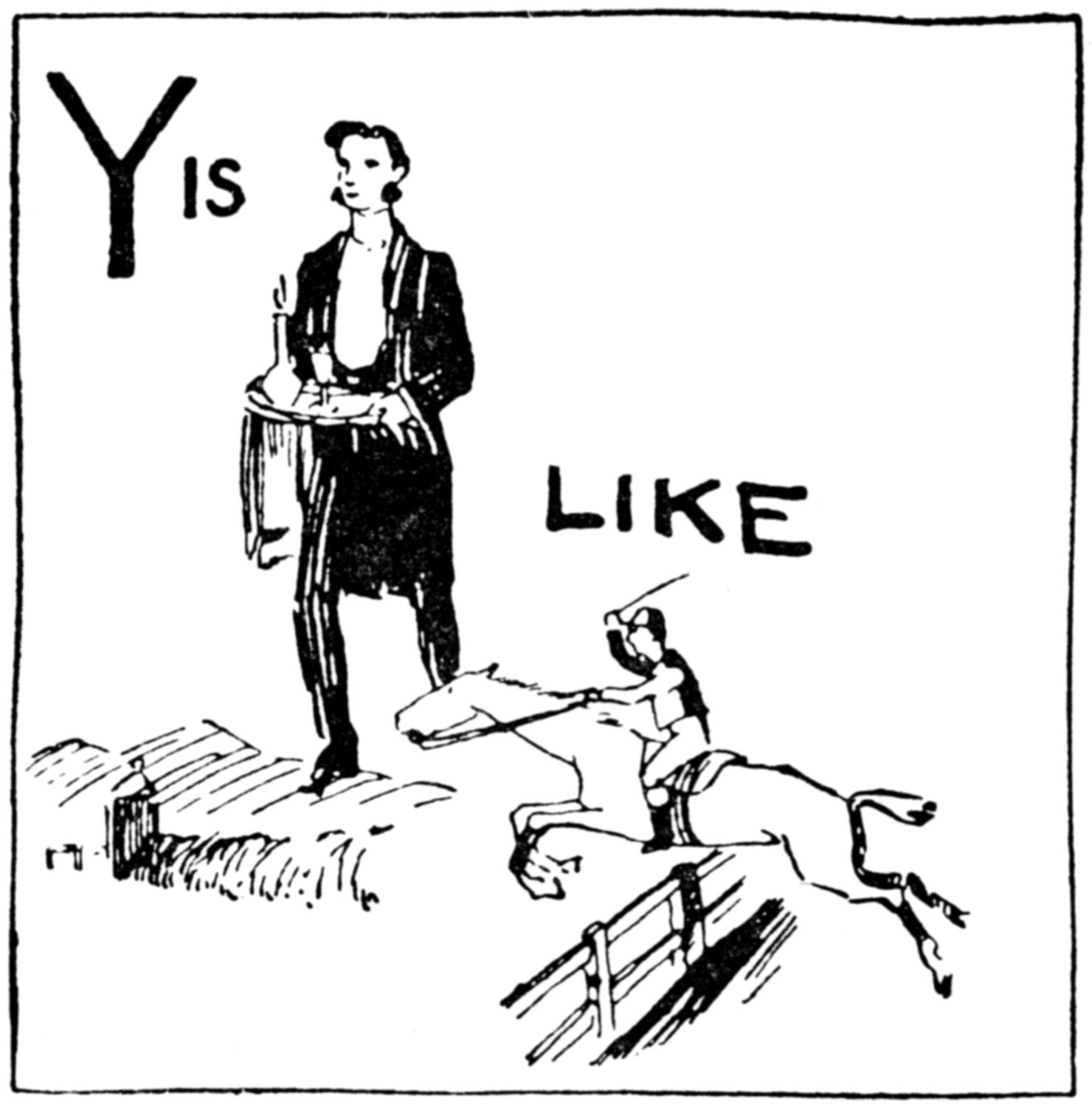
Can you read in this picture the question of our riddle?
Solution
112. TWO POSERS
1.
My dear Mr Bird, We are giving a ball; First second we third, Pray give us your all.
2.
Second, I did my first and last, Till I became my whole; And told the tale of my repast, A sad and greedy soul.
Solutions
No. CXXVIII.—BUY A BROOM
Here is an excellent example of how a characteristic figure may be contrived by shredding, warming, and uniting a few wax matches:—
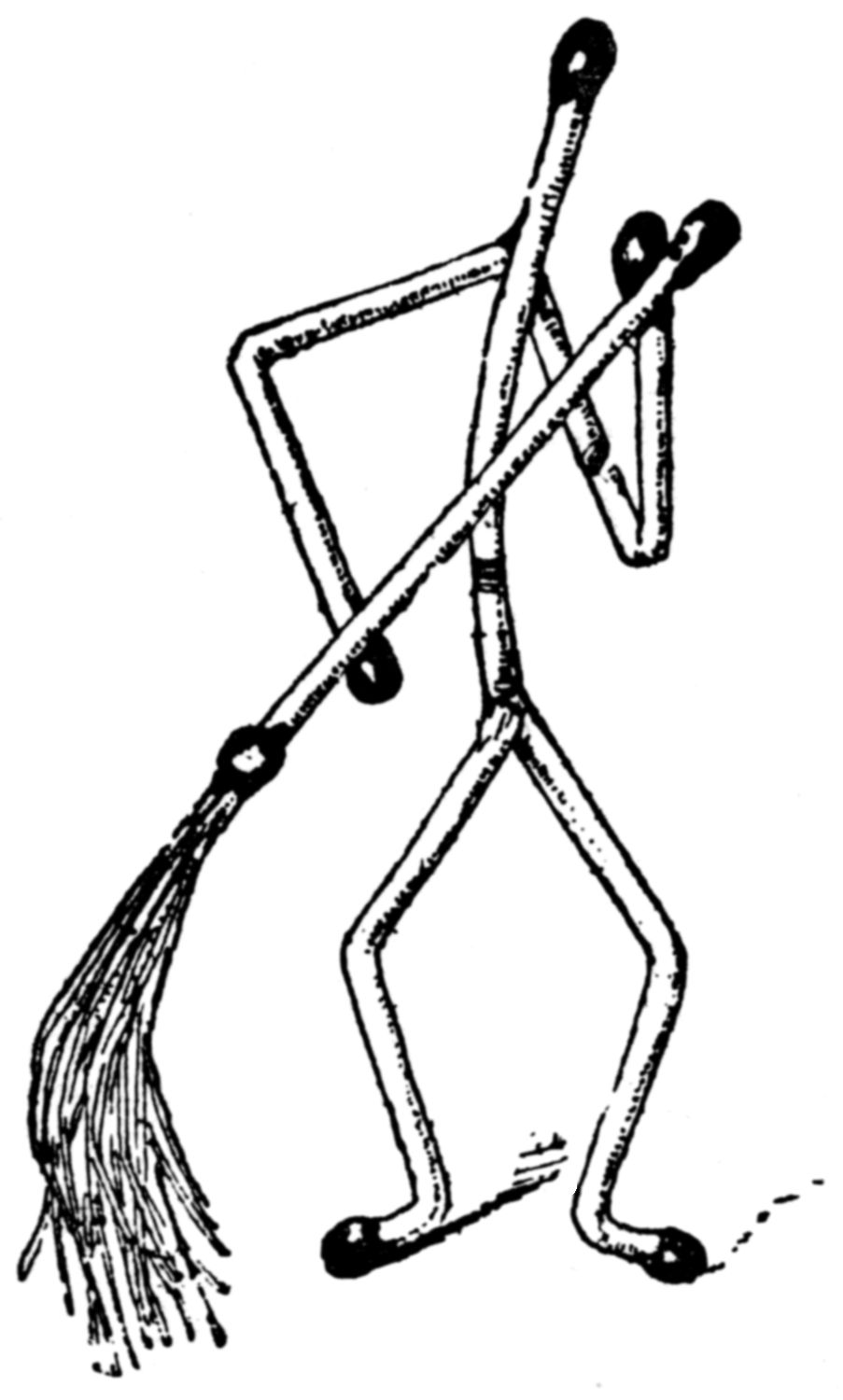
Many similar figures can be made by handy fingers.
113. A CHARADE
My whole, industrious, wends his way His daily task to meet; Behead, transpose, and lo! a sound Of music soft and sweet; Behead again, I make my way With swiftness past belief; Again, and where the fields are gay My bounty brings relief.
Solution
No. CXXIX.—JEU DE PARQUET (For the children)
An old book, published more than 100 years ago, gives the following samples of patterns which may be formed with very simple materials:—
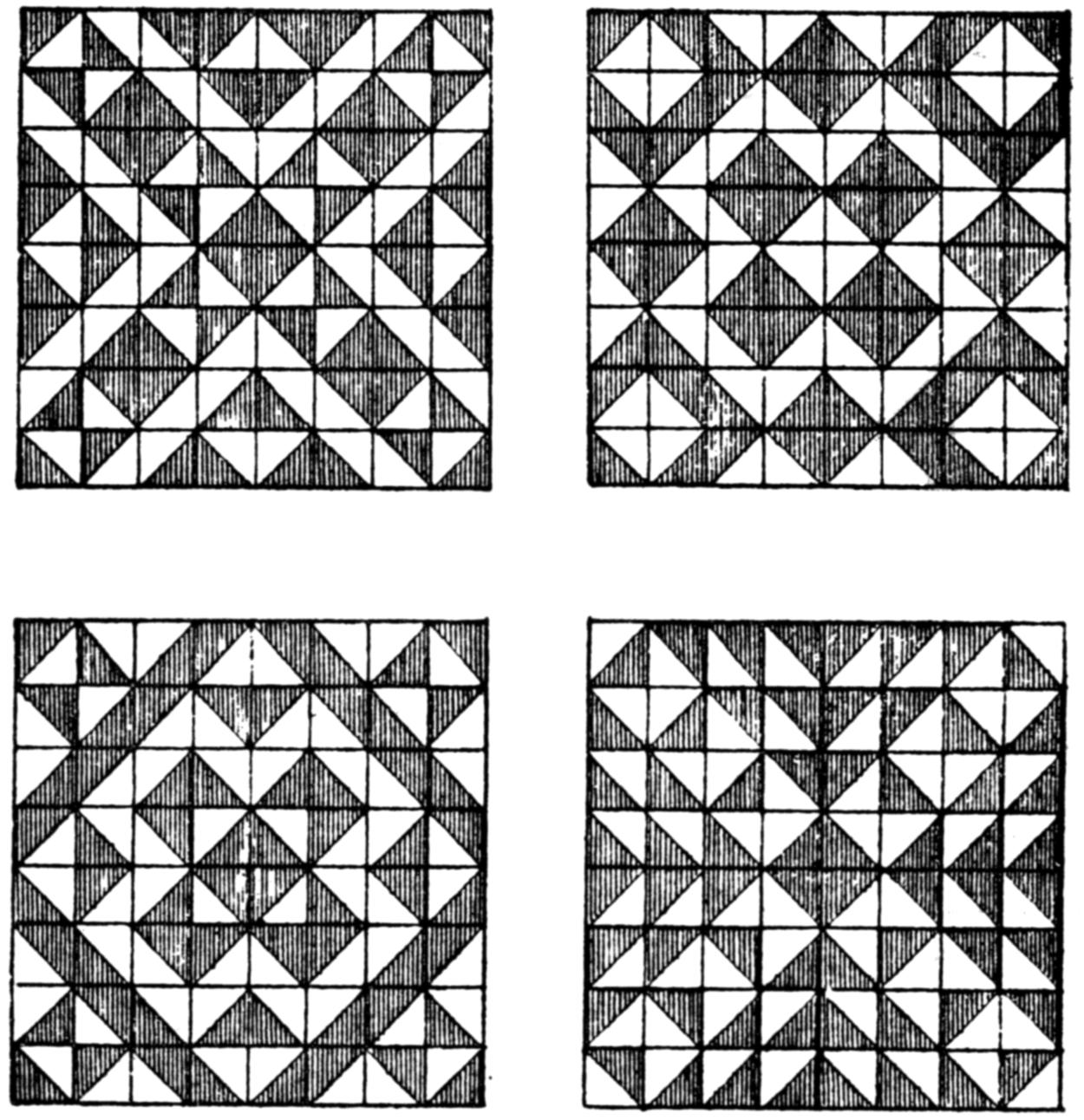
All that is needed for this pastime is a set of 128 coloured triangles, 64 of each colour, with which an endless variety of patterns can be arranged by the exercise of taste and ingenuity.
114. LINES BY AN OLD OXBRIDGE DON
’Tis an absurdity to say Women should try for a B.A. To College honours forward looking; They’d best confine themselves to cooking!
How could a Girton girl retort, using the same words?
Solution
115. LESS AND MORE
Eight letters (start with b) Three syllables contain; Take one away, and see Four syllables remain!
Solution
116. BURIED BEASTS
Can you dig out nineteen beasts that are buried in these lines?—
Ireland’s lot heals slowly. Troubles came long ago—at times in battalions—to attack and harass her. Ambitious democrats now countermine famous enthusiasts nearly akin to heroes. Anarchy enables cowards to sow hot terror and all amazement.
Solution
117. PALINDROMIC VERSE
Can you recast the following sentences so that their words form a verse of four lines, which makes good sense, with lines that rhyme alternately, when read from either end?:—
Fading slowly day dies, mournful winds sigh, Stars are waking brightly; owlet holding high revel flies hooting, breaking nightly silence.
Solution
118. AN ANAGRAM IN THE MAKING
“The Observatory at Greenwich, in England,” has been turned into an excellent anagram, which starts—On landing here begin—Can you complete it?
Solution
119. AN ENIGMA
No man at all am I And, if you turn me round, To hear my warning cry Not any men are found.
Solution
120. ASK A SAILOR
How can our sailors fare the best When times are harder? How do they greet with merry jest An empty larder?
Solution
121. AN ENIGMA
I lose my head when I am here, Transpose me I am three; Look in a book, you find me there, And with me her and he.
Solution
122. MISSING WORDS
Jack did ....... that he could square The circle to a .......; His friends ....... that a brain so rare Required attention ........
The missing words are spelt with the same seven letters.
Solution
123. A HUMAN PRODIGY
My father is my son, And I’m my mother’s mother; My daughter and sister are one, I’m grandam to my brother!
How was this?
Solution
124. A CHARADE
Catch my first with nimble wit, Add a simple word; Then my whole may help a bit Opportunely heard.
Solution
125. A PARADOX
My mate and I from home did start, Some little space we were apart. When we had run a mile or more We kept our distance, as before; Shade of Colenso! could this be, When twice as fast as I ran he?
Solution
126. AN ENIGMA (From Lewis Carroll’s Papers.)
A monument all men agree Am I in all sincerity, Half cat, half hindrance made. If head and tail removed should be, Then most of all you strengthen me. Replace my head, the stand you see On which my tail is laid.
Solution
127. A CHARADE
I’m known to the poorest and worst, And my worth by a child may be reckoned; The least thing in nature is double my first, And my whole is just half of my second.
Solution
128. WHAT IS IT?
My first without its head and tail Is one and undivided; My second shows its teeth, is frail, And as a rule one-sided. The two to hold my first avail, My busy toil provided.
Solution
129. BURIED TOWNS
In each of these sentences a town is buried:—
His sister played the piano while we sang. I saw Nell out here last evening. The general rode a large black mare. I have ordered a cab at half-past one. Meet me in the lane at half-past nine.
Can you dig them out?
Solution
130. A GOOD ANAGRAM
“The leaning tower of Pisa, in Tuscany, Italy.” The first seven words of its anagram are “A funny spot in a sweet city.” Can you complete the anagram by adding four more appropriate words?
Solution
131. MISSING WORDS
When they found that catacomb Near the ....... at Rome ’Twas the ....... discussion of the season; But the ....... effect Of the skeletons select Deprived the poor Professor of his reason!
Solution
132. A CHARADE
My first is pretence, My second a dandy; When fogs are most dense My whole will be handy.
Solution
133. A DECISIVE ANAGRAM
Can you prove by anagram that, whatever may be true of other plays accredited to Shakespeare, Bacon had certainly no hand in “Much Ado About Nothinge,” if we adopt the old spelling of the final word?
Solution
134. RATHER OBSCURE
Use all your wits to guess my all, Can any guess it right? Transposed, and never seen at all, It still is felt in sight. Behead, transpose, then let it be, And you at last a clue may see.
Solution
135. SHUFFLE THE LETTERS
Can you recast “Insanitary” and “Sanitary Reform” so as to form two very appropriate anagrams?
Solution
136. A CHARADE
Let my second cut my first When I come to table; Though I cannot quench your thirst Eat me—you are able.
Solution
137. MISSING LETTERS
whtmrslndsosdlyswr? whtdyssdrksdysthtwrslrm? lssknyskthndfr, llshllcllwrhrssndhrm. whycllsblldstlkthtghstlyrt llgllntctsgrndndmntyprt?
Can you supply the missing letters?
Solution
138. A CHARADE
To me when whole, for I am sweet, The moon fresh brightness brings; Cut off my tail, I’m blunt, but meet To sharpen other things. Behead me twice, and I have led Soldiers to face the foe; Headless and tailless, one remains Though all the rest may go.
Solution
139. IS IT BANTING?
We start when the ninth hour is past, Then there’s an end of you. A vengeful goddess shows at last What Antifat will do.
Solution
140. A CHARADE
When on charades intent I take my pen, To seek some hidden goal, Over my first my second comes, and then Quite overcomes my whole.
Solution
141. A PRIZE CRYPTOGRAM
The following cryptic lines were sent as a reliable tip before a race in which Petronel was to run:—
“Tell me, Ben, who tore it Seek a plant for it, see Bob.”
Can you discover their hidden meaning?
Solution
142. AN ENIGMA
I have no form, I have no friend, From me all come, in me all end. And it is strange but very true That I am here and nowhere too.
Solution
143. FACING BOTH WAYS
Can you fill in this broken sentence, first to describe a curse, and then to proclaim its cure:—
A sed end ought eat ease ain.
using 16, and then 17, extra letters.
Solution
144. A CHARADE
My first is a cover, My second a city; The whole you discover With this if you’re witty.
Solution
145. BURIED RIVERS
The deaf and dumb girl began gesticulating with a message, and her delivery was ever neat, with graceful pose in every attitude.
Four rivers are buried here.
Solution
146. ANSWER BY ANAGRAM
If the “shingle” on the beach at Brighton could speak, what would be its boast?
Solution
147. A SIMPLE RECIPE
She is as deaf as any post, Incurable I fear; She is my guest, I am her host, How can I make her hear?
Solution
148. THE PLAINT OF THE REJECTED
A May-Day Dirge
Refused, rejected as before! Yes,[A] ... .. I know of yore. ..... of youth, and deadly foe To genius. Eastward then I go With ..... undaunted, and my name Through ..... shall yet resound with fame; And subjects shall be mine by scores From far ..... to Ganges’ shores.
Solution
149. “BETA IN GREEK MEANS LETTER B.”
The clever play-writer who suggested these words as a phonetic excuse for wife-beating might in another fashion invite a man to beat his wife by merely calling him. What would he say?
Solution
150. A REBUS
storm? a th an umbrella me who with alls all mud.
Solution
151. BONES OF A PALINDROME
NRNRMMHDLVLDHMMRNRN.
Can you, keeping these consonants in their order, fill in vowels so as to form a sentence which is a perfect palindrome, and reads alike from either end?
Solution
152. A NICE POINT
“Can you tell me,” said an undergraduate to his tutor, who was great at Ecclesiastical Law, “whether the Pope would be allowed to bury the Archbishop of Canterbury?” As some slight stress was laid on the syllables Canterbury, the tutor for a moment suspected some trick, but being assured that it was quite a serious question, promised to consider the point. What should he reply?
Solution
153. A BURIED PROVERB
While there are very many as kind as this, they know no task unkind. Can you dig a proverb out from this sentence?
Solution
154. IN THE OPEN
Kate gathers me where children three, Tom, Jane, and Mary, chatter; He leads the way, and then we see The other two come at her!
Solution
155. A BURIED QUOTATION (From Shakespeare)
Strange weather! What could equal it? Yesterday sunshine and soft breezes, to-day a summer cyclone raging noisily; then other changes, as floods of fiercest rain eddy beneath the blast.
Solution
156. PALINDROME ON A BEETROOT
Fill in the necessary vowels, and form thus with these consonants in their present order a perfect palindrome:—
RDRTPTPTRDR
It must read alike from either end.
Solution
157. A CHARADE
My first we all do when we fail; My next is heard in rain or hail; My fourth a sheep of gender male; My third is one without its tail; My whole for foreign countries sail.