MNEMONIC. (continued 2)
Reading edition
The device is believed to represent an Arickara palisaded village and attacking soldiers. Not only the remarkable character and triumphant result of this expedition, but the connection that the Dakotas themselves had with it, made it a natural subject for the year’s totem.
All the winter counts refer to this expedition.
No. III. United States troops fought Ree Indians.
Battiste Good says: “General-——-first-appeared-and-the-Dakotas-aided-him-in-an-attack-on-the-Rees winter,” also “Much-corn winter.” For his character see Figure 69, page 166. The gun and the arrow in contact with the ear of corn show that both whites and Indians fought the Rees.
White-Cow-Killer calls it “Old-corn-plenty winter.”
Mato Sapa’s chart gives the human figure with a military cap, beard, and goatee.
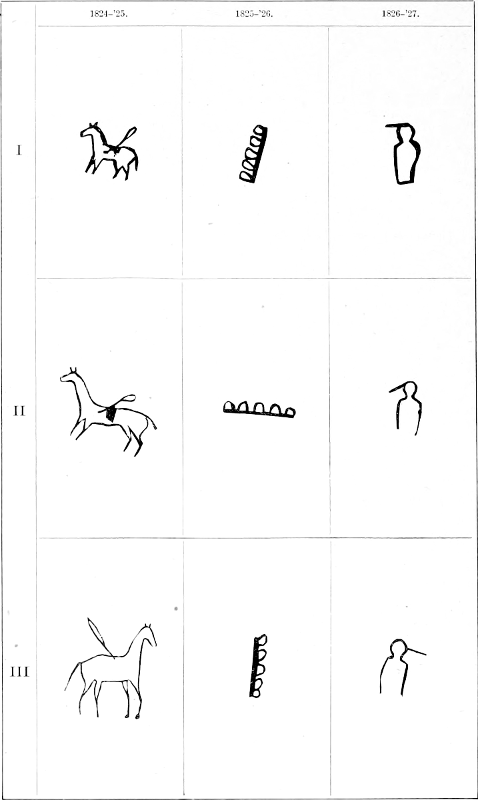
BUREAU OF ETHNOLOGY FOURTH ANNUAL REPORT PL. XVII
1824-’25.
1825-’26.
1826-’27.
THE DAKOTA WINTER COUNTS.
1824-’25.—No. I. All the horses of Little-Swan’s father are killed by Indians through spite.
No. II. Swan, chief of the Two Kettle tribe, had all of his horses killed. Device, a horse pierced by a lance, blood flowing from the wound.
No. III. Swan, a Minneconjou Indian, had twenty horses killed by a jealous Indian.
Mato Sapa says: Swan, a Minneconjou chief, lost twenty horses killed by a jealous Indian.
Major Bush says the same.
1825-’26.—No. I. River overflows the Indian camp; several drowned. The-Flame, the recorder of this count, born. In the original drawing the five objects above the line are obviously human heads.
No. II. There was a remarkable flood in the Missouri River, and a number of Indians were drowned. With some exercise of fancy, the symbol may suggest heads appearing above a line of water, or it may simply be the severed heads, several times used, to denote Indians other than Dakotas, with the uniting black line of death.
No. III. Thirty lodges of Dakota Indians drowned by a sudden rise of the Missouri River about Swan Lake Creek, which is in Horsehead Bottom, 15 miles below Fort Rice. The five heads are more clearly drawn than in No. II.
Battiste Good says: “Many-Yanktonais-drowned winter;” adding: The river bottom on a bend of the Missouri River where they were encamped was suddenly submerged, when the ice broke and many women and children, were drowned. This device is presented in Figure 43.
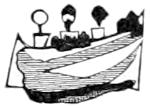
Fig. 43.—River freshet.
All the winter counts refer to this flood.
1826-’27.—No. I. All of the Indians who ate of a buffalo killed on a hunt died of it, a peculiar substance issuing from the mouth.
No. II. “An Indian died of the dropsy.” So Basil Clément was understood, but it is not clear why this circumstance should have been noted, unless the appearance of the disease was so unusual in 1826 as to excite remark. Baron de La Hontan, a good authority concerning the Northwestern Indians before they had been greatly affected by intercourse with whites, although showing a tendency to imitate another baron—Munchausen—as to his personal adventures, in his Nouveaux Voyages dans l’Amérique Septentrionale specially mentions dropsy as one of the diseases unknown to them. Carver also states that this malady was extremely rare. Whether or not the dropsy was very uncommon, the swelling in this special case might have been so enormous as to render the patient an object of general curiosity and gossip, whose affliction thereby came within the plan of the count. The device merely shows a man-figure, not much fatter than several others, but distinguished by a line extending sidewise from the top of the head and inclining downward. The other records cast doubt upon the interpretation of dropsy.
No. III. Dakota war party killed a buffalo; having eaten of it they all died.
Battiste Good says: “Ate-a-whistle-and-died winter,” and adds: “Six Dakotas, on the war-path, had nearly perished with hunger, when they found and ate the rotting carcass of an old buffalo, on which the wolves had been feeding. They were seized soon after with pains in the stomach, their abdomens swelled and gas poured from the mouth, and they died of a whistle, or from eating a whistle.” The sound of gas escaping from, the mouth is illustrated in his figure which see in Figure 146, page 221.
White-Cow-Killer calls it “Long-whistle-sick winter.”
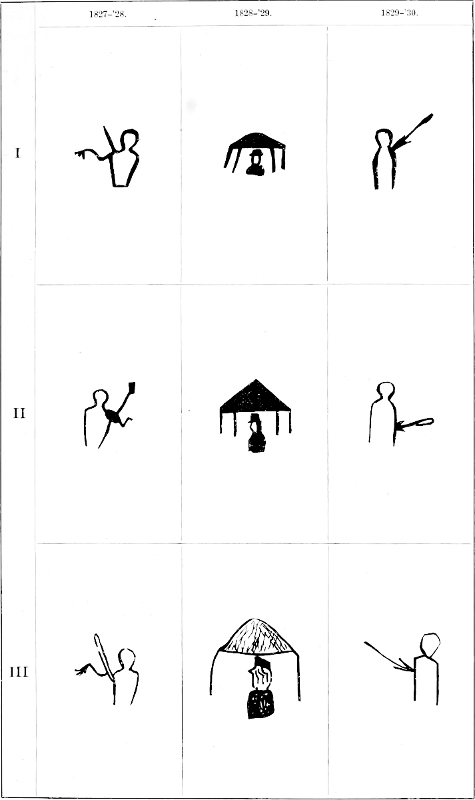
BUREAU OF ETHNOLOGY FOURTH ANNUAL REPORT PL. XVIII
1827-’28.
1828-’29.
1829-’30.
THE DAKOTA WINTER COUNTS.
1827-’28.—No. I. A Minneconjou is stabbed by a Gros Ventre, and his arm shrivels up.
No. II. Dead-Arm was stabbed with a knife or dirk by a Mandan. The illustration is quite graphic, showing the long-handled dirk in the bloody wound and the withered arm. Though the Mandans are also of the great Siouan family, the Dakotas have pursued them with special hatred. In 1823, their number, much diminished by wars, still exceeded 2,500.
No. III. A Minneconjou Dakota wounded with a large knife by a Gros Ventre. The large knife was a sword, and the Indian who was wounded was named, afterwards, Lame-Shoulder. This is an instance of a change of name after a remarkable event in life.
1828-’29.—No. I. Chardran, a white man, builds a house at forks of Cheyenne River. This name should probably be spelled Chadron, with whom Catlin hunted in 1832, in the region mentioned.
No. II. A white man named Shardran, who lately (as reported in 1877) was still living in the same neighborhood, built a dirt lodge. The hatted head appears under the roof.
III. Trading post opened in a dirt lodge on the Missouri a little below the mouth of the Little Missouri River.
1829-’30.—No. I. A Dakota found dead in a canoe.
No. II. Bad-Spike killed another Indian with an arrow.
No. III. A Yanktonai Dakota killed by Bad-Arrow Indians.
The Bad-Arrow Indians is a translation of the Dakota name for a certain band of Blackfeet Indians.
Mato Sapa says: a Yanktonai was killed by the Bad-Arrow Indians.
Major Bush says the same as Mato Sapa.
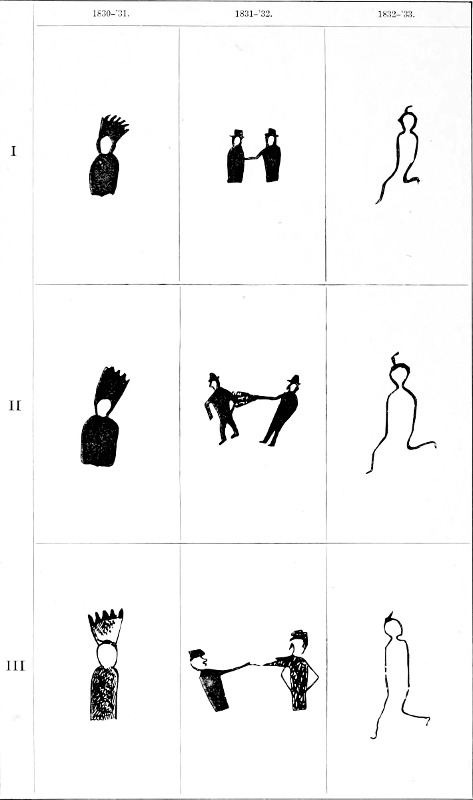
BUREAU OF ETHNOLOGY FOURTH ANNUAL REPORT PL. XIX
1830-’31.
1831-’32.
1832-’33.
THE DAKOTA WINTER COUNTS.
1830-’31.—No. I. Mandans kill twenty Crows at Bear Butte.
No. II. Bloody battle with the Crows, of whom it is said twenty-three were killed. Nothing in the sign denotes number, it being only a man-figure with red or bloody body and red war bonnet.
No. III. Twenty Crow and one Cheyenne Indians killed by Dakotas at Bear Butte.
Mato Sapa says: One Cheyenne and twenty Crows were killed by Dakotas at Bear Butte.
Major Bush says the same as Mato Sapa.
1831-’32.—No. I. Two white men killed by a white man at Medicine Creek, below Fort Sully.
No. II. Le Beau, a white man, killed another named Kermel. Another copy reads Kennel. Le Beau was still alive at Little Bend, 30 miles above Fort Sully, in 1877.
No. III. Trader named Le Beau killed one of his employés on Big Cheyenne River, below Cherry Creek.
1832-’33.—No. I. Lone-Horn’s father broke his leg.
No. II. Lone-Horn had his leg “killed,” as the interpretation gave it. The single horn is on the figure, and a leg is drawn up as if fractured or distorted, though not unlike the leg in the character for 1808-’09, where running is depicted.
No. III. A Minneconjou Dakota, Lone-Horn’s father, had his leg broken while running buffalo.
Mato Sapa and Major Bush also say Lone-Horn’s father.
Battiste Good says: “Stiff-leg-With-war-bonnet-on-died winter.” He was killed in an engagement with the Pawnees on the Platte River.
White-Cow-Killer calls it “One-Horn’s-leg-broken winter.”
In Catlin’s “North American Indians,” New York, 1844, Vol. I, page 211, the author, writing from the mouth of Teton River, Upper Missouri, site of Fort Pierre, described Ha-won-je-tah, The One-Horn, head chief of all the bands of the Dakotas, which were about twenty. He was a bold, middle-aged man of medium stature, noble countenance, and figure almost equalling an Apollo. His portrait was painted by Catlin in 1832. He took the name of One-Horn, or One-Shell, from a simple small shell that was hanging on his neck, which descended to him from his father, and which he valued more than anything else which he possessed, and he kept that name in preference to many others more honorable which he had a right to have taken, from his many exploits.
On page 221, the same author states, that after being the accidental cause of the death of his only son, Lone-Horn became at times partially insane. One day he mounted his war-horse, vowing to kill the first living thing he should meet, and rode to the prairies. The horse came back in two hours afterwards, with two arrows in him covered with blood. His tracks were followed back, and the chief was found mangled and gored by a buffalo bull, the carcass of which was stretched beside him. He had driven away the horse with his arrows and killed the bull with his knife.
Another account in the catalogue of Catlin’s cartoons gives the portrait of The One-Horn as number 354, with the statement that having killed his only son accidentally, he became deranged, wandered into the prairies, and got himself killed by an infuriated buffalo bull’s horns. This was at the mouth of Little Missouri River, in 1834.
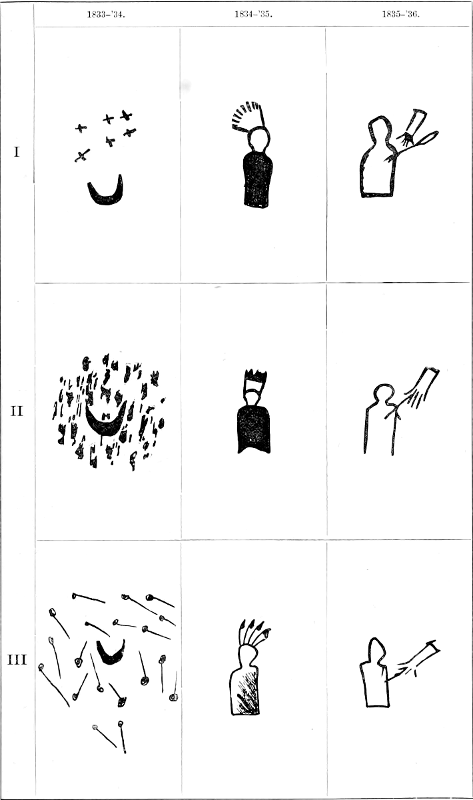
BUREAU OF ETHNOLOGY FOURTH ANNUAL REPORT PL. XX
1833-’34.
1834-’35.
1835-’36.
THE DAKOTA WINTER COUNTS.
1833-’34.—No. I. Many stars fell (meteors). The character shows six black stars above the concavity of the moon.
No. II. “The stars fell,” as the Indians all agreed. This was the great meteoric shower observed all over the United States on the night of November 12th of that year. In this chart the moon is black and the stars are red.
No. III. Dakotas witnessed magnificent meteoric-showers; much terrified.
Battiste Good calls it “Storm-of-stars winter,” and gives as the device a tipi, with stars falling around it. This is presented in Figure 44. The tipi is colored yellow in the original, and so represented in the figure according to the heraldic scheme.
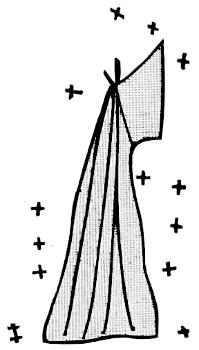
Fig. 44.—Meteoric shower.
White-Cow-Killer calls it “Plenty-stars winter.”
All the winter counts refer to this meteoric display. See page 138.
1834-’35.—No. I. A Ree killed by a Dakota.
No. II. The chief, Medicine-Hide, was killed. The device shows the body as bloody, but not the war bonnet, by which it is distinguished from the character for 1830-’31.
No. III. An Uncpapa Dakota Medicine-man killed by the Ree Indians.
Mato Sapa says: An Uncpapa medicine-man was killed by Rees. There is no red on the figure.
1835-’36.—No. I. Lame-Deer killed by a Dakota. The Dakota had only one arrow. He pulled it out and shot Lame-Deer many times.
No. II. Lame-Deer shot a Crow Indian with an arrow; drew it out and shot him again with the same arrow. The hand is drawing the arrow from the first wound. This is another instance of the principle on which events were selected. Many fights occurred of greater moment, but with no incident precisely like this.
No. III. Minneconjou chief named Lame-Deer shot an Assiniboine three times with the same arrow. He kept so close to his enemy that he never let the arrow slip away from the bow, but pulled it out and shot it in again.
Mato Sapa says a Minneconjou named Lame-Deer shot an Assiniboine three times running with the same arrow.
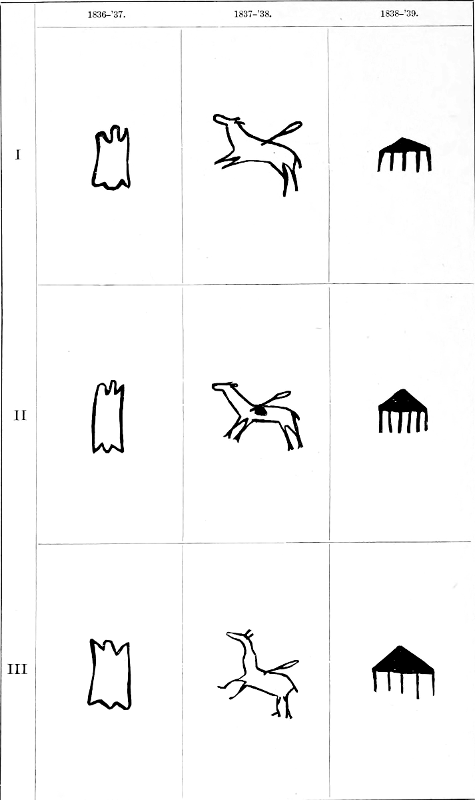
BUREAU OF ETHNOLOGY FOURTH ANNUAL REPORT PL. XXI
1836-’37.
1837-’38.
1838-’39.
THE DAKOTA WINTER COUNTS.
Lame-Deer was a distinguished chief among the hostiles in 1876. His camp of five hundred and ten lodges was surprised and destroyed by General Miles, and four hundred and fifty horses, mules, and ponies were captured.
1836-’37.—No. I. Father-of-the-Mandans died.
No. II. Band’s-Father, chief of the Two Kettles, died. The device is nearly the same as that for 1816-’17, denoting plenty of buffalo belly; and the question might be raised, what the buffalo belly had to do with the demise of the lamented chieftain, unless he suffered from a fatal indigestion after eating too much of that delicacy.
Interpreter Fielder, however, throws light on the subject by saying that this character was used to designate the year when The-Breast, father of The-Band, a Minneconjou, died. The-Band himself died in 1875, on Powder River. His name was O-ye-a-pee. The character was therefore the buffalo breast, a name-totem.
No. III. Two Kettle, Dakota, named The-Breast, died.
Mato Sapa says: A Two Kettle, named The-Breast, died.
Major Bush same as Mato Sapa.
1837-’38.—No. I. Many elk and deer killed. The figure does not show the split hoof.
No. II. Commemorates a remarkably successful hunt, in which it is said one hundred elk were killed. The drawing of the elk is good enough to distinguish it from the other quadrupeds in this chart.
No. III. The Dakotas killed one hundred elk at the Black Hills.
Mato Sapa says: The Dakotas killed one hundred elk at the Black Hills. His figure does not show the split hoof.
1838-’39.—No. I. Indians built a lodge on White Wood Creek, in the Black Hills, and wintered there.
No. II. A dirt lodge was built for Iron-Horn. The other dirt lodge (1815-’16) has a mark of ownership, which this has not. Perhaps it was not so easy to draw an iron horn as a crow feather, and the distinction was accomplished by omission. A chief of the Minneconjous is mentioned in General Harney’s report in 1856, under the name of The-One-Iron-Horn.
No. III. A Minneconjou chief, named Iron-Horn, built dirt lodge (medicine lodge) on Moreau River (same as Owl River).
This Minneconjou chief, Iron-Horn, died a few years ago and was buried near Fort Sully. He was father-in-law of Dupuis, a French Canadian.
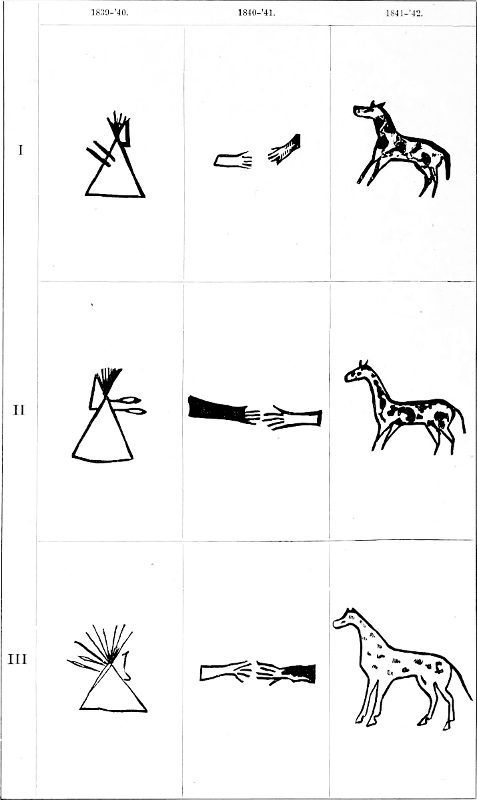
BUREAU OF ETHNOLOGY FOURTH ANNUAL REPORT PL. XXII
1839-’40.
1840-’41.
1841-’42.
THE DAKOTA WINTER COUNTS.
1839-’40.—No. I. Dakotas killed twenty lodges of Arapahos.
No. II. The Dakotas killed an entire village of Snake Indians. The character is the ordinary tipi pierced by arrows. The Snakes, or Shoshoni, were a numerous and wide-spread people, inhabiting Southeastern Oregon, Idaho, Western Montana, and portions of Utah and Nevada, extending into Arizona and California.
No. III. A Minneconjou Dakota, named The-Hard (with band), killed seven lodges of the Blue Cloud Indians.
The Blue Clouds are the Arapahos, so styled by the Dakotas, original Maqpíyato.
Mato Sapa says: A Minneconjou Dakota named The-Hard killed seven lodges of the Blue Cloud Indians.
Major Bush same as Mato Sapa.
1840-’41.—No. I. Red-Arm, a Cheyenne, and Lone-Horn, a Dakota, make peace.
No. II. The Dakotas made peace with the Cheyennes, a well-known tribe belonging to the Algonkin family. The symbol of peace is the common one of the approaching palms of two persons. The different coloration of the two arms distinguishes them from the approximation of the palms of one person.
No. III. Dakotas made peace with Cheyenne Indians.
1841-’42.—No. I. Feather-in-the-Ear steals horses from the Crows.
No. II. Feather-in-the-Ear stole thirty spotted ponies. The spots are shown red, distinguishing them from those of the curly horse in the character for 1803-’04.
No. III. A Minneconjou Dakota, named Feather-in-his-Ear, stole nineteen spotted horses from the Crow Indians.
Mato Sapa says: A Minneconjou named Feather-in-the-Ear stole nineteen spotted horses from the Crows.
Major Bush, says the same, except that he gives the number as nine instead of nineteen.
A successful theft of horses, demanding skill, patience, and daring, is generally considered by the plains Indians to be of equal merit with the taking of scalps. Indeed, the successful horse-thief is more popular than a mere warrior on account of the riches gained by the tribe, wealth until lately being generally estimated in ponies as the unit of value.
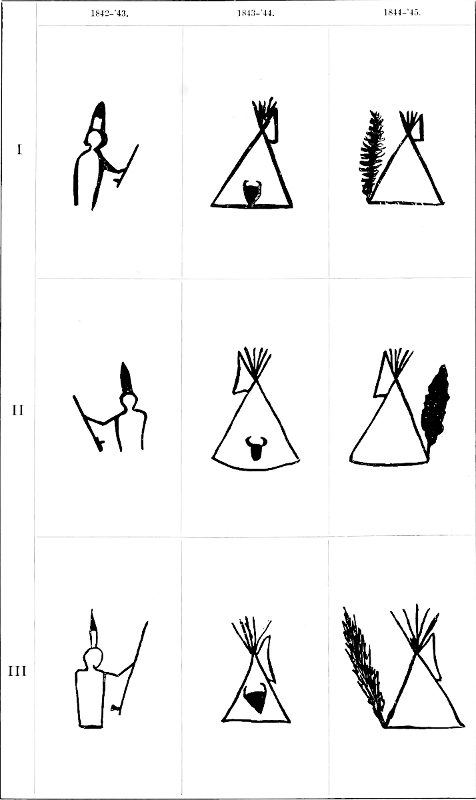
BUREAU OF ETHNOLOGY FOURTH ANNUAL REPORT PL. XXIII
1842-’43.
1842-’44.
1844-’45.
THE DAKOTA WINTER COUNTS.
1842-’43.—No. I. A Minneconjou chief tries to make war. The tip of the feather is black. No red in it.
No. II. One-Feather raised a large war party against the Crows. This chief is designated by his long solitary red eagle feather, and holds a pipe with black stem and red bowl, alluding to the usual ceremonies before starting on the war path. For further information on this subject see page 139. The Red-War-Eagle-Feather was at this time a chief of the Sans Arcs.
No. III. Feather-in-the-Ear made a feast, to which he invited all the young Dakota braves, wanting them to go with him. A memorandum is added that he failed to persuade them. See Corbusier Winter Counts for same year, page 141.
Mato Sapa says: The same man (referring to last year), Feather-in-the-Ear, made a feast inviting all Dakota young men to go to war.
Major Bush says same as Mato Sapa.
1843-’44.—No. I. Buffalo is scarce; an Indian makes medicine and brings them to the suffering.
No. II. The Sans Arcs made medicine to bring the buffalo. The medicine tent is denoted by a buffalo’s head drawn on it.
No. III. No buffalo; Indians made medicine to the Great Spirit by painting a buffalo’s head on lodge; plenty came.
Mato Sapa says: Dakotas were starving; made medicine to Great Spirit by painting buffalo head on their lodges; plenty came.
Major Bush substantially same as Mato Sapa.
1844-’45.—No. I. Mandans wintered in Black Hills.
No. II. The Minneconjous built a pine fort. Device: A pine tree connected with a tipi.
No. III. Unusually heavy snow; had to build corrals for ponies.
Major Bush says: Heavy snow, in which many of their ponies perished.
Probably the Indians went into the woods and erected their tipis there as protection from the snow, thus accounting for the figure of the tree.
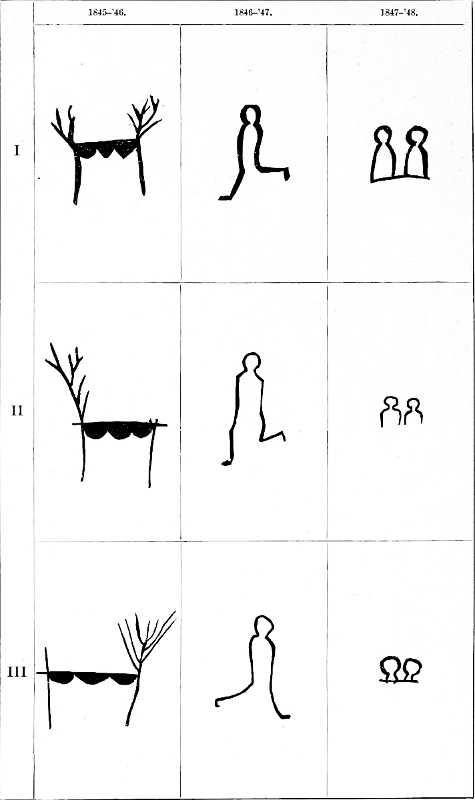
BUREAU OF ETHNOLOGY FOURTH ANNUAL REPORT PL. XXIV
1845-’46.
1846-’47.
1847-’48.
THE DAKOTA WINTER COUNTS.
1845-’46—No. I. Dakotas have much feasting at Ash Point, 20 miles above Fort Sully.
No. II. Plenty of buffalo meat, which is represented as hung upon poles and trees to dry.
No. III. Immense quantities of buffalo meat.
1846-’47.—No. I. Broken-Leg dies.
No. II. Broken-Leg died. Rev. Dr. Williamson says he knew him. He was a Brulé. There is enough difference between this device and those for 1808-’09 and 1832-’33 to distinguish each.
No. III. A Minneconjou Dakota named Broken-Leg died.
Battiste Good calls this: “The-Teal-broke-his-leg winter.” The arm in his character, given in Figure 45, is lengthened so as nearly to touch the broken leg, which is shown distorted, instead of indicating the injury by the mere distortion of the leg itself as in the charts on Plate XXIV. The bird over the head and connected by a line with it, probably represents the teal as a name-totem. He was perhaps called Broken-Leg after the injury, or perhaps the other interpreters did not remember his name, only the circumstance.
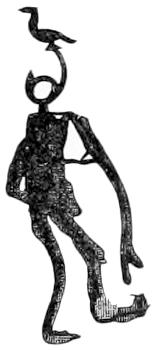
Fig. 45.—The-Teal-broke-his-leg.
Mato Sapa says: A Minneconjou named Broken-Leg died.
The Corbusier records for 1847-’48 refer to a number of accidents by which legs were broken. See page 142.
1847-’48—No. I. Mandans kill two Minneconjous.
No. II. Two-Man was killed. His totem is drawn—two small man-figures side by side.
No. III. Two Minneconjou Dakotas killed by the Assiniboine Indians.
Major Bush says: the wife of an Assiniboine chief named Big-Thunder had twins.
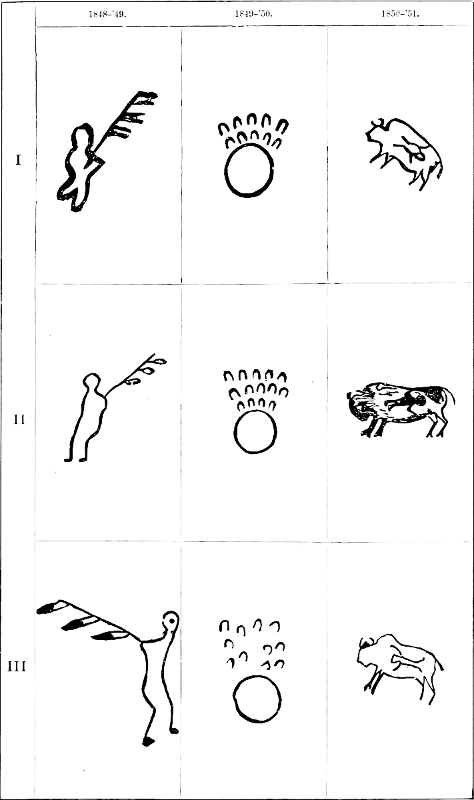
BUREAU OF ETHNOLOGY FOURTH ANNUAL REPORT PL. XXV
1848-’49.
1849-’50.
1850-’51.
THE DAKOTA WINTER COUNTS.
1848-’49.—No. I. Humpback, a Minneconjou, killed.
No. II. Humpback was killed. An ornamented lance pierces the distorted back.
No. III. A Minneconjou Dakota named Broken-Back was killed by the Crow Indians at Black Hills.
Major Bush says: A Minneconjou, Broken-Back, was killed by Crows.
1849-’50.—No. I. Crows steal all the Dakotas’ horses.
No. II. The Crows stole a large drove of horses (it is said eight hundred) from the Brulés. The circle may denote multitude, at least one hundred, but probably is a simple design for a camp or corral from which a number of horse-tracks are departing.
No. III. Crow Indians stole two hundred horses from the Minneconjou Dakotas near Black Hills.
Interpreter A. Lavary says: Brulés were at the headwaters of White River, about 75 miles from Fort Laramie, Wyoming. The Dakotas surprised the Crows in 1849, killed ten, and took one prisoner, because he was a man dressed in woman’s clothes, and next winter the Crows stole six hundred horses from the Brulés. See page 142.
1850-’51.—No. I. Cow with old woman in her belly. Cloven hoof not shown.
No. II. The character is a distinct drawing of a buffalo containing a human figure. Clément translated that “a buffalo cow was killed in that year, and an old woman found in her belly”; also that all the Indians believed this. Good-Wood, examined through another interpreter, could or would give no explanation, except that it was “about their religion.” At first the writer suspected that the medicine men had manufactured some pretended portent out of a fœtus taken from a real cow, but the Dakotas have long believed in the appearance from time to time of a monstrous animal that swallows human beings. This superstition was perhaps suggested by the bones of mastodons, often found in the territory of those Indians; and the buffalo being the largest living animal known to them, its name was given to the legendary monster, in which nomenclature they were not wholly wrong, as the horns of the fossil Bison latifrons are 10 feet in length. The medicine men, perhaps, announced, in 1850, that a squaw who had disappeared was swallowed by the mammoth, which was then on its periodical visit, and must be propitiated.
No. III. A Minneconjou Dakota, having killed a buffalo cow, found an old woman inside of her.
Memorandum from interpreter: A small party of Dakotas, two or three young men, returning unsuccessful from a buffalo hunt, told this story, and it is implicitly believed by the Dakotas.
Major Bush suggests that perhaps some old squaw left to die sought the carcass of a buffalo for shelter and then died. He has known that to occur.
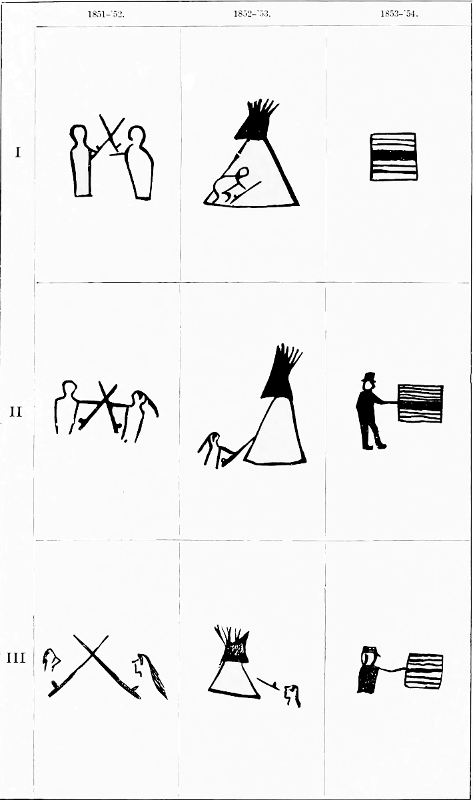
BUREAU OF ETHNOLOGY FOURTH ANNUAL REPORT PL. XXVI
1851-’52.
1852-’53.
1853-’54.
THE DAKOTA WINTER COUNTS.
1851-’52.—No. I. Peace made with the Crows.
No. II. Peace with the Crows. Two Indians, with differing arrangement of hair, showing two tribes, are exchanging pipes for a peace-smoke.
No. III. Dakotas made peace with the Crow Indians. It was, as usual, broken immediately.
The treaty of Fort Laramie was in 1851.
1852-’53.—No. I. A Crow chief, Flat-Head, comes into the tipi of a Dakota chief, where a council was assembled, and forces them to smoke the pipe of peace. This was a daring act, for he was in danger of immediate death if he failed.
No. II. The Nez Percés came to Lone-Horn’s lodge at midnight. The device shows an Indian touching with a pipe a tipi, the top of which is black or opaque, signifying night. The Nez Percés are so styled by a blunder of the early travelers, as they never have been known to pierce their noses, although others of their family, the Sahaptin, do so. The tribe was large, dwelling chiefly in Idaho.
No. III. An enemy came into Lone-Horn’s lodge during a medicine feast and was not killed. (The enemy numbered about fourteen and had lost their way in a snow-storm.) The pipe is not in the man’s hand, and the head only is drawn with the pipe between it and the tipi.
Mato Sapa says: Several strange Indians came into the Dakota camp, were saved from being killed by running into Lone-Horn’s lodge.
Major Bush says: An enemy came into Lone-Horn’s lodge during a feast and was not killed.
Touch-the-Clouds, a Minneconjou, son of Lone-Horn, on being shown Chart No. II by the present writer, designated this character as being particularly known to him from the fact of its being his father’s lodge. He remembers all about it from talk in his family, and said it was the Nez Percés who came.
1853-’54.—No. I. Spanish blankets introduced by traders. The blanket is represented without the human figure.
No. II. Spanish blankets were first brought to the country. A fair drawing of one of those striped blankets, held out by a white trader.
No. III. Dakotas first saw the Spanish blankets.
See Corbusier records for 1851-’52, page 142.
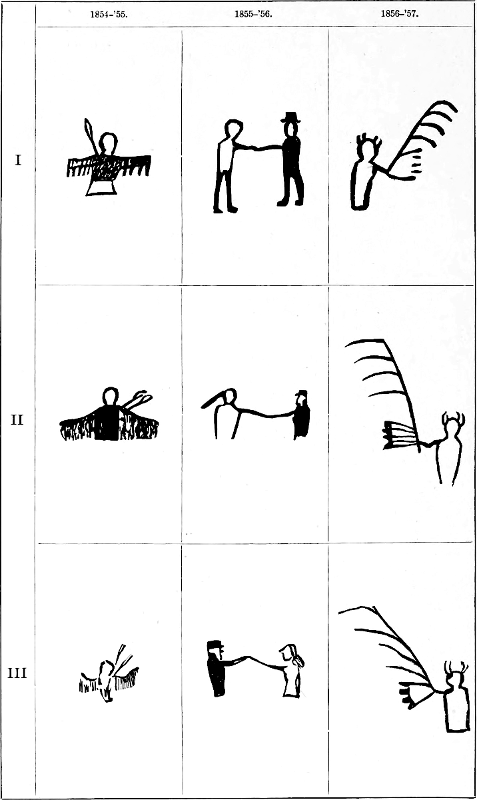
BUREAU OF ETHNOLOGY FOURTH ANNUAL REPORT PL. XXVII
1854-’55.
1855-’56.
1856-’57.
THE DAKOTA WINTER COUNTS.
1854-’55.—No. I. Brave-Bear killed by Blackfeet.
No. II. Brave-Bear was killed. It does not appear certain whether he had already invested in the new style of blanket or whether the extended arms are ornamented with pendent stripes. The latter is more probable.
No. III. A Minneconjou Dakota named Brave-Bear was killed by the Upper Blackfeet. [Satsika?]
See Corbusier winter-counts for the same year, page 143.
1855-’56.—No. I. General Harney (Putin ska) makes a treaty.
No. II. General Harney made peace with a number of the tribes or bands of the Dakotas. This was at Fort Pierre, Dakota. The figure shows an officer in uniform shaking hands with an Indian.
Executive document No. 94, Thirty-fourth Congress, first session, Senate, contains the “minutes of a council held at Fort Pierre, Nebraska, on the 1st day of March, 1856, by Brevet Brig.-Gen. William S. Harney, U. S. Army, commanding the Sioux expedition, with the delegations from nine of the bands of the Sioux, viz., the Two-Kettle band, Lower Yankton, Oncpapas, Blackfeet Sioux, Minneconjous, Sans Arcs, Yanctonnais (two bands), Brulés of the Platte.”
No. III. Dakotas made peace with General Harney (called by them Putinska, white beard or moustache) at Fort Pierre, Dakota.
1856-’57.—No. I. Four-Horns, a great warrior.
No. II. Four-Horn was made a calumet or medicine-man. This was probably the result of an important political struggle, as there is much rivalry and electioneering for the office, which, with its triple character of doctor, priest, and magician, is one of far greater power than the chieftainship. A man with four horns holds out the same kind of ornamented pipe-stem shown in the character for 1804-’05, it being his badge of office. Four-Horn was one of the subchiefs of the Uncpapas, and was introduced to General Harney at the council of 1856 by Bear-Rib, head chief of that tribe.
No. III. A Minneconjou Dakota, named Red-Fish’s-Son, danced calumet dance.
Mato Sapa says the same as last.
Major Bush says, “A Minneconjou, Red-Fish’s-Son, The-Ass, danced the Four-Horn calumet.”
Interpreter Clément, in the spring of 1874, said that Four-Horn and Sitting-Bull were the same person, the name Sitting-Bull being given him after he was made a calumet man. No other authority tells this.
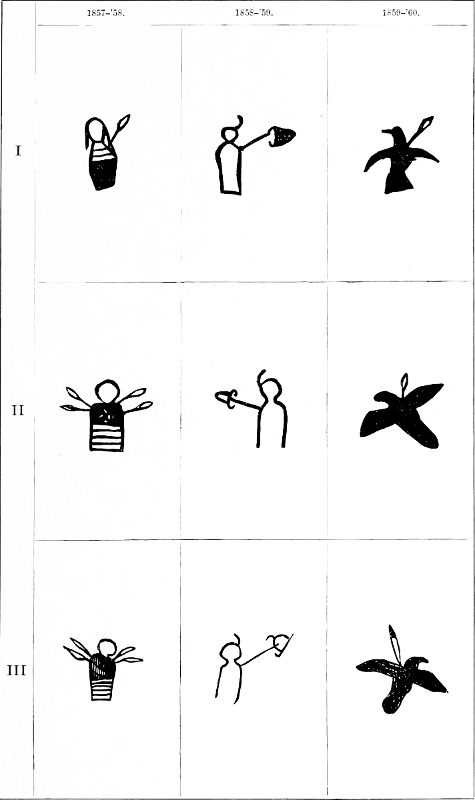
BUREAU OF ETHNOLOGY FOURTH ANNUAL REPORT PL. XXVIII
1857-’58.
1858-’59.
1859-’60.
THE DAKOTA WINTER COUNTS.
1857-’58.—No. I. White-Robe kills a Crow woman. There is but one arrow and one blood spot in the character.
No. II. The Dakotas killed a Crow squaw. The stripes on the blanket are shown horizontally, Brave-Bear’s, 1854-’55, and Swan’s, 1866-’67, being vertical. She is pierced by four arrows, and the peace made with the Crows in 1851-’52 seems to have been short lived.
No. III. A party of Crow Indians, while on a visit to the Dakotas, had one of their number killed by a young Dakota. The figure has blood from the four arrows running down each side of the body.
Mato-Sapa says: A Crow was killed by a Dakota while on a visit to the latter.
Major Bush says substantially the same as Mato Sapa.
1858-’59.—No. I. Lone-Horn makes medicine. “At such times Indians sacrifice ponies, etc., and fast.” In this character the buffalo-head is black.
No. II. Lone-Horn, whose solitary horn appears, made buffalo medicine, probably on account of the scarcity of that animal. Again the head of an albino bison. One-Horn, doubtless the same individual, is recorded as the head chief of the Minneconjous at this date.
No. III. A Minneconjou chief, named Lone-Horn, made medicine with white buffalo-cow skin.
Lone-Horn, chief of Minneconjous, died in 1874, in his camp on the Big Cheyenne.
1859-’60.—No. I. Big-Crow killed.
No. II. Big-Crow, a Dakota chief, was killed by the Crows. The crow, transfixed by an arrow, is drawn so as to give quite the appearance of an heraldic crest.
No. III. A Minneconjou Dakota, named Big-Crow, was killed by the Crow Indians. He had received his name from killing a Crow Indian of unusual size.
Mato Sapa says: Big-Crow, a Minneconjou, was killed by Crows.
Major Bush says same as Mato Sapa.
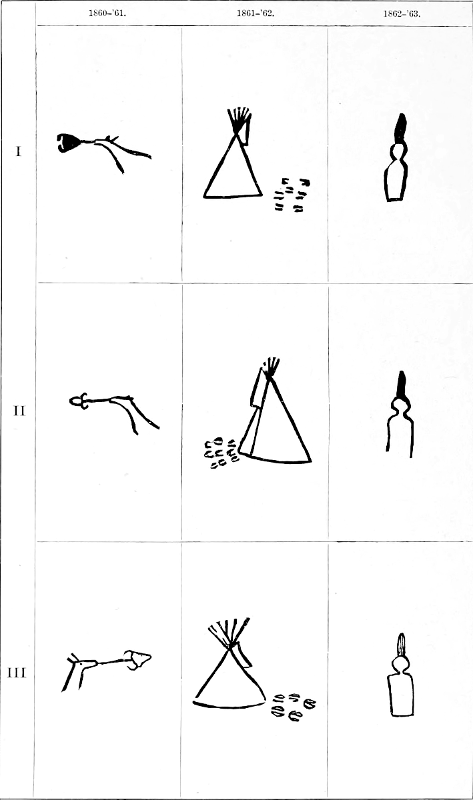
BUREAU OF ETHNOLOGY FOURTH ANNUAL REPORT PL. XXIX
1860-’61.
1861-’62.
1862-’63.
THE DAKOTA WINTER COUNTS.
1860-’61.—No. I. The-Elk-who-shows himself-when-he-walks makes medicine.
No. II. Device, the head and neck of an elk, like that part of the animal in 1837-’38, with a line extending from its mouth, at the extremity of which is the albino buffalo-head. “The elk made you understand his voice while he was walking.” The interpreter persisted in this oracular rendering, probably not being able to fully catch the Indian explanation from want of thorough knowledge of the language. The ignorance of professed interpreters, who easily get beyond their philological depth, but are ashamed to acknowledge it, has occasioned many official blunders. This device and its interpretation were unintelligible to the writer until examination of General Harney’s report above referred to showed the name of a prominent chief of the Minneconjous, set forth as “The-Elk-that-Hollows-Walking.” It then became probable that the device simply meant that the aforesaid chief made buffalo medicine, which conjecture, published in 1877, the other records subsequently discovered verified.
No. III. A Minneconjou Dakota, named Red-Fish’s-Son, made medicine with white buffalo-cow skin.
Mato Sapa’s record agrees with No. III.
Major Bush says the same, adding, after the words “Red-Fish’s-Son,” “The-Ass.”
Interpreter A. Lavary said, in 1867, that The-Elk-that-Hollows-Walking, then chief of the Minneconjous, was then at Spotted-Tail’s camp. His father was Red-Fish. He was the elder brother of Lone-Horn. His name is given as A-hag-a-hoo-man-ie, translated The Elk’s-Voice-Walking, compounded of He-ha-ka, elk, and Omani, walk—this according to Lavary’s literation. The correct literation of the Dakota word meaning elk is heqaka; voice ho; and to walk, walking, mani. Their compound would be Heqaka ho mani, the translation being the same as above given.
1861-’62.—No. I. Buffalo very plenty.
No. II. Buffalo were so plenty that their tracks came close to the tipis. The cloven hoof-mark is cleverly distinguished from the tracks of horses in the character for 1849-’50.
No. III. Dakotas had unusual abundance of buffalo.
1862-’63.—No. I. Red-Plume kills an enemy.
No. II. Red-Feather, a Minneconjou, was killed. His feather is shown entirely red, while the “one-feather” in 1842-’43 has a black tip.
No. III. A Minneconjou Dakota killed an Assiniboine named Red-Feather.
Mato Sapa says: Minneconjous kill an Assiniboine named Red-Feather.
Major Bush agrees with Mato Sapa.
It is to be noted that there is no allusion to the great Minnesota massacre, which commenced in August, 1862, and in which many of the Dakotas belonging to the tribes familiar with these charts, were engaged. Little-Crow was the leader. He escaped to the British possessions, but was killed in July, 1863. Perhaps the reason of the omission of any character to designate the massacre, was the terrible retribution that followed it, beginning with the rout by Colonel Sibley, on September 23, 1862. The Indian captives amounted in all to about eighteen hundred. A military commission sentenced three hundred and three to be hanged and eighteen to imprisonment for life. Thirty-eight were actually hanged, December 26, 1862, at Camp Lincoln.
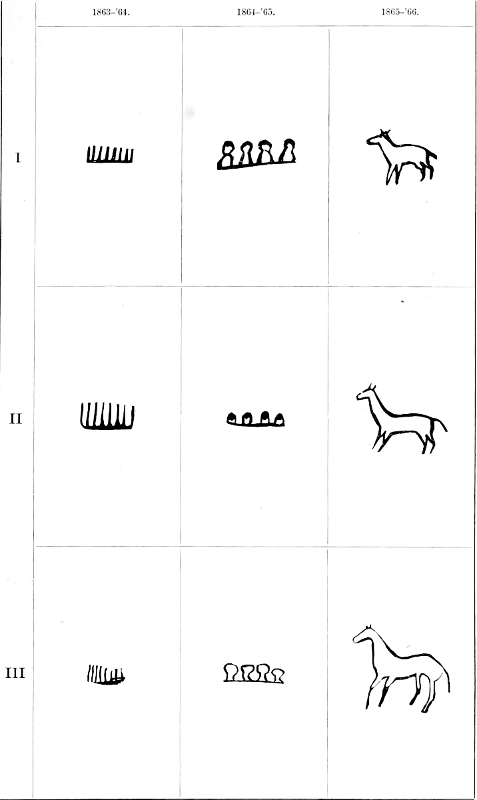
BUREAU OF ETHNOLOGY FOURTH ANNUAL REPORT PL. XXX
1863-’64.
1864-’65.
1865-’66.
THE DAKOTA WINTER COUNTS.
1863-’64.—No. I. Crows kill eight Dakotas on the Yellowstone.
No. II. Eight Dakotas were killed. Again the short parallel black lines united by a long stroke. In this year Sitting Bull fought General Sully in the Black Hills.
Interpreter Lavary says General Sully killed seven or eight Crows at The-Place-They-Shot-The-Deer, Ta-cha-con-té, about 90 miles southwest of Fort Rice, Dakota. Mulligan says that General Sully fought the Yanktonnais and the Santees at that place.
No. III. Eight Minneconjou Dakotas killed by Crow Indians.
See Corbusier Winter Counts for same year, page 144.
1864-’65.—No. I. Four Crows caught stealing horses from the Dakotas were tortured to death. Shoulders shown.
No. II. The Dakotas killed four Crows. Four of the same rounded objects, like several heads, shown in 1825-’26, but these are bloody, thus distinguishing them from the cases of drowning.
No. III. Four Crow Indians killed by the Minneconjou Dakotas. Necks shown.
1865-’66.—No. I. Many horses died.
No. II. Many horses died for want of grass. The horse here drawn is sufficiently distinct from all others in the chart.
No. III. Dakotas lost many horses in the snow.
See Corbusier’s Winter Counts, No. II for same year, page 144.
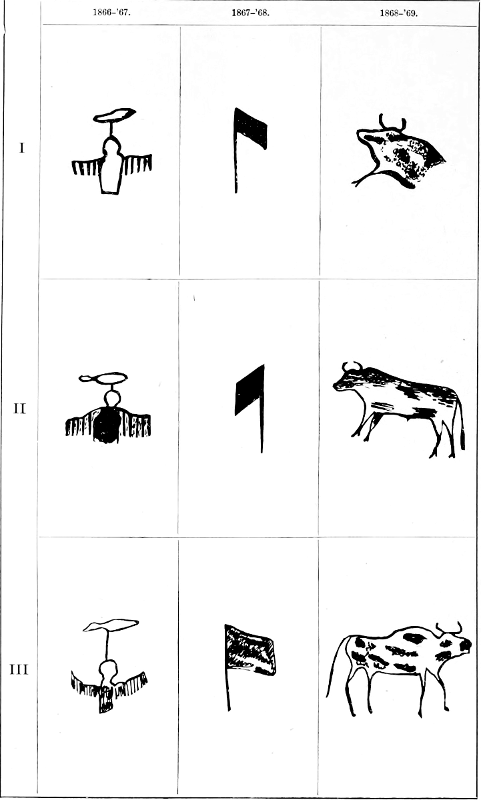
BUREAU OF ETHNOLOGY FOURTH ANNUAL REPORT PL. XXXI
1866-’67.
1867-’68.
1868-’69.
THE DAKOTA WINTER COUNTS.
1866-’67.—No. I. Little Swan, a great warrior.
No. II. Swan, father of Swan, chief of the Minneconjous in 1877, died. With the assistance of the name the object intended for his totem may be recognized as a swan swimming on the water.
No. III. Minneconjou Dakota chief, named Swan, died.
Mato Sapa’s record has a better representation of a swan.
Interpreter Lavary says: Little-Swan died in this year on Cherry Creek, 75 miles northwest of Fort Sully.
Major Bush says this is historically correct.
1867-’68.—No. I. Much medicine made.
No. II. Many flags were given them by the Peace Commission. The flag refers to the visit of the Peace Commissioners, among whom were Generals Sherman, Terry, and other prominent military and civil officers. Their report appears in the Annual Report of the Commissioner of Indian Affairs for 1868. They met at Fort Leavenworth, August 13, 1867, and between August 30 and September 13 held councils with the various bands of the Dakota Indians at Forts Sully and Thompson, and also at the Yankton, Ponka, and Santee Reservations. These resulted in the great Dakota treaty of 1868.
No. III. Made peace with General Sherman and others at Fort Laramie.
Mato Sapa says: Made peace with General Sherman and others at Fort Laramie.
Major Bush agrees with Mato Sapa.
See Corbusier’s Winter Counts, No. II, page 144.
1868-’69.—No. I. First issue of beef by Government to Indians.
No. II. Texas cattle were brought into the country. This was done by Mr. William A. Paxton, a well-known business man, resident in Dakota in 1877.
No. III. Dakotas had plenty of white men’s cattle (the result of the peace).
Mato Sapa agrees with No. III.
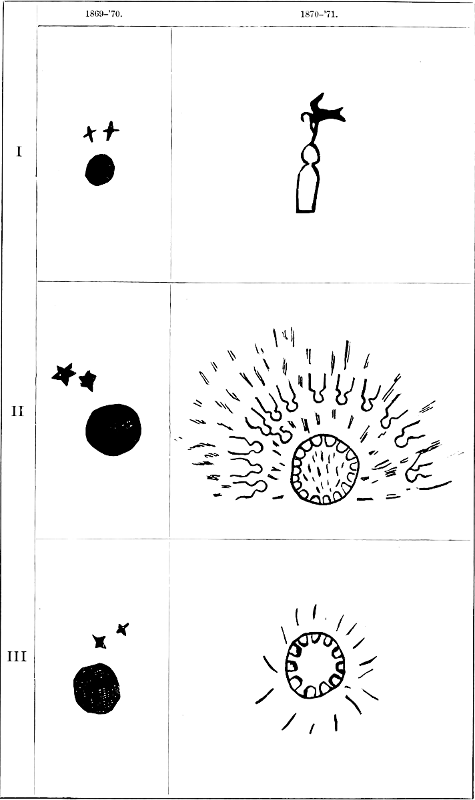
BUREAU OF ETHNOLOGY FOURTH ANNUAL REPORT PL. XXXII
1869-’70.
1870-’71.
THE DAKOTA WINTER COUNTS.
1869-’70.—No. I. Eclipse of the moon.
No. II. An eclipse of the sun. This was the solar eclipse of August 7, 1869, which was central and total on a line drawn through the Dakota country. This device has been criticised because the Indians believe an eclipse to be occasioned by a dragon or aerial monster swallowing the sun, and it is contended that they would so represent it. An answer is that the design is objectively good, the sun being painted black, as concealed, while the stars come out red, i. e., bright, and graphic illustration prevails throughout the charts where it is possible to employ it. In addition, it is learned that Prof. Cleveland Abbé, who was famed as an astronomer before he became so as a meteorologist, was at Sioux Falls, with a corps of assistants, to observe this very eclipse, and explained the subject to a large number of Indians there at that time, so that their attention was not only directed specially to that eclipse, but also to the white men as interested in it, and to its real appearance as apart from their old superstition.
In addition to this fact, Dr. Washington Matthews, assistant surgeon United States Army, communicates the statement that the Indians had numberless other opportunities all over their country of receiving the same information. He was at Fort Rice during the eclipse and remembers that long before the eclipse occurred the officers, men, and citizens around the post told the Indians of the coming event and discussed it with them so much that they were on the tip-toe of expectancy when the day came. Two-Bears and his band were then encamped at Fort Rice, and he and several of his leading men watched the eclipse along with the whites and through their smoked glass, and then and there the phenomenon was thoroughly explained to them over and over again. There is no doubt that similar explanations were made at all the numerous posts and agencies along the river that day. The path of the eclipse coincided nearly with the course of the Missouri for over a thousand miles. The duration of totality at Fort Rice was nearly two minutes (1m 48s.)
No. III. Dakotas witnessed eclipse of the sun; frightened terribly.
It is remarkable that the Corbusier Winter Counts do not mention this eclipse.
1870-’71.—No. I. The-Flame’s son killed by Rees. The recorder, The-Flame, evidently considered his family misfortune to be of more importance than the battle referred to by the other recorders.
No. II. The Uncpapas had a battle with the Crows, the former losing, it is said, 14 and killing 29 out of 30 of the latter, though nothing appears to show those numbers. The central object in the symbol is not a circle denoting multitude, but an irregularly rounded object, clearly intended for one of the wooden inclosures or forts frequently erected by the Indians, and especially the Crows. The Crow fort is shown as nearly surrounded, and bullets, not arrows or lances, are flying. This is the first instance in which any combat or killing is portrayed where guns explicitly appear to be used by Indians, though nothing in the chart is at variance with the fact that the Dakotas had for a number of years been familiar with fire arms. The most recent indications of any weapon were those of the arrows piercing the Crow squaw in 1857-’58 and Brave-Bear in 1854-’55, while the last one before them was the lance used in 1848-’49, and those arms might well have been employed in all the cases selected for the calendar, although rifles and muskets were common. There is also an obvious practical difficulty in picturing by a single character killing with a bullet, not arising as to arrows, lances, dirks, and hatchets, all of which can be and are in the chart shown projecting from the wounds made by them. Pictographs in the possession of the Bureau of Ethnology show battles in which bullets are denoted by continuous dotted lines, the spots at which they take effect being sometimes indicated. It is, however, to be noted that the bloody wound on the Ree’s shoulder (1806-’07) is without any protruding weapon, as if made by a bullet.
No. III. A Crow war party of 30 were surprised and surrounded in the Black Hills by the Dakotas and killed. Fourteen of the Dakotas were killed in the engagement.
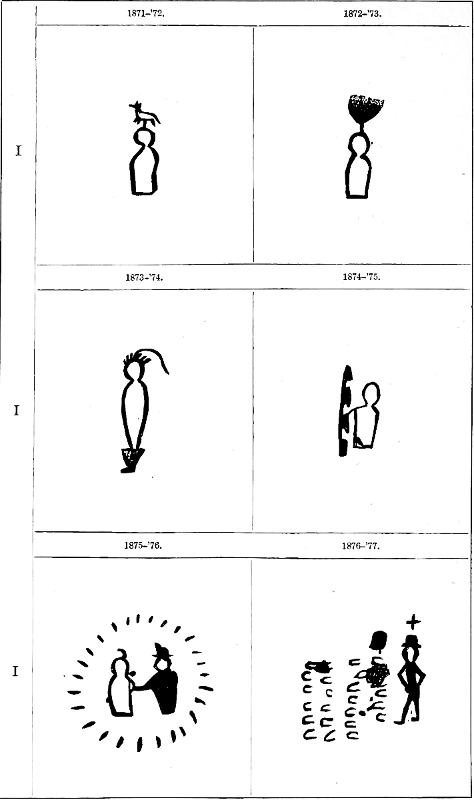
BUREAU OF ETHNOLOGY FOURTH ANNUAL REPORT PL. XXXIII
1871-’72.
1872-’73.
1873-’74.
1874-’75.
1875-’76.
1876-’77.
THE DAKOTA WINTER COUNTS.
1871-’72.—No. I. The-Flame’s second son killed by Rees.
1872-’73.—No. I. Sans-Arc-John killed by Rees.
1873-’74.—No. I. Brulés kill a number of Pawnees.
Cloud-Shield says they killed many Pawnees on the Republican River.
1874-’75.—No. I. A Dakota kills one Ree.
1875-’76.—No. I. Council at Spotted Tail Agency.
1876-’77.—No. I. Horses taken by United States Government.
White-Cow-Killer calls it “General-Mackenzie-took-the-Red-Cloud-Indians’-horses-away-from-them winter.”
In the account of Lone-Dog’s chart, published in 1877, as above mentioned, the present writer, on the subject of the recorder’s selection of events, remarked as follows:
“The year 1876 has furnished good store of events for his choice, and it will be interesting to learn whether he has selected as the distinguishing event the victory over Custer, or, as of still greater interest, the general seizure of ponies, whereat the tribes, imitating Rachel, weep and will not be comforted, because they are not.”
It now appears that two of the counts have selected the event of the seizure of the ponies, and none of them yet seen make any allusion to the defeat of Custer.
After examination of the three charts it will be conceded that, as above stated, the design is not narrative, the noting of events being subordinated to the marking of the years by them, and the pictographic serial arrangements of sometimes trivial, though generally notorious, incidents, being with special adaptation for use as a calendar. That in a few instances small personal events, such as the birth or death of the recorder or members of his family, are set forth, may be regarded as in the line of interpolations in or unauthorized additions to the charts. If they had exhibited a complete national or tribal history for the years embraced in them, their discovery would have been, in some respects, more valuable, but they are the more interesting to ethnologists because they show an attempt, before unsuspected among the tribes of American Indians, to form a system of chronology.
THE CORBUSIER WINTER COUNTS.
While the present paper was in preparation, a valuable and elaborate communication was received from Dr. William H. Corbusier, assistant surgeon, United State Army, styled by him the Dakota Winter Counts, which title was adopted for the whole subject-matter, including the charts with their interpretations which had before been known to the present writer, and those from Dr. Corbusier, which furnish a different system, are distinguished by his name. It is necessary to explain that all references in the text to colors, other than black, must be understood as applicable to the originals. Other colors could not be reproduced in the plates without an expense disproportionate to the importance of the colors for significance and comprehension.
A more important explanation is due on account of the necessity to omit from Dr. Corbusier’s contribution the figures of Battiste Good’s count and their interpretation. This count is in some respects the most important of all those yet made known. As set down by Battiste Good, it begins in a peculiar cyclic computation with the year A. D. 900, and in thirteen figures includes the time to A.D. 1700, all these figures being connected with legends and myths, some of which indicate European influence. From 1700-’01 to 1879-’80 a separate character for each year is given, with its interpretation, in a manner generally similar to those in the other charts. Unfortunately all of these figures are colored, either in whole or in large part, five colors being used besides black, and the drawing is so rude that without the colors it is in many cases unintelligible. The presentation at this time of so large a number of colored figures—in all one hundred and ninety-three—in addition to the other illustrations of the present paper, involved too great expense. It is hoped that this count can be so far revised, with the elimination of unessential coloration and with more precision in the outlines, as to allow of its publication. Several of its characters, with references also to its interpretation when compared with that of other counts, are given in various parts of the present paper. Where it was important to specify their coloration the heraldic scheme has been used.
The pages immediately following contain the contribution of Dr. Corbusier, diminished by the extraction of the parts comprising Battiste Good’s count. Its necessary omission, as above explained, is much regretted, not only on account of its intrinsic value, but because without it the work of Dr. Corbusier does not appear to all the advantage merited by his zeal and industry.
The Dakotas reckon time by winters, and apply names to them instead of numbering them from an era. Each name refers to some notable occurrence of the winter or year to which it belongs, and has been agreed upon in council on the expiration of the winter. Separate bands have often fixed upon different events, and it thus happens that the names are not uniform throughout the nation. Ideographic records of these occurrences have been kept in several bands for many years, and they constitute the Dakota Winter-Counts (waníyetu wówapi) or Counts Back (hékta yawapi). They are used in computing time, and to aid the memory in recalling the names and events of the different years, their places in the count, and their order of succession. The enumeration of the winters is begun at the one last recorded and carried backward. Notches on sticks, war-shirts, pipes, arrows, and other devices also serve a mnemonic purpose. The Counts were formerly executed in colors on the hides of animals, but the present recorders make use of paper, books, pens, pencils, and paints obtained from the whites. The alignment of the ideographs depends to some extent upon the material on which they are depicted. On robes it is spiral from right to left and from the center outward, each year being added to the coil as the snail adds to its whorl. The spiral line, frequently seen in etchings on rocks, has been explained to me as indicating a snail shell. On paper they are sometimes carried from right to left, sometimes from left to right, and again the two methods are combined as in Battiste Good’s winter-count, which begins at the back of the book and is carried forward, i. e., from right to left, but in which the alignment on each page is from left to right. The direction from right to left is that followed in many of their ceremonies, as when tobacco is smoked as incense to the sun and the pipe is passed around, and when the devotees in the dance to the sun enter and leave the consecrated lodge in which they fulfill their vows.
Among the Oglálas and the Brulés there are at least five of these counts kept by as many different men, each man seeming to be the recorder for his branch of the tribe. I obtained copies of three of them in 1879 and 1880, while stationed at Camp Sheridan, Nebraska, near the Pine Ridge Agency, Dakota. One winter count was made for me by Battiste Good, a Brulé Dakota, at the Rosebud Agency, Dakota, being a copy of the one of which he is the recorder. He explained the meaning of the pictographs to the Rev. William J. Cleveland, of the Rosebud Agency, to whom I am indebted for rendering his explanations into English. Several Indians and half-breeds had informed me that his count formerly embraced about the same number of years as the other two, but that Battiste Good gathered the names of many years from the old people and placed them in chronological order as far back as he was able to learn them.
Another winter count is a copy of the one in the possession of American-Horse, an Oglála Dakota, at the Pine Ridge Agency, who asserts that his grandfather began it, and that it is the production of his grandfather, his father, and himself. I received the explanations from American-Horse through an interpreter.
A third winter count is a copy of one kept by Cloud-Shield. He is also an Oglála Dakota at the Pine Ridge Agency, but of a different band from American-Horse. I also received his explanations through an interpreter. The last two counts embrace nearly the same number of years. I have added the dates to both of them, beginning at the last year, the date of which was known, and carrying them back. Two dates belong to each figure, as a Dakota year covers a portion of two of our calendar years.
I have seen copies of a fourth winter count which is kept by White-Cow-Killer at the Pine Ridge Agency. I did not obtain a copy of it, but learned most of the names given to the winters.
On comparing the winter counts, it is found that they often correspond, but more frequently differ. In a few instances the differences are in the succession of the events, but in most instances they are due to an omission or to the selection of another event. When a year has the same name in all of them, the bands were probably encamped together or else the event fixed upon was of general interest; and, when the name is different, the bands were scattered or nothing of general interest occurred. Differences in the succession may be due to the loss of a record and the depiction of another from memory, or to errors in copying an old one.
The explanations of the counts are far from complete, as the recorders who furnished them could in many instances recall nothing except the name of the year, and in others were loth to speak of the events or else their explanations were vague and unsatisfactory, and, again, the interpreters were sometimes at fault. Many of the recent events are fresh in the memory of the people, as the warriors who strive to make their exploits a part of the tribal traditions proclaim them on all occasions of ceremony—count their coups, as it is called. Declarations of this kind partake of the nature of affirmations made in the presence of God. War-shirts on which scores of the enemies killed are kept, and which are carefully transmitted from one generation to another, help to refresh their memories in regard to some of the events. By testing many Indians I learned that but few could interpret the significance of the figures; some of them could point out the year of their birth and that of some members of their families; others could not do so, or pretended that they could not, but named the year and asked me to point it out and tell their age.
In the following explanation of the winter counts, [figured on Plates XXXIV-LI,] No. I refers to that of American-Horse and No. II to that of Cloud-Shield.
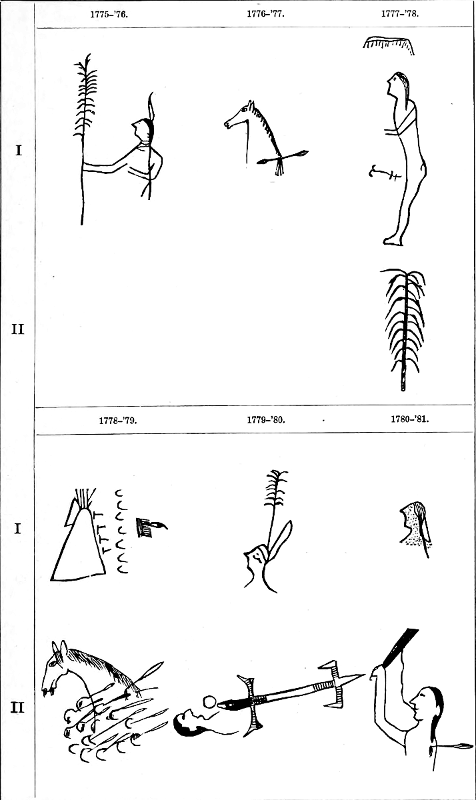
BUREAU OF ETHNOLOGY FOURTH ANNUAL REPORT PL. XXXIV
1775-’76.
1776-’77.
1777-’78.
1778-’79.
1779-’80.
1780-’81.
THE CORBUSIER WINTER COUNTS.
1775-’76.—No. I. Standing-Bull, the great-grandfather of the present Standing-Bull, discovered the Black Hills. He carried home with him a pine tree of a species he had never seen before. (In this count the Dakotas are usually distinguished by the braided scalp-lock and the feather they wear at the crown of the head, or by the manner in which they brush back and tie the hair. It will be noticed that the profile of most of the faces is given, whereas Battiste Good gives the full face. The Dakotas have of late years claimed the Black Hills, probably by right of discovery in 1775-’76; but the Crows were the former possessors.)
This is also the first winter of White-Cow-Killer’s count and is called “Two-warriors-killed winter.”
1776-’77.—No. I. Many of their horses were killed by some of their own people, who were jealous because they were fatter than their own.
1777-’78.—No. I. It was an intensely cold winter, and the Man-who-has-no-skin-on-his-penis froze to death. The sign for snow or winter, i. e., a cloud with snow falling from it, is above his head. A haka-stick, which, in playing that game, they cast after a ring, is represented in front of him.
Battiste Good’s record is that a Dakota named Skinned-Penis was killed in a fight with the Pawnees, and his companions left his body where they supposed it would not be found, but the Pawnees found it, and as it was frozen stiff, they dragged it into their camp and played haka with it.
No. II. A war party brought in the lone pine tree from the enemy’s country. They met no enemies while out. This event is also the first in No. I, in which it marks the winter of 1775-’76.
1778-’79.—No. I. The Ponkas came and attacked a village, notwithstanding peace had just been made with them. The people repulsed and followed them, killing sixty. Some elk-hair and a feather represent Ponka. Horse tracks are used for horses. Attack is indicated by signs which were said to represent bullet marks, and which convey the idea that the bullet struck. The sign seems to be derived from the gesture-sign for “it struck.”
No. II. Many of their horses were killed, but by whom is not known. The same event is recorded in No. I, 1776-’77.
1779-’80.—No. I. Long-Pine was killed in a fight with the Crows. The absence of his scalp denotes that he was killed by an enemy. The wound was made with the bow and arrow.
No. II. Skinned-his-penis was used in the ring-and-pole game.
1780-’81.—No. I. Many died of small-pox.
No. II. “The policeman” was killed by the enemy.
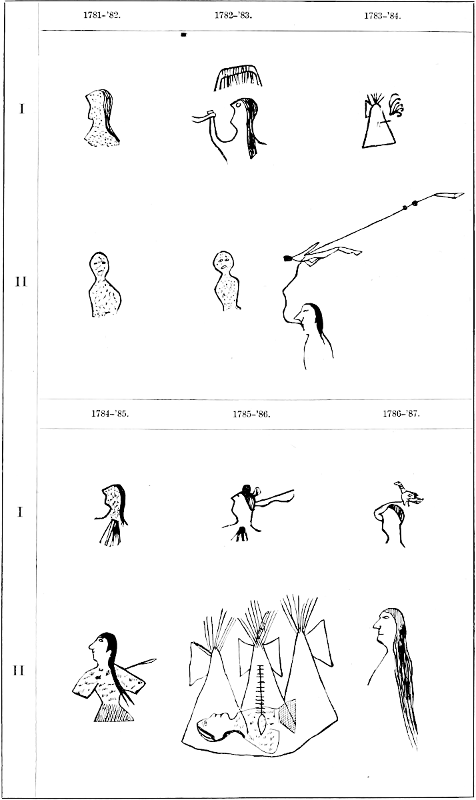
BUREAU OF ETHNOLOGY FOURTH ANNUAL REPORT PL. XXXV
1781-’82.
1782-’83.
1783-’84.
1784-’85.
1785-’86.
1786-’87.
THE CORBUSIER WINTER COUNTS.
1781-’82—No. I. Many died of small-pox.
No. II. Many people died of small-pox. They all record two successive winters of small-pox, but No. I makes the first year of the epidemic one year later than that of Battiste Good, and No. II makes it two years later.
1782-’83.—No. I. A Dakota named Stabber froze to death. The sign for winter is the same as before.
No. II. Many people died of small-pox again.
1783-’84—No. I. The Mandans and Rees made a charge on a Dakota village. The Dakotas drove them back, killed twenty five of them, and captured a boy. An eagle’s tail, which is worn on the head, stands for Mandan and Ree.
No. II. The-Stabber froze to death. The man’s name is suggested by the spear in the body over his head, which is connected with his mouth by a line.
White-Cow-Killer calls it “Big-fire winter,” possibly because big fires were required to keep them warm.
1784-’85.—No. I. A young man who was afflicted with the small-pox, and was in his tipi, off by himself, sang his death-song and shot himself. Suicide is more common among Indians than is generally suspected, and even boys sometimes take their own lives. A Dakota boy at one of the agencies shot himself rather than face his companions after his mother had whipped him, and a Pai-Ute boy at Camp McDermit, Nevada, tried to poison himself with the wild parsnip because he was not well and strong like the other boys. The Pai-Utes usually eat the wild parsnip when bent on suicide.
No. II. An Omaha woman who was living with the Oglálas attempted to run away from them, and they killed her. A war between the two tribes was the result.
1785-’86.—No. I. Bear’s-Ears, a Brulé, was killed in an Oglála village by the Crows.
No. II. The Oglálas killed three lodges of Omahas.
1786-’87.—No. I. Broken-Leg-Duck, an Oglála, went to a Crow village to steal horses and was killed. A line connects the name with the mouth.
No. II. Long-Hair was killed. To what tribe he belonged is not known.
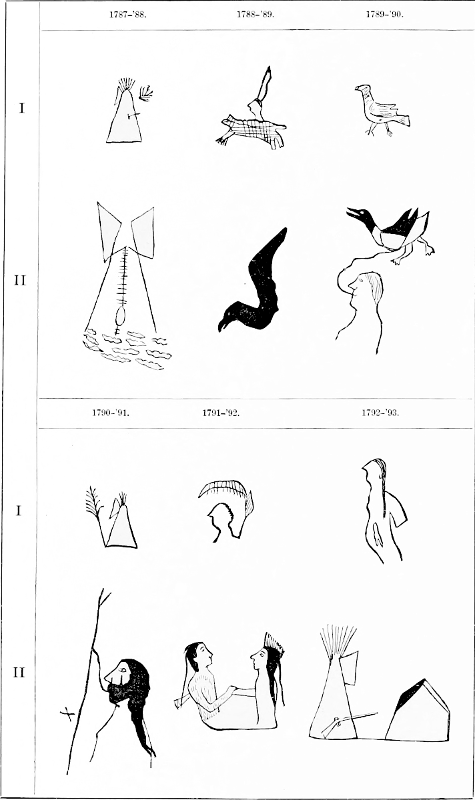
BUREAU OF ETHNOLOGY FOURTH ANNUAL REPORT PL. XXXVI
1787-’88.
1788-’89.
1789-’90.
1790-’91.
1791-’92.
1792-’93.
THE CORBUSIER WINTER COUNTS.
1787-’88.—No. I. They went out in search of the Crows in order to avenge the death of Broken-Leg-Duck. They did not find any Crows, but, chancing on a Mandan village, captured it and killed all the people in it.
No. II. A year of famine. They lived on roots, which are represented in front of the tipi.
1788-’89.—No. I. Last-Badger, an Oglála, was killed by the Rees.
No. II. The winter was so cold that many crows froze to death.
White-Cow-Killer calls 1787-’88 “Many-black-crows-died winter.”
1789-’90.—No. I. The cold was so intense that crows froze in the air and dropped dead near the lodges.
No. II. White-Goose was killed in an attack made by some enemies.
White-Cow-Killer calls it “Goose-Feather-killed winter.”
1790-’91.—No. I. They could not hunt on account of the deep snow, and were compelled to subsist on anything they could get, as herbs (pézi) and roots.
No. II. Picket-Pin went against the Cheyennes. A picket-pin is represented in front of him and is connected with his mouth by the usual line. The black band across his face denotes that he was brave and had killed enemies. The cross is the symbol for Cheyenne. The mark used for Cheyenne stands for the scars on their arms, or stripes on their sleeves, which also gave rise to the gesture sign for this tribe, given in Sign Language among the North American Indians, etc., First Annual Report of the Bureau of Ethnology, p. 465, viz.: Draw the extended right index, or the inner edge of the open right hand, several times across the base of the extended left index or across the left forearm at different heights.
White-Cow-Killer calls it “All-the-Indians-see-the-flag winter.”
1791-’92.—No. I. Glue, an Oglála, froze to death on his way to a Brulé village. A glue-stick is represented back of his head. Glue, made from the hoofs of buffalo, is used to fasten arrow-heads on, and is carried about on sticks.
No. II. The Dakotas and Omahas made peace.
1792-’93.—No. I. Many women died in child-birth.
No. II. The Dakotas camped on the Missouri River near the Gros Ventres and fought with them a long time. The Dakota tipi and the Gros Ventre lodge are shown in the figure.
White-Cow-Killer calls it “Rees-house-winter.”
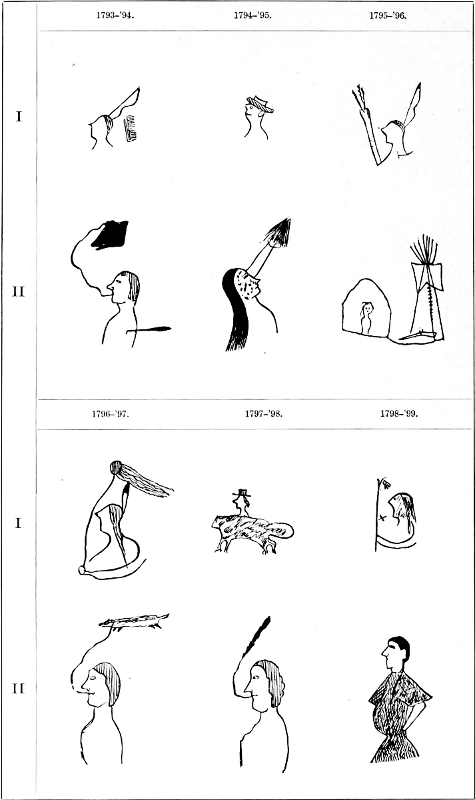
BUREAU OF ETHNOLOGY FOURTH ANNUAL REPORT PL. XXXVII
1793-’94.
1794-’95.
1795-’96.
1796-’97.
1797-’98.
1798-’99.
THE CORBUSIER WINTER COUNTS.
1793-’94.—No. I. A Ponka who was captured when a boy by the Oglálas was killed while outside the village by a war party of Ponkas.
No. II. Bear’s-Ears was killed in a fight with the Rees.
White-Cow-Killer calls it “Little-Face-killed winter.”
1794-’95.—No. I. The-Good-White-Man came with two other white men. He promised that if they would let him and his companions go undisturbed he would return and bring with him weapons with which they could kill game with but little labor. They gave them buffalo robes and dogs to pack them on and sent the party off. The sign for white man is a hat, either by itself or on a head, and the gesture-sign indicates one who wears a hat. Draw the open right hand horizontally from left to right across the forehead a little above the eyebrows, the back of the hand to be upward and the fingers pointing toward the left, or draw the index across the forehead in the same manner.
No. II. Bad-Face, a Dakota, was shot in the face.
White-Cow-Killer calls it “Long-Hair-killed winter.”
1795-’96.—No. I. The-Man-Who-Owns-the-Flute was killed by the Cheyennes. His flute is represented in front of him with sounds coming from it. A bullet mark is on his neck.
No. II. The Dakotas camped near the Rees and fought with them.
White-Cow-Killer calls it “Water-Stomach-killed winter.”
1796-’97.—No. I. They killed the long-haired man in a fight with the Cheyennes while on an expedition to avenge the death of The-Man-Who-Owns-the-Flute, who was killed by the Cheyennes the year before.
No. II. Badger, a Dakota, was killed by enemies, as shown by the absence of his scalp.
White-Cow-Killer calls it “War-Bonnet-killed winter.”
1797-’98.—No. I. Little-Beaver and three other white men came to trade, having been sent by the Good-White-Man. Their goods were loaded on three sleds, each drawn by six dogs.
No. II. The-Wise-Man was killed by enemies.
White-Cow-Killer calls it “Caught-the-medicine-god-woman winter.”
1798-’99.—No. I. Owns-the-Pole, the leader of an Oglála war party, brought home many Cheyenne scalps. The cross stands for Cheyenne.
No. II. Many women died in child-birth.
White-Cow-Killer says, “Many-squaws-died winter.”
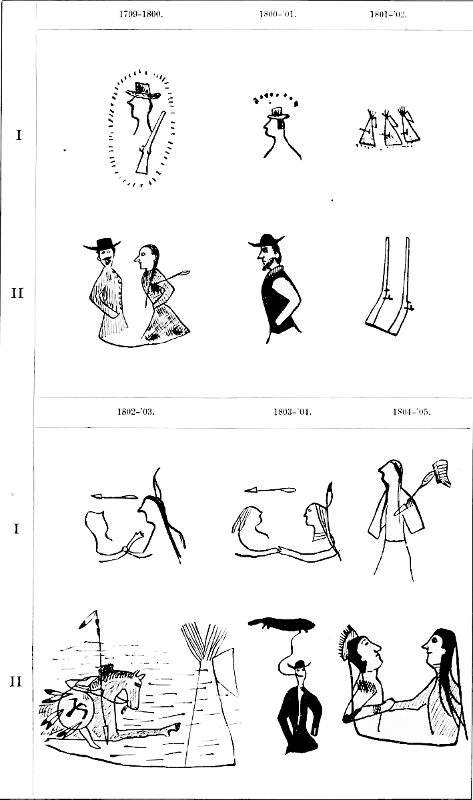
BUREAU OF ETHNOLOGY FOURTH ANNUAL REPORT PL. XXXVIII
1799-1800.
1800-’01.
1801-’02.
1802-’03.
1803-’04.
1804-’05.
THE CORBUSIER WINTER COUNTS.
1799-1800.—No. I. The-Good-White-Man returned and gave guns to the Dakotas. The circle of marks represents the people sitting around him, the flint-lock musket the guns.
No. II. A woman who had been given to a white man by the Dakotas was killed because she ran away from him. [See No. I, 1804-’05.]
White-Cow-Killer says, “The-Good-White-Man-came winter.”
1800-’01.—No. I. Nine white men came to trade with them. The covered head with short hair stands for a white man and also intimates that the eight dots over it are for white men. According to this count the first whites came in 1794-’95.
No. II. The Good-White-Man came. He was the first white man to trade and live with the Dakotas.
White-Cow-Killer calls it “Don’t-Eat-Heart-makes-a-god-house winter.”
1801-’02.—No. I. The Oglálas, Brulés, Minneconjous, Sans Arcs, and Cheyennes united in an expedition against the Crows. They surprised and captured a village of thirty lodges, killed all the men, and took the women and children prisoners. The three tipis stand for thirty; the red spots are for blood.
No. II. A trader brought them their first guns.
White-Cow-Killer says, “All-sick-winter.”
1802-’03.—No. I. The Ponkas attacked two lodges of Oglálas, killed some of the people, and made the rest prisoners. The Oglálas went to the Ponka village a short time afterward and took their people from the Ponkas. In the figure an Oglála has a prisoner by the arm leading him away. The arrow indicates that they were ready to fight.
No. II. The Omahas made an assault on a Dakota village. Arrows and bullets are flying back and forth.
White-Cow-Killer calls it “Brought-in-horse-shoes winter.”
1803-’04—No. I. They made peace with the Gros Ventres.
No. II. Little-Beaver, a white trader, came.
White-Cow-Killer calls it “Plenty-of-woolly-horses winter.”
1804-’05.—No. I. An Indian woman who had been unfaithful to a white man to whom she was married was killed by an Indian named Ponka. The symbol for Ponka indicates the name.
No. II. The Omahas came and made peace to get their people, whom the Dakotas held as prisoners.
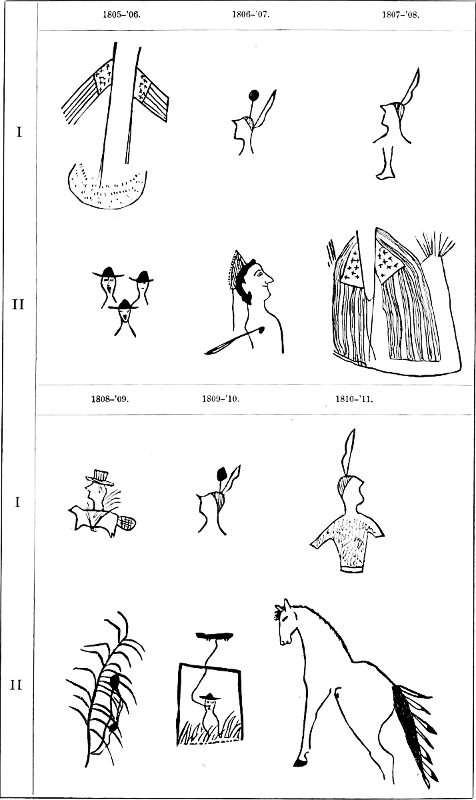
BUREAU OF ETHNOLOGY FOURTH ANNUAL REPORT PL. XXXIX
1805-’06.
1806-’07.
1807-’08.
1808-’09.
1809-’10.
1810-’11.
THE CORBUSIER WINTER COUNTS.
1805-’06.—No. I. The Dakotas had a council with the whites on the Missouri River, below the Cheyenne Agency, near the mouth of Bad Creek (the Lewis and Clarke Expedition?). They had many flags, which the Good-White-Man gave them with their guns, and they erected them on poles to show their friendly feelings. The curved line is to represent the council lodge, which they made by opening several tipis and uniting them at their sides to form a semicircle. The marks are for the people. American-Horse’s father was born this year.
No. II. Nine white men came to trade. The three covered heads represent the white men.
White-Cow-Killer calls it “Eight-Dakotas-killed winter.”
1806-’07.—No. I. Black-Rock, a Dakota, was killed by the Crows. A rock is represented above his head. He was killed with a bow and arrow and was scalped.
No. II. The Dakotas killed an Omaha in the night.
White-Cow-Killer calls it “Killed-while-hunting-eagles winter.”
1807-’08.—No. I. Broken-Leg was killed by the Pawnees. His leg had been broken by a bullet in a previous fight with the Pawnees.
No. II. Many people camped together and had many flags flying.
White-Cow-Killer calls it “Red-shirt-killed Winter.”
1808-’09.—No. I. Little-Beaver’s trading house was burned down.
No. II. A Brulé was found dead under a tree which had fallen on him.
White-Cow-Killer calls it “Blue-Blanket’s-father-dead winter.”
1809-’10.—No. I. Black-Rock was killed by the Crows. His brother, whose name he had taken, was killed by the Crows three years before.
No. II. Little-Beaver’s house was burned.
White-Cow-Killer says, “Little-Beaver’s (the white man) house-burned-down winter.”
1810-’11.—No. I. Red-Shirt, a Dakota, was killed by the Crows while looking for his ponies near Old Woman’s Fork.
No. II. They brought in a fine horse with feathers tied to his tail.
White-Cow-Killer calls it “Came-with-medicine-on-horse’s-tail winter.”
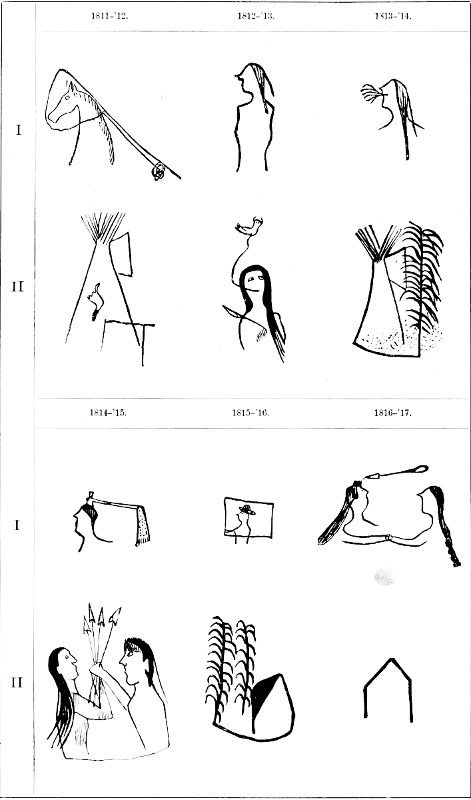
BUREAU OF ETHNOLOGY FOURTH ANNUAL REPORT PL. XL
1811-’12.
1812-’13.
1813-’14.
1814-’15.
1815-’16.
1816-’17.
THE CORBUSIER WINTER COUNTS.
1811-’12.—No. I. They caught many wild horses south of the Platte River.
No. II. They had very little buffalo meat, as the empty drying pole indicates, but plenty of ducks in the fall.
White-Cow-Killer calls it “Catching-wild-horses winter.”
1812-’13.—No. I. Big-Waist’s father killed.
No. II. Big-Owl killed.
White-Cow-Killer calls it “Big-Belly’s-father-killed winter.”
1813-’14.—No. I. Many had the whooping-cough. The cough is represented by the lines issuing from the man’s mouth.
No. II. Food was very scarce and they had to live on acorns. The tree is intended for an oak and the marks beneath it for acorns.
White-Cow-Killer calls it “Six-Rees-killed winter.”
1814-’15.—No. I. The Dakotas went to a Kaiowa village, about 6 miles from Scott’s Bluff, and near the mouth of Horse Creek, to treat for peace; but their intentions were frustrated by one of their number, who drove his hatchet into a Kaiowa’s head.
No. II. They made peace with the Pawnees. The man with the blue forehead is a Pawnee, the other is a Dakota, whose body is smeared with clay. The four arrows show that they had been at war, and the clasped hands denote peace.
White-Cow-Killer calls it “Kaiowa-hit-on-head-with-axe winter.”
Young-Man’s-Horses-Afraid, i. e., whose horses are afraid, was born this year. He is now called “Old-Man-afraid-of-his-Horses” by the whites, and his son, the present chief of the Oglálas, is known as “Young-Man-afraid-of-his-Horses.” [The present writer has heard another interpretation about “afraid-of-his-horses,” i. e., that the man valued his horses so much that he was afraid of losing them. The present representative of the name, however, stated to the writer that the true meaning was “The-young-man-whose-horses-they-fear.”]
1815-’16.—No. I. The figure is intended to represent a white man’s house.
No. II. Some of the Dakotas built a large house and lived in it during the winter.
White-Cow-Killer calls it “Made-a-house winter.”
1816-’17.—No. I. They made peace with the Crows at Pine Bluff. The arrow shows they had been at war.
No. II. They lived in the same house that they did last winter.
White-Cow-Killer calls it “Made-a-house winter.”
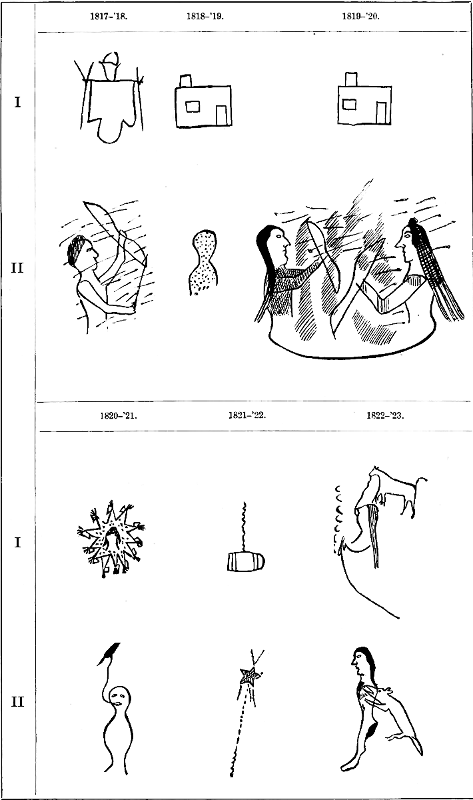
BUREAU OF ETHNOLOGY FOURTH ANNUAL REPORT PL. XLI
1817-’18.
1818-’19.
1819-’20.
1820-’21.
1821-’22.
1822-’23.
THE CORBUSIER WINTER COUNTS.
1817-’18.—No. I. The Oglálas had an abundance of buffalo meat and shared it with the Brulés, who were short of food. The buffalo hide hung on the drying pole, with the buffalo head above it, indicates an abundance of meat.
No. II. The-Brave-Man was killed in a great fight. The fight is shown by the arrows flying to and from him. Having been killed by an enemy, he is scalped.
White-Cow-Killer calls it “Plenty-of-meat winter.”
1818-’19.—No. I. A large house was built.
No. II. Many died of the small-pox.
White-Cow-Killer calls it “Little-small-pox winter.”
1819-’20.—No. I. Another house was built. The Dakotas made medicine in it.
No. II. In an engagement with the Crows, both sides expended all of their arrows, and then threw dirt at each other. A Crow is represented on the right, and is distinguished by the manner in which the hair is worn.
White-Cow-Killer calls it “Made-a-house-of-old-wood winter.”
1820-’21.—No. I. The Dakotas assaulted and took a Crow village of a hundred lodges. They killed many and took many prisoners.
No. II. A Dakota, named Glue, froze to death.
White-Cow-Killer calls it “Two-arrows-made-a-war-bonnet winter.”
1821-’22.—No. I. They had all the mini wakan (spirit water or whisky) they could drink. They never had any before. A barrel with a waved or spiral line running from it represents the whisky, the waved line signifying spirit.
No. II. A large roaring star fell. It came from the east, and shot out sparks of fire along its course. Its track and the sparks are shown in the figure. See also page 111.
White-Cow-Killer says, “One-star-made-a-great-noise winter.”
Battiste Good, alias Wa-po-ctan-qi (Brown-Hat), historian and chief, designated this year as that of his birth. Omaha bullets were whizzing through the village and striking and piercing his mother’s lodge as she brought him forth. Red-Cloud also was born.
1822-’23.—No. I. Dog, an Oglála, stole seventy horses from the Crows. Each of the seven tracks stands for ten horses. A lariat, which serves the purpose of a long whip, and is usually allowed to trail on the ground, is shown in the man’s hand.
No. II. A Brulé, who had left the village the night before, was found dead in the morning outside the village, and the dogs were eating his body. The black spot on the upper part of the thigh shows he was a Brulé.
White-Cow-Killer says, “White-man-peels-the-stick-in-his-hand-broke-his-leg winter.”
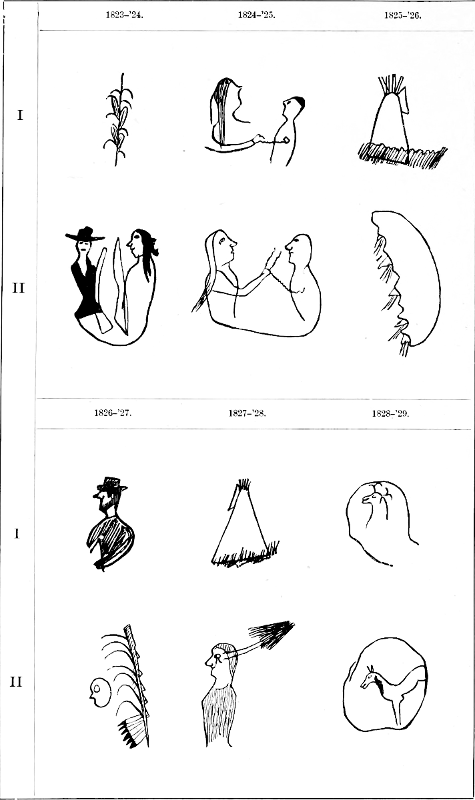
BUREAU OF ETHNOLOGY FOURTH ANNUAL REPORT PL. XLII
1823-’24.
1824-’25.
1825-’26.
1826-’27.
1827-’28.
1828-’29.
THE CORBUSIER WINTER COUNTS.
1823-’24.—No. I. They had an abundance of corn, which they got at the Ree villages.
No. II. They joined the whites in an expedition up the Missouri River against the Rees.
White-Cow-Killer calls it “Old-corn-plenty winter.” For further explanation of the record of this year, see page 111.
1824-’25.—No. I. Cloud-Bear, a Dakota, killed a Dakota, who was a long distance off, by throwing a bullet from his hand and striking him in the heart. The spiral line is again used for wakan. The gesture-sign for wakan (holy, supernatural) is: With its index-finger extended and pointing upward, or all the fingers extended, back of hand outward, move the right hand from just in front of the forehead spirally upward nearly to arm’s length from left to right. [See “Sign Language N. A. Indians,” p. 380, by the present writer, in the First Annual Report of the Bureau of Ethnology.]
No. II. Cat-Owner was killed with a spider-web thrown at him by a Dakota. The spider-web is shown reaching to his heart from the hand of the man who threw it. The blood issuing from his mouth and nose indicates that he bled to death. It is a common belief among them that certain medicine men possess the power of taking life by shooting needles, straws, spider-webs, bullets, and other objects, however distant the person may be against whom they are directed.
White-Cow-Killer calls it “Killed-the-women-picking-cherries winter.”
1825-’26.—No. I. Some of the Dakotas were living on the bottom-lands of the Missouri River, below the Whetstone, when the river, which was filled with broken ice, unexpectedly rose and flooded their village. Many were drowned or else killed by the floating ice. Many of those that escaped climbed on cakes of ice or into trees.
No. II. Many of the Dakotas were drowned in a flood caused by a rise of the Missouri River, in a bend of which they were camped. The curved line is the bend in the river; the waved line is the water, above which the tops of the tipis are shown.
White-Cow-Killer calls it “Great-flood-and-many-Indians-drowned winter.” [See page 113.]
1826-’27.—No. I. The brother of the Good-White-Man came.
No. II. Held a commemoration of the dead. The pipe-stem and the skull indicate this.
White-Cow-Killer calls it “Long-Whistle-sick winter.”
1827-’28.—No. I. The snow was very deep.
No. II. In a fight with the Mandans, Crier was shot in the head with a gun.
White-Cow-Killer calls it “Snow-shoe-making winter.”
1828-’29.—No. I. They provided themselves with a large supply of antelope meat by driving antelope into a corral, in which they were easily killed.
No. II. They drove many antelope into a corral and then killed them.
White-Cow-Killer calls it “Many-Rees-killed winter.”
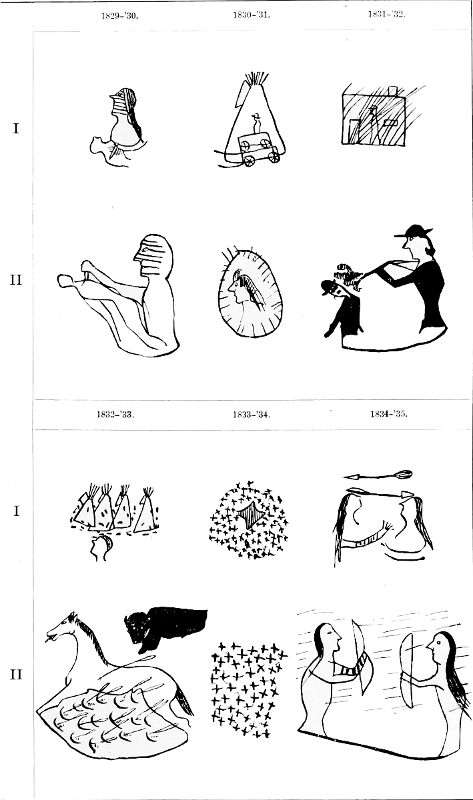
BUREAU OF ETHNOLOGY FOURTH ANNUAL REPORT PL. XLIII
1829-’30.
1830-’31.
1831-’32.
1832-’33.
1833-’34.
1834-’35.
THE CORBUSIER WINTER COUNTS.
1829-’30.—No. I. Striped-Face stabbed and killed his son-in-law for whipping his wife.
No. II. Spotted-Face stabs his son-in-law for whipping his wife.
White-Cow-Killer calls it “Spotted-Face-held-on-long winter.”
1830-’31.—No. I. They saw wagons for the first time. Red-Lake, a white trader, brought his goods in them.
No. II. The Crows were approaching a village at a time when there was a great deal of snow on the ground and intended to surprise it, but some herders discovering them the Dakotas went out, laid in wait for the Crows, surprised them, and killed many. A Crow’s head is represented in the figure.
White-Cow-Killer calls it “Killed-many-white-buffalo winter.”
1831-’32.—No. I. Red-Lake’s house, which he had recently built, was destroyed by fire, and he was killed by the accidental explosion of some powder.
No. II. A white man, whom they called Gray-Eyes, shot and killed a man who was working for him.
1832-’33.—No. I. They killed many Gros Ventres in a village which they assaulted.
No. II. All of Standing-Bull’s horses were killed, but by whom is unknown. Hoof-prints, blood-stains, and arrows are shown under the horse.
White-Cow-Killer calls it “One-Horn’s-leg-broken winter.”
1833-’34.—No. I. The stars moved around.
No. II. It rained stars.
White Cow-Killer calls it “Plenty-stars winter.”
The records [see page 116] all undoubtedly refer to the magnificent meteoric display of the morning of November 13th, 1833, which was witnessed throughout North America, and which they have correctly assigned to the winter corresponding with that of 1833-’34. All of them represent stars as having four points.
1834-’35.—No. I. They were at war with the Cheyennes. The Cheyenne is the one with the stripes on his arm.
No. II. They fought with the Cheyennes. The stripes on the arm are for Cheyenne as before.
White-Cow-Killer calls it “Cheyennes-came-and-one-killed winter.”
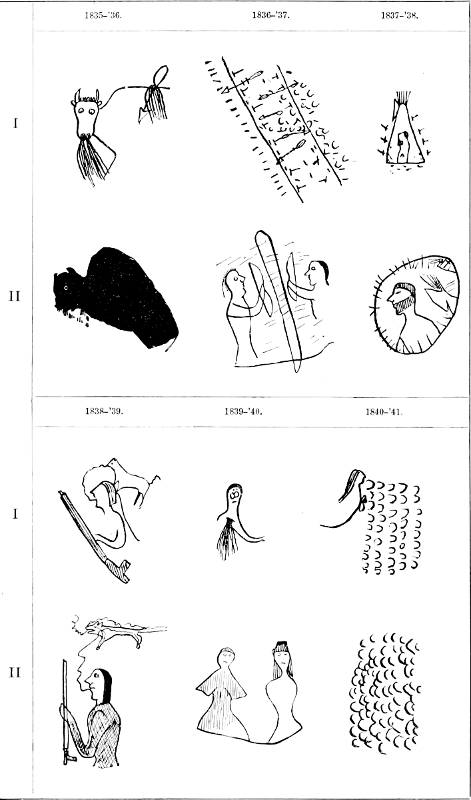
BUREAU OF ETHNOLOGY FOURTH ANNUAL REPORT PL. XLIV
1835-’36.
1836-’37.
1837-’38.
1838-’39.
1839-’40.
1840-’41.
THE CORBUSIER WINTER COUNTS.
1835-’36.—No. I. They killed a very fat buffalo bull.
No. II. They killed a very fat buffalo bull.
White-Cow-Killer calls it “Two warriors-killed winter.”
1836-’37.—No. I. The Dakotas and the Pawnees fought on the ice on the North Platte River. The former were on the north side, the right-hand side in the figure, the latter on the south side, the left in the figure. Horsemen and footmen on the right are opposed to footmen on the left. Both sides have guns and bows, as shown by the bullet-marks and the arrows. The red marks are for blood-stains on the ice.
No. II. They fought the Pawnees across the ice on the North Platte. The man on the left is a Pawnee.
White-Cow-Killer calls it “Fight-on-ice winter.”
1837-’38.—No. I. Paints-His-Cheeks-Red and his family, who were camping by themselves, were killed by Pawnees.
No. II. Paints-His-Face-Red, a Dakota, was killed in his tipi by the Pawnees.
White-Cow-Killer calls it “Five-Fingers-died winter.”
1838-’39.—No. I. Spotted-Horse carried the pipe around and took the war path against the Pawnees, to avenge the death of his uncle, Paints-His-Cheeks-Red.
No. II. Crazy-Dog, a Dakota, carried the pipe around and took the war path. The waved or spiral lines denote crazy.
White-Cow-Killer says, “Paints-his-Chin’s-lodge-all-killed winter.”
When a warrior desires to make up a war party he visits his friends and offers them a filled pipe, as an invitation to follow him, and those who are willing to go accept the invitation by lighting and smoking it. Any man whose courage has been proved may become the leader of a war party. Among the Arapahos the would-be leader does not invite any one to accompany him, but publicly announces his intention of going to war. He fixes the day for his departure and states where he will camp the first night, naming some place not far off. The morning on which he starts, and before leaving the village, he invokes the aid of the sun, his guardian by day, and often, to propitiate him, secretly vows to undergo penance, or offer a sacrifice on his return. He rides off alone, carrying his bare pipe in his hand, with the bowl carefully tied to the stem to prevent it from slipping off. If the bowl should at any time accidentally fall to the ground, he considers it an evil omen, and immediately returns to the village, and nothing could induce him to proceed, as he thinks that only misfortune would attend him if he did. Sometimes he ties eagle or hawk plumes to the stem of his pipe, and, after quitting the village, repairs to the top of some hill and makes an offering of them to the sun, taking them from his pipe and tying them to a pole, which he erects in a pile of stones. (Some of the stone-heaps seen on the hills in the Arapaho country originated in this way, but most of them were made by dreamers, who withdraw from their people to devote themselves in solitude to contemplation, fasting, and prayer, in order to work themselves into a state of rapture, hoping to have visions and receive messages from spirits.) Those who intend to follow him usually join him at the first camp, equipped for the expedition; but often there are some who do not join him until he has gone further on. He eats nothing before leaving the village, nor as long as the sun is up; but breaks his fast at his first camp, after the sun sets. The next morning he begins another fast, to be continued until sunset. He counts his party, saddles his horse, names some place six or seven miles ahead, where he says he will halt for awhile, and again rides off alone with his pipe in his hand. After awhile the party follow him in single file. When they have reached his halting place he tells them to dismount and let their horses graze. They all then seat themselves on the ground on the left of the leader, forming a semicircle, facing the sun. The leader fills his pipe, all bow their heads, and, pointing the stem of the pipe upward, he prays to the sun, asking that they may find an abundance of game, that dead-shots may be made, so that their ammunition will not be wasted, but reserved for their enemies; that they may easily find their enemies and kill them; that they may be preserved from wounds and death. He makes his petition four times, then lights his pipe, and after sending a few whiffs of smoke skyward as incense to the sun, hands the pipe to his neighbor, who smokes and passes it on to the next. It is passed from one to another, toward the left, until all have smoked, the leader refilling it as often as necessary. They then proceed to their next camp, where probably others join them. The same programme is carried out for three or four days before the party is prepared for action.
1839-’40.—No. I. Left-Handed-Big-Nose was killed by the Shoshoni. His left arm is represented extended, and his nose is very conspicuous. American-Horse was born in the spring of 1840.
No. II. They killed a Crow and his squaw, who were found on a trail.
White-Cow-Killer calls it “Large-war-party-hungry-eat-Pawnee-horses winter.”
1840-’41.—No. I. Sitting-Bear, American-Horse’s father, and others, stole two hundred horses from the Flat Heads. A trailing lariat is in the man’s hand.
No. II. They stole one hundred (many) horses from the Snakes.
White-Cow-Killer calls it “Little-Thunder’s-brothers-killed winter.”
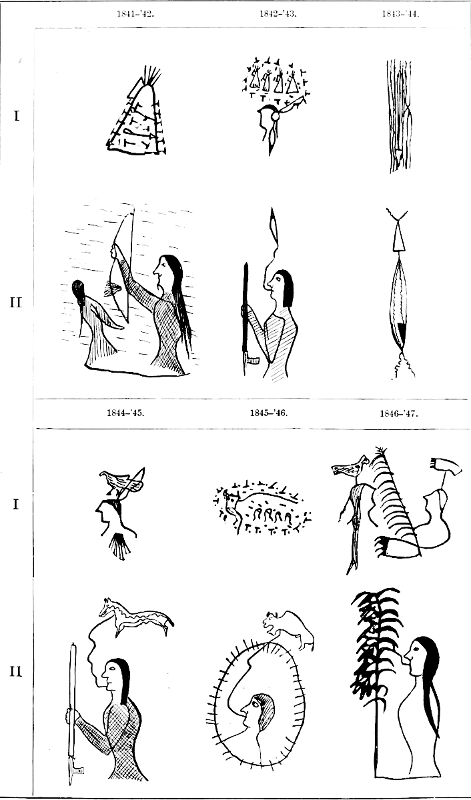
BUREAU OF ETHNOLOGY FOURTH ANNUAL REPORT PL. XLV
1841-’42.
1842-’43.
1843-’44.
1844-’45.
1845-’46.
1846-’47.
THE CORBUSIER WINTER COUNTS.
1841-’42.—No. I. The Oglálas engaged in a drunken brawl, which resulted in a division of the tribe, the Kiyuksas (Cut-Offs) separating from the others.
No. II. The Oglálas got drunk on Chug Creek, and engaged in a quarrel among themselves, in which Red-Cloud’s brother was killed, and Red-Cloud killed three men. Cloud-Shield (Mahpiya-Wahacanka) was born.
1842-’43.—No. I. Feather-Ear-Rings was killed by the Shoshoni. The four lodges and the many blood-stains intimate that he was killed at the time the four lodges of Shoshoni were killed.
No. II. Lone-Feather said his prayers, and took the war path to avenge the death of some relatives.
White-Cow-Killer calls it “Crane’s-son-killed winter.”
1843-’44.—No. I. The great medicine arrow was taken from the Pawnees by the Oglálas and Brulés, and returned to the Cheyennes, to whom it rightly belonged.
No. II. In a great fight with the Pawnees they captured the great medicine arrow which had been taken from the Cheyennes, who made it, by the Pawnees. The head of the arrow projects from the bag which contains it. The delicate waved lines (intended probably for spiral lines) show that it is sacred.
White-Cow-Killer calls it “The Great-medicine-arrow-comes-in winter.”
Battiste Good’s record gives the following for the same year:
“Brought-home-the-magic-arrow winter. This arrow originally belonged to the Cheyennes, from whom the Pawnees stole it. The Dakotas captured it this winter from the Pawnees, and the Cheyennes then redeemed it for one hundred horses.” His sign for the year is somewhat different, as shown in Figure 46. As before mentioned, an attempt is made to distinguish colors by the heraldic scheme, which in this instance may require explanation. The upper part of the body is sable or black, the feathers on the arrow are azure or blue, and the shaft, gules or red. The remainder of the figure is of an undecided color not requiring specification.
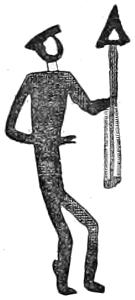
Fig. 46.—Magic arrow.
1844-’45.—No. I. Male-Crow, an Oglála, was killed by the Shoshoni.
No. II. Crazy-Horse says his prayers and goes on the war path. The waved lines are used again for crazy.
White-Cow-Killer calls it “White-Buffalo-Bull-killed by-the-Crows winter.”
1845-’46.—No. I. White-Bull and thirty other Oglálas were killed by the Crows and Shoshoni.
No. II. White-Bull and many others were killed in a fight with the Shoshoni.
White-Cow-Killer calls it “Many-sick winter.”
1846-’47.—No. I. Big-Crow and Conquering-Bear had a great feast and gave many presents.
No. II. Long-Pine, a Dakota, was killed by Dakotas. He was not killed by an enemy, as he has not lost his scalp.
White-Cow-Killer calls it “Diver’s-neck-broken winter.”
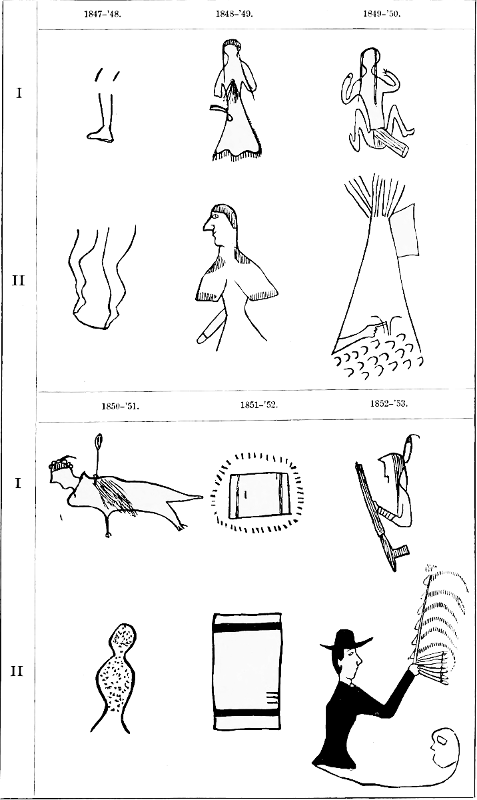
BUREAU OF ETHNOLOGY FOURTH ANNUAL REPORT PL. XLVI
1847-’48.
1848-’49.
1849-’50.
1850-’51.
1851-’52.
1852-’53.
THE CORBUSIER WINTER COUNTS.
1847-’48.—No. I. There were a great many accidents and some legs were broken, the ground being covered with ice.
No. II. Many were thrown from their horses while surrounding buffalo in the deep snow, and some had their legs-broken.
White-Cow-Killer calls it “Many-legs-broken winter.”
1848-’49.—No. I. American-Horse’s father captured a Crow who was dressed as a woman, but who was found to be an hermaphrodite and was killed.
No. II. American-Horse’s father captured a Crow woman and gave her to the young men, who discovered that she was an hermaphrodite and killed her.
White-Cow-Killer calls it “Half-man-and-half-woman-killed winter.”
It is probable that this was one of those men, not uncommon among the Indian tribes, who adopt the dress and occupation of women. [This is sometimes compulsory, e. g., on account of failure to pass an ordeal.]
1849-’50.—No. I. Many died of the cramps. The cramps were those of Asiatic cholera, which was epidemic in the United States at that time, and was carried to the plains by the California and Oregon emigrants. The position of the man is very suggestive of cholera.
No. II. Making-the-Hole stole many horses from a Crow tipi. The index points to the hole, which is suggestive of the man’s name.
White-Cow-Killer calls it “The-people-had-the-cramps winter.”
1850-’51.—No. I. Wolf-Robe was killed by the Pawnees.
No. II. Many died of the small-pox.
White-Cow-Killer calls it “All-the-time-sick-with-the-big-small-pox winter.”
1851-’52.—No. I. They received their first annuities at the mouth of Horse Creek. A one-point blanket is depicted and denotes dry-goods. It is surrounded by a circle of marks which represent the people.
No. II. Many goods were issued to them at Fort Laramie. They were the first they received. The blanket which is represented stands for the goods.
White-Cow-Killer calls it “Large-issue-of-goods-on-the-Platte-River winter.”
1852-’53.—No. I. The Cheyennes carry the pipe around to invite all the tribes to unite with them in a war against the Pawnees.
No. II. A white man made medicine over the skull of Crazy-Horse’s brother. He holds a pipe-stem in his hand. This probably refers to the custom of gathering the bones of the dead that have been placed on scaffolds and burying them.
White-Cow-Killer calls it “Great-snow winter.”
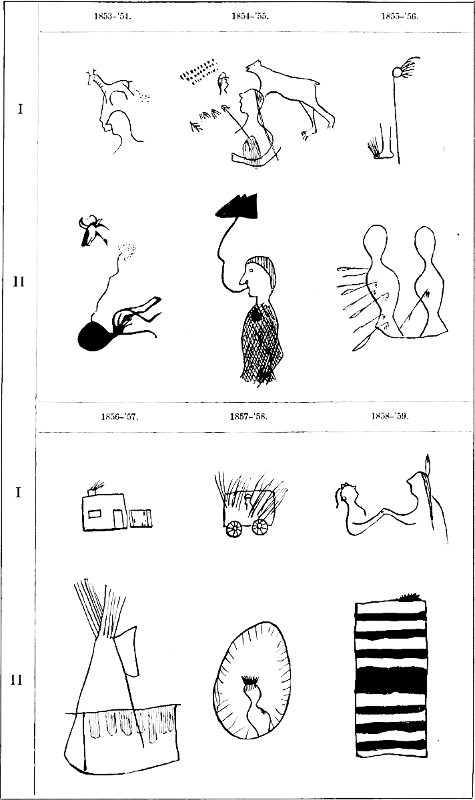
BUREAU OF ETHNOLOGY FOURTH ANNUAL REPORT PL. XLVII
1853-’54.
1854-’55.
1855-’56.
1856-’57.
1857-’58.
1858-’59.
THE CORBUSIER WINTER COUNTS.
1853-’54.—No. I. Antelope-Dung broke his neck while surrounding buffalo.
No. II. Antelope-Dung broke his neck while running antelope. His severed head is the only part of his body that is shown.
White-Cow-Killer calls it “Oak-wood-house winter.”
1854-’55.—No. I. Conquering-Bear was killed by white soldiers, and thirty white soldiers were killed by the Dakotas 9 miles below Fort Laramie. The thirty black dots in three lines stand for the soldiers, and the red stains for killed. The head covered with a fatigue-cap further shows they were white soldiers. Indian soldiers are usually represented in a circle or semicircle. The gesture-sign for soldier means all in line, and is made by placing the nearly closed hands with palms forward, and thumbs near together, in front of the body and then separating them laterally about two feet.
No. II. Brave-Bear was killed in a quarrel over a calf. He was killed by enemies; hence his scalp is gone.
White-Cow-Killer says, “Mato-wayuhi (or Conquering-Bear) killed-by-white-soldiers winter.”
1855-’56.—No. I. A war party of Oglálas killed one Pawnee—his scalp is on the pole—and on their way home froze their feet.
No. II. Torn-Belly and his wife were killed by some of their own people in a quarrel.
White-Cow-Killer calls it “A-medicine-man-made-buffalo-medicine winter.”
1856-’57.—No. I. They received annuities at Raw-Hide Butte. The house and the blanket represent the agency and the goods.
No. II. They have an abundance of buffalo meat. This is shown by the full drying pole.
White-Cow-Killer calls it “White-hill-house winter.”
1857-’58.—No. I. Little-Gay, a white trader, was killed by the explosion of a can of gunpowder. He was measuring out powder from the can in his wagon while smoking his pipe.
No. II. They surrounded and killed ten Crows.
White-Cow-Killer calls it “Bull-hunting winter.”
1858-’59.—No. I. They made peace with the Pawnees. The one on the left is a Pawnee.
No. II. They bought Mexican blankets of John Richard, who bought many wagon-loads of the Mexicans.
White-Cow-Killer calls it “Yellow-blanket-killed winter.”
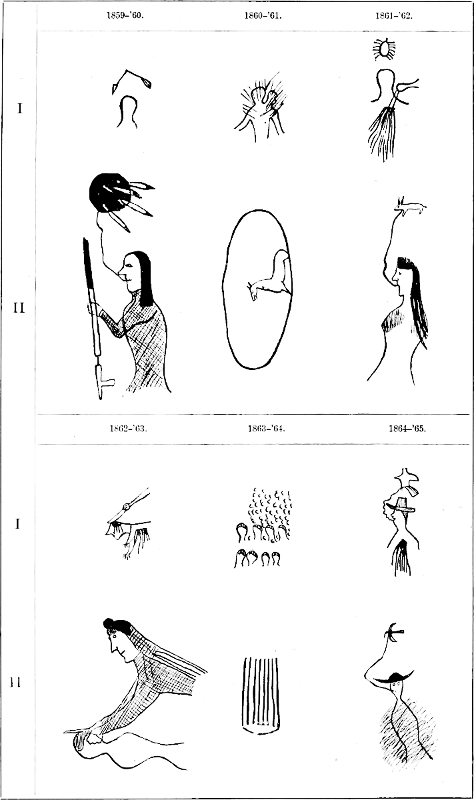
BUREAU OF ETHNOLOGY FOURTH ANNUAL REPORT PL. XLVIII
1859-’60.
1860-’61.
1861-’62.
1862-’63.
1863-’64.
1864-’65.
THE CORBUSIER WINTER COUNTS.
1859-’60.—No. I. Broken-Arrow fell from his horse while running buffalo and broke his neck.
No. II. Black-Shield says prayers and takes the war path to avenge the death of two of his sons who had been killed by the Crows.
White-Cow-Killer calls it “Black-Shield’s-two boys-go-hunting-and-are-killed-by-the-Crows winter.”
1860-’61.—No. I. Two-Face, an Oglála, was badly burnt by the explosion of his powder-horn.
No. II. They capture a great many antelope by driving them into a pen.
White-Cow-Killer calls it “Babies-all-sick-and-many-die winter.”
1861-’62.—No. I. Spider was killed (stabbed) in a fight with the Pawnees.
No. II. Young-Rabbit, a Crow, was killed in battle by Red-Cloud.
White-Cow-Killer calls it “Crow-Indian-Spotted-Horse-stole-many-horses-and-was-killed winter.”
1862-’63.—No. I. The Crows scalped an Oglála boy alive.
No. II. Some Crows came to their camp and scalped a boy.
White-Cow-Killer calls it “Crows-scalp-boy winter.”
1863-’64.—No. I. The Oglálas and Minneconjous took the war path against the Crows and stole three hundred Crow horses. The Crows followed them and killed eight of the party.
No. II. Eight Dakotas were killed by the Crows. Here eight long marks represent the number killed.
White-Cow-Killer calls it “Dakotas-and-Crows-have-a-big-fight-eight-Dakotas-killed winter.”
1864-’65.—No. I. Bird, a white trader, went to Powder River to trade with the Cheyennes. They killed him and appropriated his goods.
No. II. Bird, a white trader, was burned to death by the Cheyennes. He is surrounded by flames in the picture.
White-Cow-Killer calls it “Big-Lips-died-suddenly winter.”
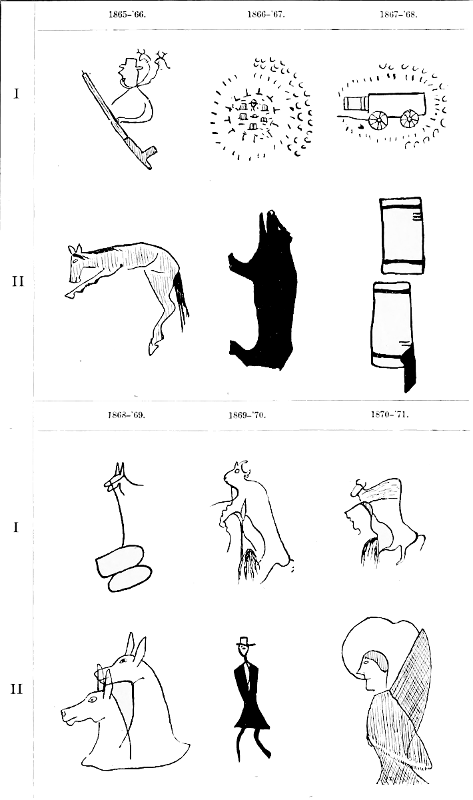
BUREAU OF ETHNOLOGY FOURTH ANNUAL REPORT PL. XLIX
1865-’66.
1866-’67.
1867-’68.
1868-’69.
1869-’70.
1870-’71.
THE CORBUSIER WINTER COUNTS.
1865-’66.—No. I. General Maynadier made peace with the Oglálas and Brulés. His name, the sound of which resembles the words “many deer,” is indicated by the two deers’ heads connected with his mouth by the lines.
No. II. Many horses were lost by starvation, as the snow was so deep they couldn’t get at the grass.
1866-’67.—No. I. They killed one hundred white men at Fort Phil. Kearny. The hats and the cap-covered head represent the whites; the red spots, the killed; the circle of characters around them, rifle or arrow shots; the black strokes, Dakota footmen; and the hoof-prints, Dakota horsemen. The Phil. Kearny massacre occurred December 21, 1866, and eighty-two whites were killed, including officers, citizens, and enlisted men. Capt. W. J. Fetterman was in command of the party.
No. II. Lone-Bear was killed in battle.
White-Cow-Killer calls it “One-hundred-white-men-killed winter.”
1867-’68.—No. I. They captured a train of wagons near Tongue River. The men who were with it got away. The blanket represents the goods found in the wagons.
No. II. Blankets were issued to them at Fort Laramie.
White-Cow-Killer calls it “Seven-Pawnees-killed winter.”
1868-’69.—No. I. They were compelled to sell many mules and horses to enable them to procure food, as they were in a starving condition. They willingly gave a mule for a sack of flour. The mule’s halter is attached to two sacks of flour.
No. II. They had to sell many mules and horses to get food, as they were starving.
White-Cow-Killer calls it “Mules-sold-by-hungry-Sioux winter.”
1869-’70.—No. I. Tall-Bull was killed by white soldiers and Pawnees on the south side of the South Platte River.
No. II. John Richard shot a white soldier at Fort Fetterman, Wyoming, and fled north, joining Red-Cloud.
White-Cow-Killer calls it “Tree-fell-on-woman-who-was-cutting-wood-and-killed-her winter.”
1870-’71.—No. I. High-Back-Bone, a very brave Oglála, was killed by the Shoshoni. They also shot another man, who died after he reached home.
No. II. High-Back-Bone was killed in a fight with the Snakes (Shoshoni).
White-Cow-Killer calls it “High-Back-Bone-killed-by-Snake-Indians winter.”
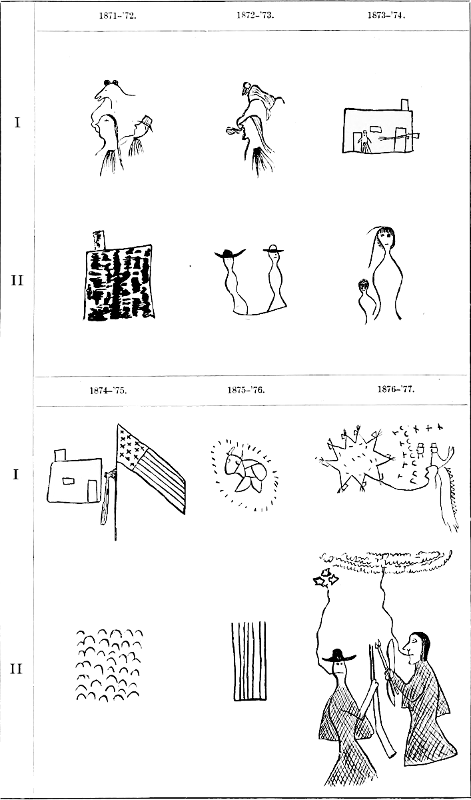
BUREAU OF ETHNOLOGY FOURTH ANNUAL REPORT PL. L
1871-’72.
1872-’73.
1873-’74.
1874-’75.
1875-’76.
1876-’77.
THE CORBUSIER WINTER COUNTS.
1871-’72.—No. I. John Richard shot and killed an Oglála named Yellow-Bear, and the Oglálas killed Richard before he could get out of the lodge. This occurred in the spring of 1872. As the white man was killed after the Indian, he is placed behind him in the figure.
No. II. Adobe houses were built by Maj. J. W. Wham, Indian agent (now paymaster, United States Army), on the Platte River, about 30 miles below Fort Laramie.
White-Cow-Killer calls it “Major-Wham’s-house-built-on-Platte-River winter.”
1872-’73.—No. I. Whistler, also named Little-Bull, and two other Oglálas, were killed by white hunters on the Republican River.
No. II. Antoine Janis’s two boys were killed by Joe (John?) Richard.
White Cow-Killer calls it “Stay-at-plenty-ash-wood winter.”
1873-’74.—No. I. The Oglálas killed the Indian agent’s (Seville’s) clerk inside the stockade of the Red Cloud Agency, at Fort Robinson, Nebraska.
No. II. They killed many Pawnees on the Republican River.
1874-’75.—No. I. The Oglálas at the Red Cloud Agency, near Fort Robinson, Nebraska, cut to pieces the flag staff which their agent had had cut and hauled, but which they would not allow him to erect, as they did not wish to have a flag flying over their agency. This was in 1874. The flag which the agent intended to hoist is now at the Pine Ridge Agency, Dakota.
No. II. The Utes stole all of the Brulé horses.
1875-’76.—No. I. The first stock cattle were issued to them. The figure represents a cow or spotted buffalo, surrounded by people. The gesture-sign also signifies spotted buffalo.
No. II. Seven of Red-Cloud’s band were killed by the Crows.
White-Cow-Killer calls it “Five-Dakotas-killed winter.”
1876-’77.—No. I. The Oglálas helped General Mackenzie to whip the Cheyennes. The Indian’s head represents the man who was the first to enter the Cheyenne village. The white man holding up three fingers is General Mackenzie, who is placed upon the head of the Dakota to indicate that the Dakotas backed or assisted him. The other white man is General Crook, or Three Stars, as indicated by the three stars above him.
[This designation might be suggested from the uniform, but General Crook did not probably wear during the year mentioned or for a long time before it the uniform either of his rank as major-general of volunteers or as brevet major-general in the Army, and by either of those ranks he was entitled to but two stars on his shoulder-straps.]
No. II. Three-Stars (General Crook) took Red-Cloud’s young men to help him fight the Cheyennes. A red cloud, indicating the chief’s name, is represented above his head.
White-Cow-Killer calls it “General-Mackenzie-took-the-Red-Cloud-Indians’-horses-away-from-them winter.”
BUREAU OF ETHNOLOGY FOURTH ANNUAL REPORT PL. LI
1877-’78.
1878-’79.
THE CORBUSIER WINTER COUNTS.
1877-’78.—No. I. A soldier ran a bayonet into Crazy-Horse, and killed him in the guard-house, at Fort Robinson, Nebraska (September 5, 1877).
No. II. Crazy-Horse’s band left the Spotted Tail Agency (at Camp Sheridan, Nebraska), and went north, after Crazy-Horse was killed at Fort Robinson, Nebraska. Hoof-prints and lodge-pole tracks run northward from the house, which represents the Agency. That the horse is crazy is shown by the waved or spiral lines on his body, running from his nose, foot, and forehead.
White-Cow-Killer calls it “Crazy-Horse-killed winter.”
1878-’79.—No. I. Wagons were given to them.
No. II. The Cheyenne who boasted that he was bullet and arrow proof was killed by white soldiers, near Fort Robinson, Nebraska, in the intrenchments behind which the Cheyennes were defending themselves after they had escaped from the fort.
White-Cow-Killer calls it “Wagons-given-to-the-Dakota-Indians winter.”