← Table of contents
Pictographs of the North American Indians. A preliminary paper

CONVENTIONALIZING.

Reading edition

The course of conventionalizing is noticeable in pictographs as well as in gesture-signs, on the one hand, and, on the other, as it appears in all forms of graphic art. The analysis of such conventions in form could be pursued at great length with regard to the pictographs now known in the same manner as has been done with success by Dr. Harrison Allen in his work “An analysis of the Life-form in Art,” Philadelphia, 1875. Some suggestions may be obtained from the present paper, especially from examples given under the headings of Ideographs, page 219, and Homomorphs and Symmorphs, page 239. See also conventionalized sign for Ponka in Winter Count No. I for 1778-79, on page 131, and for Mandan in the same count for 1783-84, on the same page; also the conventional sign for Cheyenne, Figure 78, page 173; also the device for starvation, Figure 144, page 220, as conventionalized in Figure 145, page 221. The limits of this paper will only allow of submitting in addition the following conventionalized forms of the human figure, in some cases being merely marks arbitrarily used to represent humanity:

Illustration from Pictographs of the North American Indians. A preliminary paper Fourth Annual Report of the Bureau of Ethnology to the Secretary of the Smithsonian Institution, 1882-83, Government Printing Office, Washington, 1886, pages 3-256

Fig. 186.

Figure 186 signifies men among the Arikara. The characters are used in connection with horse-shoes, to denote “mounted men.” In other pictographs such spots or dots are merely numerical.

Illustration from Pictographs of the North American Indians. A preliminary paper Fourth Annual Report of the Bureau of Ethnology to the Secretary of the Smithsonian Institution, 1882-83, Government Printing Office, Washington, 1886, pages 3-256

Fig. 187.

Figure 187 is drawn by the Kiatéxamut branch of the Innuits for man. It is an abbreviated form and rare.

Illustration from Pictographs of the North American Indians. A preliminary paper Fourth Annual Report of the Bureau of Ethnology to the Secretary of the Smithsonian Institution, 1882-83, Government Printing Office, Washington, 1886, pages 3-256

Fig. 188.

Figure 188, drawn by the Blackfeet, signifies “Man—dead.” This is from a pictograph in Wind River Mountains. See Jones’s Northwestern Wyoming, etc., op. cit.

Illustration from Pictographs of the North American Indians. A preliminary paper Fourth Annual Report of the Bureau of Ethnology to the Secretary of the Smithsonian Institution, 1882-83, Government Printing Office, Washington, 1886, pages 3-256

Fig. 189.

Figure 189 is the Kiatéxamut Innuit drawing for man. This figure is armless; generally represents the person addressed.

Illustration from Pictographs of the North American Indians. A preliminary paper Fourth Annual Report of the Bureau of Ethnology to the Secretary of the Smithsonian Institution, 1882-83, Government Printing Office, Washington, 1886, pages 3-256

Fig. 190.

Figure 190 is also a Kiatéxamut Innuit drawing for man. The figure makes the gesture for negation.

Illustration from Pictographs of the North American Indians. A preliminary paper Fourth Annual Report of the Bureau of Ethnology to the Secretary of the Smithsonian Institution, 1882-83, Government Printing Office, Washington, 1886, pages 3-256

Fig. 191.

Figure 191, from a Californian pictograph, is a man, also gesturing negation.
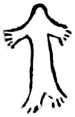
Illustration from Pictographs of the North American Indians. A preliminary paper Fourth Annual Report of the Bureau of Ethnology to the Secretary of the Smithsonian Institution, 1882-83, Government Printing Office, Washington, 1886, pages 3-256

Fig. 192.

Figure 192 is another Californian pictograph for man, making the same gesture.

Illustration from Pictographs of the North American Indians. A preliminary paper Fourth Annual Report of the Bureau of Ethnology to the Secretary of the Smithsonian Institution, 1882-83, Government Printing Office, Washington, 1886, pages 3-256

Fig. 193.

Figure 193, from Schoolcraft, I, Pl. 59, No. 91, is the Ojibwa “symbol” for disabled man.
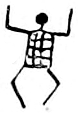
Illustration from Pictographs of the North American Indians. A preliminary paper Fourth Annual Report of the Bureau of Ethnology to the Secretary of the Smithsonian Institution, 1882-83, Government Printing Office, Washington, 1886, pages 3-256

Fig. 194.

Figure 194 is the Kiatéxamut Innuit drawing for Shaman.

Illustration from Pictographs of the North American Indians. A preliminary paper Fourth Annual Report of the Bureau of Ethnology to the Secretary of the Smithsonian Institution, 1882-83, Government Printing Office, Washington, 1886, pages 3-256

Fig. 195.

Figure 195, used by the Kiatéxamut Innuit, represents man supplicating.

The five figures, 196 to 200, are reproduced from Schoolcraft, Vol. I, Pl. 58, opp. p. 408. The Numbers attached are those given by that author:

Illustration from Pictographs of the North American Indians. A preliminary paper Fourth Annual Report of the Bureau of Ethnology to the Secretary of the Smithsonian Institution, 1882-83, Government Printing Office, Washington, 1886, pages 3-256

Fig. 196.

Figure 196, No. 6, is the Ojibwa representative figure for man.
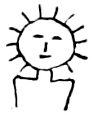
Illustration from Pictographs of the North American Indians. A preliminary paper Fourth Annual Report of the Bureau of Ethnology to the Secretary of the Smithsonian Institution, 1882-83, Government Printing Office, Washington, 1886, pages 3-256

Fig. 197.

Figure 197, No. 10, is used by the Ojibwa to denote a spirit or man enlightened from on high, having the head of the sun.
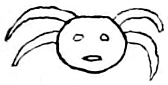
Illustration from Pictographs of the North American Indians. A preliminary paper Fourth Annual Report of the Bureau of Ethnology to the Secretary of the Smithsonian Institution, 1882-83, Government Printing Office, Washington, 1886, pages 3-256

Fig. 198.

Figure 198, No. 20, is drawn by the Ojibwa for a “wabeno” or Shaman.
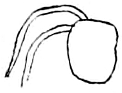
Illustration from Pictographs of the North American Indians. A preliminary paper Fourth Annual Report of the Bureau of Ethnology to the Secretary of the Smithsonian Institution, 1882-83, Government Printing Office, Washington, 1886, pages 3-256

Fig. 199.

Figure 199, No. 30, is the Ojibwa “symbol” for an evil or one-sided “meda” or higher grade Shaman.
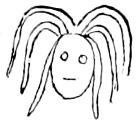
Illustration from Pictographs of the North American Indians. A preliminary paper Fourth Annual Report of the Bureau of Ethnology to the Secretary of the Smithsonian Institution, 1882-83, Government Printing Office, Washington, 1886, pages 3-256

Fig. 200.

Figure 200, No. 29, is the Ojibwa general “symbol” for a meda.

Illustration from Pictographs of the North American Indians. A preliminary paper Fourth Annual Report of the Bureau of Ethnology to the Secretary of the Smithsonian Institution, 1882-83, Government Printing Office, Washington, 1886, pages 3-256

Fig. 201.

Figure 201 is drawn by the Hidatsa for man.

Illustration from Pictographs of the North American Indians. A preliminary paper Fourth Annual Report of the Bureau of Ethnology to the Secretary of the Smithsonian Institution, 1882-83, Government Printing Office, Washington, 1886, pages 3-256

Fig. 202.

Figure 202, from Schoolcraft, I, Pl. 58, No. 3, is an Ojibwa drawing of a headless body.

Illustration from Pictographs of the North American Indians. A preliminary paper Fourth Annual Report of the Bureau of Ethnology to the Secretary of the Smithsonian Institution, 1882-83, Government Printing Office, Washington, 1886, pages 3-256

Fig. 203.

Figure 203, from Schoolcraft, I, Pl. 58, No. 2, is another Ojibwa figure for a headless body, perhaps female.
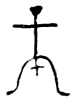
Illustration from Pictographs of the North American Indians. A preliminary paper Fourth Annual Report of the Bureau of Ethnology to the Secretary of the Smithsonian Institution, 1882-83, Government Printing Office, Washington, 1886, pages 3-256

Fig. 204.

Figure 204, contributed by Mr. Gilbert Thompson, is a drawing for man, made by the Moki in Arizona.
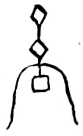
Illustration from Pictographs of the North American Indians. A preliminary paper Fourth Annual Report of the Bureau of Ethnology to the Secretary of the Smithsonian Institution, 1882-83, Government Printing Office, Washington, 1886, pages 3-256

Fig. 205.

Figure 205, reproduced from Schoolcraft, I, Pl. 64, opposite page 424, is a drawing from the banks of the River Yenesei, Siberia, by Von Strahlenberg, in his historical and geographical description of the northern and eastern parts of Europe, Asia, etc. London, 1738.

The similarity to characters on Figure 185 is obvious.
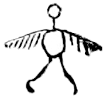
Illustration from Pictographs of the North American Indians. A preliminary paper Fourth Annual Report of the Bureau of Ethnology to the Secretary of the Smithsonian Institution, 1882-83, Government Printing Office, Washington, 1886, pages 3-256

Fig. 206.

Figure 206, also from Strahlenberg, and quoted in Schoolcraft, Vol. I, Pl. 66, Fig. 4, opp. p. 342, was found in Siberia, and is identical with the character which, according to Schoolcraft, is drawn by the Ojibwa to represent speed and the power of superior knowledge by exaltation to the regions of the air, being, in his opinion, a combination of bird and man.

It is to be noticed that some Ojibwa recently examined regard the character merely as a human figure with outstretched arms, and fringes pendant therefrom. It has, also, a strong resemblance to some of the figures in the Dakota Winter Counts (those for 1854-’55 and 1866-’67, pages 121 and 124, respectively), in which there is no attempt understood to signify any thing more than a war-dress.
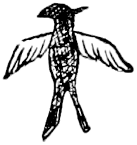
Illustration from Pictographs of the North American Indians. A preliminary paper Fourth Annual Report of the Bureau of Ethnology to the Secretary of the Smithsonian Institution, 1882-83, Government Printing Office, Washington, 1886, pages 3-256

Fig. 207.

Figure 207, according to Schoolcraft, Vol. I, Pl. 58, No. 58, is the Ojibwa drawing symbolic for an American.

Explore with AITake your curiosity a little further.

Reading settings