Tinguian
Reading edition
Introduction
The dim light of stars filtered through the leafy canopy above us, and the shadowy form of our guide once more appeared at my horse’s head. It was only for an instant, however, and then we were plunged again into the inky darkness of a tropical jungle.
We had planned to reach the distant Tinguian village in the late afternoon, but had failed to reckon with the deliberateness of native carriers. It was only by urging our horses that we were able to ford the broad Abra ere the last rays of the sun dropped behind the mountains. And then, in this land of no twilights, night had settled quickly over us.
We had made our way up the mountain-side, through the thick jungle, only to find that the trail, long imperceptible to us, had escaped even the keen eyes of our guide. For several hours we wandered about, lost in the darkness.
On and on we went, through narrow paths, steep in places, and made rough and dangerous by sharp rocks as well as by those long creepers of the jungle whose thorny fingers are ever ready to seize horse or rider. Occasionally we came out of the forest, only to cross rocky mountain streams; or perhaps it was the same stream that we crossed many times. Our horses, becoming weary and uncertain of foot, grew more and more reluctant to plunge into the dark, swiftly flowing water. And our patience was nearly exhausted when we at last caught sight of dim lights in the valley below. Half an hour later we rode into Manabo.
I shall never forget that first picture. It was a weird spectacle. Coming out of the darkness, we were almost convinced that we had entered a new world. Against the blackness of the night, grass-roofed houses stood outlined in the dim light of a bonfire; and squatting around that fire, unclad save for gay blankets wrapped about their shoulders, were brown-skinned men smoking long pipes, while women bedecked with bright beads were spinning cotton. As they worked in the flickering light, they stretched their distaffs at arm’s length into the air like witches waving their wands; and with that the elfland picture was complete.
In the stillness of the night a single voice could be heard reciting some tale in a singsong tone, which was interrupted only when peals of laughter burst forth from the listeners, or when a scrawny dog rose to bark at an imaginary noise until the shouts of the men quieted him and he returned to his bed in the warm ashes. Later we learned that these were the regular social gatherings of the Tinguian, and every night during the dry season one or more of these bonfires were to be seen in the village.
After we had attained to the footing of welcome guests in these circles, we found that a good story-teller was always present, and, while the men smoked, the women spun, and the dogs slept, he entertained us with tales of heroes who knew the magic of the betel-nut, or with stories of spirits and their power over the lives of men.
The following are some of the tales heard first around the camp fire of the distant mountain village.
Aponibolinayen and the Sun
Tinguian
Far up through the air she went until she reached the sky, and there the vine set her down under a tree. Aponibolinayen was so surprised to find herself in the sky that for some time she just sat and looked around, and then, hearing a rooster crow, she arose to see if she could find it. Not far from where she had sat was a beautiful spring surrounded by tall betel-nut trees whose tops were pure gold. Rare beads were the sands of the spring, and the place where the women set their jars when they came to dip water was a large golden plate. As Aponibolinayen stood admiring the beauties of this spring, she beheld a small house nearby, and she was filled with fear lest the owner should find her there. She looked about for some means of escape and finally climbed to the top of a betel-nut tree and hid.
Ini-init stood for some time wondering what he should do, and then he decided to cook some food and invite this lovely creature to eat with him. He put rice over the fire to boil and cut into pieces the fish he had caught. The noise of this awakened Aponibolinayen, and she slipped out of the house and back to the top of the betel-nut tree. The Sun did not see her leave, and when the food was prepared he called her, but the bed was empty and he had to eat alone. That night Ini-init could not sleep well, for all the time he wondered who the beautiful woman could be. The next morning, however, he rose as usual and set forth to shine in the sky, for that was his work.
That day Aponibolinayen stole again to the house of the Sun and cooked food, and when she returned to the betel-nut tree she left rice and fish ready for the Sun when he came home. Late in the afternoon Ini-init went into his home, and when he found pots of hot rice and fish over the fire he was greatly troubled. After he had eaten he walked a long time in the fresh air. “Perhaps it is done by the lovely woman who looks like a flame of fire,” he said. “If she comes again I will try to catch her.”
The next day the Sun shone in the sky as before, and when the afternoon grew late he called to the Big Star to hurry to take his place, for he was impatient to reach home. As he drew near the house he saw that it again looked as if it was on fire. He crept quietly up the ladder, and when he had reached the top he sprang in and shut the door behind him.
After some time Aponibolinayen and the Sun were married, and every morning the Sun went to shine in the sky, and upon his return at night he found his supper ready for him. He began to be troubled, however, to know where the food came from, for though he brought home a fine fish every night, Aponibolinayen always refused to cook it.
One night he watched her prepare their meal, and he saw that, instead of using the nice fish he had brought, she only dropped a stick into the pot of boiling water.
“Why do you try to cook a stick?” asked Ini-init in surprise.
“So that we can have fish to eat,” answered his wife.
“If you cook that stick for a month, it will not be soft,” said Ini-init. “Take this fish that I caught in the net, for it will be good.”
But Aponibolinayen only laughed at him, and when they were ready to eat she took the cover off the pot and there was plenty of nice soft fish. The next night and the next, Aponibolinayen cooked the stick, and Ini-init became greatly troubled for he saw that though the stick always supplied them with fish, it never grew smaller.
Finally he asked Aponibolinayen again why it was that she cooked the stick instead of the fish he brought, and she said:
“Do you not know of the woman on earth who has magical power and can change things?”
“Yes,” answered the Sun, “and now I know that you have great power.”
“Well, then,” said his wife, “do not ask again why I cook the stick.”
And they ate their supper of rice and the fish which the stick made.
One night not long after this Aponibolinayen told her husband that she wanted to go with him the next day when he made light in the sky.
“We will take many blankets and pillows,” said the woman, “and when the heat becomes very great, I will hide under them.”
Again and again Ini-init begged her not to go, but as often she insisted on accompanying him, and early in the morning they set out, carrying with them many blankets and pillows.
First, they went to the East, and as soon as they arrived the Sun began to shine, and Aponibolinayen was with him. They traveled toward the West, but when morning had passed into noontime and they had reached the middle of the sky Aponibolinayen was so hot that she melted and became oil. Then Ini-init put her into a bottle and wrapped her in the blankets and pillows and dropped her down to earth.
Now one of the women of Aponibolinayen’s town was at the spring dipping water when she heard something fall near her. Turning to look, she beheld a bundle of beautiful blankets and pillows which she began to unroll, and inside she found the most beautiful woman she had ever seen. Frightened at her discovery, the woman ran as fast as she could to the town, where she called the people together and told them to come at once to the spring. They all hastened to the spot and there they found Aponibolinayen for whom they had been searching everywhere.
“Where have you been?” asked her father; “we have searched all over the world and we could not find you.’
“I have come from Pindayan,” answered Aponibolinayen. “Enemies of our people kept me there till I made my escape while they were asleep at night”
So they began to prepare for the ceremony, and while they were pounding rice, Aponibolinayen asked her mother to prick her little finger where it itched, and as she did so a beautiful baby boy popped out. The people were very much surprised at this, and they noticed that every time he was bathed the baby grew very fast so that, in a short time, he was able to walk. Then they were anxious to know who was the husband of Aponibolinayen, but she would not tell them, and they decided to invite everyone in the world to the ceremony that they might not overlook him.
“If anyone refuses to come, grow on his knee,” said the people, and the betel-nuts departed to do as they were bidden.
As the guests began to arrive, the people watched carefully for one who might be the husband of Aponibolinayen, but none appeared and they were greatly troubled. Finally they went to the old woman, Alokotan, who was able to talk with the spirits, and begged her to find what town had not been visited by the betel-nuts which had been sent to invite the people. After she had consulted the spirits the old woman said:
“You have invited all the people except Ini-init who lives up above. Now you must send a betel-nut to summon him. It may be that he is the husband of Aponibolinayen, for the siksiklat vine carried her up when she went to gather greens.”
So a betel-nut was called and bidden to summon Ini-init.
The betel-nut went up to the Sun, who was in his house, and said:
“Grow on my head,” said the Sun. “I do not wish to go.”
So the betel-nut jumped upon his head and grew until it became so tall that the Sun was not able to carry it, and he was in great pain.
“Oh, grow on my pig,” begged the Sun. So the betel-nut jumped upon the pig’s head and grew, but it was so heavy that the pig could not carry it and squealed all the time. At last the Sun saw that he would have to obey the summons, and he said to the betel-nut:
“Get off my pig and I will go.”
So Aponibolinayen put on the rags that they brought her and at once set out with the stone for his home. No sooner had they arrived there, however, than he became a handsome man, and they were very happy.
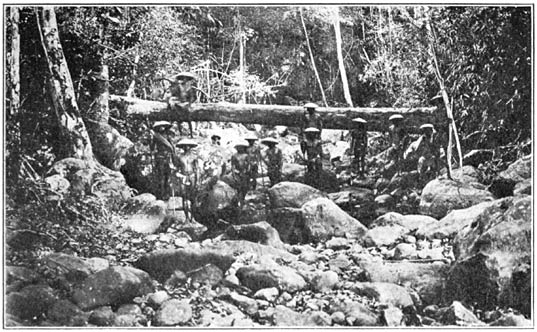
Tinguian hunters
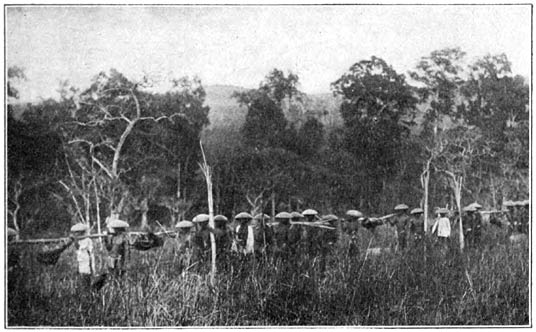
Returning from the hunt
Then they sent oiled betel-nuts to summon their relatives to the ceremony. The father of Aponibolinayen did not want to go, but the betel-nut threatened to grow on his knee if he did not. So he commanded all the people in the town to wash their hair and their clothes, and when all was ready they set out.
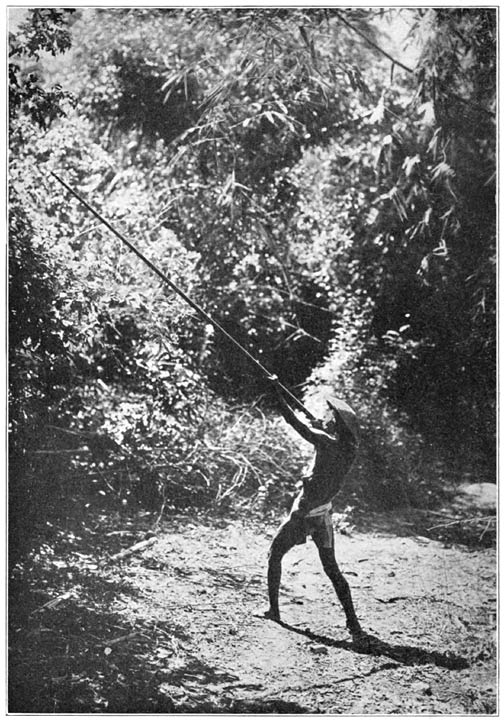
Hunting with the blowgun
After that all danced and made merry for one moon, and when the people departed for their homes Ini-init and his wife went with them to live on the earth.
Aponibolinayen
Tinguian
The most beautiful girl in all the world was Aponibolinayen of Nalpangan. Many young men had come to her brother, Aponibalagen, to ask for her hand in marriage, but he had refused them all, for he awaited one who possessed great power. Then it happened that the fame of her beauty spread over all the world till it reached even to Adasen; and in that place there lived a man of great power named Gawigawen.
But when Aponibolinayen, the bride of Gawigawen, came down out of the house to dance, the sunshine vanished, so beautiful was she; and as she moved about, the river came up into the town, and striped fish bit at her heels.
For three months the people remained here feasting and dancing, and then early one morning they took Aponibolinayen to her new home in Adasen. The trail that led from one town to the other had become very beautiful in the meantime: the grass and trees glistened with bright lights, and the waters of the tiny streams dazzled the eyes with their brightness as Aponibolinayen waded across. When they reached the spring of Gawigawen, they found that it, too, was more beautiful than ever before. Each grain of sand had become a bead, and the place where the women set their jars when they came to dip water had become a big dish.
Then said Aponibalagen to his people, “Go tell Gawigawen to bring an old man, for I want to make a spring for Aponibolinayen.”
Now during all this time Aponibolinayen had kept her face covered so that she had never seen her husband, for although he was a handsome man, one of the pretty girls who was jealous of the bride had told her that he had three noses, and she was afraid to look at him.
On and on she went until she came to the middle of the jungle, and then she met a wild rooster who asked her where she was going.
“I am running away from my husband,” replied Aponibolinayen, “for he has three noses and I do not want to live with him.”
But Aponibolinayen paid no heed to the rooster, and she went on until she reached a big tree where perched a monkey, and he also asked where she was going.
“I am running away from my husband,” answered the girl, “for he has three noses and I do not want to live with him.”
“Oh, do not believe that,” said the monkey. “Someone who told you that must have wanted to marry him herself, for he is a handsome man.”
There they came to a large orange tree, and the carabao told her to eat some of the luscious fruit while he fed on the grass nearby. As soon as he had left her, however, he ran straight to his master, Kadayadawan, and told him of the beautiful girl.
“Go to all the towns and invite our relatives to come to the ceremony which we shall make. If they do not want to come, then grow on their knees until they are willing to attend.”
So the betel-nuts started in different directions and one went to Aponibalagen in Nalpangan and said,
“Kadayadawan is making a ceremony for the spirits, and I have come to summon you to attend.”
“We cannot go,” said Aponibalagen, “for we are searching for my sister who is lost”
“You must come,” replied the betel-nut, “or I shall grow on your knee,”
“Grow on my pig,” answered Aponibalagen; so the betel-nut went on to the pig’s back and grew into a tall tree, and it became so heavy that the pig could not carry it, but squealed all the time.
Then Aponibalagen, seeing that he must obey, said to the betel-nut,
“Get off my pig, and we will go.”
The betel-nut got off the pig’s back, and the people started for the ceremony. When they reached the river, Gawigawen was there waiting to cross, for the magic nuts had forced him to go also. Then Kadayadawan, seeing them, sent more betel-nuts to the river, and the people were carried across by the nuts.
Then all the people discussed what should be done to bring peace between the two men, and it was finally decided that Kadayadawan must pay both Aponibalagen and Gawigawen the price that was first demanded for the beautiful girl.
After this was done all were happy; and the guardian spirit of Kadayadawan gave them a golden house in which to live.
Gawigawen of Adasen
Tinguian
Aponibolinayen was sick with a headache, and she lay on a mat alone in her house. Suddenly she remembered some fruit that she had heard of but had never seen, and she said to herself, “Oh, I wish I had some of the oranges of Gawigawen of Adasen.”
Aponitolau at once got up, and, taking a sack, went out to find some of the fruit for his wife. When he returned with the sack full, she said:
“Put it on the bamboo hanger above the fire, and when my head is better I will eat it.”
So Aponitolau put the fruit on the hanger and returned to the spirit house, but when Aponibolinayen tried to eat, the fruit made her sick and she threw it away.
“What is the matter?” called Aponitolau as he heard her drop the fruit.
“I merely dropped one,” she replied, and returned to her mat.
After a while Aponibolinayen again said:
“Oh, I wish I had some of the oranges of Gawigawen of Adasen,” and Aponitolau, who heard her from the spirit house, inquired:
“What is that you say?”
“I wish I had some fish eggs,” answered his wife; for she did not want him to know the truth.
Pleased that he was able to gratify his wife’s wishes, he hastened home with the eggs; and while his wife was roasting them over the fire, he returned to the spirit house. She tried to eat, but the eggs did not taste good to her, and she threw them down under the house to the dogs.
“What is the matter?” called Aponitolau. “Why are the dogs barking?”
“I dropped some of the eggs,” replied his wife, and she went back to her mat.
By and by she again said:
“I wish I had some of the oranges of Gawigawen of Adasen.”
But when her husband asked what she wished, she replied:
“I want a deer’s liver to eat”
So Aponitolau took his dogs to the mountains, where they hunted until they caught a deer, and when he had cut out its liver he spat on the wound, and it was healed so that the deer ran away.
“Why did you not tell me the truth, Aponibolinayen?” he asked.
“Because,” she replied, “no one Who has gone to Adasen has ever come back, and I did not want you to risk your life.”
When Aponitolau arrived at the well of a giantess, all the betel-nut trees bowed. Then the giantess shouted and all the world trembled. “How strange,” thought Aponitolau, “that all the world shakes when that woman shouts.” But he continued on his way without stopping.
As he passed the place of the old woman, Alokotan, she sent out her little dog and it bit his leg.
“Do not proceed,” said the old woman, “for ill luck awaits you. If you go on, you will never return to your home.”
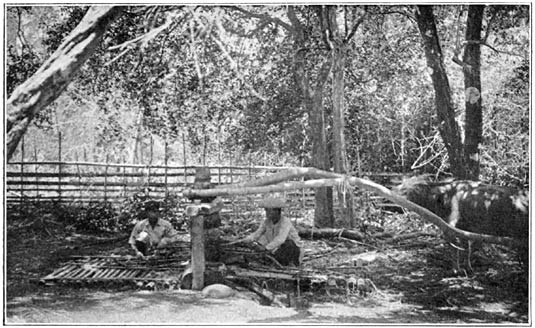
Sugar cane press
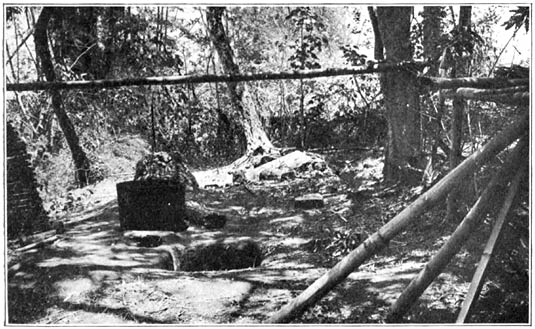
Vats for boiling sugar cane juice
But Aponitolau paid no attention to the old woman, and by and by he came to the home of the lightning.
“Where are you going?” asked the lightning.
“I am going to get some oranges of Gawigawen of Adasen,” replied Aponitolau.
“Go stand on that high rock that I may see what your sign is,” commanded the lightning.
So he stood on the high rock, but when the lightning flashed Aponitolau dodged.
“Do not go,” said the lightning, “for you have a bad sign, and you will never come back.”
Still Aponitolau did not heed.
“Where are you going, Aponitolau?”
“I am going to get oranges of Gawigawen of Adasen,” he replied.
Then the thunder commanded:
“Stand on that high stone so that I can see if you have a good sign.”
He stood on the high stone, and when the thunder made a loud noise he jumped. Whereupon Silit also advised him not to go on.
In spite of all the warnings, Aponitolau continued his journey, and upon coming to the ocean he used magical power, so that when he stepped on his head-ax it sailed away, carrying him far across the sea to the other side. Then after a short walk he came to a spring where women were dipping water, and he asked what spring it was.
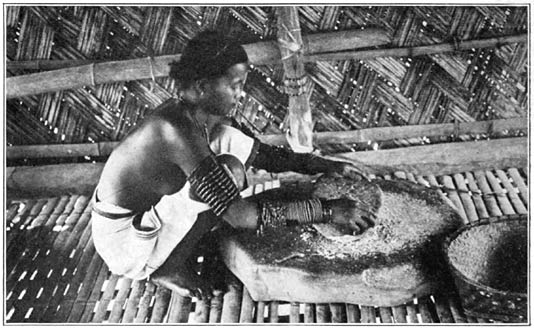
Grinding corn
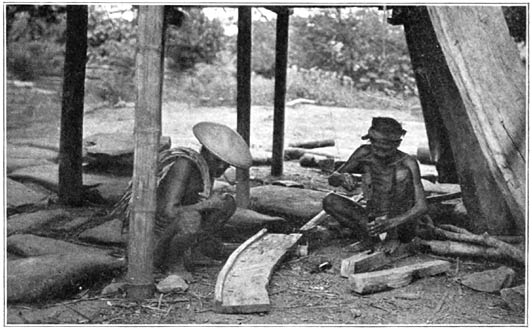
Making a harrow
“This is the spring of Gawigawen of Adasen,” replied the women. “And who are you that you dare come here?”
Without replying he went on toward the town, but he found that he could not go inside, for it was surrounded by a bank which reached almost to the sky.
While he stood with bowed head pondering what he should do, the chief of the spiders came up and asked why he was so sorrowful.
“I am sad,” answered Aponitolau, “because I cannot climb up this bank.”
Now Gawigawen was asleep in his spirit house, and when he awoke and saw Aponitolau sitting near, he was surprised and ran toward his house to get his spear and head-ax, but Aponitolau called to him, saying:
“Good morning, Cousin Gawigawen. Do not be angry; I only came to buy some of your oranges for my wife.”
“If you cannot eat all the carabao, you cannot have the oranges for your wife.”
Aponitolau grew very sorrowful, for he knew that he could not eat all the meat, but just at that moment the chief of the ants and flies came to him and inquired what was the trouble. As soon as he was told, the chief called all the ants and flies and they ate the whole carabao. Aponitolau, greatly relieved, went then to Gawigawen and said:
“I have finished eating the food which you gave me.”
Gawigawen was greatly surprised at this, and, leading the way to the place where the oranges grew, he told Aponitolau to climb the tree and get all he wanted.
As he was about to ascend the tree Aponitolau noticed that the branches were sharp knives, so he went as carefully as he could. Nevertheless, when he had secured two oranges, he stepped on one of the knives and was cut. He quickly fastened the fruit to his spear, and immediately it flew away straight to his town and into his house.
Aponibolinayen was just going down the bamboo ladder out of the house, and hearing something drop on the floor she went back to look and found the oranges from Adasen. She eagerly ate the fruit, rejoicing that her husband had been able to reach the place where they grew. Then she thought to look at the vine, whose leaves were wilted, and she knew that her husband was dead.
Soon after this a son was born to Aponibolinayen, and she called his name Kanag. He grew rapidly, becoming a strong lad, and he was the bravest of all his companions. One day while Kanag was playing out in the yard, he spun his top and it struck the garbage pot of an old woman, who became very angry and cried:
“If you were a brave boy, you would get your father whom Gawigawen killed.”
Kanag ran to the house crying, and asked his mother what the old woman meant, for he had never heard the story of his father’s death. As soon as he learned what had happened, the boy determined to search for his father, and, try as she would, his mother could not dissuade him.
As he was departing through the gate of the town with his spear and head-ax, Kanag struck his shield and it sounded like a thousand warriors.
“How brave that boy is!” said the surprised people. “He is braver even than his father.”
When he reached the spring of the giantess, he again struck his shield and shouted so that the whole world trembled. Then the giantess said:
“I believe that someone is going to fight, and he will have success.”
As soon as Kanag reached the place where the old woman, Alokotan, lived, she sent her dog after him, but with one blow of his head-ax he cut off the dog’s head. Then Alokotan asked where he was going, and when he had told her, she said:
“Your father is dead, but I believe that you will find him, for you have a good sign.”
He hurried on and arrived at the place where lightning was, and it asked:
“Where are you going, little boy?”
“I am going to Adasen to get my father,” answered Kanag.
“Go stand on that high rock that I may see what your sign is,” said the lightning.
So he stood on the high rock, and when the bright flash came he did not move, and the lightning bade him hasten on, as he had a good sign.
The thunder, which saw him passing, also called to ask where he was going, and it commanded him to stand on the high rock. And when the thunder made a loud noise Kanag did not move, and it bade him go on, as his sign was good.
The women of Adasen were at the spring of Gawigawen dipping water, when suddenly they were startled by a great noise. They rose up, expecting to see a thousand warriors coming near; but though they looked all around they could see nothing but a young boy striking a shield.
“Good morning, women who are dipping water,” said Kanag. “Tell Gawigawen that he must prepare, for I am coming to fight him.”
So all the women ran up to the town and told Gawigawen that a strange boy was at the spring and he had come to fight.
“Go and tell him,” said Gawigawen, “that if it is true that he is brave, he will come into the town, if he can.”
“This is why my father did not return. Gawigawen is a brave man, but I will kill him.”
As soon as Gawigawen saw him in the yard he said:
“How brave you are, little boy; why did you come here?”
“I came to get my father,” answered Kanag; “for you kept him when he came to get oranges for my mother. If you do not give him to me, I will kill you.”
Gawigawen laughed at this brave speech and said:
“Why, one of my fingers will fight you. You shall never go back to your town, but you shall stay here and be like your father.”
“We shall see,” said Kanag. “Bring your arms and let us fight here in the yard.”
Gawigawen was beside himself with rage at this bold speech, and he brought his spear and his head-ax which was as big as half the sky. Kanag would not throw first, for he wanted to prove himself brave, so Gawigawen took aim and threw his head-ax at the boy. Now Kanag used magical power, so that he became an ant and was not hit by the weapon. Gawigawen laughed loudly when he looked around and could not see the boy, for he thought that he had been killed. Soon, however, Kanag reappeared, standing on the head-ax, and Gawigawen, more furious than ever, threw his spear. Again Kanag disappeared, and Gawigawen was filled with surprise.
As they went about the town together, Kanag found that the skin of his father had been used for a drum-head. His hair decorated the house, and his head was at the gate of the town, while his body was put beneath the house. After he had gathered all the parts of the body together, Kanag used magical power, and his father came to life.
“Who are you?” asked Aponitolau; “how long have I slept?”
“I am your son,” said Kanag. “You were not asleep but dead, and here is Gawigawen who kept you. Take my head-ax and cut off his remaining head.”
So Aponitolau took the head-ax, but when he struck Gawigawen it did not injure him.
“What is the matter, Father?” asked Kanag; and taking the weapon he cut off the sixth head of Gawigawen.
Then Kanag and his father used magic so that the spears and head-axes flew about, killing all the people in the town, and the heads and valuable things went to their home.
When Aponibolinayen saw all these come into her house, she ran to look at the vine by the stove, and it was green and looked like a jungle. Then she knew that her son was alive, and she was happy. And when the father and son returned, all the relatives came to their house for a great feast, and all were so happy that the whole world smiled.
The Story of Gaygayoma who Lives up Above
Tinguian
One day, while Aponitolau sat weaving a basket under his house, he began to feel very hungry and longed for something sweet to chew. Then he remembered that his field was still unplanted. He called to his wife who was in the room above, and said: “Come, Aponibolinayen, let us go to the field and plant some sugar-cane.”
After seven days Aponitolau went back to the field to see if the plants had lived, and he found that the leaves were already long and pointed. This delighted him, and while he stood looking at it he grew impatient and determined to use his magical power so that the cane would grow very fast. In five days he again visited the field and found that the stalks were tall and ready to chew. He hurried home to tell Aponibolinayen how fast their plants had grown, and she was proud of her powerful husband.
Now about this time Gaygayoma, who was the daughter of Bagbagak, a big star, and Sinag, the moon, looked down from her home in the sky, and when she saw the tall sugar-cane growing below, she was seized with a desire to chew it. She called to her father, Bagbagak, and said:
“Oh, Father, please send the stars down to the earth to get some of the sugar-cane that I see, for I must have it to chew.”
So Bagbagak sent the stars down, and when they reached the bamboo fence that was around the field they sprang over it, and each broke a stalk of the cane and pulled some beans which Aponibolinayen had planted, and the stems of these beans were of gold. Gaygayoma was delighted with the things that the stars brought her. She cooked the beans with the golden stems and spent long hours chewing the sweet cane. When all that the stars brought was gone, however, she grew restless and called to her father, the big star:
“Come, Father, and go with me to the place where the sugar-cane grows, for I want to see it now.”
Bagbagak called many stars to accompany him, and they all followed Gaygayoma down to the place where the sugar-cane grew. Some sat on the bamboo fence, while others went to the middle of the field, and all ate as much as they wished.
The day following this, Aponitolau said to his wife:
“Aponibolinayen, I am going to the field to see if the bamboo fence is strong, for the carabao will try to get in to eat our sugar-cane.”
So he set out, and when he reached the field and began looking along the fence to see if it was strong, he kept finding the stalks that the stars had chewed, and he knew that someone had been there. He went into the middle of the field, and there on the ground was a piece of gold, and he said to himself:
“How strange this is! I believe some beautiful girl must have chewed my cane. I will watch tonight, and maybe she will return for more.”
As darkness came on he had no thought of returning home, but he made his meal of the sugar-cane, and then hid in the tall grass near the field to wait. By and by dazzling lights blinded his eyes, and when he could see again he was startled to find many stars falling from the sky, and soon he heard someone breaking the cane. Suddenly a star so large that it looked like a flame of fire fell into the field, and then a beautiful object near the fence took off her dress which looked like a star, and she appeared like the half of the rainbow.
Never had Aponitolau seen such sights; and for a while he lay shaking with fear.
“What shall I do?” he said to himself. “If I do not frighten these companions of the beautiful girl, they may eat me.”
“You are welcome to the sugar-cane,” answered Aponitolau. “But now we must tell our names according to our custom, for it is bad for us to talk until we know each other’s names.”
“Now it is our custom to tell our names.”
“Yes,” said she; “but you tell first”
“My name is Aponitolau and I am the husband of Aponibolinayen.”
“I am Gaygayoma, the daughter of Bagbagak and Sinag up in the air,” said the girl. “And now, Aponitolau, even though you have a wife, I am going to take you up to the sky, for I wish to marry you. If you are not willing to go, I shall call my companion stars to eat you.”
Aponitolau shook with fear, for he knew now that the woman was a spirit; and as he dared not refuse, he promised to go with her. Soon after that the stars dropped a basket that Gaygayoma had ordered them to make, and Aponitolau stepped in with the lovely star and was drawn quickly through the air up to the sky. They were met on their arrival by a giant star whom Gaygayoma introduced as her father, and he told Aponitolau that he had acted wisely in coming, for had he objected, the other stars would have eaten him.
After Aponitolau had lived with the stars for some time, Gaygayoma asked him to prick between her last two fingers, and as he did so a beautiful baby boy popped out. They named him Takyayen, and he grew very fast and was strong.
All this time Aponitolau had never forgotten Aponibolinayen who, he knew, was searching for him on the earth, but he had been afraid to mention her to the stars. When the boy was three months old, however, he ventured to tell Gaygayoma of his wish to return to the earth.
Aponibolinayen was filled with joy at the sight of her husband once more, for she had believed him dead, and she was very thin from not eating while he was away. Never did she tire of listening to his stories of his life among the stars, and so happy was she to have him again that when the time came for him to leave she refused to let him go.
That night many stars came to the house. Some stood in the windows, while others stayed outside by the walls; and they were so bright that the house appeared to be on fire.
Aponitolau was greatly frightened, and he cried out to his wife:
“You have done wrong to keep me when I should have gone. I feared that the stars would eat me if I did not obey their command, and now they have come. Hide me, or they will get me.”
But before Aponibolinayen could answer, Bagbagak himself called out:
“Do not hide from us, Aponitolau, for we know that you are in the corner of the house. Come out or we shall eat you.”
Trembling with fear, Aponitolau appeared, and when the stars asked him if he was willing to go with them he dared not refuse.
Now Gaygayoma had grown very fond of Aponitolau, and she had commanded the stars not to harm him if he was willing to return to her. So when he gave his consent, they put him in the basket and flew away with him, leaving Aponibolinayen very sad and lonely. After that Aponitolau made many trips to the earth, but at Gaygayoma’s command he always returned to the sky to spend part of the time with her.
One day when Takyayen was a little boy, Aponitolau took him down to the earth to see his half-brother, Kanag. The world was full of wonders to the boy from the sky, and he wanted to stay there always. But after some time while he and Kanag were playing out in the yard, big drops of water began to fall on them. Kanag ran to his mother and cried:
“Oh, Mother, it is raining, and the sun is shining brightly!”
But Aponitolau, looking out, said, “No, they are the tears of Gaygayoma, for she sees her son down below, and she weeps for him.”
Then he took Takyayen back to his mother in the sky, and she was happy again.
After that Takyayen was always glad when he was allowed to visit the earth, but each time when his mother’s tears began to fall, he returned to her. When he was old enough, Aponitolau selected a wife for him, and after that Takyayen always lived on the earth, but Gaygayoma stayed in the sky.
The Story of Dumalawi
Tinguian
“Son, sharpen your knife, and we will go to the forest to cut some bamboo.”
So Dumalawi sharpened his knife and went with his father to the place where the bamboo grew, and they cut many sticks and sharpened them like spears at the end.
Dumalawi wondered why they made them thus, but when they had finished, Aponitolau said:
“Now, Son, you throw them at me, so that we can see which is the braver.”
“No, Father,” answered Dumalawi. “You throw first, if you want to kill me.”
So Aponitolau threw the bamboo sticks one by one at his son, but he could not hit him. Then it was the son’s turn to throw, but he said:
“No, I cannot. You are my father, and I do not want to kill you.”
So they went home. But Dumalawi was very sorrowful, for he knew now that his father wanted to destroy him. When his mother called him to dinner he could not eat.
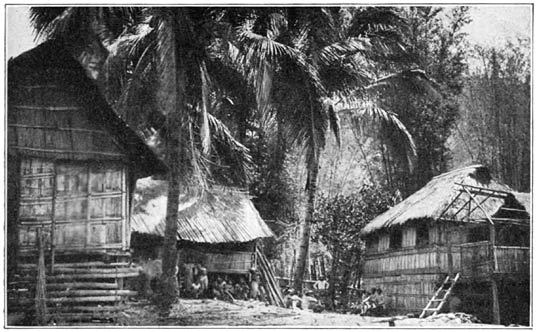
Elevated living rooms reached by ladders
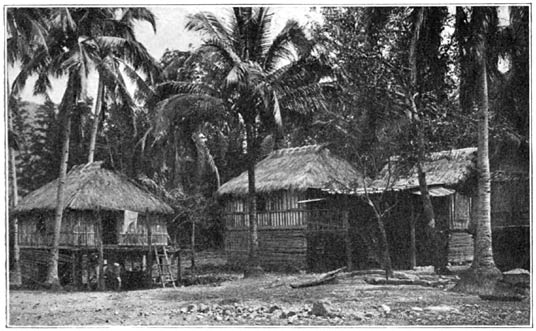
Cocoanut trees tower above the homes
Although he had been unsuccessful in his first attempt, Aponitolau did not give up the idea of getting rid of his son, and the next day he said:
The father and son went together to the field, and when they reached the little house, Aponitolau, pointing to a certain spot in the ground, said:
Dumalawi dug up the jar and they tasted the wine, and it was so pleasing to them that they drank three cocoanut shells full, and Dumalawi became drunk. While his son lay asleep on the ground, Aponitolau decided that this was a good time to destroy him, so he used his magical power and there arose a great storm which picked up Dumalawi in his sleep and carried him far away. And the father went home alone.
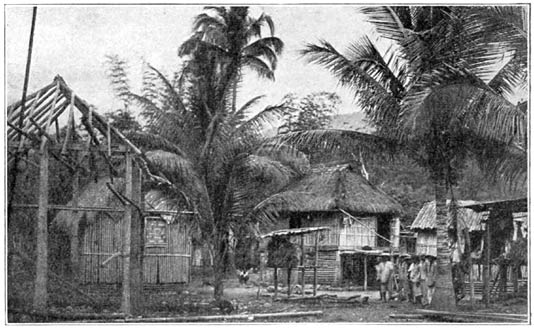
Section of a Tinguian village
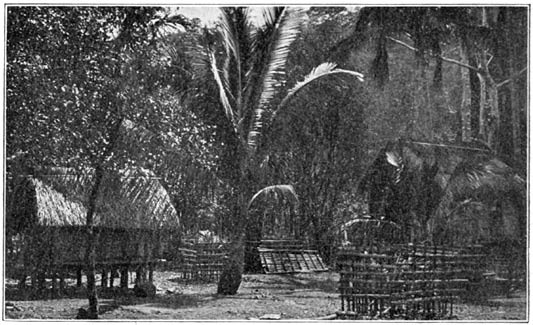
A settlement in the mountains
Now when Dumalawi awoke, he was in the middle of a field so wide that whichever way he looked, he could not see the end. There were neither trees nor houses in the field and no living thing except himself. And he felt a great loneliness.
By and by he used his magical power, and many betel-nuts grew in the field, and when they bore fruit it was covered with gold,
In one yard was a beautiful maiden, Dapilisan, and after Dumalawi had talked with her and her parents, he went on to the other yards, but she was ever in his thoughts. As soon as he had visited all the people, he returned to the house of Dapilisan and asked her parents if he might marry her. They were unwilling at first, for they feared that the parents of Dumalawi might not like it; but after he had explained that his father and mother did not want him, they gave their consent, and Dapilisan became his bride.
“You betel-nuts that are covered with gold, come here and oil yourselves and go and invite all the people in the world to come to our ceremony.”
So the betel-nuts oiled themselves and went to invite the people in the different towns.
Soon after this Aponibolinayen, the mother of Dumalawi, sat alone in her house, still mourning the loss of her son, when suddenly she was seized with a desire to chew betel-nut.
“What ails me?” she said to herself; “why do I want to chew? I had not intended to eat anything while Dumalawi was away.”
So saying, she took down her basket that hung on the wall, and saw in it a betel-nut covered with gold, and when she was about to cut it, it said:
“Do not cut me, for I have come to invite you to the ceremony which Dumalawi and his wife are to make.”
Aponibolinayen was very happy, for she knew now that her son still lived, and she told all the people to wash their hair and prepare to go to the rite. So they washed their clothes and their hair and started for the home of Dumalawi; and Aponitolau, the father of the boy, followed, but he looked like a crazy man. When the people reached the river near the town, Dumalawi sent alligators to take them across, but when Aponitolau got on the alligator’s back it dived, and he was thrown back upon the bank of the river. All the others were carried safely over, and Aponitolau, who was left on the bank alone, shouted as if crazy until Dumalawi sent another alligator to carry him across.
The spirits did as they were commanded, and when they brought the jars and had filled the spirit house nine times, Aponibolinayen said to the parents of Dapilisan:
“I think that now we have paid the price for your daughter.”
But Dalonagan, the mother of Dapilisan, was not satisfied, and said:
“No, there is still more to pay.”
“Very well,” replied Aponibolinayen. “Tell us what it is and we will pay it.”
Then Dalonagan called a pet spider and said:
After this the people feasted and made merry, and when at last they departed for home Dumalawi refused to go with his parents, but remained with his wife in the town he had created.
The Story of Kanag
Tinguian
Each day Aponitolau carried cooked rice and meat to his son in the field, but Kanag could not eat and always bade his father hang it in the watch-house until he should want it Each time Aponitolau found the food of the day before still untouched, and he began to suspect that the boy was unhappy at having to guard the grain. But he said nothing of his fears to Aponibolinayen.
One day after his father had returned home, Kanag was so lonely that he used his magical power and became a little bird and flew up into the top of a tree. The next day when Aponitolau came to the field he looked everywhere for his son, and when he could not find him he called, and from the top of a bamboo tree a little bird answered him. Realizing what had happened, the father was very sad and begged his son to come back and be a boy again, but Kanag only answered:
At last the father went home alone, and he and the boy’s mother were filled with grief that they had lost their son.
Some time after this, Aponitolau prepared to go out to fight. He took his spear and shield and head-ax and started early one morning, but when he reached the gate of the town, Kanag flew over him, giving him a bad sign, so he turned back. The next morning he started again, and this time the little bird gave him a good sign, and knowing that nothing would injure him, he went on.
After a long journey he reached a hostile town where the people said they were glad to see him, and added that because he was the first of his people who had dared to enter their town they intended to keep him there.
“Oh,” said Aponitolau, “if you say that I cannot return home, call all your people together and we will fight.”
“You are very brave,” answered his enemies, “if you wish to fight us all.”
And when the people had gathered together they laughed at him and said, “Why, one of our fingers would fight you.”
Nevertheless, Aponitolau prepared to fight, and when the bravest of the enemy threw his spear and head-ax at him he jumped and escaped. They noticed that he jumped very high, so they all ran at him, throwing their spears and trying to kill him.
But Aponitolau caught all their weapons, and then while they were unarmed he threw his own spear, and it flew about among them until it had killed them all. Then he sent his head-ax, and it cut off all the heads of the enemy; and he used magical power so that these heads went to his home in Kadalayapan.
After that Aponitolau sat down by the gate of the town to rest, and the little bird, flying over his head, called down:
“The sign that I gave you was good, Father, and you have killed all your enemies.”
The people came from all parts of the world, and while they played on the gongs and danced, Aponitolau called to Kanag and said:
“Come down, my son; do not stay always in the tops of the trees. Come and see the pretty girls and see which one you want to marry. Get the golden cup and give them basi to drink.”
But Kanag answered, “I would rather stay in the tops of the trees and give the signs when anyone goes to fight.”
Then the father and mother pleaded with him to become a boy once more, begging his forgiveness and promising never again to send him to guard the rice. But he would not listen to them, and only flew away.
Finding that they could not win him that way, Aponitolau and Aponibolinayen called the spirit servants, and commanded them to follow Kanag wherever he went, and to find a girl whom he would want to marry. So the spirit servants went after him, and wherever he went they followed.
“But,” said he to the servants, “what can I do if I become a man now, for I have no clothes and no head-band?”
“Do not worry about that,” said the spirit servants, “for we have everything here for you.”
So Kanag became a man and put on the clothes and head-band, and he went to speak to the girl. He gave her betel-nut, and they chewed together, and he said:
“My name is Kanag and I am the son of Aponitolau and Aponibolinayen.”
Then the girl said: “My name is Dapilisan and I am the daughter of Bangan and Dalonagan.”
When Dapilisan went home Kanag followed her, and he told her parents his name and how he had changed into a little bird. And when he had finished he asked if he might marry their daughter. Bangan and his wife were greatly pleased that Kanag wanted Dapilisan for his wife, but they were afraid that his parents might object, so they sent a messenger to invite Aponitolau and Aponibolinayen to come to visit them.
As soon as Kanag’s parents heard that their son had become a man they were very happy and started at once to go to him, carrying many fine presents. Before arrangements for the wedding could be made, it was necessary to decide on the price to be paid for the girl. A long discussion took place. Bangan and Dalonagan finally said that the spirit house must be filled nine times with different kinds of jars.
When this was done Dalonagan raised her eyebrows, and half of the jars disappeared. Aponibolinayen used her magical power and the spirit house was filled again, and then Dalonagan said to her:
“Now the web of the spider shall be put around the town and you must put gold beads on it. If it does not break, Kanag may marry Dapilisan.”
When Aponibolinayen had put the gold beads on the thread, Dalonagan hung on it to see if it would hold. As it did not break, she declared that the sign was good; and Kanag and Dapilisan were married.
Then the people played on the copper gongs, danced, and made merry for a long time, and when they returned to their homes Kanag and his bride went with Aponitolau and Aponibolinayen.
The Story of the Tikgi
Tinguian
“Tikgi, tikgi, tikgi, we will come to work for you. Let us cut your rice.”
“Why, you cannot cut rice,” said Ligi. “You are birds and know only how to fly.”
But the birds insisted that they knew how to cut rice; so finally he told them to come again when the grain was ripe, and they flew away.
No sooner had the birds gone than Ligi was filled with a great desire to see them again. As he went home he wished over and over that his rice were ready to cut. As soon as Ligi left the field the tikgi birds began using magic so that the rice grew rapidly, and five days later when he returned he found the birds there ready to cut the ripened grain. Ligi showed them where to begin cutting, and then he left them.
When he was out of sight, the tikgi said to the rice cutters:
“Rice cutters, you cut the rice alone.” And to the bands which were lying nearby they said: “Bands, you tie into bundles the rice which the cutters cut”
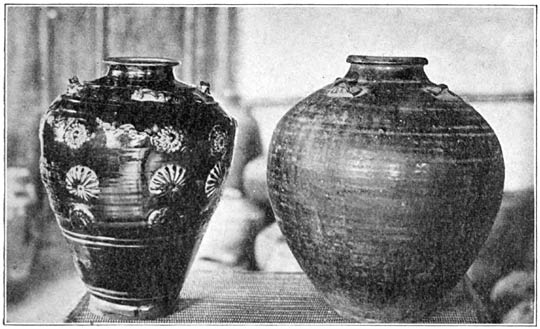
The talking jars
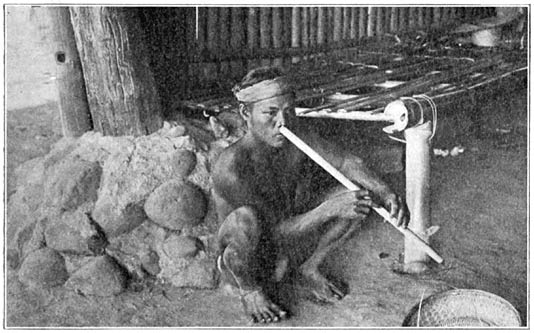
Playing the nose flute
And the rice cutters and the bands worked alone, doing as they were told.
When Ligi went again to the field in the afternoon, the tikgi said:
“Come, Ligi, and see what we have done, for we want to go home now.”
Ligi was amazed, for he saw five hundred bundles of rice cut. And he said:
“Oh, Tikgi, take all the rice you wish in payment, for I am very grateful to you.”
Then the tikgi each took one head of rice, saying it was all they could carry, and they flew away.
The next morning when Ligi reached the field, he found the birds already there and he said:
“Now, Tikgi, cut the rice as fast as you can, for when it is finished I will make a ceremony for the spirits, and you must come.”
“Yes,” replied the tikgi, “and now we shall begin the work, but you do not need to stay here.”
So Ligi went home and built a rice granary to hold his grain, and when he returned to the field the rice was all cut. Then the tikgi said: “We have cut all your rice, Ligi, so give us our pay, and when you go home the rice will all be in your granary.”
Ligi wondered at this, and when he reached home and saw that his granary was full of rice, he doubted if the tikgi could be real birds.
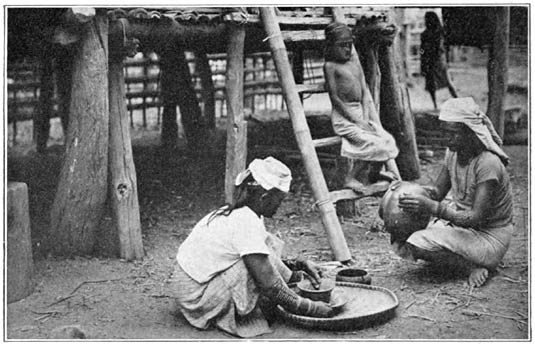
Tinguian potters at work
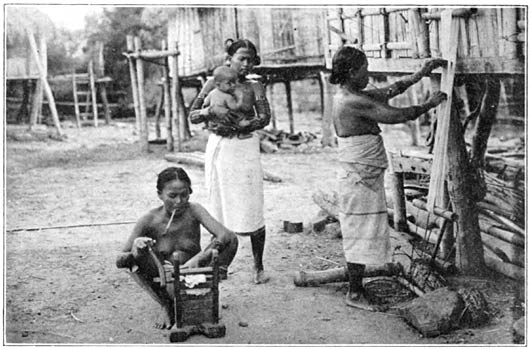
Seeding and combing cotton
“We are going home now; it is not good for us to stay here, for we cannot sit among the people.”
When they started home Ligi followed them until they came to the bana-asi tree, and here he saw them take off their feathers and put them in the rice granary. Then suddenly they became one beautiful maiden.
“Are you not the tikgi who came to cut my rice?” asked Ligi. “You look to me like a beautiful maiden.”
“Yes,” she replied; “I became tikgi and cut rice for you, for otherwise you would not have found me.” Ligi took her back to his house where the people were making the ceremony, and as soon as they saw her they began chewing the magic betel-nuts to find who she might be.
Ligi was very fond of the beautiful girl and he asked her parents if he might marry her. They were very willing and decided on a price he should pay. After the wedding all the people remained at his house, feasting and dancing for three months.
The Sun and the Moon
Tinguian
Once the Sun and the Moon quarreled with each other, and the Sun said:
“You are only the Moon and are not much good. If I did not give you light, you would be no good at all.”
But the Moon answered:
“You are only the Sun, and you are very hot. The women like me better, for when I shine at night, they go out doors and spin.”
These words of the Moon made the Sun so angry that he threw sand in her face, and you can still see the dark spots on the face of the Moon.
How the Tinguian Learned to Plant
Tinguian
Then Kadaklan, the Great Spirit who lives in the sky, saw that the people often were hungry and sick, and he sent one of his servants, Kaboniyan, to the earth to teach them many things. And it happened this way:
Dayapan, a woman who lived in Caalang, had been sick for seven years. One day when she went to the spring to bathe, there entered her body a spirit who had rice and sugar-cane with him, and he said to her:
“Dayapan, take these to your home and plant them in the ground, and after a while they will grow large enough to reap. Then when they are ripe, build a granary to put the rice in until you shall need it, and a sugar-press to crush the cane. And when these are finished, make the ceremony Sayung, and you will be well.”
When Dayapan had reaped the first rice and cane, she began to make the ceremony Sayung, and the Spirit came again and directed her. And when it was finished and she was cured, he told her to take a dog and a cock and go to bathe in the river as a sign that the ceremony was finished. So she went to the river and tied the dog and the cock near the water, but while she was bathing the dog ate the cock.
Dayapan wept bitterly at this and waited a long time for Kaboniyan, and when at last he came, he said:
“If the dog had not killed the cock, no person would die when you make this ceremony; but this is a sign, and now some will die and some will get well.”
Dayapan called all the people together, and told them the things that the spirit had taught her; and they could see that she had been made well. After that, when people became ill they called Dayapan to treat them. And it was as the Spirit had said; some died and others were made well.
Magsawi
Tinguian
Filled with curiosity they pressed on, but the jar evaded them. Faster and faster they ran, but the object, disappearing at times and then coming into view again, always escaped them. On and on they went until at last, tired out, they sat down on a wooded hill to rest and to refresh themselves with betel-nut which they took from brass boxes attached to their belts.
As they slowly cut the nuts and wrapped them in the lime and leaf ready for chewing, they talked of nothing but the wonderful jar and the mysterious power it possessed. Then just as they were about to put the tempting morsels into their mouths they stopped, startled by a strange soft voice which seemed to be near them. They turned and listened, but could see no person.
“Find a pig which has no young,” said the voice, “and take its blood, for then you will be able to catch the jar which your dog pursued.”
Sometimes Magsawi goes on long journeys alone when he visits his wife, a jar in Ilocos Norte, or his child, a small jar in San Quintin; but he always returns to Domayco on the hillside near the cave.
The Tree with the Agate Beads
Tinguian
More than a hundred seasons ago, a Tinguian went one day to the mountains to hunt. Accompanied by his faithful dog, he made his way steadily up the mountain side, only halting where it was necessary to cut a path through the jungle. And the dog ran here and there searching in the thick underbrush.
On and on he went without seeing any game, and then, when he was almost at the top of the highest peak, the dog gave a sharp yelp, and out of the brush leaped a fine deer. Zip! went the man’s spear, and it pierced the animal’s side. For an instant he waited, but the deer did not fall. On it ran with unslackened speed, and a moment later it plunged into a hole in the ground with the man and dog in close pursuit.
A short distance from the entrance the cave opened out into large, spacious rooms, and before he realized it the man was hopelessly lost In the distance he could hear the baying of the dog, and with no other guide he hurried on through the darkness.
Following the sound, he went for a long time from one unfamiliar room to another, stumbling in the darkness and striking against the stone walls, and then suddenly his outstretched hands grasped a small tree on which berries grew.
Astonished at finding anything growing in this dark place, he broke off a branch, and as he did so the shrub began to talk in a strange language. Terrified, the man ran in the direction he had last heard the dog, and a moment later he found himself in the open air on the banks of the Abra River, with the dead deer at his feet.
The sight of the beautiful beads convinced the people that he told the truth, and a number of men at once returned with him to secure the tree.
Their quest, however, was unsuccessful, for ere they reached the spot the evil spirit had taken the tree away and on the walls of the cave it had made strange carvings which even to this day can be seen.
The Striped Blanket
Tinguian
Three Tinguian once went to the mountains to hunt deer. They took their blankets with them, for they expected to be gone several days, and the nights in the mountains are cold.
The blankets of two of the men were of the blue-and-white designs such as are commonly worn by the Tinguian, but that of the third was covered with red and yellow stripes like the back of a little wild pig.
At night the men rolled up in their blankets and lay down under a tree to sleep; but while the one in the striped blanket was still awake two spirits came near and saw him.
“Oh,” he heard one spirit say to the other, “here we have something to eat, for here is a little wild pig.”
Then the man quickly took the blanket off one of his sleeping companions and put his own in its place. Very soon the spirits came and ate the man under the striped blanket.
Since that time the Tinguian never sleep under that kind of a blanket if they are where the spirits can get them.
The Alan and the Hunters
Tinguian
Two men once went to hunt wild pig in the mountains, and after some time they speared and killed one, but they had no fire over which to singe it.
He stepped on tip-toe, but nevertheless the Alan was awakened and called out:
“I should like to get some fire,” said the man, “for we have killed a wild pig.”
The Alan gave him the fire, and then taking her basket she went with him to the place where the pig was.
After they had singed the animal, the Alan cut it up with her long nails and handed the liver to the man, telling him to take it to her house to feed the baby.
The man started, and on the way he ate the liver. When he reached the Alan’s house he did not know what to do. For some time he looked around, and then seeing a large caldron of hot water on the fire, he threw the baby into it and went back.
“Did the baby eat well?” asked the Alan.
“Very well,” said the man.
Then she put most of the meat into her basket and started home. As soon as she had gone, the man told his companion what he had done, and they were so frightened that they ran to hide.
When the Alan reached home and found the baby dead in the hot water, she was very angry and started back immediately to find the men, who, in the meantime, had climbed a high tree that stood near the water.
The Alan looked down into the water, and seeing the reflection of the men, she reached in her long hand with the fingers that pointed backward, but when she could not touch them, she looked up and saw them in the tall tree.
“How did you get up there?” she cried angrily.
“We climbed up feet first,” called down the men.
Then the men came down and went to the Alan’s house, where they found a jar full of beads and another of gold, and these they brought with them when they returned home.
Man and the Alan
Tinguian
A Tinguian was once walking along a trail in the wood when he heard a strange sound in a large tree near him, and looking up he was startled to see that it was the home of the Alan—spirits who live in the wood.
He stopped and gazed for a moment at the horrible creatures, large as people, hanging from the limbs of the tree with their heads down like bats. They had wings to fly, and their toes were at the back of their feet, while their long fingers, which pointed backward, were fastened at the wrist.
“Surely,” thought the man, “these terrible beings will eat me if they can catch me. I will run away as fast as I can while they are asleep.” He tried to run but he was too frightened, and after a few steps he fell face down on the ground.
At this the Alan began to wail loudly, for they saw him fall and believed him dead And they came down out of the tree with gold and beads which they laid on him.
After a while the man gathered courage and, jumping up, he cried as loudly as he could, “Go away!”
The Alan did not move, but they looked at him and said: “Give us the one bead nagaba [a peculiar bead of double effect], and you may have the rest.” When the man refused to do this, they were angry and turned away, crying, “Then we are going to burn your house, for you are a bad man.”
Thereupon the man went home as fast as he could go, but very soon after that his house burned, for the Alan kept their word.
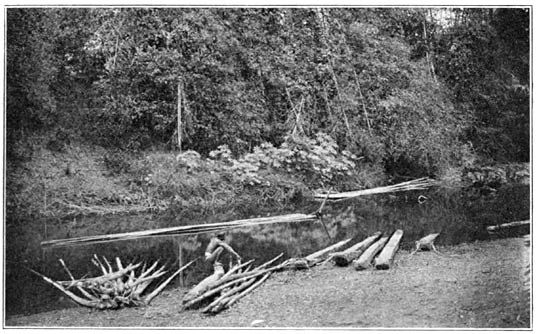
Bamboo rafts
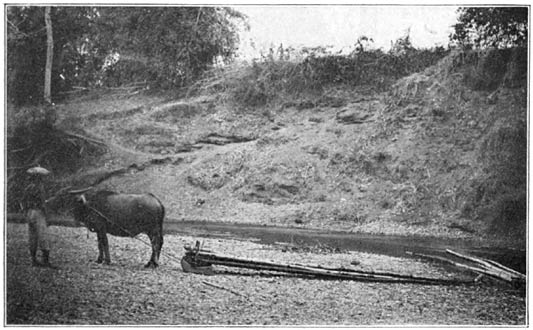
Hauling bamboo
Sogsogot
Tinguian
One day, a long time ago, some men went to the mountains to hunt deer and wild pig, and among them was one named Sogsogot.
They all went into the thick forest to look for game, but after a while Sogsogot called his dog and withdrew to an open spot near by, where he waited for the deer to come out.
Sogsogot’s first thought was to make his escape, but he found that the tree was so tall that he could not get down, and after a time he ceased his attempts to get away and began to look over his companions in the nest—two young birds and three little pigs.
By and by he became hungry, so he cut up the three little pigs, and after he had eaten all he wished he fed the two birds. When this meat was gone the mother bird brought more pigs and deer, and the man had all he could eat. Then he fed the little birds, which grew very fast and soon were able to fly. One day when they were standing on the edge of the nest Sogsogot caught hold of the birds’ legs, and they fluttered down and carried him safely to the ground.
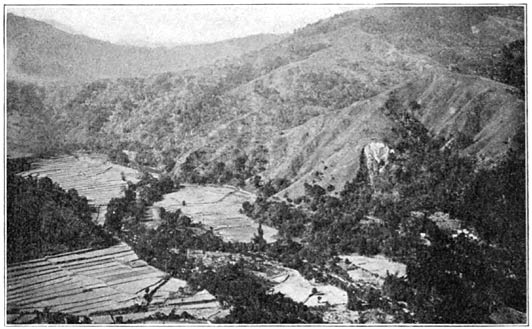
Rice terraces in the mountains
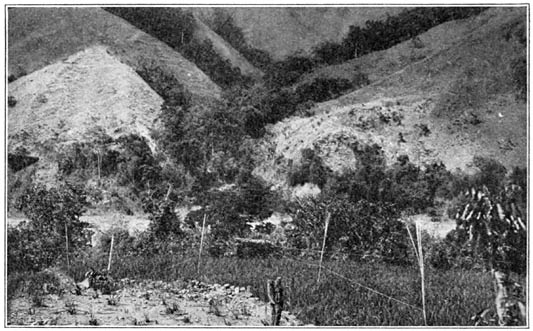
A rice field
He hastened home as fast as he could go and told the people of his wonderful trip. They made a ceremony for the spirits, and all the people rejoiced that the lost man had returned.
Some time after this Sogsogot went to a hostile town to fight, and while he was gone his wife died. On the way back to his town he met the spirit of his wife driving a cow and two pigs, and not knowing that she was a spirit he asked her where she was going.
“I am not a person any more,” she answered him; “I am dead.” And when he wanted to touch her hand, she gave him only her shortest finger. He begged to go with her so she said, “Go first to our home and get a white chicken; then follow the footmarks of the cow and pigs.”
He did as she commanded him, and after a while he came to a place where she was bathing in the river. She said to him:
The man went with her, and when they arrived at the spirit town she hid him in the rice-bin. At night the people came to eat him, as she had said they would; but when he threw the chicken feathers at them they were frightened away.
For two weeks Sogsogot lived in this place, but when the feathers were nearly gone he was afraid to stay any longer, for every night the spirits came to eat him. He begged his wife to allow him to go, and finally she showed him the way home, giving him rice to eat on his journey.
As soon as the man arrived home and inquired for his wife, the people told him that she had died and they had buried her under the house. Then he knew that it was her spirit that had taken him to the strange town.
The Mistaken Gifts
Tinguian
When Siagon was about eight years old his parents began looking for a girl who would make a suitable wife. At last when they had decided on a beautiful maiden, who lived some distance from them, they sent a man to her parents to ask if they would like Siagon for a son-in-law.
Now when the man arrived at the girl’s house the people were all sitting on the floor eating periwinkle, and as they sucked the meat out of the shell, they nodded their heads. The man, looking in at the door, saw them nod, and he thought they were nodding at him. So he did not tell them his errand, but returned quickly to the boy’s parents and told them that all the people at the girl’s house were favorable to the union.
Siagon’s parents were very much pleased that their proposal had been so kindly received, and immediately prepared to go to the girl’s house to arrange for the wedding.
Finally all was ready and they started for her house, carrying with them as presents for her parents two carabao, two horses, two cows, four iron kettles, sixteen jars of basi, two blankets, and two little pigs.
The Boy who Became a Stone
Tinguian
One day a little boy named Elonen sat out in the yard making a bird snare, and as he worked, a little bird called to him: “Tik-tik-lo-den” (come and catch me).
“I am making a snare for you,” said the boy; but the bird continued to call until the snare was finished.
Then Elonen ran and threw the snare over the bird and caught it, and he put it in a jar in his house while he went with the other boys to swim.
While he was away, his grandmother grew hungry, so she ate the bird, and when Elonen returned and found that his bird was gone, he was so sad that he wished he might go away and never come back. He went out into the forest and walked a long distance, until finally he came to a big stone and said: “Stone, open your mouth and eat me.” And the stone opened its mouth and swallowed the boy.
When his grandmother missed the boy, she went out and looked everywhere, hoping to find him. Finally she passed near the stone and it cried out, “Here he is.” Then the old woman tried to open the stone but she could not, so she called the horses to come and help her. They came and kicked it, but it would not break. Then she called the carabao and they hooked it, but they only broke their horns. She called the chickens, which pecked it, and the thunder, which shook it, but nothing could open it, and she had to go home without the boy.
The Turtle and the Lizard
Tinguian
“We must be very still or the man will hear us and come out.”
But as soon as the lizard tasted the ginger he was so pleased that he said:
“The ginger of Gotgotapa is very good.”
“Be still,” said the turtle; but the lizard paid no attention to the warning, and called louder than ever:
“The ginger of Gotgotapa is very good.”
Again and again he cried out, until finally the man heard him and came out of the house to catch the robbers.
The man ran after the lizard for a long distance, but he could not catch him. After a while he came back to the house and sat down on the shell.
By and by, the turtle called, “Kook.” The man jumped up and looked all around. Unable to tell where the noise came from, he sat down again,
A second time the turtle called, and this time the man looked everywhere in the house except under the shell, but could not find the turtle. Again and again the turtle called, and finally the man, realizing that all his attempts were unsuccessful, grew so excited that he died.
Then the turtle ran out of the house, and he had not gone far before he met the lizard again. They walked along together until they saw some honey in a tree, and the turtle said:
“I will go first and get some of the honey.”
The lizard would not wait, but ran ahead, and when he seized the honey, the bees came out and stung him. So he ran back to the turtle for help.
After a while they came to a bird snare, and the turtle said:
“That is the silver wire that my grandfather wore about his neck.”
Then the lizard ran fast to get it first, but he was caught in the snare and was held until the man came and killed him. Then the wise turtle went on alone.
The Man with the Cocoanuts
Tinguian
One day a man who had been to gather his cocoanuts loaded his horse heavily with the fruit. On the way home he met a boy whom he asked how long it would take to reach the house.
“If you go slowly,” said the boy, looking at the load on the horse, “you will arrive very soon; but if you go fast, it will take you all day.”
The Carabao and the Shell
Tinguian
One very hot day, when a carabao went into the river to bathe, he met a shell and they began talking together.
“You are very slow,” said the carabao to the shell.
“Oh, no,” replied the shell. “I can beat you in a race.”
“Then let us try and see,” said the carabao.
So they went out on the bank and started to run.
After the carabao had gone a long distance he stopped and called, “Shell!”
And another shell lying by the river answered, “Here I am!”
Then the carabao, thinking that it was the same shell with which he was racing, ran on.
By and by he stopped again and called, “Shell!”
Again another shell answered, “Here I am!”
The Alligator’s Fruit
Tinguian
Two women went to gather some wild fruit from a vine which belonged to the alligator.
“You must be careful not to throw the rind with your teeth marks on it where the alligator can see it,” said one of the women to the other as they sat eating the fruit.
But the other woman paid no attention and threw the rind showing teeth marks into the river, where the alligator saw it.
Thus he knew at once who had taken his fruit, and he was very angry. He went to the house of the woman and called to the people:
“Bring out the woman that I may eat her, for she has eaten my fruit”
“Very well,” answered the people. “But sit down and wait a little while.”
Then they put the iron soil-turner into the fire, and when it was red hot, they took it to the door and said to the alligator:
“Here, eat this first.”
He opened his mouth, and they pushed the red hot iron down his throat, and he died.
Dogedog
Tinguian
Dogedog had always been very lazy, and now that his father and mother were dead and he had no one to care for him, he lived very poorly. He had little to eat. His house was old and small and so poor that it had not even a floor. Still he would rather sit all day and idle away his time than to work and have more things.
One day, however, when the rainy season was near at hand, Dogedog began thinking how cold he would be when the storms came, and he felt so sorry for himself that he decided to make a floor in his house.
Wrapping some rice in a banana leaf for his dinner, he took his long knife and went to the forest to cut some bamboo. He hung the bundle of rice in a tree until he should need it; but while he was working a cat came and ate it. When the hungry man came for his dinner, there was none left. Dogedog went back to his miserable little house which looked forlorn to him even, now that he had decided to have a floor.
The next day he went again to the forest and hung his rice in the tree as he did before, but again the cat came and ate it. So the man had to go home without any dinner.
The third day he took the rice, but this time he fixed a trap in the tree, and when the cat came it was caught.
“Now I have you!” cried the man when he found the cat; “and I shall kill you for stealing my rice.”
“Oh, do not kill me,” pleaded the cat, “and I will be of some use to you.”
So Dogedog decided to spare the cat’s life, and he took it home and tied it near the door to guard the house.
Some time later when he went to look at it, he was very much surprised to find that it had become a cock.
“Now I can go to the cock-fight at Magsingal,” cried the man. And he was very happy, for he had much rather do that than work.
Thinking no more of getting wood for his floor, he started out at once for Magsingal with the cock under his arm. As he was crossing a river he met an alligator which called out to him:
“Where are you going, Dogedog?”
“To the cock-fight at Magsingal,” replied the man as he fondly stroked the rooster.
“Wait, and I will go with you,” said the alligator; and he drew himself out of the water.
The two walking along together soon entered a forest where they met a deer and it asked:
“Where are you going, Dogedog?”
“To the cock-fight at Magsingal,” said the man.
“Wait and I will go with you,” said the deer; and he also joined them.
By and by they met a mound of earth that had been raised by the ants, and they would have passed without noticing it had it not inquired:
“Where are you going, Dogedog?”
“To the cock-fight at Magsingal,” said the man once more; and the mound of earth joined them.
The company then hurried on, and just as they were leaving the forest, they passed a big tree in which was a monkey.
“Where are you going, Dogedog?” shrieked the monkey. And without waiting for an answer he scrambled down the tree and followed them.
As the party walked along they talked together, and the alligator said to Dogedog:
“If any man wants to dive into the water, I can stay under longer than he.”
Then the deer, not to be outdone, said:
“If any man wants to run, I can run faster.”
The mound of earth, anxious to show its strength, said:
“If any man wants to wrestle, I can beat him.”
And the monkey said:
“If any man wants to climb, I can go higher.”
They reached Magsingal in good time and the people were ready for the fight to begin. When Dogedog put his rooster, which had been a cat, into the pit, it killed the other cock at once, for it used its claws like a cat.
The people brought more roosters and wagered much money, but Dogedog’s cock killed all the others until there was not one left in Magsingal, and Dogedog won much money. Then they went outside the town and brought all the cocks they could find, but not one could win over that of Dogedog.
When the cocks were all dead, the people wanted some other sport, so they brought a man who could stay under water for a long time, and Dogedog made him compete with the alligator. But after a while the man had to come up first Then they brought a swift runner and he raced with the deer, but the man was left far behind. Next they looked around until they found a very large man who was willing to contend with the mound of earth, but after a hard struggle the man was thrown.
Finally they brought a man who could climb higher than anyone else, but the monkey went far above him, and he had to give up.