Christianized Tribes
Reading edition
Introduction
When the Spaniards discovered the Philippines in the sixteenth century, they found the tribes along the coasts of the different islands already somewhat influenced by trade with China, Siam, and the islands to the south.
Under Spanish rule the coast inhabitants, with the exception of the Moro, soon became converts to Christianity and adopted the dress of their conquerors, though they retained their several dialects and many of their former customs. Then, no longer being at war with one another, they made great advances in civilization, while the hill tribes have remained isolated, retaining their old customs and beliefs.
The tales of the Christianized tribes include a great mixture of old ideas and foreign influences obtained through contact with the outside world.
The Monkey and the Turtle
Ilocano
A monkey, looking very sad and dejected, was walking along the bank of the river one day when he met a turtle.
“How are you?” asked the turtle, noticing that he looked sad.
The monkey replied, “Oh, my friend, I am very hungry. The squash of Mr. Farmer were all taken by the other monkeys, and now I am about to die from want of food.”
“Do not be discouraged,” said the turtle; “take a bolo and follow me and we will steal some banana plants.”
So they walked along together until they found some nice plants which they dug up, and then they looked for a place to set them. Finally the monkey climbed a tree and planted his in it, but as the turtle could not climb he dug a hole in the ground and set his there.
When their work was finished they went away, planning what they should do with their crop. The monkey said:
“When my tree bears fruit, I shall sell it and have a great deal of money.”
And the turtle said: “When my tree bears fruit, I shall sell it and buy three varas of cloth to wear in place of this cracked shell.”
A few weeks later they went back to the place to see their plants and found that that of the monkey was dead, for its roots had had no soil in the tree, but that of the turtle was tall and bearing fruit.
“I will climb to the top so that we can get the fruit,” said the monkey. And he sprang up the tree, leaving the poor turtle on the ground alone.
“Please give me some to eat,” called the turtle, but the monkey threw him only a green one and ate all the ripe ones himself.
When he had eaten all the good bananas, the monkey stretched his arms around the tree and went to sleep. The turtle, seeing this, was very angry and considered how he might punish the thief. Having decided on a scheme, he gathered some sharp bamboo which he stuck all around under the tree, and then he exclaimed:
“Crocodile is coming! Crocodile is coming!”
The monkey was so startled at the cry that he fell upon the sharp bamboo and was killed.
Then the turtle cut the dead monkey into pieces, put salt on it, and dried it in the sun. The next day, he went to the mountains and sold his meat to other monkeys who gladly gave him squash in return. As he was leaving them he called back:
“Lazy fellows, you are now eating your own body; you are now eating your own body.”
Then the monkeys ran and caught him and carried him to their own home.
“Let us take a hatchet,” said one old monkey, “and cut him into very small pieces.”
But the turtle laughed and said: “That is just what I like, I have been struck with a hatchet many times. Do you not see the black scars on my shell?”
Then one of the other monkeys said: “Let us throw him into the water,”
At this the turtle cried and begged them to spare his life, but they paid no heed to his pleadings and threw him into the water. He sank to the bottom, but very soon came up with a lobster. The monkeys were greatly surprised at this and begged him to tell them how to catch lobsters.
“I tied one end of a string around my waist,” said the turtle. “To the other end of the string I tied a stone so that I would sink.”
The monkeys immediately tied strings around themselves as the turtle said, and when all was ready they plunged into the water never to come up again.
The Poor Fisherman and His Wife
Ilocano
Many, many years ago a poor fisherman and his wife lived with their three sons in a village by the sea. One day the old man set his snare in the water not far from his house, and at night when he went to look at it, he found that he had caught a great white fish. This startled the old man very much, for he had never seen a fish like this before, and it occurred to him that it was the priest of the town.
He ran to his wife as fast as he could and cried:
“My wife, I have caught the priest.”
“What?” said the old woman, terrified at the sight of her frightened husband.
“I have caught the priest,” said the old man again.
They hurried together to the river where the snare was set, and when the old woman saw the fish, she cried:
“Oh, it is not the priest but the governor.”
“No, it is the priest,” insisted the old man, and they went home trembling with fear.
That night neither of them was able to sleep for thought of the terrible thing that had happened and wondering what they should do. Now the next day was a great holiday in the town. At four o’clock in the morning cannons were fired and bells rang loudly. The old man and woman, hearing all the noise and not knowing the reason for it, thought that their crime had been discovered, and the people were searching for them to punish them, so they set out as fast as they could to hide in the woods. On and on they went, stopping only to rest so as to enable them to resume their flight.
The next morning they reached the woods near Pilar, where there also was a great holiday, and the sexton was ringing the bells to call the people to mass. As soon as the old man and woman heard the bells they thought the people there had been notified of their escape, and that they, too, were trying to catch them. So they turned and started home again.
The Presidente who had Horns
Ilocano
He sent for a barber who came to his house to cut his hair, and as he worked the presidente asked:
“What do you see on my head?”
“I see nothing,” answered the barber; for although he could see the horns plainly, he was afraid to say so.
Soon, however, the presidente put up his hands and felt the horns, and then when he inquired again the barber told him that he had two horns.
“If you tell anyone what you have seen, you shall be hanged,” said the presidente as the barber started away, and he was greatly frightened.
When he reached home, the barber did not intend to tell anyone, for he was afraid; but as he thought of his secret more and more, the desire to tell someone became so strong that he knew he could not keep it. Finally he went to the field and dug a hole under some bamboo, and when the hole was large enough he crawled in and whispered that the presidente had horns. He then climbed out, filled up the hole, and went home.
By and by some people came along the road on their way to market, and as they passed the bamboo they stopped in amazement, for surely a voice came from the trees, and it said that the presidente had horns. These people hastened to market and told what they had heard, and the people there went to the bamboo to listen to the strange voice. They informed others, and soon the news had spread all over the town. The councilmen were told, and they, too, went to the bamboo. When they had heard the voice, they ran to the house of the presidente. But his wife said that he was ill and they could not see him.
By this time the horns had grown until they were one foot in length, and the presidente was so ashamed that he bade his wife tell the people that he could not talk. She told this to the councilmen when they came on the following day, but they replied that they must see him, for they had heard that he had horns, and if this were true he had no right to govern the people.
The Story of a Monkey
Ilocano
One day when a monkey was climbing a tree in the forest in which he lived, he ran a thorn into his tail. Try as he would, he could not get it out, so he went to a barber in the town and said:
“Friend Barber, I have a thorn in the end of my tail. Pull it out, and I will pay you well.”
The barber tried to pull out the thorn with his razor, but in doing so he cut off the end of the tail. The monkey was very angry and cried:
“Barber, Barber, give me back my tail, or give me your razor!”
The barber could not put back the end of the monkey’s tail, so he gave him his razor.
On the way home the monkey met an old woman who was cutting wood for fuel, and he said to her:
“Grandmother, Grandmother, that is very hard. Use this razor and then it will cut easily.”
The old woman was very pleased with the offer and began to cut with the razor, but before she had used it long it broke. Then the monkey cried:
“Grandmother, Grandmother, you have broken my razor! You must get a new one for me or else give me all the firewood.”
The old woman could not get a new razor so she gave him the firewood.
The monkey took the wood and was going back to town to sell it, when he saw a woman sitting beside the road making cakes.
“Grandmother, Grandmother,” said he, “your wood is most gone; take this of mine and bake more cakes.”
The woman took the wood and thanked him for his kindness, but when the last stick was burned, the monkey cried out:
“Grandmother, Grandmother, you have burned up all my wood! Now you must give me all your cakes to pay for it.”
The old woman could not cut more dry wood at once, so she gave him all the cakes.
The monkey took the cakes and started for the town, but on the way he met a dog which bit him so that he died. And the dog ate all the cakes.
The White Squash
Ilocano
In a queer little bamboo house in front of a big garden lived a man and his wife all alone. They had always been kind and good to everyone, but still they were not happy, because the child for which they longed had never come to them. Each day for many years they had prayed for a son or a daughter, but their prayers had been unanswered. Now that they were growing old they believed that they must always live alone.
In the garden near their house this couple grew fine white squash, and as the vines bore the year around, they had never been in need of food. One day, however, they discovered that no new squash had formed to take the place of those they had picked, and for the first time in many seasons they had no vegetables.
Each day they examined the vines, and though the big, yellow flowers continued to bloom and fade, no squash grew on the stems. Finally, one morning after a long wait, the woman cried out with delight, for she had discovered a little green squash. After examining it, they decided to let it ripen that they might have the seeds to plant. They eagerly watched it grow, and it became a beautiful white vegetable, but by the time it was large enough for food they were so hungry that they decided to eat it.
They brought a large knife and picked it, but scarcely had they started to open it when a voice cried out from within, “Please be careful that you do not hurt me.”
Presently the woman went to the spring for a jar of water, and when she had brought it she spread a mat on the floor and began to bathe the baby. As the drops of water fell off his body, they were immediately changed to gold, so that when the bath was finished gold pieces covered the mat. The couple had been so delighted to have the baby that it had seemed as if there was nothing more to wish for, but now that the gold had come to them also they were happier than ever.
The next morning the woman gave the baby another bath, and again the water turned to gold. They now had enough money to build a large house. The third morning she brought water for his bath again, but he grew very sad and flew away. At the same time all the gold disappeared also, and the man and his wife were left poor and alone.
The Creation Story
Tagalog
Now at this time the land breeze and the sea breeze were married, and they had a child which was a bamboo. One day when this bamboo was floating about on the water, it struck the feet of the kite which was on the beach. The bird, angry that anything should strike it, pecked at the bamboo, and out of one section came a man and from the other a woman.
Then the earthquake called on all the birds and fish to see what should be done with these two, and it was decided that they should marry. Many children were born to the couple, and from them came all the different races of people.
After a while the parents grew very tired of having so many idle and useless children around, and they wished to be rid of them, but they knew of no place to send them to. Time went on and the children became so numerous that the parents enjoyed no peace. One day, in desperation, the father seized a stick and began beating them on all sides.
This so frightened the children that they fled in different directions, seeking hidden rooms in the house—some concealed themselves in the walls, some ran outside, while others hid in the fireplace, and several fled to the sea.
The Story of Benito
Tagalog
Benito was an only son who lived with his father and mother in a little village. They were very poor, and as the boy grew older and saw how hard his parents struggled for their scanty living he often dreamed of a time when he might be a help to them.
One evening when they sat eating their frugal meal of rice the father told about a young king who lived in a beautiful palace some distance from their village, and the boy became very much interested. That night when the house was dark and quiet and Benito lay on his mat trying to sleep, thoughts of the young king repeatedly came to his mind, and he wished he were a king that he and his parents might spend the rest of their lives in a beautiful palace.
The next morning he awoke with a new idea. He would go to the king and ask for work, that he might in that way be able to help his father and mother. He was a long time in persuading his parents to allow him to go, however, for it was a long journey, and they feared that the king might not be gracious. But at last they gave their consent, and the boy started out The journey proved tiresome. After he reached the palace, he was not at first permitted to see the king. But the boy being very earnest at last secured a place as a servant.
It was a new and strange world to Benito who had known only the life of a little village. The work was hard, but he was happy in thinking that now he could help his father and mother. One day the king sent for him and said:
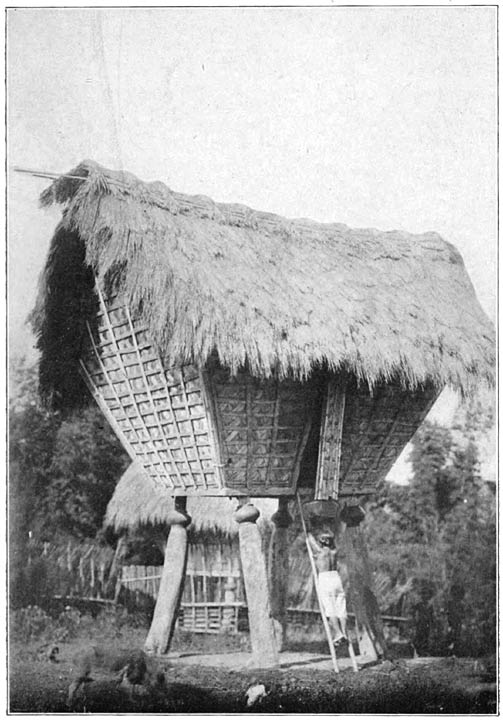
A rice granary
“I want you to bring to me a beautiful princess who lives in a land across the sea. Go at once, and if you fail you shall be punished severely,”
The boy’s heart sank within him, for he did not know what to do. But he answered as bravely as possible, “I will, my lord,” and left the king’s chamber. He at once set about preparing things for a long journey, for he was determined to try at least to fulfil the command.
When all was ready Benito started. He had not gone far before he came to a thick forest, where he saw a large bird bound tightly with strings.
“Oh, my friend,” pleaded the bird, “please free me from these bonds, and I will help you whenever you call on me.”
Benito quickly released the bird, and it flew away calling back to him that its name was Sparrow-hawk.
Benito continued his journey till he came to the sea. Unable to find a way of crossing, he stopped and gazed sadly out over the waters, thinking of the king’s threat if he failed. Suddenly he saw swimming toward him the King of the Fishes who asked:
“Why are you so sad?”
“I wish to cross the sea to find the beautiful Princess,” answered the boy.
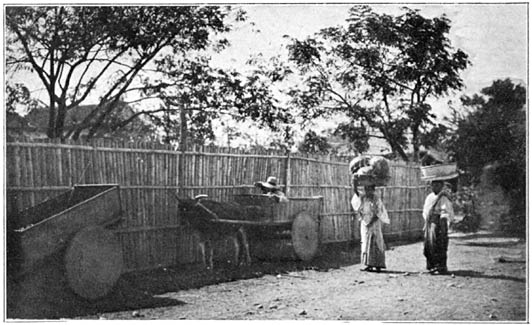
Methods of transportation
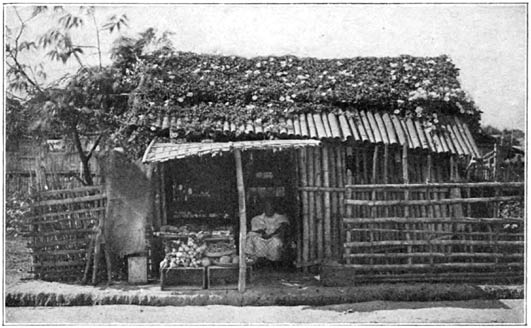
A store in a Christianized village
“Well, get on my back,” said the Fish, “and I will carry you across.”
So Benito stepped on his back and was carried to the other shore.
Soon he met a strange woman who inquired what it was he sought, and when he had told her she said:
“The Princess is kept in a castle guarded by giants. Take this magic sword, for it will kill instantly whatever it touches.” And she handed him the weapon.
Benito was more than grateful for her kindness and went on full of hope. As he approached the castle he could see that it was surrounded by many giants, and as soon as they saw him they ran out to seize him, but they went unarmed for they saw that he was a mere boy. As they approached he touched those in front with his sword, and one by one they fell dead. Then the others ran away in a panic, and left the castle unguarded. Benito entered, and when he had told the Princess of his errand, she was only too glad to escape from her captivity and she set out at once with him for the palace of the king.
At the seashore the King of the Fishes was waiting for them, and they had no difficulty in crossing the sea and then in journeying through the thick forest to the palace, where they were received with great rejoicing. After a time the King asked the Princess to become his wife, and she replied:
“I will, O King, if you will get the ring I lost in the sea as I was crossing it”
The King immediately thought of Benito, and sending for him he commanded him to find the ring which had been lost on the journey from the land of the giants.
It seemed a hopeless task to the boy, but, anxious to obey his master, he started out. At the seaside he stopped and gazed over the waters until, to his great delight, he saw his friend, the King of the Fishes, swimming toward him. When he had been told of the boy’s troubles, the great fish said: “I will see if I can help you,” and he summoned all his subjects to him. When they came he found that one was missing, and he sent the others in search of it. They found it under a stone so full that it could not swim, and the larger ones took it by the tail and dragged it to the King.
“Why did you not come when you were called?” inquired the King Fish.
“I have eaten so much that I cannot swim,” replied the poor fish.
Then the King Fish, suspecting the truth, ordered it cut open, and inside they found the lost ring. Benito was overjoyed at this, and expressing his great thanks, hastened with the precious ring to his master.
The King, greatly pleased, carried the ring to the Princess and said:
“Now that I have your ring will you become my wife?”
“I will be your wife,” replied the Princess, “if you will find my earring that I lost in the forest as I was journeying with Benito.”
Again the King sent for Benito, and this time he commanded him to find the earring. The boy was very weary from his long journeys, but with no complaint he started out once more. Along the road through the thick forest he searched carefully, but with no reward. At last, tired and discouraged, he sat down under a tree to rest.
Suddenly there appeared before him a mouse of great size, and he was surprised to find that it was the King of Mice.
“Why are you so sad?” asked the King Mouse.
“Because,” answered the boy, “I cannot find an earring which the Princess lost as we were going through the forest together.”
“I will help you,” said the Mouse, and he summoned all his subjects.
When they assembled it was found that one little mouse was missing, and the King sent the others to look for him. In a small hole among the bamboo trees they found him, and he begged to be left alone, for, he said, he was so full that he could not walk. Nevertheless they pulled him along to their master, who, upon finding that there was something hard inside the mouse, ordered him cut open; and inside they found the missing earring.
Benito at once forgot his weariness, and after expressing his great thanks to the King Mouse he hastened to the palace with the prize. The King eagerly seized the earring and presented it to the Princess, again asking her to be his wife.
“Oh, my King,” replied the Princess, “I have one more request to make. Only grant it and I will be your wife forever.”
The King, believing that now with the aid of Benito he could grant anything, inquired what it was she wished, and she replied:
“Get me some water from heaven and some from the lower world, and I shall ask nothing more.”
Once more the King called Benito and sent him on the hardest errand of all.
The boy went out not knowing which way to turn, and while he was in a deep study his weary feet led him to the forest. Suddenly he thought of the bird who had promised to help him, and he called, “Sparrowhawk!” There was a rustle of wings, and the bird swooped down. He told it of his troubles and it said:
“I will get the water for you.”
Then Benito made two light cups of bamboo which he fastened to the bird’s legs, and it flew away. All day the boy waited in the forest, and just as night was coming on the bird returned with both cups full. The one on his right foot, he told Benito, was from heaven, and that on his left was from the lower world. The boy unfastened the cups, and then, as he was thanking the bird, he noticed that the journey had been too much for it and that it was dying. Filled with sorrow for his winged friend, he waited and carefully buried it, and then he hastened to the palace with the precious water.
When the Princess saw that her wish had been fulfilled she asked the King to cut her in two and pour over her the water from heaven. The King was not able to do this, so she cut herself, and then as he poured the water over her he beheld her grow into the most beautiful woman he had ever seen.
Eager to become handsome himself, the King then begged her to pour over him the water from the other cup. He cut himself, and she did as he requested, but immediately there arose a creature most ugly and horrible to look upon, which soon vanished out of sight. Then the Princess called Benito and told him that because he had been so faithful to his master and so kind to her, she chose him for her husband.
The Adventures of Juan
Tagalog
Juan was always getting into trouble. He was a lazy boy, and more than that, he did not have good sense. When he tried to do things, he made such dreadful mistakes that he might better not have tried.
Now it happened that this was a magic tree and it said to Juan:
“If you do not cut me I will give you a goat that shakes silver from its whiskers.”
This pleased Juan wonderfully, both because he was curious to see the goat, and because he would not have to chop the wood. He agreed at once to spare the tree, whereupon the bark separated and a goat stepped out. Juan commanded it to shake its whiskers, and when the money began to drop he was so delighted that he took the animal and started home to show his treasure to his mother.
He went back to the tree and threatened to cut it down for lying to him, but the tree said:
“No, do not cut me down and I will give you a net which you may cast on dry ground, or even in the tree tops, and it will return full of fish.”
So Juan spared the tree and started home with his precious net, but on the way he met the same friend who again persuaded him to drink tuba. While he was drunk, the friend replaced the magic net with a common one, so that when Juan reached home and tried to show his power, he was again the subject of ridicule.
Once more Juan went to his tree, this time determined to cut it down. But the offer of a magic pot, always full of rice and spoons which provided whatever he wished to eat with his rice, dissuaded him, and he started home happier than ever. Before reaching home, however, he met with the same fate as before, and his folks, who were becoming tired of his pranks, beat him harder than ever.
Thoroughly angered, Juan sought the tree a fourth time and was on the point of cutting it down when once more it arrested his attention. After some discussion, he consented to accept a stick to which he had only to say, “Boombye, Boomba,” and it would beat and kill anything he wished.
When he met his friend on this trip, he was asked what he had and he replied:
“Oh, it is only a stick, but if I say ‘Boombye, Boomba’ it will beat you to death.”
At the sound of the magic words the stick leaped from his hands and began beating his friend until he cried:
“Oh, stop it and I will give back everything that I stole from you.” Juan ordered the stick to stop, and then he compelled the man to lead the goat and to carry the net and the jar and spoons to his home.
There Juan commanded the goat, and it shook its whiskers until his mother and brothers had all the silver they could carry. Then they ate from the magic jar and spoons until they were filled. And this time Juan was not scolded. After they had finished Juan said:
“You have beaten me and scolded me all my life, and now you are glad to accept my good things. I am going to show you something else: ‘Boombye, Boomba’.” Immediately the stick leaped out and beat them all until they begged for mercy and promised that Juan should ever after be head of the house.
From that time Juan was rich and powerful, but he never went anywhere without his stick. One night, when some thieves came to his house, he would have been robbed and killed had it not been for the magic words “Boombye, Boomba,” which caused the death of all the robbers.
Juan Gathers Guavas
Tagalog
One day Juan’s father sent him to get some ripe guavas, for a number of the neighbors had come in and he wanted to give them something to eat.
Juan went to the guava bushes and ate all the fruit he could hold, and then he decided to play a joke on his father’s guests instead of giving them a feast of guavas. A wasp’s nest hung near by. With some difficulty he succeeded in taking it down and putting it into a tight basket that he had brought for the fruit. He hastened home and gave the basket to his father, and then as he left the room where the guests were seated he closed the door and fastened it.
As soon as Juan’s father opened the basket the wasps flew over the room; and when the people found the door locked they fought to get out of the windows. After a while Juan opened the door, and when he saw the swollen faces of the people, he cried.
“What fine, rich guavas you must have had! They have made you all so fat!”.
The First Monkey
Visayan
Many years ago at the foot of a forest-covered hill was a small town, and just above the town on the hillside was a little house in which lived an old woman and her grandson.
The old woman, who was very industrious, earned their living by removing the seeds from cotton, and she always had near at hand a basket in which were cotton and a long stick that she used for a spindle. The boy was lazy and would not do anything to help his grandmother, but every day went down to the town and gambled.
One day, when he had been losing money, the boy went home and was cross because his supper was not ready.
“I am hurrying to get the seeds out of this cotton,” said the grandmother, “and as soon as I sell it, I will buy us some food.”
At this the boy fell into a rage, and he picked up some cocoanut shells and threw them at his grandmother. Then she became angry and began to whip him with her spindle, when suddenly he was changed into an ugly animal, and the cotton became hair which covered his body, while the stick itself became his tail.
As soon as the boy found that he had become an ugly creature he ran down into the town and began whipping his companions, the gamblers, with his tail, and immediately they were turned into animals like himself.
The Virtue of the Cocoanut
Visayan
It was the first tree of this kind that he had ever seen, and it seemed so peculiar to him that he stopped to look at it.
When he had gone some distance farther, his attention was attracted by a noisy bird in a tree, and he shot it with his blow-gun. By and by he took aim at a large monkey, which mocked him from another treetop, and that, too, fell dead at his feet.
Then he heard his dog barking furiously in the distant bushes, and hastening to it he found it biting a wild pig. After a hard struggle he killed the pig, and then, feeling satisfied with his success, he took the three animals on his back and returned to the little plant.
“I have decided to take you home with me, little plant,” he said, “for I like you and you may be of some use to me.”
He dug up the plant very carefully and started home, but he had not gone far when he noticed that the leaves had begun to wilt, and he did not know what to do, since he had no water. Finally, in despair, he cut the throat of the bird and sprinkled the blood on the cocoanut. No sooner had he done this than the plant began to revive, and he continued his journey.
Before he had gone far, however, the leaves again began to wilt, and this time he revived it with the blood of the monkey. Then he hastened on, but a third time the leaves wilted, and he was compelled to stop and revive it with the blood of the pig. This was his last animal, so he made all the haste possible to reach home before his plant died. The cocoanut began to wilt again before he reached his house, but when he planted it in the ground, it quickly revived, and grew into a tall tree.
“The cocoanut tree is like the three animals whose blood gave it life when it would have died. The man who drinks three or four cups of tuba becomes like the noisy bird that I shot with my blow-gun. One who drinks more than three or four cups becomes like the big monkey that acts silly; and one who becomes drunk is like the pig that sleeps even in a mud-hole.”
Mansumandig
Visayan
One day a man said to his wife: “My wife, we are getting very poor and I must go into business to earn some money.”
“That is a good idea,” replied his wife. “How much capital have you?”
So he took his twenty-five centavos and bought a half-cavan of rice which he carried on his shoulder to the mine. Arriving there he told the people that he had rice for sale, and they asked eagerly how much he wanted for it.
“Why, have you forgotten the regular price of rice?” asked the man. “It is twenty-five centavos.”
They at once bought the rice, and the man was very glad because he would not have to carry it any longer. He put the money in his belt and asked if they would like to buy any more.
“Yes,” said they, “we will buy as many cavans as you will bring.”
When the man reached home his wife asked if he had been successful.
“Oh, my wife,” he answered, “it is a very good business. I could not take the rice off my shoulder before the people came to buy it.”
“Well, that is good,” said the wife; “we shall become very rich.”
The next morning the man bought a half-cavan of rice the same as before and carried it to the mine and when they asked how much it would be, he said:
“It is the same as before—twenty-five centavos.” He received the money and went home.
“How is the business today?” asked his wife.
“Oh, it is the same as before,” he said. “I could not take the rice off my shoulder before they came for it.”
And so he went on with his business for a year, each day buying a half-cavan of rice and selling it for the price he had paid for it. Then one day his wife said that they would balance accounts, and she spread a mat on the floor and sat down on one side of it, telling her husband to sit on the opposite side. When she asked him for the money he had made during the year, he asked:
“What money?”
“Why, give me the money you have received,” answered his wife; “and then we can see how much you have made.”
“Oh, here it is,” said the man, and he took the twenty-five centavos out of his belt and handed it to her.
“Is that all you have received this year?” cried his wife angrily. “Haven’t you said that rice brought a good price at the mines?”
“That is all,” he replied.
“How much did you pay for the rice?”
“Twenty-five centavos.”
“How much did you receive for it?”
“Twenty-five centavos.”
“Oh, my husband,” cried his wife, “how can you make any gain if you sell it for just what you paid for it.”
The man leaned his head against the wall and thought. Ever since then he has been called “Mansumandig,” a man who leans back and thinks.
Then the wife said, “Give me the twenty-five centavos, and I will try to make some money.” So he handed it to her, and she said, “Now you go to the field where the people are gathering hemp and buy twenty-five centavos worth for me, and I will weave it into cloth.”
When Mansumandig returned with the hemp she spread it in the sun, and as soon as it was dry she tied it into a long thread and put it on the loom to weave. Night and day she worked on her cloth, and when it was finished she had eight varas. This she sold for twelve and a half centavos a vara, and with this money she bought more hemp. She continued weaving and selling her cloth, and her work was so good that people were glad to buy from her.
At the end of a year she again spread the mat on the floor and took her place on one side of it, while her husband sat on the opposite side. Then she poured the money out of the blanket in which she kept it upon the mat. She held aside her capital, which was twenty-five centavos, and when she counted the remainder she found that she had three hundred pesos. Mansumandig was greatly ashamed when he remembered that he had not made cent, and he leaned his head against the wall and thought After a while the woman pitied him, so she gave him the money and told him to buy carabao.
He was able to buy ten carabao and with these he plowed his fields. By raising good crops they were able to live comfortably all the rest of their lives.
Why Dogs Wag their Tails
Visayan
A rich man in a certain town once owned a dog and a cat, both of which were very useful to him. The dog had served his master for many years and had become so old that he had lost his teeth and was unable to fight any more, but he was a good guide and companion to the cat who was strong and cunning.
The master had a daughter who was attending school at a convent some distance from home, and very often he sent the dog and the cat with presents to the girl.
One day he called the faithful animals and bade them carry a magic ring to his daughter.
“You are strong and brave,” he said to the cat “You may carry the ring, but you must be careful not to drop it”
And to the dog he said: “You must accompany the cat to guide her and keep her from harm.”
They promised to do their best, and started out. All went well until they came to a river. As there was neither bridge nor boat, there was no way to cross but to swim.
“Let me take the magic ring,” said the dog as they were about to plunge into the water.
“Oh, no,” replied the cat, “the master gave it to me to carry.”
“But you cannot swim well,” argued the dog. “I am strong and can take good care of it.”
But the cat refused to give up the ring until finally the dog threatened to kill her, and then she reluctantly gave it to him.
The river was wide and the water so swift that they grew very tired, and just before they reached the opposite bank the dog dropped the ring. They searched carefully, but could not find it anywhere, and after a while they turned back to tell their master of the sad loss. Just before reaching the house, however, the dog was so overcome with fear that he turned and ran away and never was seen again.
The cat went on alone, and when the master saw her coming he called out to know why she had returned so soon and what had become of her companion. The poor cat was frightened, but as well as she could she explained how the ring had been lost and how the dog had run away.
On hearing her story the master was very angry, and commanded that all his people should search for the dog, and that it should be punished by having its tail cut off.
He also ordered that all the dogs in the world should join in the search, and ever since when one dog meets another he says: “Are you the old dog that lost the magic ring? If so, your tail must be cut off.” Then immediately each shows his teeth and wags his tail to prove that he is not the guilty one.
Since then, too, cats have been afraid of water and will not swim across a river if they can avoid it.
The Hawk and the Hen
Visayan
A hawk flying about in the sky one day decided that he would like to marry a hen whom he often saw on earth. He flew down and searched until he found her, and then asked her to become his wife. She at once gave her consent on the condition that he would wait until she could grow wings like his, so that she might also fly high. The hawk agreed to this and flew away, after giving her a ring as an engagement present and telling her to take good care of it.
The hen was very proud of the ring and placed it around her neck. The next day, however, she met the cock who looked at her in astonishment and said:
“Where did you get that ring? Do you not know that you promised to be my wife? You must not wear the ring of anyone else. Throw it away.”
And the hen threw away the beautiful ring.
Not long after this the hawk came down bringing beautiful feathers to dress the hen. When she saw him coming she was frightened and ran to hide behind the door, but the hawk called to her to come and see the beautiful dress he had brought her.
The hen came out, and the hawk at once saw that the ring was gone.
“Where is the ring I gave you?” he asked. “Why do you not wear it?”
The hen was frightened and ashamed to tell the truth so she answered:
“Oh, sir, yesterday when I was walking in the garden, I met a large snake and he frightened me so that I ran as fast as I could to the house. Then I missed the ring and I searched everywhere but could not find it.”
The hawk looked sharply at the hen, and he knew that she was deceiving him. Then he said to her:
“I did not believe that you could behave so badly. When you have found the ring I will come down again and make you my wife. But as a punishment for breaking your promise, you must always scratch the ground to look for the ring. And every chicken of yours that I find, I shall snatch away.”
Then he flew away, and ever since all the hens throughout the world have been scratching to find the hawk’s ring.
The Spider and the Fly
Visayan
Mr. Spider wanted to marry Miss Fly. Many times he told her of his love and begged her to become his wife, but she always refused for she did not like him.
One day when she saw Mr. Spider coming again Miss Fly closed all the doors and windows of her house and made ready a pot of boiling water. Then she waited, and when Mr. Spider called, begging her to allow him to enter, she answered by throwing boiling water at him. This made Mr. Spider very angry and he cried:
“I will never forgive you for this, but I and my descendants will always despise you. We will never give you any peace.”
Mr. Spider kept his word, and even today one can see the hatred of the spider for the fly.
The Battle of the Crabs
Visayan
One day the land crabs had a meeting and one of them said:
“What shall we do with the waves? They sing so loudly all the time that we cannot possibly sleep.”
“Well,” answered one of the oldest of the crabs, “I think we should make war on them.”
The others agreed to this, and it was decided that the next day all the male crabs should get ready to fight the waves. They started for the sea, as agreed, when they met a shrimp.
“Where are you going, my friends?” asked the shrimp.
“We are going to fight the waves,” answered the crabs, “for they make so much noise at night that we cannot sleep.”
“I do not think you will succeed,” said the shrimp, “for the waves are very strong and your legs are so weak that even your bodies bend almost to the ground when you walk.” Wherewith he laughed loudly.
This made the crabs very angry, and they pinched the shrimp until he promised to help them win the battle.
Then they all went to the shore. But the crabs noticed that the eyes of the shrimp were set unlike their own, so they thought his must be wrong and they laughed at him and said:
“Friend shrimp, your face is turned the wrong way. What weapon have you to fight with the waves?”
“My weapon is a spear on my head,” replied the shrimp, and just then he saw a big wave coming and ran away. The crabs did not see it, however, for they were all looking toward the shore, and they were covered with water and drowned.
By and by the wives of the crabs became worried because their husbands did not return, and they went down to the shore to see if they could help in the battle. No sooner had they reached the water, however, than the waves rushed over them and killed them.
Some time after this thousands of little crabs appeared near the shore, and the shrimp often visited them and told them of the sad fate of their parents. Even today these little crabs can be seen on the shore, continually running back and forth. They seem to rush down to fight the waves, and then, as their courage fails, they run back to the land where their forefathers lived. They neither live on dry land, as their ancestors did, nor in the sea where the other crabs are, but on the beach where the waves wash over them at high tide and try to dash them to pieces.