SECTION SECOND.
Reading edition
MECHANICAL ACTION OF THE MOON.
We will now proceed to give the method of determining the latitude of the axis of the vortex, at the time of its passage over any given meridian, and at any given time. And afterwards we will give a brief abstract from the record of the weather, for one sidereal period of the moon, in order to compare the theory with observation.
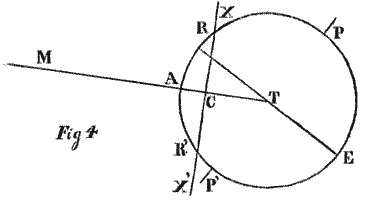
In the above figure, the circle PER represents the earth, E the equator, PP′ the poles, T the centre of the earth, C the mechanical centre of the terral vortex, M the moon, XX′ the axis of the vortex, and A the point where the radius vector of the moon pierces the surface of the earth. If we consider the axis of the vortex to be the axis of equilibrium in the system, it is evident that TC will be to CM, as the mass of the moon to the mass of the earth. Now, if we take these masses respectively as 1 to 72.3, and the moon’s mean distance at 238,650 miles, the mean value of TC is equal to this number, divided by the sum of these masses,—i.e. the mean radius vector of the little orbit, described by the earth’s centre around the centre of gravity of the earth and moon, is equal 238650 ⁄ (72.3 + 1) = 3,256 miles; and at any other distance of the moon, is equal to that distance, divided by the same sum. Therefore, by taking CT in the inverse ratio of the mean semi-diameter of the moon to the true semi-diameter, we shall have the value of CT at that time. But TA is to TC as radius to the cosine of the arc AR, and RR′ are the points on the earth’s surface pierced by the axis of the vortex, supposing this axis coincident with the pole of the lunar orbit. If this were so, the calculation would be very short and simple; and it will, perhaps, facilitate the investigation, by considering, for the present, that the two axes do coincide.
In order, also, to simplify the question, we will consider the earth a perfect sphere, having a diameter of 7,900 miles, equal to the actual polar diameter, and therefore TA is equal to 3,950 miles.
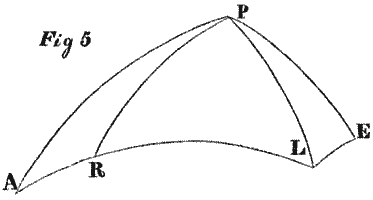
In the spherical triangle given on next page, we have given the point A, being the position of the moon in right ascension and declination in the heavens, and considered as terrestrial latitude and longitude.
Therefore, PA is equal to the complement of the moon’s declination, P being the pole of the earth, and L being the pole of the lunar orbit; PL is equal to the obliquity of the lunar orbit, with respect to the earth, and is therefore given by finding the true inclination of the lunar orbit at the time, equal EL, (E being the pole of the ecliptic,) also the true longitude of the ascending node, and the obliquity of the ecliptic PE. Now, as we are supposing the axis of the vortex parallel to the pole of the lunar orbit, and to pierce the earth’s surface at R, ARL will evidently all be in the same plane; and, as in the case of A and L, this plane passes through the earth’s centre, ARL must all lie in the same great circle. Having, therefore, the right ascension of A, and the right ascension of L, we have the angle P. This gives us two sides, and the included angle, to find the side LA. But we have before found the arc AR; we therefore know LR. But in finding LA, we found both the angles L and A, and therefore can find PR, which is equal to the complement of the latitude sought.
We have thus indicated briefly the simple process by which we could find the latitude of the axis of the central vortex, supposing it to be always coincident with the pole of the lunar orbit. The true problem is more complicated, and the principal modifications, indicated by the theory, are abundantly confirmed by observation. The determination of the inclination of the axis of the vortex, its position in space at a given time, and the law of its motion, was a work of cheerless labor for a long time. He that has been tantalized by hope for years, and ever on the eve of realization, has found the vision vanish, can understand the feeling which proceeds from frequent disappointment in not finding that, whose existence is almost demonstrated; and more especially when the approximation differs but slightly from the actual phenomena.
The chief difficulty at the outset of these investigations, arose from the conflicting authority of astronomers in relation to the mass of the moon. We are too apt to confound the precision of the laws of nature, with the perfection of human theories. Man observes the phenomena of the heavens, and derives his means of predicting what will be, from what has been. Hence the motions of the heavenly bodies are known to within a trifling amount of the truth; but it does not follow that the true explanation is always given by theory. If this were so, the mass of the moon (for instance) ought to be the same, whether deduced from the principle of gravitation or from some other source. This is not so. Newton found it 1 ⁄ 40 of that of the earth. La Place, from a profound theoretical discussion of the tides, gave it as 1 ⁄ 58.6, while from other sources he found a necessity of diminishing it still more, to 1 ⁄ 68, and finally as low as 1 ⁄ 75. Bailly, Herschel, and others, from the nutation of the earth’s axis, only found 1 ⁄ 80, and the Baron Lindenau deduced the mass from the same phenomenon 1 ⁄ 88. In a very recent work by Mr. Hind, he uses this last value in certain computations, and remarks, that we shall not be very far wrong in considering it as 1 ⁄ 80 of the mass of the earth. This shows the uncertainty of the matter in 1852. If astronomy is so perfect as to determine the parallax of a fixed star, which is almost always less than one second, why is it that the mass of the moon is not more nearly approximated? Every two weeks the sun’s longitude is affected by the position of the moon, alternately increasing and diminishing it, by a quantity depending solely upon the relative mass of the earth and moon, and is a gross quantity compared to the parallax of a star. So, also, the horizontal parallax—the most palpable of all methods—taken by different observers at Berlin, and the Cape of Good Hope, (a very respectable base line, one would suppose,) makes the mass of the moon greater than its value derived from nutation; the first giving about 1 ⁄ 70, the last about 1 ⁄ 74.2. Does not this declare that it is unsafe to depend too absolutely on the strict wording of the Newtonian law of gravitation. Happily our theory furnishes us with the correct value of the moon’s mass, written legibly on the surface of the earth; and it comes out nearly what these two phenomena always gave it, viz.: 1 ⁄ 72.3 of that of the earth. In another place we shall inquire into the cause of the discrepancy as given by the nutation of the earth.
MOTION OF THE AXIS OF THE VORTEX.
If the axis of the terral vortex does not coincide with the axis of the lunar orbit, we must derive this position from observation, which can only be done by long and careful attention. This difficulty is increased by the uncertainty about the mass of the moon, already alluded to, and by the fact that there are three vortices in each hemisphere which pass over twice in each month, and it is not always possible to decide by observation, whether a vortex is ascending or descending, or even to discriminate between them, so as to be assured that this is the central descending, and that the outer vortex ascending. A better acquaintance, however, with the phenomenon, at last dissipates this uncertainty, and the vortices are then found to pursue their course with that regularity which varies only according to law. The position of the vortex (the central vortex is the one under consideration) then depends on the inclination of its axis to the axis of the earth, and the right ascension of that axis at the given time. For we shall see that an assumed immobility of the axis of the vortex, would be in direct collision with the principles of the theory.
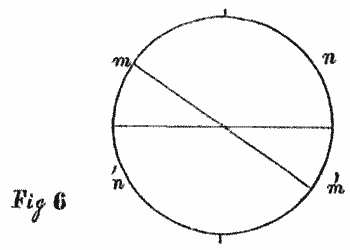
Let the following figure represent a globe of wood of uniform density throughout. Let this globe be rotated round the axis. It is evident that no change of position of the axis would be produced by the rotation. If we add two equal masses of lead at m and m′, on opposite sides of the axis, the globe is still in equilibrium, as far as gravity is concerned, and if perfectly spherical and homogeneous it might be suspended from its centre in any position, or assume indifferently any position in a vessel of water. If, however, the globe is now put into a state of rapid rotation round the axis, and then allowed to float freely in the water, we perceive that it is no longer in a state of equilibrium. The mass m being more dense than its antagonist particle at n, and having equal velocity, its momentum is greater, and it now tends continually to pull the pole from its perpendicular, without affecting the position of the centre. The same effect is produced by m′, and consequently the axis describes the surface of a double cone, whose vertices are at the centre of the globe. If these masses of lead had been placed at opposite sides of the axis on the equator of the globe, no such motion would be produced; for we are supposing the globe formed of a hard and unyielding material. In the case of the ethereal vortex of the earth, we must remember there are two different kinds of matter,—one ponderable, the other not ponderable; yet both subject to the same dynamical laws. If we consider the axis of the terral vortex to coincide with the axis of the lunar orbit, the moon and earth are placed in the equatorial plane of the vortex, and consequently there can be no derangement of the equilibrium of the vortex by its own rotation. But even in this case, seeing that the moon’s orbit is inclined to the ecliptic, the gravitating power of the sun is exerted on the moon, and of necessity she must quit the equatorial plane of the vortex; for the sun can exert no influence on the matter of the vortex by his attracting power. The moment, however, the moon has left the equatorial plane of the vortex, the principle of momentum comes into play, and a conical motion of the axis of the vortex is produced, by its seeking to follow the moon in her monthly revolution. This case is, however, very different to the illustration we gave. The vortex is a fluid, through which the moon freely wends her way, passing through the equatorial plane of the vortex twice in each revolution. These points constitute the moon’s nodes on the plane of the vortex, and, from the principles laid down, the force of the moon to disturb the equilibrium of the axis of the vortex, vanishes at these points, and attains a maximum 90° from them. And the effect produced, in passing from her ascending to her descending node, is equal and contrary to the effect produced in passing from her descending to her ascending node,—reckoning these points on the plane of the vortex.
INCLINATION OF THE AXIS.
By whatever means the two planes first became permanently inclined, we see that it is a necessary consequence of the admission of these principles, not only that the axis of the vortex should be drawn aside by the momentum of the earth and moon, ever striving, as it were, to maintain a dynamical balance in the system, in accordance with the simple laws of motion, and ever disturbed by the action of gravitation exerted on the grosser matter of the system; but also, that this axis should follow, the axis of the lunar orbit, at the same mean inclination, during the complete revolution of the node. The mean inclination of the two axes, determined by observation, is 2° 45′, and the monthly equation, at a maximum, is about 15′, being a plus correction in the northern hemisphere, where the moon is between her descending and ascending node, reckoned on the plane of the vortex, and a minus correction, when between her ascending and descending node. And the mean longitude of the node will be the same as the true longitude of the moon’s orbit node,—the maximum correction for the true longitude being only about 5° ±.
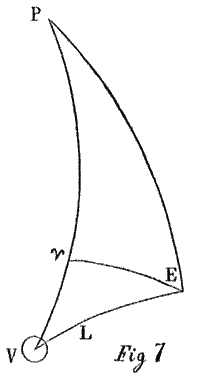
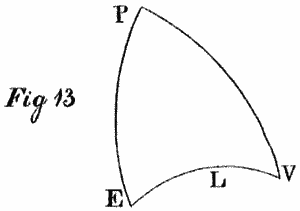
In the following figure, P is the pole of the earth; E the pole of the ecliptic; L the pole of the lunar orbit; V the mean position of the pole of the vortex at the time; the angle ♈EL the true longitude of the pole of the lunar orbit, equal to the true longitude of the ascending node ± 90°. VL is therefore the mean inclination ± 2° 45′; and the little circle, the orbit described by the pole of the vortex twice in each sidereal revolution of the moon. The distance of the pole of the vortex from the mean position V, may be approximately estimated, by multiplying the maximum value 15′ by the sine of twice the moon’s distance from the node of the vortex, or from its mean position, viz.: the true longitude of the ascending node of the moon on the ecliptic. From this we may calculate the true place of the node, the true obliquity, and the true inclination to the lunar orbit. Having indicated the necessity for this correction, and its numerical coefficient, we shall no longer embarrass the computation by such minutiæ, but consider the mean inclination as the true inclination, and the mean place of the node as the true place of the node, and coincident with the ascending node of the moon’s orbit on the ecliptic.
POSITION OF THE AXIS OF THE VORTEX.
It is now necessary to prove that the axis of the vortex will still pass through the centre of gravity of the earth and moon.
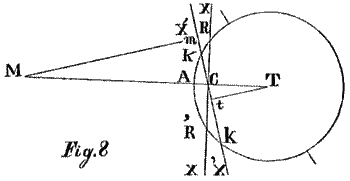
Let XX now represent the axis of the lunar orbit, and C the centre of gravity of the earth and moon, X′X′ the axis of the vortex, and KCR the inclination of this axis. Then from
similarity Ct : Tt : : Cm : Mm
but Tt : Mm : : Moon’s mass : Earth’s mass.
That is Tt : Mm : : TC : MC.
Therefore the system is still balanced; and in no other point but the point C, can the intersection of the axes be made without destroying this balance.
It will be observed by inspecting the figure, that the arc R′K′ is greater than the arc RK. That the first increases the arc AR, and the second diminishes that arc. The arc R′K′ is a plus correction therefore, and the smaller arc RK a minus correction. If the moon is between her descending and ascending node, (taking now the node on the ecliptic,) the correction is negative, and we take the smaller arc. If the moon is between her ascending and descending node, the correction is positive, and we take the larger arc. If the moon is 90° from the node, the correction is a maximum. If the moon is at the node, the correction is null. In all other positions it is as the sine of the moon’s distance from the nodes. We must now find the maximum value of these arcs of correction corresponding to the mean inclination of 2° 45′.
To do this we may reduce TC to Tt in the ratio of radius to cosine of the inclination, and taking TS for radius.
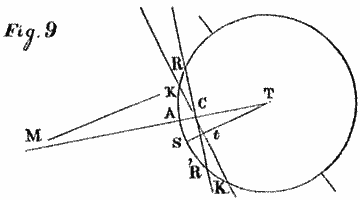
is equal the cosine of the arc SK′ and SK′ + AS = AK′ and AK′ + AR′ = R′K′. But from the nature of the circle, arc RK + arc R′K′ = angle RCK + angle R′CK′, or equal to double the inclination; and therefore, by subtracting either arc from double the inclination, we may get the other arc.

The maximum value of these arcs can, however, be found by a simple proportion, by saying; as the arc AR, plus the inclination, is to the inclination, so is the inclination to the difference between them; and therefore, the inclination, plus half the difference, is equal the greater arc, and the inclination, minus half the difference, is equal the lesser; the greater being positive, and the lesser negative.
Having found the arc AR, and knowing the moon’s distance from either node, we must reduce these values of the arcs RK and R′K′ just found, in the ratio of radius to the sine of that distance, and apply it to the arc AR or A′R′, and we shall get the first correction equal to the arc AK or AK′.
Call the arc AR = a
" inclination = n
" distance from the node = d
" arc AK = k
and supposing the value of AK be wanted for the northern hemisphere when the moon is between her descending and ascending node, we have
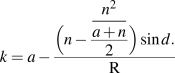
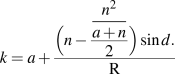
If the moon is between her ascending and descending node, then
The computation will be shorter, however, if we merely reduce the inclination to the sine of the distance from the node for the first correction of the arc AR, if we neglect the semi-monthly motion of the axis; for this last correction diminishes the plus corrections, and the first one increases it. If, therefore, one is neglected, it is better to neglect the other also; especially as it might be deemed affectation to notice trifling inequalities in the present state of the elements of the question.
There is one inequality, however, which it will not do to neglect. This arises from the displacement of the axis of the vortex.
DISPLACEMENT OF THE AXIS.
We have represented the axis of the terral vortex as continually passing through the centre of gravity of the earth and moon. Now, by following out the principles of the theory, we shall see that this cannot be the case, except when the moon is in quadrature with the sun. To explain this:
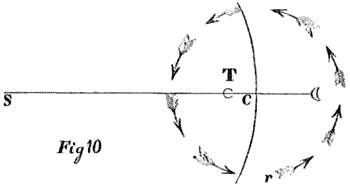
Let the curve passing through C represent a portion of the orbit of the earth, and S the sun. From the principles laid down, the density of the ethereal medium increases outward as the square roots of the distances from the sun. Now, if we consider the circle whose centre is C to represent the whole terral vortex, it must be that the medium composing it varies also in density at different distances from the sun, and at the same time is rotating round the centre. That half of the vortex which is exterior to the orbit of the earth, being most dense, has consequently most inertia, and if we conceive the centre of gravity of the earth and moon to be in the orbit (as it must be) at C, there will not be dynamical balance in the terral system, if the centre of the vortex is also found at C. To preserve the equilibrium the centre of the vortex will necessarily come nearer the sun, and thus be found between T and C, T representing the earth, and ☾ the moon, and C the centre of gravity of the two bodies. If the moon is in opposition, the centre of the vortex will fall between the centre of gravity and the centre of the earth, and have the apparent effect of diminishing the mass of the moon. If, on the other hand, the moon is in conjunction, the centre of the vortex will fall between the centre of gravity and the moon, and have the apparent effect of increasing the mass of the moon. If the moon is in quadrature, the effect will be null. The coefficient of this inequality is 90′, and depends on the sun’s distance from the moon. When the moon is more than 90° from the sun, this correction is positive, and when less than 90° from the sun, it is negative. If we call this second correction C, and the moon’s distance from her quadratures Q, we have the value of C = ±(90′ × sin Q) ⁄ R.
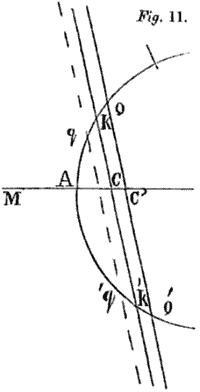
This correction, however, does not affect the inclination of the axis of the vortex, as will be understood by the subjoined figure. If the moon is in opposition, the axis of the vortex will not pass through C, but through C′, and QQ′ will be parallel to KK′. If the moon is in conjunction, the axis will be still parallel to KK′, as represented by the dotted line qq′. The correction, therefore, for displacement, is equal to the arc KQ or Kq, and the correct position of the vortex on the surface of the earth at a given time will be at the points Q or q and Q′ or q′, considering the earth as a sphere.
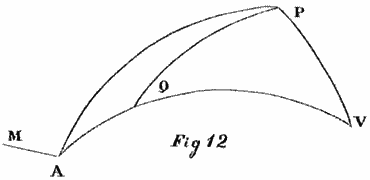
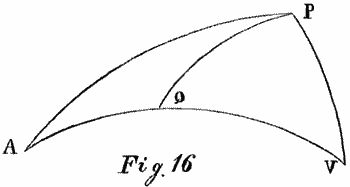
In the spherical triangle APV, P is the pole of the earth, V the pole of the vortex, A the point of the earth’s surface pierced by the radius vector of the moon, AQ is the corrected arc, and PV is the obliquity of the vortex. Now, as the axis of the vortex is parallel to the pole V, and the earth’s centre, and the line MA also passes through the earth’s centre, consequently AQV will all lie in the same great circle, and as PV is known, and PA is equal to the complement of the moon’s declination at the time, and the right, ascensions of A and V give the angle P, we have two sides and the included angle to find the rest, PQ being the complement of the latitude sought.
We will now give an example of the application of these principles.
Example.[10] Required the latitude of the central vortex at the time of its meridian passage in longitude 88° 50′ west, July 2d, 1853.
CENTRAL VORTEX ASCENDING.
Greenwich time of passage 2d. 3h. 1m.
Mean longitude of moon’s node 78° 29′
True"" 79° 32′
Mean inclination of lunar orbit 5° 9′
True"" 5° 13′
Obliquity of ecliptic 23° 27′ 32″
Mean inclination of vortex 2° 45′ 0″
Then in the spherical triangle PEV,
PE is equal 23° 27′ 32″
EV " 7° 58′ 0″
E " 100° 28′ 0″
P " 18° 5′ 7″
PV " 26° 2′ 32″
Calling P the polar angle and PV the obliquity of vortex.
To find the arc AR.
By combining the two proportions already given, we have by logarithms:
M. R. V. minor = 3256 Log. 3.512683
M. S. D. of moon = 940″" 2.973128
P. S. D. of earth = 3950 A. C. 6.403403
Radius 10.000000
T. S. D. of moon 885″.5 A. C. 7.052811
Log. Cosine arc AR = 28° 57′ 3″ 9.942025
As the only variable quantity in the above formula is the “True” semi-diameter of the moon at the time, we may add the Constant logarithm 2.889214 to the arithmetical complement of the logarithm of the true semi-diameter, and we have in two lines the log. cosine of the arc AR.
We must now find the arc RK equal at a maximum to 2° 45′. The true longitude of the moon’s node being 79° 32′, and the moon’s longitude, per Nautical Almanac, being 58° 30′, the distance from the node is 21° 2′, therefore, the correction is

To find the correction for displacement.
True longitude of sun at date 100° 30′
" of moon" 58° 30′
Moon’s distance from quadrature 48° 0′
As the moon is less than 90° from the sun this correction is also negative, or
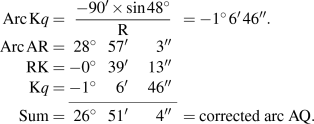
We have now the necessary elements in the Nautical Almanac, which we must reduce for the instant of the vortex passing the meridian in Greenwich time.
July 2d.
Meridian passage, local time, at 9h. 5m. A. M.
" in Greenwich time 2d. 3h. 1m.
Right ascension same time 56° 42′ 45″
Declination north " 18° 00′ 1″
Obliquity of the vortex " 26° 2′ 32″
Polar angle " 18° 5′ 7″
Arc AQ " 26° 51′ 4″
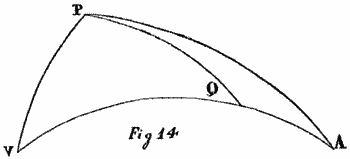
PA = 17° 59′ 59″ } P = 128° 37′ 38″
PV = 26° 2′ 32″
VA = 89° 3′ 0″ V = 47° 59′ 44″
VQ = 62° 11′ 56″ A = 20° 3′ 42″
PQ = 47° 14′ 22″ Q = 26° 22′ 55″
Latitude of Q on the sphere = 42° 45′ 38″
CORRECTION FOR PROTUBERANCE.
We have hitherto considered the earth a perfect sphere with a diameter of 7,900 miles. It is convenient to regard it thus, and afterwards make the correction for protuberance. We will now indicate the process for obtaining this correction by the aid of the following diagram.
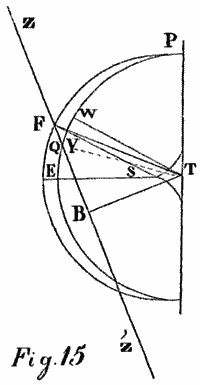
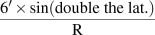
Let B bisect the chord ZZ′. Then, by geometry, the angle FQY is equal to the angle BTF, and the protuberance FY is equal the sine of that angle, making QF radius. This angle, made by the axis of the vortex and the surface of the sphere, is commonly between 30° and 40°, according as the moon is near her apogee or perigee; and the correction will be greatest when the angle is least, as at the apogee. At the equator, the whole protuberance of the earth is about 13 miles. Multiply this by the cosine of the angle and divide by the sine, and we shall get the value of the arc QY for the equator. For the smallest angle, when the correction is a maximum, this correction will be about 20′ of latitude at the equator; for other latitudes it is diminished as the squares of the cosines of the latitude. Then add this amount to the latitude EQ, equal the latitude EY. This, however, is only correct when the axis of the vortex is in the same plane as the axis of the earth; it is, therefore, subject to a minus correction, which can be found by saying, as radius to cosine of obliquity so is the correction to a fourth—the difference of these corrections is the maximum minus correction, and needs reducing in the ratio of radius to the cosine of the angle of the moon’s distance from the node; but as it can only amount to about 2′ at a maximum under the most favorable circumstances, it is not necessary to notice it. The correction previously noticed is on the supposition that the earth is like a sphere having TF for radius; as it is a spheroid, we must correct again. From the evolute, draw the line SF, and parallel to it, draw TW; then EW is the latitude of the point F on the surface of the spheroid. This second correction is also a plus correction, subject to the same error as the first on account of the obliquity, its maximum value for an angle of 30° is about 6′, and is greatest in latitude 45°; for other latitudes, it is equal
The three principal corrections for protuberance may be estimated from the following table, calculated for every 15° of latitude for an angle of 30°, or when the correction is greatest.
Latitude. 1st Corr. 2d Corr. 3d Corr.
0 + 20′ + 0 −2
15 + 19′ + 3 −1.5
30 + 15′ + 5 −1.5
45 + 10′ + 6 −1.
60 + 5′ + 5 −1
70 + 1′ + 3 −0.5
We can now apply this correction to the latitude of the vortex just found:
Latitude on the sphere 42° 45′ 38″ n.
Correction for protuberance + 14′ 22″
Correct latitude 43° 00′ 00″
MILWAUKIE STORM, JULY 2.
As this example was calculated about ten days before the actual date, we have appended an extract from the Milwaukie papers, which is in the same longitude as Ottawa, in which place the calculation was made. It is needless to remark that the latitude of Milwaukie corresponds to the calculated latitude of the centre of the vortex. It is not intended, however, to convey the idea that the central line is always the most subject to the greatest violence—a storm may have several centres or nuclei of disturbance, which are frequently waning and reviving as the storm progresses. Generally speaking, however, the greatest action is developed along the line previously passed over by the axis of the vortex.
“Summit, Waukesha Co., Wis., July 4, 1853.
“Our town, on Saturday, the 2d, was visited by a terrible storm, which will long be remembered by those who witnessed its effects and suffered from its fury. It arose in the south-west, and came scowling in blackness, sufficient to indicate its anger, for the space of eighty or a hundred rods in width, covering our usually quiet village; and for nearly half an hour’s duration, the rain fell in torrents, the heavens blazed with the lightning’s flashes, trees fell and were uprooted by the fury of the blast, fragments of gates and of buildings, shingles, roof-boards, rafters, circled through the air, the playthings of the wind—and buildings themselves were moved entire from their foundations, and deposited at different distances from their original positions. A barn, fifty-five feet square on the ground, owned by Mr. B. R. Hinckley, is moved from its position some ten feet to the eastward; and a house, some fifteen by eighteen feet on the ground, owned by the same person, fronting the east, was driven by the wind to the opposite side of the street, and now fronts nearly west; and what is most strange, is that the grass, in the route the house must have passed over, stands straight as usual, and gives no evidence that the building was pushed along on the ground. A lady running from a house unroofed by the storm, took an aërial flight over two fences, and finally caught against a tree, which arrested her passage for a moment only, when, giving way, she renewed her journey for a few rods, and was set down unhurt in Mr. O. Reed’s wheat field, where, clinging to the growing grain, she remained till the gale went by.”[11]
The weather at this place is briefly recorded in the accompanying abstract from the journal, as well as in an extract from a note to Professor Henry, of the Smithsonian Institution, from a friend of the authors, who has long occupied a high official station in Illinois. But such coincidences are of no value in deciding on the merits of such a theory, it must be tried before the tribunal of the world, and applied to phenomena in other countries with success, before its merits can be fully appreciated. The accompanying record, therefore, is only given to show how these vortices render themselves apparent, and what ought to be observed, and also to exhibit the order of their recurrence and their positions at a given time.
Extract of a note addressed to the Secretary of the Smithsonian Institution, by Hon. John Dean Caton, on this subject.
“As a striking instance of the remarkable coincidences confirmatory of these calculations, I will state, that on Friday, the first of July last, this gentleman[12] stated that on the next day a storm would pass north of us, being central a little south of Milwaukie, and that he thought, from the state of the atmosphere, the storm would be severe, and that its greatest violence would be felt on the afternoon or night of the next day. At this time the weather was fine, without any indications of a storm, so far as I could judge. At noon on the following day he pointed out the indications of a storm at the north and north-west, consisting of a dark, hazy belt in that direction, extending up a few degrees above the horizon, although so indistinct as to have escaped my observation. At five o’clock a violent storm visited us, which lasted half an hour, although a clear sky was visible at the south the whole time. On Monday morning I learned, from the telegraph office at Chicago, that early on Saturday afternoon communication with Milwaukie had been interrupted by atmospheric electricity, and that the line had been broken by a storm.”
NEW YORK STORM.
After this was written, the author discovered that the vortex was equally violent the day before at New York, July 1st, 1853. An account of this storm follows. The calculation has not been made, but it is easy to perceive that the latitude of the vortex, on July 1st, must be very nearly that of New York—being in latitude 43° next day and ascending.
“At a meeting of the American Association, convened at Cleveland, Professor Loomis presented a long notice of the terrible hail storm in New York on the 1st of July. He traced its course, and minutely examined all the phenomena relating to it, from a mile and a half south-east of Paterson, N. J., to the east side of Long Island, where it appeared nearly to have spent its force. It passed over the village of Aqueenac, striking the Island of New York in the vicinity of the Crystal Palace. It was not much more than half a mile wide. The size of the hail-stones was almost incredibly large, many of them being as large as a hen’s egg, and the Professor saw several which he thought as large as his fist. Some of them weighed nearly half a pound. The principal facts in relation to this storm were published at the time, and need not be repeated. The discussions arising among the members as to the origin and the size of these hail-stones, and the phenomena of the storm, were exceedingly interesting. They were participated in by Professors Heustus and Hosford, of Cambridge University, Professor Loomis, and Professors Bache and Redfield. The latter two gentlemen differ somewhat, we should suppose radically, in their meteorological theories, and had some very sharp but very pleasant “shooting” between them.”[13]
CENTRAL VORTEX DESCENDING.
We will now make the calculation for the central vortex descending, for longitude 88° 50′ west, August 7, 1853,—putting down the necessary elements for the time of the meridian passage in order:
Meridian passage in local time at 2h. 25m. P. M.
"" in Greenwich time 7d. 8h. 18m.
Mass of the moon 1 ⁄ 12.3 M. R. V. minor 3,256 miles.
Obliquity of the vortex, same time 26° 5′ 0″
Polar angle of" " 17° 41′ 47″
True longitude of moon’s node " 78° 42′ 0″
"inclination of orbit " 5° 5′ 0″
"longitude of the sun " 135° 20′ 0″
Moon’s longitude " 169° 44′ 0″
"distance from node " 91° 2′ 0″
"distance from quadrature " 55° 36′ 0″
"true semi-diameter " 943″
"right ascension " 172° 30′ 0″
"declination north " 8° 42′ 20″
Constant logarithm 2.889214
Arith. comp. of log. of 943 7.025488
Log. cos. arc. AR 9.914702 = 34° 44′ 48″
1st. correction, + 2° 45′ 0″
2d. correction, − 1° 14′ 15″
Corrected arc AQ = 36° 15′ 33″
PA = 81° 17′ 40″
PV = 26° 5′ 0″
P = 115° 11′ 47″
V = 63° 34′ 26″
A = 23° 28′ 24″
AV = 92° 48′ 39″
Q = 31° 32′ 18″
Complement of lat. = PQ = 48° 49′ 41″
The latitude is therefore for the earth, as a sphere 41° 10′ 18″
Correction for protuberance + 0° 16′ 0″
True latitude of centre 41° 26′ 18″ north.
Latitude of Ottowa 41° 20′ 0″ "
Vortex passed 6′ 18″ north of Ottowa.
As this was nearly a central passage, and as the influence was less extensive than usual, on account of great atmospheric pressure with a low dew point, the central disturbance could the more readily be located, and was certainly to the north, and but a few miles. The following is from the record of the weather:
August 6th. Very fine and clear all day; wind from S.-W.; a light breeze; 8 P. M. frequent flashes of lightning in the northern sky; 10 P. M. a low bank of dense clouds in north, fringed with cirri, visible during the flash of the lightning; 12 P. M. same continues.
7th. Very line and clear morning; wind S.-W. moderate; noon, clouds accumulating in the northern half of the sky; wind fresher S.-W.; 3 P. M. a clap of thunder overhead, and black cumuli in west, north, and east; 4 P. M. much thunder, and scattered showers; six miles west rained very heavily; 6 P. M. the heavy clouds passing over to the south; 10 P. M. clear again in north.
August 8th. Clear all day; wind the same (S.-W.); a hazy bank visible all along on southern horizon.
This was not a storm, in the ordinary acceptation of the term; but the same cause, under other circumstances, would have produced one; and let it be borne in mind, that although the moon is the chief disturbing cause, and the passages of the vortices are the periods of greatest commotion in both settled and unsettled weather, still the sun is powerful in predisposing the circumstances, whether favorable or unfavorable; and as there is no periodic connection between the passage of a vortex and the concurrence of the great atmospheric waves, it will, of course, happen only occasionally that all the circumstances will conspire to make a storm. There are also other modifying causes, to which we have not yet alluded, which influence the storms at different seasons of the year,—exaggerating their activity in some latitudes, and diminishing it in other latitudes. In this latitude, the months of May, June, and July are marked by more energetic action than August, September, and October. The activity of one vortex also, in one place, seems to modify the activity of another vortex in another place. But the great question to decide is: Do these vortices really exist? Do they follow each other in the order indicated by the theory? Do they pass from south to north, and from north to south, at the times indicated by the theory? Do they obey, in their monthly revolutions, a mathematical law connecting them with the motions of the moon? We answer emphatically, Yes! And the non-discovery of these facts, is one of the most humiliating features of the present age.
OTTOWA STORM, DECEMBER 22, 1852.
To show that the same calculations are applicable for other times, we will make the calculation for the centre ascending, for the 22d December, 1852, taking the following elements:
Moon’s mer. passage, Dec. 22d 15h. 16m. G. time.
" right ascension, same time 51° 57′
" declination north 15° 42′
" true S. Diameter 886.6″
" distance from node 37°
" ""quadrature 52°
Which gives the arc AR 29° 5′
1st correction −1° 51′
2d" +1° 11′
Corrected arc AQ 28° 25′
And the latitude at the time of the meridian passage = 42° north, or about forty miles north of Ottawa.
Abstract from the record:—
[14]Dec. 21st, 1852. Wind N.-E., fine weather.
Dec. 22d. Thick, hazy morning, wind east, much lighter in S.-E. than in N.-W.; 8 A. M., a clear arch in S.-E. getting more to south; noon, very black in W. N.-W.; above, a broken layer of cir. cumulus, the sun visible sometimes through the waves; wind round to S.-E., and fresher; getting thicker all day; 10 P. M., wind south, strong; thunder, lightning, and heavy rain all night, with strong squalls from south.
Dec. 23d. Wind S.-W., moderate, drizzly day; 10 P. M., wind west, and getting clearer.
The next day the vortex passed the latitude of Montreal (the moon being on the meridian about 10 P. M.)
MAGNETIC STORM, DECEMBER 23, 1852.
In the July number of Vol. XVI. of Silliman’s Journal, we find certain notices of the weather in 1852, by Charles Smallwood, of St. Martins, nine miles east of Montreal. He mentions “two remarkable electrical storms (which) occurred on the 23d and 31st of December, (in which) sparks 5 ⁄ 40 of an inch were constantly passing from the conductor to the discharger for several hours each day.” At 10 P. M. (23d) the vortex passed over Montreal, and again descending on the 31st North, and was visible at Ottowa on the morning of the 1st of January, with southerly wind setting towards it. On the 29th of December, Mr. Smallwood records “a low auroral arch, sky clear.” On the 20th, the vortex was 5° to the northward of Montreal, and the aurora was consequently low—the brightest auroras being when the vortex is immediately north without storm, or one day to the northward, although we have seen it very low when the vortex was three days to the north, and no other vortex near.
LIVERPOOL STORM.
On the night of the 24th of December, the same central vortex ascending passed between Cape Clear and Liverpool.
On the 25th, at midnight, the vortex passed to the north of Liverpool: its northerly progress being very slow, being confined for three days between the parallel of Liverpool and its extreme northern limit in latitude about 57°. The accompanying account of the weather will show the result of a long-continued disturbance near the same latitude:
The Baltic, three days out from Liverpool, encountered the vortex on the night of the 23d. On the morning of the 25th, very early, the gale commenced at Liverpool, and did much damage. On the 26th, the vortex attained its northern limit; but we have not been able to procure any account of its effects to the northward of Liverpool, although there can be but little doubt that it was violent on the coast of Scotland on the 26th; for the next day (27th) the vortex having made the turn, was near the latitude of Liverpool, and caused a tremendous storm, thus showing a continued state of activity for several days, or a peculiarly favorable local atmosphere in those parts. It is very probable, also, that there was a conjunction of the central and inner vortex on the 27th. The inner vortex precedes the central in passing latitude 41°; but as the mean radius of its orbit is less than that of the central, it attains to a higher latitude, and has, consequently, to cross the path of the central, in order again to precede it descending in latitude 41°. As a very trifling change in the elements of the problem will cause great changes in the positions of the vortices on the surface of the earth, it cannot now be asserted that such a conjunction did positively occur at that time; but, it maybe suspected, that a double disturbance would produce a greater commotion, or, in other words, a more violent, storm.
It is on this account, combined with other auxiliary causes, that the vicinity of Cape Horn is so proverbially stormy, as well as for the low standard of the barometer in that latitude, it is the stationary point of the vortices in ordinary positions of the nodes and perigee of the moon. We have already alluded to the fact, that none of the vortices scarcely ever pass much beyond latitude 80°, and then only under favorable circumstances, so that we ought to infer, that gales in high latitudes should set from the poles towards the storms in lower latitudes. This is, no doubt, the fact, but, nevertheless, a hard southerly blow may possibly occur in high northern latitudes, if a storm should be raging very violently in a lower latitude on the opposite side of the pole, the distance across the circle of 80° being only about 1,400 miles. As the different vortices have a different limit in latitude every year, the determination of this turning point is obviously of great practical utility, as the fact may yet be connected with other phenomena, so as to give us the probable character of the polar ice at any assigned time. On this point we have more to say.
PASSAGES OF ALL THE VORTICES.
Our remarks have hitherto been confined to the central vortex. We shall now show from the record, that the other vortices are as effective in deranging the equilibrium of our atmosphere. In the following table we have given the passages of the different vortices, which will serve as their true positions within moderate limits, to calculate from, for all future time.
Passages of the Central and Lateral Vortices, observed in June and July, 1853, in latitude 41° 20′ north.
I signifying Inner; O, outer; C, central; A, ascending; D, descending.
Order. Vortex. Date. Meridian Passage. Passage. Calculated latitude and Remarks.
1st I. A. June 22 7 A. M. south Centre. About 40°.
23 8 A. M. north Warsaw. Storm.
2d O. D. 27 0 noon north
28 1 A. M. south See record.
3d C. A. July 1 9 A. M. south
2 10 A. M. north Lat. 43°. Storm.
4th I. D. 7 5 P. M. north
8 6 P. M. south Lat. New York. Storm.
5th C. D. 12 5 P. M. north Aurora.
13 6 P. M. south Stormy, very.
6th O. A. 14 10 A. M. south
15 11 A. M. north See Record.
The intervals between the ascending and descending passages of the different vortices, are
Between I. A. and I. D. from 11 to 14 days.
" O. A. " O. D. " 10 " 12 "
" C. A. " C. D. " 9 " 11 "
and the effect is greatest when the vortex comes to the meridian before the sun, and least when after the sun; in which case the full effect is not developed, sometimes until the following day.
A brief abstract from a journal of the weather for one sidereal period of the moon, in 1853.
June 21st. Fine clear morning (S. fresh)[15]: noon very warm 88°; 4 P. M. plumous cirri in south; ends clear.
22d. Hazy morning (S. very fresh) arch of cirrus in west; 2 P. M., black in W.-N.-W.; 3 P. M., overcast and rainy; 4 P. M., a heavy gust from south; 4.30 P. M., blowing furiously (S. by W.); 5 P. M., tremendous squall, uprooting trees and scattering chimneys; 6 P. M., more moderate (W.)
23d. Clearing up (N.-W.); 8 A. M., quite clear; 11 A. M., bands of mottled cirri pointing N.-E. and S.-W.; ends cold (W. N.-W.); the cirri seem to rotate from left to right, or with the sun.
24th. Fine clear cool day, begins and ends (N.-W.)
25th. Clear morning (N.-W, light); 2 P. M. (E.) calm; tufts of tangled cirri in north intermixed with radiating streaks, all passing eastward; ends clear.
26th. Hazy morning (S.-E) cloudy; noon, a heavy windy looking bank in north (S. fresh), with dense cirrus fringe above on its upper edge; clear in S.
27th. Clear, warm, (W.); bank in north; noon bank covered all the northern sky, and fresh breeze; 10 P. M., a few flashes to the northward.
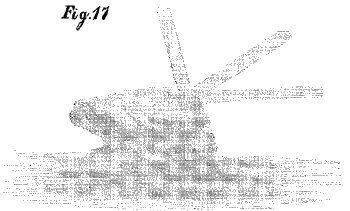
28th. Uniform dense cirro-stratus, (S. fresh); noon showers all round; 2 P. M., a heavy squall of wind, with thunder and rain (S.-W. to N.-W.); 8 P. M., a line of heavy cumuli in south; 8.30 P. M., a very bright and high cumulus in S.-W., protruding through a layer of dark stratus; 8.50 P. M., the cloud bearing E. by S., with three rays of electric light.[16]
June 29th. A stationary stratus over all, (S.-W. light); clear at night, but distant lightning in S.
30th. Stratus clouds (N.-E. almost calm); 8 A. M., raining gently; 3 P. M., stratus passing off to S; 8 P. M., clear, pleasant.
July 1st. Fine and clear; 8 A. M., cirrus in sheets, curls, wisps, and gauzy wreathes, with patches beneath of darker shade, all nearly motionless; close and warm (N.-E.); a long, low bank of haze in S., with one large cumulus in S.-W., but very distant.
July 2d. At 5 A. M., overcast generally with hazy clouds and fog of prismatic shades, chiefly greenish-yellow; 7 A. M., (S.-S.-E. freshening,) thick in W; 8 A. M., (S. fresh) much cirrus, thick and gloomy; 9 A. M., a clap of thunder, and clouds hurrying to N.; a reddish haze all around; at noon the margin of a line of yellowish-red cumuli just visible above a gloomy-looking bank of haze in N.-N.-W., (S. very fresh;) warm, 86°; more cumuli in N.-W.—the whole line of cumuli N. are separated from the clouds south by a clear space. These clouds are borne rapidly past the zenith, but never get into the clear space—they seem to melt or to be turned off N.-E. The cumuli in N. and N.-W., slowly spreading E. and S.; 3 P. M., the bank hidden by small cumuli; 4 P. M., very thick in north, magnificent cumuli visible sometimes through the breaks, and beyond them a dark, watery back-ground, (S. strong); 4.30 P. M., wind round to N.-W. in a severe squall; 5 P. M., heavy rain, with thunder, &c.—all this time there is a bright sky in the south visible through the rain 15° high; 7 P. M., clearing, (S.-W. mod.)
July 3d. Very fine and clear, (N.-W.); noon, a line of large cumuli in N., and dark lines of stratus below, the cumuli moving eastward; 6 P. M., their altitude 2° 40′. Velocity 1° per minute; 9 P. M., much lightning in the bank north.[17]
July 4th. 6 A. M., a line of small cumulo-stratus, extending east and west, with a clear horizon north and south 10° high. This band[18] seems to have been thrown off by the central yesterday, as it moves slowly south, preserving its parallelism, although the clouds composing it move eastward. Fine and cool all day—(N.-W. mod.)—Lightning in N.
July 5th. Cloudy (N. almost calm), thick in E., clear in W.; same all day.
6th. Fine and clear (E. light); small cumuli at noon; clear night.
7th. Warm (S. E. light); cirrus bank N. W.; noon (S.) thickening in N.; 6 P. M., hazy but fine; 8 P. M., lightning in N.; 10 P. M., the lightning shows a heavy line of cumuli along the northern horizon; calm and very dark and incessant lightning in N.
8th. Last night after midnight commencing raining, slowly and steadily, but leaving a line of lighter sky south; much lightning all night, but little thunder.
8th. 6 A. M. Very low scud (500 feet high) driving south, still calm below, (N. light); 10 A. M., clearing a little; a bank north with cirrus spreading south; same all day; 9 P. M., wind freshening (N. stormy); heavy cumuli visible in S.; 10.30 P. M., quite clear, but a dense watery haze obscuring the stars; 12 P. M., again overcast: much lightning in S. and N.-W.
9th. Last night (2 A. M. of 9th) squall from N.-W. very black; 4 A. M., still raining and blowing hard, the sky a perfect blaze, but very few flashes reach the ground; 7 A. M., raining hard; 8 A. M. (N.-W. strong); a constant roll of thunder; noon (N.-E.); 2 P. M. (N.); 4 P. M. clearing; 8 P. M., a line of heavy cumuli in S., but clear in N-W., N., and N.-E.[19]
NEW YORK STORM, JULY 8, 1853.
“At 5 o’clock Friday afternoon, a terrible storm of rain, hail, and lightning, rose suddenly from the north-west, and passed over the upper part of the city and neighborhood. It was quite moderate in the lower part of the town, and probably scarcely felt on Staten Island. The whole affair lasted not more than a quarter of an hour, yet the results were most disastrous, as will be seen by the following accounts from our reporters:
“Happening to be in the neighborhood of the Palace about 5 o’clock Friday evening, we sought shelter under its ample roof from an impending thunder storm, of very threatening appearance, rapidly approaching from the west. We had scarcely passed the northern entrance, and reached the gallery by the nearest flight of steps, when the torrent—it was not rain, but an avalanche of water—struck the building; the gutters were filled on the windward side in a moment, and poured over an almost unbroken sheet of water, which was driven through the Venetian blind ventilators, into and half way across the north-west gallery, and also through the upper ventilators, falling upon the main floor of the north transept. Workmen hastened to close the blinds, but that did not prevent the deluge. The tinning of the dome being unfinished, the water, of course, came down in showers all over the centre. Many workmen were engaged on the dome when the shower struck it; several of them, in their haste to escape such dangerous proximity to the terrific lightning, came down single ropes, hand over hand. Large number of workmen were engaged all over the exterior, and such a scampering will rarely be witnessed but once in a lifetime. It was found impossible to close a north window, used for ingress and egress of workmen upon the rod, and the water came in, in almost solid columns. For a time the water was nearly two inches deep on the gallery floor, and poured down the stairs in miniature cascades.
“A great number of boxes, bales, and packages of goods lay upon the main floor, among which the water poured down from the edge of the gallery floor in destructive quantities; Fortunately but few goods were opened, and were upon the tables, or the damage would have been irreparable. As it is, we fear some of the goods are injured. In the height of the storm, the centre portion of the fanlight over the western entrance burst in, and several single lights were broken, by staging or otherwise.
“About ten minutes after the storm burst, the most terrific hailstorm we ever saw began to rattle, like discharges of musketry, upon the tin roof and glass sides. Some of the masses of ice were as large as hen’s eggs. There were probably a thousand excited workmen in the building, and a good many exhibitors and visitors, among whom there were some twenty ladies, some of whom appeared a good deal alarmed at the awful din. A portion of the frame-work of the addition next to 42d street, went down with a terrible crash, and a part of the brick wall of the engine-house on the opposite side of the street, was blown over, crushing two or three shanties, fortunately without any other injury than driving the occupants out into the storm. But an awful scene occurred on the north side of 43d street, directly opposite the Latting Tower. Here two large unfinished frame buildings were blown, or rather, we should judge from appearances, were crushed down into a mass of ruins, such as may be imagined by supposing a great weight had fallen, with a circular, grinding motion, upon the first fine fabrics. One of them was partly sided, and had the rafters up, but no roof; the other was sided and rooted with tin, and was being plastered. We were told it was three stories high, 50 by 98 feet.
“We reached the ruins among the first, after the burst of the storm subsided a little. The scene was such as we pray God we may never witness again. A small portion of the roof and upper part of the front of the building stood or rather partly hung over the side-walk. The chamber and lower floor of the front rooms lay flat together. The sides were standing. In the rear all were down. In this building, besides the workmen, there were numerous laborers who had taken shelter under its roof when the storm drove them hurriedly from their work. How so many persons escaped death is truly wonderful. It can only be accounted for by supposing that they had a moment’s warning, and rushed into the street. The first alarm was from the tearing off a portion of the tin roof, which was carried high over another building, and fell in the street. A horse and cart barely escaped being buried under this. It seems the frame of the other building came down with a deafening crash at the same time, confusing instead of warning those in danger. At any rate, before they could escape, they were buried in a mass of timber, and three of them instantly killed, and four or five dangerously wounded; and others slightly bruised and badly frightened. Several would have perished but for timely assistance to extricate them. In this they were greatly assisted by Jacob Steinant, boss carpenter of the Tower, who with his men rushed to the rescue, notwithstanding the pouring down torrents.
“In Williamsburgh, the storm lasted about fifteen minutes, doing an incalculable amount of damage to dwellings, foliage, &c. Hailstones came down in sizes from that of a hickory-nut to a large apple, some with such force as to drive them through the cloth awnings.
“The storm passed over Brooklyn lightly, in comparison with the effects across the Williamsburgh line. On Flushing avenue, beyond the Naval Hospital, a number of trees were uprooted, and the window-panes of the houses shattered. On the corner of Fulton and Portland avenues, three buildings were unroofed, and the walls of the houses were sprung to the foundation.
“On Spencer street, a new frame building was levelled with the ground. Along Myrtle, Classon, and other streets and avenues of East Brooklyn, many of the shade trees were uprooted, and the windows smashed. In Jay street, two trees were struck by lightning, but no other damage ensued.
“Several schooners at the foot of Jay street were forced from their moorings, but were soon after secured. A small frame house in Spencer street, just put under roof, was prostrated to the ground.
“We understand that a large barn filled with hay, situated on the road between Bushwick and Flushing, was struck by lightning and destroyed with its contents, embracing several head of live stock.”[20]
July 10th, 3 A. M. Overcast and much lightning in south (N. mod.); 7 A. M., clear except in south; 6 P. M. (E.); 10 P. M., lightning south; 11 P. M., auroral rays long but faint, converging to a point between Epsilon Virginis and Denebola, in west; low down in west thick with haze; on the north the rays converged to a point still lower; lightning still visible in south. This is an aurora in the west.
11th. Fine clear morning (N.-E.); same all day; no lightning visible to-night, but a bank of clouds low down in south, 2° high, and streaks of dark stratus below the upper margin.
12th. Fine and clear (N.-E.); noon, a well defined arch in S.-W., rising slowly; the bank yellowish, with prismatic shades of greenish yellow on its borders. This is the O. A. At 6 P. M., the bank spreading to the northward. At 9 P. M., thick bank of haze in north, with bright auroral margin; one heavy pyramid of light passed through Cassiopæa, travelling westward 1½° per minute. This moves to the other side of the pole, but not more inclined towards it than is due to prospective, if the shaft is very long; 11.10 P. M., saw a mass of light more diffuse due east, reaching to Markab, then on the prime vertical. It appears evident this is seen in profile, as it inclines downwards at an angle of 10° or 12° from the perpendicular. It does not seem very distant. 12 P. M., the aurora still bright, but the brightest part is now west of the pole, before it was east.
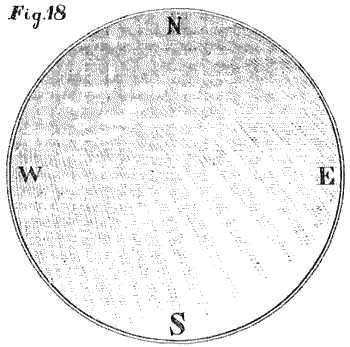
13th, 6 A. M. Clear, east and north; bank of cirrus in N.-W., i.e., from N.-N.-E. to W. by S.; irregular branches of cirrus clouds, reaching almost to south-eastern horizon; wind changed (S.-E. fresh); 8 A. M., the sky a perfect picture; heavy regular shafts of dense cirrus radiating all around, and diverging from a thick nucleus in north-west, the spaces between being of clear blue sky. The shafts are rotating from north to south, the nucleus advancing eastward.
Appearance of the central vortex descending at 8 A. M., July 13th, 1853:
In Fig. 18, the circle represents the whole sky from the zenith to the horizon, yet it can convey but a very faint idea of the regularity and vividness of this display. The reflected image of the sky was received from a vessel of turbid water, which will be found better than a mirror, when the wind will permit.
At noon (same day) getting thicker (S.-E. very fresh); 6 P. M., moon on meridian, a prismatic gloom in south, and very thick stratus of all shades; 9 P. M., very gloomy; wind stronger (S.-E.): 10 P. M., very black in south, and overcast generally.
14th. Last night about 12 P. M. commenced raining; 3 A. M., rained steadily; 7 A. M., same weather; 8.20 A. M., a line of low storm-cloud, or seud, showing very sharp and white on the dark back ground all along the southern sky. This line continues until noon about 10° at the highest, showing the northern boundary of the storm to the southward; 8 P. M., same bank visible, although in rapid motion eastward; same time clear overhead, with cirrus fringe pointing north from the bank; much lightning in south (W. fresh); so ends.
15th. Last night a black squall from N.-W. passed south without rain; at 3 A. M. clear above, but very black in south (calm below all the time); 9 A. M., the bank in south again throwing off rays of cirri in a well-defined arch, whose vortex is south: these pass east, but continue to form and preserve their linear direction to the north; no lightning in south to-night.
16th. Clear all day, without a stain, and calm.
17th. Fine and clear (N.-E. light); 6 P. M., calm.
18th. Fair and cloudy (N.-E. light); 6 P. M., calm.
19th. Fine and clear (N. fresh); I. V. visible in S.-W.
20th. 8 A. M., bank in N.-W. with beautiful cirrus radiations; 10 A. M., getting thick with dense plates of cream-colored cirrus visible through the breaks; gloomy looking all day (N.-E. light).[21]
Appearance of the Inner Vortex at 8 A. M., July 20th, 1853, including the whole sky. (See Fig. 19.)
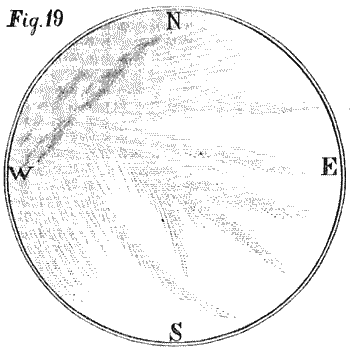
This was a different passage of the Inner Vortex ascending as compared with the same 28 days before. At that date (June 22) it did great damage in the central parts of Illinois. Still this last passage was very palpable—the clouds were very irregularly assorted—plates of cirrus above and beneath cumulus—various kinds of cirrus clouds, and that peculiar prismatic haze which is a common sign of the passage of a vortex. The appearance depicted above is a very common, although a very evanescent appearance. When the sky appears of a clear blue through the cirri, there will be generally fresh gales without any great electrical derangement; but if the clear spaces are hazy, gradually thickening towards the nucleus, a storm may be expected. Any one who wishes to understand the indications of the clouds, must watch them closely for many years, before he can place much reliance upon them. But we shall again advert to this point.
We have now passed through one sidereal period of the moon. We might continue the record, but it would be tedious. The passages of these vortices vary in violence at different times, as we might expect; but they never cease to circulate, and never will as long as the moon remains a satellite to the earth; and if we take the passage of any of these vortices, and add thereto the time of one sidereal period of the moon, we get approximately the time of the next passage. When the elements of the lunar orbit tend to accelerate the passages, they may come in 26 days; and when to retard, in 28 days; and these are about the limits of the theory.
Having begun and ended this record of the weather with the passage of the Inner vortex ascending, it may not be amiss to notice one more, (the August passage,) as it offers a peculiarity not often so distinctly marked. We have alluded to the greater force of the storms when the passage of the vortex corresponds to the passage of the line of low barometer or the depression point of a great atmospheric wave, which is also due to the action of the ether. In consequence of these waves passing from west to east, the storm will only be violent when formed a little to the westward. If the storm forms to the eastward, we neither see it nor feel it, as it requires time to develop its strength, and always in this latitude travels eastward; so that storms may generally be said to come from the west, although the exciting cause travels from east to west. In the case now alluded to, the weather indicated a high barometer, and the storm formed immediately to the eastward, even showing a distinct circular outline. We subjoin a description.
August 15th. Clear morning (N.-E.), a bank of cumuli in south: noon quite cloudy in S. and clear in north. (N.-E.)
16th. Clear morning (N.-E.); 3 P. M., getting very black in E. and S.-E., very clear to the westward; 4 P. M., much thunder and lightning in east, and evidently raining hard; 5 P. M., a violent squall from east for 10 minutes; tore up several trees; 6 P. M., the storm passing eastward, clear in west all this time; 6.30 P. M., the storm forming a regular arch, the vertex being in S.-E.; the arch of hazy cirrus and heavy cumulus much lower in S.-E., wind still moderate from east; 10 P. M., clear all around, but lightning in S.-E. and E.
17th. Fine clear morning (W.); noon, scattered cumuli in north; 6 P. M., a beautifully regular arch of dense cumuli and cirrus margin in N.-E., with a constant glimmer of lightning; 7 P. M., very clear to the west, and north-west, and south; along the northern horizon a line of high peaked cumuli terminating in N.-N.-W.; a continued roll of distant thunder in the circular bank in N.-E., and not a moment’s cessation to the lightning; the electric excitement advancing westward along the lines of cumuli; the cirrus haze also rising and passing towards S.-W.; 8 P. M., the sky alive with lightning, the cirrus now reaches the zenith; no streaks of lightning coming to the earth; they seem to radiate from the heaviest mass of cumuli, and spread slowly (sufficiently so to follow them) in innumerable fibres over the cloudy cirrus portion of the sky; every flash seems to originate in the same cloud; 8.30 P. M., one branching flash covered the whole north-eastern half of the sky, no leafless tree of the forest could show so many branches; 9.30 P. M., all passed to S.-W. without rain, leaving behind a large cumulus, as if it lagged behind. From this cumulus a straight line of lightning shot up 10° above the cloud into a perfectly clear sky, and terminated abruptly without branching.
We have been thus particular in giving these details, as this was a clear case confirming the principles advanced, that the vortices do not form a continuous line of disturbance, in their daily passage around the earth. It shows also that the barometer, in connection with these principles, will be a far more useful instrument than it has yet proved itself, for practical service as an indicator of the weather.