SECTION FIFTH.
Reading edition
COMETARY PHENOMENA.
The planetary arrangements of the solar system are all à priori indications of the theory of vortices, not only by the uniform direction of the motions, the circular orbits in which these motions are performed, the near coincidence of the planes of these orbits, and the uniform direction of the rotation of the planets themselves; but, also, by the law of densities and distances, which we have already attempted to explain. In the motions of comets we find no such agreement. These bodies move in planes at all possible inclinations in orbits extremely eccentrical and without any general direction—as many moving contrary to the direction of the planets as in the opposite direction; and when we consider their great volume, and their want of mass, it appears, at first sight, that comets do present a serious objection to the theory. We shall point out, however, a number of facts which tend to invalidate this objection, and which will ultimately give the preponderance to the opposite argument.
Every fact indicative of the nature of comets proves that the nuclei are masses of material gases, similar, perhaps (at least in the case of the short-period comets), to the elementary gases of our own planet, and, consequently, these masses must be but small. In the nascent state of the system, the radial stream of the vortex would operate as a fan, purging the planetary materials of the least ponderable atoms, and, as it were, separating the wheat from the chaff. It is thus we conceive that the average atomic density of each planet has been first determined by the radial stream, and, subsequently, that the solidification of the nebulous planets has, by their atomic density, assigned to each its position in the system, from the consequent relation which it established between the density of the ether within the planet, and the density of the ether external to it, so that, according to this view, a single isolated atom of the same density as the mean atomic density of the earth could (ceteris paribus) revolve in an orbit at the distance of the earth, and in the same periodic time. This, however, is only advanced by way of illustration.
The expulsive force of the radial stream would thus drive off this cometary dust to distances in some inverse ratio of the density of the atoms; but, a limit would ultimately be reached, when gravitation would be relatively the strongest—the last force diminishing only as the squares of the distances, and the first diminishing in the compound ratio of the squares and the square roots of the distances. At the extreme verge of the system, this cometary matter would accumulate, and, by accumulation, would still further gather up the scattered atoms—the sweepings of the inner space—and, in this condensed form, would again visit the sun in an extremely elongated ellipse. It does not, however, follow, that all comets are composed of such unsubstantial materials. There may be comets moving in parabolas, or even in hyperbolas—bodies which may have been accumulating for ages in the unknown regions of space, far removed from the sun and stars, drifting on the mighty currents of the great ethereal ocean, and thus brought within the sphere of the sun’s attraction; and these bodies may have no analogy to the periodical comets of our system, which last are those with which we are more immediately concerned.
The periodical comets known are clearly arranged into two distinct classes—one having a mean distance between Saturn and Uranus, with a period of about seventy-five years, and another class, whose mean distance assigns their position between the smaller planets and Jupiter, having periods of about six years. These last may be considered the siftings of the smaller planets, and the first the refuse of the Saturnian system. In this light we may look for comets having a mean distance corresponding to the intervals of the planets, rather than to the distances of the planets themselves. One remarkable fact, however, to be observed in these bodies is, that all their motions are in the same direction as the planets, and, with one exception, there is no periodical comet positively known whose motion is retrograde.
The exception we have mentioned is the celebrated comet of Halley, whose period is also about seventy-five years. In reasoning on the resistance of the ether, we must consider that the case can have very little analogy with the theory of projectiles in air; nor can we estimate the inertia of an infinitely divisible fluid, from its resisting influence on atomic matter, by a comparison of the resistance of an atomic fluid on an atomic solid. Analogy will only justify comparisons of like with like. The tangent of a comet’s orbit, also, can only be tangential to the circular motion of the ether at and near perihelion, which is a very small portion of its period of revolution. As far as the tangential resistance is concerned, therefore, it matters little whether its motion be direct or retrograde. If a retrograde comet, of short period and small eccentricity, were discovered moving also near the central plane of the vortex, it would present a very serious objection, as being indicative of contrary motions in the nascent state of the system. There is no such case known. So, also, with the inclinations of the orbits; if these be great, it matters little whether the comet moves in one way or the other, as far as the tangential current of the vortex is concerned. Yet, when we consider the average inclination of the orbit, and not of its plane, we find that the major axes of nearly all known cometary orbits are very little inclined to the plane of the ecliptic.
In the following table of all the periodical comets known, the inclination of the major axis of the orbit is calculated to the nearest degree; but all cometary orbits with very few exceptions, will be found to respect the ecliptic, and never to deviate far from that plane:
Designations of the Comets. Periodic times. Inclination of Major Axes. Motion in Orbit. Planetary Intervals.
Encke 1818 3 years. 1° Direct Mars & Ceres.
De Vico 1814 From five to six or seven years. 2° Direct Ceres and Jupiter.
Fayo 1843 4° Direct
De Avrest 1851 1° Direct
Brorsen 1846 7° Direct
Messier 1766 0° Direct
Clausen 1743 0° Direct
Pigott 1783 4° Direct
Pous 1819 3° Direct
Biela 1826 9° Direct
Blaupain 1819 2° Direct
Lexell 1770 1° Direct
Pous 1812 about 75 years 17° Direct Saturn and Uranus.
Olbers 1816 40° Direct
De Vico 1846 13° Direct
Brorsen 1847 12° Direct
Westphal 1852 21° Direct
Halley 1682 16° Retrograde
From which it appears, that the objection arising from the great inclination of the planes of these orbits is much less important than at first it appears to be.
Regarding then, that a comet’s mean distance depends on its mean atomic density, as in the case of the planets, the undue enlargement of their orbits by planetary perturbations is inadmissible. In 1770 Messier discovered a comet which approached nearer the earth than any comet known, and it was found to move in a small ellipse with a period of five and a half years; but although repeatedly sought for, it was the opinion of many, that it has never been since seen. The cause of this seeming anomaly is found by astronomers in the disturbing power of Jupiter,—near which planet the comet must have passed in 1779, but the comet was not seen in 1776 before it passed near Jupiter, although a very close search was kept up about this time. Now there are two suppositions in reference to this body: the comet either moved in a larger orbit previous to 1767, and was then caused by Jupiter to diminish its velocity sufficiently to give it a period of five and a half years, and that after perihelion it recovered a portion of its velocity in endeavoring to get back into its natural orbit; or if moving in the natural orbit in 1770, and by passing near Jupiter in 1779 this orbit was deranged, the comet will ultimately return to that mean distance although not necessarily having elements even approximating those of 1770. In 1844, September 15th, the author discovered a comet in the constellation Cetus, (the same previously discovered by De Vico at Home,) and from positions estimated with the naked eye approximately determined the form of its orbit and its periodic time to be very similar to the lost comet of 1770. These conclusions were published in a western paper in October 1844, on which occasion he expressed the conviction, that this was no other than the comet of 1770. As the question bore strongly on his theory he paid the greater attention to it, and had, previously to this time, often searched in hopes of finding that very comet. Since then, M. Le Verrier has examined the question of identity and given his decision against it; but the author is still sanguine that the comet of 1844 is the same as that of 1770, once more settled at its natural distance from the sun. This comet returns to its perihelion on the 6th of August, 1855, according to Dr. Brünnow, when, it is hoped, the question of identity will be reconsidered with reference to the author’s principles; and, that when astronomers become satisfied of this, they will do him the justice of acknowledging that he was the first who gave publicity to the fact, that the “Lost Comet” was found.
That comets do experience a resistance, is undeniable; but not in the way astronomers suppose, if these views be correct. The investigations of Professor Encke, of Berlin, on the comet which bears his name, has determined the necessity of a correction, which has been applied for several returns with apparent success. But there is this peculiarity about it, which adds strength to our theory: “The Constant of Resistance” requires a change after perihelion. The necessity for this change shows the action of the radial stream. From the law of this force, (reckoning on the central plane of the vortex,) there is an outstanding portion, acting as a disturbing power, in the sub-duplicate ratio of the distances inversely. If we only consider the mean or average effect in orbits nearly circular, this force may be considered as an ablatitious force at all distances below the mean, counterbalanced by an opposite effect at all distances above the mean. But when the orbits become very eccentrical, we must consider this force as momentarily affecting a comet’s velocity, diminishing it as it approaches the perihelion, and increasing it when leaving the perihelion. A resolution of this force is also requisite for the comet’s distance above the central plane of the vortex, and a correction, likewise, for the intensity of the force estimated in that plane. There is also a correction necessary for the perihelion distance, and another for the tangential current; but we are only considering here the general effect. By diminishing the comet’s proper velocity in its orbit, if we consider the attraction of the sun to remain the same, the general effect may be (for this depends on the tangential portion of the resolved force preponderating) that the absolute velocity will be increased, and the periodic time shortened; but after passing the perihelion, with the velocity of a smaller orbit, there is also superadded to this already undue velocity, the expulsive power of the radial stream, adding additional velocity to the comet; the orbit is therefore enlarged, and the periodic time increased. Hence the necessity of changing the “Constant of Resistance” after perihelion, and this will generally be found necessary in all cometary orbits, if this theory be true. But this question is one which may be emphatically called the most difficult of dynamical problems, and it may be long before it is fully understood.
According to the calculations of Professor Encke, the comet’s period is accelerated about 2 hours, 30 minutes, at each return, which he considers due to a resisting medium. May it not rather be owing to the change of inclination of the major axis of the orbit, to the central plane of the vortex? Suppose the inclination of the plane of the orbit to remain unchanged, and the eccentricity of the orbit also, if the longitude of the perihelion coincides with that of either node, the major axis of the orbit lies in the ecliptic, and the comet then experiences the greatest mean effect from the radial stream; its mean distance is then, ceteris paribus, the greatest. When the angle between the perihelion and the nearest node increases, the mean force of the radial stream is diminished, and the mean distance is diminished also. When the angle is 90°, the effect is least, and the mean distance least. This is supposing the ecliptic the central plane of the vortex. When Encke’s formula was applied to Biela’s comet, it was inadequate to account for a tenth part of the acceleration; and although Biela moves in a much denser medium, and is of less dense materials, even this taken into account will not satisfy the observations,—making no other change in Encke’s formula. We must therefore attribute it to changes in the elements of the orbits of these comets. Now, the effect of resistance should also have been noticed, as an acceleration of Halley’s comet in 1835, yet the period was prolonged. To show, that our theory of the cause of these anomalies corresponds with facts, we subjoin the elements in the following tables, taken from Mr. Hind’s catalogue:
THE ELEMENTS OF ENCKE’S COMET.
Date of Perihelion. Longitude of Perihelion. Longitude of nearest Node. Difference of Longitude.
1822 157° 11′ 44″ 154° 25′ 9″ 2° 46′ 35″
1825 157° 14′ 31″ 154° 27′ 30″ 2° 47′ 1″
1829 157° 17′ 53″ 154° 29′ 32″ 2° 48′ 21″
1832[42] 157° 21′ 1″ 154° 32′ 9″ 2° 41′ 52″
1835 157° 23′ 29″ 154° 34′ 59″ 2° 48′ 30″
1838 157° 27′ 4″ 154° 36′ 41″ 2° 50′ 23″
1842 157° 29′ 27″ 154° 39′ 10″ 2° 50′ 17″
1845 157° 44′ 21″ 154° 19′ 33″ 3° 24′ 48″
1848 157° 47′ 8″ 154° 22′ 12″ 3° 24′ 56″
1852 157° 51′ 2″ 154° 23′ 21″ 3° 27′ 41″
In this we see a regular increase of the angle, which ought to be attended with a small acceleration of the comet; but the change of inclination of the orbit ought also to be taken into consideration, to get the mean distance of the comet above the plane of the vortex, and, by this, the mean force of the radial stream.
In the following table, the same comparison is made for Biela’s comet:—
ELEMENTS OF BIELA’S COMET.
Date of Perihelion. Longitude of the Perihelion. Longitude of the nearest Node. Difference of Longitude.
1772 110° 14′ 54″ 74° 0′ 1″ 36° 14′ 53″
1806 109° 32′ 23″ 71° 15′ 15″ 38° 17′ 8″
1826 109° 45′ 50″ 71° 28′ 12″ 38° 17′ 38″[43]
1832 110° 55′ 55″ 68° 15′ 36″ 41° 45′ 19″
1846 109° 2′ 20″ 65° 54′ 39″ 43° 7′ 41″
Between 1832 and 1846, the increase of the angle is twice as great for Biela as for Encke, and the angle itself throws the major axis of Biela 10° above the ecliptic, whereas the angle made by Encke’s major axis, is only about 1°; the cosine of the first angle, diminishes much faster therefore, and consequently the same difference of longitude between the perihelion and node, will cause a greater acceleration of Biela; and according to Prof. Encke’s theory, Biela would require a resisting medium twenty-five times greater than the comet of Encke to reconcile observation with the theory. Halley’s comet can scarcely be considered to have had an orbit with perfect elements before 1835. If they were known accurately for 1759, we should no doubt find, that the angle between the node and perihelion diminished in the interval between 1750 and 1835, as according to the calculations of M. Rosenberg, the comet was six days behind its time—a fact fatal to the common ideas of a resisting medium; but this amount of error must be received as only approximate.
No comet that has revisited the sun, has given astronomers more trouble than the great comet of 1843. Various orbits have been tried, elliptical, parabolic and hyperbolic; yet none will accord with all the observations. The day before this comet was seen in Europe and the United States, it was seen close to the body of the sun at Conception, in South America; yet this observation, combined with those following, would give an orbital velocity due to a very moderate mean distance. Subsequent observations best accorded with a hyperbolic orbit; and it was in view of this anomaly, that the late Sears C. Walker considered that the comet came into collision with the sun in an elliptical orbit, and its debris passed off again in a hyperbola. That a concussion would not add to its velocity is certain, and the departure in a hyperbolic orbit would be contrary to the law of gravitation. This principle is thus stated by Newton:—“In parabola velocitas ubiquo equalis est velocitati corporis revolventis in circulo ad dimidiam distantiam; in ellipsi minor est in hyperbola major.” (Vid. Prin. Lib. 1. Prop. 6 Cor. 7.)
But as regards the fact, it is probable that Mr. Walker’s views are correct, so far as the change from an ellipse to an hyperbola is considered. The Conception observation cannot be summarily set aside, and Professor Peirce acknowledges, that “If it was made with anything of the accuracy which might be expected from Captain Ray, it exhibits a decided anomaly in the nature of the forces to which the comet was subjected during its perihelion passage.” The comet came up to the sun almost in a straight line against the full force of the radial stream; its velocity must therefore necessarily have been diminished. After its perihelion, its path was directly from the sun, and an undue velocity would be kept up by the auxiliary force impressed upon it by the same radial stream; and hence, the later observations give orbits much larger than the early ones, and there can be no chance of identifying this comet with any of its former appearances, even should its orbit be elliptical. This unexpected confirmation of the theory by the observation of Capt. Ray, cannot easily be surmounted.
We must now endeavor to explain the physical peculiarities of comets, in accordance with the principles laid down. The most prominent phenomenon of this class is the change of diameter of the visible nebulosity. It is a most singular circumstance, but well established as a fact, that a comet contracts in its dimensions on approaching the sun, and expands on leaving it. In 1829, accurate measures were taken on different days, of the diameter of Encke’s comet, and again in 1838. The comet of 1618 was also observed by Kepler with this very object, and also the comet of 1807; but without multiplying instances, it may be asserted that it is one of those facts in cometary phenomena, to which there are no exceptions. According to all analogy, the very reverse of this ought to obtain. If a comet is chiefly vaporous, (as this change of volume would seem to indicate,) its approach to the sun ought to be attended by a corresponding expansion by increase of temperature. When the contrary is observed, and invariably so, it ought to be regarded as an index of the existence of other forces besides gravitation, increasing rapidly in the neighborhood of the sun; for the disturbing power of the sun’s attraction would be to enlarge the diameter of a comet in proportion to its proximity. Now, the force of the radial stream, as we have shown, is as the 2.5th power of the distances inversely. If this alternate contraction and expansion be due to the action of this force, there ought to be an approximate correspondence of the law of the effect with the law of the cause. Arago, in speaking of the comet of 1829, states, “that between the 28th of October and the 24th of December, the volume of the comet was reduced as 16000 to 1, the change of distance in the meantime only varying about 3 to 1.” To account for this, a memoir was published on the subject by M. Valz, in which he supposes an atmosphere around the sun, whose condensation increases rapidly from superincumbent pressure; so that the deeper the comet penetrates into this atmosphere the greater will be the pressure, and the less the volume. In this it is evident, that the ponderous nature of a resisting medium is not yet banished from the schools. In commenting on this memoir, Arago justly observes, that “there would be no difficulty in this if it could be admitted that the exterior envelope of the nebulosity were not permeable to the ether; but this difficulty seems insurmountable, and merits our sincere regret; for M. Valz’s ingenious hypothesis has laid down the law of variation of the bulk of the nebulosity, as well for the short-period comet as for that of 1618, with a truly wonderful exactness.” Now, if we make the calculation, we shall find that the diameter of the nebulosity of a comet is inversely as the force of the radial stream. This force is inversely as the 2.5 power of the distances from the axis, and not from the sun: it will, therefore, be in the inverse ratio of the cosine of the comet’s heliocentric latitude to radius, and to this ratio the comet’s distance ought to be reduced. But, this will only be correct for the same plane or for equal distances above the ecliptic plane, considering this last as approximately the central plane of the vortex. From the principles already advanced, the radial stream is far more powerful on the central plane than in more remote planes; therefore, if a comet, by increase of latitude, approaches near the axis, thus receiving a larger amount of force from the radial stream in that plane than pertains to its actual distance from the sun, it will also receive a less amount of force in that plane than it would in the central plane at the same distance from the axis. Now, we do not know the difference of force at different elevations above the central plane of the vortex; but as the two differences due to elevation are contrary in their effects and tend to neutralize each other, we shall make the calculation as if the distances were truly reckoned from the centre of the sun.
The following table is extracted from Arago’s tract on Comets, and represents the variations of the diameter of Encke’s comet at different distances from the sun,—the radius of the orbis magnus being taken as unity.
Times of observation, 1828. Distances of the comet from the sun. Real diameters in radii of the earth.
Oct. 28 1.4617 79.4
Nov. 7 1.3217 64.8
Nov. 30 0.9668 29.8
Dec. 7 0.8473 19.9
Dec. 14 0.7285 11.3
Dec. 24 0.6419 3.1
In order the better to compare the diameters with the force, we will reduce them by making the first numbers equal.
Distances. Diameters. The 2.5th power of the Distances. Reduced Diameters.
1.4617 79.4 2.58 2.58
1.3217 64.8 2.10 2.10
0.9668 29.8 0.92 0.97
0.8473 19.9 0.66 0.65
0.7285 11.3 0.45 0.37
0.5419 3.1 0.21 0.10
This is a very close approximation, when we consider the difficulty of micrometric measurement, and the fact, that as the comet gets nearer to the sun, as at the last date of the table, the diameter is more than proportionally diminished by the fainter nebulosity becoming invisible. But, there may be a reality in the discrepancy apparent at the last date, as the comet was then very near the plane of the ecliptic, and was, consequently, exposed to the more violent action of the radial stream.
To attempt to explain the modus agendi is, perhaps, premature. Our principal aim is to pioneer the way into the labyrinth, and it is sufficient to connect this seeming anomaly with the same general law we have deduced from other phenomena. Still, an explanation may be given in strict accordance with the general principles of the theory.
Admitting the nucleus of a comet to be gaseous, there is no difficulty about the solution. According to Sir John Herschel, “stars of the smallest magnitude remain distinctly visible, though covered by what appears the densest portion of their substances; and since it is an observed fact, that the large comets which have presented the appearance of a nucleus, have yet exhibited no phases, though we cannot doubt that they shine by the reflected solar light, it follows that even these can only be regarded as great masses of thin vapor.” That comets shine solely by reflected solar light, is a position that we shall presently question; but that they are masses of vapor is too evident to dispute. According to the same authority quoted above, “If the earth were reduced to the one thousandth part of its actual mass, its coercive power over the atmosphere would be diminished in the same proportion, and in consequence the latter would expand to a thousand times its actual bulk.” If this were so, and comets composed of the elementary gases, some of them would have very respectable masses, as the nuclei are frequently not more than 5,000 miles in diameter, and consequently it becomes important to examine the principle. From all experiments the density of an elastic fluid is directly as the compressing force; and if a cylinder reached to the top of our atmosphere, compressed by the gravitation of the earth, considered equal at each end of the cylinder, it would represent the actual compressing force to which it owes its density. If the gravitation of the earth were diminished one thousand times this atmospheric column would expand one thousand times,[44] (taking no account of the decrease of gravitation by increase of distance;) so that the diameter of the aërial globe would be increased to 108,000 miles, taking the atmosphere at 50 miles. But the mere increasing the bulk of the atmosphere 1000 times would increase the diameter to little more than double. Even giving the correct expansion, a comet’s mass must be much greater than is generally supposed, or the diameters of the nuclei would be greater if composed of any gas lighter than atmospheric air.
It is very improbable that a comet is composed of only one elementary gas, and if of many, their specific gravities will vary; the lighter, of course, occupying the exterior layers. With such a small mass, therefore, the upper portion of its atmosphere must be very attenuated. Now let us remember that the density of the ether at a comet’s aphelion, is greater than at the perihelion, in the direct ratio of the square roots of the distances from the sun nearly. At the aphelion the comet lingers through half his period, giving ample time for the nucleus to be permeated by ether proportionally dense with the surrounding ether of the vortex at that distance. Thus situated, the comet descends to its perihelion, getting faster and faster into a medium far less dense, and there must consequently be an escape from the nucleus, or in common parlance, the comet is positively electric. This escaping ether, in passing through the attenuated layers composing the surface of the nucleus, impels the lighter atoms of cometic dust further from the centre, and as for as this doubly attenuated atmosphere of isolated particles extends, so far will the escaping ether be rendered luminous. It may be objected here, that a contrary effect ought to be produced when the comet is forsaking, its perihelion; but the objection is premature, as the heat received from the sun will have the same effect in increasing the elasticity, as change of density, and the comet will probably part with its internal ether as long as it is visible to the earth; and not fully regain it perhaps, until after it arrives at its aphelion. Suppose that we admit that a comet continues to expand in the same ratio for all distances, as is laid down for the comet of Encke when near its perihelion; it would follow, that the comet of 1811, would have a diameter at its aphelion of fifty millions of millions of miles, that is, its outside would extend one thousand times further from the sun, at the opposite side to that occupied by the centre of the comet, than the distance of the comet’s centre from the sun, at its enormous aphelion distance. Such an absurdity shows us that there is a limit of expansion due to natural causes, and that if there were no radial stream the volume of a comet would be greatest when nearest the sun.
But while the comet is shortening its distance and hastening to the sun in the form of a huge globular mass of diffuse light, it is continually encountering another force, increasing in a far more rapid ratio than the law of gravitation. At great distances from the sun, the force of the radial stream was insufficient to detach any portion of the comet’s atmosphere; presently, however, the globular form is changed to an ellipsoid, the radial stream begins to strip the comet of that doubly attenuated atmosphere of which we have spoken, and the diameter of the comet is diminished, merely because the luminosity of the escaping ether is terminated at the limit of that atmosphere. Meanwhile the mass of the comet has suffered only an infinitely small diminution; but if the perihelion distance be small, the force may become powerful enough to detach the heavier particles of the nucleus, and thus a comet may suffer in mass by this denudating process. We regard, therefore, the nucleus of a comet to represent the mass of the comet and the coma, as auroral rays passing through a very attenuated envelope of detached particles. The individual gravitating force of these particles to the comet’s centre, may be therefore considered as inversely as the squares of the distances, and directly as the density of the particles; and this density will, according to analogical reasoning, be as the distances or square roots of the distances;—grant the last ratio, and the gravitating force of the particles composing the exterior envelope of a comet, becomes inversely as the 2.5th power of the distances from the comet’s centre.[45] This being the law of the radial stream, it follows, of course, that a comet’s diameter is inversely as the force of the radial stream. It must, however, be borne in mind, that we are speaking of the atomic density, and not of density by compression; for this cometary dust, which renders luminous the escaping ether of the nucleus, must be far too much diffused to merit the name of an elastic fluid. May not the concentric rings, which were so conspicuous in the comet of 1811, be owing to differences in the gravitating forces of such particles, sifted, as it were, and thus arranged, according to some ratio of the distances, by the centripulsive force of the electric coma, leaving vacant intervals, through which the ether passed without becoming luminous? This at least is the explanation given by our theory. We may, indeed, consider it possible that the escaping ether, when very intense, might be rendered luminous by passing into the surrounding ether, and, as it became more diffused by radiation, at last become invisible. In this case, as the law of radiation is as the squares of the distances from the centre inversely, the rays would be more and more bent at right angles, or apparently shortened, as the power of the radial stream increased, and the apparent diameters of the coma would be diminished faster than the ratio of the 2.5th power of the distances. But whichever view we adopt, the diameter would again increase in the same ratio on leaving the sun, if we make allowance for increase of temperature, as well as for diminution of density, for the ordinary distance of a comet’s visibility. We, however, regard the change of diameter, as due to both these nodes of action, as best agreeing with the indications afforded by their tails.
From the preceding remarks, it results that the density of the particles producing the nebulous envelope of a comet, renders the variations of diameter only approximate to the law of the radial stream; a comet’s own electric energy, or the intensity of the escaping ether, may also modify this expression, and many other causes may be suggested. That the radial stream is the cause, in the way we have pointed out, is proved by the positions of the major axis of the short-period comet, making frequently nearly a right angle with the radius vector of the orbit in 1828. A soap bubble gently blown aside, without detaching it from the pipe, will afford a good illustration of the mode, and a confirmation of the cause. The angles measured by Struve, reckoned from the radius vector, prolonged towards the sun, are subjoined:
November 7 99°.7 December 7 154°.0
November 30 145°.3 December 14 149°.4
At this last date, the comet was getting pretty close to the sun. When the angle was greater, as on November 7th, the comet appeared to make almost a right angle with the radius vector; and in this position of the earth and comet, the longer axis of the elliptical comet was directed to the axis of the vortex, as may be verified by experiment. At the later dates, the comet was more rapidly descending, and, at the same time, the axis of the comet was getting more directed towards the earth; so that the angle increased between this axis and the radius vector, and consequently became more coincident with it. We have now to consider the luminous appendage of a comet, commonly called a tail.
The various theories hitherto proposed to account for this appendage are liable to grave objections. That it is not refracted light needs not a word of comment. Newton supposes the tail to partake of the nature of vapor, rising from the sun by its extreme levity, as smoke in a chimney, and rendered visible by the reflected light of the sun. But, how vapor should rise towards opposition in a vacuum, is utterly inexplicable. In speaking of the greater number of comets near the sun than on the opposite side, he observes: “Hinc etiam manifestum est quod cœli resistentiâ destituuntur.”[46] And again, in another place, speaking of the tail moving with the same velocity of the comet, he says: “Et hinc rursus colligitur spatia cœlestia vi resistendi destitui; utpote in quibus non solum solida planetarum et cometarum corpora, sed etiam rarissimi candarum vapores motus suos velocissimos liberrimè peragunt ac diutissimè conservant.” On what principle, therefore, Newton relied to cause the vapors to ascend, does not appear. Hydrogen rises in our atmosphere because specifically lighter. If there were no atmosphere, hydrogen would not rise, but merely expand on all sides. But, a comet’s tail shoots off into space in a straight line of one hundred millions of miles, and frequently as much as ten millions of miles in a single day, as in the case of the comet of 1843. Sir John Herschel observes, that “no rational or even plausible account has yet been rendered of those immensely luminous appendages which they bear about with them, and which are known as their tails.” Yet, he believes, and astronomers generally believe, that a comet shines by reflected light. This theory of reflexion is the incubus which clogs the question with such formidable difficulties; for, it follows, that the reflecting matter must come from the comet. But, what wonderful elements must a comet be made of, to project themselves into space with such immense velocity, and in such enormous quantities as to exceed in volume the body from which they emanate many millions of times. This theory may be, therefore, safely rejected.
From what we have already advanced concerning the coma or nebulosity of the comet, we pass by an easy path to an explanation of the tail. In the short-period comets, the density of the elementary atoms is too great to be detached in the gross from the nucleus, or, rather, the density of the atoms composing the nucleus is too great to permit the radiating stream of the comet carrying them to a sufficient distance to be detached by the radial stream of the sun. Hence, these comets exhibit but very little tails. We may also conceive, that the continual siftings which the nucleus undergoes at each successive perihelion passage, have left but little of those lighter elements in comets whose mean distances are so small. Yet, again, if by any chance the eccentricity is increased, there are two causes—the density of the ether, and the heat of the sun—which may make a comet assume quite an imposing appearance when apparently reduced to the comparatively passive state above mentioned.
According to our theory, then, the coma of a comet is due to the elasticity of the ethereal medium within the nucleus, caused both by the diminished pressure of the external ether near the sun, and also by the increased temperature acting on the nucleus, and thus on the involved ether. The tail, on the contrary, is caused by the lighter particles of the comet’s attenuated atmosphere being blown off by the electric blast of the radial stream of the solar vortex, in sufficient quantities to render its passage visible. It is not, therefore, reflected light, but an ethereal stream rendered luminous by this detached matter still held in check by the gravitating force of the sun, whose centre each particle still respects, and endeavors to describe such an orbit as results from its own atomic density, and the resultant action of both the acting forces. From the law of density of the ether, the coma ought to be brightest and the radiating stream of the comet’s nucleus strongest on the side of least pressure: from this cause, and the fact that the body of the comet affords a certain protection to the particles immediately behind it, there will be an interval between the comet and the tail less luminous, as is almost invariably observed. We thus have an explanation of the fact noticed by Sir John Herschel, “that the structure of a comet, as seen in section in the direction of its length, must be that of a hollow envelope of a parabolic form, enclosing near its vertex the nucleus or head.” We have, also, a satisfactory explanation of the rapid formation of the tail; of its being wider and fainter at its extremity; of its occasional curvature; and of its greater length after perihelion than before. But, more especially may we point to the explanation which this theory gives of the fact, that, ceteris paribus, the long-period comets, when their perihelion distances are small, have tails of such exaggerated dimensions.
A comet, whose mean distance is considerable, is supposed by the theory to be composed of elements less dense, and, during its long sojourn at its aphelion, it may be also supposed that it there receives continual accessions to its volume from the diffused siftings of the system, and from the scattered debris of other comets. On approaching the perihelion, the rapidity of the change in the density of the ether in a given time, depends on the eccentricity of the orbit, and so does the change of temperature; so that, from both causes, both the length of the tail and the brilliancy of the comet measurably depends on the magnitude of the period and of the eccentricity.
If the nuclei of comets be gaseous as we suppose, and that the smallest stars are visible through them, it is an outrage on common sense, to refer that light, which renders a comet visible at noon-day, within six minutes of space of the sun itself, to the reflected light of the sun. When a small star has been seen through the nucleus of a comet, without any perceptible diminution of light, it indicates perfect transparency; but there can be no reflection from a perfectly transparent body, and therefore, a comet does not shine by reflected light. It is true that Arago discovered traces of polarized light in the comet of 1819, and also in more recent comets, but they are mere traces, and Arago himself admits, that they do not permit “the conclusion decidedly that these stars shine only with a borrowed light.” But it still does not follow that a comet (even if independent of reflected light) is in an incandescent state. The auroral light is not polarized, nor any other electric light, neither is it owing to a state of incandescence, yet it is luminous. The intense light of a comet at perihelion is analogous to the charcoal points of a galvanic battery, caused by a rapid current of ether from the nucleus, and assisted by the radial stream of the vortex. This will account for the phenomenon in all its shades of intensity, as well as for the absence of any perceptible phase. It will also account for the non-combustion of such comets as those of the years 1680 and 1843. We shall also be at no loss to understand, why there is no refraction when a ray of light from a star passes through the nebulosity of a comet; and if, as we may reasonably suppose, the gaseous matter composing the nucleus be very attenuated, instruments are yet too imperfect to determine whether these also have any refracting power. On this point, however, it is safest to suspend our judgment, as there may be comets not belonging to our system, with even liquid or solid nuclei, or of matter widely different to those elements composing the members of the solar system.
In addition to what has been already advanced on this subject of a comet’s light, we may appeal to the well-known fact that the visibility of a comet is not reciprocally as the squares of the distances from the earth and sun as it ought to be, if shining by reflected light. In Mr. Hind’s late work on comets, the fact is stated that “Dr. Olbers found that the comet of 1780 attained its greatest brightness on the 8th of November, thirteen days subsequent to its discovery, whereas according to the law of reflected light, it should have become gradually fainter from the day of its discovery; and supposing the comet self-luminous, the intensity of light should have increased each day until November 26th; yet in the interval between the 8th and 26th of that month, it grew rapidly less.” Now this theory teaches, that a comet is neither self-luminous nor dependent on the sun, but on its distance from the axis of the vortex, and a certain amount of elapsed time from the perihelion, varying somewhat in each particular case. This fact is therefore a very strong argument in favor of our theory.
Amidst the many anomalous peculiarities of comets, it has been noticed that a short tail is sometimes seen at right angles to the principal tail, and in a few cases pointing directly towards the sun. Much of this may be owing to perspective, but granting the reality of the fact, it is still explicable on the same general principles.
In speaking of the modifying causes which influence the weather, we mentioned the effect due to the position of the sun with respect to the axis of the vortex. This will be found to have a sensible effect on the action of the radial stream. The natural direction of a comet’s electric stream is towards the axis of the vortex, and in the central plane of the vortex it will be also towards the sun. But this stream is met by the stronger radial stream from the axis, and as Mr. Hind describes it, “is driven backward in two streams passing on either side of the head, and ultimately blending into one to form the tail.” Now, if the body of the sun be situated between the comet and the axis of the vortex, it will shield the comet from the action of the radial stream, and thus a tail may really point towards the sun.
In 1744 a brilliant comet exhibited six distinct tails spread out like a fan, some seven days after its perihelion passage; its distance from the sun at the time not being more than a third of the earth’s distance. The comet was then rapidly approaching the plane of the ecliptic, and if we make the calculation for the position of the sun, we shall find that the body of the sun was on the same side of the axis of the vortex as the comet, and that the comet was then situated at the boundaries of the conical space, enclosed by the radial stream in its deflected passage round the body of the sun. In this position there are numerous cross currents of the stream, and hence the phenomenon in question. As this fact rests on the testimony of one individual, and is an occurrence never recorded before or since, many are disposed to doubt the fact, yet our theory explains even this peculiarity, and shows that there is no necessity for impugning the statement of Cheseaux.
Another unexplained phenomenon is the corruscation of the tail. It has been attempted to explode this fact also, by referring it to conditions of our own atmosphere; and it is generally considered the argument of Olbers, founded on the great length of the tail and the velocity of light, is sufficient to prove that these corruscations are not actually in the tail. Now, it is undoubtedly true, that as light travels less than two hundred thousand miles in a second, and a comet’s tail is frequently one hundred millions long, it is impossible to see an instantaneous motion along the whole line of the tail; but granting that there are such flickerings in the tail as are described by so many, it must necessarily be, that these flickerings will be visible. It would be wonderful indeed, if a series of waves passing from the comet to the extremity of the tail, should have their phases so exactly harmonizing with their respective distances as to produce a uniform steady light from a light in rapid motion. The argument, therefore, proves too much, and as it is in the very nature of electric light thus to corruscate, as we see frequently in the northern lights, we must be permitted still to believe that not only the tails, but also the heads of comets do really corruscate as described.
With respect to the direction of the tail, astronomers have been forced to abandon the antiquated notion, that the tail always pointed directly from the sun; yet they still pertinaciously cling to the idea, that although this is not always the case, the tail only deviates from this direction in the plane of the orbit. As this is a most important question, it is necessary formally to protest against such a conclusion. If the earth should happen to be in the plane of the comet’s orbit and the tail appears in that plane, it must of course be in that plane really; but if the earth is not in the plane of the comet’s orbit, the tail is not necessarily in the same plane, whatever its apparent direction may indicate. It is true there is a tendency of every particle of the tail, moving under the restraining influence of the sun’s attraction, to continue in the plane of the orbit; and in certain positions there is no oblique action arising from the force of the radial stream to cause it to deviate from that plane; yet in other positions of the comet, the action of the radial stream may be oblique, forcing it out of that plane, and still such a direction might be assigned to it as to make it conform. In the comet of 1843, P. Smythe observed a forked tail 25° long on March 3d, and from the end of the forked tail, and from its north side, a streamer diverged at an angle of 6° or 7° to the north. As this was contrary to the direction of the curvature, if the tail had been curved, it could only arise from a portion being driven off by the radial stream, or bent towards the plane of the ecliptic. The curvature observed by others at a later date, was concave to the south. Towards the middle and close of March, the tail became straight, and with the above exception, might be considered to move in the plane of the orbit.
The celebrated comet of Halley, as observed by Dr. Bessel in 1835, showed that a more or less well-defined tuft of rays emanated from that part of the nucleus which was turned towards the sun; and the rays being bent backward formed a part of the tail. The nucleus, with its emanations, presented the appearance of a burning rocket, the end of which was turned sideways by the force of the wind. And, Bessel concludes: “That the cone of light issuing from the comet deviated considerably both to the right and left of the true direction of the sun, but that it always returned to that direction, and passed over to the opposite side; so that the cone of light, and the body of the comet from whence it emanated, experienced a rotatory, or, rather, a vibrating motion in the plane of the orbit.” It is impossible that Bessel should here mean that this motion was certainly in the plane of the orbit; for the orbit was then viewed sideways, and he had no means of ascertaining the fact. His meaning must be that it was apparently in the plane of the orbit. If a plane be made to pass through the earth, the comet, and the sun, the tail might be placed in any position in that plane, and yet appear to be at the intersection of the two; that is, in the plane of the comet’s orbit. The vibration of the tail, in this case, is another strong proof of the correctness of our theory. To make it more intelligible, we shall resort to a diagram.
In the following diagram, the comet’s orbit, represented by the dotted line, is drawn on the plane of the ecliptic; it is, therefore, necessary to bear in mind, that it is tilted up from the line of nodes SN, at an angle of 17° 45′. The position of the comet, October 9th, is at C, approaching its perihelion; that of the earth at the same time at T; while S represents the sun, and SQ the line of equinoxes. Now, from a cause already explained, the tail always tends to lay behind the comet, in the direction indicated by the lower tail in the diagram at 1, and, if produced, would pass to the left of the sun, as seen from the earth: the force of the radial stream, however, will not allow this lagging of the tail, and it is straightened out by this force; but, being directed to the axis of the vortex, and not to the sun, it is not really in the plane of the orbit, but is seen in the direction of the upper tail depicted in the diagram at 3, and, if produced, would pass to the right of the sun, as seen from T. Now, there is an intermediate position of the tail, in which it will appear in the prolongation of the radius vector SC; this position is represented by the middle or central tail of the comet at 2, yet this is not in the plane of the orbit, it only appears to be, as may be readily understood by remembering that the earth at this time is under this plane, and the comet is seen at a considerable elevation above the plane of the ecliptic. When the comet’s tail becomes directed to the axis of the vortex, or in the apparent position of No. 3, the comet, rapidly careering on its way to the sun, again leaves the tail behind, and again it is strengthened out by the radial stream oscillating about the mean position at 2, as observed by Bessel. From this, it appears, that there is no necessity to make confusion worse confounded, by resorting to polar forces, which are about as intelligible as the foundations of the pillars of Atlas.
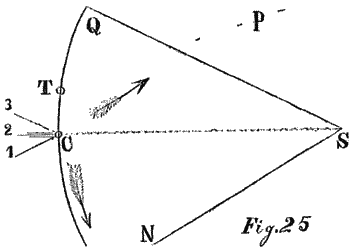
It may be objected that the continued action of the radial stream with that velocity we have contended for, ought to keep the tail invariably directed from the axis of the vortex; but, where there are two forces or tendencies, as in this case, analogy would teach us that a certain degree of oscillation is a necessary result. There may, also, be slight and transient changes in the direction of the radial stream. In the hurricane there are short and fitful blasts inclined to the general direction of the wind, which must arise from the inertia of the moving mass of atmosphere, causing temporary condensations and rarefactions. Be this as it may, we have assigned a cause which satisfies the phenomenon, without coming into collision with a single principle of celestial mechanics.
Prof. Struve compared the tail of this comet to a flame, or “ray of fire shot out from the nucleus, as from some engine of artillery, and driven on one side by the wind.” At the same time, he saw a second emanation nearly in the opposite direction. This last might arise from a momentary fluctuation in the relative intensities of the electric radiation of the comet, and of the radial stream, owing to the probable irregularities just alluded to. Such and kindred phenomena are utterly inexplicable, without we adopt the theory we are advocating. One other feature, and we will leave the subject.
From our explanation of the solar spots, we inferred the existence of another large planet in the system. Might not the same effect be produced by a comet? Or may there not be so many comets, whose great elongation, combined with even a moderate mass, may render it impossible to calculate the position of the sun with respect to the central axis of the vortex,—always considering this last as the axis of equilibrium? In a general way, we might say that the very number of comets in all directions and all distances, would tend to neutralize each other’s effects; but we are not under this necessity. A comet, moving in a parabola, does not belong to the system or to the rotating vortex; and the periodic comets, if of gaseous elements, (as seems so probable,) must, from the size of their nuclei, which the theory considers the only part constituting their mass, have far less mass than the very smallest of the asteroids, and consequently could have very little effect on the mechanical balance of the vortex, even if elongated as far as the orbit of Neptune. Did we know the influence of cold in limiting the expansibility of the elementary gases, we might approximately determine the mass of a comet, from the size of its nucleus; but this is a problem that has never yet been solved; and astronomers ought to avail themselves of every indication which promises to realize this great desideratum. The grand comet of 1556 is now probably approaching, and, from recent investigations, it appears that it will arrive at its perihelion in 1858,—subject to an error either way of about two years. An opportunity may thus be presented of determining the mass of one of the largest comets on record, which may not again occur. This arises from the possible appulse of the comet to the planet Pallas, whose mass, being so small, would more sensibly be disturbed by such an appulse than the earth. As the inclinations and ascending nodes of the two orbits approximately coincide, and as Pallas will be near the comet’s path, on the approach of the latter to the sun, at the beginning of the year 1857, should the comet become visible about that time, a very close appulse is possible. It is not unlikely, also, that if the elements of Pallas were so far perfected as to afford reliable indications, that the near approach of the comet might thus be heralded in advance, and lead to an earlier detection of its presence. Would it not be a worthy contribution to science, for some one possessing the necessary leisure, to give an ephemeris of the planet for that epoch; as a very slight change in Mr. Hind’s elements of the comet, would cause an actual intersection of the two orbits in about heliocentric longitude 153°? The subsequent nodal passage of Pallas will take place near opposition, and be very favorably situated for determining the instant of its passage; and, of all the elements, this would be more likely to be affected than any other.[47]
THE ZODIAL LIGHT.
A phenomenon, akin to that which we have just been considering, is presented by that great cone of diffused light which accompanies the sun, and which in tropical climes displays a brilliancy seldom witnessed in high latitudes, on account of its greater deviation from the perpendicular. Sir John Herschel conjectures that it may be “no other than the denser part of that medium, which, as we have reason to believe, resists the motion, of comets,—loaded, perhaps, with the actual materials of the tails of millions of those bodies, of which they have been stripped in their successive perihelion passages, and which may be slowly subsiding into the sun.” If these materials have been stripped, it is due to some force; and the same force would scarcely permit them to subside into the sun. Once stripped, these portions must be borne outwards, by the radial stream, to the outer verge of the system. Still, there are, no doubt, denser particles of matter, of the average atomic density of Mercury and Venus, which can maintain their ground against the radial stream, and continue to circulate near the central plane of the vortex, in all that space between the earth and the sun. But if the zodial light be the denser part of that medium, which astronomers now generally recognize as a resisting medium, how happens it that it should be confined to the plane of the ecliptic? Why should it not be a globular atmosphere? Here, again, our theory steps in with a triumphant explanation; for while it permits the accumulation of such particles around the equatorial plane of the sun, it allows no resting-place very far removed from this plane. The zodial light, therefore, is not the resisting medium, but the passage of the radial stream through a diffuse nebula of atoms, brought down the poles of the vortex by the polar current, and held in check along the central plane by gravitation.
If these atoms partook of the velocity of the ether, they would not be luminous; but being held back by gravitation, they are opposed to the radial stream, and hence the light.
Many stars are also nebulous. In some cases we see the nebulosity edgewise, or along the equatorial planes of the stellar vortices; in others we look down the poles, and the nebulosities are circular, and there is an endless variety in the shape and intensity of this light. But the universe seems full of motion, and we are not justified in supposing, because a star shows no such light, that it is without rotation. The parallax of the nearest star is only one second, the whole lenticular mass of light which surrounds our sun would therefore only subtend an angle of a single second at the nearest fixed star. Seeing its extreme faintness, therefore, the effulgence of the star would render it totally invisible, provided that it could traverse the vast immensity of intervening space, without feeling the influence of that extinction, which Struve has proved does actually diminish the number of visible stars.
Corruscations and flickerings have also been noticed in the zodial light, and as usual, the learned have suggested atmospheric conditions as the cause, instead of trusting to the evidence of their own senses. How prone is philosophy to cling to that which is enveloped in the mist of uncertainty, rather than embrace the too simple indications of nature. As if God had only intended her glories to be revealed to a favored few, and not to mankind at large. Blessed will be the day when all will appreciate their own powers and privileges, and no longer regard the oracles which emanate from a professional priesthood, whose dicta have so often tended to darken the simple counsels of truth! To set the question of pulsations in the zodial light, as well as in the tails of comets, at rest, only requires previously concerted observations, in places not very widely apart; for it is scarcely possible, that atmospheric conditions should produce simultaneous pulsations in two distant places. If the pulsations are found to be simultaneous, they are real; if not simultaneous, they may depend on such conditions; but from the nature of the cause, we should look for them as much in the zodial light, as in the aurora borealis, regarding the different intensities.
There is also reason to suspect that the northern side is always the brightest, both in spring and autumn. On the morning of October 4th, 1853, the light was very vivid and well defined, its northern margin grazing Regulus and terminating at Mars, which was also to the north of it. Now, although the northern side was the brightest, the great mass of light was to the south of the ecliptic, as far down as the cone shape was preserved; but at 10° from the horizon, a still brighter mass protruded from the cone towards the north, which was all north of the ecliptic, and of an irregular form, extending along the horizon. The time was 4 A. M., and consequently was not due to any crepuscular light. An explanation of the general fact of the brightest light being always on the north side, is given in the present section, in connection with another phenomenon. If, as some suppose, the light does not reach to the sun, the annulus must at least fill all the space between Venus and the earth, but it is far more in accordance with facts as well as with our theory, to suppose it increases in density to the body of the sun.
Observations made at the observatory of the British Association, detected, in 1850, sudden brightenings of the light, altogether different from pulsations. The theory would refer these to that fitful irregularity in the momentary intensity of the radial stream, which gives the flickering and tremulous motion to comets’ tails. But, the steady variations in the intensity of this light must be due to other causes. The longitude of the sun will here come in as a modifying cause; for the obstruction caused by the body of the sun, when displaced from the axis of the vortex, must necessarily exercise an influence on the force and direction of the radial stream. A sudden influx of cometary matter down the poles of the vortex, in more than usual quantities, will also tend to brighten and enlarge the zodial light; and, in this last cause, we have an explanation not only of ancient obscurations of the solar light, but, also, of those phosphorescent mists, such as occurred in 1743 and 1831, rendering moonless nights so light that the smallest print could be read at midnight.
In total eclipses of the sun, the denser portion of the zodial light is visible as a brilliant corona; but, on such occasions, the brightest stars only are to be seen, and, consequently, the fainter portions of the light must be invisible. Hind mentions as many as ten stars visible in the total eclipse of 1842. According to the same authority, the color of the corona was like tarnished silver, and rays of light diverged in every direction, and appeared shining through the light of the corona in the total eclipse of 1851. In this year on the day of the eclipse (July 28th), the longitude of the sun was about 340°, and, therefore, the body of the sun obstructed the radial stream as seen from the earth on the right side; but, in 1842, the longitude of the sun was, according to our table, about 116°, the sun’s centre then being 700,000 miles from the axis of the vortex, and on the opposite side with respect to the earth; the position was, therefore, not so favorable for the appearance of these rays which, in many cases, have given the appearance of a whirling motion to the corona.
At this date, July 7th, 1842, the corona, according to Prof. Airy, “possibly had a somewhat radial appearance, but not sufficiently marked to interfere with the general annular structure.“ Mr. Baily, on the contrary, says, the corona had the appearance of brilliant rays; and, at Milan, long jets of light were particularly noticed. There can be no doubt but that the passage of the radial stream past the outer margin of the moon must also give rise to the same phenomena as when passing the sun, and in this we have an explanation of the fact, that, previous to the moment of first contact, an appearance resembling a faintly-illuminated limb of the moon, has been perceived near the body of the sun; as well as of those flashes of light which have been observed in the lunar disc as the eclipse advances. One important fact, worthy of note, is, that these luminous streaks are more nearly parallel than is due to a radiation from the centre. These streaks have, also, been seen bent at right angles at the middle of their height, as a flame is by means of a blowpipe, precisely analogous to cometary rays being driven backwards to form the tail, as already described, thus indicating a common origin. If the moon had an atmosphere, we should, no doubt, see a greater display; but, having no rotating vortex to protect her from the radial stream, her atmosphere must have been long since stripped off, leaving her exposed to the withering winter blast of the great stream of the solar vortex. In this connection, we may also allude to the appearance of the moon when totally eclipsed. Instead of disappearing at these times, she sometimes shines bright enough to reveal her smallest spots. This has been generally referred to the refraction of the earth’s atmosphere bending inwards the solar rays. May it not be owing to the brilliancy of the solar corona, which, in 1842, was described as so intense that the eye was scarcely able to support it? This is a far more palpable cause for the production of this phenomenon, but of which astronomers cannot avail themselves, as long as they are uncertain of the origin of this corona.
SHOOTING STARS.
The continual influx of cosmical matter into the heart of the vortex in ever-varying quantities, and speedily dispersed along the central plane, according to its density, must necessarily give rise to another phenomenon to which we have not yet alluded. Scarcely a night passes without exhibiting this phenomena in some degree, and it is generally supposed that the hourly average of shooting stars is from five to ten, taking the whole year round. The matter composing these meteors we regard as identical with that mass of diffused atoms which forms a stratum conforming to the central plane of the vortex, and whose partial resistance to the radial stream occasions that luminosity which we call the zodial light. These atoms may coalesce into spherical aggregations, either as elastic gas, or as planetary dust, and, passing outward on the radial stream, will occasionally become involved in the vortex of our own globe; and being drawn inwards by the polar current, and acted on by the earth’s gravity, be impelled with great velocity through the rarefied air of the upper atmosphere. That meteors are more abundant about the time of meridian passage of a vortex (or, perhaps, more correctly speaking, from six to twelve hours afterwards, when the current of restoration penetrates the atmosphere), well accords with the author’s observations. It is about this time that high winds may be looked for, according to the theory; and it has ever been a popular opinion, that these meteors are a sign of windy weather. Even in Virgil’s time, the same belief prevailed, as a passage in his Georgics would seem to indicate.
“Sape etiam stellas, vento impendente, videbis Præcipites cœlo labi; noctisque per umbram Flammarum longos à tergo albescere tractus;”
Virgil was a close observer of nature, and commences a storm with the wind at south, “Quo signo caderent Austri;” just as we have represented the usual course when these vortices pass near the observer’s latitude. It is also a well-known fact, that after a display of meteors, (and we are now speaking of ordinary displays, and not of the great showers,) the temperature falls considerably. It is not uncommon also, that meteors are more abundant during an auroral display, as they ought to be by the theory. We must, however, exempt from this influence those solid meteors which sometimes come into collision with the earth, and afterwards grace the cabinets of the curious. These bodies may be considered microscopic planets, moving in stated orbits with planetary velocity, and bear strongly on the explosive theory of Olbers, as fully detailed by Sir David Brewster.
It is a very remarkable fact, first noticed by Olbers, that no fossil meteoric stones have yet been discovered. If this fact be coupled with the hypothesis advanced by Olbers, in reference to the origin of the asteroidal group, we should have to date that tremendous catastrophe since the deposition of our tertiary formations, and therefore it might possibly be subsequent to the introduction of the present race into the world. May not some of the legendary myths of the ancient world as mystified by the Greeks, have for a foundation the disappearance of a former great planet from the system? The idea of the existence of seven planets is one of the oldest records of antiquity; but the earth of course would not be counted one, and therefore in after times, the sun was included to make up the number; just as the signs of the Zodiac have been explained in accordance with the seasons of far later times than we can possibly assign for the invention of this division of the heavens. Let those who have the leisure, try how far the contraction and dilation of the asteroidal orbits, to some average mean distance, will restore them to a common intersection or node, as the point of divergence of the different fragments. The question is interesting in many of its aspects, and may yet be satisfactorily answered.
The composition of aërolites may also be taken as indications of the common origin and elementary texture of the planets, whether they are independently formed or have originally pertained to a former planet; for no hypothesis of telluric or selenic origin yet advanced, can stand against the weight of evidence against it. Their fragmentary character rather favors the views of Sir David Brewster, and when we consider that they have been revolving for thousands of years with planetary velocity, and in very eccentric orbits, through the ether of space, continually scathed by the electric blast of the radial stream, their rounded angles, and black glossy crust of an apparently fused envelope, may be accounted for, without difficulty, from the non-vitrified appearance of the interior. The composition of aërolites as far as known, embrace nearly one-third of all known simple substances according to Humboldt, and are as follows: iron, nickel, cobalt, manganese, chromium, copper, arsenic, zinc, potash, soda, sulphur, phosphorus, and carbon.
The theory we have thus given of the common occurrence of shooting stars, will render a satisfactory general account of their sporadic appearance; but there are other phenomena of greater interest, viz.: the occasional recurrence of swarms of such meteors, which defy all numerical estimates, being more like a fiery rain than anything they can be compared to. The most interesting feature of this phenomena, is the apparent periodicity of their return. In the following table we have set down the most remarkable epochs mentioned by Humboldt, (and no man has devoted more attention to the subject,) as worthy of notice:
About April 22 to 25
" July 17 to 26
" August 9 to 11
" November 12 to 14
" November 27 to 29
" December 6 to 12
Besides these, he mentions two showers, from Arabian authority, in October; one in October, observed in Bohemia; one observed by himself, in the Pacific, on March 15; one February 4, just preceding the terrible earthquake of Riobamba, in 1797. The Chinese annals also contain many showers of stars, before the present era commenced. Some were in March, more in July, and others in different months. How, then, in view of these numerous dates, can we attach so much importance to the periodicity of these showers? The great shower of 1833, in the United States, on the 12th and 13th of November, brought to mind the great shower at Cumana, observed by Humboldt and Bonpland just thirty-three years before, to a day; and it must be confessed that more than ordinary displays have been seen on this date. Yet, on the strength of this, every meteoric shower is supposed to be periodical, and has resulted in a theory which becomes more complicated as the phenomenon is more observed, and can never lead to any useful and practical results. To cite the numerous instances of discrepant results, would only encumber this brief notice with facts neither interesting to the general reader, nor convincing to those who hold a contrary opinion. The author of these pages has watched for many years, and, in view of all the facts, has concluded that the doctrine of periodicity (as held by present meteorologists) is not tenable. The celebrated August shower failed, also, this year, at least in this place, as for four hours each night, on the 9th, 10th, and 11th, there were fewer bright meteors than at the close of July.
Professor Olmsted, who has paid considerable attention to the subject, has indeed attempted to connect the great November shower with the zodial light, which last he considers a nebulous body, of an elongated form, whose external portions, at this time of the year, lie across the earth’s path. (See Silliman’s Journal for 1837, vol. xxxiii. No. 2, p. 392.) He even gives its periods, (about six months,) the aphelion of the orbit being near the earth’s orbit, and the perihelion within Mercury’s. In this way he attempts to explain both phenomena; but as the zodial light is seen unchanged all the year round in tropical latitudes, it is not the kind of body supposed by Olmsted, and the theory adds nothing to our knowledge. Others have imagined rings of nebulous matter, in which all the separate parts are moving in the same orbit around the sun, with a retrograde motion, and this, with some modifications, is the current theory of the day. The principal arguments rested on, for the support of this view, are derived from the great shower of 1833, in which a common radiant point was observed, and confirmed subsequently by the radiant of other years, in the same month of November. As this point is almost tangential to the earth’s orbit at this season, the earth meets the nebulous ring moving in the contrary direction, and thus confers on these meteors the necessary velocity that is thought to be demanded by observation.
Now, our theory gives a totally different explanation of the phenomenon. We contend that a retrograde motion of such a nebulous mass, is subversive of our whole theory; and we must be permitted to examine certain points, hitherto disregarded by those entertaining antagonist views. It is supposed that the meteors in 1833 fell for eight or nine hours. The orbital velocity of the earth is more than 1,000 miles per minute, and the orbital velocity of the nebulous zone must have had a similar velocity. During the nine hours of meteoric display, therefore, the earth traversed 500,000 miles of her orbit, which would give 1,000,000 miles for the depth of the nebulous stratum. But if of such vast extent, how happened it that the only part of the earth in which these were visible in great density, was the United States, or a space embraced between the latitudes of 50° and 20° north, and the longitudes 60° and 100° west, (and these are the widest limits,) comprising only 1 ⁄ 40 of the surface of the globe? To a calm inquirer, this difficulty seems insurmountable. The author was then in the Mediterranean, on deck the greatest part of the night,—the weather fine, and nothing unusual visible in the heavens; from other sources he has also derived similar information. Yet, were the earth then passing through a stratum of meteors 1,000,000 miles in extent, it is utterly inconceivable that other portions of the earth escaped. Much stress is also laid on the fact that these meteors in 1833, passed from east to west generally, as they ought to do, if tangential to the earth in her orbit; but on the same phenomenon occurring in 1799, when the earth was in precisely the same part of her orbit, Humboldt says distinctly, “the direction (of the meteors) was very regular from north to south.” How could this possibly happen, and at the same time be moving tangentially to the orbit?
There is also another fact of importance not duly weighed in forming such a theory. In 1833 the meteors evidently differed in velocity; one class, consisting of luminous points, passed like a shower of fire with great velocity to the westward, another class were like large fire-balls with luminous trains moving with less rapidity, while a third class consisted of nebulous patches which remained stationary for a long time, and frequently emitting large streams of light. These last, at least, do not deport themselves as planetary bodies moving 2,000 miles per minute. But the fact still remains, that unusual displays have occurred about the 12th and 14th of November; and also as a general thing when there are no unusual displays, the meteors are more abundant about this time. Let us try if we can reconcile these facts with the theory of vortices.
We will first confine our remarks to the increased number of meteors about November 12th and 14th. The cosmical matter composing the zodial light, or at least the lighter parts of it, is continually driven outwards by the radial stream, just as the matter of a comet’s tail is stripped from the nucleus. This matter becomes involved in the terral vortex by descending the poles, and is again passed out along the equatorial plane. The form of the zodial light, as seen edgewise, gives a lenticular form for the stratum of planetary particles composing it, and its central plane has been considered as coinciding with the plane of the sun’s equator. At the orbit of the earth, this lenticular space is narrowed to a very thin stratum, but undoubtedly reaches beyond the earth’s orbit with a rapidly diminishing density. As the axis of the sun is inclined about 7° to the ecliptic, and the ascending node is in the 20th degree of Gemini, the earth can only pass through the plane of the sun’s equator about the 12th of December and the 12th of June. If, therefore, the central plane of the vortex coincides with the plane of the sun’s equator, meteors ought to be more numerous about the dates above mentioned. But the observed times are on November 12th and 13th. Now, from actual measurements, a computation has been made by M. Houzeau, that the elements of the zodial light are materially different from those of the sun’s equator. He fixes the node of the light (according to Mr. Hind) in 2° heliocentric longitude, subject to an uncertainty of 12° or 13°, and its inclination to the plane of the ecliptic, 3° 35′, subject to an uncertainty of about 2°. The truth is, astronomers have argued the coincidence of the two planes from considerations connecting the zodial light with the sun’s equator, as if it were a solar atmosphere; but such an atmosphere is impossible, and it is high time such measures should be taken as will lead to some certain conclusion. If in the present state of the question, we were to take the mean, we should find the node in about longitude 40°, which is the position of the earth on November 2d. But in the absence of measurements, we will assume, for the sake of argument, that the ascending node of the central plane of the vortex was, in 1833, in 50° heliocentric longitude, and consequently the earth was passing through the meteoric stratum or central plane of the zodial light, on the night of November 12th. The opposite period of the year is May 12th—a date, it is true, on which no great shower of stars is recorded, but sporadic meteors are very plentiful at that time, and what is more important to observe is, that the 11th, 12th, and 13th of May, are the three noted cold days which we have before mentioned. Thus truly indicating that the earth is then in or near the central plane of the vortex along which the radial stream is at its maximum of power at any given distance from the axis.
But the question occurs, does the node of this plane remain stationary, and is there no variation of the inclination of the axis of the solar vortex? We have found from observation, that the axis of the terral vortex is continually oscillating about a mean position by the action of the moon; and reasoning from this analogy, and the constant tendency of a material vortex to preserve a dynamical balance, the same tendency must obtain in the solar vortex under the action of the great planets, whose orbits do not coincide with the central plane of the vortex. The ascending node of Jupiter’s orbit is in longitude 98°, Saturn’s 112°, Uranus’ 72°, Neptune’s 131°; so that this plane does not correspond with the plane of greatest inertia discovered by La Place, and from the non-coincidence of these planes with the central plane of the vortex, must produce the same oscillation in the axis of the solar vortex, as the moon does in the terral vortex, but to what amount, observation can alone determine. Jupiter and Saturn will of course exert the greatest influence, and when these two planets are in conjunction, the ascending node of the central plane of the vortex will vary in longitude perhaps sufficiently to bring the meteoric maximum at the ascending node into October on the one hand, and to the close of November on the other, and at the descending node to April 25th on the one hand, and the close of May on the other.
The great showers of stars which have been recorded, must be therefore considered as an accidental exaggeration of a perennial phenomenon, attaining its maximum when the earth passes through the central plane of the vortex, whose ascending node in 1833 we will suppose was in longitude 50°. This theory will therefore account for those great showers which have occurred about the 24th of April, as well as those occurring in October and November; for it is far more consonant to all analogy, to suppose the influx of planetary atoms into the solar vortex to be in irregular, than in regular quantities. Yet, whether in the one case or in the other, the matter will pass along the central plane of the vortex, either diffusely scattered or in denser clouds, and will be encountered by the earth when near the nodes more frequently than at other times. The phenomenon of 1833, may then be attributed to the earth encountering an unformed comet on the 12th of November; but we must reflect, that the medium of the vortex is also in motion, and the cometary matter drifting along with it; and that this motion corresponds with the earth’s motion. By becoming involved in the terral vortex, it will in a measure be carried along with the earth in her orbit as a temporary occupant of the terral vortex. But we are here met with the objection that the radiant being nearly stationary amongst the stars, demonstrated conclusively, that the source of these meteors did not partake of the earth’s motion. There is no difficulty in this. We suppose as a general thing, that the meteors descended to the surface of our atmosphere down the axis of the vortex (at least in the greatest numbers), and the geocentric longitude of this axis was nearly the same during the whole time of the display. We say nearly, for the motion of the moon in her orbit in nine hours, would change the longitude of the axis three or four degrees, and this is about the change in the position of the radiant noted at the time. This objection, therefore, falls to the ground; for the axis of the vortex, although carried along with the earth in her orbit, was unaffected by the earth’s rotation, and would therefore appear nearly as stationary in the heavens as Gamma Leonis. But it is again urged, that the moon was near conjunction with the sun, and consequently the central vortex was on the opposite side of the globe. This is true; but the outer vortex must have been near the meridian about three hours after midnight, or about the time when the radiant was vertical and the display the greatest. When the axis was to the eastward, the stars would shoot westward, when on the meridian, they would pass in all directions, but principally to the south, on account of the inclination of the axis of the vortex; but this would only be true for places situated to the southward of the central latitude. During the great shower of stars seen by Humboldt, in Cumana, the direction was to the south uniformly. Now, the latitude of Cumana is above 10° north, yet still too low for the general limits of the vortices; but from the same inclination of the axis (from 30° to 36° to the surface), the meteors would pass far south of the limit, and might even reach to the equator. The latitude of the outer vortex ascending on November 12th, must have been near the line of greatest display, from the position of the moon at the time. We thus see why the phenomenon was limited to so small a fraction of the earth’s surface; why these meteors should be intermingled with nebulous patches stationary in the heavens for an hour together, and why, notwithstanding these facts, they were independent of the earth’s rotation.
We have yet another objection to answer, viz.: the planetary velocity of some of these bodies. Let us be understood. The velocity of a solid aërolite is due to gravitation, and is planetary, on the other hand, voluminous collections of cometary dust united by accident, and remaining so by mere inertia, are borne passively on the ethereal currents with electric velocity, and probably never penetrate far, even into the attenuated atmosphere, which may be supposed (from the facts connected with the aurora) to extend far above the denser stratum which refracts and reflects light, and from which the assigned limits of our atmosphere have been derived.
It is generally considered that sporadic meteors are more numerous in the summer and autumn than in the winter and spring, and we have, likewise, in the tenth of August, a date which corresponds to many great displays and meteoric showers, both in recent and remote times. This would seem to vitiate our theory; for we cannot suppose that there are two central planes in the vortex intersecting the ecliptic in longitude 320° and 50°. We must remember, however, that as these great displays are accidental, and as the stratum composing the zodial light is manifestly of sufficient thickness to envelope the whole orbit of the earth, that it does not necessarily follow that the dense portions to which meteoric showers are due, should be always confined to the central plane of the vortex. And, besides, we have similar displays recorded in other months, which invalidates the theory of a regularly-recurring phenomenon. We shall, therefore, only aim at explaining why meteors are generally more abundant in summer and autumn than in the opposite seasons.
The axis of the solar vortex, considered as cylindrical, must be admitted to run out to a great depth on either side from the sun, and reach far into that unoccupied space intervening between our system and the nearest fixed stars, and from these opposite points the solar vortex is supplied with that stream of ether which passes down either pole to restore a partial equilibrium in the density of the ether of the vortex, rarefied by centrifugal force. As certain portions of the heavens are crowded with stars, and other parts comparatively vacant, we may expect a similar inequality in the distribution of that cometic dust, which causes a certain amount of extinction in the light of the stars, and, therefore, seeing that the two extremities of the axis of the solar vortex are so widely separated, it would not be wonderful if different quantities of such matter were brought down into the vortex from these extremities.
From recent observations made by H. R. Birt, at the observatory of the British Association, it would appear that the brightest portion of the zodial light is always north of the ecliptic. Others have also remarked the same, and if we couple this fact with the suggestion just made, we are justified in suspecting that a greater quantity of cometic dust comes down the northern pole of the vortex than down the southern. This matter, in passing outward, does not, of course, immediately attain to the central plane of the vortex, but is more thickly distributed along a plane parallel to this plane. And the same will be observed by that matter coming down the southern pole; it will be, in a certain degree, retained in a plane south of the central plane, but still parallel with it. This would account for the greater brightness of the northern side of the zodial light. It would, also, account for the greater frequency of meteors in summer and autumn than in the opposite seasons. From May to November the earth is above the central plane of the vortex, and, consequently, on the northern side; but after passing the node in November, she is on the under or southern side, and the meteors are less frequent. With this general explanation we shall close. If what we have advanced be an approximation to the truth, the theory itself affords ample indications of what observations are requisite to prove or disprove it; and, on this account, a theory is of great benefit, as suggestive of many questions and combinations of facts which otherwise might never be thought of.
We have thus taken a cursory glance at the prominent physical phenomena of the world, and attempted to link them together in the bonds of one all-pervading principle. We have fearlessly taken a new path, and claim originality for the whole, disclaiming all intention of retailing second-hand wares, or of compiling an ingenious theory from heterogeneous scraps. If it be true, or if it be partially true, let those professionally engaged in such pursuits enter the wide field of investigation we have discovered for them; for if the whole theory be true, it only shows in a clearer light that the great work which has been fancied so near completion is scarcely yet begun; while the prospect of an ultimate and final completion of the temple which so many zealous votaries are erecting, is rendered mournfully hopeless by the contemplation of what yet remains to be performed.