SECTION FIRST.
Reading edition
PRESENT STATE OF METEOROLOGY.
The present state of the science of which we are about to treat, cannot be better defined than in the words of the celebrated Humboldt, who has devoted a long life to the investigation of this department of Physics. He says: “The processes of the absorption of light, the liberation of heat, and the variations in the elastic and electric tension, and in the hygrometric condition of the vast aërial ocean, are all so intimately connected together, that each individual meteorological process is modified by the action of all the others. The complicated nature of these disturbing causes, increases the difficulty of giving a full explanation of these involved meteorological phenomena; and likewise limits, or wholly precludes the possibility of that predetermination of atmospheric changes, which would be so important for horticulture, agriculture, and navigation, no less than for the comfort and enjoyment of life. Those who place the value of meteorology in this problematic species of prediction, rather than in the knowledge of the phenomena themselves, are firmly convinced that this branch of science, on account of which so many expeditions to distant mountainous regions have been undertaken, has not made any very considerable progress for centuries past. The confidence which they refuse to the physicist they yield to changes of the moon, and to certain days marked in the calender by the superstition of a by-gone age.”
The charge thus skilfully repelled, contains, however, much truth; there has been no adequate return of the vast amount of labor and expense thus far devoted to this branch of knowledge. And it is not wonderful that the popular mind should expect a result which is so much in accordance with the wants of mankind. Who is there whose happiness, and health, and comfort, and safety, and prosperity, may not be more or less affected by reducing to law, the apparently irregular fluctuations of the weather, and the predetermination of the storm? To do this would be the crowning triumph of the age; and the present theory has pioneered the way for its speedy accomplishment.
ORIGINAL CONDITION OF THE EARTH.
That the present order of things had a beginning, is taught by every analogy around us, and as we have the glaring fact forced upon us, that our globe has experienced a far higher temperature on its surface than obtains at present, and moreover, as it is demonstrated beyond a cavil, that the interior is now of far higher temperature than is due to solar radiation, we are justified in concluding, not only that the condition of the interior of our globe is that of fusion, but that its original temperature was far higher than at present; so that the inference is allowable that there has been a time when the whole globe was perhaps in this state. But why should we stop here? There are three states of matter, the solid, the fluid, and the gaseous; and with this passing glance at the question, we will jump at once to the theory of La Place,—that not only our own globe, but the whole solar system, has been once in the nebulous state.
In justice to himself, the author ought to remark, that he had reasoned his way up to this starting point, before even the name of La Place had reached his ears. He makes the remark in order to disclaim any desire to appropriate that which belongs to another; as he may innocently speak of things hereafter, the idea of which has occurred to others. It is not his intention here to say a word pro or con on the nebular hypothesis; it is sufficient to allude to the facts, that the direction of rotation and of revolution is the same for all the planets and satellites of our system; and that the planes on which these motions are performed, are nearly coincident. That this concordance is due to one common cause, no one acquainted with the theory of probabilities will pretend to deny.
GREAT OBJECT OF LA PLACE.
The science of Astronomy occupies a pre-eminent rank in the physical circle, not only on account of that dignity conferred upon it in the most remote antiquity, or as being the grand starting point—the earliest born of science—from whence we must contemplate the visible creation, if we would reduce its numerous details into one harmonious whole; but also on account of its practical fruits, of the value of which modern commerce is an instance. Accordingly we will glance at its past history. In the earliest ages there was no doubt a rational view entertained of the movements of the planets in space. From the Chaldeans to the Arabs, a belief prevailed, that space was filled with a pure ethereal fluid, whose existence probably did not rest on any more solid foundation than analogy or tradition. One hundred years after Copernicus had given to the world the true arrangements of our planetary system, Descartes advanced his theory of vortices in the ethereal medium, in which the planets were borne in orbits around the sun, and the satellites around their primaries. This idea retained its ground with various additions, until the Geometry of Newton reconciled the laws of Kepler with the existence of a power pertaining to matter, varying inversely as the squares of the distances, to which power he showed the weight of terrestrial bodies was owing, and also the revolution of the moon about the earth. Since Newton’s day, those deviations from the strict wording of Kepler’s laws, have been referred to the same law, and the avowed object of the author of the “Mechanique Celeste,” was to bring all the great phenomena of nature within the grasp of analysis, by referring them to one single principle, and one simple law. And in his Introduction to the Theory of the Moon, he remarks: “Hence it incontestibly follows, that the law of gravitation is the sole cause of the lunar inequalities.”
BESSEL’S OPINION.
However beautiful the conception, it must be admitted that in its à priori aspect, it was not in accordance with human experience and analogy to anticipate a successful issue. In nature law re-acts upon law, and change induces change, through an almost endless chain of consequences; and it might be asked, why a simple law of matter should thus be exempt from the common lot? Why, in a word, there should be no intrinsic difference in matter, by which the gravitation of similar or dissimilar substances should be affected? But experiment has detected no such differences; a globe of lead and a globe of wood, of equal weight, attract contiguous bodies with equal force. It is evident, therefore, that if there be such differences, human means are not yet refined enough to detect them. Was the issue successful then? Generally speaking, we may say yes. But where there is a discrepancy between theory and observation, however small that may be, it shows there is still something wanting; and a high authority (Professor Bessel) says in relation to this: “But I think that the certainty that the theory based upon this law, perfectly explains all the observations, is not correctly inferred.” We will not here enumerate the cases to which suspicion might be directed, neither will we more than just allude to the fact, that the Theory of Newton requires a vacuum, in order that the planetary motions may be mathematically exact, and permanent in their stability.
A VACUUM REQUIRED BY MODERN SYSTEMS.
Whatever may be the practical belief of the learned, their fundamental principles forbid the avowal of a plenum, although the undulatory theory of light renders a plenum necessary, and is so far virtually recognized by them, and a correction for resistance is applied to the Comet of Encke. Yet there has been no attempt made to reconcile these opposing principles, other than by supposing that the celestial regions are filled with an extremely rare and elastic fluid. That no definite view has been agreed on, is not denied, and Sir John Herschel speculates on the reality of a resisting medium, by suggesting questions that will ultimately have to be considered, as: “What is the law of density of the resisting medium which surrounds the sun? Is it in rest or in motion? If the latter, in what direction does it move?” In these queries he still clings to the idea of Encke, that the resistance is confined to the neighborhood of the sun and planets, like a ponderable fluid. But the most profound analyst the world has ever boasted, speaks less cautiously, (Poisson Rech.) “It is difficult to attribute, as is usually done, the incandescence of aërolites to friction against the molecules of the atmosphere, at an elevation above the earth where the density of the air is almost null. May we not suppose that the electric fluid, in a neutral condition, forms a kind of atmosphere, extending far beyond the mass of our atmosphere, yet subject to terrestrial attraction, yet physically imponderable, and, consequently, following our globe in its motion?” The incandescence of aërolites must, therefore, be owing to friction against the molecules of the electric fluid which forms an atmosphere around the globe. According to this view, some force keeps it there, yet it is not ponderable. As it is of limited extent, this is not the medium whose undulations brings to light the existence of the stars; neither is Encke’s, nor Herschel’s, nor any other resisting medium. Where shall we find the present established principles of science? If we grant the Newtonians a plenum, they still cling to attraction of all matter in some shape. If we confine them to a vacuum, they will virtually deny it. Is not this solemn trifling? How much more noble would it be to exhibit a little more tolerance, seeing that they themselves know not what to believe? We do not offer these remarks as argument, but merely as indications of that course of reasoning by which we conclude that the upholders of the present systems of science are not entitled to any other ground than the pure Newtonian basis of an interplanetary vacuum.
DIFFICULTIES OF THIS VIEW.
This, then, is the state of the case: Matter attracts matter directly as the mass, and inversely as the squares of the distances. This law is derived from the planetary motions; space is, consequently, a void; and, therefore, the power which gives mechanical momentum to matter, is transferred from one end of creation to the other, without any physical medium to convey the impulse. At the present day the doctrines of Descartes are considered absurd; yet here is an absurdity of a far deeper dye, without we resort to the miraculous, which at once obliterates the connection between cause and effect, which it is the peculiar province of physical science to develop. Let us take another view. The present doctrine of light teaches that light is an undulation of an elastic medium necessarily filling all space; and this branch of science probably rests on higher and surer grounds than any other. Every test applied to it by the refinements of modern skill, strengthens its claims. Here then the Newtonian vacuum is no longer a void. If we get over this difficulty, by attributing to this medium a degree of tenuity almost spiritual, we shall run upon Scylla while endeavoring to shun Charybdis. Light and heat come bound together from the sun, by the same path, and with the same velocity. Heat is therefore due also to an excitement of this attenuated medium. Yet this heat puts our atmosphere in motion, impels onward the waves of the sea, wafts our ships to distant climes, grinds our corn, and in various ways does the work of man. If we expose a mass of metal to the sun’s rays for a single hour the temperature will be raised. To do the same by an artificial fire, would consume fuel, and this fuel would generate the strength or force of a horse. Estimate, therefore, the amount of force received from the sun in a single day for the whole globe, and we shall find that nothing but a material medium will suffice to convey this force.
Let us appeal to analogy. The undulations of our atmosphere produce sound; that is, convey to the ear a part of a mechanical force imparted to a solid body—a bell for instance. Let us suppose this force to equal one pound. On account of the elasticity of the bell, the whole of the force is not instantaneously imparted to the surrounding air; but the denser the air the sooner it loses its motion. In a dense fluid like water, the motion is imparted quickly, and the sound is not a ring but a click. If we diminish the density of the air, the loss of motion is retarded; so that we might conceive it possible, provided the bell could be suspended in a perfect vacuum, without a mechanical tie, and there was no friction to overcome from the rigidity of its particles, that the bell would vibrate forever, although its sound could never reach the ear. We see, therefore, that the mechanical effect in a given time, is owing to the density of the medium. But can we resort to such an analogy? Every discovery in the science confirms more and more the analogy between the motions of air and the medium of space; the angle of reflexion and incidence follows the same law in both; the law of radiation and interference; and if experiments were instituted, there can be but little doubt that sound has also got its spectrum.
ETHER IMPONDERABLE.
The medium of space, therefore, is capable of conveying a mechanical force from one body to another; it therefore possesses inertia. Does it also possess gravity? If we forsake not the principles of science, it is but right that we expect science shall abide by her own principles. Condensation in every elastic medium is as the compressing power, according to all experiments. In the case of our atmosphere under the law of gravitation, the density of air, (supposing it to be infinitely expansible,) at a height only of ten semidiameters of the earth above its surface, would have only a density equal to the density of one cubic inch of such air we breathe, if that cubic inch was to be expanded so as to fill a globular space whose centre should be the earth, and whose surface should take inside the whole visible creation. Such a medium could convey no mechanical force from the sun, and therefore the medium of space cannot be ponderable. Simple as the argument is, it is unassailable.
ELECTRIC FLUID THE MEDIUM OF SPACE.
Let us take yet another view. All experiments prove that the phenomenon we call electricity, is owing to a disturbance of the equilibrium or natural condition of a highly elastic fluid. In certain conditions of the atmosphere, this fluid is accumulated in the region of the clouds, and by its tension is enabled to force a passage through opposing obstacles, in order to restore the equilibrium. By experiment it is found that dry dense air opposes the greatest obstacle to its escape. As the air is rarefied, this obstacle diminishes; until in a vacuum the transmission may be considered instantaneous. There ought to be, therefore, a greater escape of electricity from the clouds upwards than downwards; and, if space be void, or only filled with an extremely attenuated matter, the electricity of the earth, considered as an elastic fluid without ponderosity, (and no law of condensation from the law of gravity in harmony with its other attributes, will allow us to consider it otherwise,) would long since have left the earth. The same objection applies in the case of the galvanic and magnetic fluids. If we entertain the idea that electricity is a mere disturbance of natural condition, wherein two fluids are united, and that an excess of one is necessarily attended by deficiency in the other, we depart from the first rule of philosophy, which teaches us to admit no greater number of causes than are sufficient to explain the phenomenon. For we fearlessly assert that not a single fact exists in electrical science, which can be explained better on Dufoy’s theory than on Franklin’s; and the former objections would still apply.
NEWTONIAN GRAVITY.
But what is gravity? According to Newton: “Hæc est qualitas omnium in quibus experimenta instituere licet, et propterea per Reg. 3 de universes affirmanda est.” Vide Prin. Lib. Ter. Cor. 2. Prop. vi.
Now the other primary qualities of matter are unaffected by circumstances. The inertia of a particle of matter is the same at Jupiter as on the earth, so also is its extension; but not so with gravity. It depends on other matter, and on its distance from it; and may be less or greater at different times, and in different places. It is, therefore, not philosophical to say that all matter is necessarily ponderous, inasmuch as it is a virtue not residing in itself alone, but needs the existence of other matter to call it into action. If an atom were isolated in space it would have no weight. If influenced by other matter, there must be some physical medium to convey the influence, or gravity is not in accordance with the laws of force and motion. Which horn of the dilemma shall we take? Let us first admit that there is a principle of gravitation, affecting all planetary or atomic matter, and that there exists a highly elastic medium, pervading all space, conveying to us the light of the most distant stars, and that this medium is not affected by gravity. In this summary way, therefore, we have arrived at the pivot on which this theory turns.
The prominent feature of the theory, therefore, is the necessity it will show for the existence of an all-pervading medium, and that it possesses inertia without ponderosity. That electricity is nothing more than the effects of the condensation and rarefaction of this medium by force. That it also pervades all atomic matter, whose motions necessarily move the medium; and, consequently, that there can be no motion without some degree of electricity. That no change can take place in bodies either by chemical decomposition, by increase or decrease of temperature, by friction or contact, without in some measure exciting electricity or motion of the ether. That galvanism and magnetism are but ethereal currents without condensation, induced by peculiar superficial and internal molecular arrangement of the particles of certain substances. That light and heat are effects of the vibrations of atoms, propagated through this universal medium from body to body. That the atomic motion of heat can be produced by the motion of translation or momentum of bodies in the gross, that is, by friction, by compression, &c.; and can be reconverted into momentum at our pleasure. Hence the latent heat or specific atomic motion of combustibles, originally derived from the sun, is transferred to atoms, which are capable of being inclosed in cylinders, so as to make use of their force of expansion, which is thus converted into momentum available for all the wants of man.
GRAVITY MECHANICAL.
When we come to a full examination of this theory, we shall further reason that this ether so far from being of that quasi spiritual nature which astronomers would have us believe, is a fearfully energetic fluid, possessing considerable inertia and elasticity; that its law of condensation is that of all other fluids, that is, as the compressing force directly; and that its effects are simply a product of matter and motion. We will next endeavor to prove that the gravity of planetary matter could not exist without this ethereal medium, by showing that it is an effect produced by the interference of opposing waves, whereby a body is prevented from radiating into space its own atomic motion, from the side opposite which another body is placed, as much as on the opposite side, and consequently it is propelled by its own motion towards the other body. And this effect following the simple law of inertia and radiation, is directly as the mass, and inversely as the squares of the distances.
GREAT PRINCIPLE OF DYNAMICS.
One great principle to be kept in view in this investigation, is that which teaches that the product of matter, angular velocity, and distance from the centre of motion, must ever be a constant quality in every balanced system. Yet this principle does not seem to be observed in the case of the planets. We will, however, endeavor to show that it is rigidly observed. And we will extend the principle further, and contend that all the phenomena of nature are consequences of the constant tendency of matter to conform to this principle of equilibrium, when suffering temporary derangement from the operation of other laws. That throughout the system of nature, equal spaces possess equal force. That what we call temperature, is nothing more than the motion of equilibrium or atomic momentum of space; or, in other words, that if all space were fluid, and in a state of equilibrium, the product of each atom of equal volume, by its motion would be a constant quality. From this it would seem to follow, that the specific heat of bodies should be inversely as their atomic weights; and this does, no doubt, approximately obtain as was proved by Dulong and Petit, for metallic substances, more recently by Regnault, and has since been extended by Garnier to other substances. But it is to the gaseous state that we must look for confirmation of the principle that equal spaces possess equal power; and in doing so, it will be necessary to bear in mind, that the ether also is affected by temperature.
SPECIFIC HEAT.
It has been contended by some that the medium which conveys the impression of light through transparent, bodies, is necessarily more dense within the body than without; but according to this theory the converse is true. A ray of light is a mechanical impulse, propagated through an elastic medium, and, like a wave in water, tends to the side of least resistance. Within a refracting body the ether is rarefied, not only by the proximity of the atoms of the body (or its density), but also by the motions of those atoms; so that if two simple gases of different specific gravity be made equal in density by compression, their refraction will be approximately as their specific heats. In the case of solids and liquids, or even compound gases, there is a continual absorption of motion to produce the cohesion of composition and aggregation. And the specific heats of compound gases will be found greater than those of simple gases, in proportion to the loss of volume by combination, ceteris paribus. If impenetrability be a law of matter, the more a portion of atomic matter is condensed, the less ether will be found in the same space. The same is also true when the natural density or specific gravity of a gas is greater than that of another. And the lighter the gas, the more will this circumstance vitiate the experiments to determine its specific heat. There is, therefore, this great source of fallacy in such experiments, viz.: that the ether permeates all fluids and solids, and that its specific heat probably far exceeds that of all other matter. This is a fundamental position of the theory, in support of which we will introduce a fact announced by M. V. Regnault, which was published in the Comptes Rendus of the French Academy for April, 1853. He says: “In the course of my researches I have encountered, indeed, at every step, anomalies which appeared to me inexplicable, in accordance with the theories formally recognized. For the sake of illustration I will quote one instance: 1st, a mass of gas, under a pressure of ten atmospheres, is contained in a space which is suddenly doubled; the pressure falls to five atmospheres. 2d. Two reservoirs of equal capacity are placed in a calorimeter; the one is filled with a gas, under a pressure of ten atmospheres; the second is perfectly empty. In these two experiments, the initial and final conditions of the gas are the same; but this identity of condition is accompanied by calorific results which are very different; for while in the former experiment there is a reduction of temperature, in the second the calorimeter does not indicate the slightest alteration of temperature.” This experiment tends to confirm the theory. In the first experiment, the sudden doubling of the space causes the ether also to expand, inasmuch as the sides of the vessel prevent the instantaneous passage of the external ether. In the second, both vessels are full, one of ether, and the other of air mixed with ether; so that there is no actual expansion of the space, and consequently no derangement of the quantity of motion in that space.
LAW OF SPECIFIC HEAT.
From this view it is evident that the specific heat of elastic fluids can only be considered as approximately determined. If equal spaces possess equal momenta, and the ethereal or tomic matter be inversely as the weight of the atomic matter in the same space, it follows that the product of the specific gravities and specific heats of the simple gases should be constant; or that the specific heats should be inversely as the specific gravities,—taking pound for pound in determining those specific heats. If we test the matter by the data now afforded, it is best to obey the injunction, “In medio tutissimus ibis.” In the following table, the first column are the values obtained by Regnault; in the second, the former values; and in the third, the mean of the two.
Gases. Reg. specific heats. Former specific heats. Mean.
Atmospheric air, .237 .267 .252
Oxygen, .218 .236 .227
Nitrogen, .244 .275 .260
Hydrogen, 3.405 3.294 3.350
The specific gravities of these gases, according to the best tables in our possession, are:
Specific gravities. Mean. Products.
Atmospheric air, 1.0000 × .252 = .252
Oxygen, 1.1111 × .227 = .252
Nitrogen, 0.9722 × .260 = .252
Hydrogen, 0.0745 × 3.350 = .249
As might be expected, there is a greater discrepancy in the case of hydrogen.
If we test the principle by the vapor of water, we must consider that it is composed of two volumes of hydrogen and one volume of oxygen, and that one volume disappears; or that one-third of the whole atomic motion is consumed by the interference of the vibrations of the ether, necessary to unite the atoms, and form an atom of water. We must therefore form this product from its specific gravity and two-thirds of its specific heat. On no one subject in chemistry has there been so much labor expended, as in determining the specific heat of watery vapor. In relation to this, Regnault observes: “It is important to remark that an immense number of experiments have been made, to find the specific heat of steam, and that it is about one-half of what it was thought to be.” He gives its value .475; but this is vitiated still, by the non-recognition of the specific heat of the ether. Former experiments give .847. Perhaps Regnault’s numbers are entitled to the most weight. Instead of taking the mean, therefore, we will give double weight to his results; so that we get .600 for the specific heat of vapor, and as its specific gravity is .625, the product .400 × .625 is .250, the same as for hydrogen. Little importance, however, should be attached to such coincidences, owing to the uncertainty of the numbers. If our position be correct, the specific heat of hydrogen should be 10 times greater than of oxygen. The atomic weights are as 1 to 8, while their volumes are as 2 to 1; therefore, for equal spaces, the matter is as 1 to 16. Calling the specific heat 10 to 1, and taking the amount due to half the space, the product becomes as 8 to 16; but in the rarer gas there is 8 times as much ethereal momentum or matter, which, added to the atomic matter, renders the spaces equal.[3] Regnault’s results give a ratio of specific heats = 1 to 3.405 ⁄ .215 = 1 to 15.6.
THE GOLDEN MEAN.
The history of science proves how few have practically respected the adage of the ancients, which we have chosen for our motto; words which ought to be written in letters of gold in every language under the sun. Descartes, by considering the mechanical impulse of the ether sufficient to explain the planetary motions, failed to detect the force of gravity in the heavens. Newton, on the other hand, feeling that his law was sufficient to explain them, and requiring a vacuum for its mathematical accuracy, rejected the notion of an ethereal medium. His successors, following too closely in his footsteps, and forgetting the golden law, have forced themselves into a position by no means enviable. The short-period comet has driven them to a resisting medium, which, while according to Encke’s hypothesis of increasing density around the sun, it explains the anomalies of one periodical comet, requires a different law of density for another, and a negative resistance for a third.
OUTLINES OF THE PROBLEM.
From the position we now occupy, we can see the outlines of the problem before us, viz.: To reconcile the existence of an ethereal medium with the law of gravitation, and to show the harmony between them. We shall thus occupy the middle ground, and endeavor to be just to the genius of Descartes, without detracting from the glory of Newton, by demonstrating the reality of the Cartesian vortices, and by showing that the ether is not affected by gravitation, but on the other hand is least dense in the centre of our system. But what (it may be asked) has this to do with the theory of storms? Much every way. And we may so far anticipate our subject as to assert that every phenomenon in meteorology where force is concerned, is dependent on the motions of the great sea of electric fluid which surrounds us, in connection with its great specific, caloric. If we are chargeable with overweening pretensions, let it be attributed to the fact that for the last fifteen years we have treated the weather as an astronomical phenomenon, calculated by simple formulæ, and that the evidence of its truth has been almost daily presented to us, so as to render it by this time one of the most familiar and palpable of all the great fundamental laws of nature. True, we have neither had means nor leisure to render the theory as perfect as we might have done, the reason of which we have already communicated.
MOTIONS OF THE STARS.
In investigating the question now before us, we shall first take the case of an ethereal vortex without any reference to the ponderable bodies which it contains, considering the ether to possess only inertia. If there be a vortex around the sun, it is of finite extent; for if the ether be co-extensive with space, and the stars likewise suns with surrounding vortices, the solar vortex cannot be infinite. That there is an activity in the heavens which the mere law of attraction is incompetent to account for, is an admitted fact. The proper motions of the fixed stars have occupied the attention of the greatest names in astronomy, and motions have been detected, which according to the theory of gravity, requires the admission of invisible masses of matter in their neighborhood, compared with which the stars themselves are insignificant. But this is not the only difficulty. No law of arrangement in the stars can exist that will save the Stellar system from ultimate destruction. The case assumed by Sir John Herschel, of a cluster, wherein the periods shall be equal, cannot be made to fulfil the conditions of being very numerous, without infringing the other condition—the non-intersection of their orbits; while the outside stars would have to obey another law of gravitation, and consequently would be still more liable to derangement from their ever-changing distances from each other, and from those next outside; in brief, the stability of those stars composing the cluster would necessarily depend on the existence of outside stars, and plenty of them. But those outside stars would follow the common law of gravity, and must ultimately bring ruin on the whole. We know such clusters do exist in the heavens, and that the law of gravity alone must bring destruction upon them. This is a case wherein modern science has been instrumental in drawing a veil over the fair proportions of nature. That such collections of stars are not designed thus to derange the order of nature, proves à priori, that some other conservative principle must exist; that the medium of space must contain many vortices—eddies, as it were, in the great ethereal ocean, whose currents are sweeping along the whole body of stars. We shall consider, (as a faint shadowing of the glorious empire of Omnipotence,) that the whole infinite extent of space is full of motion and power to its farthest verge; and it may be an allowable stretch of the imagination to conceive that the whole comprises one infinite cylindrical vortex, whose axis is the only thing in the universe in a state of absolute unchangeableness.
VORTICOSE MOTION.
Let us for a moment admit the idea of an infinite ocean of fluid matter, having inertia without gravity, and rotating around an infinite axis, in this case there is nothing to counteract the effect of the centrifugal force. The elasticity of the medium would only oppose resistance in a vortex of finite diameter. Where it is infinite, each cylindrical layer is urged outward by its own motion, and impelled also by those behind. The result would be that all the fluid would at last have left the axis, around which would exist an absolute and eternal void; into which neither sound, nor light, nor aught material, could enter. The case of a finite vortex is very different. However great the velocity of rotation, and the tendency of the central parts to recede from the axis, there would be an inward current down either pole, and meeting at the equatorial plane to be thence deflected in radii. But this radiation would be general from every part of the axis, and would be kept up as long as the rotation continued, if the polar currents can supply the drain of the radial stream, that is, if the axis of the vortex is not too long for the velocity of rotation and the elasticity of the ether, there will be no derangement of the density, only a tendency. And in this case the periodic times of the parts of the vortex will be directly as the distances from the axis, and the absolute velocities will be equal.
FORMATION OF VORTICES.
There is reason to suspect that Newton looked at this question with a jaundiced eye. To do it justice, we must consider the planetary matter in a vortex, as the exponent of its motion, and not as originating or directing it. If planetary matter becomes involved in any vortex, it introduces the law of gravitation, which counteracts the expulsive force of the radial stream, and is thus enabled to retain its position in the centre. A predominating mass in the centre will, by its influence, retain other masses of matter at a distance from the centre, even when exposed to the full power of the radial stream. If the power of the central mass is harmoniously adjusted to the rotation of the vortex, (and the co-existence of the phenomena is itself the proof that such an adjustment does obtain,) the two principles will not clash or interfere with each other. Or in other words, that whatever might have been the initial condition of the solar vortex, the ultimate condition was necessarily one of equilibrium, or the system of the planets would not now exist. With this view of its constitution, we must consider that the periodic times of the planets approximately correspond to the times of the contiguous parts of the vortex. Consequently, in the solar vortex, the density of the ether is directly as the square roots of the distances from the axis. This is not the place fully to enter into a discussion of the question, or to show that the position of each planet in the system is due to the outstanding, uncompensated, portion of the expulsive force of the radial stream, modified by the density of the ether within the planets, and also by their own densities, diameters, inclinations of axis, and periods of rotation. That Jupiter could not remain in the orbit of Mercury, nor Mercury in that of Jupiter, by merely exchanging periods and distances, but that each planet can only be in equilibrio in its own orbit. That any change in the eccentricities of the planetary orbits will neither increase nor diminish the action of the radial stream of the vortex, and consequently will not interfere with the law of gravitation. In relation to the numerous questions that will spring up from such a position, it is sufficient here to say, that it is believed all objections can be satisfactorily answered; while, by this light, a long range of phenomena that have hitherto baffled the sagacity of the wise, come out plainly, and discover their parentage.
In cometary astronomy we shall find much to substantiate these views. The anomalies in their motions, the discrepancies in their periods, calculated from different sets of observations, their nebulosities and appendages, will all receive a satisfactory solution; and these lawless wanderers of the deep be placed in a more interesting light.
TEST OF A THEORY.
It has been remarked that the best evidence of the truth of a theory, is its ability to refer to some general principle, the greatest number of relevant phenomena, that, like the component masses of the chiselled arch, they may mutually bind and strengthen each other. This we claim to be the characteristic of this theory. At the outset it was not intended to allude to more than was actually necessary to give an outline of the theory, and to introduce the main question, yet untouched. We have exhibited the stones of which the arch is composed; but they may be pasteboard,—for the reader has not handled them. We will now produce the keystone, and put it in its place. This he shall handle and weigh. He will find it hard,—a block of granite, cut from the quarry of observed facts, and far too heavy to be held in its place by a mere pasteboard structure.
ENUNCIATION OF THE THEORY.
Quitting, therefore, the region of the planets, we will come down to the surface of our own globe, to seek for some more palpable evidence of the truth of the following propositions:
1st. That space is filled with an elastic fluid, possessing inertia without weight.
2d. That the parts of this fluid in the solar system circulate, after the manner of a vortex, with a direct motion.
3d. That there are also secondary vortices, in which the planets are placed.
4th. That the earth is also placed in a vortex of the ethereal medium.
5th. That the satellites are passively carried around their primaries, with the ethereal current, and have no rotation relative to the ether, and therefore they always present the same face to their primaries, and have no vortex.
The consideration of these propositions involves many others, many difficulties, many apparent anomalies and contradictions, which should bespeak for such a theory,—the offspring of observation, without the aid afforded by the knowledge of others, and of toil without leisure,—a large share of indulgence. With this we will close these preliminary remarks, and present our theory of the physical cause which disturbs the equilibrium of our atmosphere, and which appears the principal agent in the production of storms, in the following words:
The dynamical axis of the terral vortex passes through the centre of gravity of the earth and moon, and is continually circulating over the earth’s surface in both hemispheres, in a spiral,—its latitude and longitude, at any particular time, being dependent,—
1st. On the relative mass of the moon.
2d. On the inclination of the axis of the vortex to the earth’s axis.
3d. On the longitude of the ascending node of the vortex on the lunar orbit.
4th. On the longitude of the ascending node of the lunar orbit on the ecliptic.
5th. On the eccentricity of the lunar orbit at the time.
6th. On the longitude of the perigee of the lunar orbit at the time.
7th. On the moon’s true anomaly at the time.
MASS OF THE MOON.
Those elements which represent the moon’s distance and motion are accurately known, and may be taken from the Nautical Almanac, being all embodied in the moon’s parallax or semi-diameter, and in the declination and right ascension; but for the most important element,—the moon’s mass, we in vain look to astronomy. In fact, it may be averred that the importance attached to astronomical authority, concerning the mass of the moon, has caused more trouble than any other question of the whole theory, until we trusted implicitly to the theory itself to determine it. The determination of three unknown elements, viz.: the moon’s mass, the inclination of the axis of the vortex, and the right ascension of that axis, is a more difficult problem than at first sight appears, owing to the nature of the phenomena, which affords the only clue for its solution. There are six principal vortices ever in operation on the surface of the earth, and their disturbing influence extends from 200 to 400 miles. To find the precise centre, by one observer confined to one place, is difficult; and to separate them, so as to be fully assured that you have the right one, is perhaps still more so. Happily this tedious labor is accomplished, and we are able with confidence to give the following important elements, as very close approximations to the truth:
Mass of the moon 1 ⁄ 72.3
Obliquity of the axis of the vortex 15° to 32° variable.
Right ascension of ditto 250° to 290° variable.
It must be borne in mind that we are now discussing the main or central vortex of the earth; but before applying them to the calculation, we will explain the modus operandi, waiving for the present the consideration of the law of density in the Terral vortex. It is evident at first sight that if the periodic times of the parts of the vortex contiguous to the moon, are equal to the moon’s period approximately, that the velocity of the ether is greater at the surface of the earth than the velocity of that surface. Now, we have before argued that the ether possesses inertia, it therefore would under such circumstances exert some mechanical action. Consequently, the aërial envelope of our globe, or its superior stratum, is impelled eastward by convection[4] of the more rapidly rotating ether. And from the extreme tenuity of its upper layers, is probably forced into immense waves, which will observe to a certain degree, a general parallelism north and south.
ATMOSPHERIC CURRENTS.
It is a well-known fact, that the prevailing current of the atmosphere in high latitudes is from the westward. The cause of this is ascribed by Professor Dove to the transfer of the equatorial portions to a higher latitude, by which the excess of its rotative velocity is made apparent, by outstripping the slower moving surface in its progress eastward. No doubt some effect is due to this, but still a difficulty remains. Let us follow this current. The polar current reaches the surface on the borders of the trades with less rotative velocity than the surface, and is, therefore, met by the surface as a current partaking of both motions. In the northern hemisphere it is north-east deflected to east as it approaches the southern trades. By the same reasoning, coming from the north before it readies the surface, it ought to be also a north-east wind above the lower westerly currents. Now it is an observed fact, that while in the latitude of New York, for instance, the lower westerly winds are to the easterly, as 3 or 4 to 1, in the highest regions of observed clouds, the ratio is much increased; and according to our own observations in this place,[5] we have never seen the highest cirrus clouds moving westward. How then is this continual interchange kept up? Assuredly we cannot have a current from the poles without a contrary current to the poles. If we go into the arctic circle, we again find the westerly and northerly winds predominating. If the current from the equator follows the surface, the westerly winds ought to be south-west. If it be above the surface wind, then the surface wind is the polar current, and ought to be north-east. Whereas, from the testimony of all who have visited these regions, the prevailing winds are north-west. How can this be?
Again, it is proved that the upper current near the equator is also from the westward—as near due west as possible. Take the latitude of St Vincent. The difference between the cosine of 13° and radius applied to the circumference, is about 600 miles, which would give 25 miles per hour to the eastward, in lat. 13°. But to do this, it is necessary to transfer it suddenly from the equator; for by a slow motion the easterly tendency would be lost. Give it 24 hours from the equator to lat. 13°, without any loss of easterly tendency, and it comes to that latitude with a velocity of 38 miles per hour to the northward, and only 25 to the eastward; we have, therefore, a wind from south-west by south. Yet it is known that in the tropics the highest visible clouds move from the westward. But as no such case could occur as a transfer in twenty-four hours without loss, and if we diminish the time, the wind is still more southerly. Meteorologists usually cite the falling of ashes at Jamaica during the eruption of Coseguina, in Guatamala, in February 1835, as coming from south-west, whereas the true direction was about west south-west, and the trade wind below was about north. But do we deny that there is an interchange between the frigid and torrid zones? By no means; but we would show that the great controlling power is external to our atmosphere, and that the relative velocities of the earth and the atmosphere is not alone adequate to account for it. By this view the polar current is a north-west wind (which is impossible by Professor Dove’s theory), or is carried eastward by electric convection.
HUTTON’S THEORY.
Whether we adopt the views of Fourier or Poullet, as to the temperature of the planetary spaces, it is certain that it is at least equal to, or less than, the lowest temperature of our globe. It is also a well-known fact, that the capacity of air to hold vapor in solution, increases in a higher ratio than the temperature, so that the intermingling of saturated portions of air, at different temperatures, must necessarily be attended by precipitation of moisture. This idea was advanced by Doctor Hutton, and considered competent to account for the prominent meteorological phenomena, until Professor Espy broached a questionable principle, (and which is rendered still more so by the late investigations of Regnault,) in opposition to Hutton’s theory. That the theory is deficient, no one can gainsay. That Espy has rendered the question clearer, is equally hazardous to assert. Hutton failed in showing a cause for such intermingling on a sufficient scale; while Espy, it may be suspected, has misinterpreted facts, and incautiously rejected the only element possessing the power of raising the storm.
GREAT SPECIFIC HEAT OF THE ETHER.
Whatever may be the degree of condensation or rarefaction in the terral vortex, there must necessarily be a current down the pole or axis, thence to be deflected along the equatorial plane of the vortex, and this drain will be as perpetual as the rarefaction of the centre, (caused by the centrifugal force of rotation,) which calls it forth. It will now be perceived that the fluid of the vortex, which we shall still term ether, is neither more nor less than the electric fluid,—the mighty energising principle of space,—the source of motion,—the cause of magnetism, galvanism, light, heat, gravity, of the aurora, the lightning, the zodiacal light, of the tails and nebulosities of comets, of the great currents of our atmosphere, of the samiel, the hurricane, and the earthquake. It will be perceived that we treat it as any other fluid, in relation to its law of motion and condensation. But we have no right to base our calculations on its resistance, by the analogies presented by ponderable or atomic matter. Atomic fluids,—even pure air, may be considered viscid and tenacious when compared to an infinitely divisible fluid, between whose particles (if we may use the term) no attraction of any kind exists. No ponderable matter can come in close contact without feeling the influence of the gravitating force which, at insensible distances,—such as the breadth of a wave of ether, is increased in power, and becomes a cohering and combining force. We contend that this fluid is the only fluid of space; when condensed it is positive, and seeks to escape; when rarefied it is negative, and receives from the contiguous space a restoration of its power. That it can give and receive, from planetary matter, what we call motion; and consequently can affect the temperature of such matter, and be in turn affected by it. And finally that, for its degree of inertia, it exceeds in elasticity and specific heat all other matter.
PROCESS OF DERANGEMENT.
This premised, we see that as the axis of the vortex traverses the surface of the earth, there is a tendency to derange the electric state of the parts travelled over, by bringing the atmosphere and surface of the earth under the rarefied centre of the vortex. For it is not the ether of the atmosphere alone that is affected. It is called forth from the earth itself, and partakes of the temperature of the crust,—carrying up into the upper regions the vapor-loaded atmosphere of the surface. The weather now feels close and warm; even in winter there is a balmy change in the feelings. The atmosphere then fills with haze, even to the highest regions of the clouds; the clouds themselves are ill defined; generally the wind comes in at E. S-E., or S., getting very fresh by the time it chops round to W. In from six to twelve hours from the time of the meridian passage, in this latitude, the Big Cumuli have formed, and commenced their march eastward. In summer time there is always thunder and lightning, when the passage is attended or followed by a storm. In winter, generally, but not always. In summer, the diameter of the storm is contracted; in winter, dilated; in consequence of this, summer is the best season to trace the vortices of the earth through their revolutions. Let us now attend a little to the results. The ether of the surface atmosphere partakes of the temperature of that atmosphere, so also the ether of the earth’s crust partakes of the temperature of the crust; and its escape is rapid, compared with the ascent of the air. When it arrives at the colder layers of air above, its temperature sinks, and, on account of the greater specific caloric, it imparts a much higher temperature to those layers than is due to their position; an elevation consequently takes place,—begetting a drain from below, until the upper regions are loaded with a warm and vapory atmosphere. If the action of the sun conspires at the same time to increase the effect, the storm will be more violent. In twelve hours after the meridian passage of the vortex, the storm is brought under the parts of the ethereal atmosphere of the earth most remote from the axis; a reaction now takes place; the cold ether of space rushes in, and, on account of its great specific caloric, it abstracts from the warm atmosphere more than pertains to the difference of temperature, and there is a great condensation. Rain and hail may form in fearful quantities; and when the equilibrium is restored, the temperature will have fallen many degrees.
As it is important that we should have a clear view of the character of the ether, we will revert to the principle we have advocated, viz.: that in equal spaces there are equal momenta. What the ether wants in inertia, is made up by its motion or specific heat, considering in this case inertia to stand for weight when compared with ponderable matter; so that to raise an equivalent amount of inertia of ether to the same temperature as atmospheric air, will require as much more motion or specific heat as its matter is less. And this we conceive to be a law of space in relation to all free or gaseous matter. To apply it to solids would require a knowledge of the amount of force constituting the cohesion of the solid.
INFLUENCE OF DIMINISHED PRESSURE.
But there is another principle which modifies these effects. We have already adverted to the action of the tangential current of the vortex forcing the outer layers of the atmosphere into waves. These waves will be interfered with by the different vortices, sometimes being increased and sometimes diminished by them.[6] If these waves are supposed very wide, (which would be the case in the attenuated outside layers of the atmosphere,) the action of the vortex will be greater in its passage over a place, which at the time corresponded to the depression point of the wave, that is, to the line of low barometer; because here there would be less resistance to overcome in the passage of the ether from the surface of the earth into space; so that we may conceive each vortex making a line of storms each day around the earth, separated by less disturbed intervals. After the formation of the storm, it of course has nothing to do with the vortex that produced it; it travels in the general direction of the local atmosphere of the place—in intratropical latitudes westward, in extratropical latitudes eastward. If, therefore, the disturbance forms at the place of observation, there will probably be no storm; but further eastward its action would be more apparent or violent. It is impossible, of course, to lay down any general description which shall meet every case. It is a knowledge that can only be acquired by observation, and then is not readily or easily communicated. There are many contingencies to be allowed for, and many modifying causes to keep sight of, to enter into which would only be tedious; we shall, therefore, confine ourselves to the prominent phenomena.
ACTION OF THE POLAR CURRENT.
We have seen how the passage of the axis of the vortex may derange the electric tension of the parts passed over; but there is another mode of action not yet adverted to.
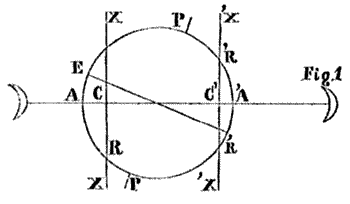
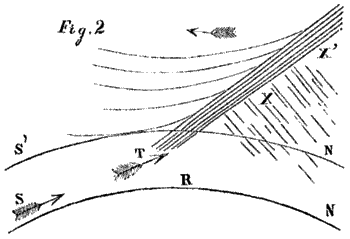
When the moon is at her perigee, the axis of the vortex passes through the centre of gravity of the earth and moon at C, and cuts off the segment RR. At the apogee, on account of her greater distance, and of her consequent power to push the earth out from the axis of the vortex XX, the segment R′R′ is only cut off by the axis; and the angle which the axis makes with the surface will vary with the arcs AR and A′R′; for these arcs will measure the inclination from the nature of the circle. In passing from the perigee to the apogee the axis will pass over the latitudes intermediate between R and R′ in both hemispheres, neither reaching to the equator E, nor to the pole P. Let us now suppose a meridian of the earth, represented by the line NRS, N being north, and S south, and the surface of the atmosphere by N′S′; XX still representing the axis of the vortex, ordinarily inclined 34° or 35° to the surface. Let us also conceive the rotation of the earth to cease, (the action of the vortex remaining the same,) thus leaving the axis over a particular longitude. If the ether possesses inertia, there will be an actual scooping out of the upper portions, driving them southward to a certain distance, where the atmosphere will be piled up above the ordinary level. There will, therefore, be a strong contrary current at the surface of the earth to restore the equilibrium, and if the action be violent, the surface wind will be increased; so that if it be considered tangential to the surface at S, its own momentum will tend to make it leave the surface and mount up to T; and in this way increase the action due to the ether. Now, although the axis is never stationary, but travels round the earth in less than twenty-five hours, yet there is a tendency to this mode of action; and it is even sometimes palpable to the observer when the axis has passed immediately to the northward; for the pinnate shafts and branching plumes of the cirri often reach far to the south of the southern boundary of the storm. These shafts are always longer when radiating from the northward than when proceeding from the southward. The cause is understood by the above figure. At such a time, after dark, the auroral shafts will also be seen over the storm to the northward, but will be invisible to those beneath. There is this to be observed, however, that the visibility of the ethereal current (or the aurora) is more frequent when the passage of the vortex is not attended with any great commotion, its free passage being perhaps obstructed by too dry an atmosphere; hence it becomes more visible. But it may be asserted that a great aurora is never seen except when a vortex is near, and to the northward, and within a few hours of its passage over the meridian. We have, however, seen partial auroras to the south when none existed north, and also cases when the radiation was from west, but they are never as bright as in the north. They are all due, however, to the same cause; and we have frequently followed a vortex for three days to the northward, (that is, seen the effects of its meridian passage,) at 700 miles distance, by the aurora, and even by the lightning, which proves plainly that the exterior layers of our atmosphere can reflect a flash of lightning, assisted by the horizontal refraction, otherwise the curvature of the earth would sink it ten miles below the horizon.
LIMITS OF THE VORTEX.
The action of the polar current of the ether, therefore, tends to cause a depression of the barometer, and an elevation to the northward and southward, and there is a general set of the wind below to the point of greatest depression. The action of the tangential current works the outer surface of the atmosphere into great ridges and hollows, whose distances apart as well as actual dimensions, are continually changing under the influences of causes not yet alluded to, and it is in the hollows where the action of the polar current will be principally expended. Luckily for the earth, the axis of the vortex is never long in passing over any particular place. In this latitude, whose natural cosine is three-fourths, the velocity westward is over 700 miles per hour; but at its extreme limits north, the motion is much slower, and is repeated for two or three days in nearly the same latitude, for then it begins to return to the south; thus oscillating in about one sidereal period of the moon. At its southern limit, the vortex varies but slowly in latitude for the same time, but the velocity is much greater. The extreme latitudes vary at different times with the eccentricity of the lunar orbit, with the place or longitude of the perigee, and with the longitude of the moon’s ascending node, but in no case can the central vortex reach within 5° of the equator, or higher than about 75° of latitude north or south. Hence there are no storms strictly speaking beyond 88°[7] of latitude; although a storm may be raging close by, at the turning point south, and draw in a very strong gale from the northward with a clear sky above. So also, although rains and short squalls may be frequent in the vapor-loaded atmosphere of the equator, yet the hurricane does not reach there, owing to the adjustment of the mass and distance of the moon, and the inclination of the axes of the vortices to the axis of the earth. If the temperature of the upper limit or highest latitude of the vortex, was equal to the temperature which obtains at its lowest limit, and the daily extremes of the solar influence as great, the hurricanes would be as violent at the one as the other, and even more so on account of the smaller velocity. But the deficiency of temperature and moisture, (which last is all-important,) prevents the full development of the effect. And even in the tropics, the progress of the sun, by its power in directing the great annual currents of the atmosphere, only conspires in the summer and autumn months, to bring an atmosphere in the track of the vortices, possessing the full degree of moisture and deficiency of electric tension, to produce the derangement necessary to call forth the hurricane in its greatest activity.
ROUTINE OF A STORM.
The novelty and originality of this theory will perhaps justify us in dwelling a little longer on what observation has detected. The vortex (and we are now speaking only of the central vortex) does not derange every place alike, but skips over large tracts of longitude in its progress westward. We speak here of the immovable axis of the vortex as in motion; in reality it is the rotation of the earth which brings every meridian under its influence in some latitude once every twenty-four hours. The centre of greatest derangement forms the nucleus, towards which the surface currents, under certain restrictions, flow. The strongest current will, however, usually be from the south, on account of the inclination of the axis of the vortex to the surface of the earth.[8] These currents continuing onwards by their vires inertiæ, according to the first law of motion, assist somewhat in conveying the warm surface wind, loaded with moisture, into the region of cloud; and the diminution of temperature causes the condensation of large masses of vapor, according to Hutton’s views; and the partial vacuum thus produced, causes a still greater intermingling. But we have already shown that this is not the sole cause, nor is it ever more than partially accomplished. The ether of the lower atmosphere, and of the crust of the earth, is disturbed, and rushes towards the rarefied axis from the surface, and with the temperature of the surface, thus conveying the surface atmosphere, in a measure, along with it. In the upper regions, this ether (or electric fluid) cools down, or parts with some of its heat, to the air of those regions, and, by its great specific caloric, necessarily and unduly increases the temperature of the air. This, by its expansion and ascension will cause a further influx from below, until the upper atmosphere becomes loaded with vapor. In twelve hours, at least, a reaction must take place, as that part of the earth’s surface is carried six or seven thousand miles from the axis, where the ether is more dense. This in turn descends to the surface, carrying with it the temperature of space, at least 60° below zero; a great condensation must follow; local derangements of the electric equilibrium in the centre of large clouds, when the condensation is active, must now take place, while partially nonconducting masses intervene, to prevent an instantaneous restoration of the equilibrium, until the derangement is sufficient to cause the necessary tension, when all obstacles are rent asunder, and the ether issues forth, clothed in the power and sublimity of the lightning. It is a fearfully-energetic fluid, and, when sufficiently disturbed, competent to produce the most violent tornado, or the most destructive earthquake. That these two phenomena have simultaneously occurred, seems well authenticated; but the earthquake, of course, must be referred generally to derangements of the electric equilibrium of the earth’s interior, of which at present we know but little.
The day or morning previous to the passage of the vortex, is frequently very fine, calm, mild, and sleepy weather,—commonly called a weather breeder. After the storm has fully matured, there is an approach of the clouds to the surface, a reduction of the temperature above, and the human body feels the change far more than is due to the fall of temperature. This is owing to the cold ether requiring so much heat to raise its temperature to that of surrounding bodies, or, in other words, is due to its great specific caloric. In summer, this falling of the upper layers in front of the storm is so apparent, that every part is seen to expand under the eye by perspective,—swelling, and curling, and writhing, like the surface of water or oil when just commenced boiling. The wind now partakes of the motion of the external ether, and moves with the storm eastward (in this latitude), or from N-E. to S-E., until the action ceases.
CONDITIONS NECESSARY TO PRODUCE A STORM.
The vortex, in its passage round the earth, may only meet with a few localities favorable for producing a very violent storm; but these nuclei will generally be connected by bands of cloudy atmosphere; so that could we view them from the moon, the earth would be belted like the planet Jupiter. There is reason to suspect, also, that there are variations in the energy of the ethereal motions, independent of the conditions of the earth and its atmosphere, which affects even the radial stream of the sun. For the zodiacal light, which is caused by this radial stream, is at times much more vivid than at others. Also in the case of the aurora, on our own globe. On this point there is much to say, but here is not the place. The conditions favorable for the production of a storm at the central passage of a vortex, are a previous exemption from excitement ceteris paribus, a high temperature and dew point, a depression of the barometer, and local accumulation of electric tension, positive or negative; and these are influenced by the storms in other places controlling the aërial currents, and thus determining the atmosphere of the place.
LATERAL VORTICES.
We have already alluded to the lateral vortices of the terral system. We must now resort to a diagram.
In the following figure, the arrows represent the ethereal current of the terral vortex; the linear circle, the earth; C the centre of gravity of the earth and moon, and, consequently, the central vortex or axis of the vortex of the earth, I represents the position of the inner vortex, and O that of the outer vortex. These two last are eddies, caused by the obstacle presented by the earth in being pushed out from the centre by the moon, and are called lateral vortices. There are, therefore, two lateral vortices, and one central, in both hemispheres, and by this simple arrangement is the earth watered, and the atmospheric circulation produced.
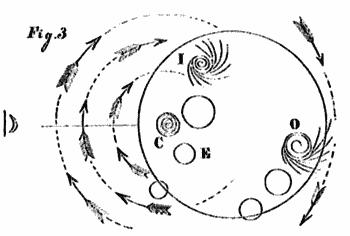
ILLUSTRATION OF THEIR ACTION.
If we place a globe in a vessel of water, so that the vertex shall only just be covered, and place the globe eccentrically in the vessel so that the centre of the vessel may not be too far from the outside of the globe, and then impart an equable but slow motion to the water, in the manner of a vortex; by viewing the reflected light of the sky from the surface of the water above the globe, we shall be able to trace a succession of dimples, originating at I and O, and passing off with the current, and dying away. The direction of the fluid in these little eddies, will be the same as the direction of the current in the main vortex. If we displace the globe, so as to remove it far from the centre of the vessel, and impart the same motion, the vortex I will be found at E, and the direction of the current will be contrary to the direction of the fluid in the vessel. In the case of the earth and moon, the displacement can never change the position of the inner vortex much. It will always be to the right hand of the central vortex in north latitudes, and in consequence of the ether striking our globe in such a position, the current that is deflected from its true path, by the protuberance of the earth forcing it inside, is prevented by the circular current of the parts nearer the axis of the vortex, from passing off; so that a vortex is formed, and is more violent, ceteris paribus, than the vortex at O.
ORDER OF OCCURRENCE.
Whether this mode of action has been correctly inferred, matters little; the lateral vortices follow the law of such a position. The inner vortex always precedes the central from five to eight days, when ascending in this latitude, and comes to the meridian after the moon. The outer vortex, on the contrary, follows the central in its monthly round, and comes to the meridian before the moon. It will be readily understood that if the axes of these lateral vortices be produced through the earth, they will pass through similar vortices in the opposite hemisphere; but as the greatest latitude of the one, corresponds to the least latitude of the other, the same calculation will not answer for both. The same remark applies to the central vortex also.
Thus there are six passages each month over latitude 41°; but as there are intervals of 3° to 6° between two consecutive passages of the same vortex, it may happen that an observer in the middle latitude, would perhaps see nothing of their effects without looking for them. Generally speaking, they are not only seen, but felt. The time of the passage of the outer vortex ascending, corresponds so nearly (in 38° of latitude) at certain times, with the passage of the central vortex descending, that the two may be considered one if attention is not directed to it. The orbits of these lateral vortices depend, like that of the central vortex, on the orbit of the moon for eccentricity, but the longitudes of the perigee will not correspond with the longitude of the moon’s perigee. This follows from the theory. As the elements of these orbits are only approximately determined, we shall confine our calculations to the orbit of the central vortex.
REDFIELD’S THEORY OF STORMS.
It will now appear plainly to the reader, that this theory of storms differs in every particular from the rival theories of Redfield and Espy, both as to the cause and the modus agendi. It would appear at first sight, as if the discovery of these vortices would at once remedy the great defect in the theory of Redfield, viz.: that no adequate cause is assigned for the commencement and continuation of the vorticose motion, in the great circular whirlwinds which compose a storm. The facts, however, are adverse to such an application. According to Mr. Redfield, the rotation of a circular storm in the northern hemisphere is from right to left, and the reverse in the southern. The author’s attention has, of course, been considerably directed to this point; but in every case he has been unfortunate in finding in the clouds a rotation from left to right. Some cases are mentioned in the appended record of the weather. He has also noticed many of those small whirlwinds on arid plains, in Egypt, in Mexico, and in California, which, in the great majority of cases, were also from left to right. His opportunities, however, have not extended to the southern hemisphere. This theory has not, however, been formed on theoretic views, but by looking nature in the face for years, and following her indications. Accordingly, we find that the changes of the wind in a storm forbid the adoption of the circular hypothesis.
WHIRLWINDS VERY LIMITED IN DIAMETER.
The theory, as extended by Col. Reid, rests on a simple rotation around a progressing centre, and is found sometimes supported by evidence of the most violent action at the centre, and sometimes by showing that the central portion is often in a state of calm. We do not attempt to reconcile these views; but would merely observe, that an atmospheric vortex must be subject to the same dynamical laws as all other vortices; and inasmuch as the medium cannot differ greatly in density, from the centre to the circumference, the periodic times of the parts of the vortex, must be directly as their distances from the axis, and consequently the absolute velocities must be equal. If Mr. Redfield resorts to a spirally inward current, it would be a centripetal instead of a centrifugal current, and therefore could not cause the barometer to fall, which was the best feature of the theory in its primitive form. The absolute velocity of the wind is the important element which most concerns us. In the case of a tornado of a few yards in diameter, there is no doubt a circular motion, caused by the meeting of opposing currents; but this may be considered a circle of a very small diameter. The cause is due to a rapid escape of electric or ethereal matter, from the crust of the earth, called forth by the progressing, disturbed space above; this involves the air, and an ascending column in rotation begets the rush on all sides to that column in straight lines: consequently, the velocities will be inversely as the distances from the axis, and the force of the current as the squares of the velocities. On the circular theory, no increase of velocity would be conferred by the approach of the centre, and consequently no increase of power.
OBJECTION TO CIRCULAR STORMS.
Another objection to the circular theory of storms, is the uniformity of phase. If that theory be true, we see no reason why a person should not be sometimes on the northern side of the gale. By referring to a diagram, we perceive that on the northern side the changes of the wind pursue a contrary direction to what they do on the south, yet in nine cases out of ten, each vessel meeting a hurricane will find the same changes of wind as are due to the southern side of the storm. It is true, that if a vessel be to the northward of a great hurricane, there will almost certainly be a north-east gale drawn in, and this might be set down as the outer limits of a circular storm. But when the storm really begins, the wind comes round south-east, south, south-west, ending at north-west, and frequently is succeeded, on the following day, (if in middle latitude,) by a moderate breeze from the northward. Now, if the north-east gale spoken of above, was the outer limits of an atmospheric vortex, a vessel sailing west ought not to meet the hurricane, as a north-east wind is indicative of being already on the west side, or behind the storm.
Again, the characters of the winds, and appearances at the different changes, are opposed to the circular theory. At a distance of fifty miles from the centre of a storm, the wind which passes over a ship as a southerly wind, will have made a rotation and a half, with the hurricane velocity, before the same wind can again pass the ship as a northerly wind, (supposing the progress eastward, and the ship lying to,) that is, the same wind which in another place was a south wind two hours before, and after only going one degree north, becomes a northerly wind,—changed in character and temperature, as every seaman is well aware. In a storm, if the circular theory be true, the character and temperature should be the same, no matter from what point the wind is blowing. This should be a conclusive argument.
Mr. Espy has also changed his ground on the storms of the United States; he does not now contend that the winds blow inwards to a centre, but to a line either directly or obliquely. Thus we see that while Mr. Redfield concedes to Mr. Espy a spirally inward current, the latter also gives up a direct current to the centre, to Mr. Redfield. This shows at least an approximation to the truth.
It is not necessary for the support of this theory, that we should derive any materials from the ruins of others; we shall therefore not avail ourselves of certain discrepant results, which can be found in many of the storms cited by Colonel Reid. With respect to Mr. Espy’s cause of storms, the experiments of Regnault may be considered as decisive of the question:—1st, because the specific heat of vapor is so much less than Espy assumed it to be; and 2d, because the expansion of air in a free space does not suffer any change of volume by ascending, except what is due to diminished pressure, and the natural temperature of that elevation.
INDICATIONS OF A STORM.
In accordance with our theory, the direction and force of the wind in a storm are due to ascending columns of air, supplied from the upper portion of the atmospheric stratum beneath the clouds. The commotion begins at the highest limits of the cirri, and even at greater elevations. Hence, the hazy appearance of the sky is a legitimate precursor of the coming gale. As a general thing, the wind will blow (at the surface) towards the centre of greatest commotion, but it is too dependent on the ever-varying position and power of temporary nuclei of disturbance, to be long steady, except when the disturbance is so remote that its different centres of induction are, as it were, merged into one common focus. When a vortex is descending, or passing from north to south, and withal very energetic at the time, the southerly wind (which may always be considered the principal wind of the storm in this hemisphere) may blow steadily towards the vortex for three or even four days. When a vortex is ascending, the induced northerly current will be comparatively moderate, and be frequently checked by the southerly wind overblowing the storm, and arriving the day before the vortex which produced it.
The important point for the navigator, is to know the time of meridian passage of the vortex, and its latitude at the time of the passage, and then be guided by the indications of the weather and the state of barometer. If it commences storming the day before the passage, he may expect it much worse soon after the passage; and again, if the weather looks bad when no vortex is near, he may have a steady gale setting towards a storm, but no storm until the arrival of a vortex. Again, if the barometer is low the day before the vortex passes, there may be high barometer to the west, and the passage be attended by no great commotion, as it requires time for the storm to mature, and consequently its greatest violence will be to the east. If at the ship the barometer is high, the vortex may still produce a storm on a line of low barometer to the west, and this line may reach the ship at the time of the passage. In tropical climates the trouble must be looked for to the eastward; as a storm, once excited, will travel westward with that stratum of atmosphere in which the great mass of vapor is lodged, and in which, of course, the greatest derangement of electric tension is produced.
It will now be seen that we do not admit, with Col. Reid, that a storm continues in existence for a week together. Suppose a hurricane to originate in the Antilles at the southern limits of a vortex, the hurricane would die away, according to our theory, if the vortex did not come round again and take up the same nucleus of disturbance. On the third day the vortex is found still further north, and the apparent path of the hurricane becomes more curved. In latitude 30° the vortex passes over 3° or 5° of latitude in a day; and here being the latitude where the lower atmospheric current changes its course, the storm passes due north, and afterwards north-east. Now, each day of the series there is a distinct hurricane, (caused by an increase of energy in a particular vortex, as we have before hinted,) each one overlapping on the remains of the preceding; but in each the same changes of the wind are gone through, and the same general features preserved, as if it were truly a progressive whirlwind, except that each vessel has the violent part of it, as if she was in the southern half of the whirl. The apparent regularity of the Atlantic storms in direction, as exhibited by Col. Reid, are owing in a great degree to the course of the Gulf Stream, in which a vortex, in its successive passages in different latitudes, finds more favorable conditions for the development of its power, than in other parts of the same ocean; thus showing the importance of regarding the established character of storms in each locality, as determined by observation. In this connection, also, we may remark, that the meridians of greatest magnetic intensity are, ceteris paribus, also the meridians of greatest atmospheric commotion. The discovery of this fact is due to Capt. Sabine. The cause is explained by the theory.
As it is the author’s intention to embody the practical application of this theory to navigation, with the necessary rules and tables, in a separate work, sufficient has been said to familiarize the reader with the general idea of a cause external to the earth, as the active motor in all atmospheric phenomena. We will therefore only allude in a general way to the principal distinguishing feature of the theory. We say, then, that the wind in a storm is not in rotation, and it is a dangerous doctrine to teach the navigator. We also assert as distinctly, that the wind in a storm does not blow from all sides towards the centre, which is just as dangerous to believe. If it were wise to pin our faith to any Procrustean formula, we might endorse the following propositions: That at the beginning of a storm the wind is from the equator towards the poles in every part of the storm; that, at a later date, another current (really a polar current deflected by convection) sets in at right angles to the first one; and that at the end of the storm there is only one wind blowing at right angles to the direction at the beginning. Outside the storm, considered as a hundred, or two or three hundred miles in diameter, there is, under certain limitations, a surface wind setting towards the general focus of motion and condensation, and this surface wind will be strongest from the westward, on account of the motion of the whole atmosphere in which these other motions are performed being to the eastward.[9] The whole phenomenon is electrical or magnetic, or electro-magnetic or ethereal, whichever name pleases best. The vortex, by its action, causes a current of induction below, from the equator, as may be understood by inspecting Fig. 2, which in the northern hemisphere brings in a southerly current by convection: the regular circular current, however, finally penetrates below, as soon as the process of induction has ceased; and thus the polar current of the atmosphere at last overcomes the equatorial current in a furious squall, which ceases by degrees, and the equilibrium is restored.
Every locality will have its peculiar features; in each, the prevailing wind will be at right angles to the magnetic meridian, and the progress of the storm will tend to follow the magnetic parallel, which is one reason why the Atlantic and Indian Ocean storms have been mistaken for progressive whirlwinds. When these views are developed in full, the mariner can pretty certainly decide his position in the storm, the direction of its progress, and its probable duration.