MOSQUITOES AND DISEASE
Reading edition
The mosquito is nothing more than a small, slender fly, very similar to the housefly in every essential detail of its structure. There are about sixty species and varieties in America, but the three most common and important species are: the ordinary house mosquito (Culex pipiens) which does not carry disease, the malarial mosquito (Anopheles quadrimaculatus) which disseminates malaria, and the tiger mosquito (Aedes calopus) which is a carrier of yellow fever.
The common house mosquito has perhaps no equal as a persistent and universally damned destroyer of human tranquility. Heartily detested everywhere, even by entomologists, no serious studies of the life history were made until comparatively recent years. The female deposits her eggs upon the surface of still water in boat-shaped masses, each mass containing from fifty to two hundred eggs. The floating egg-mass is always large enough to be seen with the naked eye, and often measures a quarter of an inch in length. The eggs usually hatch in two or three days, and the larva is the well-known wiggler which swims with a peculiar jerky motion in every rain-barrel and roadside pool in the country. The wiggler breathes through a tube near the caudal end of its body, and usually hangs head downward at the surface of the water, with the tip of the breathing tube in contact with the air. The food consists largely of minute organisms collected by two vibrating tufts of hair about the mouth. After a week or so of this wriggling life, the larva is transformed into another stage called the pupa, which has a larger head and thorax, and rides differently in the water because the breathing tubes have shifted to the upper part of the body. In five or six days more the skin of the pupa splits open and the adult mosquito slowly emerges. It usually rests quietly on the floating pupa-skin for a few moments, and then, as soon as its wings are sufficiently dried, flies away in search of food and mates.
The male Culex is much handsomer than the female, being provided with large plume-like feelers or antennae, by which he may be easily recognized. Another important sex-difference is that the male doesn’t bite, but lives by sucking the nectar of flowers, like a bee. The female of the species is deadlier than the male, even among mosquitoes, and it is the female that does the blood-sucking. The mosquito’s beak consists of several sharp lances inside a sheath, the whole apparatus admirably adapted to pierce the human skin and transfer human blood to the stomach of the mosquito. Incidentally some poisonous substance, probably a salivary secretion, flows into the wound and produces more or less inflammation and swelling. The Culex or house mosquito, so far as is known, does not transmit any disease to human beings—it is detested only because of the pain which follows its bites, and its intolerable buzzing.
The malarial mosquito (Anopheles quadrimaculatus) deposits its eggs singly on the surface of the water, never in rafts like those of the house mosquito. The eggs are very seldom found in barrels or tubs about houses—the Anopheles prefers ditches, or creeks, or the shallows of slowly flowing rivers. The malarial larvae do not hang head downward at the surface as the Culex wigglers do, but lie flat just beneath the surface film, and may be identified by this characteristic horizontal position. The Anopheles pupa does not differ greatly in appearance from that of the house mosquito. The adult is somewhat larger than Culex, and the wings are gray-spotted instead of clear. Another important difference is this: Culex alights and rests with its body parallel to the surface which supports it, while Anopheles rests with its body at an angle—head down, tail up. Herrick says that he has seen them “clinging to the ceiling of a horse stall by their four front legs, with their bodies hanging almost straight downward.”
It has been known for a long time that malaria, otherwise known as ague, or chills-and-fever, was connected in some way with stagnant water. It was obvious enough to everybody that the disease was most prevalent in low, swampy regions, and most people regarded it as a result of poisonous gases which somehow arose from the surface of the waters. The word malaria means bad air. It was later discovered that the real cause of the disease is a microscopic bit of jelly-like protoplasm—a protozoan parasite which lives in the red cells of the blood. Brues tells us that “the protozoan blood parasites which cause malaria were first demonstrated many years ago, in 1880, by a French surgeon, Laveran, who discovered them in the blood of persons suffering from malaria. Five years later an Italian, Golgi, distinguished three kinds, each associated with one of the more familiar types of malaria. They were found to go through a regular life cycle in the red blood corpuscles and, from analogy with other known protozoa, it was suspected that in addition to their non-sexual generations in the human blood there must be a sexual development in some cold-blooded animal. Manson was led to suspect that some insect might be the secondary host and, working on this hypothesis, Ross in India first found the malarial parasites in a certain kind of mosquito in 1898. He had worked for nearly three years with a common mosquito belonging to the genus Culex without result, but finally in a mosquito of the genus Anopheles was able to trace the development of the parasite. His epoch-making discovery has since been amply confirmed and extended by experimental proof until we now know that the various types of malarial blood parasites complete their life cycles in anopheline mosquitoes, the latter acting as the sole carriers of the disease.”
Malaria, then, is acquired in one way only, and that is through the bite of the malarial mosquito. A mosquito sucks a little blood from a malarial patient, this blood containing some of the protozoan germs which are the immediate cause of the disease. In the stomach of the mosquito the parasites reproduce sexually, penetrate the stomach walls, and proceed finally to the salivary glands, from which position they are injected into the blood of the next victim of the mosquito’s blood-lust. The parasites reproduce asexually in the man’s red blood corpuscles, and then burst out by millions into the liquid part of the blood. This happens simultaneously in all parts of the body, and the patient is shaken by the chills characteristic of the disease. Some varieties of the germs reproduce every two days, producing what is known as tertian fever; other types form spores every three days, and the resulting disturbance is known as quartan fever. After a while male and female germs appear in the patient’s blood plasma, but these never develop unless the sufferer is bitten by another mosquito. When this occurs, the sexual germs pass into the mosquito’s stomach, reproduce sexually, and are distributed as described above. Another man bitten, more non-sexual reproduction, more chills and fever, and so on ad infinitum.
A healthy person may, of course, be bitten by Anopheles and have a great many malarial germs in his body without developing malarial fever, as they sometimes lie dormant in the blood without reproducing at all. Ross has estimated that “something like a quarter of a billion of them must be present to produce fever.” The more infected mosquitoes that bite one, the larger the number of germs that will be introduced, and the more severe the disease. The essential result of all the investigations is concisely stated by Herrick: “Malaria is caused by a minute animal parasite that lives within the red blood corpuscles of human beings. The parasite destroys millions of the red blood cells that are so necessary to life, and, in addition, secretes certain poisonous substances known as toxins, which lodge in various parts of the body.... Since this parasite lives only in man and the mosquito, it can get from one person to another only through the agency of these insects. In other words, a person once free from the malarial parasite will remain free just so long as the bites of certain species of mosquitoes can be avoided.” One acquires malaria in one way only, and that is by being bitten by Anopheles mosquitoes.
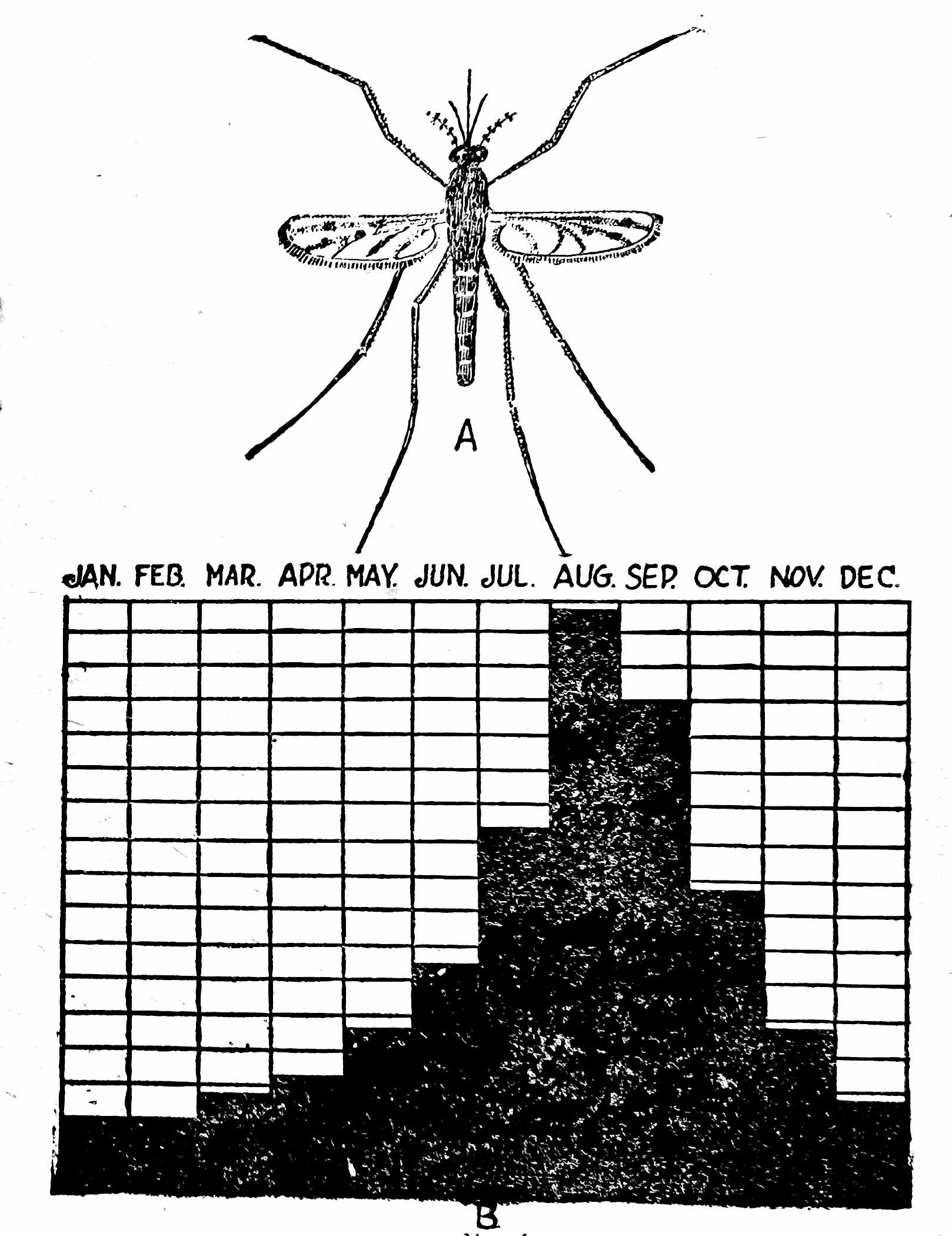
Fig. II. Malaria and its Carrier. A, the malarial mosquito, Anopheles quadrimaculatus. B, chart showing the seasonal prevalence of malaria in the United States.
The tiger mosquito (Aedes calopus) is not native to the United States, but has been introduced from the tropics. Today, however, it is widely distributed in the Southern States, and has been found as far north as New York. The eggs are laid singly or in small groups in stagnant water, and hatch in from twelve hours to three or four days. The larval life lasts about nine days, and the larvae are much more active than the other mosquito wigglers. The tiger mosquito is not often found in the country, but always near human dwellings, and it prefers to deposit its eggs about houses, in vessels containing only a little water—tubs, cisterns, rain barrels, old tin cans and the like. The pupa state lasts only about two days, and the whole development from egg to adult is sometimes passed in less than a fortnight. The adult is considerably smaller than the other mosquitoes described here, and is conspicuous for its white banded legs, and the prominent white stripes on the thorax.
In 1881 a man named Carlos Finlay claimed that yellow fever was transmitted by mosquitoes, but nobody paid any serious attention to this novel theory, as everybody thought yellow fever was highly contagious—carried about in the clothing like smallpox. In 1900 a commission of United States army officers—Drs. Reed, Carroll, Lazear and Agramonte—went to Cuba to make an experimental study of the situation there. The procedure and results are concisely summarized by Herrick:
“In a field near Quemado, Cuba, this commission of surgeons erected a small wooden building tightly ceiled and with the windows and doors closely screened so that no mosquitoes could enter. In this house, during a total of sixty-three days, seven non-immune men were kept. These men slept in beds furnished with the unwashed pillow-slips, sheets, and blankets that had previously been used on the beds of genuine yellow fever patients in Havana and elsewhere. This bedding was actually stained with the excretions of the fever patients. Neither during that time nor subsequently did one of these seven men develop a case of yellow fever. This indicated to the surgeons, beyond much question, that yellow fever is not carried in clothing, as had always been held.
“Another house was built in this same field and divided into two rooms by means of a wire screen extending from floor to ceiling. The doors and windows of each room were closely screened with fine wire netting so that no mosquitoes could enter. All bedding and material carried into the rooms were disinfected by steam, which precluded any possibility of the yellow fever germ being present in the bedding or clothing.
“In one of the rooms, mosquitoes of a certain kind that had previously bitten patients sick with yellow fever were placed. In the other room none were allowed. Non-immune men were placed in both rooms. Of those in the room containing no mosquitoes, not one had yellow fever. Of those in the other room that were bitten by the infected mosquitoes, six out of seven developed cases of genuine yellow fever. This indicated beyond much question that mosquitoes were transmitters of this disease.
“These experiments have been extended and duplicated many times with the same results, so that we are justified in believing that a certain mosquito known as Aedes calopus is the sole and only agent in the transmission of yellow fever.”
Dr. Lazear died from fever during the course of the experiments—a true martyr of medical science—and Dr. Carroll came very near losing his life also, following the bite of an experimentally infected mosquito. Among other things, it was discovered that a mosquito may bite a person suffering from yellow fever without becoming infected, unless the bite occurs during the first three or four days of illness—later than this the poison is not present in the blood. Another interesting fact is that the Aedes cannot infect anyone until at least twelve days after it has received the virus from a sufferer, but after this period it remains infected for a long time, and may give the disease to a large number of people.
The actual cause of yellow fever is as yet undiscovered. As Herrick says, “it is either too small to be seen with any lens now made or it inhabits some organs of the body not suspected, or its habits are entirely different from any other parasite with which we are familiar. In any case the germ has eluded all efforts to locate it and scientists are still ignorant regarding its real nature, habits, and appearance.” It has been supposed that the yellow fever organism is similar to the protozoan which produces malaria, but we do not know. Very little of importance has been learned about the disease or the mosquito since the Cuba commission in 1900, but wonderful progress has been made in the application of such information as we have. By 1902 Havana was entirely free from the yellow fever, and Rio de Janeiro, which had been a fever-hell for many years, eliminated the disease entirely after a six-year fight with the mosquitoes. In the Panama Canal Zone an army surgeon named Gorgas was very successful in combating both yellow fever and malaria. Although the United States has never suffered as the tropical countries have, there have been numerous epidemics, the last of which broke out in New Orleans in 1905. Vigorous anti-mosquito campaigns were waged and the plague stamped out in a short time. The tiger mosquito is still common all over the South, but there are no yellow fever patients for them to bite. When a case does appear—some sailor from the tropics, usually—he is seized by the Public Health Service people and placed where no mosquito can get at him, and thus it has not been necessary to wage a general exterminative war on the yellow fever mosquito.
When the situation gets out of hand vigorous measures for the temporary and local eradication of the insect are of course necessary. As Brues says: “The success of this campaign has undoubtedly sounded the death knell of the yellow fever epidemic and panic in the United States, for New Orleans has amply demonstrated what may be accomplished in the control of an epidemic by an efficient group of workers backed by a sympathetic public and supplied with reasonable funds. Even in parts of the tropics where it persists throughout the year, it is being rapidly and permanently eliminated. Indeed, it bids fair to be the first disease actually to become extinct as a direct result of human discovery and applied science.”
There is, so far as is known, no satisfactory method of destroying mosquitoes in the adult state, so that in the war against this pest we must direct our efforts against the eggs and young. Herrick tells us that “the methods taken to destroy mosquitoes fall into three distinct classes; namely, the draining of bodies of water liable to contain eggs and wrigglers, the application of oil to bodies of water that cannot be drained and the introduction of fish into pools that cannot be drained or oiled.”
Probably the best way to rid one’s immediate vicinity of mosquitoes is to drain all marshes, pools and open receptacles. The drying up of a few acres of swamp land may cause a marked fall in the death-rate of an entire neighborhood, particularly in regions where malaria is prevalent. The exposure of open tanks, reservoirs and barrels in which stagnant water stands is no less than criminal in some parts of the South.
Very often, for economic reasons, it is not practical to drain a swamp or to eliminate open sewage ditches. In such cases we may take advantage of the fact that the larvae of mosquitoes do not breathe by gills, but are forced to come to the top for air. If ordinary kerosene oil is sprayed upon the surface of the water, it spreads to form a thin film which the larva cannot penetrate with their breathing tubes, and so are drowned. The kerosene also destroys the floating eggs, and kills the female mosquitoes as fast as they attempt to deposit. Crude petroleum has been used instead of kerosene, but it does not spread as well, and is very little cheaper. According to Herrick, one ounce of kerosene is enough for fifteen square feet of water surface, and half a teacupful is plenty for a barrel of water. The most convenient way to apply the oil to small pools and ditches is by means of a five-gallon tank carried knapsack fashion, with a short hose and nozzle. As the entire development of the mosquito from egg to laying female seldom requires more than eighteen or twenty days, it is best to use the oil once every two weeks during the mosquito season. It would seem that an easier way to get kerosene into the sewage ditches would be simply to pour it into the water closet, and this has proven successful in cases where there is little or no current; on the whole, however, the surface-spraying system is best.
Ornamental ponds and pools cannot be drained or sprayed with oil, and the same may be said of artificial ponds where domestic animals drink. In these cases the mosquito pest may be mitigated by introducing fish or other small creatures which feed upon the larvae. In Japan, and more recently in other countries, the goldfish has been found very satisfactory for this purpose. Various species of shiners, sunfish and top minnows have also been used. W. P. Seal, who has given a great deal of attention to this phase of the mosquito problem, states his results as follows: “The writer has come to the conclusion, after many experiments in small ponds, that a combination of the goldfish, which is ornamental and useful in the open water, the roach or shiner, which is a very active species, two small species of sunfish, which live among plants, and the top minnow would probably prove to be more effective in preventing mosquitoes breeding than any other fishes.”
Vernon Kellogg, Tillyard and others have studied the habits of dragonflies in this connection, and the latter particularly has emphasized their value as destroyers of mosquito larvae. He saw a single dragonfly larva eat sixty wrigglers in ten minutes, and captured an adult dragonfly which had over a hundred mosquitoes in its mouth—so many that the mouth could not be closed. “I believe that a successful checking of the mosquito pest in the ornamental waters of parks and gardens could be readily obtained by the introduction of dragonflies whose larvae, as well as the adults, would prey upon the nuisance.”
The use of wire screens to exclude flies and mosquitoes from dwellings is now well-nigh universal in most parts of the United States, although there are still many rural communities in the South in which it appears to be quite unknown. To keep out ordinary mosquitoes the wire should have at least fourteen meshes to the inch, and the yellow fever mosquito will pass through any screen which has less than eighteen meshes. It is practically impossible to fit screens and frames well enough to exclude all mosquitoes, but it is certainly better to contend with a few stray mosquitoes in a screened house than to do battle with the myriads of pests which swarm into an unscreened domicile. The fewer the bites one receives, the fewer the chances of being bitten by an infected mosquito; the fewer infected bites, the less severe the resulting illness will be.
In many Southern cities the use of bed nets of bobbinet or mosquito bar has now become quite general. There is usually a kind of wire frame over the bed, and the net is sometimes tucked under the mattress all round, while in other cases it is long enough to reach the floor on all sides. Many travelers who must visit small towns, where the hotel bed nets are lacking or unsatisfactory, carry their own nets, and set them up every night to suit their fancy. Dr. Ross says: “Perhaps our first and best defense against malaria lies in the habitual and scrupulous use of mosquito nets at night.... The first care of the resident in the tropics, of the traveler, the sportsman, the soldier, the miner, the clerk, should be for his mosquito net. Wherever he lives, wherever he goes, he should see that his mosquito net is with him, that it is in good order, and that it is properly arranged at bedtime.”
There are several chemical substances used in driving mosquitoes out of houses. One may rid a room of mosquitoes by the fumes of burning sulphur, but the gas often discolors articles painted with lead paint, and tarnishes gilt furniture and brass bedsteads. A vegetable powder sold as pyrethrum, buhach, or Persian insect powder is made of chrysanthemums, and is fairly effective when scattered about or blown into cracks and crevices. It may also be burned as a smudge, but the fumes are not as effective as those of sulphur. Many of the mosquitoes fall to the floor in a stupor, and must be gathered up and burned, as otherwise they will revive in an hour or so. Another fumigant much in favor in New Orleans is a mixture of carbolic acid and gum camphor, and is known as culicide. A heavy reddish liquid, it is evaporated by heating slightly over a gas burner or alcohol lamp. The mixture is inflammable but not explosive, and the fumes are not dangerous to human life.
Hunters and campers often smear their hands and faces with various substances supposed to discourage mosquitoes, oil of citronella being one of the most popular. Camphor, cedar oil, kerosene and mixtures of these substances in various proportions are also used, besides several patented smudges and ointments. I have tried several of these, but found them unsatisfactory. Tobacco-smoke helps a little sometimes, and is at least free from the unpleasant and even nauseating odors of the other mosquito repellants.