CHIGGERS, TICKS AND FLEAS
Reading edition
The chigger (Leptus irritans) is not a true insect, but the immature form of a mite, related to the spiders. The eggs are laid upon the ground in the Spring, and when the young chigger hatches it climbs up a blade of grass and awaits the coming of some animal to which it can attach itself. At this time it is a very small red creature, barely large enough to be seen with the unaided eye. It clings to any moving object which presents itself—usually some passing insect, but quite frequently a bird or one of the higher animals. After having fed for a time upon the blood and juices of its mount, the chigger drops off and changes into the adult mite, which is not parasitic, but feeds largely upon plant lice.
Man’s contact with the chigger usually comes while walking through the grass and weeds to which they cling. They cannot bear direct sunlight, and are not common upon closely clipped lawns unless these are very densely shaded. The tiny tormenter passes through the finest of clothing—silk hosiery and underwear are no protection—and attaches itself to the skin, sucking blood and setting up a severe irritation by means of some poisonous secretion. The resultant itching is so intense that one cannot resist the temptation to scratch the affected parts, which may become infected and cause blood poisoning, and, according to Hamilton, erysipelas. Although the chigger is not known to disseminate any particular disease, it is an intolerable nuisance, and has spoiled many a vacation in the South.
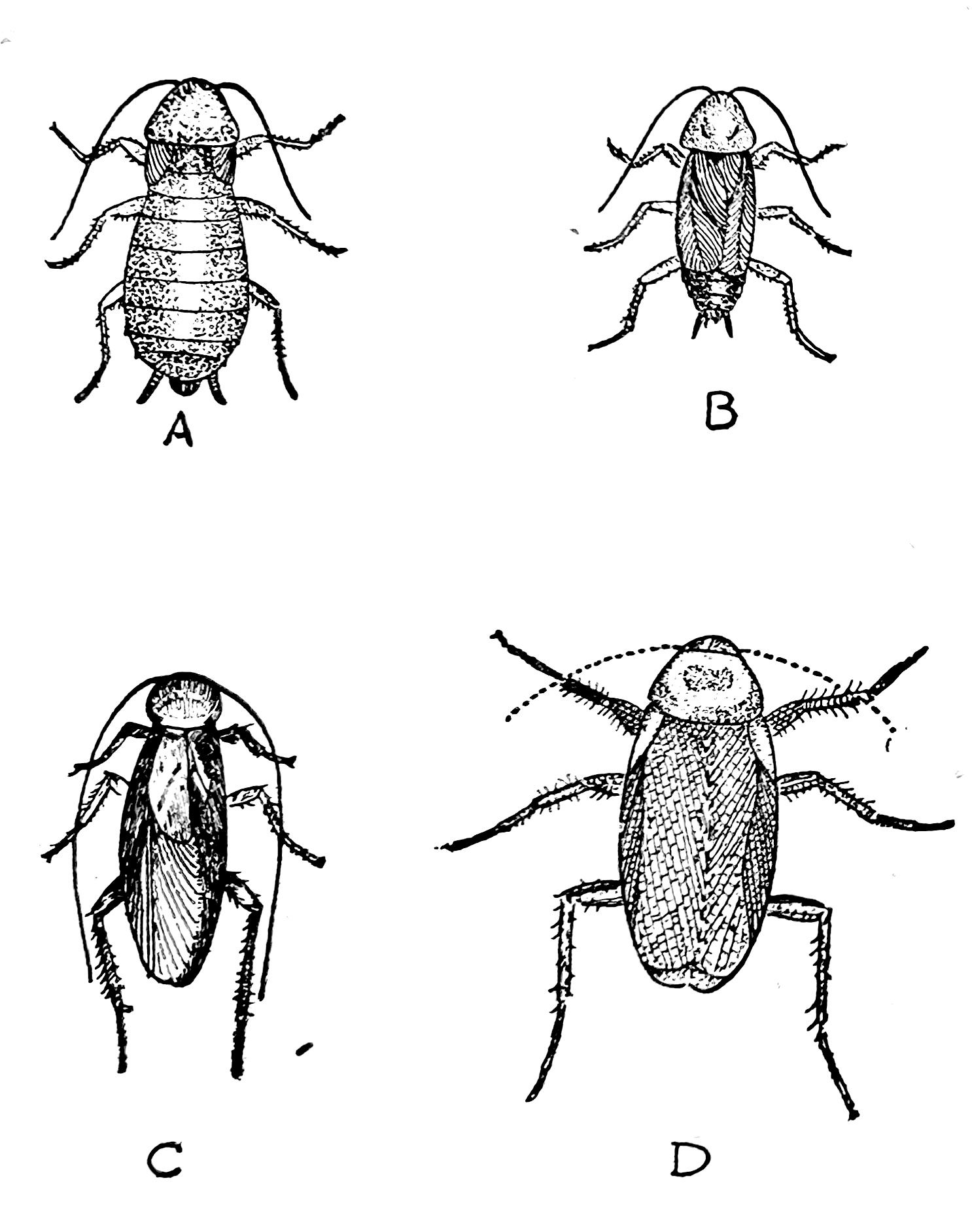
Fig. IV. Some Common Cockroaches. A, Oriental cockroach (Blatta orientalis), female. B, same, male. C, American cockroach (Periplaneta americana). D, Australian cockroach (Periplaneta australasiae).
Some persons avoid chiggers by wearing high boots, others, sprinkle sulphur in their stockings, while still others use various patent preparations both before and after the act. My own experience is that if, directly after coming in from the field, one changes to chigger-free clothing and rubs whiskey or gasoline upon the parts likely to be affected, the number of bites will be greatly decreased. Dr. Vernon C. Allison treats the inflamed areas with potassium permanganate, but I have had no satisfaction in the use of this remedy.
The fever tick (Dermacentor venustus) is the carrier of the disease known as Rocky Mountain spotted fever. This disease is now restricted to the Northwestern states, most of the cases occurring in Idaho and Montana. The life history of the tick is much like that of the chigger. Hatched from eggs on the ground, the young seed tick mounts a tall blade of grass or a weed and fastens upon the first animal which comes along. Forcing the hooked sucking beak into the flesh of the host, it sucks blood until it is full grown. Then it falls to the ground and reproduces, dying soon after this duty is done.
Brues describes the fever tick situation as follows: “The Dermacentor ticks occur abundantly on various small wild mammals in the younger stages and as adults on domesticated animals, such as cattle, and from these become transferred to man. It has been experimentally shown that certain rodents are susceptible to the disease, and a tick thus infected in the nymphal stage can retain the disease organism until it becomes adult. It may then reach its human host through the medium of domesticated animals such as cattle. It appears that this is the ordinary way in which human cases have their origin, i. e., through the bite of adult ticks, although the newly hatched seed ticks derived from eggs laid by infected mother ticks are known to contain the organism also.
“Although Rocky Mountain fever is of minor importance at the present, it is feared that it may increase its range at any time, since other ticks of wider distribution are apparently capable of acting as carriers. Whether this may happen is by no means certain, however, and the vigorous measures already undertaken to reduce the abundance of ticks on domesticated animals will undoubtedly bear fruit in the gradual reduction of this locally much-dreaded disease.”
There are many other species of ticks in the United States, but their life histories are all very similar. Several of them are believed to be carriers for various diseases of cattle, but Dermacentor venustus is the only one known to distribute disease among human beings. The common Southern cattle-tick (Margaropus annulatus) is the sole carrier of the cattle disease known as Texas fever, which has caused a tremendous pecuniary loss in several of the Gulf States. The protozoan parasite which actually causes the trouble is called Babesia bigemina, and Brues refers to the tick’s “becoming infected during its period of engorgement when feeding on the blood of a diseased animal and then transmitting the Babesia through its eggs to the young ticks of the next generation. These may feed on healthy animals the next season, conveying to them the parasites that have been handed down from the mother tick.”
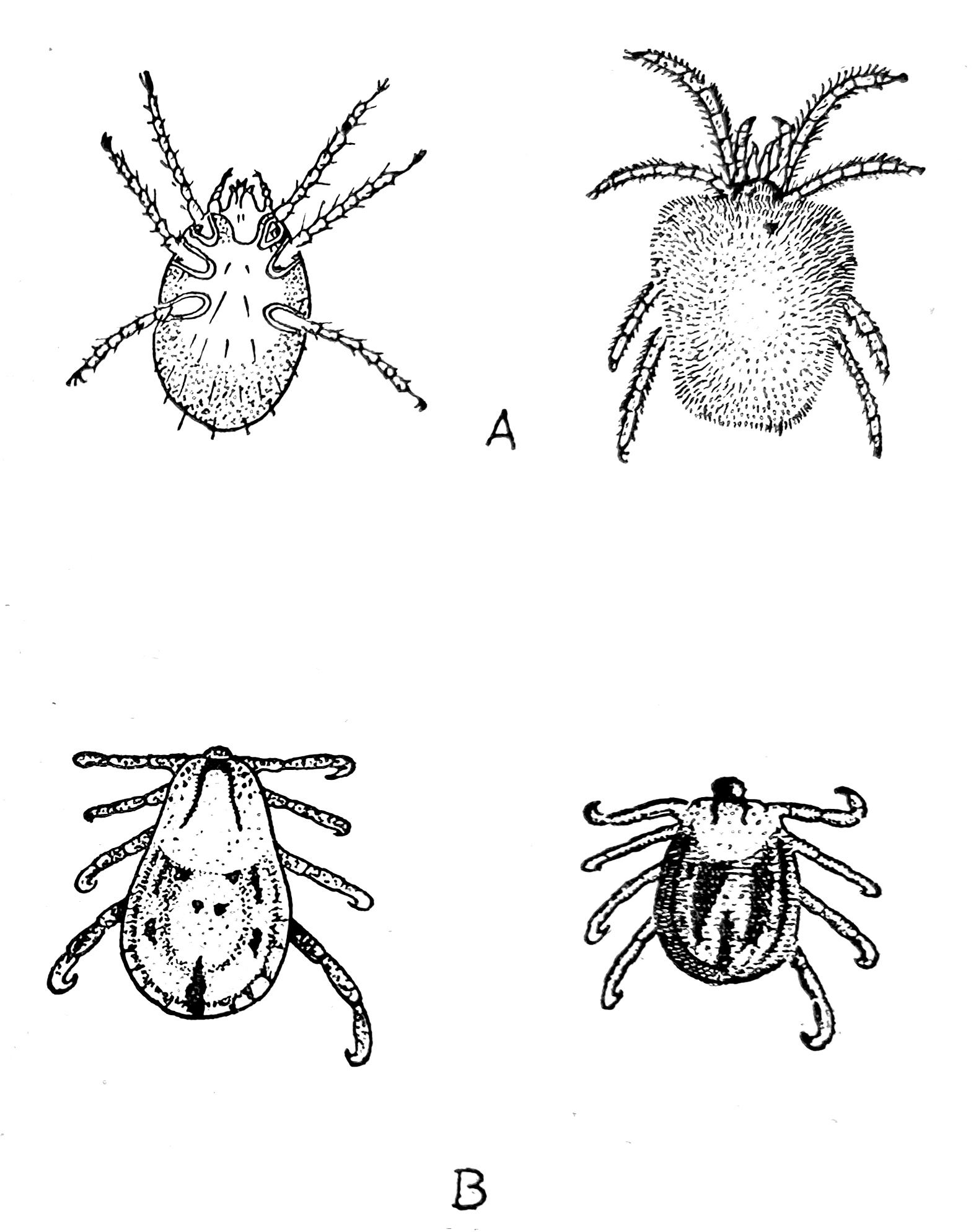
Fig. V. Chiggers and Ticks. A, young and adult chigger (Leptus irritans) redrawn from Herrick. B, Rocky Mountain spotted fever tick, (Dermacentor venustus), after Brues. Male at left, unengorged female at right.
Only two species of fleas are common in dwelling-houses in the United States. One is the human flea (Pulex irritans) and the other is Ctenocephalus canis, found almost universally upon cats and dogs. One must not suppose, however, that human fleas bite humans only, and that Ctenocephalus confines its attention to dogs and cats; the human flea does not scruple on certain occasions of good omen to attack dogs, cats, rats and mice, while the various other species of fleas bite man also whenever the spirit moves them. The adult flea lives entirely upon the blood of its host, obtained through the admirable piercing and sucking mouthparts. The human flea, according to Herrick, is so bloodthirsty that it sucks regularly more blood than it can hold, and the surplus is seen squirting out of the anus while the creature is sucking more in at the mouth.
The eggs are dropped almost anywhere, and the tiny white larvae develop in cracks and crevices, feeding upon the organic matter in wood and rubbish. The pupa is enclosed in a silken cocoon, and the adult may appear in less than two weeks after the eggs are laid, although the period is usually somewhat longer.
Until comparatively recent years the flea was looked upon only as a nuisance, but it has now been discovered that some species act as agents in spreading bubonic plague, one of the most terrible scourges known to human history. It appears that the plague is primarily a rat-disease, and affects the human animal only incidentally. Outbreaks of plague among human beings are always preceded by an epidemic among the rats of the same region. The part placed by fleas in the matter is stated by Brues as follows: “The relation of the flea to the transmission of plague is due to the fact that rats are regularly infested by fleas that may become infected with the bacillus of plague, if it be present in the blood of the host upon which they are feeding. These bacilli remain in a viable condition for some time in the gut of the flea and may be transferred to a human subject bitten by an infected flea. Thus, when a rat dies of plague, its fleas leave it to search for a new host; if they attach themselves to a rat, that animal is liable to infection, or if they feed upon a human being, as they frequently do, the disease may become transferred to man.... The plague bacilli (Bacillus pestis) appear only in fleas that have bitten infected persons or rats twelve to twenty-six hours previous to death, for after this time the bacilli do not occur in the blood. The vitality and virulence of the bacilli are preserved for nearly a week at least and sometimes fully a month; and there is actually an increase in their number during the first few days. Infection from these insects may then occur through their bites, if they contain extremely virulent bacilli, but probably occurs more commonly by the insects being crushed in situ after they have punctured the skin.”
From 300,000 to 400,000 cases of bubonic plague occur in India every year, and nearly half of them terminate fatally. Comparatively few cases have been reported from the United States in recent years, but in various places, San Francisco for example, only the most vigorous and persistent repressive warfare against rats and fleas have prevented what might have been very serious outbreaks.