LICE, CRABS AND COOTIES
Reading edition
Lice have been associated with human beings as far back as our historical records go, and are mentioned in the writings of Aristotle, Herodotus and other ancient writers. Ordinarily cleanly and well-dressed people today would be horrified to find lice about their persons, as they are now confined to soldiers and others who do not keep their bodies and clothing clean, but a few hundred years ago, when everybody was dirty, they thought nothing of it. Samuel Pepys, an English diarist of the seventeenth century, made the following laconic entry in 1668: “Up betimes, finding our beds good, but lousy, which did make us merry,” and there are many other matter-of-fact references to these vermin in the literature of the period.
There are three common species, but they are all essentially alike in structure, being small, wingless and provided with piercing and sucking mouthparts. Schiödte describes the behavior of a louse on the back of his hand: “Scarcely does the abominable little monster feel the heat of the skin before it lays aside its former disheartened attitude, and begins to feel at ease, its antennae oscillate for joy, and it stretches all six legs complacently out from the body. But though the pleasure and surprise at the sudden transportation into congenial surroundings for the first moment eclipse everything else, hunger soon asserts its claim, sharpened as it is by the long fast, which has rendered its stomach and intestines quite transparent. The animal raises itself on its legs, walks a few steps, seeking and feeling its way with its antennae, while we follow it with a magnifier. Presently it stops, draws in its legs a little, arches its back, bends the head down toward the skin at an oblique angle, while it probes a small dark and narrow organ repeatedly forward, and draws it back through the fore end of the head; at last it stands still, with the point of the head firmly abutted against the skin.”
All three of our species are blood-suckers, and are strictly human parasites, being found only occasionally upon the bodies of animals other than man. It is said, however, that they are sometimes carried about by flies.
The head louse (Pediculus capitis) is usually found among the hairs on the head, occurring elsewhere only occasionally. The female is about one-twelfth of an inch long, while the male is only about one-half as large; both sexes are grayish in color, but it is said that this varies with the color of the host. Herrick quotes Murray to the effect that lice on West Africans are black, those on Chinese yellow, those on Hindoos smoky brown, and so on. The eggs are fastened to the hairs by a gelatinous secretion, and the female has been known to deposit at least fifty eggs in the course of a week. The period of incubation is usually five or six days, and the young louse reaches maturity in a fortnight. The movements and bites of these creatures are irritating in the extreme, and the sufferer is sure to scratch so incessantly that the scalp is always in an inflamed condition. The head louse is not known, however, to carry any disease-producing organism.
The best way to get rid of the head louse, according to a circular memorandum prepared under the direction of Surgeon General M. W. Ireland, of the United States army, is to “clip the hair of the head with a hair clipper and wash with a mixture of equal parts of kerosene and vinegar. This should be followed in a few hours with a bath of soap and hot water.... The hair should be caught in bags and burned. In order to reduce the liability to infestation, the hair should be kept close at all times.” Sulphur ointment may be used without sacrificing the hair, but it is not so effective as the kerosene mixture.
The body louse (Pediculus corporis), known also as the gray-back and the cootie, is somewhat larger than the head louse, and is usually of a dirty white color. These creatures dwell in the seams and folds of clothing, and are therefore known to some writers as Pediculus vestimenti. They are difficult to find and to dislodge, as they do not often cling long to the skin, but retire to their hiding places in the clothing as soon as their blood-sucking is done. The eggs are laid in the seams and wrinkles of the clothing, that made of wool being given the preference. When one has no opportunity to change or wash one’s clothes the pests become so abundant as to be quite unbearable. Soldiers, inmates of prison camps and such people are particularly liable to be abundantly supplied with body lice; they may pass from one person to another when the bodies are brought into actual contact, or one may become infested by sleeping in louse-ridden beds.
The Dutch scientist Leeuwenhoek, more than two hundred years ago, carried out some experiments which are pleasantly reviewed by Herrick: “Leeuwenhoek ... made an attempt to find out something definite about the life history and rate of development of the body louse. He did not believe the popular saying that a louse could become a grandfather in twenty-four hours. At first he thought of hiring some person to act as host for the lice. Later he changed his mind, overcame his own natural aversion to these pests, and enclosed two large females within a fine black stocking, the top of which he fastened tightly around his leg above the knee. Here he allowed the two lice to live for six days and obtain their sustenance from his leg. At the end of this period he removed the stocking and found fifty eggs around one of the females and forty eggs in another part of the stocking, evidently laid by the second female, which, however, had escaped. He wore the stocking for yet ten days, when on examination he found twenty-five young lice which so disgusted him and dampened his enthusiasm that he threw the whole thing into the street. Since Leeuwenhoek’s time the author is not aware that any scientist has ever tried in the same way to study the life history of these lice.”
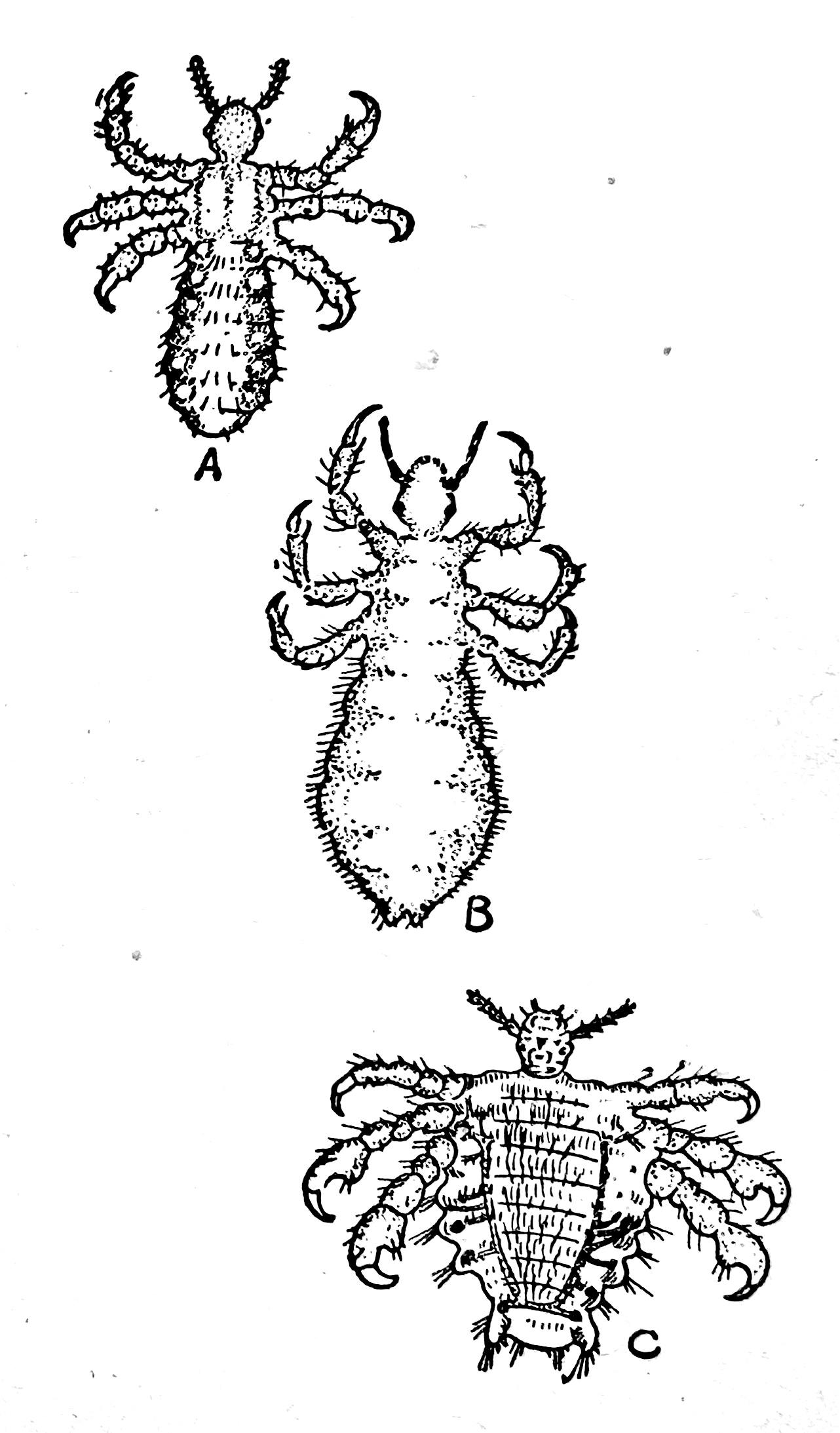
Fig. III. Three kinds of Lice. A, the head louse, Pediculus capitis; B, the body louse, gray-back, or cootie (Pediculus corporis); C. the crab or crab louse, Pediculus pubis.
Pediculus corporis is the only species of louse known to act as a carrier of disease. Its connection with typhus and trench fever is admirably described by Brues: “Typhus fever has been well-known for many years and regarded as a disease characteristic of filthy surroundings. During our own civil war it claimed many victims among the inmates of army prisons, and has been endemic though not very prevalent in many parts of the world in times of peace. Through the researches of Ricketts and others we now know that typhus is spread by the body louse and its epidemiology is at once made clear. When it broke out in Serbia in severe epidemic form, a knowledge of the method of its transmission made control possible, even under extremely difficult and unfavorable circumstances.
“Trench fever has attracted notice in the European war zones, to which it appears to be restricted so far as present knowledge extends. That it is a new disease is, however, without question an utterly unwarranted assumption, for it has undoubtedly been brought to Europe from some little-known quarter of the globe, unless it may have previously existed in Europe which does not appear probable. During the latter part of the war it was successively recognized as a distinct disease, suspected of association with the louse, and soon proved actually to be louse-borne. We now know that the disease is due to a living microorganism, probably of such small size that it cannot be recognized under the microscope. This virus is obtained by the lice with their meal of blood taken from an infected person. At least five days must elapse before the louse becomes capable of transmitting the disease, indicating that the organism must undergo a development of definite periodicity in the insect. If it is transferred to another person its bite is not or only rarely infectious, but its excrement contains the virus and if scratched into the skin, trench fever develops. Typhus fever is a very dangerous disease with a quite high death-rate, but trench fever is non-fatal and its importance in the war zones has been due to its great prevalence and the fact that persons afflicted with it are often incapacitated for long periods.”
As body lice do not cling to the body except when actually biting, it is a comparatively easy matter to get rid of them. One has only to bathe while his clothing is being steamed or soaked in gasoline. The United States Army set up delousing plants which were nothing but steam sterilizes on a large scale, and they proved very satisfactory.
The crab louse (Pediculus pubis) is short and stout-legged, whitish on the back, with a distinct reddish cast about the legs. It usually inhabits the hairy areas about the sex organs, clinging close against the skin, but is not uncommon in the armpits, and has been found upon practically every part of the body except the head. The eggs are attached to the hairs, like those of the head louse; they hatch in less than a week, and the young crab reproduces at an early age. This little pest multiplies much more rapidly than either of the other species, and is besides more easily transmitted from one person to another. Although the usual means of communication is direct bodily contact, as in the sexual embrace, it may be transmitted otherwise. The United States Army memorandum informs us that “this insect is transmitted mainly by contact in lodging houses, houses of prostitution, bathtubs, and perhaps occasionally from toilet seats.... Although the crab louse has not been shown to be a transmitter of disease, still it is very annoying, and its presence is a reflection on a man’s cleanliness.... The treatment for this condition is to shave the hair of the pubic region, axillae, chest and legs. This should be followed by an application of the kerosene and vinegar mixture, followed by a bath with soap and warm water.” The usual treatment among civilians is the application of a little mercurial or blue ointment.