MY HAWAIIAN ALOHA THREE ARTICLES BY JACK LONDON (continued 5)
Reading edition
Honolulu, August 6.
A few kamaainas of Honolulu have long since discovered the climatic and scenic advantages of Tantalus, Puu Ohia, one of the high, wooded ridges behind the city, more particularly in the sultry summer months. Tantalus is ideal for suburban nests, overlooking as it does the city and Waikiki District, well-forested, with opportunity for vigorous exercise on the steep sides of Makiki and Pauoa valleys, and to their rustic eyry at the head of Makiki Valley, the Thurstons carried us by saddle.
One afternoon, while I languished with a headache, Jack returned gleefully from a tramp, bringing me some of the wild fruits and nuts of the mountain, among them water-lemons and rose-apples. The former are round balls of about two-inch diameter, with greenish-brown, crisp rind full of tart, pulpy, spicy seeds. Although quite different in flavor and color, the formation reminds one of pomegranates and guavas. But the rose-apple!—evergreen native of the West Indies, it is too good to be true, for the edible shell has a flavor precisely like the odor of attar of roses, which is my favorite perfume. Almost it makes one feel native to the soil of a strange country, to nourish the blood of life with its vegetation.
Last night, back in town, Jack, at the request of Mr. Thurston and the Research Club of which he is a member, delivered his much-bruited lecture, “Revolution.”
This paper of Jack’s, an arraignment of the capitalist class for its mismanagement of human society, was originally a partly extempore flare of the spirit delivered in 1905 before an audience of nearly five thousand at the University of California, where he himself had studied during part of a Freshman year.
Hawaii knows little of socialism, for she lacks the problems that confront the United States and other great countries. Sugar is her backbone, labor is almost entirely imported, and handled in a patriarchal way that makes for comparative contentment, especially in so rigorless a climate. Feudal Hawaii is; but the masters are benevolent.
And Jack, who stepped before the Research Club with the blue fire of challenge in his eyes, his spirited head well back, and a clarion in his voice, found these gentlemen to be their own vindication of the name they had chosen for their Club. For with open minds they hearkened to this passionate youngster, insolent with righteous certitude of his solution of the wrongs of the groaning old earth; and presently, sensing unexpected atmosphere of intelligent and courteous attention, Jack muted his trumpets.
Discussion lasted into the small hours, and Lorrin Thurston, no mean antagonist with his lightning-flash arguments, who laid every possible gin and pitfall for Jack’s undoing, beamed upon the rather startling guest he had introduced among his tranquil fellows, and whispered to me:
“That boy of yours is the readiest fellow on his feet in controversy that I ever laid eyes upon!”
Honolulu, August 14.
To-morrow we embark once more upon our Boat of Dreams, for the Big Island. Thence, if the engines prove satisfactory, and our new skipper, Captain James Langhorne Warren of Virginia, measures up to Jack’s judgment, we shall sail from Hilo in earnest for the South Seas. Captain Rosehill and the crew had failed to assimilate.
And now, a few notes upon these latter days on Oahu.
No one interested should fail to visit the Entomological and Sugar Cane Experiment Station, where the clear-eyed and sometimes weary-eyed scientists are glad to explain the remarkable work being done in coping with all pestiferous enemies of profitable agriculture in the Territory. Mr. “Joe” Cooke, midway in a drive to the polo field, allowed us a fascinating hour or two with our eyes glued to wondrous microscopes that showed us an undreamed world of infinitesimal life.
In the open air once more, we set out for Moanalua Valley, to see the polo ponies that were being conditioned for the great game, which we attended two days later. The players of Hawaii cherish a widespread and enviable reputation for their keen, clean game.
Saturday dawned clear and fine, after a hard rain. The beautiful course around the slippery field was lined with automobiles, while an upper terrace furnished the parked carriages an unobstructed view. Miss Rose Davison, astride a mighty red roan, officer of the S. P. C. A., and a splendidly efficient character, marshaled the crowd, with the assistance of a staff of mounted Hawaiian police—magnificent fellows all. Every one loves the Hawaiian police for their ability, courtesy, and distinguished appearance.
Mr. and Mrs. Longworth declared that this tournament, set in the exquisite little valley, and played so inimitably, was quite the most exciting they had ever witnessed anywhere.
We had heard of the Bishop Museum as being one of the world’s best, embracing exhibits from every isle in the Pacific Ocean, historical, geographical, ethnological, zoological; and hither one afternoon we went. Despite the exalted repute of this storehouse of antiquity, we had passed it by, for the idea of wandering through a stuffy public building on a hot day, concerning ourselves with lifeless relics, when we might be out in the open-air world of the quick, had never appealed.
Once inside the portals of koa wood, as ornamental as precious marbles, we knew no passing of time until the hour of their closing for the day. The building alone is worthy of close inspection, finished as it is throughout with that incomparable hardwood. In the older sections, the timber has been fantastically turned, much of its splendid grain being lost in convolutions of pillar and balustrade; but modern architects have utilized the timber in all its beauty of rich gold, mahogany-red, maple-tints, and darker shades, with sympathetic display of its traceries that sometimes take the form of ships at sea, heads of animals, or landscapes.
The Curator of the Museum, Dr. William T. Brigham, spends his learned years in the absorbing work of sustaining and adding to the excellence of his charge.
Of all the treasures of this passing race, we lingered most enchanted before the superb feather cloaks, or capes, long and short, of almost unbelievable workmanship; as well as helmets, fashioned of wicker and covered with the same tiny feathers, yellow or scarlet, of the oo, mamo, iiwi, and akakani, birds now practically extinct, and modeled on a combined Attic and Corinthian pattern. The cloaks, robes of state, called mamo, were the costly insignia of high rank; a wondrous surface of feathers, black, red, red-and-black, yellow, yellow-and-black, upon a netting of olona, native hemp. Some notion of the value of these kingly garments may be gained by the statement that nine generations of kings lapsed during the construction of one single mantle, the greatest of all these in the Bishop Museum, that fell upon the godlike shoulders of the first Kamehameha. Among the others, remarkable though they be, this woof of mamo, of indescribable flame-yellow, like Etruscan gold, stands out “like a ruby amidst carrots.”
All this royal regalia, blood-inherited by Mrs. Pauahi Bishop, together with the kahilis, formed the starting point for the Museum. And the kahilis! Their handles are inlaid cunningly with turtle shell and ivory and pearl, some of them ten to thirty feet in height, topped by brilliant black or colored feather cylinders fifteen or eighteen inches in diameter. In 1822, one of the second party of missionaries went into ecstacies over these feather devices of Hawaii royalty:
“So far as the feather mantles, helmets, coronets and kahilis had an effect, I am not fearful of extravagance in the use of the epithet (splendid). I doubt whether there is a nation in Christendom which at the time letters and Christianity were introduced, could have presented a court dress and insignia of rank so magnificent as these; and they were found here, in all their richness, when the islands were discovered by Cook. There is something approaching the sublime in the lofty noddings of the kahilis of state as they tower far above the heads of the group whose distinction they proclaim; something conveying to the mind impressions of greater majesty than the gleamings of the most splendid banners I ever saw unfurled.”
Dr. Brigham comments upon the foregoing:
“Not in the least does the excellent missionary exaggerate in his eulogy on the grand kahilis. Those of us who, in these latter days of the degeneration of all good native works and customs, have seen the kahilis wave above royalty, however faded—the finely built and naked bronze statues that bore the kahilis replaced by clumsy, ill-dressed, commonplace bearers of neither rank nor dignity—even the withered rose, most of its fragrance gone, has yet appealed strongly to our admiration and sympathy. The powerfully built chiefs, head and shoulders above the common crowd, free from all sartorial disfigurements, sustained easily the great weight of these towering plumes; but the modern bearer, stranger alike to the strength and virtue of his predecessors, has to call in the aid of stout straps of imported leather to bear the much smaller kahilis of the modern civilized days.”
A bit of heraldry would not be out of place here. I borrow Mary S. Lawrence’s description of the Royal Hawaiian coat-of-arms. The device is extensively reproduced in jewelry, its colors pricked up in enamel, and is a handsome souvenir of these islands.
“It is divided into quarters. The first and fourth quarters of the shield contain the eight red, white and blue stripes which represent the inhabited islands.
“Upon the yellow background of the second and third quarters are the puloulou, or tabu sticks—white balls with black staffs. These were a sign of protection, as well as of tabu.
“In the center is found a triangular flag, the puela, lying across two alia, or spears. This also was a sign of tabu and protection.
“The background represents a mantle or military cloak of royalty. At the sides are the supporters in feather cloaks and helmets. Kameeiamoku on the right carries an ihe, or spear, while Kamanawa, his twin brother, on the left, holds a kahili, or staff, used only upon state occasions.
“Above the shield is the crown, ornamented with twelve taro leaves. Below is the national motto taken from the speech of the king upon Restoration Day: ‘The life of the land is perpetuated by righteousness.’”
The coat-of-arms has not been used by the government since the islands have been a territory of the United States.
No tapa “cloth” is made in Hawaii to-day, though these people formerly excelled all Polynesia for fineness of the almost transparent, paper-like tissue, beaten from bark of the wauke, paper-mulberry. It was worn, several deep, for draping the human form. Now, for the most part, Hawaiian tapa can be seen only in the Museum, where rare samples are pasted carefully upon diamond-paned windows. Yards of it are stored in drawers. There is little resemblance between this delicate stuff and the handsome but heavy modern tapas of Samoa, with which one grows familiar in the curio shops of Honolulu.
A replica of the volcano Kilauea claimed especial attention, in view of our visit in the near future to the vent in Mauna Loa’s 14,000-foot flank; and we lingered over a model, worked out in wood and grass and stone, of an ancient temple and City of Refuge, or heiau, with its place of human sacrifice at one end of the inclosure. A gruesome episode took place shortly after this model was installed. A young Hawaiian, repairing the roof, lost balance and crashed through, breaking a gallery railing directly above the imitation sacrificial altar, where his real blood was spilled—Fate his executioner, ilamuku.
One more of the countless exhibits, and I am done. Here and there in the building, stages are set with splendid waxen Hawaiians engaged in olden pursuits, such as basket-weaving and poi-pounding. The figures, full-statured, are startlingly lifelike, except in the unavoidable deadness of the coloring. It is impossible to imitate the living hue, of which the natives say, “You can always see the blood of an Hawaiian under his skin.” The model for one of the best of these figures died some time ago; and to this day his young widow comes, and brings her friends, to admire the beautiful image.
No matter how the very thought of a museum aches your feet, and back, and eyes, do not pass by the Bishop Museum.
It was our good fortune to be bidden, with the Thurstons, to a New England breakfast at the Diamond Head seaside residence of Judge and Mrs. Sanford B. Dole. Judge Dole, who was President of the Provisional Republic (often called the Dole Republic) that followed the collapse of the monarchy, is a busy man; and so, rather than visit and be visited during the week, at eleven of a Sunday he and Mrs. Dole welcome their friends to déjeuner.
Imposingly tall, benignant and patriarchal, blue-eyed and healthy-skinned, with silver-white hair and long beard, the Judge is unaffectedly grand and courteous, making a woman feel herself a queen with his thought for her every comfort. He must have been another of the courtly figures of the old regime, and Jack always warms to the instance of the gallant resistance made by him and another man, holding the legislative doors against an infuriated mob during an uprising incident to a change of monarchs. “Can’t you see them? Can’t you see the two of them—the glorious youth of them risking its hot blood to do what it saw had to be done!” he cries in appreciation of the sons of men.
Anna Dole, the Judge’s wife, is a forceful, stately woman of gracious manner, with handsome eyes rendered more striking by her shining white hair and snowy garb—a diaphanous holoku of sheerest linen and rare lace.
And groaning board is just what it was, from alligator pears and big spicy Isabella grapes, papaias, luscious Smyrna figs, mangoes, pineapples, and “sour-sop,” a curious and pleasant fruit, of the consistency of cotton or marshmallow, and of a taste that might be described as a mixture of sweet lemonade and crushed strawberries.
Also we sampled our first breadfruit, roasted over coals, although not at its best in this season. I concluded that upon closer acquaintance I should like it as well as taro or sweet potatoes, for it resembles both potato and bread, broken open and steaming its soft shellful of tender meat, of the consistency of moist potato. The breadfruit has no seeds, being propagated by suckers.
But this exotic menu was not the half. We were expected to partake, and more than once, of accustomed as well as extraordinary breakfast dishes—eggs in variety, crisp bacon, and delicious Kona coffee from Leeward Hawaii—and, as if to bind us irrevocably to New England tradition, brown-bread and baked pork and beans!
This leisurely breakfasting was done to the animated conversation of two of the most representative of kamaainas, who talked unreservedly of their vivid years and their ambitions for the future of the Islands. Always and ever we note how devoted seem the “big” men of the Territory, old and young alike, above personal aggrandizement, to the interests of Hawaii. It looks to be an example of a benevolent patriarchy.
Following this matin banquet, which, it scarce need be urged, one should approach after a fast, we reclined about the awninged lanai, talking or listening to the phonographic voices of the world’s great singers, the while a high tide, driven by the warm Kona wind, broke upon coral retaining walls in a rhythmic obligato.
“The Doctorage,” Holualoa, Hawaii, August 21.
Long ago, when the building and purpose of the Snark were first reported in the press, Dr. E. S. Goodhue, brother of our noble Dr. Will Goodhue on Molokai wrote to Jack, bidding us welcome when we should put in at Kailua, in the Kona District of the west coast of Hawaii. And here we are, surrounded with the loving-kindness of his family, in their home nestled a thousand feet up the side of Hualalai, “Child of the Sun,” a lesser peak on this surpassing isle of mounts—merely eight thousand feet in height, and an active volcano within the century.
There was a touching gathering of Honolulu acquaintance on the 15th, to bid the Snark Godspeed for the Southern Seas, by way of Kailua and Hilo on Hawaii. Piled to the eyes with sumptuous leis, we waved farewell while the little white yacht, under power, moved out in response to the new skipper’s low, decisive commands. She was a very different craft, or so we thought, from the floating wreck that, praying to be unnoticed of yachtsmen, slipped by the same harbor four months earlier.
With the exception of Nelson, a Scandinavian deep-water sailor, we all fell seasick in the rough channel. Next day, with a dead calm of which we had been warned, in Auau Channel between Maui and the low island of Lanai, the big engine was started, with high hopes of reaching Kailua by nightfall. But auwe! Something went immediately wrong, despite the months of expensive repair.
At sunset Haleakala vouchsafed a glimpse of its head two miles in the flushing ether, and on Sunday we sighted the island of Hawaii above a cloud-bank. Crippled with neither engine nor wind-power, we could only wonder when the few remaining miles would be covered; for still in our ears rang tales of schooners long becalmed off the Kona coast, and of one that drifted offshore for a sweltering month.
Monday night, four days from Honolulu, the Snark wafted into Kailua. There Kamehameha died in 1819, at the age of eighty-two, his active brain to the last filled with curiosity about the world even to an interest in rumors of the Christian religion, which had found their way from the Society group. Three years after his death, Kaahumanu, favorite of his two wives (a remarkable woman whose career would make a great romance), together with her second husband, held a grand midsummer burning of idols collected from their hiding places.
Kailua is the first port into which our boat has made her own way under sail. It was an occasion of sober excitement, in a moonless night lighted softly by large stars that illumined the shifting cloud vapors. The enormous bulk of the island appeared twice its height against the starry night-blue sky, and a few unblinking lights strewn midway of the darkling mass hinted of mouths of caverns strewn in a savage wilderness.
When at last the searchlight was manned, fed by the five-horse-power engine that had been driving our blessed electric fans, we discovered the palm-clustered village on the shore, and, sweeping the water with the shaft of radiance, made out a ghostly schooner in our own predicament.
“Do you know where you are?—do you like it?” Jack breathed in the almost oppressive stillness, where we sat in damp swimming-suits, in which we had spent the afternoon, occasionally sluicing each other with canvas bucketfuls of water from overside. Ah, did I like it! I sensed with him all the wordless glamour of the tropic night; floating into a strange haven known of old to discoverer and Spanish pirate, the land a looming shadow of mystery; our masts swaying gently among bright stars so low one thought to hear them humming through space, and no sound but the tripping of wavelets along our imperceptibly moving sides, with a dull boom of breakers not too far off the port bow. As we drew closer in the redolent gloom, dimly could be seen melting columns and spires of white, shot up by the surf as it dashed against the rugged lava shore line.
Little speech was heard—the captain alert, anxious, the searchlight playing incessantly to the throbbing of the little engine, anchor ready to let go at an instant’s notice. Suddenly the voice of Nelson, who handled the lead-line, struck the tranquility, naming the first sounding, and continued indicating the lessening depth as we slid shoreward in a fan of gentle wind, until “Twelve!” brought “Let her go!” from the skipper. Followed the welcome grind of chain through the hawse pipe, the yacht swung to her cable as the fluke laid hold of bottom, the breakers now crashing fairly close astern; and we lay at anchor in a dozen fathoms in Kailua Bay, all tension relaxed, half-wondering how we had got there.
Hardly could we compose ourselves to sleep, for curiosity to see in broad daylight our first unaided landfall. And it was not disappointing, but quite our tropic picturing, simmering in dazzling sunlight. One could not but vision historical enactments in the placid open bay, say when the French discovery-ship Uranie put in, the year of Kamehameha’s death, yonder, past the wharf, where heavy stone walls mark his crumbling fortifications. The Uranie was received by a chief, Kuakine, popularly called Governor Adams, from a fancied resemblance to President Adams of the United States. The “palace” built by Kuakine still is to be seen, across from the stone church with its memorial arch to the first missionaries, who stepped ashore near the site of the wharf where we of the Snark landed, with their three Hawaiian associates, Thomas Hopu, William Kenui, John Honolii, all returning from Connecticut. Besides the Thurstons, the other first missionaries were: Mr. and Mrs. Bingham, Mr. and Mrs. Chamberlain with their five children, Mr. and Mrs. Holman, Mr. and Mrs. Loomis, Mr. and Mrs. Ruggles, Mr. and Mrs. Whitney. George Kaumalii, son of the king of Kauai, was also with them, returning home. “Kuakine,” says the late Dr. Sereno E. Bishop in his Reminiscences of Hawaii, “was disposed to monopolize such trade as came from occasional whalers.... He possessed large quantities of foreign goods stored up in his warehouses, while his people went naked. I often heard my father tell of once seeing one of Kuakine’s large double canoes loaded deep with bales of broadcloths and Chinese silks and satins which had become damaged by long storage. They were carried out and dumped in the ocean. Probably they had been purchased by the stalwart Governor with the sandalwood which in the twenties was such a mine of wealth to the chiefs, but soon became extirpated.” And, later, the brig Thaddeus, long months from Boston Town with her pioneer missionaries, was greeted by the welcome tidings that the tabus were abolished, temples and fanes destroyed, and that peace reigned under Kamehameha the Second, Liholiho, who, among other radical acts, had broken the age-long tabu and sat at meat with his womenkind.
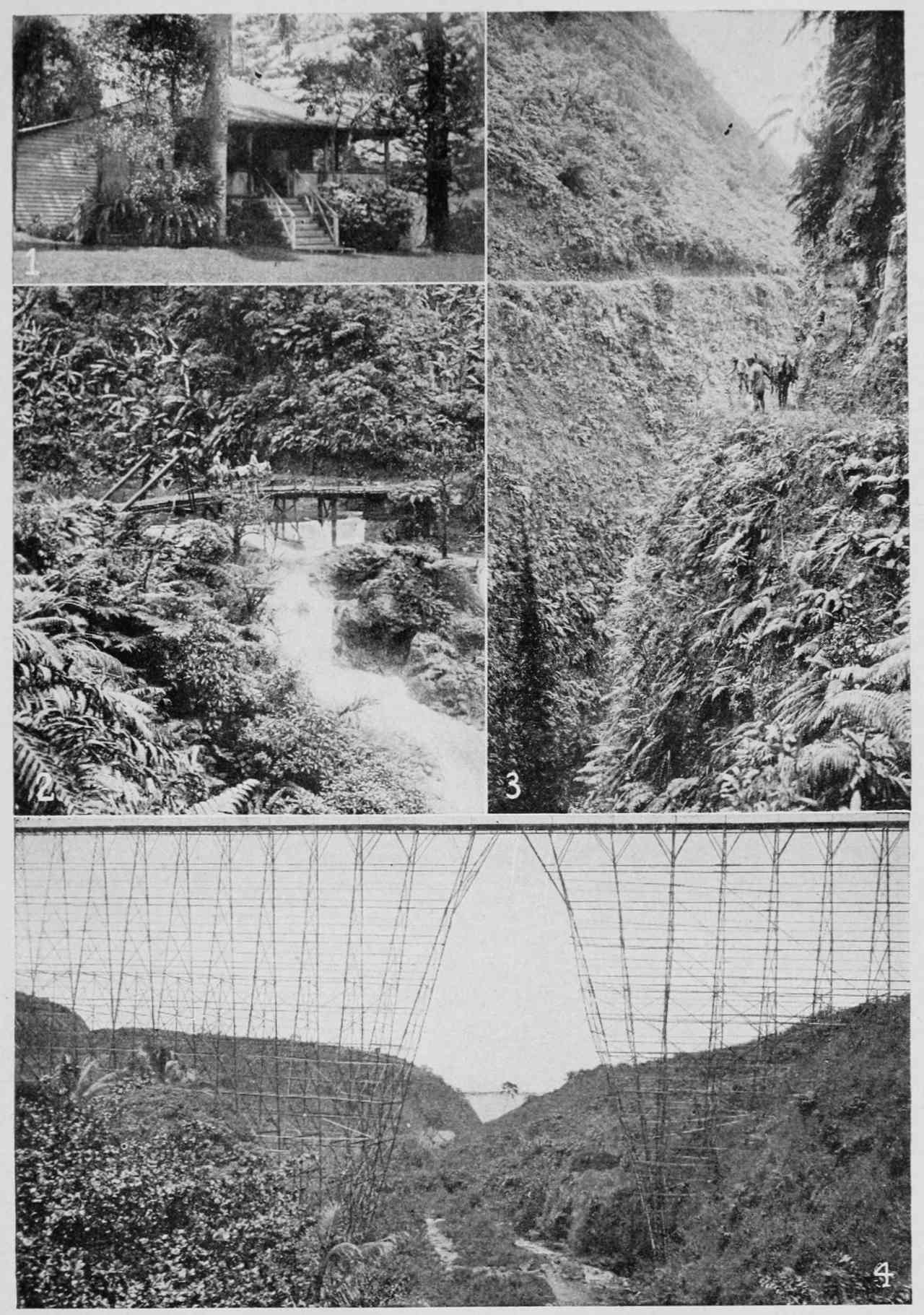
(1) Where the Queen Composed “Aloha Oe”. (2) A Hair-raising Bridge on the Ditch Trail. (3) A Characteristic Mountain Trail in Hawaii. (4) The Flume Across a Gulch.
Aboard the Thaddeus were Mr. and Mrs. Asa Thurston, grandparents of our Kakina. All must have suffered outlandish inconveniences, to say the least, in that primitive environment. I am minded of having read how, on one occasion, those early Thurstons made a passage from Kailua to Lahaina in a very small brig that scarcely furnished standing room for its four hundred and seventy-five passengers and numerous live stock; which was not considered an unusual overcrowding.
A good five-mile pull it is from the village to the “Doctorage,” through quaint Kailua, past Hackfeld’s old store, and the small, formal white palace where Prince Kalanianaole and his princess are staying; on, higher and higher, across a sloping desert of cactus blooming white and red and yellow, and laden with juicy-sweet “prickly pears,” called papipi, and sometimes panini, by the natives. In these, with care for the prickles, we eased a continuous thirst in the sapping noonday heat.
Shortly after quitting Kailua, we were pointed out a tumble-down frame dwelling, the home of the original Thurstons, which is now almost disintegrated by termites, borers, inaccurately termed “white ants,” whose undermining must ceaselessly be fought in the Islands. This house is a dreamfully pathetic reminder of those long-dead men and women who voyaged so courageously to a far land where, oh, savage association! a conch shell was the bell for the afternoon session of school. Their special interest in the Hawaiian people had been awakened in the New England missionaries by the acquaintance of several kanaka sailors brought to New Haven by Captain Brintnall in 1809, more especially one Opukahaia, whom they dubbed Obookiah. In 1817 the “Foreign Mission School” was instituted at Cornwall, Connecticut, for heathen youth, and five Sandwich Islanders were among the first pupils. Obookiah died in 1818, but three of his countrymen embarked for their native isles, with the missionaries, in 1819, in the Thaddeus, Captain Blanchard.
Presently we began to enjoy a cooler altitude, in which the vegetation changed to a sort of exotic orchard—a wilderness of avocado, kukui, guava, and breadfruit trees burdened with shining knobby globes of emerald, like those of Aladdin’s jeweled forest. And coffee—Kona coffee; spreading miles of glossy, green shrubbery sprinkled with its red, sweet berry inclosing the blessed bean.
At 1000 feet elevation the road emerged upon a variously level, winding highway which we pursued to the post office of Holualoa. From there we turned down an intricate lane between stone walls overhung with blossomy trees, that with sudden twist delivered us upon a verdant shelf of the long seaward lava incline. Here the Goodhues live and work and raise their young family of two in this matchless equable climate; and here with the unstudied graciousness of their adopted land welcomed us as we had been kinfolk.
“Now, this is what I call a white-man’s climate,” Jack enounces. “Few of us Anglo-Saxons are so made as to thrive in fervent spots like Kailua yonder,” indicating the far-distant and just-visible thumb-sketch of that storied hamlet, “no matter how beautiful they may be to the eye and mind.”
Dr. Goodhue agrees to this; but Jack will not follow him in the contention that, under the Hawaiian sun, even in this semi-temperate climate, said Anglo-Saxon should rest more than do we. “I wish you’d heed what I am advising,” almost wistfully the good Doctor urges. “You’ll last longer under the equator and have a better time on your voyage.—If I did not have such sweet responsibilities,” he smiled upon his wife and young ones, “I’d beg the chance to go along as ship’s physician!... And as for myself,” he added, “I have to work too hard—largely prescribing for people like you and myself, who have not heeded my own warnings.”
There is small need for residents of Kona to plan special entertainment for guests, provided those guests have eyes. First, one’s imagination is set in motion by this unheard-of gradient vastness of molten rock so ancient that it has become rich soil overspread in the higher reaches with bright sugar cane, coffee, bracken and forestage. Below this belt of vegetation, barren, seamy lava stretches to the coast line, lost in distance to right and left, all its miniature palm-feathered bays pricked out by a restless edge of pearly surf in dazzling contrast to the vivid turquoise water inshore. Off to the south, the last indentation visible is historic Kealakekua Bay, where Captain Cook paid with his life for stupid mishandling of a people proud beyond that Englishman’s comprehension of a brown-skinned people. We have never seen anything like this azure hemisphere of sea and sky. For we have observed no horizon from the Kona Coast. The water lies motionless as the sky—a frosted blue-crystal plane, no longer a “pathless, trackless ocean,” for over its limitless surface run serpentine paths, coiling and intermingling as in an inconceivable breadth of watered silk. Ocean and dome overhead are wedded by cloud masses that rear celestial castles in the blue, which in turn are reflected in the “windless, glassy floor”; and the atmospheric and vaporous suffusion I can only call a blue flush. The very air is blue.
We can just make out our house-upon-the-sea, tiny pearl upon lapis lazuli, beyond the slender, white spire of Kailua’s church. Fair little Dorothy, her eyes the all-prevalent azure, glides white-frocked and cool to our side and lisps her father’s child-verse:
“There’s Jack London coming, see?
In a little white-speck boat;
He will wave his hands to me,
Then he’ll float and float and float;
So he said last time he wrote—
He is such a man of note!”
For three miles today we rode south along the fine road skirting the mighty sweep of mountain. On our saddles were tied raincoats, for smart rains are frequent of an afternoon, filling one’s nostrils with the smell of the good red earth.
“Oh, look—look at your yacht!” Jack suddenly cried; and there was she, the “white-speck boat,” in a whisper of wind crawling out across the level blue carpet of the open roadstead, growing dimmer and still dimmer in the Blue Flush, bound for Hilo, our port of departure for the Marquesas.
We turned downhill on a trail through guava and lantana shrubbery sparkling from the latest shower. Owing to the success of an imported enemy, large tracts of that beautiful pest, the lantana, have the appearance of having been burned.
One of our party bestrode a ridiculous dun ass, a pet that for the most part wreaked its own will upon its young rider, especially when its large braying, “a sound as of a dry pump being ‘fetched’ by water and suction,” elicited like responses from the “bush” where these Kona Nightingales, as they are known throughout the region, breed unchecked and are had for the catching. If not a favorite, they are an inexpensive and popular means of travel among the poorer natives and the long-legged pakés (Chinese) on the roads of the district.
Winning through the expanse of shrubbery, we traversed a desert of decomposed lava, our path edged pastorally with wild flowers, among them the tiny dark-blue ones of the indigo plant. Across this arid prospect undulates the ruin of the prehistoric holualoa—a causeway built fifty feet wide of irregular lava blocks, flanked either side by massive, squat walls of masonry several feet thick. This amazing slide extends from water’s edge two or three miles up-mountain, and its origin, like that of the ambitious fish ponds, is lost in the fogs of antiquity. Its supposed use was as an athletic track for the ancient game of holua—coasting on a few-inches-wide sledge—papa holua—with runners a dozen feet long and several inches deep, fashioned of polished wood, hard as iron, curving upward in front, and fastened together by ten or more crosspieces. The rider, with one hand grasping the sledge near the center, ran a few yards for headway, then leaped upon it and launched headforemost on the descent. Ordinarily, a smooth track of dry pili grass was prepared on some long declivity that ended in a plain; but this holualoa (loa connotes long) is believed to have been sacred to high chiefdom, whose papa holuas were constructed with canoe-bottoms. Picture a mighty chief of chiefs, and his court of magnificent warriors, springing upon their carved and painted canoe-sleds, flashing with ever increasing flight down this regal course until, at the crusty edge of the solid world, shouting they breasted the surf of ocean!
We have heard that there is another holua, a short one, with a level approach of but seventy-five feet, eight feet wide, with a two-hundred-foot incline widening to twenty feet at the sea-edge. This may be visited by canoe, with a chance to see beautiful colored fish by water-telescopes.
The ancients of Hawaii were keen sportsmen—and gamblers. One historian asserts that many of their games were resorted to primarily for the betting, which was pursued by both sexes, and often resulted in impromptu pitched battles. We should hesitate before speaking loosely of “modern” sports, for in Old Hawaii boxing, moko-moko, regulated by umpires who rigidly enforced strict rules, was the favorite national sport, often attended by spectators numbering ten thousand.
And there was wrestling, hakoko, and the popular kukini, foot-racing. Disk-throwing, maika, was done with a highly polished stone disk, ulu, three or four inches in diameter, slightly convex from edge to center, on a track half a mile long and three feet broad. The game was either to send the stone between two upright sticks fixed but a few inches apart at a distance of thirty or forty yards, or to see which side could bowl it the greater length. The champions would sometimes succeed in propelling it upward of a hundred rods.
They also knew a complicated game of checkers, played with black and white pebbles upon a board marked with numerous squares. These irrepressible gamesters raised cocks for fighting, and wagered hotly around the ringside. The tug-of-war was not unknown, hukihuki; and there was a polite parlor game, loulou, the pulling of crooked fingers hooked in those of an opponent. Another mild amusement was similar to “cat’s cradle,” the hei. A wide variety of ball-playing was done with a round ball, and called kini-popo. Po-hee was a contest in which darts or spears were made to skip along the ground or over the grass. Even children played at this, with reeds or sugar-canes, getting their hand in for adult spear-throwing, in which Kamehameha was so proficient. There were schools for warriors, in which the use of the sling-shot, maa, was taught as a fine art with warlike purpose.
Mr. Ford should resurrect some of the games of Hawaii—even to the restoration of the Great Slide—as he has done with surf-boarding, for not only would the natives doubtless be interested, but haole residents have their lives enriched by either the novelty or the resemblance of the ancient sports to modern ones. Visitors would welcome the innovations. I do not mean merely as a spectacle, such as Honolulu resurrects so splendidly from time to time, but that some of these forgotten athletics be incorporated into the life of the Islands.
That monster scenic railway, holualoa, of Polynesian forefathers, lies in flowing undulations like our twentieth century ones, showing the engineers to have been men of calculation. One old Hawaiian told us the story that the arduous toil of building it was performed by amorous youths contesting for a single look at the loveliness of a favorite of the moi, king.
Despite the fact that wahines existed under severe and sometimes heartless tabus and punishments for the infringement thereof, they played the usual important role of femininity among superior races. For one thing, they were exempt from sacrifice; and rank was inherited chiefly from the maternal parents. War canoes were christened for the loved one of the chiefs, as evidenced by Kamehameha, whose sentiment for Kaahumanu caused him to rename for her the brig Forester, bought from Captain Piggott in exchange for sandalwood. And after Kamehameha II, Liholiho, had removed the ban of Adamless feasting, woman’s emancipation went on apace. When, in the past century, the “people” were called by their white government to vote, there was no murmur from the husbands, fathers, and brothers, if report can be credited, at having their womenkind accompany them to the polls to cast their own ballot. The haole law-makers, however, not ripe to tolerate woman suffrage, and equally unwilling to cause hurt, got around the embarrassing difficulty by merely neglecting to count the feminine names![9]
The “free life of the savage” is a myth, so far as concerns the early Hawaiians. Almost every act was accompanied by prayer and offering, to the tutelar deities. Every vocation had its patron gods, who must be propitiated, and innumerable omens were observed. A fisherman could not use his new net without sacrifice to his patron fane, more especially the shark-god. A professional diviner, kilokilo, had to be called in for advice as to the position of a house to be erected; and no tree must stand directly before the door for some distance, lest bad luck be the portion of the householder. Canoe-building was a ceremonial of the strictest sort; while, most important of all, the birth of a male child was attended by offerings to the idols, with complicated services.
Again am I lost in the labyrinth of Hawaii’s tempting history, for between the lines one may find the utmost romance.
The Kona coast is said to be as primitive in its social status as anywhere in Hawaii to-day, but we saw none but wooden dwellings, tucked in the foliage of the high bank behind Keauhou’s miniature crescent beach with its miniature surf—a mere nick in the snowy coastline, where small steamers call at a little roofed pier. In a small lot inclosed by a low stone wall, gravely we were shown by the natives a large sloping rock, upon which, they said, Kamehameha III, grandson of the Great Ancestor, was born. Queen Liliuokalani has lately caused the wall to be built around the sacred birthplace.
August 23.
This perfect day, in high balmy coolness, found us driving twenty miles over the shower-laid highway. Once more we detected the Snark, still holding to westward in order to lay her proper slant for the coastwise course—by now a mere-flick of white or silver or shadow in the shifting light, sometimes entirely eluding sight in the cloud-dimming blue mirror.
The road swings along through forest of lehua and tree-ferns, the larger koa being found in higher regions of the acclivity; and on some of the timbered hillsides Jack and I exclaimed over the likeness to our home woods.
At intervals, up little trails branching from the road, poi-flags fluttered appetizingly in the breeze—a white cloth on a stick being advertisement of this staple for sale. I longed to follow those crooked pathways for the sake of a peep at the native folk and their huts.
“I wish I had miles of these stone walls on my ranch,” quoth Jack, on the broad top of one of which he sat, munching a sandwich in the kukui shade. Every where one sees examples of this well-made rock-fencing, built by the hands of bygone Hawaiian commoners to separate the lands of the alii. But most of the stone-fencing along the highway has been done since 1888, when the first wagon-road was built in Kona.
The return miles were covered in a downpour that the side-curtains could not entirely exclude, and we stopped but once—to make a call upon a neighbor, a hale and masterful man of eighty-odd years, whose fourth wife, in her early twenties, is nursing their two-months-old babe. “Gee!” Jack said in an awed tone as we resumed our way under a sunset-breaking sky, “the possibilities of this high Kona climate are almost appalling! This is certainly the place to spend one’s declining years.” And the Doctor added, “They say in this district that people never die. They simply dry up and float away in the wind!”
Jack’s admiration for the holoku remains unabated; and so, as have many Americans, I have adopted it for housewear as the most logically beautiful toilette in this easy-going latitude. Callers arrive: I am bending over the typewriter, wrapped in a kimono. In a trice, I am completely gowned in a robe of fine muslin and lace, with ruffled train, ready for domestic social emergency.
August 24.
To Keauhou again we came this lovely evening, guests of Mr and Mrs. Thomas White, of Kona, she of alii stock. After a mad dash, neck and neck, on the bunched and flying horses, with heavy warm rain beating in our warmer faces, someone led the riot makai on the muddiest trail through the slapping, dripping lantana. We arrived at the seashore drenched to the buff, feet squashing unctuously in our boots.
Turkey-red calico muumuus had been brought for us malihini haoles, that we might be entirely Hawaiian in the water, and at last I was able to demonstrate to my own skepticism that it is more than possible to keep from drowning in a flowing robe. A bevy of chocolate colored water-babies were already bobbing blissfully in the sunset-rosy flood that was tepid as new milk.
In the water I was seized with a small panic when a distressful stinging sensation began spreading over my body like flame. Simultaneously, others began to make for the beach with little shrieks of pain and laughter. The brown mer-babies tried with wry, half-smiling faces to explain, but it took an older indigene to make plain that in the twilight we had blundered into a squadron of Portuguese men of war, whose poisonous filaments are thrown out somewhat as spiders cast their webs over victims. A man-of-war has been known to lower these filaments many feet, say into a shoal of sardines, whereupon the fish become paralyzed from poison at the instant of contact and the enemy is able to hoist them to the surface. No wonder our tender skins felt the irritation. Never again shall I be able to look upon the fairy fleets of Lilliputian azure ships with the same unalloyed pleasure in their pretty harmlessness.
Robust appetites we brought to Mrs. White’s luau, spread on the little wharf. Although we did sit on the floor, in approved posture, it was disappointing to note the forks, spoons, and knives, together with many haole dishes. Jack considerately forestalled comment from me by whispering, “They do not know us well enough to realize that we would appreciate the strictly Hawaiian customs.”
Some of the Keauhou folk sat with us, but were extremely shy, for few strangers find their way to the little village by the sea; and at the shore end of the pier a group of singers stared at us out of their beautiful eyes while their voices blended “with true consent” in older melodies than any we had heard.
Jack and I rode home in the dim misty moonlight, beholding the land and sea in a wondrous new aspect, the Blue Flush transformed into iridescent pearl and the frosted silver sea streaked with dull gold by a low-dipping moon. In the stillness the hoofs rang sharply on the stony steep, or a clash of palm swords in a vagrant puff of wind startled the horses to the side. It was a wild ride, up into the chiller air strata and along the clattering highway, and I enjoyed imagining myself a half-winged creature in a dream.
August 25.
Farther than any day yet we have bowled along the blithesome highroad, and then dropped into the increasing heat of the shimmering tropic levels, into Napoopoo village under its fruitful palms on the beach of Kealakekua Bay where Captain Cook met his fate. Mr. Leslie had us into his pleasant home to rest from the hot drive, and then led to where two canoes lay ready at the landing to paddle us over the romantic waters to the Cook Monument. Weather-grayed little outriggers they were; one of them propelled by an astonishing person, a full-blooded Hawaiian albino—curious paradox of a white man who was not a white man.
Skimming the lustrous water beyond the inshore breakers, on our way to the point of land, Kaawaloa, where stands the white monument pure and silent in the green gloom of trees, our eyes roved the palm-feathered, surf-wreathed shore and beetling cliffs honeycombed with tombs where rotting canoes still hold tapa-swathed bones of bygone inhabitants. Some of these, undoubtedly, knew the features of the Captain James Cook whom they deified as an incarnation of their secondary god, Lono, previous to slaying him for his misbehavior with a people too decent to countenance methods he had found possible among certain South Sea groups.
Day-dreaming I reinvested the roadstead with its sturdy whalers and picturesque adventurers’ ships, and garlanded dusky mermaidens swimming out in laughing schools to the strange white men from an unimagined bourne beyond the blue flush that encircled theirs, while again the friendly natives made high luau beneath the palms of the waterside. Our handsome boatman somewhat disturbed the mermaid fantasy: “Aole—no; no swim this place ... I tell you—planty, planty shark.”
No shark could we discern; only, in coral caverns deep below the quaint outrigger, burnished fishes playing in and out like sunbeams. We skimmed a jeweled bowl, the blue contents shot through with broadsides of amber by the afternoon sun, and on the surface shadowy undulations—violet pools in the azure; liquid sapphire spilled upon molten turquoise; and all exquisite hues melting into an opalescent fusion of water and air.
An arm of lava draws in the harbor on the north and near its end the rocky ruin of a heiau, undoubtedly of Lonomakahiki, where Captain Cook was worshipped, lends a befitting sacrificial spell, which the loud and irreverent mynah does everything in his power to desecrate. We landed on the broad dark rocks opposite the white concrete monument, which stands half-way of the little cape. The original memorial was a piece of ship’s copper, nailed to a coco palm near the site of the present imposing shaft, which is inclosed in a military square of chain-cable supported from posts topped by cannon-balls.
When Captain Cook was slain here, in 1779, his body was borne to a smaller heiau above the pali, where the same night the high priests performed their funeral rites. The flesh was removed from the skeleton, and part of it burned; while the bones were cleansed, tied with red feathers and deified in the temple of Lono. All that the men of his ship, the Resolution, could recover of their commander’s valorous meat was a few pounds which had been allotted to Kau, chief priest of Lono, which he and another friendly priest secretly conveyed to them under cover of darkness. Most of the wan framework, apportioned among the chiefs according to custom, was eventually restored, and committed with military honors to the deep.
It has been held that the flesh of Captain Cook was devoured, but this rumor is disproved by written accounts of officers of the Resolution and the Discovery. What probably gave rise to the impression of gustatory propensities in the Hawaiians at that time is the story that three hungry youngsters, prowling about during the ghastly ceremonial, picked up the heart and other organs that had been laid aside, and made a hearty lunch, taking them to be offal of some sacrificial animal. It is not recorded whether or not these gruesome giblets were already roasted! The three children lived to be old men in Lahaina. There seems to be no proof that the Hawaiians ever were cannibals—with the exception of the man on Oahu, before mentioned, where he was named Aikanaka, Man-Eater; whereas there is indisputable evidence that in extremity many Caucasians have eaten their fellows.
Always a rebellious memory will be mine that I allowed myself to be dissuaded by the Doctor from climbing the avalanched slope at the base of the pali in which those canoe-coffined bones of Kealakekua’s dead are shelved. It is even said that Kekupuohe, wife of Kalaniopuu, who was king of Hawaii at the time of its discovery by Captain Cook, is interred here. Such a burial place is rare in the Islands, for more frequently human relics were secreted beyond discovery, as in the case of the mighty warrior Kahekili, who died at Waikiki less than twenty years after Cook’s passing, and whose blanched bones were effectively hidden in some cave near Kaloko on the North Kona coast. Mine was a perfectly healthy yearning to brave the face of the cliff and peer into sunless cobwebby recesses to see what I could see. The open mouths of these aerie tombs were once barred by upright stakes. The fact that so few are now thus grated is said to be due to warships having used them as targets; while sailors rifled the lower caves.
Back on the lava masonry of the steamboat landing at Napoopoo, in the shade we ate luncheon, dangling our happy heels overside; after which Mr. Leslie carried us off again to his house, where he showed us the original Cook “monument,” the slab of vert, sea-worn copper, bearing the old scratched inscription. A man of deep content is the wealthy Mr. Leslie, who declares that he prefers life in this dreamy Polynesian haven, with his tranquil-sweet part-Hawaiian wife, to any place on earth. Perhaps his philosophy of happiness is somewhat like that of our Jack, who always comes back to this:
“A man can sleep in but one bed at a time; and he can eat but one meal at a time. The same with cigarettes, drink, everything. And, best of all, he can only love one woman at a time ... a long time, if he is lucky.”
August 26.
Mr. White, debonair and gay, on a nimble cattle pony, led up a guava-wooded trail that leads to a fair free range of upland, where we could give rein to the impatient horses, as on the Haleakala pasture-lands. Higher still, near the edge of the umbrageous woods we rounded in with a flourish at an inclosure containing a very old frame house, or connected group of houses of various periods. Here lives Mrs. Roy, Mrs. White’s part-Hawaiian mother of chiefly lineage.
Never were ranch-house precincts so bewitchingly harmonious. The garden is terraced shallowly, its grassy divisions hedged with flowering hibiscus, white and blush, coral, and crimson flame; and all about the rambling structure, bounded castle-like with a great barrier of eucalyptus, grows a tended riot of plants—red amaryllis, and glooms of heliotrope; young bananas, their long leaves like striped ribbons; tree-ferns in the deep, short-clipped sod; a sober cypress or two; tawny lilies, with splashes of blood in their hearts; a merry blow of Shirley poppies, white and crinkly and scarlet-edged like bonbons, and double rosettes of white and mauve and twilight-purple; steep gables of the dwelling smothered under climbing roses; and rarest roses blooming about the steps; flagged walks bordered with violets white and blue, distilling perfume.
And begonias amazingly everywhere. Begonias big, begonias little; begonias in sedate rows, pink and white; begonias in groups, and singly; begonias standing a dozen feet tall swaying like reeds in the wind; why, the very entrance to the charmed garden is by a gateway of withy begonias, afire like lanterns dripping carmine; wrist-thick and twenty feet in length, bent and bound into a triumphal arch of welcome. What had seemed the enormity of the Molokai begonias receded before these that were twice their height and girth. And speaking of Molokai reminds me that a guest at the Whites to-day is a relative of the Myers family—a magnificent woman, high-featured, high-breasted, with the form and presence of a goddess and the indefinable Hawaiian hauteur that dissolves before a smile.
The old house seems made of crannied nooks, and contains curious and antique furnishings that fared across the Plains or around Cape Horn; little steps up, little steps down, from room to room; or rooms joined by short paved walks drifted with flowers.
Later, continuing up Hualalai, we edged along lehua woods that would make a lumberman dream of untold wealth of sawmills; and I for one yearned toward the forest primeval of koa, still above, which we had not time to penetrate. Once this mountain was the property of the Princess Ruta Keelikolani, granddaughter of Kamehameha.
Native cowboys, with shining eyes and teeth, gay in colored neckerchiefs, dashed about the pasture, working among the cattle. Upon the backs of detached ruminating cows sat the ubiquitous and impudent mynah birds, devouring pestiferous horn-flies. And we malihinis were amused and edified by the sworn statements of the men of our party, that the scraggly tails of the Kona horses, which had aroused our polite curiosity, are shaped by hungry calves patiently chewing this questionable fodder with scant protest from the larger beasts.
One feature of great human interest is a mammoth wall of large stones, four feet high, and more than wide enough to accommodate an automobile. It rose in a single day, by edict of Kamehameha, to inclose four hundred acres of choice grazing land. The people turned out en masse and toiled systematically under the genius of organization and the direction of his lieutenants.
One who has come to believe that the “trade winds make the climate of Hawaii,” cannot comprehend why, in Kona, lying north and south, where the trades are cut off by Mauna Loa’s bulk to the east and the dome of Hualalai to the north, this is the most “abnormally healthy” climate in the group. Explanation is found in the frequent afternoon and night rains resulting from the piling up, by a gentle west wind, of banks of cloud against the high lands. Toward sundown, whatever airs have been blowing from the west, die out, replaced by an all-night mountain breeze, chill and refreshing, which makes one draw the blankets close.
August 27.
“The little ship—the little old tub!” Jack fairly crooned, hanging up the telephone receiver. “It was Captain Warren, and they anchored last night in Hilo Bay. He says they ran into a stiff gale as soon as they got out of that Blue Flush calm of yours, and the big schooner that left Kailua the same day had to double-reef, while our audacious little tub weathered the big blow under regular working canvas. The captain’s voice was quite shaky with emotion when he said he was more in love with the Snark than ever.—Some boat, Mate-Woman, some boat!” And all during the drive to Kailua to call on Prince and Princess Kalanianaole he kept bubbling over with his joy in “the little tub.”
Prince Cupid had urged Dr. Goodhue to bring us to the Palace; but the meeting was doomed through carelessness of a Japanese servant who failed to deliver the Doctor’s telephoned message; and the couple, to our disappointment, were absent when we called.
We tied the team in the shade of banyan, and proceeded along the garden path between white-pillared royal palms to the mauka entrance, where we knocked again and again. Peering through the ajar door, we saw, at the farther end of a little reception hall, upon its man-high pedestal the marble head of King Kalakaua, heroic size, festooned with freshly made leis of the enamel-green mailé and glowing red roses. What furniture we could see was of koa and hair-cloth, reminiscent of our grand-parents.
So I was robbed of my opportunity to wander in the square wooden house of departed as well as deposed Polynesian royalty, that had surperseded the grass habitations of Hawaii’s undiscovered centuries. It was on the Kona coast, according to tradition, that the very first white navigators who flushed these Delectable Isles set their feet—the captain of a Spanish vessel that was wrecked at Keei, just below Kealakekua Bay. The only other survivor was his sister, and the natives received them kindly. Intermarrying, these Castilian castaways became the progenitors of well-known alii families, one of these being represented by Kaikioewa, a former governor of Kauai. There is also small doubt that the Sandwich Islands were discovered also by another Spaniard, Juan Gaetano, in 1555, since no other Europeans were navigating the Pacific at that early time.
The Princess’s garden is ravishing—a fragrant crush of heliotrope and roses and begonias, with shadowy bowers among tall vine-veiled trees. Our mind’s eye needed only the flower of all—the tropic grace of the Princess of the Palace.
August 29.
Mr. Tommy White, aided and abetted by Mrs. Tommy, making good the determination that we should see a real, untarnished-by-haole luau, had us down once more to the jewel-sanded horseshoe of Keauhou waterside, and gave us what bids fair to rival all memories of Hawaiian Hawaii that have yet been ours.
Our one responsibility, at ease on yielding layers of ferns and flowers and broad ti-leaves that brown hands had spread, was to strike the exact right human note with the Keauhou dwellers. The essential thing a foreigner, who would know them, should avoid is the slightest spark of condescension toward the free, uncapturable spirit-stuff of the race. Proud, with fine, light scorn of lip and eye, volatile if you will, they are still unhumiliated by circumstance. Grudges they do not harbor; but pride bulks large in their natures. Affection spent upon them returns in tenfold meed of love and confidence that to forfeit would be one of the few true sins of mankind.
Arriving early to observe the bustle of preparation, we peeped into an improvised kitchen over by the bank, near which sucking-pigs were barbecued in native fashion, stuffed with hot stones and wrapped in ti-leaves and laid among other hot roasting-stones in the ground; and wahines sat plaiting individual poi-baskets from wide grasses.
The men were approachable, and ready to chat upon the least encouragement. One in particular was an elegantly mannered man, of fine form and carriage and handsome face, hair touched with gray at the temples and corners of eyes sprayed with the kindly wrinkles that come from much smiling through life. Educated at Punahou College in Honolulu, he speaks noticeably correct English. Again to-night we observed that the elderly men are even more distinguished in appearance than their sons, with unmistakably aristocratic air, something lion-like about their gray-curled heads, the leonine note softened by smile-wrought lines and wonderfully sweet expression of large, wide-set, long-lashed eyes. And in their bearing is a slow stateliness of utter serenity, and gentlehood, as of souls born to riches of content. Many tend to obesity; but this superior specimen was slim, and clean-limbed, and muscularly graceful as a cadet in marching trim.
Mr. Kawewehi, a full-blooded Hawaiian who ran for the Legislature last year, was cordial as ever and entirely at ease, while his pretty hapa-paké wife, amiably non-committal at a former meeting, blossomed out deliciously, talking excellent English and doing much by her unaffected example to draw the other women from their cool aloofness.
One unforgettable picture I must give: Upon arrival we had observed a more than ordinarily large and elegant canoe of brilliant black and yellow, fitted with mast and sail, hauled out upon the sunset-saffron strand. “The Prince’s canoe,” was the word, and a perfect thing it was in the semi-torrid scene. And then came Prince Cupid, and we knew, once and for all, why he was so called. In careless open-breasted fishing clothes, a faint embarrassment in his otherwise calm expression as he regretted his absence the day of our call, he was another creature from the formal Prince of Honolulu. Despite mature years, he looked a beautiful boy as he stood before us, holding his hat in both tapering hands, showing a double row of white teeth in a smile that spread like breaking sunlight to his warm brown eyes. He declined an invitation to remain to the luau, pleading as excuse his rough attire and that he was expected home; and by the time we were taking our places around the feast on the pier, the great barbaric canoe floated alongside and presently sailed out leisurely, two men resting on the steering-paddles, their graceful, indolent Prince, crowned with red bugles of stephanotis, in the stern sheets.
In the past, the physical difference between the nobility—alii—and the common or laboring people was far more conspicuous than to-day, when practically all Hawaiians are well nourished. “No aristocracy,” says one historian, “was ever more distinctly marked by nature.” Death was the penalty for the most trifling breach of etiquette, such as for a commoner to remain on his feet at mention of the moi’s (king’s) name, or even while the royal food or beverage was being carried past. This stricture was carried even to the extent of punishing by death any subject who crossed the shadow of the sacred presence or that of his halé, house.
Besides the ordinary household officials, such as wielder of the kahili, custodian of the cuspidor, masseur (the Hawaiians are famous for their clever massage, or lomi-lomi), as well as chief steward, treasurer, heralds, and runners, the court of a high chief included priests, sorcerers, bards and story-tellers, hula dancers, drummers, and even jesters.
The chiefs were as a rule the only owners of land, appropriating all that the soil raised, and the fish adjacent to it, to say nothing of the time and labor of the makaainana (workers) living upon it—a proper feudal system. The only hold the common people and the petty chiefs had upon the moi was their freedom to enter, service with some more popular tyrant; and as wars were frequent, it behooved monarchs not to act too arbitrarily lest they be caught in a pinch without soldiery.
To dip into the lore of Hawaii, is to be stirred by the tremendous romance of it all. Visioning the conditions of those days, one sees the people slaving and sweating for their warlike masters, and, after the manner of slaves the world over down the past, worshiping the pageantry supported by their toil, whether of white invention, or that of the most superb savagery—priceless feather-mantles, ornaments, weapons of warfare, or red-painted canoes with red sails cleaving the blue of ocean.
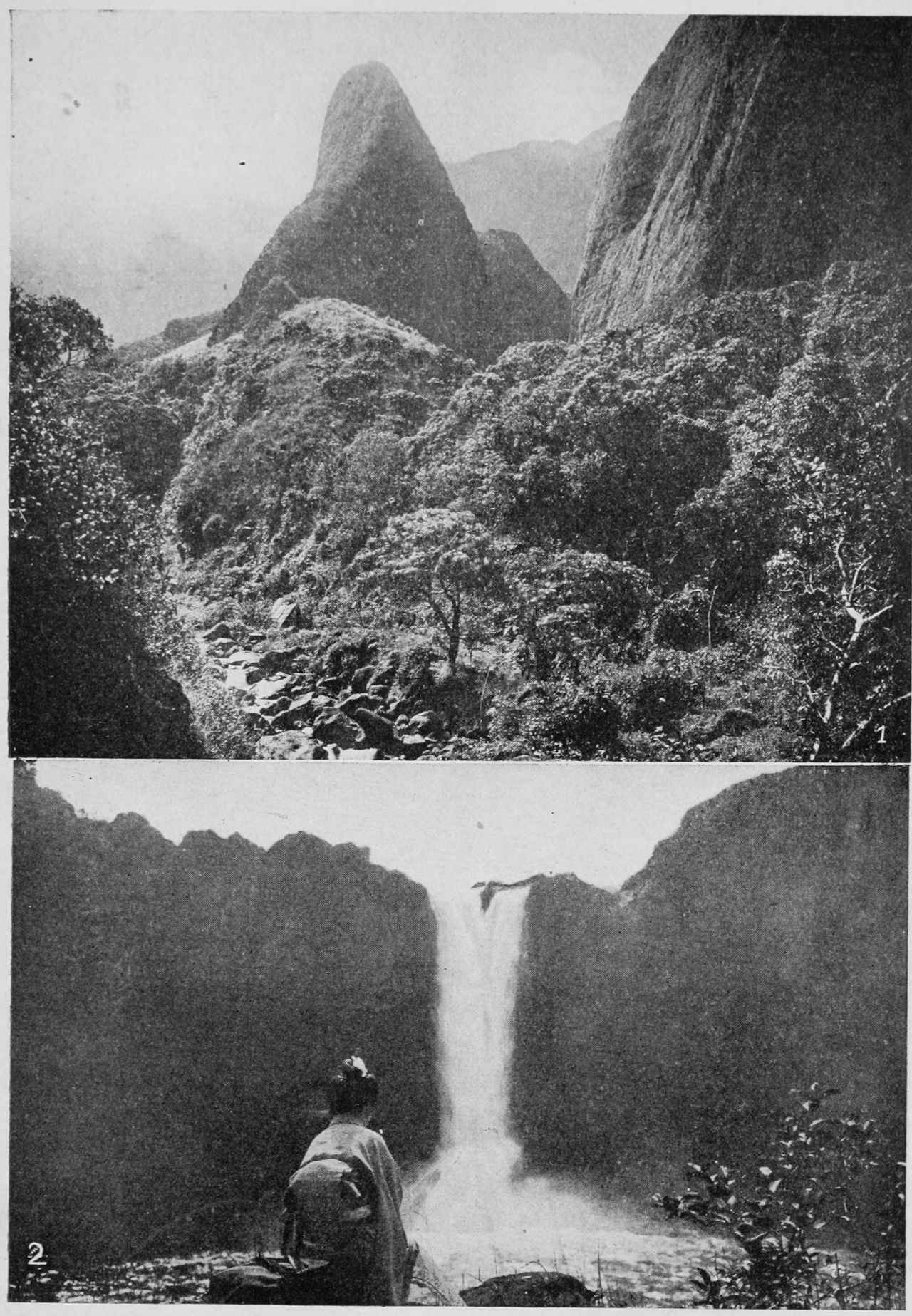
(1) Iao Valley, Island of Maui. (2) Rainbow Falls, Hawaii.
Before reclining upon the green-carpeted wharf, we haole guests were weighted with leis of the starry plumeria, awapuhi, in color deep-cream centered with yellow, in touch like cool, velvety flesh, clinging caressingly to neck and shoulder. The perfume is not unlike that of our tuberose, or gardenia, though not quite so heavy. Half-breathing in the sensuous air, we were conscious of the lapping of dark waters below, that mirrored the star-lamped zenith.
Our unforced relish of their traditional delicacies had much to do with the unbending of the natives, both those who sat with us and those who served. And when we were seen to twirl our fingers deftly in their beloved poi and absorb it with avidity that was patently honest, the younger women and girls were captured, ducking behind one another in giggly flurry at each encounter of smiles and glances. I wonder if they ever pause to be thankful that they live in the days of ai noa, free eating, as against those of ai kapu, tabu eating, which obtained before the time of Kamehameha II.
The foods were of the finest, and, half-lying, like the Romans, we ate at our length—and almost consumed our length of the endless variety, this time without implements of civilized cutlery. We pitied quite unnecessarily, those who boast that they have lived so-and-so many years in the Islands and have never even tasted poi—together with most other good things of the land and sea and air.
Recalling the christening feast at Pearl Lochs, we looked vainly for some sign of desire on the part of the Hawaiians to dance, and finally asked Mr. Kawewehi about it. The young people appeared unconquerably shy, but an old man, grizzled and wrinkled, his dim eyes retrospective of nearly fourscore years, squatted before us, reenforced with a rattling dried gourd, and displayed the rather emasculated hula of the Kalakaua reign—an angular performance of elbows and knees accompanied by a monotonous, weird chant, the explosive rattling of the gourd accentuating the high lights. This obliging ancient responded to several encores; and while the “dance” was different from any we had witnessed, it seemed a bloodless and decadent example of motion in which was none of the zest of life that rules the dancing of untrained peoples.
With smiles and imploring looks, and finally, in response to their tittering protestations of ignorance of the steps, declaring that after all we believed they did not know the hula, we touched the mettle of some of the younger maidens. One white-gowned girl of sixteen disappeared from the line sitting along the stringer-piece of the pier, and presently, out of the dusk at the land-end, materializing between the indistinct rows of her people, she undulated to the barbaric two-step fretting of an old guitar that had strummed throughout. Directly the social atmosphere underwent a change, vibrating and warming. Wahines with their sweet consenting faces, and their men, strong bodies relaxed as they rested among the ferns, jested musically in speech that has been likened to a gargle of vowels. Another and younger sprite took form in the shoreward gloom and joined the first, where the two revolved about each other like a pair of pale moths in the lantern light. Fluttering before Mrs. Kawewehi, with motions they invited her to make one of them; but either she could not for diffidence, or would not, even though her husband sprang into the charmed space and danced and gestured temptingly before her blushing, laughing face. A slim old wahine, coaxed by the two girls, whom all the company seemed eager to exhibit as their choicest exponent of the olden hula, next stood before us, and held the company breathless with an amazing and all-too-short dance. Unsmiling, she seemed unconscious of our presence—twisting and circling, drawing unseen forms to her withered heart; level eyes and still mouth expressionless, dispassionate as a mummy’s. She was anything but comely, and far from youthful. But she could out-dance the best and command the speechless attention of all.
Came a pause when the guitar trembled on, though it seemed that the dancing must be done. Just as, reluctantly, we began to gather our leis and every day senses, in order not to outlive the sumptuous welcome, into the wavering light there glided a very young girl, slender and dark, curl-crowned, dainty and lovely as a dryad, who stepped and postured listlessly with slow and slower passes of slim hands in the air, as a butterfly opens and shuts its wings on a flower, waiting for some touch to send it madly wheeling into space.
And he came—the Dancing Faun; I knew him the moment he greeted my eyes. Black locks curled tightly to his shapely head, his nose was blunt and broad, eyes wild and wicked-black with fun, and lips full and curled back from small, regular teeth. I could swear to a pointed ear in his curls to either side, and that his foot was cloven. I could not see these things, but knew they must be. His shirt, for even a Faun must wear a shirt in twentieth century Hawaii, was a frank tatter—a tatter and nothing more, over his bister, glistening chest. The hands, long and supple, betokened the getting of an easy livelihood from tropic branches.
The listless dryad swayed into quickened life, and the last and most beautiful spectacle of the night was on. I do not try to describe a hula. To you it may mean one thing, or many; to me, something else, or many other things. History tells us that the ancient professional dancers were devotees of a very naughty goddess, Laka. One may read vulgarity and sordid immorality into it; another infuse it with art and with poetry. And it is the love-poetry of the Polynesian. A poet sings because he must. The Hawaiian dances because he cannot refrain from dancing. Deprived of his mode of motion, he fades away, and in the process is likely to become immoral where before he was but unmoral, as a child may be. The page of the history of this people is nearly turned. Such as they were, they have never really changed—the individuality of their blood, manifested in their features, their very facial expression, is not strong enough to persist as a race, but unaltered endures in proportion to its quantity, largely mixed as it now is with other strains. The pure-bred Hawaiians are become far-apart and few, dying off every year with none to fill their gracious places. The page is being torn off faster and faster, and soon must flutter away.
Holualoa, to Huehue, August 30.
The Doctor, as a final benefaction, waiving inconvenience to himself, sent us the whole journey to Waimea on the Parker Ranch, in his own carriage, in charge of the Portuguese coachman.
The first night we were fortunate enough to spend at Huehue, home of the John Maguires, rich Hawaiian ranchers who had extended the invitation at the Goodhues’ reception. Lacking such hospitality, the malihini must travel, either by horse or carriage, or the one automobile stage, a long distance to any sort of hotel. “They don’t know what they’ve got!” Jack commented on the ignorance of the American public concerning the glorious possibilities of this country. “Just watch this land in the future, when they once wake up!”
Mrs. Maguire, one eighth Hawaiian, is an unmitigated joy, compounded of sweet dignity and a bubbling vivacity that wipes out all thought of years and the wavy graying hair that only intensifies the beauty of her dark eyes—a merry, sympathetic companion, one decides, for all moods and ages. Her husband is a noble example of the Hawaiian type, like the descendant of a race of rulers, strong kings, with commanding brow and eye of eagle, firm mouth, square jaw, and stern aquiline nose, the lofty-featured countenance gentled by a thatch of thick powder-gray hair and a benevolent expression.
The Kona Sewing Guild was in full blast when we drew up in the blooming garden of the rambling house, but I fell napping on a hikiè in the guest-cottage, tired from a strenuous day of packing, typing—and traveling, even through such ravishing country, in full view of the ravishing Blue Flush of sea and sky.
“I hate to wake my poor tired Woman,” Jack’s voice wooed me from sleep an hour later; “but the most wonderful horse is waiting for you to ride him.”
“But I’ve no clothes,” as I came back to earth.
“Oh, I’ve got some for you,” he grinned, depositing a scarlet calico muumuu on the hikiè, “and I’m just dying to see you ride in it!—Mrs. Maguire has one on, and looks all right.”
Properly adjusted, in a man’s saddle this full garment appears like bloomers, and I can vouch is most comfortable.
Then to me they led one of Pharaoh’s horses—no other could it be, so full his eye, so proud his neck, the pricking of his ear so fine; none but a steed of Pharaoh’s wears quite such flare of nostril, nor looks so loftily across the plain. Ah, he is something to remember, “Sweet Lei Lehua,” and I can never forget his brave crest, nor the flick of that small pointed ear, and the red, red nostril, blowing scented breath of grass and flowers—sweet as the flower whose name he wears.
Our ride was upon the lava flank of Hualalai and all within the boundaries of the Maguire possessions, which comprise some 60,000 acres. My steed, like the Welshman on Haleakala showing yonder above the clouds, evidenced his sober years only in judgment of head and hoof. We attacked precarious places of sliding stones and slid down others as steep and uncertain, brushing lehua and great ferns; into deep, green-grown blowholes of prehistoric convulsions we peered; and finally, descending a verdant pinnacle where Mrs. Maguire led for the viewing of broad downward miles of tumultuous lava to the blue sea, we went gingerly on a grassy trail beset with snares of slaty lava that tinkled like glass, over natural bridges of the same brittle-blown substance, then threaded a sparse lehua wood to the main road.
All the while our hostess, younger hearted than any, was the soul of the party, a constant incentive to daring climbs or breathless bursts of speed, just an untired girl in mind and body of her. One could but join in abandon of enjoyment that comes with swift motion, urging to greater effort, whirling around curves, going out of the way to leap obstacles. And which is better, and what constitutes long life: to sit peacefully with folded hands while the rout goes by a-horseback with laugh and love and song, walking carefully all one’s days, or to live in heat of blood and thrill of beauty and every cell of persisting youth, taking high hazard with sea and sail, mountain and horse, and every adventurous desire?
Spinning an abrupt curve, our mounts stopped at a gate like shots against a target, and our gleeful leader spurred at right angles straight up a four-foot stone wall to the next zigzag of road, we following willy-nilly in the mad scramble, marveling how we escaped a spill.
Following the Feast of Horses came the luau—not so-called, for it is the accustomed dinner of these people who, it seems to me, feed upon nectar and ambrosia. Fancy the tender fowl, stewed in coconut cream, and the picked and “lomied” rosy salmon bellies, with rosier fresh tomatoes, and salmon-pink salt like ground pigeon-blood rubies, and—but the entirely Hawaiian dinned, served with all the silver and crystal, napery and formality of a city banquet eludes my pen.
“Do play, Mate,” Jack said in the twilight, where he lounged on the lanai after dining; “I haven’t heard a grand piano for a long time, in this lotus loveland of guitars and ukuleles and their delectable airs.”
And so, high upon a sleeping volcano in the Sandwich Isles I sat me down to Chopin’s and Beethoven’s stately processionals. For once, in this land of spent fires, we all forewent and forgot the lilt of hulas and threnodies of dusky love songs, in the brave, deep music of our own Caucasian blood.
“I haven’t played those things since I studied in Paris,” Mrs. Maguire said with reminiscence in her sobered eyes; and a “Thank you” came through the doorway from a visiting clergyman, while a blithe young judge of the District called for Mendelssohn’s Funeral March while I was about it.
But Jack, with cigarette dead between his pointed fingers, lay in a long chair, his wide eyes star-roving in the purple pit of the night sky; for music always sets him dreaming, and many’s the time I have momentarily wondered, at concert and opera, if he heard aught but the suggestions of the opening measures, so busily did he make notes upon whatever those suggestions had been to his flying brain.
Huehue, to Parker Ranch, August 31.
“The sweetest poi is eaten out of the hau calabash,” “He mikomiko ka ai’na oka poi o loko oka umeke hau,” say the Hawaiians; and our parting gift from the Maguires was a little calabash of polished, light-golden wood, out of their cherished hoard.
Then, sped by the warm “Aloha nui oe” we set our faces toward the expanse of lava that was to be our portion for a day. One’s principal impression, geographical as well as geological, of the journey, is of lava, and lava, and more lava—new lava of 1859, old lava, older lava, oldest lava, and wide waste of inexpressible ruin upon ruin of lava, lava without end. How present any conception of this resistless, gigantic fall of molten rock across which, mid-mountain, our road graded? The general aspect of stilled lava is little different from photographic portrayal of the living, fluid substance. It cools, and quickly, in the veriest shapes of its activity, and the traveler who misses the wonder of a moving mountain-side finds fair representation in the arrested flood. It needs little imagination to assist the eye to carry to the brain an illusion of movement in the long red-brown sweep from mountain top to sea margin. In many places we could see where hotter, faster streams had cut through slower, wider swaths; and again, following the line of least resistance, where some swift, deep torrent had burned its devastating way down between the rocky banks of a gully.
The pahoehoe lava preserves all its swirls and eddies precisely as they chilled in the long-ago or shorter-ago; while the a-a rears snapping, flame-like edges against obstructions, or has piled up of its own coolness in toothed walls. Incalculable, shimmering leagues below, purple-brown lava rivers lie like ominous shadows of unseen menaces upon plains of disintegrate eruptive stuff of our starry system that has for remote ages ceased to resemble lava.
Ribboning this strange, fire-licked landscape our road lay gray-white as ashes, at times spanning dreadful chasms where once had blown giant blisters and bubbles. These, chilling too suddenly, had collapsed, leaving caverns and bridges of material fragile as crystal, layer upon layer, which at close range looked to be molten metal, shining like grains of gold and silver mixed with base alloy.
Often our eyes lifted to the azure summer sea with its tracks like footprints of the winds, or as if the water had been brushed by great wings. And with that day, meeting the breezes of Windward Hawaii, there passed my Blue Flush into the limbo of heavenly memories.
Leaving the later flow, we traversed a land of lava so eternally ancient that it blossoms with fertile growth. Beautiful color of plant life springs from this seared dust of millenniums—cactus blossoming magenta and reddish-gold and snow-white; native hibiscus, flaunting tawny flames on high, scraggly trees of scant foliage; lehua’s crimson-threaded paint brushes; blue and white morning-glories and patches of crimson flowers, flung about like velvet rugs. And here one comes upon what remains of a sandalwood forest that was systematically despoiled by generations of traders from the time of its discovery somewhere around 1790, according to Vancouver. By 1816 the ill-considered deforesting of sandalwood had become an important industry of the Hawaiians, chief and commoner, with foreigners.
The wood was originally exported to India, though said to be rather inferior. Then the Canton market claimed the bulk of the aromatic timber, where it was used for carved furniture, as well as for incense. Even the roots were grubbed by the avaricious native woodsmen, and trade flourished until about 1835, when the government awoke to the imminent extermination of the valuable tree, and put a ban upon the cutting of the younger growth. But it is not surprising to learn that the tireless forethought of Kamehameha had long before protested against the indiscriminate barter, and particularly the sacrifice of the new growth.
The livelong day we had traveled upon privately owned ranches, and at last found ourselves on Parker Ranch, the largest in the Territory, approximately 300,000 acres, lying between and on the slopes of the Kohala Mountains to the north, knobby with spent blowholes, and great Mauna Kea, reaching into the vague fastnesses of the latter. This grand estate, estimated at $3,000,000, is the property of one small, slim descendant of the original John Parker who, with a beautiful Hawaiian maiden to wife, founded the famous line and the famous ranch, which is a principality in itself. Perhaps no young Hawaiian beauty, since Kaiulani, has commanded, however modestly, so conspicuous a place as that occupied by Thelma Parker.
Although we had gone with humane leisure, the horses fagged as the day wore. Often we walked to rest them and refresh our own cramped members, treading rich pasture starred with flowers we did not know, and keeping an eye to bands of Scotch beef-cattle, some of the 20,000 head with which little Thelma is credited. After the pampering climate of Kona, coats and carriage robes were none too warm at the close of day, when we neared the sizable post-office village of Waimea, headquarters of the enormous ranch.
Never shall be forgotten that approach to Waimea under Kohala’s jade-green mountains like California’s in showery springtime; nor the little craters in plain and valley—red mouths blowing kisses to the sun; nor yet tenderly painted foothills and sunset cloud-rack, and the sweet, cool wind and lowing herds.
“It seems like something I have dreamed, long ago,” Jack mused; for, year in and year out, often in sleep he wanders purposefully in a land of unconscious mind that his waking eyes have never seen.
Parker Ranch, September 2.
Judging from even our sketchy view of the Parker Ranch, it is reason in itself for a future visit to Hawaii. The glorious country, with its invaluable assets, is handled with all the precision of a great corporation. Through the courtesy of Mr. Thurston, we are enjoying the hospitality of the manager, Mr. Alfred W. Carter, and his wife, who dwell in the roomy house of Thelma, now abroad. In our short horseback ride we saw a few of the fine thoroughbred horses which are raised, one of the imported stallions being a son of Royal Flush II. Royal Flush II lives and moves and pursues his golden-chestnut being on the ranch of Rudolph Spreckles, adjoining our own on Sonoma Mountain.
Louisson Brothers’ Coffee Plantation, Honokaa District, Hawaii, September 5.
Our next lap was to Honokaa, where we were met by another carriage. The day’s trip demonstrated a still better realization that the big island comprises nearly two-thirds of the 6700 square miles of the eight inhabited islands; as well as the copiously watered fertility of this windward coast. Leaving Waimea, we continued across the rolling green plains, whose indefinite borders were lost in Mauna Kea’s misty foothills. Rain fell soothingly, and often we had glimpses of fierce-looking, curly-headed Scotch bulls with white faces, vignetted in breaking Scotch mist into the veriest details of old steel engravings. Hawaiian cowboys, taking form in the cottony vaporousness, waved and called to our coachman ere swallowed again.
One cannot encompass Hawaii without stepping upon the feet of one lordly mountain or another. If it is not the exalted Mauna Kea, it is surely the hardly less lofty Mauna Loa, or Hualalai.
At any moment in these Islands one may look off to the sea, whether calm or blue-flushed; or, as here, deep-blue and white-whipped, driven like a mighty river by the strong and steady trade wind. One never grows fully accustomed to the startling height of the horizon, which seems always above eye-level, cradling one’s senses in a vast blue bowl.
At last the road dipped seaward to the bluffs where lies red-roofed, tree-sheltered Honokaa, headquarters of a great sugar plantation. After luncheon at the little hotel, we set out upon the almost unbroken climb of several miles to Louissons’ coffee plantation, where we had been invited by these two indefatigable brothers. Never have I met but one man who could surpass in perpetual motion our dear and earnest friend Alexander Hume Ford, and that man is “Abe” Louisson, who, body and eye and brain, seems animated by a galvanic battery.
It was a waving, shimmering land of incalculable proportions through which we ascended, of green so fair that there is no other green like it—the fabulous sugar-cane so closely standing that it responds to all moods of the capricious sky, like the pale-green surfaces of mountain lakes; cane that on the one hand surges out of sight into the mountain clouds, and on the other floods its fair green clear to the sudden red verge of cliffs sheering into the blue, high-breasting Pacific. And every way we turned, there were the sweat-shining, swart foreigners, Japanese, Portuguese, and what not, in blue-denim livery of labor, directed by mounted khaki-gaitered lunas (overseers), white or Hawaiian, or both, under broad sombreros.
We had not been in the high-basemented cottage half an hour, when the driven enthusiasm of Mr. “Abe” had us out again and among the magnificent coffee plants; and we learned that a coffee plantation can be one of the prettiest places under heaven, with its polished dark-green foliage, head-high and over, crowded with red jewels of berries, interspersed by an imported shade tree which he calls the grevillea. This tree serves the dual purpose of shading the plants—which are kept resolutely trimmed to convenient height—and of fertilizing with its leaves the damp ground under the thick shrubbery. Nowhere have we seen such luxuriant growth of coffee, and the café noir was unequaled save for a magic brew we had once drunk in the mountains of Jamaica.
We were making very jolly over dessert and the thick, black coffee, when the house seemed seized in an angry grasp and shaken like a gigantic rat. I never did like earthquakes, and the April eighteenth disaster which I saw through in California has not strengthened my nerve. Jack, with expectant face, remained in his seat; but I, as the violence augmented, stood up and reached for his hand, vaguely wondering why every one did not run for the outside. The frame building seemed yielding as a basket—purposely erected that way. At the beginning of the tremor, the cook and his kokua had come quietly into the room and held the lamps; and when the second shock was heard grinding through the mountain Mr. Abe, wishing us to have the full benefit of the harmless volcanic diversion, rose dramatically, black eyes burning and arms waving, and cried:
“Here it comes! Listen to it! It’s coming! Hear it! Feel it!”
It was a milder shock, and was followed by a still lighter one, accompanied by a distant rumbling and grinding in this last living island of the group.
Of course, our first thought following upon the immediate excitement of the shake was of the volcanoes. Would Kilauea, which had this long time dwindled to a breath of smoke, awake? A telephone to Hilo brought no report of activity. Our first attempts to use the wire were ludicrous failures, for every Mongolian and Portuguese of the thousands on Hawaii was yapping and jabbering after his manner, and the effect was as of a rising and falling murmur of incommunicable human woe, broken here and there by a sharper or more individual note of trouble. A white man’s speech carried faintly in the unseen Babel.
Louisson’s to Hilo, September 6.
In the perfumed cool of morning we bade farewell to the hospitable bachelors, and descended once more from the knees of Mauna Kea to its feet upon the cliffs. The world was a-sparkle from glinting mountain brow above purple forest and cloud-ring, down the undulating lap of rustling cane, to the dimpling sea that ruffled its edges against the bold coast. Trees, heavy with overnight rain, shook their sun-opals upon us from leaf and branch, and little rills tinkled across the road. The air was filled with bird-songs, and in our hearts there was also something singing for gladness.
Thus far, in our junketing, we have relied for the most part upon saddle horses and railroad trains, or private conveyances of one sort or another. Long stretches endured in public vehicles have never tempted. But to-day’s journeying, in the middle seat of three, luggage strapped on behind the four-in-hand stage, was a unique experience, and an excellent chance to observe the labor element. For we traveled in company with members of its various branches—Hawaiian, Portuguese, Japanese, and many another breed.
The overcrowding was ludicrous. At some stop on the way, a bevy of Japanese would swarm into the stage without first a “look-see” to find if it was already full, literally piling themselves upon us. Jack, determinedly extricating them and holding firmly to his seat, would say with laughing eyes and smiling-set lips, while he thrust his big shoulders this way and that: “I like to look at them, but they’d camp on us if we’d let them!”
The only compromise we made with the overreaching coolie tide was to take into our seat a sad little Porto Rican cripple, a mere child with aged and painwrought face, whom the passengers, of whatsoever nationality, shunned because of the bad repute of his blood in the Islands; and also a sunny small daughter of Portugal, glorious-eyed and bashfully friendly. When presented with a big round dollar, she answered maturely, to his query as to how she would squander it, a laconic:
“School shoes.”
Shades of striped candy! How did her mother accomplish it? Now, the shrinking Porto Rican lad hobbled straight into a fruit store at the next halt, reappeared laden with red-cheeked imported apples, and with transfigured face of gratitude, held up his treasure for us to share. Jack, with moist eyes, bit his lip. So much for one Porto Rican in Hawaii. One would like to know his mother, too.
Isabella Bird Bishop has painted a thrilling word-picture of the gulches of Windward Hawaii in the Hilo District—giant erosions of age-old cloud-bursts, their precipitous sides hidden in a savage wealth of vegetation, heavy with tropic perfume. And this day, swinging through and beyond the coffee and cane of the Hamakua District that adjoins the Kona, following the patient grades along the faces of stupendous ravines, descending to bridges over rapturous streams that began and ended in waterfalls, we remembered how she, long before any bridging, at the risk of her precious life, forded on horseback these same turbulent water courses, swollen by freshets. For she was possessed of that same joy in existence that I know so well, and which, unescorted in a period when few women braved traveling alone, led her to venture ocean and island and foreign continent, writing as vividly as she lived.
Only fleeting glimpses we had of the coast—sheer green capes overflung with bursting waterfalls that dropped rainbow fringes to meet the blue-and-white frills of surf. “Bearded with falls,” to quote Robert Louis Stevenson, is this bluffwise coast of the Big Island, and we envied the Snark’s crew who from seaward had viewed the complete glory, from surf to mountain head.
Laupahoehoe, “leaf of lava,” was the simple poesy of the ancient-Hawaiian who named a long, low outthrust at the mouth of a wide ravine. Weather-softened old houses as well as grass huts stray its dreamy length, under coco palms etched against the horizon; and the natives seem to have no business but to bask beneath the blue-and-gold sky. One lovely thumb-sketch we glimpsed, where a river frolicked past a thatched hut beneath a leaning coco palm, near which a living bronze stood motionless—a rare picture in modern Hawaii.
Laupahoehoe, Hakalau, Onomea, each representing a sugar plantation—we passed them all, and toward the end of day our absurd four-in-hand of gritty little mules trotted into a fine red boulevard. Just as we had settled our cramped limbs to enjoy the unwonted evenness of surface, the driver pulled up in Wainaku, a section of suburban Hilo, before a seaward-sloping greensward terrace fanned by a “Travelers’ palm,” under which grazed a golden-coated mare. Here, upon a word sent ahead by mutual friends in the adorable way of the land, we were again to know the welcome of perfect strangers—an unequalled hospitality combined of European and Polynesian ideals by the white peoples who have made this country their own.
On the steps of an inviting lanai room stood a blue-eyed lady-woman, sweet and cool and solicitous, with three lovely children grouped about her slender, blue-Princess-gowned form—Mrs. William T. Balding, whose husband is connected with the Hilo Sugar Company. Its mill purrs all hours at Wainaku by the sea.
Refreshed by a bath, and arrayed in preposterously wrinkled ducks and holoku out of our suit cases, we dined exquisitely with the young couple in an exquisite dining room hung with fern baskets, the table sparkling with its perfect appointment, in contrast with the natural wildness of tropical growth seen through the wide windows.
Shipmans’ Volcano Home, Hawaii, September 7.
Away back in 1790 or thereabout, an American fur-trader named Metcalf, commanding the snow Eleanor, visited the Sandwich Islands on his way to the Orient, his son, eighteen years of age, being master of a small schooner, Fair American, which had been detained by the Spaniards at Nootka Sound.
A plot was hatched by some of the chiefs to capture the Eleanor, which was frustrated by Kamehameha, who himself boarded her and ordered the treacherous chiefs ashore. Following this, a high alii of Kona was insulted and thrashed with a rope’s-end by Captain Metcalf for some trifling offense, and vowed vengeance upon the next vessel that should come within his reach.
The little snow crossed Hawaii Channel to Honuaula, Maui, where a chief of Olowalu with his men one night stole a boat and killed the sailor asleep in it, afterward breaking up the boat for the nails. Metcalf set sail for Olowalu, where, under mask of trading with the natives, he turned loose a broadside of cannon into the flock of peaceful canoes surrounding the Eleanor, strewing the water with dead and dying.
After this wanton massacre of innocent islanders, Metcalf returned to Hawaii and lay on and off Kealakekua Bay waiting for the Fair American, which had by now arrived off Kawaihae, the seaport of the present Parker Ranch, which we had seen when we passed through.
Chief Kameeiamoku went out with a fleet of canoes as if to trade, and when the eighteen-year-old skipper of the schooner was off guard, threw him outboard and dispatched the crew with the exception of Isaac Davis, the mate.
Simultaneously, John Young, the original of the Youngs of Hawaii, found himself detained ashore, and all canoes under tabu by orders of Kamehameha, in order that Metcalf should not hear of the loss of his son and the schooner. The Eleanor continued lying off and on, firing signals, for a couple of days, and finally sailed for China.
John Young and Isaac Davis were eventually raised by Kamehameha to the rank of chiefs, endowed with valuable tracts of land; and they in turn lent the great moi their service of brain and hand in council and war, though carefully guarded for years whenever a foreign keel hove in sight.
Small cannon, looted from the Fair American as well as from other vessels which had been “cut out,” were of priceless worth in the experienced hands of the white men in enabling Kamehameha eventually to win his war of conquest, especially over the Maui armies under the sons of Kahekili.
All of which is preamble to the pleasant fact that we are enviable guests of Mr. and Mrs. W. H. Shipman, of Hilo, at their volcano residence, Mrs. Shipman being the granddaughter of the gallant Isaac Davis. Also we find she is half-sister to our friend Mrs. Tommy White. Such a healthy, breezy household it is; and such a wholesome, handsome brood of young folk, under the keen though indulgent eye of this motherly deep-bosomed woman. Her three fourths British ancestry keeps firm vigilance against undue demonstration of the ease-loving strain of wayward sunny Polynesian blood she has brought to their dowry.
The tropic wine in her veins has preserved her from all age and decay of spirit. During this day and evening I have more than once failed to resist my desire to lay my tired head upon her breast, where it has been made amply welcome.
A social and domestic queen is Mrs. Shipman, and right sovranly she reigns over her quiet, resourceful Scotch spouse, in whose contented blue eye twinkles pride in her efficient handling of their family. Although models of discipline and courtesy, their offspring are brimming with hilarious humor, while ofttimes their mother’s stately, silken-holokued figure is the maypole of a dancing, prancing romp. Those holokus are the care of the two elder daughters, who never tire of planning variations of pattern and richness, with wondrous garniture of lace and embroidery.
Mrs. Shipman—and again we are in Kakina’s debt—had telephoned our latest hostess to extend an invitation to this suburban home; and according to arrangement Jack and I met her on the up-mountain train from Hilo to the terminal station, whence the Shipman carriage carried us ten miles farther to this high house in a garden smothered in tree-ferns.
Today we had our first glimpse of Hilo, the second city of the Territory, on its matchless site at the feet of Mauna Loa, divided by two rivers, the Wailuku tearing its way down a deep and tortuous gorge. Nothing could be more impressive than the pretty town’s background of steadily rising mountain of sugar cane and forest and twisted lava-flow. The rivers are spanned by steel bridges, the main streets broad and clean and shaded by enormous trees, with many branching lanes over-arched by blossoming foliage and hedged with vines and shrubbery.