MY HAWAIIAN ALOHA THREE ARTICLES BY JACK LONDON (continued 2)
Reading edition
“Kah-mah-ah-ee-nah,” I struggled with careful notes and tongue. “But when Miss Frances says it quickly, it seems to run into ‘Kah-mah-I’-nah.’—And you mustn’t say ‘Kammy-hammy-hah’ for ‘Kam-may-hah-may’-hah,’” I got back at him, for Kamehameha the Great’s name had tripped us both in the books read aloud at sea.
“I’d rather be called ‘Kamaaina’ than any name in the world, I think,” Jack ignored my efforts at his education. “I love the land and I love the people.”
For be it known this is not his first sight of these islands. Eleven or twelve years ago, on the way to the sealing grounds off the Japan coast in the Sophie Sutherland, he first saw the loom of the southernmost of the group, Hawaii, on its side Kilauea’s pillar of smoke by day and fiery glow by night. Again, in 1904, bound for Korea as correspondent to the Japanese-Russian War, he was in Honolulu for the short stop-over of the Manchuria, and spent as brief a time there on his return aboard the Korea six months later. And ever since, despite the scantiness of acquaintance, he has been drawn to return—so irresistibly as now to make a very roundabout voyage to the Marquesas in the South Pacific, in order that Hawaii might be first port of call.
“Here’s something I didn’t show you in the mail,” he said presently, picking up a thick envelope addressed in his California agent’s hand. It contained a sheaf of rejections of his novel “The Iron Heel” which has proved too radical for the editors, or at least for their owners’ policies. “I had hoped it was timely,” he went on, “and would prove a ten-strike; but it seems I was wrong.
“They’re all afraid of it, Mate-Woman. They see their subscriptions dropping off if they run it; but they give hell to us poor devils of writers if they catch us writing for the mere sake of money instead of pure literature. What’s a fellow to do? We’ve got to eat, and our families have got to eat. And we’ve got to buy holo—what do you call those flowy white things? for small wives;—and sail boats, and gather fresh material for more stories that will and won’t sell...” he trailed off lugubriously.
Thus Jack on his unsuccessful and very expensive novel. Whereupon he shrugs his wide shoulders under the blue kimono, girds the fringed white obi a little more snugly, picks up a note-pad and long sharp pencil, and makes swift, sprawling notes for a Klondike yarn on which he has been working, “To Build a Fire.” I catch myself holding back tears of disappointment in his disappointment, and hoping he knows the half of how sorry I am. When I turn to look at him again, he is shaking uncontrollably in a fit of giggles over a cartoon in Life.
Perspiring this afternoon even in the thick shade of the gnarled algarobas, we watched the “dear old tub” swirl on her chain cable in stiff little squalls, and noted with satisfaction that her anchors seem to have taken firm hold despite the reputed “skaty” bottom of this part of the harbor.
After the exertion of a vociferous rubber of cribbage, the crisp sage-green wavelets on the reef invited us to come out and play. So fine was the water that, once at the outer edge of the coral, I decided to venture as far as the yacht.
Martin, who vanished Honolulu-ward yesterday, returned this morning laden with an assortment of produce—all he could carry. His ambition was to be photographed rampant in the midst of tropical plenty for the wonder and envy of his Kansan acquaintance. The fruity properties for the tender scene cost him all of five dollars. A mainlander might naturally conjecture Hawaii to be a land of almost automatic abundance; but the price Martin paid is illustration of the not economical cost of living. Meat is very high, and even fish, as this morning when Tochigi had to pay twenty-five cents for three small mullet, Hawaii’s best “meat that swims” (that is Jack’s) peddled by a Chinese fisherman. And everything else is in proportion.
Unfortunately the papaia on our trees is not yet ripe. Jack is wild about this fruit, and has it for every breakfast. I like it, too, but the larger part of my pleasure is in looking at it, especially on its tree, which is too artificially beautiful to seem a live plant. Never have we read nor heard any adequate description of a papaia tree; but it is the most remarkable we have ever seen. The trunks of our papaias are six or seven inches in diameter, rise perfectly straight without a branch nearly to the top, where the fruit clusters thick and close around the carven hole, for so the ash-colored wood appears with its indented markings. Among the “melons” and above them are very soft large palmated leaves, some close to the trunk and some on slender stems. And then there are the blossoms, on the axils of the leaves, twisting and twining where the fruit comes later, little flowerlets not unlike orange blossoms in appearance and odor. The trunk is said to be hollow; and there are male and female trees, which should be planted in company to insure a good yield—for both share in bearing. The young trees are not so tall but one can easily reach the fruit; but the trees at Miss Johnson’s call for a stepladder, or stout hands and knees for climbing. Papaia faintly resembles cantaloupe and muskmelon, although more evenly surfaced; and it tastes—how does it taste? We have about decided upon “sublimated pumpkin, very sublimated, but sweeter.” For the table, it is cut in half, lengthwise, its large canary-yellow interior scraped of a fibrous lining and a handful of slippery black seeds coated with a sort of mucus, that look like caviar, and is then set in the ice box before serving with lemon. In conjunction with beauty and flavor, the fruit has strong peptonic virtues, and some one told us it would disintegrate a raw beefsteak overnight.
So Martin had us “snap” him, properly alert amidst his Pacific plentitude, banked under an algaroba at the waterside—cocoanuts, watermelons, pineapples, oranges, lemons, mangoes (real mangoes but tastelessly unripe), guavas, and bananas; not to mention papaias and taro, and a homely cabbage or two for charm against nostalgia. After which nothing would do for him but he must pose Jack and myself. Martin can now be heard developing films in our bathroom, his principal noise a protest at the warmth of the “cold” water.
May 23.
Beginning to wonder why Tochigi was so late laying breakfast on the end of the long table that holds the phonograph and the typewriter, our surprise was sweet when with a flush on his olive cheeks he led us out to where he had set a little table under the still trees. It was strewn with single red hibiscus and glossy coral peppers from a low hedge that trims the base of the cottage. He served a faultless meal of papaia, shirred eggs, a curled shaving of bacon, and fresh-buttered toast, with perfect coffee brewed in the Snark’s percolator.
Breakfast over, for an hour we lingered at table reading aloud snatches of books on Hawaii, and laughing over some of the freaks of her mythology, which are not in the main so dissimilar from those of other races, including the Caucasian, as entirely to justify our superior mirth.
All the time I am conscious of a wish that is almost a passion to share, with any who may read this diary, the loveliness of this smiling garden so green and so sweet-scented when little winds wake the acacia laces of the umbrageous algarobas; where nothing really exists beyond our red wicket, but dreams may be dreamed of mirage-like mountains shimmering in the tropic airs across the fairy lagoon.
Strolling to the bank, we sit in long grass with our feet over the seaweed-bearded coral, and lazily watch three native women—the first we have seen—in water to their ample waists, with holokus tucked high, wading slowly in the reef-shallows. One carries a small box with glass bottom, and now and again she bobs under with the box, and then comes up laughing and flinging back her dark hair that waves and ringlets in the sun. They are hunting crabs and other toothsome sea food, which they snare in small hooped nets with handles; and their mellow contralto voices strike the heavy air like full-throated bells, as they gossip and gurgle or break into barbaric measures of melody. Whether it be hymn or native song, the voices are musically barbaric. Upon discovery of us, a truly feminine flurry of bashfulness overcomes them, but they smile like children when we call “Aloha!” and repeat the sweet greeting softly. The mirage effect of the scene is furthered by a motionless reflection of the white yacht in the glassy water, as well as of the far shore and billowy reaches of snowy cloud. The very thought of work is shocking in such drowsy unreality of air and water and earth. Poor Jack groans over self-discipline and there is a lag in his light and merry foot when he finally makes for the little work table, brushes off a brown pod and leafy lace pattern from the algaroba, and dives into the completion of “To Build a Fire.”
May 25.
Observing those native women (wahines—wah-he-nays) harvest crabs gave me an idea. Stirring betimes, virtuously I gathered a novel breakfast for my good man. In other words, I set baited lines along the jetty, and was soon netting the diminutive shellfish that hurried to the raw meat. No hooks are used; the crab furnishes these, and, being a creature of one idea, forgets to let go his juicy prize when the string begins to pull, so that by the time he does relinquish hold, the net is ready for his squirming fall. Although small, these yellowish gray, red-spotted crabs are spicily worth the trouble of picking to pieces.
Here is a peculiar thing: the fish of Pearl Lochs seldom bite, and must be either netted or speared native fashion. To be sure, there are the ancient fishponds, where it would be easy to use a seine; but these ponds are closely protected by their owners, and no uncertain penalties are exacted for poaching. There are no privileges connected with the long pond that flanks our boundary to the north, so we must depend upon the unromantic peddler for our sea fruit.
No lingering could we allow ourselves at table this morning, for we were bound Honolulu-ward on the forenoon train, to bring back the horses. “Wish I had a million dollars, so I could really enjoy life here,” yawned Jack, arms above head and bare feet in the warm, wet grass (it had rained heavily overnight), as he moved toward his work, with a longing eye hammockward.
Always have I remembered, from my days at Mills College, where I met and loved my first Hawaiian girls, the enthusiasm of Mrs. Susan L. Mills over the cross-saddle horse craft of women in Honolulu, where she and her husband founded a school in early days. So I do not hesitate to ride my Australian saddle here.
And so, trousered, divided-skirted, booted and spurred, both of us coatless, as the day promised to be sultry, we walked to Tony’s little dummy-train, on which, with fellow passengers of every yellow and brown nationality except the Hawaiian, we traveled to the very Japanesque-Americanesque village of Pearl City, to join the through-train. During the half-hour ride, we enjoyed the shining landscape of cane and terraced rice, long rolling hills, and the alluring purple gorges and blue valleys of the mountains. The volcanic red of the turned fields is like ours in Sonoma County, with here and there splashes of more violent madder than any at home.
I had expected Oahu to be more tropical, palmy and jungly. But I woefully lacked information, and the disappointment is nobody’s fault but my own. Even the cocoanut palms of Hawaii are not indigenous, nor yet the bananas, breadfruit, taro, oranges, sugar cane, mangoes—indeed, this group does not lie in the path of seed-carrying birds, and it remained for early native geniuses navigating their great canoes by the stars, and white discoverers like Cook and Vancouver, to introduce a large proportion of the trees and plants that took like weeds to the fertile soil.
Of all imported trees, the algaroba Prosopis juliflora (Hawaiian, kiawe—ke-ah’-vay) has been the best “vegetable missionary” to the waiting territory, and flourishes better here than in its own countries, which seem to include the West Indies, the southern United States, and portions of South America. One writer fares farther, and claims that it is the Al-Korab, the husks of which the Prodigal Son fed to the swine he tended. The first seed of the algaroba is supposed to have been brought to Hawaii from Mexico by Father Bachelot, founder of the Catholic Mission, and was planted by him in Honolulu, on Fort Street, near Beretania, the inscription giving the date as 1837. But an old journal of Brother Melchoir places the date as early as 1828. This tree is still alive and responsible for above 60,000 acres of algaroba growth in Hawaii. Left to itself, the algaroba seems to prefer an arid and stony bed, judging from the manner in which it has reclaimed and forested the reefy coast about Honolulu, making beautiful what was formerly a bare waste. On this island as well as on Molokai, Maui, and Hawaii, it has changed large tracts of rocky desert into abundantly wooded lands. The algaroba shades the ground with a dense brush, and attains all heights up to fifty and sixty feet—as these in our garden, where the boles have been kept trimmed and show their massive twisted trunks and limbs in contrast to their light and feathery foliage. The wood is of splendid quality, the pods are a most useful stock feed, while bees love the sweet of the blossoms and distill excellent honey. One of the two kinds of gum exuded is used like gum arabic. Containing no tannin, it has been used, dissolved in water, in laundries in other countries than Hawaii, where for some reason it is not appreciated.
Speeding along, we noticed a number of the exotic monkey-pod trees. The tropical-American name is samang, though sometimes it is called the rain-tree, from its custom of blossoming at the beginning of the rainy season. Broad-spreading, flat-topped, with enormous trunk, like the algaroba it is a member of the acacia family, folding its feathery leaves at night. It is wonderfully ornamental for large spaces, but cannot be used to shade streets, as its quick growth plays ludicrous havoc with sidewalks and gutters. I have read that a common sight in the Islands is a noonday monkey-pod shade of a hundred and fifty feet diameter.
“The Japanese city of Honolulu!” burst from my astonished lips, once we were out of the station and walking toward the famous fish market. For the Japanese are in possession of block after block of tenements, stores and eating places, that fairly overlap one another, while both men and women go about their business in the national garb of kimono and sandals.
The market was more or less depleted of the beautiful colored fish Jack had been so desirous for me to see, and we plan to come back some time in the early morning, when both the fish and the quaint crowd are at their best.
Not until in the business center of the city proper were our eyes gladdened by the sight of our own kind and of the native Hawaiians, though the latter have become so intermixed with foreign strains that comparatively few in Honolulu can be vouched for as pure bred. According to the latest census, there are less than 30,000 all-Hawaiians in Hawaii Nei, with nearly 8000 hapa-haoles (hap-pah-hah-o-lays—quickly hah-pah-how-lees), which means half-whites. The total population of Honolulu is around the 40,000 mark, and of these roughly 10,000 only are white.
I had pictured Honolulu differently; and the abrupt evidence of my eyes was a trifle saddening. The name Honolulu is said to mean “the sheltered,” and it would not inaptly refer to the population of far-drifted nationalities that shelters in its hospitable confines.
Soon, however, all temporary dash to my hopes became absorbed in the types that had given rise to disappointment, and in the unfolding of the town itself, with its bright shop windows, and sidewalks where real, unmistakably real, Hawaiian wahines sat banked in a riot of flowers, themselves crowned with leis (lay’ees—wreaths), and offering others for sale.
Many of the Japanese are of a totally different breed from those in the cities of California—the refined, student house-boys like our Tochigi of the gentle voice and unfailing courtesy. The coolies in Hawaii are of bigger, sturdier frame and coarser features, with a masculine, aggressive expression in their darker-skinned faces. Jack’s practiced eye leads him to think that a large proportion of them is from the rank and file that served in the Japanese-Russian War three years ago.
We lunched in the Alexander Young Hotel, a modest skyscraper of gray stone. It is altogether too continental looking for this sub-tropic zone, but has a delightful café in the top story, affording a view of the city. Here we learned two new dishes of the island. One was an “alligator-pear cocktail,” sliced avocado in a peppery tomato-sauce; and guava ice-cream, the deliciously flavored crushed fruit staining the cream a salmon pink.
We could not help noting how many men go about in woollen business suits of the cooler mainland. Jack remarked:
“I leave it to any one if it isn’t silly that in a tropic city the conventions of altogether different climates should make slaves of men!”
I am glad we are not obliged to follow their example, but may happily be counted with the “white-robed ones” who compose the fitting majority.
Pasadena with all its riot of roses is not more beautiful than lovely Honolulu glowing with gorgeous flowering vines as well as large trees that vie in abandon of bloom. And Honolulu has her roses as well.
Inside a garden gate, I sat me down, breathless with the astounding mantle of color that lay over house and barns and fence. I had heard of the poinciana regia, and bougainvillea, and golden shower, and was already familiar with the single red and pink hibiscus in the West Indies. And again we must register complaint that either the globe trotters we have met have short memories or little care for these things, for we were quite unprepared for the splendor.
“There can’t be any such tree,” Jack broke our silence before the poinciana regia, the “flame tree,” and flamboyante of the French. It was named in honor of Poinci, Governor General of the West Indies about the middle of the seventeenth century, who wrote upon their natural history. I have never seen anything so spectacular growing out of the ground. It might have been manufactured in Japan—like the fretted papaia—for stage property. The smooth trunk expands at the base into a buttress-like formation that corresponds to the principal roots, with an effect on the eye of an artificial base broad enough to support the gray pillar without underpinning. The tree grows flat topped, not unlike the monkey-pod; and the foliage of fine pinnate leaves, superimposed horizontally layer upon layer, carries out the “made in the Orient” fantasy. But the wonder of wonders is the burst of flame that covers all the green with palpitating scarlet. Clearly red in the flowering mass, it is another marvel to examine the separate blossoms, one of which covered the palm of my hand. In form it was suggestive of an orchid, and there were one or two small, salmon-yellow petals. The petals were soft and crinkly as those of a Shirley poppy, delicate fairy crêpe.
Under this colorful shelter, Mr. Rowell raises orchids for the market, and I thought I never could tear myself from the floral butterflies. I was sorry I could not carry on horseback the ones freely proffered.
In the rambling garden, we could but turn from one bursting wonder to another. The most ramshackle building, chicken coop, fence, or outhouse is glorified by the bougainvillea vine, named after the early French navigator. In color a bright yet soft brick-red, or terra cotta, like old Spanish tiling, it flows over everything it touches, sending out showers and rockets that softly pile in masses on roof and arbor. I discovered they were not exactly flowers, these painted petals, but more on the order of leaves, or half-formed petals. It is the bracts themselves, which surround the inconspicuous blossoms, that hold the color—as with the poinsettia. We had already noticed, in other gardens, great masses of magenta vine, which is also bougainvillea, and sports two varieties, one a steady bloomer, season upon season. There are other colors, too—salmon-pink, orange, and scarlet. And speaking of the poinsettia, which, even in California, we cherish in pots, here in magical Hawaii it thrives out of doors, sometimes to a height of fifteen or twenty feet—as do begonias on some of the islands; but I, for one, want to see to believe.
We are willing to accept anything about the guava, be it tree or shrub, and it is both in this sunset land, for to-day we feasted on its yellow globes—dozens of them. Ripe, they were better far than the ice cream, a soft edible rind inclosing a heart of pulpy seeds crushed-strawberry in tint, which, oddly enough, taste not unlike strawberries—stewed strawberries with a dash of lemon. Before I realize it, I am breaking my vow not to try describing flavors.
At length we must tear rudely from this Edenic inclosure, and saddle the little bay mares. It was good to feel the creaking leather and the eager pull on bits, though in the case of Jack’s mount, Koali (Morning Glory), that eager pull was all in a retrograde direction when we attempted to leave town. City limits were good enough for the Morning Glory, and her rider had a perilous time on the slippery quadruped, who had evidently been not too well trained. My heart was in my mouth at her narrow escapes from electric cars, and from sliding sprawls on wet tracks. Finally she capitulated, and all went smoothly once we struck the fine stretch of road to the peninsula, which leads through the Damon gardens—an enchanted wood. This is the way to travel, intimately in touch with land and sea and sky, without having to crane our necks out of car windows or after vanishing views on the wrong side of the coach. We went leisurely, and found it very warm, with that heavy, moist, perfumed air that more than all the scenery makes one feel the strangeness of a new country. Tall sugar cane rustled in the late fan of wind, and a sudden shower, warm as milk, wet our coatless shoulders. Little fear of catching cold from a drenching in this climate where it is always summer.
The owner of the mares assures us that all they need be fed is the sorghum that grows outside our inclosure along the roadway, balanced by a measure of grain twice daily. We are also at liberty to pasture them in a handy vacant lot, and Tochigi will feed the grain which he has stored in the tiny servant house.
“They’re used to outdoors day and night, so the sky is sufficient stable roof,” their owner praised the climate.
May 28.
One old-time sojourner on this coral strand fitly wrote: “When all days are alike, there is no reason for doing a thing to-day rather than to-morrow.” Whether or not he lived up to his wise conclusion I do not know; but the average hustling white-skin, filled with unreasonable ambition to visit other shores, does not live up, or down, to any such maxim. Maybe it is a mistake; maybe we should pay more heed to the lure of dolce far niente. Even so, for us it is not expedient and we may as well put it by. Jack does not regard it seriously, anyway. His deep-chested vitality and personal optimism, together with his gift of the gods, sleep under any and all conditions, if he but will to sleep, quite naturally make him intolerant of coddling himself in any climate under the sun, no matter how inimical to his supersensitive white skin. And I decline to worry. It is so easy to acquire the habit of worrying about one’s nearest and dearest, to the ruin of all balance of true values. Nothing annoys and antagonizes Jack so much as inquiries about his feelings when he himself has not given them a thought. Time enough when the thing happens, is his practice, if not his theory; but in justice I must say that he applies this unpreparedness only to himself, and has ever a shrewd and scientific eye for the welfare of those dependent upon him, though never will he permit himself to “nag.” “I’m telling you, my dear,” once, twice, possibly thrice—and there’s an end on’t.
Everything is freshening in the cool trade wind that is commencing to wave the live-palm-leaf fans, and on the slate-blue horizon masses of low trade wind clouds pile and puff and promise refreshment—“wool-packs,” sailors call them. The past few days of variable weather have roasted us one minute, and steamed us the next when the un-cooling rains descended. But it is all in the tropic pattern, and it is nice never to require anything heavier than summer garments.
“Hello, Twin Brother!” Jack greeted me yesterday, when, booted and trousered, I was bridling Lehua. “I wish you didn’t have to put on the skirt, you look so eminently trim and appropriate!”
“Be patient,” I told him. “We’ll all be riding this way in a few years, see if we aren’t. You wait.”
But the cheery prophecy of public good sense could not stifle a sigh as I blotted out the natty boyish togs with the long, hot black skirt. What a silliness to put the “weaker sex” to such disadvantages—as if we did not manifest our bonny brawn by surviving to fight them!
To the village we cantered to have Koali and Lehua shod at the blacksmith’s, and odd enough it was to see a Japanese working on their hoofs. But for a succession of violent downpours, we should have taken a long ride. There is inexpressible glory in this broken weather; one minute you move in a blue gloom under a low-hanging sky and the next all brilliance of heaven shines through, gilding and be jeweling the vivid-green world.
This date marks a vital readjustment in ship matters. Two of the Snark’s complement are to return to the mainland, and Jack has cabled a man to come down by first steamer and take hold of the engines. Not to mention many other details of incomprehensible neglect aboard by the undisciplinary sailing master, the costly sails have been left to mildew in their tight canvas covers on the booms in all this damp weather, with deck awnings stretched under the booms instead of protectingly above. And no bucket of water has been sluiced over the deck since our arrival eight days ago, necessitating the not inconsiderable expense of recalking thus early in the voyage. The appearance of the deck can be guessed; and otherwise no effort has been put forth to bring the yacht into presentable order, nor any interest nor head-work displayed in forwarding repairs. If a salaried master will let his valuable charge lapse, there is no cure but to get one who will not.
Last Sunday we lunched with the Waterhouses and their rollicking week-end crowd from town, who showed what they thought of conventional restrictions in tropic cities, by spending the day in light raiment and bare feet, resting or romping over house and grounds. Mrs. Gretchen’s father, who is superintendent of the Honolulu Iron Works, was also there, and came back with us to take a personal look-see at our wrecked engine. To-day he made a special trip from the city, bringing an engineer, and the upshot was a more encouraging report than he had deemed possible from his first inspection. “Anyway,” he cheered our dubiousness, “you’re a whole lot better off than the little yacht that piled ashore on the reef outside yonder this morning.”
So Jack’s face, that had been fairly downcast for two or three days, cleared like an Oahu sky after a thunder-shower; and later he said to me, with a familiar little apologetic smile:
“Mate Woman, you mustn’t mind my getting a little blue sometimes. I can’t help it. When a fellow does his damndest to be square with everybody, buys everything of the best in the market and makes no kick about paying for it, and then gets thrown down the way I’ve been thrown down with the whole building and running of this boat, from start to finish—why, it’s enough to make him bite his veins and howl. A man picks out a clean wholesome way of making and spending his money, and every goldarned soul jumps him. If I went in for race horses and chorus girls and big red automobiles, there’d be no end of indulgent comment. But here I take my own wife and start out on good clean adventure.... Oh, Lord! Lord! What’s a fellow to think!... Only, don’t you mind if I get the blues once in a while. I don’t very often.—And don’t think I’m not appreciating your own cheerfulness. I don’t miss a bit of it.—And you and I are what count; and we’ll live our life in spite of them!”
Again referring to that beloved scrap heap, the Snark, there’s a comedian in our own small tragedy, although he doesn’t know it. His sweet and liquid name is Schwank, assumably Teutonic, and, with hands eloquent of by-gone belaying pins, “every finger a fishhook, every hair a rope yarn,” he tinkers about the boat in the capacity of carpenter. With his large family, he lives on the other side of the peninsula, and bids fair to be a great diversion to us all. Belike he has of old been a sad swashbuckler for he hints at dark deeds on the high seas, of castaways and stowaways, of smuggled opium and other forbidden treasure; and he gloats over memories of gleaming handfuls of pearls exchanged for handfuls of sugar in the goodly yesteryears. Why did he not make it pailfuls of pearls while he was on the subject? In my own dreams of pearl-gathering in the Paumotus and Torres Straits far to the southwest, I never allow myself to think in less measure than a lapful. But pondering upon this theatrical old pirate’s vaunted exchange, I cannot help wishing I had been a sugar planter, for I care more for pearls than for sugar.
Late this afternoon we took out the horses for a few red miles over the roads of Honolulu Plantation. The rich, rolling country recalled rides in Iowa, its high green cane, over our heads, rustling and waving like corn of the Middle West. And everywhere we turned were the stout and gnarly Japanese laborers, women as well as men. Female field laborers may be picturesque in some lands; but I am blest if these tiny Japanese women, with their squat, misshapen bodies, awful bandy legs, and blank, sexless faces, look well in ours. Their heads are bound in white cloth, while atop, fitting as well as Happy Hooligan’s crown, sit small sun-hats of coarse straw. From under bent backs men and women alike lowered at us with their slant, inscrutable eyes. Tony, who claims a smattering of their language, tells us: “I think Americans no lika-da talk those Japanese I hear on my train and Pearl City.” And there are 56,000[2] of them by now in this covetable Territory.
Sunday night we went up by train to Honolulu, to fulfill a dinner engagement with Mr. and Mrs. Charles L. Rhodes. Mr. Rhodes is editor of the evening paper, The Star, and Mr. Walter Gifford Smith, editor of the Pacific Commercial Advertiser, whom Jack had met here in 1904, was also a guest. The others were Brigadier-General John H. Soper and his family. General Soper is the first officer ever honored by the Hawaiian Government—by any one of the successive Hawaiian Governments—with the rank and commission of General. He had been in charge of the police during the unsettled days of the Revolution, and later on was made Marshal of the Republic of Hawaii, in effect previous to her annexation by the United States.
Mr. and Mrs. Rhodes live in a roomy, vine-clambered cottage, set in a rosy lane tucked away behind an avenue clanking with open electric cars; such a pretty lane, a garden in itself, closed at one end, where a magnificent bougainvillea flaunts magenta banners, and a slanting coconut palm traces its deep green frondage against the sky.
This was a most pleasant glimpse into a Honolulu home, and our new friends further invited us to go with them to a reception Wednesday evening. Now, be it known that neither of us is overfond of public receptions; but this one is irresistible, for Prince Jonah Kuhio Kalanianaole and his royal wife are to receive in state, in their own home, with the Congressional party, now visiting the Islands from Washington, on the Reception Committee. Also, there is a possibility that Her Majesty, Liliuokalani, the last crowned head of the fallen monarchy, may be there. In these territorial times of Hawaii, such a gathering may not occur again, and it is none too early for us to grasp a chance to glimpse something of what remains of the incomparably romantic monarchy.
May 29.
Heigh-O, palm-trees and grasses! This is a lovely world altogether, and we are most glad to be in it. But it has its small drawbacks, say when the honored Chief Executive of one’s own United States of America makes an error quite out of keeping with his august superiority. This placid gray-and-gold morning, arriving by first train from town, and before we had risen from our post-breakfast feast of books at the jolly little outdoor table, an affable young man, whose unsettled fortune—or misfortune—it is to be a newspaper reporter, invaded our vernal privacy. In his hand no scrip he bore, but a copy of Everybody’s Magazine, portly with advertising matter, his finger inserted at an article by Theodore Roosevelt on the subject of “nature-fakers.” In this more or less just diatribe, poor Jack London is haled forth and flayed before a deceived reading public as one of several pernicious writers who should be restrained from misleading the adolescent of America with incorrect representation of animal life and psychology. An incident in Jack’s “White Fang,” published last fall, companion novel to “The Call of the Wild,” is selected for damning evidence of the author’s infidelity to nature. Our Teddy, oracle and idol of adventurous youth, declares with characteristic emphasis that no lynx could whip a wolf-dog as Jack’s lynx whipped Kiche, the wolf-dog. But the joke is on the President this time, as any one can see who will take the trouble to look up the description in “White Fang.” And lest you have no copy convenient, let me explain that Jack never said the lynx whipped the wolf-dog. Quite to the contrary—
“Why, look here,” he laughed, running his eye rapidly down the magazine column, “he says that the lynx in my story killed the wolf-dog. It did nothing of the kind. That doesn’t show that Mr. Roosevelt is as careful an observer as Everybody’s would have us believe. My story is about the wolf-dog killing the lynx—and eating it!”
“I hope he’ll get it straight,” he mused after the departing form of the reporter with a “good story.” “I can see myself writing an answer to Mr. Roosevelt later on, in some magazine.”
Jack’s hope that his response to the charge of “nature-faking” would be honestly reported, was a reflex to the relentless treatment he has suffered from the press of the Pacific Coast. This is undoubtedly due to the menace of his socialistic utterances; but what a distorted civilization it is that makes a man who has unaided fought his way up from nether levels of circumstance, pay so bitterly for his stark humanitarian politics.
The newspapers of Honolulu, this Farthest West of his own country, have shown toward him no influence of the unkindness of his natal State, but have been all that is hospitable, and this in face of the rebuff put upon their city when we sailed calmly by to the suburbs. From various sources again we hear of the welcomes that were waiting along the wharves, the garlands that were woven for our necks.
It must be forgiven that I jump from theme to theme in more or less distracted manner; for if the way of my life is one of swift adjustments, so must be the honest way of my chronicle. And so, from Presidents, and reporters, wolf-dogs, and politics, lynxes, and ethics, and histories of author-husbands, I shift to fripperies, and gala gardens, and Polynesian princes.
My party-gown hangs on a line across a corner of the big room, faultlessly pressed by the æsthetic Tochigi, with yards of Spanish lace, souvenir of Santiago de Cuba, about the shoulders, arranged with unerring taste by fair Gretchen. It is always a pleasure to hear her benevolent “How are you people?” and Albert’s cheery “Zing!” at the red gate. Often he and the Madonna stroll over in the dusk, in their hands slender red-glowing punks to ward off mosquitoes—the “undesirable immigrants” that have infested Hawaii’s balmy nights these eighty years, ever since the ship Wellington, last from San Bias, Mexico, unwittingly discharged them in her otherwise empty water barrels at Lahaina, on Maui. It was a sad exchange for unpolluted drinking water. Fortunately the days are free of the pests; but woe to the malihini who kens not deftly how to tuck his bobinet under the edges of his mattress.
The enchantment of our lovely acre and the novel way of living, it would seem, are being challenged by the varying temptations of the Capital. To-night we attend the reception, and to-morrow ride to Waikiki to spend a few days on the Beach.
Pearl Harbor, May 30.
We took the five o’clock train to Honolulu, and drove in a funny one-horse carriage to the Royal Hawaiian Hotel for dinner. Ever since Jack’s letters to me from Hawaii three years ago, I have longed to see this noted tropic hostelry with its white tiers of balconies and its Hawaiian orchestra, and the red and green lights which its foreign visitors execrate and adore. Last evening, however, the hotel was quiet—no music, no colored lights, and few guests. But the gardens were there, and the fairy balconies, on the lowest of which we dined most excellently, with an unforeseen guest. Before the “American-plan” dinner hour, we were sitting in a cool corner, when a bearded young man stepped briskly up:
“You’re Jack London, aren’t you?—My name is Ford.”
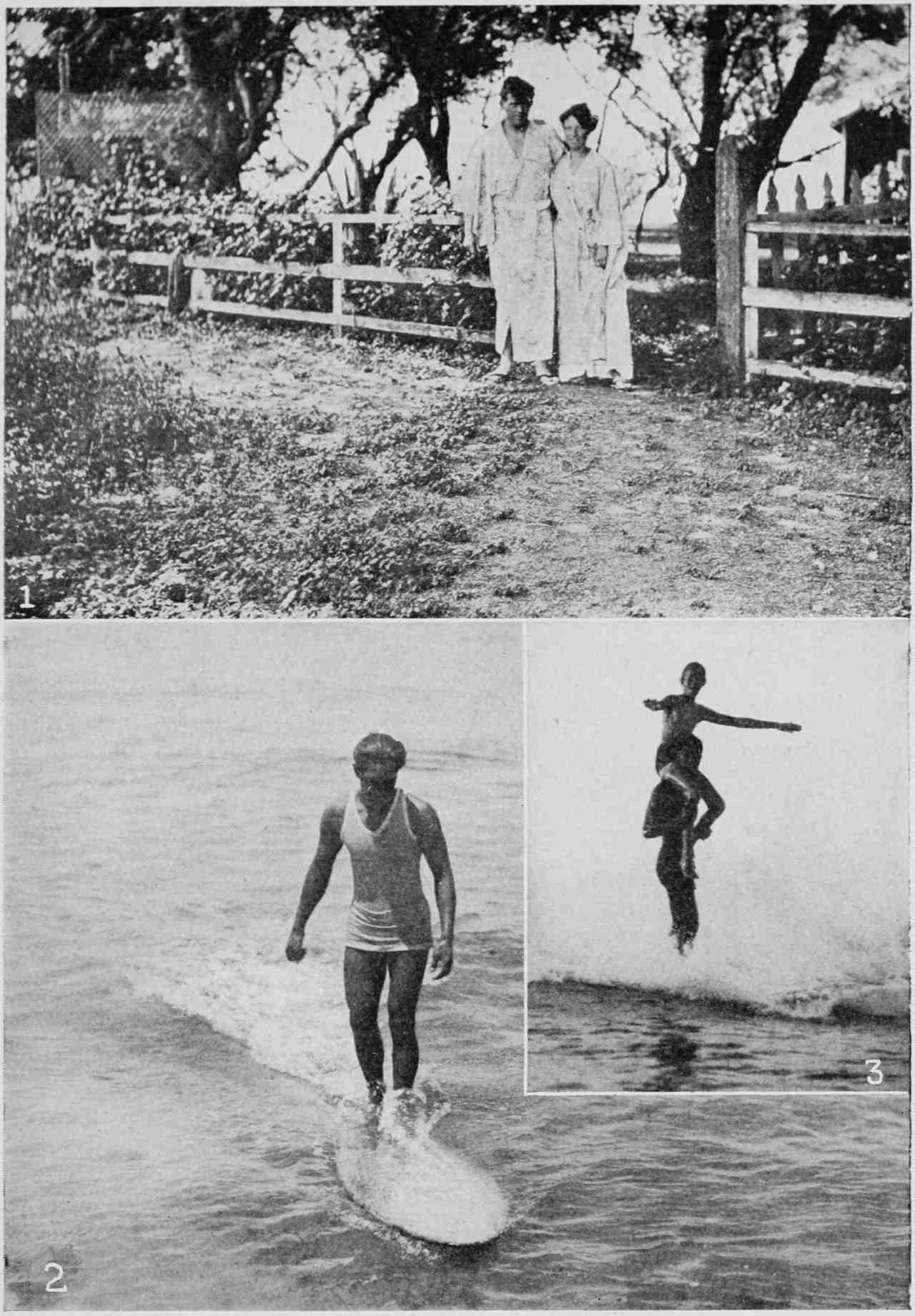
(1) Working Garb in Elysium. (2) Duke Kahanamoku, 1915.
“Oh, yes,” Jack returned, quickly on his feet. “—Alexander Hume Ford. I heard you were in Honolulu, and have wanted to see you. I’ve read lots of your stuff—and all of your dandy articles in The Century.”
Mr. Ford could hardly spare time to look his pleasure, nor to be introduced to me, before rushing on, in a breathless way that made one wonder what was the hurry:
“Now look here, London,” in a confidential undertone. “I’ve got a lot of whacking good material—for stories, you understand. I can’t write stories—there’s no use my trying. My fiction is rot—rot, I tell you. I can write travel stuff of sorts, but it takes no artist to do that. You can write stories—the greatest stories in the world—and I’ll tell you what: I’ll jot down some of the things I’ve got hold of here and everywhere, and you’re welcome to them.... What d’you say?”
Jack suggested that he make three at our table, and he talked a steady stream all through—of information about everything under the sky, it would seem, for he has traveled widely. At present he is interested in reviving the old Hawaiian sport of surf-riding, and promised to see us at Waikiki, and show us how to use a board.
On the electric car bound for Waikiki, we found ourselves part of a holiday crowd that sat and stood, or hung on the running-boards—a crowd that convinced me Honolulu was Honolulu after all. The passengers on the running boards made merry way for the haole wahine, while a beaming Hawaiian, a gentleman if ever was one, gave me his seat, raising a garlanded hat. The people made a kaleidoscope of color—white women in evening gowns and fluffy wraps, laughing Hawaiian and hapahaole girls in gaudy holokus and woolly crocheted “fascinators,” the native men sporting brilliant leis of fresh flowers, the most characteristic being the ilima, which, strung on thread, forms an orange-hued inch-rope greatly affected for neck garlands and hat bands. Like ourselves, all were making for the gardens of their Prince.
Some three miles from the center of town, we alighted at the big Moana Hotel, where, in a lofty seaward lanai overlooking a palmy carriage court, was spent our first hour at Waikiki, sipping from cool glasses while we rested in large rattan chairs; for none but a malihini moves quickly here in hours of relaxation, though the haoles of Hawaii work at least as hard as on the mainland, and no shorter hours. Lovely indeed was this my first glimpse of Hawaii’s celebrated watering place, as we lounged in the liquid night-breeze from over rolling star-tipped waters that broke in long white lines on the dim crescent beach.
Strolling across broad Kalakaua Avenue, we entered a park where great looming trees were festooned high and low with colored lights—Prince Cupid’s private gardens thrown wide to his own people as well as to foreign guests. A prodigious buzz and hum came from a lighted building, and we stepped over the lawns to a fanfare of martial music from Berger’s Royal Hawaiian Band. From an immense open tent where many were sitting at little tables, the lilting of a Hawaiian orchestra of guitars and ukuleles (oo-koo-lay’lees) blended into the festive din; and then, threading purely the medley of sound, was heard a woman’s voice that was like a violin, rising high and higher, dominating the throng until it lapsed into absolute silence. It was the sweetest of Hawaiian singers, Madame Alapai; and when she had finished a prodigious gale of applause went up from all over the grounds, ceasing instantly at the first crystal tone of her encore.
Like a child at a fair, I had no attention for the way of my feet in the grass, and Jack laughed paternally at my absorption as he piloted me by the elbow, with a “Dear Kid—it’s a pleasure to take you anywhere, you do have such a good time!”
A pretty Hawaiian maid at the dressing-tent greeted us haole wahines with a smiling “Aloha,” and led to where we women could shed wraps, and dust noses and pat coiffures; after which the four of us picked a way through the company, the women lovely in their trailing gowns, and men in black and white evening attire or glittering army and navy uniforms. All around under the trees in the back-ground hundreds of Hawaiians looked on, their dusky faces and eyes eloquent with curiosity and interest. Up a green terrace we paced, to the broad encircling lanai of what looked to be an immense grass house. And grass house it proved, in which the royal owners dwelt before the building of the more modern mansion.
This entertainment, including as it did the Congressional party, was unique in its significance. To the right of the receiving line stood the delegate, Prince Jonah Kuhio Kalanianaole, affectionately known as Prince Cupid, a well-known figure in Washington, D. C., a dark, well-featured, medium-sized man in evening dress, handsome, but in my eyes quite eclipsed by the gorgeous creature at his side, pure Hawaiian like himself, his wife, the Princess Elizabeth. The bigness of her was a trifle overwhelming to one new to the physical aristocracy of island peoples. You would hesitate to call her fat—she is just big, sumptuous, bearing her splendid proportions with the remarkable poise I had already noticed in Hawaiian women, only more magnificently. Her bare shoulders were beautiful, the pose of her head majestic, piled with heavy, fine, dark hair that showed bronze lights in its wavy mass. She was superbly gowned in silk that had a touch of purple or lilac about it, the perfect tone for her full, black, calm eyes and warm, tawny skin. For Polynesians of chiefly blood are often many shades fairer than the commoners.
Under our breath, Jack and I agreed that we could not expect ever to behold a more queenly woman. My descriptive powers are exasperatingly inept to picture the manner in which this Princess stood, touching with hers the hands of all who passed, with a brief, graceful droop of her patrician head, and a fleeting, perfunctory, yet gracious flash of little teeth under her small fine mouth. Glorious she was, the Princess Kalanianaole, a princess in the very tropical essence of her. Always shall I remember her as a resplendent exotic flower, swaying and bending its head with unaffected, innate grace.
One and all, they filed by, those of her own race, proud and humble alike, kissing the small, jeweled brown hand, while the white Americans merely touched it with their own. And what came most sharply to me, out of the conventionality, out of the scene so wrapped about with state and pomp, was a fleeting, shifting glint of the wild in her full black eyes, shining through the garmenture of her almost incredible culture and refinement—a fitful spark of the passing savage soul of her, one of a people but lately clothed in modern manners.
To the left of the deposed Princess, in a deep armchair, sat an even more interesting, if not so beautiful, personage—no less than Queen Lydia Kamakaeha Liliuokalani, last sovereign of the Kingdom of Hawaii, sister and successor to the much-traveled King Kalakaua. The Queen is rarely on view to foreigners, especially Americans, for she loves us not, albeit her consort, Governor John Owen Dominis, dead these sixteen years, was the son of a Massachusetts captain. I was glad to be well down the line, as I had more time to watch her, for the vigor of her hot fight of but yesterday to preserve the Crown of Hawaii is to me one of the most interesting dramas in history—bleeding tragedy to her.
Photographs and paintings do not flatter Queen Liliuokalani. All I have seen depict a coarseness and heaviness that is entirely absent. I was therefore surprised, brought face to face with Her Majesty, to find that face rather thin, strong, and pervaded with an elusive refinement that might be considered her most striking characteristic, if anything elusive can be striking. But this evasive effect, in a countenance fairly European in feature, was due, I think, to the expression of the narrow black eyes, rather close-set, which gave the impression of being implacably savage in their cold hatred of everything American. However the seeming, I have been assured that by this time the Queen has come amiably to accept the U. S. A. in Hawaii, and to rise above all vengeful feelings. Indeed during this very reception she greeted an erstwhile arch-enemy: “I am glad to see you Mr—!” As near as I can figure it, she was tricked and trapped by brains for which her brain, remarkable though it be, was no match. Imagine her emotions, she who received special favor from Queen Victoria at the Jubilee in London; she who then had the present Kaiser for right-hand courtier at royal banquets, and the royal escort of Duke This and Earl That upon public occasions, now sitting uncrowned, receiving her conquerors.[3]
It is easier for the younger ones; but the Queen’s pretense looks very thin, and my sympathy, for one, is warm toward her. There is no gainsaying that truism, “the survival of the fittest,” in the far drift of the human, and the white indubitably has proved the fittest; but our hearts are all for this poor old Queen-woman; although I could not help wondering if she would have liked us any better had she known. Most certainly, when our eyes met in the short contact of glances there was nothing of the tender suavity of the Hawaiian, only abysmal dislike. Taking my cue from those preceding, I offered a dubious paw, which she touched gingerly, as if she would much prefer to slap it. It was a distinct relief to meet the prankish eye of Acting Governor “Jack” Atkinson, my Jack’s old friend (who stood next the Queen’s chair, murmuring in her ear the names of strangers), and surrender my timorous hand to his hearty clasp.
Thence on, down one side of the long lanai, and off to the lawn, we ran the gantlet of a bowing, embarrassed, amused string of Congressmen with their wives and daughters, all smiling uncomfortably in the absence of introductions, since they formed the Reception Committee in this stranger city. We undoubtedly looked quite as foolish, when the tension was immeasurably let down by a jolly young Congressman who blurted out:
“That Jack London! Why didn’t somebody tell us? Great Scott!”
A subdued titter went up, and I said to the grinning Jack:
“That’s how you pay for your ‘Dream Harbor’ seclusion!”
Now we were free to mingle with the charming throng, and it was “Aloha” here and “Aloha” there, that all-loving salutation, employed alike by white and native. We happened upon old acquaintances from the States, and were introduced to many Honolulans. Some of these were Hawaiian or part-Hawaiian, who met us with a half-bashful, affectionate child-sweetness that was altogether irresistible. There is that in their beautiful eyes which is a golden trumpet call for a like honesty and good will.
Every one shakes hands—men, women, children—at every friendly excuse of meeting and parting. Smiles are one with the language, and there is a pretty custom of ending a remark, or even a direction, or command, with a pleasant “eh!”—the e pronounced a, with an upward inflection. Jack is especially taken with this gentle snapper, and goes about practicing on it with great glee.
You might have thought yourself at a social fair at home, what of the canopies, refreshments, and faces of countrymen—but for the interspersing of brown Hawaiians, so soft and so velvet in face and body, voice and movement, “the friendliest and kindest people in the world.” A learned New Englander over forty years ago eulogized: “When the instinct of hospitality which is native to these islands gets informed and enriched and graced by foreign wealth, intelligence, and culture, it certainly furnishes the perfection of social entertainment. Of course there are in other lands special circles of choice spirits who secure a brilliant intercourse all to themselves of a rare and high kind, but I question if anywhere in the whole world general society is more attractive than in Honolulu. Certainly nowhere else do so many nationalities blend in harmonious social intercourse. Natives of every well-known country reside there, and trading vessels or warships from America and the leading countries of Europe are frequently in port. A remarkable trait of these foreign-born or naturalized Hawaiians is that interest in their native land seems only intensified by their distant residence. The better Hawaiians they are, the better Americans, English, French, or Germans they are. And thus it happens that you meet people fully alive to the great questions and issues of the day all the world over. Their distance from the scene of these conflicts seems to clear their view, and I have heard some of the wisest possible comments upon American affairs, methods, and policies from residents of the islands. Besides, they have in small the same problems to solve in their little kingdom which engage us. All the projected reforms social, moral, civil, or religious, have their place and agitators here.”
The residence of the Prince was open to the public, and through a labyrinth of handsome apartments we roamed, now up a step into a big drawing-room furnished in magnificent native woods and enormous pots of showering ferns, the walls hung with old portraits of the rulers of Hawaii; now down three steps into a pillared recess where, in a huge iron safe, unlocked for the evening, we were shown trophies of the monarchies. Near by were several priceless old royal capes woven of tiny bird-feathers, some red, some of a rich deep yellow, and others of the two colors combined in a glowing orange. Farther on, a glass-front cabinet displayed shelf above shelf of medals and trinkets pertaining to the past regime, including the endless decorations received by King David Kalakaua in the lands visited in his progress around the world in the early ’80s. Some one remarked that he had possessed more of these royal decorations than any known monarch. But this is not so surprising as the fact that he was the only known reigning monarch who ever circumnavigated the globe.
A space in the cabinet was devoted to the Crown of the Realm, a piece of workmanship at once formal and barbaric, with its big bright gems, most conspicuous of which, to me, were the huge pearls. One diamond had been stolen, and the large gaping socket was a pathetic reminder of the empty throne in the old Palace now used as the Executive Building.
Many and barbaric were the objects in this modern home, mere “curios” should the uncaring gaze upon them in a museum; but here in Hawaii they breathed of the vanishing race whose very hands we were pressing and whose singers’ voices caressed the heavy, fragrant air; the while across a lawn that had been carpet for Hawaii Nei festivities of many years sat the deprived sovereign under the eaves of a grass house.
When, we wonder, in our westward traverse, shall we see another queen, or a prince, or a princess—even shadows of such as are these of Hawaii? Not soon enough, I swear, to fade the memory of this remarkable trio; for nothing can ever dim the picture that is ours. And the Princess Elizabeth Kalanianole has set an example, a pattern, that will make us full critical of royal women of any blood.
Seaside Hotel, Waikiki Beach, Honolulu, May 31.
“Waikiki! there is something in the very name that smacks of the sea!” caroled a visitor in the late ’70s. Waikiki—the seaside resort of the world, for there is nothing comparable to it, not only in the temperature of its effervescent water, which averages 78° the year round, but in the surroundings, as well as the unusual variety of sports connected with it, surf-canoeing in the impressively savage black-and-yellow dug-outs; surf-boarding, the ancient game of kings; fishing, sailing; and all on a variously shallow reef, where one may swim and romp forgetful hours without necessarily going out of depth on the sandy bottom. The cream-white curve of beach is for miles plumed with coconut palms, and Diamond Head, “Leahi,” which rounds in the southeastern end of the graceful crescent, is painted by every shifting color, light, and shade, the day long, on its rose-tawny, serrated steeps. And many’s the sail comes whitening around the point, yacht or schooner or full-rigged ship, a human mote that catches the eye and sets one a-dreaming of lately hailed home harbors and beckoning foreign ports with enchanting names.
And one must not forget the earlier mariners who fixed these island havens in the eye of the world. There was Captain Broughton, who anchored off Waikiki in the British discovery-ship Providence, bristling with her sixteen guns. In lazy, inviting mood, floating upon the rocking swell, I like to picture Kamehameha the Great, gorgeous in his orange and crimson feather-cape, stepping aboard from his hardly less gorgeous black and yellow canoe of state, manned by warriors; his mission to request arms and ammunition. But it seems that Broughton was more peacefully bent than his predecessors of two years before, Brown and Gordon; for he firmly declined to lend any part of his armament. When he went ashore, it was for the purpose of making the first survey of Honolulu harbor, and his men were kept at this work for three days.
Broughton was much concerned over the poor estate of the common people, and noted a rapid decline in their numbers since his former visit with Vancouver. Both on Oahu and later on Kauai, he did his best to dissuade those in power from their internecine warfare. Nor did he relax his refusal to allow any part of his sea-arsenal to leave the Providence.
Waikiki! Waikiki! We keep repeating the word; for already it spells a new phase of existence. Here but a scant twenty-four hours, the rest of the world slips into a mild and pleasant, not imperative memory, for the spirit of storied Waikiki has entered ours. The air seems full of wings. I am so happy making home, this time a tent. We two can pitch home anywhere we happen to alight: a handful of clothes-hangers, a supply of writing materials—and other details are mere incidentals. The art of living, greatest of arts, may be partially summed up in this wise:
“... to inhabit the earth is to love that which is; to catch the savor of things.”
This brown canvas domicile, comprising three rooms separated by thin portieres, with an accessory bath-house and servant room, also of tenting, is the last of a scattered row of detached accommodations belonging to the Seaside Hotel, some of them weathered old cottages of the palmy days when Hawaiian royalty spent most of its time on the beach. A short distance mauka (mountainward) or away from makai (toward the sea), on a lawn pillared with sky-brushing coconut palms, still stands a true old grass house of romantic association. It was created for the seaside retreat of King Lot, Kamehameha V, during his reign in the decade commencing 1863, and each Wednesday was devoted to the fashioning of it, from Lama wood inside and pandanus (screw-pine) leaves outside. It was named Lama House, for the wood was sacred to the construction of temples and idols in the older days. The King left no issue, and upon his death the estate went to the Princess Ruta (Ruth) Keelikolani, and at her demise to Mrs. Bernice Pauahi Bishop, the last known descendant of Kamehameha the Great.
To the south we are separated from the big Moana Hotel with its tiers of green roofs, by a sand-banked stream fed from the mountains, with, beyond, a lavender field of lilies. Kalakaua Avenue is so far away across the hotel gardens that the only sound from that quarter is an occasional rumble of electric trams over a bridge that spans the stream, fitting into our bright solitude like distant thunder from the black range that is visible through a grove of palms and algaroba.
Not twenty feet in front, where grass grows to the water’s edge at highest tide, the sands, sparkling under blazing sunrays, are frilled by the lazy edges of the surf; and the flawed tourmaline of the reef-waters, pale green, or dull pink from underlying coral patches, stretches to the low white line of breakers on the barrier reef some half-mile seaward, while farthest beyond lies the peacock-blue ribbon of the deep-sea horizon.
In the cool of morning, we skipped across the prickly grasses for a dip, accompanied by a frisking collie neighbor. The water was even more wonderful than at the Lochs, invigorating enough at this early hour, full of life and movement. Jack gave me lessons in diving through the mild breakers, and it was hard to tear ourselves away, even for the tempting breakfast tray that a white-suited Filipino was bearing to the tent-house.
Besides our cottage row, the Seaside Hotel includes one large frame house of many rooms, half over the water, reached by a winding driveway from the main avenue through a grove of lofty coconut palms, under which stray large cottages belonging to the hotel. In a rambling one-storied building are the kitchen, the bar, an oriental private dining room, and a reception hall, also furnished in Chinese carved woods and splendid fittings, that belong to the estate. This hall opens into a circular lanai with frescoed ceiling—a round dining and ballroom open half its disk. Beyond the curving steps, on the lawn toward the sea, grow two huge gnarled hau trees, each in the center of a round platform where drinks are served. The hau is a native of the Islands, and is related to the hibiscus. The limbs snarl into an impenetrable shape, and are hung with light yellow bells formed of five to ten lobes, which turn to mauve and then to ruddy brown when they fall.
Mr. and Mrs. Fred Church (he is manager, and an old Klondike acquaintance of Jack) gave us a dinner before the “Transport Night Dance.” While the first word is appropriate for the bewitchment of dancing in a Hawaiian night to the music of Hawaii, it is here used to designate the entertainment on arrival of a United States Army transport, when the officers and their ladies come ashore midway in the long passage to or from the Coast and the Philippines.
The immense half-open circle of the lanai was cleared of dining equipment, and the shining floor dusted with shavings of wax. Many-hued Chinese lanterns were the only lighting here and out among the trees, where dancers rested in the pauses of the music.
And the music. It was made entirely by an Hawaiian orchestra of guitars and ukuleles, with a piano for accent, and all I had heard and dreamed of the glamour of “steamer night in Honolulu” came to pass. It seemed hardly more real than the dream, gliding over the glassy floor to lilt of hulas played and sung by these brown musicians whose mellow, slurring voices sang to the ukuleles and guitars because they could not refrain from singing.
Between two dances I found Jack talking with Princess David Kawananakoa and her husband, who is brother to Prince Cupid, and whom he resembles. Both Princes are nephews of King Kalakaua’s queen, Kapiolani. Princess David, Abigail, was a Campbell, and is only about an eighth Hawaiian. She is a beauty; no more splendid in carriage than her sister-in-law, but much more European in coloring and feature. Doubtless she could be quite as regal upon occasion; but this evening she was charmingly vivacious, and I caught myself looking with affection born of the instant into her beautiful eyes that smiled irresistibly with her beautiful mouth—“a smile of pearls.”
The lovely ball closed with “Aloha Oe,” Love to You, in waltz measure, while the dancers joined in singing. The last, dying cadence left one with a reposeful sense of fulfillment, and none broke this dreamy repose by clapping for an encore.
Waikiki, June 1.
Yesterday, after a luncheon that included our first yam (little different from a fried potato-patty), we rode to Diamond Head, where at last I gazed into a real crater. The way led through Kapiolani Park, where the little sleeping volcano formed a painted background for the scattered trees and blossoming lotus ponds. Once out of the shady driveways, we sweltered in a windless glare upon the rising white road.
It was a mud volcano, this Leahi, and upon its oblong steep sides remain the gutterings of age-ago eruptions. While less than eight hundred feet high, at a distance it appears much higher. We had had a never-to-be-forgotten view of it on our first ride to Honolulu, when, through a gap, we looked across the tree-embowered city, and the low red crater of Punchbowl—Puowaina; and far Diamond Head rose too ethereal in the shimmering atmosphere to be of solid earth thrown up by ancient convulsions.
Skirting the south side of the Head, we tethered our dripping horses, and on foot climbed the limy wall, seething hot under the midday sun. I arrived at the edge of the crater sans heart and lungs, muscles quivering, and eyes dim. But what I there saw brought me back in short order to my normal state of joy at being alive. Compared with other wonders of Hawaii Nei, probably this small hollow mountain should be sung without trumpets. But I have not seen Haleakala and Kilauea, Mauna Kea or Hualalai, and lacked no thrills over my first volcano, albeit a dead one. The bowl is a symmetrical oval, and may be half a mile long—we could not judge, for the eye measures all awry these incurving walls of tender green, cradling, far beneath, the still, green oval mirror of a lakelet.
We rested our burned eyes on the soft green shell of earth before retracing the scorching way to the horses, and decided that small-boat travel is ill training for mountain scaling anywhere near the Southern Cross. Around Diamond Head we continued, gazing off across blue bays and white beaches to Koko Head, very innocent seen from the land by light of day, but full of omen by night when winds blow hot and small Snarks drift near wicked reefs. To-day the road led close by Diamond Head lighthouse and the signal station that telephoned our approach to Honolulu; and we learned that it was wirelessed from the city to the island of Maui, where the Congressional party hung 10,000 feet, on the lip of Haleakala’s twenty-three-mile crater. How different from times when the only way of messages was by the watery miles separating the islands, in sloops and schooners or outrigger canoes, and telephones had never been dreamed of.
On the way to return the mares, Jack took me aside to the transport wharf that I might see the departure of a vessel from Honolulu, for never, since his own experiences, has he spoken without emotion of this beautiful ceremonial. There is nothing like it anywhere else in the world.
The steamer decks were bowers of fragrant color, as was the wharf, for the shoulders of the departing congressmen and their womenfolk were high-piled with wreaths, of ilima, of roses, of heliotrope, carnations, lilies, and scented green things; while the dense throng ashore was hardly less garlanded, and streams of flowers flowed back and forth on the gangways. A great humming of voices blent with the quivering strains of an Hawaiian orchestra on the upper deck, and now and again all tuneful din drowned in a patriotic burst from Berger’s Royal Hawaiian Band ashore. An impressive scene it was, not alone for beauty, but in a human way, for the myriad faces of the concourse shaded from white through all the browns to yellow skins, mingling in good fellowship and oneness of spirit in this hour of farewell to the lawmakers of their common cause. And none of these wishing godspeed were more imposing nor charming than the Hawaiians, from the two Princes and their splendid consorts to the humblest commoners of their people. Humblest is wrong—there is no humility in the breed. Their eyes look only an innocent equality of sweet frankness, and their feet step without fear the soil they can but still regard as their dearest own.
Prince Cupid, the delegate, received round after round of cheers from the passengers when a deep-mouthed siren called the parting moment; and at the last, the native orchestra, descending the gangway, joined with the wind instruments in Queen Liliuokalani’s own song, tenderest of farewells and hopes for a returning, “Aloha Oe.” The human being did not live whose heart was not conscious of a nameless longing for he knew not what. One ached with burden of all the good-bys that ever were and ever will be, of all the sailings of all the ships of all the world.
“O warp her out with garlands from the quays,”
went through my mind when the vessel glided slowly past the wharf, and the ropes of living blossoms and network of wild-hued serpentine parted and fell into the water. Flowers filled the air as they were tossed to and from the gay decks of the ship, many falling into the stream, until she moved upon a gorgeous tapestry that clung to her forefoot.
As the huge black transport cleared, suddenly her surface seemed flying to pieces. A perfect fusillade of small dark objects in human form sprang from her sides, rails, rigging, from every height of ringbolt and sill, and disappeared in almost unrippling dives through the swirling blossomy carpet of the harbor.
“Look—look at them!” Jack cried, incoherent with the excitement of his joy in the kanaka imps who entered the water so perfectly and came up shaking petals from their curly heads, white teeth flashing, their child faces eloquent with expectation of a lucrative shower from the passengers. A bountiful hour it was for them, and little their bright eyes and brown hands lost of the copper and silver disks that slowly angled through the bubbling flood. We wished we were down there with them, for it is great fun to pick a coin from the deep as it filters down with a short, tipping motion.
“Do you wish you were aboard, going back?” Jack asked, as we turned for the last time to look at the diminishing bulk of the ship, bannered with scarves and handkerchiefs and serpentine. I did not. I want to go home only from east to west.
Such content is ours here at Waikiki, that it is a shame to press it all into one life, for it could be spread over several incarnations. We sleep like babies, in the salt night airs wafting through mosquito canopies. Before breakfast, it is into the blissful warm tide, diving through bubbling combers, coming up eyes level with tiny sails of fishermen beyond the barrier reef. All hours one hears the steady, gentle boom and splash of the surf—not the disturbing, ominous gnashing and roaring of the Pacific Coast rollers, nor the carnivorous growlings off the rock-jagged line of New England. And under sun or moon, it is all a piece of beauty. Toward Diamond Head, when the south wind drives, swift breakers, like endless charges of white cavalry, leap and surge shoreward, flinging back long silver manes. The thrill of these landward races never palls at Waikiki. One seems to vision Pharaoh’s Horses in mighty contest with backwashing waters, arriving nowhere, dying and melting impotent upon the sand.
Jack, to whom beauty is never marred by knowledge of its why and wherefore, has explained to me the physics of a breaking wave.
“A wave is a communicated agitation,” he says. “The water that composes a wave really does not move. If it moved, when you drop a stone in a pool and the ripples widen in an increasing circle, there should be at the center an increasing hole. So the water in the body of a wave is stationary. If you observe a portion of the ocean’s surface, you will see that the same water rises and falls endlessly to the agitation communicated by endless successive waves. Then picture this communicated agitation moving toward shore. As the land shoals, the bottom of the wave hits first and is stopped. Water is fluid, and the upper part of the wave not having been stopped, it keeps on communicating its agitation, and moves on shoreward. Ergo,” says he, “something is bound to be doing when the top of a wave keeps on after the bottom has stopped, dropped out from under. Of course, the wave-top starts to fall, forward, down, cresting, overcurling, and crashing. So, don’t you see? don’t you see?” he warms to his illustration, “it is actually the bottom of the wave striking against the rising land that causes the surf! And where the land shoals gradually, as inside this barrier reef at Waikiki, the rising of the undulating water is as gradual, and a ride of a quarter of a mile or more can be made shoreward on the cascading face of a wave.”
Alexander Hume Ford, true to promise, appeared to-day with an enormous surf-board, made fun of the small ones that had been lent us, and we went down to the sea to learn something of hee-nalu, sport of Hawaiian kings. The only endeavor of fish, flesh, and fowl, which Mr. Ford seems not to have partially compassed, is that of the feathered tribe—undoubtedly from lack of time, for his energy and ambition seem tireless enough even to grow feathers. Jack, who seldom stops short of what he wants to accomplish, finds this man most stimulating in an unselfish enthusiasm to revive neglected customs of elder islands days, for the benefit of Hawaii and her advertisement to the world. Although we have seen a number of natives riding the breakers, face downward, and even standing upright, almost no white men appear to be expert. Mr. Ford, born genius of pioneering and promoting, swears he is going to make this islands pastime one of the most popular on earth, and judging by his personal valor, he cannot fail.
The thick board, somewhat coffin-shaped, with rounded ends, should be over six feet long. This plank is floated out to the breaking water, which can be done either wading alongside or lying face-downward paddling; and there you wait for the right wave. When you see it coming, stand ready to launch the board on the gathering slope, spring upon it, and—keep on going if you can. Lie flat on your chest, hands grasping the sides of the large end of the heavy timber, and steer with your feet. The expert, having gauged the right speed, rises cautiously to his knees, to full stature, and then, erect with feet in the churning foam, makes straight for the beach, rides up the sparkling incline, and steps easily from his grounded sea-car.
A brisk breeze this afternoon, with a rising surf, brought out the best men, and we saw some splendid natives at close range, who took our breath away with their reckless, beautiful performance. One, George Freeth, who is only one quarter Hawaiian, is accounted the best surf-board rider and swimmer in Honolulu.
When a gloriously bodied Hawaiian, naked but for a loin-cloth carved against his shining bronze, takes form like a miracle in the down-rushing smother of a breaking wave, arms outstretched and heels winged with backward-streaming spray, you watch, stricken of speech. It is not the sheer physical splendor of the thing that so moves one, for, lighting and informing this, is an all dominating spirit of joyful fearlessness and freedom that manifests an almost visible soul, and lends a slow thrilling of awe to one’s contemplation of the beauty and wonder of the human. What was it an old Attic philosopher exclaimed? “Things marvelous there are many, but among all naught moves more truly marvelous than man.”
And our journalist friend, malihini, white-skinned, slim, duplicated the act, and Jack murmured, “Gee! What a sport he is—and what a sport this is for white men too!” His glowing eyes, and a well-known firm expression about the jaw, told me he would be satisfied with nothing less than hours a day in the deep-water smokers. As it was, in the small surf, he came safely in several times. I accomplished one successful landing, slipping up the beach precisely to the feet of some stranger hotel guests, who were not half so surprised as myself. It took some while to learn to mount the board without help, for it is a cumbrous and unruly affair in the heaving water.
The rising tide was populous with Saturday afternoon bathers, but comparatively few women, except close inshore. A fleet of young surf-boarders hovered around Ford and his haole pupils, for he loves children and is a great favorite with these. Often, timing our propelling wave, we would find a brown and smiling cherub of ten or so, all eyes and teeth, timing the same wave, watching with anxiety lest we fail and tangle up with the pitching slice of hardwood. Not a word would he utter—but in every gesture was “See! See! This way! It is easy!”
Several times, on my own vociferous way, I was spilled diagonally down the face of a combing wave, the board whirling as it overturned, and slithering up-ended, while I swam to bottom for very life, in fear of a smash on the cranium. And once I got it, coming up wildly, stars shooting through my brain. And once Jack’s board, on which he had lain too far forward, dived, struck bottom, and flung him head over heels in the most ludicrous somersault. His own head was struck in the ensuing mix-up and we were able to compare size and number of stars. Of course, his stars were the bigger—because my power of speech was not equal to his. It seems to us both that never were we so wet in all our lives, as during those laughing, strenuous, half-drowned hours in the milk warm surf.
Sometimes, just sometimes, when I want to play the game beyond my known vitality, I almost wish I were a boy. I do my best, as to-day; but when it comes to piloting an enormous weighty plank out where the high surf smokes, above a depth of twelve to fifteen feet, I fear that no vigor of spirit can lend my scant five-feet-two, short hundred-and-eleven, the needful endurance. Mr. Ford pooh-poohs: “Yes, you can. It’s easier than you think—but better let your husband try it out first.”
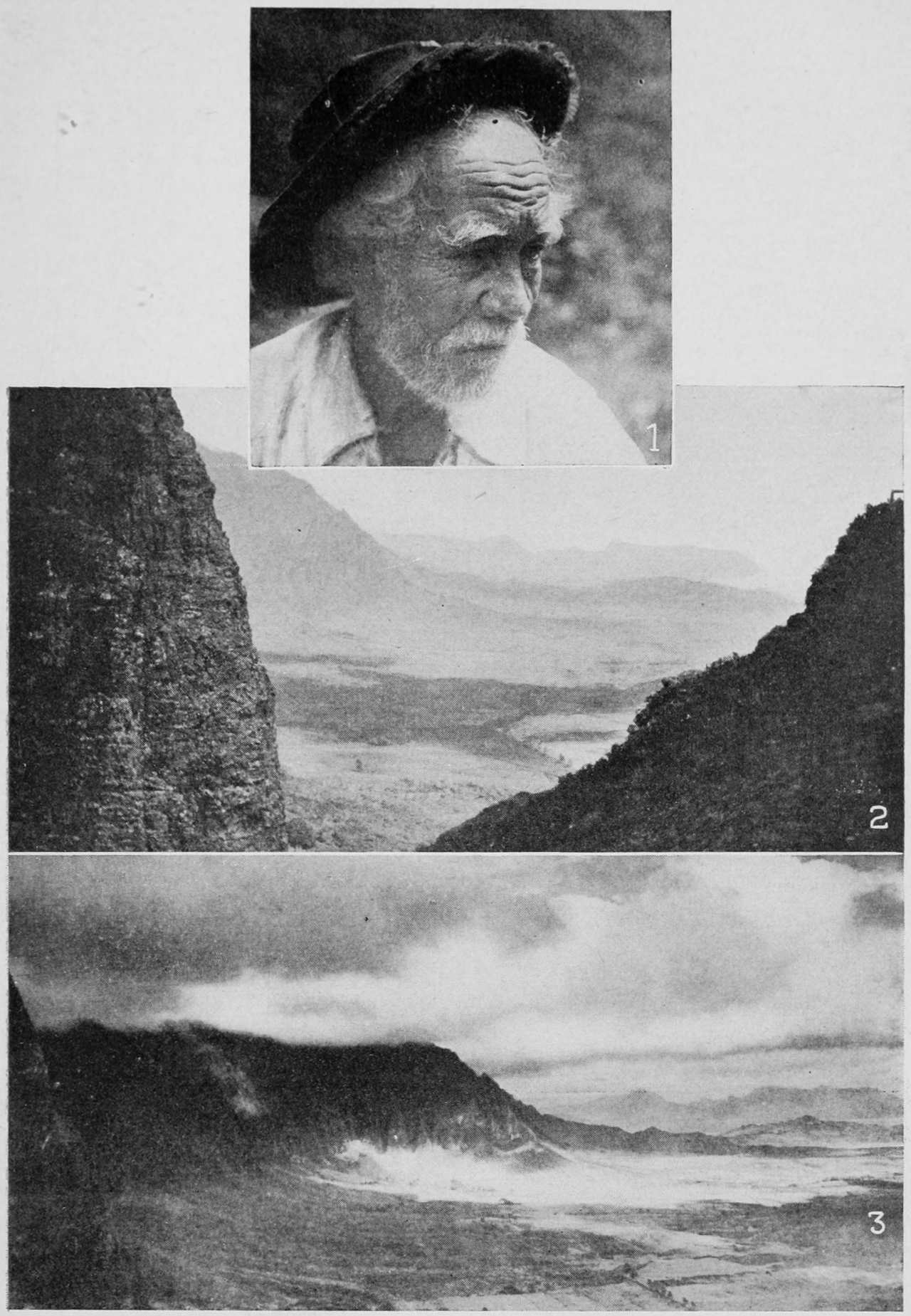
(1) Old Hawaiian. (2) The Sudden Vision. (3) The Mirrored Mountains. (Painting by Hitchcock.)
Waikiki, June 2.
An eventful day, this, especially for Jack, who is in bed thinking it over between groans, eyes puffed shut with a strange malady, and agonizing in a severe case of sunburn. I can sympathize to some extent, for, in addition to a considerable roasting, my whole body is racked with muscular quirkings and lameness from the natatorial gymnastics of the past forty-eight hours. Our program to-day began at ten, with a delirious hour of canoe riding in a pounding sea. While less individual boldness is called upon, this game is even more exciting than surf-boarding, for more can take part in the shoreward rush.
The great canoes are the very embodiment of royal barbaric sea spirit—dubbed out of hard koa logs, long, narrow, over two feet deep, with slightly curved perpendicular sides and rounded bottoms; furnished with steadying outriggers on the left, known as the “i-á-ku”—two curved timbers, of the light tough hardwood, their outer ends fastened to the heavy horizontal spar, or float, of wili-wili, called the “a-ma,” nearly the canoe’s length. The hulls are painted lusterless, dead black, and trimmed by a slightly in-set, royal-yellow inch-rail, broadening upward at each end of the boat, with a sharp tip. There is an elegance of savage warlikeness about these long sable shapes; but the sole warfare in this day and age is with Neptune, when, manned by shining bronze crews, they breast or fight through the oncoming legions of rearing, trampling, neighing sea cavalry.
It required several men on a side to launch our forty-foot canoe, and altogether eight embarked, vaulting aboard as she took the water, each into a seat only just wide enough. Jack wielded a paddle, but I was placed in the very bow, where, both outward and back, the sharpest thrills are to be had. As we worked reefward in the high breaking flood, more than once breath was knocked out of me when the bow lunged straight into a stiff wall of green water just beginning to crest. Again, the canoe poised horizontally on the springing knife-edge of a tall wave on the imminence of overcurling, and then, forward-half in midair, plunged head-into the oily abyss, with a prodigious slap that bounced us into space, deafened with the grind of the shore-going leviathan at our backs. I could hear Jack laughing in the abating tumult of sound, as he watched me trimming my lines so as to present the least possible surface to the next deluge. He knew, despite my desperate clutches at the canary streak on either hand, that I was having the time of my life, as, from his own past experience, he had told me I would have.
It was more than usually rough, so that our brown crew would not venture out as far as we had hoped, shaking their curly heads like serious children at the big white water on the barrier reef. Then they selected a likely wave for the slide home, shouting strange cries to one another that brought about the turning of the stern seaward to a low green mounting hill that looked half a mile long and ridged higher and higher to the burst.
“‘A hill, a gentle hill, Green and of mild declivity,’... It is not!” some one quoted and commented on his Byron and the threatening young mountain, with firm hands grasping his paddle, when, at exactly the right instant, he joined the frantic shrill “Hoe! Hoe!” (Paddle! paddle like—everything!) that sent all the blades madly flying to maintain equal speed with the abrupt, emerald slope. Almost on end, wiki-wiki, faster—faster, and yet faster, we shot, ever the curl of white water behind, above, overhanging, menacing any laggard crew. Once I dared to look back. Head above head I marked them all; but never can fade the picture of the last of all, a magnificent Hawaiian sitting stark in the stern, hardly breathing, curls straight back in the wind, his biceps bulging to the weight of canoe and water against the steering paddle, his wide brown eyes reflecting all the responsibility of bringing right-side-up to shore his haole freight.
And then the stern settles a little at a time, as the seething bulk of water dissipates upon the gentle up-slope of the land before the Moana, while dripping crew and passengers swing around in the backwash and work out to repeat the maneuver.
Few other canoes were tempted out to-day, but we saw one capsize by coasting crookedly down a wave. The yellow outrigger rose in air, then disappeared in white chaos. Everything emerged on the sleek back of the comber, but the men were unable in the ensuing rough water to right the swamped boat. We lost sight of them as the next breaker set us zipping inshore, but later saw them swimming slowly in, towing the canoe bottom-upward, like a black dead sea monster, and making a picnic of their plight.
An hour of this tense and tingling recreation left us surprisingly tired, as well as chilled from the strong breeze on wet suits. Mr. Ford, with a paternal “I-told-you-so” smile at our enthusiasm over the canoeing, was prompt for the next event on our program, a further lesson in surf-boarding. After assisting me for a time I noticed he and Jack were sending desireful glances toward the leaping backs of Pharaoh’s Horses, and I knew they wanted to be quit of the pony breakers inshore—the wahine (woman) surf, as the native swimmers have it, and manfulwise ride the big water. Our friend had a thorough pupil in Jack, who with characteristic abandon never touched foot to sand in four broiling hours.
Nursing my own reddened skin in the cool tent-house, I saw a weary figure dragging its feet across the lawns, which it was hard to recognize for Jack until he came quite near. Face and body, he was covered with large swollen blotches, like hives, and his mouth and throat were closing painfully. Rather against his wish, I sent Tochigi to summon a doctor. He had not given a thought during those four hours, face-downward on the board, to the fact that under the vertical rays of a tropic sun a part of him never before so exposed was being cooked through and through. Shoulders and back of neck were cruelly grilled; but the really frightful damage was to the backs of his legs, especially the tender hind-side of the knee joints, which were actually warping so rapidly that in a few moments he could not stand erect because the limbs refused to straighten. Between us we managed to get him into bed, and later on, restless with the intolerable pain of his ruined surfaces, and thinking my room might be cooler, he could progress there only on heels and palms, face upward. “Don’t let me laugh—it hurts too much,” he moaned through swollen lips, realizing the preposterous spectacle.
Little aid could be rendered, either of diagnosis or practice, by the physician, Dr. Charles B. Cooper. From his six-foot-odd of height he bent wide, black eyes upon the piteous mass on my bed, that indisputably required all known sun-burn remedies; but the swollen blotches were plainly beyond him. He had observed cases of mouth and throat swelling from fruit poisoning in the tropics; but this patient had eaten nothing that he had not been living on for weeks. And also there was the blotched body.
“Just my luck!” this from the sufferer. “I’m always running into something no one ever saw or heard of! Although this is something like the shingles I had on the Sophie Sutherland.”
Dr. Cooper left some medicine, and later his filled prescription came from a druggist, to relieve the torturing burn. Meantime I kept up a steady changing of cool, wet cloths on the warped legs, while Jack’s “It can’t last forever!” was the best cheer under the circumstances, until the blotches began to subside and the throat could swallow grateful drafts of cold water, and a supper of long, iced poi-cocktail—“Such beneficent stuff,” he dwelt upon it.
You! All whiteskins who would learn Ford’s rejuvenescent royal sport, take warning that the “particular star” which illumes our world, despite its insidiousness, is particularly ardent in Hawaiian skies.
Pearl Lochs, June 6.
Home in our Dream Harbor, after a full week away. The burning hours at Waikiki were beguiled with cool cloths and reading aloud, Jack taking his turn when I grew nervous with my own distressed cuticle and an aching ear from diving. Out of his grip of varied reading matter, he had selected Lilian Bell’s “The Under Side of Things”—I wonder if with reference to his fried-and-turned-over condition! A Bulletin reporter lightened a half hour in an interview upon our unplotted future around the globe, and told us that our erstwhile sailing master, leaving yesterday for the Coast on the Sierra, had given the impression that he considered the Snark unsafe.
“He built her!” was Jack’s only comment.
“And sailed over two thousand miles in her,” the newspaper man grinned.
On Tuesday, waiving all discussion, Jack got into his clothing, the operation (not an unappropriate word) accompanied by running commentary on things as they were, which would be both interesting and instructive in a biographical sense, did one dare the editorial censor. Neither of us was this day “admirin’ how the world was made,” and my widest sympathy was with his fevered sentiments concerning astronomy, geology, the starry hereafter, mid-Pacific watering places—and Alexander-Hume-Fords.
“But I warned you, and warned you!” fended poor Ford, suppressing a snicker as the fervid cripple, now on his feet, essayed a step or two. “And you’re luckier than I was the first time I got burned—worse than you are—and by mistake used capsicum vaseline!—And anyway, I really did think you had become toughened a bit on your month at sea.”
With stiff-crooked legs, for he could neither unbend nor further bend the knees, and feet pitched some twenty inches apart, Jack’s action was perforce unlike that of any known biped. So enamored did he become of the wonder of it that he insisted upon employing it to progress to the lanai for luncheon, where his most pitying acquaintances failed to keep back their mirth. Be assured he enjoyed it all as much as they, for the lessening hurt made him very happy. An hour face-downward on the beach that fateful afternoon had not improved my own carriage, but I was not unwilling to risk it on a short trip along Kalakaua Avenue to the Aquarium, which Jack, from his memories, had pronounced a world-wonder. In the cool many-roomed grotto, built of quarried lava, we forgot all earthly dole, spellbound before the incredible forms and colors of the sentient rainbows.
It is impossible to communicate an adequate idea of these color organisms. If an object could be laughably lovely, any one of these fish would serve; Striped Roman scarf effects showed behind the glass as if in a shop window display; polka-dot patterns in color schemes beyond imagining; against the crystal lay figured designs that manufacturers would make no mistake in copying. And all were possessed of an iridescent quality that made one expect them to melt into the shifting greens of their element, as they faded into the farther spaces of the tanks. But presently they would intensify, coming on larger and brighter like marine headlights in Elfland.
One fish was an aquatic bird-of-paradise for hues, with a long spine like an aigrette springing from midway of a body almost as round as a coin and not much larger, with golden-brown beak and bold black eye. His name was the kihi-kihi. The hinaleanukuiwi was a turquoise-blue, five-inch shuttle, terminating in a peacock-blue wisp of tail, with fins like ruffles tipped with stripes of yellow and black, and a long blue needle for beak. The fins back of and below its beaded eyes were tiny azure butterflies striped two ways with purple and gold; and on each side the turquoise body a splotch of opaque gold rested like a sunbeam. Around this bright blue marvel slowly wove one of magenta as vivid, and half as long, of familiar shape but with the bulging eye of a frog shaded by a thick ruby lid, two pale-pink fins shaped like center-boards, and a dorsal fin carrying five smartly raked masts.
The kikakapu did not look his bristly name, being a mere shapeless handful of pigments—green as a parrot, with birdlike head of harlequin opal and parrot eye of black and yellow. Half of the dorsal was a black-velvet spot rimmed with gold, his tail two shades of gray with a root of scarlet. I have not patience to spell the name of an almost perfect oval of blue black, with a flaming autumn leaf on each side, a narrow dorsal of shaded rose and salmon-yellow bearing a dotted line of red, and a gray and red flag for tail, while two sapphire-blue feathers trailed underneath. Next him flaunted a bright yellow fish that had patently been scissored midlength and grown a stiff mauve tail in the middle of its vertical rear, to match a mauve-velvet, long-beaked face. A canary-wing formed this one’s dorsal fin, and two absurd back-slanted spikes and a ribby trailer decorated its horizontal base.
The opule and the luahine were both meant to be normally formed,—the first, speckled on top like a mountain trout, its frills red and black and blue, jaw crimson spotted, with grass-green gills and tiny gilt fins, and on its dark sides three parallel rows of larger dots, and one dropped below, of startling blue, each with an electric light behind! The second, all brown save for a scarlet headlight on the tall dorsal, was similarly lit up, all over, fins as well, the head zigzagged with lightning streaks of the same electric blue. The akilolo wore cold blue jewels on plum satin, with electric-green stripes on its head, crimson and green fins and sharply demarked rudder of yellow.
One lovely thing would have been a little heart of gold, if its white-and-gilt tail had not transformed it into a prefect ace of spades. Another, modestly fashioned, bore pink fins socketed in emerald like the head and tail, a yellow stomach, seal-brown back, with three broad downward bands of the emerald joining a wide lateral band of the same, decorated in hollow squares of indigo! There were also dainty mother-of-pearl forms, and gorgeous autumnal petals of the ocean drifting among the jeweled swimming creatures, with little rainbow crabs lying on the bottom of sand and shells, and other crannied creatures.
An imaginative child could spin unending day dreams about these living pictures in the Honolulu Aquarium; and for nightmares, there be excellent specimens of the octopus family. These squid we have on the Pacific Coast, but there is no way of observing them. Mr. Potter, the superintendent, said his were unusually active to-day, and we saw them displaying all their paces—a very useful spectacle for those who may venture among the more unfrequented coral hummocks at Waikiki. A wader can be made very uncomfortable by their ugly ability to attach to a rock and a victim at one and the same time. They showed their fighting colors through the glass, coming straight at us, their little devil’s-heads set with narrow serpent-eyes glinting maliciously, and sharp turtle-beaks; all their tentacles—awful constricting arms covered with awful suckers—cast behind in the lightning dart.
When attacked, the squid opens an “ink bag,” fouling the water to the confusion of its enemy. A native in trouble with one bites its head, and to such mortal wound the pediculate marine dragon gives up the ghost. The only thing about the squid that is not unpleasant is its color—in action a rosy tan; but when curled in the rock crevices, protective tinting makes it hard to find. Mr. Potter dropped some tiny crabs into the tank from behind the scenes which caused an exhibition not soon to be forgotten. The almost invisible squid, watching with one bright eye, unwreathed its eight flexile, trailing limbs, rose swiftly, swooped, and enfolded the prey as with a swirl of grey net or veiling. When the monster presently unwound, the mites of crabs had been absorbed.
“And the Creator sat up nights inventing that,” Jack observed with sacrilegious gravity. The superintendent looked appropriately startled, but not unappreciative.
This Honolulu Aquarium, though small, is said to surpass in the beauty of its exhibit anything in the world, not excepting the Italian; and fancy our surprise to learn that it is not maintained by the Territory, nor yet by the city, existing solely by the enterprise of the electric railway company. The “colored” fish are recruited from the chance catch of fishermen and from adjacent reefs by the Aquarium attendants. It is not easy to understand why Honolulu remains luke-warm with regard to this, one of her greatest attractions. Mr. Ford should be spoken to about it!
Hawaii is a paradise for the visiting fisherman, where can be hooked anything from a shark to small fry of various sorts, whether “painted” or otherwise. Among the many game fish may be named black sea bass, barracuda in schools, albacore, dolphin, swordfish, yellow-tail, amber fish, leaping tuna and several other kinds of tuna—these of unthinkable weight and size. And flying fish may be picked off with rifle or shotgun—or netted, as by the old Hawaiians.[4]