MY HAWAIIAN ALOHA THREE ARTICLES BY JACK LONDON (continued 4)
Reading edition
Many of the girls were mercifully still comely, even pretty, and rode superbly, handling their curvetting steeds with reckless grace and ease.
All forenoon these gala-colored horsewomen trooped singing and calling over the rises and hollows of the countryside, to incessant blaring of the bands of both villages combined. The whole was a picture of old Hawaii not to be composed elsewhere in the Territory, and certainly nowhere else in the world. For no set reproduction of the bygone customs could equal this whole-souled exhibition, costumed from simple materials by older women who remembered days of the past, carried out in the natural order of life in one of the most beautiful spots in the Islands, if not on the globe. No description can depict the sight that was ours the forenoon long.
To our distress, we were appointed to award prizes at the race track. We feared hurting the contestants by injudicious choices. But Jack McVeigh pooh-poohed our diffidence, and insisted that we serve on the committee. Horseback we went to the races, and found the track like any other, with its grand stand, its judges, its betting and bickering—the betting running as high as $150—its well-bred horses, and wild excitement when the jockeys came under the wire.
Jack tied his fractious pony, and I saw him on foot over by the judges’ stand, waving arms and cowboy hat and yelling himself hoarse, just as crazy as the crowd of lepers he jostled, who were as crazy as he. Later, he was conversing soberly with a Norwegian and his wife, both patients, who told us we had no idea what it meant to them all for us to come here and mingle among them as friends, and that people were very happy about it. This was good tidings, for the lepers are so little forward in manners that invariably we must accost them first, whereupon they break into the smiling Aloha of their land.
Between heats, there were footraces, and screaming sack races, and races to the slowest, in which McVeigh figured on the rump of a balking donkey, and won; then followed a wahine contest of speed, and a wahine horse race.
But the most imposing event of the afternoon, as of the morning, was enacted by the pa’u riders, who paced leisurely in stately procession once around the course, then circled once in a swinging canter, and, finally, with mad whoopings, broke into a headlong stampede that swept twice and a half around before the Amazons could win control of their excited animals. A truly gorgeous spectacle it was, the flying horses with their streaming beribboned tails, the glowing riders, long curling hair outblown, and floating draperies painting the track with brilliant color—all mortal decay a thing forgot of actors and onlookers alike, in one grand frolic of bounding vitality and youth.
The three prizes were for $5, $3, and $2, and it would not be guessing widely to say that they came out of the private pocket of the Superintendent, along with numerous other gifts during the day. He is not the man to go about with his heart’s good intentions pinned on his sleeve—indeed, a supersensitive character would be out of place as manager of such an institution; but hand in hand with iron will and executive ability, he carries a heart as big as the charge he keeps, and a keen gray eye quick to the needs of his children, as he calls them.
The three beaming winners galloped abreast once around the track, and then rode out; but suddenly the buxom wahine, bright and bold of eye and irresistible of smile, who had taken second, wheeled about and came to attention before the judges’ stand with the request, to our surprise, that I ride once around with her. “Oh, do, do!” Jack under his breath instantly prompted, fearing I might hesitate. Of course I mounted forthwith, and together we pranced the circuit, to deafening cheers.
But I was not riding with a leper, for it turned out that this inviting girl is a kokua, an assistant at the surgery, from whom the bid to ride with her was in the best Kalaupapa social usage.
The Superintendent’s big dinner was a signal triumph, and he handled the mixed company with rare tact, several factions being represented. But even the grave Bishop Liebert and the Fathers warmed to his kindly and ready humor, and soon all were under the spell of Kalama’s perfumed garlands and the really sumptuous feast.
Following several merry toasts, Mr. McVeigh rose and raised his glass to “The Londons—Jack and Charmian, God bless them!” And went on to confess to a warm regard that affected us deeply. For he has given us of his confidence during the past day or two in a way that has mightily pleased us. At the end of the little speech, breaking into his engaging smile, he announced that he knew all present would wish us well upon our departure, which was approaching all too soon etc., etc., and which would be via the pali trail; and that Mrs. London should ride the best horse on Molokai—his mule Makaha!
By the time we arrived at Beretania Hall for the evening entertainment, it was crammed to suffocation with a joyful crowd of lepers, orchestra in place, resting on their violins, banjos, guitars and ukuleles. After they had opened with Star-Spangled Banner and several Hawaiian selections, a willowy young woman, graceful as a nymph but with face as awful as her body was lovely, rendered a popular lightsome song in tones that had lost all semblance to music. Half-caste she is, traveled and cultured, once a beauty in Honolulu, whose native mother’s bank account is in seven figures. And this girl, in the blossom-time of life, with death overtaking in long strides, bereft of comeliness, shocking to behold, and having known the best that life has to bestow, rises superior to life and dissolution, and, foremost in courage, surpasses the gayest of her sisters in misfortune. What material for a Victor Hugo!
At the end of an hour, we left the fantastic company dancing as lustily as it had sung and laughed and ridden the gladsome day through. No one, listening outside to the unrestrained merrymaking, could have guessed the band of abbreviated human wrecks, their distorted shadows monstrous in the flickering lamplight, performing, unconcernedly for once, their Dance of Death.
July 5.
Let none say that great men, capable of noble sacrifice, have ceased from the earth in this day and age. And Dr. William J. G. Goodhue, with his exceeding modesty, would be the first to protest any association of his pleasant name with such holy company. But no outsider, entering upon the scene of his wonderful and precarious operations in tissue and bone diseased with the mysterious curse of the ages, could doubt that he had come face to face with one who spares himself not from peril of worse than sudden death. Although the world at large recks as little of him as it does of leprosy, great surgeons know and acclaim his work, performed bi-weekly at his clinics, where remedial and plastic operations of incalcuable importance take place. His tracheotomies in lepral stenosis have saved many, and have cured or improved conditions of the nose and throat which no other treatment, so far, has been known to relieve.
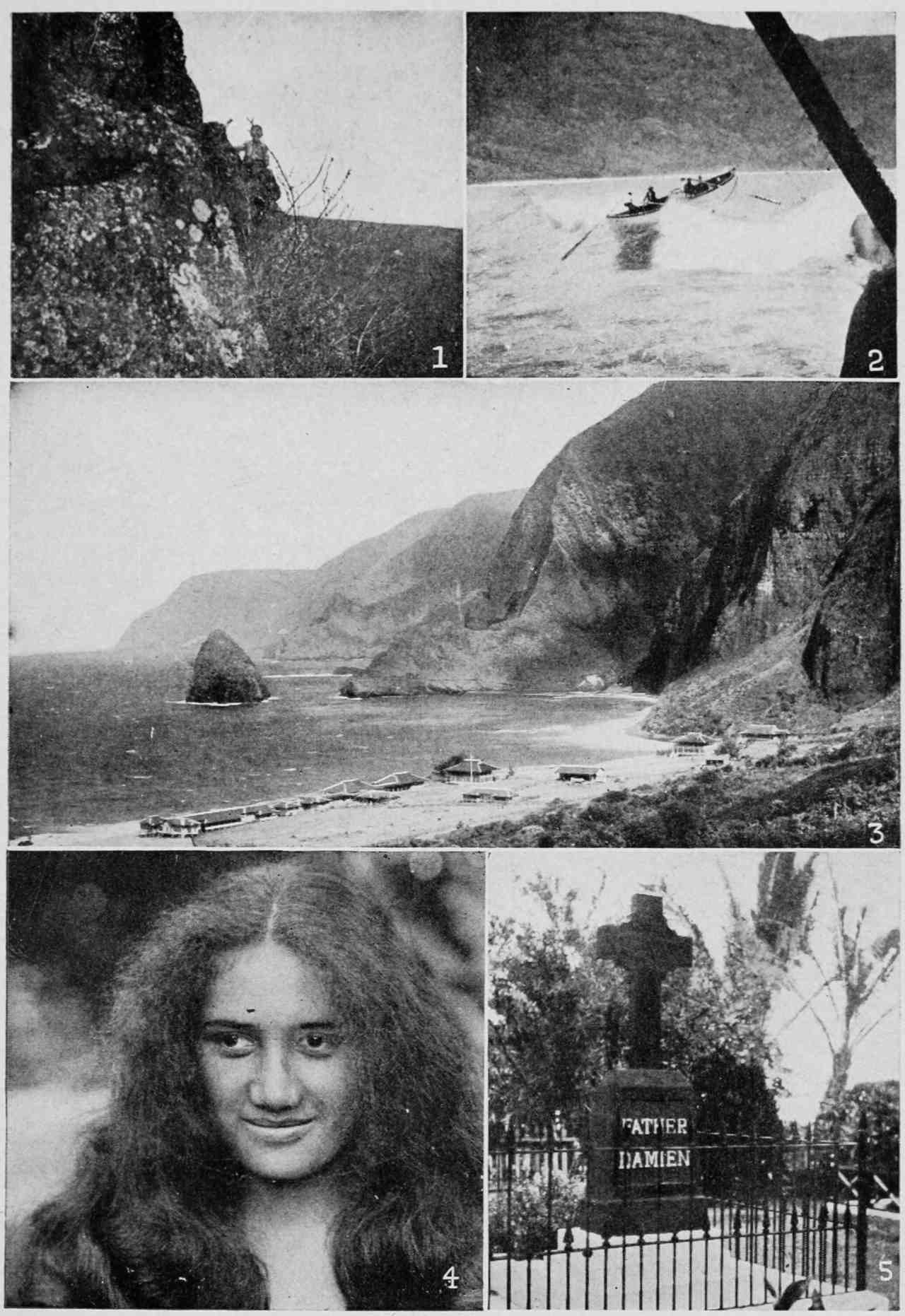
(1) The Forbidden Pali Trail, 1907. (2) Landing at Kalaupapa, 1907. (3) Coast of Molokai—Federal Leprosarium on shore. (4) American-Hawaiian. (5) Father Damien’s Grave, 1907.
Ungloved, his sole protection vested in caution against abrading his skin, and an antiseptic washing before and after his work, the man of empirical science waded elbow-deep into the unclean menace upon the operating table. He was assisted by two women nurses, one Hawaiian, one Portuguese, and both with a slight touch of anæsthic leprosy.
The first subject to-day was a middle-aged wahine, jolly and rolling fat, who was borne in laughing and borne out laughing again. In between were but a few self-pitying moans when she raised her head to watch the doctor. We had every proof that she knew no pain, nor even discomfort; but the sight of copiously flowing blood caused her to weep and wail “Auwe!” until one of the nurses said something that made her laugh in spite of herself. The sole of her foot had thickened two inches, and she had not stepped upon it for a couple of years. Into this dulled pad, lengthwise, the cool surgeon cut clean to the diseased bone, which he painstakingly scraped, explaining that the blood itself remains pure, only the tissues and bone being attacked by the bacillus lepræ.
But the second patient, a good-looking lad who came on the Noeau with us, was victim of the most loathsome and agonizing sort, which made it necessary to anæsthetize him—Dr. Hollman using the slow and safe “A. C. E.” (Alcohol, one part; Chloroform, two parts; Ether, three parts). The only visible spot was a running sore forward of and below the left shoulder; but what appeared on the surface was nothing to that which the knife divulged.
Although the details are not pretty, and I shall not harrow with more of them, I wish I could picture the calm, pale surgeon, with his intensely dark-blue eyes and the profile of Ralph Waldo Emerson, whose kinsman he is, working with master strokes that cleansed the deep cavity of corruption; for it was an illustration of the finest art of which the human is capable.
And now this boy may possibly be quite healthy for the rest of a natural life, and die of some other cause or of old age. Again, the bacillus at any time may resume its destructive inroads elsewhere in his system. There are myriad unknown quantities about leprosy. All that Dr. Goodhue, with his pensive smile, can say about it with finality, is:
“The more I study and learn about leprosy, the less assurance I have in saying that I know anything about it!”
By this evening all troubadour spirit was quenched, and no minstrelsy greeted our postprandial lolling on the lanai. No voice above a night-bird’s disturbed the quiet of tired Kalaupapa. And we also were weary, for seeing the operations, though not our first, claimed a certain measure of nervous energy; besides, we had ridden hard to another rugged valley in the late afternoon, goat-hunting on the crags, and were ready for early bed. In passing, I must not forget to relate that we were shown some black-and-white-striped mosquitoes up-valley, the proper carriers of yellow fever—though Heaven forbid that these ever have a chance to carry it!
Mr. and Mrs. Myers to-day ascended the baking pali on foot, to prepare for our coming on the morrow, when we shall have accomplished the hair-raising exit from Kalaupapa. Now that permission has been graciously accorded, our witty host enlarges continually upon the difficulties and dangers of the route.
Waikiki, Sunday, July 7.
At eleven o’clock yesterday, on our diminutive beasts, we bade farewell under the cluster of kukuis where our friends had accompanied us on the beginning of the ascent, and proceeded to wage the sky-questing, arid pathway, for this section of the pali is almost bare of vegetation. Short stretches as scary we have ridden; it is the length of this climb that tries—angling upon the stark face of a 2300-foot barrier.
They told me, when I bestrode the short strong back of the mule Makaha, to “stay by her until the summit is reached. She never fails.” Implicitly I obeyed, for the very good reason that I would have been loath to trust my own feet, let alone my head. Never a stumble did her tiny twinkling hoofs make, even where loose stony soil crumbled and fell a thousand feet and more into the sea that wrinkled oilily far below; and the hardy muscle and lungs of her seemed to put forth no unusual effort. But Jack and the Hawaiian mail carrier, who led the way, were obliged several times to dismount where the insecure vantage was too much for the quivering, dripping ponies, though they are accustomed to the work. Once, from the repairing above, some rubble came down, fortunately curving clear. Makaha, who has a few rudimentary nerves, shied, but instantly recovered, only to shy again at a bag of tools by the trailside.
Sometimes an angle was so acute that she and the ponies were forced to swing on hind legs to reach the upper zigzag, where poised front hoofs must grip into sliding stones or feel for hold among large, fixed rocks, and the rider lie forward on the horse’s neck. A miss meant something less than a half mile of catapultic descent through blue space into the blue ocean. Once Jack glimpsed destruction from the guide’s horse that slipped and scrambled and almost parted from the zigzag immediately overhead. There were places where it seemed incredible that anything less agile than a goat could stick.
“I don’t wonder McVeigh won’t let malihinis go out this way,” Jack called down, craning his neck to see the base of the sea-washed rampart, and failing. “It is worse than its reputation!”
The Settlement lay stretched in the noonday sun, like the green map of a peninsula in a turquoise sea. And we amused ourselves, while resting the animals, picking out familiar landmarks.
A short distance from the summit we joined the rebuilt portion of the trail, and passed the time of day with the stolid Japanese laborers. Six feet wide, some parts railed, to our pinched vision it appeared a spacious boulevard. Our sensations, now speedily at the top and looking over, may have been something like those of Jack of Beanstalk fame when he found a verdant level plain at the end of his clambering. Here was a rolling green prairie browsed by fat cattle, and threaded by a red road. A family carriage waited, driven by a stalwart son of the Myers’.
The restful two-mile drive through rich pasture land dotted with guava shrub brought us to his home in the midst of a 60,000-acre ranch. There are no hotel facilities on Molokai, which is forty miles long by ten in breadth, and the visitor without friends and friends of friends on the island will see little unless equipped for camping. The climate at this elevation is mild and cool, the hills and ruggeder mountains interspersed with meadows, where spotted Japanese deer have become so numerous that shooting them is a favor to the ranchers.
High Molokai—and the top of it, Mt. Kamakou, is nearly 5000 feet—should be a paradise for sportsmen, and it is surprising the Territory does not get together with the owners and try to develop facilities at Kaunakakai for housing, and transportation into the back country which is surpassingly beautiful and interesting. Somewhere on the coast there is an old battlefield where countless human bones still whiten; and on the rocky coast to the south can be seen in shallow water the ruins of miles of ancient fish ponds equaled nowhere in the group. To the northwest Oahu disturbs the horizon, cloud-capped and shimmering in the blue; while Haleakala bulks ten thousand feet in air on Maui to the east.
This ranch home is buried in flowers, and my unbelief in begonias a dozen feet high underwent rude check. A fairy forest of these surrounds the guest cottage, casting a rosy shadow on window and lanai. I should have been content to remain here indefinitely.
On the ten-mile gradual descent mid-island to the port, Kaunakakai, there was ample chance to observe this aspect of the supposedly melancholy isle, and noticing dry creeks and the general thirsty appearance of the lower foothills, we descanted upon its rich future when irrigation schemes are worked out and applied. As it is now, only in the rainy season do the streams flow, while the amphitheatre-shaped valleys on the other side of the island, set as they are almost directly across the path of the northeast tradewinds, are drenched with tropical rains. Some day these waters will be controlled to make fertile these rich but parched lands.
Dashing native cowboys, bound for a wedding luau, passed us on the road, teeth and eyes flashing, gay neckerchiefs about their singing brown throats, and hatbrims blown back from vivid faces, out-Westing the West.
Kaunakakai itself is not especially attractive, and during two hours’ waiting for the Iwalani, we occupied ourselves keeping as comfortable as possible, for July is hot on the leeward sides of the “Sandwich Islands.”
Once aboard, and our luggage, taken on at Kalaupapa, safely located, we watched the loading of freight and live-stock on the little steamer. Between the deep rolling of the ship and the din and odor of seasick swine for’ard, there was little rest the night. And the Steamship Company has a very unceremonious way of dumping its passengers ashore in Honolulu at heathenish hours. The car lines had not yet started when we stood yawning and chill beside our bags and saddles on the wharf, and we were obliged to wake a hackman to drive us to Waikiki. The city might have been dead but for an occasional milk-wagon; but after all we did not grudge ourselves the dawning loveliness of the morning—an unearthly gray-silver luminance wherein a large lemon-tinted moon melted in a lilac sky. It was like a miracle, this swift awakening of the growing earth. Birds stretched into song, the water-taro rustled in a fitful wind, young ducks stirred and fluffed their night-damp feathers on the margins of the ponds, where lilies opened to the brightening waves of light, while the broken slate-blue mountains in the background shifted their graying curtains of shimmering rain. Diamond Head developed slowly into the scene, like a photographed mountain in a dark-room, and took opalescent shades of dove and rose. Creation might have been like this! I recalled Mascagni’s “Iris,” for all living things burgeoned visibly on the warm awakening earth.
All through the busy morning hours, and the surf-boarding and swimming and romping of the afternoon, of all the remarkable impressions of that astounding week on Molokai, the pali endured. Again and again I seem to cling to the incredible face of it, creeping foot by foot, alert, tense, unafraid except for each other...[5]
Waikiki, July 11.
In a fine frenzy to give a just presentation of the Leper Settlement, Jack has lost no time finishing the promised article, “The Lepers of Molokai.”
In it he pictures himself having a “disgracefully good time,” yelling at the track-side with the lepers when the horses came under the wire, and presently branches off into a serious consideration of the situation, interspersed with bright items of life in the Settlement. The article is highly approved by Mr. Pinkham, and Mr. Lorrin A. Thurston avers it is the best and fairest that has ever been written.
Although the President of the Board of Health is entirely satisfied with himself and with the article, as well as with Jack’s press interviews regarding the trip, several prominent citizens have expressed themselves to the official as highly indignant that we should have been allowed in the Settlement. But the imperturable Pinkham has told them with asperity that it does not profit them or Hawaii to imitate ostriches and simulate obliviousness of the fact that the world knows of leprosy in Hawaii. And why should Hawaii be supersensitive? Leprosy is not unknown in the large cities even of America; and Hawaii should be proud to advertise her magnificent system of segregation, unequaled anywhere in the world, and be glad to have it exploited by men of conscience and intelligence.
Wailuku, Maui, Sunday, July 14.
Two evenings gone, in company with Mr. and Mrs. Thurston, we boarded the Claudine, which though much larger than the Noeau, pitched violently in the head-sea of Kaiwi Channel, and took more than spray over the upper deck for’ard where were our staterooms.
A swarm of Japanese sailed steerage and outside on the lower deck, each bearing a matted bundle exactly like his neighbor’s. The women carried their possessions wrapped in gorgeously printed challies in which a stunning orange was most conspicuous among vivid blues and greens and intermediate purples. Early in the trip all were laid low in everything but clamor and from our deck we could see the poor things in every stage of disheartened deshabille, pretty matron and maiden alike careless of elaborate chignon falling awry, the men quite chivalrously trying to ease their women’s misery in the pauses of their own.
Kahului, our destination, on Maui, the “Valley Isle,” is on the northern shore of the isthmus connecting West Maui with the greater Haleakala section of this practically double island; but Mr. Thurston’s sea-going emotions had increased to such intensity that around midnight he crept to our latticed door and suggested we disembark at Lahaina, the first port, finish the night at the hotel, and in the morning drive around the Peninsula of West Maui to Wailuku.
Nothing loath to escape the roughest part of the passage, doubling the headland, we dressed and gathered our hand-luggage; and at half past one in the morning dropped over the Claudine’s swaying side. As we clung in the chubby, chopping boat, manned by natives with long oars, we could make out towering heights against the star-bright sky, and on either side heard the near breakers swish and hiss warningly upon the coral. And all about, near and far, burned the slanting flares of fishermen, the flames touching the inky tide water with elongated dancing sparkles. Voices floated after from the anchored steamer, and ghostly hoof-beats clattered faint but distinct from the invisible streets of the old, old town. As at Molokai, shadowy hands helped us upon the wharf—and the tender witchery of the night fled before the babble of hackmen, stamping of mosquito-bitten horses, a lost and yelping dachshund pup that insisted on being trod upon, and the huge red-headed hotel proprietor of an unornamental wooden hostelry, its uninviting entrance lighted with smoking kerosene lamps.
“Beautiful Lahaina,” warbles Isabella Bird Bishop, in her charming book “Hawaii”; “Sleepy Lahaina,” she ecstatically trills—and she is not the only writer who has sung the praises of this town of royal preference, once the prosperous capital of the kingdom, and the oldest white settlement, where touched the whaling ships that sometimes anchored fifty strong off shore. But this prosperity entailed disease and death, since the sailors were given free run by their unscrupulous captains. The village dwindled to less than a wraith of its former opulence, much of the original site now being planted to cane.
A short distance above the town, at an altitude of 700 feet, the old Lahainaluna (“upper Lahaina”) Seminary, founded in 1831 by the missionaries, still flourishes, maintaining its reputation as an excellent industrial school. The land on which it stands was a gift from Hoopili Wahine, wife of Hoopili, governor of Maui. The original school opened in a temporary lanai shed of kukui poles with grass roof. Tuition was free; but the scholars did what work was required, and raised their own food. Among the pupils of The Reverend Lorrin Andrews were some of the finest young men from the islands, many of whom were married. During the next year a stone building with thatched roof was raised by the scholars. In 1833 a very much worn printing outfit was obtained and placed in charge of Mr. Ruggles, with the aid of which school books were printed; and the very first Hawaiian newspaper was published, the Lama Hawaii (“Hawaiian Luminary”), preceding the Kumu Hawaii, at Honolulu. Mr. Andrews prepared the first Hawaiian Grammar, and later the Hawaiian Dictionary.
The reader of Isabella Bird longs for Lahaina above all bournes; Lahaina, Seat of Kings! He cannot wait to test for himself its spell of loveliness and repose. But this repose is of the broad day, or else the gallant lady’s mosquito net was longer than ours, which did cruelly refuse to make connection with the coverlet. Jack’s priceless perorations will ever be lost to posterity, for I shall repeat them not.
In the morning, Mrs. Thurston peeped laughingly in and asked if I knew my husband’s whereabouts; and I, waking solitary, confessed that I did not, though I seemed to recall his desertion in a blue cloud of vituperation against all red-headed hotel hosts and stinging pests. Mrs. Thurston, viewing the blushing morn from the second-story veranda, had come upon the weary boy fast asleep on the hard boards, blanket over head and feet exposed, as is the wont of sailors and tramps, and led me to where he lay. But none more vigorously famished than he, when we sat in an open-air breakfast room, table spread with land fruit and sea fruit; for Mr. Thurston had been abroad early to make sure the repast should be an ideal one after our hard night—fish from the torchlight anglers, alligator pears dead-ripe out of the garden, mangoes of Lahaina, the best in the Islands, and coffee from the Kona Coast.
Mrs. Bishop, in the seventies, spoke of Lahaina as “an oasis in a dazzling desert.” The dazzling desert has been made to produce the cane for two great sugar mills whose plantations spread their green over everything in sight to the feet of sudden mountains, rent by terrific chasms that rise 6000 feet behind the village. Once this was a missionary center as well as the regular port of call for the devastating whale ships. The deserted missionary house, fallen into decay these long years, is still landmark of a Lahaina that but few live to remember. But the blood of the missionaries has neglected not to make hay, or, more properly, sugar, under the ardent sun.
The streets of the drowsy town are thickly shaded by coconuts, breadfruit with its glossy truncated leaves and green globes, monkey-pod, kukui, bananas, and avocados; and before we bade farewell to Lahaina, Mr. Thurston drew up beside an enormous mango tree, benefactor of his boyhood, where an obliging Hawaiian policeman, in whose garden it grows, with his pretty wife threw rocks to bring down a lapful of the ripe fruit—deep yellow, with crimson cheeks, a variety known as the “chutney” mango.
It is some twenty-three scenic miles from Lahaina to Wailuku, and the road runs for a distance through tall sugar cane, then begins an easy ascent to where it is cut into the sides of steep and barren volcanic hills above the sea. There was a glorious surf running, and for miles we could gaze almost straight down to the water, in places catching glimpses of shoals of black fish in the blue brine where there was no beach and deep ocean washed the feet of the cliffs.
Jack has blue-penciled my description of the capital luncheon arranged in advance by Mr. Thurston, holding that though I write best on the subject of food, my readers may become bored. So I pass on to Iao Valley (E-ah-o—quickly E-ow) where we drove in the afternoon, following the Wailuku River several miles to the valley mouth. On the shelving banks of this river, near the town, many Hawaiians have their homes and live in native style for the most part.
Iao has been pronounced by travelers quite as wonderful in its way as Yosemite. I should not think of comparing the two, because of their wide dissimilarity. The walls of Iao are as high, but appear higher, since the floor, if floor it can be called, is much narrower. Most gulches in Hawaii draw together from a wide entrance, but in Iao this is reversed, for, once the narrow ascending ingress is passed, the straight walls open like the covers of a book which Dore might have illustrated, the valley widening into an amphitheater of surpassing grandeur. On the ferned and mossed walls of the entrance hang festoons of deep-trumpeted, blue convolvulæ between slender dracena palms and far-reaching branches of silvery kukuis, quivering or softly swaying in passing airs.
It is foolish to try to extend any impression of the prodigious palisades with their springing bastions; the needled peaks; shimmering tropical growth of tree and vine; bursting, sounding falls of watercourses rushing headlong over mighty bowlders; the rolling glory of clouds, casting showers of gold upon joyous green pinnacles or with deep violet shadow turning these into awful fingers pointing to the zenith. Nor can one fitly characterize the climate—the zephyrs warm and the wind-puffs cool that poured over us where we lay on a table-land, reached by trail through a sylvan jungle of ferns, in matted grass so deep and dense that we never felt the solid earth.
Long we rested, speaking little, surrounded by impregnable fastnesses, marveling at this superlatively grand and beautiful cleft, at its head, lord of all lesser peaks and spires and domes, Puu Kukui piercing nearly 6000 feet into the torn sky. There are other valleys back of Puu Kukui, as beautiful as Iao, but more difficult of access. It is said by the few who have ascended that the view from the top of Puu Kukui is away and beyond anything they have ever seen.
There is but one way out of Iao, as with most of these monster gulches of Hawaii, and that is the way in. Old warriors learned this to their rue, caught by Kamehameha in the sanguinary battle that completed his conquest of Maui, when their blood stained the waters of the stream as it flowed seaward, which henceforth bore the name of Wailuku, “Water of Destruction.”
From our high post, looking seaward, down past the interlacing bases of beryl-green steeps eroded by falling waters of æons, the vision included the plains country beneath, rose and yellow and green with cultivated abundance, bordered at the sea-rim by white lines of surf inside bays and out around jutting points and promontories, the sapphire deep beyond; and upon the utmost indigo horizon pillowy trade clouds lowlying—all the splendor softened into tremulous, mystic fairyland. “Hawaii herself, in all the buxom beauty, roving industry ... with all the bravery and grace of her natural scenery.”
One pursues one’s being in Hawaii within an incessant atmosphere of wonder and expectation—ah, I have seen Yosemite, the Grand Canyon, the Alps, the Swiss lakes; but Hawaii is different, partaking of those and still different, and more elusively wonderful. Even now, as I write of what my eyes have gloried in, they behold mighty roofless Haleakala, ancient House of the Sun, its ragged battlements ranging two miles into the ether, above the cloud-banners of sunset.
Haleakala Ranch, Maui, Monday, July 15.
Except one be deaf, dumb, and blind, there is no boredom in these Islands. Indeed, one must avoid bewilderment among the attractions that fill the days. Little opportunity was ours to become acquainted with the old town of Wailuku, with its picturesque population of natives and immigrants, for yesterday’s program included a private-car trip over the Hawaiian Commercial and Kihei Sugar Companies’ vast plantations. We were the guests of the superintendent of the Kahului Railroad Company, who entertained us at Kahului, where we went aboard the car. There was a bustling air of activity and newness about the port—track-laying, boat-loading, house-building; and in the harbor swung at anchor a big freighter of the American-Hawaiian Line, unloading on lighters and receiving sugar by the same means.
Waving fields of cane occupy practically all the broad neck between the two sections of Maui, spreading into the slopes of Haleakala’s foothills and extending well around to the “windward” side of the island. Our trip included one of the mills and a descent three hundred feet into the shaft of Kihei’s pumping station, where we were conducted by a young football giant from Chicago.
At the village of Paia, with its alluring Japanese shops, we transferred to carriages for an eight-mile drive to this stock ranch 2000 feet up Haleakala. From afar, the mountain appears simple in conformation, smooth and gradual in rise. The rise is gradual, to be sure, but varied by ravines that are valleys, and level pastures, and broken by ancient blowholes and hillocks that are miniature mountains as symmetrical as Fujiyama. It is almost disappointing—one has a right to expect more spectacular perpendicularity of a 10,000-foot mountain. Even now, from where we sit on a shelf of lawn, under a tree with a playhouse in its boughs, it is impossible to realize that the amethyst summit, free for once of cloud, is still 8000 feet above, so lazily does it lean back. And looking downward, never have I taken in so much of the world from any single point.
Louis von Tempsky, English-Polish, son of the last British officer killed in the Maori War, handsome, wiry, military of bearing and discipline, is manager of this ranch of sixty thousand-odd acres, owned by Lorrin A. Thurston, James B. Castle, and H. P. Baldwin. He came to Hawaii years ago on a vacation from his New Zealand bank cashiership, and he never went back—“Shanghaied,” says Jack. One cannot blame the man. Here he is able to live to the full the life he loves, with those he loves—the big free life of saddle and boundless miles, with his own fireside (and one needs a fireside up here of an evening) at the end of the day. His wife, Amy, was born in Queen Emma’s house in Honolulu, of English parentage. Her father, Major J. H. Wodehouse, was appointed English Minister to Hawaii about three years before annexation to the United States took place, and now, home in England, is retired upon a pension.
The climate is much like California’s in the mountains, and refreshing after the sea-level midsummer heat. This bracing air makes one feel younger by years. Life here is ideal—a rambling old house, with a drawing-room that is half lanai, furnished with a good library and piano, and fine-matted couches deep in cushions; a cozy dining-room where one comes dressed for dinner, and a commodious guest-wing where Jack and I have two rooms and bath, and he can work in comfort.
The lawn is in a two-sided, sheltered court, intersected with red-brick walks, and lilies grow everywhere. From our books on the lawn beside a little fountain under tall trees where birds sing and twitter, we rise and step past the lilies to the edge of the garden where the rich red earth, grass mantled, slopes to the ocean. Standing as if in a green pavilion, we seem detached from the universe while viewing it. Terrace upon terrace of hills we trace, champaigns of green speckled with little rosy craters like buds turned up to sun and shower; and off in the blue vault of sea and sky, other islands mirror-blue and palpitating like mirages. One hears that Maui, the second largest island, contains 728 square miles and that it is 10,000 feet high; but what are calculated confines when apparently the whole world of land and sea is spread before one’s eyes on every hand! Hand in hand, we look, and look, and strive to grasp the far-flung vision, feeling very small in its midst. “Beautiful’s no name for it,” breathes Jack; and through my mind runs a verse of Mrs. Browning’s, a favorite of my childhood:
“We walk hand in hand in the pure golden ether,
And the lilies look large as the trees;
And as loud as the birds sing the bloom-loving bees—
And the birds sing like angels, so mystical-fine,
While the cedars are brushing the Archangel’s feet.
And Life is eternity, Love is divine,
And the world is complete.”
This morning early we were out looking over our mounts and seeing that our saddles were in good shape. “I love the old gear!” Jack said, caressing the leather, well worn on many a journey. A cattle-drive and branding, with colt-breaking to follow, were the business of the day. At ten we cantered away from the corrals, and Jack and I went right into the work with Mr. Von Tempsky and his girls, Armine and Gwendolen, and the native cowboys, to round up the steers. Oddly enough, although born and raised in the West, we two have sailed over two thousand miles to take part in our first rodeo.
To my secret chagrin, I was doomed to be tried out upon an ambitionless mare, albeit Louisa is well-gaited and goodly to the eye. But I dislike to spur another person’s animal, so took occasion to look very rueful when my host, coming alongside, inquired: “Are you having a good time?” He could see that I was not, and sensed why; so he advised me not to spare the spur, adding: “There isn’t a better cattle pony, when she knows you mean business!”
And oh, these “kanaka” horses, with their sure feet! And oh, the wild rushes across grassland that has no pit-falls—gophers and ground-squirrels are unknown—thudding over the dustless, cushioned turf, hurdling the taller growth, whirling “on a cowskin” to cut off stray or willful stock, and making headlong runs after the racing herd. All the while taking commands from General Daddy, and sitting tight our eager horses, streaking the landscape in ordered flight to head off the runaways, the young girls with hair flying, sombreros down backs, cheeks glowing, eyes sparkling, utterly devoted to the work in hand.
Miles we covered, doubling back and forth, searching out the bellowing kine; up and down steep canyons we harried them, along narrow soft-sliding trails on stiff inclines, turning to pathless footing to keep them going in the right direction. And the farther afield we rode, the farther beckoned the reaches of that deceptive mountain.
At last the droves were converged toward a large gate not far from the outlying corrals, and after a lively tussle we rounded up all but one recalcitrant—a quarter-grown, black-and-white calf that outran a dozen of us for half an hour before we got him.
Promptly followed the segregation of those to be marked; the throwing of calves in the dusty corral, and their wild blatting when the cowboys trapped them neck and thigh, with the lasso; the restless circling of the penned victims waiting their turns; the trained horses standing braced against lariats thrown from their backs into the seething mass; the rising, pungent smoke of burning hair and hide as the branding irons bit; then frantic scrambling of the released ones to lose themselves in the herd.
We sat fence-high on a little platform overlooking the strenuous scene, and when the branding was finished, the colt-breaking began, in which the Von Tempsky children took intense interest, as did we. Their father superintended his efficient force of native trainers in the work of handling three-year-old colts that had never known human restraint, which made a Buffalo Bill show seem tame indeed. For breathless hours we watched the making of docile saddlers, all being finally subdued but one, which threatened to prove an “outlaw.” After the “buck” has been taken out of the young things, they are tied up all night to the corral fence, and in the morning are expected to be tractable, with all tendency to pull back knocked out of them forever.
“And some are sulky, while some will plunge,
(So ho! Steady! Stand still, you!)
Some you must gentle, and some you must lunge,
(There! There! Who wants to kill you!)
Some—there are losses in every trade—
Will break their hearts ere bitted and made;
Will fight like fiends as the rope cuts hard,
And die dumb-mad in the breaking-yard.”
Ukulele, on Haleakala, July 16.
Thirteen strong, we rode out from the ranch house this morning, beginning a week’s trip in the crater and on around through the Nahiku “Ditch” country. Besides the cowboys, gladsome brown fellows, overjoyed to go along, there were seven in the party, with a goodly string of pack animals trailing out behind. And bless my soul! if there wasn’t Louisa, meekly plodding under a burden of tent-poles and other gear. For Mr. Von Tempsky had now allotted me his own Welshman, “the best horse on the mountain.”
Fifty-four hundred feet above sea level, we stopped here at Ukulele, the dairy headquarters of the ranch. Why Ukulele, we are at loss to know, for nothing about the place suggests that minute medium of harmony. However, there is a less romantic connotation, for the definition of ukulele is literally “jumping louse,” which name was given by the natives to the first fleas imported. Let us hope the place was called after the instrument!
The ascent was steeper than below the ranch house, but it worked no hardship on horse or rider. We were in good season to “rustle” supper, and went berrying for dessert. Of course, there had to be a berry-fight between Jack and the two husky girls, who soon became weird and sanguinary objects, plastered from crown to heel with the large juicy akalas, which resemble our loganberries. Jack asserts that they are larger than hens’ eggs; but lacking convenient eggs, there is no proving him in error. Nothing does him more good than a whole-hearted romp with young people, and these were a match that commanded his wary respect.
After supper, we reclined upon a breezy point during a lingering sunset over the wide, receding earth, lifted high above the little affairs of men, and, still high above, the equally receding summit. We felt light, inconsequential, as if we had no place, no ponderability, no reality—motes poised on a sliver of rock between two tremendous realities.
Louis Von Tempsky recounted old legends concerning the House of the Sun, and the naming thereof, and the fierce warfare that is ever going on about its walls, between the legions of Ukiukiu and Naulu, the Northeast Trade and the Leeward Wind; and until we were driven indoors by the chill, we lay observing the breezy struggle beneath among opposing masses of driven clouds.
There is a continual temptation to digress and dwell upon the rich folk-lore. I am glad to note that Thomas G. Thrum, of Honolulu, has compiled a book entitled Hawaiian Folk Tales.
It will fascinate many an older person than a child in years to learn, whatever we know or do not know about fairies, that in truth there is a foundation, in the lore of Hawaii, for the belief in Brownies. Tradition says that they were the original people of these Islands—an adventurous and nomadic tribe known as Menehunes, sprightly, cunning, and so industrious that it was their rule that any work undertaken must be entirely accomplished in one night. If it were not, it would never be finished, since they would not put their hand twice on one task. An ancient uncompleted wall of a fish-pond, on Kauai, is by credulous natives laid to the fact that the Menehunes neglected to begin work until midnight, and dawn found them but half done. To those who may smile at this legend, I can only point out the Little Peoples whom Martin Johnson has but lately discovered in both the Solomons and New Hebrides, moving-pictures of which I have seen: veritable Brownies, if better-proportioned than our fairy-tale books would have us believe of Menehunes.
We are going to rest upon our hikie (hik-e-a), the same being a contrivance of hard boards, seven feet square, laid deep, native fashion, with lauhala mats, and haole quilts made to measure, with warmer covering at hand for the crisp small hours.
Paliku, Crater of Haleakala, July 17.
And it’s ho! for the crater’s rim, to look over into the mysterious Other Side from the tantalizing skyline that promises what no other horizon in all the world can give. Hail, Haleakala! It’s boots and saddles for the unroofed House of the Sun, the largest extinct crater in existence! What will it be like? (“Nothing you’ve ever seen or dreamed,” assures one.) Shall we be disappointed? (“Not if you’re alive!” laughs another.) Jack gives me a heaving hand into the saddle, and my Welshman strikes a swinging jog-trot that plays havoc with the opu-full—opu being stomach—with which my terrible mountain appetite has been assuaged.
Rolling grasslands give place to steep and rugged mountain, with sparse vegetation. Here and there gleams a sheaf of blades, the “silver-sword,” with a red brand of blossoms thrusting from the center; or patches of “silver verbena,” a velvet flower that presses well and serves as edelweiss for Haleakala. Stopping to breathe the horses, we nibble ohelo berries, like cranberries, but with a mealy-apple flavor, like the manzanita-berries of California. There is wild country up here, where sometimes cattle and ranging horses are pulled down by wild dogs; and back in the fastnesses, even mounted cowboys, rounding up the stock, have been attacked.
Somebody is singing all the time. If it is not Mr. Von’s tenor, one hears Mr. Thurston’s pleasant voice on the breeze, attempting a certain climacteric note that eludes his range at the end of “Sweet Lei Lehua.”
Over the sharp, brittle lavas of antiquity our horses, many barefooted, their hoofs like onyx, scramble with never a fall on the panting steeps; on and on, up and up, we forge, with a blithe, lifting feel in the thin and thinner air, while the great arc of the horizon seems ever above eye level. Rings a thrilling call from ahead that the next rise will land us on the jagged edge of the hollow mountain. I am about to join the charge of that last lap when a runaway packhorse—none other than Louisa—diverts my attention to the rear. When I turn again, the rest are at the top—all but Jack, who faces me upon his Pontius Pilate, until I come up. “I wanted to see it with you,” he explains, and together we follow to Magnetic Peak—so-called what of its lodestone properties. And then...
More than twenty miles around its age-sculptured brim, the titanic rosy bowl lay beneath; seven miles across the incredible hollow our eyes traveled to the glowing mountain-line that bounds the other side, and, still above, across a silver sea, high in the sky ... we could not believe our vision that was unprepared for such ravishment of beauty. Surely we beheld very Heaven, the Isles of the Blest, floating above clouds of earth—azure, snow-crowned peaks so ineffably high, so ungraspably lovely, that we forgot we had come to see a place of ancient fire, and gazed spellbound, from our puny altitude of ten thousand feet, upon peaks of snow all unrelated to the burned-out world on which we stood.
It was only Mauna Kea—Mauna Kea and its twin, Mauna Loa, on the Big Island of living fire, half again as high as our wind-swept position; but so remote and illusive were they, that our earthborn senses were incapable of realizing that their sublimity was anything more than a day-dream, and that we looked upon the same island, the loftiest on the globe, that had greeted our eyes from the Snark.
“It never palls,” Armine whispered solemnly, the dew in her forget-me-not-blue eyes. And her father, who had stood here uncounted times, soberly acquiesced. I knew, with certitude birthed of the magic moment, that my memory, did I never return, would remain undimmed for all my days.
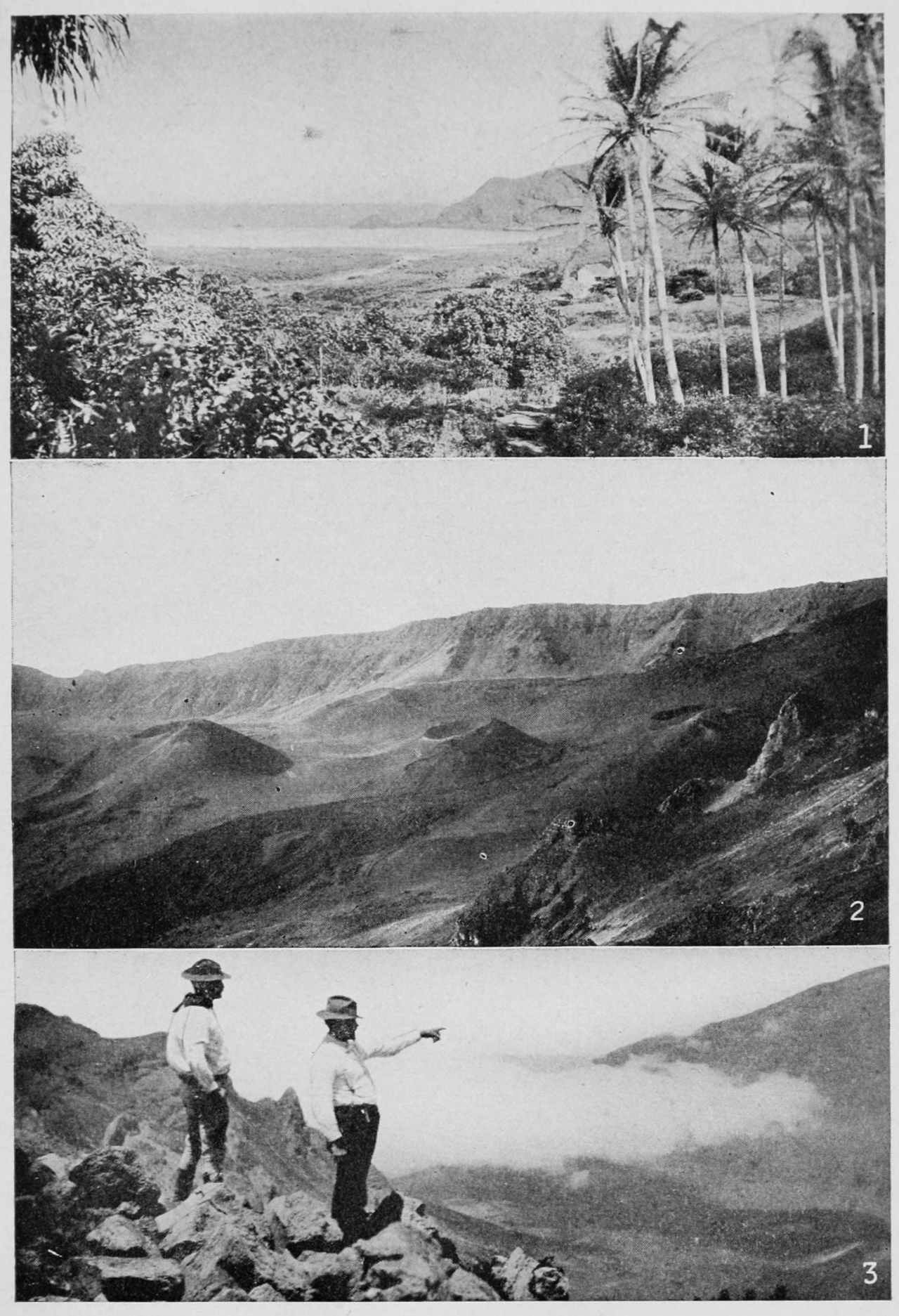
(1) Hana. (2) The Ruin of Haleakala. (3) Von and Kakina.
And then we devoted ourselves to hanging upon the glassy-brittle brink and peering into the crater’s unbelievable depths, which are not sheer but slope with an immensity of sweep that cannot be measured by the eye, so deceptive are the red and jet inclined planes of volcanic sand.
Pointing to an inconsiderable ruddy cone in the floor of the crater, Mr. Thurston said: “You would hardly think that that blowhole is taller than Diamond Head, but it is!” And before there was time to readjust our dazzled minds, he was indicating an apparent few hundred feet of incurving cinder-slope that looked ideal for tobogganing, with the information that it was over a mile in length. A dotted line of hoof prints of some wayward goat strung across its red-velvet surface, and we tossed clinkers of lava over-edge upon unbroken stretches immediately below, to watch the little interrupted trails they traced until the wind should erase them. Only when the men loosened bowlders into the chasm, and we saw them leaving diminishing puffs of yellow ocher dust as they bounded upon the cindrous declivity, could we begin to line up the proportions of the immediate crater-side. Whole minutes were consumed, and minutes upon minutes for those swift projectiles to pass beyond sight.
“And why,” queried Jack, “are we the only ones enjoying this incomparable grandeur? Why aren’t there thousands of people climbing over one another to hang all around the rim of ‘the greatest extinct crater in the world’? Such a reputation ought to be irresistible. Why, there’s nothing on earth so wonderful as this! I should think there wouldn’t be ships enough to carry the tourists, if only for Iao and Haleakala. Perhaps Hawaii doesn’t want them, or need them..... Personally,” he laughed, “I’m glad my wife and I are the only tourists here to-day. And we’re not tourists, thank God!”
Two broad portals there are into the House Built by the Sun, and through them march the warring winds, Ukiukiu and Naulu. In at the northern portal, Ukiukiu drives the trade clouds, mile-wide, like a long line of silent, ghostly breakers, only to have them torn to shreds, as to-day, and dissipated in the warm embrace of the rarefied airs of Naulu. Sometimes Ukiukiu meets with better fortune, and fills the castle with cloud-legions; but ours was the fortune this day, for the crater was swept of all but remnants of floating cloud-dust, and the view was superb.
At last, tearing from the absorbing spectacle, we descended a short way to a stone-walled corral, where the bright-eyed, quiet-mannered cowboys had lunch waiting—a real roughing-it picnic of jerked beef and salt pork, products of the ranch; and hard-poi, called pai’ai, thick and sticky, royal pink-lavender, in a roomy sack. Into this we dug our fists, bringing them out daubed with the hearty substance. It came to me, blissfully licking the pai’ai from my fingers, that this promiscuous delving for poi into one receptacle which obtains among the natives, and which the real kamaaina hesitates not to emulate, is far from the unfastidious custom it is sure to appear upon first sight. “Why, yes—” Jack caught the idea, “you stick your finger into a thick paste, and the finger is withdrawn coated with it. Ergo, your finger has touched nothing of what remains in the pot—or sack.”
Having lunched, we mounted a disgorged litter of bowlders and sharp lava, to the meager crumbling ruins of what are thought to be fortifications built into the side of the mountain by Kamehameha the Great; then, overtopping the verge, slowly we sank into the ruddy depths, by way of the cinder declivities we had speculated upon from our soaring perch. They proved entirely too rough with loose rubble for tobogganing. The horses left sulphur-yellow tracks as they pulled their pasterns from out the bottomless burnt sands, and a golden streamer flew backward from each hoof-fall. So swift was our drop that riders strung out ahead speedily grew very, very small, though distinct, as if seen through the wrong end of a telescope. In the crystal-pure atmosphere each object stood out clean-cut, while an insidious sunburn began to spread over lips and cheeks and noses. Apart from slightly shortened breathing at the summit, we had felt no inconvenience from the elevation.
Thus our caravan straggled into the depths of Haleakala, sometimes a horseman galloping springily across a dark cinderslope in a halo of tawny sun-shot dust, then dropping steeply, his mount nearly sitting; while overhead and behind, on the evanescent path of our making, came the picturesque pack horses and cowboys, and one small patient mule laden with camp comforts. From farthest below rose quaint reiterative chants of hulas, as Louis von Tempsky rode and sang, loose in the saddle, reins on his cow-pony’s neck, debonair and tireless, with a bonny daughter to either side.
Strange is the furnishing of this stronghold of the Sun God. And few are the nooks in it that would invite the tired and parched wayfarer to tarry. For all the beauty of its rose and velvet of distance, there reigns intense desolation, With something sinister in the dearth of plant or animal life. Passing an over-toppling crimson Niagara of dead lava frozen in its fall, we reinvested the silent bleakness with fire and flow and upheaval, until, suddenly whooping into a mad race up the flanks of a big blowhole that had earlier presented its dry throat to our downward scrutiny, we hesitated to look over into the soundless pit, half expecting we knew not what. Nothing happened, of course, though dead volcanoes have been known to resurrect; and we slanted back into the floor of the House, and went on our burning, arid course.
It gives an odd sensation to realize that one is traversing miles literally inside a high mountain. We thought of friends we should have liked to transport abruptly into this unguessable cavity. Oddly enough, as we progressed, it turned out that the warm color, so vivid from the summit, flushes only one side of the cones, like a fever not burned out; although ahead, on the opposite wall, there is a giant scar of perfect carmine.
At last we commenced to wind among crateresque hillocks, clothed with rough growths by the healing millenniums, until, far on, we could just glimpse the Promised Rest of verdure—clustered trees and smiling pasture, where our tents were to be pitched for two nights, while the beasts should graze. But the distance was as deceptive as a mirage, and we had still to endure many a sharp trail across fields of clinking lava, black and fragile as jet, swirled smoothly in the cooling process, and called pahoehoe; while the a-a lava, twisted and tormented into shapes of flame, licked against the blue-enamel sky. I never cease to feel a sense of aghastness before these stiff, upstanding waves of the slow, resistless molten rock, flung stark and frozen like the stilled waters of the Red Sea of old; and here, at the bases of the carven surges, are smooth sandy levels, dotted with shrubs, where one may gallop in and out as if at the bottom of a recessant ocean.
Involved in a maze of lava-flows among small gray cones, the vast aspect of the crater was lost. Still, turning, we could yet discern Magnetic Peak. In every direction the vistas changed from moment to moment; and wonder surged as we tried to grasp the immensity of the moribund volcano and its astounding details. Once we halted at the Bottomless Pit itself—a blowhole in the ground that had leisurely spat liquid rock, flake upon flake, until around its jagged mouth a wall piled up, of material so glassy light that large pieces could easily be broken off. And one must have a care not to lean too heavily, for judged by its noiseless manner of swallowing dropped stones, a human body falling into the well would never be heard after its first despairing cry.
There is but one chance to water animals until camp-ground is reached, and we found the pool dry—auwe! But the kanakas, carrying buckets, scaled the crater wall to a higher basin, from which they sent down a thin stream. One by one the horses drank while we rested in an oasis of long grass, cooling our flaming faces in the shade.
A mile or two more, and we reined up, to the cracking of rifle-shots, under the cliff at Paliku, a fairy nook of a camping spot where Mr. Von and the cowboys, having outdistanced us, were bringing down goat-meat for supper. I was guilty of inward treacherous glee that only one was killed, as that was plenty for our needs; and the spotted kids looked so wonderful upon a wall where we could see no foothold.
Camp had been planned in a luxuriant grove of opala and kolea trees close to the foot of the pali; but the ground being soggy from recent rains, we found better tent-space in the open, where sleek cattle grazed not far off, getting both food and drink from lush grass that grows the year round in this blossoming pocket of the desert. There are sections on the “dry” side of Maui where herds flourish entirely upon prickly cactus, having no other food or moisture. Only the weaker ones succumb to the spines of the cactus, and it is said that there are no finer cattle on the islands than the survivors.
All took a hand in settling camp, we women filling sacks with ferns, to serve as mattresses. The change of exercise was the best thing that could happen to us malihinis, else we might have stiffened from the many hours in saddle.
It was a starved company that smacked its lips at Von’s jerked beef broiling on a stick over a fire at the open tent-flap, behind which the rest of us sat and made ready the service on a blanket. For it is right cold of an evening, nearly 7000 feet in the air—a veritable refrigerating plant in the mansion of the Sun.
I hope, if ever I land in heaven, and it is anything half as attractive as this earth I go marveling upon, that it will not be incumbent upon me to keep a journal. Seeing and feeling are enough to keep one full occupied.
Paliku, to Hana, Maui, July 18.
Too burned and tired to fancy goat-hunting in the rain, Mrs. Thurston and I spent yesterday resting, reading, sleeping, and playing cards in the dripping tent, while our men went with Mr. Von and the girls. The drenching clouds drifted and lifted on the pali, where the sun darted golden javelins through showers until the raindrops broke into a glory of rainbows. Then the brief splendor waned, leaving us almost in darkness at midday, in an increasing downpour.
The hunters returned in late afternoon, wet and weary, but jubilant and successful, eager for supper and a damp game of whist on the blankets. After we had tucked under those same blankets, with shrewdly placed cups to catch the leaks in our soaked tent-roof, we listened to the mellow voices of the Hawaiians singing little hulas and love-songs and laughing as musically.
This morning it was down-tent, and boot and saddle once more; but ere we made our six o’clock get-away, I found a half hour to go prowling to the feet of the pali, to an alluring spot that had been in my eyes since the moment of arrival—a green lap in the gray rock where a waterfall had been. Winning through a thicket, I peeped into a ferny, flowery corner of Elfland at the base of a vertical fall, down which the water had furrowed a shining streak on the polished rock amid fanning ferns and grasses and velvet mosses—a grotto fit for childhood’s imaginings to people with pink and white fairy-folk and brown and green gnomes.
They were slippery trails that led out of the crater and down through Kaupo Gap, chill with Naulu’s drafty onslaught, where Pélé, Goddess of Fire, once broke through the ramparts of the crater and fled forever from Maui to take up her abode on Mauna Loa’s wounded side. But soon out of the clouds we rode and went steaming in the horizontal rays of a glorious sunrise. Again there were glimpses of Mauna Kea and Mauna Loa, supernal in the morning sky, though a trifle more plausible seen from this level.
Down our sure-footed animals dropped into lush meadows, where fat cattle raised their heads to stare; up and down, across crackling lava beds, like wrecked giant stairways balustraded by the cool gray-and-gold palisades of the Gap, from between which we could make out the surfy coast line. Once we had struck the final descent, there were no ups, only downs, for 6000 feet; and several times our saddles, sliding over the withers of the horses, obliged us to dismount and set them back.
On a rocky cliff above the sea we found an early lunch ready and waiting, at the house of a Portuguese-Hawaiian family; and by eleven were cantering easily along green cliffs, past old grass-houses still occupied by natives—a sight fast becoming rare. From one weirdly tattered hut, there rushed a nut-brown, wrinkled woman, old, but with fluffy black hair blown out from wild black eyes, flinging her arms about and crying “Aloha! Aloha!” with peal upon peal of mad sweet laughter.
For several miles the coast was much like that of Northern California, with long points, rimmed by surf, running out into the ocean; but soon we were scrambling up and down gulch-trails. In olden times these clefts were impassable on account of the tremendous rainfall on this eastern shore; and around on the north, or Nahuku side, it averages two hundred inches yearly. (Three years ago it registered as high as four hundred and twenty inches.) So the wise chiefs, somewhere around the sixteenth century, with numerous commoners at their command, had the curt zigzags paved with a sort of cobblestone, without regard to suavity of grade. So the rises and falls of this slippery highway are nothing short of formidable, especially when one’s horse, accustomed to leading, resents being curbed midway of the procession and repeatedly tries to rush past the file where there is no passing-room.
But the animals quickly proved that they could take care of themselves, and we advantaged by this assurance to look our fill upon the beautiful coast and forested mountain. Tiny white beaches dreamed in the sunlight at the feet of the deep indentations, where rivers flowed past banana and cocoanut palms that leaned and swayed in the strong sea breeze, and brown babies tumbled among tawny grass huts; while gay calicoes, hung out to dry, gave just the right note of brilliant color.
Some of the idyllic strands were uninhabited and inviting; and I thought of the tired dwellers of the cities of all the world, who never heard of Windward Maui, where is space, and solitude, and beauty, warm winds and cool, soothing rainfalls, fruit and flowers for the plucking, swimming by seashore and hunting on mountain side, and Mauna Kea over there a little way to gladden eye and spirit. Then, “Mate, are you glad you’re alive?” broke upon my reverie as Jack leaned from his horse on a zigzag above my head.
It would not have seemed like Hawaii if we had not traversed a cane plantation, and halt was made at the Kipahulu Sugar Mill, where one of the horses must have a shoe reset. It would appear that the onyx feet of the unshod horses, that have never worn iron in their lives, stand the wear and tear of the hard travel over ripping lava better than the more pampered ones.
All of the eager train knew from experience that at Hana waited their fodder; and we, in like frame of mind, restrained them not. We had done thirty-five miles when we pulled up before the small hotel—and such miles! Mr. Cooper, manager of Hana Plantation store, called upon us with extra delicacies to eke out the plain hotel fare—avocados, luscious papaias, and little sugary bananas. “Gee!” murmured Jack from the buttery depths of a big alligator pear, “I wish we could grow these things in the Valley of the Moon!”
This village of Hana lies high on the horseshoe of a little blue bay embraced by two headlands, and is fraught with warlike legend and history. In the eighteenth century, King Kalaniopuu, of the old dynasty, whose life was one long bloody battle with other chiefs of Maui for the possession of these eastern districts, held the southern headland of the bay, Kauiki, for over twenty years; then the great Kahekili deprived the garrison of its water supply, and retook the fort, which is an ancient crater. In the time of Kamehameha, it withstood his attacks for two years, after the remainder of Maui had been brought to his charmed heel.
To-night, I know, I shall fall unconscious with, in my ears, the ringing of iron hoofs on stony pathways and the gurgle and plash of waterfalls.
Hana, to Keanae Valley, Maui, July 20.
The Ditch Country—this is the unpoetical, imageless name given to a wonderland that eludes the power of language. An island world in itself, it is compounded of vision upon vision of heights and depths, hung with waterfalls. It is of a gentle grandeur withal, clothed softly with greenest green of tree and shrub and grass, ferns of endless variety, fruiting guavas, bananas, mountain-apples—all in a warm, generous, tropical tangle. It is a Land of Promise for generations to come. All who can sit a Haleakala horse—the best mountain horse on earth—must come some day to feast eyes upon this possession of the United States of America, whose beauty, we are assured of the surprising fact, is unknown save to a few hundred white men exclusive of the engineers of the trail and ditch and those financially interested in the plantations of Windward Maui. And undoubtedly no white foot previously trod here.
The Ditch Country—untrammeled paradise wherein an intrepid engineer yclept O’Shaughnessy, overcame almost unsurmountable odds and put through an irrigation scheme that harnessed the abundant water and tremendously increased the output of the sugar plantations. And to most intents it remains an untrammeled paradise, for what little the transient pilgrim marks of the fine achievement of the Nahiku Ditch is in the form of a wide concrete waterway running for short, infrequent distances in company with a grassy trail before losing itself in Mr. O’Shaughnessy’s difficult tunnels, through which most of its course is quarried.
All manner of Hawaiian timber goes to make up the splendid foresting of this great mountainside, whose top is lost in the clouds; huge koa trees, standing or fallen, the dead swathed in vines, the quick embraced by the ie-ie, a climbing palm that clings only to living pillars, its blossoming tendrils depending in curves like cathedral candelabra; the ohia ai, lighting the prevailing green with its soft, thistle-formed, crimson-brushed blossom, and cherry-red fruit; the ohia lehua, prized for its dark-brown hardwood, but bearing no edible fruit; and the kukui, silver-green as young chestnuts in springtime, trooping up hill and down dale. More than half a hundred varieties of bananas grow from beach to summit of this exotic region. Especially ornamental are the luxuriant tree ferns on their chocolate-hued, hairy pedestals. Many of the ground ferns were familiar—even the gold- and silver-back flourish in Hawaii. Indeed, a collector of Filicales would be in his element in these islands, which own to a large number known nowhere else. Maui alone has a hundred and thirty-odd different kinds.
We nooned on a rubber plantation, where we were entertained at a hospitable luncheon, served by two kimino’d Japanese maids—little bits of pictures off a fan, Jack observed. He, by the way, well-nigh disgraced himself when, replying to a query from the hostess whether or not he liked foreign dishes, he assured her he enjoyed all good food of all countries, with one exception, “nervous” pudding, which he declared made him tremble internally. The words and accompanying gestures were still in the air when a maid entered bearing the dessert, a quivering watermelon-hued dome of gelatine! A horrified silence was broken by a shout of laughter, in which every one joined with relief. But Jack consistently declined any part of the “nervous” confection, saying that he always preferred coffee alone for his dessert.
Armine, to the surprise of father and sister, and my speechless delight, offered to let me ride her superb Bedouin, a young equine prince with movement so springy that he seemed treading in desert sand. We had traveled nearly all day in heavy showers, and were convinced of the accuracy of the figures of Windward Maui’s annual rainfall; for no saddle-slicker was able to turn the searching sky-shot water. But the discomfort of wet garments was lost in rapt attention to the splendor round about. Rightly had our guides assured us that yesterday’s scenery was as nothing compared to this, where the waterfalls ever increased in height and volume, thundering above and sometimes clear over the trail quarried into a wall of rock that towered thousands of feet overhead and a thousand sheer below the narrow foothold. Our brains swam with the whirling, shouting wonder of waters, the yawning depths that opened beneath our feet, filled with froth of wild rivers born of the fresh rains. Jack’s warning was right: I have saved no words for this stunning spectacle.
We reached Keanae Valley tired in body, in eye, in mind—aye, even surfeited with beauty. Once in dry clothing, however, weariness fell from us, and we reclined in rattan chairs on a high lanai, leisurely counting the cataracts that fringed the valley amphitheatre, upon whose turrets the sunset sky, heavy with purple and rose and gold, seemed to rest. We made out thirty-five, some of them dropping hundreds of feet, making hum the machinery in great sugar mills elsewhere. Commercialism in grand Keanae! And yet, it is not out of the way of romance to associate the idea of these natural forces with the mighty enginery that man’s thinking machinery has evolved for them to propel in the performance of his work.[6]
Keanae Valley, to Haleakala Ranch, July 21.
Mr. Von had us stirring by half-past six, after ten hours in bed. So soundly had we been sunk in “the little death in life,” that even a driven rain which soaked our dried riding togs, hanging on chairs in the middle of the room, failed to disturb. We had the novel sensation of shivering in a tropic vale, the while pulling on water-logged corduroy and khaki, even hats being soggy.
Our amiable host and hostess, Mr. and Mrs. Tripp, after serving a breakfast of wild bananas, boiled taro, poi, broiled jerked beef, and fresh milk, bade us Godspeed with tiaras and necklets of ginger-blossoms, and we fared from the mist-wreathed valley and up-trail on horses spurred with knowledge of this last stretch to home stables. The air was ineffably clear, as if from a cleansing bath, with light clouds in the sunny sky to rest the eyes.
More ditch trails and jungle of unwithering green, sparkling wet, and steaming rainbows in the slanting sun-gold of the morning; more and still more stupendous gulches, to make good Mr. Von’s overnight prophecy. And we traversed a succession of makeshift bridges that called for the best caution of the horses who knew every unstable inch. Jack, pacing behind on many-gaited Pontius Pilate, told me afterward that his heart was in his throat to see the slender spans give to the weight and swinging motion of my stout charger, who, never ceasing to fret at being withheld from the lead, pranced scandalously in the most unwise places.
At length we approached a promised “worst and last gulch,” a flood-eroded ravine of appalling beauty, down the pitch of which we slid with bated breath, to the reverberation of hurtling waters on every hand. Obeying Mr. Von’s serious behest, we gathered on the verge of a roaring torrent overflung by a mere excuse for a bridge, not more than four feet wide, about fifty feet long, and innocent of railing. To our left the main cataract sprayed us in its pounding fall to a ledge in the rocky defile where it crashed just under the silly bridge, thence bursting out in deafening thunder to its mightiest plunge seaward.
“Now, hurry and tell Von what you want,” Jack shouted in my ear above the din. And what I wanted was to be allowed to precede the others over this bridge;—oh, not in bravado, believe—quite the contrary. Fact was, I feared to trust the Welshman, justly intolerant of his enforced degradation to the ranks, not to make a headlong rush to overtake his rival, Mr. Von’s horse, should he lead; for a single rider at a time was to be permitted on the swaying structure.
Mr. Von appreciated and consented; and when the order of march was arranged, the Welshman proved his right to leadership; without hesitation, wise muzzle between his exact feet, sniffing, feeling each narrow plank of the unsteady way. It was an experience big with thought—carrying with it an intense sense of aloneness, aloofness from aid in event of disaster, trusting the vaunted human of me without reserve to the instinct and intelligence of a “lesser animal.” The blessed Welshman!—with chaos all about the insecure foothold, trembling but courageous, he won slowly step by step across the white destruction and struck his small fine hoofs into firm ground once more.
With brave, set face Harriet Thurston, who was little accustomed to horses, came next after Mr. Von, and her ambitious but foolhardy steed, midway of the passage, began jogging with eagerness to be at the end, setting up a swaying rhythm of the bridge that sent sick chills over the onlookers, and it was with immense relief we watched him regain solid earth. Pontius Pilate bore Jack sedately, followed by the little girls.
A conception may be gained of the scariness of this adventure through an incident related by Mr. Von. One of his cowboys, noted on Maui for his fearlessness, always first in the pen with a savage bull, and first on the wildest bucking bronco off range, absolutely balked at riding this final test of all our nerve: “I have a wife and family,” he expostulated; then led his horse across.[7]
Kaleinalu, Maui, July 23.
Kaleinalu (Kah-lay-e-nah’-lu), “Wreath of Surf,” the seaside retreat of the Von Tempskys, is but another illustration of the ideal conditions that compose existence in these fabulous isles. We become almost incoherent on the subject of choice of climates and scenery and modes of living to be found from mountain top to shore. One may sleep none too warmly under blankets at Ukulele and Paliku, with all the invigoration of the temperate zone; enjoy mild, variable weather at 2000 to 3000 feet, as at the Ranch house; or lie at sea level, under a sheet or none, caressed by the flowing trade wind. “Watch out, Mate,” Jack warns; “I’m likely to come back here to live some day, when we have gone round the world and back—if I don’t get too attached to the Valley of the Moon.” One ceases not to marvel that the shore-line is not thronged with globe trotters bickering for sand lots. It is an enviable place for old and young, with finest of sand for the babies to play in, and exciting surfing inside protecting reef, for swimmers.
And here we malihinis are resting, after one day of tennis and colt-breaking up-mountain, from our six days in the saddle. Nothing more arduous fills the hours than swinging in hammocks in a sheltered ell of the beach-house, reading, playing whist, swimming in water more exhilarating than at Waikiki, romping, sleeping—and eating, fingering our poi and kukui-nut and lomi’d salmon with the best.
To-morrow we bid good-by to these new friends, who must have sensed our heart of love for them and their wonderland, for they beg us to return, ever welcome, to their unparalleled hospitality. By now we have proudly come into our unexpected own, with a translation of our name into the Hawaiian tongue, worked out by Kakina (Mr. Thurston) and Mr. Von, who speak like natives with the natives, and sometimes with each other, while the speech of the lassies abounds in the pretty colloquialisms of their birth-land.
Always they say pau for connotation of “finish,” “that will do,” “enough”; kokua for help, noun or verb—or, in the sense of approval, or permission; hapai is to carry; hiki no, as we should say “all right,” “very well”; hele mai, or pimai, come here, or go up; one oftenest hears pilikia for trouble, difficulty, or aole pilikia for the harmonious negative; the classic awiwi, hurry, has been superseded by expressive and sharply explosive synonym, wikiwiki; and when the hostess orders a bath prepared, she enunciates auau to the Japanese maids. Most commands, however, are given in mixed English-Hawaiian. The old pure word for food, and to eat, paina, is never heard, for the Chinese kowkow—kaukau in the Hawaiian adaptation—has likewise come to stay.
Peremptory commands often trail off into the engaging eh? that charmed our ears the first day at Pearl Lochs. And so, as I say, upon us has been bestowed the crown of all graciousness accorded upon Maui—the Hawaiian rendering of London, which is Lakana; although how London can be transmuted into Lakana is as much a mystery as the mutation of Thurston into Kakina. At any rate, my pleased partner struts as Lakana Kane (Kane means literally male), while meekly I respond to Lakana Wahine.
Aboard Claudine, Maui to Honolulu, July 24.
From Kahului the passengers were towed on a big lighter to the Claudine rocking well offshore; and, watching Louis von Tempsky’s lean, military figure growing smaller on the receding wharf, we felt a surge of emotion at parting. “He’s all man, that Von,” Jack said, hastily turning away and lighting a cigarette. And in my ears still rang the quaint cadences of his voice, rising from the cinder-slopes of Haleakala, or heard from smoking corral, or hammock on the beach, in little hulas of his own devising.
From the deck we saw his fine beef-cattle towed swimming to the steamer and crowded in the main-deck forward, bound for the Honolulu market. And when the Claudine swept out of the roadstead, we gazed our last, through daylight into dark, upon hoary Haleakala, whose stern head only once looked out from a red sunset smother.
The moon came up like a great electric globe, spilling pools of brilliant light in the pitchy water. At Lahaina the steamer lay off to take aboard a few passengers, and again we saw the infrequent lights of the little quiet town. We could have wished nothing better than once more to disembark at Sleepy Lahaina, and repeat the whole holiday.
Nuuanu Valley, August 1.
It seems that we are to know many homes in Hawaii Nei. Now it is with Mr. and Mrs. Thurston, who have lifted us, bag and baggage, from the August fervency of Waikiki to a cooler site within the “first shower” level of Nuuanu. Here, at the end of a short side street, their roomy house[8] juts from the lip of a ravine worn by a tumultuous watercourse from the Koolau Mountains. And here, on the edge of the city, from the windows, we can see, across fertile plains broken with green hillocks, the blue, velvet masses of the Waianae Range, and, below, can pick out Pearl Lochs and the silvered surf-line of the coast around to Honolulu Harbor.
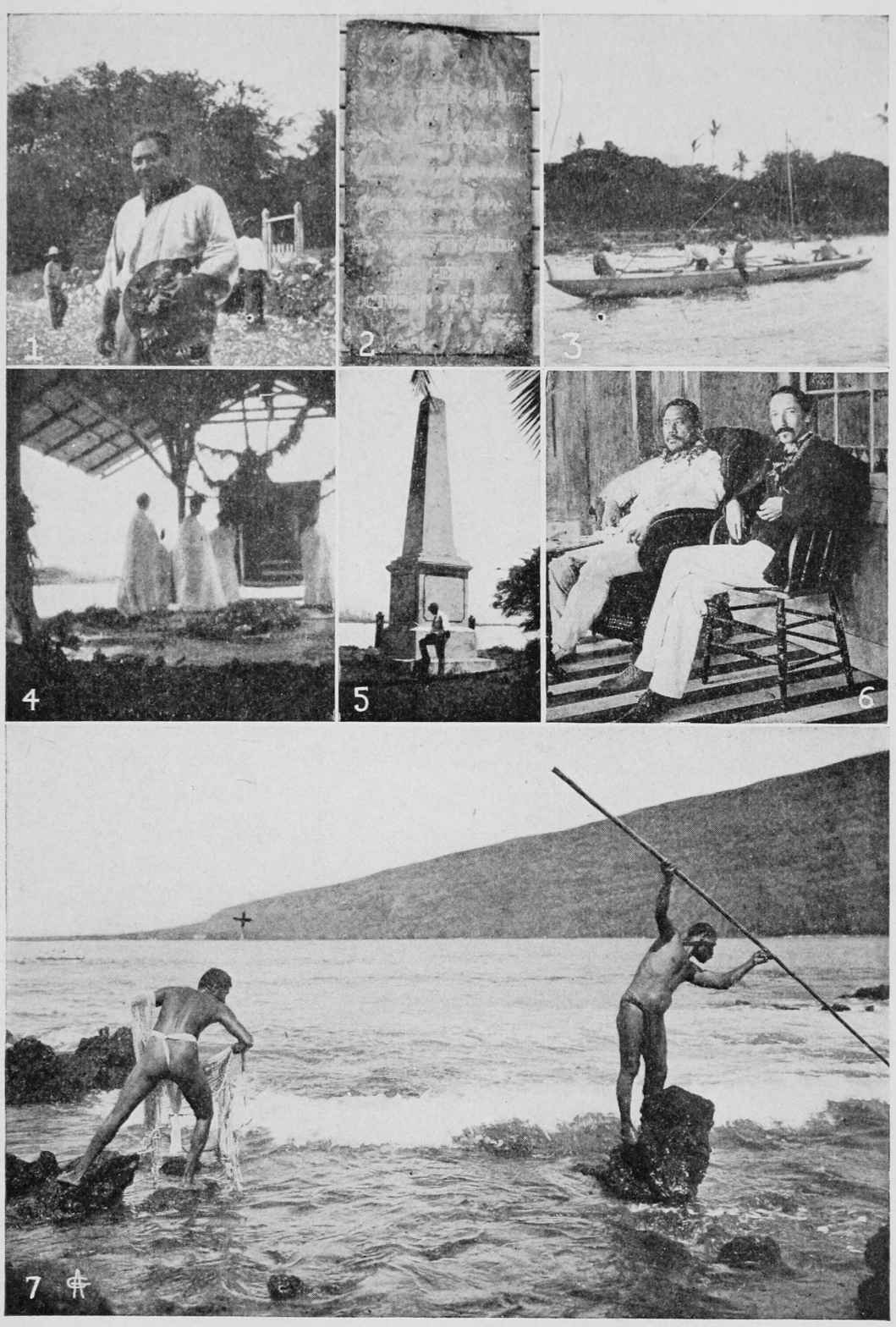
(1) Prince Cupid. (2) Original “Monument.” (3) The Prince’s Canoe. (4) At Keauhou, Preparing the Feast. (5) Jack at Cook Monument. (6) King Kalakaua and Robert Louis Stevenson. (7) Kealakekua Bay—Captain Cook Monument at +.
At table, on a broad lanai, morning, noon and night, can be observed the life of the port, the movement of ships to and from the storied harbors of all the world. One cannot rave too earnestly over this lanai existence, in the ideal climate of Hawaii. Jack, at work, must needs sit with back resolute against the distracting windows that set him dreaming of the future of the Snark.
We are accorded the perfect entertainment of freedom to come and go at our own sweet will, which is the way of the land. At meals, and afterward lounging in hanging-couches and great reclining chairs, we listen rapt to Kakina’s memories of the old regime, from his missionary childhood on through the variable fortunes of the doomed monarchies, in which he bore his important part. And he, wisely reticent except with those he knows are deeply appreciative of the romance and tragedy of the Hawaiian race and dynasties, delves into his mine of information with never a relaxing of attention from us.
Of a late afternoon, Mrs. Thurston and I drive down palmy Nuuanu avenue into the architectural jumble of the business center, picturesque despite its unbeautiful buildings, what of foreign shops and faces and costumes. Here we abstract her husband from the Advertiser editorial sanctum, and Jack from the barber’s shop; afterward driving for an hour in the bewilder of wandering hibiscus byways and narrow streets, where hide, in a riot of foliage, the most exquisite old cottages of both native and foreign citizens. Thus we become acquainted with the city known and loved until death by travelers like Isabella Bird, whose book still holds place, with me, as the sweetest interpretation of the Hawaii we have so far seen.
One evening we left behind the homes that stray over the lower slopes of the purple-rosy, time-worn crater of Punch Bowl, Puowaina; wound up past the Portuguese settlement that hangs, overgrown with gayest flowers, on haphazard rock terraces, and ascended through a luxuriant growth of blossoming, fruiting cactus, to the height of five hundred feet, where we stood at the mouth of the perfect crater basin that had suggested the name of Punch Bowl. This cone, blown out by a comparatively recent, final upheaval between the spurs of the older peaks and the Pacific, standing isolated as it does, we now realize should be visited early in one’s sojourn in Honolulu, for it is a remarkable point from which to orient oneself to the city’s topography. And lo, a white speck on the water-front, we could make out the Snark, moored opposite a leviathan black freighter. From the mauka edge of the Bowl we looked up Pauoa, one of the wooded vales that rend Honolulu’s lofty background, flanked with sharp green ridges.
For the present, although we miss the convenient swimming of Waikiki, welcome indeed is this chance to acquaint ourselves with other phases of this Paradise at the cross-roads of the Pacific.
August 4.
“Mate, you know, or I think you know, how little figure fame cuts with me, except in so far as it brings you and me the worth-while things—the free air and earth, sky and sea, and the opportunities of knowing worth-while people.” Thus Jack, descanting upon some of the rare privileges that money cannot buy but which his work has earned him in all self-respect. This leads to the observation that in this community composed of groups of the closest aristocracies in the world, bar none, to quote Jack’s sober judgment, mere wealth cannot buy the favor of their hospitality. It is a well-recommended tourist who ever sees behind into the kamaaina social atmosphere of Honolulu. And of all the exclusive spirit manifested by the kamaainas, none is more difficult to conquer than that of the elder Hawaiian and part-Hawaiian families.
So it was with quiet gratification that we two set out upon an invitation to the out-of-town retreat of Mr. and Mrs. Henry Macfarlane, members of the same family with whom we have come in contact from time to time, since the day we first shook the Commodore’s hand in Pearl Lochs.
Our way lay over the Pali, and this second view lost none of the glamorous memory of the former. Now that I have seen other parts of Hawaii, I find that no comparison can be made. Nuuanu Pali stands unique.
Descending the zigzags to the main drive, we soon turned off to the left and rolled over the red loops of a branch road to the very base of the Mirrored Mountains, where nestles Ahuimanu, “Refuge of Birds.” It is a beauteous spot, more than faintly Spanish in suggestion, where an old house, in sections connected by arbors, rambles about a court of green lawn that terraces down to the hospitable gate. The Spanish-mission effect of the low architecture is enhanced by the fact that it occupies the site of a Catholic institution, built by the first French Bishop of Honolulu as a place where he might retire for meditation and prayer. A short distance behind the present buildings the precipitous mountain rises until its head is lost in the clouds. Somewhere on its face, reached by a stiff trail, hides a pocket, a small, green solitude, called the Bishop’s Garden. From this the climb is so steep that it is said none but the olden natives could surmount it, and one young priest lost his life making the attempt.
Adown the terraced walk, with this background of romance and stern beauty, stepped our part-Hawaiian hostess with the inimitable stately bearing of her chiefly kind, clad in flowing white holoku; and a little behind walked her daughter, Helen, as stately and graceful if more girlishly slender. Our welcome was of a warmth and courtesy that still further bore out the Spanish air of the place. But Hawaiian manners and hospitality were never patterned upon the Spanish nor any other; they are original, and as natural to these gracious souls as the breath of their nostrils.
In bathing attire we all emerged from our rooms that opened upon a low flagged veranda, and went barefoot along a grassy pathway wet with a fresh rain shot from the near clouds which hid the upstanding heights, to a large cement pool fed from a waterfall. The sun had dropped untimely behind the valley wall, while the air was anything but summery in this nook where daylight is of short duration; but the shock of cold water sent blood and spirit a-tingling. Before we had finished a game of water-tag, there was a merry irruption of young cousins from the city, several of whom we greeted as acquaintances. Boys and girls, in haole swimming suits or muumuus, they turned the tranquil late-afternoon into a rollicking holiday, some making directly for the pool, others playing hand ball, and all wasting no moment of their youth and high spirits while the light lasted.
In the absence of her husband, Mrs. Macfarlane presided at the head of a long table that nearly filled the low-ceilinged, oblong room in a wing of the old house, and the more racket the hungry swarm raised, the more benignly she beamed. The greater the number of guests and their appetite, the greater the content of the Hawaiian-born.
Following dinner, we sat or lay about in the soft-illumined living-room, gone all the bashful reserve that unknowing ones mistake for superciliousness in the Hawaiian. Mrs. Macfarlane we coaxed from smiling confusion to talk of her family’s interesting present and past, members of whom, Cornwells and Macfarlanes, served in honored capacities under the crowned heads of the country, as late as Queen Liliuokalani’s interrupted reign.
In a comprehensive window seat some of the young men sprawled reading magazines, and a quartet at the card-table was oblivious to all comforts of deep easy-chairs, pillowed floor-nooks, and indoor hammocks. One golden-eyed boy on a scarlet hassock strummed an ukulele to a low song to his lady-love. She, from the cushioned recess of a hanging-chair, gazed back langurously out of great soft Hawaiian eyes—lovely as an exotic blossom, in her long, clinging holoku of rose-flowered silken stuff. Oh, we were very Spanish this night—and all-Hawaiian.
And yet, there is but a trace of the Hawaiian stock in any of these—like Jack’s French, or my own Spanish strain—an eighth, perhaps, a sixteenth, a thirty-second; but the modicum of native blood that they are heir to lends them their pleasant lack of sharp edges. Among such one is gentled and loved into thinking well of oneself and all mankind.
“I have Aloha nui loa for them, forever,” Jack murmured as we pattered over the brick pave of the fragrant arbor to the quaint bedroom whose small-paned windows might have looked out upon a New England landscape.
At six we were roused by the shouting clan trooping to the pool, and the indefatigable Jack rose to write for a couple of hours before breakfast, on his Maui article, “The House of the Sun.” By nine, with dewy cables of roses about our shoulders, unwillingly we bade farewell to the household, and drove under a lovely broken sky to the foot of the Nuuanu Pali. Here, as much for the experience of climbing the up-ended ridges as to ease the burden of the horses, we left the carriage to meet it at the pass. Except for a short climb I once made at Schynige Platte in Switzerland, this wet path, lying straight up an extremely narrow hog-back, was the steepest and most difficult of my life. The ground drops with startling suddenness on either hand—or foot; and for me it was not infrequently both hand and foot. But we won over the horses, and had leisure at the drafty platform once more to feast our unsatiated eyes on the wide beauty of that scene which never can tire.
My husband, who holds that it is a waste of valuable effort to shave himself when he might be enjoying the soothing ministrations of a specialist, went to the barber in town while I shopped in the fascinating Japanese, Chinese, Portuguese, and East Indian stores, always with an eye to the fine Filipino and other embroideries, pina or pineapple cloth, of exquisite tints, and unusual and gorgeous stuffs worn by the oriental women in Honolulu—silk and wool and mysterious fibers impossible to buy in the States, as there is no demand. And the heart feminine thrills not in vain over kimonos and mandarin coats, for the prices are absurdly cheap, and the colors food for the eye, with untold possibilities for household as well as personal decoration.
From little houses and huts on the rolling fields, parties of natives, men, women, old and young, and naked brown imps of babies, gather to bathe—always the favorite sport—in a rocky basin of the verdant ravine. From the balconies of the big house often we watch them playing, in gaudy, wet-clinging muumuus, unaware of any haole observer—their carefree, childlike selves, splashing, diving, laughing and singing, laundering their hair, and calling to one another in wild, sweet gutturals. This afternoon we were struck with a new note—a strange, savage chanting. In it there was distinct, accentuated rhythm, but no music as we understand the term—only the harsh, primitive voicing of a man with the noble, grayed head of the old Hawaiians. Listening to the curious untamed note, the like of which we had never heard, Mr. Thurston said: “You are lucky to hear it under these circumstances—when the old fellow thinks no one but his own people are listening. He is probably intoning the oli, genealogy of one of the swimmers. There was no music, what we would call music, until the missionaries brought it here.”
In the sudden transition from the ancient tabu system to an entirely changed order that came with the death of Kamehameha I in 1819, followed by the arrival from Boston a year later of the first missionaries, the old “singing” became obsolescent. The new music, with its pa, ko, li, conforming to our do, re, mi, was taken up by everyone, soon becoming universal with these people who learned with such facility; and out of the simple, melodious Christian hymning, the natives evolved a music inoculated with their primal rhythms, that has become uniquely their own. Captain James King, who sailed with Captain Cook on his disastrous last voyage, makes the interesting statement that the men and women chanted in parts.
The predominance of vowel and labial sounds lends a distinct character to the tone-quality of Polynesian language, lacking, as it does our consonants, b, c, s and d, f, g, j, q, x, and z, so that the upper cavities of the throat are not called into full play. Therefore the voice, with its Italian vowels, developed a low and sensuous quality that, when strained for dramatic or passional expression, breaks into the half-savage, barbaric tones that stir the ferine blood lying so close to the outer skin of the human. Sometimes there is a throaty musical gurgle that seems a tone-language out of the very tie-ribs of the human race.
The phrasing was made by old Hawaiians to suit the verse of the mélé, a sort of chanted saga, and not to express a musical idea. The cadencing was marked by a prolonged trilling or fluctuating movement called i’i, in which the tones rose and fell, touching the main note that formed the framework of the chant, repeatedly springing away for short intervals—a half-step or even less. In the hula the verses are shorter, with a repetitional refrain of the last phrase of each stanza. That full-throated, lissom-limbed girl at the christening feast on the peninsula illustrated much of the foregoing when she sang for the dancers.
With a pleasant thrill I looked forward to meeting Alice Roosevelt Longworth at a dinner and dance given this evening at the Seaside. In one’s imagination she seems the epitome of the American Girl, and I found her far more beautiful than her pictures, with eyes wide apart, unafraid and level, looking like topazes from across the table in a glow of yellow candleshades upon yellow roses. And when “Princess Alice” smiles, she smiles, with eyes as well as lips. There is inner as well as outer poise about her brown-golden head, and she is straight as a young Indian and fair as a lily.
She and Jack were in no time cheek-by-jowl in a heated argument upon “nature-faking” that would have delighted, by proxy, her illustrious father, with whom Jack has all these weeks been tilting in the press; and I heard him offering to back a bull-dog against the Colonel’s wolf-dog, in the latter’s back yard!
I sat between Nicholas Longworth and “Jack” Atkinson, and our talk at table—strange subject for a banquet—was largely concerned with the welfare of the Leper Settlement, in which both Mr. Longworth and Mr. Atkinson are extraordinarily interested.
The Longworths were scheduled to serve on the committee receiving Secretary Strauss and his party from Washington; and though Jack and I first begged off from attending the formal occasion, when we learned it was to be in the old throne room of the Palace, we decided to go. Mr. Atkinson whirled us away to the Executive Building, standing in its illuminated gardens, and soon we were passing along the dignified line of those receiving, out of which Mrs. Longworth, who is refreshingly unbound by convention, temporarily strayed to bombard Jack with a new argument in favor of the wolf-dog she had essayed to champion against his imaginary bull-pup.
But what snared our fancy on this occasion was not the gathering of American statesmen and their bejeweled ladies, nor the impressive meeting between Secretary Strauss from Washington and Governor Carter of Hawaii. Our eyes were most often with the throng of high-caste Hawaiians in the lofty hall, more especially the queenly women, gowned in their distinguishing and distinguished white holokus, standing proud-bosomed, gazing with their beautiful eyes of brown at the white-and-gold girl who is the daughter of their alien ruler, President Theodore Roosevelt. We wondered what memories were in their brains as they recalled other brilliant occasions when they had filed by the imposing crimson throne yonder, to bow kissing the hands of their hereditary kings, and their last queen. She, H. R. H. Liliuokalani, has resolutely declined all invitations whatsoever to this house of her royal triumph and her humiliating imprisonment, since 1895, the year of her formal renouncement of all claim to the crown, and her appeal for clemency to those who had taken part in the insurrection.