"The Red Fawn of the Flower Land" (continued 4)
Reading edition
“Oh! that we need not fear.”
“Well—with him once in our power the opposition will be crushed—the rest will yield easily—for, beyond doubt, it is he that now intimidates and hinders them from signing.”
“True,” replied Clinch in a reflective tone; “but how about the government, eh? Will it endorse the act, think you?”
“It will—it must—my latest dispatch from the President almost suggests as much. If you agree to act, I shall take the risk.”
“Oh, I place myself under your orders,” replied the commander-in-chief, evidently inclined to the commissioner’s views, but still not willing to share the responsibility. “It is but my duty to carry out the will of the executive. I am ready to coöperate with you.”
“Enough then—it shall be done as we have designed it. Ask the chiefs,” continued the speaker, addressing himself to me, “ask them, if they have any fear of signing to-morrow.”
“No—not of the signing, but afterwards.”
“And what afterwards?”
“They dread an attack from the hostile party—their lives will be in danger.”
“What would they have us do?”
“Omatla says, if you will permit him and the other head chiefs to go on a visit to their friends at Tallahassee, it will keep them out of danger. They can stay there till the removal is about to take place. They give their promise that they will meet you at Tampa, or elsewhere, whenever you summon them.”
The two generals consulted together—once more in whispers. This unexpected proposal required consideration.
Omatla added:
“If we are not allowed to go to Tallahassee, we cannot, we dare not, stay at home; we must come under the protection of the fort.”
“About your going to Tallahassee,” replied the commissioner, “we shall consider it, and give you an answer to-morrow. Meanwhile, you need not be under any apprehension. This is the war-chief of the whites; he will protect you.”
“Yes,” said Clinch, drawing himself proudly up. “My warriors are numerous and strong. There are many in the fort, and many more on the way. You have nothing to fear.”
“It is good!” rejoined the chiefs. “If troubles arise, we shall seek your protection; you have promised it—it is good.”
“Ask the chiefs,” said the commissioner, to whom a new question had suggested itself—“ask them if they know whether Holata Mico will remain for the council of to-morrow.”
“We cannot tell now. Holata Mico has not declared his intention. We shall soon know it. If he designs to stay his tents will stand till the rising of the sun; if not, they will be struck before the moon goes down. The moon is sinking—we shall soon know whether Holata Mico will go or stay.”
“The tents of this chief are not within sight of the fort?”
“No—they are back among the trees.”
“Can you send word to us?”
“Yes, but only to this place; our messenger would be seen entering the fort. We can come back here ourselves, and meet one from you.”
“True—it is better so,” replied the commissioner, apparently pleased with the arrangement.
A few minutes passed, during which the two generals communicated with each other in while whispers, the chiefs stood apart, silent and immobile as a pair of statues.
The commander-in-chief at length broke the silence:
“Lieutenant! you will remain upon the ground till the chiefs return. Get their report, and bring it direct to my quarters.”
Salutations were exchanged; the two generals walked off on the path that led to the fort, while the chiefs glided silently away in the opposite direction. I was left alone.
Note 1. So Lusta Hajo was called by the Americans. His full name was Fuchta-Lusta-Hajo, which signifies “Black Crazy Clay.”
Note 2. A name given to the Micosaucs, from their custom of setting up red poles in front of their houses when going to war. A similar custom exists among other tribes; hence the name “Baton Rouge,” applied by the French colonists.
Chapter Thirty Two.
Shadows in the Water.
Alone with my thoughts, and these tainted with considerable acerbity. More than one cause contributed to their bitterness. My pleasant purpose thwarted—my heart aching for knowledge—for a renewal of tender ties—distracted with doubts—wearied with protracted suspense.
In addition to these, my mind was harassed by other emotions I experienced disgust at the part I had been playing. I had been made the mouth-piece of chicanery and wrong; aiding conspiracy had been the first act of my warlike career; and although it was not the act of my own will, I felt the disagreeableness of the duty—a sheer disgust in its performance.
Even the loveliness of the night failed to soothe me. Its effect was contrary; a storm would have been more congenial to my spirit.
And it was a lovely night. Both the earth and the air were at peace.
Here and there the sky was fleeced with white cirrhi, but so thinly, that the moon’s disk, passing behind them, appeared to move under a transparent gauze-work of silver, without losing one ray of her effulgence. Her light was resplendent in the extreme; and, glancing from the glabrous leaves of the great laurels, caused the forests to sparkle, as though beset with a million of mirrors. To add to the effect, fire-flies swarmed under the shadows of the trees, their bodies lighting up the dark aisles with a mingled coruscation of red, blue and gold—now flitting in a direct line, now curving, or waving upward and downward, as though moving through the mazes of some intricate cotillon.
In the midst of all this glittering array, lay the little tarn, shining, too, but with the gleam of plated glass—a mirror in its framework of fretted gild.
The atmosphere was redolent of the most agreeable perfumes. The night was cool enough for human comfort, but not chill. Many of the flowers refused to close their corollas—for not all of them were brides of the sun. The moon had its share of the sweets. The sassafras and bay-trees were in blossom, and dispensed their odours around, that, mingling with the aroma of the aniseed and the orange, created a delicious fragrance in the air.
There was a stillness in the atmosphere, but not silence. It is never silent in the southern forests by night. Tree-frogs and cicadas utter their shrillest notes after the sun has gone out of sight, and there is a bird that makes choice melody during the moonlight hours—the famed mimic of the American woods. One, perched upon a tall tree that grew over the edge of the pond, appeared trying to soothe my chafed spirit with his sweet notes.
I heard other sounds—the hum of the soldiery in the fort, mingling with the more distant noises from the Indian camp, now and then some voice louder than the rest, in oath, exclamation, or laughter, broke forth to interrupt the monotonous murmur.
How long should I have to wait the return of the chiefs? It might be an hour, or two hours, or more? I had a partial guide in the moon. They said that Holata would depart before the shining orb went down, or not at all. About two hours, then, would decide the point, and set me free.
I had been standing for half the day. I cared not to keep my feet any longer; and choosing a fragment of rock near the water’s edge, I sat down upon it:
My eyes wandered over the pond. Half of its surface lay in shadow; the other half was silvered by the moonbeams, that, penetrating the pellucid water, rendered visible the white shells and shining pebbles at the bottom. Along the line where the light and darkness met, were outlined several noble palms, whose tall stems and crested crowns appeared stretching towards the nadir of the earth—as though they belonged to another and a brighter firmament beneath my feet. The trees, of which these were but the illusory images, grew upon the summit of a ridge, which, trending along the western side of the pond, intercepted the rays of the moon.
I sat for some time gazing into this counterpart of heaven’s canopy, with my eyes mechanically tracing the great fan-like fronds.
All at once, I was startled at perceiving a new image upon the aqueous reflector. A form, or rather the shadow of one, suddenly appeared among the trunks of the palms. It was upright, and evidently human, though of magnified proportions—beyond a doubt, a human figure, yet not that of a man.
The small head, apparently uncovered, the gentle rounding of the shoulders, the soft undulation of the waist, and the long, loose draping which reached nearly to the ground, convinced me that the shadow was that of a woman.
When I first observed it, it was moving among the stems of the palm-trees; presently it stopped, and for some seconds remained in a fixed attitude. It was then I noted the peculiarities that distinguish the sex.
My first impulse was to turn round, and, if possible, get a sight of the figure that cast this interesting shadow. I was myself on the western edge of the pond, and the ridge was behind me. Facing round I could not see the summit nor yet the palms. Rising to my feet, I still could not see them: a large live-oak, under which I had seated myself, intercepting my view.
I stepped hastily to one side, and then both the outline of the ridge and the palm-trees were before my eyes; but I could see no figure, neither of man nor woman.
I scanned the summit carefully, but no living thing was there; some fronds of the saw-palmetta, standing along the crest, were the only forms I could perceive.
I returned to where I had been seated; and, placing myself as before, again looked upon the water. The palm shadows were there, just as I had left them; but the image was gone.
There was nothing to be astonished at. I did not for a moment believe myself under any delusion. Some one had been upon the ridge—a woman, I supposed—and had passed down under the cover of the trees. This was the natural explanation of what I had seen, and of course contented me.
At the same time, the silent apparition could not fail to arouse my curiosity; and instead of remaining seated, and giving way to dreamy reflections, I rose to my feet, and stood looking and listening with eager expectation.
Who could the woman be? An Indian, of course. It was not probable that a white woman should be in such a place, and at such an hour. Even the peculiar outlines of the shadow were not those that would have been cast by one habited in a garb of civilisation: beyond a doubt, the woman was an Indian.
What was she doing in that solitary place, and alone?
These questions were not so easily answered; and yet there was nothing so remarkable about her presence upon the spot. To the children of the forest, time is not as with us. The hours of the night are as those of the day—often the hours of action or enjoyment. She might have many a purpose in being there. She might be on her way to the pond for water—to take a bath; or it might be some impassioned maiden, who, under the secret shadows of this secluded grove, was keeping assignation with her lover.
A pang, like a poisoned arrow, passed through my heart: “might it be Maümee?”
The unpleasantness which this conjecture caused me is indescribable. I had been all day the victim of dire suspicions, arising from some half-dozen words, casually dropped from the lips of a young officer, and which I had chanced to overhear. They had reference to a beautiful girl among the Indians, apparently well-known at the fort; and I noticed that the tone of the young fellow was that of one either triumphant or boasting. I listened attentively to every word, and watched not only the countenance of the speaker, but those of his auditory—to make out in which of the two categories I should place him. His vanity appeared to have had some sacrifice made to it—at least by his own statement; and his listeners, or most of them, agreed to concede to him the happiness of a bonne fortune. There was no name given—no hint that would enable me to connect the subject of the conversation with that of my own thoughts; but that the girl was an Indian, and a “beauty,” were points, that my jealous heart almost accepted as sufficient for identification.
I might easily have become satisfied. A word, a simple question, would have procured me the knowledge I longed for; and yet I dared not say that word. I preferred passing long hours—a whole day—upon the rack of uncertainty and suspicion.
Thus, then, was I prepared for the painful conjectures that sprang into my thoughts on beholding that mirrored form.
The pain was of short duration; almost instantaneous was the relief. A shadowy figure was seen gliding around the edge of the pond; it emerged into the open moonlight, not six paces from where I stood. I had a full and distinct view of it. It was a woman—an Indian woman. It was not Maümee.
Chapter Thirty Three.
Haj-Ewa.
I saw before me a woman of middle age—somewhere between thirty and forty—a large woman, who once possessed beauty—beauty that had been abused. She was the wreck of a grand loveliness, whose outlines could not be effaced—like the statue of some Grecian goddess, broken by Vandal hands, but whose very fragments are things of priceless value.
Not that her charms had departed. There are men who affect to admire this ripe maturity; to them, she would have been a thing of peerless splendour. Time had made no inroad upon those large rounded arms, none upon the elliptical outlines of that noble bust. I could judge of this—for it was before my eyes, in the bright moonlight, nude, from neck to waist, as in the hour of infancy. Alone the black hair, hanging in wild dishevelment over the shoulders, formed a partial shrouding. Nor had time laid a finger upon this: amidst all that profusion of rich raven clusters, not a strand of silver could be detected.
Time could not affect, nor had it, that fine facial outline. The moulding of the chin; the oval of those lips; the aquiline nose, with its delicate spirally curved nostril; the high, smooth front; the eye—the eye—what is it? why that unearthly flash? that wild unmeaning glance? Ha! that eye—Merciful heavens! the woman is mad!
Alas! it was true—she was mad. Her glance would have satisfied even a casual observer, that reason was no longer upon its throne. But I needed not to look at her eye; I knew the story of her misfortunes, of her wrongs. It was not the first time I had looked upon that womanly form—more than once I had stood face to face with Haj-Ewa (Note 1), the mad queen of the Micosaucs.
Beautiful as she was, I might have felt fear at her presence—still worse than fear, I might have been terrified or awed—the more so on perceiving that her necklace was a green serpent; that the girdle around her waist, that glittered so conspicuously in the light of the moon, was the body of an enormous rattlesnake, living and writhing!
Yes, both were alive—the smaller serpent wound about her neck, with its head resting upon her bosom; the more dangerous reptile knotted around her waist, its vertebrated tail hanging by her side, while its head, held in her hand, protruding through her fingers, exhibited a pair of eyes that scintillated like diamonds.
On the head of Haj-Ewa was no other covering than that which nature had provided for it; but those thick black clusters afforded ample protection against sun and storm. On her feet she wore moccasins, but those were hidden by the long “hunna,” that reached to the ground. This was the only garment she wore. It was profusely adorned with beads and embroidery—with the bright plumage of the green parroquet—the skin of the summer-duck, and the for of various wild animals. It was fastened round her waist, though not by the girdle already described.
Truly, I might have felt terror, had this singular appearance been new to me. But I had seen all before—the green snake, and the crotalus, the long hanging tresses, the wild flash of that maniac eye—all before, all harmless, all innocuous—at least to me. I knew it, and had no fear.
“Haj-Ewa!” I called out, as she advanced to where I was standing.
“I-e-ela!” (an expression of astonishment, usually lengthened out into a sort of drawl) exclaimed she with a show of surprise.
“Young Randolph! war-chief among the pale-faces! You have not then forgotten poor Haj-Ewa?”
“No, Ewa, I have not. What seek you here?”
“Yourself, little mico.”
“Seek me?”
“No—I have found you.”
“And what want you with me?”
“Only to save your life, your young of life, pretty mico—your fair life—your precious life—ah! precious to her, poor bird of the forest! Ah! there was one precious to me—long, long ago. Ho, ho, ho!
“O why did I trust in a pale-faced lover? Ho, ho, ho! (Literally, Yes, yes, yes!) Why did I meet him in the wild woods’ cover? Ho, ho, ho! Why did I list to his lying tongue, That poisoned my heart when my life was young? Ho, ho, ho!
“Down, chitta mico!” (Note 1) she cried, interrupting the strain, and addressing herself to the rattlesnake, that at my presence had protruded his head, and was making demonstrations of rage—“down, great king of the serpents! ’tis a friend, though in the garb of an enemy—quiet, or I crush your head!”
“I-e-ela!” she exclaimed again, as if struck by some new thought; “I waste time with my old songs; he is gone, he is gone! they cannot bring him back. Now, young mico, what came I for? what came I for?”
As she uttered these interrogatives, she raised her hand to her head, as if to assist her memory.
“Oh! now I remember. Hulwak (it is bad). I lose time. You may be killed, young mico—you may be killed, and then—Go! begone, begone, begone! back to the topekee (fort). Shut yourself up; keep among your people: do not stray from your blue soldiers; do not wander in the woods! Your life is in danger.”
All this was spoken in a tone of earnestness that astonished me. More than astonished, I began to feel some slight alarm, since I had not forgotten the attempted assassination of yesterday. Moreover, I knew that there were periods when this singular woman was not positively insane. She had her lucid intervals, during which she both talked and acted rationally, and often with extraordinary intelligence. This might be one of those intervals. She might be privy to some scheme against my life, and had come, as she alleged, to defeat it.
But who was my enemy or enemies? and how could she have known of their design?
In order to ascertain this, I said to her:
“I have no enemy, Ewa; why should my life be in danger?”
“I tell you, pretty mico, it is—you have enemies. I-e-ela! you do not know it?”
“I never wronged a red man in my life.”
“Red—did I say red man? Cooree (boy), pretty Randolph, there is not a red man in all the land of the Seminoles that would pluck a hair from your head. Oh! if they did, what would say the Rising Sun? He would consume them like a forest fire. Fear not the red men—your enemies are not of that colour.”
“Ha! not red men? What, then?”
“Some white—some yellow.”
“Nonsense, Ewa! I have never given a white man cause to be my enemy.”
“Chepawnee (fawn) you are but a young fawn, whose mother has not told it of the savage beasts that roam the forest. There are wicked men who are enemies without a cause. There are some who seek your life, though you never did them wrong.”
“But who are they? And for what reason?”
“Do not ask, chepawnee! There is not time. Enough if I tell you, you are owner of a rich plantation, where black men make the blue dye. You have a fair sister—very fair. Is she not like a beam from yonder moon? And I was fair once—so he said. Ah! it is bad to be beautiful Ho, ho, ho!
“Why did I trust in a pale-faced lover? Ho, ho, ho! Why did I meet him—
“Hulwak!” she exclaimed, again suddenly breaking off the strain: “I am mad; but I remember. Go! begone! I tell you, go: you are but an echochee (fawn), and the hunters are upon your trail. Back to the topekee—go! go!”
“I cannot, Ewa; I am here for a purpose; I must remain till some one comes.”
“Till some one comes! hulwak! they will come soon.”
“Who?”
“Your enemies—they who would kill you; and then the pretty doe will bleed—her poor heart will bleed: she will go mad—she will be like Haj-Ewa.”
“Whom do you speak of?”
“Of—Hush! hush! hush! It is too late—they come—they come! see their shadows upon the water!”
I looked, as Haj-Ewa pointed. Sure enough there were shadows upon the pond, just where I had seen hers. They were the figures of men—four of them. They were moving among the palm-trees, and along the ridge.
In a few seconds the shadows disappeared. They who had been causing them had descended the slope, and entered among the timber.
“It is too late now,” whispered the maniac, evidently at that moment in full possession of her intellect. “You dare not go out into the open woods. They would see you—you must stay in the thicket. There!” continued she, grasping me by the wrist, and, with a powerful jerk, bringing me close to the trunk of the live-oak: “this is your only chance. Quick—ascend! Conceal yourself among the moss. Be silent—stir not till I return. Hinklas!” (It is good—it is well.)
And so saying, my strange counsellor stepped back under the shadow of the tree; and, gliding into the umbrageous covert of the grove, disappeared from my sight.
I had followed her directions, and was now ensconced upon one of the great limbs of the live-oak—perfectly hidden from the eyes of any one below by festoons of the silvery tillandsia. These, hanging from branches still higher up, draped around me like a set of gauze curtains, and completely enveloped my whole body; while I myself had a view of the pond—at least, that side of it on which the moon was shining—by means of a small opening between the leaves.
At first I fancied I was playing a very ridiculous rôle. The story about enemies, and my life being in danger, might, after all, be nothing more than some crazy fancy of the poor maniac’s brain. The men, whose shadows I had seen, might be the chiefs on their return. They would reach the ground where I had appointed to meet them, and not finding me there, would go back. What kind of report should I carry to head-quarters? The thing was ridiculous enough—and for me, the result might be worse than ridiculous.
Under these reflections, I felt strongly inclined to descend, and meet the men—whoever they might be—face to face.
Other reflections, however, hindered me. The chiefs were only two—there were four shadows. True, the chiefs might be accompanied by some of their followers—for better security to themselves on such a traitorous mission—but I had noticed, as the shadows were passing over the pond—and notwithstanding the rapidity with which they moved—that the figures were not those of Indians. I observed no hanging drapery, nor plumes. On the contrary, I fancied there were hats upon their heads, such as are worn only by white men. It was the observation of this peculiarity that made me so ready to yield obedience to the solicitations of Haj-ewa.
Other circumstances had not failed to impress me: the strange assertions made by the Indian woman—her knowledge of events, and the odd allusions to well-known persons—the affair of yesterday: all these, commingling in my mind, had the effect of determining me to remain upon my perch, at least for some minutes longer. I might be relieved from my unpleasant position sooner than I expected.
Without motion, almost without breathing, I kept my seat, my eyes carefully watching, and ears keenly bent to catch every sound.
My suspense was brief. The acuteness of my eyes was rewarded by a sight, and my ears by a tale, that caused my flesh to creep, and the blood to run cold in my veins. In five minutes’ time, I was inducted into a belief in the wickedness of the human heart, exceeding in enormity all that I had ever read or heard of.
Four demons filed before me—demons, beyond a doubt: their looks, which I noted well—their words, which I heard—their gestures, which I saw—their designs, with which I in that hour became acquainted—fully entitled them to the appellation.
They were passing around the pond. I saw their faces, one after another, as they emerged into the moonlight.
Foremost appeared the pale, thin visage of Arens Ringgold; next, the sinister aquiline features of Spence; and, after him, the broad brutal face of the bully Williams.
There were four—who was the fourth?
“Am I dreaming?—Do my eyes deceive me? Is it real? Is it an illusion? Are my senses gone astray—or is it only a resemblance, a counterpart? No—no—no! It is no counterpart, but the man himself!—that black curling hair, that tawny skin, the form, the gait—all, all are his. O God! it is Yellow Jake!”
Note 1. Literally, “crazy wife,” from Haja, crazy, and Ewa or Awa, wife. Philologists have remarked the resemblance of this Muscogee word to the Hebraic name of the mother of mankind.
Note 2. “Chief of the snakes”—the rattlesnake is so styled by the Seminoles, being the most remarkable serpent in their country. They have a superstitions dread of this reptile.
Chapter Thirty Four.
A Pretty Plot.
To dispute the identity was to doubt the evidence of my senses. The mulatto was before me—just as I remembered him—though with changed apparel, and perhaps grown a little bigger in body. But the features were the same—that tout ensemble the same as that presented by Yellow Jake, the ci-devant woodman of our plantation.
And yet how could it possibly be he? And in the company of Arens Ringgold too, one of the most active of his intended executioners? No, no, no! altogether improbable—utterly impossible! Then must I be deluded—my eyes deceiving me—for as certain as I looked upon man, I was looking upon Jake the mulatto! He was not twenty feet from where I lay hidden; his face was full towards me; the moon was shining upon it with a brilliancy scarcely inferior to the light of day. I could note the old expression of evil in his eyes, and mark the play of his features. It was Yellow Jake.
To confirm the impression, I remembered that, notwithstanding all remonstrance and ridicule, the black pertinaciously adhered to his story. He would listen to no compromise, no hypothesis founded upon resemblance. He had seen Yellow Jake, or his ghost. This was his firm belief, and I had been unable to shake it.
Another circumstance I now remember: the strange behaviour of the Ringgolds during the postprandial conversation—the action of Arens when I mentioned the mulatto’s name. It had attracted my attention at the time, but what was I to think now? Here was a man supposed to be dead, in company of three others who had been active in assisting at his death—one of them the very keenest of his executioners, and all four now apparently as thick as thieves! How was I to explain, in one moment, this wonderful resurrection and reconciliation?
I could not explain it—it was too complicated a mystery to be unravelled by a moment’s reflection; and I should have failed, had not the parties themselves soon after aided me to an elucidation.
I had arrived at the only natural conclusion, and this was, that the mulatto, notwithstanding the perfect resemblance, could not be Yellow Jake. This, of course, would account for everything, after a manner; and had the four men gone away without parley, I should have contented myself with this hypothesis.
But they went not, until after affording me an opportunity of overhearing a conversation, which gave me to know, that, not only was Yellow Jake still in the land of the living, but that Haj-Ewa had spoken the truth, when she told me my life was in danger.
“Damn! he’s not here, and yet where can he have gone?”
The ejaculation and interrogative were in the voice of Arens Ringgold, uttered in a tone of peevish surprise. Some one was sought for by the party who could not be found. Who that was, the next speaker made manifest.
There was a pause, and then reached my ears the voice of Bill Williams—which I easily recognised, from having heard it but the day before.
“You are sartint, Master Arens, he didn’t sneak back to the fort ’long wi’ the ginral?”
“Sure of it,” replied Master Arens; “I was by the gate as they came in. There were only the two—the general and the commissioner. But the question is, did he leave the hommock along with them? There’s where we played devil’s fool with the business—in not getting here in time, and watching them as they left. But who’d have thought he was going to stay behind them; if I had only known that—You say,” he continued, turning to the mulatto—“you say, Jake, you came direct from the Indian camp? He couldn’t have passed you on the path.”
“Carajo! Señor Aren! No?”
The voice, the old Spanish expression of profanity, just as I had heard them in my youth. If there had been doubt of the identity, it was gone. The testimony of my ears confirmed that of my eyes. The speaker was Yellow Jake.
“Straight from Seminole come. Cat no pass me on the road; I see her. Two chiefs me meet. I hide under the palmettoes; they no me see. Carrambo! no.”
“Deuce take it! where can he have gone! There’s no signs of him here. I know he might have a reason for paying a visit to the Indians—that I know; but how has he got round there without Jake seeing him!”
“What’s to hinder him to hev goed round the tother road?”
“By the open plain?”
“Yes—that away.”
“No—he would not be likely. There’s only one way I can explain it: he must have come as far as the gate along with the general, and then kept down the stockade, and past the sutler’s house—that’s likely enough.”
This was said by Ringgold in a sort of half soliloquy.
“Devils?” he exclaimed in an impatient tone, “we’ll not get such a chance soon again.”
“Ne’er a fear, Master Arens,” said Williams—“ne’er a fear. Plenty o’ chances, I kalkerlate—gobs o’ chances sech times as these.”
“We’ll make chances,” pithily added Spence, who now spoke for the first time in my hearing.
“Ay, but here was a chance for Jake—he must do it, boys; neither of you must have a hand in it. It might leak out; and then we’d all be in a pretty pickle. Jake can do it, and not harm himself, for he’s dead, you know, and the law can’t reach him! Isn’t it so, my yellow boy?”
“Carrambo! si, señor. No fear have, Don Aren Ringgol; ’for long, I opportunity find. Jake you get rid of enemy—never hear more of him; soon Yellow Jake good chance have. Yesterday miss. She bad gun, Don Aren—not worth shuck gun.”
“He has not yet returned inside the fort,” remarked Ringgold, again speaking in a half soliloquy. “I think he has not. If no, then he should be at the camp. He must go back to-night. It may be after the moon goes down. He must cross the open ground in the darkness. You hear, Jake, what I am saying?”
“Si, señor; Jake hear all.”
“And you know how to profit by the hint, eh?”
“Carrambo! si, señor. Jake know.”
“Well, then, we must return. Hear me, Jake—if—”
Here the voice of the speaker fell into a half whisper, and I could not hear what was said. Occasionally there were phrases muttered so loudly that I could catch their sound, and from what had already transpired, was enabled to apprehend something of their signification. I heard frequently pronounced the names of Viola the quadroon, and that of my own sister; the phrases—“only one that stands in our way,”—“mother easily consent,”—“when I am master of the plantation,”—“pay you two hundred dollars.”
These, with others of like import, satisfied me that between the two fiends some contract for the taking of my life had already been formed; and that this muttered dialogue was only a repetition of the terms of the hideous bargain!
No wonder that the cold sweat was oozing from my temples, and standing in bead-like drops upon my brow. No wonder that I sat upon my perch shaking like an aspen—far less with fear than with horror at the contemplated crime—absolute horror. I might have trembled in a greater degree, but that my nerves were to some extent stayed by the terrible indignation that was swelling up within my bosom.
I had sufficient command of my temper to remain silent; it was prudent I did so; had I discovered myself at that moment, I should never have left the ground alive. I felt certain of this, and took care to make no noise that might betray my presence.
And yet it was hard to hear four men coolly conspiring against one’s life—plotting and bargaining it away like a piece of merchandise—each expecting some profit from the speculation!
My wrath was as powerful as my fears—almost too strong for prudence. There were four of them, all armed. I had sword and pistols; but this would not have made me a match for four desperadoes such as they. Had there been only two of them—only Ringgold and the mulatto—so desperate was my indignation, at that moment, I should have leaped from the tree and risked the encounter coûte qui coûte.
But I disobeyed the promptings of passion, and remained silent till they had moved away.
I observed that Ringgold and his brace of bullies went towards the fort, while the mulatto took the direction of the Indian camp.
Chapter Thirty Five.
Light after Darkness.
I stirred not till they were gone—till long after. In fact, my mind was in a state of bewilderment, that for some moments hindered me either from acting or thinking; and I sat as if glued to the branch. Reflection came at length, and I began to speculate upon what I had just heard and seen.
Was it a farce to frighten me? No, no—they were not the characters of a farce—not one of the four; and the re-appearance of Yellow Jake, partaking as it did of the wild and supernatural, was too dramatic, too serious to form an episode in comedy.
On the contrary, I had just listened to the prologue of an intended tragedy, of which I was myself to be the victim. Beyond doubt, these men had a design upon my life!
Four men, too, not one of whom could charge me with ever having done him a serious injury. I knew that all four disliked me, and ever had—though Spence and Williams could have no other cause of offence than what might spring from boyish grudge—long-forgotten by me; but doubtless their motive was Ringgold’s. As for the mulatto, I could understand his hostility; though mistaken, it was of the deadliest kind.
But what was I to think of Arens Ringgold, the leader in this designed assassination? A man of some education—my equal in social rank—a gentleman!
O Arens Ringgold—Arens Ringgold! How was I to explain it? How account for conduct so atrocious, so fiendish?
I knew that this young man liked me but little—of late less than ever. I knew the cause too. I stood in the way of his relations with my sister—at least so thought he. And he had reason; for, since my father’s death, I had spoken more freely of family affairs. I had openly declared that, with my consent, he should never be my brother; and this declaration had reached him. I could easily believe, therefore, that he was angry with me; but anger that would impel a man to such demoniac purpose, I could not comprehend.
And what meant those half-heard phrases—“one that stands in our way,” “mother easily consent,” “master of the plantation,” coupled with the names of Viola and my sister? What meant they?
I could give them but one, and that a terrible interpretation—too fearful to dwell upon.
I could scarcely credit my senses, scarcely believe that I was not labouring under some horrid hallucination, some confusion of the brain produced by my having been en rapport with the maniac!
But no; the moon had been over them—my eyes open upon them—my ears open, and could not have deceived me. I saw what they did—I heard what they said. They designed to kill me!
“Ho, ho, young mico, you may come down. The honowaw-hulwa (bad men) are gone. Hinklas! Come down, pretty mico—down, down, down!”
I hastened to obey, and stood once more in the presence of the mad queen.
“Now you believe Haj-Ewa? Have an enemy, young mico? Ho—four enemies. Your life in danger? Ho? ho?”
“Ewa, you have saved my life; how am I to thank you for the service you have done me?”
“Be true to her—true—true—true.”
“To whom?”
“Great Spirit! he has forgotten her! False young mico! false pale-face! Why did I save him? Why did I not let his blood fall to the ground?”
“Ewa!”
“Hulwak, hulwak! Poor forest-bird! the beauty-bird of all; her heart will sicken and die, her head will go mad.”
“Ewa, explain.”
“Hulwak! better he should die than desert her. Ho, ho! false pale-face, would that he had died before he broke poor Ewa’s heart; then Ewa would have lost only her heart; but her head—her head, that is worse. Ho, ho, ho!
“Why did I trust in a pale-faced lover? Ho, ho, ho! Why did I meet him—”
“Ewa,” I exclaimed with an earnestness that caused the woman to leave off her wild song, “tell me! of whom do you speak?”
“Great Spirit, hear what he asks! Of whom?—of whom? there is more than one. Ho, ho! there is more than one, and the true one forgotten. Hulwak, hulwak! what shall Ewa say? What tale can Ewa tell? Poor bird! her heart will bleed, and her brain be crushed. Ho, ho! There will be two Haj-Ewas—two mad queens of the Micosaucs.”
“For Heaven’s sake! keep me not in suspense. Tell me, Ewa, good Ewa, of whom are you speaking? Is it—”
The name trembled upon my tongue; I hesitated to pronounce it. Notwithstanding that my heart was full of delightful hope, from the confidence I felt of receiving an affirmative answer, I dreaded to put the question.
Not a great while did I hesitate; I had gone too far to recede. I had long waited to satisfy the wish of a yearning heart; I could wait no longer. Ewa might give me the satisfaction. I pronounced the words:
“Is it—Maümee?”
The maniac gazed upon me for some moments without speaking. The expression of her eye I could not read; for the last few minutes, it had been one of reproach and scorn. As I uttered the name, it changed to a look of bewilderment; and then her glance became fixed upon me, as if searching my thoughts.
“If it be Maümee,” I continued, without awaiting her reply—for I was now carried away by the ardour of my resuscitated passion—“if it be she, know, Ewa, that her I love—Maümee I love.”
“You love Maümee? You still love Maümee?” interrogated the maniac with startling quickness.
“Ay, Ewa—by my life—by my—”
“Cooree, cooree! swear not—his very oath. Hulwak! and he was false. Speak again, young mico? say you love Maümee—say you are true, but do not swear.”
“True—true?”
“Hinklas!” cried the woman in a loud and apparently joyful tone—“Hinklas! the mico is true—the pretty pale-faced mico is true, and the haintclitz (the pretty one) will be happy.”
Ho, ho! Now for the love, the sweet young love Under the tala tree (Palm, Chamaerops palmetto). Who would not be like yonder dove— The wild little dove— The soft little dove— Sitting close by his mate in the shade of the grove— Co-cooing to his mate in the shade of the grove, With none to hear or see?
“Down, chitta mico!” she exclaimed, once more addressing the rattlesnake; “and you, ocola chitta! (Green snake.) Be quiet both. It is not an enemy. Quiet, or I crush your heads!”
“Good Ewa—”
“Ho! you call me good Ewa. Some day, you may call me bad Ewa. Hear me!” she continued, raising her voice, and speaking with increased earnestness—“hear me, George Randolph! If ever you are bad—false like him, like him, then Haj-Ewa will be your enemy; chitta mico will destroy you. You will, my king of serpents? you will? Ho, ho, ho!”
As she spoke the reptile appeared to comprehend her, for its head was suddenly raised aloft, its bright basilisk eyes gleamed as though emitting sparks of fire—its forked, glittering tongue was protruded from its mouth, and the “skirr-rr” of the rattles could be heard for some moments sounding continuously.
“Quiet! now quiet!” said she, with a motion of her fingers, causing the serpent to resume its attitude of repose. “Not he, chitta! not he, thou king of the crawlers! Quiet, I say!”
“Why do you threaten me, Ewa? You have no cause.”
“Hinklas! I believe it, fair mico, gallant mico; true, I believe it.”
“But, good Ewa, explain to me—tell me of—”
“Cooree, cooree! not now, not to-night. There is no time, chepawnee! See! look yonder to the west! Netle-hasse (the night sun—the moon) is going to bed. You must be gone. You dare not walk in the darkness. You must get back to the topekee before the moon is hid—go, go, go!”
“But I told you, Ewa, I had business here. I dare not leave till it is done.”
“Hulwak! there is danger then. What business, mico! Ah! I guess. See! they come for whom you wait?”
“True—it is they, I believe.”
I said this, as I perceived the tall shadows of the two chiefs flitting along the further edge of the pond.
“Be quick, then: do what you must, but waste not time. In the darkness you will meet danger. Haj-Ewa must be gone. Good night, young mico: good night.”
I returned the salutation; and facing round to await the arrival of the chiefs, lost sight of my strange companion.
The Indians soon came upon the ground, and briefly delivered their report.
Holata Mico had struck his tents, and was moving away from the encampment.
I was too much disgusted with these traitorous men to spend a moment in their company; and, as soon as I had gained the required information, I hurried away from their presence.
Warned by Haj-Ewa, as well as by the words of Arens Ringgold, I lost no time in returning to the fort. The moon was still above the horizon; and I had the advantage of her light to protect me from being surprised by any sudden onset.
I walked hastily, taking the precaution to keep in the open ground, and giving a wide berth to any covert that might shelter an assassin.
I saw no one on the way, nor around the back of the stockade. On arriving opposite the gate of the fort, however, I perceived the figure of a man—not far from the sutler’s store—apparently skulking behind some logs. I fancied I knew the man; I fancied he was the mulatto.
I would have gone after him, and satisfied myself; but I had already hailed the sentinel, and given the countersign; and I did not desire to cause a flurry among the guard—particularly as I had received injunctions to pass in as privately as possible.
Another time, I should likely encounter this Jacob redivivus; when I should be less embarrassed, and perhaps have a better opportunity of calling him and his diabolical associates to an account. With this reflection, I passed through the gate, and carried my report to the quarters of the commander-in-chief.
Chapter Thirty Six.
In Need of a Friend.
To pass the night under the same roof with a man who intends to murder you is anything but pleasant, and repose under the circumstance, is next to impossible. I slept but little, and the little sleep I did obtain was not tranquil.
Before retiring for the night, I had seen nothing of the Ringgolds, neither father nor son; but I knew they were still in the fort, where they were to remain as guests a day or two longer. They had either gone to bed before my return, or were entertained in the quarters of some friendly officer. At all events, they did not appear to me during the remainder of the night.
Neither saw I aught of Spence and Williams. These worthies, if in the fort, would find a lodgment among the soldiers, but I did not seek them.
Most of the night I lay awake, pondering on the strange incidents of the day, or rather upon that one episode that had made me acquainted with such deadly enemies.
I was in a state of sad perplexity as to what course I should pursue—uncertain all night long; and when daylight shone through the shutters, still uncertain.
My first impulse had been to disclose the whole affair at head-quarters, and demand an investigation—a punishment.
On reflection, this course would not do. What proofs could I offer of so grave an accusation? Only my own assertions, unbacked by any other evidence—unsustained even by probability—for who would have given credence to crime so unparalleled in atrocity?
Though certain the assassins referred to me, I could not assert that they had even mentioned my name. My story would be treated with ridicule, myself perhaps with something worse. The Ringgolds were mighty men—personal friends both of the general and commissioner—and though known to be a little scoundrelly and unscrupulous in worldly affairs, still holding the rank of gentlemen. It would need better evidence than I could offer to prove Arens Ringgold a would-be murderer.
I saw the difficulty, and kept my secret.
Another plan appeared more feasible—to accuse Arens Ringgold openly before all, and challenge him to mortal combat. This, at least, would prove that I was sincere in my allegations.
But duelling was against the laws of the service. It would require some management to keep clear of an arrest—which of course would frustrate the scheme before satisfaction could be obtained. I had my own thoughts about Master Arens Ringgold. I knew his courage was but slippery. He would be likely enough to play the poltroon; but whether so or not, the charge and challenge would go some way towards exposing him.
I had almost decided on adopting this course, though it was morning before I had come to any determination.
I stood sadly in need of a friend; not merely a second—for this I could easily procure—but a companion in whom I could confide, and who might aid me by his counsel. As ill luck would have it, every officer in the fort was a perfect stranger to me. With the Ringgolds alone had I any previous acquaintance.
In my dilemma, I thought of one whose advice might stand me in good stead, and I determined to seek it. Black Jake was the man—he should be my counsellor.
Shortly after daylight the brave fellow was by my side. I told him all. He appeared very little surprised. Some suspicion of such a plot had already taken possession of his mind, and it was his intention to have revealed it to me that very morning. Least of all did he express surprise about Yellow Jake. That was but the confirmation of a belief, which he entertained already, without the shadow of a doubt. He knew positively that the mulatto was living—still more, he had ascertained the mode by which the latter had made his almost miraculous escape.
And yet it was simple enough. The alligator had seized him, as was supposed; but the fellow had the adroitness to “job” its eyes with the knife, and thus cause it to let go its hold. He had followed the example of the young Indian, using the same weapon!
This occurred under water, for the mulatto was a good diver. His limbs were lacerated—hence the blood—but the wounds did not signify, nor did they hinder him from making further efforts to escape.
He took care not to rise to the surface until after swimming under the bank; there, concealed by the drooping branches, he had glided out, and climbed up into a live-oak—where the moss sheltered him from the eyes of his vengeful pursuers. Being entirely naked, there was no sign left by dripping garments, to betray him; besides, the blood upon the water had proved his friend. On seeing that, the hunters were under the full belief that he had “gone under,” and therefore took but little pains to search further.
Such was Black Jake’s account of this affair. He had obtained it the evening before from one of the friendly Indians at the fort, who professed to have the narration from the mulatto’s own lips.
There was nothing improbable in the story, but the contrary. In all likelihood, it was strictly true; and it at once dispersed the half-dozen mysteries that had gathered in my mind.
The black had received other information. The runaway had taken refuge with one of the half-negro tribes established amid the swamps that envelop the head-waters of the Amazura. He had found favour among his new associates, had risen to be a chief, and now passed under the cognomen of the “Mulatto-mica.”
There was still a little mystery: how came he and Arens Ringgold in “cahoot?”
After all, there was not much puzzle in the matter. The planter had no particular cause for hating the runaway. His activity during the scene of the baffled execution was all a sham. The mulatto had more reason for resentment; but the loves or hates of such men are easily set aside—where self-interest interferes—and can, at any time, be commuted for gold.
No doubt, the white villain had found the yellow one of service in some base undertaking, and vice versâ. At all events, it was evident that the “hatchet had been buried” between them, and their present relations were upon the most friendly footing.
“Jake!” said I, coming to the point on which I desired to hear his opinion, “what about Arens Ringgold—shall I call him out?”
“Golly, Massr George, he am out long ’go—I see um ’bout, dis two hour an’ more—dat ar bossy doant sleep berry sound—he hant got de good conscience, I reck’n.”
“Oh! that is not what I mean, my man.”
“Wha—what massr mean?”
“To call him out—challenge him to fight me.”
“Whaugh! massr, d’you mean to say a dewel ob sword an’ pistol?”
“Swords, pistols, or rifles—I care not which weapon he may choose.”
“Gorramity! Massr George, don’t talk ob such a thing. O Lordy! no—you hab moder—you hab sister. ’Spose you get kill—who know—tha bullock he sometime kill tha butcha—den, Massr George, no one lef—who lef take care on ya moder?—who be guardium ob ya sister Vagin? who ’tect Viola—who ’tect all ob us from dese bad bad men? Gorramity! massr, let um lone—doant call ’im out!”
At that moment, I was myself called out. The earnest appeal was interrupted by the braying of bugles and the rolling of drums, announcing the assembling of the council; and without waiting to reply to the disinterested remonstrance of my companion, I hastened to the scene of my duties.
Chapter Thirty Seven.
The Final Assembly.
The spectacle of yesterday was repeated: the troops in serried lines of blue and steel—the officers in full uniform with shining epaulettes—in the centre the staff grouped around the general, close buttoned and of brilliant sheen; fronting these the half-circle of chiefs, backed by concentric lines of warriors, plumed, painted, and picturesque—horses standing near, some neighing under ready saddles, some picketed and quietly browsing—Indian women in their long hunnas, hurrying to and fro—boys and babes at play upon the grass—flags waring above the soldiers—banners and pennons floating over the heads of the red warriors—drums beating—bugles braying; such was the array.
Again the spectacle was imposing, yet scarcely so much as that of the preceding day. The eye at once detected a deficiency in the circle of the chiefs, and nearly half of the warriors were wanting. The assemblage no longer impressed you with the idea of a multitude—it was only a respectable crowd, with room enough for all to gather close around the council.
The absence of many chiefs was at once perceived. King Onopa was not there. The coronet of British brass—lacquered symbol of royalty, yesterday conspicuous in the centre—was no longer to be seen. Holato Mico was missing, with other leaders of less note; and the thinness in the ranks of the common warriors showed that these chiefs had taken their followers along with them. Most of the Indians on the ground appeared to be of the clans of Omatla, “Black Dirt,” and Ohala.
Notwithstanding the fewness of their following, I saw that Hoitle-mattee, Arpiucki, negro Abram, and the dwarf were present. Surely these stayed not to sign?
I looked for Osceola. It was not difficult to discover one so conspicuous, both in figure and feature. He formed the last link in the now contracted curve of the chiefs. He was lowest in rank, but this did not signify, as regarded his position. Perhaps he had placed himself there from a feeling of modesty—a well-known characteristic of the man. He was in truth the very youngest of the chiefs, and by birthright entitled to a smaller command than any present; but, viewing him as he stood—even at the bottom of the rank—one could not help fancying that he was the head of all.
As upon the preceding day, there was no appearance of bravado about him. His attitude, though stately and statuesque, was one of perfect ease. His arms were folded over his full chest—his weight resting on one limb, the other slightly retired—his features in repose, or now and then lit up by an expression rather of gentleness. He seemed the impersonation of an Apollo—or, to speak less mythologically, a well-behaved gentleman waiting for some ceremony, of which he was to be a simple spectator. As yet, nothing had transpired to excite him; no words had been uttered to rouse a spirit that only seemed to slumber.
Ere long, that attitude of repose would pass away—that soft smile would change to the harsh frown of passion.
Gazing upon his face, one could hardly fancy such a transformation possible, and yet a close observer might. It was like the placid sky that precedes the storm—the calm ocean that in a moment may be convulsed by the squall—the couchant lion that on the slightest provocation may be roused to ungovernable rage.
During the moments that preceded the inauguration of the council, I kept my eyes upon the young chief. Other eyes were regarding him as well; he was the cynosure of many, but mine was a gaze of peculiar interest.
I looked for some token of recognition, but received none—neither nod nor glance. Once or twice, his eye fell upon me, but passed on to some one else, as though I was but one among the crowd of his pale-faced adversaries. He appeared not to remember me. Was this really so? or was it, that his mind, preoccupied with great thoughts, hindered him from taking notice?
I did not fail to cast my eyes abroad—over the plain—to the tents—towards the groups of loitering women. I scanned their forms, one after another.
I fancied I saw the mad queen in their midst—a centre of interest. I had hopes that her protégée might be near, but no. None of the figures satisfied my eye: they were all too squaw-like—too short or too tall—too corpulent or too maigre. She was not there. Even under the loose hunna I should have recognised her splendid form—if still unchanged.
If—the hypothesis excites your surprise. Why changed, you ask? Growth?—development?—maturity? Rapid in this southern clime is the passage from maiden’s form to that of matron.
No; not that, not that. Though still so young, the undulating outlines had already shown themselves. When I last looked upon her, her stature had reached its limits; her form exhibited the bold curve of Hogarth, so characteristic of womanhood complete. Not that did I fear.
And what then? The contrary? Change from attenuation—from illness or grief? Nor this.
I cannot explain the suspicions that racked me—sprung from a stray speech. That jay bird, that yestreen chattered so gaily, had poured poison into my heart. But no; it could not be Maümee? She was too innocent. Ah! why do I rave? There is no guilt in love. If true—if she—hers was not crime; he alone was the guilty one.
I have ill described the torture I experienced, consequent upon my unlucky “eaves-dropping.” During the whole of the preceding days it had been a source of real suffering. I was in the predicament of one who had, heard too much, and to little.
You will scarcely wonder that the words of Haj-Ewa cheered me; they drove the unworthy suspicion out of my mind, and inspired me with fresh hopes. True, she had mentioned no name till I myself had pronounced it; but to whom could her speech refer? “Poor bird of the forest—her heart will bleed and break.” She spoke of the “Rising Sun:” that was Osceola, who could the “haintclitz” be? who but Maümee?
It might be but a tale of bygone days—a glimpse of the past deeply impressed upon the brain of the maniac, and still living in her memory. This was possible. Haj-Ewa had known us in these days, had often met us in our wild wood rambles, had even been with us upon the island—for the mad queen could paddle her canoe with skill, could ride her wild steed, could go anywhere, went everywhere.
It might only be a souvenir of these happy days that caused her to speak as she had done—in the chaos of her intellect, mistaking the past for the present. Heaven forbid!
The thought troubled me, but not long; for I did not long entertain it. I clung to the pleasanter belief. Her words were sweet as honey, and formed a pleasing counterpoise to the fear I might otherwise have felt, on discovering the plot against my life. With the knowledge that Maümee once loved—still loved me—I could brave dangers a hundred-fold greater than that. It is but a weak heart that would not be gallant under the influence of love. Encouraged by the smiles of a beautiful mistress, even cowards can be brave. Arens Ringgold was standing by my side. Entrained in the crowd, our garments touched; we conversed together!
He was even more polite to me than was his wont—more friendly! His speech scarcely betrayed the habitual cynicism of his nature; though, whenever I looked him in the face, his eye quailed, and his glance sought the ground.
For all that, he had no suspicion—not the slightest—that I knew I was side by side with the man who designed to murder me.
Chapter Thirty Eight.
Cashiering the Chiefs.
To-day the commissioner showed a bolder front. A bold part had he resolved to play, but he felt sure of success; and consequently there was an air of triumph in his looks. He regarded the chiefs with the imperious glance of one determined to command them; confident they would yield obedience to his wishes.
At intervals his eye rested upon Osceola with a look of peculiar significance, at once sinister and triumphant. I was in the secret of that glance: I guessed its import; I knew that it boded no good to the young Seminole chief. Could I have approached him at that moment, I should have held duty but lightly, and whimpered in his ear a word of warning.
I was angry with myself that I had not thought of this before. Haj-Ewa could have borne a message on the previous night; why did I not send it? My mind had been too full. Occupied with my own thoughts, I had not thought of the danger that threatened my friend—for in this light I still regarded Powell.
I had no exact knowledge of what was meant; though, from the conversation I had overheard, I more than half divined the commissioner’s purpose. Upon some plea, Osceola was to be arrested.
A plea was needed; the outrage could not be perpetrated without one. Even the reckless agent might not venture upon such a stretch of power without plausible pretext; and how was this pretext to be obtained?
The withdrawal of Onopa and the “hostiles,” while Omatla with the “friendlies” remained, had given the agent the opportunity. Osceola himself was to furnish the plea.
Would that I could have whispered in his ear one word of caution!
It was too late: the toils had been laid—the trap set; and the noble game was about to enter it. It was too late for me to warn him. I must stand idly by—spectator to an act of injustice—a gross violation of right.
A table was placed in front of the ground occupied by the general and staff; the commissioner stood immediately behind it. Upon this table was an inkstand with pens; while a broad parchment, exhibiting the creases of many folds, was spread out till it occupied nearly the whole surface. This parchment was the treaty of the Oclawaha.
“Yesterday,” began the commissioner, without further preamble, “we did nothing but talk—to-day we are met to act. This,” said he, pointing to the parchment, “is the treaty of Payne’s Landing. I hope you have all considered what I said yesterday, and are ready to sign it?”
“We have considered,” replied Omatla for himself and those of his party. “We are ready to sign.”
“Onopa is head chief,” suggested the commissioner; “let him sign first. Where is Miconopa?” he added, looking around the circle with feigned surprise.
“The mico-mico is not here.”
“And why not here? He should have been here. Why is he absent?”
“He is sick—he is not able to attend the council.”
“That is a lie, Jumper. Miconopa is shamming—you know he is.”
The dark brow of Hoitle-mattee grew darker at the insult, while his body quivered with rage. A grunt of disdain was all the reply he made, and folding his arms, he drew back into his former attitude.
“Abram! you are Miconopa’s private counsellor—you know his intentions. Why has he absented himself?”
“O Massr Ginral!” replied the black in broken English, and speaking without much show of respect for his interrogator, “how shed ole Abe know the ’tention of King Nopy? The mico no tell me ebberting—he go he please—he come he please—he great chief; he no tell nobody his ’tention.”
“Does he intend to sign? Say yes or no.”
“No, den!” responded the interpreter, in a firm voice, as if forced to the answer. “That much ob his mind Abe do know. He no ’tend to sign that ar dockament. He say no, no.”
“Enough!” cried the commissioner in a loud voice—“enough! Now hear me, chiefs and warriors of the Seminole nation! I appear before you armed with a power from your Great Father the President—he who is chief of us all. That power enables me to punish for disloyalty and disobedience; and I now exercise that right upon Miconopa. He is no longer king of the Seminoles!”
This unexpected announcement produced an effect upon the audience similar to that of an electric shock. It started the chiefs and warriors into new attitudes, and all stood looking eagerly at the speaker. But the expression upon their faces was not of like import—it varied much. Some showed signs of anger as well as surprise. A few appeared pleased, while the majority evidently received the announcement with incredulity.
Surely the commissioner was jesting? How could he make or unmake a king of the Seminoles? How could the Great Father himself do this? The Seminoles were a free nation; they were not even tributary to the whites—under no political connection whatever. They themselves could alone elect their king—they only could depose him. Surely the commissioner was jesting?
Not at all. In another moment, they perceived he was in earnest. Foolish as was the project of deposing King Onopa, he entertained it seriously. He had resolved to carry it into execution; and as far as decrees went, he did so without further delay.
“Omatla! you have been faithful to your word and your honour; you are worthy to head a brave nation. From this time forth, you are King of the Seminoles. Our Great Father, and the people of the United States, hail you as such; they will acknowledge no other. Now—let the signing proceed.”
At a gesture from the commissioner, Omatla stepped forward to the table, and taking the pen in his hand, wrote his name upon the parchment.
The act was done in perfect silence. But one voice broke the deep stillness—one word only was heard uttered with angry aspirate; it was the word “traitor.”
I looked round to discover who had pronounced it; the hiss was still quivering upon the lips of Osceola; while his eye was fixed on Omatla with a glance of ineffable scorn.
“Black Crazy Clay” next took the pen, and affixed his signature, which was done by simply making his “mark.”
After him follower Ohala, Itolasse Omatla, and about a dozen—all of whom were known as the chiefs that favoured the scheme of removal.
The hostile chiefs—whether by accident or design I know not—stood together, forming the left wing of the semi-circle. It was now their turn to declare themselves.
Hoitle-mattee was the first about whose signing the commissioner entertained any doubt. There was a pause, significant of apprehension.
“It is your turn, Jumper,” said the latter at length, addressing the chief by his English name.
“You may jump me, then,” replied the eloquent and witty chief, making a jest of what he meant for earnest as well.
“How? you refuse to sign?”
“Hoitle-mattee does not write.”
“It is not necessary; your name is already written; you have only to place your finger upon it.”
“I might put my finger on the wrong place.”
“You can sign by making a cross,” continued the agent, still in hopes that the chief would consent.
“We Seminoles have but little liking for the cross; we had enough of it in the days of the Spaniards. Hulwak!”
“Then you positively refuse to sign?”
“Ho! Mister Commissioner does it surprise you?”
“Be it so, then. Now hear what I have to say to you.”
“Hoitle-mattee’s ears are as open as the commissioner’s mouth,” was the sneering rejoinder.
“I depose Hoitle-mattee from the chieftainship of his clan. The Great Father will no longer recognise him as chief of the Seminoles.”
“Ha, ha, ha!” came the scornful laugh in reply. “Indeed—indeed! And tell me,” he asked, still continuing to laugh, and treating with derision the solemn enunciation of the commissioner, “of whom am I to be chief, General Thompson.”
“I have pronounced,” said the agent, evidently confused and nettled by the ironical manner of the Indian; “you are no more a chief—we will not acknowledge you as one.”
“But my people?—what of them?” asked the other in a fine tone of irony; “have they nothing to say in this matter?”
“Your people will act with reason. They will listen to their Great Father’s advice. They will no longer obey a leader who has acted without faith.”
“You say truly, agent,” replied the chief, now speaking seriously. “My people will act with reason, but they will also act with patriotism and fidelity. Do not flatter yourself on the potency of our Great Father’s advice. If it be given as a father’s counsel, they will listen to it; if not, they will shut their ears against it. As to your disposal of myself, I only laugh at the absurdity of the act. I treat both act and agent with scorn. I have no dread of your power. I have no fear of the loyalty of my people. Sow dissension among them as you please; you have been successful elsewhere in making traitors,”—here the speaker glared towards Omatla and his warriors—“but I disregard your machinations. There is not a man in my tribe that will turn his back upon Hoitle-mattee—not one.”
The orator ceased speaking, and, folding his arms, fell back into an attitude of silent defiance. He saw that the commissioner had done with him, for the latter was now appealing to Abram for his signature.
The black’s first answer was a decided negative—simply “No.” When urged to repeat his refusal, he added:
“No—by Jovah! I nebber sign the damned paper—nebber. Dat’s enuf—aint it, Bossy Thompson?”
Of course, this put an end to the appeal, and Abram was “scratched” from the list of chiefs.
Arpiucki followed next, and “Cloud” and the “Alligator,” and then the dwarf Poshalla. All these refused their signatures, and were in turn formally deposed from their dignities. So, likewise, were Holata Mico and others who were absent.
Most of the chiefs only laughed as they listened to the wholesale cashiering. It was ludicrous enough to hear this puny office holder of an hour pronounce edicts with all the easy freedom of an emperor! (Note 1.)
Poshala, the last who had been disgraced, laughed like the others; but the dwarf had a bitter tongue, and could not refrain from a rejoinder.
“Tell the fat agent,” cried he to the interpreter—“tell him that I shall be chief of the Seminoles when the rank weeds are growing over his great carcass—ha, ha!”
The rough speech was not carried to the ears of the commissioner. He did not even hear the scornful cachinnation that followed it, for his attention was now entirely occupied with one individual—the youngest of the chiefs—the last in the line—Osceola.
Note 1. The United States government afterwards disapproved of this absurd dethronement of the chiefs; but there is no doubt that Thompson acted under secret instructions from the President.
Chapter Thirty Nine.
The Signature of Osceola.
Up to this moment the young chief had scarcely spoken; only when Charles Omatla took hold of the pen he had hissed out the word traitor.
He had not remained all the time in the same attitude, neither had his countenance shown him indifferent to what was passing. There was no constraint either in his gestures or looks—no air of affected stoicism—for this was not his character. He had laughed at the wit of Jumper, and applauded the patriotism of Abram and the others, as heartily as he had frowned disapproval of the conduct of the traitors.
It was now his turn to declare himself, and he stood, with modest mien, in the expectation of being asked. All the others had been appealed to by name—for the names of all were well-known to the agent and his interpreters.
I need hardly state that at this crisis silence was on tiptoe. Throughout the ranks of the soldiery—throughout the crowd of warriors—everywhere—there was a moment of breathless expectancy, as if every individual upon the ground was imbued with the presentiment of a scene.
For my part I felt satisfied that an explosion was about to take place; and, like the rest, I stood spell-bound with expectation.
The commissioner broke the silence with the words:
“At last we have come to you, Powell. Before proceeding further, let me ask—Are you acknowledged as a chief?”
There was insult in the tone, the manner, the words. It was direct and intended, as the countenance of the speaker clearly showed. There was malice in his eye—malice mingled with the confidence of prospective triumph.
The interrogation was irrelevant, superfluous. Thompson knew well that Powell was a chief—a sub-chief, it is true, but still a chief—a war-chief of the Redsticks, the most warlike tribe of the nation. The question was put for mere provocation. The agent tempted an outburst of that temper that all knew to be none of the gentlest.
Strange to say, the insult failed in its effect, or it seemed so. They who expected an angry answer were doomed to disappointment. Osceola made no reply. Only a peculiar smile was observed upon his features. It was not of anger, nor yet of scorn: it was rather a smile of silent, lordly contempt—the look which a gentleman would bestow upon a blackguard who is abusing him. Those who witnessed it were left under the impression that the young chief regarded his insulter as beneath the dignity of a reply, and the insult too gross, as it really was, to be answered. Such impression had I, in common with others around me.
Osceola’s look, might have silenced the commissioner, or, at least, have caused him to have changed his tactics, had he been at all sensitive to derision. But no—the vulgar soul of the plebeian official was closed against shame, as against justice; and without regarding the repulse, he pressed on with his plan.
“I ask, are you a chief?” continued he, repeating the interrogatory in a still more insulting tone. “Have you the right to sign?”
This time his questions were answered, and by a dozen voices at once. Chieftains in the ring, and warriors who stood behind it; shouted in reply:
“The Rising Sun?—a chief! He is a chief. He has the right to sign.”
“Why call his right in question?” inquired Jumper, with a sneering laugh. “Time enough when he wishes to exercise it. He is not likely to do that now.”
“But I am,” said Osceola, addressing himself to the orator, and speaking with marked emphasis. “I have the right to sign—I shall sign.”
It is difficult to describe the effect produced by this unexpected avowal. The entire audience—white men as well as red men—was taken by surprise; and for some moments there was a vibratory movement throughout the assembly, accompanied by a confused murmur of voices. Exclamations were heard on all sides—cries of varied import, according to the political bias of those who uttered them. All, however, betokened astonishment; with some, in tones of joy; with others, in the accents of chagrin or anger. Was it Osceola who had spoken? Had they heard aright? Was the “Rising Sun” so soon to sink behind the clouds? After all that had transpired—after all he had promised—was he going to turn traitor?
Such questions passed rapidly among the hostile chiefs and warriors; while those of the opposite party could scarcely conceal their delight. All knew that the signing of Osceola would end the affair; and the removal become a matter of coarse. The Omatlas would have nothing more to fear; the hostile warriors, who had sworn it might still resist; but there was no leader among them who could bind the patriots together as Osceola had done. With this defection the spirit of resistance would become a feeble thing; the patriots might despair.
Jumper, Cloud, Coa Hajo, and Abram, Arpiucki and the dwarf, seemed all equally stricken with astonishment. Osceola—he on whom they had reposed their fullest confidence—the bold designer of the opposition—the open foe to all who had hitherto advocated the removal—he, the pure patriot in whom all had believed—whom all had trusted, was now going to desert them—now, in the eleventh hour, when his defection would be fatal to their cause.
“He has been bribed,” said they. “His patriotism has been all a sham: his resistance a cheat. He has been bought by the agent! He has been acting for him all along. Holy-waugus! Iste-hulwa-stchay. (bad man—villain). ’Tis a treason blacker than Omatla’s!”
Thus muttered the chiefs to one another, at the same time eyeing Osceola with the fierce look of tigers.
With regard to Powell’s defection, I did not myself know what to make of it. He had declared his resolution to sign the treaty; what more was needed? That he was ready to do so was evident from his attitude; he seemed only to wait for the agent to invite him.
As to the commissioner being a party to this intention, I knew he was nothing of the kind. Any one who looked in his face, at that moment, would have acquitted him of all privity to the act. He was evidently as much astonished by Osceola’s declaration as any one upon the ground, or even more so; in fact, he seemed bewildered by the unexpected avowal; so much so, that it was some time before he could make rejoinder.
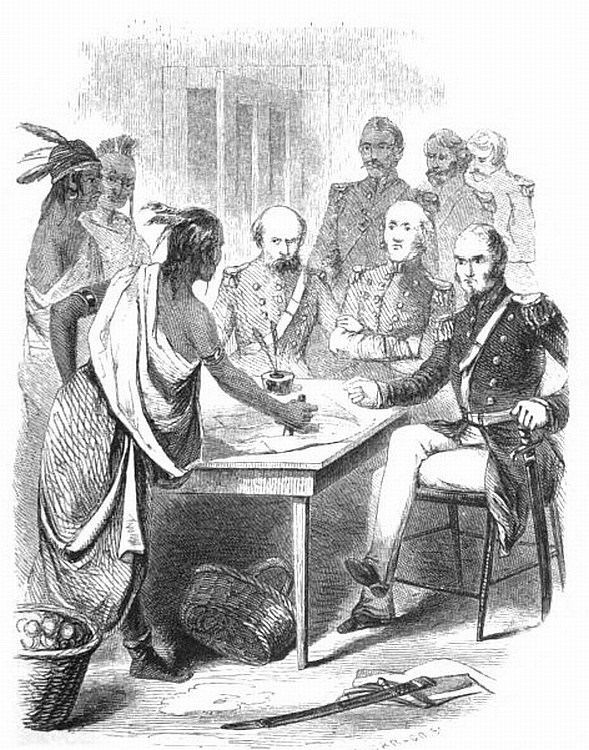
He at length stammered out:
“Very well, Osceola! Step forward here, and sign then.”
Thompson’s tone was changed; he spoke soothingly. A new prospect was before him. Osceola would sign, and thus agree to the removal. The business upon which the supreme government had deputed him would thus be accomplished, and with a dexterity that would redound to his own credit. “Old Hickory” would be satisfied; and then what next? what next? Not a mission to a mere tribe of savages, but an embassy to some high court of civilisation. He might yet be ambassador? perhaps to Spain?
Ah! Wiley Thompson! thy castles in the air (châteaux en Espagne) were soon dissipated. They fell as suddenly as they had been built; they broke down like a house of cards.
Osceola stepped forward to the table, and bent over it, as if to scan the words of the document. His eyes ran rapidly across the parchment; he seemed to be searching for some particular place.
He found it—it was a name—he read it aloud: “Charles Omatla.”
Raising himself erect, he faced the commissioner; and, in a tone of irony, asked the latter if he still desired him to sign.
“You have promised, Osceola.”
“Then will I keep my promise.”
As he spoke the words, he drew his long Spanish knife from its sheath, and raising it aloft, struck the blade through the parchment till its point was deep buried in the wood.
“That is my signature!” cried he, as he drew forth the steel. “See, Omatla! it is through your name. Beware, traitor! Undo what you have done, or its blade may yet pass through your heart!”
“Oh! that is what he meant,” cried the commissioner, rising in rage. “Good. I was prepared for this insolence—this outrage. General Clinch!—I appeal to you—your soldiers—seize upon him—arrest him!”
These broken speeches I heard amidst the confusion of voices. I heard Clinch issue some hurried orders to an officer who stood near. I saw half a dozen files separate from the ranks, and rush forward; I saw them cluster around Osceola—who the next moment was in their grasp.
Not till several of the blue-coated soldiers were sent sprawling over the ground; not till guns had been thrown aside, and a dozen strong men had fixed their gripe upon him, did the young chief give over his desperate struggles to escape; and then apparently yielding, he stood rigid and immobile, as if his frame had been iron.
It was an unexpected dénouement—alike unlooked for by either white men or Indians. It was a violent proceeding, and altogether unjustifiable. This was no court whose judge had the right to arrest for contempt. It was a council, and even the insolence of an individual could not be punished without the concurrence of both parties. General Thompson had exceeded his duty—he had exercised a power arbitrary as illegal.
The scene that followed was so confused as to defy description. The air was rent with loud ejaculations; the shouts of men, the screams of the women, the cries of children, the yells of the Indian warriors, fell simultaneously upon the ear. There was no attempt at rescue—that would have been impossible in the presence of so many troops—so many traitors; but the patriot chiefs, as they hurried away from the ground, gave out their wild ‘Yo-ho-ehee’—the gathering war-word of the Seminole nation—that in every utterance promised retaliation and revenge.
The soldiers commenced dragging Osceola inside the fort.
“Tyrant!” cried he, fixing his eye upon the commissioner, “you have triumphed by treachery; but fancy not that this is the end of it. You may imprison Osceola—hang him, if you will—but think not that his spirit will die. No; it will live, and cry aloud for vengeance. It speaks! Hear ye yonder sounds? Know ye the ‘war-cry’ of the Redsticks? Mark it well; for it is not the last time it will ring in your ears. Ho—yo-ho-ehee! yo-ho-ehee! Listen to it, tyrant! it is your death-knell—it is your death-knell!”
While giving utterance to these wild threats, the young chief was drawn through the gate, and hurried off to the guard-house within the stockade.
As I followed amid the crowd, some one touched me on the arm, as if to draw my attention. Turning, I beheld Haj-Ewa.
“To-night, by the we-wa,” (spring, pond, water) said she, speaking so as not to be heard by those around. “There will be shadows—more shadows upon the water. Perhaps—”
I did not hear more; the crowd pressed us apart; and when I looked again, the mad queen had moved away from the spot.
Chapter Forty.
“Fighting Gallagher.”
The prisoner was confined in a strong, windowless blockhouse. Access to him would be easy enough, especially to those who wore epaulets. It was my design to visit him; but, for certain reasons, I forbore putting it in execution, so long as daylight lasted. I was desirous that my interview should be as private as possible and therefore waited for the night.
I was influenced by other reasons; my hands were full of business; I had not yet done with Arens Ringgold.
I had a difficulty in deciding how to act. My mind was a chaos of emotions; hatred for the conspirators—indignation at the unjust behaviour of the agent towards Osceola—love for Maümee—now fond and trusting—anon doubting and jealous. Amid such confusion, how could I think with clearness?
Withal, one of these emotions had precedence—anger against the villain who intended to take my life was at that moment the strongest passion in my breast.
Hostility so heartless, so causeless, so deadly, had not failed to imbue me with a keen desire for vengeance; and I resolved to punish my enemy at all hazards.
He only, whose life has been aimed at by an assassin, can understand the deadly antipathy I felt towards Arens Ringgold. An open enemy, who acts under the impulse of anger, jealousy, or fancied wrong, you may respect. Even the two white wretches, and the yellow runaway, I regarded only with contempt, as tools pliant for any purpose; but the arch-conspirator himself I now both hated and despised. So acute was my sense of injury, that I could not permit it to pass without some act of retaliation, some effort to punish my wronger.
But how? Therein lay the uncertainty! How? A duel?
I could think of no other way. The criminal was still inside the law. I could not reach him, otherwise than by my own arm.
I well weighed the words of my sable counsellor; but the faithful fellow had spoken in vain, and I resolved to act contrary to his advice, let the hazard fall as it might. I made up my mind to the challenge.
One consideration still caused me to hesitate: I must give Ringgold my reasons.
He should have been welcome to them as a dying souvenir; but if I succeeded in only half-killing him, or he in half-killing me, how about the future? I should be showing my hand to him, by which he would profit; whereas, unknown to him, I now knew his, and might easily foil his designs.
Such calculations ran rapidly through my mind, though I considered them with a coolness that in after-thought surprises me. The incidents that I had lately encountered—combined with angry hatred of this plausible villain—had made me fierce, cold and cruel. I was no longer myself; and, wicked as it may appear, I could not control my longings for vengeance.
I needed a friend to advise me. Who could I make the confidant of my terrible secret?
Surely my ears were not deceiving me? No; it was the voice of my old school-fellow, Charley Gallagher. I heard it outside, and recognised the ring of his merry laugh. A detachment of rifles had just entered the fort with Charley at their head. In another instant we had “embraced.”
What could have been more opportune? Charley had been my “chum” at college—my bosom companion. He deserved my confidence, and almost upon the instant, I made known to him the situation of affairs.
It required much explanation to remove his incredulity; he was disposed to treat the whole thing as a joke—that is, the conspiracy against my life. But the rifle shot was real, and Black Jake was by to confirm my account of it: so that my friend was at length induced to take a serious view of the matter.
“Bad luck to me!” said he, in Irish accent: “it’s the quarest case that ever came accrast your humble frind’s experience. Mother o’ Moses! the fellow must be the divil incarnate. Geordie, my boy, have ye looked under his instip?”
Despite the name and “brogue,” Charley was not a Hibernian—only the son of one. He was a New-Yorker by birth, and could speak good English when he pleased; but from some freak of eccentricity or affectation, he had taken to the brogue, and used it habitually, when among friends, with all the rich garniture of a true Milesian, fresh from the “sod.”
He was altogether an odd fellow, but with a soul of honour, and a heart true as steel. He was no dunce either, and the man above all others upon whose coat tail it would not have been safe to “trid.” He was already notorious for having been engaged in two or three “affairs,” in which he had played both principal and second, and had earned the bellicose appellation of “Fighting Gallagher.” I knew what his advice would be before asking it—“Call the schoundrel out by all manes.”
I stated the difficulty as to my reasons for challenging Ringgold.
“Thrue, ma bohill! You’re right there; but there need be no throuble about the matther.”
“How?”
“Make the spalpeen challenge you. That’s betther—besides, it gives you the choice of waypons.”
“In what way can I do this?”
“Och! my innocent gossoon! Shure that’s as asy as tumblin’ from a haycock. Call him a liar; an’ if that’s not sufficiently disagraable, twake his nose, or squirt your tobacco in his ugly countenance. That’ll fetch him out, I’ll be bail for ye.
“Come along, my boy!” continued my ready counsellor, moving towards the door. “Where is this Mister Ringgowld to be sarched for? Find me the gint, and I’ll shew you how to scratch his buttons. Come along wid ye!”
Not much liking the plan of procedure, but without the moral strength to resist, I followed this impetuous son of a Celt through the doorway.
Chapter Forty One.
Provoking a Duel.
We were scarcely outside before we saw him for whom we were searching. He was standing at a short distance from the porch, conversing with a group of officers, among whom was the dandy already alluded to, and who passed under the appropriate appellation of “Beau Scott.” The latter was aide-de-camp to the commander-in-chief, of whom he was also a relative.
I pointed Ringgold out to my companion.
“He in the civilian dress,” I said.
“Och! man, ye needn’t be so purticular in your idintification. That sarpint-look spakes for itself. Be my sowl! it’s an unwholesome look altogither. That fellow needn’t fear wather—the say’ll niver drown him. Now, look here, Geordy, boy,” continued Gallagher, facing towards me and speaking in a more earnest tone: “Follow my advice to the letther! First trid upon his toes, an’ see how he takes it. The fellow’s got corns; don’t ye see, he wears a tight boot? Give him a good scrouge; make him sing out. Ov course, he’ll ask you to apologise—he must—you won’t. Shurely that’ll do the bizness without farther ceremony? If it don’t, then, by Jabus! hit him a kick in the latter end.”
“No, Gallagher,” said I, disliking the programme, “it will never do.”
“Bad luck to it, an’ why not? You’re not going to back out, are ye? Think man! a villain who would murdher you! an’ maybe will some day, if you let him escape.”
“True—but—”
“Bah! no buts. Move up, an’ let’s see what they’re talking about, anyhow. I’ll find ye a chance, or my name’s not Gallagher.”
Undetermined how to act, I walked after my companion, and joined the group of officers.
Of course, I had no thoughts of following Gallagher’s advice. I was in hopes that some turn in the conversation might give me the opportunity I desired, without proceeding to such rude extremes.
My hopes did not deceive me. Arens Ringgold seemed to tempt his fate, for I had scarcely entered among the crowd, before I found cause sufficient for my purpose.
“Talking of Indian beauties,” said he, “no one has been so successful among them as Scott here. He has been playing Don Giovanni ever since he came to the fort.”
“Oh,” exclaimed one of the newly arrived officers, “that does not surprise us. He has been a lady-killer ever since I knew him. The man who is irresistible among the belles of Saratoga, will surely find little difficulty in carrying the heart of an Indian maiden.”
“Don’t be so confident about that, Captain Roberts. Sometimes these forest damsels are very shy of us pale-faced lovers. Lieutenant Scott’s present sweetheart cost him a long siege before he could conquer her. Is it not so, lieutenant?”
“Nonsense,” replied the dandy with a conceited smirk.
“But she yielded at last?” said Roberts, turning interrogatively towards Scott.
The dandy made no reply, but his simpering smile was evidently intended to be taken in the affirmative.
“Oh yes,” rejoined Ringgold, “she yielded at last: and is now the ‘favourite,’ it is said.”
“Her name—her name?”
“Powell—Miss Powell.”
“What! That name is not Indian?”
“No, gentlemen; the lady is no savage, I assure you; she can play and sing, and read and write too—such pretty billets-doux. Is it not so, lieutenant?”
Before the latter could make reply, another spoke:
“Is not that the name of the young chief who has just been arrested?”
“True,” answered Ringgold; “it is the fellow’s name. I had forgotten to say that she is his sister.”
“What! the sister of Osceola?”
“Neither more nor less—half-blood like him too. Among the whites they are known by the name of Powell, since that was the cognomen of the worthy old gentleman who begot them. Osceola, which signifies ‘the Rising Sun,’ is the name by which he is known among the Seminoles; and her native appellation—ah, that is a very pretty name indeed.”
“What is it? Let us hear it; let us judge for ourselves.”
“Maümee.”
“Very pretty indeed!”
“Beautiful! If the damsel be only as sweet as her name, then Scott is a fortunate fellow.”
“Oh, she is a very wonder of beauty; eyes liquid and full of fiery love—long lashes: lips luscious as honeycombs; figure tall; bust full and firm; limbs like those of the Cyprian goddess; feet like Cinderella’s—in short, perfection.”
“Wonderful. Why, Scott, you are the luckiest mortal alive. But say, Ringgold! are you speaking in seriousness. Has he really conquered this Indian divinity? Honour bright—has he succeeded? You understand what I mean?”
“Most certainly,” was the prompt reply.
Up to this moment I had not interfered. The first words of the conversation had bound me like a spell, and I stood as if glued to the ground. My brain was giddy, and my heart felt as if the blood passing through it was molten lead. The bold enunciations had so staggered me, that it was some time before I could draw my breath; and more than one of the bystanders noticed the effect which the dialogue was producing on me.
After a little, I grew calmer, or rather more resolute. The very despair that had passed into my bosom had the effect of steeling my nerves; and just as Ringgold uttered the flippant affirmative, I was ready for him.
“Liar!” I exclaimed; and before the red could mount into his cheek, I gave it a slap with the back of my hand, that no doubt helped to heighten the colour.
“Nately done!” cried Gallagher; “there can be no mistake about the maynin of that.”
Nor was there. My antagonist accepted the act for what it was meant—a deadly insult. In such company, he could not do otherwise; and, muttering some indistinct threats, he walked away from the ground, attended by his especial friend, the lady-killer, and two or three others.
The incident, instead of gathering a crowd, had the contrary effect; it scattered the little group who had witnessed it; the officers retiring in-doors to discuss the motives, and speculate as as to when and where “the affair would come off.”
Gallagher and I also left the ground; and, closeted in my quarters, commenced preparing for the event.
Chapter Forty Two.
The Challenge.
At the time of which I write duelling was not uncommon in the United States army. In war-time, it is not uncommon yet, as I can testify from late experience. It is contrary to the regulations of the American service—as I believe it is of every other in the civilised world. Notwithstanding, an infringement of the code militaire in this regard, is usually looked upon with leniency—more often “winked at” than punished. This much I can affirm—that any officer in the American army who has received the “lie direct,” will find more honour in the breach of this military rule than in its observance.
After all that has been said and written about duelling, the outcry against it is a sad sham, at least in the United States of America—nothing less than a piece of superb hypocrisy. Universal as has been this condemnation, I should not like to take shelter under it. I well know that it would not protect me from being called by that ugly appellation, “poltroon.” I have noticed over and over again, that the newspapers loudest in their declamations against duelling, are the first to fling “coward” in the teeth of him who refuses to fight.
It is even so. In America, moral courage, though much be-praised, does not find ready credence. A refusal to meet the man who may challenge you is not thus explained. It is called “backing out,” “shewing the white feather;” and he who does this, need look no more upon his ladye-love; she would “flog him with her garters.”