"The Red Fawn of the Flower Land" (continued 2)
Reading edition
The fiend struggled fiercely to free himself; but the muscular grasp of his old rival never became relaxed until Hickman and others arrived upon the ground; and then a fast binding of thongs rendered him at once harmless and secure.
Chapter Twelve.
A Severe Sentence.
Such a series of violent incidents of course created excitement beyond our own boundaries. There was a group of plantations upon the river lying side by side, and all having a frontage upon the water; they formed the “settlement.” Through these ran the report, spreading like wildfire; and within the hour, white men could be seen coming from every direction. Some were on foot—poor hunters who dwelt on the skirts of the large plantations; others—the planters themselves, or their overseers—on horseback. All carried weapons—rifles and pistols. A stranger might have supposed it the rendezvous of a militia “muster,” but the serious looks of those who assembled gave it a different aspect: it more resembled the gathering of the frontier men upon the report of some Indian invasion.
In one hour, more than fifty white men were upon the ground—nearly all who belonged to the settlement.
A jury was quickly formed, and Yellow Jake put upon his trial. There was no law in the proceedings, though legal formality was followed in a certain rude way. These jurors were themselves sovereign—they were the lords of the land, and, in cases like this, could easily improvise a judge. They soon found one in planter Ringgold, our adjoining neighbour. My father declined to take part in the proceedings.
The trial was rapidly gone through with. The facts were fresh and clear; I was before their eyes with my arm in a sling, badly cut. The other circumstances which led to this result were all detailed. The chain of guilt was complete. The mulatto had attempted the lives of white people. Of course, death was the decree.
What mode of death? Some voted for hanging; but by most of these men, hanging was deemed too mild. Burning met the approbation of the majority. The judge himself cast his vote for the severer sentence.
My father plead mercy—at least so far as to spare the torture—but the stern jurors would not listen to him. They had all lost slaves of late—many runaways had been reported—the proximity of the Indians gave encouragement to defection. They charged my father with too much leniency—the settlement needed an example—they would make one of Yellow Jake, that would deter all who were disposed to imitate him. His sentence was, that he should be burnt alive!
Thus did they reason, and thus did they pronounce.
It is a grand error to suppose that the Indians of North America have been peculiar in the habit of torturing their captive foes. In most well-authenticated cases, where cruelty has been practised by them, there has been a provocative deed of anterior date—some grievous wrong—and the torture was but a retaliation. Human nature has yielded to the temptings of revenge in all ages—and ferocity can be charged with as much justice against white skin as against red skin. Had the Indians written the story of border warfare, the world might have modified its belief in their so called cruelty.
It is doubtful if, in all their history, instances of ferocity can be found that will parallel those often perpetrated by white men upon blacks—many of whom have suffered mutilation—torture—death—for the mere offence of a word! certainly often for a blow, since such is a written law!
Where the Indians have practised cruelty, it has almost always been in retaliation; but civilised tyrants have put men to the torture without even the palliating apology of vengeance. If there was revenge, it was not of that natural kind to which the human heart gives way, when it conceives deep wrong has been done; but rather a mean spite, such as is often exhibited by the dastard despot towards some weak individual within his power.
No doubt, Yellow Jake deserved death. His crimes were capital ones; but to torture him was the will of his judges.
My father opposed it, and a few others. They were outvoted and overruled. The awful sentence was passed; and they who had decreed it at once set about carrying it into execution.
It was not a fit scene to be enacted upon a gentleman’s premises; and a spot was selected at some distance from the house, further down the lake-edge. To this place the criminal was conducted—the crowd of course following.
Some two hundred yards from the bank, a tree was chosen as the place of execution. To this tree the condemned was to be bound, and a log-fire kindled around him.
My father would not witness the execution; I alone of oor family followed to the scene. The mulatto saw me, and accosted me with words of rage. He even taunted me about the wound he had given, glorying in the deed. He was no doubt under the belief that I was one of his greatest foes. I had certainly been the innocent witness of his crime, and chiefly through my testimony, he had been condemned; but I was not revengeful. I would have spared him the terrible fate he was about to undergo—at least its tortures.
We arrived upon the ground. Men were already before us, collecting the logs, and piling them up around the trunk of the tree; others were striking a fire. Some joked and laughed; a few were heard giving utterance to expressions of hate for the whole coloured race.
Young Ringgold was especially active. This was a wild youth—on the eve of manhood, of somewhat fierce, harsh temper—a family characteristic.
I knew that the young fellow affected my sister Virginia; I had often noticed his partiality for her; and he could scarcely conceal his jealousy of others who came near her. His father was the richest planter in the settlement; and the son, proud of this superiority, believed himself welcome everywhere. I did not think he was very welcome with Virgine, though I could not tell. It was too delicate a point upon which to question her, for the little dame already esteemed herself a woman.
Ringgold was neither handsome nor graceful. He was sufficiently intelligent, but overbearing to those beneath him in station—not an uncommon fault among the sons of rich men. He had already gained the character of being resentful. In addition to all, he was dissipated—too often found with low company in the forest cock-pit.
For my part, I did not like him. I never cared to be with him as a companion; he was older than myself, but it was not that—I did not like his disposition. Not so my father and mother. By both was he encouraged to frequent our house. Both probably desired him for a future son-in-law. They saw no faults in him. The glitter of gold has a blinding influence upon the moral eye.
This young man, then, was one of the most eager for the punishment of the mulatto, and active in the preparations. His activity arose partly from a natural disposition to be cruel. Both he and his father were noted as hard task-masters, and to be “sold to Mass’ Ringgold” was a fate dreaded by every slave in the settlement.
But young Ringgold had another motive for his conspicuous behaviour: he fancied he was playing the knight-errant, by this show of friendship for our family—for Virginia. He was mistaken. Such unnecessary cruelty to the criminal met the approbation of none of us. It was not likely to purchase a smile from my good sister.
The young half-blood, Powell, was also present. On hearing the hue and cry, he had returned, and now stood in the crowd looking on, but taking no part in the proceedings.
Just then the eye of Ringgold rested upon the Indian boy, and I could perceive that it was instantly lit up by a strange expression. He was already in possession of all the details. He saw in the dark-skinned youth, the gallant preserver of Virginia’s life, but it was not with gratitude that he viewed him. Another feeling was working in his breast, as could plainly be perceived by the scornful curl that played upon his lips.
More plainly still by the rude speech that followed:
“Hilloa! redskin!” he cried out, addressing himself to the young Indian, “you’re sure you had no hand in this business? eh, redskin?”
“Redskin!” exclaimed the half-blood in a tone of indignation, at the same time fronting proudly to his insulter—“Redskin you call me? My skin is of better colour than yours, you white-livered lout!”
Ringgold was rather of a sallow complexion. The blow hit home. Not quicker is the flash of powder than was its effect; but his astonishment at being thus accosted by an Indian, combined with his rage, hindered him for some moments from making reply.
Others were before him and cried out:
“O Lordy! such talk from an Injun!”
“Say that again!” cried Ringgold, as soon as he had recovered himself.
“Again if you wish—white-livered lout!” cried the half-blood, giving full emphasis to the phrase.
The words were scarcely out before Ringgold’s pistol cracked; but the bullet missed its aim; and next moment the two clinched, seizing each other by the throats.
Both came to the ground, but the half-blood had the advantage. He was uppermost, and no doubt would quickly have despatched his white antagonist—for the ready blade was gleaming in his grasp—but the knife was struck out of his hand; and a crowd of men rushing to the spot, pulled the combatants apart.
Some were loud against the Indian lad, and called for his life; but there were others with finer ideas of fair play, who had witnessed the provocation, and despite the power of the Ringgolds, would not suffer him to be sacrificed. I had resolved to protect him as far as I was able.
What would have been the result, it is difficult to guess; but, at that crisis, a sudden diversion was produced by the cry—that Yellow Jake had escaped!
Chapter Thirteen.
The Chase.
I looked around. Sure enough the mulatto was making off.
The rencontre between Ringgold and the Indian monopolised attention, and the criminal was for the moment forgotten. The knife knocked out of Powell’s hand had fallen at the feet of Yellow Jake. Unobserved in the confusion he had snatched it up, cut the fastenings from his limbs, and glided off before any one could intercept him. Several clutched at him as he passed through the straggled groups; but, being naked, he was able to glide out of their grasp, and in a dozen bounds he had cleared the crowd, and was running towards the shore of the lake.
It seemed a mad attempt—he would be shot down or overtaken. Even so; it was not madness to fly from certain death—and such a death.
Shots were ringing; at first they were the reports of pistols. The guns had been laid aside, and were leaning against trees and the adjacent fence.
Their owners now ran to seize them. One after another was levelled; and then followed a sharp rapid cracking, like file-firing from a corps of riflemen.
There may have been good marksmen among the party—there were some of the best—but a man running for his life, and bounding from side to side, to avoid the stumps and bushes, offers but a very uncertain mark; and the best shot may miss.
So it appeared on this occasion. After the last rifle rang, the runaway was still seen keeping his onward course, apparently unscathed.
The moment after, he plunged into the water, and swam boldly out from the shore.
Some set to reloading their guns; others, despairing of the time, flung them away; and hastily pulling off hats, coats, boots, rushed down to the lake, and plunged in after the fugitive.
In less than three minutes from the time that the mulatto started off, a new tableau was formed. The spot that was to have been the scene of execution was completely deserted. One half the crowd was down by the shore, shouting and gesticulating; the other half—full twenty in all—had taken to the water, and were swimming in perfect silence—their heads alone showing above the surface. Away beyond—full fifty paces in advance of the foremost—appeared that solitary swimmer—the object of pursuit; his head of black tangled curls conspicuous above the water, and now and then the yellow neck and shoulder, as he forged forward in the desperate struggle for life.
Strange tableau it was; and bore strong resemblance to a deer-hunt—when the stag, close-pressed, takes to the water; and the hounds, in full cry, plunge boldly after—but in this chase were the elements of a still grander excitement—both the quarry and the pack were human.
Not all human—there were dogs as well—hounds and mastiffs mingled among the men—side by side with their masters in the eager purpose of pursuit. A strange tableau indeed!
Stray shots were still fired from the shore. Rifles had been reloaded by those who remained; and now and then the plash of the tiny pellet could be seen, where it struck the water far short of the distant swimmer. He needed no longer have a dread of danger from that source; he was beyond the range of the rifles.
The whole scene had the semblance of a dream. So sudden had been the change of events, I could scarcely give credit to my senses, and believe it a reality. But the moment before, the criminal lay bound and helpless, beside him the pile upon which he was to be burnt—now was he swimming far and free, his executioners a hopeless distance behind him. Rapid had been the transformation—it hardly appeared real. Nevertheless, it was real—it was before the eyes.
A long time, too, before our eyes. A chase in the water is a very different affair from a pursuit on dry land; and, notwithstanding there was life and death on the issue, slow was the progress both of pursuers and pursued. For nearly half an hour we who remained upon the shore continued spectators of this singular contest.
The frenzy of the first moments had passed away; but there was sufficient interest to sustain a strong excitement to the last; and some continued to shout and gesticulate, though neither their cries nor actions could in anywise influence the result. No words of encouragement could have increased the speed of the pursuers; no threats were needed to urge forward the fugitive.
We who remained inactive had time enough to reflect; and upon reflection, it became apparent why the runaway had taken to the water. Had he attempted to escape by the fields, he would have been pulled down by the dogs, or else overtaken by swift runners, for there were many swifter than he. There were few better swimmers, however, and he knew it. For this reason, then, had he preferred the water to the woods, and certainly his chances of escape seemed better.
After all, he could not escape. The island for which he was making was about half a mile from the shore; but beyond was a stretch of clear water of more than a mile in width. He would arrive at the island before any of his pursuers; but what then? Did he purpose to remain there, in hopes of concealing himself among the bushes? Its surface of several acres was covered with a thick growth of large trees. Some stood close by the shore, their branches draped with silvery tillandsia, overhanging the water. But what of this? There might have been cover enough to have given shelter to a bear or a hunted wolf, but not to a hunted man—not to a slave who had drawn the knife upon his master. No, no. Every inch of the thicket would be searched: to escape by concealing himself he might not.
Perhaps he only meant to use the island as a resting-place; and, after breathing himself, take once more to the water, and swim for the opposite shore. It was possible for a strong swimmer to reach it; but it would not be possible for him. There were skiffs and pirogues upon the river, both up and down. Men had already gone after them; and, long before he could work his way across that wide reach, half-a-dozen keels would be cutting after him. No, no—he could not escape: either upon the island, or in the water beyond, he would be captured.
Thus reasoned the spectators, as they stood watching the pursuit.
The excitement rose higher as the swimmers neared the island. It is always so at the approach of a crisis; and a crisis was near, though not such a one as the spectators anticipated. They looked to see the runaway reach the island, mount up the bank, and disappear among the trees. They looked to see his pursuers climb out close upon his heels, and perhaps hear of his capture before he could cross through the timber, and take to the water on the other side.
Some such crisis were they expecting; and it could not be distant, for the mulatto was now close into the edge of the island; a few strokes would bring him to the shore; he was swimming under the black shadows of the trees—it seemed as if the branches were over his head—as if he might have thrown up his hands and clutched them.
The main body of his pursuers was still fifty yards in his rear; but some, who had forged ahead of the rest, were within half that distance. From where we viewed them, they seemed far nearer; in fact, it was easy to fancy that they were swimming alongside, and could have laid hands on him at any moment.
The crisis was approaching, but not that which was looked for. The pursuit was destined to a far different ending from that anticipated either by spectators or pursuers. The pursued himself little dreamed of the doom that was so near—a doom awfully appropriate.
The swimmer was cleaving his way across the belt of black shadow; we expected next moment to see him enter among the trees, when all at once he was seen to turn side towards us, and direct his course along the edge of the island!
We observed this manoeuvre with some astonishment—we could not account for it; it was clearly to the advantage of his pursuers, who now swam in a diagonal line to intercept him.
What could be his motive? Had he failed to find a landing-place? Even so, he might have clutched the branches, and by that means drawn himself ashore.
Ha! our conjectures are answered; yonder is the answer; yonder brown log that floats on the black water is not the trunk of a dead tree. It is not dead; it has life and motion. See! it assumes a form—the form of the great saurian—the hideous alligator!
Its gaunt jaws are thrown up, its scolloped tail is erect, its breast alone rests upon the water. On this as a pivot it spins round and round, brandishing its tail in the air, and at intervals lashing the spray aloft. Its bellowing is echoed back from the distant shores; the lake vibrates under the hoarse baritone, the wood-birds flutter and cry, and the white crane mounts screaming into the air.
The spectators stand aghast; the pursuers have poised themselves in the water, and advance no farther. One solitary swimmer is seen struggling on; it is he who swims for his life.
It is upon him the eyes of the alligator are fixed. Why upon him more than the others! They are all equally near. Is it the hand of God who takes vengeance?
Another revolution, another sweep of its strong tail, and the huge reptile rushes upon its victim.
I have forgotten his crimes—I almost sympathise with him. Is there no hope of his escape?
See! he has grasped the branch of a live-oak; he is endeavouring to lift himself up—above the water—above the danger. Heaven strengthen his arms!
Ah! he will be too late; already the jaws—That crash?
The branch has broken!
He sinks back to the surface—below it. He is out of sight—he has gone to the bottom! and after him, open-mouthed and eager, darts the gigantic lizard. Both have disappeared from our view.
The froth floats like a blanket upon the waves, clouting the leaves on the broken branch.
We watch with eager eyes. Not a ripple escapes unnoted; but no new movement stirs the surface, no motion is observed, no form comes up; and the waves soon flatten over the spot.
Beyond a doubt the reptile has finished its work.
Whose work? Was it the hand of God who took vengeance?
So they are saying round me.
The pursuers have faced back, and are swimming towards us. None cares to trust himself under the black shadows of those island oaks. They will have a long swim before they can reach the shore, and some of them will scarcely accomplish it. They are in danger; but no—yonder come the skiffs and pirogues that will soon pick them up.
They have seen the boats, and swim slowly, or float upon the water, waiting their approach.
They are taken in, one after another; and all—both dogs and men—are now carried to the island.
They go to continue the search—for there is still some doubt as to the fate of the runaway.
They land—the dogs are sent through the bushes, while the men glide round the edge to the scene of the struggle. They find no track or trace upon the shore.
But there is one upon the water. Some froth still floats—there is a tinge of carmine upon it—beyond a doubt it is the blood of the mulatto.
“All right, boys!” cries a rough fellow; “that’s blueskin’s blood, I’ll sartify. He’s gone under an’ no mistake. Darn the varmint! it’s clean spoilt our sport.”
The jest is received with shouts of boisterous laughter.
In such a spirit talked the man-hunters, as they returned from the chase.
Chapter Fourteen.
Ringgold’s Revenge.
Only the ruder spirits indulged in this ill-timed levity; others of more refined nature regarded the incident with due solemnity—some even with a feeling of awe.
Certainly it seemed as if the hand of God had interposed, so appropriate had been the punishment—almost as if the criminal had perished by his own contrivance.
It was an awful death, but far less hard to endure than that which had been decreed by man. The Almighty had been more merciful: and in thus mitigating the punishment of the guilty wretch, had rebuked his human judges.
I looked around for the young Indian: I was gratified to find he was no longer among the crowd. His quarrel with Ringgold had been broken off abruptly. I had fears that it was not yet ended. His words had irritated some of the white men, and it was through his being there, the criminal had found the opportunity to get off. No doubt, had the latter finally escaped, there would have been more of it: and even as matters stood, I was not without apprehensions about the safety of the bold half-blood. He was not upon his own ground—the other side of the river was the Indian territory; and, therefore, he might be deemed an intruder. True, we were at peace with the Indians; but for all that, there was enough of hostile feeling between the two races. Old wounds received in the war of 1818 still rankled.
I knew Ringgold’s resentful character—he had been humiliated in the eyes of his companions; for, during the short scuffle, the half-blood had the best of it. Ringgold would not be content to let it drop—he would seek revenge.
I was glad, therefore, on perceiving that the Indian had gone away from the ground. Perhaps he had himself become apprehensive of danger, and recrossed the river. There he would be safe from pursuit. Even Ringgold dare not follow him to the other side, for the treaty laws could not have been outraged with impunity. The most reckless of the squatters knew this. An Indian war would have been provoked, and the supreme government, though not over scrupulous, had other views at the time.
I was turning to proceed homeward, when it occurred to me that I would accost Ringgold, and signify to him my disapproval of his conduct. I was indignant at the manner in which he had acted—just angry enough to speak my mind. Ringgold was older than myself, and bigger; but I was not afraid of him. On the contrary, I knew that he was rather afraid of me. The insult he had offered to one who, but the hour before, had risked his life for us, had sufficiently roused my blood, and I was determined to reproach him for it. With this intention, I turned back to look for him. He was not there.
“Have you seen Arens Ringgold?” I inquired of old Hickman.
“Yes—jest gone,” was the reply.
“In what direction?”
“Up-river. See ’im gallop off wi’ Bill Williams an’ Ned Spence—desprit keen upon somethin’ they ’peered.”
A painful suspicion flashed across my mind.
“Hickman,” I asked, “will you lend me your horse for an hour?”
“My old critter? Sartin sure will I: a day, if you wants him. But, Geordy, boy, you can’t ride wi’ your arm that way?”
“O yes; only help me into the saddle.”
The old hunter did as desired; and after exchanging another word or two, I rode off in the up-river direction.
Up the river was a ferry; and at its landing it was most likely the young Indian had left his canoe. In that direction, therefore, he should go to get back to his home, and in that direction Ringgold should not go to return to his, for the path to the Ringgold plantation led in a course altogether opposite. Hence the suspicion that occurred to me on hearing that the latter had gone up the river. At such a time it did not look well, and in such company, still worse; for I recognised in the names that Hickman had mentioned, two of the most worthless boys in the settlement. I knew them to be associates, or rather creatures, of Ringgold.
My suspicion was that they had gone after the Indian, and of course with an ill intent. It was hardly a conjecture; I was almost sure of it; and as I advanced along the river road, I became confirmed in the belief. I saw the tracks of their horses along the path that led to the ferry, and now and again I could make out the print of the Indian moccasin where it left its wet mark in the dust. I knew that his dress had not yet dried upon him, and the moccasins would still be saturated with water.
I put the old horse to his speed. As I approached the landing, I could see no one, for there were trees all around it; but the conflict of angry voices proved that I had conjectured aright.
I did not stop to listen; but urging my horse afresh, I rode on. At a bend of the road, I saw three horses tied to the trees. I knew they were those of Ringgold and his companions, but I could not tell why they had left them.
I stayed not to speculate, but galloped forward upon the ground. Just as I had anticipated, the three were there—the half-blood was in their hands!
They had crept upon him unawares—that was why their horses had been left behind—and caught him just as he was about stepping into his canoe. He was unarmed—for the rifle I had given him was still wet, and the mulatto had made away with his knife—he could offer no resistance, and was therefore secured at once.
They had been quick about it, for they had already stripped off his hunting-shirt, and tied him to a tree. They were just about to vent their spite on him—by flogging him on the bare back with cowhides which they carried in their hands. No doubt they would have laid them on heavily, had I not arrived in time.
“Shame, Arens Ringgold! shame!” I cried as I rode up. “This is cowardly, and I shall report it to the whole settlement.”
Ringgold stammered out some excuse, but was evidently staggered at my sudden appearance.
“The darned Injun desarves it,” growled Williams.
“For what, Master Williams?” I inquired.
“For waggin his jaw so imperent to white men.”
“He’s got no business over here,” chimed in Spence; “he has got no right to come this side of the river.”
“And you have no right to flog him, whether on this side or the other—no more than you have to flog me.”
“Ho, ho! That might be done, too,” said Spence, in a sneering tone, that set my blood in a boil.
“Not so easily,” I cried, leaping from the old horse, and running forward upon the ground.
My right arm was still sound. Apprehensive of an awkward affair, I had borrowed old Hickman’s pistol, and I held it in my hand.
“Now, gentlemen,” said I, taking my stand beside the captive, “go on with the flogging; but take my word for it, I shall send a bullet through the first who strikes!”
Though they were but boys, all three were armed with knife and pistol, as was the custom of the time. Of the three, Spence seemed most inclined to carry out his threat; but he and Williams saw that Ringgold, their leader, had already backed out, for the latter had something to lose, which his companions had not. Besides, he had other thoughts, as well as fears for his personal safety.
The result was, that all three, after remonstrating with me for my uncalled-for interference in a quarrel that did not concern me, made an angry and somewhat awkward exit from the scene.
The young Indian was soon released from his unpleasant situation. He uttered few words, but his looks amply expressed his gratitude. As he pressed my hand at parting, he said:
“Come to the other side to hunt whenever you please—no Indian will harm you—in the land of the red men you will be welcome.”
Chapter Fifteen.
Maümee.
An acquaintance thus acquired could not be lightly dropped. Should it end otherwise than in friendship? This half-blood was a noble youth, the germ of a gentleman. I resolved to accept his invitation, and visit him in his forest home.
His mother’s cabin, he said, was on the other side of the lake, not far off. I should find it on the bank of a little stream that emptied into the main river, above where the latter expands itself.
I felt a secret gratification as I listened to these directions. I knew the stream of which he was speaking; lately, I had sailed up it in my skiff. It was upon its banks I had seen that fair vision—the wood-nymph whose beauty haunted my imagination. Was it Maümee?
I longed to be satisfied. I waited only for the healing of my wound—till my arm should be strong enough for the oar. I chafed at the delay; but time passed, and I was well.
I chose a beautiful morning for the promised visit, and was prepared to start forth. I had no companion—only my dogs and gun.
I had reached my skiff, and was about stepping in, when a voice accosted me; on turning, I beheld my sister.
Poor little Virgine! she had lost somewhat of her habitual gaiety, and appeared much changed of late. She was not yet over the terrible fright—its consequences were apparent in her more thoughtful demeanour.
“Whither goest thou, Georgy?” she inquired as she came near.
“Must I tell, Virgine?”
“Either that or take me with you.”
“What! to the woods?”
“And why not? I long for a ramble in the woods. Wicked brother! you never indulge me.”
“Why, sister, you never asked me before.”
“Even so, you might know that I desired it. Who would not wish to go wandering in the woods? Oh! I wish I were a wild bird, or a butterfly, or some other creature with wings; I should wander all over those beautiful woods, without asking you to guide me, selfish brother.”
“Any other day, Virgine, but to-day—”
“Why, but? Why not this very day? Surely it is fine—it is lovely!”
“The truth, then, sister—I am not exactly bound for the woods to-day.”
“And whither bound? whither bound, Georgy?—that’s what they say in ships.”
“I am going to visit young Powell at his mother’s cabin. I promised him I should.”
“Ha!” exclaimed my sister, suddenly changing colour, and remaining for a moment in a reflective attitude.
The name had recalled that horrid scene. I was sorry I had mentioned it.
“Now, brother,” continued she, after a pause; “there is nothing I more desire to see than an Indian cabin—you know I have never seen one. Good Georgy! good Georgy! pray take me along with you!”
There was an earnestness in the appeal I could not resist, though I would rather have gone alone. I had a secret that I would not have trusted even to my fond sister. I had an indefinite feeling, besides, that I ought not to take her with me, so far from home, into a part of the country with which I was so little acquainted.
She appealed a second time.
“If mother will give her consent—”
“Nonsense, Georgy—mamma will not be angry. Why return to the house? You see I am prepared; I have my sun-bonnet. We can be back before we are missed—you’ve told me it was not far.”
“Step in, sis! Sit down in the stern. There—yo ho! we are off!”
There was not much strength in the current, and half an hour’s rowing brought the skiff to the mouth of the creek. We entered it, and continued upward. It was a narrow stream, but sufficiently deep to float either skiff or canoe. The sun was hot, but his beams could not reach us; they were intercepted by the tupelo trees that grew upon the banks—their leafy branches almost meeting across the water.
Half a mile from the mouth of the creek, we approached a clearing. We saw fields under cultivation. We noticed crops of maize, and sweet potatoes, with capsicums, melons, and calabashes. There was a dwelling-house of considerable size near the bank, surrounded by an enclosure, with smaller houses in the rear. It was a log structure—somewhat antique in its appearance, with a portico, the pillars of which exhibited a rude carving. There were slaves at work in the field—that is, there were black men, and some red men too—Indians!
It could not be the plantation of a white man—there were none on that side the river. Some wealthy Indian, we conjectured, who is the owner of land and slaves. We were not surprised at this—we knew there were many such.
But where was the cabin of our friend? He had told me it stood upon the bank of the stream not more than half a mile from its mouth. Had we passed without seeing it? or was it still higher up?
“Shall we stop, and inquire, Virgine?”
“Who is it standing in the porch?”
“Ha! your eyes are better than mine, sis—it is the young Indian himself. Surely he does not live there? That is not a cabin. Perhaps he is on a visit? But see! he is coming this way.”
As I spoke, the Indian stepped out from the house, and walked rapidly towards us. In a few seconds, he stood upon the bank, and beckoned us to a landing. As when seen before, he was gaily dressed, with plumed “toque” upon his head, and garments richly embroidered. As he stood upon the bank above us, his fine form outlined against the sky, he presented the appearance of a miniature warrior. Though but a boy, he looked splendid and picturesque. I almost envied him his wild attire.
My sister seemed to look on him with admiration, though I thought I could trace some terror in her glance. From the manner in which her colour came and went, I fancied that his presence recalled that scene, and again I regretted that she had accompanied me.
He appeared unembarrassed by our arrival. I have known it otherwise among whites; and those, too, making pretensions to haut ton. This young Indian was as cool and collected as though he had been expecting us, which he was not. He could not have expected both.
There was no show of coldness in our reception. As soon as we approached near enough, he caught the stem of the skiff, drew her close up to the landing, and with the politeness of an accomplished gentleman, assisted us to debark.
“You are welcome,” said he—“welcome!” and then turning to Virginia with an inquiring look, he added:
“I hope the health of the señorita is quite restored. As for yours, sir, I need not inquire: that you have rowed your skiff so far against the current, is a proof you have got over your mishap.”
The word “señorita” betrayed a trace of the Spaniards—a remnant of those relations that had erewhile existed between the Seminole Indians and the Iberian race. Even in the costume of our new acquaintance could be observed objects of Andalusian origin—the silver cross hanging from his neck, the sash of scarlet silk around his waist, and the bright triangular blade that was sheathed behind it. The scene, too, had Spanish touches. There were exotic plants, the China orange, the splendid papaya, the capsicums (chilés), and love-apples (tomatoes); almost characteristics of the home of the Spanish colonist. The house itself exhibited traces of Castilian workmanship. The carving was not Indian.
“Is this your home?” I inquired with a little embarrassment.
He had bid us welcome, but I saw no cabin; I might be wrong.
His answer set me at rest. It was his home—his mother’s house—his father was long since dead—there were but the three—his mother, his sister, himself.
“And these?” I inquired, pointing to the labourers.
“Our slaves,” he replied, with a smile. “You perceive we Indians are getting into the customs of civilisation.”
“But these are not all negroes? There are red men; are they slaves?”
“Slaves like the others. I see you are astonished. They are not of our tribe—they are Yamassees. Our people conquered them long ago; and many of them still remain slaves.”
We had arrived at the house. His mother met us by the door—a woman of pure Indian race—who had evidently once possessed beauty. She was still agreeable to look upon—well-dressed, though in Indian costume—maternal—intelligent.
We entered—furniture—trophies of the chase—horse accoutrements in the Spanish style—a guitar—ha! books!
My sister and I were not a little surprised to find, under an Indian roof, these symbols of civilisation.
“Ah!” cried the youth, as if suddenly recollecting himself, “I am glad you are come. Your moccasins are finished. Where are they, mother? Where is she? Where is Maümee?”
He had given words to my thoughts—their very echo.
“Who is Maümee?” whispered Virgine.
“An Indian girl—his sister, I believe.”
“Yonder—she comes!”
A foot scarce a span in length; an ankle that, from the broidered flap of the moccasin, exhibits two lines widely diverging upward; a waist of that pleasing flexure that sweeps abruptly inward and out again; a bosom whose prominence could be detected under the coarsest draping; a face of rich golden brown; skin diaphanous; cheeks coral red; lips of like hue; dark eyes and brows; long crescent lashes; hair of deepest black, in wantonness of profusion!
Fancy such a form—fancy it robed in all the picturesque finery that Indian ingenuity can devise—fancy it approaching you with a step that rivals the steed of Arabia, and you may fancy—no, you may not fancy Maümee.
My poor heart—it was she, my wood-nymph!
I could have tarried long under the roof of that hospitable home; but my sister seemed ill at ease—as if there came always recurring to her the memory of that unhappy adventure.
We stayed but an hour; it seemed not half so long—but short as was the time, it transformed me into a man. As I rowed back home, I felt that my boy’s heart had been left behind me.
Chapter Sixteen.
The Island.
I longed to revisit the Indian home; and was not slow to gratify my wish. There was no restraint upon my actions. Neither father nor mother interfered with my daily wanderings: I came and went at will; and was rarely questioned as to the direction I had taken. Hunting was supposed to be the purpose of my absence. My dogs and gun, which I always took with me, and the game I usually brought back, answered all curiosity.
My hunting excursions were always in one direction—I need hardly have said so—always across the river. Again and again did the keel of my skiff cleave the waters of the creek—again and again, till I knew every tree upon its banks.
My acquaintance with young Powell soon ripened into a firm friendship. Almost daily were we together—either upon the lake or in the woods, companions in the chase; and many a deer and wild turkey did we slaughter in concert. The Indian boy was already a skilled hunter; and I learned many a secret of woodcraft in his company.
I well remember that hunting less delighted me than before. I preferred that hour when the chase was over, and I halted at the Indian house on my way home—when I drank the honey-sweetened conti out of the carved calabash—far sweeter from the hands out of which I received the cup—far sweeter from the smiles of her who gave it—Maümee.
For weeks—short weeks they seemed—I revelled in this young dream of love. Ah! it is true there is no joy in afterlife that equals this. Glory and power are but gratifications—love alone is bliss—purest and sweetest in its virgin bloom.
Often was Virginia my companion in these wild wood excursions. She had grown fond of the forest—she said so—and willingly went along. There were times when I should have preferred going alone; but I could not gainsay her. She had become attached to Maümee. I did not wonder.
Maümee, too, liked my sister—not from any resemblance of character. Physically, they were unlike as two young girls could well be. Virginia was all blonde and gold; Maümee, damask and dark. Intellectually they approached no nearer. The former was timid as the dove; the latter possessed a spirit bold as the falcon. Perhaps the contrast drew closer the ties of friendship that had sprung up between them. It is not an anomaly.
Far more like an anomaly was my feeling in relation to the two. I loved my sister for the very softness of her nature. I loved Maümee for the opposite; but, true, these loves were very distinct in kind—unlike as the objects that called them forth.
While young Powell and I hunted, our sisters stayed at home. They strolled about the fields, the groves, the garden. They played and sang and read, for Maümee—despite her costume—was no savage. She had books, a guitar, or rather a bandolin—a Spanish relic—and had been instructed in both. So far as mental cultivation went, she was fit society even for the daughter of a proud Randolph. Young Powell, too; was as well, or better educated than myself. Their father had not neglected his duty.
Neither Virginia nor I ever dreamed of an inequality. The association was by us desired and sought. We were both too young to know aught of caste. In our friendships we followed only the prompting of innocent nature; and it never occurred to us that we were going astray.
The girls frequently accompanied us into the forest; and to this we, the hunters, made no objection. We did not always go in quest of the wide-ranging stag. Squirrels and other small game were oftener the objects of our pursuit; and in following these we needed not to stray far from our delicate companions.
As for Maümee, she was a huntress—a bold equestrian, and could have ridden in the “drive.” As yet, my sister had scarcely been on horseback.
I grew to like the squirrel-shooting the best; my dogs were often left behind; and it became a rare thing for me to bring home venison.
Our excursions were not confined to the woods. The water-fowl upon the lake, the ibises, egrets, and white cranes, were often the victims of our hunting ardour.
In the lake, there was a beautiful island—not that which had been the scene of the tragedy, but one higher up—near the widening of the river. Its surface was of large extent, and rose to a summit in the centre. For the most part, it was clad with timber, nearly all evergreen—as the live-oak, magnolia, illicium, and the wild orage—indigenous to Florida. There was zanthoxylon trees, with their conspicuous yellow blossoms; the perfumed flowering dogwood, and sweet-scented plants and shrubs—the princely palm towering high over all, and forming, with its wide-spread umbels, a double canopy of verdure.
The timber, though standing thickly, did not form a thicket. Here and there, the path was tangled with epiphytes or parasites—with enormous gnarled vines of the fox-grape—with bignonias—with china and sarsaparilla briers—with bromilias and sweet-scented orchids; but the larger trees stood well apart; and at intervals there were openings—pretty glades, carpeted with grass, and enamelled with flowers.
The fair island lay about half-way between the two homes; and often young Powell and I met upon it, and made it the scene of our sport. There were squirrels among the trees, and turkeys—sometimes deer were found in the glades—and from its covered shores we could do execution among the water-fowl that sported upon the lake.
Several times had we met on this neutral ground, and always accompanied by our sisters. Both delighted in the lovely spot. They used to ascend the slope, and seat themselves under the shade of some tall palms that grew on the summit; while we, the hunters, remained in the game-frequented ground below, causing the woods to ring with the reports of our rifles. Then it was our custom, when satiated with the sport, also to ascend the hill, and deliver up our spoils, particularly when we had been fortunate enough to procure some rare and richly plumed bird—an object of curiosity or admiration.
For my part, whether successful or not, I always left off sooner than my companion. I was not so keen a hunter as he; I far more delighted to recline along the grass where the two maidens were seated: far sweeter than the sound of the rifle was it to listen to the tones of Maümee’s voice; far fairer than the sight of game was it to gaze into the eyes of Maümee.
And beyond this, beyond listening and looking, my love had never gone. No love-words had ever passed between us; I even knew not whether I was beloved.
My hours were not all blissful; the sky was not always of rose colour. The doubts that my youthful passion was returned were its clouds; and these often arose to trouble me.
About this time, I became unhappy from another cause. I perceived, or fancied, that Virginia took a deep interest in the brother of Maümee, and that this was reciprocated. The thought gave me surprise and pain. Yet why I should have experienced either, I could not tell. I have said that my sister and I were too young to know ought of the prejudices of rank or caste; but this was not strictly true. I must have had some instinct, that in this free association with our dark-skinned neighbours we were doing wrong, else how could it have made me unhappy? I fancied that Virginia shared this feeling with me. We were both ill at ease, and yet we were not confidants of each other. I dreaded to make known my thoughts even to my sister, and she no doubt felt a like reluctance to the disclosing of her secret.
What would be the result of these young loves if left to themselves? Would they in due time die out? Would there arrive an hour of satiety and change? or, without interruption would they become perpetual? Who knows what might be their fate, if permitted to advance to perfect development. But it is never so—they are always interrupted.
So were ours—the crisis came—and the sweet companionship in which we had been indulging was brought to a sudden close. We had never disclosed it to our father or mother, though we had used no craft to conceal it. We had not been questioned, else should we certainly have avowed it; for we had been taught strictly to regard truth. But no questions had been asked—no surprise had been expressed at our frequent absences. Mine, as a hunter, were but natural; the only wonderment was that Virginia had grown so found of the forest, and so often bore me company; but this slight surprise on the part of my mother soon wore off, and we went freely forth, and as freely returned, without challenge of our motives.
I have said that we used no art to conceal who were our associates in these wild wanderings. That again is not strictly true. Our very silence was craft. We must both have had some secret perception that we were acting wrongly—that our conduct would not meet the approval of our parents—else why should we have cared for concealment.
It was destined that this repose should not be of long continuance. It ended abruptly—somewhat harshly.
One day we were upon the island, all four as usual. The hunt was over, and Powell and I had rejoined our sisters upon the hill. We had stretched ourselves under the shade, and were indulging in trivial conversation, but I far more in the mute language of love. My eyes rested upon the object of my thoughts, too happy that my glances were returned. I saw little besides: I did not notice that there was a similar exchange of ardent looks between the young Indian and my sister. At that moment I cared not; I was indifferent to everything but the smiles of Maümee.
There were those who did observe the exchange of glances, who saw all that was passing. Anxious eyes were bent upon the tableau formed by the four of us, and our words, looks, and gestures were noted.
The dogs rose with a growl, and ran outward among the trees. The rustling branches, and garments shining through the foliage, warned us that there were people there. The dogs had ceased to give tongue, and were wagging their tails. They were friends, then, who were near.
The leaves sheltered them no longer from our view: behold my father—my mother!
Virginia and I were startled by their appearance. We felt some apprehension of evil—arising no doubt, from our own convictions that we had not been acting aright. We observed that the brows of both were clouded. They appeared vexed and angry.
My mother approached first. There was scorn upon her lips. She was proud of her ancestry, even more than the descendant of the Randolphs.
“What!” exclaimed she—“what, my children, these your companions? Indians?”
Young Powell rose to his feet, but said nothing in reply. His looks betrayed what he felt; and that he perfectly understood the slight.
With a haughty glance towards my father and mother, he beckoned to his sister to follow him, and walked proudly away.
Virginia and I were alarmed and speechless. We dared not say adieu.
We were hurried from the spot; and homeward Virginia went with my father and mother. There were others in the boat that had brought them to the island. There were blacks who rowed; but I saw white men there too. The Ringgolds—both father and son—were of the party.
I returned alone in the skiff. While crossing the lake, I looked up. The canoe was just entering the creek. I could see that the faces of the half-blood and his sister were turned towards us. I was watched, and dared not wave an adieu, although there was a sad feeling upon my heart—a presentiment that we were parting for long—perhaps for ever!
Alas! the presentiment proved a just one. In three days from that time I was on my way to the far north, where I was entered as a cadet in the military academy of West Point. My sister, too, was sent to one of those seminaries, in which the cities of the Puritan people abound. It was long, long before either of us again set eyes upon the flowery land.
Chapter Seventeen.
West Point.
The military college of West Point is the finest school in the world. Princes and priests have there no power; true knowledge is taught, and must be learned, under penalty of banishment from the place. The graduate comes forth a scholar, not, as from Oxford and Cambridge, the pert parrot of a dead language, smooth prosodian, mechanic rhymster of Idyllic verse; but a linguist of living tongues—one who has studied science, and not neglected art—a botanist, draughtsman, geologist, astronomer, engineer, soldier—all; in short, a man fitted for the higher duties of social life—capable of supervision and command—equally so of obedience and execution.
Had I been ever so much disinclined to books, in this institution I could not have indulged in idleness. There is no “dunce” in West Point. There is no favour to family and fortune: the son of the President would be ejected, if not able to dress up with the rank; and under the dread of disgrace, I became, perforce, a diligent student—in time a creditable scholar.
The details of a cadet’s experience possess but little interest—a routine of monotonous duties—only at West Point a little harder than elsewhere—at times but slightly differing from the slave-life of a common soldier. I bore them bravely—not that I was inspired by any great military ambition, but simply from a feeling of rivalry: I scorned to be the laggard of my class.
There were times, however, when I felt weariness from so much restraint. It contrasted unfavourably with the free life I had been accustomed to; and often did I feel a longing for home—for the forest and the savanna—and far more, for the associates I had left behind.
Long lingered in my heart the love of Maümee—long time unaffected by absence. I thought the void caused by that sad parting would never be filled up. No other object could replace in my mind, or banish from my memory the sweet souvenirs of my youthful love. Morning, noon, and night, was that image of picturesque beauty outlined upon the retina of my mental eye—by day in thoughts, by night in dreams.
Thus was it for a long while—I thought it would never be otherwise! No other could ever interest me, as she had done. No new joy could win me to wander—no Lethe could bring oblivion. Had I been told so by an angel, I would not, I could not, have believed it.
Ah! it was a misconception of human nature. I was but sharing it in common with others, for most mortals have, at some period of life, laboured under a similar mistake. Alas! it is too true—love is affected by time and absence. It will not live upon memory alone. The capricious soul, however delighting in the ideal, prefers the real and positive. Though there are but few lovely women in the world, there is no one lovelier than all the rest—no man handsomer than all his fellows. Of two pictures equally beautiful, that is the more beautiful upon which the eye is gazing. It is not without reason that lovers dread the parting hour.
Was it books that spoke of lines and angles, of bastions and embrasures—was it drill, drill, drill by day, or the hard couch and harder guard tour by night—was it any or all of these that began to infringe upon the exclusivism of that one idea, and at intervals drive it from my thoughts? Or was it the pretty faces that now and then made their appearance at the “Point”—the excursionary belles from Saratoga and Ballston, who came to visit us—or the blonde daughters of the patroons, our nearer neighbours—who came more frequently, and who saw in each coarse-clad cadet the chrysalis of a hero—the embryo of a general?
Which of all these was driving Maümee out of my mind?
It imports little what cause—such was the effect. The impression of my young love became less vivid on the page of memory. Each day it grew fainter and fainter, until it was attenuated to a slim retrospect.
Ah! Maümee! in truth it was long before this came to pass. Those bright smiling faces danced long before my eyes ere thine became eclipsed. Long while withstood I the flattery of those siren tongues; but my nature was human, and my heart yielded too easily to the seduction of sweet blandishments.
It would not be true to say that my first love was altogether gone: it was cold, but not dead. Despite the fashionable flirtations of the hour, it had its seasons of remembrance and return. Oft upon the still night’s guard, home-scenes came flitting before me; and then the brightest object in the vision-picture was Maümee. My love for her was cold, not dead. Her presence would have re-kindled it—I am sure it would. Even to have heard from her—of her—would have produced a certain effect. To have heard that she had forgotten me, and given her heart to another, would have restored my boyish passion in its full vigour and entirety; I am sure it would.
I could not have been indifferent then? I must still have been in love with Maümee.
One key pushes out the other; but the fair daughters of the north had not yet obliterated from my heart this dark-skinned damsel of the south.
During all my cadetship, I never saw her—never even heard of her. For five years I was an exile from home—and so was my sister. At intervals during that time we were visited by our father and mother, who made an annual trip to the fashionable resorts of the north—Ballston Spa, Saratoga, and Newport. There, during our holidays, we joined them; and though I longed to spend a vacation at home—I believe so did Virginia—the “mother was steel and the father was stone,” and our desires were not gratified.
I suspected the cause of this stern denial. Our proud parents dreaded the danger of a mésalliance. They had not forgotten the tableau on the island.
The Ringgolds met us at the watering-places; and Arens was still assiduous in his attentions to Virginia. He had become a fashionable exquisite, and spent his gold freely—not to be outdone by the ci-devant tailors and stock-brokers, who constitute the “upper ten” of New York. I liked him no better than ever, though my mother was still his backer.
How he sped with Virginia, I could not tell. My sister was now quite a woman—a fashionable dame, a belle—and had learnt much of the world, among other things, how to conceal her emotions—one of the distinguished accomplishments of the day. She was at times merry to an extreme degree; though her mirth appeared to me a little artificial, and often ended abruptly. Sometimes she was thoughtful—not unfrequently cold and disdainful. I fancied that in gaining so many graces, she had lost much of what was in my eyes more valuable than all, her gentleness of heart. Perhaps I was wronging her.
There were many questions I would have asked her, but our childish confidence was at an end, and delicacy forbade me to probe her heart. Of the past we never spoke: I mean of that past—those wild wanderings in the woods, the sailings over the lake, the scenes in the palm-shaded island.
I often wondered whether she had cause to remember them, whether her souvenirs bore any resemblance to mine!
On these points, I had never felt a definite conviction. Though suspicious, at one time even apprehensive—I had been but a blind watcher, a too careless guardian.
Surely my conjectures had been just, else why was she now silent upon themes and scenes that had so delighted us both? was her tongue tied by the after-knowledge that we had been doing wrong—only known to us by the disapproval of our parents? Or, was it that in her present sphere of fashion, she disdained to remember the humble associates of earlier days?
Often did I conjecture whether there had ever existed such a sentiment in her bosom; and, if so, whether it still lingered there? These were points about which I might never be satisfied. The time for such confidences had gone past.
“It is not likely,” reasoned I; “or, if there ever was a feeling of tender regard for the young Indian, it is now forgotten—obliterated from her heart, perhaps from her memory. It is not likely it should survive in the midst of her present associations—in the midst of that entourage of perfumed beaux who are hourly pouring into her ears the incense of flattery. Far less probable she would remember than I; and have not I forgotten?”
Strange, that of the four hearts I knew only my own. Whether young Powell had ever looked upon my sister with admiring eyes, or she on him, I was still ignorant, or rather unconvinced. All I knew was by mere conjecture—suspicion—apprehension. What may appear stranger, I never knew the sentiment of that other heart, the one which interested me more than all. It is true, I had chosen to fancy it in my own favour. Trusting to glances, to gestures, to slight actions, never to words, I had hoped fondly; but often too had I been the victim of doubt. Perhaps, after all, Maümee had never loved me!
Many a sore heart had I suffered from this reflection. I could now bear it with more complacency; and yet, singular to say, it was this very reflection that awakened the memory of Maümee; and, whenever I dwelt upon it, produced the strongest revulsions of my own spasmodic love!
Wounded vanity! powerful as passion itself! thy throes are as strong as love. Under their influence, the chandeliers grow dim, and the fair forms flitting beneath lose half their brilliant beauty. My thoughts go back to the flowery land—to the lake—to the island—to Maümee.
Five years soon flitted past, and the period of my cadetship was fulfilled. With some credit, I went through the ordeal of the final examination. A high number rewarded my application, and gave me the choice of whatever arm of the service was most to my liking. I had a penchant for the rifles, though I might have pitched higher into the artillery, the cavalry, or engineers. I chose the first, however, and was gazetted brevet-lieutenant, and appointed to a rifle regiment, with leave of absence to revisit my native home.
At this time, my sister had also “graduated” at the Ladies’ Academy, and carried off her “diploma” with credit; and together we journeyed home.
There was no father to greet us on our return: a weeping and widowed mother alone spoke the melancholy welcome.
Chapter Eighteen.
The Seminoles.
On my return to Florida, I found that the cloud of war was gathering over my native land. It would soon burst, and my first essay in military life would be made in the defence of hearth and home. I was not unprepared for the news. War is always the theme of interest within the walls of a military college; and in no place are its probabilities and prospects so folly discussed or with so much earnestness.
For a period of ten years had the United States been at peace with all the world. The iron hand of “Old Hickory” had awed the savage foe of the frontiers. For more than ten years had the latter desisted from his chronic system of retaliation, and remained silent and still. But the pacific status quo came to an end. Once more the red man rose to assert his rights, and in a quarter most unexpected. Not on the frontier of the “far west,” but in the heart of the flowery land. Yes, Florida was to be the theatre of operations—the stage on which this new drama was to be enacted.
A word historical of Florida, for this writing is, in truth, a history.
In 1821, the Spanish flag disappeared from the ramparts of San Augustine and Saint Marks, and Spain yielded up possession of this fair province—one of her last footholds upon the continent of America. Literally, it was but a foothold the Spaniards held in Florida—a mere nominal possession. Long before the cession, the Indians had driven them from the field into the fortress. Their haciendas lay in ruins—their horses and cattle ran wild upon the savannas; and rank weeds usurped the sites of their once prosperous plantations. During the century of dominion, they had made many a fair settlement, and the ruins of buildings—far more massive than aught yet attempted by their Saxon successors—attest the former glory and power of the Spanish nation.
It was not destined that the Indians should long hold the country they had thus conquered. Another race of white men—their equals in courage and strength—were moving down from the north; and it was easy prophecy to say that the red conquerors must in turn yield possession.
Once already had they met in conflict with the pale-faced usurpers, led on by that stern soldier who now sat in the chair of the president. They were defeated, and forced further south, into the heart of the land—the centre of the peninsula. There, however, they were secured by treaty. A covenant solemnly made, and solemnly sworn to, guaranteed their right to the soil, and the Seminole was satisfied.
Alas! the covenants between the strong and the weak are things of convenience, to be broken whenever the former wills it—in this case, shamefully broken.
White adventurers settled along the Indian border; they wandered over Indian ground—not wandered, but went; they looked upon the land; they saw that it was good—it would grow rice and cotton, and cane and indigo, the olive and orange; they desired to possess it, more than desired—they resolved it should be theirs.
There was a treaty, but what cared they for treaties? Adventurers—ruined planters from Georgia and the Carolinas, “negro traders” from all parts of the south; what were covenants in their eyes, especially when made with redskins? The treaty must be got rid of.
The “Great Father,” scarcely more scrupulous than they, approved their plan.
“Yes,” said he, “it is good—the Seminoles must be dispossessed; they must remove to another land; we shall find them a home in the west, on the great plains; there they will have wide hunting-grounds, their own for ever.”
“No,” responded the Seminoles; “we do not wish to move; we are contented here: we love our native land; we do not wish to leave it; we shall stay.”
“Then you will not go willingly? Be it so. We are strong, you are weak; we shall force you.”
Though not the letter, this is the very spirit of the reply which Jackson made to the Seminoles!
The world has an eye, and that eye requires to be satisfied. Even tyrants dislike the open breach of treaties. In this case, political party was more thought of than the world, and a show of justice became necessary.
The Indians remained obstinate—they liked their own land, they were reluctant to leave it—no wonder.
Some pretext must be found to dispossess them. The old excuse, that they were mere idle hunters, and made no profitable use of the soil, would scarcely avail. It was not true. The Seminole was not exclusively a hunter; he was a husbandman as well, and tilled the land—rudely, it may be, but was this a reason for dispossessing him?
Without this, others were easily found. That cunning commissioner which their “Great Father” sent them could soon invent pretexts. He was one who well knew the art of muddying the stream upwards, and well did he practise it.
The country was soon filled with rumours of Indians—of horses and cattle stolen, of plantations plundered, of white travellers robbed and murdered—all the work of those savage Seminoles.
A vile frontier press, ever ready to give tongue to the popular furor, did not fail in its duty of exaggeration.
But who was to gazette the provocations, the retaliations, the wrongs and cruelties inflicted by the other side? All these were carefully concealed.
A sentiment was soon created throughout the country—a sentiment of bitter hostility towards the Seminole.
“Kill the savage! Hunt him down! Drive him out! Away with him to the west!” Thus was the sentiment expressed. These became the popular cries.
When the people of the United States have a wish, it is likely soon to seek gratification, particularly when that wish coincides with the views of its government; in this case, it did so, the government itself having created it.
It would be easy, all supposed, to accomplish the popular will, to dispossess the savage, hunt him, drive him out. Still there was a treaty. The world had an eye, and there was a thinking minority not to be despised who opposed this clamorous desire. The treaty could not be broken under the light of day; how then, was this obstructive covenant to be got rid of?
Call the head men together, cajole them out of it; the chiefs are human, they are poor, some of them drunkards—bribes will go far, fire-water still farther; make a new treaty with a double construction—the ignorant savages will not understand it; obtain their signatures—the thing is done!
Crafty commissioner! yours is the very plan, and you the man to execute it.
It was done. On the 9th of May, 1832, on the banks of the Oclawaha, the chiefs of the Seminole nation in full council assembled bartered away the land of their fathers!
Such was the report given to the world.
It was not true.
It was not a full council of chiefs; it was an assembly of traitors bribed and suborned, of weak men flattered and intimidated. No wonder the nation refused to accede to this surreptitious covenant; no wonder they heeded not its terms; but had to be summoned to still another council, for a freer and fuller signification of their consent.
It soon became evident that the great body of the Seminole nation repudiated the treaty. Many of the chiefs denied having signed it. The head chief, Onopa, denied it. Some confessed the act, but declared they had been drawn into it by the influence and advice of others. It was only the more powerful leaders of clans—as the brothers Omatla, Black Clay, and Big Warrior—who openly acknowledged the signing.
These last became objects of jealousy throughout the tribes; they were regarded as traitors, and justly so. Their lives were in danger; even their own retainers disapproved of what they had done.
To understand the position, it is necessary to say a word of the political status of the Seminoles. Their government was purely republican—a thorough democracy. Perhaps in no other community in the world did there exist so perfect a condition of freedom; I might add happiness, for the latter is but the natural offspring of the former. Their state has been compared to that of the clans of Highland Scotland. The parallel is true only in one respect. Like the Gael, the Seminoles were without any common organisation. They lived in “tribes” far apart, each politically independent of the other; and although in friendly relationship, there was no power of coercion between them. There was a “head chief”—king he could not be called—for “Mico,” his Indian title, has not that signification. The proud spirit of the Seminole had never sold itself to so absurd a condition; they had not yet surrendered up the natural rights of man. It is only after the state of nature has been perverted and abased, that the “kingly” element becomes strong among a people.
The head “mico” of the Seminoles was only a head in name. His authority was purely personal: he had no power over life or property. Though occasionally the wealthiest, he was often one of the poorest of his people. He was more open than any of the others to the calls of philanthropy, and ever ready to disburse with free hand, what was in reality, not his people’s, but his own. Hence he rarely grew rich.
He was surrounded by no retinue, girt in by no barbarian pomp or splendour, flattered by no flunkey courtiers, like the rajahs of the east, or, on a still more costly scale, the crowned monarchs of the west. On the contrary, his dress was scarcely conspicuous, often meaner than those around him. Many a common warrior was far more gaillard than he.
As with the head chief, so with the chieftains of tribes; they possessed no power over life or property; they could not decree punishment. A jury alone can do this; and I make bold to affirm, that the punishments among these people were in juster proportion to the crimes than those decreed in the highest courts of civilisation.
It was a system of the purest republican freedom, without one idea of the levelling principle; for merit produced distinction and authority. Property was not in common, though labour was partially so; but this community of toil was a mutual arrangement, agreeable to all. The ties of family were as sacred and strong as ever existed on earth.
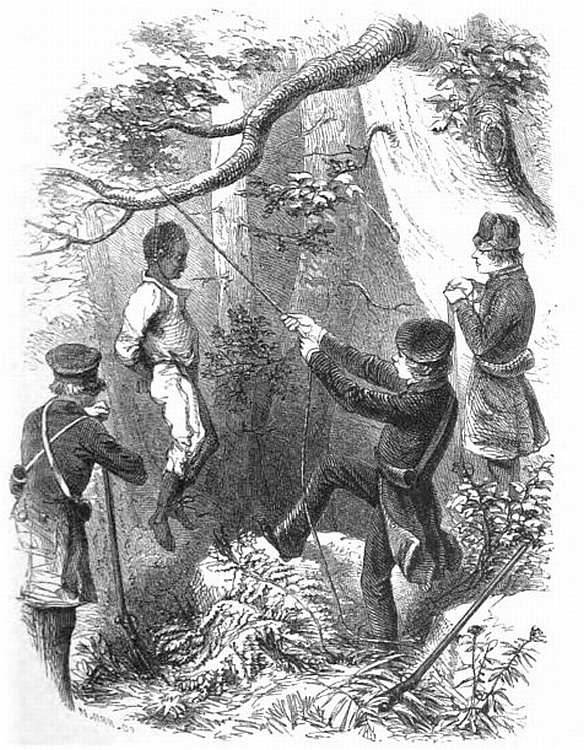
And these were savages forsooth—red savages, to be dispossessed of their rights—to be driven from hearth and home—to be banished from their beautiful land to a desert wild—to be shot down and hunted like beasts of the field! The last in its most literal sense, for dogs were to be employed in the pursuit!
Chapter Nineteen.
An Indian Hero.
There were several reasons why the treaty of the Oclawaha could not be considered binding on the Seminole nation. First, it was not signed by a majority of the chiefs. Sixteen chiefs and sub-chiefs appended their names to it. There were five times this number in the nation.
Second, it was, after all, no treaty, but a mere conditional contract—the conditions being that a deputation of Seminoles should first proceed to the lands allotted in the west (upon White River), examine these lands, and bring back a report to their people. The very nature of this condition proves that no contract for removal could have been completed, until the exploration had been first accomplished.
The examination was made. Seven chiefs, accompanied by an agent, journeyed to the far west, and made a survey of the lands.
Now, mark the craft of the commissioner! These seven chiefs are nearly all taken from those friendly to the removal. We find among them both the Omatlas, and Black Clay. True, there is Hoitle-mattee (jumper), a patriot, but this brave warrior is stricken with the Indian curse—he loves the fire-water; and his propensity is well-known to Phagan, the agent, who accompanies them.
A ruse is contemplated, and is put in practice. The deputation is hospitably entertained at Fort Gibson, on the Arkansas. Hoitle-mattee is made merry—the contract for removal is spread before the seven chiefs—they all sign it: and the juggle is complete.
But even this was no fulfilment of the terms of the Oclawaha covenant. The deputation was to return with their report, and ask the will of the nation. That was yet to be given; and, in order to obtain it, a new council of all the chiefs and warriors must be summoned.
It was to be a mere formality. It was well-known that the nation as a body disapproved of the facile conduct of the seven chiefs, and would not endorse it. They were not going to “move.”
This was the more evident, since other conditions of the treaty were daily broken. One of these was the restoration of runaway slaves, which the signers of the Oclawaha treaty had promised to send back to their owner. No blacks were sent back; on the contrary, they now found refuge among the Indians more secure than ever.
The commissioner knew all this. He was calling the new council out of mere formality. Perhaps he might persuade them to sign—if not, he intended to awe them into the measure, or force them at the point of the bayonet. He had said as much. Troops were concentrating at the agency—Fort King—and others were daily arriving at Tampa Bay. The government had taken its measures; and coercion was resolved upon.
I was not ignorant of what was going on, nor of all that had happened during my long years of absence. My comrades, the cadets, were well versed in Indian affairs, and took a lively interest in them—especially those who expected soon to escape from the college walls. “Black Hawk’s war,” just terminated in the west, had already given some a chance of service and distinction, and young ambition was now bending its eyes upon Florida.
The idea, however, of obtaining glory in such a war was ridiculed by all. “It would be too easy a war—the foe was not worth considering. A mere handful of savages,” asserted they; “scarcely enough of them to stand before a single company. They would be either killed or captured in the first skirmish, one and all of them—there was not the slightest chance of their making any protracted resistance—unfortunately, there was not.”
Such was the belief of my college companions; and, indeed, the common belief of the whole country, at that time. The army, too, shared it. One officer was heard to boast that he could march through the whole Indian territory with only a corporal’s guard at his back; and another, with like bravado, wished that the government would give him a charter of the war, on his own account. He would finish it for 10,000 dollars!
These only expressed the sentiments of the day. No one believed that the Indians would or could sustain a conflict with us for any length of time; indeed, there were few who could be brought to think that they would resist at all: they were only holding out for better terms, and would yield before coming to blows.
For my part, I thought otherwise. I knew the Seminoles better than most of those who talked—I knew their country better; and, notwithstanding the odds against them—the apparent hopelessness of the struggle—I had my belief that they would neither yield to disgraceful terms, nor yet be so easily conquered. Still, it was but a conjecture; and I might be wrong. I might be deserving the ridicule which my opposition to the belief of my comrades often brought upon me.
The newspapers made us acquainted with every circumstance. Letters, too, were constantly received at the “Point” from old graduates now serving in Florida. Every detail reached us, and we had become acquainted with the names of many of the Indian chieftains, as well as the internal politique of the tribe. It appeared they were not united. There was a party in favour of yielding to the demands of our government, headed by one Omatla. This was the traitor party, and a minority. The patriots were more numerous, including the head “mico” himself, and the powerful chiefs Holata, Coa hajo, and the negro Abram.
Among the patriots there was one name that, upon the wings of rumour, began to take precedence of all others. It appeared frequently in the daily prints, and in the letters of our friends. It was that of a young warrior, or sub-chief, as he was styled, who by some means or other had gained a remarkable ascendency in the tribe. He was one of the most violent opponents of the “removal;” in fact, the leading spirit that opposed it; and chiefs much older and more powerful were swayed by his counsel.
We cadets much admired this young man. He was described as possessing all the attributes of a hero—of noble aspect, bold, handsome, intelligent. Both his physical and intellectual qualities were spoken of in terms of praise—almost approaching to hyperbole. His form was that of an Apollo, his features Adonis or Endymion. He was first in everything—the best shot in his nation, the most expert swimmer and rider—the swiftest runner, and most successful hunter—alike eminent in peace or war—in short, a Cyrus.
There were Xenophons enough to record his fame. The people of the United States had been long at peace with the red men. The romantic savage was far away from their borders. It was rare to see an Indian within the settlements, or hear aught of them. There had been no late deputations from the tribes to gratify the eyes of gazing citizens; and a real curiosity had grown up in regard to these children of the forest. An Indian hero was wanted, and this young chief appeared to be the man.
His name was Osceola.
Chapter Twenty.
Frontier Justice.
I was not allowed long to enjoy the sweets of home. A few days after my arrival, I received an order to repair to Fort King, the Seminole agency, and head-quarters of the army of Florida. General Clinch there commanded. I was summoned upon his staff.
Not without chagrin, I prepared to obey the order. It was hard to part so soon from those who dearly loved me, and from whom I had been so long separated. Both mother and sister were overwhelmed with grief at my going. Indeed they urged me to resign my commission, and remain at home.
Not unwillingly did I listen to their counsel: I had no heart in the cause in which I was called forth; but at such a crisis I dared not follow their advice: I should have been branded as a traitor—a coward. My country had commissioned me to carry a sword. I must wield it, whether the cause be just or unjust—whether to my liking or not. This is called patriotism!
There was yet another reason for my reluctance to part from home. I need hardly declare it. Since my return, my eyes had often wandered over the lake—often rested on that fair island. Oh, I had not forgotten her!
I can scarcely analyse my feelings. They were mingled emotions. Young love triumphant over older passions—ready to burst forth from the ashes that had long shrouded it—young love penitent and remorseful—doubt, jealousy, apprehension. All these were active within me.
Since my arrival, I had not dared to go forth. I observed that my mother was still distrustful. I had not dared even to question those who might have satisfied me. I passed those few days in doubt, and at intervals under a painful presentiment that all was not well.
Did Maümee still live? Was she true? True! Had she reason? Had she ever loved me?
There were those near who could have answered the first question; but I feared to breathe her name, even to the most intimate.
Bidding adieu to my mother and sister, I took the route. These were not left alone: my maternal uncle—their guardian—resided upon the plantation. The parting moments were less bitter, from the belief that I should soon return. Even if the anticipated campaign should last for any considerable length of time, the scene of my duties would lie near, and I should find frequent opportunities of revisiting them.
My uncle scouted the idea of a campaign, as so did every one. “The Indians,” he said, “would yield to the demands of the commissioner. Fools, if they didn’t!”
Fort King was not distant; it stood upon Indian ground—fourteen miles within the border, though further than that from our plantation. A day’s journey would bring me to it; and in company of my cheerful “squire,” Black Jake, the road would not seem long. We bestrode a pair of the best steeds the stables afforded, and were both armed cap-à-pié.
We crossed the ferry at the upper landing, and rode within the “reserve” (Note 1). The path—it was only a path—ran parallel to the creek, though not near its banks. It passed through the woods, some distance to the rear of Madame Powell’s plantation.
When opposite to the clearing, my eyes fell upon the diverging track. I knew it well: I had oft trodden it with swelling heart.
I hesitated—halted. Strange thoughts careered through my bosom; resolves half-made, and suddenly abandoned. The rein grew slack, and then tightened. The spur threatened the ribs of my horse, but failed to strike.
“Shall I go? Once more behold her. Once more renew those sweet joys of tender love? Once more—Ha, perhaps it is too late! I might be no longer welcome—if my reception should be hostile? Perhaps—”
“Wha’ you doin’ dar, Massr George? Daat’s not tha’ road to tha fort.”
“I know that, Jake; I was thinking of making a call at Madame Powell’s plantation.”
“Mar’m Powell plantayshun! Gollys! Massr George—daat all you knows ’bout it?”
“About what?” I inquired with anxious heart.
“Dar’s no Mar’m Powell da no more; nor hain’t a been, since better’n two year—all gone clar ’way.”
“Gone away? Where?”
“Daat dis chile know nuffin ’bout. S’pose da gone some other lokayshun in da rezav; made new clarin somewha else.”
“And who lives here now?”
“Dar ain’t neery one lib tha now: tha ole house am desarted.”
“But why did Madame Powell leave it?”
“Ah—daat am a quaw story. Gollys! you nebber hear um, Massr George?”
“No—never.”
“Den I tell um. But s’pose, massr, we ride on. I am a gettin’ a little lateish, an’ ’twont do nohow to be cotch arter night in tha woods.”
I turned my horse’s head and advanced along the main road, Jake riding by my side. With aching heart, I listened to his narrative.
“You see, Massr George, ’twar all o’ Massr Ringgol—tha ole boss (Note 2) daat am—an’ I blieve tha young ’un had ’im hand in dat pie, all same, like tha ole ’un. Waal, you see Mar’m Pow’ll she loss some niggas dat war ha slaves. Dey war stole from ha, an’ wuss dan stole. Dey war tuk, an’ by white men, massr. Tha be folks who say dat Mass’ Ringgol—he know’d more ’n anybody else ’bout tha whole bizness. But da rubb’ry war blamed on Ned Spence an’ Bill William. Waal, Mar’m, Powell she go to da law wi’ dis yar Ned an’ Bill; an’ she ’ploy Massr Grubb tha big lawyer dat lib down tha ribba. Now Massr Grubb, he great friend o’ Massr Ringgol, an’ folks do say dat boaf de two put tha heads together to cheat dat ar Indyen ’ooman.”
“How?”
“Dis chile don’t say for troof, Massr George; he hear um only from da black folks: tha white folks say diffrent. But I hear um from Mass’ Ringgol’s own nigga woodman—Pomp, you know Massr, George? an’ he say that them ar two bosses did put tha heads together to cheat dat poor Indyen ’ooman.”
“In what way, Jake?” I asked impatiently.
“Waal, you see, Massr George, da lawya he want da Indyen sign ha name to some paper—power ob ’turney, tha call am, I believe. She sign; she no read tha writin. Whuch! daat paper war no power ob ’turney: it war what tha lawyas call a ‘bill ob sale’.”
“Ha!”
“Yes, Massr George, dat’s what um war; an’ by dat same bill ob sale all Mar’m Pow’ll’s niggas an’ all ha plantation-clarin war made ober to Massr Grubb.”
“Atrocious scoundrel?”
“Massr Grubb he swar he bought ’em all, an’ paid for ’em in cash dollar. Mar’m Pow’ll she swar de berry contr’y. Da judge he decide for Massr Grubb, ’kase great Massr Ringgoh he witness; an’ folks do say Massr Ringgol now got dat paper in um own safe keeping an’ war at tha bottom ob tha whole bizness.”
“Atrocious scoundrels! oh, villains! But tell me, Jake, what became of Madame Powell?”
“Shortly arter, tha all gone ’way—nob’dy know wha. Da mar’m haself an’ dat fine young fellur you know, an’ da young Indyen gal dat ebbery body say war so good-lookin’—yes, Massr George, tha all gone ’way.”
At that moment an opening in the woods enabled me to catch a glimpse of the old house. There it stood in all its grey grandeur, still embowered in the midst of beautiful groves of orange and olive. But the broken fence—the tall weeds standing up against the walls—the shingles here and there missing from the roof—all told the tale of ruin.
There was ruin in my heart, as I turned sorrowing away.
Note 1. That portion of Florida reserved for the Seminoles by the treaty of Moultrie Creek made in 1823. It was a large tract, and occupied the central part of the peninsula.
Note 2. Master or proprietor; universally in use throughout the Southern States. From the Dutch “baas.”
Chapter Twenty One.
Indian Slaves.
It never occurred to me to question the genuineness of Jake’s story. What the “black folks” said was true; I had no doubt of it. The whole transaction was redolent of the Ringgolds and lawyer Grubbs—the latter a half planter, half legal practitioner of indifferent reputation.
Jake further informed me that Spence and Williams had disappeared during the progress of the trial. Both afterwards returned to the settlement, but no ulterior steps were taken against them, as there was no one to prosecute!
As for the stolen negroes, they were never seen again in that part of the country. The robbers had no doubt carried them to the slave-markets of Mobile or New Orleans, where a sufficient price would be obtained to remunerate Grubbs for his professional services, as also Williams and Spence for theirs. The land would become Ringgold’s, as soon as the Indians could be got out of the country—and this was the object of the “bill of sale.”
A transaction of like nature between white man and white man would have been regarded as a grave swindle, an atrocious crime. The whites affected not to believe it; but there were some who knew it to be true, and viewed it only in the light of a clever ruse!
That it was true, I could not doubt. Jake gave me reasons that left no room for doubt; in fact it was only in keeping with the general conduct of the border adventures towards the unfortunate natives with whom they came in contact.
Border adventures did I say? Government agents, members of the Florida legislature, generals, planters, rich as Ringgold, all took part in similar speculations. I could give names. I am writing truth, and do not fear contradiction.
It was easy enough, therefore, to credit the tale. It was only one of twenty similar cases of which I had heard. The acts of Colonel Gad Humphreys, the Indian agent—of Major Phagan, another Indian agent—of Dexter, the notorious negro-stealer—of Floyd—of Douglass—of Robinson and Millburn, are all historic—all telling of outrages committed upon the suffering Seminole. A volume might be filled detailing such swindles as that of Grubbs and Ringgold. In the mutual relations between white man and red man, it requires no skillful advocate to shew on which side must lie the wrongs unrepaired and unavenged. Beyond all doubt, the Indian has ever been the victim.
It is needless to add that there were retaliations: how could it be otherwise?
One remarkable fact discloses itself in these episodes of Floridian life. It is well-known that slaves thus stolen from the Indians always returned to their owners whenever they could! To secure them from finding their way back, the Dexters and Douglasses were under the necessity of taking them to some distant market, to the far “coasts” of the Mississippi—to Natchez or New Orleans.
There is but one explanation of this social phenomenon; and that is, that the slaves of the Seminole were not slaves. In truth they were treated with an indulgence to which the helot of other lands is a stranger. They were the agriculturists of the country, and their Indian master was content if they raised him a little corn—just sufficient for his need—with such other vegetable products as his simple cuisine required. They lived far apart from the dwellings of their owners. Their hours of labour were few, and scarcely compulsory. Surplus product was their own; and in most cases they became rich—far richer than their own masters, who were less skilled in economy. Emancipation was easily purchased, and the majority were actually free—though from such claims it was scarcely worth while to escape. If slavery it could be called, it was the mildest form ever known upon earth—far differing from the abject bondage of Ham under either Shem or Japheth.
It may be asked how the Seminoles became possessed of these black slaves? Were they “runaways” from the States—from Georgia and the Carolinas, Alabama, and the plantations of Florida? Doubtless a few were from this source; but most of the runaways were not claimed as property; and, arriving among the Indians, became free. There was a time when by the stern conditions of the Camp Moultrie Covenant these “absconding” slaves were given up to their white owners; but it is no discredit to the Seminoles, that they were always remiss in the observance of this disgraceful stipulation. In fact, it was not always possible to surrender back the fugitive negro. Black communities had concentrated themselves in different parts of the Reserve, who under their own leaders were socially free, and strong enough for self-defence. It was with these that the runaways usually found refuge and welcome. Such a community was that of “Harry” amidst the morasses of Pease Creek—of “Abram” at Micosauky—of “Charles” and the “mulatto king.”
No; the negro slaves of the Seminoles were not runaways from the plantations; though the whites would wish to make it appear so. Very few were of this class. The greater number was the “genuine property” of their Indian owners, so far as a slave can be called property. At all events, they were legally obtained—some of them from the Spaniards, the original settlers, and some by fair purchase from the American planters themselves.
How purchased? you will ask. What could a tribe of savages give in exchange for such a costly commodity? The answer is easy. Horses and horned cattle. Of both of these the Seminoles possessed vast herds. On the evacuation by the Spaniards the savannas swarmed with cattle, of Andalusian race—half-wild. The Indians caught and reclaimed them—became their owners.
This, then, was the quid pro quo—quadrupeds in exchange for bipeds!
The chief of the crimes charged against the Indians was the stealing of cattle—for the white men had their herds as well. The Seminoles did not deny that there were bad men amongst them—lawless fellows difficult to restrain. Where is the community without scamps?
One thing was very certain. The Indian chiefs, when fairly appealed to, have always evinced an earnest desire to make restoration: and exhibited an energy in the cause of justice, entirely unknown upon the opposite side of their border.
It differed little how they acted, so far as regarded their character among their white neighbours. These had made up their mind that the dog should be hanged; and it was necessary to give him a bad name. Every robbery, committed upon the frontier was of course the act of an Indian. White burglars had but to give their faces a coat of Spanish brown, and justice could not see through the paint.