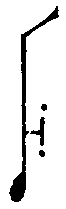
Of Springing Steps.
John Weaver translation
A
Springing Step
, is perform’d two ways, either by
springing
and
falling
on the same Foot which moves forward, which I shall, for the future, call a
Bound;
or
springing
and
falling
on the Foot that does not move forward, which I shall call a
Hop
.
When there is a Mark of a Spring upon the Step, and no Mark for the holding up of the Foot after it, it shews, that the Spring is to be made with the Foot that moves, which is call’d a Bound
A Bound.
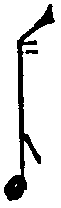
But when there is a Mark for a Spring, and afterwards a Mark for the Foot up, it signifies, that the Spring must be made on the Foot that does not move forwards, which is call’d a Hop.
A Hop.
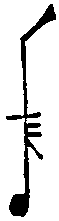
The mark for falling, has no proper Place assign’d it, and I shall only observe, that in rising, when it is in Order to fall, it is necessary the Mark for a Rise, should be near the beginning of the Step.
Rise and Fall.
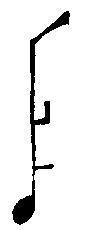
The mark for a Slide, has likewise no proper Place, when it is single on a Step; but when it is accompanied with other Marks, as sinking, rising, &c. then it must be plac’d last.
Sink, Rise, and Slide.
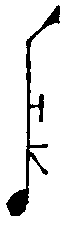
If after the Mark of a Slide, there be also the Mark for the Foot up, you must Slide no farther than that Mark shewing the Foot up.
Slide, and afterwards hold the Foot up.
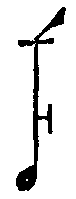
The Mark for the Foot up, may be plac’d either in the Middle, or the End; when it is in the Middle, it shews, that the Foot is only up, in Order to be set down afterwards.
Foot up, and then put down.
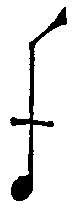
But when it is at the End, it signifies, that the Foot must remain up.
Foot up.
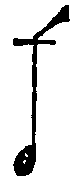
To point the Toe, and afterwards the Heel, there must be a Point on the outside of that which represents the Toe, and another on the inside of that which represents the Heel.
To point the Toe, and after to place the Heel.
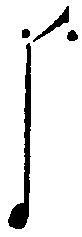
To place the Heel, and afterwards point the Toe, there must be a point on the outside of that which represents the Heel, and another on the inside of that which represents the Toe.
To place the Heel, and afterwards point the Toe.
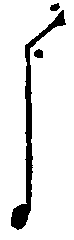
It is to be observed, that in the two foregoing Examples, the Point which is on the Outside of that which represents either the Toe or Heel, is the Point from whence you must always begin.
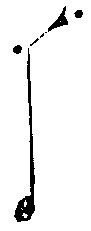
When there is a Point at the end of that which represents the Toe, and another behind that which shews the Heel, it shews, that the Foot must be set down flat.
A flat Foot.
Marks for Turning, have no proper Places assign’d them, no more than the falling or sliding Mark ; but you must then observe to which side to turn, whether to the right or left.
You must observe, that the beginning of the turning Mark, is to be taken from that Part which is nearest to the black Spot.
After having thus shewn the beginning of each turning Mark, you must observe exactly which way to turn, whether to the right or left, as appears by the following Examples:
A quarter turn to the Right. A quarter Turn to the Left. A half Turn to the Right. A half Turn to the Left. Three quarter Turn to the Right. Three quarter Turn to the Left.
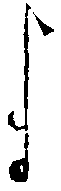
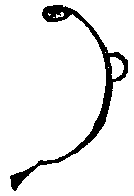
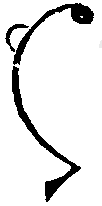
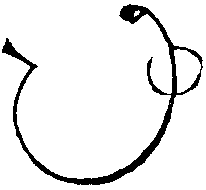
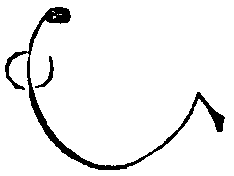
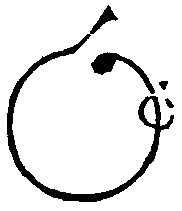
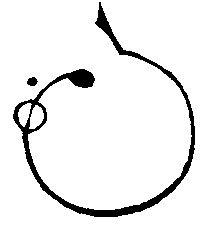
The beginning of a whole Turn, or turn quite round, is more difficult to find out, because the Circle, which is the Mark of it, has neither beginning nor End: But it is nevertheless to be known by a Point plac’d on the side of the Step; from which Point the beginning being known, you make Use of the same Rules as above.
A whole Turn to the Right. A whole Turn to the Left.
When a
Turn
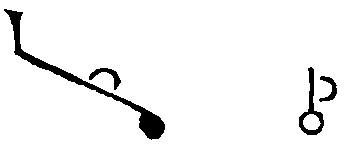
is to be made but half a quarter round, it must be mark’d a quarter of a
Circle
on the side of the
Step,
without joining it to the Step.
A half quarter Turn to the Left. A half quarter Turn to the Right.
I have already shewn, that all
Steps
and half
Positions
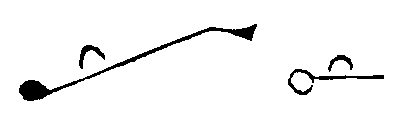
, which have but one Point at either of their Extremities, signify either the pointing of the
Toe
, or placing the
Heel
, without the Body’s bearing on it; but when there happens to be two Points, it then shews, that the Body must bear upon it.
To bear the Body on the Toe. To bear the Body on the Heel.
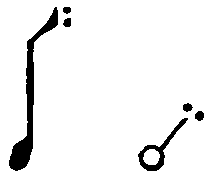
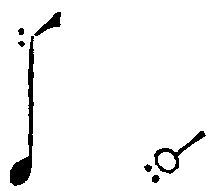
Having explain’d all the before-mention’d
Marks
, I hope it will not be thought improper to shew when
Sinkings, Risings, Springings
, and
Slidings,
are to be made upon the
Toe, Heel
, or
flat Foot
, as the following Examples will demonstrate.
When there is a Point at the end of the sinking Mark, it shews, that the Toe must be bent downwards.
Sink, the Toe towards the Ground.
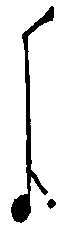
When there is a Point behind the sinking Mark, it denotes, that the Heel must be bent downwards.
Sink, the Heel towards the Ground.
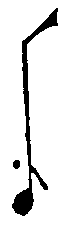
When there is a Point at the end of the sinking Mark, and another behind, it shews the Sink must be with a flat Foot.
Sink, the Foot flat.
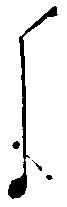
When there is a Point at the end of a rising Mark, it shews the Rise must be made on the Toe.
Rise on the Toe.
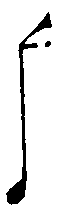
When there is a Point behind the rising Mark, it shews, that the Rise must be made on the Heel.
Rise on the Heel.
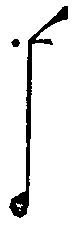
When there is a Point at the end of a rising Mark, and another behind, it shews, that the Rise must be on a flat Foot.
Rise on a flat Foot.
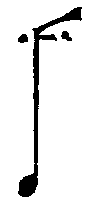
When there is a Point at the end of a springing Mark, it shews, that the Spring, Hop, or Bound, must be made on the Toe.
Spring on the Toe.
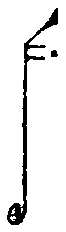
When there is a Point behind the springing Mark, it shews, that the Spring, Hop, or Bound, must be made on the Heel.
Spring on the Heel.
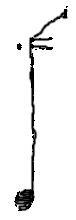
When there is a Point at the end of the springing Mark, and another behind, it signifies, that the Spring, Hop, or Bound, must be made on a flat Foot.
Spring on a flat Foot.
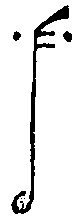
When there is a Point at the end of the sliding Mark, towards the Mark representing the Foot, it shews, that the Slide must be made on the Toe.
Slide on the Toe.
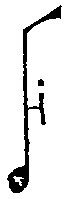
When there is a Point at the other end of the sliding Mark, it shews, that the Slide is to be made on the Heel.
Slide on the Heel.
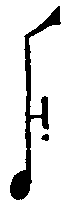
And when there is a Point at each end of the sliding Mark, it denotes, that the Slide must be made with a flat Foot.
Slide with a flat Foot.