OOM PAUL'S PEOPLE (continued 4)
Reading edition
One street car in Cape Town was for a long time distinguished because of its many American features. The Philadelphia-made car was propelled over Pittsburg tracks by means of the power passing through Wilkesbarre wires, and the human agencies that controlled it were a Boston motorman and a San Francisco conductor. It might not be pursuing the subject too far to add that of the twelve passengers in the car on a certain journey ten were Americans, representing eight different States.
One of the first railroads in South Africa--that which leads from Lorenzo Marques to the Transvaal border--was built by an American, a Mr. Murdock, while American material entered largely into the construction of the more extensive roads from the coast to the interior. American rails are more quickly and more cheaply[#] obtainable in South Africa than those of English make, but the influence which is exerted against the use of other than British rails prevents their universal adoption. Notwithstanding the efforts of the influential Englishmen to secure British manufactures wherever and whenever possible, American firms have recently secured the contracts for forty thousand tons of steel rails for the Cape Colony Railway system, and the prospects are that more orders of a similar nature will be forthcoming.
[#] "But the other day we gave an order for two hundred and fifty miles of rails. We had a large number of tenders, and the lowest tender, you may be sorry to hear, was sent by an American, Mr. Carnegie. Fortunately, however, the tender was not in order, and we were therefore able to give the work to our own people. It may be said that this American tender was a question of workmen and strikes."--Cecil J. Rhodes, at a meeting of the stockholders of the Cape-Cairo Railway, London, May 2, 1899.
It is not in the sale of steel rails alone that the American manufacturer is forging ahead of his competitors in South Africa. American manufactured wares of all kinds are in demand, and in many instances they are leaders in the market. Especially true is this of American agricultural implements, which are so much more adaptable to the soil and much cheaper than any other make. Small stores in the farming communities of Natal and Cape Colony sell American ploughshares, spades, forks, rakes, and hoes almost exclusively, and it amazes the traveller to find that almost every plough and reaper used by the more progressive agriculturists bears the imprint "Made in the United States."
It is a strange fact that, although South Africa has vast areas covered with heavy timber, almost all the lumber used in the mining districts is transported thither from Puget Sound. The native timber being unsuited for underground purposes and difficult of access, all the mine owners are obliged to import every foot of wood used in constructing surface and underground works of their mines, and at great expense, for to the original cost of the timber is added the charges arising from the sea and land transportation, import duties, and handling. The docks at Cape Town almost all the year round contain one or more lumber vessels from Puget Sound, and upon several occasions five such vessels were being unloaded at the same time.
American coal, too, has secured a foothold in South Africa, a sample cargo of three thousand tons having been despatched thither at the beginning of the year. Coal of good quality is found in several parts of the Transvaal and Natal, but progress in the development of the mines has been so slow that almost the total demand is supplied by Wales. Cape Colony has an extensive petroleum field, but it is in the hands of concessionaires, who, for reasons of their own, refuse to develop it. American and Russian petroleums are used exclusively, but the former is preferred, and is rapidly crowding the other out of the market.
Among the many other articles of export to South Africa are flour, corn, butter, potatoes, canned meats, and vegetables--all of which might be produced in the country if South Africans took advantage of the opportunities offered by soil and Nature. American live stock has been introduced into the country since the rinderpest disease destroyed almost all of the native cattle, and with such successful results that several Western firms have established branches in Cape Town, and are sending thither large cargoes of mules, horses, cattle, and sheep. Cecil J. Rhodes has recently stocked his immense Rhodesian farm with American live stock, and, as his example is generally followed throughout the country, a decided increase in the live-stock export trade is anticipated.
Statistics only can give an adequate idea of American trade with South Africa; but even these are not reliable, for the reason that a large percentage of the exports sent to the country are ordered through London firms, and consequently do not appear in the official figures. As a criterion of what the trade amounts to, it will only be necessary to quote a few statistics, which, however, do not represent the true totals for the reason given. The estimated value of the exports and the percentage increase of each year's business over that of the preceding year is given, in order that a true idea of the growth of American trade with South Africa may be formed:
YEAR. Value. Per cent increase. 1895 $5,000,000 1896 12,000,000 140 1897 16,000,000 33 1/8 1898 (estimated) 20,000,000 25
A fact that is deplored by Americans who are eager to see their country in the van in all things pertaining to trade is that almost every dollar's worth of this vast amount of material is carried to South Africa in ships sailing under foreign colours. Three lines of steamships, having weekly sailings, ply between the two countries, and are always laden to the rails with American goods, but the American flag is carried by none of them. A fourth line of steamships, to ply between Philadelphia and Cape Town, is about to be established under American auspices, and is to carry the American flag. A number of small American sailing vessels trade between the two countries, but their total capacity is so small as to be almost insignificant when compared with the great volume carried in foreign bottoms.
The American imports from South Africa are of far less value than the exports, for the reason that the country produces only a few articles that are not consumed where they originate. America is the best market in the world for diamonds, and about one fourth of the annual output of the Kimberley mines reaches the United States. Hides and tallow constitute the leading exportations to America, while aloes and ostrich feathers are chief among the few other products sent here. Owing to this lack of exports, ships going to South Africa are obliged to proceed to India or Australia for return cargoes in order to reduce the expenses of the voyage.
However great the commercial interests of the United States in South Africa, they are small in comparison with the work of individual Americans, who have been active in the development of that country during the last quarter of a century. Wherever great enterprises have been inaugurated, Americans have been prominently identified with their growth and development, and in not a few instances has the success of the ventures been wholly due to American leadership. European capital is the foundation of all the great South African institutions, but it is to American skill that almost all of them owe the success which they have attained.
British and continental capitalists have recognised the superiority of American methods by intrusting the management of almost every large mine and industry to men who were born and received their training in the United States. It is an expression not infrequently heard when the success of a South African enterprise is being discussed, "Who is the Yankee?" The reason of this is involved in the fact that almost all the Americans who went to South Africa after the discovery of gold had been well fitted by their experiences in the California and Colorado mining fields for the work which they were called upon to do on the Randt, and, owing to their ability, were able to compete successfully with the men from other countries who were not so skilled.
Unfortunately, not all the Americans in South Africa have been a credit to their native country, and there is a considerable class which has created for itself an unenviable reputation. The component parts of this class are men who, by reason of criminal acts, were obliged to leave America for new fields of endeavour, and non-professional men who follow gold booms in all parts of the world and trust to circumstances for a livelihood. In the early days of the Johannesburg gold fields these men oftentimes resorted to desperate means, with the result that almost every criminal act of an unusually daring description is now credited against them by the orderly inhabitants. Highwaymen, pickpockets, illicit gold buyers, confidence men, and even train-robbers were active, and for several years served to discredit the entire American colony. Since the first gold excitement has subsided, this class of Americans, in which was also included by the residents all the other criminal characters of whatever nationality, has been compelled to leave the country, and to-day the American colony in Johannesburg numbers about three thousand of the most respected citizens of the city.
The American who has been most prominent in South African affairs, and the stanchest supporter of American interests in that country, is Gardner F. Williams, the general manager and one of the alternate life governors of the De Beers Consolidated Diamond Mines at Kimberley. A native of Michigan, Mr. Williams gained his mining experience in the mining districts of California and other Western States, and went to South Africa in 1887 to take charge of the Kimberley mines, which were then in an almost chaotic condition. By the application of American ideas, Mr. Williams succeeded in making of the mines a property which yields an annual profit of about ten million dollars on a nominal capital of twice that amount. He has introduced American machinery into the mines, and has been instrumental in many other ways in advancing the interests of his native country. Although Mr. Williams receives a salary twice as great as that of the President of the United States, he is proud to be the American consular agent at Kimberley--an office which does not carry with it sufficient revenue to provide the star-spangled banner which constantly floats from a staff in front of his residence.
Dr. J. Perrott Prince is another American who has assisted materially in extending American interests in South Africa, and it is due to his own unselfish efforts that the commerce of the United States with the port of Durban has risen from insignificant volume to its present size. Dr. Prince was a surgeon in the Union army during the civil war, and afterward was one of the first Americans to go to the Kimberley diamond fields. He it was who later induced Dr. Leander Starr Jameson to accompany him to Kimberley in the capacity of assistant surgeon--a service which he performed with great distinction until Mr. Rhodes sent him into Matabeleland to take charge of the military forces, which later he led into the Transvaal.
Dr. Prince's renown as a physician was responsible for a call to Madagascar, whither he was summoned by Queen Ranavalo. He remained in Madagascar as the queen's physician until the French took forcible possession of the island and sent the queen into exile on the Reunion Islands. Dr. Prince has lived in Durban, Natal, for several years, and during the greater part of that time conducted the office of American consular agent at a financial loss to himself. Unfortunately, Dr. Prince was obliged to end his connection with the consular service, and the United States are now represented in Durban by a foreigner, who on the last Fourth of July inquired why all the Americans in the city were making such elaborate displays of bunting and the Stars and Stripes.
The consular agent at Johannesburg is John C. Manion, of Herkimer, N.Y., who represents a large American machinery company. Mr. Manion, in 1896, carried on the negotiations with the Transvaal Government by which John Hays Hammond, an American mining engineer, was released from the Pretoria prison, where he had been confined for complicity in the uprising at Johannesburg. American machinery valued at several million dollars has been sent to South Africa as the result of Mr. Manion's efforts.
In the gold industry on the Randt, Americans have been specially active, and it is due to one of them, J. S. Curtis, that the deep-level mines were discovered. In South Africa a mining claim extends only a specified distance below the surface of the earth, and the Governments do not allow claim-owners to dig beyond that depth. Mr. Curtis found that paying reefs existed below the specified depth, and the result was that the Government sold the underground or deep-level claims with great profit to itself and the mining community.
The consulting engineers of almost all the mines of any importance in the country are Americans, and their salaries range from ten thousand to one hundred thousand dollars a year. John Hays Hammond, who was one of the first American engineers to reach the gold fields, was official mining engineer for the Transvaal Government, and received a yearly salary of twenty-five thousand dollars for formulating the mining laws of the country. He resigned that office, and is now the consulting engineer for the British South Africa Company in Rhodesia and several gold mines on the Randt, at salaries which aggregate almost one hundred thousand dollars a year. Among the scores of other American engineers on the Randt are L. I. Seymour, who has control of the thirty-six shafts of the Randt Mines; Captain Malan, of the Robinson mines; and H. S. Watson, of the Simmer en Jack mines, in developing which more than ten million dollars have been spent.
Another American introduced the system of treating the abandoned tailings of the mines by the cyanide process, whereby thousands of ounces of gold have been abstracted from the offal of the mills, which had formerly been considered valueless. Others have revolutionized different parts of the management of the mines, and in many instances have taken abandoned properties and placed them on a paying basis. It would not be fair to claim that American ingenuity and skill are responsible for the entire success of the Randt gold mines, but it is indisputable that Americans have done more toward it than the combined representatives of all other nations.
Every line of business on the Randt has its American representatives, and almost without exception the firms who sent them thither chose able men. W. E. Parks, of Chicago, represents Frazer & Chalmers, whose machinery is in scores of the mines. His assistant is W. H. Haig, of New York city.
The American Trading and Importing Company, with its headquarters in Johannesburg, and branches in every city and town in the country, deals exclusively in American manufactured products, and annually sells immense quantities of bicycles, stoves, beer, carriages, and other goods, ranging from pins to pianos.
Americans do not confine their endeavours to commercial enterprises, and they may be found conducting missionary work among the Matabeles and Mashonas, as well as building dams in Rhodesia. American missionaries are very active in all parts of South Africa, and because of the practical methods by which they endeavour to civilize and Christianize the natives they have the reputation throughout the country of being more successful than those who go there from any other country. In the Rhodesian country Mr. Rhodes has given many contributions of land and money to the American missionaries, and has on several occasions complimented them by pronouncing their achievements unparalleled.
A practical illustration will demonstrate the causes of the success of the American missionary. An English missionary spent the first two years after his arrival in the country in studying the natives' language and in building a house for himself. In that time he had made no converts. An American missionary arrived at almost the same time, rented a hut, and hired interpreters. At the end of two years he had one hundred and fifty converts, many more natives who were learning useful occupations and trades, and had sent home a request for more missionaries with which to extend his field.
It is rather remarkable that the scouts who assisted in subduing the American Indians should later be found on the African continent to assist in the extermination of the blacks. In the Matabele and Mashona campaigns of three years ago, Americans who scouted for Custer and Miles on the Western plains were invaluable adjuncts to the British forces, and in many instances did heroic work in finding the location of the enemy and in making way for the American Maxim guns that were used in the campaigns.
The Americans in South Africa, although only about ten thousand in number, have been of invaluable service to the land. They have taught the farmers to farm, the miners to dig gold, and the statesmen to govern. Their work has been a credit to the country which they continue to revere, and whose flag they raise upon every proper occasion. They have taken little part in the political disturbances of the Transvaal, because they believe that the citizens of a republic should be allowed to conduct its government according to their own idea of right and justice, independently of the demands of those who are not citizens.
CHAPTER XII
JOHANNESBURG OF TO-DAY
The palms and bamboos of Durban, the Zulu policemen and 'ricksha boys, and the hospitable citizens have been left behind, and the little train of English compartment cars, each with its destination "Johannesburg" labelled conspicuously on its sides, is winding away through cane fields and banana groves, past groups of open-eyed natives and solemn, thin-faced Indian coolies.
Pretty little farmers' cottages in settings of palms, mimosas, and tropical plants are dotted in the green valleys winding around the innumerable small hills that look for all the world like so many inverted moss-covered china cups. Lumbering transport wagons behind a score of sleek oxen, wincing under the fire of the far-reaching rawhide in the hands of a sparsely clad Zulu driver, are met and passed in a twinkling. Neatly thatched huts with natives lazily lolling in the sun become more frequent as the train rolls on toward the interior, and the greenness of the landscape is changing into the brown of dead verdure, for it is the dry season--the South African winter. The hills become more frequent, and the little locomotive goes more slowly, while the train twists and writhes along its path like a huge python.
Now it is on the hilltop from which the distant sea and its coast fringe of green are visible on the one side, and nothing but treeless brown mountain tops on the other. A minute later it plunges down the hillside, along rocky precipices, over deep chasms, and then wearily plods up the zigzag course of another hillside. For five hours or more the monotony of miniature mountains continues, relieved by nothing more interesting than the noise of the train and the hilarious laughter and weird songs of a car load of Zulus bound for the gold fields. After this comes an undulating plain and towns with far less interest in their appearance than in their names. The traveller surfeited with Natal scenery finds amusement and diversion in the conductor's call of Umbilo, Umkomaas, Umgeni, Amanzimtoti, Isipingo, Mooi River, Zwartkop, or Pietermaritzburg, but will not attempt to learn the proper pronunciation of the names unless he has weeks at his command.
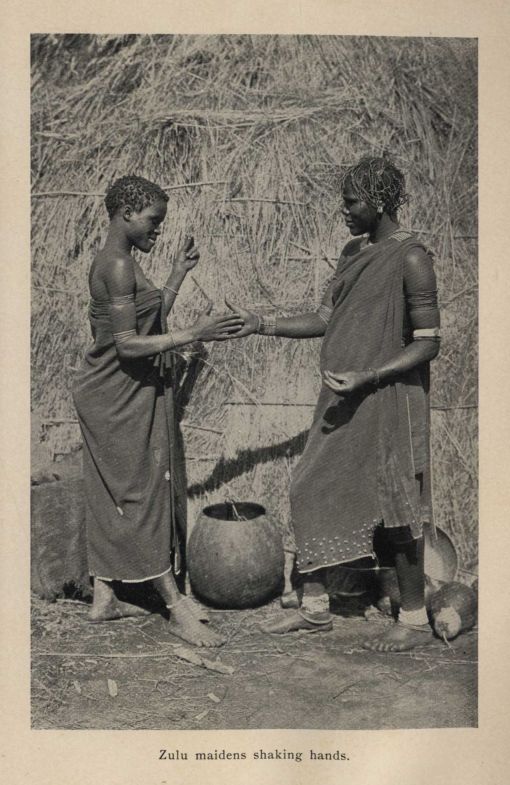
Zulu maidens shaking hands.
Farther on in the journey an ostrich, escaped from a farm, stalks over the plain, and, approaching to within several yards of the train, jogs along for many miles, and perchance wheedles the engineer into impromptu races. Hardly has the bird disappeared when on the wide veldt a herd of buck galloping with their long heads down, or a large number of wildebeest, plunging and jumping like animated hobby-horses, raise clouds of dust as they dash away from the monster of iron and steam. Shortly afterward the train passes a waterfall almost thrice as lofty as Niagara, but located in the middle of the plain, into whose surface the water has riven a deep and narrow chasm.
Since the balmy Indian Ocean has been left behind, the train has been rising steadily, sometimes an inch in a mile but oftener a hundred feet, and the air has grown cooler. The thousands of British soldiers at Ladysmith are wearing heavy clothing; their horses, tethered in the open air, are shivering, and far to the westward is the cause of it all--the lofty, snow-covered peaks of the Dragon Mountain. Night comes on and clothes the craggy mountains and broken valleys with varying shades of sombreness. The moon outlines the snow far above, and with its rays marks the lofty line where sky and mountain crest seem to join. Morning light greets the train as it dashes down the mountain side, through the passes that connect Natal with the Transvaal and out upon the withered grass of the flat, uninteresting veldt of the Boer country.
The South African veldt in all its winter hideousness lies before you. It stretches out in all directions--to the north and south, to the east and west--and seems to have no boundaries. Its yellowish brownness eats into the brain, and the eyes grow weary from the monotony of the scene. Hour after hour the train bears onward in a straight line, but the landscape remains the same. But for noises and motions of the cars you would imagine that the train was stationary, so far as change of scenery is concerned. Occasionally a colony of huge ant-heaps or a few buck or deer may be passed, but for hours it is veldt, veldt, veldt! An entire day's journey, unrelieved except toward the end by a few straggling towns of Boer farmhouses or the sheet-iron cabins of prospectors, bring it to Heidelberg, once the metropolis as well as the capital of the republic, but now pining because the former distinguishing mark has been yielded to its neighbour, Johannesburg.
As the shades of another night commence to fall, the veldt suddenly assumes a new countenance. Lights begin to sparkle, buildings close together appear, and scores of tall smokestacks tower against the background of the sky. The presence of the smoke-stacks denote the arrival at the Randt, and for twenty miles the train rushes along this well-defined gold-yielding strip of land. Buildings, lights, stacks, and people become more numerous as the train progresses into the city limits of Johannesburg, and the traveller soon finds himself in the middle of a crowd of enthusiastic welcoming and welcomed persons on the platform of the station of the Nederlandsche Zuid-Afrikaansche Spoorweg-Maatschappij, and in the Golden City.
The sudden change from the dreary lifelessness of the veldt to the exciting crush and bustle of the station platform crowd is almost bewildering, because it is so different from what is expected in interior Africa. The station, a magnificent structure of stone and iron, presents more animated scenes whenever trains arrive than the Grand Central in New York or the Victoria in London, because every passenger is invariably met at the train by all his friends and as many of their friends as the station platform will accommodate. The crowd which surges around this centre of the city's life is of a more cosmopolitan character than that which can be found in any other city in the world with the exceptions of Zanzibar and Port Said. Almost every race is represented in the gathering, which is suggestive of a mass meeting of the villagers of the Midway Plaisance at the Columbian Exposition. In the crowd are stolid Anglo-Saxons shaking hands effusively; enthusiastic Latins embracing each other; negroes rubbing noses and cheeks; smiling Japanese; cold, stern Chinese; Cingalese, Russians, Malays, and Egyptians--all in their national costumes, and all welcoming friends in their native manner and language. Meandering through the crowd are several keen-eyed Boer policemen, commonly called "Zarps," politely directing the attention of innocent-looking newcomers to placards bearing the inscription "Pas op Zakkenrollers," which is the Boer warning of pickpockets.
After the traveller has forced a way through the crowd he is attacked by a horde of cabmen who can teach tricks of the trade to the London and New York night-hawks. Their equipages range from dilapidated broughams to antique 'rickshas, but their charges are the same--"a quid," or five dollars, either for a mile or a minute's ride. After the insults which follow a refusal to enter one of their conveyances have subsided, the agents of the hotels commence a vociferous campaign against the newcomers, and very clever it is in its way. They are able to distinguish a foreigner at one glance, and will change the name of the hotel which they represent a score of times in as many seconds in order to bag their quarry. For the patriotic American they have the New York Hotel, the Denver House, the Hotel California, and many other hostelries named after American cities. "Hey, Yank!" they will salute an American, "Come up to the New York Hotel and patronize American enterprise." If the traveller will accompany one of these agents he will find that all the names apply to one hotel, which has an American name but is conducted and patronized by a low class of foreigners. The victim of misrepresentation will seek another hotel, and will be fortunate if he finds comfortable quarters for less than ten dollars a day, or three times the amount he would be called upon to pay at a far better hotel in any American city of equal size. The privilege of fasting, or of awakening in the morning with a layer of dust an eighth of an inch deep on the counterpane and on the face may be ample return for the extraordinary charges, but the stranger in the city is not apt to adopt that view of the situation until he is acclimated.
The person who has spent several days in crossing the veldt and enters Johannesburg by night has a strange revelation before him when he is awakened the following morning. He has been led to believe that the city is a motley collection of corrugated-iron hovels, hastily constructed cabins, and cheap public buildings. Instead he finds a beautiful city, with well-paved streets, magnificent buildings of stone and brick, expensive public buildings, and scores of palatial residences. Many American cities of the same size and many times older can not show as costly buildings or as fine public works. Hotels of five and six stories, and occupying, in several instances, almost entire blocks, are numerous; of office buildings costing a quarter of a million dollars each there are half a score; banks, shops, and newspapers have three- and four-story buildings of brick and stone, while there are hundreds of other buildings that would be creditable to any large city in America or Europe. The Government Building in the centre of the city is a five-story granite structure of no mean architectural beauty. In the suburbs are many magnificent private residences of mine owners and managers who, although not permanent residents of the city, have invested large amounts of money, so that the short time they spend in the country may be amid luxurious and comfortable surroundings.
One of the disagreeable features of living in Johannesburg is the dust which is present everywhere during the dry season. It rises in great, thick clouds on the surrounding veldt, and, obscuring the sun, wholly envelops the city in semi-darkness. One minute the air is clear and there is not a breath of wind; several minutes later a hurricane is blowing and blankets of dust are falling. The dust clouds generally rise west of the city, and almost totally eclipse the sun during their progress over the plain. Sometimes the dust storms continue only a few minutes, but very frequently the citizens are made uncomfortable by them for days at a time. Whenever they arrive, the doors and windows of buildings are tightly closed, business is practically at a standstill, and every one is miserable. There is no escape from it. It penetrates every building, however well protected, and it lodges in the food as well as in the drink. Pedestrians on the street are unable to see ten feet ahead, and are compelled to walk with head bowed and with handkerchief over the mouth and nostrils. Umbrellas and parasols are but slight protection against it. Only the miners, a thousand feet below the surface, escape it. When the storm has subsided the entire city is covered with a blanket of dust ranging in thickness from an inch on the sidewalks to an eighth of an inch on the store counters, furniture, and in pantries. It has never been computed how great a quantity of the dust enters a man's lungs, but the feeling that it engenders is one of colossal magnitude.
Second to the dust, the main characteristic of Johannesburg is the inhabitants' great struggle for sudden wealth. It is doubtful whether there is one person in the city whose ambition is less than to become wealthy in five years at least, and then to return to his native country. It is not a chase after affluence; it is a stampede in which every soul in the city endeavours to be in the van. In the city and in the mines there are hundreds of honourable ways of becoming rich, but there are thousands of dishonourable ones; and the morals of a mining city are not always on the highest plane. There are business men of the strictest probity and honesty, and men whose word is as good as their bond, but there are many more who will allow their conscience to lie dormant so long as they remain in the country. With them the passion is to secure money, and whether they secure it by overcharging a regular customer, selling illicit gold, or gambling at the stock exchanges is a matter of small moment. Tradesmen and shopkeepers will charge according to the apparel of the patron, and will brazenly acknowledge doing so if reminded by the one who has paid two prices for like articles the same day. Hotels charge according to the quantity of luggage the traveller carries, and boarding-houses compute your wealth before presenting their bills. Street-car fares and postage stamps alone do not fluctuate in value, but the wise man counts his change.
The experiences of an American with one large business house in the city will serve as an example of the methods of some of those who are eager to realize their ambitions. The American spent many weeks and much patience and money in securing photographs throughout the country, and took the plates to a large firm in Johannesburg for development and printing. When he returned two weeks later he was informed that the plates and prints had been delivered a week before, and neither prayers nor threats secured a different answer. Justice in the courts is slow and costly, and the American was obliged to leave the country without his property. Shortly after his departure the firm of photographers commenced selling a choice collection of new South African photographs which, curiously, were of the same scenes and persons photographed by the American.
Gambling may be more general in some other cities, but it can not be more public. The more refined gamblers patronize the two stock exchanges, and there are but few too poor to indulge in that form of dissipation. Probably nine tenths of the inhabitants of the city travel the stock-exchange bypath to wealth or poverty. Women and boys are as much infected by the fever as mine owners and managers, and it would not be slandering the citizens to say that one fourth of the conversation heard on the streets refers to the rise and fall of stocks.
The popular gathering place in the city is the street in front of one of the stock exchanges known as "The Chains." During the session of the exchange the street is crowded with an excited throng of men, boys, and even women, all flushed with the excitement of betting on the rise and fall of mining stocks in the building. Clerks, office boys, and miners spend the lunch hour at "The Chains," either to invest their wages or to watch the market if their money is already invested. A fall in the value of stocks is of far greater moment to them than war, famine, or pestilence.
The passion for gambling is also satisfied by a giant lottery scheme known as "Sweepstakes," which has the sanction of the Government. Thousands of pounds are offered as prizes at the periodical drawings, and no true Johannesburger ever fails to secure at least one ticket for the drawing. When there are no sessions of the stock exchanges, no sweepstakes, horse races, ball games, or other usual opportunities for gambling, they will bet on the arrival of the Cape train, the length of a sermon, or the number of lashes a negro criminal can endure before fainting.
Drinking is a second diversion which occupies much of the time of the average citizen, because of the great heat and the lack of amusement. The liquor that is drunk in Johannesburg in one year would make a stream of larger proportions and far more healthier contents than the Vaal River in the dry season. It is a rare occurrence to see a man drink water unless it is concealed in brandy, and at night it is even rarer that one is seen who is not drinking. Cape Smoke, the name given to a liquor made in Cape Colony, is credited with the ability to kill a man before he has taken the glass from his lips, but the popular Uitlander beverage, brandy and soda, is even more fatal in its effects. Pure liquor is almost unobtainable, and death-dealing counterfeits from Delagoa Bay are the substitutes. Twenty-five cents for a glass of beer and fifty cents for brandy and soda are not deterrent prices where ordinary mine workers receive ten dollars a day and mine managers fifty thousand dollars a year.
Of social life there is little except such as is afforded by the clubs, of which there are several of high standing. The majority of the men left their families in their native countries on account of the severe climate, and that fact, combined with the prevalent idea that the weather is too torrid to do anything unnecessary, is responsible for Johannesburg's lack of social amenity. There are occasional dances and receptions, but they are participated in only by newcomers who have not yet fallen under the spell of the South African sun. The Sunday night's musical entertainments at the Wanderer's Club are practically the only affairs to which the average Uitlander cares to go, because he can clothe himself for comfort and be as dignified or as undignified as he pleases.
The true Johannesburger is the most independent man in the world. When he meets a native on the sidewalk he promptly kicks him into the street, and if the action is resented, bullies a Boer policeman into arresting the offender. The policeman may demur and call the Johannesburger a "Verdomde rooinek," but he will make the arrest or receive a drubbing. He may be arrested in turn, but he is ever willing and anxious to pay a fine for the privilege of beating a "dumb Dutchman," as he calls him. He pays little attention to the laws of the country, because he has not had the patience to learn what they consist of, and he rests content in knowing that his home government will rescue him through diplomatic channels if he should run counter to the laws. He cares nothing concerning the government of the city except as it interferes with or assists his own private interests, but he will take advantage of every opportunity to defy the authority of the administrators of the laws. He despises the Boers, and continually and maliciously ridicules them on the slightest pretexts. Specially true is this of those newspapers which are the representatives of the Uitlander population. Venomous editorials against the Boer Government and people appear almost daily, and serve to widen the breach between the two classes of inhabitants. The Boer newspapers for a long time ignored the assaults of the Uitlander press, but recently they have commenced to retaliate, and the editorial war is a bitter one. An extract from the Randt Post will show the nature and depth of bitterness displayed by the two classes of newspapers:
"Though Dr. Leyds may be right, and the Johannesburg population safe in case of war, we advise that, at the first act of war on the English side, the women and children, and well-disposed persons of this town, be given twenty-four hours to leave, and then the whole place be shot down; in the event, we repeat--which God forbid!--of war coming.
"If, indeed, there must be shooting, then it will be on account of seditious words and deeds of Johannesburg agitators and the co-shareholders in Cape Town and London, and the struggle will be promoted for no other object than the possession of the gold. Well, then, let such action be taken that the perpetrators of these turbulent proceedings shall, if caught, be thrown into the deep shafts of their mines, with the debris of the batteries for a costly shroud, and that the whole of Johannesburg, with the exception of the Afrikander wards, be converted into a gigantic rubbish heap to serve as a mighty tombstone for the shot-down authors of a monstrous deed.
"If it be known that these valuable buildings and the lives of the wire-pullers are the price of the mines, then people will take good heed before the torch of war is set alight. Friendly talks and protests are no use with England. Let force and rough violence be opposed to the intrigues and plots of Old England, and only then will the Boer remain master."
It is on Saturday nights that the bitterness of the Uitlander population is most noticeable, since then the workers from the mines along the Randt gather in the city and discuss their grievances, which then become magnified with every additional glass of liquor. It is then that the city streets and places of amusement and entertainment are crowded with a throng that finds relaxation by abusing the Boers. The theatre audiences laugh loudest at the coarsest jests made at the expense of the Boers, and the bar-room crowds talk loudest when the Boers are the subject of discussion. The abuse continues even when the not-too-sober Uitlander, wheeled homeward at day-break by his faithful Zulu 'ricksha boy, casts imprecations upon the Boer policeman who is guarding his property.
Johannesburg is one of the most expensive places of residence in the world. Situated in the interior of the continent, thousands of miles distant from the sources of food and supplies, it is natural that commodities should be high in price. Almost all food stuffs are carried thither from America, Europe, and Australia, and consequently the original cost is trebled by the addition of carriage and customs duties. The most common articles of food are twice as costly as in America, while such commodities as eggs, imported from Madeira, frequently are scarce at a dollar a dozen. Butter from America is fifty cents a pound, and fruits and vegetables from Cape Colony and Natal are equally high in price and frequently unobtainable. Good board can not be obtained anywhere for less than five dollars a day, while the best hotels and clubs charge thrice that amount. Rentals are exceptionally high owing to the extraordinary land values and the cost of erecting buildings. A small, brick-lined, corrugated-iron cottage of four rooms, such as a married mine-employee occupies, costs from fifty to seventy-five dollars a month, while a two-story brick house in a respectable quarter of the city rents for one hundred dollars a month.
Every object in the city is mutely expressive of a vast expenditure of money. The idea that everything--the buildings, food, horses, clothing, machinery, and all that is to be seen--has been carried across oceans and continents unconsciously associates itself with the cost that it has entailed. Four-story buildings that in New York or London would be passed without remark cause mental speculation concerning their cost, merely because it is so patent that every brick, nail, and board in them has been conveyed thousands of miles from foreign shores. Electric lights and street cars, so common in American towns, appear abnormal in the city in the veldt, and instantly suggest an outlay of great amounts of money even to the minds which are not accustomed to reducing everything to dollars and pounds. Leaving the densely settled centre of the city, where land is worth as much as choice plots on Broadway, and wandering into the suburbs where the great mines are, the idea of cost is more firmly implanted into the mind. The huge buildings, covering acres of ground and thousands of tons of the most costly machinery, seem to be of natural origin rather than of human handiwork. It is almost beyond belief that men should be daring enough to convey hundreds of steamer loads of lumber and machinery halfway around the world at inestimable cost merely for the yellow metal that Nature has hidden so far distant from the great centres of population.
The cosmopolitanism of the city is a feature which impresses itself most indelibly upon the mind. In a half-day's stroll in the city representatives of all the peoples of the earth, with the possible exception of the American Indian, Eskimos, and South Sea islanders, will be seen variously engaged in the struggle for gold. On the floors of the stock exchanges are money barons or their agents, as energetic and sharp as their prototypes of Wall and Throckmorton Streets. These are chiefly British, French, and German. Outside, between "The Chains," are readily discernible the distinguishing features of the Americans, Afrikanders, Portuguese, Russians, Spaniards, and Italians. A few steps distant is Commissioner Street, the principal thoroughfare, where the surging throng is composed of so many different racial representatives that an analysis of it is not an easy undertaking. He is considered an expert who can name the native country of every man on the street, and if he can distinguish between an American and a Canadian he is credited with being a wise man.
In the throng is the tall, well-clothed Briton, with silk hat and frock coat, closely followed by a sparsely clad Matabele, bearing his master's account books or golf-sticks. Near them a Chinaman, in circular red-topped hat and flowing silk robes, is having a heated argument in broken English with an Irish hansom-driver. Crossing the street are two stately Arabs, in turbans and white robes, jostling easy-going Indian coolies with their canes. Bare-headed Cingalese, their long, shiny hair tied in knots and fastened down with circular combs, noiselessly gliding along, or stopping suddenly to trade Oriental jewelry for Christian's money; Malays, Turks, Egyptians, Persians, and New-Zealanders, each with his distinctive costume; Hottentots, Matabeles, Zulus, Mashonas, Basutos, and the representatives of hundreds of the other native races south of the Zambezi pass by in picturesque lack of bodily adornment.
It is an imposing array, too, for the majority of the throng is composed of moderately wealthy persons, and even in the centre of Africa wealth carries with it opportunities for display. John Chinaman will ride in a 'ricksha to his joss-house with as much conscious pride as the European or American will sit in his brougham or automobile. Money is as easily spent as made in Johannesburg, and it is a cosmopolitan habit to spend it in a manner so that everybody will know it is being spent. To make a display of some sort is necessary to the citizen's happiness. If he is not of sufficient importance to have his name in the subsidized newspapers daily he will seek notoriety by wearing a thousand pounds' worth of diamonds on the street or making astonishing bets at the race-track. In that little universe on the veldt every man tries to be superior to his neighbour in some manner that may be patent to all the city. When it is taken into consideration that almost all the contestants were among the cleverest and shrewdest men in the countries whence they came to Johannesburg, and not among the riffraff and failures, then the intensity of the race for superiority can be imagined.
Johannesburg might be named the City of Surprises. Its youthful existence has been fraught with astonishing works. It was born in a day, and one day's revolution almost ended its existence. It grew from the desert veldt into a garden of gold. Its granite residences, brick buildings, and iron and steel mills sprang from blades of grass and sprigs of weeds. It has transformed the beggar into a millionaire, and it has seen starving men in its streets. It harbours men from every nation and climate, but it is a home for few. It is far from the centre of the earth's civilization, but it has often attracted the whole world's attention. It supports its children, but by them it is cursed. Its god is in the earth upon which it rests, and its hope of future life in that which it brings forth. And all this because a man upturned the soil and called it gold.
THE END