OOM PAUL'S PEOPLE (continued 2)
Reading edition
THE BOER OF TO-DAY
The wholesale slander and misrepresentation with which the Boers of South Africa have been pursued can not be outlived by them in a hundred years. It originated when the British forces took possession of the Cape of Good Hope, and it has continued with unabated vigour ever since. Recently the chief writers of fiction have been prominent Englishmen, who, on hunting expeditions or rapid tours through the country, saw the object of their venom from car windows or in the less favourable environments of a trackless veldt.
In earlier days the outside world gleaned its knowledge of the Boers from certain British statesmen, who, by grace of Downing Street, controlled the country's colonial policy, and consequently felt obliged to conjure up weird descriptions of their far-distant subjects in order to make the application of certain harsh policies appear more applicable and necessary. Missionaries to South Africa, traders, and, not least of all, speculators, all found it convenient to traduce the Boers to the people in England, and the object in almost every case was the attainment of some personal end. Had there been any variety in the complaints, there might have been reason to suppose they were justifiable, but the similarity of the reports led to the conclusion that the British in South Africa were conducting the campaign of misrepresentation for the single purpose of arousing the enmity of the home people against the Boers. The unbiased reports were generally of such a nature that they were drowned by the roar of the malicious ones, and, instead of creating a better popular opinion of the race, only assisted in stirring the opposition to greater flights of fancy.
American interests in South Africa having been so infinitesimal until the last decade, our own knowledge of the country and its people naturally was of the same proportions. When Americans learned anything concerning South Africa or the Boers it came by way of London, which had vaster interests in the country, and should have been able to give exact information. But, like other colonial information, it was discoloured with London additions, and the result was that American views of the Boers tallied with those of the Englishman.
Among the more prominent Englishmen who have recently studied the Boers from a car window, and have given the world the benefit of their opinions, is a man who has declared that the Boer blocked the way in South Africa, and must go. Among other declarations with which this usually well-informed writer has taken up the cudgel in behalf of his friend Mr. Rhodes, he has called the Boers "utterly detestable," "guilty of indecencies and family immorality," and even so "benighted and uncivilized" as to preclude the possibility of writing about them. All this he is reported to have said about a race that has been lauded beyond measure by the editors of every country in the world except those under the English flag. The real cause of it all is found in the Boers' disposition to carry their own burdens, and their disinclination to allow England to be their keeper. Their opinions of justice and right were formed years ago in Cape Colony, and so long as their fighting ability has not been proved in a negative manner, so long will the Boers be reviled by the covetous Englishmen of South Africa and their friends.
The Boer of to-day is a man who loves solitude above all things. He and his ancestors have enjoyed that chief product of South Africa for so many generations that it is his greatest delight to be alone. The nomadic spirit of the early settler courses in his veins, and will not be eradicated though cities be built up all around him and railroads hem him in on all sides.
He loves to be out on the veldt, where nothing but the tall grass obstructs his view of the horizon, and his happiness is complete when, gun in hand, he can stalk the buck or raise the covey on soil never upturned by the share of a plough. The real Boer is a real son of the soil. It is his natural environment, and he chafes when he is compelled to go where there are more than a dozen dwellings in the same square mile of area.
The pastoral life he and his ancestors have been leading has endowed him with a happy-go-lucky disposition. Some call him lazy and sluggish because he has plenty of time at his disposal and "counts ten" before acting. Others might call that disposition a realization of his necessities, and his chosen method of providing for them.
The watching of herds of cattle and flocks of sheep has since biblical times been considered an easier business than the digging of minerals or the manufacture of iron, and the Boer has realized that many years ago. He has also realized the utter uselessness of digging for minerals and the manufacture of iron when the products of either were valueless at a distance of a thousand miles from the nearest market. Taking these facts in consideration, the Boer has done what other less nomadic people have done. He has improved the opportunities which lay before him, and has allowed the others to pass untouched.
The Boers are not an agricultural people, because the nature of the country affords no encouragement for the following of that pursuit. The great heat of the summer removes rivers in a week and leaves rivulets hardly big enough to quench the thirst of the cattle. Irrigation is out of the question, as the great rivers are too far distant and the country too level to warrant the building of artificial waterways. Taking all things into consideration, there is nothing for a Boer to do but raise cattle and sheep, and he may regard himself particularly fortunate at the end of each year if drought and disease have not carried away one half of this wealth.
The Boer's habits and mode of life are similar to those of the American ranchman, and in reality there is not much difference between the two except that the latter is not so far removed from civilization. The Boer likes to be out of the sight of the smoke of his neighbour's house, and to live fifteen or twenty miles from another dwelling is a matter of satisfaction rather than regret to him. The patriarchal custom of the people provides against the lack of companionship which naturally would follow this custom.
When a Boer's children marry they settle within a short distance of the original family homestead; generally several hundred yards distant. In this way, in a few years, a small village is formed on the family estates, which may consist of from five hundred to ten thousand acres of uninclosed grazing ground. Every son when he marries is entitled to a share of the estate, which he is supposed to use for the support of himself and his family, and in that way the various estates grow smaller each generation. When an estate grows too small to support the owner, he "treks" to another part of the country, and receives from the state such an amount of territory as he may require.
Boer houses, as a rule, are situated a long distance away from the tracks of the transport wagons, in order that passing infected animals may not introduce disease into the flocks and herds of the farmer. Strangers are seldom seen as a result of this isolation, and news from the outer world does not reach the Boers unless they travel to the towns to make the annual purchases of necessaries.
Their chief recreation is the shooting of game, which abounds in almost all parts of the country. Besides being their recreation, it is also their duty, for it is much cheaper to kill a buck and use it to supply the family larder than to kill an ox or a sheep for the same purpose. It is seldom that a Boer misses his aim, be the target a deer or an Englishman, and he has ample time to become proficient in the use of the rifle. His gun is his constant companion on the veldt and at his home, and the long alliance has resulted in earning for him the distinction of being the best marksman and the best irregular soldier in the world. The Boer is not a sportsman in the American sense of the word. He is a hunter, pure and simple, and finds no delight in following the Englishman's example of spending many weeks in the Zambezi forests or the dangerous Kalahari Desert, and returning with a giraffe tail and a few horns and feathers as trophies of the chase. He hunts because he needs meat for his family and leather for sjam-bok whips with which to drive his cattle, and not because it gives him personal gratification to be able to demonstrate his supreme skill in the tracking of game.
The dress of the Boer is of the roughest description and material, and suited to his occupation. Corduroy and flannel for the body, a wide-brimmed felt hat for the head, and soft leather-soled boots fitted for walking on the grass, complete the regulation Boer costume, which is picturesque as well as serviceable. The clothing, which is generally made by the Boer's vrouw, or wife, makes no pretension of fit or style, and is quite satisfactory to the wearer if it clings to the body. In most instances it is built on plans made and approved by the Voortrekkers of 1835, and quite satisfactory to the present Boers, their sons, and grandsons.
Physically, the Boers are the equals, if not the superiors, of their old-time enemy, the Zulus. It would be difficult to find anywhere an entire race of such physical giants as the Boers of the Transvaal and the Orange Free State. The roving existence, the life in the open air, and the freedom from disturbing cares have combined to make of the Boers a race that is almost physically perfect. If an average height of all the full-grown males in the country were taken, it would be found to be not less than six feet two inches, and probably more. Their physique, notwithstanding their comparatively idle mode of living, is magnificently developed.
The action of the almost abnormally developed muscles of the legs and arms, discernible through their closely fitting garments, gives an idea of the remarkable powers of endurance which the Boers have displayed on many occasions when engaged in native and other campaigns. They can withstand almost any amount of physical pain and discomfort, and can live for a remarkably long time on the smallest quantity of food. It is a matter of common knowledge that a Boer can subsist on a five-pound slice of "biltong"--beef that has been dried in the sun until it is almost as hard as stone--for from ten to fifteen days without suffering any pangs of hunger. In times of war, "biltong" is the principal item in the army rations, and in peace, when he is following his flocks, it also is the Boer shepherd's chief article of diet.
The religion of the Boers is one of their greatest characteristics, and one that can hardly be understood when it is taken into consideration that they have been separated for almost two hundred years from the refining influences of a higher civilization. The simple faith in a Supreme Being, which the original emigrants from Europe carried to South Africa, has been handed down from one generation to another, and in two centuries of fighting, trekking, and ranching has lost none of its pristine depth and fervour.
With the Boer his religion is his first and uppermost thought. The Old Testament is the pattern which he strives to follow. The father of the family reads from its pages every day, and from it he formulates his ideas of right and wrong as they are to be applied to the work of the day. Whether he wishes to exchange cattle with his neighbour or give his daughter in marriage to a neighbour's son, he consults the Testament, and finds therein the advice that is applicable to the situation. He reads nothing but the Bible, and consequently his belief in its teachings is indestructible and supreme.
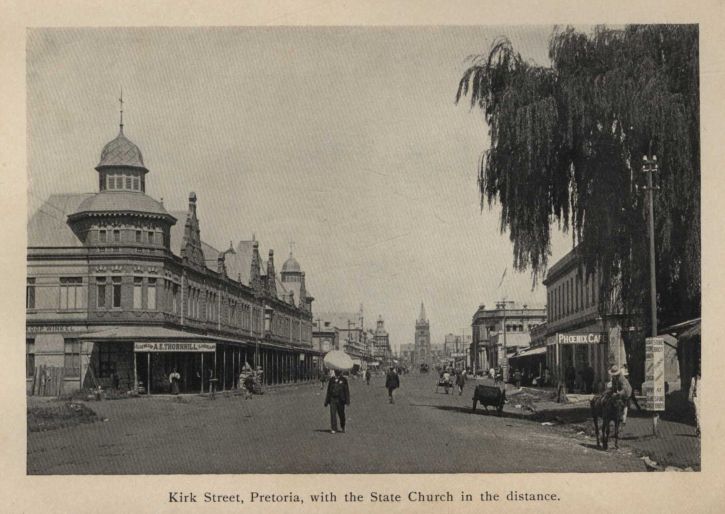
Kirk Street, Pretoria, with the State Church in the distance.
His religious temperament is portrayed in almost every sentence he utters, and his repetition of biblical parables and sayings is a custom which so impresses itself upon the mind of the stranger that it is but natural that those who are unacquainted with the Boer should declare it a sure sign of his hypocrisy. He does not quote Scripture merely to impress upon the mind of his hearer the fact that he is a devout Christian, but does it for the same reasons that a sailor speaks the language of the sea-farer.
The Boer is a low churchman among low churchmen. He abhors anything that has the slightest tendency toward show or outward signs of display in religious worship. He is simple in his other habits, and in his religious observances he is almost primitively simple. To him the wearing of gorgeous raiment, special attitudes, musical accompaniment to hymns, and special demonstrations are the rankest sacrilege. Of the nine legal holidays in the Transvaal, five--Good Friday, Easter Monday, Ascension Day, Whit Monday, and Christmas--are Church festival days, and are strictly observed by every Boer in the country.
The Dutch Reformed Church has been the state Church since 1835, when the Boers commenced emigrating from Cape Colony. The "trekkers" had no regularly ordained ministers, but depended upon the elders for their religious training, as well as for leadership in all temporal affairs. One of the first clergymen to preach to the Boers was an American, the Rev. Daniel Lindley, who was one of the earliest missionaries ever sent to South Africa. The state controls the Church, and, conversely, the Church controls the state, for it is necessary for a man to become a factor in religious affairs before he can become of any political importance. As a result of this custom, the politicians are necessarily the most active church members.
The Hervormde Dopper branch of the Dutch Reformed Church is the result of a disagreement in 1883 with the Gereformeerde branch over the singing of hymns during a religious service. The Doppers, led by Paul Kruger, peaceably withdrew, and started a congregation of their own when the more progressive faction insisted on singing hymns, which the Doppers declared was extremely worldly.
Since then the two chief political parties are practically based on the differences in religion. The Progressive party is composed of those who sing hymns, and the members of the Conservative party are those who are more Calvinistic in their tendencies. As the Conservatives have been in power for the last decade, it follows that the majority of the Boers are opposed to the singing of hymns in church. The greatest festival in the Boer calendar is that of Nachtmaal, or Communion, which is generally held in Pretoria the latter part of the year.
The majority of the Boers living in remote parts of the country, where established congregations or churches are an impossibility, it behooves every Boer to journey to the capital once a year to partake of communion. Pretoria then becomes the Mecca of all Boers, and the pretty little town is filled to overflowing with pilgrims and their "trekking" wagons and cattle. Those who live in remote parts of the country are obliged to start several weeks before the Nachtmaal in order to be there at the appointed time, and the whole journey to and fro in many instances requires six weeks' time. When they reach Pretoria they bivouac in the open square surrounding the old brick church in the centre of the town, and spend almost all their time in the church. It is one of the grandest scenes in South Africa to observe the pilgrims camping in the open square under the shade of the patriarchal church, which to them is the most sacred edifice in the world.
The home life of the Boers is as distinctive a feature of these rough, simple peoples as is their deep religious enthusiasm. If there is anything that his falsifiers have attacked, it is the Boer's home life, and those who have had the opportunity to study it will vouch that none more admirable exists anywhere. The Boer heart is filled with an intense feeling of family affection. He loves his wife and children above all things, and he is never too busy to eulogize them. He will allow his flocks to wander a mile away while he relates a trifling incident of family life, and he would rather miss an hour's sleep than not take advantage of an opportunity to talk on domestic topics.
He does not gossip, because he sees his neighbours too rarely for that, but he will lay before you the detailed history and distinctive features of every one of his ancestors, relations, and descendants. He is hospitable to a degree that is astonishing, and he will give to a stranger the best room in the house, the use of his best horse, and his finest food. Naturally he will not give an effusive welcome to an Englishman, because he is the natural enemy of the Boer, but to strangers of other nationalities he opens his heart and house.
The programme of the Boer's day is hardly ever marred by any changes. He rises with the sun, and works among the sheep and cattle until breakfast. There at the table he meets his family and conducts the family worship. If the parents of the married couple are present, they receive the best seats at the table, and are treated with great reverence.
After breakfast he makes his plans for the day's work, which may consist of a forward "trek" or a hunting trip. He attends to the little plot of cultivated ground, which provides all the vegetables and grain for the table, and spends the remainder of the day in attending to the cattle and sheep. Toward night he gathers his family around him, and reads to them selected chapters from the Bible. From the same book he teaches his children to read until twilight is ended, whereupon the Boer's day is ended, and he seeks his bed.
During the dry season the programme varies only as far as his place of abode is concerned. With the arrival of that season the Boer closes his house and becomes a wanderer in pursuit of water. The sheep and cattle are driven to the rivers, and the family follows in big transport wagons, not unlike the American prairie-schooner, propelled by eight spans of oxen. The family moves from place to place as the necessity for new pasturage arises. With the approach of the wet season the nomads prepare for the return to the deserted homestead, and, as soon as the first rain has fallen and the grass has changed the colour of the landscape, the Boer and his vast herds are homeward bound.
The Boer homestead is as unpretentious as its owner. Generally it is a low, one-story stone structure, with a steep tile roof and a small annex in the rear, which is used as a kitchen. The door is on a level with the ground, and four windows afford all the light that is required in the four square rooms in the interior. A dining room and three bedrooms suffice for a family, however large. The floors are of hardened clay, liberally coated with manure, which is designed to ward off the pestiferous insects that swarm over the plains.
The house is usually situated in a valley and close to a stream, and, in rare instances, is sheltered by a few trees that have been brought from the coast country. Native trees are such a rarity that the traveller may go five hundred miles without seeing a single specimen. The Boer vrouw feels no need of firewood, however, for her ancestors taught her to cook her meals over a fire of the dry product of the cattle-decked plains.
Personal uncleanliness is one of the great failings that has been attributed to the Boer, but when it is taken into consideration that water is a priceless possession on the plains of South Africa, no further explanation is needed. The canard that the Boers go to bed without undressing is as absurd as the one of like origin that an entire family sleeps in one bed. Yet these fictions constantly appear, and frequently over the names of persons who have penetrated into South Africa no farther than Cape Town.
The Boer here depicted is the representative Boer--the one who shoulders his rifle and fights for his country; the one who watches his cattle on the plains and pays his taxes; the one who tries to improve his condition, and takes advantage of every opportunity for advancement that is offered. There is a worthless Boer, as there is a worthless Englishman, a worthless German, and a worthless American, but he is so far in the minority that he need not be analyzed.
There is, however, a Boer who lives in the towns and cities, and he compares favourably with other men of South African birth. He has had the advantage of better schools, and can speak one or more languages besides his own. He is not so nomadic in his tendencies as his rural countryman, and he has absorbed more of the modernisms. He can conduct a philosophic argument, and his wife and daughters can play the piano. If he is wealthy, his son is a student at a European university and his daughter flirting on the beach at Durban or attending a ladies' seminary at Bloemfontein or Grahamstown.
He is as progressive as any white man cares to be under that generous South African sun, and when it comes to driving a bargain he is a match for any of the money sharks of Johannesburg. For the youthful Boer who reaches the city directly from the country, without any trade or profession, the prospects are gloomy. He is at a great disadvantage when put into competition with almost any class of residents. The occupations to which he can turn are few, and these have been still further restricted in late years by the destruction of cattle by the rinderpest and the substitution of railways for road transport. His lack of education unfits him for most of the openings provided in such a city as Johannesburg, even when business is at its highest tide, and a small increase in the tension of business brings him to absolute want.
The Boer of to-day is a creature of circumstance. He is outstripped because he has had no opportunities for development. Driven from Cape Colony, where he was rapidly developing a national character, he was compelled to wander into lands that offered no opportunities of any description. He has been cut off for almost a hundred years from an older and more energetic civilization, and even from his neighbours; it is no wonder that he is a century behind the van. No other civilized race on earth has been handicapped in such a manner, and if there had been one it is a matter for conjecture whether it would have held its own, as the Boer has done, or whether it would have fallen to the level of the savage.
Had the Boer Voortrekkers been fortunate enough to settle in a fertile country bordering on the sea, where they might have had communication with the outer world, their descendants would undoubtedly to-day be growing cane and wheat instead of herding cattle and driving transport wagons. Their love of freedom could not have been greater under those circumstances, but they might have averted the conditions which now threaten to erase their nation from the face of the earth.
CHAPTER V
PRESIDENT KRUGER
Stephanus Johannes Paulus Kruger, or Uncle Paul, the Lion of Rustenberg, is a man of most remarkable characteristics. A man of absolutely no education, as we understand the word, he has, during the long years of a notable career, so applied his inherent abilities, his natural astuteness, the cunning acquired by constant battling with the wiles of native enemies, as to be able to acquit himself of his high office in a manner to be envied by many who have enjoyed a hundred times as many advantages. Although he is almost seventy-five years old, the President's mind has not become dimmed, but, if anything, has grown keener of perception and wider in its scope during the last ten years.
Since his youth Mr. Kruger has been a leader among his countrymen. When a boy he had pronounced ability as a deer-stalker, and it is related of him that before he had reached manhood he had killed more lions than any other man in the colony. He was absolutely fearless, and could endure any amount of bodily pain and discomfort. As an example of this, I repeat his explanation of the accident that caused him to lose his left thumb:
"We were shooting rhinoceros one day," said he, "when an old gun exploded in my hands. It cut my thumb so badly that I saw it could not be saved. I borrowed a dull knife and cut the thumb off, because it prevented me from holding the gun properly."
President Kruger's personality is most unique. He impresses one as being a king in the garb of a farmer, a genius in a dunce's cap. At first sight he would be mistaken for an awkward countryman, with "store clothes" and a silk hat intended for some one else. His frock coat is far too small to reach around his corpulent body, and his trousers seem to have a natural antipathy for his shoes.
He wears no cuffs, and the presence of a collar and tie may be determined only by drawing aside the natural curtain formed by his whiskers. He is uncouth in his manner, but he has great natural attractiveness gained by a long life among hunters in the wilds. He is suspicious of everything and every one, but that quality is easily accounted for by his early dealings with negro chiefs, whose treacherous habits caused him to become wary in all his transactions with them. In later days this has stood him in good stead. He is slow to make friends, but once he trusts a person voluminous proof is necessary before he alters his opinion of the man. He never forgets a good deed, and never pardons the man who does a bad one.
President Kruger is short in stature, measuring less than five feet seven inches. His head and body are large and fat, but his legs are thin and short. His head is just a trifle longer than broad, and almost fits the English definition of "square head." The small eyes are surmounted by bushy, white eyebrows, which extend half an inch beyond his forehead.
When he is not sitting for a photograph his hair is not so neatly arranged as it appears in the well-known pictures, but hangs loosely down over his wide forehead, except when, with a hasty swish of the hand, he brushes it aside. The hair is nearly white, and hangs over the sides of his head in long tresses, which cover both his ears.
When he smiles the big fat circles above his cheeks are pushed upward, and shut his small gray eyes from view. But when pleased the President generally laughs hilariously, and then his eyes remain closed for the greater part of a minute. Mr. Kruger's nose and mouth are the chief features of his face. Both are more extensive than his large face demands, but they are such marvels in their own peculiar way as to be distinguishing marks. The bridge of the nose grows wide as it goes outward from the point between the eyes, and before it reaches the tip it has a gentle upheaval. Then it spreads out on either side, and covers fully two inches of area above his upper lip. It is not attractive, but in that it follows the general condition of his facial landscape.
The mouth is wide and ungainly. The constant use of a heavy pipe has caused a deep depression on the left side of his lower lip, and this gives the whole mouth the appearance of being unbalanced. His chin is large and prominent, and his ears correspond relatively in size and symmetry with his face. When in repose his features are not pleasant to look upon, but when lighted up by a smile they become rather attractive, and generally cause his laughter to become contagious among his hearers.
The thin line of beard which runs from ear to ear combines with the hair on his head in forming what is not unlike a white halo around the President's face. The lines in the man's face are deep, irregular, and very numerous. They indicate more than anything the ceaseless worry and troubles to which the President has been subjected while directing the affairs of his countrymen of the Transvaal.
The physical description of the Kruger of to-day is one that suggests sluggishness and idleness rather than alertness and ceaseless activity. The appearance of the man certainly does not conform with his record of marvellous performances, unflagging endeavour, and superior mental attainments. The well-preserved Kruger at seventy-five years bears no deep marks of the busy and eventful life he has led, nor are there any visible indications that the end of his usefulness to his people is close at hand.
The fragmentary history of Mr. Kruger's life, as related by himself, gives an insight into his remarkably varied experiences. He modestly refrains from allowing any one, even those who know him best, to obtain from him enough of his own history to incorporate in a biography, and it is likely, unless in his later years he changes his mind, that no detailed narrative can ever be written.
Although the majority of his countrymen are of Dutch or Huguenot ancestry, Mr. Kruger is of German descent. Jacob Kruger, his paternal ancestor, emigrated to South Africa, in 1713, from the Potsdam district of Germany, and married a young woman who was born in Cape Colony. He was born October 10, 1825, in Colesburg, Cape Colony, whither his parents had "trekked" from Cape Town a quarter of a century before. The first Krugers whose names appear in the Dutch East India Company's records arrived in the settlement at the Cape in 1712, and thereafter became leaders in enterprise among the settlers. While Mr. Kruger was yet in his infancy the Boers' troubles with the Colonial Government began, and when he was ten years old he migrated with the "Voortrekkers" to the unknown regions in the interior.
The life in the open and the tropical temperature served to develop him early, and at the age of fifteen we find him shooting his first lion, as well as serving in the capacity of "field cornet," a minor official position. As such he took part in the wars with the Zulu Dingaan and the Matabele Moselekatse, and served with distinction. In 1842 he was confirmed by the Rev. Daniel Lindley, the American missionary, and had implanted more firmly in his heart the religious feeling which in later years has proved to be his greatest solace in his troubles.
Next we hear of him standing by the side of his father while he fires the first shot at the English soldiers in the battle of Boomplaats, in 1848. After doing valiant service in that battle, he became one of the leaders of the "trekkers" who settled in the Transvaal country.
In 1856 young Kruger, then barely thirty-one years old, is elected sub-commandant of the Transvaal army, a most responsible position in a country where natives are as treacherous as they are innumerable. Five years later he becomes commandant of the army, and leads a force of one hundred and fifty men against Chief Sechele. He retains that office until 1877, when England annexes the country to her domain. During the war for independence which then ensues, Mr. Kruger is Vice-President of the Triumvirate, which executes the government of the country, and after peace is declared in 1883 he is elected to the presidency. He is thrice re-elected, and is now serving his fourth term as head of the South African Republic.
Into this skeleton of his life's story might be fitted innumerable incidents and anecdotes that are related by his countrymen, who treasure them greatly and repeat them at every opportunity. Many of these are probably imaginary, while others have undoubtedly been retold so frequently that they have lost all resemblance of the original form. The majority of the stories refer to Mr. Kruger's prowess in dealing with lions, tigers, and elephants, and many of these are probably true. Several of those that he himself verifies are given merely to illustrate the experiences that the Boers encountered in the early days of the "trekkers."
When fifteen years old Kruger and one of his sisters, being left alone on the veldt by their parents, were approached by a South African panther, small but of ample enough proportions to frighten the two children. Kruger, with only a knife for a weapon, boldly attacked the panther, and after a severe struggle, during which he was sorely injured, slew the beast. Another story, illustrative of his physical strength, is that he contested with a native in a foot-race of twelve hours' duration, and won by such a large margin that he was enabled to stalk a buck on the veldt and carry it to his father's house before his competitor reached the goal.
During the "trekking" trip from Cape Colony to the final settlement in the Transvaal the Boer settlers shot no less than six thousand lions, and of that number Kruger is credited with shooting more than two hundred and fifty.
His personal bravery was never shown to better advantage than in 1857, when he was sub-commandant of the Transvaal army. He had ordered several of his burghers to go into the Orange Free State, with which country there was a serious misunderstanding, and there they were arrested. As soon as Mr. Kruger heard of the men's arrest he hastened into the camp of the Free State forces and asked for the release of the prisoners on the ground that they were innocent, and that if any one were guilty he was that man, because he had ordered them to enter the country. The commandant of the Free State forces was so greatly amazed by Mr. Kruger's bravery that he allowed all the Boers to return to their own camp.
Mr. Kruger's remarkable vitality and capacity for hard mental labour are the results of the great care which he bestows upon himself and the regular habits which he has followed for almost twenty years. He rises at half past five o'clock every morning, and follows a daily programme, from which he never deviates unless he is absent from home. After he leaves his bedroom he proceeds to his library and drinks several cups of intensely black coffee, and smokes several pipefuls of strong Boer tobacco. Then he spends the greater part of an hour in family devotions and the perusal of the Bible. After breakfast, at half past seven o'clock, he receives the members of the Volksraad, and then transacts the heaviest business of the day. After all the Volksraad members have departed, he steps out on the piazza of his little whitewashed cottage and joins the burghers, or citizens, who every morning congregate there and discuss state affairs while they sip the coffee and smoke the tobacco which the President furnishes to all visitors.
At ten o'clock the state carriage and its escort of eight gaudily apparelled troopers await him at the gate, and he is conveyed to the Government House, several blocks distant. As soon as he arrives there he is to be found either in one legislative chamber or the other, directing the affairs of the two bodies, making addresses or quietly watching the progress of legislative matters. At noon he returns to his home for luncheon, but is back at his duties in the Government House at two o'clock, and remains there three hours in the afternoon. Thereafter he receives burghers at his home until seven o'clock, and retires every evening at precisely eight o'clock.
The power which Mr. Kruger has over the majority of his countrymen is due in no small measure to his fondness for conversing with them and his treatment of them when they visit his cottage. As soon as the sun has risen, a small stream of Boers wends its way toward the President's cottage and awaits his appearance on the piazza. When Mr. Kruger comes among them he loses his identity as President, and merges his personality into that of an ordinary burgher. This custom has endeared him in the affections of his people, and, as a result, whenever he makes a stand on any question it may be taken for granted that he has thoroughly discussed the subject beforehand with his burghers, and that he can depend upon the majority of them for their support.
Mr. Kruger is a speech-maker of no mean ability. His addresses in the Volksraad are filled with good reasoning, homely similes, biblical quotations, and convincing argument. He speaks without preparation, indulges in no flights of oratory, but uses the simple, plain language that is easily understood by the burgher as well as the statesman. All his speeches are delivered in the Boer "taal," a dialect which bears the same relation to the Dutch language as "low" German does to "high" German. Generally the dialect is used by the Boers in speaking only, the pure Dutch being used in correspondence and official state papers.
The President may be able to speak the English language, but if such is the case he succeeds admirably in allowing no one except his most trusted friends to hear him. Much investigation has failed to reveal any one in Pretoria who has ever heard him speak the English language, although reports have it that he speaks it fluently. He understands the language well, and any one who has ever held a conversation with him through an interpreter will recall that he occasionally forgets his assumed inability to understand English, and replies to a question before the interpreter has commenced to translate it.
Mr. Kruger has been twice married. His first wife, a Miss Du Plessis, was the daughter of one of the early voortrekkers, and with the other women took part in many of the Boer wars against the natives. She died shortly after the founding of the republic, and left one son, who lived only a short time. Mr. Kruger several years afterward married his first wife's niece, who is now the first lady of the land. Like almost all Boer women, she has a retiring disposition, and very rarely appears in public except at religious gatherings. The President rarely introduces her to his visitors, probably in obedience to her own desires, but she constantly entertains the wives and daughters of burghers who call on her husband.
President and Madame Kruger have had sixteen children, seven of whom still live. One of his sons is the President's private secretary, and a youth of decidedly modern ideas and tendencies. Another son is a private in the Pretoria police, a state military organization in which he takes great pride. A third occupies his father's farm near Rustenberg. The other children are daughters, who are married to Boer farmers and business men. One of Kruger's sons-in-law is Captain F. C. Eloff, who was taken prisoner by the Uitlanders during the raid, and who has since aroused the enmity of the English residents by freely expressing his opinion of them in public speeches. Captain Eloff is several times a millionaire, and lives in a two-hundred-and-fifty-thousand-dollar mansion.
Popular report in Pretoria has it that the President's wealth amounts to a million dollars, but his mode of living certainly does not betray it. His salary as President is thirty-five thousand dollars, in addition to which he is annually allowed fifteen hundred dollars for house-rent, or "huishuur." He has long since purchased the house in which he lives, but, as the allowance of fifteen hundred dollars is annually paid to him, the English residents aver that the amount is intended as a slight reimbursement to him for the money he spends for the coffee and tobacco used by the burgher callers at his cottage. During the later years of his life Barney Barnato, the wizard of South African finance, supplied to the President all the tobacco he used, and consequently Mr. Kruger was able to save the Government tobacco allowance. Barnato also presented to Mr. Kruger two handsome marble statues of lions which now adorn the lawn of the presidential residence. A photograph which is greatly admired by the patriotic Boers represents Mr. Kruger appropriately resting his hand on the head of one of the recumbent lions in a manner which to them suggests the physical superiority of the Boers over the British.
Mr. Kruger has always been a man of deep and earnest religious convictions. In his youth he was taught the virtues of a Christian life, and it is not recorded that he ever did anything which was inconsistent with his training. An old Zulu headman who lives near the Vaal River, in the Orange Free State, relates that Mr. Kruger yoked him beside an ox in a transport wagon when the trekkers departed from Natal in the early '40s, and compelled him to do the work of a beast; but he has no good reason for declaring that his bondsman was Mr. Kruger rather than any one of the other Boers in the party.
When Mr. Kruger was about thirty-five years old his religious enthusiasm led him into an experience which almost resulted in his death. He had met with some reverses, which caused him to doubt the genuineness of religious assistance. He endeavoured to find comfort and consolation in his Bible, but failed, and he became sorely troubled. One night, after bidding farewell to his wife, he disappeared into the wilderness of the Magalies Hills, a short distance west of Pretoria. After he had been absent from his home for several days, a number of men went to the hills to search for him, and found him on his knees engaged in singing and praying. He had been so many days without food and water that he was too weak to rise from the ground, and it was necessary for the men to carry him to his home. Since that experience he has believed himself to be a special instrument of a divine power, and by his deeds has given the impression that he is a leader chosen to defend the liberties and homes of his people.
He never speaks of his experience in the hills, but those who have been his friends for many years say that it marked an epoch in his life. The Boers, who have none of the modern cynicism and scepticism, regard him as the wielder of divine power, while those who admire nothing which he is capable of doing scoff and jeer at him as a religious fanatic, and even call him a hypocrite. Any one who has observed Mr. Kruger in his daily habits, or has heard him in the pulpit of the church opposite the cottage where he lives, will bear witness to the intensity and earnestness of his genuine religious feeling. The lessons of life which he draws from his own personal experiences, and expounds to his congregation with no little degree of earnestness, are of such a character as to remove all doubts which the mind may have concerning his purity of purpose.
Mr. Kruger's style of writing is unique, but thoroughly characteristic of himself. The many references to the Deity, the oftentimes pompous style, the words which breathe of the intense interest in and loyalty to his countrymen, all combine to make his state communications and proclamations most interesting reading. The following proclamation, made to the citizens of Johannesburg several days after the Jameson raid, is typical:
"To all the Residents of Johannesburg.
"I, S. J. P. Kruger, State President of the South African Republic, with the advice and consent of the Executive Council, by virtue of Article VI of the Minutes of the Council, dated January 10, 1896, do hereby make known to all the residents of Johannesburg and neighbourhood that I am inexpressibly thankful to God that the despicable and treacherous incursion into my country has been prevented, and the independence of the republic saved, through the courage and bravery of my burghers.
"The persons who have been guilty of this crime must naturally be punished according to law--that is to say, they must stand their trial before the high court and a jury--but there are thousands who have been misled and deceived, and it has clearly appeared to me that even among the so-called leaders of the movement there are many who have been deceived.
"A small number of intriguers in and outside of the country ingeniously incited a number of the residents of Johannesburg and surroundings to struggle, under the guise of standing up for political rights, and day by day, as it were, urged them on; and when in their stupidity they thought that the moment had arrived, they (the intriguers) caused one Dr. Jameson to cross the boundary of the republic.
"Did they ever ask themselves to what they were exposing you?
"I shudder when I think what bloodshed could have resulted had a merciful Providence not saved you and my burghers.
"I will not refer to the financial damage.
"Now I approach you with full confidence. Work together with the Government of this republic, and strengthen their hands to make this country a land wherein people of all nationalities may reside in common brotherhood.
"For months and months I have planned what changes and reforms could have been considered desirable in the Government and the state, but the loathsome agitation, especially of the press, has restrained me.
"The same men who have publicly come forward as leaders have demanded reforms from me, and in a tone and a manner which they would not have ventured to have done in their own country, owing to fear for the criminal law. For that cause it was made impossible for me and my burghers, the founders of this republic, to take their preposterous proposals in consideration.
"It is my intention to submit a draft law at the first ordinary session of the Raad, whereby a municipality, with a mayor at the head, would be granted to Johannesburg, to whom the control of the city will be intrusted. According to all constitutional principles, the Municipal Board will be elected by the people of the town.
"I earnestly request you, laying your hands on your hearts, to answer me this question: After what has happened, can and may I submit this to the representatives of the people? My reply is, I know there are thousands in Johannesburg and the suburbs to whom I can intrust such elective powers. Inhabitants of Johannesburg, render it possible for the Government to go before the Volksraad with the motto, 'Forgotten and Forgiven.'"
Mr. Kruger's political platform is based on one of the paragraphs of a manifesto which he, as Vice-President of the Triumvirate, sent to Sir Owen Lanyon, the British Resident Commissioner, on Dingaan's Day, 1880, when the Boers were engaged in their second struggle for independence. The paragraph, which was apparently written by Mr. Kruger, reads:
"We declare before God, who knows the heart, and before the world: Any one speaking of us as rebels is a slanderer! The people of the South African Republic have never been subjects of Her Majesty, and never will be."
The President's hatred of the English was bred in the bone, and it will never be eradicated. To see his country free from every English tie is the aim of his existence, and every act of his political career has been born with that thought. His own political aggrandizement has always been a secondary thought. He himself has declared that there is no one in the republic who is able or willing to complete the independence of the republic with such little friction as he, and that, such being the case, he would be a traitor to desert the cause in the hours of its gravest peril. He considers personal victories at the polls of his own country as mere stepping-stones toward that greater victory which he hopes to secure over the English colonial secretary, and the day that England renounces all claim to suzerainty over the Transvaal Mr. Kruger will consider his duty done, and will go into the retirement which his great work and the fulness of his years owe him.
For a man whose education has been of the scantiest, and whose people were practically unheard of until he brought them into prominence, Paul Kruger has received from foreign sources many remarkable tributes to the wisdom with which he has conducted the affairs of the country under circumstances of more than ordinary difficulty.
That which he received from Emperor William, of Germany, several days after the repulse of the Jameson raiders, was perhaps the finest tribute that Mr. Kruger has ever received, and one that created a greater sensation throughout the world than any peaceful message that ever passed between the heads of two governments. The cablegram, of which the text follows, is one of the most priceless treasures in Mr. Kruger's collection:
"Received January 3d, 1896. "From Wilhelm I. R., Berlin. "To PRESIDENT KRUGER, Pretoria.
"I tender you my sincere congratulations that, without appealing to the help of friendly powers, you and your people have been successful in opposing with your own forces the armed bands that have broken into your country to disturb the peace, in restoring order, and in maintaining the independence of your country against attacks from without.
"WILHELM I. R."
Prince Bismarck declared that Kruger was the greatest natural-born statesman of the time. William E. Gladstone, who had many opportunities to gauge Kruger's skill in diplomacy, referred to him as the shrewdest politician on the continent of Africa, and not a mean competitor of those of Europe. Among the titles which have been bestowed upon him by European rulers are Knight of the First Class of the Red Eagle of Prussia, Grand Officer of the Legion of Honour, Grand Knight of the Leopold Order of Belgium, Grand Knight of the Netherland Lion, and Grand Knight of the Portuguese Order of Distinguished Foreigners.
If a detailed history of Mr. Kruger's life could be obtained from his own lips, it would compare favourably with those of the notable characters of modern times. The victories he has gained in the field of diplomacy may not have affected as many people as those of Bismarck; the defeats administered in battle may not have been as crushing as those of Napoleon, but to his weakling country they were equally as decisive and valuable.
The great pyramid in the valley of the Nile is seen to best advantage as far away as Cairo. Observed close at hand, it serves only to disturb the spectator's mind with an indefinable sense of vastness, crudity, and weight; from a distance the relative proportions of all things are clearly discerned. So it is with the career of Mr. Kruger. Historic perspective is necessary to determine the value of the man to the country. Fifty or a hundred years hence, when the Transvaal has safely emerged from its period of danger, there will be a true sense of proportion, so that his labours in behalf of his country may be judged aright.
At this time the critical faculty is lacking because his life work is not ended, and its entire success is not assured. He has earned for himself, however, the distinction of being the greatest diplomatist that South Africa has ever produced. Whether the fruits of his diplomacy will avail to keep his country intact is a question that will find its answer in the results of future years. He has succeeded in doing that which no man has ever done. As the head of the earth's weakest nation he has for more than a decade defied its strongest power to take his country from him. That should be sufficient honour for any man.
CHAPTER VI
INTERVIEW WITH PRESIDENT KRUGER
As is the rule with them everywhere, Englishmen in South Africa speak of Mr. Kruger with contempt and derision. Unprejudiced Americans and other foreigners in South Africa admire him for his patriotism, his courage in opposing the dictatorial policy of England's Colonial Office, and his efforts to establish a republic as nearly like that of the United States of America as possible. My desire to see Mr. Kruger was almost obliterated a week after my arrival in the country by the words of condemnation which were heaped upon him by Englishmen whenever his name was mentioned. In nearly every Englishman's mind the name of "Oom Paul" was a synonym for all that was corrupt and vile; few gave him a word of commendation.
When I came into the pretty little town of Pretoria, the capital of the Transvaal, where the President lives and where he mingles daily with the populace with as much freedom and informality as a country squire, there was a rapid transformation in my opinion of the man. The Boers worship their leader; to them he is a second George Washington, and even a few Englishmen there speak with admiration of him.
The day before my arrival in the town John McCann, of Johannesburg, who is a former New-Yorker and a friend of the President, informed Mr. Kruger of my intention to visit Pretoria. The President had refused interviews to three representatives of influential London newspapers who had been in the town three months waiting for the opportunity, but he expressed a desire to see an American.
"The Americans won't lie about me," he said to Mr. McCann. "I want America to learn our side of the story from me. They have had only the English point of view." I had scarcely reached my hotel when an emissary from the President called and made an appointment for me to meet him in the afternoon. The emissary conducted me to the Government Building, where the Volksraad was in session, and it required only a short time for it to become known that a representative from the great sister republic across the Atlantic desired to learn the truth about the Boers.
I was overwhelmed with information. Cabinet members, Raad members, the Commissioner of War, the Postmaster General, the most honoured and influential men of the republic--men who had more than once risked their lives in fighting for their country's preservation--gathered around me and were so eager to have me tell America of the wrongs they had suffered at the hands of the British that the scene was highly pathetic.
One after another spoke of the severe trials through which their young republic had passed, the efforts that had been made to disrupt it, and the constant harassment to which they had been subjected by enemies working under the cloak of friendship. The majority spoke English, but such as knew only the Boer taal were given an opportunity by their more fortunate friends to add to the testimony, and spoke through an interpreter. Such earnest, such honest conversation it had never been my lot to hear before. It was a memorable hour that I spent listening to the plaints of those plain, good-hearted Boers in the heart of South Africa. It was the voice of the downtrodden, the weak crying out against the strong.
When the hour of my appointment with the President arrived there was a unanimous desire among the Boers gathered around to accompany me. It was finally decided by them that six would be a sufficient number, and among those chosen were Postmaster-General Van Alpen, who was a representative at the Postal Congress in Washington several years ago; Commissioner of Mines P. Kroebler, Commissioner of War J. J. Smidt, Justice of the Peace Dillingham, and former Commandant-General Stephanne Schoeman.
When our party reached the little white-washed cottage in which the President lives a score or more of tall and soil-stained farmers were standing in a circular group on the low piazza. They were laughing hilariously at something that had been said by a shorter, fat man who was nearly hidden from view by the surrounding circle of patriarchs. A breach in the circle disclosed the President of the republic with his left arm on the shoulder of a long-whiskered Boer, and his right hand swinging lightly in the hand of another of his countrymen. It was democracy in its highest exemplification.
Catching a glimpse of us as we were entering on the lawn, the President hastily withdrew into the cottage. The Boers he deserted seated themselves on benches and chairs on the piazza, relighted their pipes, and puffed contentedly, without paying more attention to us than to nod to several of my companions as we passed them.
The front door of the cottage, or "White House," as they call it, was wide open. There was no flunkey in livery to take our cards, no white-aproned servant girls to tra-la-la our names. The executive mansion of the President was as free and open to visitors as the farmhouse of the humblest burgher of the republic. In their efforts to display their qualities of politeness my companions urged me into the President's private reception room, while they lingered for a short time at the threshold. The President rose from his chair in the opposite end, met me in the centre of the room, and had grasped my hand before my companions had an opportunity of going through the process of an introduction.
There was less formality and red tape in meeting "Oom Paul" than would be required to have a word with Queen Victoria's butcher or President McKinley's office-boy.
While Mr. Kruger's small fat hand was holding mine in its grasp and shaking it vehemently, he spoke something in Boer, to which I replied, "Heel goed, danke," meaning "Very well, I thank you." Some one had told me that he would first ask concerning my health, and also gave me the formula for an answer. The President laughed heartily at my reply, and made a remark in Boer "taal." The interpreter came up in the meantime and straightened out the tangle by telling me that the President's first question had been "Have you any English blood in your veins?"
The President, still laughing at my reply, seated himself in a big armchair at the head of a table on which was a heavy pipe and a large tobacco box. He filled the pipe, lighted the tobacco, and blew great clouds of smoke toward the ceiling. My companions took turns in filling their pipes from the President's tobacco box, and in a few minutes the smoke was so dense as nearly to obscure my view of the persons in front of me.
The President crossed his short, thin legs and blew quick, spirited puffs of smoke while an interpreter translated to him my expression of the admiration which the American people had for him, and how well known the title "Oom Paul" was in America. This delighted the old man immeasurably. His big, fat body seemed to resolve itself into waves which started in his shoes and gradually worked upward until the fat rings under his eyes hid the little black orbits from view. Then he slapped his knees with his hands, opened his large mouth, and roared with laughter.
It was almost a minute before he regained his composure sufficiently to take another puff at the pipe which is his constant companion. During the old man's fit of laughter one of my companions nudged me and advised me: "Now ask him anything you wish. He is in better humour than I have ever seen him before." The President checked a second outburst of laughter rather suddenly and asked, "Are you a friend of Cecil Rhodes?" If there is any one whom "Oom Paul" detests it is the great colonizer. The President invariably asks this question of strangers, and if the answer is an affirmative one he refuses to continue the conversation.
Being assured that such was not the case, Mr. Kruger's mind appeared to be greatly relieved--as he is very suspicious of all strangers--and he asked another question which is indicative of the religious side of his nature: "To what Church do you belong?" A speaking acquaintanceship was claimed with the Dutch Reformed Church, of which the President is a most devout member, and this served to dissipate all suspicions he might have had concerning me.
The interpreter was repeating a question to him when the President suddenly interrupted, as is frequently his custom during a conversation, and asked: "Do the American people know the history of our people? I will tell you truthfully and briefly. You have heard the English version always; now I will give you ours."
The President proceeded slowly and, between puffs at his great pipe, spoke determinedly: "When I was a child we were so maltreated by the English in Cape Colony that we could no longer bear the abuses to which we were subjected. In 1835 we migrated northward with our cattle and possessions and settled in Natal, just south of Zululand, where by unavoidable fighting we acquired territory from the Zulus. We had hardly settled that country and established ourselves and a local form of government when our old enemies followed, and by various high-handed methods made life so unendurable that we were again compelled to move our families and possessions. This time we travelled five hundred miles inland over the trackless veldt and across the Vaal River, and after many hardships and trials settled in the Transvaal. The country was so poor, so uninviting, that the English colonists did not think it worth their while to settle in the land which we had chosen for our abiding-place.
"Our people increased in number, and, as the years passed, established a form of government such as yours in America. The British thought they were better able to govern us than we were ourselves, and once took our country from us. Their defeats at Laing's Nek and Majuba Hill taught them that we were fighters, and they gave us our independence and allowed us to live peaceably for a number of years. They did not think the country valuable enough to warrant the repetition of the fighting for it. When it became known all over the world twelve years ago that the most extensive gold fields on the globe had been discovered in our apparently worthless country, England became envious and laid plans to annex such a valuable prize. Thousands of people were attracted hither by our wonderful gold mines at Johannesburg, and the English statesmen renewed their attacks on us. They made all sorts of pretexts to rob us of our country, and when they could not do it in a way that was honest and would be commended by other nations, they planned the Jameson raid, which was merely a bold attempt to steal our country."
At this point Kruger paused for a moment and then added, "You Americans know how well they succeeded." This sally amused him and my companions hugely, and they all joined in hearty laughter.
The President declared that England's attitude toward them had changed completely since the discovery of the gold fields. "Up to that time we had been living in harmony with every one. We always tried to be peaceable and to prevent strife between our neighbours, but we have been continually harassed since the natural wealth of our land has been uncovered."
Here he relighted his pipe, which had grown cold while he was detailing the history of the Transvaal Boers, and then drew a parable, which is one of his distinguishing traits: "The gold fields may be compared to a pretty girl who is young and wealthy. You all admire her and want her to be yours, but when she rejects you your anger rises and you want to destroy her." By implication England is the rejected suitor, and the Transvaal the rich young girl.
Comparing the Boers' conduct in South Africa with that of the English, the President said: "Ever since we left Cape Colony in 1835 we have not taken any territory from the natives by conquest except that of one chief whose murderous maraudings compelled us to drive him away from his country. We bartered and bought every inch of land we now have, England has taken all the land she has in South Africa at the muzzles of repeating rifles and machine guns. That is the civilized method of extending the bounds of the empire they talk about so much."
The Englishmen's plaint is that the republic will tax them, but allow them no representation in the affairs of government. The President explained his side in this manner: "Every man, be he Englishman, Chinaman, or Eskimo, can become a naturalized citizen of our country and have all the privileges of a burgher in nine years. If we should have a war, a foreigner can become a citizen in a minute if he will fight with our army. The difficulty with the Englishmen here is that they want to be burghers and at the same time retain their English citizenship.
"A man can not serve two masters; either he will hate the one and love the other, or hold to the one and despise the other. We have a law for bigamy in our country, and it is necessary to dispose of an old love before it is possible to marry a new."
"Oom Paul" is very bitter in his feeling against the English, whom he calls his natural enemies, but it is seldom that he says anything against them except in private to his most intimate friends. The present great distress in the Johannesburg gold fields is attributed by the English residents to the high protective duties imposed by the Government and the high freight charges for the transmission of machinery and coal. Mr. Kruger explained that those taxes were less than in the other colonies in the country.
"We are high protectionists because ours is a young country. These new mines have cost the Government great amounts of money, and it is necessary for us to raise as much as we expend. They want us to give them everything gratuitously, so that we may become bankrupt and they can take our country for the debt. If they don't like our laws, why don't they stay away?"
Nowhere in the world is the American Republic admired as much outside of its own territory as in South Africa. Both the Transvaal and the Orange Free State Constitutions are patterned after that of the United States, and there is a desire lurking in the breasts of thousands of South Africans to convert the whole of the country south of the Zambezi into one grand United States of South Africa.
Sir Alfred Milner, the Queen's Commissioner to South Africa, said to me several days before I saw Mr. Kruger that such a thing might come to pass within the next twenty years. The President hesitated when I asked him if he favoured such a proposition to unite all the colonies and republics in the country. "If I should say 'Yes,' the English would declare war on us to-morrow." He appeared to be very cautious on this subject for a few minutes, but after a consultation with my companions he spoke more freely.
"We admire your Government very much," he said, "and think there is none better in the world. At the present time there are so many conflicting affairs in this country as to make the discussion of an amalgamation inadvisable. A republic formed on the principle of the United States would be most advantageous to all concerned, but South Africa is not yet ripe for such a government. I shall not live to see it."
According to those around him, the President had not been in such a talkative mood for a long time, and, acting upon that information, I asked him to tell me concerning the Boers' ability to defend themselves in case of war with England. Many successes against British arms have caused the Boers to regard their prowess very highly, and they generally speak of themselves as well able to protect their country. The two countries have been on the very verge of war several times during the last three years, and it was only through the greatest diplomacy that the thousands of English soldiers were not sent over the border of the Transvaal, near which they have been stationed ever since the memorable raid of Jameson's troopers.
The President's reply was guarded: "The English say they can starve us out of our country by placing barriers of soldiers along the borders. Starve us they can, if it is the will of God that such should be our fate. If God is on our side they can build a big wall around us and we can still live and flourish. We don't want war. My wish is to live in peace with everybody."
It was evident that the subject was not pleasant to him, and he requested me to ask Commissioner of War Smidt, a war-scarred hero of Majuba Hill, to speak to me on the ability of the Boers to take care of themselves in case of a conflict.
Commissioner Smidt became very enthusiastic as he progressed with the expression of his opinion, and the President frequently nodded assent to what the head of the War Department said.
"It is contrary to our national feeling to engage in war," said Mr. Smidt, "and we will do all in our power to avert strife. If, however, we are forced into fighting, we must defend ourselves as best we are able. There is not one Boer in the Transvaal who will not fight until death for his country. We have demonstrated our ability several times, and we shall try to retain our reputation. The English must fight us in our own country, where we know every rock, every valley, and every hill. They fight at a disadvantage in a country which they do not know and in a climate to which they are strangers.
"The Boers are born sharpshooters, and from infancy are taught to put a bullet in a buzzard's skull at a hundred yards. One Boer is equal in a war in our own country to five Englishmen, and that has been proved a number of times. We have rugged constitutions, are accustomed to an outdoor life, and can live on a piece of biltong for days, while the Queen's soldiers have none of these advantages. They can not starve us out in fifty years, for we have sources of provender of which they can not deprive us. We have fortifications around Pretoria that make it an impossibility for any army of less than fifty thousand men to take, and the ammunition we have on hand is sufficient for a three years' war. We are not afraid of the English in Africa, and not until every Boer in the Transvaal is killed will we stop fighting if they ever begin. Should war come, and I pray that it will not, the Boers will march through English territory to the Cape of Good Hope, or be erased from the face of the earth."
Never was a man more sincere in his statements than the commissioner, and his companions supported his every sentence by look and gesture. Even the President gave silent approval to the sentiments expressed.
"Have you ever had any intention of securing Delagoa Bay from the Portuguese, in order that you might have a seacoast, as has been rumoured many times?" I asked the President. Delagoa Bay, the finest harbour in Africa, is within a few miles of the Transvaal, and might be of great service to it in the event of war.
"'Cursed be he who removes the landmarks of his neighbour,'" quoted he. "I never want to do anything that would bring the vengeance of God on me. We want our country, nothing more, nothing less."
Asked to give an explanation of the causes of the troubles between England and the Transvaal, he said:
"Mr. Rhodes is the cause of all the troubles between our country and England. He desires to form all the country south of the Zambezi River into a United States of South Africa, and before he can do this he must have possession of the Transvaal and the Orange Free State. His aim in life is to be President of the United States of South Africa. He initiated the Jameson raid, and he has stirred up the spirit of discontent which is being shown by the Englishmen in the Transvaal. Our Government endeavours to treat every one with like favour, but these Englishmen are never satisfied with anything we do. They want the English flag to wave over the Transvaal territory, and nothing less. Rhodes spent millions of pounds in efforts to steal our country, and will probably spend millions more. But we will never leave this land, which we found, settled, and protected."
Then, rising from his chair and raising his voice, he continued slowly and deliberately:
"We will fight until not one Boer remains to defend our flag and country; our women and children will fight for their liberties; and even I, an old man, will take the gun which I have used against them twice before and use it again to defend the country I love. But I hope there will be no war. I want none and the Boers want none. If war comes, we shall not be to blame. I have done all in my power for peace, and have taken many insults from Englishmen merely that my people might not be plunged into war. I want no war. I hope that I may spend the rest of my days in peace."
The President's carriage had arrived in front of the cottage to convey him to the Government Building, and the time had arrived for him to appear before one of the Volksraads. He displayed no eagerness to end the interview, and continued it by asking me to describe the personality and ability of President McKinley. He expressed his admiration of former President Cleveland, with whose Department of State he had some dealings while John Hays Hammond was confined in the Pretoria prison for complicity in the Jameson raid.
His opinion of the Americans in South Africa was characteristic of the man. "I like and trust true Americans. They are a magnificent people, because they favour justice. When those in our country are untainted with English ideas I trust them implicitly, but there were a number of them here in Jameson's time who were Americans in name only."
He hesitated to send any message to the sister republic in America, lest his English enemies might construe it to mean that he curried America's favour. His friends finally persuaded him to make a statement, and he dictated this expression of good fellowship and respect:
"So long as the different sections of the United States live in peace and harmony, so long will they be happy and prosperous. My wish is that the great republic in America may become the greatest nation on earth, and that she may continue to act as the great peace nation. I wish that prosperity may be hers and her people's, and in my daily prayers I ask that God may protect her and bless her bounteously."
It being far past the time for his appearance at the Government Building, the President ended the interview abruptly. He refilled his pipe, bade farewell to us, and bustled from the room with all the vigour of a young man. On the piazza, he met his little, silver-haired wife, who, with a half-knit stocking pendant from her fingers, was conversing with the countrymen sitting on the benches. The President bent down and kissed her affectionately, then jumped into the carriage and was rapidly conveyed to the Government Building. When the dust obscured the carriage and the cavalrymen attending it, one of my companions turned to me and remarked:
"Ah! there goes a great man!"
CHAPTER VII
CECIL JOHN RHODES
Sixteen years ago Cecil J. Rhodes, then a man of small means and no political record, stood in a small Kimberley shop and looked for a long time at a map of Africa which hung on the wall. An acquaintance who had watched him for several minutes stepped up to Rhodes and asked whether he was attempting to find the location of Kimberley. Mr. Rhodes made no reply for several seconds, then placed his right hand over the map, and covered a large part of South and Central Africa from the Atlantic to the Indian Ocean. "All that British!" he said. "That is my dream."
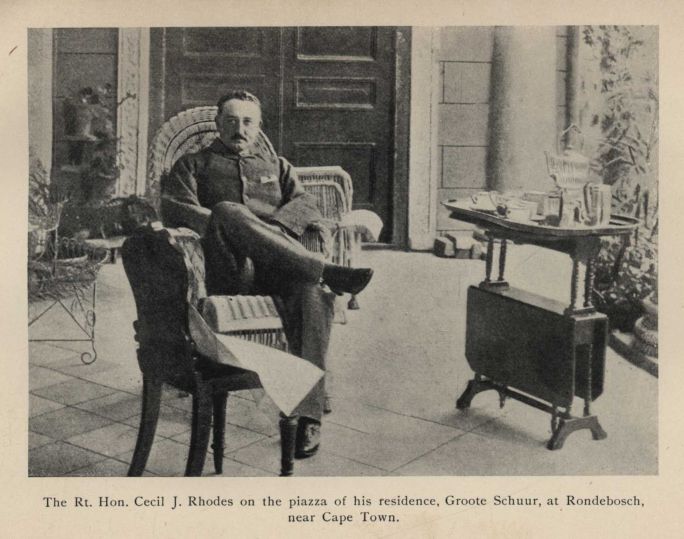
The Rt. Hon. Cecil J. Rhodes on the piazza of his residence, Groote Schuur, at Rondebosch, near Cape Town.
"I will give you ten years to realize it," replied the friend.
"Give me ten more," said Rhodes, "and then we'll have a new map."
Three fourths of the required time has elapsed, and the full realization of Rhodes's dream must take place within the next four years. There remain only two small spaces on that part of the map which was covered by Rhodes's hand that are not British, and those are the Orange Free State and the South African Republic. Mr. Rhodes's success will come hand-in-hand with the death of the two republics. The life of the republics hinges on his failure, and good fortune has rarely deserted him.
Twenty-seven years ago Cecil Rhodes, then a tall, thin college lad, was directed by his physician to go to South Africa if he wished to live more than three years. He and his brother Herbert, the sons of the poor rector of Bishop Stortford, sailed for Durban, Natal, and reached that port while the diamond fever was at its height at Kimberley. The two boys, each less than nineteen years old, joined a party of adventurers and prospectors, and, after many vicissitudes, reached the Kimberley fields safely, but with little or no money. The boys were energetic, and found opportunities for making money where others could see none.
The camp was composed of the roughest characters in South Africa, all of whom had flocked thither when the discovery of diamonds was first announced. Illicit diamond buying was the easiest path to wealth, and was travelled by almost every millionaire whose name has been connected with recent South African affairs. Mr. Rhodes is one of the few exceptions, and even his enemies corroborate the statement.
"You don't steal diamonds," said Barney Barnato to Mr. Rhodes fifteen years ago, "but you must prove it when accused. I steal them, but my enemies must prove it. That's the difference between us."
The youthful Rhodes engaged in many legitimate schemes for making money, and saved almost all that he secured. For a short time he pumped water out of mines, using an abandoned engine for the purpose, and then embarked in commercial enterprises. After spending two or three years in the fields, he returned to England and resumed his course at Oxford. In connection with this visit to England, Mr. Rhodes relates the story of the meeting with the physician who several years before had placed the limit of his existence at three years.
"You the same Rhodes?" asked the discomfited doctor when he saw the healthy young man. "According to my books, you have been in your grave some time. Here is the entry: 'Tuberculosis; recovery impossible.' You can't be the same Rhodes, sir. Impossible!"
At the end of each term at Oxford Mr. Rhodes returned to Kimberley, and, by judiciously investing his savings in mining claims, soon became a power in the affairs of the diamond fields. When the diamond fever was followed by the usual reaction, and evil days fell upon the industry, Mr. Rhodes secured all the shares, claims, and lands that his thousands would buy. Then he conceived the idea of making a monopoly of the diamond industry by consolidating all the mines and limiting the output.
Lacking the money wherewith to buy the valuable properties necessary for his plans, he went to the Rothschilds and asked for financial assistance. The scheme was extraordinary, and required such a large amount of money that the request, coming from such a young man as Mr. Rhodes was then, staggered the Rothschilds, and they asked him to call several days later for an answer.
"My time is valuable," remarked Mr. Rhodes, rather haughtily. "I will come again in an hour for your answer. If you have not decided by that time, I shall seek assistance elsewhere."
The Rothschilds sent Mr. Rhodes back to Africa with the necessary amount of money to purchase the other claims and property in the Kimberley district, and, after he had formed the great De Beers Company, appointed him managing director for life at a salary of one hundred and fifty thousand dollars a year. Under Mr. Rhodes's management the De Beers consolidated mines have been earning annual dividends of almost fifty per cent., and more than four hundred million dollars' worth of diamonds have been placed on the market. With the exception of the Suez Canal, the mines are the best paying property in the world, and much of their success is due to the personal efforts of Mr. Rhodes.
It was while he was engineering the consolidation of the diamond mines that Mr. Rhodes began his political career. He realized that his political success was founded on personal popularity, and more firmly so in a new country, where the political elements were of such a diversified character as are usually present in a mining community. In the early days of the Kimberley fields the extent of a man's popularity depended upon the amount of money he spent in wining those around him. Mr. Rhodes was astute enough to appreciate the secret of popularity, and, having gained it, allowed himself to be named as candidate for the Cape Colony Parliament from the Kimberley district.
By carefully currying the favour of the Dutch inhabitants, who were not on the friendliest political terms with the English colonists, he was elected. Thereafter Mr. Rhodes's political star was in the ascendant, and he was elected successively to the highest office in the colony's government.
At the age of twenty-eight he was Treasurer-General of Cape Colony, and it was while he filled that office that Chinese Gordon appeared at the Cape and appealed to Mr. Rhodes to join the expedition to Khartoum. Mr. Rhodes was undecided whether to resign the treasurer-generalship and accompany Gordon or to remain in South Africa, but finally determined to stay in the colony. Gordon, who had taken a great fancy to the young and energetic colonist, was sorely disappointed, and went to Khartoum, where he was killed.
During the years he held minor Government offices Mr. Rhodes formed the alliances which were the foundation of his later political success. He was a friend at the same time of the Englishman, the Afrikander, the Dutchman, and the Boer, and he was always in a position where he could reciprocate the favours of one class without incurring the enmity of another. He worked with the Dutchmen when protection was the political cry, and with the Englishmen when subjects dear to them were in the foreground. He never abused his opponents in political arguments, as the majority of Cape politicians do, but he pleaded with them on the veldt and at their firesides.
When he was unable to swerve a man's opinions by words, he has frequently been charged with having applied the more seductive method of using money. Mr. Rhodes is said to be a firm believer in money as a force superior to all others, and he does not hesitate to acknowledge his belief that every man's opinions can be shaped by the application of a necessary amount of money. This belief he formed in the early days of the diamond fields, and it has remained with him ever since.
"Find the man's price" was Mr. Rhodes's formula for success before he reached the age of thirty, and his political enemies declare it has given him the power he desired. In a country which had such a large roving and reckless population as South Africa it was not difficult for a politician with a motto similar to that of Mr. Rhodes's to become influential at election periods, nor did it require many years to establish a party that would support him on whatever grounds he chose to take.
It was with such a following that Mr. Rhodes commenced his higher political career in Cape Colony. When, in 1884, he became Commissioner of Bechuanaland, the vast and then undeveloped country adjoining the colony on the north, and made his first plans for the annexation of that territory to the British Empire, he received the support of the majority of the voters of the colony. His first plan of securing control of the territory was not favourably received by the Colonial Office in London, and no sooner was it pronounced visionary than he suggested another more feasible.
Bechuanaland was then ruled by a mighty native chief, Lobengula, whose vast armies roved over the country and prevented white travellers and prospectors from crossing the bounds of his territory. In the minds of the white people of South Africa, Bechuanaland figured as a veritable Golconda--a land where precious stones and minerals could be secured without any attendant labour, where the soil was so rich as to yield four bounteous harvests every year.
Mr. Rhodes determined to break the barriers which excluded white men from the native chief's domain, and sent three agents to treat with Lobengula. The agents made many valuable presents to the old chief, and in 1888, after much engineering, secured from him an exclusive concession to search for and extract minerals in Bechuanaland. The payment for the concession included five hundred dollars a month, a thousand rifles and ammunition, and a small gunboat on the Zambezi.
After Mr. Rhodes discovered the real value of the concession, he and a number of his friends formed the British South Africa Company, popularly known as the Chartered Company, and received a charter from the British Government, which gave to them the exclusive right of governing, developing, and trading in Lobengula's country. Several years afterward the white man's government became irksome to Lobengula and his tribes, as well as to the Mashonas, who occupied the immense territory adjoining Bechuanaland on the east, and all rebelled. The result was not unlike those of native rebellions in other countries. The natives were shot down by trained English soldiers, their country was taken from them, and those who escaped death or captivity were compelled to fly for safety to the new countries of the north.
The British South Africa Company in 1895 practically became the sole owner of Rhodesia, the great territory taken from Lobengula and the Mashonas; and Mr. Rhodes, having realized part of his dream, began casting about for other opportunities whereby he might extend the empire.
Mr. Rhodes was then in the zenith of his glory. He was many times a millionaire, the head of one of the greatest capitalistic enterprises in the world, the director of the affairs of a dominion occupying one tenth of a continent, and the Premier of Cape Colony. His power was almost absolute over a territory that stretches from the Cape of Good Hope into Central Africa, and then eastward to within a few miles of the Indian Ocean. He had armies under his command, and two governments were at his beck and call.
But Mr. Rhodes was not satisfied. He looked again at the map of Africa, already greatly changed since he placed his hand over it in the Kimberley shop, but the dream was not realized. He saw the Transvaal and the Orange Free State flags still occupying the positions he had marked for the British emblem, and he plotted for their acquisition.
The strife between the Boers and the Uitlanders in the Transvaal was then at its height, and Mr. Rhodes recognised the opportunity for the intervention of England that it afforded. Mr. Rhodes did not consider it of sufficient importance to inquire concerning the justice of the Uitlanders' claims, nor did he express any sympathy for their cause. In fact, if anything, he felt that if the Uitlanders were unjustly treated by the Boers their remedy was simple. Once he blandly told a complaining Uitlander that no Chinese wall surrounded the Transvaal, and that to escape from the alleged injustice was comparatively easy.
To Mr. Rhodes the end was sufficient excuse for the means, and, if the acquisition of the two republics carried with it the loss of his Boer friends, he was willing to accept the situation. The fall of the Transvaal Republic carried with it the subsequent fall of the Orange Free State, and, in order that he might strike at the head, he determined to commence his campaign of exterminating republics by first attacking the Transvaal.
Whether he had the promise of assistance from the Colonial Office in London is a subject upon which even the principals differ. Mr. Rhodes felt that his power in the country was great enough to make the attack upon the Transvaal without assistance from the home Government, and the plot of the Jameson raid was formed.
He retired to Groote Schuur, his home at Cape Town, and awaited the fruition of the plans he had so carefully made and explained. His lieutenants might have been overhasty, or perhaps the Uitlanders in Johannesburg might have feared the Boer guns too much; whatever the reason, the plans miscarried, and Mr. Rhodes experienced the first and greatest reverse in his brilliant public career.
The dream which appeared so near realization one day was dissolved the next, and with it the reputation of the dreamer. He was obliged to resign the premiership of Cape Colony, many of his best and oldest supporters in England deserted him, and he lost the respect and esteem of the Dutch inhabitants of South Africa, who had always been among his stanchest allies. The heroic Rhodes, the idol of Cape Colony, found himself the object of attack and ridicule of the majority of the voters of the colony. The parliamentary inquiry acquitted him of all complicity in the Jameson raid, it is true, but the Dutch people of South Africa never have and never will.
The Jameson raid was a mere incident in Mr. Rhodes's career; he would probably call it an accident. Having failed to overthrow the Transvaal Republic by means of an armed revolution, he attempted to accomplish the same object by means of a commercial revolution. Rhodesia, the new country which had a short time previously been taken from the Matabeles and the Mashonas, was proclaimed by Mr. Rhodes to be a paradise for settlers and an Ophir for prospectors. He personally conducted the campaign to rob the Transvaal of its inhabitants and its commerce; but the golden promises, the magnificent farms, the Solomon's mines, the new railways, and the new telegraph lines all failed to attract the coveted prizes to the land which, after all, was found to be void of real merit except as a hunting ground where the so-called British poor-house, the army, might pot negroes.
Mr. Rhodes spent hundreds of thousands of dollars in developing the country which bears his name, and the British South Africa Company added thousands more, but the hand which was wont to turn into gold all that it touched had lost its cunning. To add to Mr. Rhodes's perplexities, the natives who had been conquered by Dr. Jameson learned that their conqueror had been taken prisoner by the Boers, and rose in another rebellion against English authority. Mr. Rhodes and one of his sisters journeyed alone into the enemy's stronghold and made terms with Lobengula, whereby the revolution was practically ended.
After the Rhodesian country had been pacified, and he had placed the routine work of the campaign to secure settlers for the country in the hands of his lieutenants, Mr. Rhodes bent all his energies toward the completion of the transcontinental railway and telegraph lines which had been started under his auspices several years before, but had been allowed to lag on account of the pressure of weightier matters. The Cape Town to Cairo railroad and telegraph are undertakings of such vast proportions and importance that Mr. Rhodes's fame might easily have been secured through them alone had he never been heard of in connection with other great enterprises.
He himself originated the plans by which the Mediterranean and Table Bay will eventually be united by bands of steel and strands of copper, and it is through his own personal efforts that the English financiers are being induced to subscribe the money with which his plans are being carried out. The marvellous faith which the English people have in Mr. Rhodes has been illustrated on several occasions when he was called to London to meet storms of protests from shareholders, who feared that the two great enterprises were gigantic fiascos. He has invariably returned to South Africa with the renewed confidence of the timid ones and many millions of additional capital.
Mr. Rhodes has tasted of the power which is absolute, and he will brook no earthly interference with his plans. The natives may destroy hundreds of miles of the telegraph lines, as they have done on several occasions. He teaches them a lesson by means of the quick-firing gun, and rebuilds the line. White men may fear the deadly fever of Central Africa, but princely salaries and life-insurance policies for a host of relatives will always attract men to take the risk. Shareholders may rebel at the expenditures, but Mr. Rhodes will indicate to them that their other properties will be ruined if they withdraw their support from the railway and telegraph.
A strip of territory belonging to another nation may be an impediment to the line, but an interview with the Emperor of Germany or the King of Portugal will be all-sufficient for the accomplishment of Mr. Rhodes's purpose. Providence may swerve him in his purpose many times, but nations and individuals rarely.
All South Africans agree that Mr. Rhodes is the most remarkable Englishman that ever figured in the history of the African continent. Some will go further and declare that he has done more for the British Empire than any one man in history. No two South Africans will agree on the methods by which Mr. Rhodes attained his position in the affairs of the country. Some say that he owes his success to his great wealth; others declare that his personal magnetism is responsible for all that he ever attained. His enemies intimate that political chicanery is the foundation of his progress, while his friends resent the intimation and laud his sterling honesty as the basis of his successful career.